How to Measure Static Water Level in a Private Well
A US-homeowner worksheet for measuring a recovered static water level, repeating the reading, and deciding what the result can—and cannot—prove.
The short answer
Use one permanently marked measuring point, stop the pump and household use long enough for recovery, then measure depth to water with a suitable sounder or other compatible method. Record the date, time, method, and pumping status. Repeat after 15–30 minutes. If the readings move, the well is not demonstrably static. Compare only like-for-like readings; a changed level is evidence to investigate, not proof of aquifer, pump, or well failure.How to Measure Static Water Level in a Private Well
The useful homeowner result is not a single number. It is a repeatable record: the depth to water below one marked point, taken after the pump and household use have stopped long enough for recovery, repeated after a short stability interval, and labeled with the method, time, and pumping status.
For a first baseline, use the well log if you have it, identify one safe measuring point on the casing, and plan an early-morning measurement after a long no-use period. A commercial electric sounder is usually the most practical direct method when the well has a compatible access path. Take reading A, wait another 15–30 minutes, and take reading B. If the level is still moving, you do not yet have a defensible static reading. Do not turn that result into a diagnosis of a failed pump, dry aquifer, or bad well.
1. Know what you are measuring—and what it cannot prove #
“Static water level” means the water level in a well under normal, undisturbed, no-pumping conditions. It is normally recorded as depth to water below a reference point, not as an absolute elevation. A smaller depth means the water surface is higher; a larger depth means it is farther below the reference point.
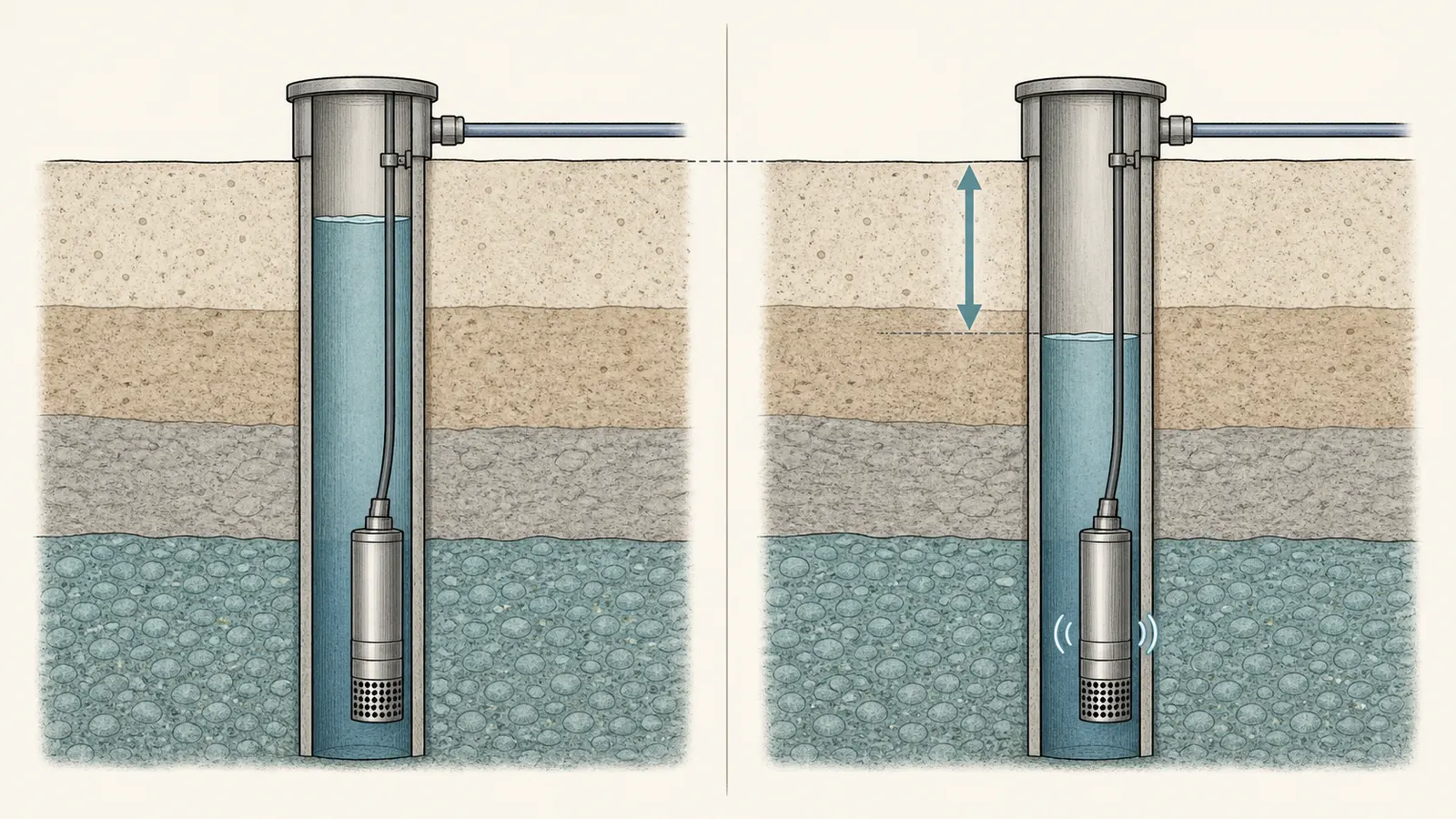
That is different from a pumping water level. When a pump is operating, the water surface in the well may be lower. The difference between the recovered non-pumping level and the pumping level at a defined time is drawdown. Penn State describes a pump test as a separate exercise: pumping rate, time, and water level are measured systematically to evaluate well capacity or specific capacity. A static reading by itself is not a yield test. See Penn State Extension’s well-planning guidance for the distinction between a water-level observation and a controlled pump test.
A good static-level record can answer useful maintenance questions:
- What was the recovered depth at this well, from this point, on this date?
- Did the level stabilize between two readings on the same visit?
- Is a later reading comparable, or was it taken after pumping, drought, nearby irrigation, or a different method?
- Is the observed change large enough or persistent enough to justify a professional check?
It cannot, on its own, answer these questions:
- Is the aquifer depleted?
- Is the pump worn, undersized, damaged, or set too high?
- Is the well screen or intake plugged?
- How many gallons per minute the well can sustainably produce?
- Is the water safe to drink?
The last boundary matters. Water level and water quality are different observations. A clear, stable level is not a bacteria, nitrate, arsenic, or fuel test. If water quality is the concern, use the appropriate state- or health-department-recognized laboratory path.
2. Establish one measuring point before you chase a trend #
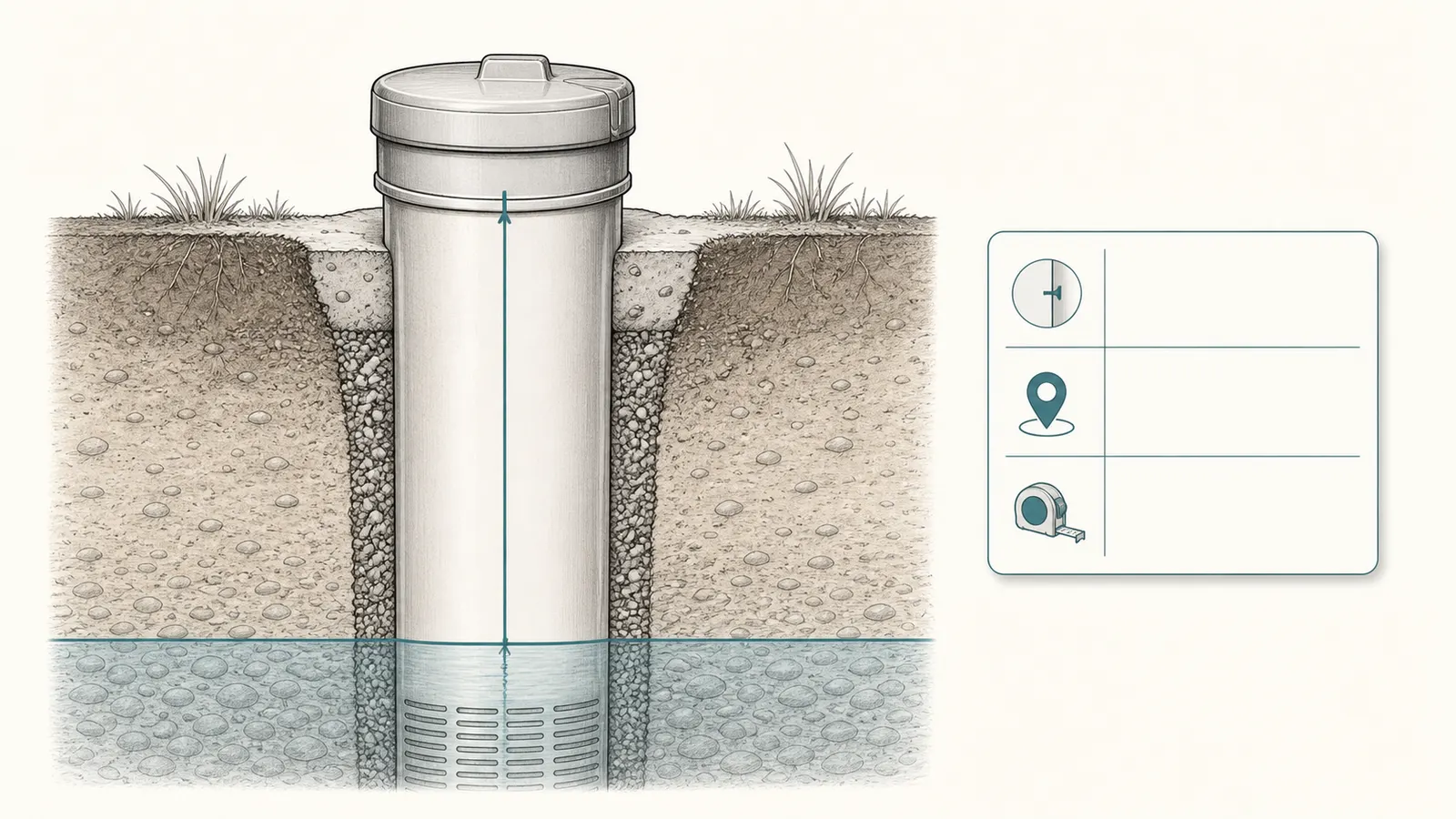
Every comparison starts at the same physical point. The US EPA groundwater measurement procedure says water-level measurements should be made relative to an established reference point on the well casing and documented in field records. The casing edge, cap, and nearby ground can look similar, but changing the point changes the measurement even when the water has not moved.
Choose a point only if it can be used without unsafe access. If the casing has a permanent mark from the installer, use it. If not, a qualified professional can establish one. For a homeowner observation, do not notch, drill, loosen, or modify a cap or casing simply to create a mark. Instead, record the exact existing point you used—such as a particular edge or an existing mark—and use it consistently until a professional can make the reference permanent.
Record these details with the point:
| Field | What to record | Why it matters |
|---|---|---|
| Measuring point | Exact casing mark or edge; describe its location | Prevents a later reading from starting higher or lower |
| Point height | Approximate distance above ground, if known | Helps interpret records and hand off the setup |
| Direction or landmark | For example, the marked side of the casing and a nearby fixed landmark | Helps you find the same point again |
| Access type | Purpose-built port, open access, or installed monitoring equipment | Determines which methods are compatible |
| Well record | Well depth, casing, pump setting, original test or log, if available | Gives a professional the system context |
For a simple seasonal comparison, you usually do not need a surveyed elevation if every reading comes from the same point. If a professional needs water-surface elevation or a comparison among several wells, the reference point may need a local or surveyed datum. Do not manufacture that elevation from a tape measure.
Penn State Extension recommends keeping a well record book for installation, maintenance, inspections, repairs, and water tests. Its private-well management guidance explains why those records help reveal change and give an expert useful context. Add each water-level visit to the same record rather than keeping isolated numbers in text messages or memory.
Start with the records you already have
Look for a completion report, well log, pump-installation invoice, pump-test sheet, previous inspection, or a contractor’s service note. Useful fields may include total well depth, casing and screen information, original yield or flow rate, pump setting, and any recorded static or pumping levels. These details are not required to make a cautious observation, but they change how a professional interprets one. A shallow well with a seasonal history is not the same evidence problem as a deep well with a submerged pump, a pressure transducer, and no reliable original level.
If you do not have the record, do not fill the gap with a neighbor’s well depth or an online map. Ask the original driller, pump company, local well authority, or the relevant state record system whether a copy exists. Record when you made the request and what remains unknown. “Pump setting unknown” is useful information; an assumed pump setting can send a diagnosis in the wrong direction.
Decide whether you need a baseline or a response measurement
A baseline is a repeatable reading collected under ordinary, documented conditions before a problem is urgent. A response measurement is taken because the home has a symptom—low pressure, air, sediment, frequent cycling, or a no-water event. The second situation has more confounders: people may already be conserving water, the pump may have been running repeatedly, a treatment device may have regenerated, or a professional may have changed a control setting.
Label the purpose before measuring. A baseline can be compared with another baseline. A response measurement can help a professional understand what happened, but it may not be suitable as the long-term reference. The same worksheet can hold both as long as the purpose is explicit.
3. Choose a method that matches the wellhead #
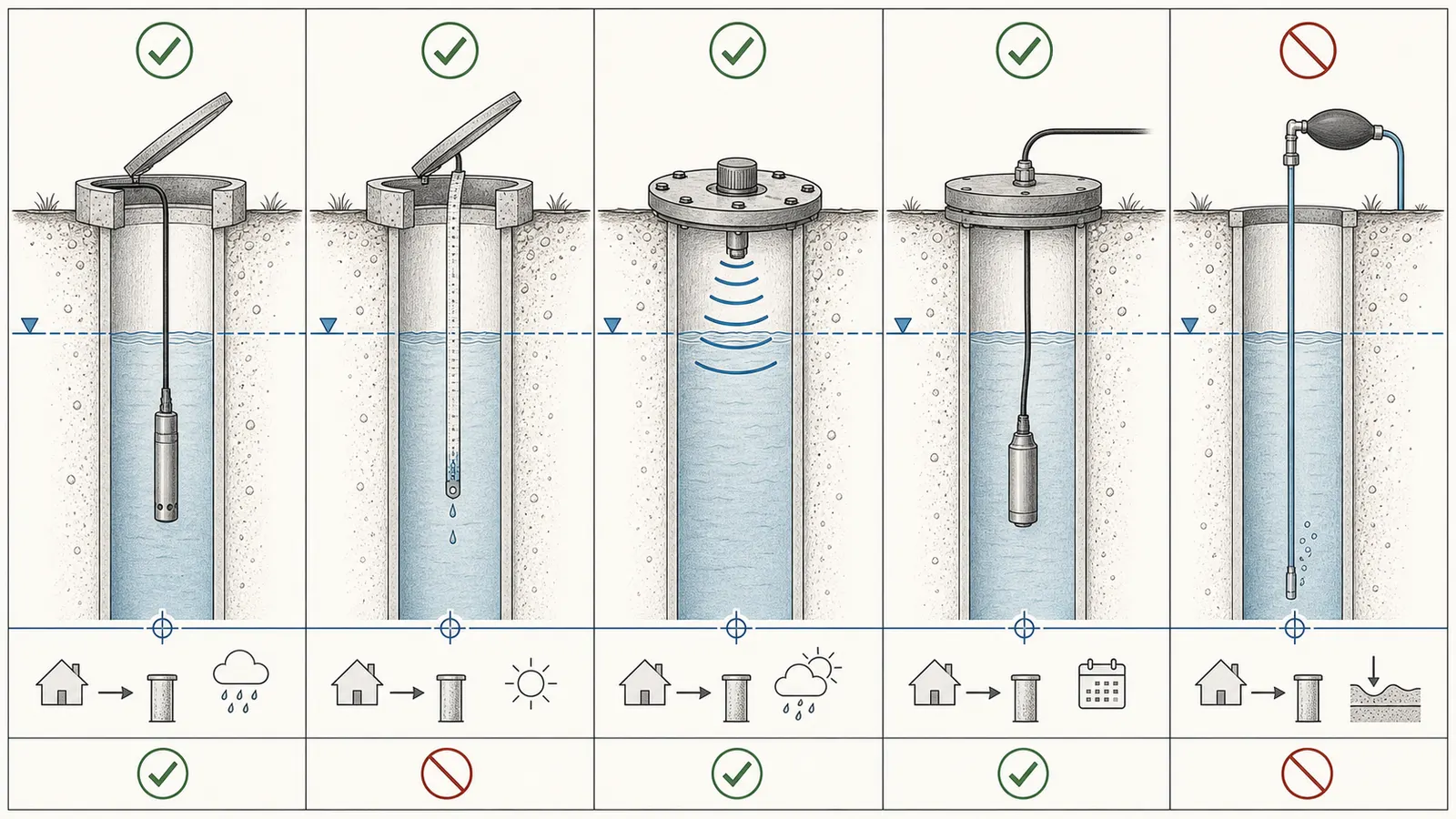
The best method is the one that is compatible with the access, depth, well construction, and purpose of the measurement. The EPA procedure lists electronic indicators, weighted or chalked tape, acoustic methods, air-line pressure methods, and automatic recording devices as possible approaches, with different limitations. The Agriculture and Agri-Food Canada well-monitoring guide likewise describes electric sounders, sonar meters through a suitable access port, and installed pressure transducers.
Electric sounder or electronic water-level indicator
For a well with a compatible access path, an electric sounder is often the most understandable direct method. A probe at the end of an insulated, graduated line completes a circuit when it contacts the water, producing a light, meter, or audible signal. The reading is the distance from the established measuring point to the water surface. The EPA describes this operating principle and says the device should be checked for obvious damage and prepared according to its manufacturer’s instructions before use.
Use the exact device instructions for cleaning, function checks, probe position, line handling, and reading resolution. Keep the line controlled; do not let a probe, weight, or loose cable fall into the well. A device that is too short, too large for the access, unreliable, or difficult to retrieve is not a good homeowner method for that well.
Wetted tape
A wetted steel tape uses a known chalked section to show where the tape crossed the water surface. Wellcare describes it as requiring an approximate depth to water and gives an approximate useful context of up to about 90 feet. That is not a universal accuracy guarantee for every tape, well, or operator. It is a reason to avoid choosing the method blindly when you do not know the water depth.
Do not improvise a string, household tape, fishing weight, or unknown metal object. The USGS water-level protocol prohibits lead weights in its wells because a lost weight could affect water quality. That is a program policy, not a nationwide private-well regulation, but it is a sound boundary for a homeowner: use a purpose-made, non-lead, manufacturer-approved tool or ask a professional.
Sonar, pressure transducer, and air line
An acoustic or sonar meter may work when the cap has a compatible access port. An installed pressure transducer can log a time series, but its reference depth and any required atmospheric-pressure correction must be understood. An air line can be useful for repeated testing in a deep well, but it involves tubing, a known installation depth, an airtight setup, and pressure readings. Wellcare presents air-line measurement as a deep-well method with contractor installation details, not as a casual one-off experiment.
If you cannot explain how the device references the casing point, how it handles the cap or access port, and how it will be repeated later, do not use the result as a baseline.
Match the method to the access, not to a shopping list
| Situation | Potentially suitable approach | What to verify before measuring | Homeowner boundary |
|---|---|---|---|
| Compatible access and known approximate depth | Commercial electric sounder | Probe and line fit the access; device instructions are available; line can be controlled and retrieved | Do not lower equipment through an opening you cannot identify or safely reach |
| Known, relatively shallow water level | Purpose-made wetted tape | Approximate depth is known; tape and weight are suitable; method can be repeated | Do not improvise a line or use lead or loose hardware |
| Purpose-built cap port | Compatible acoustic or sonar meter | The port is intended for the device and the manufacturer’s method is understood | Do not drill, enlarge, or remove the cap to make a meter fit |
| Permanently installed monitoring equipment | Existing pressure transducer or data logger | Reference depth, calibration, time stamps, and any barometric correction are documented | Do not install, rewire, or recalibrate pressure equipment as a first DIY step |
| Deep, sealed, flowing, or difficult-access well | Qualified professional’s air line or other method | The well construction and pressure behavior are known | Do not create pressure, open a sealed system, or adapt tubing yourself |
The table is a selection aid, not a promise that any method will work at a particular property. The EPA procedure says method accuracy and suitability should be evaluated before selection. The practical homeowner question is: “Can this reading be safely repeated from the same point with the same method?” If the answer is no, the measurement may still be useful to a professional, but it should be labeled as an observation with limitations—not as a clean baseline.
4. Create a genuinely recovered static reading #
The timing is part of the measurement. A reading taken immediately after a shower, irrigation cycle, laundry, or pump run may be a post-pumping reading even if the faucet is now closed. Wellcare says static level is best determined after the well has not been pumped for several hours and warns that recent pumping can create a false reading. Agriculture and Agri-Food Canada suggests early morning before household use, with the pump off until the measurement is complete.
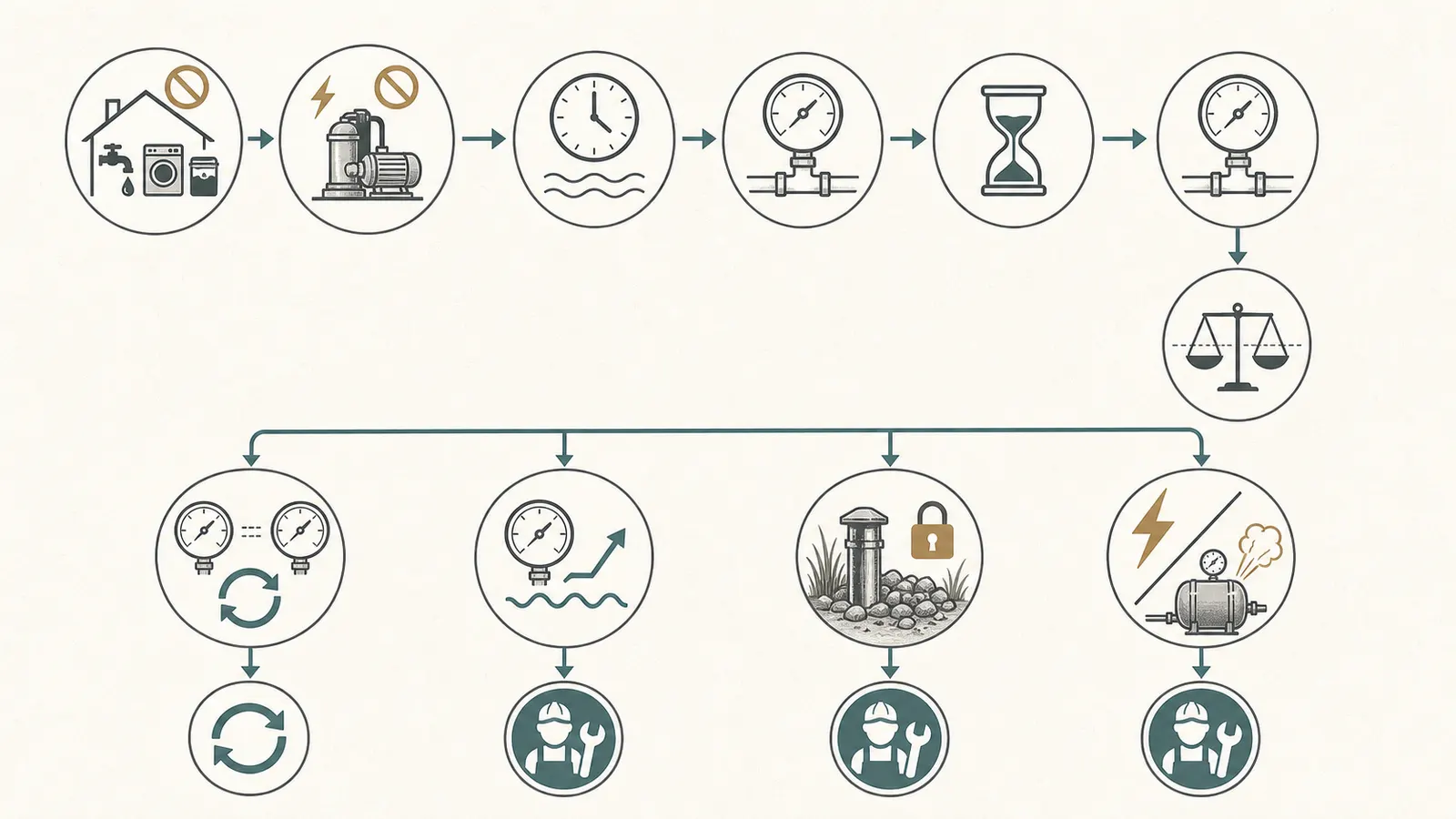
Use this recovery protocol:
- Choose a no-use window. Early morning after overnight non-use is a practical target. Do not schedule the reading immediately after a known high-demand period.
- Stop household demand. No showers, faucets, toilets refilling, laundry, irrigation, treatment regeneration, or other use that could start the pump. If other people or automatic equipment can use water, coordinate the window.
- Confirm the pump is at rest without opening controls. Use only a safe, visible indication available from a dry location, such as an existing status display. Do not open an electrical enclosure to prove the pump is off.
- Record the recent status. Write down the last known water use, approximate rest time, whether the pump had been running, and any nearby well or irrigation activity.
- Take reading A. Use the same measuring point and method you intend to use in the future.
- Wait and take reading B. Agriculture and Agri-Food Canada recommends another 15–30 minutes before the second static check. In a low-permeability aquifer, recovery may take several hours, so the interval is not a universal guarantee.
- Classify the result. If A and B are stable at the resolution your device can legitimately show, label the visit “repeatable recovered reading.” If the water is still rising, falling, or the readings disagree materially, label it “not demonstrably static” and extend recovery or call a professional.
The point of the second reading is not to force two numbers to match. It is to reveal whether the well is still recovering or the method is not repeatable. The USGS protocol describes two consecutive measurements and repeating when they do not agree within about 0.02 feet, with a 0.01-foot recording target. That is a professional field-protocol precision context. Do not report that precision for a consumer device that does not support it; record the device’s actual resolution and the result as observed.
Situations that make a reading non-static
The pump being quiet at the moment you arrive is not enough. Treat the following as reasons to qualify the status or postpone the baseline:
- Unknown recent demand: Someone used water, a toilet refilled, an irrigation controller ran, or a treatment system regenerated and no one can establish when.
- Repeated short cycles: The pump has been starting and stopping because of a pressure or control issue. The water level may be responding to repeated withdrawals rather than ordinary rest.
- Nearby pumping: A neighboring well, shared well, irrigation well, or temporary construction dewatering may influence the level. Agriculture and Agri-Food Canada specifically recommends recording nearby influences.
- Flowing or artesian behavior: Water may be moving at or above the casing or the well may be under pressure. This is not a normal open-access measurement scenario.
- Low-permeability or slow-recovery setting: A 15–30 minute wait may be insufficient. A rising result is information about recovery, not evidence that the second number is “wrong.”
- Cap or access change: Removing a seal or changing the access geometry can change equilibration and may create contamination or safety concerns. The EPA procedure says equilibration after removing sealing caps can range from minutes to hours depending on the site and objective.
- Different device or reference point: A later reading can differ because the probe, tape zero, casing edge, or access route changed.
Record these conditions even if you decide to take the reading. A qualified professional can often use a limited measurement if its limitations are clear. An unqualified “static” label is harder to repair later because it hides the conditions under which the number was produced.
5. Complete the two-reading worksheet #
Use the table below on every baseline visit. It is intentionally structured so that a later reader can tell whether the number represents recovered static water or a post-pumping condition.
Visit record
| Field | Reading A | Reading B |
|---|---|---|
| Date | ||
| Time | ||
| Measuring point | ||
| Method and device | ||
| Device resolution or display increment | ||
| Pumping status at reading | ||
| Approximate rest time before reading | ||
| Household or irrigation use since pump stopped | ||
| Nearby pumping or unusual conditions | ||
| Depth to water below measuring point | ||
| Water still moving? | ||
| Notes on signal, obstruction, or access |
Compare the readings
Use one sign convention every time:
Observed change in depth = later depth to water − earlier depth to water
With that convention, a positive change means the later water surface is farther below the reference point; a negative change means it is closer to the reference point. If you want water-surface elevation and you have a known reference elevation, use:
Water-surface elevation = measuring-point elevation − depth to water
Do not fill in a measuring-point elevation from an unverified property elevation or a phone map. For two readings on one visit, compare A and B first. For a future visit, compare the future repeatable reading with the earlier repeatable baseline, not with an unrecovered reading.
Mark the visit with one of these classifications:
- Repeatable recovered reading: same point and method; pump and household use stopped; A and B stable at the tool’s legitimate resolution.
- Recovery in progress: B is still changing, or the level is visibly rising or falling between readings.
- Post-pumping reading: the pump ran recently, rest time is unknown or short, or household use could not be controlled.
- Method uncertain: access, device signal, line position, or reference point was not reliable.
- No measurement: the wellhead was unsafe, inaccessible, sealed without compatible access, obstructed, flowing, or otherwise unsuitable for homeowner measurement.
The classification is as important as the number. A clean “no measurement” entry is better maintenance intelligence than a precise-looking number gathered under unknown conditions.
Build a comparable series over time
The immediate A/B repeat checks stability during one visit. A later comparison asks a different question: did the recovered level change between visits? For that comparison, keep as many conditions aligned as practical:
- use the same measuring point, method, and device;
- use the same unit and sign convention;
- measure at a similar time of day when possible;
- document the rest period and recent household demand;
- note season, rainfall or drought conditions, irrigation, and nearby pumping;
- separate baseline visits from symptom-driven visits;
- preserve the raw A and B readings instead of saving only an average.
Do not average away disagreement. If A and B differ because the level is still recovering, an average can look authoritative while representing no real condition of the well. If a device reports only a coarse increment, save the displayed value and device resolution rather than adding decimal places.
The Agriculture and Agri-Food Canada monitoring guide recommends regular water-level monitoring and says both non-pumping and pumping levels may be recorded on a recurring basis, while also explaining that the frequency and method depend on the well. That is guidance for a monitoring program, not a US homeowner mandate. For a private household, a reasonable purpose is enough: establish a baseline after a repair, compare similar seasons, investigate a recurring symptom, or create a handoff record before a professional visit.
6. Interpret a change without inventing a failure threshold #
There is no universal homeowner rule that says a specific number of feet proves an aquifer, pump, or well has failed. Groundwater levels naturally vary with recharge, season, drought, nearby pumping, and local geology. Agriculture and Agri-Food Canada says changes in static level may signal possible aquifer depletion, while pumping-level changes may signal a possible well-performance issue; it also emphasizes that the well, pump, and aquifer are interrelated and the source of a decline can be difficult to determine.
Use the interpretation matrix below.
| Observation | What it supports | What it does not prove | Safest next step |
|---|---|---|---|
| A and B agree after a long rest | A repeatable baseline for that date and condition | Sustainable yield, pump health, or water quality | Save the record and repeat seasonally or when symptoms occur |
| B is still rising after the interval | Recovery is incomplete or the well is slow to equilibrate | A failed well or aquifer | Wait longer if the site is safe; otherwise ask a professional to measure |
| Later matched reading is deeper than baseline | An observed change under the recorded conditions | A universal decline threshold or single cause | Repeat under matched conditions and review drought, nearby pumping, use, and records |
| Later matched reading is shallower | Recharge or a different groundwater condition may be present | That the system is healthy in every respect | Keep monitoring; do not use level alone as a safety test |
| Static level is similar but pressure or flow is poor | The symptom may be above-ground, pump-related, treatment-related, or demand-related | That the pump and well are cleared | Give a professional the level record plus pressure and symptom history |
| Static level changed and water production also changed | A well-performance investigation is warranted | Whether the pump, intake, casing, or aquifer is responsible | Request a qualified evaluation with controlled pumping measurements |
For a real well-performance conclusion, the professional may need a controlled test with a defined pumping rate, duration, discharge route, pumping level, recovery data, and the well’s construction and pump records. Penn State’s pump-test guidance describes that level of systematic measurement. A homeowner static worksheet should not quietly become a DIY pump test.
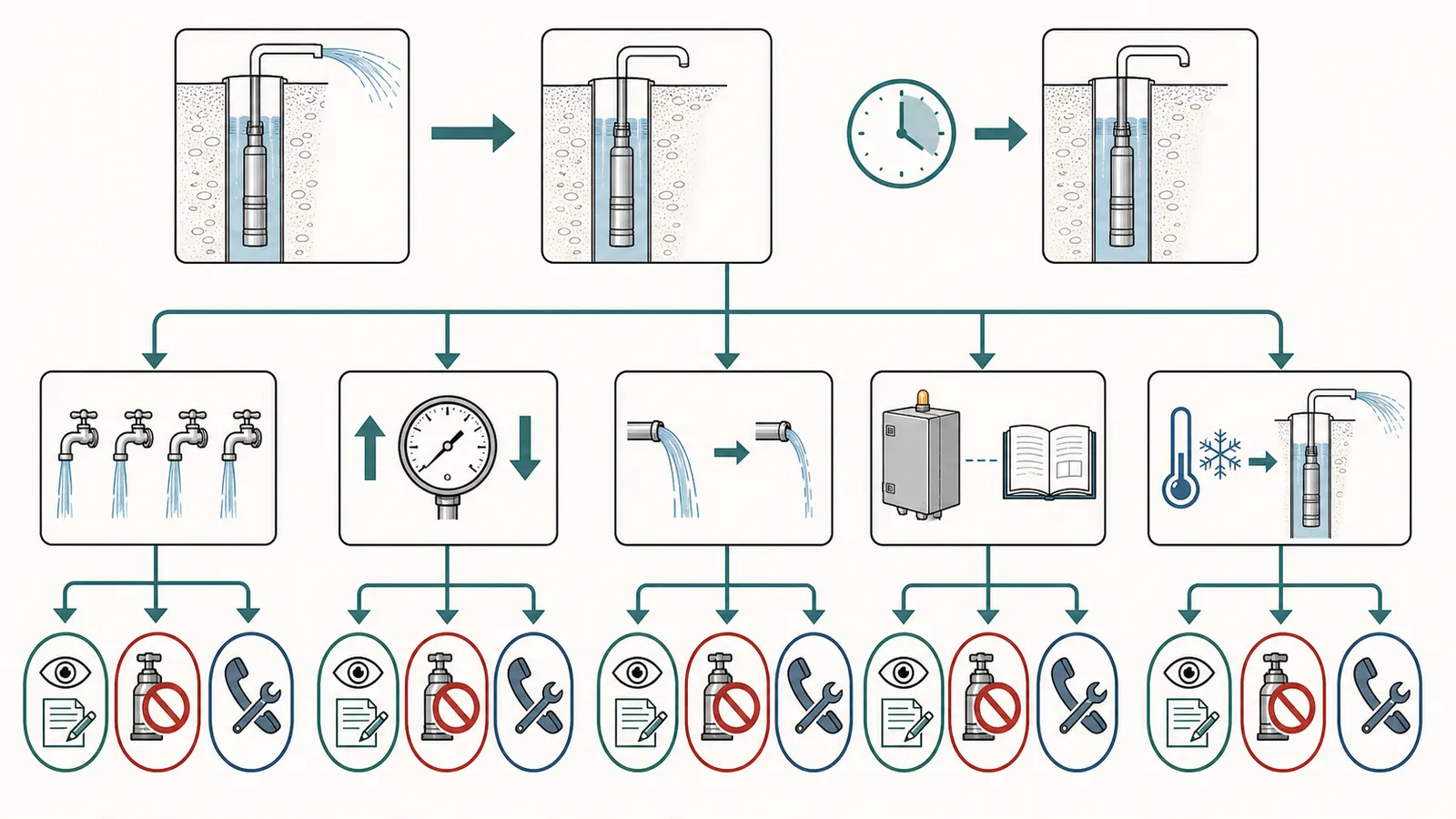
Use the symptom and the level together
The same water-level change has different decision value depending on what else changed. For example, a deeper repeatable static level during a dry period is an observation that may justify continued monitoring and a conversation with a well professional. A similar level change at the same time as loss of pressure, air, sediment, or inability to refill the pressure tank deserves a more active evaluation. Neither situation supplies a universal threshold.
Conversely, a stable static level does not clear the pump system. The water level can be normal while an above-ground pressure component, control, treatment restriction, leak, or pump problem causes a household symptom. This is why the handoff packet should include both the level record and the symptom timeline. A measurement that narrows one branch of the decision tree is valuable even when it does not identify the failed part.
Also separate depth to water from water available to the house. The casing may contain water while the well’s inflow, pump intake, pump performance, pressure storage, or treatment flow is inadequate. A depth reading is a vertical position, not a volume, flow rate, or pressure result. Avoid converting it to gallons unless the well geometry and water-bearing behavior are known and a professional has defined the calculation.
7. Stop at the boundary and hand over a clean record #
Verify permission before accessing the wellhead
This worksheet is not permission to access or alter a wellhead. State, county or other local, tribal, and—where applicable—water-utility rules or easements may control who may access the wellhead, open or alter a cap, or perform a water-level measurement. Requirements are not uniform: the CDC notes that some local health departments regulate, inspect, or license private drinking water, and advises well owners to contact the appropriate health or environmental department. A state-specific example, New Jersey guidance directs owners who want an individual-well water-level measurement to a licensed well driller or pump installer and warns that opening caps or seals can compromise sanitary integrity.
Before you touch the cap or use an access port, check the authority for the well’s location and ownership. If you cannot confirm that a homeowner may perform this measurement, or you do not know which authority controls, stop and do not assume the procedure is permitted. Ask the local health or environmental authority, tribal water authority, utility, or a qualified licensed well professional whether owner access is allowed, whether the cap may be opened, and what method or record is required. Keep the unanswered jurisdiction question in the worksheet as “permission not verified” and arrange the measurement through the authority or professional if needed.
Do not open energized controls, test live wiring, pull a pump, enter a well or other confined space, remove a sealed or sanitary cap, manipulate pressurized equipment, install an air line, or drop an improvised object into the well. Do not work at a wellhead with damaged wiring, standing water near electrical equipment, an unsecured cap, active flow, or an access opening you cannot safely identify. Do not lean over an open well or try to retrieve a dropped probe.
Stop and use a qualified well or pump professional when:
- the well is inaccessible, sealed, obstructed, or lacks a compatible access point;
- the well is flowing, surging, or behaving as an artesian or pressurized system;
- the cap must be loosened, removed, drilled, notched, or modified;
- the measurement path could contact wiring, controls, moving equipment, or pressurized piping;
- the sounder or tape cannot be lowered and retrieved without force;
- the device gives inconsistent signals, or the water level continues moving after a reasonable recovery window;
- a water-level change is accompanied by loss of production, repeated pump operation, air or sediment, contamination concern, or a no-water event.
Wellcare recommends contacting a licensed well contractor for determining static level and well maintenance; its information sheet is a useful homeowner-facing explanation of that professional handoff. The EPA field procedure likewise says safety precautions complement the judgment of an experienced professional.
When you call, send the record—not just the latest number. Include:
- the well address and state, if relevant to local licensing or records;
- the well log or completion report, if available;
- casing diameter and depth, pump type and setting, and any original pump-test information;
- the permanent or described measuring point;
- every reading with date, time, method, device resolution, and pumping status;
- the A/B repeat result and whether the level was still moving;
- recent drought, irrigation, nearby well activity, repairs, treatment regeneration, or unusual household demand;
- the symptom that prompted the measurement, such as low pressure, air, sediment, pump cycling, or loss of water.
Ask the professional to state what the proposed next measurement is intended to establish. Useful distinctions include:
- a repeat depth-to-water measurement from the same reference point;
- a pumping-level or recovery observation under a defined pump run;
- a flow or yield test with a controlled discharge and timing record;
- an above-ground pressure, control, or treatment-system diagnosis;
- a water-quality sample collected and interpreted separately.
These are different scopes. A quote for a static reading is not automatically a pump-performance test, and a pump service visit is not automatically a water-quality investigation. If a proposal uses “well level,” “well yield,” “recovery,” and “pump capacity” as if they were interchangeable, ask for the method, duration, records produced, and limitations before authorizing work.
If the well has a sealed cap, a flowing condition, a damaged casing, a confined or restricted access point, or electrical equipment in the measurement path, tell the professional that before the appointment. Do not remove the obstacle to make the visit easier. The access condition is part of the system evidence and may determine the correct method.
That packet lets a professional decide whether the next step is a better water-level measurement, a controlled well-performance test, an above-ground pump-system check, water-quality testing, or simple continued monitoring. The value of this worksheet is not that it diagnoses the hidden system. It makes the next decision more honest, comparable, and efficient.
Cite this guide
Brictale. “How to Measure Static Water Level in a Private Well.” Published 2026-08-31; updated 2026-08-31.
https://brictale.com/water/wells/measure-static-water-level-private-well · Read the Markdown version
Sources and scope
Evidence behind this page
- Static water level is the water level under normal, undisturbed, no-pumping conditions; a recent pumping event can produce a false static reading, and several hours without pumping is a useful target for a recovered reading.
Determining Static Water Level in a Well
Water Systems Council wellcare information sheet; general homeowner explanation, not a universal recovery-time rule.
Accessed · Link to this claim - A static reading should be checked with a second measurement after an additional recovery interval; if the level is not stable, the result should not be treated as a static baseline.
Agriculture and Agri-Food Canada guidance recommends waiting 15–30 minutes after pumping, longer in low-permeability aquifers, then measuring again after another 15–30 minutes.
Accessed · Link to this claim - Measurements should be taken from an established, clearly marked reference point on the well casing and documented so future readings are comparable.
Groundwater Level and Well Depth Measurement
US EPA Region 4 operating procedure FSBPROC-105-R6, effective April 17, 2025; field-procedure guidance adapted here for a homeowner record.
Accessed · Link to this claim - An electronic water-level indicator uses a probe and an electrical circuit that signals when the probe contacts water; the measurement is depth from the reference point to the water surface.
Groundwater Level and Well Depth Measurement
US EPA Region 4 procedure describes electronic indicators, their contact signal, and recording depth from the established reference point.
Accessed · Link to this claim - Method selection depends on access, depth to water, measurement frequency, and intended use; alternatives include electronic indicators, weighted or chalked tape, acoustic methods, air-line pressure, and automatic recording.
Groundwater Level and Well Depth Measurement
US EPA Region 4 procedure; it does not certify a particular consumer device or make every method suitable for every private well.
Accessed · Link to this claim - USGS water-level protocol describes two consecutive static measurements to 0.01 ft and repeating when results do not agree within about 0.02 ft; that precision is a professional protocol target, not a promise that every homeowner tool can achieve it.
USGS NAWQA protocol for field data collection; used to support the repeatability principle and carefully bounded precision context.
Accessed · Link to this claim - USGS NAWQA policy prohibits lead weights in its wells because a lost weight could affect water quality; a homeowner should use only a manufacturer-approved, non-lead measuring device rather than improvising a weighted line.
USGS program policy for its wells; not a blanket US regulation for every private well, but a conservative equipment boundary.
Accessed · Link to this claim - A wetted-tape method requires an approximate depth to water and is described by wellcare as accurate to depths up to about 90 feet; deeper or less accessible wells may call for another method or a professional.
Determining Static Water Level in a Well
Water Systems Council wellcare sheet; the approximate 90-foot context is not a universal accuracy guarantee for every tape or operator.
Accessed · Link to this claim - An air-line method can be useful for repeated measurements in deep wells, but it involves installed tubing, calibration, and pressure equipment and is not a casual improvisation for a homeowner.
Determining Static Water Level in a Well
Water Systems Council wellcare description of air-line measurement and its installation requirements.
Accessed · Link to this claim - A useful water-level record includes date and time, a consistent measuring point, depth below that point, the point's relation to ground level, and nearby influences such as pumping wells or cascading water.
Agriculture and Agri-Food Canada monitoring checklist; the page is Canadian guidance and is used for record structure, not US regulatory requirements.
Accessed · Link to this claim - A water-level change can be associated with aquifer depletion or well-performance changes, but well, pump, and aquifer systems are interrelated, so a single level reading does not identify the cause.
Agriculture and Agri-Food Canada discussion of static and pumping levels, drawdown, and the difficulty of separating pump, intake, and aquifer causes.
Accessed · Link to this claim - Well yield and specific capacity require a systematic pumping test with controlled pumping rate, time, and drawdown measurements; a recovered static reading alone is not a well-yield test.
Penn State Extension guidance for well planning and pump testing; its long-duration test context is not a DIY instruction for an existing household system.
Accessed · Link to this claim - Well record books and completion information help detect changes over time and give a local expert useful context when a problem occurs; records can include well depth, construction, and yield or flow rate.
Best Management Practices for Private Water Wells
Penn State Extension homeowner management guidance; recordkeeping advice is general and not a substitute for a state-specific well-log system.
Accessed · Link to this claim - Wellcare recommends contacting a licensed well contractor for determining static level and well maintenance.
Determining Static Water Level in a Well
Water Systems Council wellcare homeowner guidance; used to support the professional handoff boundary for static-level measurement and maintenance.
Accessed · Link to this claim - EPA field guidance says minimum safety precautions complement the judgment of an experienced professional when measuring well levels and depths.
Groundwater Level and Well Depth Measurement
US EPA Region 4 operating procedure FSBPROC-105-R6; applied here as a safety boundary, not as a homeowner certification or local code rule.
Accessed · Link to this claim - Private-well oversight is not uniform: local health departments may regulate, inspect, or license private drinking water, so a homeowner should verify the applicable local or state authority before accessing a wellhead or arranging well work.
Private Drinking Water and Public Health
CDC reports that 56% of local health departments regulate, inspect, or license private drinking water and describes local health-department involvement; it does not establish a universal rule for every jurisdiction.
Accessed · Link to this claim - New Jersey guidance directs owners who want an individual-well water-level measurement to contact a licensed well driller or pump installer and warns that opening caps or seals can compromise sanitary integrity.
New Jersey Department of Environmental Protection guidance; used as a concrete state-specific example, not as a nationwide legal requirement.
Accessed · Link to this claim