How to Compare Well Pump Repair Quotes
A US-homeowner worksheet for comparing well-pump repair quotes by diagnosis, scope, tests, access, startup, disinfection, warranty, and exclusions.
The short answer
Compare the diagnosis and promised result before comparing totals. Put each quote into one of three scopes—diagnostic visit, above-ground repair, or pump pull—then record the tests, failure found, parts, labor, access, startup, disinfection, warranty, and exclusions. If one quote assumes a pump pull or adds a tank, controls, or wiring work that another does not, they are not apples-to-apples. Do not open energized controls or pull a pump yourself.How to Compare Well Pump Repair Quotes
Compare the diagnosis and promised result before comparing totals. Put every quote into one of three scopes—diagnostic visit, above-ground component repair, or pump-pull work—then record the tests performed, failure found, parts, labor, access, startup, disinfection, warranty, and exclusions. If one quote assumes a pump pull or adds a tank, controls, or wiring work that another does not, they are not apples-to-apples.
Do not open an energized control box, test live wiring, change pressure-switch settings, loosen pressurized fittings, open a well, enter a confined space, pull a pump, or handle disinfection chemicals as part of this comparison. Use the page to document what a qualified professional says and what each quote actually promises. Franklin Electric’s current technical guidance reserves VFD service for technically qualified personnel familiar with the correct tools, equipment, and procedures, and warns that ignoring codes or product instructions can cause shock, fire, poor performance, or equipment failure. (Franklin Electric’s VFD service safety disclaimer)
1. Use one comparison rule: same evidence, same scope, same handoff #
A repair quote is not comparable because both documents say “well pump repair.” It is comparable only when the documents describe the same starting condition, the same evidence, the same component scope, the same access assumptions, and the same finished condition. A surface-repair quote and a pump-pull quote may both be reasonable for different findings; they are not competing prices for one job.
NGWA’s Wellowner.org makes the same underlying point in its written-contract guidance: an owner cannot compare offers without knowing what each contractor will do for the specified price. It recommends itemized charges and calls out contract subjects such as applicable requirements, disinfection, cleanup, and guarantees of materials and workmanship. That guidance is written mainly for well construction, so use its documentation principle here without assuming that every construction line item belongs in a pump repair. (NGWA’s written-contract guidance)
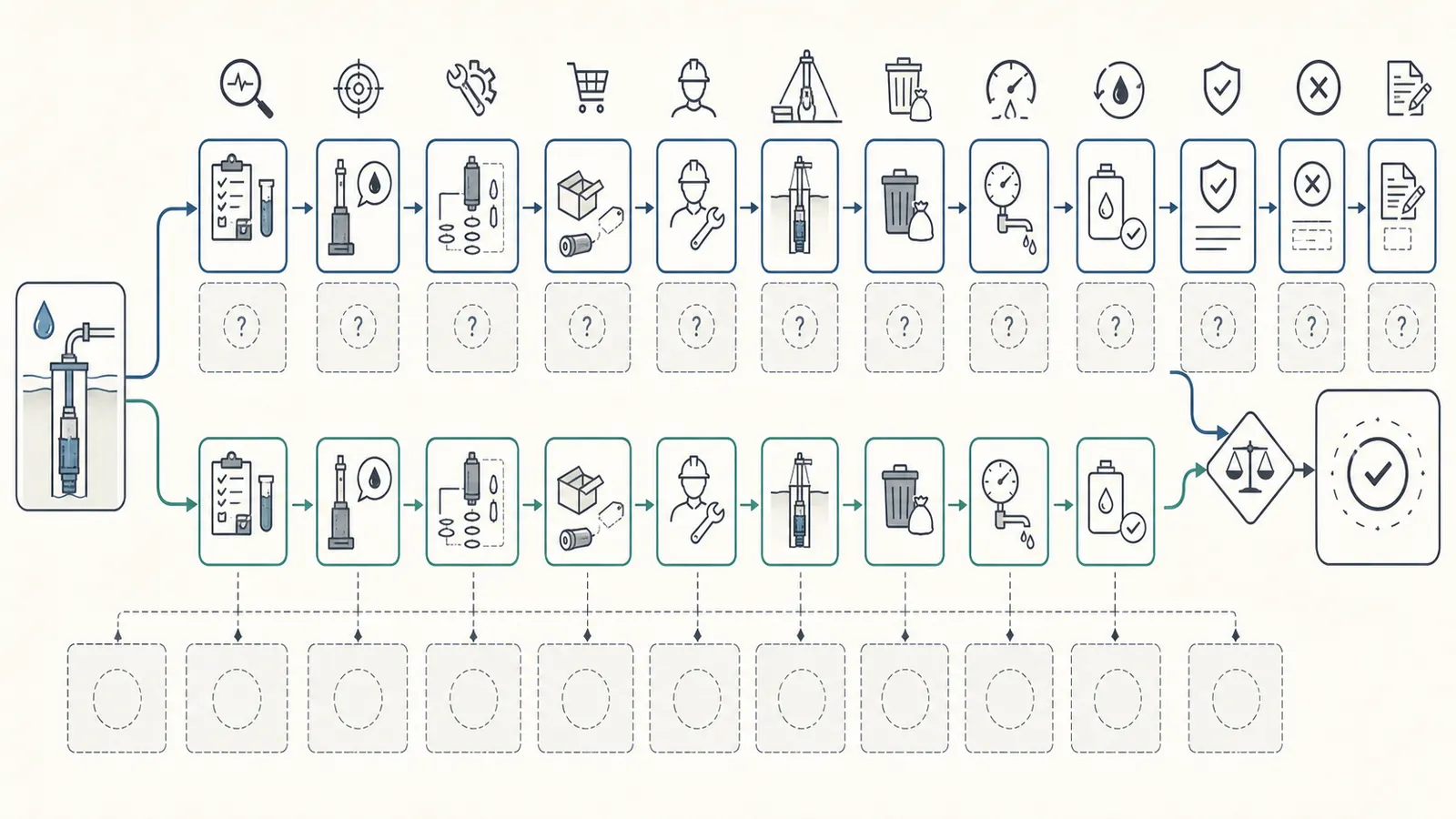
Start a two-column record before you call a contractor back. Put Quote A and Quote B side by side, but add a third column called “not stated.” A blank is not a no. It is an unanswered question that can change the total or the risk.
| Comparison gate | Quote A | Quote B | If different or blank |
|---|---|---|---|
| Same reported symptom and date | ____ | ____ | Ask both contractors to restate the starting condition |
| Diagnostic visit included or already completed | ____ | ____ | Separate diagnosis from repair authorization |
| Tests performed and results attached | ____ | ____ | Do not treat a component guess as a finding |
| Failure found, in plain language | ____ | ____ | Ask what observation supports it |
| Repair scope and components named | ____ | ____ | List each part, model, or “allowance” |
| Pump pull included? | yes / no / unclear | yes / no / unclear | Stop the price comparison until access is clear |
| Parts, labor, access, disposal | ____ | ____ | Normalize line items before comparing totals |
| Startup and post-repair verification | ____ | ____ | Ask what successful operation means |
| Disinfection and water testing | ____ | ____ | Confirm who performs, pays, and documents it |
| Warranty and exclusions | ____ | ____ | Ask what is excluded even if the repair fails |
| Change-order rule | ____ | ____ | Require approval before added work |
| Total, tax, permit or travel charges | ____ | ____ | Record user-entered local amounts only |
The fastest way to create a false bargain is to compare the “today” total in one quote with a total that excludes access, parts discovered after opening, startup verification, or water-safety follow-up in the other. The fastest way to create a false emergency is to accept a replacement recommendation without recording what was tested and what failed.
What the three evidence levels mean
Use these labels consistently in your notes:
- Observed: you or the professional saw a symptom, reading, leak, alarm, or operating event. Record the time and condition, not just “bad pump.”
- Measured: a value was obtained with a stated instrument or procedure, such as pressure at a fixture with water use stopped, flow under a stated condition, or a documented electrical reading taken by a qualified person.
- Inferred: a proposed cause based on the symptom or measured result. It may be a reasonable working diagnosis, but it is not the same as a failed component being confirmed.
Write those words into the record. “Pump failed” is much less useful than “No water at fixtures; contractor states the pump did not respond during their qualified test; test method and result attached; pump pull proposed.” The second version still does not prove every possible cause, but it tells the next contractor what evidence exists.
2. Separate the quote into diagnostic, surface repair, or pump pull #
The scope label is the first decision. Do not let a quote move between scopes without showing what new evidence triggered the change.
| Scope | What it normally answers | Evidence to request | What it does not automatically include |
|---|---|---|---|
| Diagnostic visit | Where should the next safe investigation begin? | Symptoms, system type, visible labels, observations, tests performed, results, working diagnosis, recommended next step | Parts, repair, pump removal, guaranteed root cause, or water-quality clearance |
| Above-ground component repair | Can a visible or accessible component be repaired without opening the well? | Confirmed or bounded failure of a pressure switch, gauge, control, valve, tank connection, wiring component, or other named part; compatibility and startup plan | Pump performance below grade, well yield, hidden pipe or cable condition, or a pump that must be pulled |
| Pump-pull work | Is below-grade equipment being accessed, repaired, replaced, or inspected? | Reason for pull, access method, pump and motor identification, depth or setting information if available, drop-pipe and cable assumptions, contingency rates, reinstallation and startup plan | A promise that the pump is the only failure, or that a pull will solve low yield, water quality, or a damaged well |
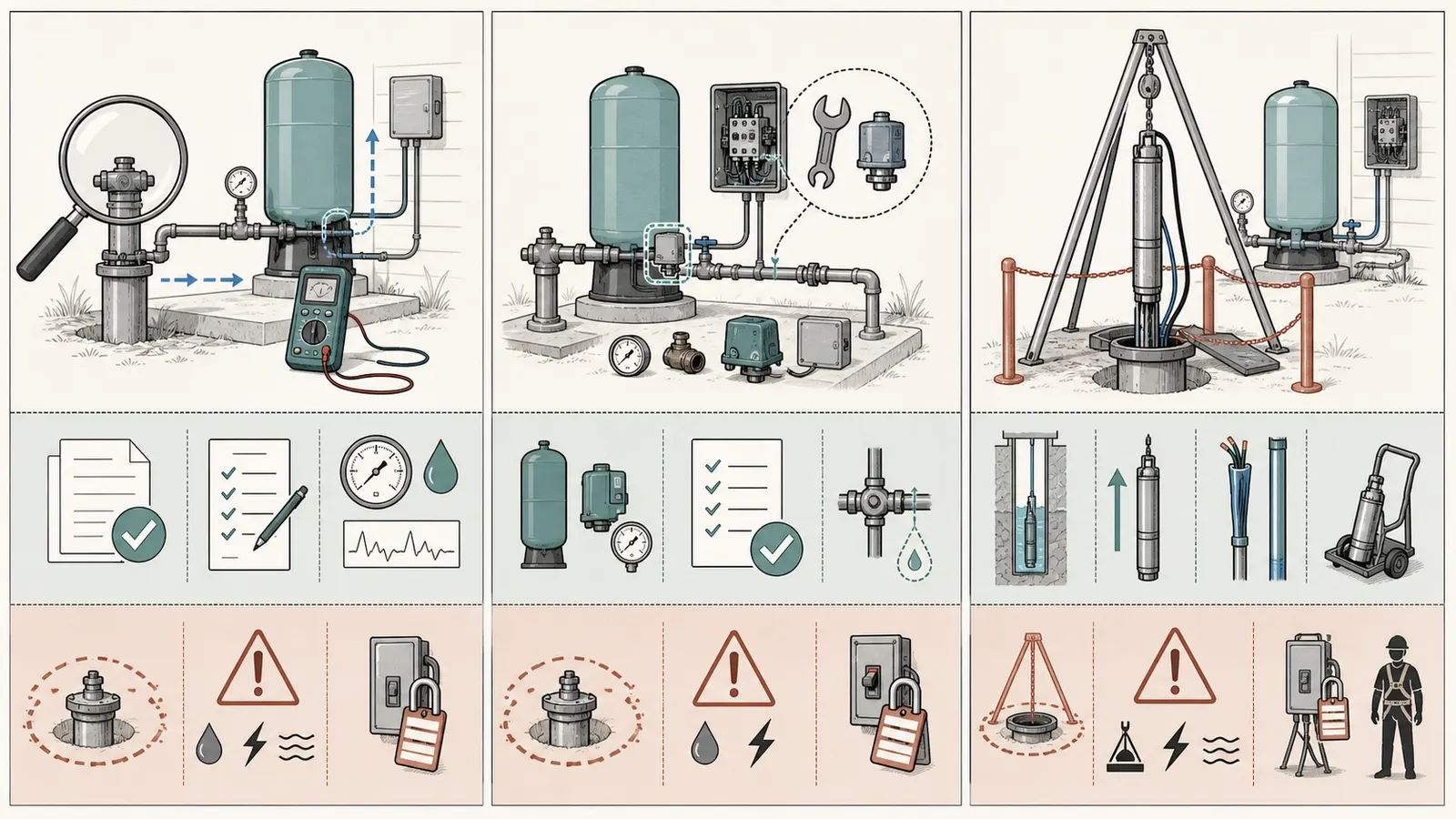
These are not three price tiers. They are three different decisions. A diagnostic visit may be the right next step when the symptom is intermittent or the quote uses words such as “likely,” “appears,” “could be,” or “recommend replacement” without attaching a test result. An above-ground repair may be comparable when both quotes identify the same accessible component, same compatible part, same labor, and same startup check. A pump pull deserves a separate review because access, depth, equipment, labor, and what is found after removal can materially change the work.
Diagnostic visit: pay for evidence, not a guess
Ask the contractor to state whether the visit is diagnostic-only or includes a repair allowance. The record should say:
- What the homeowner reported: no water, low pressure, cycling, air or sediment, nuisance tripping, visible leak, abnormal noise, or another symptom.
- When it happens: all the time, only after heavy use, only at one fixture, only when irrigation runs, or only after a power event.
- What the professional observed without relying on homeowner access to hazardous equipment.
- What system type is present: conventional fixed-speed pump with a pressure switch, surface pump, submersible pump, or controller-based constant-pressure system.
- Which tests were performed, by whom, under what conditions, and what each result supports.
- What remains unknown and what event would justify the next scope.
Do not infer that a dead gauge means a failed pump, that a pump that runs means it delivers enough water, or that low pressure at one faucet identifies the well equipment. A clogged aerator, treatment equipment, a leak, a valve position, a pressure-control problem, a pump problem, a well-yield problem, or several issues can produce overlapping symptoms. The point of the diagnostic line is to narrow the branch, not to decorate a replacement recommendation with technical words.
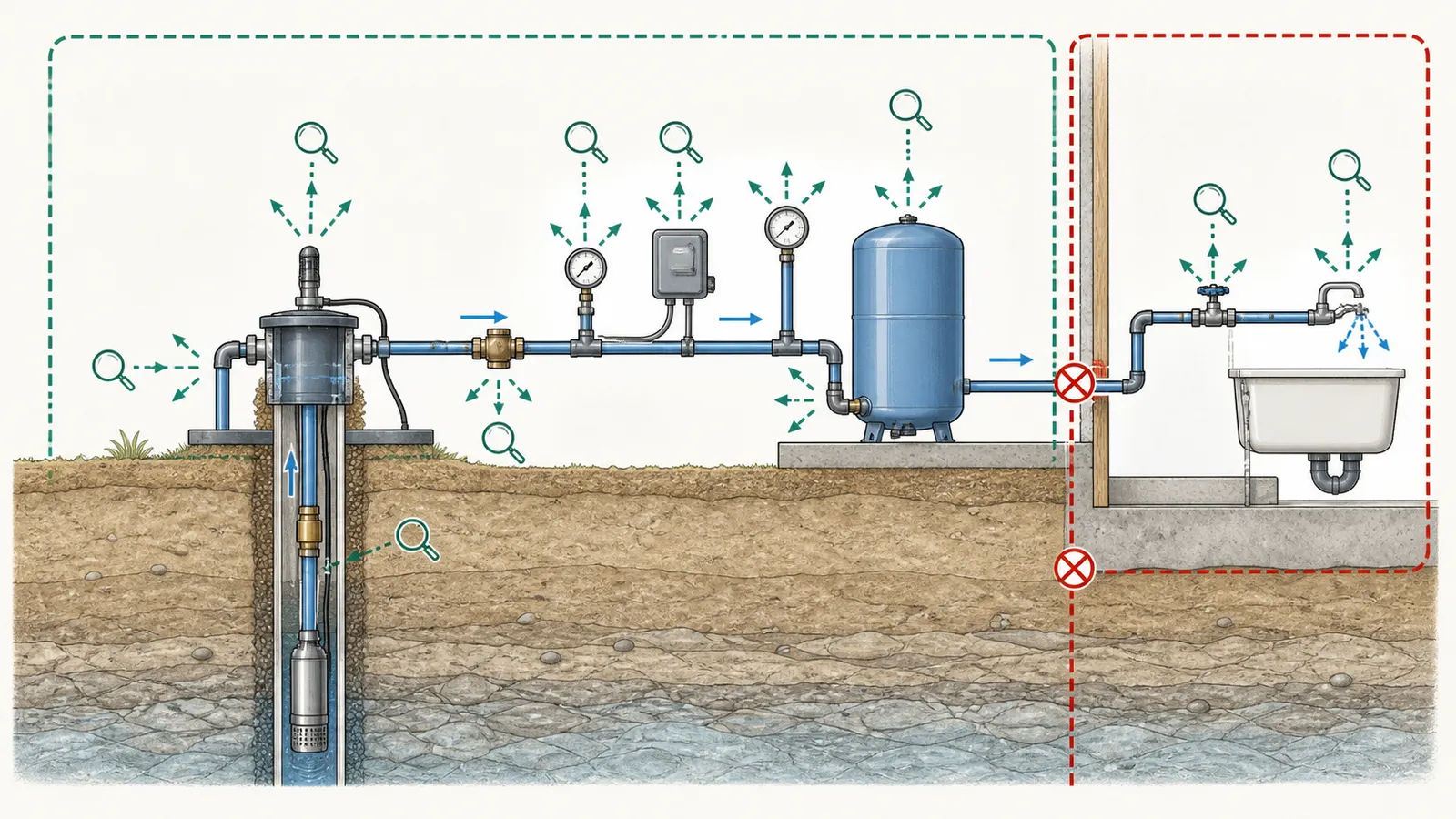
Above-ground repair: name the component and the boundary
For a proposed pressure-switch, gauge, control-box, tank-connection, valve, or accessible wiring repair, record the exact component and what is outside the repair. “Replace pressure components” is not a comparable scope. Ask for the make and model of the replacement part when compatibility depends on voltage, phase, motor, pressure range, tank type, connection, or controller.
If the quote adds a pressure tank, control box, check valve, pressure-relief device, wiring, isolation valve, or treatment component, treat that as a separate line item with its own reason. A contractor may reasonably recommend additional work after inspection. The homeowner should still know whether it is required to restore the reported function, recommended as preventive work, or optional modernization.
Penn State Extension explains that a pressure tank helps a well system maintain pressure and supply water between pump cycles, but has limited usable storage and cannot by itself solve every low-yield-well problem. That is why a tank recommendation should be tied to a stated symptom or measured system issue rather than presented as proof that the pump is bad. (Penn State Extension on pressure tanks and low-yield wells)
Pump pull: turn access into explicit decisions
A pump-pull quote must say whether the price is for access only, removal and inspection, repair, replacement, or a combination. Ask these questions before authorizing:
- What finding makes below-grade access necessary?
- Is the pump being removed, or is the quote only for an attempt to retrieve or inspect it?
- What pump, motor, cable, drop pipe, check valve, pitless adapter, well cap, or other parts are assumed to be reusable?
- What happens if the assembly is stuck, damaged, contaminated, or not the model expected?
- Is there an hourly, depth-based, equipment, travel, disposal, or emergency rate beyond the stated total?
- Who provides and pays for replacement materials if a fitting, cable, pipe, or wellhead component cannot be reused?
- What is the reinstallation, startup, pressure, flow, leak, and water-quality verification plan?
- What is the change-order ceiling, and must the homeowner approve it before the next operation?
EPA advises hiring a certified well driller for new construction, modification, or abandonment and closure. It also gives a specific flood-response warning: stay away from a flooded well pump because of electric-shock risk and have a qualified contractor clean and disinfect the system before restarting it. Those instructions do not turn every repair into a drilling job, but they establish the correct boundary around well access, modification, electrical exposure, and contaminated systems. (EPA private-well protection guidance)
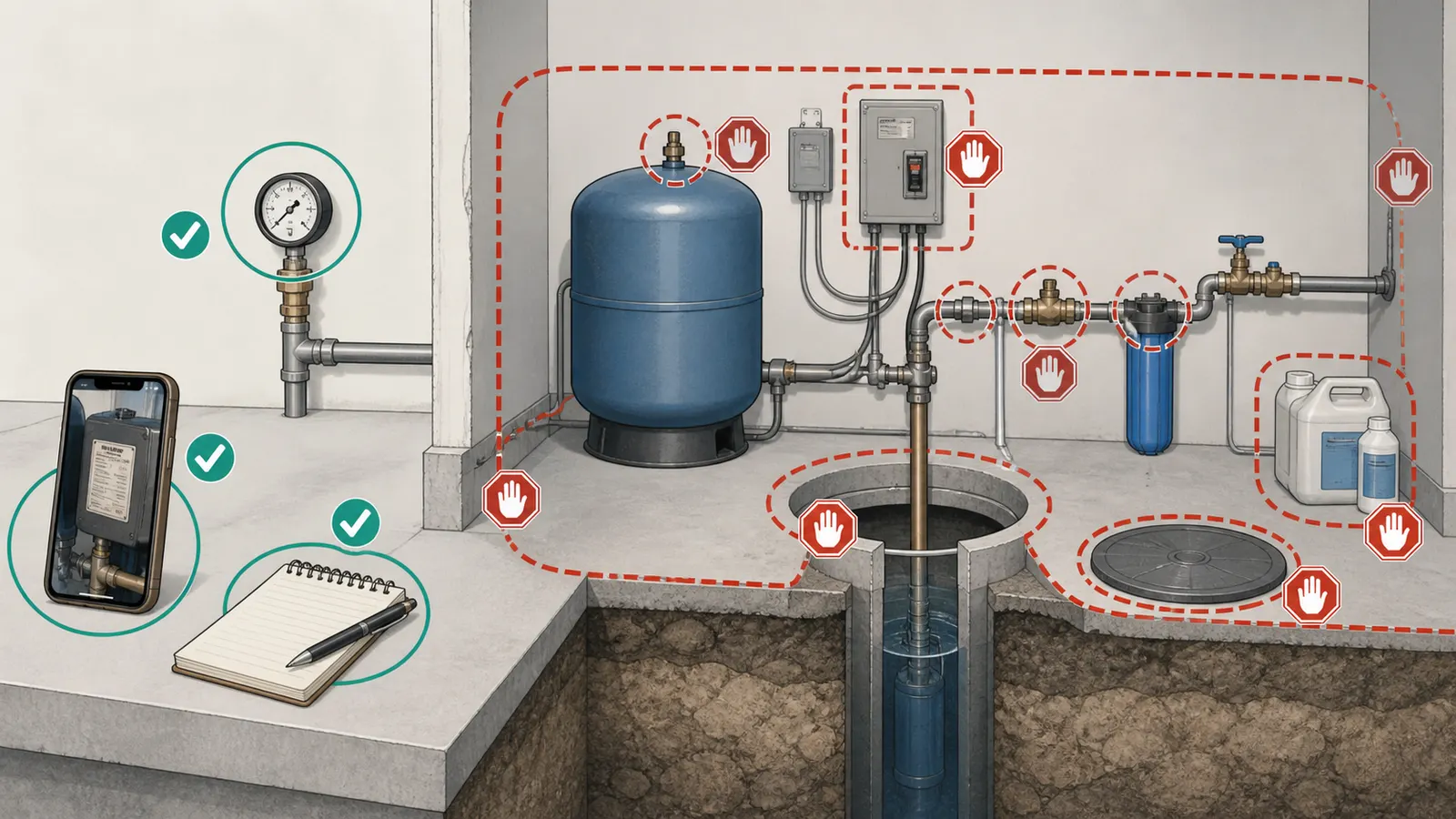
Do not open the well or help pull the pump so you can “confirm” the quote. A homeowner can gather records, photograph visible labels from a dry and safe location, and describe symptoms. A qualified professional must decide how to isolate power, release pressure, access the well, handle the assembly, and protect the water supply.
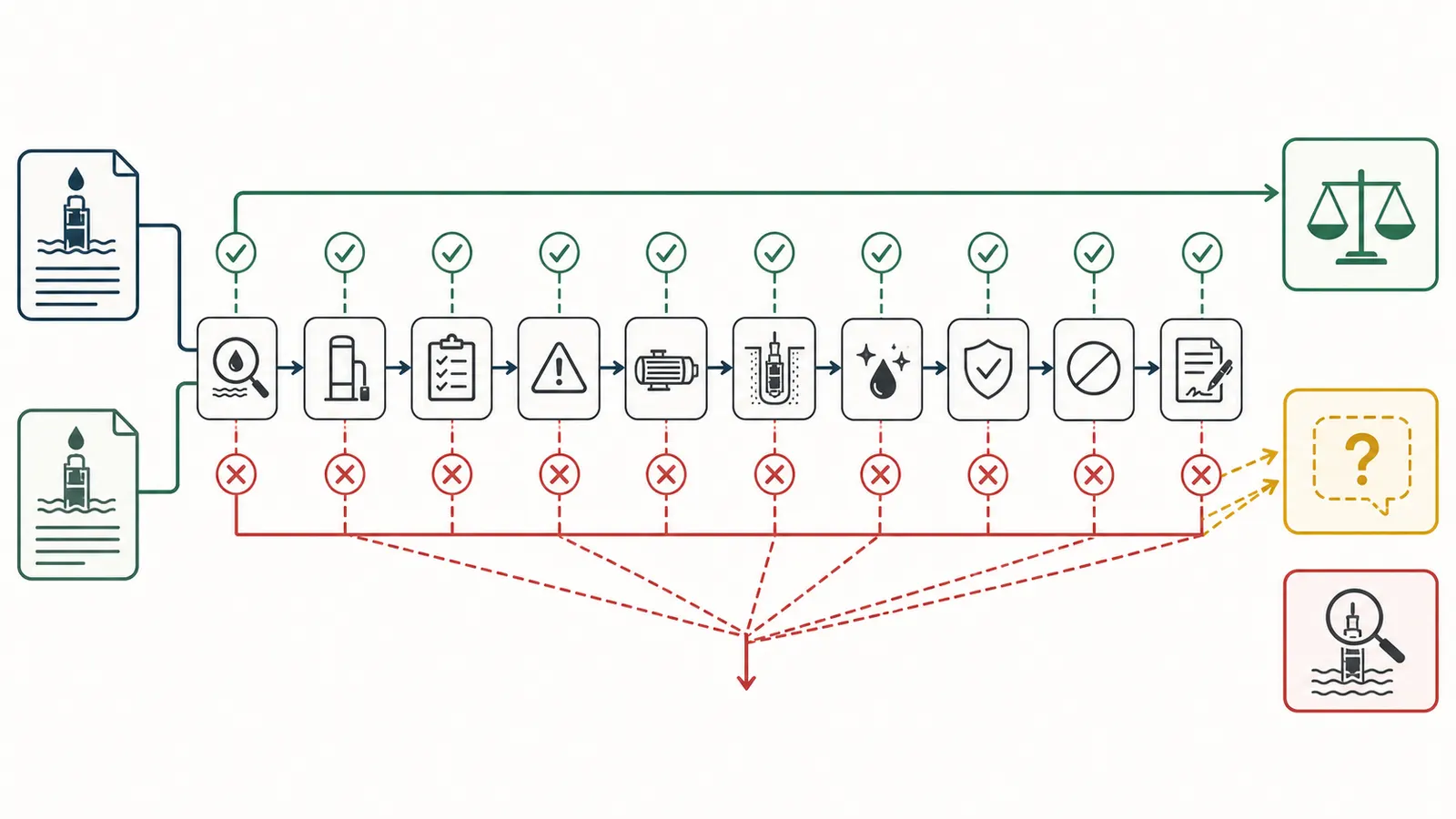
3. Put the diagnostic evidence beside the proposed work #
The most valuable comparison field is not the total. It is the connection between a test and the proposed action. Build a short evidence chain for every quote:
symptom → test or observation → failure found or bounded hypothesis → proposed work → verification that would confirm success
For example, a useful record might say: “Pressure drops rapidly while no fixture is open; contractor checked for visible leaks and states the system loses pressure at the well-side check valve; replace named check valve; verify stable pressure with fixtures closed and document startup.” That record is still subject to the contractor’s actual report and the system’s design, but it gives the homeowner a way to compare the next quote.
| Evidence field | Record this | Do not infer |
|---|---|---|
| Symptom | Exact behavior, timing, affected fixtures, recent changes | That the named component is the cause |
| System type | Fixed-speed pressure-switch, surface pump, submersible, constant-pressure, or unknown | That every well uses the same control logic |
| Pressure | Where measured, when, gauge used, water-use condition, start/stop behavior if safely observed | That a single faucet reading is the pump’s delivered flow |
| Flow | Where measured, duration, discharge destination, pressure condition, and who measured it | That horsepower or a catalog maximum equals house flow |
| Electrical or controller evidence | Qualified professional’s stated test and result, with model and fault information when available | That a reset or fault code identifies the failed part by itself |
| Tank evidence | Visible model, age if documented, leak or corrosion observation, stated test result | That a tank’s nominal gallons equal usable storage |
| Well and water evidence | Well records, recent water changes, flooding, sediment, odor, color, or test report | That clear water means safe water |
| Failure statement | Exact component, failure mode, and confidence or remaining uncertainty | That “recommend” means “confirmed” |
Pressure is an observation, not a universal setting
If the system has a safe, accessible hose bibb and a pressure gauge can be used without opening controls or loosening pressurized equipment, a homeowner may record a basic incoming-pressure observation exactly as the gauge shows it. EPA WaterSense describes turning off water-using fixtures and systems, attaching a gauge to a hose bibb, and opening the water fully; it says fixtures generally operate best with incoming service pressure between 45 and 60 psi and recommends professional help when pressure is much lower or higher. (EPA WaterSense pressure-testing guidance)
Use that as a bounded home-pressure observation, not as a national rule for a well-pump switch. A quote should separately record the pump’s stated cut-in and cut-out if those settings are relevant, how they were verified, and whether the system is conventional or controller-based. Do not remove a control cover, touch terminals, adjust a switch, or bleed a pressure tank to obtain a number.
Flow is a condition-dependent number
Ask the quote to identify how flow was established. A number without a condition is not a useful comparison. Record whether it is:
- a measured flow at a fixture or discharge point;
- a documented pump performance value at a stated pressure and depth;
- a well-yield record from an earlier test;
- a controller or fault record; or
- an estimate or allowance.
Do not substitute motor horsepower, pump nameplate, a maximum catalog flow, or a neighbor’s result for the installed system’s actual operating condition. A contractor may need to perform professional tests to distinguish pump performance from well yield, piping restriction, or a control issue. Penn State Extension describes low-yield systems as a case where a normal pump can outpace the well’s ability to replenish, and notes that a larger tank only provides limited additional storage. (Penn State Extension’s low-yield-well explanation)
Water quality is a separate verification track
Repairing a pump does not automatically establish that the drinking water is safe. EPA says to test a private well immediately after replacing or repairing any part of the well system or after a water-quality change, and to use a state-certified laboratory for drinking-water testing. (EPA private-well testing guidance)
Therefore, make water follow-up a named quote field:
| Water follow-up field | Quote A | Quote B |
|---|---|---|
| Is well or plumbing disinfection included? | ____ | ____ |
| Who performs it, and with what product or procedure? | ____ | ____ |
| Is flushing included, and where does discharge go? | ____ | ____ |
| Is a certified-laboratory sample included, optional, or excluded? | ____ | ____ |
| Which results are required before drinking use? | ____ | ____ |
| Who interprets results and handles a failed result? | ____ | ____ |
Never add chlorine or another treatment chemical because a quote contains the word “disinfect.” Ask the professional to state the procedure, safety controls, discharge plan, and testing responsibility. If the well flooded, was opened, had a sanitary defect, or has a changed odor, taste, color, or sediment condition, contact the local or state health authority as well as a qualified well professional.
4. Normalize every line item, not only the repair part #
A clean comparison keeps three numbers separate:
- Diagnostic subtotal: the cost already paid or proposed to establish the next decision.
- Base repair subtotal: the labor and parts needed for the named repair under stated access conditions.
- Conditional work: pump pull, additional material, access equipment, disposal, disinfection, testing, permits, or repairs that occur only if a stated finding appears.
Do not collapse conditional work into “miscellaneous” and do not assume it is included because the contractor used the word “complete.” NGWA’s written-contract guidance recommends itemized charges and discussion of unforeseen costs and changed options. Again, its page is aimed at well construction; the bounded repair application is to make inclusions, exclusions, and change orders visible before work starts. (NGWA’s itemization and unforeseen-cost guidance)
Use this normalization table for each quote:
| Cost or responsibility | What to record | Quote A | Quote B |
|---|---|---|---|
| Diagnostic or service-call fee | Paid, credited, or separate | ____ | ____ |
| Troubleshooting tests | Named tests and whether results are delivered | ____ | ____ |
| Parts | Brand/model or a defined compatible specification | ____ | ____ |
| Labor | Hours, flat rate, crew, regular or emergency rate | ____ | ____ |
| Access | Pump pull, excavation, lifting equipment, wellhead access, travel | ____ | ____ |
| Wiring or controls | Included, excluded, or only after qualified finding | ____ | ____ |
| Tank, valve, gauge, or piping | Required, recommended, optional, or allowance | ____ | ____ |
| Disposal and removed parts | Who removes and disposes of each item | ____ | ____ |
| Startup verification | Pressure, flow, cycling, leaks, alarms, or other stated checks | ____ | ____ |
| Disinfection and flushing | Procedure, discharge, chemicals, labor | ____ | ____ |
| Water testing | Certified lab, sample timing, parameters, interpretation | ____ | ____ |
| Permit or inspection charges | Local, state, or utility-dependent; quote must state assumption | ____ | ____ |
| Warranty | Parts, labor, workmanship, duration, exclusions, call-back terms | ____ | ____ |
| Change orders | Approval method, rates, ceiling, emergency exception | ____ | ____ |
| Total | Tax and all stated fees included | ____ | ____ |
Keep local price values in your own record. There is no responsible national repair total to insert into this table because labor, access, pump depth, equipment, local requirements, system design, and failure mode vary. A price range from a cost site is not a substitute for a scope-matched quote.
Treat allowances as unknowns until bounded
Words such as “allowance,” “as needed,” “standard materials,” “minor electrical,” “repair pump,” or “bring system back online” may be normal shorthand, but they are not enough for comparison. Ask the contractor to convert each one into:
- the trigger that activates it;
- the unit or hourly rate;
- the assumed quantity or depth;
- what is included in the base total;
- who approves additional work; and
- what happens if the assumption is wrong.
If a quote cannot define the allowance, label the total not comparable rather than trying to estimate the missing amount yourself.
Compare warranties by the failure they cover
“One-year warranty” is not a complete warranty comparison. Record whether it covers the part, labor, original workmanship, return travel, diagnostic fees, and a repeat of the original symptom. Record exclusions for low water level, sediment, lightning, power quality, freezing, abuse, treatment chemicals, water quality, or unrelated components only when the contractor actually states them. Do not assume a part warranty covers the labor to access a pump again.
Ask what documentation activates the warranty: invoice, model and serial number, installation record, water test, maintenance record, or proof of a particular operating condition. Franklin Electric provides current AIM manuals and installation-record forms for its submersible motor systems, which illustrates why model and installation records matter for later service; those forms do not certify the work on your system. (Franklin Electric AIM and installation records)
5. Flag the quotes that are not actually for the same job #
Use a red flag whenever one document contains a different branch, not necessarily because the contractor is wrong but because the homeowner needs an explanation before authorization.
| Mismatch | What it may mean | Focused question |
|---|---|---|
| One quote is diagnostic-only; the other includes repair | The totals answer different decisions | “What evidence supports moving from diagnosis to repair, and is that evidence included in both?” |
| One says pressure switch; the other says pump | Different failure hypotheses or different test results | “Which test rules in the proposed component, and what remains untested?” |
| One includes a new tank | A separate cycling, storage, compatibility, or condition issue | “Is the tank required for the reported symptom, recommended, or optional? What observed result supports it?” |
| One assumes a pump pull | Below-grade access, stuck equipment, or a different diagnosis | “What is the reason for the pull, what is the access contingency, and what is excluded if the assembly cannot be removed?” |
| One includes controls or wiring | Electrical or controller work may be part of the proposed fix | “Which model and test result require this work, and who is qualified to perform it?” |
| One includes disinfection or testing | Different water-safety handoff | “Who performs and documents the procedure, and what result returns the water to use?” |
| One offers a replacement while the other repairs | Different life-cycle choice, not a simple repair comparison | “Please provide the repair scope and replacement scope separately, with the same startup and warranty fields.” |
| One has a much shorter warranty | Different parts, labor, installation assumptions, or exclusions | “What is excluded from the shorter warranty, including repeat access?” |
| One uses “up to” or “starting at” pricing | The total is conditional | “What exact assumptions make this the stated total, and what are the rates if they change?” |
Do not rank contractors from the table alone. A well-supported pump-pull quote can be safer and more economical than a surface repair that does not address the failure. A cautious diagnostic quote can be better than a confident replacement quote when the evidence is thin. The comparison surface is designed to expose the decision, not to choose a contractor by price or marketing language.
A second opinion should compare evidence, not repeat a story
Send the next contractor the symptom log, equipment labels, well records, prior repair invoices, water-test reports, the first contractor’s tests and results, and the exact quote. Ask for an independent assessment before showing the proposed fix if you want a cleaner second opinion. Then ask the contractor to identify which evidence they agree with, which they dispute, and what additional test changes the recommendation.
Wellowner.org recommends selecting a licensed contractor where the state licenses contractors, checking insurance, asking for references, and obtaining a written contract. Those are screening steps, not proof of technical correctness, and state requirements differ. (NGWA contractor-selection guidance)
6. Ask for a safe authorization and completion record #
Before you authorize, send the contractor a short written list of unresolved fields. The goal is not to make a homeowner perform technical triage. The goal is to ensure the approved work matches the evidence and that the handoff is documented.
Questions to ask before work starts
- “What is the exact reported failure, and what test or observation supports it?”
- “Is this quote diagnostic-only, an above-ground repair, a pump pull, or a combination?”
- “Which parts are included by model or defined compatibility, and which are allowances?”
- “What work is explicitly excluded?”
- “What access, lifting, excavation, disposal, or travel conditions change the total?”
- “What happens if the proposed repair does not restore pressure, flow, or normal cycling?”
- “What is the change-order process, and can I approve it before additional work?”
- “What will you verify at startup, and will I receive the readings or a written result?”
- “Does the work include disinfection, flushing, or certified-laboratory testing? If not, what is the safe next step?”
- “What parts and labor are covered if the original symptom returns?”
- “What records will you leave: tests, readings, parts, model and serial numbers, work performed, removed parts, warranty, and recommended follow-up?”
Keep the answers with the quote. NGWA’s contractor guidance asks owners to find out what records a contractor will provide and whether there will be a written contract. (NGWA’s contractor-record guidance) A repair record is useful for future comparison, but it is not an official inspection, code certificate, laboratory report, or guarantee that every hidden condition was found.
The homeowner-safe boundary
You may usually contribute useful information by:
- writing down when the symptom occurs and what fixtures are affected;
- photographing visible equipment labels from a dry, stable location;
- recording the visible gauge without opening any cover or adjusting anything;
- noting recent flooding, power events, construction, treatment changes, sediment, odor, taste, or color changes;
- locating prior well, pump, repair, and water-test records; and
- asking for a written scope and change-order rule.
Stop and call a qualified professional before:
- opening a pressure-switch or control enclosure;
- touching or testing live wiring, capacitors, terminals, or controller components;
- changing pressure-switch settings or controller programming;
- removing a tank cap, relief device, fitting, well cap, or sanitary seal;
- releasing tank pressure or using the tank air valve;
- opening the well, entering a pit, vault, crawlspace, or other confined space;
- pulling, lifting, cutting, or disconnecting the pump, drop pipe, or cable; or
- adding disinfectant, flushing a contaminated system, or deciding that water is safe after a repair.
Franklin Electric’s qualified-personnel warning is especially relevant to controller and VFD work. EPA’s private-well guidance adds the water-safety boundary: after a repair, testing and local health guidance may be needed before normal drinking use. (Franklin Electric’s service disclaimer; EPA’s private-well testing guidance)
7. Verify the finished work and preserve the decision record #
The final comparison is between the approved scope and the completed record. Do not close the file because water comes back from a faucet. Ask what the contractor verified and what remains outside the work.
| Completion check | Record the professional’s result |
|---|---|
| Approved scope and any change orders | ______________________________ |
| Parts installed, model and serial numbers | ______________________________ |
| Original symptom after repair | gone / changed / remains / unknown |
| Pressure or controller behavior under stated conditions | ______________________________ |
| Flow or delivery observation and condition | ______________________________ |
| Leaks, cycling, alarms, noise, or visible defects | ______________________________ |
| Startup and shutdown behavior | ______________________________ |
| Disinfection and flushing completed? | ______________________________ |
| Water sample collected by a certified laboratory? | ______________________________ |
| Laboratory result and return-to-use instruction | ______________________________ |
| Warranty start date and exclusions | ______________________________ |
| Maintenance or follow-up date | ______________________________ |
If the original symptom is low pressure, record where pressure was observed and whether water use was stopped. If the symptom is short cycling, record the observed start and stop behavior and what the contractor says caused it. If the symptom is no water, record whether the repair restored water under the stated conditions but do not treat that alone as proof of normal well yield or long-term pump health. If the symptom is water-quality change, keep the laboratory report and follow the health department or qualified professional’s instructions.
EPA recommends keeping accurate private-well maintenance records, including records of disinfection or sediment removal that may involve chemicals in the well. (EPA well-maintenance record guidance) Keep the quote, diagnostic report, invoices, test results, photos of visible labels, installed model numbers, warranty, and any water-quality follow-up in one place. That packet makes the next repair comparison faster and reduces the chance that a future contractor has to rediscover the same facts.
The decision in one line
Authorize the quote that has the clearest supported diagnosis and the most complete, scope-matched handoff—not automatically the lowest total. If the documents do not agree on the failure, system type, pump-pull assumption, parts, startup verification, water-safety follow-up, or change-order exposure, pause the price comparison and buy clarity first: a written diagnostic scope from a qualified professional.
Cite this guide
Brictale. “How to Compare Well Pump Repair Quotes.” Published 2026-08-28; updated 2026-08-28.
https://brictale.com/water/pumps/compare-well-pump-repair-quotes · Read the Markdown version
Sources and scope
Evidence behind this page
- Wellowner.org says a written contract is necessary for comparing offers because the owner needs to know what each contractor will do for the specified price; it also recommends itemized charges, applicable-code language, disinfection, cleanup, and guarantees of materials and workmanship in the contract guidance.
NGWA Wellowner.org — Guidelines for Written Contracts
NGWA/Wellowner guidance is written primarily for well construction contracts. This page applies its comparison principles to repair quotes without treating the construction-specific line items as mandatory for every repair.
Accessed · Link to this claim - Wellowner.org recommends checking state licensing where applicable, contractor insurance, references, and whether the contractor will furnish a written contract before selection.
NGWA Wellowner.org — How to Find a Contractor
General contractor-selection guidance for water-well work. Licensing and insurance requirements vary by state and work type; the page does not establish a national licensing rule.
Accessed · Link to this claim - EPA says private-well owners should test immediately when they replace or repair any part of the well system or notice a change in water quality, and should use a state-certified drinking-water laboratory.
U.S. EPA — Protect Your Home's Water
EPA private-well health guidance. Testing parameters, timing, and follow-up can be affected by state or local health-department guidance and the specific repair.
Accessed · Link to this claim - EPA says owners should hire a certified well driller for new well construction, modification, or abandonment and closure, and after flooding should stay away from the pump because of electric-shock risk and use a qualified contractor to clean and disinfect before restarting it.
U.S. EPA — Protect Your Home's Water
EPA guidance for private wells, including a specific flood-response boundary. It supports professional involvement around well modification and contaminated or flooded systems; it is not a substitute for local code or equipment instructions.
Accessed · Link to this claim - EPA WaterSense says residential fixtures generally operate best with incoming service pressure between 45 and 60 psi and describes a homeowner observation procedure using a pressure gauge at a hose bibb with water-using fixtures turned off; it recommends professional help when pressure is much lower or higher.
U.S. EPA WaterSense — Home Maintenance
WaterSense guidance concerns incoming home service pressure, not a universal well-pump pressure-switch setting. The article uses it only as a bounded observation and comparison note.
Accessed · Link to this claim - Penn State Extension explains that a pressure tank helps a well system operate automatically by maintaining pressure and supplying water between pump cycles; it also notes that a pressure tank has limited usable storage and does not by itself solve every low-yield-well problem.
Penn State Extension — Using Low-Yielding Wells
University Extension explanation for low-yielding well systems. It supports separating tank symptoms from well-yield and pump-capacity diagnoses; it does not diagnose an individual home.
Accessed · Link to this claim - Franklin Electric describes its AIM manual as covering submersible motor application, installation, and maintenance, and provides current manual and installation-record downloads; the current equipment manual is therefore the appropriate source for model-specific requirements in a repair scope.
Franklin Electric — Franklin AIM
Manufacturer resource page for Franklin Electric submersible-motor systems. It does not establish requirements for non-Franklin equipment or authorize a homeowner to perform service.
Accessed · Link to this claim - Franklin Electric warns that its VFD service work should be performed by technically qualified personnel familiar with the correct tools, equipment, and procedures, and that failure to follow codes and product instructions may result in electric shock, fire, poor performance, or equipment failure.
Franklin Electric — Quickly Service a VFD: Troubleshooting the Top 5 Most Common Challenges
Manufacturer safety disclaimer for VFD systems. The article applies the conservative service boundary to pump controls and live electrical work generally, while leaving exact service requirements to the installed equipment manual and qualified professional.
Accessed · Link to this claim - Wellowner.org recommends asking what records the contractor will provide and whether the contractor will furnish a written contract; those records support a repair comparison and future service history but are not proof that a diagnosis is correct.
NGWA Wellowner.org — How to Find a Contractor
The cited page discusses well-construction records and contractor selection. The repair-record recommendation here is a bounded application of that documentation principle.
Accessed · Link to this claim