Where Should You Sample Private Well Water With Treatment Equipment?
Choose the right private-well sample tap by purpose: source baseline, drinking-water exposure, treatment performance, RO, or plumbing investigation.
The short answer
For a well baseline, sample untreated water before treatment. If you want to know what the family drinks or whether treatment works, add a post-treatment sample. For a plumbing or storage question, pair a near-well or untreated sample with a downstream untreated tap. Label every bottle by location, treatment status, date, and time; the laboratory’s current bottle and holding-time instructions control.Where Should You Sample Private Well Water With Treatment Equipment?
For a well-water baseline, collect an untreated sample before any softener, filter, UV unit, carbon bed, or other treatment. That result represents the source water entering the treatment train—not necessarily the water coming from the kitchen tap. If your question is “What are we actually drinking?” add a sample at the treated drinking tap. If your question is “Is treatment working?” collect raw and treated samples as a matched pair. If you suspect a storage tank or distribution-plumbing problem, add an untreated downstream tap and compare it with the nearest safe source point.
This distinction is not cosmetic. Barnstable County’s private-well sampling guidance says a sample collected after a treatment system or filter may not reflect well-water quality and directs homeowners to sample before treatment for an untreated result. USGS likewise describes bypassing softeners, filters, and ultraviolet systems to obtain a raw, untreated sample representative of the aquifer. New Jersey’s rule is program-specific but makes the same boundary for its Private Well Testing Act: treatment present means the sample must be collected before treatment. (NJDEP)
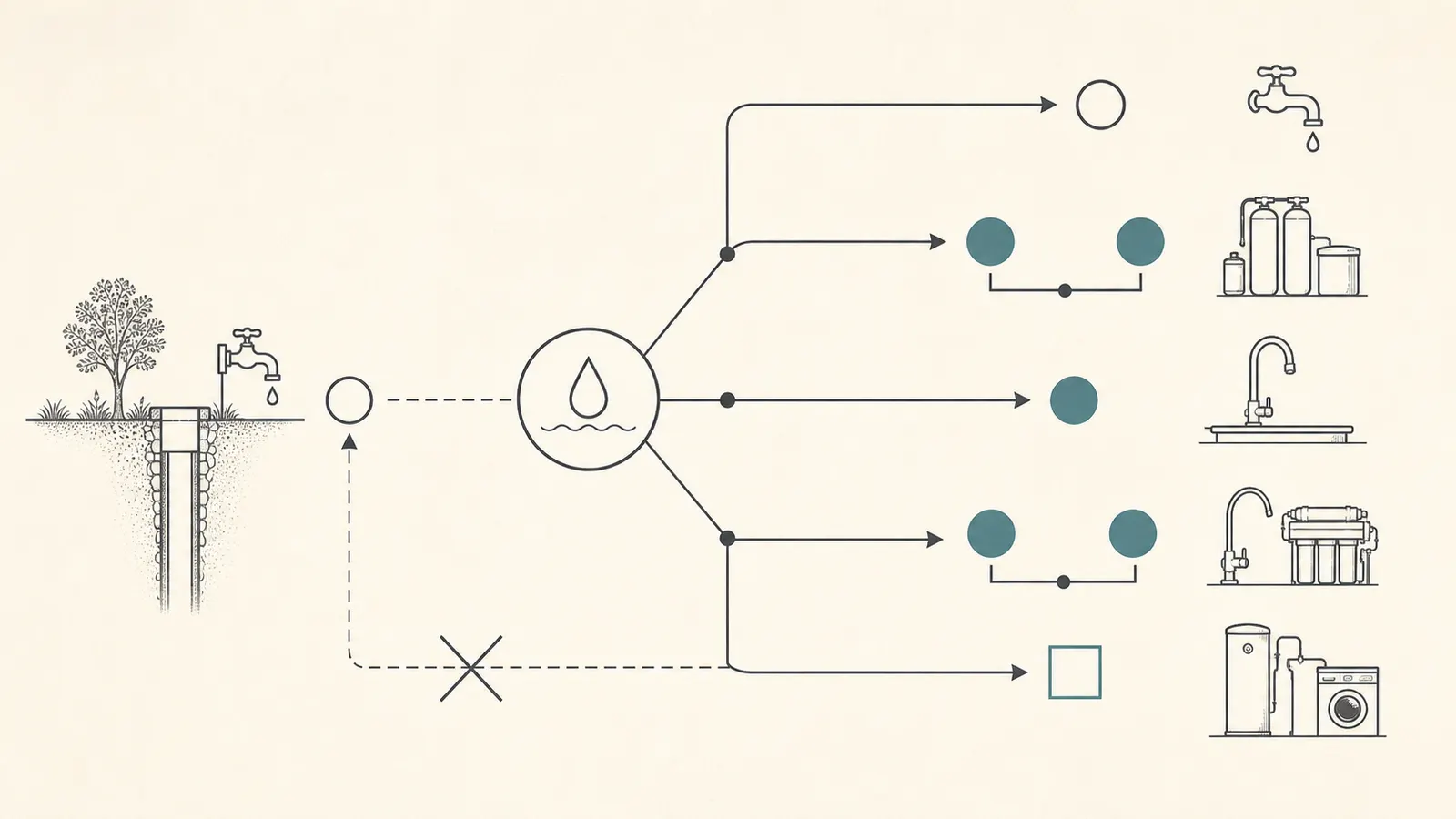
The decision surface below separates five questions that are often collapsed into “test the well.” Choose the row that matches the decision you are about to make, then follow the collection instructions from the laboratory that supplied the bottles. Do not treat a post-treatment result as your well baseline.
1. Choose the tap by the question you need answered #
| Your question | Primary sample location | Raw or treated? | One sample or pair? | What the result can answer |
|---|---|---|---|---|
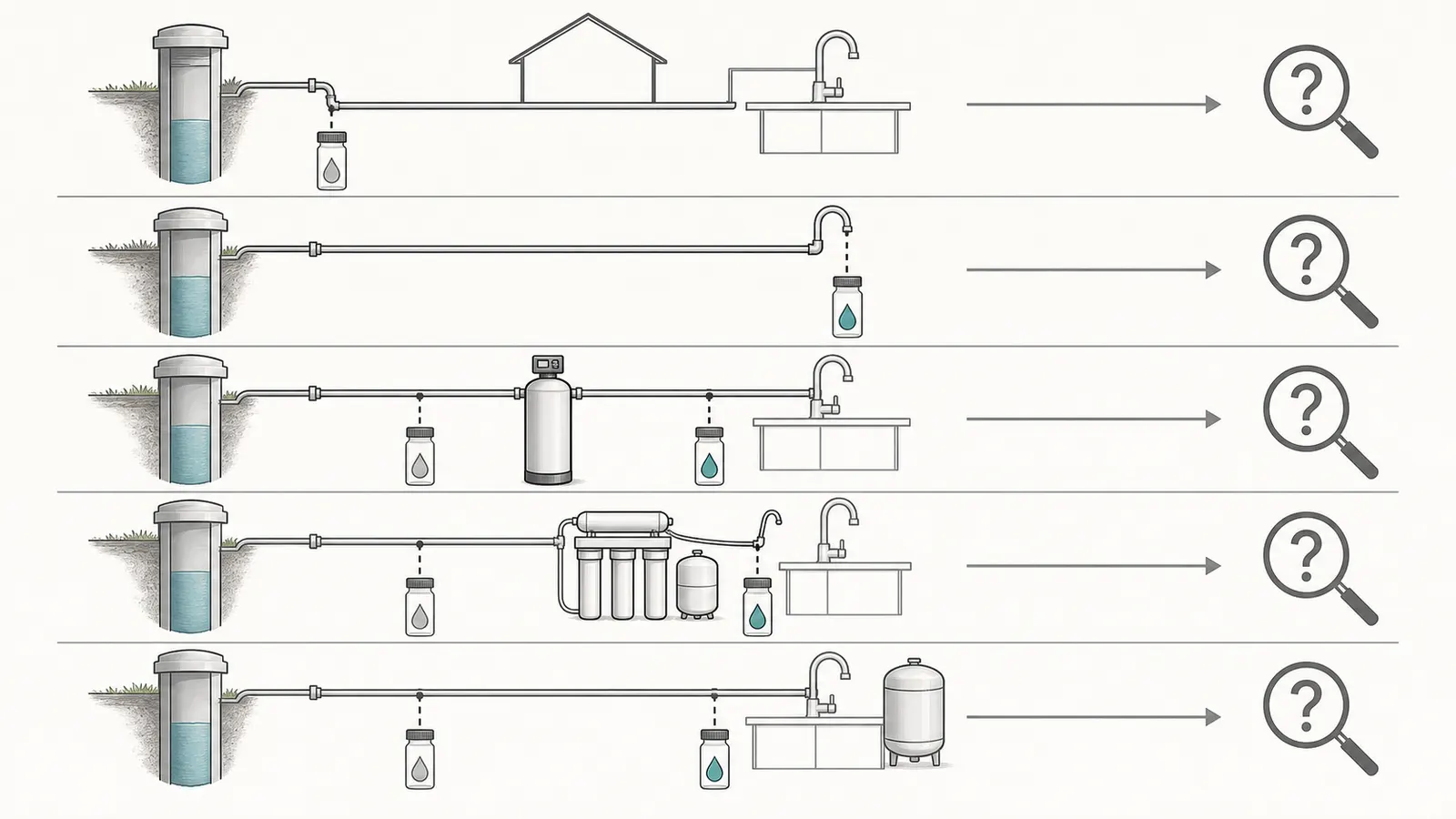
| Is the well source water contaminated? | A tap immediately before treatment; ideally a safe sample tap near the wellhead or pump house | Raw / untreated | One raw sample | What enters the home’s treatment system |
| What water is the family actually drinking? | The cold drinking tap after the treatment that supplies it | Treated | One treated sample, plus raw if source context matters | Exposure at that point of use on the collection day |
| Is a whole-house softener, filter, carbon bed, or UV unit removing the target? | The same raw/pre-treatment point and a treated tap downstream of that unit | Raw + treated | Matched pair | Whether the result changed across that treatment step |
| Is point-of-use reverse osmosis working? | The RO faucet, plus the raw/pre-treatment sample; add the untreated kitchen cold tap if plumbing is in question | Treated at RO + raw | Usually pair; three points for a plumbing question | Source concentration versus RO output, and whether the non-RO line differs |
| Could an untreated pipe, storage tank, or fixture be changing the water? | A near-well or pre-treatment untreated point and a downstream untreated cold tap | Raw + raw | Pair | Whether a parameter changes before treatment, suggesting storage or distribution involvement |
| Is the water heater involved? | Use the lab’s specific hot-water protocol; keep the cold untreated baseline separate | Hot or protocol-defined | Pair when comparing hot and cold | A bounded plumbing or heater investigation, not a source baseline |
Arizona Cooperative Extension explicitly maps these purposes to three locations: wellhead if possible, after a treatment device to check removal, and an inside cold tap receiving no treatment. It says the wellhead and untreated-tap analyses should be the same in principle; if they differ, investigate a cracked pipe, leak, contaminated storage tank, or distribution system. That is a comparison clue, not proof of a particular failure.
When only one bottle is affordable, choose the location that answers the decision with the greatest consequence. For a health baseline, that is normally the untreated pre-treatment point. For a treatment-service visit, a raw-and-treated pair is more useful than two treated taps. For an immediate question about the water being consumed, the treated drinking tap matters—but it does not tell you whether the source is clean.
2. Map the water path before you touch a bottle #
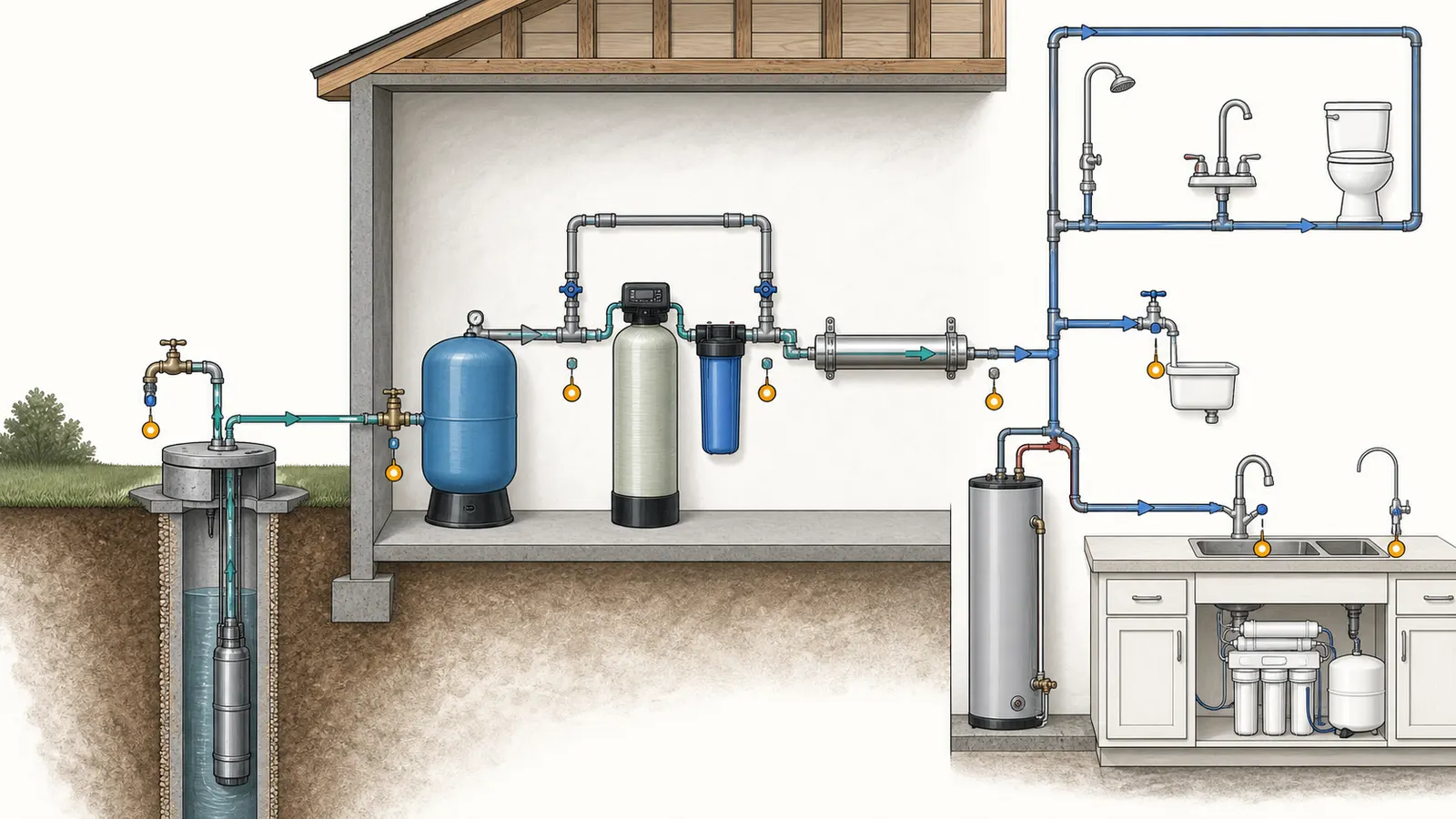
Draw the water path from the well toward the house. You do not need a plumbing drawing suitable for a permit. You need enough detail to identify where water is raw, where it is treated, and where it may spend time in a tank or branch line.
Record these points, in order where you can identify them:
- wellhead or pump-house piping;
- the pump discharge and any pressure or storage tank;
- the first accessible untreated tap or sample spigot;
- sediment filters, cartridge filters, carbon, iron treatment, softeners, oxidizers, or chemical feed;
- UV or other disinfection equipment;
- the treated line feeding the home;
- the cold tap used for drinking and cooking;
- a point-of-use RO faucet, if present;
- the water heater and hot-water branch; and
- any unusual branch, tank, dead leg, hose connection, or fixture that could create a different sample.
The word “before” must mean before the relevant treatment—not merely before the last filter you can see. A softener may change hardness and sodium or potassium. An RO system may reduce salts and other contaminants. A UV unit may disinfect without changing the chemistry in the same way a filter does. The Arizona Extension guide explains that softeners and RO systems change water quality and tells the reader to use a faucet attached to the line before treatment for a source sample.
Do not assume the kitchen cold tap is untreated because it is cold. Do not assume an outdoor faucet is raw because it is outside. Confirm which line each tap receives. If you cannot tell, take a photograph of the piping for a qualified well or water-treatment professional and ask the laboratory which location is acceptable for the analyte you are ordering.
Three layout traps that change the meaning of a tap
The pressure-tank trap. A tap can be physically close to the well and still contain water that has been held in a pressure or storage tank. That does not automatically make it a bad sample point. It means the record should say “after pressure tank” or “after storage,” and the laboratory or sampling professional should decide how much purging is appropriate for the panel. A result from that point is not identical in scope to water sampled before storage.
The bypass trap. A valve handle or labeled bypass does not prove that water is currently bypassing treatment. The valve may be partly open, mislabeled, stuck, or feeding a branch that does not serve the tap you selected. Treat the visible label as a clue. Trace the line without opening covers or pressurized housings, and record whether the treatment unit was visibly in service, bypassed, regenerating, or unknown. If the state cannot be confirmed safely, call for a professional verification.
The mixed-fixture trap. A faucet with a lever or mixing feature, a swivel spout, an aerator, a hose bib, or a fixture with a long unused branch may not be the best location for a particular test. The laboratory’s instructions may specifically exclude or permit it. A cold tap that is routinely used can be easier to flush consistently than a rarely used outlet, but convenience does not override the need to identify the treatment path. Record the fixture type and whether the lab directed you to remove an aerator or screen.
If a professional tells you to use an existing sample tap, ask one useful question: “What does this bottle represent—water before treatment, water after treatment, or water after storage and building plumbing?” Write the answer beside the bottle ID. That single sentence can prevent a later reviewer from comparing unlike samples.
What “raw,” “untreated,” and “treated” mean here
Use labels that describe the water’s path, not a vague adjective:
- Raw / pre-treatment: collected before the treatment unit relevant to the question. This is the normal baseline category.
- Untreated downstream: water that has not passed through the named treatment, but may have passed through a pressure tank, storage tank, or building plumbing.
- Treated whole-house: water after a treatment unit that is intended to serve multiple fixtures.
- Treated point-of-use: water after a device at one fixture, such as an RO faucet.
- Hot-water sample: water that has passed through the water heater; it is not interchangeable with a cold raw sample.
This vocabulary prevents a common error: calling an untreated kitchen tap “raw” when it is actually downstream of a storage tank and several feet of building plumbing. It may still be the correct location for a distribution comparison, but its result represents more than the aquifer.
3. Use one raw sample for a source-water baseline #
Choose the closest safe pre-treatment tap you can access. A dedicated sample tap near the wellhead or pump house is useful when it is installed for sampling and the laboratory accepts it. Otherwise, use a verified tap on the water line before the treatment train. A bathtub cold faucet can sometimes be useful as a pre-treatment indoor point if it is on the raw line; Arizona Extension identifies that as a possible source-water location.
EPA’s potable-water supply sampling procedure says the ideal sample is at or near the wellhead and before storage tanks or treatment units. A household arrangement may not provide that exact point, so document what the tap is actually before and after. If a sample must be collected beyond a pressurization or holding tank, the EPA procedure calls for enough purging to exchange water in the tank and at the collection location under its specified conditions. Your lab may provide a different analyte-specific procedure; its current instructions govern.
A source sample answers a narrow question
A raw result helps you understand what enters the treatment equipment and gives a defensible comparison point for a treatment decision. It can support questions such as:
- What contaminant panel should be discussed with the health department or lab?
- Is the proposed treatment aimed at a contaminant that is actually present?
- Is the source concentration changing over time?
- Did a treatment unit reduce the parameter compared with the same-day raw sample?
It does not by itself prove that every fixture receives the same water. It does not prove that a treated tap is safe when the treatment unit is unmaintained, bypassed, overloaded, or supplied by a different branch. It also does not answer whether the family’s RO faucet, hot water, or downstream storage has introduced a separate issue.
Do not improvise a bypass
USGS may bypass equipment as part of a planned sampling review. A homeowner should not disconnect plumbing, open a filter housing, defeat a UV safety interlock, open a well cap, manipulate a pressure switch, or change energized controls to create a raw sample. If the only apparent pre-treatment point requires opening a pressurized housing or electrical enclosure, stop and ask a qualified well or water professional to identify a safe sample tap. The goal is a representative sample, not a risky plumbing experiment.
4. Add a treated sample when the decision is about treatment #
A treated sample is not a lesser version of the raw sample. It is a different measurement with a different purpose. Take it when you need to know what reaches a drinking tap, or when you need to evaluate removal across a treatment unit.
For a whole-house unit, collect the raw sample and the treated sample as close together in time as practical, using the same laboratory, panel, bottles, and collection conventions where the lab permits. Label the pair so the lab and any reviewer can tell that the samples are intended for comparison. A pair is strongest when the raw and treated samples represent the same operating state: same day, same treatment setting, same bypass status, and no cartridge change between them.
The comparison also needs a defined “before” and “after.” If a sediment cartridge is upstream of carbon and the sample is taken between them, it is a post-sediment/pre-carbon sample. That may be valuable, but it should not be called the result for the complete system. If a softener regenerates between the two bottles, the pair may reflect different operating states rather than removal performance. If a UV lamp is in an alarm condition, the result may describe an alarmed system rather than normal operation. Write these conditions down even when they seem obvious; service visits often happen weeks after collection.
Whole-house treatment
Place the treated sample after the unit being evaluated and before another treatment step that could change the answer. For example, if you want to evaluate a carbon filter, do not collect the “treated” bottle after an RO system as well. If you want to evaluate the entire treatment train, identify every step between raw and treated and label the sample “post-whole-house train,” not merely “filtered.”
For UV, the post-UV tap tells you about water after the UV chamber only if the sample point is actually downstream of the unit. A UV system can have a power, lamp, intensity, flow, or pretreatment dependency. A treated sample taken when the unit is bypassed or alarmed is not a valid performance check. Record the unit’s operating or alarm state and ask the lab whether its bacteria sampling protocol is appropriate for a treated sample.
For softeners and ion exchange, record whether the unit was in service, in regeneration, or bypassed. Because the unit intentionally changes water chemistry, a post-softener sodium, hardness, or chloride result cannot be interpreted as the well’s raw value. It may be exactly the result you need for the drinking-water question and the wrong result for the source baseline.
Point-of-use reverse osmosis
An RO faucet is a special case because it may serve only one tap. A sample from it answers “what comes out of this RO faucet?” It does not represent water from the shower, ice maker, bathroom, or other fixtures unless those fixtures receive the same treatment.
For an RO performance check, collect:
- a raw or pre-treatment sample;
- an RO-faucet sample; and
- if the comparison is confusing, an untreated cold sample at the kitchen or drinking location before the RO branch.
The third point helps separate an RO result from a branch-plumbing issue. If the raw and untreated kitchen samples differ, investigate the plumbing or storage path before attributing the difference to RO. If raw and untreated kitchen samples agree but the RO sample is different, the difference is more plausibly associated with the RO path—but confirm with the lab and the equipment’s maintenance and performance records.
Do not infer that a low RO result proves the entire home’s water is treated. Do not infer that a high RO result proves the membrane alone failed. The result may depend on pretreatment, filter and membrane age, tank condition, flow, pressure, maintenance, and the selected analyte. Bring the RO model, filter-change dates, any service notes, and the lab’s full report to a qualified evaluator.
5. Use paired samples to investigate plumbing or storage #
A raw-and-treated pair asks whether treatment changed the water. A raw-and-raw pair asks whether something between two untreated locations changed it. That second design is useful when the wellhead or near-pump result seems different from a downstream untreated tap.
Choose a near-well or pre-treatment point and an untreated indoor cold tap that is confirmed to bypass treatment. Keep the labels explicit: “raw-near-well” and “untreated-downstream,” not “sample A” and “sample B.” If the downstream point is beyond a pressure tank or storage tank, record that. If it is in a building, record the fixture and whether it is a swivel, mixing, leaking, or aerated faucet.
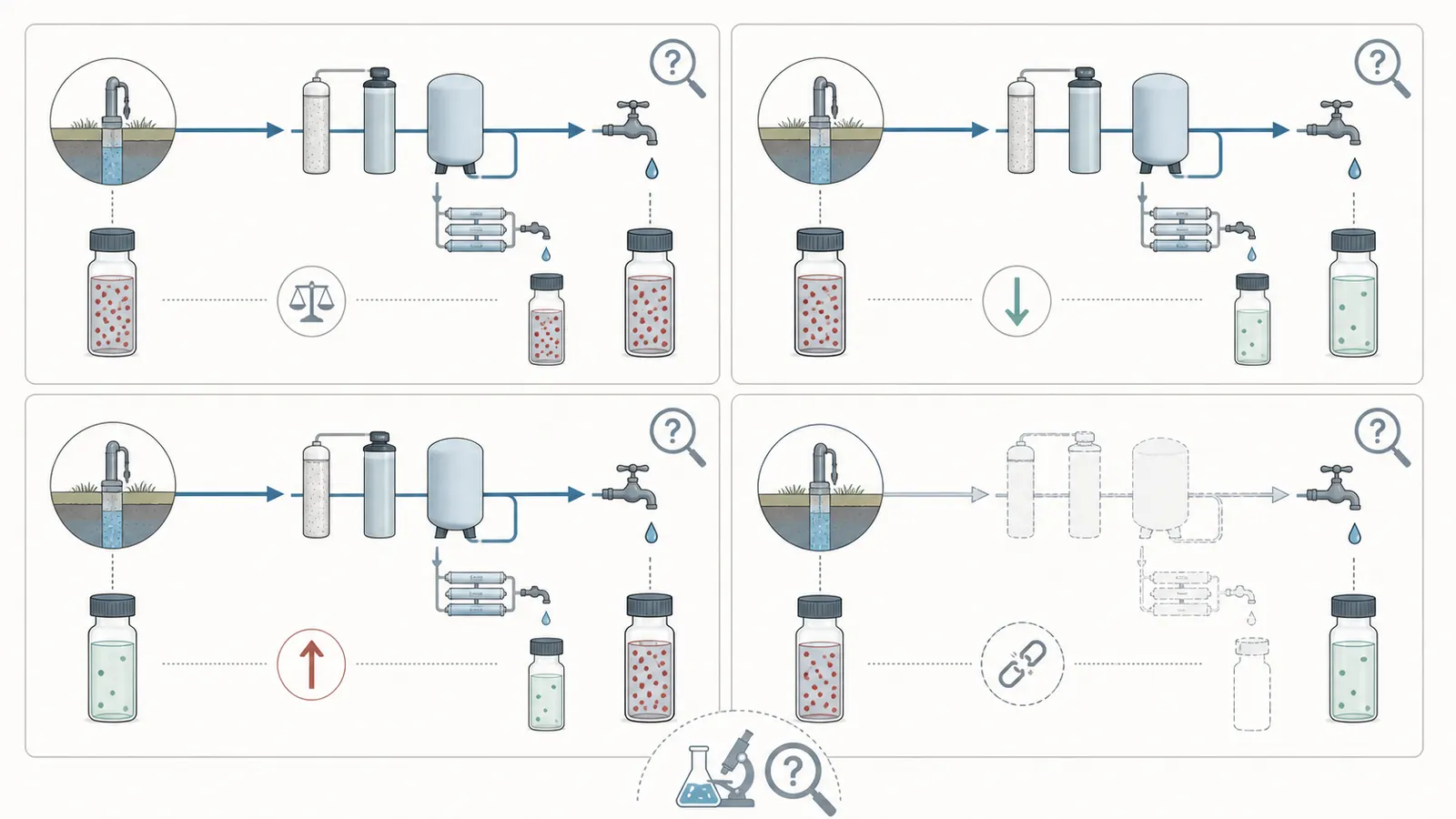
| Pattern | What it suggests | What it does not prove | Safest next step |
|---|---|---|---|
| Raw near well and untreated downstream are similar | The sampled path is broadly consistent for the tested parameters on that day | That every branch, hot line, or treatment unit is sound | Keep the record; add a treated sample if treatment is the question |
| Raw near well is elevated and downstream untreated is also elevated | The parameter is present before treatment and persists downstream | The contaminant’s exact source, health significance, or treatment solution | Ask the lab or health department about confirmation and treatment scope |
| Raw near well is low but downstream untreated is higher | A downstream pipe, tank, fixture, or sampling condition may be contributing | That the well itself is clean for all contaminants or that the pipe is definitely the cause | Recheck with lab-directed sampling and have the plumbing reviewed |
| Raw near well is elevated but treated is lower | Treatment may be reducing the tested parameter | That the unit removes every contaminant, works at peak demand, or will keep working without maintenance | Verify the panel, treatment state, maintenance, and retest plan |
| Raw and treated are unexpectedly identical | The unit may not target that parameter, may be bypassed, exhausted, undersized, or sampled at the wrong point | Which failure mode occurred | Check the flow path and service records; ask a qualified evaluator |
| Results cannot be compared | Bottles, analytes, timing, locations, preservation, or treatment state differed | That the water changed or treatment failed | Ask the lab whether a repeat pair is required |
Arizona Extension uses this comparison logic, noting that a difference between a wellhead sample and an untreated tap could involve a cracked pipe, leak, contaminated storage tank, or distribution system. A paired result narrows the next question; it does not identify a defect without inspection and appropriate repeat sampling.
Do not use appearance as a substitute for the pair
Taste, odor, color, cloudiness, and staining can be useful observations to record, but they do not define a safe sample location or a complete contaminant panel. Some contaminants have no taste, color, or smell. A clear post-RO sample is not a source-water baseline. A rusty-looking raw sample is not a complete diagnosis. Write down what you observed and let the laboratory and local public-health guidance determine the analytes and interpretation.
6. Follow the laboratory’s collection protocol exactly #
The location decision comes first, but collection quality can still invalidate a well-planned comparison. Purdue Extension advises using the laboratory’s collection bottles and forms, choosing a point close to the pump and before treatment for most tests, removing the aerator, disinfecting the faucet, clearing the line, and delivering the sample within the laboratory’s required window. It also notes that some tests, such as lead, require a different standing-time protocol. Do not apply a generic “run the tap for five minutes” rule to every analyte.
Before sampling:
- Call the laboratory and state your purpose: raw baseline, drinking tap, whole-house performance, RO performance, or untreated distribution comparison.
- Ask whether the lab accepts homeowner-collected samples for the selected panel and whether a certified collector is required in your jurisdiction or program.
- Obtain the lab’s bottles; do not substitute a household jar.
- Ask whether the panel requires preservatives, zero headspace, field blanks, sterile bottles, special caps, cooling, or same-day delivery.
- Confirm the lab’s receiving days and holding time before you open a tap.
- Mark which treatment units must remain in service and which must be bypassed, but only use an existing safe bypass or a professional’s direction.
During sampling, follow the bottle and analyte instructions. General practices may include washing hands, using a clean non-leaking cold tap, removing an aerator or screen when the protocol calls for it, flushing the line, reducing flow for volatile-organic sampling, and avoiding contact with the bottle interior or cap. Those are not universal substitutions for the lab’s protocol.
For bacterial work, the handling boundary is tighter. Arizona Extension says bacterial samples require sterile containers and careful handling, recommends prompt refrigeration without freezing, and directs the collector to record the date, time, and location. It also warns that mailing bacterial samples is not recommended in its guidance because delays can affect reliability. Ask your lab whether it requires same-day drop-off, a courier, or a certified sampler.
A sample record that travels with the bottles
Use one row per bottle. This is a homeowner record, not an official chain-of-custody form; complete the laboratory’s form separately.
| Field | What to write |
|---|---|
| Bottle ID | The lab’s bottle number or your paired ID, such as RAW-01 and RO-01 |
| Exact location | “Dedicated tap 3 ft after wellhead,” “basement cold tap before softener,” or “RO faucet at kitchen sink” |
| Water category | Raw/pre-treatment, untreated-downstream, treated-whole-house, treated-RO, or hot/protocol-defined |
| Treatment state | In service, bypassed using existing safe valve, regenerating, alarmed, recently serviced, or unknown |
| Date and time | Collection time, not only the day |
| Flush or standing condition | Follow the lab’s instruction and record what you actually did |
| Cold/hot and fixture details | Cold line, hot line, swivel or non-swivel, aerator removed or left in place per protocol |
| Observations | Clear/cloudy, color, odor, sediment, recent change, unusual pressure or flow |
| Maintenance context | Filter, softener salt, UV lamp, RO filter or membrane change date if relevant |
| Delivery | Drop-off or courier time, cooler/ice use if required, receiving laboratory |
This record is what keeps “treated” from becoming an ambiguous label six months later. Arizona Extension specifically directs collectors to write down the date, time, and location for each sample. Keep the report, the record, treatment invoices, maintenance dates, and any well or plumbing diagrams together.
7. Interpret the result without crossing the safety boundary #
Start by asking whether the laboratory actually received comparable samples. Compare the analyte, unit, detection limit, collection time, sample category, preservation, and treatment state. A raw sample reported in mg/L and a treated sample reported in a different unit cannot be compared until the lab confirms the conversion. A “not detected” result is bounded by the method’s detection limit; it does not mean absolute zero.
Then ask which of these statements the evidence supports:
- Source statement: “This raw/pre-treatment sample contained the reported result at this location and time.”
- Exposure statement: “This treated drinking tap produced the reported result at this location and time.”
- Treatment statement: “The paired samples differed across the identified treatment path under the recorded operating conditions.”
- Distribution statement: “The two untreated locations differed for the tested parameter under the recorded collection conditions.”
Do not turn those into broader statements such as “the well is safe,” “the filter works for everything,” or “the plumbing is contaminated” without the appropriate panel, repeat sampling, health benchmark, and professional review. Barnstable County notes that private-well owners are responsible for water quality and for treatment-system design, installation, monitoring, and maintenance in its Massachusetts program. Other states and local programs may assign different responsibilities or reporting steps.
If a result is elevated or bacteria is detected
Use the lab’s notification and health guidance. Contact your local or state health department for the current interpretation of the contaminant, the household’s vulnerability, and any jurisdiction-specific requirements. Do not select treatment from a single post-treatment result, and do not assume that a raw result can be ignored because the treated tap was lower.
If the result could pose an immediate health concern, ask the laboratory or health department what water uses should stop and what alternate water is appropriate while the result is confirmed or addressed. For bacteria, ask whether a certified sampler or lab-directed repeat is needed; home sampling can be contaminated by poor technique. For a treatment-performance concern, keep the treatment in its documented state until a qualified professional or the laboratory advises the next comparison, rather than opening housings or changing settings while the evidence is still being collected.
Stop-and-call boundaries for homeowners
Moderate safety does not mean every visible tap is safe to manipulate. Do not open energized electrical controls. Do not test live wiring. Do not open a well. Do not pull a pump. Do not enter a well pit or other confined space. Do not disconnect pressurized piping, open a pressurized filter housing, or change pressure-switch or treatment controls to manufacture a sample location. Do not defeat a UV interlock or handle treatment chemicals as part of sampling unless the specific manufacturer and professional procedure makes that action demonstrably safe and appropriate.
The safe homeowner contribution is to identify accessible taps, photograph the visible flow path without removing covers, record treatment status, collect only with the laboratory’s approved kit and instructions, and bring the sample record and maintenance history to the lab or qualified professional. Ask the professional to identify the raw sample point, any safe existing bypass, and whether the home needs a paired raw/treated or raw/raw comparison.
The durable rule is simple: sample before treatment when you are asking about the well; sample after treatment when you are asking about the water delivered by that treatment; sample both when you are asking whether the treatment changed the result. Add a second untreated point when the problem may live in storage or distribution plumbing. Label the path, preserve the laboratory’s instructions, and keep every result tied to the exact tap that produced it.
Cite this guide
Brictale. “Where Should You Sample Private Well Water With Treatment Equipment?.” Published 2026-09-02; updated 2026-09-02.
https://brictale.com/water/wells/where-to-sample-private-well-water-before-or-after-treatment · Read the Markdown version
Sources and scope
Evidence behind this page
- Barnstable County says water collected after a treatment system or filter may not reflect well-water quality and directs homeowners with treatment to use a tap before the treatment unit for an untreated sample.
Free Water Testing of Private Wells
Barnstable County, Massachusetts private-well sampling program guidance; it establishes the raw-baseline distinction but does not create a nationwide sampling law.
Accessed · Link to this claim - Arizona Cooperative Extension recommends, when possible, analyzing water at the wellhead, after a treatment device, and at an inside cold tap receiving no treatment; it explains that the first two untreated locations should be comparable and differences may indicate a pipe, leak, storage tank, or distribution problem.
Well Water Testing and Understanding the Results
University of Arizona Cooperative Extension guidance for private well owners; the wellhead step is conditional on access and safe, lab-directed collection.
Accessed · Link to this claim - Arizona Cooperative Extension distinguishes a source-water question from a drinking-water question: a source sample comes from a faucet before treatment, while water actually being used is sampled at the drinking tap; it notes that softeners and reverse osmosis change water quality.
Well Water Testing and Understanding the Results
University of Arizona Cooperative Extension discussion of treatment-device effects; it does not establish that any particular unit is functioning correctly.
Accessed · Link to this claim - USGS describes a plumbing review intended to obtain a raw, untreated sample representative of the aquifer and lists softeners, filters, and ultraviolet systems among treatment equipment that may need to be bypassed before sampling.
Well Water Sampling Procedures
U.S. Geological Survey Pennsylvania Water Science Center procedure description; bypassing is a sampling-design step and should not be performed by manipulating unsafe or pressurized equipment.
Accessed · Link to this claim - New Jersey DEP’s Private Well Testing Act guidance requires untreated groundwater for the Act’s testing, and says that if treatment exists the sample must be collected before the water goes through treatment; without treatment, it allows a cold, non-aerated tap.
New Jersey Private Well Testing Act (PWTA)
New Jersey’s property-sale and lease testing program; this is a New Jersey legal/program requirement, not a national rule.
Accessed · Link to this claim - Purdue Extension’s general sampling procedure says to take most water-test samples close to the pump and before water passes through a treatment system, use the laboratory’s collection bottles, remove the aerator, clear the line, and follow the lab’s timing and storage directions.
WQ-3: How To Take A Water Sample
Indiana-focused Purdue Extension homeowner guidance; exact preservation, holding time, and collection details vary by analyte and laboratory.
Accessed · Link to this claim - EPA’s 2025 potable-water supply sampling procedure says the ideal sample is at or near the wellhead and before storage tanks or treatment units; if sampling beyond a tank, enough water must be purged to exchange the tank and sample location, subject to the procedure’s specific conditions.
EPA sampling procedure effective April 16, 2025; it provides technical sampling guidance and does not turn every household tap into a required federal sample point.
Accessed · Link to this claim - Arizona Cooperative Extension says bacterial samples require sterile containers and careful handling, recommends prompt refrigeration without freezing, and directs the collector to record each sample’s date, time, and location for the laboratory.
Well Water Testing and Understanding the Results
University of Arizona sampling instructions; the selected laboratory’s current bottle, preservation, holding-time, and transport instructions control.
Accessed · Link to this claim - Barnstable County frames an untreated pre-treatment sample as the baseline for private-well quality and separately states that treatment-system design, installation, monitoring, and maintenance are the owner’s responsibility in Massachusetts.
Free Water Testing of Private Wells
Barnstable County program and Massachusetts private-well context; responsibilities and local reporting can differ by jurisdiction.
Accessed · Link to this claim