PFAS Found in Private Well Water: A Homeowner Action Worksheet
Turn a private-well PFAS result into a safe-use boundary, confirmation plan, treatment choice, certification check, and post-install test record.
The short answer
Preserve the report, confirm the named compounds and method with a state-certified laboratory, and ask your state health or environmental agency which comparison level applies. Until advised otherwise, use an alternate source for drinking, cooking, food preparation, brushing teeth, and infant formula. Choose point-of-use or point-of-entry treatment only after matching the exact PFAS claim, capacity, maintenance schedule, and post-install verification plan.PFAS Found in Private Well Water: A Homeowner Action Worksheet
If a private-well report found PFAS, preserve the original report, stop using the result as a drinking-water decision until you understand what was actually measured, and contact your state environmental or health agency. Ask a state-certified laboratory how to confirm the result using an appropriate drinking-water method. Until you receive specific advice that the source is suitable, use an alternate water source for drinking, preparing food, cooking, brushing teeth, preparing infant formula, and other activities in which someone may swallow the water. EPA gives this ingestion-focused alternate-source advice for PFAS in private wells, and ATSDR lists the same exposure-reduction boundary while directing people to local agencies for testing and interpretation.
Do not boil the well water to solve PFAS. NSF says boiling water containing PFAS will not reduce exposure risk. Do not buy a filter because it says “carbon,” “chemical reduction,” or “PFAS-ready.” First match the named compound, concentration, units, sample point, laboratory method, treatment location, exact model, certified reduction claim, capacity, maintenance schedule, and post-install test plan.
1. Put an immediate safe-use boundary around the result #
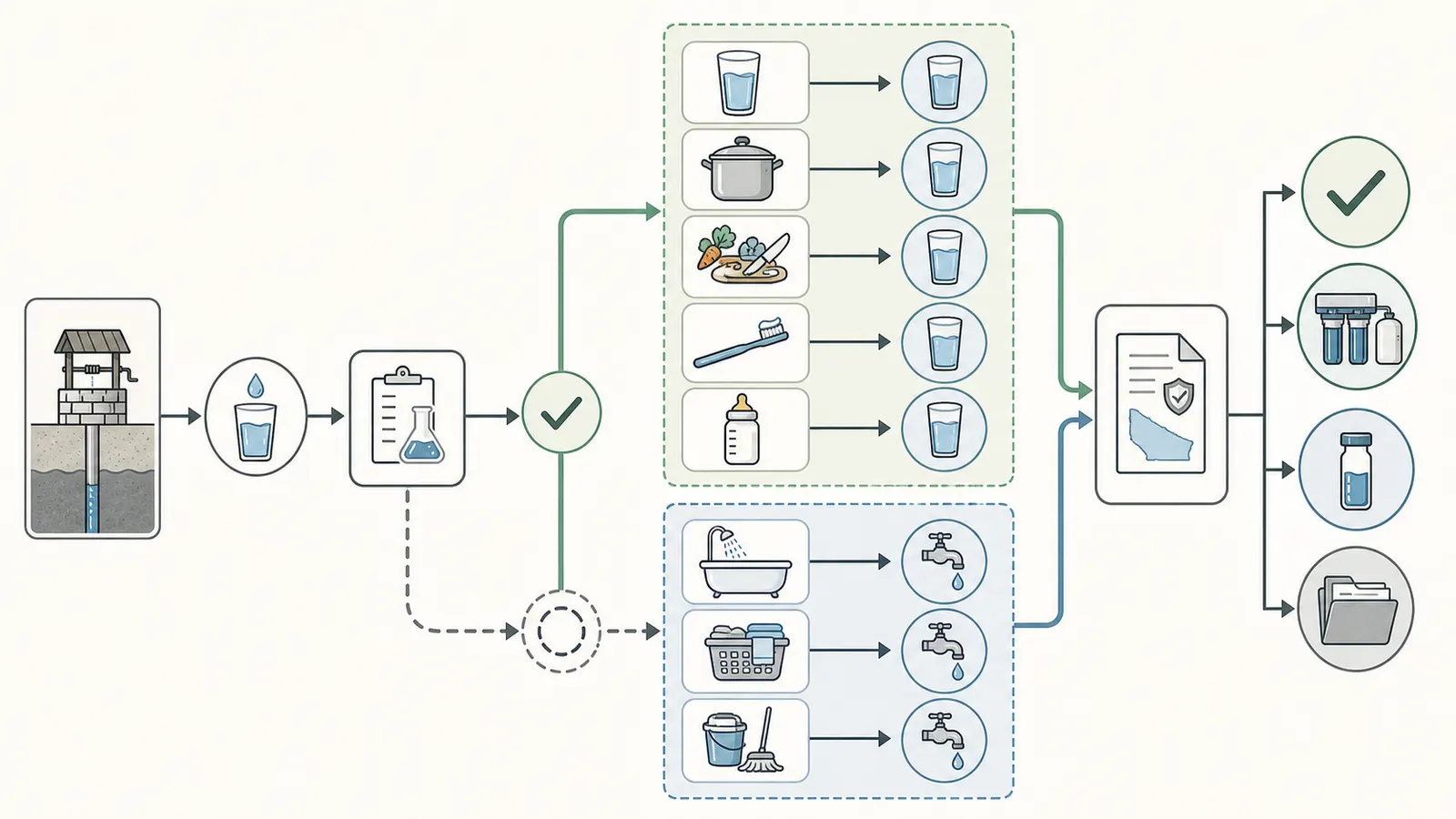
A positive result is a reason to reduce ingestion exposure and clarify the evidence, not a reason to panic or to assume that every use of the home’s water has the same instruction. EPA says the meaning of a result above a federal drinking-water standard depends on the level, the amount and duration of exposure, and individual factors; EPA also says it does not regulate or provide recommended standards for private wells. Read EPA’s private-well PFAS guidance before treating a federal number as a household order.
Use this first-pass boundary while you contact the relevant authority:
| Water use | Conservative interim decision | Why this belongs in the record |
|---|---|---|
| Drinking, ice, beverages, cooking, food preparation | Use alternate water tested for PFAS when advised | These are direct ingestion routes named by EPA and ATSDR. |
| Brushing teeth and infant formula | Use the same alternate source when advised | Small amounts can still be swallowed; infant formula is specifically named by both agencies. |
| Pets or livestock | Ask the state or local health authority; do not assume pets are outside the advice | The report may trigger a site-specific exposure decision. |
| Bathing, showering, handwashing, laundry, toilets, irrigation | Do not invent a universal rule; follow the state or health-authority instruction for your result | EPA’s private-well PFAS page gives an ingestion boundary, not a national instruction for every non-ingestion use. |
| Boiling the water | Do not use boiling as PFAS treatment | Boiling does not reduce PFAS exposure risk. |
This boundary is not a determination that the well water is dangerous for every possible contact. It is a way to prevent a common failure: continuing to swallow untreated water while a homeowner researches filters. If a state, county, tribal, or federal authority has issued a more restrictive advisory, follow that advisory. If anyone has a health concern about prior exposure, EPA recommends discussing it with a doctor; this worksheet cannot assess individual health risk.
Keep two separate questions in view:
- What was in the water at the sampled point? This is the laboratory question.
- What water can the household safely use while the result is clarified or treated? This is the exposure-management question.
The first question may need a repeat sample. The second should not wait for a sales representative to define it.
2. Preserve the report and confirm what was measured #
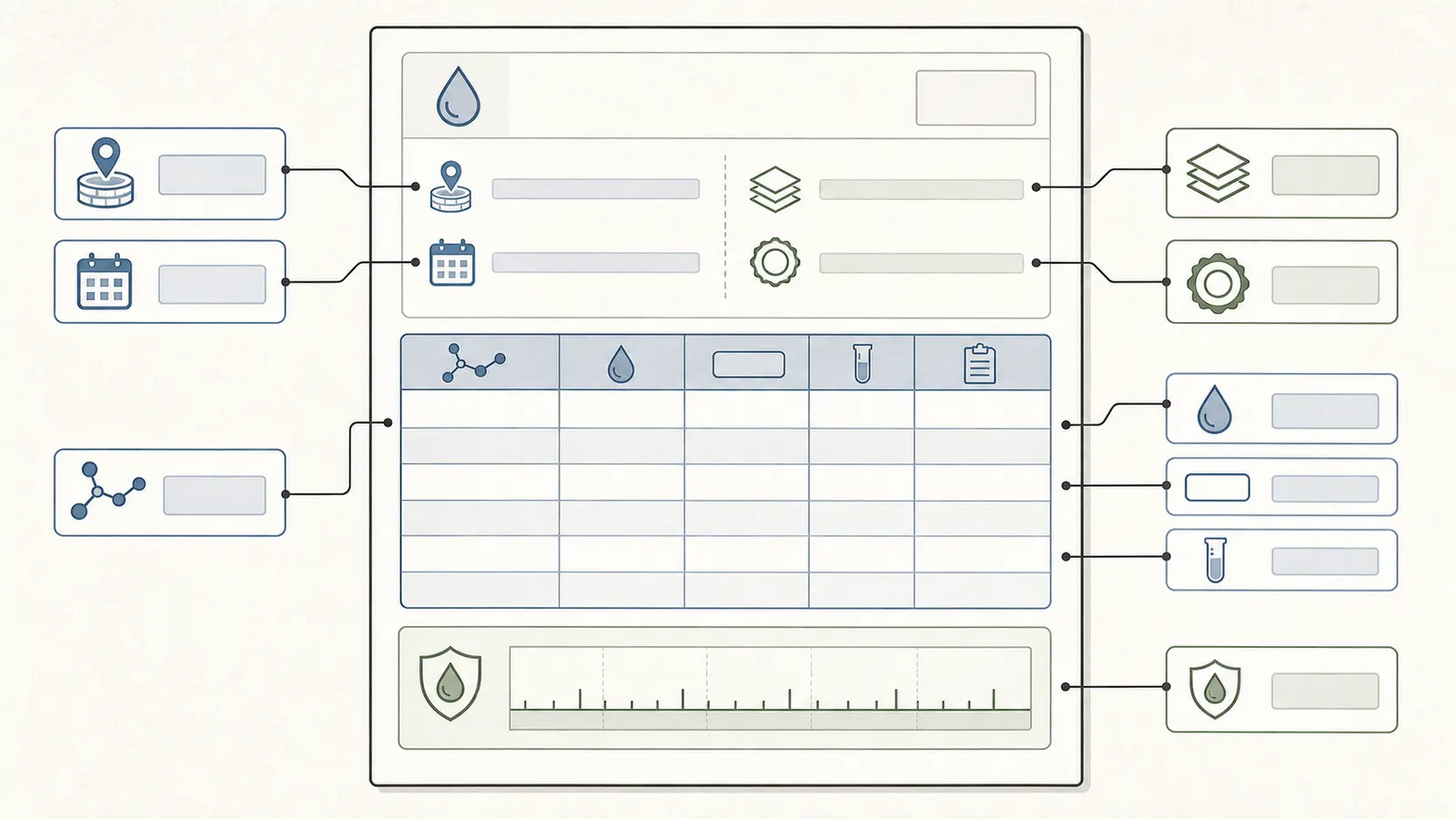
Save the original PDF, laboratory narrative, chain-of-custody record, sample-kit instructions, invoice, and any email that explains the result. Do not copy only the largest number into a text message. A PFAS report is useful only when the number stays attached to its compound, units, method, reporting limit, sample point, and collection date.
Fill in this evidence strip before calling a laboratory or treatment professional:
| Report field | Record exactly | What it changes |
|---|---|---|
| Named analyte(s) | ____________________ | PFOA, PFOS, PFHxS, PFNA, HFPO-DA/GenX, PFBS, and other PFAS are not interchangeable claims. |
| Result and units | ____________________ | For water, ng/L is numerically equivalent to parts per trillion; do not silently convert other units. |
| Reporting limit or MRL | ____________________ | A non-detect is not the same as zero; it is a result relative to the laboratory’s reporting capability. |
| Method and version | ____________________ | EPA Methods 533 and 537.1 cover different analyte sets and method versions matter. |
| Laboratory and state status | ____________________ | EPA directs homeowners to ask the state laboratory-certification program about suitable labs. |
| Sample point | ____________________ | Untreated well water, a pressure-tank outlet, a kitchen tap, and post-filter water answer different questions. |
| Collection date and time | ____________________ | PFAS results are time- and location-specific observations. |
| Treatment operating at sampling | yes / no / unknown | A sample after treatment cannot prove the untreated source is clean. |
| Blank, qualifier, or data-quality note | ____________________ | Ask the lab to explain flags before comparing the result. |
EPA says Methods 533 and 537.1 can measure 29 PFAS in drinking water. That does not mean every laboratory panel measures all 29, and it does not mean that a report labeled “PFAS” covers every PFAS in existence. EPA also says techniques other than Methods 533 and 537.1 may be appropriate for some purposes but have not been evaluated by EPA for UCMR 5 or the PFAS National Primary Drinking Water Regulation. Ask the laboratory which method, version, analyte list, and reporting limits apply to your decision.
Sampling quality matters at very low concentrations. EPA’s PFAS sampling guidance warns against glass and contact with water-, oil-, or stain-resistant materials, directs samplers to use nitrile gloves, and requires recording the sample location and collection information in the public-system context. A homeowner kit may have different steps, so follow the receiving laboratory’s kit exactly. Do not decant the sample into a household jar, reuse a bottle, add a preservative, or improvise a “cleaner” tap. If the first result is unexpected or close to a comparison level, ask whether the laboratory or state program recommends a confirmation sample and whether it should be collected at the same point or at a different point.
When you call, ask five precise questions:
- Was the laboratory certified or otherwise accepted by my state for this kind of drinking-water PFAS analysis?
- Which compounds were included, and which important compounds were not included?
- Which EPA method and version were used, and was it a standard or modified method?
- What are the reporting limit, qualifiers, and blank results?
- For a confirmation sample, what exact bottle, tap preparation, holding time, shipping, and sample point should I use?
EPA directs individual homeowners to contact their state laboratory certification program for current laboratory recommendations. A mail-order kit can be convenient, but convenience is not the same as state acceptance or a method that answers the question you need answered.
3. Compare the result without confusing standards and risk #
Federal PFAS levels are a comparison reference, not a private-well permit. EPA’s current PFAS rule page lists the 2024 public-system MCLs as 4.0 parts per trillion for PFOA and PFOS, 10 parts per trillion for PFHxS, PFNA, and HFPO-DA, and a unitless hazard-index MCL of 1 for mixtures containing two or more of PFHxS, PFNA, HFPO-DA, and PFBS. EPA’s table also states that those MCLs apply to public water systems and notes proposed federal changes announced in May 2026. EPA separately states that private wells are not federally regulated under the Safe Drinking Water Act. Use the EPA rule page for a dated federal comparison, then check your state’s current private-well guidance.
Record the comparison like this:
| Analyte | Reported result | Unit | Comparison level and authority | Comparison result | Next question |
|---|---|---|---|---|---|
| PFOA | ______ | ______ | ______ | ______ | Is the lab result confirmed and does the treatment claim name PFOA? |
| PFOS | ______ | ______ | ______ | ______ | Is the lab result confirmed and does the treatment claim name PFOS? |
| Other named PFAS | ______ | ______ | ______ | ______ | What state or health-agency level applies to this compound? |
| Mixture or hazard-index result | ______ | ______ | ______ | ______ | Has the agency supplied the inputs and calculation method? |
For one compound, a screening comparison can be written as:
reported concentration ÷ stated comparison level = comparison ratio
Example with placeholders only: if a report says A ng/L and the agency supplies B ng/L as the comparison level, record A ÷ B = ____. This is a comparison ratio, not a diagnosis, a probability of illness, or proof that water below the ratio is risk-free. Do not calculate a mixture hazard index from a product brochure or from rounded numbers. Ask the state agency or laboratory which analytes, units, reporting limits, and rounding rules it expects.
The federal picture is moving. As of August 23, 2026, EPA’s current rule page says one proposed rule would retain the PFOA and PFOS NPDWR while allowing some public systems to seek two more years, and another proposed rule would rescind the 2024 regulations for PFHxS, PFNA, HFPO-DA, and the related mixture hazard index. Those proposals concern public systems and are not a reason to use a private well without an exposure plan. Record the access date beside every comparison level so a future retest is not judged against a stale screenshot.
Also avoid a health inference from a single number. EPA says that a result above a federal standard does not necessarily mean adverse health effects will occur and identifies level, amount and duration of exposure, and individual factors as relevant. That statement should make the plan more precise, not more casual: reduce ingestion exposure, confirm the data, obtain agency guidance, and arrange a treatment or alternate-source decision.
Questions for the state or local agency
The agency conversation should produce an action record, not just a copied web link. Ask which private-well guidance applies in your state and whether the result changes the recommended use of the water. Ask whether the agency recognizes the laboratory and method used, whether it wants a same-point confirmation sample, and whether it recommends testing a broader PFAS panel or other well contaminants. Ask whether the area has an investigation, known source, public-water connection option, alternate-water program, treatment assistance, or a site-specific advisory. Finally, ask when the next sample should be taken and whether the agency wants a post-treatment result sent to it.
Write down the agency’s exact wording when it distinguishes a benchmark, screening level, health advisory, interim value, state standard, or public-system MCL. Those labels are not interchangeable. A benchmark helps interpret a result; it does not prove that a sample below it is risk-free. A public-system MCL governs a covered water system; it does not make a private well compliant. A treatment certification validates a product claim; it does not replace a state use recommendation. Keeping those roles separate prevents a homeowner from using the most reassuring number as though it answered every question.
If the result came from a consultant, real-estate transaction, neighbor, cleanup investigation, or product seller rather than from your own state-accepted laboratory, preserve it but identify its purpose. A screening sample may be adequate to trigger follow-up without being the final record for a treatment decision. A sample from a kitchen tap may describe that tap’s plumbing and any treatment in its path, not the well source. A sample collected after a filter may show treated water without telling you whether the filter was new, loaded, bypassed, or correctly installed. These are interpretation limits, not reasons to discard evidence.
4. Choose the treatment location only after the use boundary is clear #
The central treatment decision is not “Which filter is best?” It is “Which water needs treatment, at which point, for which named PFAS, under which flow and maintenance conditions?”
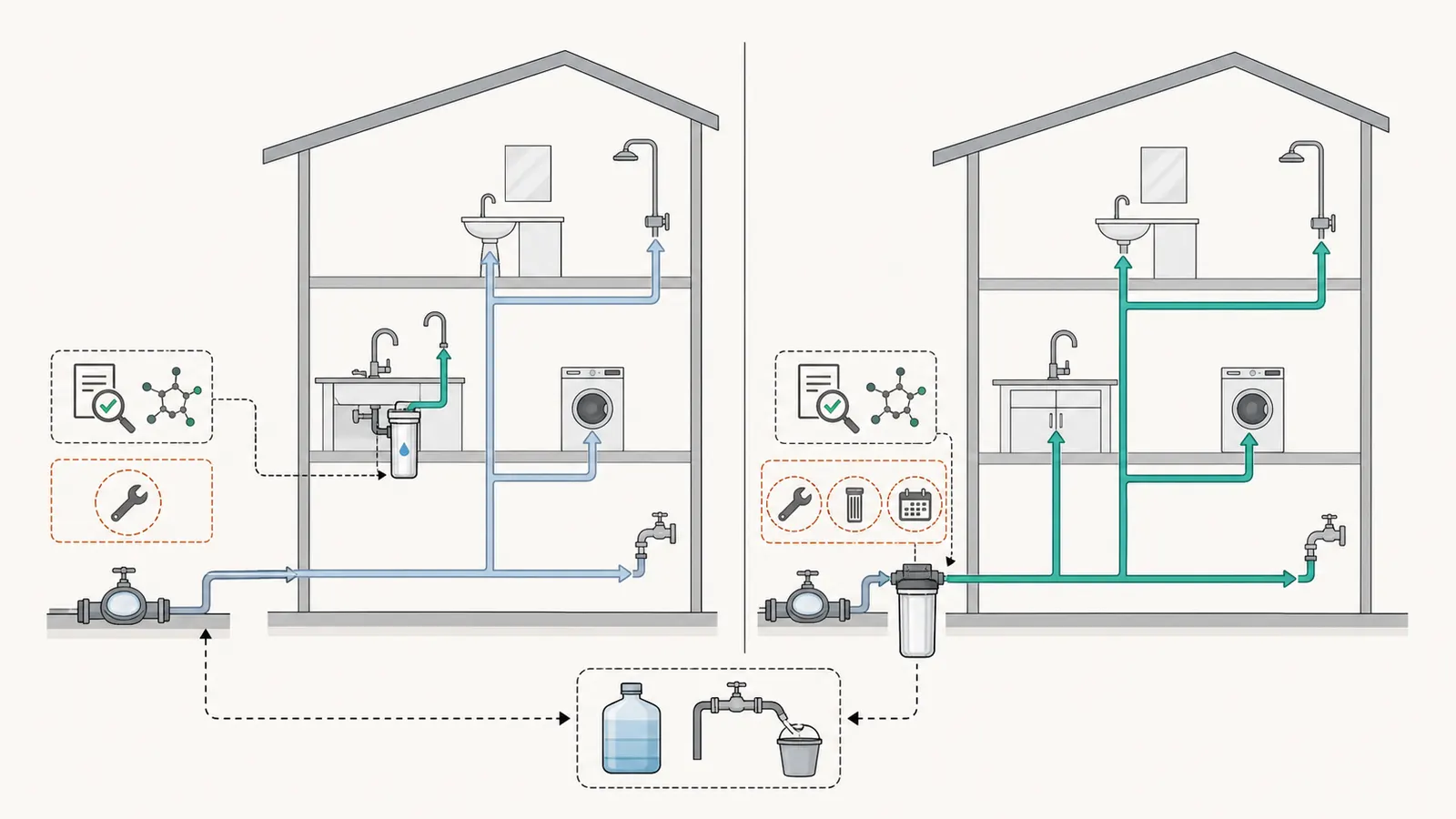
EPA defines point-of-use (POU) treatment as treatment at the tap or fixture, such as a pitcher, faucet-mounted filter, or under-sink system. POU can be a rational interim or long-term choice when the household needs treated water primarily for drinking and cooking and can reliably use the treated outlet. EPA defines point-of-entry (POE), or whole-house treatment, as treatment where water enters the building so treated water is distributed throughout the home. EPA’s WaterSense guide says POE treats larger quantities, is suited to consistent and significant contamination challenges, and generally costs more to install and maintain.
| Decision factor | Point of use | Point of entry |
|---|---|---|
| Water treated | One dedicated faucet, pitcher, refrigerator, or fixture | Water entering the home and distributed to many fixtures |
| Best fit to investigate | Drinking, cooking, and food preparation uses | A documented need to treat broader household flow, subject to agency and professional advice |
| Main failure branch | Someone fills a glass or ice maker from an untreated tap | The system is undersized, bypassed, unmaintained, or cannot handle the house flow |
| Verification | Test the dedicated treated outlet and confirm untreated taps are labeled | Test a representative treated outlet and verify the intended fixtures are actually downstream |
| Operating burden | Cartridge or membrane changes at a smaller water volume; user discipline is critical | Larger flow, plumbing changes, drainage, pressure, media capacity, and professional maintenance may matter |
| What it does not prove | A certified kitchen outlet does not certify the shower, bath, or hose bib | A whole-house claim does not prove every PFAS compound or every operating condition is covered |
Do not infer that because a treatment technology can reduce PFAS in a study, any product using the same technology will deliver the same result. EPA identifies granular activated carbon, ion exchange, and reverse osmosis as technologies used in residential PFAS treatment, but the product, water chemistry, PFAS type and concentration, flow, capacity, and maintenance determine the result. EPA’s filter page describes these technologies and their maintenance limits.
Treatment location also interacts with other well-water problems. Sediment, hardness, iron, manganese, disinfectant residual, pH, and other constituents may affect pretreatment, pressure, membrane life, or carbon capacity. Bring the full water-quality panel to a water-treatment professional rather than asking for a PFAS cartridge in isolation. If the well has bacteria, nitrate, arsenic, or another contaminant, one PFAS claim does not solve those problems. EPA says that treatment choice depends on the contaminant, its concentration, and the condition of the well; in some situations a new water source or new well may be needed. See EPA’s private-well testing and treatment guidance.
5. Verify the certification claim, not just the logo #
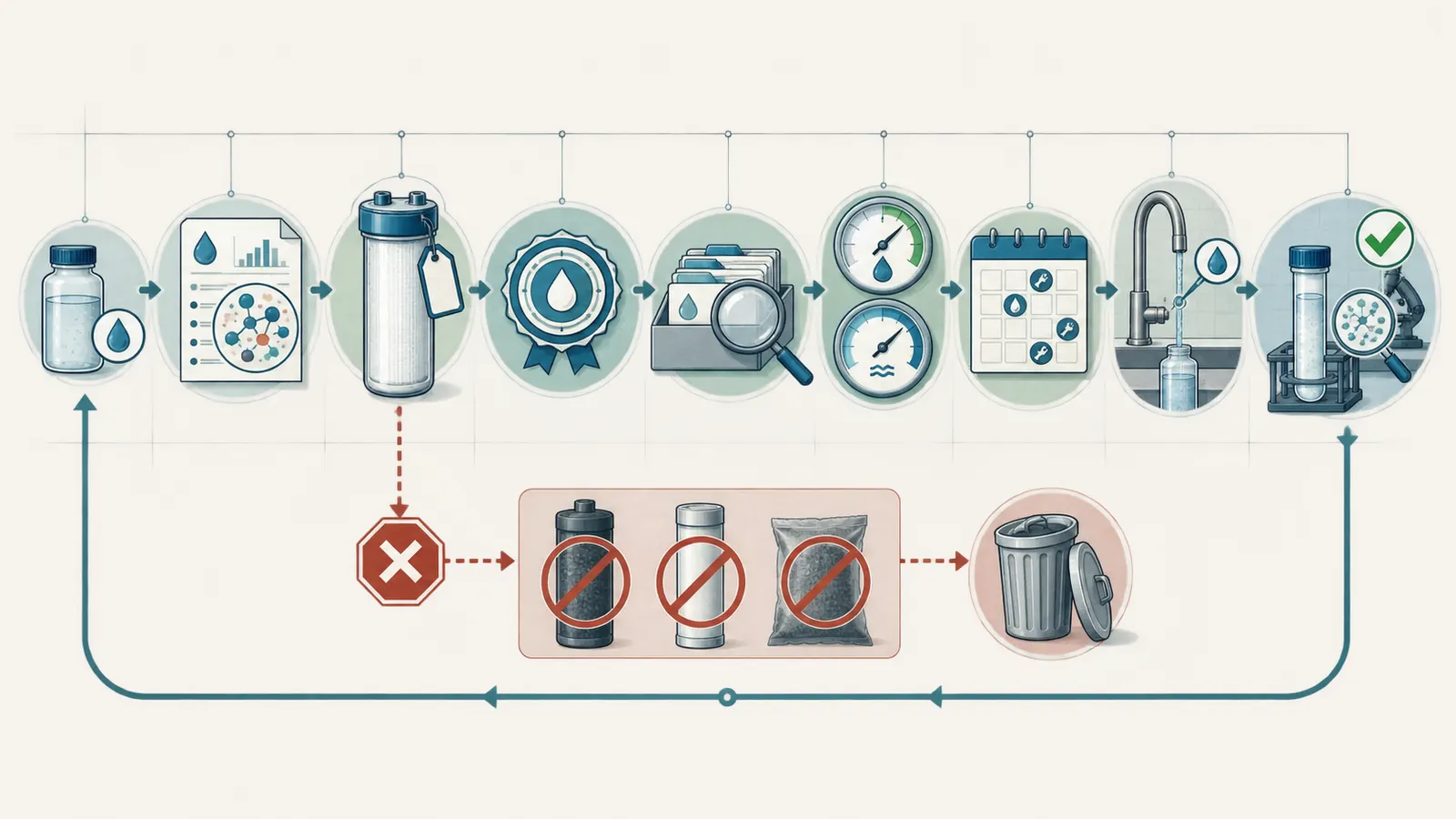
Certification is useful when you read it as a bounded claim. It is not a guarantee that a product treats every PFAS, every gallon, forever, or down to every government benchmark.
Use this purchase gate:
| Gate | Pass condition | Stop condition |
|---|---|---|
| Exact compound | Your report’s compound is named in the product’s certified reduction claim, or the certifier and state agency explain the scope | The package says only “PFAS,” “forever chemicals,” “carbon,” or “chemical reduction” without an exact listing |
| Exact model | The model number, configuration, replacement cartridge, and flow path match the current third-party directory listing | The seller shows a similar model or a family logo but not the model you will install |
| Applicable standard | The claim is tied to NSF/ANSI 53 for PFAS reduction or NSF/ANSI 58 for a reverse-osmosis system, as applicable | The product cites NSF/ANSI 42, a taste-and-odor claim, or a general “tested to standards” statement without the PFAS claim |
| Capacity and conditions | The performance data sheet states capacity, flow, pressure, influent assumptions, and replacement trigger | No capacity, no flow condition, or no instruction for your source water |
| Maintenance | You can obtain the exact replacement media or membrane and schedule the change | Replacement is unavailable, discretionary, or dependent on a sales visit you cannot plan |
| Verification | The installer and laboratory agree on pre- and post-treatment sample points and a retest timing | No one can explain where treated water will be sampled or what result would trigger action |
EPA tells consumers to look for NSF/ANSI 53 or NSF/ANSI 58 PFAS claims and to check the certification body’s product directory. NSF’s directory can be searched by manufacturer, model, standard, and reduction claim, including PFOA, PFOS, and Total PFAS categories. Search the exact model yourself, save the listing, and record the date. A retailer’s “NSF tested” wording is not the same as a current certified listing for the model and claim.
NSF says certification validates the contaminant-reduction claims shown on the label, material safety, structural integrity, and non-misleading labeling. It also says that a filter must reduce PFAS below 20 parts per trillion to make a PFAS reduction claim under the described standards, and that certified products are retested periodically with annual manufacturing-facility inspections. Read NSF’s explanation of what certification does.
That 20-ppt statement is not an EPA private-well safe-use level. EPA’s filter page cautions that the certification standards it describes, as of April 2024, do not indicate that a filter will remove PFAS down to the levels in EPA’s drinking-water standard. Keep both statements in the worksheet: certification validates a defined product claim; it does not erase the need to compare the exact compound, follow state advice, maintain the system, and verify the treated water.
6. Plan installation, maintenance, and post-install verification #
The treatment plan is incomplete until it answers three operational questions: where will treated water go, when will the treatment media be changed, and how will you know the system still works?
Before installation
Give the installer and laboratory:
- the original report and confirmation result, including all named compounds and units;
- sample points, collection dates, methods, reporting limits, and any qualifiers;
- the state or local agency’s comparison level or use guidance;
- the household’s intended treated uses and peak flow;
- the existing well, pressure tank, plumbing, septic, treatment, and drainage layout;
- the complete product performance data sheet and current certification listing;
- the proposed bypass, isolation valves, drain connection, power requirements, and service clearances.
Ask the installer to mark every untreated outlet if the plan is POU. Ask how an ice maker, refrigerator dispenser, pot filler, beverage faucet, humidifier, or other automatic device will be handled. An under-sink filter with a dedicated faucet does not automatically treat the refrigerator line. If the plan is POE, ask which fixtures are downstream, whether irrigation or hose connections bypass treatment, what the expected pressure and flow are, and where spent carbon, resin, reject water, or backwash water will go. The exact answer depends on the equipment and site; do not accept “whole house” as a complete scope.
During and after installation
Record the model, serial or lot information, installed media, installation date, initial meter or hour reading if applicable, and the normal valve positions. Photograph labels and valves from a safe, dry location. Have the installer document the pre-treatment sample point and the treated sample point. If the system has an alarm, flow monitor, pressure gauge, membrane tank, drain, or automatic valve, record what the indicator means and what it does not mean.
Use the manufacturer’s flush and commissioning instructions. Do not use taste, odor, appearance, a green light, or a new filter cartridge as proof of PFAS removal. Arrange post-install testing with the laboratory or state agency before installation so the sample timing and sample points are not improvised afterward. A useful verification record has:
| Checkpoint | Record |
|---|---|
| Untreated baseline sample point and date | ____________________ |
| Treated sample point and date | ____________________ |
| Product model and certified claim | ____________________ |
| Flow or capacity condition at sampling | ____________________ |
| Media or membrane age at sampling | ____________________ |
| Laboratory, method, analytes, reporting limits | ____________________ |
| Post-install result by compound | ____________________ |
| State or professional interpretation | ____________________ |
| Next replacement date or capacity trigger | ____________________ |
If a post-install result is higher than expected, do not simply replace the cartridge and declare success. First stop ingestion from the questionable treated outlet, use the alternate source, and ask the laboratory and installer to review sample identity, sample point, plumbing path, bypass position, commissioning, product configuration, influent concentration, capacity, and method. A single unexpected result is a reason to preserve evidence and diagnose the treatment path.
Maintenance must be calendar- and capacity-aware. EPA says filters have limited capacity and are effective only when maintained according to the manufacturer’s instructions. EPA’s home-filter guidance explains the replacement dependency. Put the manufacturer’s replacement interval, gallon capacity, alarm threshold, pressure or flow trigger, and post-replacement flush instruction in a log. If the maker gives both a time and gallon limit, use the earlier trigger unless the maker or qualified professional says otherwise.
Do not stretch a cartridge because it still tastes fine. Do not reset a warning light without recording why. Do not treat a filter-change reminder as a laboratory result. When replacing media, follow the exact manual and use a qualified installer for pressurized, hard-piped, electrical, drain, or whole-house systems beyond a clearly documented safe homeowner procedure.
7. Know the stop rules and prepare a professional handoff #
PFAS treatment sits inside a pressurized, electrically controlled well system. A homeowner can preserve records, read labels, identify normal valve positions, and coordinate a laboratory. The following actions are outside this guide unless the exact equipment instructions demonstrably establish a safe homeowner procedure and the relevant professional has confirmed it:
- opening energized controls or testing live wiring;
- removing a pump-control cover or electrical disconnect cover;
- opening a well, removing a cap, entering a well pit, or entering any confined space;
- pulling a pump, drop pipe, pressure tank, or treatment vessel;
- opening a filter housing or other pressurized vessel without the exact shutoff, pressure-release, and lockout procedure;
- changing pressure-switch settings, bypassing a safety control, or manipulating unknown valves;
- drilling, abandoning, disinfecting, or chemically treating the well;
- modifying plumbing, drainage, septic discharge, or electrical service without qualified review.
If a well contractor, plumber, electrician, laboratory, or health agency gives instructions, write down the person or organization, date, exact instruction, and the evidence it addressed. Do not let a treatment salesperson become the only interpreter of a laboratory report.
Bring this handoff packet:
- Original and confirmation laboratory reports.
- Full analyte list, method and version, units, reporting limits, and qualifiers.
- State certification or laboratory-acceptance information.
- Sample-point map: well or untreated point, pressure-tank outlet, treatment inlet, treated outlet, and any untreated fixtures.
- Federal comparison level and access date, plus the state or local benchmark actually used.
- Household use boundary and the alternate-water plan.
- Candidate treatment model, current certification listing, performance data sheet, flow, capacity, and replacement schedule.
- Well construction, pump, pressure tank, plumbing, septic, and prior treatment records.
- Proposed post-install sampling plan and the professional responsible for interpreting it.
The decision is complete only when the record can answer: What was found? Where and how was it measured? What uses are paused? What comparison level applies here? Which exact treatment claim matches the compound? Where will treatment occur? How will capacity and maintenance be tracked? Which post-install test will show whether the plan worked?
That is the difference between buying a PFAS-labeled filter and operating a documented household water-safety plan. Keep the evidence packet current, re-check state and federal guidance before a retest or replacement, and keep using the alternate source whenever the health authority or your verified treatment record says the well water should not be swallowed.
Cite this guide
Brictale. “PFAS Found in Private Well Water: A Homeowner Action Worksheet.” Published 2026-08-28; updated 2026-08-28.
https://brictale.com/water/wells/what-to-do-if-pfas-is-found-in-private-well-water · Read the Markdown version
Sources and scope
Evidence behind this page
- EPA says it does not regulate or provide recommended standards for private wells, so federal PFAS drinking-water levels are not a private-well compliance rule.
PFAS in Private Wells | US EPA
Private domestic wells; use to distinguish federal public-water-system standards from homeowner decision guidance.
Accessed · Link to this claim - EPA advises considering an alternate water source for drinking, preparing food, cooking, brushing teeth, preparing baby formula, and other activities in which the family might swallow the water.
PFAS in Private Wells | US EPA
Exposure-reduction actions for PFAS found in private-well water; not a universal bathing or laundry instruction.
Accessed · Link to this claim - EPA directs homeowners to contact their state laboratory certification program or state environmental or health agency when selecting a laboratory for PFAS drinking-water analysis.
EPA PFAS Drinking Water Laboratory Methods | US EPA
Laboratory selection for private-well drinking-water samples; state programs and recommendations vary.
Accessed · Link to this claim - EPA says Methods 533 and 537.1 can effectively measure 29 PFAS in drinking water, and the report should identify the method rather than merely saying PFAS was tested.
EPA PFAS Drinking Water Laboratory Methods | US EPA
Validated drinking-water analytical methods; the analyte list and method version still need to be checked against the homeowner’s decision.
Accessed · Link to this claim - EPA’s PFAS sampling guidance says samples should avoid glass and contact with PFAS-containing materials, use nitrile gloves, record the sample location and date, and follow the laboratory kit instructions.
EPA public-system sampling requirements and best practices; homeowner kits may differ, so the receiving laboratory’s instructions control.
Accessed · Link to this claim - EPA’s current PFAS rule page lists the 2024 public-system MCLs for PFOA, PFOS, PFHxS, PFNA, HFPO-DA, and a mixture hazard index, while noting May 2026 proposed changes for public systems.
Per- and Polyfluoroalkyl Substances (PFAS) | US EPA
Federal public-water-system rule status as of the access date; not a private-well standard and not a substitute for state guidance.
Accessed · Link to this claim - EPA says studied GAC, ion-exchange, and reverse-osmosis point-of-use systems can greatly reduce PFAS, but filters work only when maintained and replaced according to manufacturer instructions.
Identifying Drinking Water Filters Certified to Reduce PFAS | US EPA
EPA discussion of residential PFAS treatment technologies; performance depends on source water, product, operating conditions, and maintenance.
Accessed · Link to this claim - EPA WaterSense defines point-of-use treatment as treatment at a tap or fixture and point-of-entry treatment as treatment where water enters the building for distribution throughout the home; POE systems treat larger quantities and generally require more installation and maintenance.
WaterSense Guide to Selecting Water Treatment Systems | US EPA
Residential treatment-location comparison; exact design, plumbing, drainage, and local requirements are site-specific.
Accessed · Link to this claim - EPA cautions that current PFAS filter certification standards, as described on its filter page, do not indicate that a filter will remove PFAS down to the levels in EPA’s drinking-water standard.
Identifying Drinking Water Filters Certified to Reduce PFAS | US EPA
Certification interpretation as stated by EPA; check the current certification body listing and state advice before purchase.
Accessed · Link to this claim - NSF says certification validates the PFAS contaminant-reduction claim shown on the label, material safety, structural integrity, and non-misleading labeling; it does not turn a generic filter label into a claim for every PFAS compound.
NSF-certified drinking-water treatment units; verify the exact model and reduction claim in the current directory.
Accessed · Link to this claim - NSF states that a filter must reduce PFAS below 20 parts per trillion to make a PFAS reduction claim under the described certification standards, and that certified products are retested periodically and facilities inspected annually.
NSF’s described certification criteria; this threshold is not presented as a private-well safe-use level or as the EPA MCL.
Accessed · Link to this claim - NSF’s certification directory allows a homeowner to search by manufacturer, model, product standard, and reduction claim, including PFOA, PFOS, and Total PFAS reduction categories.
Search for NSF Certified Drinking Water Treatment Units, Water Filters | NSF
NSF directory interface; listing presence and claim scope must be checked for the exact model being considered.
Accessed · Link to this claim - NSF advises not to boil water containing PFAS because boiling will not reduce exposure risk.
PFAS exposure reduction; follow state or health-authority instructions for all other water uses.
Accessed · Link to this claim - ATSDR lists an alternate PFAS-tested water source or a filter shown to reduce PFAS for drinking, food preparation including infant formula, cooking, brushing teeth, and other activities that can result in ingestion, and advises consulting local agencies about retesting and interpretation.
Clinical Evaluation and Management: PFAS Information for Clinicians | ATSDR
Clinical exposure-reduction information; not an individualized medical diagnosis or state-specific private-well order.
Accessed · Link to this claim