Should You Let a Faucet Drip During a Freeze If You Have a Private Well?
A private-well freeze decision tool: identify the vulnerable pipe, then choose a drip, insulation, drain-down, or safe shutdown.
The short answer
Usually—but only to protect the indoor plumbing that the faucet actually drains. A drip can make a working pump cycle, yet it may not protect an exposed pump, pressure switch, gauge, or well-to-tank line. Identify the cold section first; insulate or drain it. Stop for falling pressure, continuous running, low-yield symptoms, a frozen control, power loss, or an already frozen line.Should You Let a Faucet Drip During a Freeze If You Have a Private Well?
Usually, yes—but only when the drip protects the indoor pipe that is actually at risk and your well system is operating normally. A dripping faucet can lower pressure enough to make a working pump cycle. That does not mean it protects every part of a private-well system. It may do nothing for an exposed jet pump, pressure switch, pressure gauge, or well-to-tank line in an unheated space.
The freeze-night decision is:
- Find the cold section.
- If the vulnerable section is a house branch downstream of a functioning pressure tank, use a small, controlled drip while watching pressure and pump behavior.
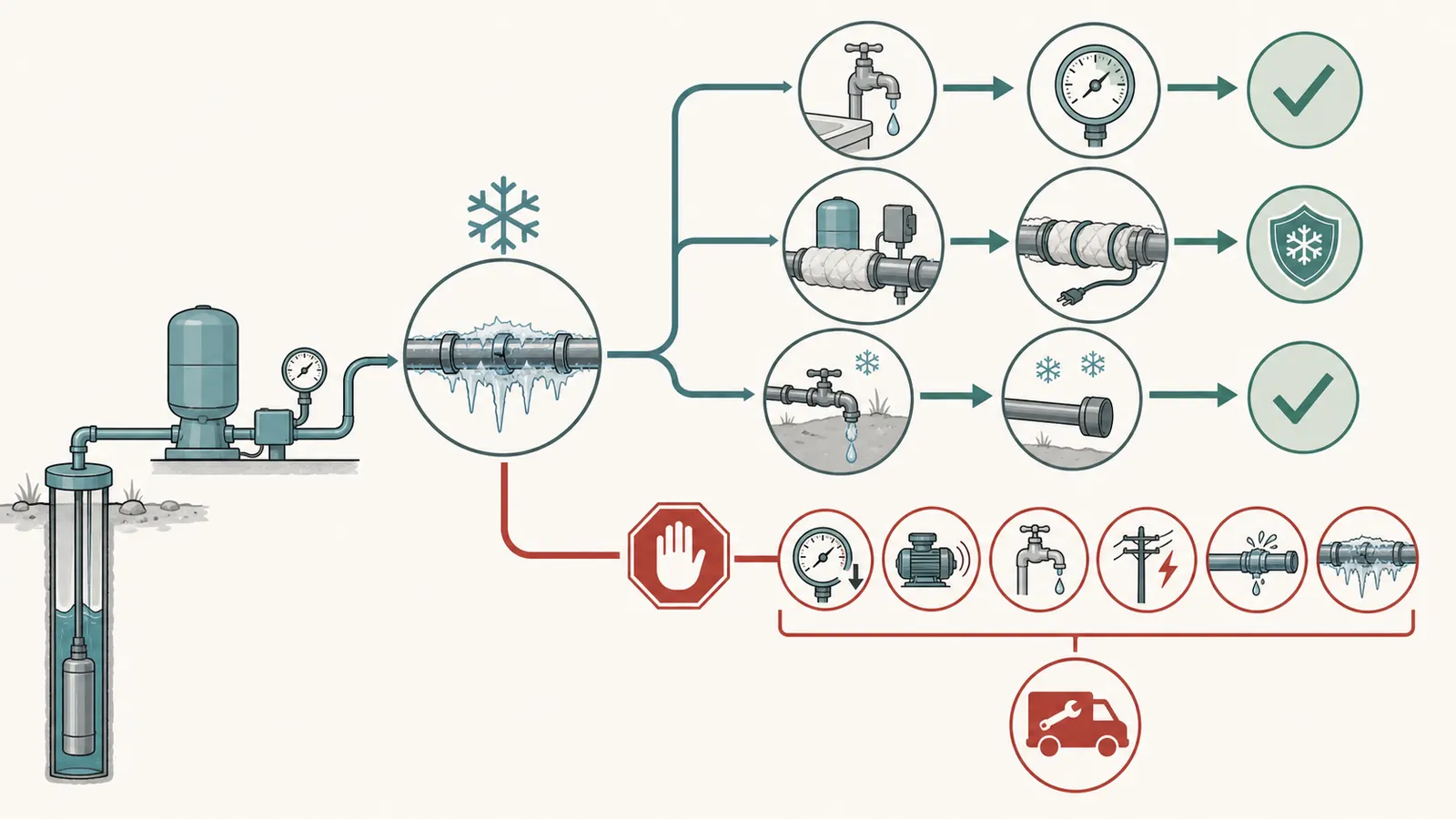
- If the vulnerable section is exposed equipment or the line between the well and pressure tank, insulate, enclose, drain, or get professional help; do not assume the faucet reaches it.
- Stop the drip and conserve water if pressure falls, the pump runs continuously or rapidly short-cycles, the well is low-yield, a pressure switch or control appears frozen, power is lost, a leak appears, or the line is already frozen.
This is a decision aid for common residential systems, not a substitute for the well record, pump manual, local freeze-depth information, or a qualified well contractor or electrician.
First identify which well layout you have #
“Private well” describes the water source, not the location of the equipment that can freeze. The same faucet-drip advice has a different reach in a deep drilled well with a buried pitless adapter than in a shallow well with an above-ground jet pump.
Layout A: buried pitless adapter, indoor pressure equipment
In a common deep-well arrangement, a submersible pump sits inside the well casing. The water line leaves the casing through a pitless adapter and runs underground to the house or a heated mechanical room. The U.S. Environmental Protection Agency describes the pitless adapter as the connector that lets the surface water pipe remain below the frost line while maintaining a sanitary, frost-proof seal. The National Ground Water Association likewise describes the adapter as a below-frost-line connection that diverts water horizontally so it does not freeze at the wellhead. See EPA’s private-well component guide and WellOwner.org’s pitless-adapter explanation.
If your pressure tank, gauge, and pressure switch are inside a heated basement or utility room, the most likely freeze targets are instead:
- a pipe in an exterior wall, crawl space, garage, attic, or unheated addition;
- a branch to an outdoor faucet or irrigation connection;
- a plumbing penetration exposed to cold air; or
- a section that was altered, poorly insulated, or routed above the intended frost protection.
For this layout, a drip at a faucet near the vulnerable indoor branch can help keep water moving through that branch and can reduce pressure in the house piping. It is not a reason to open a faucet at random and leave it running all night without checking the gauge and pump response.
Do not infer from a buried well cap that you have a pitless adapter. Check the well record, installation diagram, service invoice, or contractor description. The local frost line determines where a pitless adapter should be installed; EPA notes that well construction and requirements depend on local conditions and governing agencies. A buried pipe can still have a shallow exposed transition, an unheated valve box, or a vulnerable entry into the building.
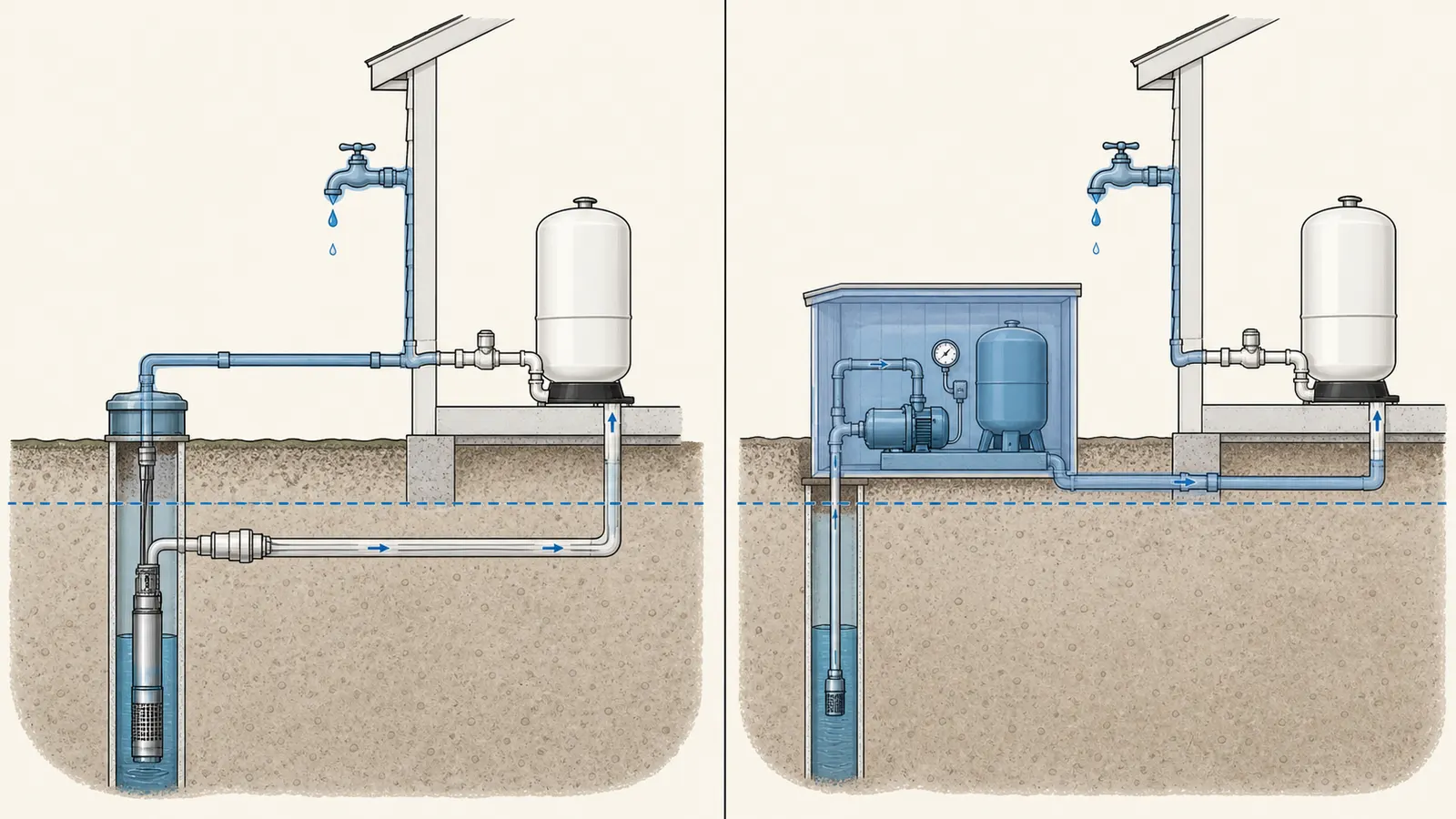
Layout B: exposed pump, pressure tank, or controls
Shallow wells commonly use jet pumps mounted above ground. The EPA identifies jet pumps as common for shallow wells and submersible pumps as common for deep private wells. In an older system, a pump, pressure tank, gauge, and pressure switch may sit in an unheated well house, garage, crawl space, or addition. The National Ground Water Association’s winter guidance specifically calls for an insulated enclosure for an above-ground pump and protection for exposed pipes, fittings, gauges, and switch lines. Read WellOwner.org’s winter-care guidance for that equipment-specific distinction.
Here, a house faucet is downstream of the pressure tank. Opening it may draw stored tank water and lower pressure, but it does not bathe the pump or pressure switch in warm water. If the line from the well to the pump or tank is blocked by ice, no amount of indoor dripping can make that frozen section flow. A drip can therefore create a misleading signal: water may run briefly from stored pressure while the vulnerable upstream equipment remains cold.
If the exposed equipment is the risk, prioritize safe enclosure and professional freeze protection. Do not open the pressure-switch cover, touch wiring, adjust the switch, remove a gauge, loosen a fitting, or try to warm a pressurized control with improvised heat. University of Nebraska–Lincoln Extension says the pressure switch is electrically powered and that homeowners should not adjust it because of serious injury risk. See the UNL mechanical-components guide.
If a pressure switch or other control is visibly or suspected frozen, use a direct stop branch: stop the drip and other water use, and do not open, energize, adjust, or improvise-heat the control. Do not use a faucet to test whether it has thawed. Obtain qualified well or electrical service from a dry, safe location; a control that looks normal after warming is not thereby proven safe or correctly set.
Layout C: storage tank, booster pump, or unusual controls
Some homes have an intermediate storage tank, a separate pressure pump, a constant-pressure or variable-frequency-drive controller, or a cistern. These systems may not react to a drip like the traditional pump–pressure-tank–pressure-switch arrangement. A control may vary pump speed instead of starting and stopping at fixed pressure points, or the well pump may fill a storage tank while a separate pump serves the house.
If you cannot identify the pump, tank, and control path, treat the system as unknown. Use the drip only for an accessible indoor branch that is clearly at risk, keep the flow minimal, and call the installer or a qualified well professional for a topology-specific plan. Do not use a faucet as a test of whether an unseen pump or control is protected.
For this moderate-safety decision, the homeowner boundary is firm: do not open an energized control, test live wiring, open a well cap or casing, pull a pump, enter a well pit or other confined space, or loosen, adjust, or otherwise manipulate pressurized equipment. Those actions belong to a qualified well professional, plumber, or electrician. The only homeowner shutdown action considered here is operating a clearly labeled, dry, accessible normal shutoff without opening an enclosure or disturbing a fitting; if that condition is not met, step away and call for help. UNL Extension’s warning that pressure-switch work can cause serious injury is the reason for this limit.
Choose drip, insulate, drain, or stop #
Use this decision surface on the freeze night. “Yes” means the condition is verified by observation or by a record—not guessed from a generic well layout.
| What you observe | Best immediate action | What that action can protect | What it cannot prove or protect |
|---|---|---|---|
| Indoor branch is cold or exposed; water flows normally; pressure is stable | Use a small drip at a faucet served by that branch; monitor | The flowing indoor branch and pressure relief in downstream plumbing | The wellhead, exposed pump, switch, gauge, or a frozen upstream line |
| Exposed pipe, fitting, gauge, or above-ground pump is in an unheated space | Insulate or enclose it if the work is safe and accessible; arrange qualified heat-trace work where needed | The identified exposed component | That a house faucet reaches the component |
| Pressure switch or other control is visibly or suspected frozen | Stop the drip and other use; do not open, energize, adjust, or improvise-heat the control; obtain qualified well or electrical service | Limits demand while the control is assessed safely | A drip cannot thaw, test, or make an unsafe control safe |
| Outdoor faucet, hose bib, irrigation branch, or seasonal line is unused | Shut off and drain it before the freeze; disconnect hoses | The drained outdoor branch and faucet | A line that cannot drain because of a blockage, incorrect slope, or trapped section |
| Pressure falls, pump runs continuously, or pump starts and stops unusually fast | Stop using the drip; protect the building from a possible leak and call a professional | Limits added demand while the fault is evaluated | The cause; it may be a leak, check valve, tank, switch, pump, or low-water problem |
| Power is lost and heat is also lost | Do not rely on the drip; use only a shutdown or drain plan documented for this system by the installer or a qualified well professional | Limits added demand while the system-specific plan is obtained | It does not make an inaccessible or frozen well line safe |
| A line is already frozen, a pipe is bulging, or a leak is visible | Stop adding demand; shut off the pump/water only through safe, known shutoffs and get qualified help | Limits water damage and pump stress | A drip will not thaw the blockage |
The table’s central rule is simple: a faucet drip is a downstream plumbing measure. It is not a general-purpose well-winterization method.
Why a drip can cycle the pump—and still miss the cold section #
A typical private-well system has a pump, pressure tank, and pressure switch. UNL Extension explains that the tank stores pressurized water and that the pressure switch starts the pump when pressure drops, then stops it as the tank refills to the stop setting. See UNL’s description of pump, tank, and switch operation.
That sequence creates two different paths to think about:
Stored water path: The pressure tank can supply a short period of faucet flow while the pump is off. The drip may look successful even if the pump never runs.
Pump-flow path: When pressure drops far enough, the switch calls for the pump. The pump then moves water through the well-side piping and into the tank. Water reaching the tank does not necessarily mean every exposed section is warm or adequately protected; the pump may be drawing through a different route, or the vulnerable section may be downstream of a closed valve or branch.
This is why “the faucet is dripping” and “the well system is protected” are not equivalent statements. The drip protects only the pipe segments through which water is actually flowing and only while the rest of the system can safely supply that flow.
A safe observation loop
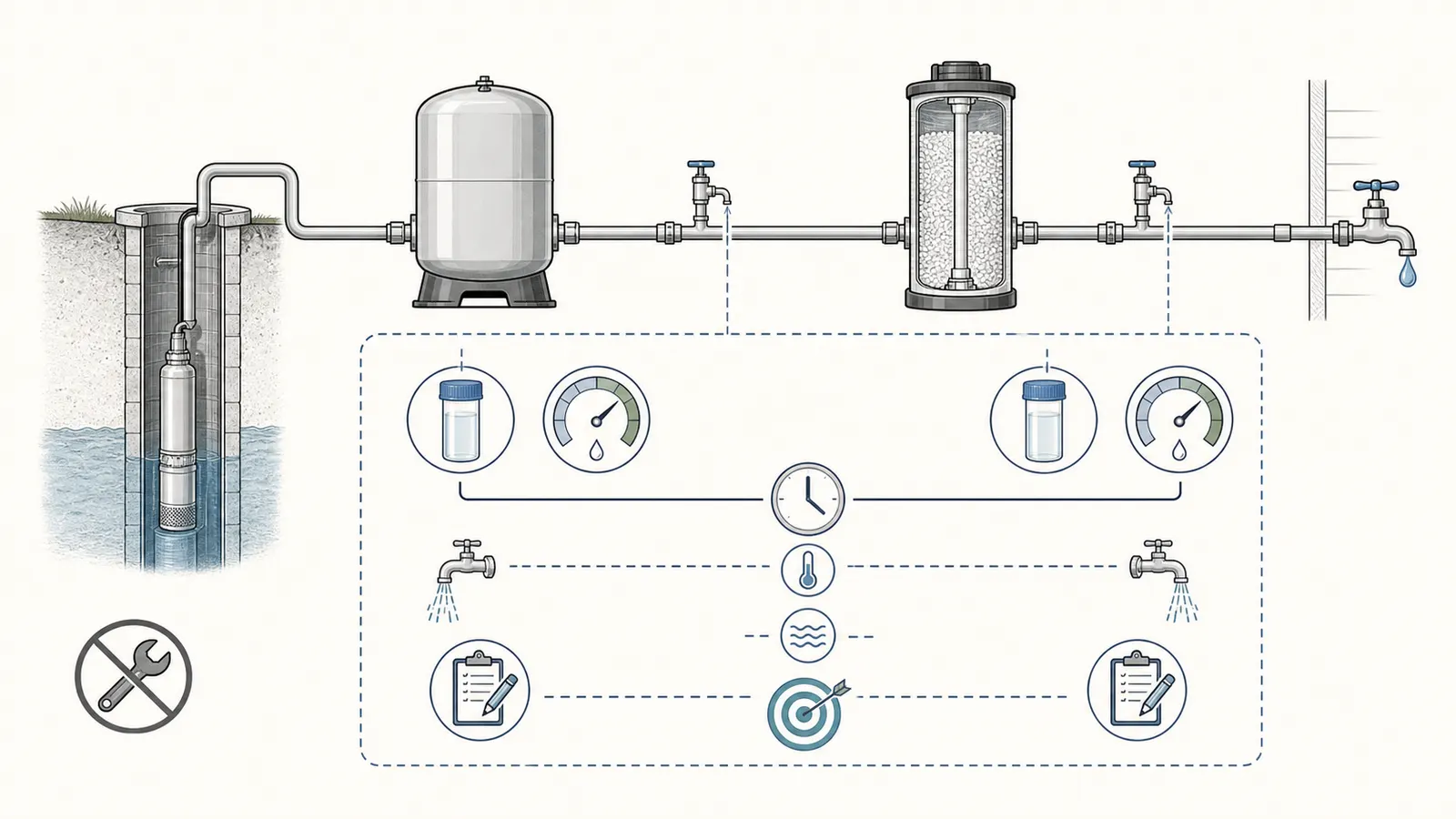
You can observe the system without opening a control or touching live wiring:
- Before starting the drip, record the pressure gauge reading if the gauge is visible, dry, and clearly readable. Do not remove its cover or touch fittings.
- Open the selected faucet only enough to produce a small, steady flow. A drip should not be a wide stream that runs the pump continuously.
- Listen from a safe distance. Note whether the pump starts, whether it stops after restoring pressure, or whether it continues running.
- Recheck the gauge after several minutes. A normal-looking cycle should restore pressure within the behavior you recognize from ordinary faucet use. A falling gauge, no recovery, or a pump that does not stop is a stop condition.
- Check accessible rooms and ceilings for new dampness, water sounds, or a leak. Do not enter a wet area containing electrical equipment.
Do not treat a pump cycle as proof that the entire well-to-tank run is above freezing. It proves only that the control system responded at that moment.
If you decide to drip, size and place it conservatively #
Place the drip at the fixture served by the cold branch, not automatically at the nearest convenient faucet. If the vulnerable pipe is along an exterior wall, the farthest fixture on that branch may be the useful observation point. If the risk is a garage branch or outdoor line, an indoor faucet may be on the wrong path entirely.
Do not adopt a canned “pencil-point” rate for an unidentified pipe, pump, pressure tank, or well yield. If a qualified professional or local utility has given your home a drip instruction, follow that system-specific instruction. Otherwise, use only a small, supervised flow on a verified downstream indoor branch with stable pressure; a measured flow is a record of water demand, not proof that the pipe is protected or that the well can sustain it.
Measure the actual drip instead of guessing
If the flow is small and the fixture is safe to use, catch it for a fixed, known interval and record the amount and interval in your freeze log. This can help a professional understand the demand you imposed, but it does not establish a universal freeze-protection rate or prove that water reached an exposed well component.
Record the following in a note:
- fixture and branch location;
- measured cups per minute;
- starting and ending gauge readings;
- whether the pump cycled, and how often;
- outdoor temperature and wind exposure;
- whether the pressure recovered after each cycle; and
- any sputtering, air, sand, cloudy water, or leak.
If your well is low-yield, use less water rather than relying on a drip. Penn State defines yield as the maximum rate at which a well can be pumped without lowering the water level below the pump intake. Its guidance explains that a low-yield well may not replenish the pressure tank as quickly as the household withdraws water, and that the pressure tank alone provides limited storage. Read Penn State’s low-yield well guidance.
The practical interpretation is not “all well owners should avoid dripping.” It is “a drip is a continuous water demand, so a low-yield or already stressed well needs a different plan.” A short, supervised drip on a stable, healthy system is a different risk from an unattended overnight flow on a well that already struggles during showers, laundry, or drought.
Protect the component the faucet cannot reach #
Exposed pumps, tanks, gauges, and switch lines
If the equipment is in an unheated well house, garage, crawl space, or addition, the first question is whether the space can remain above freezing. Close drafts, maintain safe building heat, and inspect insulation around—not inside—equipment enclosures. The National Ground Water Association advises insulating or enclosing above-ground pumps and protecting exposed pipes, fittings, gauges, and switch lines. That guidance is more directly relevant than a faucet drip when the equipment itself is exposed.
For permanent protection, the DOE Building America Solution Center recommends insulating exposed plumbing, sealing penetrations, and considering temperature-controlled heat trace in unconditioned spaces. It also warns that heat trace must follow the electrical and fire code and that improper installation can create a fire hazard. See DOE Building America’s pipe-insulation guidance.
A homeowner can usually observe whether insulation is missing or a door is open. Do not open the pressure-switch cover to inspect its contacts. Do not tape a heating device to a control, pressure tank, or pipe unless the product manual expressly permits that installation and the electrical setup is appropriate. A qualified electrician or well contractor should select and install heat trace around equipment and controls.
Outdoor faucets and seasonal lines
Disconnect hoses. Shut off and drain outdoor faucets and irrigation branches using the installed indoor shutoff or drain arrangement. WellOwner.org specifically advises shutting off and draining outdoor lines, while UNL Extension describes frost-protected outdoor hydrants that drain water from the hydrant body and may have a buried seasonal shutoff. Those designs vary; do not assume every hose bib drains simply because it is called frost-free.
If a seasonal line will not drain, stop forcing valves and do not dig around the wellhead or hydrant during the freeze. Mark the location and ask a plumber or well professional to verify the shutoff, slope, drain port, and buried route. If excavation is later needed, use the applicable utility-locating service before digging.
Buried well-to-house line
A properly buried line may be below the local frost line, but a record or visual inspection is needed to confirm that. Vulnerable transitions include the well casing, pitless adapter area, shallow sections near the house, exposed entry piping, and lines passing through unheated additions. Do not remove a well cap, pull a pitless adapter, expose a buried line, or enter a confined space to investigate. Those are professional tasks.
If your system has no pressure, the pump runs without recovery, or the house line is suspected to be frozen, the correct next step is diagnosis—not a larger faucet drip. The professional will need the well record, pump model, pressure-switch settings if known, tank size, pipe route, recent service history, and the exact timing of pressure loss.
Stop conditions: when dripping becomes the wrong action #
Stop the drip and move to fault protection if any of these occur.
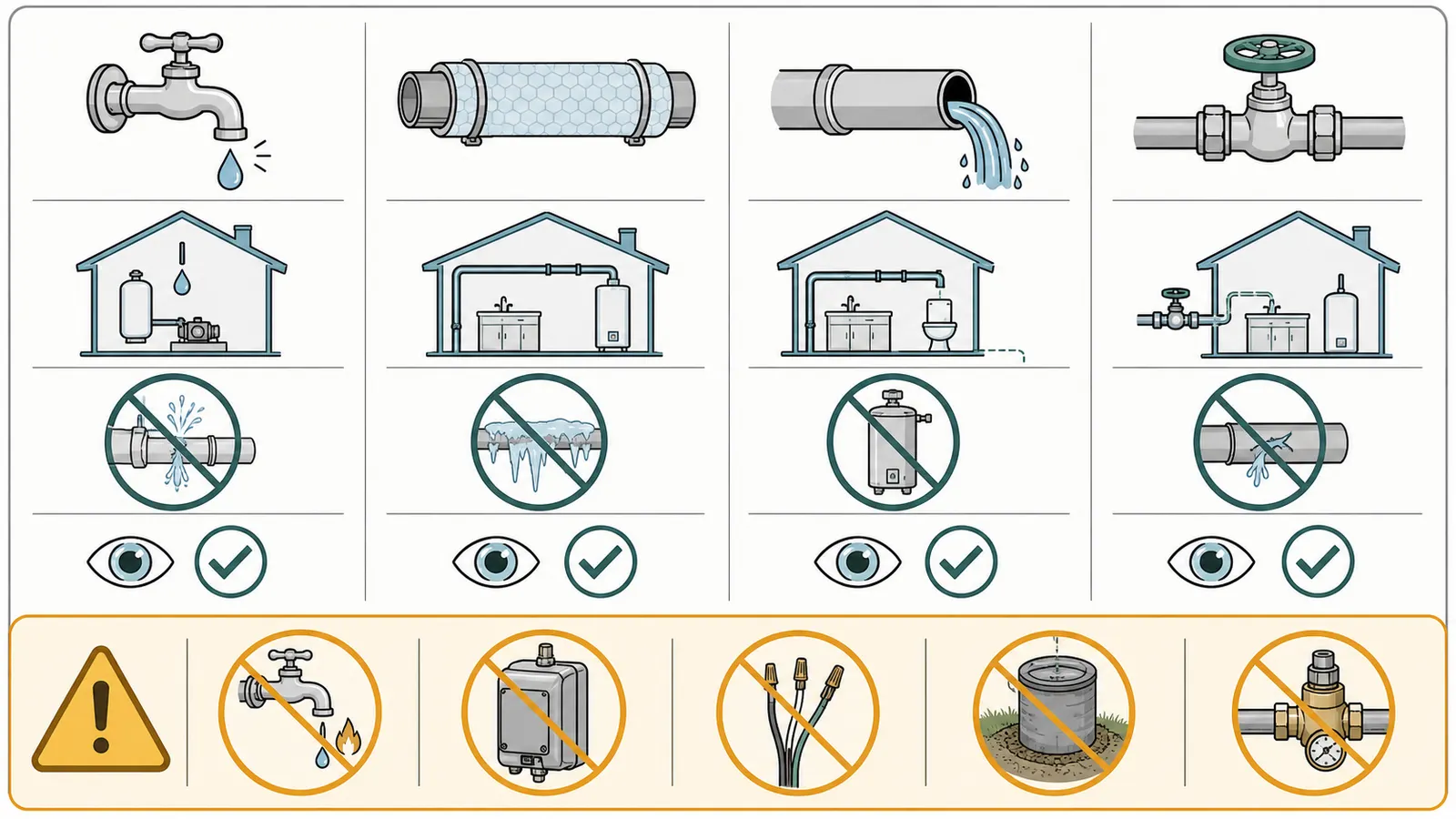
Falling pressure or no recovery
If the gauge falls while the faucet is open and does not recover, close the faucet. A loss of pressure can reflect a frozen section, leak, failed pump, electrical fault, check-valve problem, or a low water level. The University of Minnesota Extension lists pressure-tank or pump problems, electrical connections, clogged plumbing, and low water level among possible causes of loss of water; do not call every freeze-night symptom a frozen pipe. See UMN Extension’s private-well troubleshooting guidance.
Continuous running or rapid short-cycling
If the pump runs continuously, close the faucet and stop adding demand. UNL Extension identifies a break in the line or a check-valve problem as possible causes of continuous operation. It also says a pump that runs only a few seconds and shuts off can indicate a pressure-tank problem. Both patterns require professional diagnosis, not a bigger drip.
Rapid cycling is especially concerning because repeated starts add stress. Do not adjust the pressure switch or attempt to recharge the pressure tank while the system is connected to power or pressure. A professional can isolate power, relieve pressure, test the tank, and verify the switch settings using the equipment’s instructions.
Low-yield or low-water symptoms
Stop the drip if you hear the pump sucking air or the water sputters. Texas Well Owner Network guidance also identifies sand in the toilet tank and milky water that clears after standing as warning signs that the water level may have dropped near the pump. It advises resting the pump and involving a licensed pump installer when appropriate. Read the Texas A&M AgriLife well-owner guide.
These signs are non-diagnostic: sand, sputtering, milky or cloudy water can reflect a low-water condition, air, sediment, plumbing disturbance, or a water-quality problem. Treat a new change in appearance or behavior as a potable-water stop boundary. Stop drinking and cooking with the water, use a known-safe alternative, and have a qualified well professional evaluate the system. Do not resume potable use until the cause has been evaluated and appropriate water testing through a certified drinking-water laboratory supports that decision. EPA advises prompt testing after a change in private-well water quality, use of certified laboratories, and follow-up with public-health officials and retesting when results exceed health standards; see EPA’s private-well water-quality guidance. This is a precautionary health boundary, not a diagnosis from appearance alone.
Do not keep a faucet running to “make the pump stay warm” when the pump may be drawing air. That can worsen a water-quantity problem and may pull sediment into the system. Use stored water sparingly, avoid laundry and other high-demand uses, and call the well professional.
Power loss, loss of heat, leak, or already frozen line
If the power is out, the pump cannot replenish the system. If the building is also losing heat, the risk is no longer limited to the faucet branch. Do not keep a drip running or improvise a faucet-opening or lowest-point drain-down sequence. The correct shutdown and drain plan depends on the installed pump, tank, plumbing, and labeled controls; use a plan documented for that system by the installer or directed by a qualified well professional. If the pump disconnect or breaker is clearly labeled and accessible from a dry, safe location, use only the normal shutoff; never open an electrical enclosure. If the shutoff is unknown, the floor is wet, wiring is exposed, or water is spraying, leave the area and call an electrician, plumber, or well contractor.
If a line is already frozen, a drip is not a thawing method. Do not use a torch, open flame, improvised heating element, or heat source near plastic pipe, insulation, wiring, or a pressure control. Do not open a wall or pull equipment to chase the ice. Keep the building heated if it is safe, shut down through known safe controls if a burst is possible, and arrange qualified service.
What to do after the freeze and what to hand a professional #
When temperatures rise, close the drip and inspect before returning to normal use. Look for damp drywall, water around the pressure tank or pump, a wet well-house floor, a soggy yard along the buried line, new cycling, low pressure, sputtering, sand, or cloudy water. Do not restart a pump repeatedly if it is running continuously or the line may be broken.
If there is a known indoor leak and you can reach a labeled valve without entering a wet electrical area, close the house-side water valve if you know it is the correct one. UNL Extension notes that shutting off pump power stops the pump from supplying more water, but the pressure tank still contains water; a downstream water valve may also be needed to isolate the building. A professional should handle any uncertainty, pressurized fitting, switch, tank, gauge, well cap, or buried-line work.
A useful freeze log
Bring this information to the well contractor or plumber:
- date and approximate time the pressure changed;
- outdoor temperature, wind, and whether the building heat or power failed;
- system layout: pitless adapter, jet pump, submersible pump, storage tank, or unknown;
- location of pump, tank, gauge, pressure switch, and exposed piping;
- gauge reading before and after the drip or faucet use;
- whether the pump was off, cycled normally, short-cycled, or ran continuously;
- whether water sputtered, carried air, looked milky, or contained sand;
- the fixture used for the drip and the measured cups per minute;
- any wet spots, leaks, frost, or bulging pipe; and
- the latest well record, pump/tank invoice, manuals, and previous repair notes.
This turns “the well froze” into a useful failure report. The professional can then distinguish a frozen branch from a failed pressure switch, low-yield condition, leaking buried line, check-valve issue, or damaged pump.
The next-freeze preparation
Before the next cold event, walk the system once with the power off only where a professional or the equipment manual directs it—and do not open controls. Identify:
- where the water line enters the house;
- whether the well has a documented pitless adapter and its approximate route;
- whether the pump is submersible or above ground;
- where the pressure tank, gauge, and pressure switch are located;
- which pipes pass through unheated spaces;
- which outdoor lines have indoor shutoffs and drains;
- the labeled pump disconnect or breaker; and
- the contractor and electrician to call during a freeze.
Ask the professional to mark the normal pressure range, confirm whether a faucet drip is acceptable for your pump and well yield, identify the lowest drain point, and document which equipment requires insulation, heat trace, enclosure, or seasonal drain-down. Local frost depth, well construction, electrical requirements, and product instructions control those details.
Bottom line #
Letting a faucet drip can be reasonable for a stable private-well system when the threatened pipe is a downstream indoor branch and the pump cycles and recovers normally. It is not a substitute for protecting exposed equipment or a buried-line transition, and it is the wrong response to falling pressure, continuous running, rapid short-cycling, low-water symptoms, power loss, a leak, or an already frozen line.
Find the cold section first. Then use the narrowest action that matches it: drip the affected indoor branch, insulate or professionally heat-trace exposed equipment, drain unused outdoor lines, or stop the system and document the failure for qualified service.
Cite this guide
Brictale. “Should You Let a Faucet Drip During a Freeze If You Have a Private Well?.” Published 2026-09-05; updated 2026-09-05.
https://brictale.com/water/wells/should-i-let-a-faucet-drip-during-a-freeze-with-a-private-well · Read the Markdown version
Sources and scope
Evidence behind this page
- A pitless adapter allows the water pipe to the surface to remain below the frost line and maintains a sanitary, frost-proof connection; the local frost line determines installation depth.
Learn About Private Water Wells
EPA description of common private-well components and the role of a pitless adapter; local construction requirements still apply.
Accessed · Link to this claim - If a well pump is above ground, well-owner guidance calls for a properly insulated enclosure; exposed pipes, fittings, gauges, and switch lines in cold spaces also need protection, and outdoor lines should be shut off and drained.
General winter-care guidance from the National Ground Water Association's WellOwner.org resource; it does not specify one insulation product or national code.
Accessed · Link to this claim - A common private water system uses a pump, pressure tank, and pressure switch; using water lowers system pressure, the switch starts the pump, and the pump refills the tank until the stop pressure is reached.
Private Drinking Water Wells: Operation and Maintenance for Mechanical Components
University of Nebraska–Lincoln Extension description of common systems; variable-frequency-drive and other configurations can operate differently.
Accessed · Link to this claim - The pressure tank provides a reserve supply and reduces pump starts; UNL Extension says homeowners should not adjust the pressure switch because it is connected to electric power and can cause serious injury.
Private Drinking Water Wells: Operation and Maintenance for Mechanical Components
Homeowner safety and mechanical-function guidance from a peer-reviewed Nebraska Extension publication; do not generalize it into permission to open or service controls.
Accessed · Link to this claim - UNL Extension identifies continuous pump operation as a possible check-valve problem or break in the water line and recommends professional checking; a pump that runs only a few seconds and stops can indicate insufficient pressure-tank air.
Private Drinking Water Wells: Operation and Maintenance for Mechanical Components
Diagnostic possibilities for common private well systems, not a remote diagnosis of any particular installation.
Accessed · Link to this claim - Penn State defines well yield as the maximum pumping rate that does not lower the water level below the pump intake and explains that a low-yield well may fail when demand exceeds its replenishment rate; pressure-tank storage is limited.
Penn State Extension guidance on low-yield wells and storage; no universal low-yield threshold is assigned to every aquifer or pump.
Accessed · Link to this claim - Texas Well Owner Network guidance lists pump sounds of sucking air, sputtering water, sand in a toilet tank, and milky water that clears as warning signs of a water level dropping near the pump; it advises resting the pump and contacting a licensed pump installer when appropriate.
Texas Well Owner Network: Well Owner's Guide to Water Supply
Texas A&M AgriLife Extension well-owner education; symptoms can have other causes and require system-specific diagnosis.
Accessed · Link to this claim - The U.S. Department of Energy Building America Solution Center recommends insulating exposed or exterior-wall plumbing, sealing penetrations, and considering temperature-controlled heat trace in unconditioned spaces; it warns that heat-trace installation must follow electrical and fire code and improper installation can create a fire hazard.
DOE Building America retrofit and design guidance; specific heat-trace products and installations require their manuals and applicable local code.
Accessed · Link to this claim - National Ground Water Association guidance explains that a pitless adapter is connected to the well casing below the determined frost line and diverts water horizontally so it does not freeze at the wellhead connection.
Well System Components - Wellowner.org
NGWA component education; the presence and depth of a pitless adapter must be confirmed from well records or by a qualified professional, not assumed from a buried well cap.
Accessed · Link to this claim - University and extension guidance lists the pressure tank, well pump, electrical connection, clogged plumbing, and low water level as possible causes of a loss of water, so a freeze-night loss of pressure should not automatically be attributed to a frozen pipe.
Protecting your private well during drought
University of Minnesota Extension troubleshooting context; drought guidance is used here only for its equipment and low-water symptom distinctions.
Accessed · Link to this claim - EPA says private-well owners should test promptly after a change in water quality such as odor, color, or taste, use a certified drinking-water laboratory, and contact public-health officials and retest when results exceed health standards.
EPA private-well water-quality guidance; the appropriate analytes and release decision depend on the symptom, local health guidance, and the installed well and treatment system.
Accessed · Link to this claim