Private Well Specific Capacity: A Homeowner Test Log
Calculate drawdown and specific capacity from repeatable well measurements, compare like-for-like tests, and choose the safest next investigation.
The short answer
Specific capacity is flow rate divided by drawdown: Q ÷ (pumping level − static level). Use it only when the measuring point, flow, pump state, and pumping duration are comparable. A lower result is a signal to repeat the test and investigate—not proof that the pump, well intake, or aquifer must be replaced.Private well specific capacity: a homeowner test log
If your well seems to be producing less water, specific capacity can help you organize the evidence. It is not a remote diagnosis and it is not a universal pass/fail number.
Specific capacity = flow rate ÷ drawdown
In U.S. customary units:
specific capacity (gpm/ft) = Q (gpm) ÷ [pumping water level (ft) − static water level (ft)]
The calculation is useful only when the measurements are comparable: same reference point, same units, similar pump and control state, same pumping duration, and a measured flow rate that has not quietly changed. A lower result is a reason to repeat the test and route the evidence—not proof that the pump, well intake, or aquifer must be replaced.
What the number can tell you #
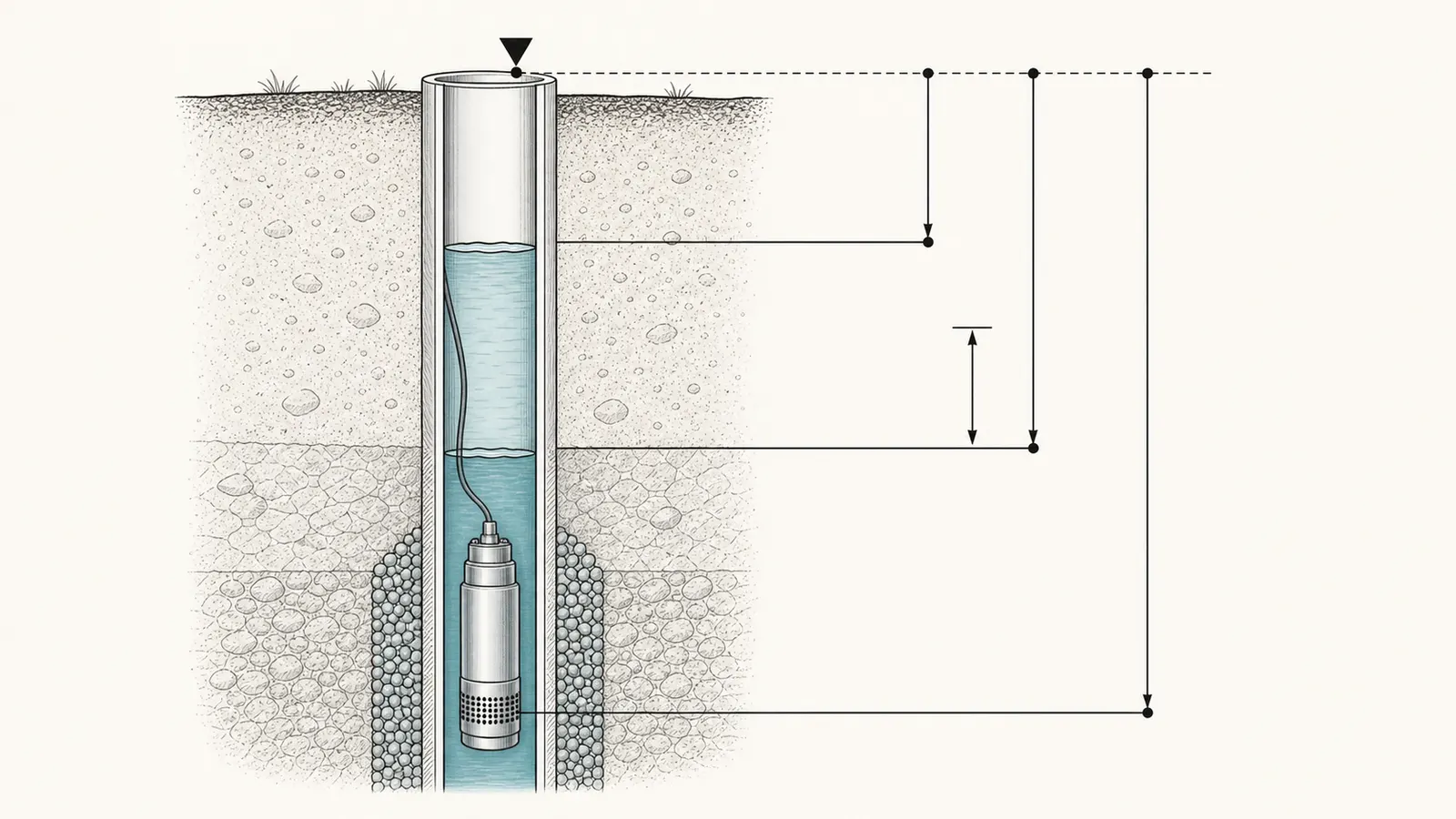
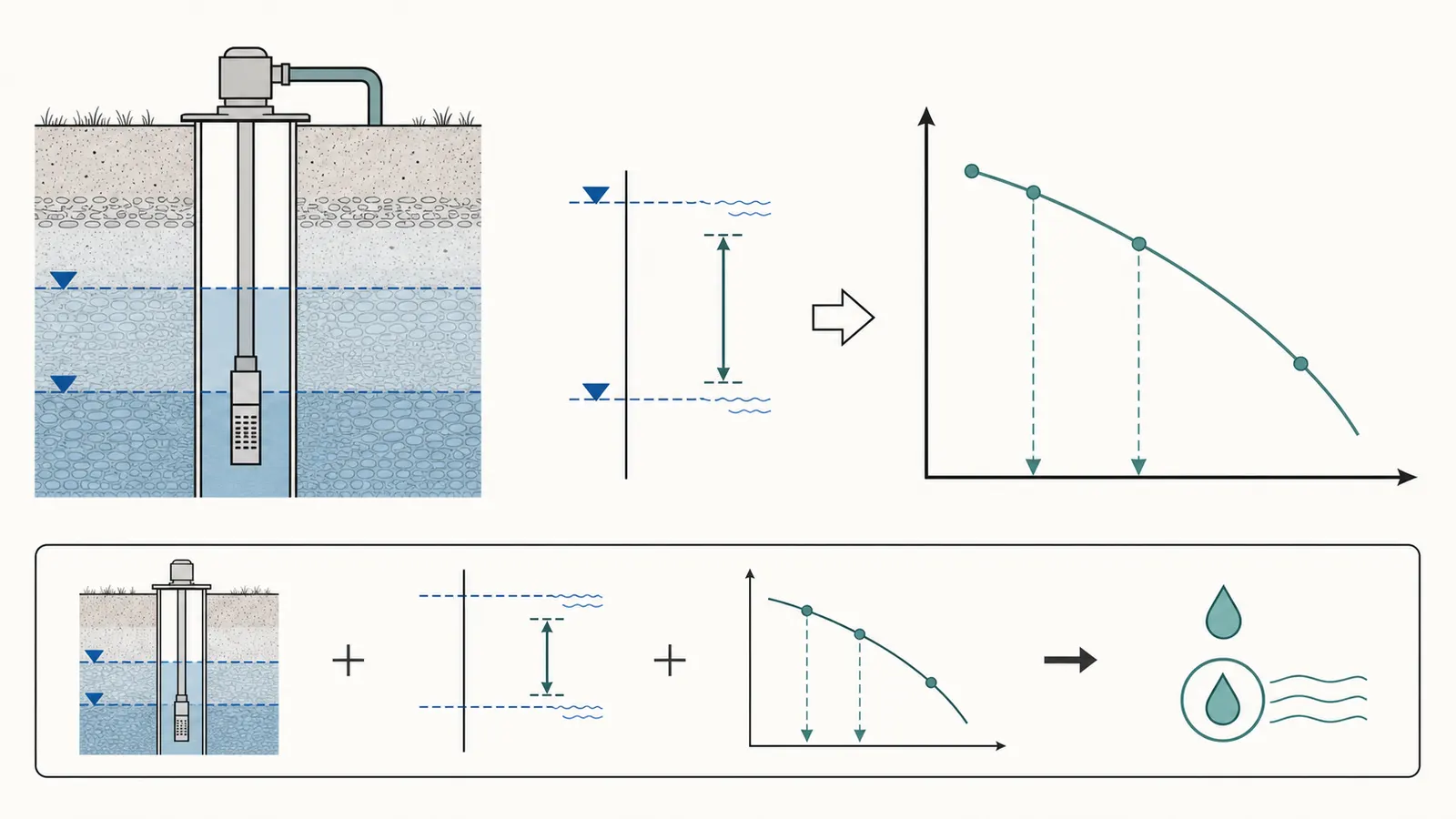
Static water level is the depth to water when the well is at rest. Pumping water level is the depth to water while the well is producing at a stated flow and elapsed time. Because these depths are measured downward from the same point, drawdown is the difference between them.
For example:
| Input | Test A |
|---|---|
| Measuring point | top of casing, marked |
| Static water level | 52 ft below measuring point |
| Pumping water level | 78 ft below measuring point |
| Drawdown | 78 − 52 = 26 ft |
| Measured flow | 8 gpm |
| Specific capacity | 8 ÷ 26 = 0.31 gpm/ft |
This is a relationship between one flow rate and one observed drawdown over one stated test duration. It is not the total amount of water stored in the well, the maximum safe household flow, a drinking-water result, or a guarantee that the pump will continue to run.
The metric becomes more useful when you repeat it under like-for-like conditions and keep the raw inputs. The Government of Canada’s well-monitoring guidance describes specific capacity as yield per unit drawdown and says future measurements should use similar time intervals and the same pumping rate. It also explains why attribution is difficult: the well, pump, and aquifer system are interrelated.
Why a lower result is a signal, not a verdict
At the same flow, a larger drawdown produces a smaller specific-capacity number. That pattern may be consistent with a change in the well intake area, such as plugging. NDSU Extension notes that screen blockage can increase drawdown and pumping energy requirements.
But a lower result can also be created by a weaker pump, a different pump or control setting, a bad flow estimate, a different test duration, a lower aquifer level, nearby pumping, or a static reading taken before recovery. The number cannot identify which component changed by itself. A useful result makes the next professional test more efficient; it does not replace that test.
Before you measure: safety and like-for-like rules #
Start with the well record if you have one. Look for the well completion report, original pump information, pump setting or intake depth, casing diameter, prior flow or yield test, and any dates of repairs, treatment, drought, flooding, or nearby well construction. Do not fill missing fields with guesses. Mark them “unknown.”
The fixed reference point
Choose one visible, stable measuring point—often a marked point on the top of the well casing—and use it for every water-level reading. Record what it is and how far it is above or below ground level if known. The Agriculture and Agri-Food Canada monitoring protocol specifically calls for a consistent measuring point and records of the point’s elevation. The Water Systems Council’s static-level sheet likewise describes measuring from the top of the casing or another marked reference point.
If Test A was measured from the top of the casing and Test B was measured from a nearby pit floor, do not trend them together. A tidy subtraction cannot repair a changed datum.
Comparable means comparable
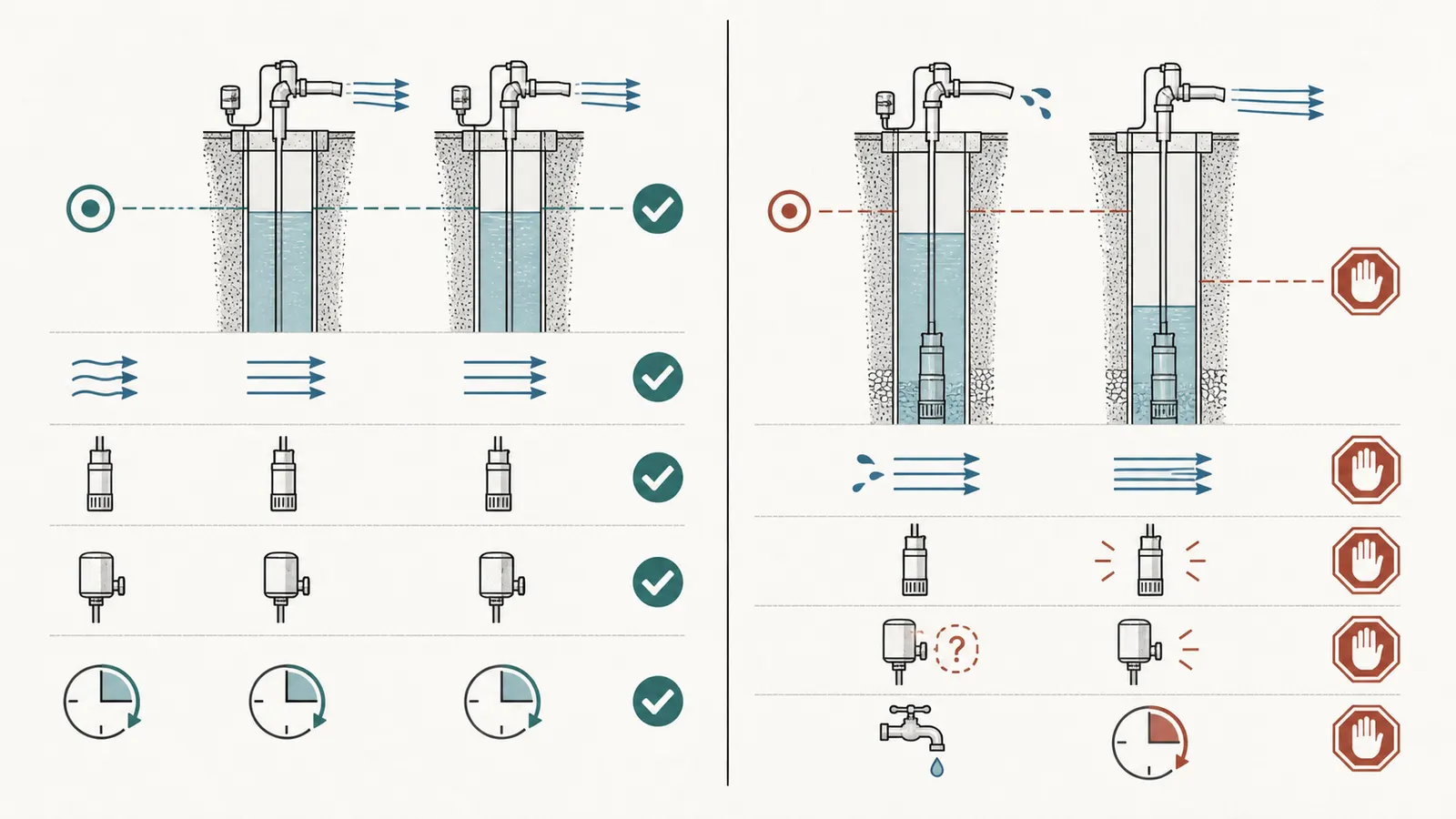
Use this gate before calculating a trend:
| Check | Proceed when… | Stop or label the result “not comparable” when… |
|---|---|---|
| Reference point | Both levels are measured from the same marked point. | The point moved, was not recorded, or changed between tests. |
| Units | Both depths use the same unit and direction. | Feet and meters are mixed, or one reading is an elevation and the other is a depth. |
| Static condition | The pump has been off long enough for the level to stabilize. | The well was recently used and the level is still rising. |
| Flow | The discharge rate is measured at the test, using the same outlet and method where practical. | Flow is guessed from pump horsepower, pipe size, or a faucet label. |
| Pump state | The same pump, control settings, and normal system configuration are in service. | The pump, pressure settings, wiring, treatment bypass, or plumbing arrangement changed. |
| Duration | The pumping-level reading is taken at the same elapsed time after starting. | One reading is at five minutes and the other is at thirty minutes. |
| Outside influence | Nearby pumping, irrigation, weather, and unusual household demand are documented. | A nearby well or unusual event may have changed the level and was not recorded. |
These are repeatability rules, not code requirements. A professional may deliberately vary flow or duration for a formal test; that is a different test design. The Canada guidance says systematic recording of time, discharge, and drawdown is what makes pumping-test data reliable.
Do only the safe portion
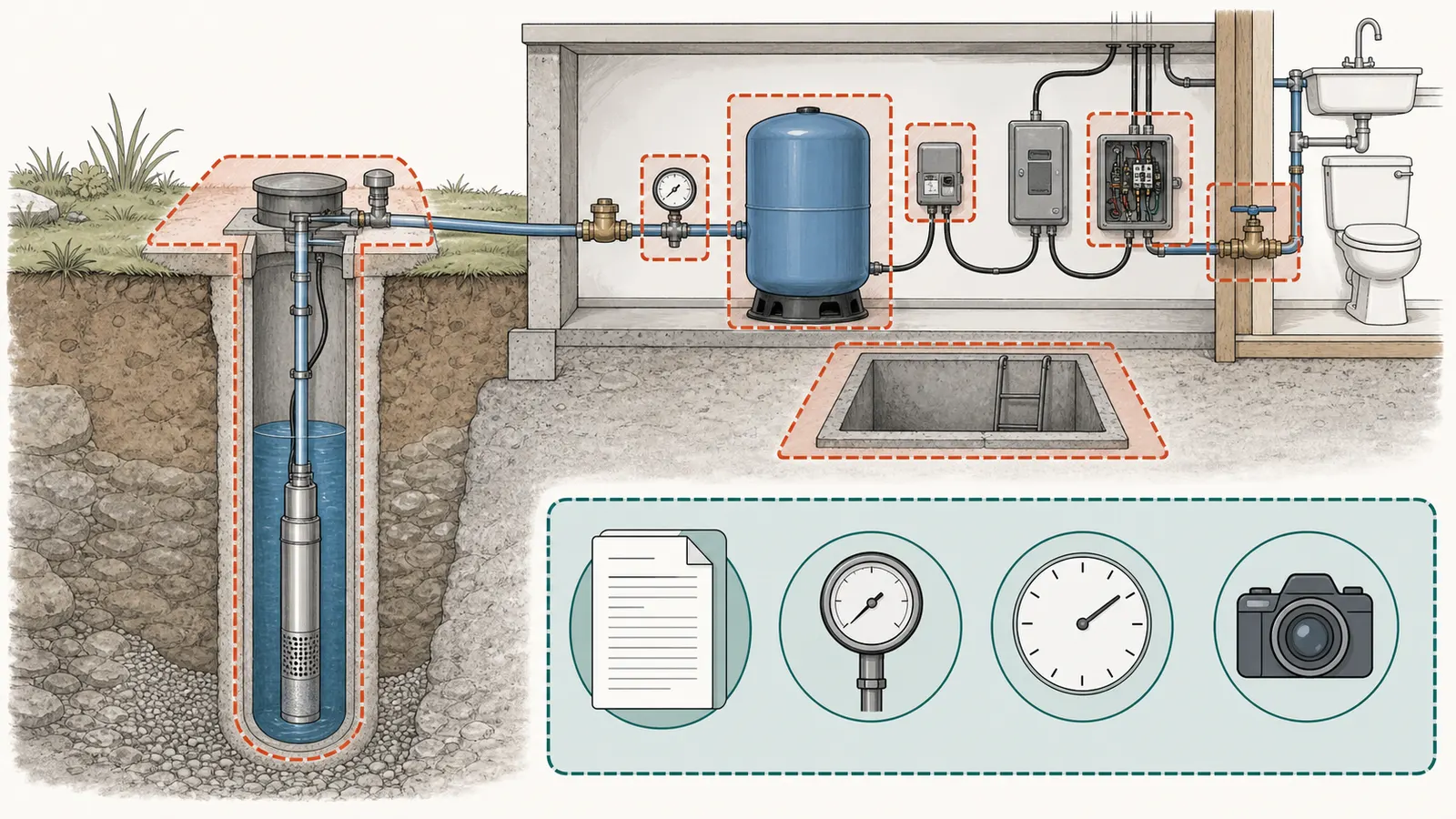
A homeowner can review records, identify a measuring point, observe an already-visible pressure gauge, time a normal discharge, and record an accessible flow measurement when the equipment is designed for it. Only take a water-level reading if the well has a suitable access port or other safe, intended method and you know how to use the instrument without damaging the system.
Do not open an energized control box, test live wiring, change pressure-switch settings, open pressurized piping, disconnect a pressure tank or treatment system, remove a well cap, pull a pump, lower yourself into a pit, or enter a confined space. Do not lean over an open well. Electrical, pressure, fall, entanglement, and contamination hazards are real. Assign those actions to a qualified well and pump professional. The Water Systems Council recommends contacting a licensed well contractor for static-level measurement and well maintenance; its discussion of air-line measurement includes installation and calibration details that are not a safe improvisation.
If the wellhead is flooded, the cap or casing is damaged, water quality changed after flooding, or you see exposed wiring or unsafe standing water, stop the measurement. The EPA’s private-well guidance says to stay away from a flooded well pump because of electric-shock risk and to obtain professional assistance before returning a flooded well to service.
Run a controlled homeowner screening test #
This is a documentation protocol, not a formal aquifer test. If you cannot hold the conditions below, record the reason and ask a professional to test the system.
1. Set up the log
Create one row for each test. Record:
- date, start time, weather or recent drought/rain context;
- the exact measuring point and water-level method;
- pump status before the test and any recent repairs or setting changes;
- whether nearby wells, irrigation, livestock, or unusual household use may be operating;
- the intended pumping duration and the discharge location;
- flow rate in gallons per minute, or the unit you will convert before calculating.
The public Missouri Rural Water Association drawdown and specific-capacity tool exposes the operator-style inputs clearly: air-line length, pressure with the pump off, pressure after five minutes of pumping, and gallons-per-minute flow. That is useful as a checklist of inputs, but it does not make an uncontrolled homeowner reading a controlled test.
2. Confirm a rested, stable static level
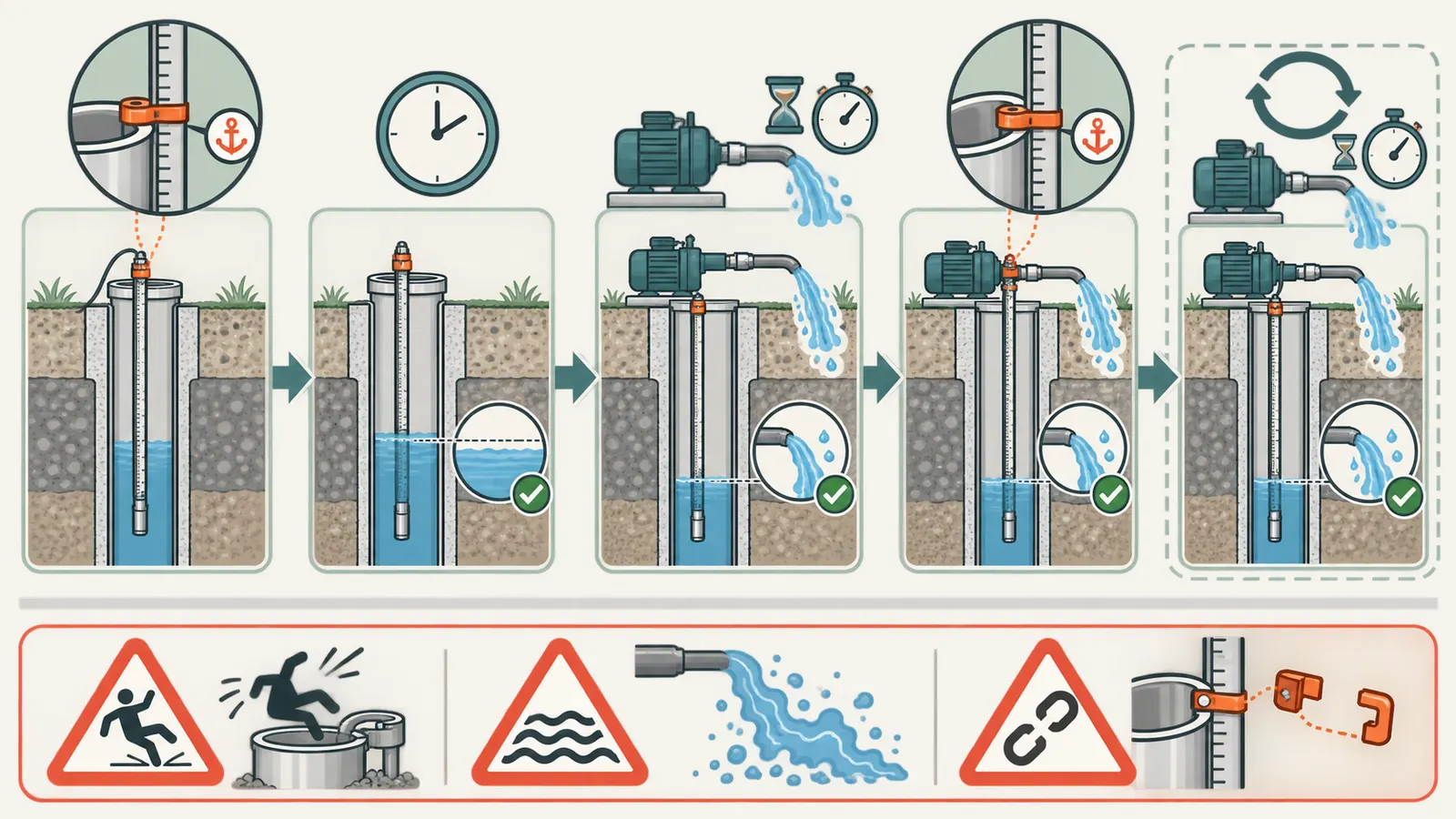
Do not call the first post-use reading “static.” The pump should be off until the level has had time to recover. Agriculture and Agri-Food Canada advises waiting at least 15–30 minutes after pumping, while noting that a low-permeability aquifer can take several hours; it then recommends a second reading 15–30 minutes later to check stability. The Water Systems Council describes static water level as an undisturbed, no-pumping condition and cautions that pumping just before the measurement can produce a false reading.
For a household log, choose a repeatable rest window that is realistic for your home—often an overnight period—and write it down. If the second reading is still moving substantially, do not force a static value into the formula. Record “not stable” and ask a professional how long the well should recover for a meaningful test.
3. Measure the flow you are actually testing
Specific capacity uses the flow entering the test calculation, not the pump’s nameplate, horsepower, advertised maximum, or a flow estimate from a fixture. Use a permanently installed flow meter when available. If you use a measured-container method, it must be safe, the container volume must be known, the discharge must not create a slip or electrical hazard, and the outlet must be consistent between tests. Convert the result to gallons per minute before calculating.
Record flow at the beginning and near the end when practical. If the flow changes noticeably during the test, keep both readings and label the test variable. Do not average away a change you do not understand. It may be a control-cycle event, restriction, air, pump behavior, or a changing water level.
Never redirect discharge toward the wellhead, foundation, septic area, or a place where it can recirculate into the well. The Canada guidance calls for safe discharge and attention to interference effects before a pump test. A professional should design the discharge arrangement if the property cannot safely handle the water.
4. Take the pumping reading at the same endpoint
Start the stopwatch when the test flow begins. Record elapsed time and the water level at the chosen endpoint. For a simple comparison, the endpoint might be 30 minutes if the system can safely operate that way and the flow remains controlled; Canada’s example uses 30 minutes, while its specific-capacity procedure also describes a designated 30-minute or one-hour test with readings at five-minute intervals.
Do not modify the pressure switch, bypass safety controls, open a panel, or force a continuous run. If the pump cycles, the discharge changes, the flow becomes unsafe, or the water level approaches a known pump or screen limit, stop and record exactly what happened. A professional may need a formal test arrangement that separates well performance from household pressure-storage behavior.
Calculate the result without hiding the raw data #
Use depths below the same measuring point:
drawdown (ft) = pumping water level (ft) − static water level (ft)
specific capacity (gpm/ft) = measured flow (gpm) ÷ drawdown (ft)
If the static depth is 52 ft and pumping depth is 78 ft, drawdown is 26 ft. At 8 gpm, specific capacity is 0.31 gpm/ft. Keep at least two decimal places in the working calculation, but do not imply that instrument precision makes the final number exact.
Invalid or misleading entries
Do not calculate a result when:
- static or pumping level is missing;
- the pumping level is shallower than the static level without a documented reason;
- drawdown is zero or negative;
- the flow unit was not converted;
- the two depths use different measuring points;
- the pump was not actually in the stated operating state;
- the static level was not stable;
- the discharge rate was unknown or changed materially.
“No result” is a useful result. It protects the record from false precision and tells the professional which field to solve next.
A compact worksheet to print or copy
| Field | Test A | Test B | Test C |
|---|---|---|---|
| Date / start time | |||
| Measuring point and elevation | |||
| Water-level method | |||
| Pump off since | |||
| Static level, depth below point | |||
| Static level stable? How checked? | |||
| Discharge outlet and method | |||
| Flow at start, gpm | |||
| Flow near end, gpm | |||
| Pumping duration | |||
| Pumping level, depth below point | |||
| Drawdown = pumping − static | |||
| Specific capacity = flow ÷ drawdown | |||
| Nearby pumping / unusual conditions | |||
| What changed since prior test? | |||
| Confidence: comparable / limited / invalid |
Keep the raw depths even if you also store the calculated result. A professional can often learn more from the two levels, flow, time, and system notes than from the rounded gpm/ft value.
Read repeats as signals, not replacement thresholds #
Do not ask, “Is 0.31 gpm/ft good?” Ask, “Did this well produce a different relationship than it produced under the same conditions before?” Geology, well construction, aquifer type, pump setting, measurement method, and seasonal conditions all affect the number. The supplied sources do not establish one national homeowner threshold, and this page does not invent one.
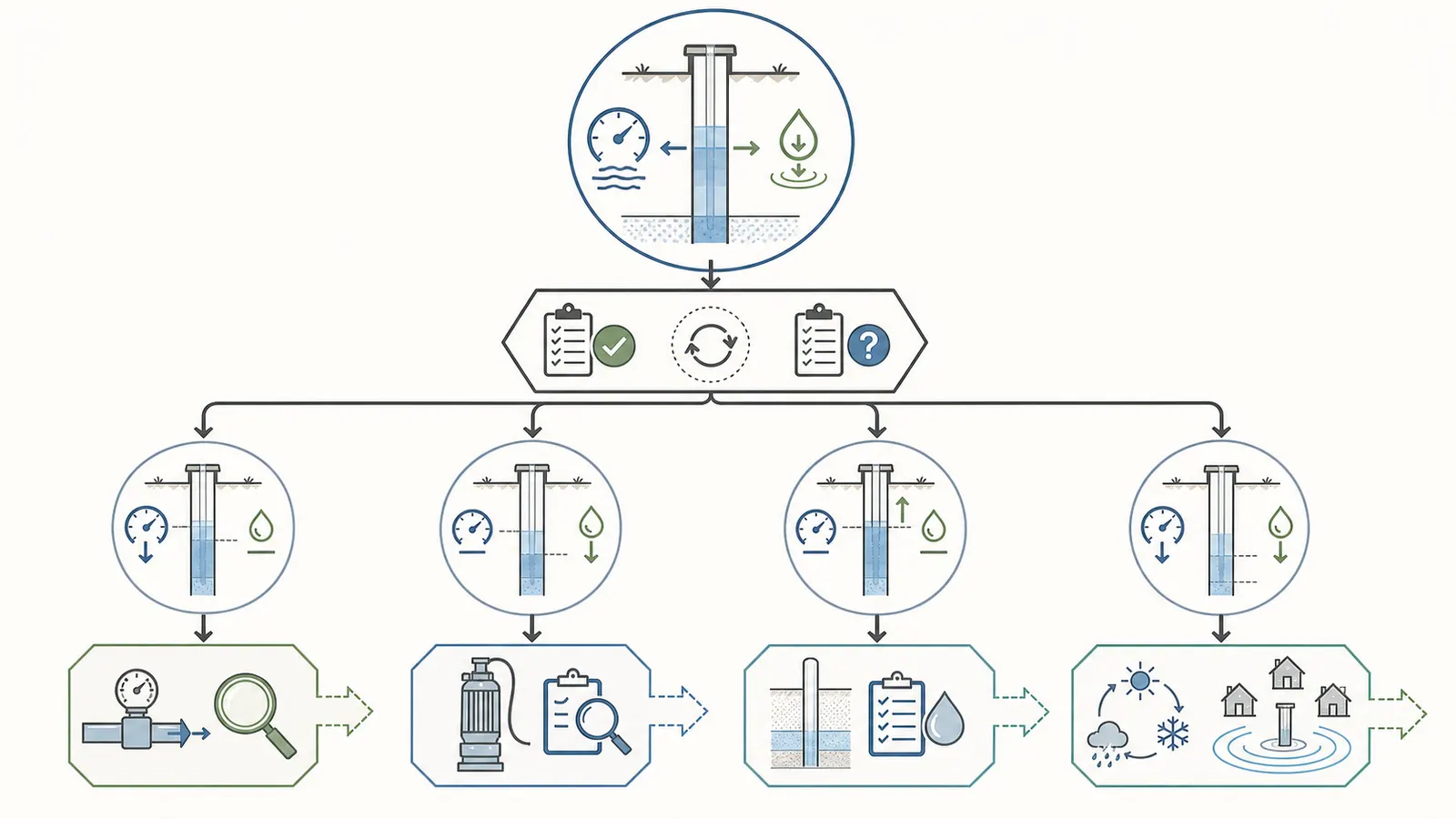
Use the pattern matrix below as a routing aid:
| Observed pattern after a comparable repeat | What it may signal | Safest next action |
|---|---|---|
| One low result, then a return toward the prior range | Measurement, recovery, flow, or temporary-condition issue | Repeat once under the documented baseline conditions; do not order replacement from one reading. |
| Flow is lower, drawdown is similar | Pump, discharge restriction, control cycling, or flow-measurement issue is worth checking first | Verify the flow measurement and visible system observations; request a pump/system inspection if the change persists. |
| Flow is similar, drawdown is greater | Well-intake restriction, aquifer condition, nearby pumping, or a changed test condition may be involved | Request a well-performance evaluation that reviews the well, pump, and surrounding conditions. |
| Static level is deeper, but pumping drawdown is similar | Aquifer or seasonal water-level change may be affecting the absolute depths | Compare season, rainfall/drought, nearby pumping, and recovery history; do not call it pump failure from this pattern alone. |
| Flow is lower and drawdown is greater | Multiple parts of the system may have changed, or the test may not be comparable | Preserve the complete log and ask for a combined pump and well-performance diagnosis. |
| Static level never stabilizes | The test does not have a dependable baseline | Stop calculating specific capacity and ask a professional to define the recovery and test method. |
The Government of Canada’s well-monitoring guidance lists inefficient pump performance, plugging at the well intake, and reduced aquifer production as possible causes of declining yield. That is why the matrix routes to a next test instead of naming a failed part.
What not to infer
Do not infer that a lower specific capacity means the well must be replaced. Do not infer that a stable specific-capacity number proves the pump is healthy, the pressure tank is correctly charged, or the water is safe to drink. Do not infer that a deep static level alone proves aquifer depletion; seasonal conditions and nearby pumping can matter.
Do not infer that a high number guarantees a supply during a peak event. Specific capacity is not a storage calculation and does not describe recovery after the pump stops. It also does not tell you whether bacteria, nitrate, arsenic, radon, or another contaminant is present.
Pressure-tank behavior can blur a household reading
Most homeowners experience the well through a pressure tank, pressure switch, indoor plumbing, and treatment equipment. A faucet test can therefore describe the whole delivery system rather than the well alone. The pump may start and stop, the tank may supply part of the flow, a filter may restrict the outlet, or a treatment device may change the discharge. Those conditions can make an apparently simple “how many gallons per minute?” observation difficult to interpret.
For a screening record, write down what was operating during the test. Note whether the pump ran continuously, cycled, or stopped; whether a pressure gauge was visible and changing; whether a filter, softener, or other treatment device was in the flow path; and whether more than one fixture was open. Do not change the system to make it run continuously unless a qualified professional has designed the test and confirmed that the arrangement is safe. Do not use a pressure-switch cut-in or cut-out value as a substitute for a water level.
If the well has a dedicated, safe test outlet installed for this purpose, a professional can use it to isolate well discharge from household demand. If it does not, do not disconnect the pressure tank or treatment equipment just to imitate an operator test. Record the limitation and ask for a controlled test. The Canada guidance lists disconnecting the pump from pressure storage and treatment systems as a pre-test activity, but that is a test-design step—not a direction to open or alter homeowner equipment.
This distinction explains why two valid-looking numbers may disagree:
- Test A may have measured a continuous discharge from the well.
- Test B may have measured water supplied partly from the pressure tank while the pump cycled.
- The arithmetic may be correct for both rows, but the rows do not answer the same question.
Keep both records if they help explain the event, but mark them as different test configurations. A qualified professional can decide whether the comparison needs a flow meter, a temporary discharge setup, a pressure-tank check, or a formal pumping test.
When the well record is missing
An absent completion report does not make a current measurement useless. It changes the first objective from “compare with the original well” to “establish a documented baseline.” Record the current measuring point, method, static recovery, pumping duration, flow, pump status, and any uncertainty. Repeat under the same conditions before assigning meaning to a change.
Ask the local permitting or environmental agency whether a well record is available, and ask the current well professional whether they can document the pump setting, casing, screen or intake information, and test method during a service visit. Do not assume that a nearby property’s well depth, a pump horsepower label, or a neighbor’s yield is a valid substitute. Wells that are close together can still respond differently to construction, geology, pumping history, and seasonal conditions.
If you inherit a home and have no baseline, create one before there is a crisis. A baseline is not a promise that the well will always perform the same way. It is a dated reference that makes a future conversation more precise.
How to handle unit and reference errors
Depth below a measuring point and water-surface elevation are different forms of data. If a professional gives you an elevation above a datum while your log uses feet below the casing, do not subtract them until the reference system has been reconciled. Likewise, convert liters per minute, gallons per hour, or imperial gallons per minute before using a U.S. gallons-per-minute formula. The Canada source uses imperial gallons per minute in its definition and example; NDSU presents gallons per minute per foot in an irrigation-well context. The unit label belongs in every row so a later reader can see which convention was used.
If you cannot confirm the gallon convention, preserve the original flow value and label the unit rather than silently converting it. A qualified professional can convert the record or repeat the flow measurement. A result with a clear “unit unknown” flag is safer than a precise-looking number with an unknown conversion.
A three-test example without a universal verdict
Suppose a homeowner establishes a baseline at 8 gpm, with a static depth of 52 ft and pumping depth of 78 ft after 30 minutes. The baseline is 0.31 gpm/ft. A later test at the same flow and duration records a static depth of 55 ft and a pumping depth of 81 ft. Drawdown is still 26 ft, so the specific capacity is still 0.31 gpm/ft even though the whole water level is three feet deeper. That pattern deserves seasonal and nearby-pumping context; it does not, by itself, identify a plugged intake.
If a third comparable test records 7 gpm, static depth 55 ft, and pumping depth 84 ft after the same duration, drawdown is 29 ft and the result is about 0.24 gpm/ft. Flow is lower and drawdown is greater. That is a stronger reason to preserve the complete record and request a combined pump and well-performance evaluation, but it still does not establish which component is responsible.
These examples show why the raw levels matter. Looking only at 0.31 and 0.24 hides whether the static level moved, whether the pump was asked to produce the same flow, and whether the test endpoint was actually the same.
Choose the right professional next step #
Bring the worksheet, well record, pump model and age if known, pressure observations, repair history, water-quality results, and notes about drought, flooding, nearby wells, irrigation, or construction. Ask the professional to state which test they propose and what decision it is meant to answer.
Ask for a pump or system inspection first when…
The flow measurement is lower but drawdown is not clearly higher; the pump cycles differently; pressure behavior changed; the pump runs longer; there is a visible restriction; or the pump, controls, tank, treatment equipment, or plumbing changed. This is a screening route, not proof that the pump is the cause.
Do not open the electrical enclosure or make live measurements yourself. A qualified professional can inspect the pump, controls, wiring, pressure tank, and discharge conditions safely and determine whether the observed flow is a well problem or a system problem.
Ask for a well-performance evaluation when…
Comparable tests show similar flow with increasing drawdown, the pumping level is approaching a known operating limit, recovery is changing, sand or sediment is appearing, or the decline persists after pump-side checks. Request that the evaluation address intake or screen condition, aquifer and nearby-pumping context, water levels, flow, and the test duration—not just a replacement recommendation.
NDSU Extension discusses physical, biological, and chemical screen blockage as different mechanisms that can reduce open intake area. The appropriate remedy depends on the well construction and evidence; cleaning, rehabilitation, pump work, or replacement are not interchangeable conclusions.
Ask about water testing separately
Specific capacity is about hydraulic performance, not health protection. If taste, odor, color, turbidity, flooding, nearby land disturbance, or a system repair has changed the water, arrange drinking-water testing through a certified laboratory and contact the local or state health authority for applicable advice. EPA recommends annual private-well testing for total coliform bacteria, nitrates, total dissolved solids, and pH, with additional testing based on local conditions and changes.
If a well has flooded, keep people away from the pump and do not improvise electrical or disinfection work. Follow local health guidance and use a qualified well professional.
Keep the record useful over time #
Specific capacity earns its place in a homeowner record when it is repeated deliberately. Pick a sensible interval that fits the well and local conditions, use the same marked measuring point, keep the same units, and note the season. Canada’s guidance says pumping and non-pumping water levels should be recorded regularly and describes at-least-monthly monitoring in its program context; a professional can help adapt the interval to your well and the decisions you need to make.
At minimum, keep these items together:
- well completion report and pump information;
- every raw static and pumping depth, not only the calculated result;
- flow at the beginning and end, with method and units;
- elapsed time, pump state, and whether the system cycled;
- recovery observations and the time the pump had been off;
- nearby pumping, weather, drought, flooding, construction, and repairs;
- water-quality laboratory reports in a separate section;
- the professional’s test method, findings, and recommended follow-up.
The decision boundary is simple: a repeatable change deserves investigation, not an automatic replacement. If the data are not like-for-like, improve the record before interpreting the trend. If the change persists, take the complete record to a qualified well and pump professional so the pump, well intake, aquifer conditions, and water quality are evaluated as separate questions.
Cite this guide
Brictale. “Private Well Specific Capacity: A Homeowner Test Log.” Published 2026-08-30; updated 2026-08-30.
https://brictale.com/water/wells/private-well-specific-capacity-calculator · Read the Markdown version
Sources and scope
Evidence behind this page
- Water-level measurements should be taken from an established, marked measuring point, such as the top of the well casing, so readings remain consistent and comparable.
Government of Canada guidance for recording private and agricultural well monitoring measurements.
Accessed · Link to this claim - A static or non-pumping level should be measured after the pump has rested; recovery can take 15–30 minutes or several hours in a low-permeability aquifer, and a second reading can check stability.
Government of Canada procedure for non-pumping water-level measurements; the recovery duration is site-dependent.
Accessed · Link to this claim - Pumping water levels should be measured after the same pumping duration for comparison, with discharge rate recorded alongside the level.
Government of Canada well-performance monitoring and specific-capacity testing guidance.
Accessed · Link to this claim - Specific capacity is well yield divided by drawdown, commonly expressed as gallons per minute per foot; drawdown is the difference between pumping and static water levels.
Care and Maintenance of Irrigation Wells
NDSU Extension explanation of well-performance records and specific capacity; the publication is written for irrigation wells, so the metric is used here as a bounded comparison tool for a private household well.
Accessed · Link to this claim - A declining well-yield signal can have more than one source, including an inefficient pump, plugging around the well intake, or reduced aquifer production; the well, pump, and aquifer are interrelated.
Government of Canada explanation of why well-performance changes are difficult to attribute remotely.
Accessed · Link to this claim - Increased drawdown at a given flow can be associated with screen plugging and can increase pumping energy requirements; the specific-capacity trend should be recorded under comparable conditions.
Care and Maintenance of Irrigation Wells
NDSU Extension irrigation-well maintenance discussion; it describes a mechanism and maintenance signal, not a universal homeowner failure threshold.
Accessed · Link to this claim - Static water level is the water level under normal, undisturbed, no-pumping conditions; a level sounder or depth gauge can be used from the top of the casing, with the reference point marked.
Determining Static Water Level in a Well
Water Systems Council wellcare information sheet; it recommends a licensed well contractor for this and other well maintenance.
Accessed · Link to this claim - For repeated testing of deep wells, an air line may be used, but the Water Systems Council describes installation and calibration details that are appropriate for a well contractor rather than an improvised homeowner procedure.
Determining Static Water Level in a Well
Water Systems Council description of air-line measurement for deep wells.
Accessed · Link to this claim - A public rural-water calculator exposes inputs for air-line length, pressure with the pump off, pressure after five minutes of pumping, and gallons-per-minute flow, then reports static level, pumping level, drawdown, and gpm/ft specific capacity.
Well Drawdown and Specific Capacity Calculator
Missouri Rural Water Association tool interface; the tool is evidence of the operator-style input pattern, not a substitute for a controlled test or professional diagnosis.
Accessed · Link to this claim - Well performance measurements do not establish drinking-water safety; EPA recommends annual private-well testing for total coliform bacteria, nitrates, total dissolved solids, and pH, with additional testing when conditions or water quality change.
U.S. EPA private-well water-quality guidance; testing requirements and programs can vary by state.
Accessed · Link to this claim - Well construction, modification, abandonment, and closure should be handled by a certified well driller, and exposed well components should be inspected for casing, cap, and seal problems.
U.S. EPA private-well protection guidance; local certification and licensing rules vary.
Accessed · Link to this claim