Can My Well Handle a Sprinkler System? A Homeowner Decision Worksheet
Use well-yield evidence, pressure, delivered flow, indoor reserve, and sprinkler demand to choose zones, drip, storage, or no irrigation.
The short answer
Maybe—but a faucet flow test alone cannot answer it. Compare a documented sustainable well yield and recovery result with pressure-corrected delivered flow, the sprinkler heads' manufacturer-rated demand, and water needed by the home at the same time. If the evidence is incomplete, protect the domestic supply: use smaller zones or drip only after a professional confirms the operating point, or investigate timed refill, storage with a booster, or no irrigation from the well.Can My Well Handle a Sprinkler System? A Homeowner Decision Worksheet
Maybe. A well can run irrigation only when the evidence lines up at the same operating point: the well can sustainably supply water, the pump can deliver it at the pressure the heads require, the irrigation zone uses less flow than is available, and the house still has its domestic reserve. A quick faucet test is useful, but it is not a sustainable-yield result.
Use this decision surface to record a defensible result:
| Evidence status | What you can conclude | Safest next move |
|---|---|---|
| Sustained yield and recovery are documented; pressure and delivered flow are measured at the irrigation operating point; zone demand is lower than the available flow; household demand is protected | A limited irrigation design may be supportable | Start with the smallest zone that meets the sprinkler specifications and verify the first run |
| Pressure and delivered flow are known, but sustained yield or recovery is unknown | You know what the system can do briefly, not what the well can sustain | Do not label the result “well capacity”; arrange a qualified yield/recovery evaluation before full-lawn irrigation |
| Yield is low or seasonal, but daily household supply is adequate | The domestic well may need storage or demand scheduling | Analyze household storage first; treat irrigation as an optional load, not the reserve |
| Zone demand exceeds the conservative available flow, or indoor pressure falls when irrigation runs | The proposed zone is a no-go at that operating point | Split zones, choose a lower-demand landscape use such as drip where appropriate, or stop and redesign |
| The well is drawing down, recovering poorly, producing air or sediment, or has no reliable test record | The risk is not just poor sprinkler coverage; it may be loss of domestic supply or pump damage | Stop irrigation testing and call a qualified well or pump professional |
The worksheet below is deliberately conservative. It does not give a universal gallons-per-minute promise because well geology, pump selection, water level, pipe friction, elevation, sprinkler choice, and household demand differ.
1. Know which “capacity” number you are recording #
Three numbers are often collapsed into one. Keep them separate.
Sustainable well yield is the rate the well can provide continuously without lowering the water level below the pump intake. Penn State Extension defines well yield this way and calls wells that cannot meet peak home or farm demand “low-yielding.” Penn State’s low-yield well guidance also explains why a well yielding 1 gallon per minute can produce 1,440 gallons over a day yet still fail a two-hour household peak: demand arrives faster than the aquifer supplies it.
Connecticut’s Department of Public Health similarly defines yield as the quantity that may flow or be pumped continuously, and its guidance says a stabilized discharge is needed when checking an existing well. It describes a professional installing a low-capacity meter on the discharge line and running the well until output is consistent. Read the Connecticut safe-yield guidance as Connecticut guidance, not as a national test rule.
Pump delivery is what the installed pump and piping can send at a particular pressure and water level. A pump may be capable of more flow at low pressure than at the pressure a sprinkler needs. The pump installer’s curve, the well’s current water level, pipe size, filters, check valves, elevation, and pressure controls all matter. Do not substitute a pump nameplate rating for a delivered-flow observation.
Delivered flow at the irrigation operating point is the flow you actually observe where irrigation connects, while the system is operating at the pressure the heads need. It is the right number for an initial zone comparison, but a short observation can include water already stored in the pressure tank or borehole. It can therefore overstate what the aquifer can keep supplying.
Domestic reserve is the water the home needs while irrigation is on or immediately afterward. It includes drinking, toilets, showers, laundry, and other simultaneous uses. New York State Department of Health uses 5 gpm—two 2.5-gpm fixtures—as a good estimate of typical household peak demand and says a well that reliably yields 5 gpm should meet peak and daily needs for most residences. That is household guidance from New York, not a universal irrigation threshold or a guarantee for your home. See the New York fact sheet.
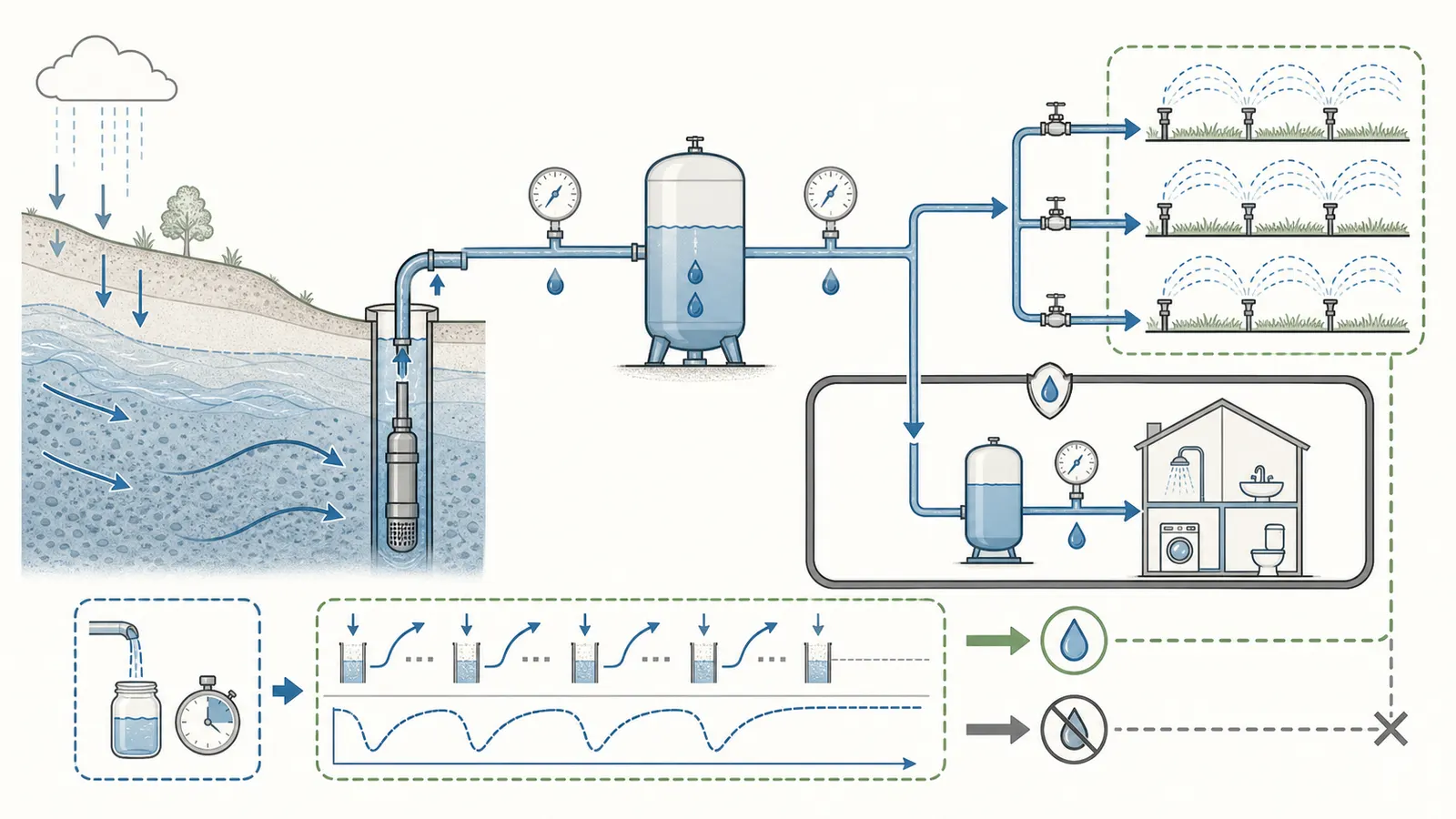
Your decision therefore has two gates:
- Aquifer gate: Is there evidence of sustainable yield and recovery through the season, not just a brief discharge?
- System gate: At the required sprinkler pressure, does delivered flow cover the zone while the home keeps its reserve?
Fail either gate and the full-lawn sprinkler proposal is not ready for a go decision.
2. Build the evidence record before choosing heads #
Before buying valves, heads, or a larger pump, collect the following. Put the date and conditions beside every number; a result from a wet spring may not represent a late-summer drawdown.
Well and pump record
Look for the well completion report, drilling invoice, pump replacement record, or service notes. Record, if documented:
- well depth and casing diameter;
- static water level and any measured pumping water level;
- original or recent well-yield result, including test duration;
- pump model, horsepower, rated flow, and pump curve if available;
- pressure-switch cut-in and cut-out settings, only from records or a professional;
- pressure-tank size and any service history;
- low-water cutoff, dry-run protection, or flow-control equipment;
- any history of seasonal shortage, air, sand, rapid cycling, or pressure loss.
Do not fill a blank with a guess. “The well has always been fine” is useful history, but it is not a yield measurement. Connecticut notes that existing private wells do not necessarily have a yield test requirement and that yield can lessen over time; that is one reason an old drilling report should not be treated as current proof. The state’s guidance explains this limitation.
Irrigation design record
For every proposed sprinkler head or nozzle, record the manufacturer’s model, nozzle or arc, rated flow at the intended pressure, and wetted diameter. Record the number of heads assigned to each zone, pipe size and approximate length, elevation change, filter or backflow components, and the target pressure at the least-favored head.
The University of Georgia Extension explains why these details matter: sprinkler type and number must match the water source’s pressure and volume, and output is primarily determined by nozzle size and pressure. Its guidance identifies rotary sprinklers as generally operating at higher pressure than spray heads, but the model’s own performance table controls your design. Use the UGA irrigation bulletin for the design principles.
Home-use record
Write down which water uses can overlap with watering. Include showers, toilets, dishwasher, washing machine, hose use, water treatment backwash, livestock, and any automatic fixture. Note the time of day when the home has its highest demand. If the system would start irrigation automatically, assume it can overlap unless the control schedule prevents it.
The five-number worksheet
Copy this into a note or print it for a professional discussion:
| Field | Record | Evidence quality |
|---|---|---|
| Sustainable well yield | ____ gpm | Test date, duration, stabilized rate, water-level drawdown, and recovery: __________________ |
| Current delivered flow | ____ gpm | Test location, duration, water level/season, and whether pump cycled: __________________ |
| Pressure with irrigation operating | ____ psi at connection / ____ psi at last head | Gauge location, flow running, other uses off: __________________ |
| Concurrent indoor demand | ____ gpm or documented fixture combination | Peak time and fixtures operating: __________________ |
| Zone demand | ____ gpm at manufacturer-rated pressure | Head/nozzle schedule and source table: __________________ |
The blank for sustainable yield should remain blank if you only have a five-minute faucet test. That is a useful “unknown,” not a failure of the worksheet.
3. Measure current delivery without calling it yield #
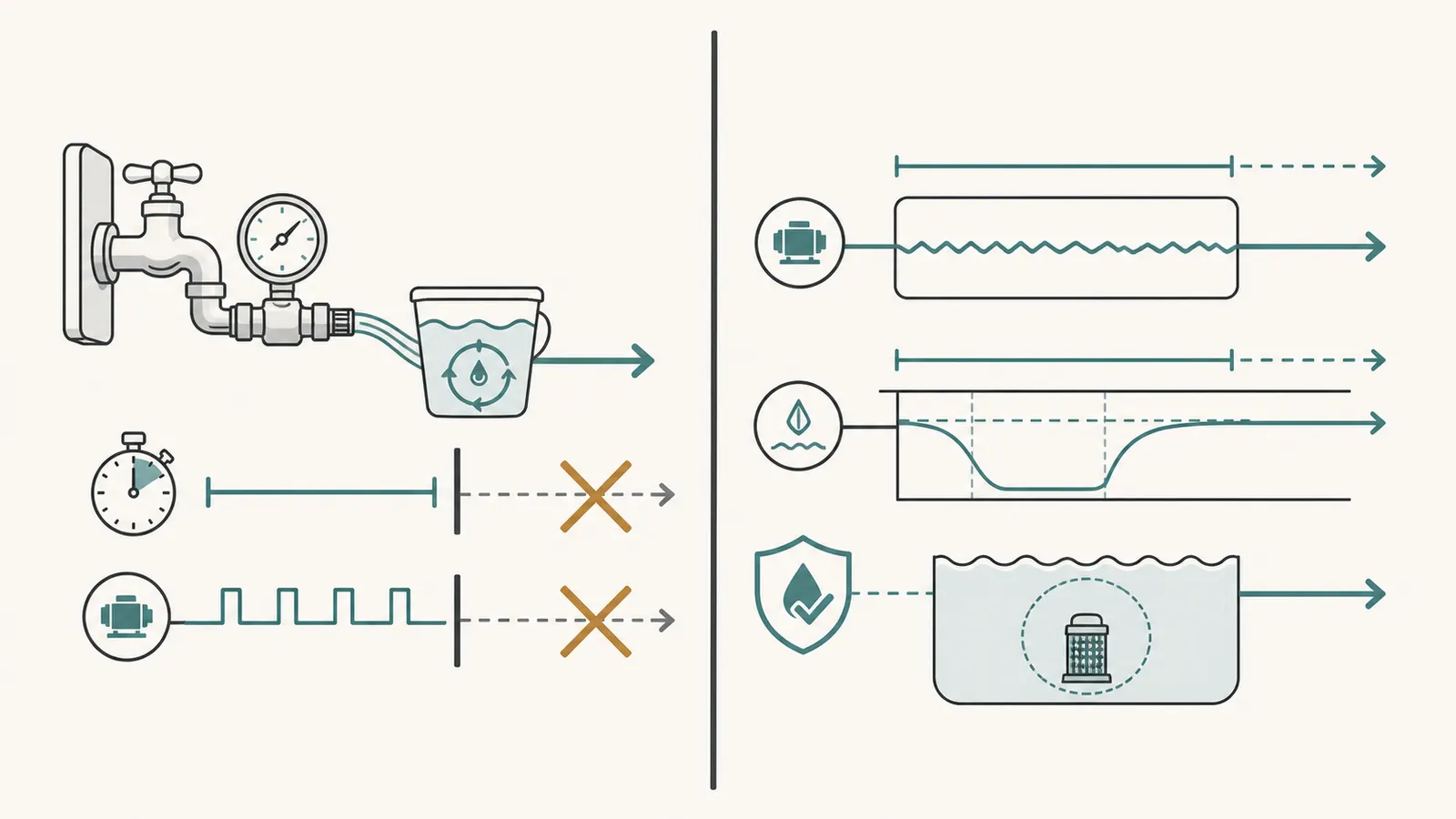
A homeowner can often document an operating-point observation without opening a well, pump control, or electrical enclosure. This is a screening step for the irrigation design, not a well-development test.
Safe observation procedure
- Choose the intended irrigation connection or a suitable exterior faucet. Use a pressure gauge only where it can be attached without disassembling pressurized plumbing. If the connection, gauge, or hose bib is damaged, corroded, hot, or leaking, stop and have it evaluated.
- Turn off indoor water uses and record static pressure after the system has recovered. Hunter’s residential capacity guidance uses a pressure gauge with no other water flowing for the static reading; its table is written for metered city-water service, so do not copy its GPM chart to a private well. Hunter’s page explains the pressure-and-flow measurement concept and its private-well limitation.
- Open the test point gradually and record pressure while water is flowing. If you are testing a proposed zone, use the actual connection, filter, valve, and pipe route where possible. A pressure reading at a nearby faucet may not equal pressure at the last sprinkler.
- Measure flow with a meter already installed or with a clean container of known volume and a stopwatch, only if the discharge can be collected safely and the pump installer or professional has not restricted the test. UGA Extension describes catching sprinkler discharge for one minute and measuring gallons as a way to determine gpm at the applied pressure. See its output-measurement guidance.
- Calculate the observation as
gpm = gallons collected ÷ seconds × 60. Record the pressure at the same time. Repeat only long enough to see whether the number is stable under the planned operating conditions; do not run a questionable well until it loses pressure or produces air. - Record pump cycling, pressure decline, sputtering, sand, cloudiness, or a sudden change in discharge. Stop the test if indoor pressure drops, water quality changes, the pump appears to run continuously without recovering, or the well or equipment behaves abnormally.
The result is delivered flow at this test point, on this date, under these conditions. It is not the well’s sustainable yield. In particular, a pressure tank or water stored in the well casing can temporarily support a higher draw than the aquifer can replenish. Penn State says a pressure tank is primarily for maintaining pressure and has limited usable storage; larger pressure tanks alone do not solve a low-yield problem. Read Penn State’s storage discussion.
What a sustained yield evaluation adds
A qualified well professional can plan a test that measures more than a faucet’s immediate discharge. The record should identify the pumping rate, test duration, stabilized water level or drawdown, recovery after pumping stops, and whether the pump intake remained protected. The exact test duration and procedure depend on the well, jurisdiction, and purpose. Connecticut’s two-page guidance says requirements vary from 1 to 24 hours across states and towns, references a minimum four-hour test for certain new private wells under Connecticut rules, and recommends longer testing for some low-yielding wells. Do not turn that state-specific language into a national requirement; ask your local health department or qualified well professional what applies.
For an existing older well, Connecticut describes a professional metering the discharge and running the well until it stabilizes, without removing the pump. That may be a useful conversation starter, but a professional must decide whether the test safely represents the current aquifer, pump, and season. A short test that never reaches stabilized conditions cannot establish sustainable yield.
4. Convert sprinkler hardware into zone demand #
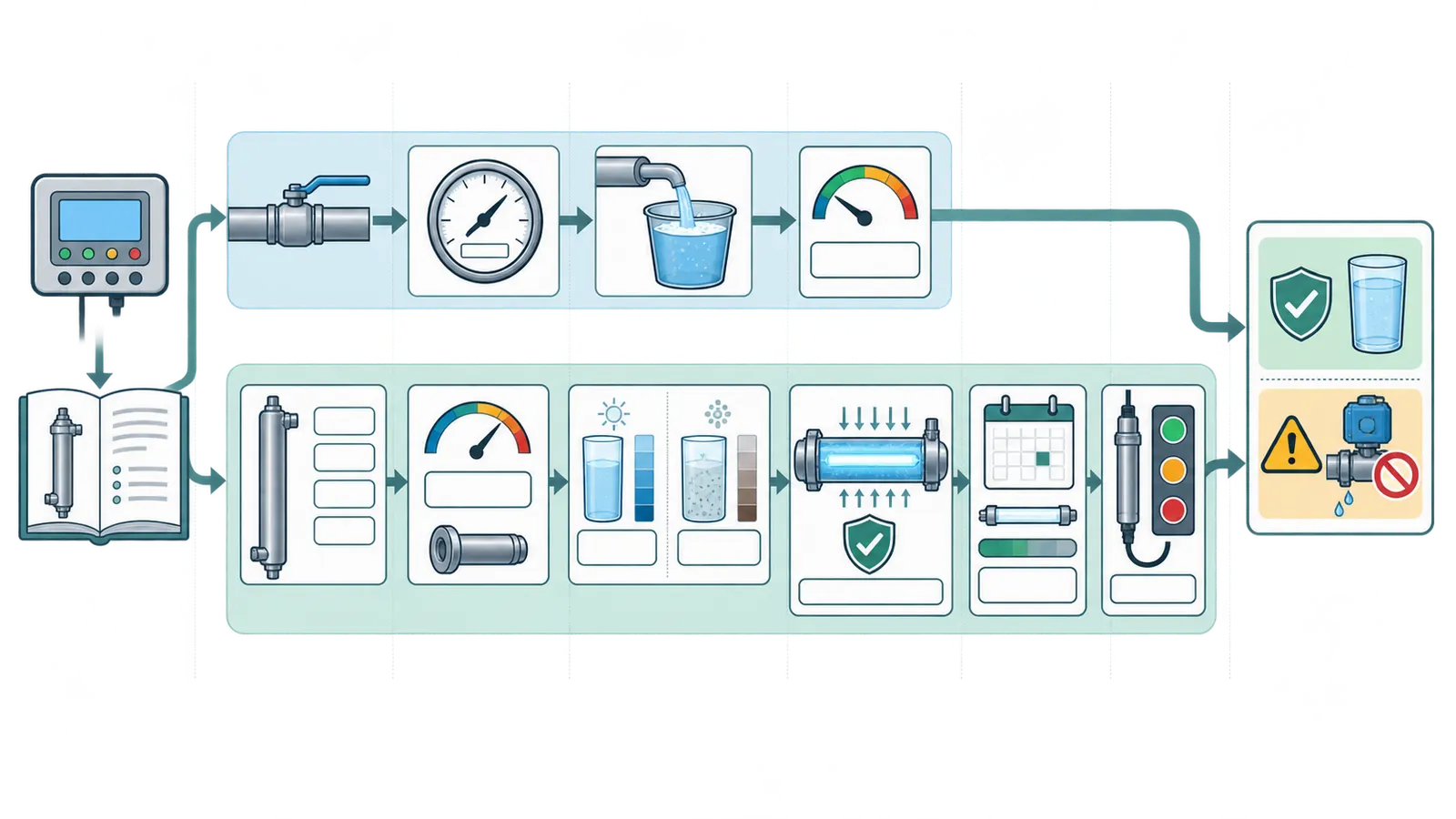
The question is not “How many sprinklers can a well run?” The question is “What is the sum of the specified flows for this zone at the pressure the heads require, and can the water system sustain that condition?”
Use the manufacturer’s pressure row
For each head, find the exact nozzle, arc, and pressure in the manufacturer’s performance table. Record its flow. Do not use a marketing maximum, a flow value from a different nozzle, or a flow value at a pressure your well cannot maintain.
UGA Extension says sprinkler output depends on nozzle size and pressure and that manufacturer specifications normally give output and wetted diameter for different nozzle sizes and pressures. It also explains that a part-circle head should have an output proportional to the area it covers when it shares a valve with full-circle heads. Use the UGA specification guidance and the exact head manufacturer’s table together.
Sum the zone, then check pressure losses
Use this recordable calculation:
Zone demand = head 1 flow + head 2 flow + head 3 flow + … + drip-emitter flow
Then compare the result with the flow available while the zone is running at its target pressure. If one head requires materially more pressure than the others, or if the first and last heads sit at different elevations or pipe distances, a single GPM sum is not enough.
Water loses pressure through pipe and fittings. UGA explains that friction loss increases with flow and pipe length, that more pressure is needed to move water uphill, and that elevation changes pressure by about 0.43 psi per foot of water rise. It recommends keeping pressure variation on a sprinkler circuit within 20% for good uniformity. Review the UGA pressure and pipe-sizing section.
That means a zone can fail even when the total GPM looks acceptable:
- the pump delivers the flow only at a pressure below the sprinkler’s operating range;
- a long or narrow pipe consumes too much pressure before the last head;
- a filter, backflow device, valve, or elevation change adds loss;
- the well water level falls during operation and the pump’s delivery changes;
- the zone contains heads with incompatible pressure or nozzle requirements.
Separate sprinkler zones from drip zones
Drip irrigation can be a lower-demand path for beds, shrubs, trees, containers, and vegetables. UGA describes drip as a slow application method that permits close control and generally uses less water, while noting that it is not well adapted to solid plantings of shallow-rooted grass. Point-source emitters commonly operate in a much lower flow range than lawn sprinklers, but the exact emitter, pressure regulator, filter, and layout still control the design. See UGA’s drip guidance.
Do not use drip’s lower flow to skip water-quality and pressure checks. UGA says drip water generally needs to be as clean as drinking water, filtration is used to prevent clogging, and pressure regulation is commonly required. Its maintenance guidance says filter and screen cleaning frequency depends on water quality and filter size and that laterals should be flushed periodically. A lower-demand system that silently clogs is not a successful irrigation system.
Apply a conservative comparison
Use the lowest defensible number, not the most flattering one:
Conservative outdoor allowance = the lower of documented sustainable yield and stable delivered flow at target pressure – concurrent indoor demand
This is a worksheet rule, not a published universal engineering formula. It keeps the two kinds of evidence visible. If sustainable yield is unknown, the result is not calculable for a full automatic system. If indoor demand is unknown, measure it or schedule irrigation away from the home’s peak. If the subtraction does not leave a positive, pressure-corrected allowance for the zone, the zone is a no-go.
Do not add a universal “extra 2 gpm” or claim that a given well can run a given number of heads. The correct zone may be one head, several small heads, or no sprinkler zone at all, depending on the recorded evidence.
5. Protect the house with a simultaneous-demand test #
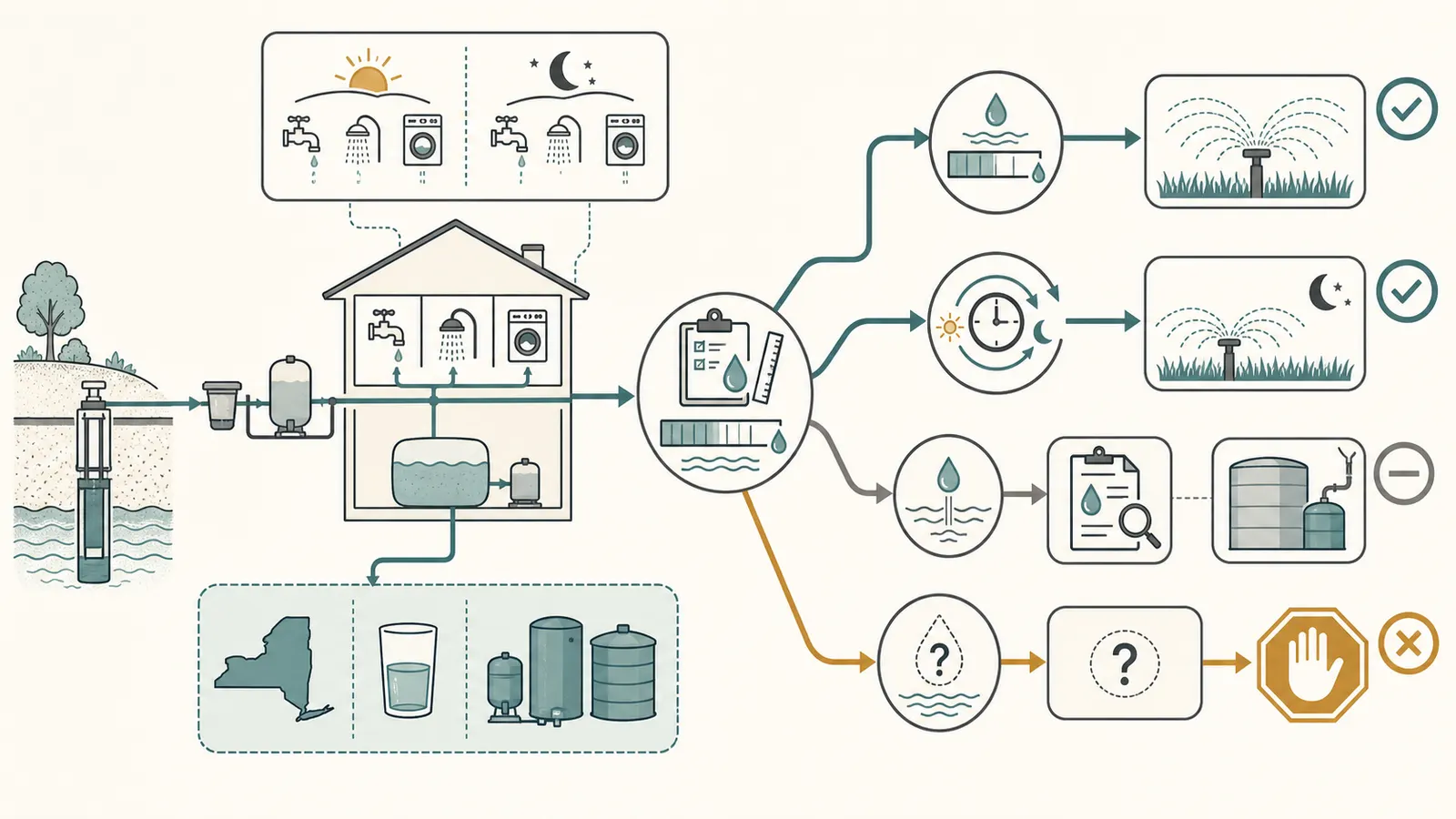
Irrigation is an outdoor load added to a drinking-water system. The domestic well should not be judged only by whether the lawn looks evenly watered for a short run.
New York’s health guidance says low-yield wells may supply enough total daily water yet fail during peak demand. It also says higher-use activities such as lawn irrigation are not recommended for homes served by low-yield wells without addressing the additional demand. Read the current New York water-storage fact sheet.
Record the home’s peak window
Choose a normal high-use period, often morning or evening, and record what actually overlaps. Do not deliberately create a damaging stress event. Use ordinary fixtures and stop if pressure or water quality changes.
| Household condition while irrigation is proposed | Record | Interpretation |
|---|---|---|
| No indoor use | Time of day and pressure | Useful for an isolated irrigation observation, not proof of household safety |
| One shower or bath plus normal toilet use | Fixture combination and pressure | A realistic reserve test for some homes; not a universal household profile |
| Shower plus laundry, dishwasher, or treatment backwash | Duration, pressure, and any recovery lag | High-priority conflict to avoid through scheduling or system separation |
| Several occupants using water unpredictably | Occupants, likely peak window, and observed symptoms | Treat automatic irrigation as a conflict unless controls prevent overlap |
If the home has a water softener, cartridge filter, ultraviolet unit, or other equipment that backwashes or consumes water automatically, include its cycle in the schedule. A well can look adequate when the only load is a hose bib and fail when a treatment cycle starts.
New York’s 5-gpm figure is useful context for a typical household, but it is not permission to dedicate 5 gpm to irrigation. A well that reliably yields less than that may need supplemental storage even for domestic peaks. Penn State gives the same conceptual warning with a 1-gpm example: daily volume and peak-hour ability are different questions.
Do not spend the indoor reserve on a zone
Use the worksheet in this order:
- Record the household condition you are protecting.
- Measure or document indoor demand in that condition.
- Determine delivered flow and pressure with the irrigation connection operating.
- Subtract the indoor demand from the lower, defensible water-supply number.
- Compare the remaining outdoor allowance with the zone’s specified demand.
- Repeat during the season when the well is most stressed, or have a professional assess seasonal risk.
If the irrigation run causes a shower to lose pressure, toilets to refill slowly, the pump to run continuously, or the well to produce air or sediment, treat that as a failed test. Do not solve it by increasing pressure-switch settings or changing pump controls yourself. It may be a capacity, drawdown, equipment, or protection problem.
6. Choose the least-risk irrigation path #
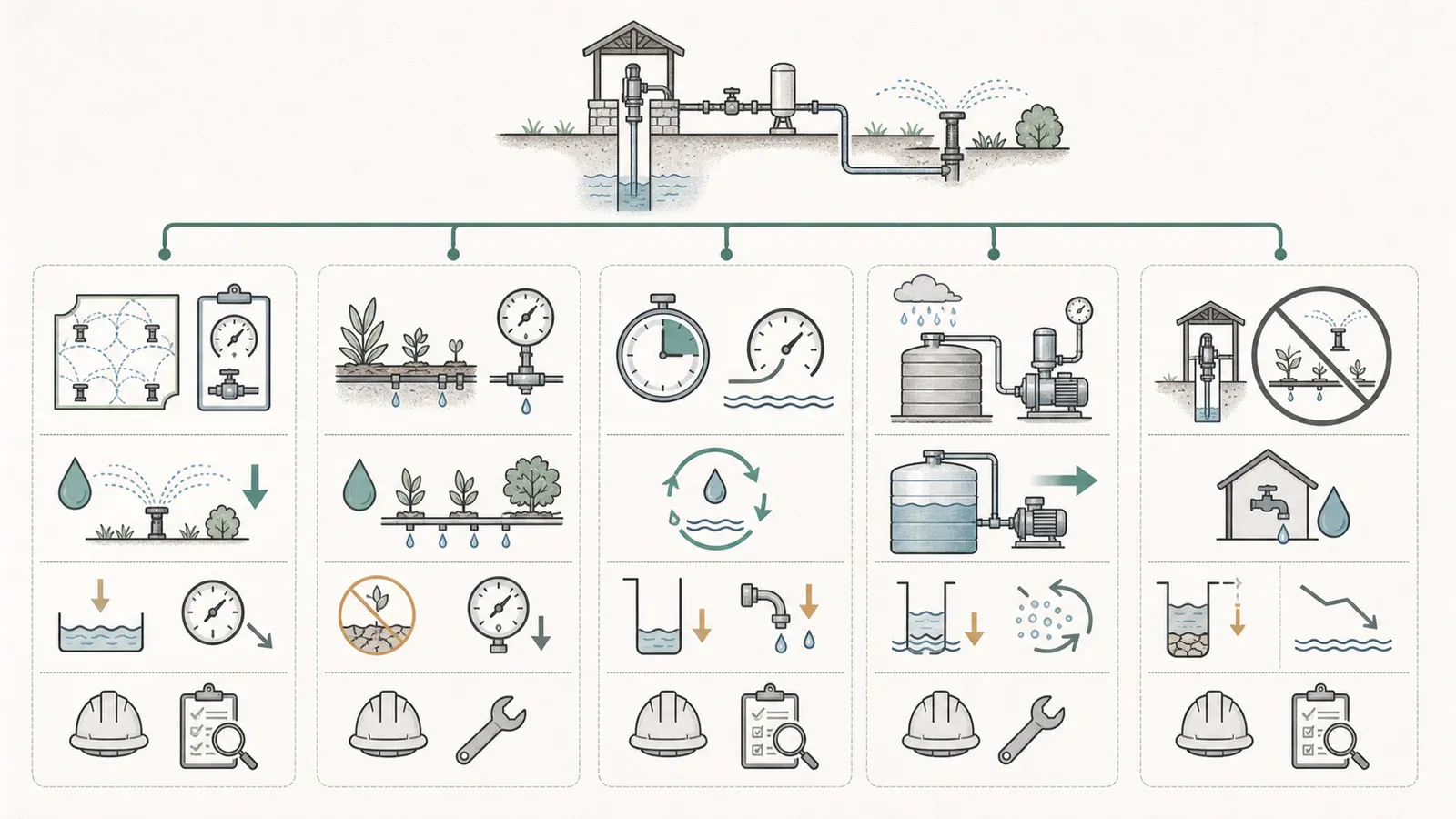
The right result may be a smaller design rather than a new pump. A larger pump can increase demand faster than the aquifer or plumbing can safely support it. Match the path to the evidence you actually have.
| Path | Use it when | Evidence still required | Main boundary |
|---|---|---|---|
| Smaller sprinkler zones | Yield/recovery are documented and pressure is adequate, but the proposed zone demand is too high | Exact head flows, operating pressure, pipe/elevation losses, indoor reserve | Smaller zones reduce instantaneous demand; they do not create more well yield or eliminate seasonal drawdown |
| Drip irrigation | The target is beds, shrubs, trees, containers, or vegetables rather than solid turf | Emitter flow, regulator pressure, filtration, water quality, run time, and clogging maintenance | Drip is not an automatic substitute for lawn coverage and still consumes well water |
| Timed refill | The well supplies a limited, steady amount and irrigation can wait between runs | Sustained yield, recovery, daily household demand, storage volume, refill controls, and a protected domestic reserve | A timer cannot make an unstable well sustainable; it only spaces demand |
| Storage with a booster | A low-yield well can replenish a properly designed reservoir and the system can separate source pumping from distribution | Professional tank sizing, potable-water protection, controls, freeze protection, overflow/drainage, booster capacity, and power-outage plan | Storage can buffer timing; it does not improve water quality or prove the well can refill indefinitely |
| No irrigation from the domestic well | Yield/recovery is unknown, seasonal, inadequate, or the household has no reserve | Protect domestic use; consider non-well landscape options where lawful and practical | This is a complete decision, not an unfinished project |
How storage changes the question
Supplemental storage can help a low-yield well meet a household peak because the well refills the reservoir more slowly while a separate pressure pump serves short demand peaks. Penn State describes an intermediate system as a storage reservoir between the well and the pressurized distribution system and notes that it requires a well pump, a storage tank or reservoir, and a pressure pump. It also says the well pump should be rated slightly below well yield and protected by a low-water cutoff. Review Penn State’s intermediate-storage description.
New York provides a household storage table for typical moderate use. For example, its guidance lists 100, 150, 200, and 250 gallons for two-, three-, four-, and five-bedroom homes with a 3–5 gpm well, and 150, 200, 250, and 300 gallons for those same bedroom counts with a 1–3 gpm well. The table has additional brackets and blank cells for some combinations. These are state guidance values for domestic peak-demand storage, not a sprinkler-zone design table, not a national standard, and not a guarantee that a tank can support lawn irrigation. Use the complete New York table only within that scope.
A pressure tank is not the same as a large atmospheric storage tank. Penn State says only about 20% of a pressure tank’s nominal capacity is usable in its example and that larger pressure tanks alone provide too little additional storage to solve a low-yield problem. Connecticut also warns that small usable pressure-tank volume can cause short-cycling and identifies combinations of pressure tanks and non-pressurized tanks with booster pumps as an alternative. See the Connecticut storage notes.
Storage is therefore a design project, not a homeowner shortcut. A professional must account for potable-water protection, tank cleaning, pump controls, overflow, freezing, electrical work, backflow, and what happens during a power outage. If irrigation water could ever cross-connect with drinking plumbing, ask the local authority or a qualified designer about the required separation and backflow protection. UGA specifically directs homeowners to check local codes for backflow-device locations and requirements when installing drip systems. See that local-code caution in UGA’s bulletin.
7. Stop conditions, maintenance, and the professional handoff #
Stop before you risk the domestic system
Stop the irrigation test and arrange qualified help when any of these is true:
- there is no sustained-yield or recovery evidence and the proposed system is more than a brief manual test;
- the well has a history of seasonal shortage, recent drought stress, or a changing water level;
- the flow or pressure falls as the test continues, never stabilizes, or returns slowly;
- the pump runs continuously, cycles rapidly, produces air, or draws sand or sediment;
- household pressure or water quality changes when irrigation starts;
- the sprinkler zone needs more pressure than the pump can deliver at the observed flow;
- the proposed system depends on raising pressure-switch settings, changing wiring, removing a protection device, or installing a larger pump without a well-capacity review;
- a storage or booster proposal lacks a documented refill rate, tank volume, control logic, and potable-water protection plan;
- local permitting, backflow, plumbing, electrical, or water-well requirements are unknown.
For this worksheet, Brictale applies one additional conservative safety boundary: if the water becomes cloudy, sandy, discolored, develops an unusual taste or odor, or contamination is otherwise suspected, stop using it for drinking and cooking, keep irrigation off, and contact the local health department or a qualified well professional about testing before resuming either use. This is a precautionary scope for an uncertain private-well condition, not a diagnosis or a universal regulatory rule. Do not use a clear-looking sample as proof that the water is safe.
Never open energized controls, test live wiring, open the well, pull a pump, enter a well pit or other confined space, or manipulate pressurized equipment as a homeowner diagnostic shortcut. Do not adjust a pressure switch, tank precharge, low-water cutoff, pump control, or electrical enclosure unless the exact action is demonstrably safe and within the manufacturer’s instructions; otherwise assign it to a qualified well, pump, irrigation, plumbing, or electrical professional. A pressure gauge reading at a faucet is an observation. It is not permission to work inside the system.
Maintain the evidence after installation
An irrigation decision can age. Sprinkler demand can change when nozzles, filters, valves, pipe, landscaping, or pressure-regulating devices change. Well yield can change with season and aquifer conditions. Keep a simple log:
| When | Record | Why it matters |
|---|---|---|
| Before the first seasonal run | Static pressure, operating pressure, zone flow, and any pump symptoms | Detects a changed operating point before the lawn becomes the test |
| During the first run of each zone | Pressure at the connection or designed gauge point, visible coverage, leaks, sputtering, and indoor pressure | Confirms the installed zone resembles the design record |
| After a dry spell or unusual household demand | Recovery behavior, water level information if professionally measured, and any domestic symptoms | Seasonal stress can make a previous result less representative |
| When a filter or treatment device is serviced | Device, date, pressure before/after if available, and irrigation impact | Filters and treatment equipment can add friction loss or alter flow |
| For drip systems | Filter cleaning, pressure-regulator check, emitter flow symptoms, and lateral flushing | UGA says filter cleaning frequency depends on water quality and filter size and recommends periodic lateral flushing |
Bring the following packet to a professional rather than asking for “a bigger pump”:
- well log and completion report;
- pump model, curve, horsepower, and installation date if available;
- pressure-tank and control records;
- every pressure and flow observation with date, duration, test point, and season;
- sustained-yield, drawdown, and recovery report if one exists;
- the proposed sprinkler head/nozzle schedule with manufacturer links and pressure rows;
- pipe sizes, approximate lengths, elevation changes, filters, valves, and backflow components;
- the home’s peak-use window and any treatment-equipment cycles;
- the decision you want reviewed: smaller zones, drip, timed refill, storage with booster, or no irrigation.
Ask the professional to answer in writing:
- What is the current sustainable yield, how was it tested, and what recovery was observed?
- What flow and pressure can the installed pump deliver at the irrigation connection and at the least-favored head?
- What low-water or dry-run protection remains active, and what event would shut irrigation down?
- What zone demand is acceptable after friction, elevation, filtration, backflow, and the home’s indoor reserve are included?
- If storage is proposed, what is the refill rate, usable volume, booster capacity, sanitation plan, and power-outage behavior?
- What local approvals or backflow requirements apply to this connection?
The homeowner-safe conclusion is simple: a sprinkler system is supportable only when the well’s sustained behavior and the installed system’s pressure-corrected delivery agree. When they do not, reduce the instantaneous demand, add a professionally designed storage path, or keep irrigation off the domestic well. Preserve the record; the next season’s evidence is part of the decision.
Cite this guide
Brictale. “Can My Well Handle a Sprinkler System? A Homeowner Decision Worksheet.” Published 2026-08-30; updated 2026-08-30.
https://brictale.com/water/wells/can-my-well-handle-a-sprinkler-system · Read the Markdown version
Sources and scope
Evidence behind this page
- Penn State Extension defines well yield as the maximum gallons-per-minute rate that can be pumped without lowering the water level below the pump intake, and explains that a well can produce substantial daily volume yet fail to meet a short household peak demand.
Penn State Extension — Using Low-Yielding Wells
University extension guidance for private wells and low-yield systems; the 1-gpm example illustrates the difference between daily volume and peak demand and is not a universal household design value.
Accessed · Link to this claim - Connecticut Department of Public Health defines yield as water that may flow or be pumped continuously and describes checking an existing well by metering its discharge until the output stabilizes; its discussion of test durations is Connecticut-specific and says requirements vary by state and town.
Connecticut Department of Public Health — Private Well Guidance for Determining Well Safe Yield
Connecticut private-well guidance; it supports separating stabilized discharge from a short faucet observation and must not be generalized as a national test duration or requirement.
Accessed · Link to this claim - New York State Department of Health describes well yield as a sustainable flow over an extended period, uses 5 gpm as a typical household peak-demand estimate, and warns that wells below 5 gpm may meet daily demand but not peak demand.
New York State Department of Health — Individual Water Supply Wells, Fact Sheet #2
New York household well-water guidance; 5 gpm is presented as a typical residential peak-demand estimate, not a universal irrigation allowance, code requirement, or guarantee for an individual home.
Accessed · Link to this claim - Hunter instructs residential designers to record static pressure with no other water flowing and says that well or lake installations should obtain pressure and volume specifications from the pump installer or dealer; its chart is for city-water meter and service-line conditions.
Hunter Industries — Determine System Design Capacity
Manufacturer guidance for residential irrigation design; the published capacity chart is based on water-meter and service-line assumptions and is not transplanted into the private-well calculation.
Accessed · Link to this claim - University of Georgia Extension says sprinkler type and number must match the water source's pressure and volume and that sprinkler output is primarily determined by nozzle size and pressure; manufacturer specifications normally provide output and wetted diameter by pressure and nozzle.
University of Georgia Extension — Irrigation for Lawns and Gardens
UGA Extension irrigation-design guidance for home landscapes; exact head performance remains model-, nozzle-, pressure-, and layout-specific.
Accessed · Link to this claim - UGA Extension says a sprinkler's output can be measured by applying the desired pressure and catching the discharge for one minute, then measuring the gallons to determine gallons per minute.
University of Georgia Extension — Irrigation for Lawns and Gardens
UGA's simple sprinkler-output measurement method; this article limits it to a safe screening observation and does not treat it as a sustained well-yield test.
Accessed · Link to this claim - UGA Extension explains that pipe friction loss increases with flow and length, elevation changes pressure by about 0.43 psi per foot of rise, and pressure variation on a sprinkler circuit should generally be no more than 20% for uniform sprinkler application.
University of Georgia Extension — Irrigation for Lawns and Gardens
UGA home-irrigation design guidance; the 20% figure is a design guideline for sprinkler uniformity, not a well-capacity margin or local code.
Accessed · Link to this claim - UGA Extension describes drip irrigation as a slow, controllable method that generally uses less water, but says drip systems commonly require pressure regulation, filtration to prevent emitter clogging, and periodic filter and lateral maintenance.
University of Georgia Extension — Irrigation for Lawns and Gardens
UGA guidance for residential drip irrigation; it does not guarantee lower total demand for a particular landscape or eliminate the need to size the system and protect potable water.
Accessed · Link to this claim - Penn State Extension says a pressure tank primarily maintains pressure and has limited usable storage, and that increasing pressure-tank size alone is not enough to solve a low-yield well problem.
Penn State Extension — Using Low-Yielding Wells
Penn State discussion of household low-yield well systems; it supports distinguishing a pressure tank from an intermediate storage reservoir and is not a design prescription for irrigation storage.
Accessed · Link to this claim - Penn State Extension describes intermediate storage as a reservoir between the well and the pressurized distribution system, generally using a well pump to refill the reservoir and a pressure pump to serve the distribution system; it also describes low-water cutoff protection.
Penn State Extension — Using Low-Yielding Wells
University extension guidance for low-yield household systems; actual tank, pump, controls, potable-water, and irrigation sizing require a qualified design.
Accessed · Link to this claim - New York State Department of Health publishes minimum supplemental-storage examples by well-yield bracket and bedroom count for typical moderate household use, including 100–250 gallons for a 3–5 gpm well and 150–300 gallons for a 1–3 gpm well across listed bedroom counts.
New York State Department of Health — Individual Water Supply Wells, Fact Sheet #2
New York domestic peak-demand storage guidance; these values are not sprinkler-zone sizing, a national standard, a permit requirement, or a guarantee of irrigation capacity.
Accessed · Link to this claim - Connecticut Department of Public Health notes that pressure tanks have little usable water compared with nominal capacity, that short-cycling can reduce pump life, and that combinations of pressure tanks and non-pressurized tanks with booster pumps can provide storage.
Connecticut Department of Public Health — Private Well Guidance for Determining Well Safe Yield
Connecticut private-well guidance; it supports professional review of storage and controls and does not establish a universal pump-run-time rule for all systems.
Accessed · Link to this claim - UGA Extension directs homeowners installing drip systems to check local codes for the location and requirements of backflow devices.
University of Georgia Extension — Irrigation for Lawns and Gardens
UGA guidance for residential irrigation; local requirements vary and the article does not generalize this statement into a national code claim.
Accessed · Link to this claim