Why Does Water Taste Salty After Softener Regeneration?
Track when the salty taste appears, safely bypass the softener, check accessible drainage, run one approved cycle, and know when to call for service.
The short answer
A salty taste only during regeneration can be expected while the softener is using brine, but a distinct salty taste after a complete cycle is not the normal endpoint. Record the timing, use the labeled bypass if needed, inspect the accessible drain hose for kinks or blockage, and follow your exact manual for one full recharge. If the taste remains, stop changing settings and arrange service; a seal, valve, injector, or programming fault may need model-specific work.Why does my water softener make water taste salty after regeneration?
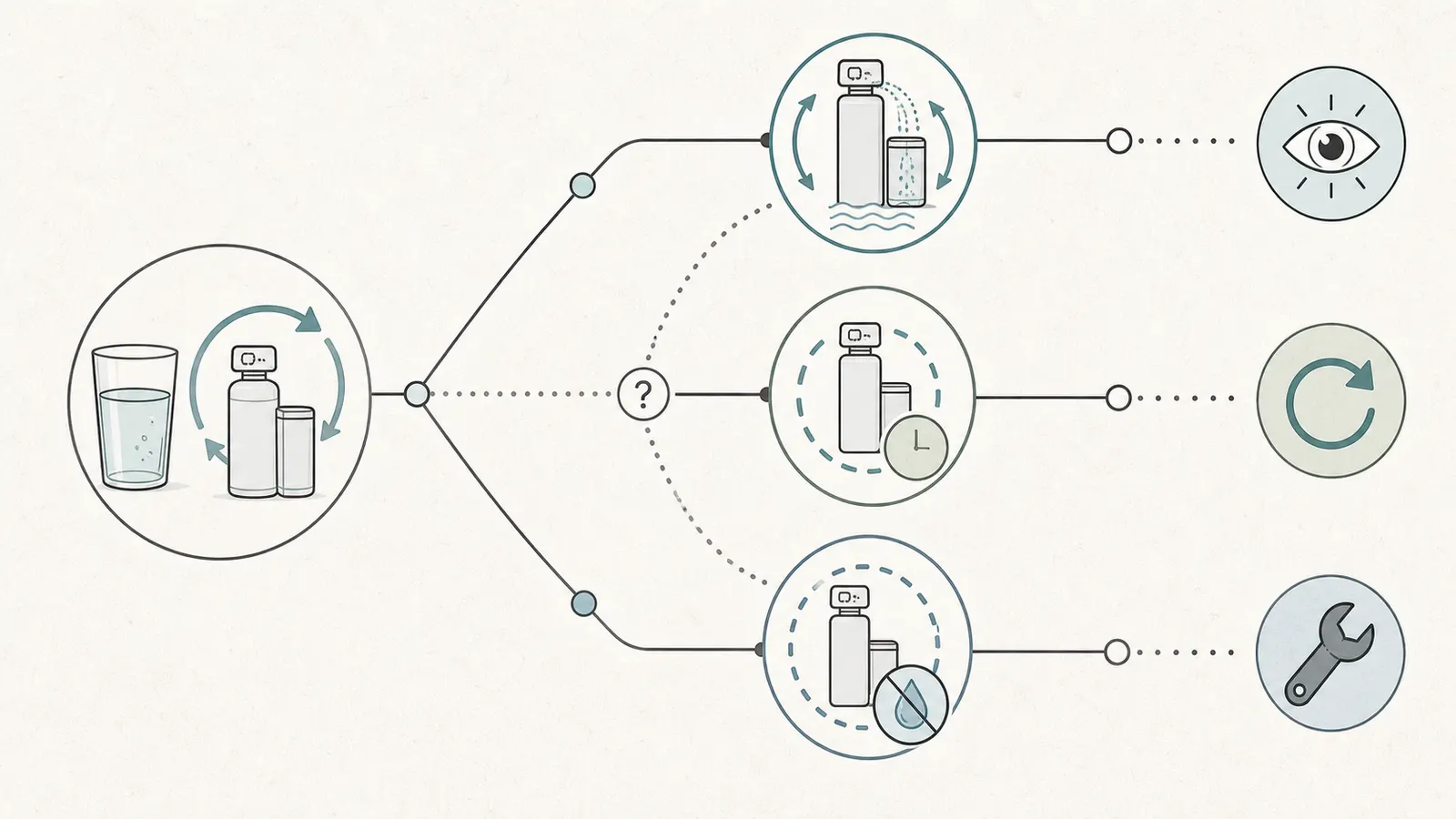
A distinct salty taste after a completed regeneration is a troubleshooting signal, not the normal endpoint to accept indefinitely. The first question is timing:
- If the taste occurs only while the unit is actively regenerating, do not sample from a treated tap and call the result a failure. Regeneration uses brine and rinse water by design.
- If the taste appears briefly after the cycle and then clears, document how long it lasts and whether only one faucet is affected. Follow the exact owner manual before changing a setting.
- If the taste remains after a complete cycle, put the softener in its labeled bypass if you need normal water service, make only safe visual checks, and arrange model-specific service.
GE says softened water may taste different from the previous supply but should not have a distinct salty taste, and it recommends service when that taste remains after a complete regeneration cycle. GE’s salty-water guidance is a useful cross-brand escalation boundary, not a claim that every softener fails for the same reason.
Use that timing distinction as your working map before touching the controls: it tells you whether to wait, document a clearing taste, or move toward service.
Start with the timing and the faucet #
Salt taste is a symptom. It does not identify whether the cause is a restricted drain, a wrong program, incomplete rinsing, a valve or seal problem, a local plumbing issue, or something unrelated to the softener. A short, repeatable observation can separate those branches without opening the equipment.
Use a clean drinking glass and a cold-water faucet downstream of the softener. If your plumbing has several treated cold taps, choose one close to the softener and one farther away. Do not use a hose bib or other outlet that is intentionally bypassed from treatment. If the water is hot, let it cool before comparing taste; a water heater or fixture can change the result.
Record:
| Observation | What it tells you | Safest next action |
|---|---|---|
| Taste only while the display says regeneration or recharge | The unit is in a brine-and-rinse process; the sample is not a post-cycle result | Wait for the exact cycle to finish; do not interrupt it unless the manual gives a safe cancellation procedure |
| Taste at one faucet only | A faucet, aerator, branch, or local plumbing condition remains possible | Compare another treated cold tap; clean or service the fixture only if that is a normal, safe task |
| Taste at several treated cold taps, then clears | Residual taste or incomplete rinse may be involved, but the timing alone does not prove the cause | Record the clearing time and consult the model manual before one approved recharge or setting check |
| Taste still present after a complete cycle | The unit may not have completed or rinsed correctly, or a component may need service | Use the labeled bypass if needed; stop repeated setting changes and request service |
| Taste changes or disappears in bypass | The softener or its treated branch becomes more likely | Leave the unit bypassed if that is the manufacturer’s normal service position and arrange evaluation |
| Taste remains in bypass | The softener is not proven to be the source | Stop treating the softener as the answer; investigate the water source, plumbing, fixture, or another treatment stage |
The bypass comparison is a localization clue, not a laboratory test. A bypass may route untreated water, and a blended-water valve or unusual plumbing arrangement may behave differently. Read the label and owner manual for your unit before moving any handle. If the handle is stuck, leaks, or requires force, stop.
Know what regeneration is—and what the taste does not prove #
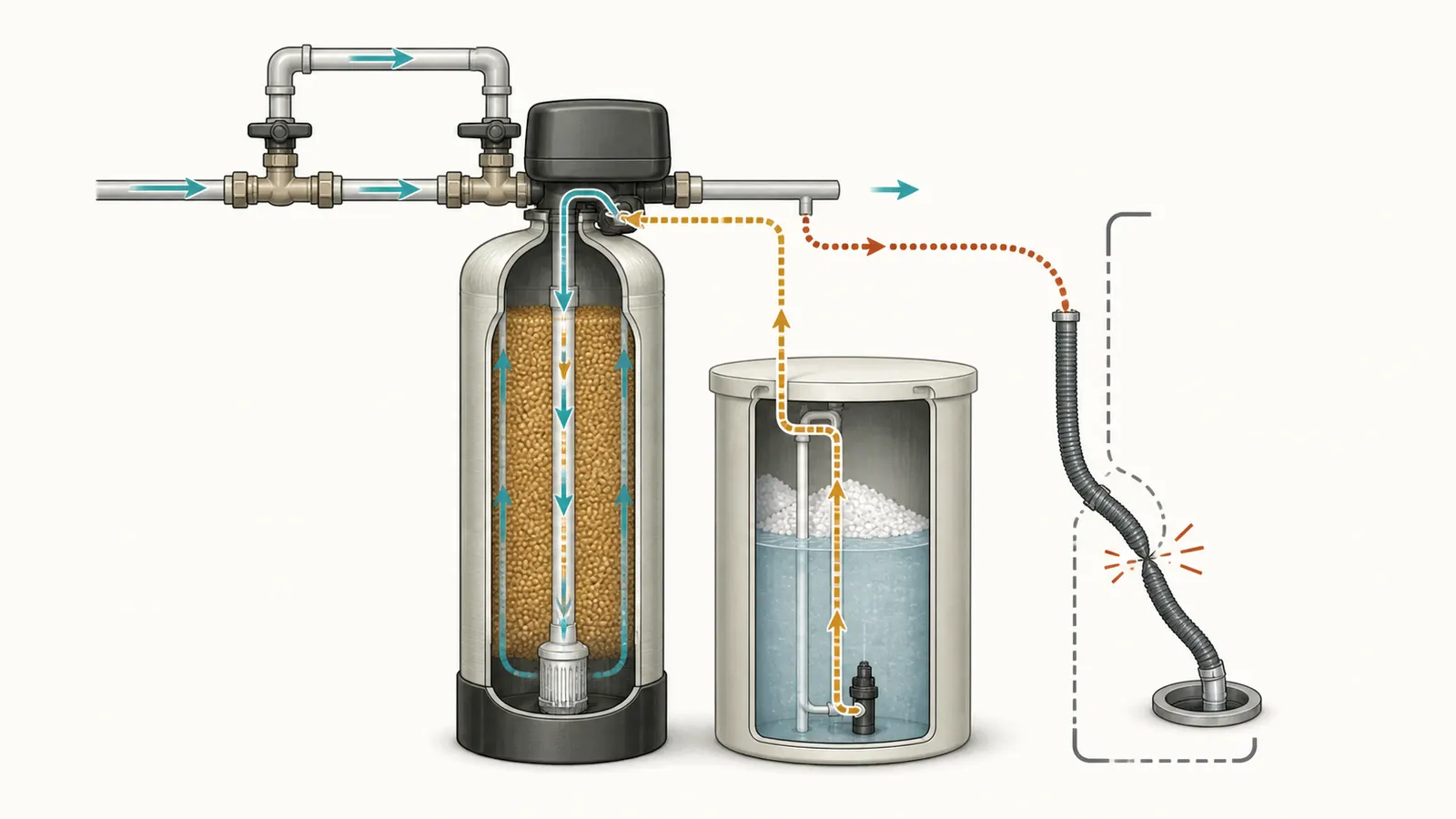
Salt-based softeners use a resin bed to exchange hardness ions. During regeneration, the control valve sends brine through the resin and then rinses the bed before returning to service. Whirlpool Water Solutions describes regeneration as a salt-water cleaning cycle driven by household use and incoming water quality; it also cautions that a manual regeneration can use the maximum salt dose on some models. Whirlpool’s homeowner explanation supports a practical rule: do not keep starting manual regenerations simply because the first taste has not disappeared.
A salty taste does not, by itself, prove that the brine tank has “dumped salt into the house,” that the resin is ruined, or that the water is unsafe for every person and use. It also does not prove that more salt, a longer cycle, or a higher capacity setting will fix the symptom. Those are model- and water-chemistry-dependent conclusions. The useful facts are when the taste occurs, which outlets show it, whether bypass changes it, and whether a full manufacturer-approved cycle clears it.
Do not confuse three different things:
- Salt in the brine tank. Salt is an operating material, not proof of a fault.
- A salty sample taken during regeneration. That is not a valid post-cycle check.
- Persistent salty taste after the controller reports completion. That is the symptom that deserves structured troubleshooting.
Some manufacturers publish ordinary cycle behavior. Whirlpool says its example units regenerate automatically based on use and water quality, and gives an approximate cycle duration for its product family. That does not establish a universal duration. Use the display, manual, and model code for your unit. If the display is blank, stuck in regeneration, repeatedly loses time, or shows an error, record the code and call the manufacturer or a qualified service provider rather than guessing at a cycle duration.
The flow below is a simplified orientation aid, not a parts diagram for a particular brand. Its purpose is to show why brine, rinse water, treated flow, and the drain route matter to the symptom.
Make the low-risk checks first #
These checks are intentionally narrow. They are observations and basic use of a labeled control, not a repair procedure.
1. Find the model code and manual
Photograph the rating label and write down the brand, model, serial number if present, water source, and any displayed code. Rheem’s salty-taste procedure begins by confirming the model code because its menu names, internal parts, and cleaning steps are not interchangeable with another softener.
Do not use a neighbor’s settings, a generic video, or a different model’s “backwash” and “fast rinse” times as if they were a standard. GE, for example, describes a model-specific option that can increase backwash and fast-rinse time up to 10 minutes in one-minute increments, while Rheem describes a different sequence and two-minute adjustments for applicable models. Read GE’s control-setting guidance and Rheem’s procedure as examples of why the exact manual matters—not as permission to copy either menu.
2. Check the accessible drain route
With the unit in its normal service state, look at the drain hose from end to end. A kink, sharp bend, crushed section, disconnected fitting, visible blockage, or hose pulled tight can restrict discharge. GE specifically identifies a kinked drain hose as a possible reason a unit does not regenerate properly and tells owners to inspect the hose. GE’s support page supports this visual check.
Look only at what is accessible without removing the valve head, opening a control enclosure, disconnecting pressurized plumbing, or putting a hand into a drain. Do not assume that blowing compressed air through a hose, pulling an elbow, or cleaning an injector is a universal homeowner step. Rheem includes those actions in a model-specific sequence, but that sequence is for applicable Rheem equipment and begins with bypassing the unit. Rheem’s instructions do not authorize applying the same teardown to a GE, Pentair, Whirlpool, or other model.
The drain termination also matters. Pentair’s installation and service manual describes an appropriate drain connection and says most local codes require an air gap. That is a manufacturer installation note, not a nationwide code rule. Do not redesign, reroute, extend, or tie drain lines based on this page; local plumbing requirements and the equipment manual control.
3. Use the labeled bypass when you need to stop treated flow
A bypass is intended to isolate a softener for service on many systems. Pentair’s manual explicitly lists emergency leaks and service calls as bypass situations. Pentair’s manual is the evidence for that model family; other valves may use a different direction or configuration.
Before moving it, read the label. Move it gently only if it is designed for homeowner operation. Then run a cold tap briefly and record whether the taste changes. Do not force a stuck valve, loosen fittings, remove the valve head, or attempt to make a bypass out of disconnected tubing. If bypassing causes a leak or does not behave as labeled, stop and call for service.
Run one complete, approved cycle #
If the drain route looks normal, the bypass operates normally, and the model manual tells the homeowner how to start a recharge, run one full cycle according to that manual. “Complete” means the controller has returned to its normal service state; do not infer completion from a guessed number of minutes. Keep people away from any discharge that is not safely routed, and do not sample water from a treated tap while the cycle is active.
After the controller returns to service, let a cold treated tap run only as long as the manual or normal household practice requires to obtain a representative sample. Note the time, faucet, temperature, and result. Do not claim that a single taste check measures sodium, chloride, hardness, bacteria, or any other contaminant. Taste is a screening observation, not a water-quality test.
If the taste clears, do not immediately reprogram the unit. Save the log and watch the next automatic cycle. Whirlpool advises allowing automatic regeneration for efficiency because manual regeneration may use a maximum salt dose on some models. That guidance also explains why repeated manual cycles can add salt and water use without answering the underlying question.
If the taste returns after the next automatic cycle, capture the same observations. A repeatable pattern is more useful to a technician than several undocumented regenerations.
Separate settings from parts that need service #
Manufacturer instructions reveal several possible branches, but they do not make those branches interchangeable. Rheem lists incorrect settings, a partial drain blockage, or a leaking seal as usual causes of salty softened water. Its published sequence includes bypassing the unit, cleaning a venturi and drain route, running a full recharge, and then considering an O-ring kit if the taste persists. Rheem’s source article is useful precisely because it shows the handoff: internal cleaning and seal replacement depend on the model.
Pentair’s manual similarly lists a valve remaining in regeneration, a failed brine-draw condition, a leak between the rotor and seal disk, a riser-tube leak, and incorrect regeneration scheduling in its troubleshooting table. It directs unresolved symptoms to a local dealer. Pentair’s troubleshooting table does not turn rotor, seal, riser, or electrical work into a generic DIY checklist.
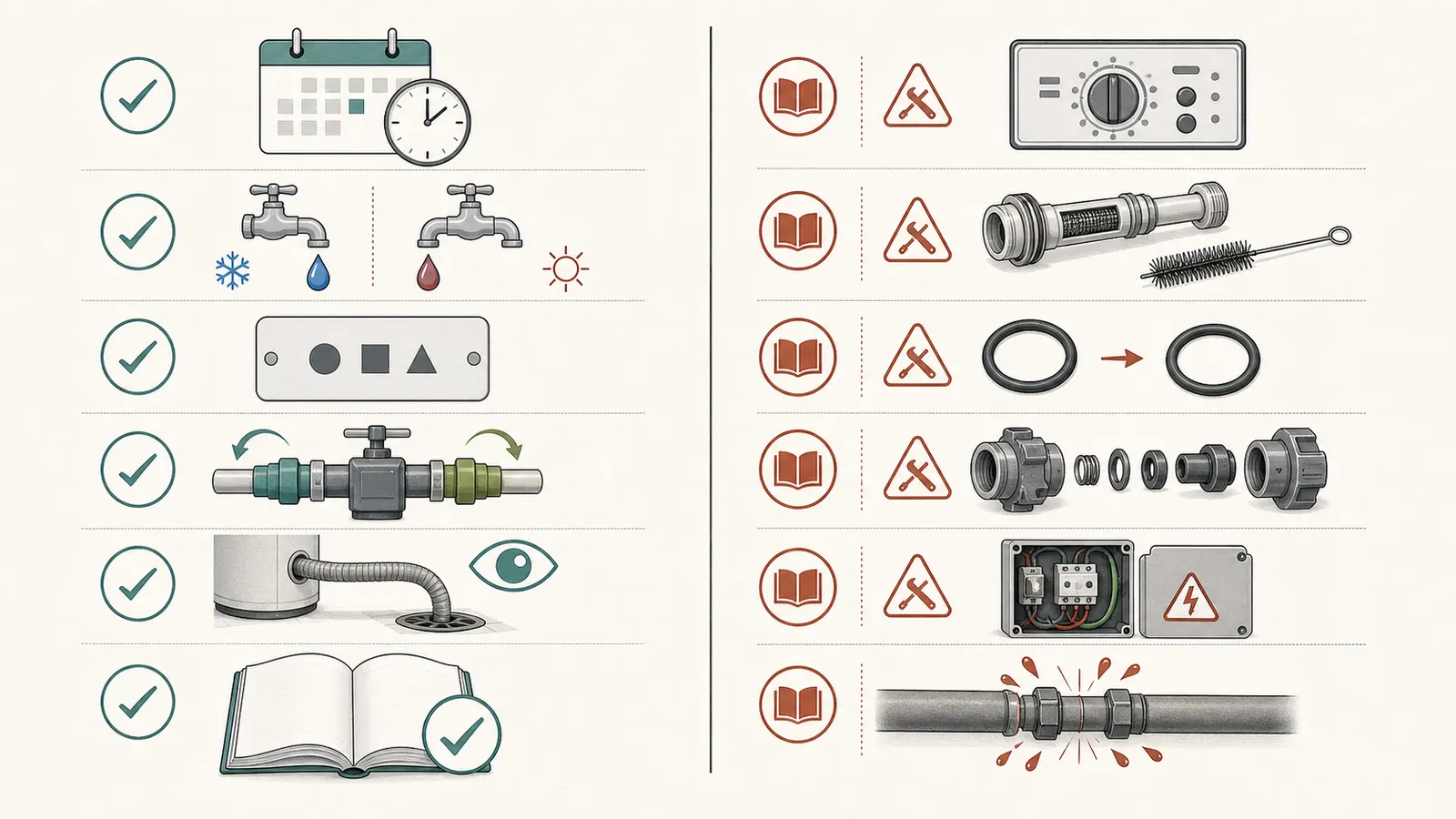
Use this boundary:
| Action | Homeowner decision |
|---|---|
| Record timing, faucet, cold versus hot, and whether the taste clears | Reasonable observation |
| Photograph the model label and display | Reasonable observation |
| Inspect visible drain-hose routing | Reasonable if dry, accessible, and no disconnection is required |
| Operate a clearly labeled bypass according to the manual | Reasonable if it moves normally and does not leak |
| Start one manual regeneration exactly as the manual directs | Reasonable only when the manual supports it and the unit is otherwise normal |
| Change hardness, salt dose, reserve, backwash, or fast-rinse settings | Model-specific; do it only from the exact manual, and stop if the symptom persists |
| Remove a venturi, injector, elbow, flow plug, valve cover, seal, or O-ring | Model-specific repair; assign it to a qualified technician unless the exact manual clearly makes it a safe homeowner task |
| Open the control enclosure, test live wiring, disconnect pressurized plumbing, or work on a stuck valve | Do not do this as homeowner troubleshooting |
The last line is important even when a manufacturer support page shows photographs. A photo sequence can omit your installation, pressure, electrical arrangement, warranty terms, or local plumbing constraints. Moderate-safety troubleshooting should end at a safe observation boundary.
Keep the homeowner side of that boundary visible while you work through the checks. A safe observation can still give a technician useful facts without becoming an improvised repair.
Know when to stop and request service #
Request service instead of repeating regeneration or experimenting with settings when any of these conditions apply:
- A distinct salty taste remains after one complete, model-approved regeneration.
- The taste returns after the next automatic cycle despite a normal-looking drain route.
- The display is stuck in regeneration, shows an error, loses time, or will not complete its sequence.
- The bypass handle is stuck, leaks, or does not isolate the softener as labeled.
- You see water around the valve head, brine connections, drain connection, or tank.
- The drain hose is obstructed beyond a simple visible kink, terminates in a questionable arrangement, or would need rerouting.
- The unit is under warranty and the proposed repair would require opening the valve or replacing a part.
- The water source or treatment train changed, or other taps show a new taste even when the softener is bypassed.
If there is an electrical smell, smoke, heat, flooding near controls, or a rapidly worsening leak, stop using the equipment and follow the home’s emergency water and electrical procedures. Do not open energized controls, test live wiring, enter a confined space, open a well, pull a pump, or manipulate pressurized equipment. Those actions belong to qualified professionals with the right isolation and protective procedures.
The service request should include the model label, the manual or product link, the date and time of the taste, whether regeneration was active, whether the taste was at hot or cold taps, whether it appeared at more than one treated faucet, the bypass result, the visible drain-hose condition, the display status, salt level, and what happened after the complete cycle. A short video of the display or drain discharge can help if it is taken from a dry, safe position without opening anything.
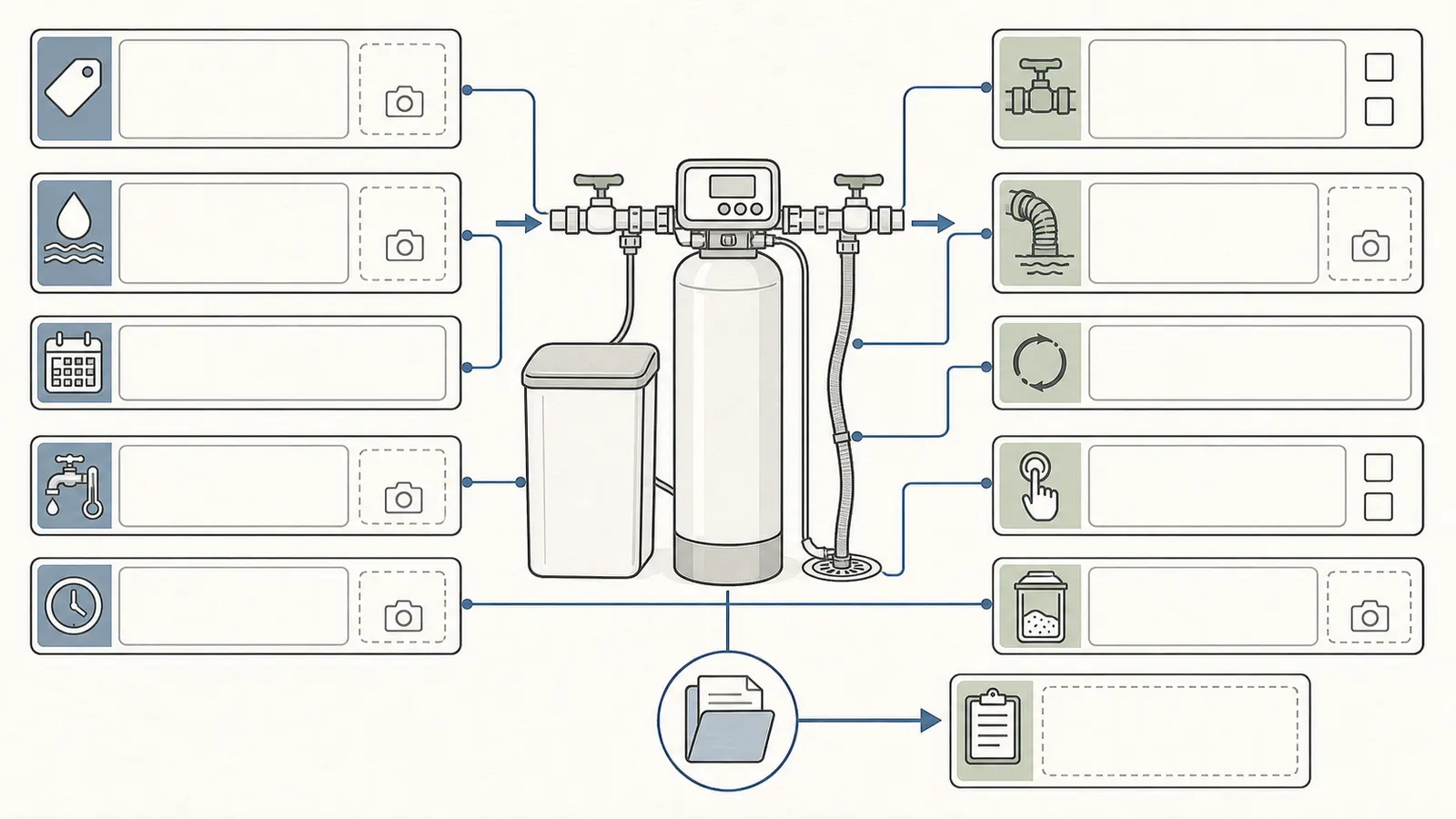
Capture those details in one handoff record so the technician can see the sequence without relying on a string of repeated, undocumented regenerations.
Keep a simple one-cycle log #
The log below is enough to make the decision reproducible. It is not a water test or official inspection.
| Field | Record |
|---|---|
| Brand, model, serial | |
| Water source | Municipal / private well / other |
| Date and time taste noticed | |
| Faucet and temperature | |
| Was regeneration active? | Yes / no / unknown |
| Taste at another treated cold tap | Yes / no / not checked |
| Bypass operated according to label? | Yes / no / not attempted |
| Taste changed in bypass? | Yes / no / unknown |
| Visible drain-hose condition | Straight / kinked / blocked-looking / unknown |
| Display after cycle | Normal service / error / stuck / unknown |
| Full manual-approved cycle completed? | Yes / no / unknown |
| Taste after completion | Gone / remains / intermittent / unknown |
| Salt level or bridging observation | Record only what the manual says is relevant |
| Photos available | Label / display / hose routing / leak, if safe |
This sequence answers the homeowner’s actual decision: is the taste tied to an active cycle, does it clear after the cycle, or does it persist? GE’s guidance places persistent distinct salty taste after a complete cycle on the service side of that decision. Rheem and Pentair show why the next step may involve programming, drain flow, seals, brine draw, or valve timing—but those repairs belong to the exact model manual and a qualified service handoff.
The practical endpoint is therefore simple: observe once, bypass safely if needed, check only accessible routing, run one approved complete cycle, and escalate persistent salty water. Repeated regeneration is not a diagnosis.
Cite this guide
Brictale. “Why Does Water Taste Salty After Softener Regeneration?.” Published 2026-08-29; updated 2026-08-29.
https://brictale.com/water/softeners/why-water-softener-water-tastes-salty-after-regeneration · Read the Markdown version
Sources and scope
Evidence behind this page
- GE states that softened water may taste different from the previous supply, but should not have a distinct salty taste.
GE Appliances — Softened Water Tastes Salty
GE homeowner support guidance; the expectation is not a universal performance guarantee for every softener model.
Accessed · Link to this claim - GE identifies a kinked drain hose as a possible reason a softener does not regenerate properly and recommends checking the hose and initiating a regeneration cycle.
GE Appliances — Softened Water Tastes Salty
GE homeowner support guidance; inspect only accessible routing unless the exact manual authorizes more.
Accessed · Link to this claim - GE recommends service if a distinct salty taste continues after a complete regeneration cycle.
GE Appliances — Softened Water Tastes Salty
GE homeowner support guidance; Brictale uses this as a conservative escalation boundary, not as a diagnosis of a particular failed part.
Accessed · Link to this claim - GE describes longer backwash and fast-rinse times as an optional model-specific setting for salty-tasting water, with increases up to 10 minutes in one-minute increments and owner-manual instructions.
GE Appliances — Water Softener Optional Control Settings
GE control-setting guidance only; do not transfer its timing or menu sequence to another brand or model.
Accessed · Link to this claim - Rheem lists incorrect settings, a partial drain-line blockage, or a leaking seal as usual causes of salty softened water and asks the owner to verify the model code before model-specific troubleshooting.
Rheem water-treatment support for applicable Rheem models; the listed causes are not a universal diagnosis.
Accessed · Link to this claim - Rheem directs the owner to bypass the softener while performing its cleaning sequence, then run a full recharge and check a softened cold-water faucet after the recharge; the article says persistent taste may require a distributor O-ring kit and gives a model-specific backwash and fast-rinse adjustment sequence.
Rheem model-specific support sequence; Brictale does not generalize its venturi, O-ring, or timing instructions to other brands.
Accessed · Link to this claim - Pentair's manual says the bypass valve can be used for emergency leaks and service calls, and its installation guidance describes a drain connection and notes that most local codes require an air gap.
Pentair — Whole House Water Softening System Installation and Service Manual
Pentair manual and model installation context; local plumbing requirements vary and are not established here as a national rule.
Accessed · Link to this claim - Pentair's troubleshooting table includes a valve in regeneration, incorrect regeneration schedule, a valve that fails to draw brine, a leak between the rotor and seal disk, and a leak at the riser tube among possible softener symptoms or causes, and directs unresolved symptoms to a local dealer.
Pentair — Whole House Water Softening System Installation and Service Manual
Pentair troubleshooting table; these are model-manual failure branches, not proof that a homeowner should open a valve.
Accessed · Link to this claim - Whirlpool Water Solutions describes regeneration as a salt-water cleaning cycle, says regeneration frequency changes with water quality and household use, and advises that manual regenerations use the maximum salt dose in some cases; it recommends allowing automatic regeneration for efficiency.
Whirlpool Water Solutions — What to Expect From Your New Water Softener
Whirlpool Water Solutions licensed-partner homeowner guidance; cycle duration and salt use vary by model and settings.
Accessed · Link to this claim - Whirlpool Water Solutions says the salt tank should normally retain a small amount of water at the bottom, with the level rising and falling during regeneration, and recommends checking salt level and bridging as routine maintenance.
Whirlpool Water Solutions — What to Expect From Your New Water Softener
Whirlpool Water Solutions guidance; brine-tank appearance and maintenance vary by design, so the exact manual controls.
Accessed · Link to this claim