Why Is My Water Softener Regenerating Too Often?
A homeowner evidence path for separating real water demand from a wrong setting, leak, salt problem, or softener valve fault, with a manual-based waste estimate.
The short answer
There is no universal normal interval. Log every regeneration for two weeks, then compare the interval with hardness, household water use, the programmed settings, salt movement, and the owner’s manual. A wrong hardness or model setting and a leak can create real demand; a salt bridge, blocked brine draw, drain restriction, pressure problem, or valve fault can signal equipment trouble. Use the manual’s own cycle water and salt values to estimate avoidable waste.Why Is My Water Softener Regenerating Too Often?
There is no universal “normal” regeneration interval. A demand-initiated softener regenerates after its usable capacity has been consumed, so the interval changes with water hardness, household water use, iron loading, the programmed settings, and the unit’s actual condition. GE Appliances describes regeneration as need-based and points first to hardness and household use; it also identifies an excessively high hardness setting as a possible reason for recharging too often. Read the GE support guidance.
The useful decision is not “How many days should it last?” It is: Does the log show unusually high real demand, a wrong setting, a leak, a salt or brine problem, or a control-valve fault? Record two weeks of events before changing settings. EPA WaterSense confirms that regeneration consumes water and salt. The Department of Energy’s method is useful for estimating conditioned-water demand from the volume delivered between regenerations and the regeneration frequency; it does not supply regeneration-water or salt-per-cycle values. Those worksheet inputs come from the exact manufacturer manual and the owner’s records. EPA WaterSense and DOE FEMP support those limited, separate uses.
1. Define “too often” from the evidence #
A regeneration every few days is not automatically a fault. A large household with hard water, a high iron load, guests, irrigation connected through the softener, or a unit operating near its capacity can legitimately regenerate more often than a lightly occupied home. Conversely, a small household that suddenly goes from infrequent regeneration to daily or repeated regeneration has a change worth investigating. That last comparison is a practical inference from demand-based operation, not a manufacturer-set threshold.
Start with the observed interval and the change from your own baseline.
| Observation | What it can mean | What it does not establish | Next safe check |
|---|---|---|---|
| The interval has always been short and tracks a full house or hard water | Real demand, an undersized unit, or a conservative programmed reserve | That the unit is defective | Compare test results, household use, capacity, and manual settings |
| The interval became short after a new resident, visitors, laundry increase, or outdoor use | Increased water volume may be consuming capacity | That the softener itself caused the change | Read the whole-home meter with all fixtures off and note unusual uses |
| The interval became short without a lifestyle change | Leak, hardness change, iron loading, setting change, or equipment problem | Which branch is responsible | Begin the two-week log and verify displayed settings against the manual |
| The display shows a regeneration when the home used little water | Incorrect meter signal, forced schedule, control issue, or an unobserved use | That the display is wrong | Photograph the display, record time, and check the manual’s history or error-code feature |
| Water runs to the drain while the softener should be in service | Valve leak, drain restriction, brine or float issue, or a control fault is possible | The exact failed part | Do only a visual check; call for service if flow persists or access requires opening equipment |
| Salt is not falling even though the unit regenerates | Salt bridge, brine-making problem, or a misleading salt-level observation | That the control valve is sound | Follow the exact manual’s safe salt-bridge check; do not disassemble the unit |
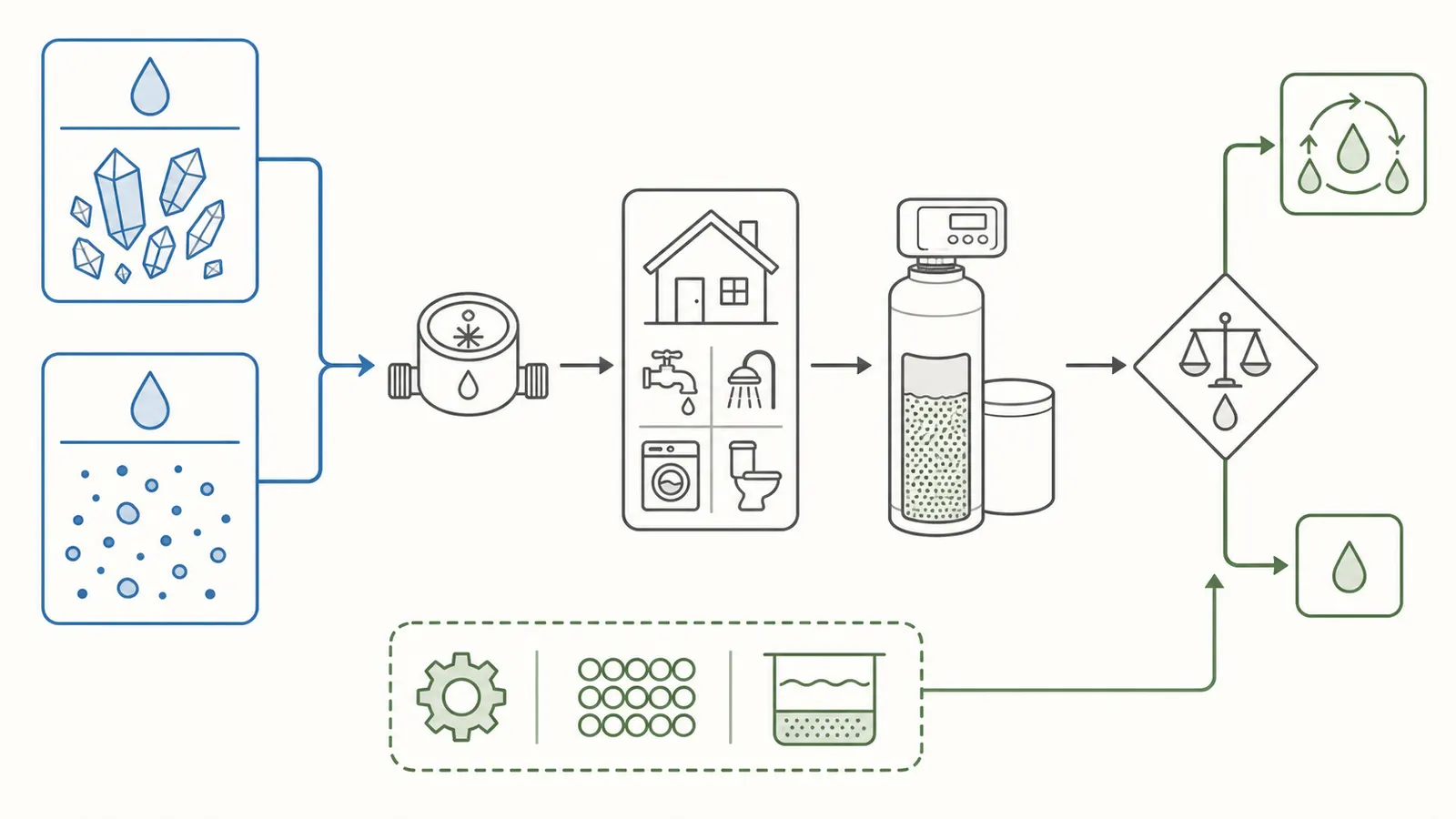
Do not use a retailer’s “regenerates every X days” statement as a diagnosis. The interval belongs to the installed unit, the water chemistry, and the household. A manual may also include a maximum-days override or a special iron-cleaning schedule. For example, the Whirlpool WHES30/WHES33 manual describes a demand-initiated feature but also documents a maximum-days setting and model-specific capacity, salt dose, water use, pressure, and flow limits. Those figures apply to those models, not to every softener.
2. Build a two-week evidence log #
The goal is to make the next decision reproducible. Set a start date, write down the model and serial number, and record every automatic or manual regeneration. If the display has a regeneration history or count, record that reading at the start and end. Do not reset the controller just to make the count look cleaner; preserving the record is more useful.
Use one row for each day and an extra row for every regeneration event:
| Field | What to record | Why it matters |
|---|---|---|
| Date and time | When regeneration starts or is noticed | Separates a real event from a display-memory or schedule observation |
| Interval | Time since the prior regeneration | Establishes the household’s actual pattern |
| Salt level | Approximate level using the tank’s own scale or a consistent visual mark | Shows whether salt is being consumed and whether the level is changing as expected |
| Water-meter movement | With all faucets, toilets, appliances, irrigation, and known water uses off, note whether the meter’s low-flow indicator moves | A moving meter makes a leak or hidden use more likely; no movement does not rule out a leak during the check window |
| Displayed hardness | The number currently programmed, with units if shown | A wrong value can make the controller calculate demand incorrectly |
| Iron adjustment | Any iron value or equivalent hardness entry | Iron treatment and settings are model- and chemistry-dependent |
| Model code and capacity | Exact programmed model code, capacity or salt-dose selection | A wrong model code can load incorrect configuration data on models that use one |
| Water use changes | Guests, laundry, filling a pool, outdoor taps, livestock, a new appliance, or a vacancy | Identifies legitimate demand changes |
| Salt or brine observations | Bridge, crust, tank water, unusual odor, or salt that remains unchanged | Directs the salt/brine branch |
| Drain observation | Water flowing when the unit is not regenerating, or an overflowing or restricted drain | Directs the valve and drain branch |
| Water result | Current hardness, iron, manganese, pH, or lab result with units and date | Prevents programming from being based on an old or guessed result |
For a standard water-meter observation, choose a time when no one will use water. Confirm that toilets are not refilling, then watch the meter’s normal indicator without opening the meter box or disturbing utility equipment. If it moves, record the duration and stop the check; do not start cutting into piping to locate the leak. On a private well, pump cycling can be evidence of use or a leak, but the pump, pressure tank, and controls are pressurized and electrical equipment. Leave those components closed.
Record the water softener’s own meter or diagnostic display only through the normal user controls described by the manual. Some equipment exposes a water-meter count or regeneration count; some does not. A model-specific manual can tell you what a code means. Do not assume that a flashing number on one brand has the same meaning on another.
3. Branch A: real demand, wrong setting, or undersized capacity #
This branch is most likely when the meter log shows substantial water use, the interval is consistent, and the softener regenerates after a plausible amount of conditioned water has passed through it. “Plausible” still has to be checked against the unit’s capacity and the water test; the interval alone cannot prove correct sizing.
Verify hardness and iron inputs
The controller needs a hardness input to estimate how quickly the resin’s exchange capacity is being used. GE’s support page says that an overly high hardness setting can cause recharging more often and directs owners to confirm the hardness with the water supplier and then use the exact owner manual for programming. That logic is not permission to copy a municipal number into a private-well system. A well can vary, and hardness may not be the only load.
For a private well or any system with stains, metallic taste, or a known iron issue, obtain current water results. The Minnesota Department of Health’s home-softening guidance says that some softeners may remove iron or manganese depending on water quality, but iron or manganese exposed to air or chlorine can foul the resin and may need filtration before the softener. Ask the laboratory whether the result is total, dissolved, or another defined fraction. The form matters because a softener may handle some dissolved iron but not oxidized particles or biological material.
Do not convert iron into an equivalent hardness value unless your model manual explicitly gives the conversion and conditions. A cited Whirlpool manual, for example, tells owners of its models to add a model-specific hardness adjustment for each unit of clear-water iron. That instruction is not a general rule for another unit, another iron form, or another water chemistry.
Check the programmed settings without guessing
Compare the display and settings to the exact manual and your dated water report:
- hardness number and units;
- iron adjustment or iron mode, if present;
- salt dose or efficiency selection;
- capacity or model code;
- clock and day/time;
- reserve or minimum-days settings;
- maximum-days override;
- any vacation, salt-saver, pre-rinse, or forced-regeneration setting.
Take a photograph before changing anything. If a setting is wrong, write down the old value, the evidence for the correction, and the new value. Make only the normal front-panel programming change that the manual clearly describes. Do not change several settings at once: if frequency improves, you need to know which change mattered.
Decide whether the unit is undersized
An undersized unit may regenerate often even when every setting is correct. The relevant comparison is the unit’s documented capacity at the selected salt dose and the household’s measured demand. A capacity number printed on a sales page is not enough; the Whirlpool manual shows why: the same model family can have several capacity values tied to different salt doses, and operational efficiency can be lower than laboratory-rated efficiency because of hardness, water use, and other contaminants.
Ask a qualified water-treatment professional to evaluate sizing when the log shows high but legitimate demand, the unit is near its rated flow, the water chemistry changed, or the home’s use has grown. Bring the model number, water report, household count, typical meter readings, current settings, salt use, and the manual. A professional should be able to explain whether the recommendation is a setting correction, a different salt dose, a larger resin capacity, pretreatment, or a separate treatment device.
4. Branch B: a leak or hidden water use is consuming capacity #
A softener does not know whether water went to a shower, a leaking toilet, an irrigation line, or a hidden appliance. If that water passes through the unit, it consumes softening capacity. The Whirlpool troubleshooting table specifically lists a leaking faucet or toilet valve as excessive water use and warns that a small leak can waste hundreds of gallons in a few days. Treat that amount as the cited manufacturer’s warning for its troubleshooting context, not as a universal leak measurement.
Use the log to compare the regeneration event with meter movement:
- Record the whole-home meter at a time when the home is quiet.
- Confirm that known automatic uses are off: ice maker, water treatment drain, humidifier, irrigation, water heater filling, and appliances that may run on a schedule.
- Watch the meter’s ordinary low-flow indicator for a consistent interval.
- If it moves, record the observation and check accessible fixtures for sound, drips, toilet refill cycling, or a wet area without removing panels or disconnecting plumbing.
- Repeat at a different quiet time if the first result is ambiguous.
If the meter is still, that only describes that observation window. It does not rule out a toilet leak that stops temporarily, a scheduled appliance, an outdoor branch, or a leak that occurs only when pressure rises. If the meter moves, use a plumber or qualified leak professional when the source is not obvious.
Also check whether the softener serves uses that were not part of the original design. Outdoor hose bibs, irrigation, a detached building, a reverse-osmosis drain, a humidifier, and water used for livestock can materially change demand. Do not reroute plumbing as a diagnostic experiment. First identify the branch from existing records or a professional’s inspection.
If the regeneration frequency falls after a leak is repaired or a large water use stops, preserve the before-and-after dates. That is stronger evidence than a guess about the unit’s size. If frequency stays high, return to settings, hardness, iron, and equipment branches instead of continuing to lower the hardness setting.
5. Branch C: salt bridge, iron loading, or a brine-draw problem #
This branch is suggested when the controller calls for regeneration but the salt level does not change as expected, hard water returns quickly, the brine tank is unusually full, or the unit sends water to the drain while it should be in service.
Salt bridge
A salt bridge is a hardened layer that can leave empty space between the salt and the water. The Whirlpool manual explains that the salt then does not dissolve to make brine, so the resin is not recharged. It also warns against sharp or pointed tools that could puncture the brine tank and against pounding on the tank.
Only perform a salt-bridge check if your own manual gives a clear homeowner procedure and the check does not require opening a pressurized or energized area. Use the manual’s specified non-sharp tool and light pressure. If you meet resistance, the tank is damaged, water is leaking, or the procedure is not clear, stop. Do not add chemicals, pour hot water, chop through salt, or improvise a tool.
A bridge usually explains a failure to regenerate correctly, not necessarily a controller that is initiating regeneration too often. The log may show both: the controller sees demand and starts cycles, while poor brine formation leaves the water hard. That distinction matters because “regenerate again” may not solve the underlying problem.
Iron loading and pretreatment
Iron can consume capacity or foul resin depending on its form. The Minnesota Department of Health’s home-softening guidance says oxidized iron or manganese can foul resin and that pretreatment may be needed. Do not treat a softener as a universal iron filter. If water is visibly cloudy or gritty at the tap, if iron appears after standing, or if the iron result changed, get current testing and compare the result with the exact manual’s iron limits and maintenance instructions.
Do not pour resin cleaner, chlorine, or another treatment chemical into the tank unless the exact manufacturer instructions authorize it for your model, water condition, dose, and sequence. Chemical handling can create exposure or damage equipment. A persistent iron problem, bacterial growth, or repeated resin fouling belongs with a qualified water professional.
Brine draw and drain behavior
The Whirlpool manual’s model-specific diagnostic procedure checks fill, brine draw, backwash, fast rinse, and drain flow. It lists a blocked nozzle or venturi, valve seals, an obstructed brine tube or valve, drain-hose restriction, elevated or long drain routing, and low pressure as possible reasons for failed brine draw. That is useful evidence for a service call, but it is not a universal homeowner repair procedure.
Homeowner-safe observations are limited to what you can see without removing covers, exposing wiring, disconnecting hoses, or manipulating pressurized fittings:
- Is the drain hose visibly kinked, crushed, disconnected, or overflowing?
- Is water continuously running to the drain when the unit is not regenerating?
- Is the brine tank visibly overflowing or leaking?
- Does the display show an error code?
- Does the manual explicitly allow a normal user-initiated regeneration and visual observation from outside the equipment?
If a manual check requires removing the top cover, entering a diagnostic mode that exposes moving parts, checking live controls, opening the valve body, or handling pressurized water, assign it to service. Do not infer that a slow drain, a quiet motor, or a full brine tank identifies a single failed component.
6. Branch D: control, valve, pressure, or drain fault #
Suspect this branch when the unit regenerates without corresponding water use, runs to drain in service, shows error codes, has a blank or unstable display, has a brine level that does not respond, or cycles at implausible times after settings are verified.
The Whirlpool troubleshooting guide lists incorrect time, incorrect hardness, an incorrect model code, inner-valve leaks, pressure problems, motor or wiring faults, and error codes. The manual also says that low pressure can disrupt brine draw and that high pressure can damage valve parts. These are model-specific troubleshooting categories, not a recommendation for the homeowner to adjust pump output, pressure switches, relief valves, or electrical components.
Make a service-ready record:
| Evidence | Record it this way |
|---|---|
| Display | Exact text or code, capitalization, and whether it is steady or flashing |
| Timing | Date and time, with the prior regeneration interval |
| Water flow | “No visible drain flow in service,” “continuous visible flow,” or the exact observation |
| Brine tank | Salt level, water level if visible without opening equipment, leak or overflow |
| Settings | Photograph and transcribe hardness, capacity, model code, clock, and reserve settings |
| Pressure symptom | Faucet flow changes, well pump cycling, or a pressure gauge reading only if already visible and safe to observe |
| Recent event | Power outage, plumbing work, well work, freeze, flooding, treatment chemical, or maintenance |
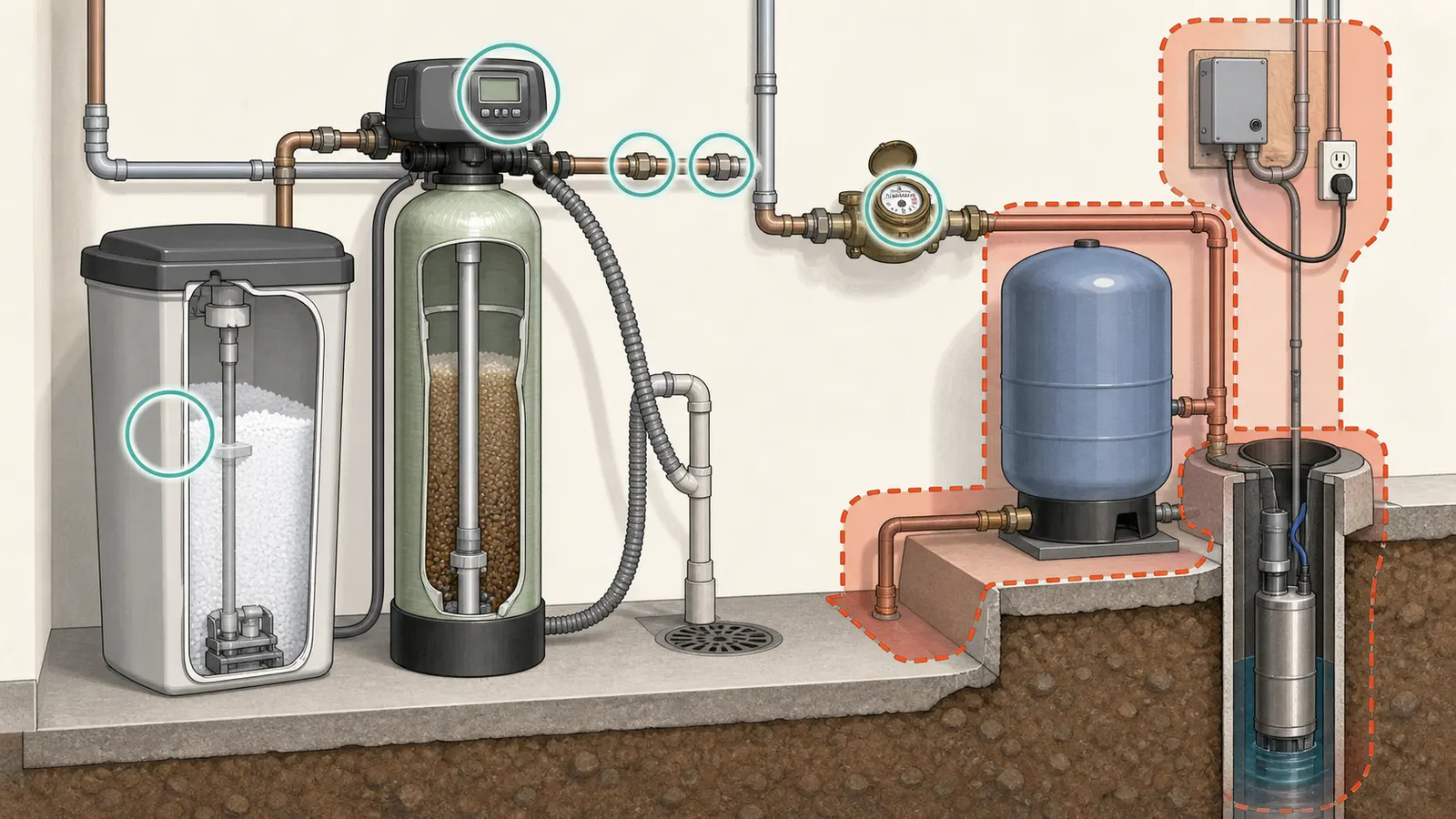
Do not turn a pressure-adjustment screw, remove a pressure-tank cap, open a valve body, test live wiring, or bypass a safety control. A manual may list a pressure range, but the correct measurement and correction can involve pressurized water, stored energy, electrical shock, or a well pump. A qualified plumber, well/pump professional, or manufacturer-authorized service provider should perform that work.
The drain deserves attention because a restricted or incorrectly routed drain can interfere with regeneration and create water damage. Look only for an obvious exterior kink, disconnection, or overflow. Do not disconnect the drain hose to “see what happens.” If drain water is entering the floor, wall, or electrical area, stop using the unit and arrange service.
Jurisdiction and installation boundary
This page does not authorize installation or plumbing changes. Before installing a unit, rerouting a drain, changing pressure equipment, or altering a well or pump system, check the rules of the authority having jurisdiction and any permit, inspection, licensed-trade, electrical, plumbing, septic, or well requirements that apply where you live. Requirements vary by locality and govern the work. The Whirlpool installation manual says its plumbing must comply with national, state, and local codes and that flexible drain hose is not allowed in every locality. Use a qualified, properly licensed professional when the local rule, equipment condition, or manual requires one.
7. Estimate water, salt, and avoidable waste from your manual #
EPA WaterSense explains that cation-exchange softeners use water and salt during regeneration. It does not give one universal cycle volume for all residential softeners. The Whirlpool manual demonstrates the reason: its two cited models have different rated capacities, salt doses, water-use values, pressure limits, and drain-flow specifications. Use the number for your exact model, exact salt setting, and exact cycle—not a search-result average. The DOE method cited above can help describe conditioned-water demand, but this regeneration worksheet is an owner-record calculation: the cycle-water and salt inputs must come from the exact manual or manufacturer documentation and the recorded settings, not from DOE or a universal average.
Record these inputs:
| Input | Your value | Where to find it |
|---|---|---|
| Log length in days | ____ | Calendar |
| Regenerations during the log | ____ | Display, observation, or both |
| Expected regenerations after correction | ____ | A dated post-correction baseline; do not guess |
| Manual water per regeneration | ____ gal | Exact owner manual or manufacturer support |
| Manual salt per regeneration | ____ lb | Exact owner manual or manufacturer support |
| Water price | $____ / 1,000 gal | Current utility bill or provider tariff |
| Salt price | $____ / lb | Your receipt or current supplier price |
Use the following calculations:
Observed cycles per day = recorded cycles ÷ log days
Annualized observed cycles = observed cycles per day × 365
Annual regeneration water = annualized cycles × manual gallons per cycle
Annual salt = annualized cycles × manual pounds per cycle
Annual water cost = annual regeneration water ÷ 1,000 × water price per 1,000 gallons
Annual salt cost = annual salt × salt price per pound
To estimate avoidable waste, wait until the suspected cause has been corrected and record a comparable baseline. Then calculate:
Avoidable cycles per year = (observed cycles per day − corrected cycles per day) × 365
Avoidable water = avoidable cycles per year × manual gallons per cycle
Avoidable salt = avoidable cycles per year × manual pounds per cycle
Avoidable water cost = avoidable water ÷ 1,000 × your water price per 1,000 gallons
Avoidable salt cost = avoidable salt × your salt price per pound
If the manual gives water use as gallons per 1,000 grains rather than total gallons per cycle, do not multiply until you know the capacity and salt dose used for that regeneration. Ask the manufacturer or service professional to identify the correct cycle value. If the controller varies salt dose automatically, record the selected dose or the manual’s range and report a range rather than pretending one number applies to every cycle.
The estimate measures resource exposure, not a repair bill. It does not include sewer charges, salt delivery, resin replacement, pretreatment media, labor, or the cost of a leak. It also does not prove that every extra cycle is avoidable: a verified increase in water demand, a genuine iron load, or a manual-required maximum-days regeneration may be legitimate.
8. Know when to stop and hand off the evidence #
Water-quality safety boundary
A water softener is a hardness-treatment appliance, not proof that drinking water is microbiologically safe. Minnesota Department of Health guidance warns that bacteria and fungi can potentially grow on a softener when the supply is not disinfected, and the CDC says not to drink water from a private well that may be contaminated: use bottled water or another safe source until the water has been treated and tested. While contamination is unresolved, do not use the unverified tap water for drinking, cooking, making ice, or brushing teeth. Contact your local health or environmental department and use a state-certified drinking-water laboratory. Follow their treatment and retesting instructions; boiling or disinfection can address many germs but does not remove heavy metals, salts, or most chemicals, so do not improvise a universal treatment. EPA emergency-disinfection guidance explains that limit.
Stop at visual checks and call a qualified professional when:
- regeneration continues while the unit should be in service;
- water is running to the drain continuously or the brine tank is overflowing;
- the display shows an error code, the motor stalls, or the controller behaves unpredictably;
- the brine level does not change during a manual procedure and the next step requires access inside the equipment;
- a salt bridge cannot be checked or cleared using the exact manual’s safe method;
- pressure is low or high, a well pump cycles unexpectedly, or a pressure tank or switch may be involved;
- the problem follows well work, flooding, a freeze, electrical event, or plumbing alteration;
- water quality results show a new or significant iron, manganese, bacterial, or other contamination concern; stop treating the softener as the water-safety solution and follow the water-quality boundary above.
For moderate-safety equipment, do not open energized controls, test live wiring, open a well or well casing, pull a pump, enter a pit or other confined space, disconnect pressurized plumbing, adjust pressure switches or relief valves, or handle treatment chemicals as a diagnostic shortcut. Do not remove covers to watch a motor or valve move unless a qualified professional is controlling the work. A normal button press or ordinary visual observation is different from opening equipment; if the manual does not clearly describe the action as homeowner-safe, stop.
Bring this packet to service:
- the two-week log and the before/after regeneration intervals;
- the model, serial number, installation date, and exact manual;
- photographs of the display and visible plumbing, without opening equipment;
- current hardness, iron, manganese, pH, and other relevant water results with units and dates;
- the programmed settings before any change and the documented change afterward;
- meter observations, leak repairs, household-use changes, and recent well or plumbing work;
- salt type, salt purchase history, cleanser or chemical use, and maintenance records;
- the manual-based water, salt, and cost worksheet.
Ask the professional to answer these questions:
- Is the observed frequency consistent with the measured hardness, iron, household flow, and selected capacity?
- Is the programmed hardness, iron adjustment, model code, reserve, and clock correct for this exact unit?
- Is there evidence of a household leak or a downstream use consuming conditioned water?
- Is the brine draw, drain flow, pressure, meter signal, or valve control failing?
- What work is required, what is safe for the owner to observe, and what should be retested afterward?
- Which manual-listed cycle water and salt values should be used in the owner-specific waste estimate?
The decision surface is compact: log the interval, verify demand and settings, check for a leak, inspect only safe external clues, then escalate brine-draw, pressure, drain, electrical, or valve symptoms. A frequent cycle may be the softener doing legitimate work, or it may be charging for water that should not be there. Your meter record, water results, settings, salt movement, and exact manual can tell those cases apart without inventing a universal regeneration schedule.
Cite this guide
Brictale. “Why Is My Water Softener Regenerating Too Often?.” Published 2026-08-25; updated 2026-08-25.
https://brictale.com/water/softeners/why-water-softener-regenerates-too-often · Read the Markdown version
Sources and scope
Evidence behind this page
- GE Appliances says most softeners regenerate based on need rather than a fixed schedule, and that frequency depends on water hardness and household water use.
GE Appliances — Water Softener: Recharging Too Often
Manufacturer support guidance; the principle is general, while the reserve-capacity figures and programming steps belong to the cited GE guidance and the exact model manual.
Accessed · Link to this claim - GE Appliances identifies an excessively high programmed hardness level as a possible reason for recharging too often and directs owners to verify hardness and use the specific owner manual for programming.
GE Appliances — Water Softener: Recharging Too Often
GE support page; it does not establish the correct hardness value for another brand, a private well, or a specific household.
Accessed · Link to this claim - EPA WaterSense says cation-exchange softeners consume water and salt during regeneration and directs consumers to use the model's information and maintenance guidance to reduce waste; EPA does not provide a universal cycle volume for every softener.
U.S. EPA WaterSense — Cation Exchange Water Softeners
U.S. EPA consumer guidance; the page's historical specification discussion is not used as a universal per-cycle estimate.
Accessed · Link to this claim - The Whirlpool WHES30/WHES33 manual lists model-specific capacity, salt-dose, water-use, pressure, flow, and drain specifications, including different regeneration water values by model and salt setting.
Whirlpool Water Softeners — WHES30 and WHES33 Installation and Operation Manual
Only the cited Whirlpool WHES30 and WHES33 models; these specifications must not be generalized to another softener.
Accessed · Link to this claim - The Whirlpool manual lists leaking faucets or toilet valves as excessive water usage that can cause hard water symptoms and says a small leak can waste hundreds of gallons in a few days.
Whirlpool Water Softeners — WHES30 and WHES33 Installation and Operation Manual
Troubleshooting guidance for the cited Whirlpool models; the exact leak amount is not used as a universal estimate.
Accessed · Link to this claim - The Whirlpool manual explains that a salt bridge can leave an empty space between water and salt so brine is not made, and warns against sharp tools or pounding on the brine tank.
Whirlpool Water Softeners — WHES30 and WHES33 Installation and Operation Manual
Cited Whirlpool brine-tank instructions; any homeowner check must follow the exact model manual and stop if the procedure is not clearly safe.
Accessed · Link to this claim - The Whirlpool manual's regeneration diagnostics identify a blocked nozzle or venturi, valve seals, drain restrictions, brine-valve or tubing obstructions, and low pressure or drain-hose backpressure as possible causes of failed brine draw.
Whirlpool Water Softeners — WHES30 and WHES33 Installation and Operation Manual
Model-specific diagnostic procedure; this page uses it to define service signals, not to authorize opening or testing a homeowner's energized or pressurized equipment.
Accessed · Link to this claim - The Whirlpool troubleshooting guide lists incorrect time, hardness, or model code, inner-valve leaks, motor or wiring faults, and displayed error codes among possible softener problems.
Whirlpool Water Softeners — WHES30 and WHES33 Installation and Operation Manual
Troubleshooting table for the cited Whirlpool models; names, codes, and repair procedures vary by manufacturer.
Accessed · Link to this claim - The Minnesota Department of Health says some softeners may remove iron or manganese depending on water quality, while iron or manganese exposed to air or chlorine can foul the resin and may require filtration before the softener.
Minnesota Department of Health — Home Water Softening: Frequently Asked Questions
Accessible state health guidance; it supports chemistry-dependent treatment, resin-fouling and pretreatment cautions, not a universal softener capacity or product recommendation.
Accessed · Link to this claim - The Department of Energy describes estimating conditioned-water end use from the volume delivered between regenerations and the regeneration frequency; it does not establish regeneration discharge or salt-per-cycle values.
U.S. Department of Energy FEMP — Estimating Methods for Determining End-Use Water Consumption
DOE estimation method for conditioned-water demand; the article does not use it as evidence for regeneration-water or salt calculations, whose inputs come from the exact manual and owner records.
Accessed · Link to this claim - CDC says that if a private well may be contaminated, the owner should not drink the water and should use bottled water or another safe source until the well has been treated and tested; CDC also directs owners to contact the health department and use appropriate testing.
Public-health safety boundary for private wells; it does not claim that a water softener disinfects or verifies drinking water.
Accessed · Link to this claim - EPA says to use only properly disinfected water for drinking, cooking, making ice, washing dishes, and brushing teeth during an emergency, and warns that boiling or disinfection does not destroy heavy metals, salts, or most chemicals.
U.S. EPA — Emergency Disinfection of Drinking Water
Emergency drinking-water guidance; treatment choice remains dependent on the contaminant and local public-health direction.
Accessed · Link to this claim - The Whirlpool manual says plumbing must comply with national, state, and local plumbing codes, that drain arrangements vary by locality, and that a licensed plumber is required for the cited Massachusetts installation.
Whirlpool Water Softeners — WHES30 and WHES33 Installation and Operation Manual
Installation instructions for the cited Whirlpool models; local authority requirements govern and may differ elsewhere.
Accessed · Link to this claim