Why Are Resin Beads Coming Out of My Water Softener?
Trace sandy or gold particles to a softener, private well, pipes, or water heater with a bypass-first evidence path and a safe service boundary.
The short answer
Gold or sandy beads can be softener resin, especially when particles appear after the unit or after regeneration. Put the softener on its labeled bypass, preserve a sample, and compare a cold upstream tap, cold downstream tap, hot tap, and regeneration drain without opening the equipment. If particles persist on untreated well water, or water quality changed, test through a state-certified laboratory. Do not open pressurized or energized equipment.Why Are Resin Beads Coming Out of My Water Softener?
Gold or sandy particles can be water-softener resin, but the same symptom can come from private-well sediment, a local pipe, a faucet screen, or the water heater. The useful first question is not “which replacement softener should I buy?” It is “where do the particles first appear, and do they stop when the softener is bypassed?”
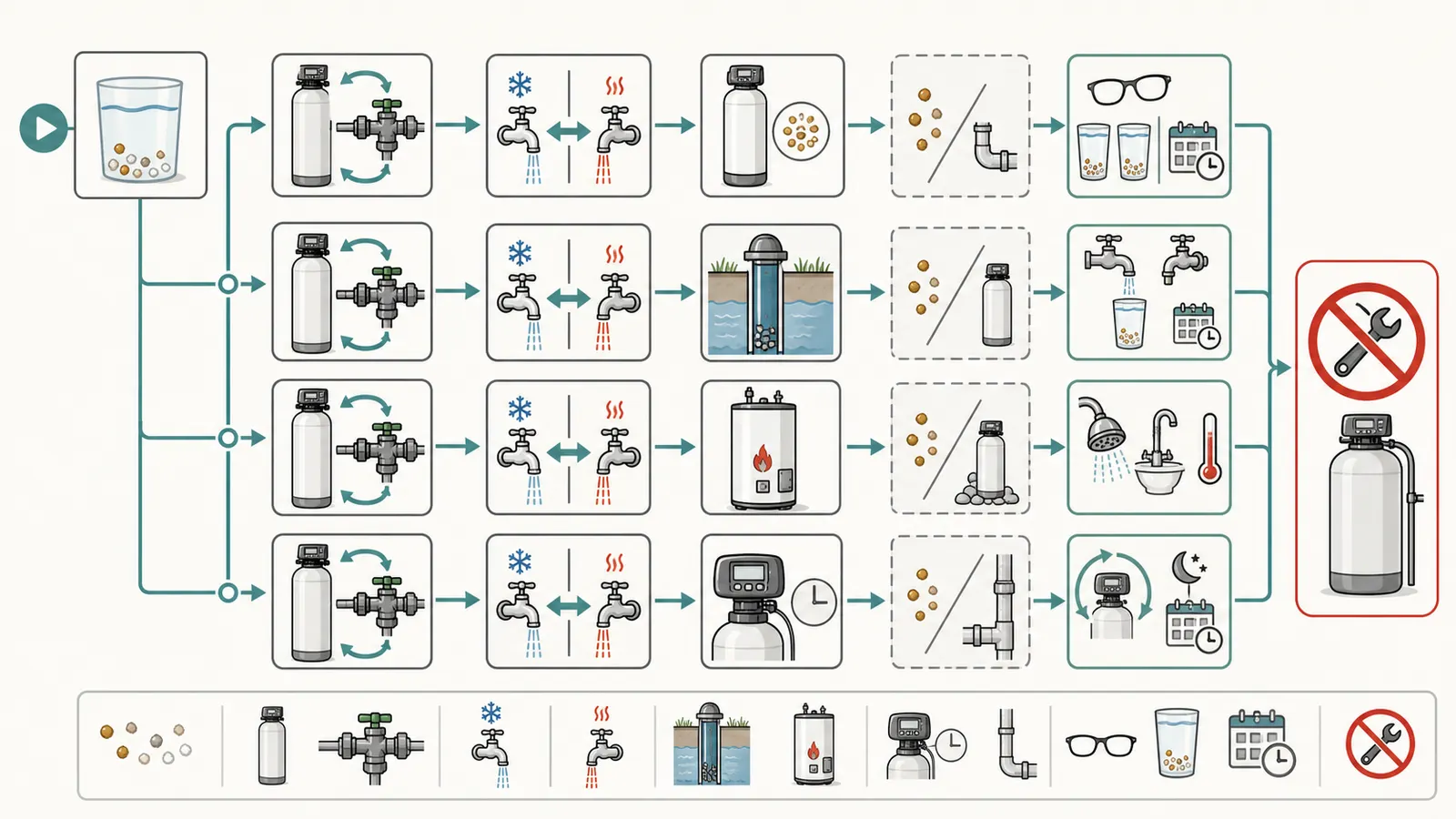
If particles are appearing now, use this order: put the softener on its clearly labeled bypass if the valve moves normally and the model instructions allow it; preserve a representative sample and photographs; compare accessible cold and hot fixtures without opening equipment; and record whether the event follows regeneration. Do not open the valve head, resin tank, well, pump, pressure equipment, or energized controls. If private-well water itself changed, arrange testing through a state-certified drinking-water laboratory.
1. What the particle may be—and what it does not prove #
Resin is a plausible match, not an identification
GE describes ion-exchange resin as particles that vary in size. It notes that smaller, lighter particles settle toward the top of the resin bed and that correctly plumbed service flow travels down through the bed and out to the home. GE also says that if a softener is plumbed backward, water can travel up through the bed and carry some of those fine particles toward the house. See GE’s support guidance on particles or resin beads in a water supply.
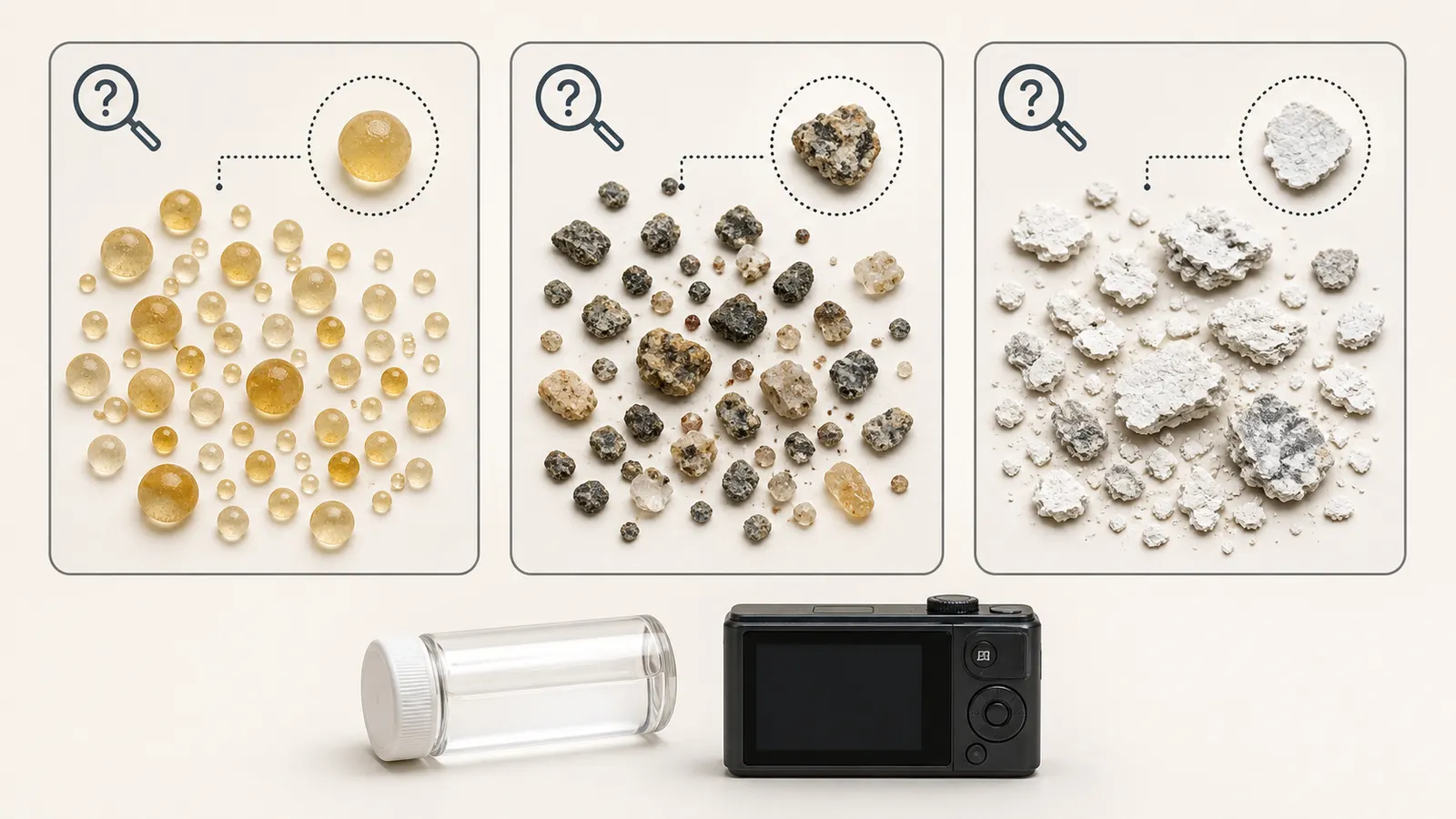
That makes rounded gold, tan, amber, or sandy-looking particles a credible softener clue, especially when they appear at multiple fixtures downstream of the unit. It is still only a clue. Color, size, and shape do not establish the material, and a clear photograph cannot prove whether a bead came from a softener, a filter, or another source.
The more useful pattern is a combination of observations:
| Observation | What it raises | What it does not prove | Safest next action |
|---|---|---|---|
| Rounded gold or sandy particles at several fixtures | Resin migration is plausible | That the resin tank or distributor has failed | Bypass, preserve a sample, and compare upstream and downstream cold water |
| Particles only at one faucet or inside one aerator | Local fixture or branch-pipe debris | That the softener is innocent | Photograph the screen, collect the debris, and compare another fixture |
| White or gray chalky particles, especially after installation | Pipe or water-heater buildup is plausible | That the softener produced resin | Compare cold and hot water and flush only as the exact fixture or heater instructions permit |
| Particles in an accessible untreated well-water sample | Well or source sediment is plausible | That the casing, cap, or screen has failed | Stop treating the softener as the sole suspect and arrange water-quality advice/testing |
| Particles appear only during or after regeneration | A cycle-related softener event is plausible | That every regeneration is shedding resin | Record the cycle timing and have the valve, drain flow, distributors, and riser evaluated |
| Particles continue after bypass | Downstream residue or another source is possible | That bypass failed or the softener is cleared | Avoid repeated use of affected drinking fixtures until the source is clarified |
White, gray, and chalky are a different branch
Do not call every particle “resin.” GE’s manufacturer support separates gold or sandy particles from white or gray particles and chalky water. It says pipes or the water heater may need purging and that calcium and magnesium buildup can be dislodged during a softener installation. That is a reason to investigate hot-versus-cold behavior and the installation history before ordering media.
A particle in hot water may have traveled through the plumbing from an earlier event, so “hot only” is not a laboratory identification either. But hot-only appearance, chalky residue, or particles concentrated at the water heater should keep the heater and hot-water branch in the working differential.
2. Contain the event and preserve useful evidence #
The best homeowner action is a controlled pause, not a teardown.
Use the labeled bypass as containment
A softener bypass is intended to remove the treatment unit from the service path. In the Pentair whole-house softener manual, the manufacturer describes bypass for an equipment emergency or service call. The same manual tells an installer to verify the inlet and outlet orientation and to rinse the plumbing with the softener on bypass before rinsing the softener itself.
For a homeowner, that supports a limited action:
- Photograph the valve, its labels, and the current handle position.
- If the bypass is clearly labeled and moves in the normal way described by the exact manual, place the unit in bypass. Do not force a stuck handle or improvise a valve sequence.
- Do not start an immediate regeneration to “clean” the unit. A regeneration changes the flow path and could destroy the clean comparison you are trying to make.
- Let any already-running cycle finish only if the manual provides a normal homeowner control for that situation. Otherwise record the display and call for model-specific help.
- After bypassing, do not assume every downstream faucet is instantly particle-free. Water already in pipes, faucet screens, and the water heater can remain there.
Bypass is containment, not proof. If particles stop at a downstream cold tap after the existing line is flushed according to normal faucet practice, the softener becomes more likely. If particles persist, the result may reflect residual beads or debris already downstream, a bypass that does not isolate the suspected path, or a separate source.
Preserve the sample without creating a new hazard
Take a close photograph on a plain white background beside a familiar object for scale, without claiming a measurement. Save a few representative particles in a clean, closed container only if they can be collected without touching energized equipment, opening plumbing, or reaching into a drain. Do not taste, crush, heat, or chemically test them at home. Keep the sample away from children and pets.
Record:
- date and time, including the last regeneration start or completion time if visible;
- exact fixture and whether it was cold or hot;
- whether the particle appeared at first flow or after the line ran briefly;
- color, approximate visual shape, whether it floats or sinks, and whether it feels gritty—without treating those observations as composition tests;
- whether an aerator, screen, filter cartridge, or water-heater work occurred recently;
- whether the home uses a private well, and whether the well water changed in color, odor, taste, or clarity;
- whether particles were observed in the softener drain during a cycle, if that drain can be viewed without disconnecting or handling it.
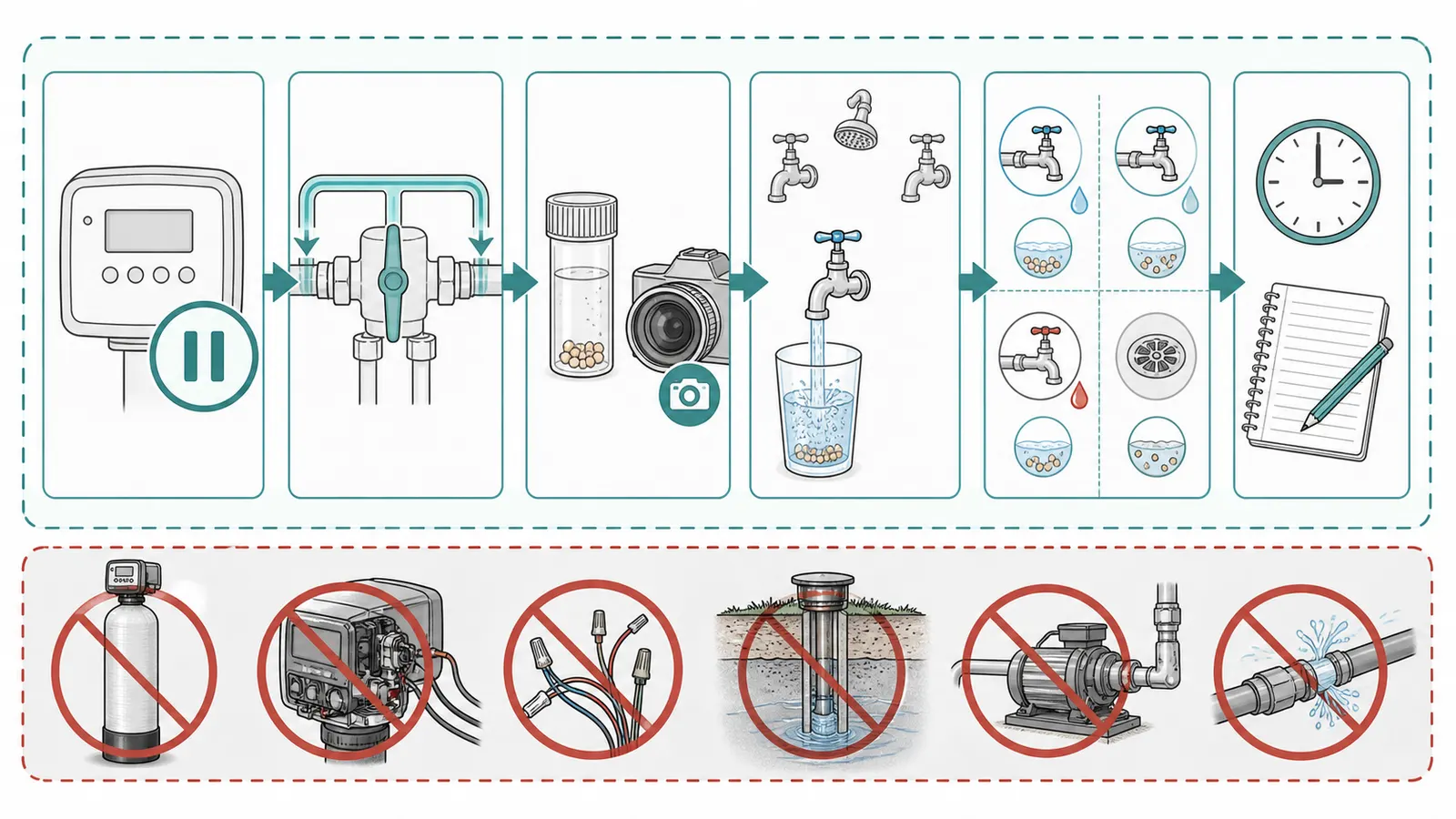
This record is more valuable to a technician than “the softener is bad.” It preserves timing and locations that can be lost after repeated flushing.
3. Locate the first point of appearance #
The decisive homeowner test is a comparison of safe, already-accessible points. Never create a sampling point by loosening a fitting or disconnecting a hose.
Choose the four observations
Use the following locations only when they are already available and clearly identified:
- Untreated or upstream cold tap: Some installations have an accessible hose bib or tap before treatment. Confirm its location from the installation layout or a professional; do not guess from pipe direction.
- Downstream cold tap: Choose a fixture supplied through the softener, preferably one without a removable screen if the fixture instructions allow normal flow.
- Hot tap: Compare a hot-water fixture after it has reached normal temperature, while respecting burn risk. You are recording presence or absence, not flushing the heater as a repair.
- Softener drain observation: If the drain is visible during a normal regeneration, observe from a distance. Do not put a hand, container, or tool into a discharge path and do not disconnect the hose.
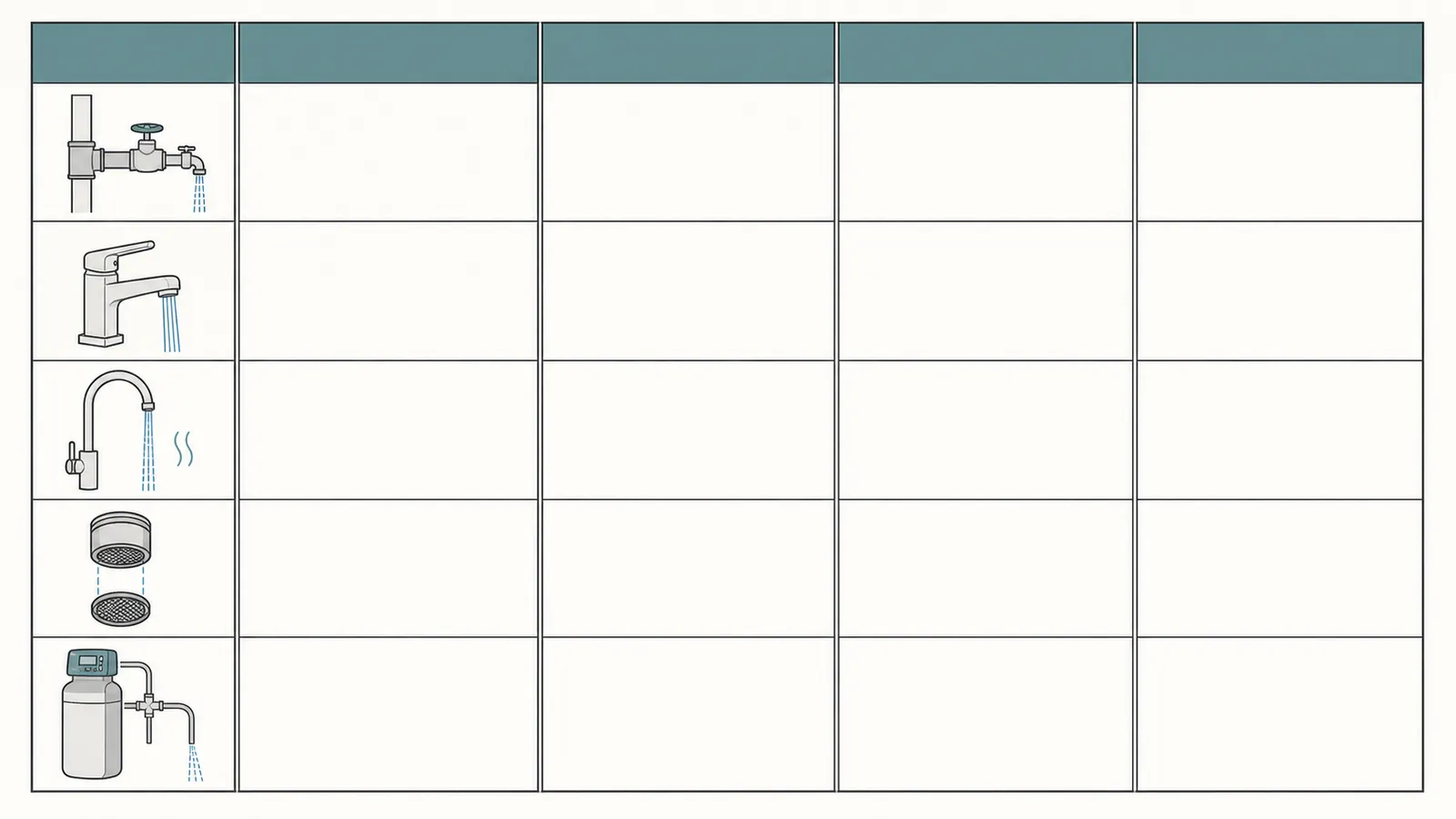
Use one clean container per sample if collecting is appropriate, and label the location and time. If you are submitting water to a laboratory, follow that laboratory’s bottle, preservation, and flushing instructions rather than substituting this observation routine for its protocol.
Interpret location before appearance
If the first accessible untreated sample already contains similar particles, the softener may only be passing material that entered with the source water. On a private well, that makes source-water investigation important. EPA explains that casing and grout help keep dirt and excess water out, that well screens help prevent too much sediment from entering, and that well caps help block debris. Those are protective functions, not a basis for declaring a well component failed from one sample; see EPA’s private-well component overview.
If the upstream sample is clear but the first downstream sample contains particles, the softener or its immediate plumbing becomes more likely. That is an inference from the location pattern, not a substitute for opening and inspecting the exact model by a qualified person.
If only one faucet has particles, remove that fixture from the whole-house conclusion. A faucet screen, branch line, or local repair can retain and release debris. Photograph the screen before cleaning it. If you clean it, record that fact and do not represent the next sample as a fresh baseline.
4. Use temperature and regeneration timing as branches #
Cold versus hot water
Particles in both cold and hot water suggest a source upstream of the water heater, but particles already released into household plumbing can travel or remain in both branches. Particles only in hot water keep the water heater and hot-water branch in play. GE’s guidance specifically identifies pipes and the water heater as possible explanations for white or gray particles and chalky water.
Do not use a hot-water result to declare the heater failed. The practical next step is to document whether the cold result is clear, whether the hot result changes after normal use, and whether a qualified plumber or appliance professional should inspect or purge the affected branch according to the exact equipment instructions.
Timing around regeneration
Write down the exact time a regeneration starts, the time it ends if known, and the first time particles are observed. “The next morning” is less useful than a timestamp.
Pentair states in its manual that its system diverts hard water to the home during regeneration and that water drawn during regeneration can send hard water into the household plumbing and possibly the hot-water tank. That fact explains why a regeneration event can change what a homeowner observes, but it is about treatment flow and hardness—not proof that resin beads should be in the house.
For resin loss specifically, Pentair’s troubleshooting guide lists three failure modes for loss of resin through the drain line: excessive backwash or fast-rinse flow, a damaged lower or upper distributor, and a leak between the riser tube and upper distributor. These are service diagnoses for that system family. They should become questions for a technician, not a DIY parts list.
The strongest timing pattern is: the unit runs a cycle, particles appear in the drain or at several downstream fixtures, and the event diminishes when the unit is bypassed. Even then, call it “consistent with a cycle-related softener source,” not confirmed resin loss. A professional still needs to verify the model’s flow controls, distributors, riser, valve programming, plumbing direction, and any prior service.
5. Decide which branch deserves professional attention #
Branch A: softener is the leading suspect
Escalate the softener when all or most of these are true:
- the particles resemble the gold or sandy material described by the manufacturer;
- an accessible upstream cold sample is clear while downstream water is not;
- more than one downstream fixture is affected;
- the event started after installation, plumbing changes, a valve replacement, or an unusual regeneration;
- particles are visible in the softener drain during a cycle; or
- the pattern changes when the clearly labeled bypass is used.
Ask the service professional to inspect, for the exact model, the inlet/outlet orientation, valve programming, backwash or fast-rinse flow control, upper and lower distributors, riser tube seating and condition, drain routing, and the evidence you preserved. Ask whether the recommended repair is a component or media replacement rather than a complete softener replacement, and ask what evidence supports that scope.
Branch B: well sediment or source-water change is plausible
Treat the well as a separate branch when particles are present before the softener, appear at untreated taps, began after flooding or land disturbance, or accompany a change in odor, taste, color, or clarity. Do not open the well cap, inspect the casing interior, pull a pump, alter a pressure switch, or enter a well pit.
EPA advises private-well owners to test annually for specified baseline indicators through a certified laboratory and to test immediately when water quality changes or a well-system part is replaced or repaired. Read the current guidance in EPA’s private-well water protection page. If the water change is significant, if contamination is suspected, or if anyone becomes ill, contact the local or state health department for direction on water use and testing.
Do not let a softener diagnosis substitute for a well-water diagnosis. A softener can change hardness treatment; it cannot make an unexplained source-water change disappear from the safety record.
Branch C: pipes, faucet screens, or water heater are plausible
Keep the plumbing branch open when particles are white, gray, chalky, isolated to one outlet, concentrated in hot water, or first appeared after plumbing or heater work. Capture the fixture location and the appearance before cleaning. A plumbing professional can decide whether the relevant next step is local screen service, branch flushing, heater evaluation, or a broader water-quality check.
Avoid using a whole-house cartridge filter as a diagnostic shortcut. A cartridge may capture some particles while also hiding the event, and its presence does not identify the material or source. If a filter is already installed, photograph its condition and record the replacement date; do not open a pressurized housing unless the exact manufacturer procedure makes the task safe and you are qualified to perform it.
6. Keep the service boundary explicit #
A resin tank is a pressurized water component, and the valve head may include electrical controls and hose connections. The fact that a manufacturer publishes a replacement procedure does not make every model safe to open by every homeowner.
Whirlpool’s resin-replacement procedure illustrates the boundary: it calls for the home’s main water to be turned off, a nearby faucet opened to relieve plumbing pressure, the unit bypassed, and power unplugged before the valve head is disconnected. It then involves removing clamps, hoses, distributors, and the riser tube. That is service work, not the next step in a symptom screen. The exact manual controls for the exact equipment.
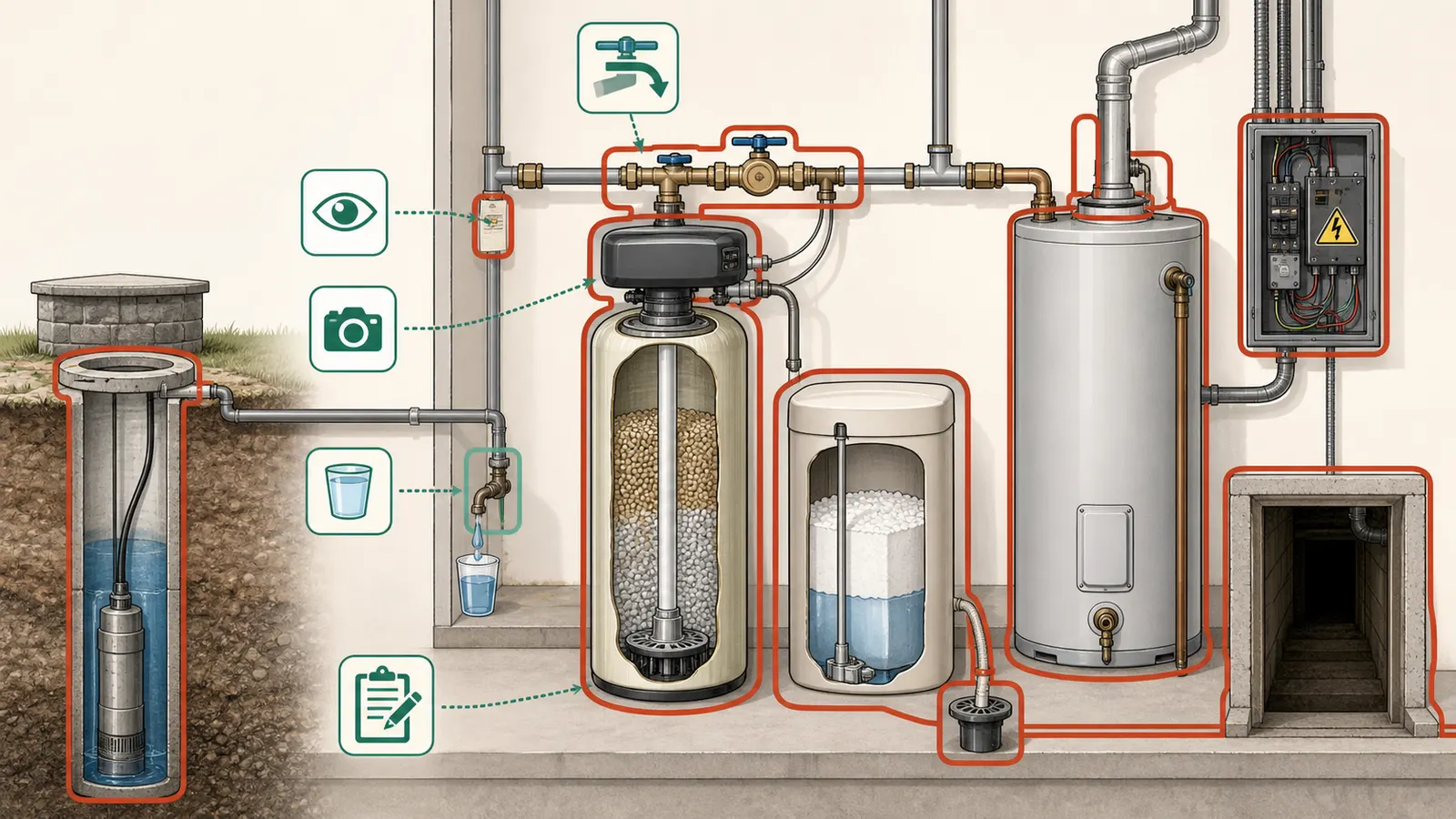
For this moderate-safety issue, do not:
- remove the valve head, tank cap, clamps, riser tube, distributor, brine line, or drain line;
- open an electrical control enclosure, test live wiring, defeat a switch, or handle a wet plug;
- open or modify a pressure tank, well casing, well cap, pump, pressure switch, or pressure relief assembly;
- pull a submersible pump or enter a pit, tank, crawlspace, or other confined space;
- force a bypass, manually reprogram a regeneration, or change backwash settings without the exact manual and a clear reason;
- direct discharge into a container by placing it into a pressurized drain stream; or
- assume that a clear faucet after flushing means the source has been repaired.
The safe homeowner scope is observation, photography, reading an already-visible label or display, using a clearly labeled bypass in the normal manner, collecting a non-invasive sample, and arranging the right professional. Electrical work, well work, pump work, pressurized disassembly, and confined-space work belong to qualified professionals.
7. Hand the technician a defensible evidence record #
Give the professional a one-page chronology instead of a conclusion:
Before the visit
- Model and serial number, photographed rather than guessed.
- Softener installation date and any recent plumbing, valve, heater, filter, or well work.
- Whether the home is on municipal water or a private well.
- First date and fixture where particles were noticed.
- Particle photographs and a labeled retained sample, if collected safely.
- Cold upstream, cold downstream, hot, single-fixture, and drain observations.
- Bypass position and what changed afterward.
- Regeneration start/end timing and any displayed error or service message.
- Recent changes in well-water taste, odor, color, clarity, pressure, or flooding/land disturbance.
Questions worth asking
- Does the evidence localize the source to the softener, downstream plumbing, water heater, or source water?
- For this exact model, is the service plumbing oriented correctly?
- What does the manufacturer list for resin loss through the drain, and which of those causes is supported here?
- Is the proposed scope a distributor, riser, flow-control, valve, media, or full-tank repair—and what observation supports it?
- How will the professional contain and flush particles already in the home without sending more media downstream?
- If this is a private well, should the sample go to a state-certified laboratory, and which tests are appropriate for the observed change?
- What is the release criterion for returning the softener to service, and how will the result be documented?
The decision is complete when you can state the source confidence and the next safe action separately. For example: “Particles are consistent with softener resin because they occur downstream, began after regeneration, and stop after bypass; resin loss is not yet confirmed; a qualified technician should inspect the exact valve, distributors, riser, and flow control.” That sentence protects the home, protects the technician’s starting point, and avoids paying for a whole-unit replacement before the evidence earns it.
Cite this guide
Brictale. “Why Are Resin Beads Coming Out of My Water Softener?.” Published 2026-08-26; updated 2026-08-26.
https://brictale.com/water/softeners/why-are-resin-beads-coming-out-of-my-water-softener · Read the Markdown version
Sources and scope
Evidence behind this page
- GE identifies gold or sandy particles as possible ion-exchange resin, explains that smaller beads sit at the top of the bed, and states that reverse plumbing can carry fine particles toward the home.
Water Softener - Particles or Resin Beads in Water Supply
Manufacturer homeowner support for identifying possible resin-like particles and the specific reverse-flow mechanism; not proof that every gold or sandy particle is resin.
Accessed · Link to this claim - GE distinguishes white or gray particles and chalky water as a possible pipes-or-water-heater purge issue, including mineral buildup dislodged during softener installation.
Water Softener - Particles or Resin Beads in Water Supply
Manufacturer support for a differential diagnosis; it does not establish the source of an individual sample.
Accessed · Link to this claim - Pentair describes the bypass as a way to bypass the system during an emergency leak or service call, instructs the installer to verify inlet and outlet orientation, and describes rinsing the plumbing on bypass before rinsing the softener.
Whole House Water Softening System Manual
Pentair model-family installation and startup instructions; orientation, bypass design, and exact operation vary by softener.
Accessed · Link to this claim - Pentair's troubleshooting guide lists excessive backwash or fast-rinse flow, damaged lower or upper distributors, and a leak between the riser tube and upper distributor as causes of resin loss through the drain line.
Whole House Water Softening System Manual
Manufacturer troubleshooting for the cited Pentair system family; homeowners should not infer that these parts are failed without model-specific service diagnosis.
Accessed · Link to this claim - Pentair states that its system diverts hard water to the home during regeneration and that water drawn during regeneration can send hard water into household plumbing and possibly the hot-water tank.
Whole House Water Softening System Manual
Pentair operating behavior for the cited system; the timing clue can correlate with particles but does not by itself identify resin loss.
Accessed · Link to this claim - Whirlpool's resin-replacement procedure calls for turning off the home's main water, opening a nearby softened-water faucet to relieve pressure, bypassing the unit, and unplugging power before disconnecting the valve head.
Manufacturer procedure for a Whirlpool water softener; used here to establish the disassembly boundary, not as a universal repair procedure.
Accessed · Link to this claim - EPA advises private-well owners to test annually through a certified laboratory and to test immediately when water quality changes or a well-system part is replaced or repaired.
EPA guidance for private wells; it is not a diagnosis of softener resin and does not replace state or local health-department advice.
Accessed · Link to this claim - EPA explains that well casing and grout help keep dirt and excess water out of a well and that well screens help prevent too much sediment from entering; it also identifies the well cap as a barrier to debris.
Learn About Private Water Wells
EPA descriptions of private-well components and their intended protective functions; an observed particle does not prove casing, cap, or screen failure.
Accessed · Link to this claim