Is Softened Well Water Safe to Drink? A Private-Well Decision Guide
Use your well test, hardness, sodium, household needs, and plumbing layout to choose softened water, a drinking-tap bypass, or certified point-of-use treatment.
The short answer
Usually, a properly working softener does not make contaminated private-well water safe. It removes hardness and usually adds sodium or potassium. If the well passes contaminant testing, choose whole-house softening only when added sodium is acceptable; otherwise soften hot water only, keep an unsoftened drinking line, or use certified point-of-use treatment matched to the test result. Ask a clinician about medically restricted sodium or potassium.Is softened well water safe to drink? Use the route, not a yes/no label
Usually, a working water softener can make hard private-well water more pleasant and reduce scale, but it does not make contaminated well water safe to drink. Minnesota Department of Health describes a conventional softener as exchanging calcium and magnesium for sodium or potassium. Neither choice replaces a private-well test for bacteria, nitrate, arsenic, fuel-related chemicals, or other local concerns; EPA’s private-well guidance separates contaminant testing and treatment by the contaminant found.
The homeowner decision is:
- Is the source water acceptable for drinking based on a recent, contaminant-appropriate test?
- How hard is it, and how much sodium would the softener add?
- Who drinks or cooks with the water, including anyone on a medically restricted diet?
- Which taps actually need softened water?
If the well passes the relevant health testing and added sodium is acceptable, whole-house softening may be reasonable. If sodium matters, the usual lower-exposure route is an unsoftened cold drinking line or hot-water-only softening. If a contaminant needs removal at the drinking tap, use a certified point-of-use treatment matched to that contaminant and verify the treated tap.
1. Start with the well result: soft does not mean safe #
Private-well water is a source, not a public utility product with routine government monitoring. The CDC explains that federal public-water rules do not apply to privately owned wells and that the owner is responsible for testing the water and making it safe to drink. That responsibility does not move to the softener when a softener is installed.
The first decision is therefore not “salt or potassium?” It is “what did the well test actually measure, where was the sample taken, and is the result recent enough for the risk?” A softener changes water chemistry after the water enters the house. It cannot prove that the well, pressure system, plumbing, or untreated source water is free from hazards.
The immediate stop branch
Use an alternate source for drinking, cooking, and ice and contact your local or state health department promptly if any of these apply:
- A test shows bacteria, nitrate, or another contaminant above the applicable health guidance or standard.
- The well was flooded, the wellhead was damaged, or there was a spill, sewage event, major ground disturbance, or another plausible contamination event.
- Water suddenly changes in color, taste, or smell and you do not yet know why.
- A fuel, solvent, or petroleum odor is present.
- The laboratory, health department, or treatment professional says the result needs confirmation or the water should not be used.
The EPA’s private-well guidance says to test when water quality changes or the well is repaired and to choose treatment for the contaminant found. It also notes that some cases require a new source or a new well rather than an on-site treatment device. Do not try to “solve” a positive bacteria, nitrate, or chemical result by changing the softener setting.
If you suspect fuel or chemical contamination, do not rely on boiling or a softener. New York’s private-well guidance says to stop using contaminated water for drinking and food preparation until the problem is addressed and testing confirms suitable quality. A softener is not disinfection, and it is not a universal chemical filter.
What to record before choosing a route
Keep the complete laboratory report, not just a line that says “hard water.” Record:
| Evidence to record | Why it changes the decision | What not to infer |
|---|---|---|
| Sample tap and whether it was raw, before treatment, or after treatment | A treated kitchen tap can differ from the well or an untreated hose bib | One tap represents every tap forever |
| Collection date and reason for testing | Flooding, repairs, new occupants, or a taste change can require prompt retesting | An old “pass” covers a new event |
| Total coliform and, when indicated, E. coli or fecal coliform | These are indicators of biological contamination | A softener removes or inactivates germs |
| Nitrate/nitrite and local chemical tests | Nitrate, arsenic, VOCs, PFAS, metals, and pesticides require different decisions | Hardness or sodium predicts all other contaminants |
| Hardness, units, pH, alkalinity, iron, and manganese | These affect softener sizing, corrosion concerns, and treatment compatibility | A high hardness number is itself proof of unsafe water |
| Sodium and chloride, especially if salty taste or road salt is plausible | Sodium may rise through the softener or arrive from the aquifer | A low sodium result today is a medical clearance for everyone |
For a general starting point, CDC recommends annual testing for total coliform bacteria, nitrates, total dissolved solids, and pH through a state-certified laboratory. Ask the local health or environmental department which additional contaminants fit your geology, land use, well construction, and household. A state schedule is not automatically a national rule: for example, New York recommends annual bacteria testing and testing every 3–5 years for a broader list that includes sodium, nitrate/nitrite, arsenic, iron/manganese, hardness, and alkalinity.
2. Understand what the softener changes—and what it leaves alone #
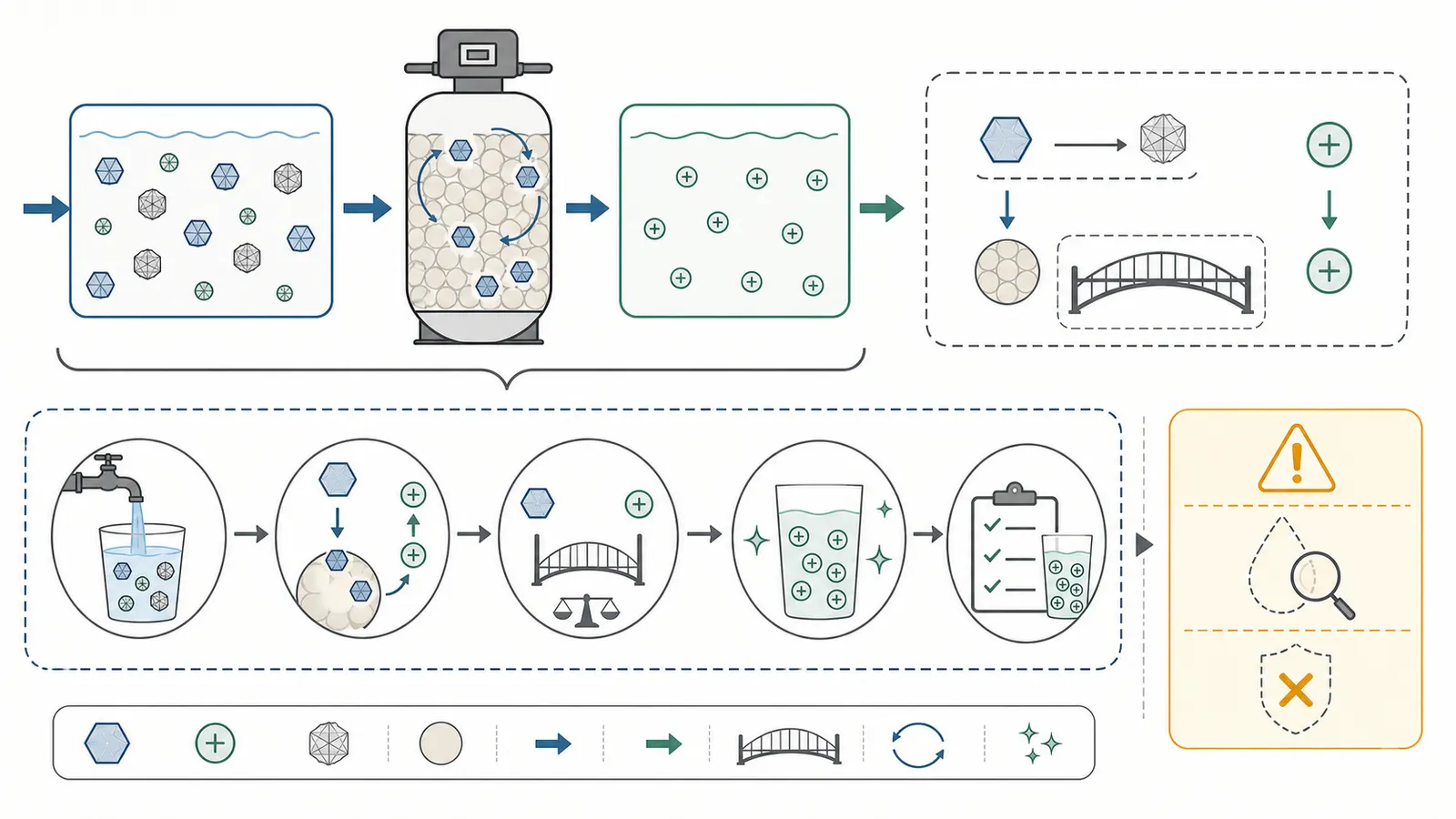
A standard cation-exchange softener contains resin with exchange sites. As water passes through, calcium and magnesium are captured and sodium or potassium is released. During regeneration, a concentrated salt solution restores the exchange capacity and creates a waste stream. The Minnesota Department of Health describes this ion-exchange process and the sodium-or-potassium exchange; EPA describes cation exchange as a hardness treatment that removes calcium and magnesium.
That explains the useful part of softening: less scale on fixtures, pipes, water heaters, and appliances; fewer mineral spots; and better soap performance. It also explains the boundary. The resin is not a general-purpose disinfection stage, and a normal softener setting does not tell you whether a contaminant is present or absent.
A softener is not the treatment for every “well-water problem”
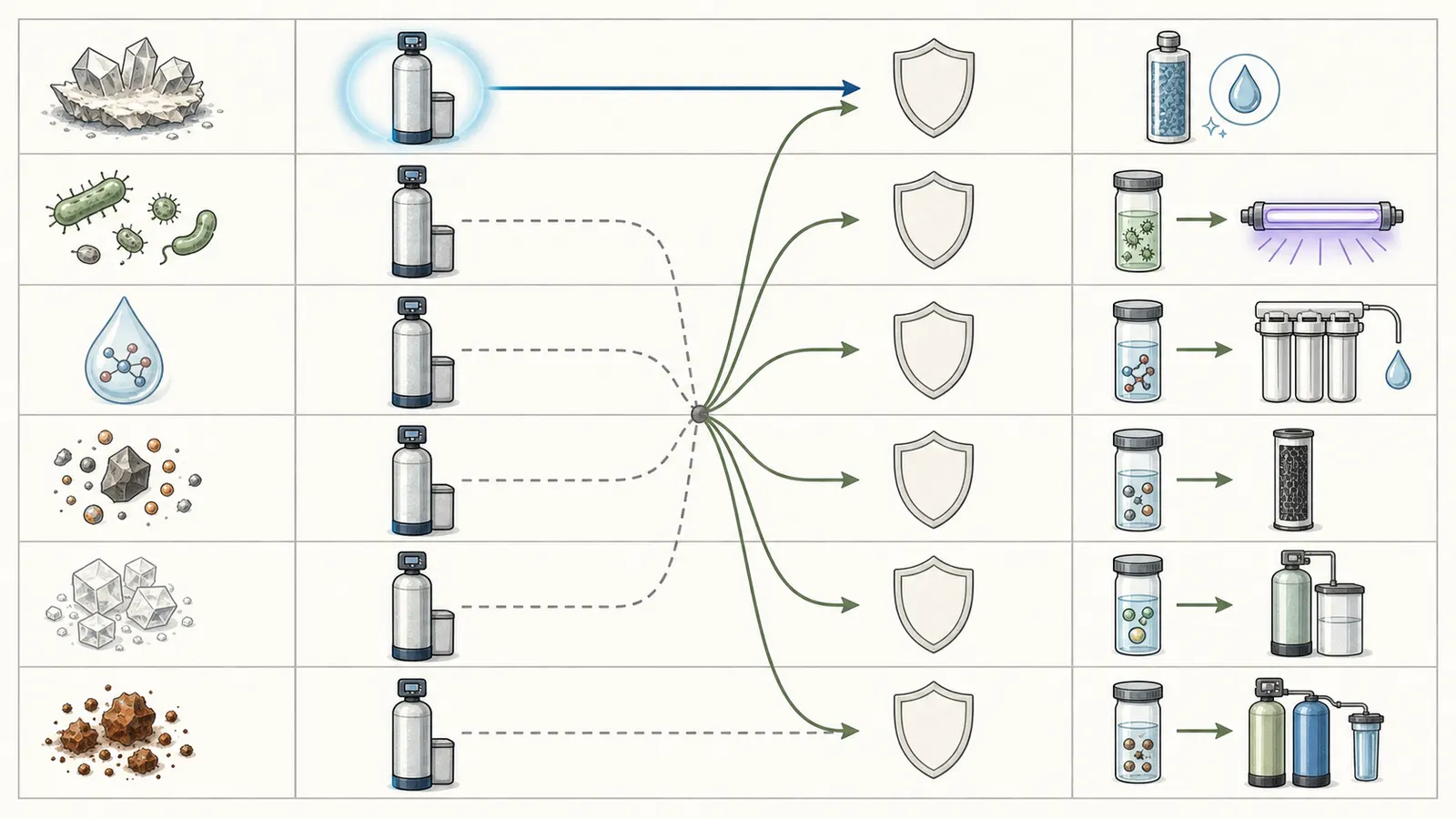
| What the report or observation suggests | What a standard softener may do | Safer interpretation and next step |
|---|---|---|
| Calcium and magnesium hardness | Remove hardness and replace it with sodium or potassium | Decide whether scale control is worth the added ion and whether all household uses need it |
| Total coliform or E. coli | Does not establish disinfection | Stop drinking until the source, disinfection, and follow-up testing are handled with health-department or qualified-professional guidance |
| Nitrate/nitrite | Not a standard hardness-softening function | Use a treatment specifically rated for the measured contaminant, such as a properly selected anion-exchange or RO path, and verify it |
| Arsenic, PFAS, VOCs, or fuel-related chemicals | Not established by a conventional softener | Identify the exact contaminant and concentration, then match a certified claim and treatment design |
| Sodium or chloride already present in the well | A sodium-regenerated softener can add sodium; it does not make salty source water safe | Test raw and treated water; ask the health department or treatment professional about a contaminant-specific route |
| Iron or manganese | Some specialized ion-exchange media may address some forms | Do not assume a normal softener will work; test concentration, form, pH, and competing contaminants and follow the equipment manual |
The New Jersey Department of Environmental Protection’s private-well treatment table maps different contaminants to different treatment categories. It lists cation exchange for some iron or manganese situations, anion exchange or reverse osmosis for nitrate, and ultraviolet light or chlorination for bacterial contamination. This is a treatment-selection map, not a promise that every device in a category will work on every well.
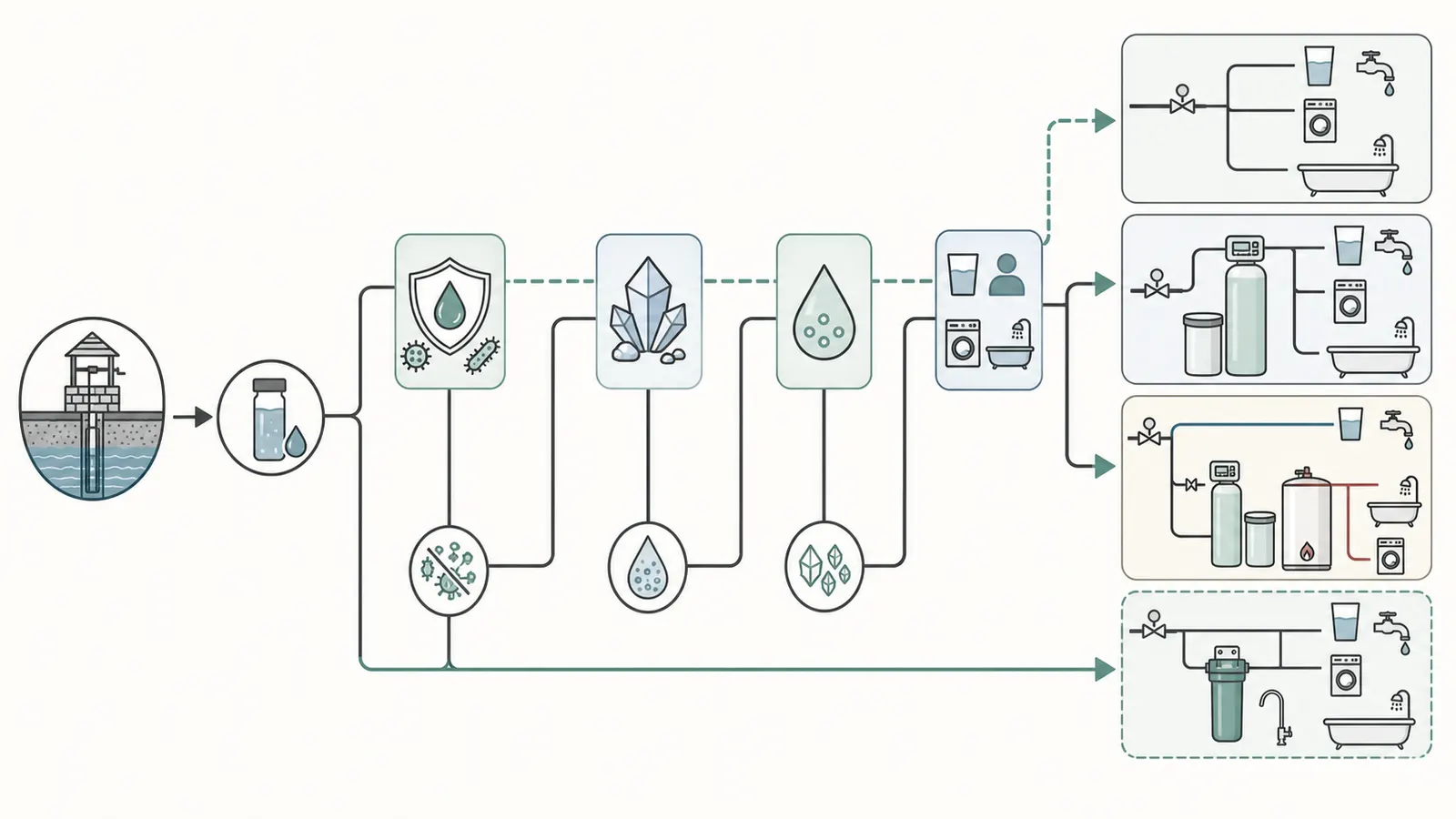
Why water can taste better and still need testing
Hardness is a nuisance and equipment concern in many homes. A change in taste, fewer spots, or a “slick” shower feeling can tell you that the softener is changing the water. None of those observations confirms the absence of nitrate, bacteria, arsenic, or organic chemicals. Conversely, a salty taste can justify a sodium/chloride test, but lack of salty taste does not prove a low sodium concentration.
The EPA’s well-water testing table links conditions such as scaly residues to hardness, salty taste to chloride and sodium, and a needed water softener to hardness with iron or manganese. Treat those as clues for what to test, not as diagnoses from appearance alone.
3. Read hardness units and estimate sodium without overpromising #
Well reports commonly show hardness as mg/L or ppm, usually expressed as calcium carbonate equivalent. Softener controls often ask for grains per gallon (gpg). Virginia Tech’s hardness table gives the practical conversion: 1 gpg equals 17.1 mg/L, with 7–10.5 gpg classified as hard and above 10.5 gpg as very hard.
Use the lab’s units exactly. Do not enter a number in mg/L into a control that expects gpg. If the report says “as CaCO3,” it is using the conventional hardness basis used by the cited conversion. If it does not identify the basis or the report has separate calcium and magnesium values, ask the laboratory or equipment professional how the control should be set.
The bounded sodium estimate
Virginia Tech gives an approximate relationship for common water softeners: about 1 mg/L of sodium is added for every 2.1 mg/L of hardness removed.
For a sodium-chloride softener, a screening estimate is:
estimated sodium added (mg/L)
= hardness removed (mg/L) ÷ 2.1
If your report is in grains per gallon:
hardness removed (mg/L) = hardness removed (gpg) × 17.1
estimated sodium added (mg/L) = hardness removed (gpg) × 17.1 ÷ 2.1
Example: if a softener removes 12 gpg of hardness, the estimated increase is:
12 × 17.1 ÷ 2.1 = about 98 mg/L sodium added
That is an estimate of the change from the softening process, not the sodium concentration at the tap. To estimate the treated tap, you would also need the sodium already in the well water, the actual hardness removed, the softener’s residual hardness or blending, and the system’s operating condition. Potassium-chloride regeneration changes the exchanged ion, so this sodium calculation does not describe the treated-water potassium concentration.
Why the estimate is not a medical threshold
The estimate is useful for comparing routes. It can show why a very hard well may add a meaningful amount of sodium even when the incoming water had little sodium. It should not become a personal pass/fail number. New York State says there is no drinking-water standard for sodium and presents 20 mg/L and 270 mg/L as guidance associated with very-low and moderately restricted diets. Those figures are not a universal limit for every person, and they are not permission to ignore sodium from food, medicines, or other water sources.
If anyone in the household has a clinician-directed sodium restriction, hypertension, kidney disease, heart disease, diabetes, or a medication that affects sodium or potassium handling, bring the raw and treated water results to the clinician. Minnesota advises people with a history of high blood pressure to consult a doctor about drinking softened water. Virginia Tech also warns that potassium from potassium-chloride softening can present concerns for people with kidney disease, some cardiovascular conditions, diabetes, or certain medications (see the Virginia Tech sodium and chloride guidance). Potassium is not automatically the “healthy” replacement for sodium.
4. Choose the household route #
Once the source water passes the health-related tests relevant to your property, choose the smallest route that solves the actual problem. Softening every cold tap is not the only design.
| Household situation | Usually sensible route to investigate | Why | Verify before relying on it |
|---|---|---|---|
| Hardness is low or scale is not a problem | No softener | Avoids salt, potassium, regeneration water, and added complexity | Confirm the decision with the hardness result and the uses that matter |
| Hardness is high, no medically restricted diet, and whole-home scale control is the priority | Whole-house softening may fit | One treatment route serves selected household uses | Correct setting, drain, bypass, maintenance, and treated-tap chemistry |
| Hardness is high but sodium in drinking water should be minimized | Hot-water-only softening or an unsoftened cold drinking branch | Showers, laundry, and water heating can receive softened water while drinking and cooking use untreated cold water | Confirm every drinking and cooking outlet, refrigerator maker, pot-filler, and any other intended outlet is actually on the unsoftened branch |
| A drinking-water contaminant needs removal | Certified point-of-use treatment matched to the result | Treats a smaller volume at the tap where it is consumed | Specific contaminant claim, installation, cartridge/membrane schedule, and treated-tap lab result |
| The well test is positive or the source is suspect | Alternate safe water plus health-department/professional response | The softener does not address the underlying safety problem | Confirm the source and treatment with follow-up testing |
Route A: whole-house softened water
This route is most straightforward when hardness causes substantial scale, the household does not need to minimize sodium or potassium for medical reasons, and the source water has passed the relevant contaminant tests. Even then, set the unit to the measured hardness rather than an exaggerated default. Minnesota notes that setting hardness too high increases operating cost and water waste.
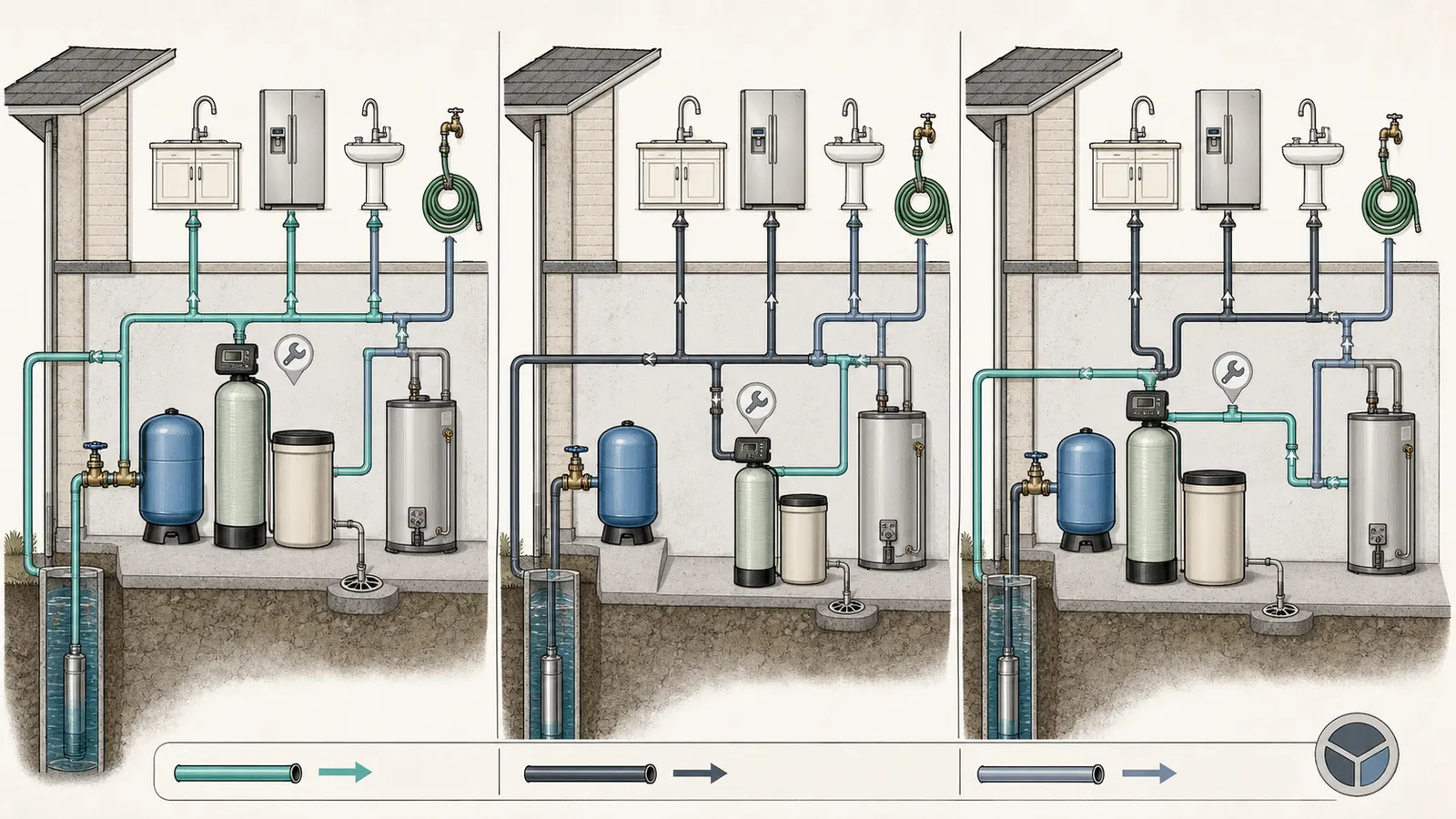
Whole-house treatment also means the softened water may reach cold drinking taps, cooking taps, refrigerator dispensers, and ice makers. Count those uses before deciding that “the kitchen” is protected or bypassed. A bypass valve on the main line does not create a separate drinking route by itself; the actual pipe layout determines which outlets receive which water.
Route B: hot-water-only softening
Minnesota specifically notes that many homes soften only hot water, while Virginia Tech describes softening only hot water and leaving cold drinking and food-preparation lines untreated as a way to avoid adding sodium to drinking water. This can be an elegant compromise when the goal is scale reduction in the water heater, shower, laundry, or cleaning uses.
The tradeoff is coverage. A cold bathroom faucet, refrigerator line, ice maker, kitchen cold tap, outside spigot, or basement sink may remain hard. That is not a defect if it is intentional and labeled for the household. It is a defect if occupants assume every tap has the same water.
Route C: an unsoftened drinking and cooking branch
Some homes soften the main household supply but route one cold line around the softener to the kitchen and other drinking/cooking outlets. This reduces the sodium added by the softener at those outlets, but it does not remove sodium that was already in the well. Test the untreated branch if sodium is the concern. Also consider lead or copper from plumbing, because the water at a particular tap is affected by the pipe materials and time in the plumbing, not only the well and softener.
Ask the plumber to identify the branch in plain language and document the destinations. A future refrigerator installation or remodeling project can accidentally connect a drinking outlet to the softened line. Do not assume a faucet’s position tells you whether it is treated.
Route D: certified point-of-use treatment
If the well is acceptable but the sodium added by a softener is the limiting issue, a small drinking-water system can be more targeted than treating every gallon. If the issue is nitrate, arsenic, PFAS, or another contaminant, the treatment must be selected for that specific contaminant and concentration, not for the word “well.”
Virginia Tech describes reverse osmosis and distillation as point-of-use options for sodium and chloride, with tradeoffs such as storage, pressure, wastewater, energy, and maintenance. NSF identifies NSF/ANSI 58 as the standard for reverse-osmosis drinking-water treatment systems. Check the exact model’s certification and contaminant claim; a device certified for one reduction claim is not automatically certified for another.
For a private well, also ask whether hard water, iron, manganese, turbidity, or low pressure will shorten the treatment system’s life or require pretreatment. New Jersey notes that some contaminants can make treatment less effective or void a warranty and recommends testing other parameters before installation. This is one reason to bring the complete well report to the treatment designer.
5. Handle sodium, potassium, and special household members #
The question “Is softened well water safe?” often means “Is the added ion appropriate for this household?” That is a health conversation, not a softener-sales conversation.
Sodium-regenerated softener
The salt in a typical softener is sodium chloride. Sodium in the finished water comes from the exchange process, and the amount rises with the hardness removed. It also may already be present in the well because of natural geology, road salt, sewage, fertilizer, or other sources. Virginia Tech identifies water softeners and several environmental sources as possible contributors to sodium and chloride in household water.
If sodium is medically relevant, do not pick an action based only on the estimated 20 mg/L or 270 mg/L figures found in a state handout. Give the clinician the measured sodium concentration, how much water the person drinks, whether the water is used in cooking, and the person’s full diet and medical context. The clinician can decide whether drinking softened water fits the prescribed plan.
Potassium-chloride softener
Potassium chloride can reduce the sodium added by regeneration, but it does not make the water universally safer. The resulting potassium can matter for people with impaired kidney function, certain heart conditions, diabetes, or medications that affect potassium. The Virginia Tech guidance specifically recommends consulting a physician when sodium or potassium levels in drinking water are a concern.
Do not substitute potassium chloride just because a bag says “salt alternative.” Confirm that the softener is designed and programmed for it, that the regeneration performance remains appropriate, and that the household’s clinician has considered the actual exposure.
Babies, pregnancy, older adults, and illness
Household vulnerability changes the testing conversation. EPA notes that private-well owners may want more frequent testing when young children, older adults, or a pregnant or nursing person lives in the home. CDC also lists pregnancy, a new child, a change in taste or smell, repairs, and nearby environmental changes as reasons to test.
This does not mean a softener is dangerous for every household. It means a homeowner should not treat the machine’s presence as a safety certificate, especially when the water is used for infant formula, cooking, or ice. Ask the pediatrician or clinician what water source and test results are appropriate for the specific situation.
6. Verify the actual drinking tap and maintain the boundary #
A well test before installation answers a different question from a treated-tap test after installation. The first asks what is in the source or untreated plumbing at the time of collection. The second asks what a person receives from a particular outlet after the softener, branch piping, storage, filters, and faucet have acted on the water.
A practical verification sequence
Use the laboratory’s own bottles and collection instructions. Do not sterilize, flush, or handle a sample in a way that conflicts with the lab’s method.
- Save the raw or pre-softener report, the softener model and settings, the salt or potassium product, and the plumbing diagram.
- Identify the exact outlets intended for drinking and cooking. Include the refrigerator dispenser and ice maker if they are used.
- Ask the laboratory which paired samples are useful: untreated source or bypass tap, and the final treated drinking tap.
- Collect samples on the schedule and after the flushing or no-flushing procedure the lab specifies.
- Label each bottle with the tap, treatment status, date, and any recent regeneration or cartridge change if the lab asks for it.
- Compare sodium, hardness, pH, and any contaminant-specific result. If the route is meant to address bacteria or nitrate, test for those too; do not use sodium or hardness as a proxy.
- If the result is unexpected, pause the drinking route and ask the lab or professional whether to repeat the sample, inspect the plumbing, or evaluate the equipment.
The goal is not a one-time “safe forever” certificate. It is evidence that the selected route is producing the intended water now, followed by maintenance and retesting when the source, equipment, or household changes.
Softener maintenance that affects the decision
Follow the manufacturer’s manual for salt or potassium, regeneration, cleaning, bypass operation, and service intervals. The Minnesota Department of Health says routine testing and maintenance are needed to keep water quality stable and notes that poorly managed water chemistry can contribute to corrosion.
Keep a simple log:
| Date | Observation or action | Record |
|---|---|---|
| Installation or setting change | Hardness setting, salt type, bypass status | Photo or written setting; do not record a guessed number |
| Each lab test | Tap, treatment status, results, lab | Attach the complete report |
| Salt or potassium refill | Product, approximate amount, any bridging or empty tank | Follow the equipment manual |
| Regeneration or alarm | Date, display message, unusual taste or pressure | Call for service if the manual does not resolve it |
| Plumbing change | New refrigerator, filter, faucet, water heater, or branch | Confirm whether the outlet is softened or unsoftened |
| Well event | Flooding, repair, cap disturbance, power loss, odor/color change | Ask the health department or professional whether to retest |
Do not assume that a softener removes every mineral problem. The Minnesota guidance notes that special media may address some iron, manganese, copper, or radium conditions, but those are not automatic capabilities of a typical unit. Confirm the exact manual and test results.
Also account for the drain. Regeneration sends concentrated brine to the drain; disposal and environmental restrictions vary by location. Minnesota highlights chloride impacts and notes that private-well softener waste may enter a septic system. Do not reroute a drain or alter a septic connection based on a generic diagram; ask a qualified professional about the site and applicable requirements.
7. Work safely and bring the right brief to a professional #
This is a high-safety water decision because the wrong inference can expose a household to contaminated water, and the equipment is connected to water pressure, drains, and sometimes electricity.
Homeowner-safe work is limited to reading the report and manuals, observing which taps run through which labeled route, collecting laboratory-directed samples, recording taste/color/odor changes, and checking for obvious external leaks without opening equipment.
Do not open energized controls, test live wiring, open a well or remove its cap, pull a pump, enter a confined space, open pressurized equipment, or manipulate a pressure tank or pump control. Do not shock or disinfect a well on your own unless the responsible health authority and a qualified professional have given specific, situation-appropriate direction; New Jersey DEP recommends that a private-well professional perform shock chlorination. Turn service and repairs over to qualified professionals.
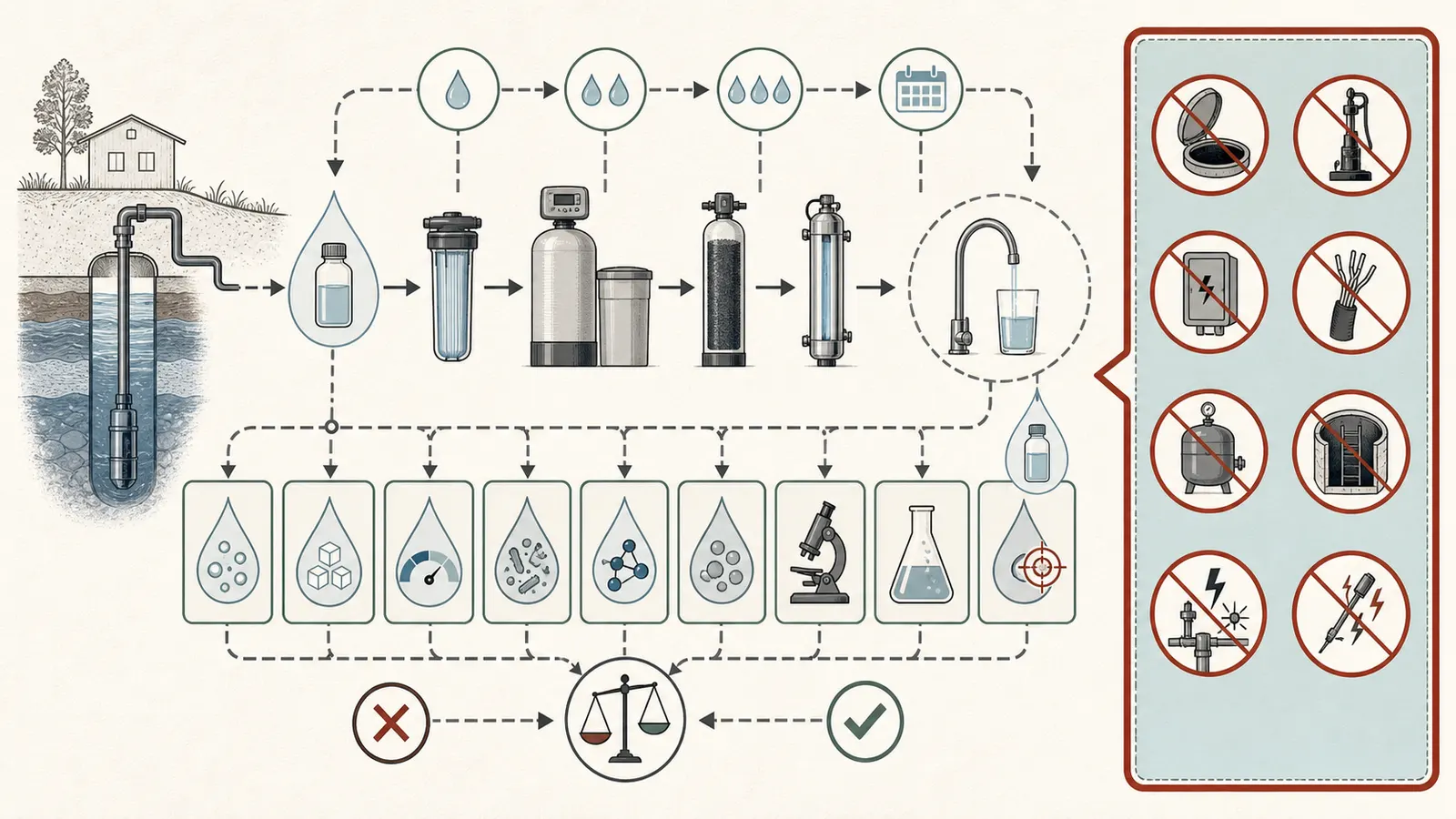
When you call a laboratory, health department, plumber, or certified water-treatment professional, provide:
- the state and county, well type if known, well age, and recent flooding or repair history;
- the complete raw-water report with units, detection limits, and collection point;
- the softener brand/model, regeneration medium, hardness setting, and any treatment before or after it;
- the exact drinking, cooking, refrigerator, ice-maker, shower, laundry, and outdoor outlets you want treated;
- the household medical concern, described as a question rather than a diagnosis; and
- the result you want: scale control, lower sodium at drinking taps, contaminant removal, or confirmation that the present route is working.
Ask the professional to write down which contaminant each proposed stage is intended to address, the certified performance claim if one exists, what pretreatment is required, which tap should be tested after installation, and what maintenance failure would make the result unreliable. If the proposal says “purifies well water” without naming the contaminant, concentration, certification, and verification plan, it is not yet a decision-ready specification.
The final route/no-route check
Use this short checklist before treating softened well water as the household drinking supply:
- The private well has a current, contaminant-appropriate test from a certified laboratory.
- There is no unresolved bacteria, nitrate, fuel, chemical, flooding, or well-integrity concern.
- Hardness is recorded in the report’s units and converted correctly if the softener control uses gpg.
- Any sodium estimate is labeled approximate and is not being used as a medical limit.
- The household has decided whether sodium or potassium needs clinician review.
- The selected plumbing route identifies every drinking and cooking outlet.
- Any point-of-use device has a certification and contaminant claim matching the actual problem.
- The treated drinking tap has been tested when the route or health concern warrants it.
- Regeneration, salt/potassium, drain, filters, membranes, and retesting have named owners and dates.
- No one is being asked to open energized, pressurized, electrical, well, pump, or confined-space equipment.
If every box is satisfied and hardness control is the only remaining goal, softened well water may be a reasonable household choice. If one of the safety or contaminant boxes is unresolved, the correct next step is not a stronger softener setting. It is a safer water source, a contaminant-specific treatment decision, or professional and health-department guidance followed by verification.
Cite this guide
Brictale. “Is Softened Well Water Safe to Drink? A Private-Well Decision Guide.” Published 2026-08-31; updated 2026-08-31.
https://brictale.com/water/softeners/is-softened-well-water-safe-to-drink · Read the Markdown version
Sources and scope
Evidence behind this page
- Private wells are not covered by the federal rules that regulate public drinking-water systems; the owner is responsible for testing and making the water safe to drink.
Guidelines for Testing Well Water
CDC guidance for privately owned wells in the United States; not a statement about a particular state’s additional requirements.
Accessed · Link to this claim - CDC recommends testing private-well water at least annually for total coliform bacteria, nitrates, total dissolved solids, and pH, and using a state-certified laboratory.
Guidelines for Testing Well Water
General CDC baseline guidance; local health departments may recommend additional contaminants or different schedules.
Accessed · Link to this claim - A conventional home softener uses ion exchange to remove calcium and magnesium and exchange them for sodium or potassium during treatment and regeneration.
Home Water Softening Frequently Asked Questions
Minnesota Department of Health explanation of home ion-exchange softeners; actual media and performance depend on the equipment and water.
Accessed · Link to this claim - EPA describes cation exchange as useful for water softening by removing calcium and magnesium, while noting that treatment capacity varies with the resin and incoming water characteristics.
Overview of Drinking Water Treatment Technologies
EPA technology overview; it is not a design approval for a particular residential softener.
Accessed · Link to this claim - Softening is a hardness treatment and does not establish that a private-well supply is free of bacteria, nitrate, arsenic, fuel-related chemicals, or other contaminants.
EPA private-well testing and treatment guidance; treatment must be selected for the contaminant and its concentration.
Accessed · Link to this claim - Virginia Tech classifies hardness using both grains per gallon and mg/L: 1 gpg is 17.1 mg/L, and water above 7 gpg or 120 mg/L is in the hard range.
Virginia Household Water Quality Program: Hardness in Household Water
Virginia Cooperative Extension classification table; hardness is reported as calcium carbonate equivalent in the cited context.
Accessed · Link to this claim - Virginia Tech states that most softeners add about 1 mg/L of sodium for every 2.1 mg/L of hardness removed.
Virginia Household Water Quality Program: Sodium and Chloride in Household Drinking Water
Approximate relationship for common household softeners; not a guaranteed treated-water result or medical limit.
Accessed · Link to this claim - A homeowner can reduce sodium in drinking water by softening only hot water or leaving cold drinking and food-preparation lines untreated; Minnesota also advises softening only what is needed.
Home Water Softening Frequently Asked Questions
Practical routing guidance from Minnesota Department of Health; plumbing layout and local requirements must be confirmed for the home.
Accessed · Link to this claim - Virginia Tech warns that potassium from potassium-chloride softening can matter for people with kidney disease, some heart conditions, diabetes, or certain medications and recommends physician consultation when sodium or potassium in drinking water is a concern.
Virginia Household Water Quality Program: Sodium and Chloride in Household Drinking Water
Health-conversation guidance, not individualized medical advice or a universal sodium/potassium threshold.
Accessed · Link to this claim - Minnesota advises people with a history of high blood pressure to consult a doctor about drinking softened water.
Home Water Softening Frequently Asked Questions
Minnesota Department of Health advice to discuss softened water with a doctor; not individualized medical advice.
Accessed · Link to this claim - New York State advises private-well owners to test at the tap at least annually for bacteria and every 3–5 years for sodium, lead, nitrate/nitrite, arsenic, iron/manganese, turbidity, pH, hardness, and alkalinity.
New York State Department of Health recommendation; not a national testing schedule.
Accessed · Link to this claim - New York State advises stopping use of private-well water for drinking and food preparation when contamination is shown or suspected, then addressing the problem and testing to confirm suitable quality.
New York State private-well safety guidance; local health departments may provide additional instructions.
Accessed · Link to this claim - New York State says there is no drinking-water standard for sodium and describes 20 mg/L and 270 mg/L as guidance for very-low and moderately restricted diets, respectively.
New York State health guidance; these figures are not a personal medical clearance and should not be applied without clinical context.
Accessed · Link to this claim - New Jersey’s private-well treatment table maps different contaminants to different treatment categories: cation exchange for some iron or manganese, anion exchange or reverse osmosis for nitrate, and UV or chlorination for bacterial contamination.
New Jersey DEP summary table; suitability depends on test results, equipment, pretreatment, maintenance, and manufacturer claims.
Accessed · Link to this claim - New Jersey DEP says suspected bacterial contamination requires identifying the source where possible, disinfection, and follow-up testing; it recommends that a private well professional perform shock chlorination rather than the homeowner.
New Jersey DEP guidance for private wells; local health departments and professionals may set additional steps.
Accessed · Link to this claim - Virginia Tech describes reverse osmosis and distillation as point-of-use options that can address sodium or chloride, with system-specific tradeoffs, storage, waste, pressure, and maintenance considerations.
Virginia Household Water Quality Program: Sodium and Chloride in Household Drinking Water
Virginia Tech discussion of sodium/chloride treatment; a device must be certified and matched to the contaminant claim.
Accessed · Link to this claim - EPA advises testing for contaminants based on local conditions and notes that on-site treatment may include disinfection, distillation, or filtration, while some situations require a new water source or well.
EPA general private-well guidance; it does not select a treatment design for an individual property.
Accessed · Link to this claim - NSF/ANSI 58 is the standard for reverse-osmosis drinking-water treatment systems, and product claims should be checked against the specific certified listing and contaminant claim.
NSF/ANSI 58: Reverse Osmosis Drinking Water Treatment Systems
NSF overview of the standard; certification of one contaminant claim does not imply removal of every contaminant.
Accessed · Link to this claim