What Causes a Marble-Like Crackling Noise in a Well Pump?
A homeowner-safe decision path for a marble or gravel sound: locate and time it, record pressure and flow, check visible restrictions, and know when to stop.
The short answer
A marble- or gravel-like crackle while a pump runs can indicate cavitation, but the sound alone cannot rule out a restricted suction path, air entering a shallow-well line, a damaged impeller, loose piping, or worn bearings. Record when it starts, where it is loudest, pressure, flow, and water delivery. Stop prolonged operation—especially with little water, falling pressure, heat, leaks, or repeated cycling—and have a qualified well professional test it.What a marble sound can—and cannot—tell you #
A well pump that sounds like marbles, gravel, pebbles, or rocks passing through is giving you a useful symptom, not a finished diagnosis. A sharp crackling or rattling sound that occurs while the pump is running can be consistent with cavitation. The U.S. Bureau of Reclamation describes a sharp crackling sound similar to rocks passing through a pump as a strong indication of cavitation and warns that prolonged operation can damage pumping equipment quickly. Its bulletin is written for broader pumping operations, so use the sound as a reason to stop prolonged testing and arrange diagnosis—not as proof that your particular residential pump has one specific failed part. (U.S. Bureau of Reclamation, Water Operation and Maintenance Bulletin 232)
Other faults can sound surprisingly similar. Flint & Walling's troubleshooting guidance lists cavitation, a restricted inlet line, and worn motor bearings as separate possible causes of excessive pump noise. Pentair's Shurflo manual is narrower: its excessive-noise table lists an unsecured pump, unsupported piping, restricted suction, and cavitation described as a marble-like noise. The same description can therefore point toward a water-supply or suction condition, a mechanical fault, or vibration in the installation; it does not identify which one is present. (Flint & Walling troubleshooting; Pentair Shurflo centrifugal-pump manual)
Your safe goal is to describe the pattern precisely: where the sound is loudest, when it begins, whether water delivery changes, what an already-installed gauge shows, and whether the pump stops normally. Do not treat a sound recording or a pressure number as permission to open a control box, pull a pump, open the well, or force a test that restricts discharge.
First record where and when the sound happens #
Listen from a dry, stable location while the system is operating normally. Do not place hands on moving equipment, remove covers, or lean into a wet pump area. Note the loudest location without touching the equipment: the pump housing, an exposed pipe, the pressure tank area, the pressure-switch area, a wellhead enclosure, or a faucet. Treat the location as an observation to report, not proof of the source.
Record the event against ordinary household actions. A single observation is less useful than a repeatable pattern. Use this sequence:
- With no water running, note whether the system is quiet, ticking, or making the sound continuously.
- At one fixture, open water normally and note whether the sound begins at pump startup, after flow has continued, as pressure falls, or at shutdown.
- Note whether the sound is present only during heavy demand, such as two fixtures or irrigation, or also during a small flow.
- Note whether the sound changes when the fixture is closed slowly versus quickly. Do not slam valves or create a deliberate closed-discharge condition.
- Record whether the water sputters, contains visible air, loses pressure, becomes cloudy or discolored, develops a new taste or odor, shows sediment, or stops flowing while the sound occurs.
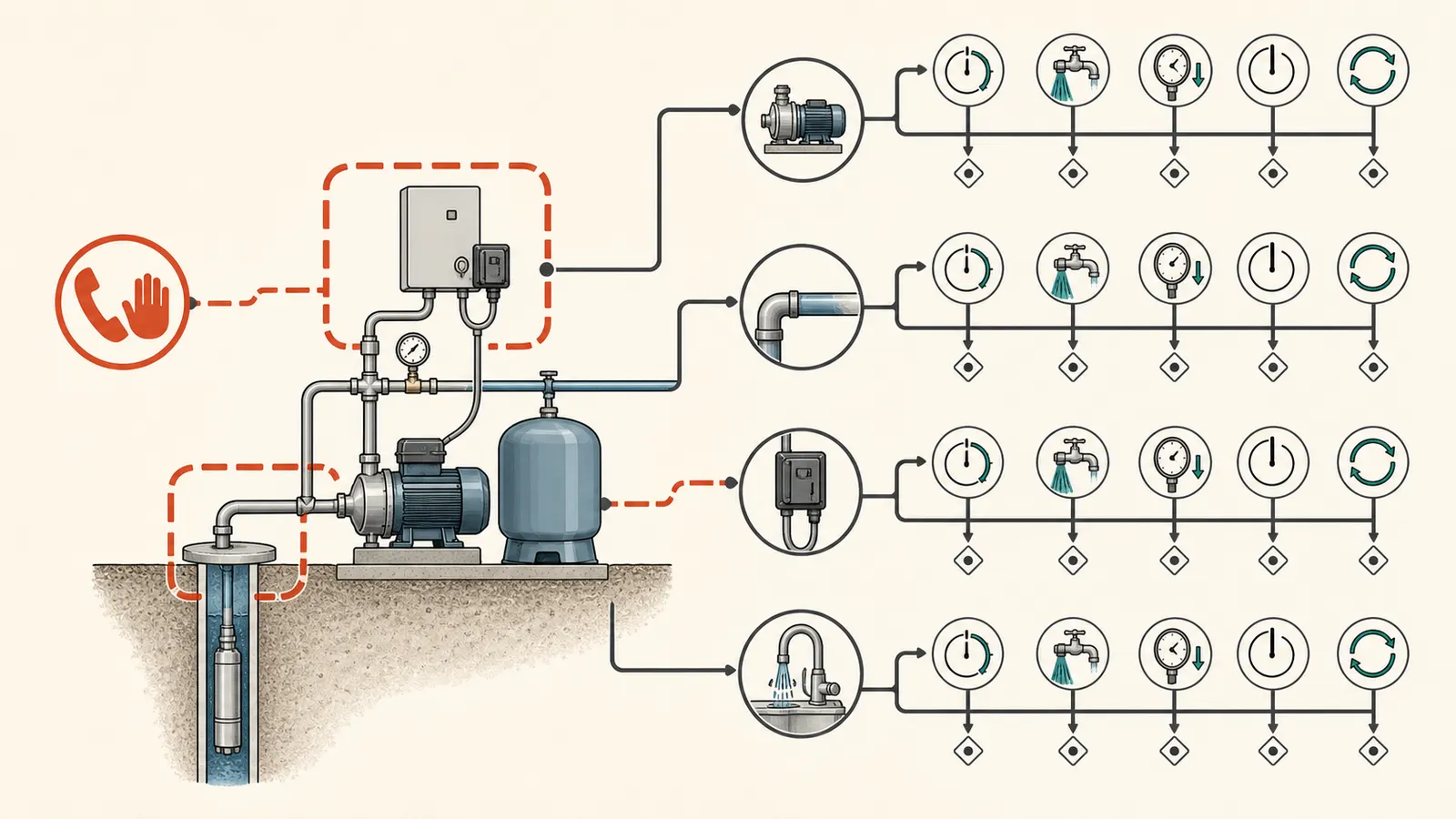
Do not repeatedly start and stop the pump just to reproduce the noise. If the sound is sharp and crackling, or if water delivery is falling, one brief normal-use observation is enough to document the pattern. A recording from a safe distance can help a professional, but it cannot establish cavitation, bearing damage, or well level by itself.
Use pressure and flow as clues, not as a DIY pump test #
If a pressure gauge is already installed and readable without removing a cover, record its reading before water use, when the pump starts, while the sound is present, and after the pump stops. Write down the units and the gauge location. Pair each reading with the demand and water-delivery observation so a professional can compare the pressure event with what the fixture was doing; one number by itself is incomplete.
Pair the gauge observation with a simple, bounded flow note. You can time how long it takes to fill a known container at an ordinary fixture only if the fixture can discharge safely and the pump is behaving normally. Record the container size, elapsed time, fixture used, and whether the sound appeared. Stop the observation if water delivery fades, air enters the stream, the sound intensifies, the pump runs without delivering water, or the equipment becomes hot or leaks. Do not drain a suspected low-yield well for an extended experiment.
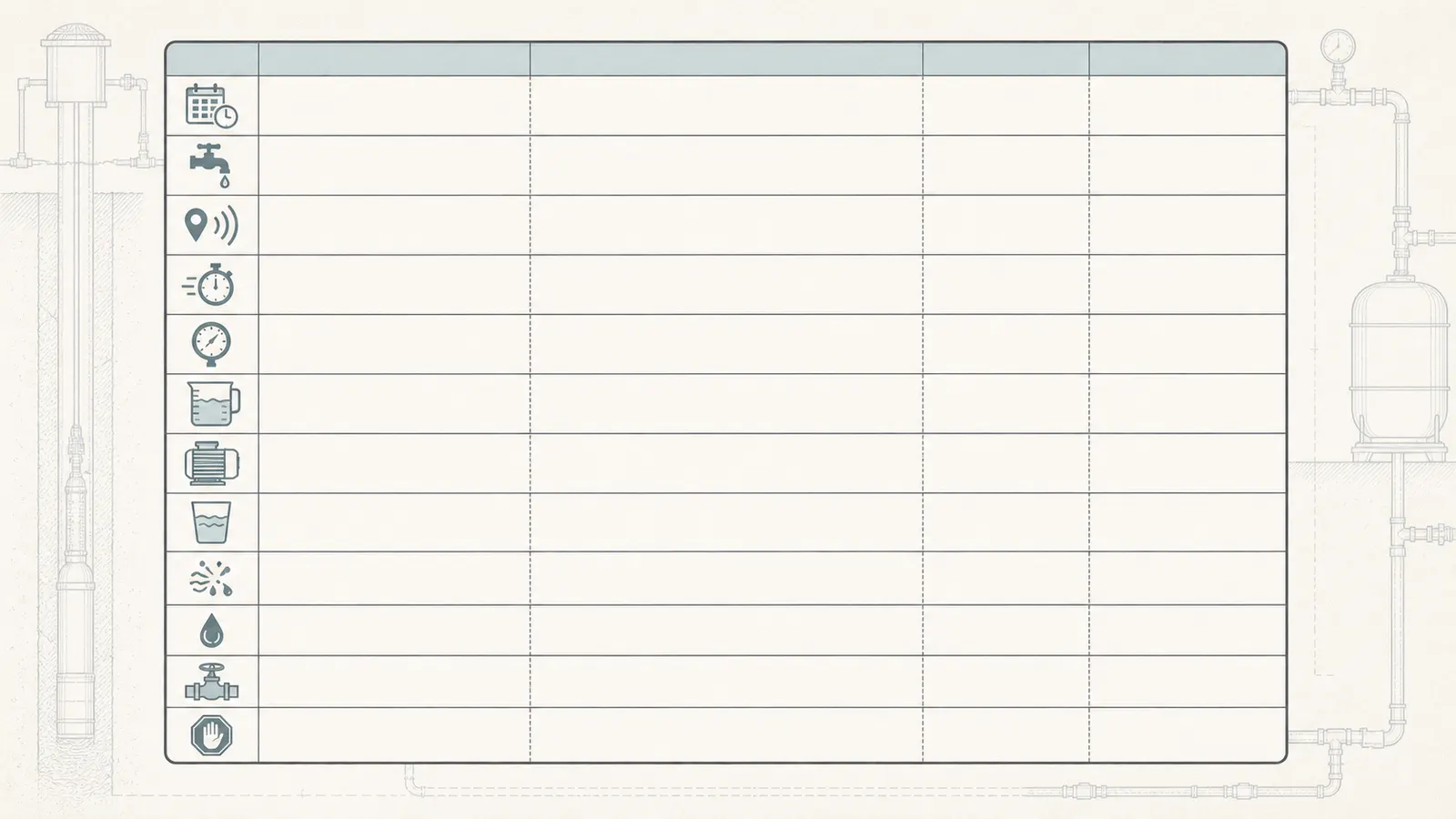
| Observed pattern | What it may move higher on the list | Safe next step |
|---|---|---|
| Sound starts with pump startup and pressure or flow falls | Suction restriction, air intrusion, cavitation, or a pump problem | Stop prolonged operation; document the gauge and flow pattern for service |
| Sound appears only during heavy demand | Supply limitation, suction condition, restriction, or pump operating point | Reduce demand and arrange testing of flow, pressure, and water level |
| Sound is loudest at a motor or pump body and remains with normal flow | Mechanical wear, pump damage, or another equipment fault | Avoid teardown; have a qualified pump professional inspect it |
| Sound is a bang or thump when a valve or pump changes state | Flow-change shock or unsupported piping | Operate valves slowly and have piping/supports checked if it persists |
| Sound is rapid clicking at the control area | Pressure-switch or control behavior | Keep the cover closed; stop if cycling is rapid or abnormal and call for service |
| Sound accompanies sputtering or air at fixtures | Air entering a suction path, loss of prime, low source level, or plumbing air | Limit use and arrange a well/pump diagnosis; do not open the well |
This table is a triage aid. It deliberately leaves overlapping branches because a residential system may have a submersible pump, a shallow-well jet pump, a pressure tank, treatment equipment, check valves, and multiple sources of vibration. The exact pump model and installation determine which tests are valid.
Check only visible restrictions, supports, and valve position #
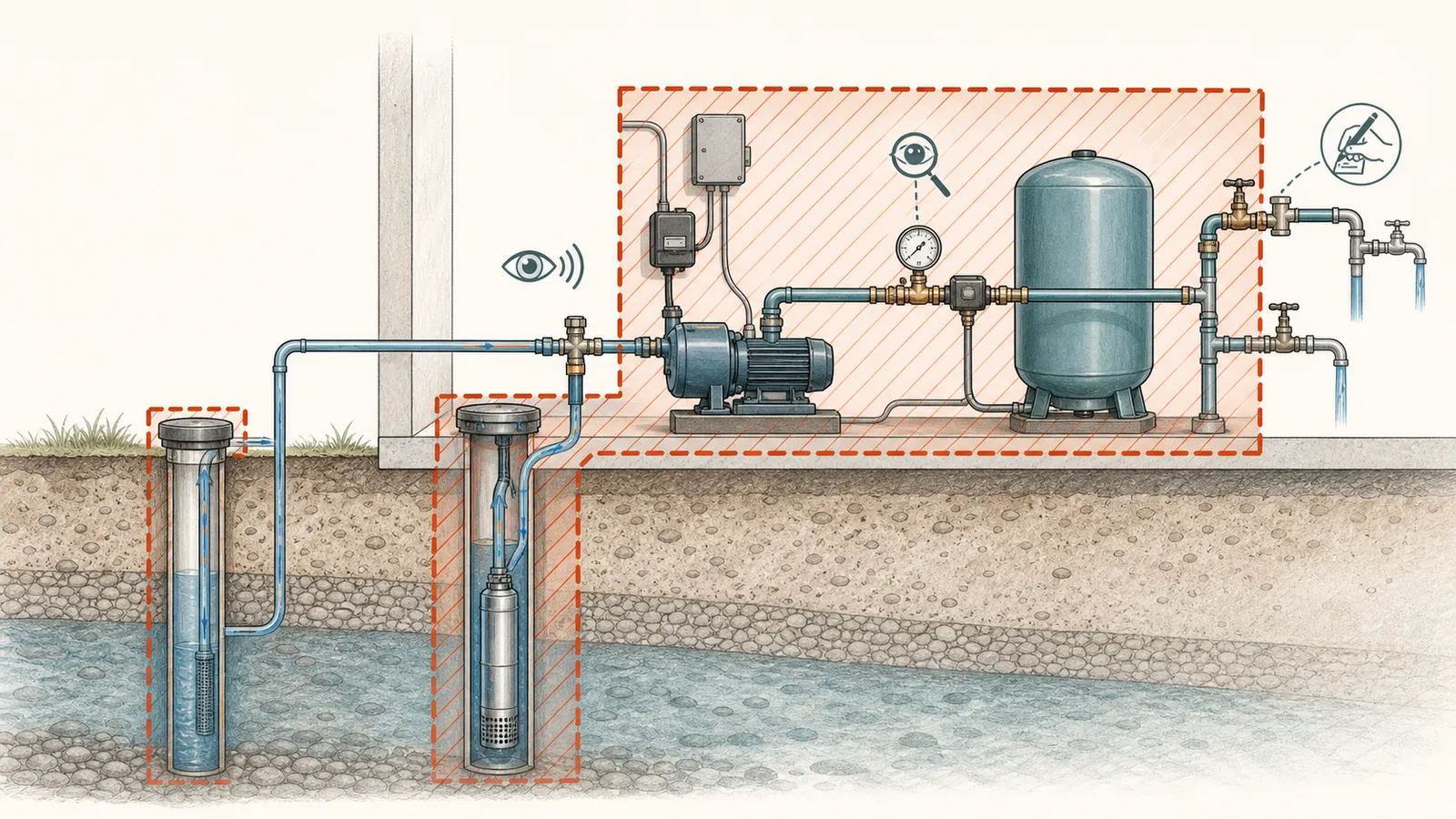
A homeowner can make a useful visual record without taking the system apart. From a safe position, look for a valve that is visibly out of its normal marked position, a kinked or crushed exposed hose, a filter gauge reading that has changed, a new leak, pipe movement, or a pipe touching a wall or framing member. Note recent work: a filter change, plumbing repair, pump service, drought, flooding, power event, or a change in irrigation demand.
Do not assume that a closed-looking or partly turned valve is the cause, and do not force a stuck valve. If a valve is not clearly labeled or you cannot tell what it serves, photograph it and leave it for the professional. Do not bypass a treatment device merely to see whether pressure improves; bypassing can remove water-quality protection and may violate the equipment's operating instructions. Do not open a pressurized filter housing, remove a strainer, loosen a union, disconnect a suction line, or crack a drain to “let air out.”
The suction-line branch matters especially for a shallow-well jet pump. Pentair's shallow-well manual says suction-pipe joints must be air-tight as well as water-tight because an air leak can prevent the pump from pulling water from the well. It lists air leaks, a water level below the suction inlet, plugged foot valves or strainers, and clogged pump components among causes of lost prime or no water. These clues do not transfer directly to a sealed submersible pump, which does not use the same above-ground suction line. (Pentair Pro shallow-well jet-pump manual)
If the system has exposed piping, note whether it vibrates only during the sound or whether a support is loose. Pentair's Shurflo guidance includes unsupported piping among possible noise causes. A pipe-borne rattle can coexist with a pump problem, so securing or padding a visible contact point is not a substitute for checking pump performance. (Pentair Shurflo centrifugal-pump manual)
Separate the main sound patterns without naming a winner #
The timing and location help separate possibilities, but none of these patterns is conclusive at homeowner level.
Cavitation or restricted suction. A sharp crackle that resembles rocks or marbles and occurs while the pump is running deserves priority because cavitation can damage equipment. It may become more noticeable under high demand or when suction conditions are inadequate. A restricted inlet, clogged strainer, excessive suction lift, or air leak can also produce poor flow or noise in applicable pump designs. The observation that matters is not “it sounds like marbles,” but “it begins under this demand, pressure does this, and water delivery does that.” (U.S. Bureau of Reclamation, Water Operation and Maintenance Bulletin 232; Flint & Walling troubleshooting; Pentair Shurflo centrifugal-pump manual)
Air entering a shallow-well suction path. Sputtering faucets, loss of prime, or a pump that struggles to deliver water can move an air-intrusion or source-level problem higher on the list for a jet-pump system. The manual distinction matters: do not apply a shallow-well suction-line explanation to a submersible pump without knowing the installation. Have the professional verify the pump type, suction conditions, foot valve or strainer, water level, and prime rather than adding water or opening fittings yourself. (Pentair Pro shallow-well jet-pump manual)
Mechanical wear or pump damage. A steady growl, grinding sound, or noise strongest at the motor or pump body may suggest a mechanical fault, especially if it does not track household demand. Flint & Walling lists worn bearings separately from cavitation, and Penn State Extension identifies damage involving bearings, impellers, sediment, corrosion, operating temperature, and cavitation as matters for manufacturer-directed maintenance. Those sources support service escalation, not a homeowner diagnosis from sound alone. Do not remove the motor, impeller, wiring, or pump. (Flint & Walling troubleshooting; Penn State Extension, Water Well Maintenance and Rehabilitation)
Pressure-switch chatter or rapid cycling. Rapid clicks near the pressure-switch area, frequent starts, or failure to shut off belongs to the control and pressure-system branch. Pentair's troubleshooting example lists pressure-switch faults, leaks, tank problems, and other conditions among causes of cycling or failure to shut off; its example pressure range is model-specific, not a universal target. Keep the cover closed and do not adjust springs because the pump sound makes you suspect the switch. (Pentair Pro shallow-well jet-pump manual)
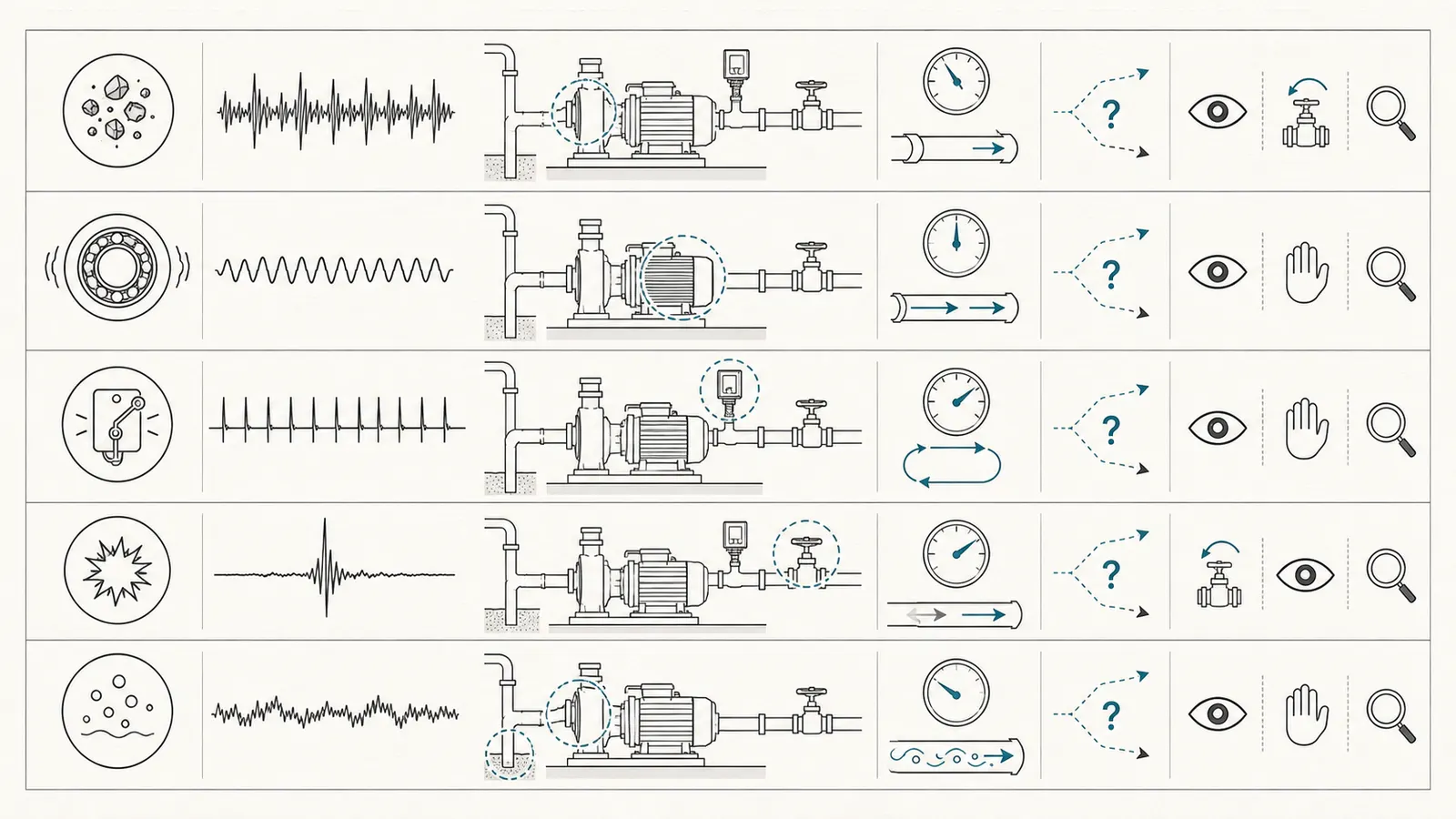
Water hammer or pipe movement. A single bang or thump immediately after a valve, pump, or solenoid changes flow is a different pattern from a crackle that continues while the pump is moving water. University of Florida IFAS describes water hammer as a shock-wave response to sudden flow changes and recommends slow valve operation and controlled filling or restarting. That guidance supports a pattern distinction; it does not prove the source in your house. (University of Florida IFAS, Water Hammer in Irrigation Systems)
Stop running the system and arrange service when the boundary is crossed #
Stop extended operation and contact a qualified well or pump professional when the marble-like sound is sharp, persistent, or worsening; when pressure or flow falls; when the pump runs without delivering water; when air or sediment appears; when the motor or pump becomes unusually hot; when you see a leak, sparking, burning smell, or uncontrolled pressure; or when the pump cycles rapidly or will not shut off. A change in equipment sound, longer run time after use, and lower pressure are recognized warning signs that can require a licensed well driller or pump installer to distinguish a dry well from an electrical or mechanical pump issue. Licensing rules vary by location, so use the applicable local requirements. (New Jersey Department of Environmental Protection, Private Well Owner FAQ)
Do not create a dead-head test by closing a discharge valve or blocking a fixture to see whether the noise changes. Pentair warns that running a pump against a closed discharge can create hazardous pressure and boiling water inside the pump, and its pressure-switch instructions warn against running with a closed discharge longer than necessary for a controlled professional pressure reading. Follow the exact manual for the installed model and let a qualified person perform equipment-specific testing. (Pentair Pro shallow-well jet-pump manual; Pentair pressure-switch instructions)
Do not remove an electrical enclosure, test live wiring, adjust a pressure switch, open a well cap or casing, measure downhole water level, pull a submersible pump, or open pressurized components. New Jersey environmental guidance warns that opening a well can jeopardize sanitary integrity and that inserting measuring devices can damage or obstruct pumping equipment. Generalize the stop boundary, not that state's licensing rule: local health, well, electrical, and plumbing requirements apply. (New Jersey Department of Environmental Protection, Private Well Owner FAQ)
Never enter a well pit, well casing, vault, or any other confined space to inspect the pump. Keep every observation remote; do not climb down, reach into an opening, or attempt a rescue. Federal confined-space guidance lists wells, pits, and utility vaults as examples and says confined spaces should not be entered by unauthorized people; NIOSH specifically warns against an untrained emergency rescue entry. Call emergency services and keep others away if someone is inside or has collapsed. (National Institute of Environmental Health Sciences, Confined Spaces Awareness; NIOSH, Working Safely in Confined Spaces)
Treat a water-quality change as a separate stop-use boundary. If the water becomes cloudy or discolored, develops a new taste or odor, or contains new sediment, do not assume it is safe because the pump still runs or the pressure looks normal. As a conservative Brictale safety rule, use another source for drinking, cooking, and ice until you have guidance. Contact your local or state health department about what to test and use a state-certified drinking-water laboratory; CDC guidance specifically recommends testing after a change in color, taste, or smell and says the health department can help select and interpret testing. (CDC, Guidelines for Testing Well Water)
For a shallow-well jet pump, stop if it does not deliver water after the model's brief priming procedure or if dry running is suspected. Pentair warns against dry running and against running against a closed discharge because of equipment and scalding hazards. Do not keep adding water or repeating prime attempts without following the exact manual and confirming that the discharge path is open. (Pentair Pro shallow-well jet-pump manual)
Hand the professional a repeatable symptom record #
The most useful service call starts with a short record rather than a proposed repair. Capture these facts from safe observation:
- Date, time, weather or drought context, and what water uses were active.
- Pump type if known: submersible, shallow-well jet, or another design; make, model, and approximate age if visible on a label.
- Sound description in plain words and, if safe, a recording from a dry distance.
- Sound location: pump body, exposed pipe, tank or gauge area, pressure-switch area, wellhead enclosure, or fixture.
- Timing: startup, heavy demand, falling pressure, steady running, shutdown, or continuous.
- Existing gauge readings before flow, during the sound, at pump start, and after the pump stops, with units and gauge location.
- Flow observation: fixture, container or meter method, elapsed time, sputtering, air, sediment, or loss of delivery.
- Visible conditions: valve position, leaks, pipe movement, filter indicator, recent repairs, power events, or changes in demand.
- The exact stop-use event, if one occurred, and whether the system was left off afterward.
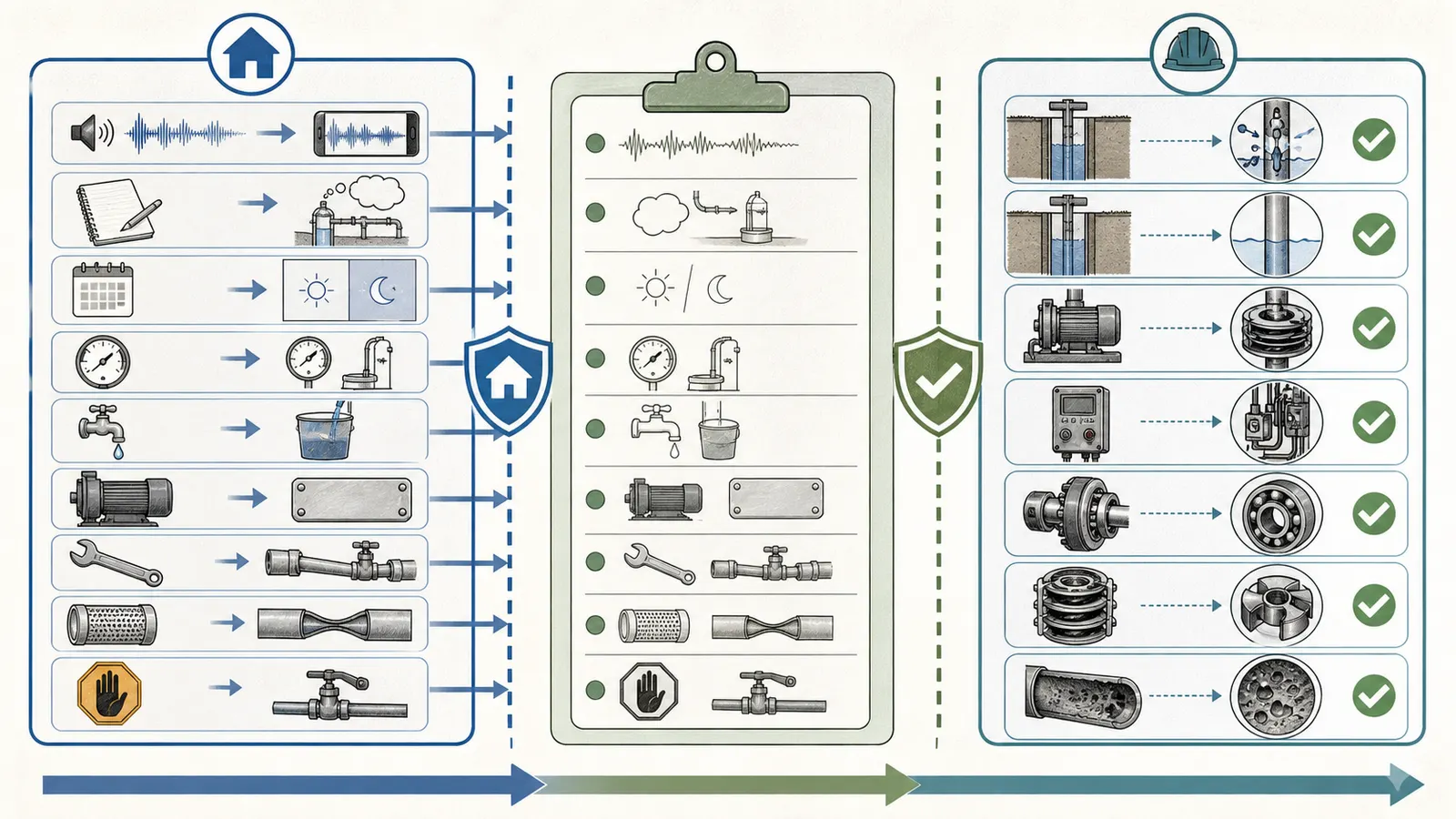
Ask the professional to explain which branch the measurements support. Depending on the equipment, useful service tests may include suction condition and prime, static and pumping water levels, well recovery, pressure and flow against the pump curve, electrical measurements, control operation, bearings, impeller condition, piping support, and signs of cavitation. Penn State Extension recommends addressing mechanical problems involving pump parts according to manufacturer recommendations, and New Jersey guidance emphasizes professional evaluation when sound, run time, or pressure changes suggest a well or pump problem. (Penn State Extension, Water Well Maintenance and Rehabilitation; New Jersey Department of Environmental Protection, Private Well Owner FAQ)
The right outcome is not a confident label based on a noise word. It is a documented explanation of whether the sound tracks suction or supply conditions, flow-change shock, controls, or mechanical wear; a safe operating boundary while the issue is unresolved; and a repair recommendation tied to measured conditions. Until that evidence exists, treat a new marble- or gravel-like sound as a reason to limit operation and arrange qualified service.
Cite this guide
Brictale. “What Causes a Marble-Like Crackling Noise in a Well Pump?.” Published 2026-09-07; updated 2026-09-07.
https://brictale.com/water/pumps/well-pump-marble-like-crackling-noise · Read the Markdown version
Sources and scope
Evidence behind this page
- Flint & Walling's pump troubleshooting table identifies cavitation as a possible cause of excessive noise and describes cavitation as a noise like marbles in the pump; it also lists a restricted inlet line and worn motor bearings as separate possibilities.
Flint & Walling — Troubleshooting
Manufacturer troubleshooting guidance across several pump families; it supports a symptom differential, not a diagnosis for every residential well-pump model.
Accessed · Link to this claim - The U.S. Bureau of Reclamation says a sharp crackling sound from a pump while it is running, similar to rocks passing through the pump, is a strong indication of cavitation; it notes cavitation may occur under inadequate suction-head conditions, while filling an enclosed system, or when a pump is throttled, and warns that prolonged operation can cause serious damage quickly.
U.S. Bureau of Reclamation — Water Operation and Maintenance Bulletin 232
Federal technical guidance for pumping equipment, written for operation and maintenance contexts broader than a single residential well; use it for the cavitation sound and stop-running boundary, not for a residential performance guarantee.
Accessed · Link to this claim - Pentair's Shurflo centrifugal-pump manual lists an air leak in the suction line, a clogged foot valve or strainer, excessive suction lift, and restricted suction as causes of priming or flow problems; its excessive-noise table lists an unsecured pump, unsupported piping, restricted suction, and cavitation described as a noise like marbles in the pump.
Pentair Shurflo self-priming centrifugal pump manual; exact troubleshooting and limits depend on the installed pump and system.
Accessed · Link to this claim - Pentair's Pro shallow-well jet-pump manual says suction-pipe joints must be air-tight as well as water-tight because an air leak can prevent the pump from pulling water from the well; its troubleshooting table lists air leaks, water level below the suction inlet, plugged foot valves or strainers, and clogged ejectors or impellers among causes of no water or lost prime.
Pentair — Pro Shallow Well Jet Pumps Installation and Operating Manual
Pentair Pro shallow-well jet-pump installation and troubleshooting guidance; the shallow-well suction-line branch does not apply to a sealed submersible pump in the same way.
Accessed · Link to this claim - Pentair's Pro shallow-well jet-pump manual warns not to run the pump dry or against a closed discharge because dry running can overheat and damage the seal, while a closed discharge can create hazardous pressure, boiling water inside the pump, explosion risk, and scalding risk; it directs the operator to stop a pump that has not delivered water after a short priming attempt.
Pentair — Pro Shallow Well Jet Pumps Installation and Operating Manual
Manufacturer safety warnings for the cited Pro shallow-well jet-pump family; homeowners should follow the exact manual for their model and should not create a closed-discharge test.
Accessed · Link to this claim - Pentair's shallow-well manual lists pressure-switch faults, open faucets, clogged pump components, waterlogged pressure tanks, leaks, leaking foot valves, and low tank air charge as causes of failure to shut off or frequent cycling; it also gives 30/50 PSI as an example of a pressure-switch setting and says tank precharge is checked with pressure relieved.
Pentair — Pro Shallow Well Jet Pumps Installation and Operating Manual
A model-family troubleshooting example, not a universal pressure setting; adjustment, pressure relief, and tank service are not homeowner assumptions.
Accessed · Link to this claim - New Jersey Department of Environmental Protection says a change in the sound of well pumping equipment, longer pump run time after water use, or lower water pressure can indicate a problem, and says a licensed well driller or pump installer may be needed to distinguish a well running dry from an electrical or mechanical pump issue.
New Jersey Department of Environmental Protection — Private Well Owner FAQ
New Jersey private-well public guidance; the warning signs are broadly useful, but the licensing statement is New Jersey-specific and is not a national legal rule.
Accessed · Link to this claim - New Jersey Department of Environmental Protection advises private-well owners to use a licensed well driller or pump installer to determine individual well water level, warns that opening a well can jeopardize sanitary integrity, and warns that inserting measuring devices can damage or obstruct pumping equipment.
New Jersey Department of Environmental Protection — Private Well Owner FAQ
New Jersey well-owner safety and service guidance; the article generalizes only the homeowner stop boundary, while referring licensing and local requirements to the applicable jurisdiction.
Accessed · Link to this claim - University of Florida IFAS explains that water hammer is a shock-wave response to sudden flow changes such as rapid valve movement or pump starting and stopping; it recommends slow valve operation and controlled filling or restarting to reduce the effect.
University of Florida IFAS Extension — Water Hammer in Irrigation Systems
University Extension guidance focused on irrigation systems; it supports the sound-pattern distinction and slow-flow-change advice, not a diagnosis of a particular house's plumbing.
Accessed · Link to this claim - Pentair's pressure-switch instructions state that the pressure switch controls pump starting and stopping, define dead-head pressure as pressure with no water movement against a closed outlet, warn against running a pump with a closed discharge longer than necessary to read pressure, and direct the operator to disconnect power before working on the motor or pressure switch.
Pentair — Adjusting Well Pump Pressure Switches Instructions
Pentair pressure-switch guidance; it supports the electrical and dead-heading boundary, not permission for a homeowner to adjust a switch.
Accessed · Link to this claim - Penn State Extension identifies abrasive sand or sediment, corrosion, excessive operating temperature, and pump cavitation as causes of pump damage, and says mechanical problems involving bearings, impellers, and other pump parts should be addressed according to the manufacturer's recommendations.
Penn State Extension — Water Well Maintenance and Rehabilitation
University Extension guidance for water-well maintenance and rehabilitation; it supports service escalation and does not identify the cause of one sound without testing.
Accessed · Link to this claim - The CDC advises private-well owners to test when water's color, taste, or smell changes, use a state-certified laboratory, and contact the local health department for help choosing tests and interpreting results; private-well water is not monitored by public officials in the same way as public water.
CDC — Guidelines for Testing Well Water
Federal public-health guidance for private wells; it supports testing and local follow-up after a water-quality change, not a diagnosis from color, taste, odor, or sediment alone.
Accessed · Link to this claim - The National Institute of Environmental Health Sciences lists wells, pits, and utility vaults among confined-space examples and directs that confined spaces be entered only by authorized personnel; it says not to attempt entry into a confined space.
National Institute of Environmental Health Sciences — Confined Spaces Awareness
Federal confined-space awareness material; it supports a homeowner no-entry boundary and does not classify a particular well installation under local law.
Accessed · Link to this claim - NIOSH warns that people should never enter a confined space to attempt an emergency rescue unless they are trained in confined-space entry and rescue and have the proper tools and protective equipment.
NIOSH — Working Safely in Confined Spaces
Federal confined-space safety guidance; it supports a no-rescue instruction for untrained homeowners.
Accessed · Link to this claim