What Should Be on a Well Pump Installation Record?
Use this U.S. homeowner checklist to review a pump repair or replacement record: equipment identity, well baseline, test results, warranty trail, and state-dependent filings.
The short answer
A useful well-pump installation record identifies the well, installer, work date and scope; records the pump, motor, controls, tank, setting and pipe details; preserves static and pumping levels, flow, pressure and post-service observations; and includes manuals, warranties, invoices and any required state filing. State forms and manufacturer fields vary, so the homeowner should request copies of both the provider’s record and the evidence needed for future service.What Should Be on a Well Pump Installation Record?
The best record is a handoff packet, not just an invoice. It should let the next qualified professional answer five questions without guessing:
- Which well and which equipment were serviced?
- What exactly was installed, replaced, adjusted, or left in place?
- What were the well and pressure-system baselines at the time?
- What did the installer test or observe after the work?
- Which warranty, manual, permit, filing, and contact records should the owner preserve?
The University of Arizona’s homeowner installation and maintenance form is a useful model: it groups well identity, installer, pump identity, performance testing, water-quality information, electrical test results, observations, and corrections. The record does not need to copy Arizona’s layout, but it should preserve the same decision-useful facts.
Safety boundary: A homeowner can review paperwork, photograph an already-visible equipment label without removing a cover, record a normal visible gauge reading, and ask the installer for test results. NGWA homeowner guidance says to consult a water-well professional anytime the well needs to be opened. Do not attempt opening a well or removing its cap, opening energized controls, testing live wiring, pulling a pump, entering a pit or confined space, changing pressure settings, or manipulating pressurized equipment such as disconnecting piping. Assign those tasks to a qualified well or pump professional. Missing paperwork is a documentation problem, not a remote diagnosis.
1. Start with an owner-side handoff packet #
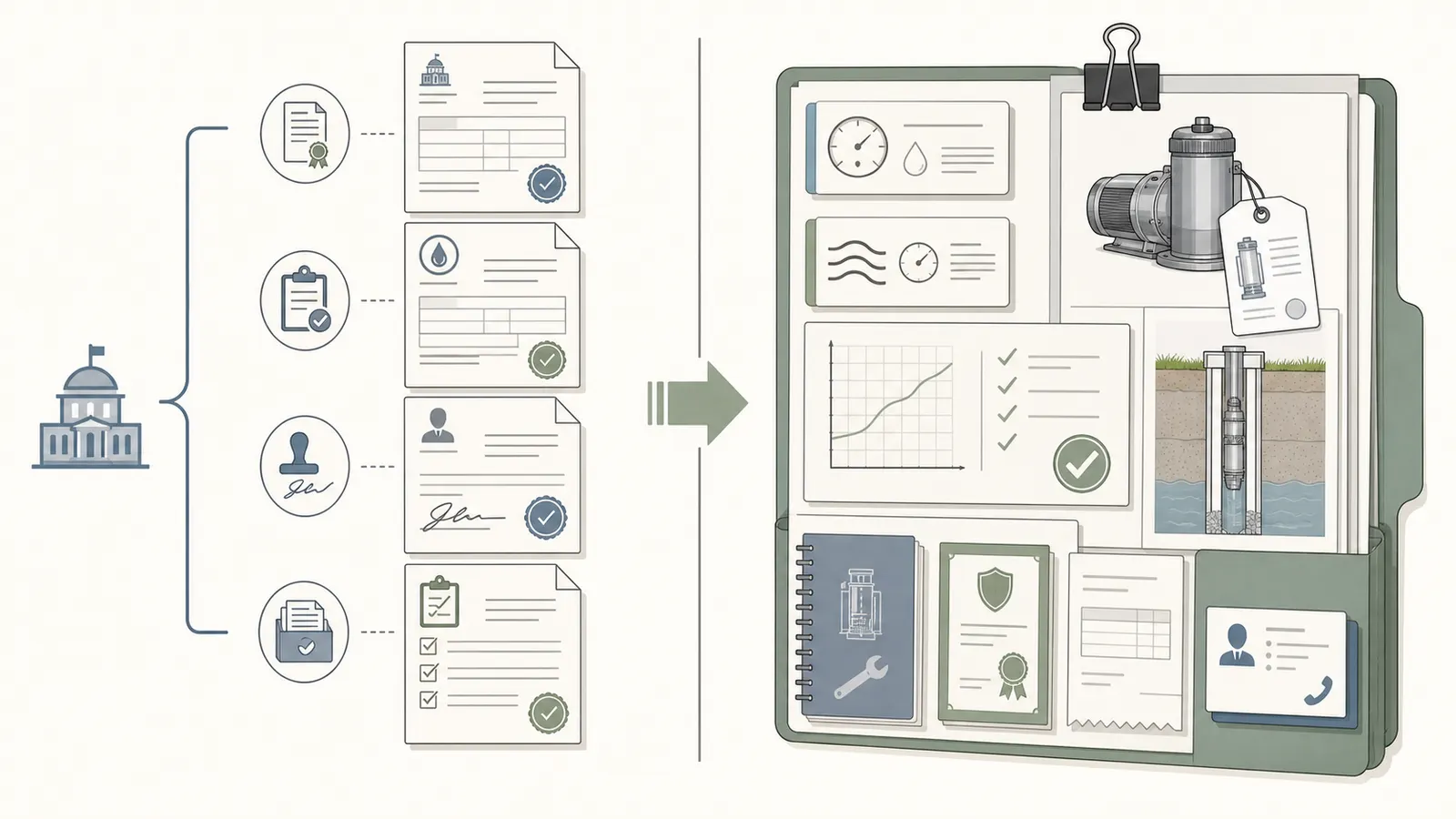
Ask for one organized packet in digital or paper form. It can contain several documents, but the documents should point to the same well and service event.
| Packet section | Minimum useful contents | Why the homeowner keeps it |
|---|---|---|
| Well identity | Property address, well ID or permit number if applicable, well location, owner, service date | Prevents records for a neighboring or former well being mixed in |
| Work summary | Repair or replacement reason, date, installer and license or certification information where applicable, itemized scope, parts removed and installed | Shows what changed and what did not |
| Equipment identity | Pump and motor manufacturer, model, serial number, date code, horsepower, voltage, phase, frequency, pump type and rated capacity | Makes the next warranty or compatibility question answerable |
| Installation setting | Pump inlet or setting depth, total well depth, casing diameter, drop-pipe diameter and material, check-valve or flow-sleeve details when relevant | Preserves the physical context that determines future troubleshooting |
| Operating baseline | Static and pumping water levels, drawdown, flow rate, test duration, pump-on and pump-off pressure, run time, date, method and person who measured it | Allows future observations to be compared with a known starting point |
| Post-service evidence | Leak or pressure observations, water appearance, cycling or flow observations, tests performed, results, limitations and corrections needed | Separates “the work was completed” from “the system was actually observed” |
| Owner file | Invoice, warranty terms, manuals, model and serial photographs, state or local filing copy, inspection or permit result if applicable, emergency contacts | Preserves the service trail after the installer’s software or business records change |
Oklahoma State University Extension recommends a separate file for each well containing a property map, construction log, contractor information, maintenance and warranty information, inspection reports, water-quality results, and the well identification number. That is broader than a single pump invoice, which is the point: the pump record should join a durable well history rather than become a lone PDF in an email inbox.
2. Record the work event before listing the parts #
The first page should make the service event unambiguous. Record:
- Well address and a well ID, permit number, or agency record number if one exists.
- Date the work began and date the system was returned to service.
- Name, business, phone number, address, and license or certification details of the driller, pump installer, electrician, or other provider involved.
- Whether the event was a new installation, repair, replacement, modification, inspection, cleaning, disinfection, or diagnostic visit.
- The homeowner’s reported problem, without rewriting it as a diagnosis unless the provider documented that diagnosis.
- What was removed, what was reused, what was installed, and what remains unknown.
- Any access limitation, failed test, deferred correction, or recommendation for later work.
Use plain language in the scope line. “Replaced submersible pump and motor; reused drop pipe and control box; set pump at documented depth; tested flow and pressure” is useful. “Pump service” is not. If the provider says the cause was “low pressure,” keep that as the reported symptom unless the record identifies the measured cause.
The Illinois Department of Public Health and Illinois State Water Survey specifically advise owners to keep service records, well depth, emergency instructions, and local health-department and drilling-contractor contacts. Those contacts matter when the installer is unavailable or when a future professional needs the original well log.
Attach the invoice, but do not stop there
An invoice proves that a transaction occurred. It may not identify the actual pump model, motor serial number, setting depth, pressure settings, measured flow, or test method. Ask the provider to attach the installation or service record, photos of accessible nameplates, manuals, warranty information, and any agency-facing completion form.
Do not demand that a contractor disclose a measurement that was not taken. Instead, the record should say “not measured,” “not applicable,” or “not accessible,” with a reason. An honest blank with a reason is more useful than a guessed number.
3. Capture the installed equipment’s identity and setting #
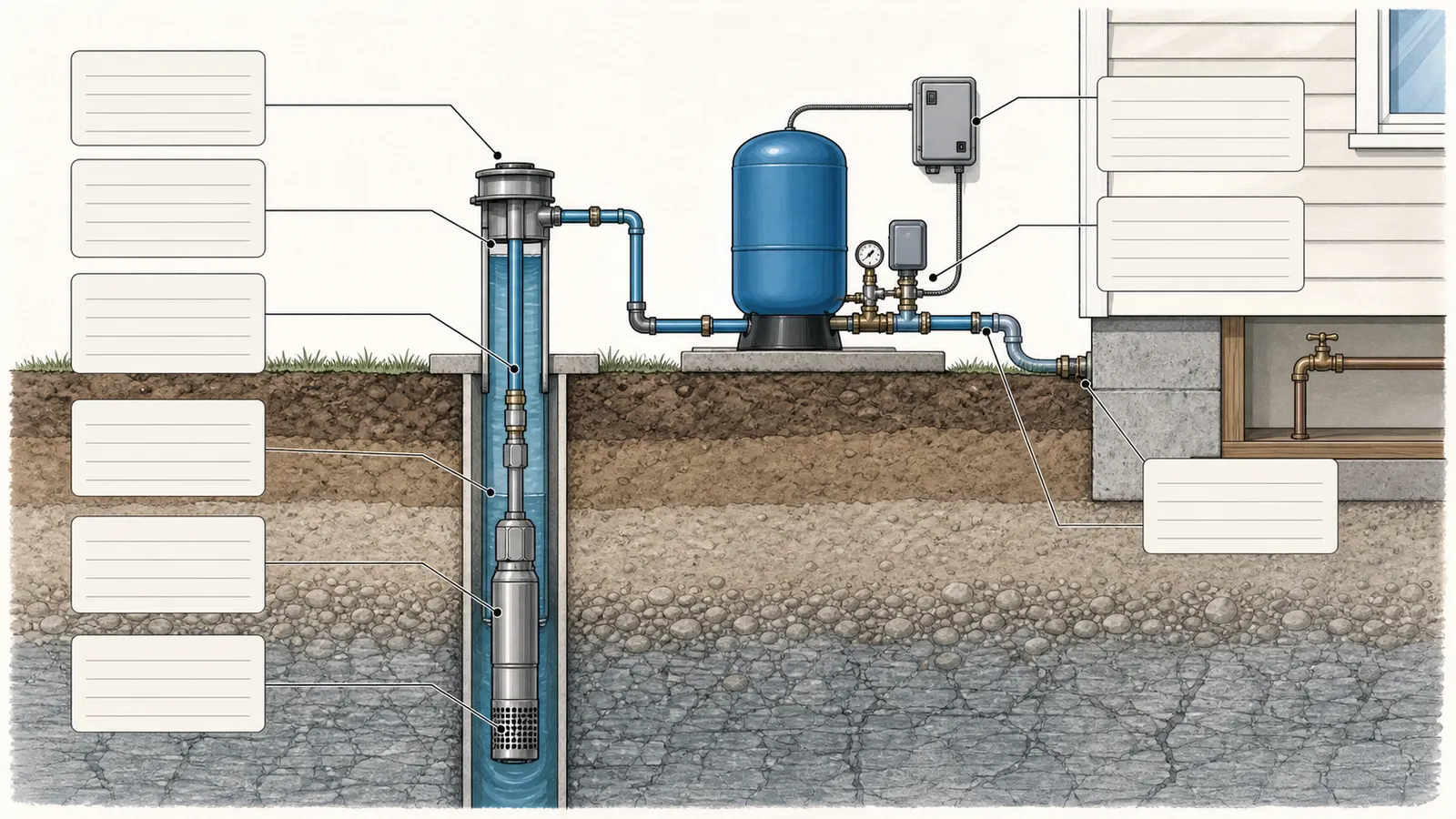
This is the section that prevents an unknown replacement pump. Record the identity of each component that can affect compatibility, service, or warranty.
Pump and motor
Ask for:
- Pump manufacturer and exact model.
- Pump serial number, date code, and rated capacity or design point if available.
- Motor manufacturer and exact model.
- Motor serial number or date code.
- Horsepower, voltage, phase, and frequency.
- Pump type: submersible, jet, centrifugal, turbine, or another configuration.
- Number of stages when the equipment record uses that field.
- Whether the part is new, repaired, rebuilt, or a replacement.
The Franklin Electric Form 2207 installation record shows why “a new pump” is not enough. Its fields include motor model, serial number and date code; pump manufacturer, model and stages; design rating; actual delivery; controls; well data; static and pumping levels; pump inlet setting; casing and drop-pipe details; and control-panel information. That is a manufacturer-specific example, not a universal form, but it is a strong test for whether a handoff contains enough identity to support the next service decision.
Well setting and connected equipment
Ask the installer to record, where applicable:
- Total well depth and casing inside diameter.
- Pump inlet or pump setting depth, measured from a named reference point.
- Drop-pipe diameter and material.
- Check-valve locations or count if the installer documented them.
- Flow sleeve or shroud, if used.
- Pressure tank manufacturer, model, size, serial number, and installation date.
- Pressure switch or constant-pressure controller manufacturer, model, and control type.
- Gauge, relief valve, control box, starter, VFD, filters, treatment equipment, or storage tank that was installed, replaced, or left in service.
- Any component intentionally not replaced because it was tested or judged serviceable.
Do not turn “setting depth” into “well depth.” The pump can be set above the bottom, and the casing, screen, drop pipe, and pump inlet can all have separate depths. The Mississippi Department of Environmental Quality’s current pump-installer form separately asks for pump type, rated capacity, motor horsepower, setting depth, and pump-test results. That separation is useful for owners in every state even though Mississippi’s form itself is not a national requirement.
Preserve label evidence safely
A clear photograph of an already-visible nameplate is often valuable. Photograph the whole label, including units and serial number, and write down which component it belongs to. Do not remove a well cap, open a control-panel cover, handle wiring, or lean into a well opening to obtain a better photograph. Ask the installer to supply the label photo or a typed transcription.
4. Document the well and pressure baseline #
A record should contain numbers that describe the system’s condition, not only the parts that were sold. The exact tests depend on the work and equipment, but the record should identify what was measured, when, how, by whom, and in what units.
| Baseline field | What the record should say | What not to infer |
|---|---|---|
| Static water level | Depth, reference point, date, rest condition, method, and measurer | A construction-era level is today’s level |
| Pumping water level | Depth, pumping rate, elapsed time, reference point, method, and measurer | A single pressure reading is a pumping-level test |
| Drawdown | How it was calculated or reported, with the associated static and pumping readings | Drawdown alone proves a failing well |
| Flow rate | Measured rate, units, date, test setup, and duration | Rated pump capacity is actual delivered flow |
| Pump-on and pump-off pressure | Observed settings or cycling readings, date, gauge location, and whether a controller was used | One gauge snapshot proves correct operation |
| Run time or cycle observation | How long the pump ran and under what demand | A short observation predicts every household load |
| Water quality | Sample date, lab, report number, analytes and results if a sample was taken | Clear water is safe water |
The Arizona owner form includes static water level, flow rate, pressure-on and pressure-off, and run time. Mississippi’s state pump report adds static and pumping water levels, drawdown, test pumping rate, test duration, and measurement method. Together they show the difference between a useful baseline and a vague statement such as “pressure good.”

Keep the reference point visible
Every depth needs a reference point: for example, a marked point on the top of the well casing. A depth from the casing top cannot be cleanly compared with a depth from the ground surface unless the offset is known. Ask for the reference point in words, not just a number.
For pressure, record the gauge location and the control arrangement. A conventional pressure-switch system and a constant-pressure controller may not produce the same kind of on/off record. If there is no pressure switch, write down the controller type instead of forcing a switch-setting field.
Provider-completed technical tests
Electrical resistance, insulation, amperage, voltage, current balance, grounding, protection, and cable condition can be important installation evidence. The Franklin Electric installation record includes those technical fields, but they are installer-completed fields. A homeowner should receive the result and the instrument or method where relevant, not attempt to test live wiring.
5. Add post-service observations, tests, and limits #
The closeout section should answer: “What happened after the work was complete?” Ask for the following when relevant to the job:
- The date and time the system was tested.
- Whether the pump started, stopped, and delivered water under the stated test demand.
- Measured flow, pressure, and run time, with units and method.
- Visible leaks, unusual noise, vibration, rust, damaged fittings, or control warnings.
- Whether water was cloudy, discolored, or carrying sediment after the work, and what the provider recommended.
- Whether the well or plumbing was disinfected, who did it, and what follow-up was advised.
- Whether a water sample was collected, where it was sent, the report number, and the results.
- Corrections still needed, conditions that limited the test, and the next recommended review.
NGWA’s WellOwner.org maintenance guidance recommends a written report after a professional checkup with recommendations and laboratory or other test results. The report should not imply that every pump replacement requires every possible test. It should make the test boundary explicit: “flow measured for 20 minutes at hose bib,” “no water-quality sample collected,” or “pump setting not verified because the pump was not pulled.”
Water-quality paperwork belongs in the same file
Pump work can disturb sediment or change the equipment path, but the installation record is not a substitute for a laboratory result. If a sample was taken, preserve the chain of information: sample date, location, lab, report number, analytes, result units, and any follow-up instruction. If no sample was taken, say so.
Testing schedules are not identical nationwide. For example, Illinois public-health guidance recommends annual total-coliform and nitrate/nitrite testing and metals testing every three years, with additional testing based on local conditions. Treat that as Illinois guidance, not a universal rule. Ask your state or local health authority and the laboratory for the appropriate sampling plan.
Do not infer from a pump record that drinking water is safe, that a well has adequate yield, or that a treatment system is working. Those are separate questions requiring the appropriate measurement or professional review.
6. Separate state filings from the homeowner’s file #
A service provider may have a legal obligation to file a form with a state or local agency. That does not mean the homeowner has received a usable owner record. Ask for both:
- A copy of any permit, completion report, inspection result, filing receipt, or agency correspondence that applies to the work.
- A plain-language service record containing the installed equipment and measured baseline.
Requirements vary. Arizona Cooperative Extension explains that Arizona’s pump installation completion report is filed with the state within 30 days of pumping-equipment installation and recommends keeping copies of the submitted records. Mississippi’s current form says the responsible license holder prepares and files its state report within 30 days of drilling completion. Those are examples of state-specific rules, not a national deadline for every pump repair or replacement.
State or local paperwork may prioritize agency identifiers, location, casing, screen, well depth, licensed signatures, meter data, or a pump test. A manufacturer record may prioritize model, serial, motor, control, cable, voltage, current, pump curve, and installation details. The homeowner needs the overlap plus the practical handoff information that lets a future professional find the right component and interpret a change.
If a provider says “the state has it,” ask for the agency name, form or record number, submission date, and a copy or retrieval path. If the work was not subject to a filing, ask the provider to write that down rather than leaving the requirement ambiguous.
7. Use the completeness gate: accept, request, or escalate #
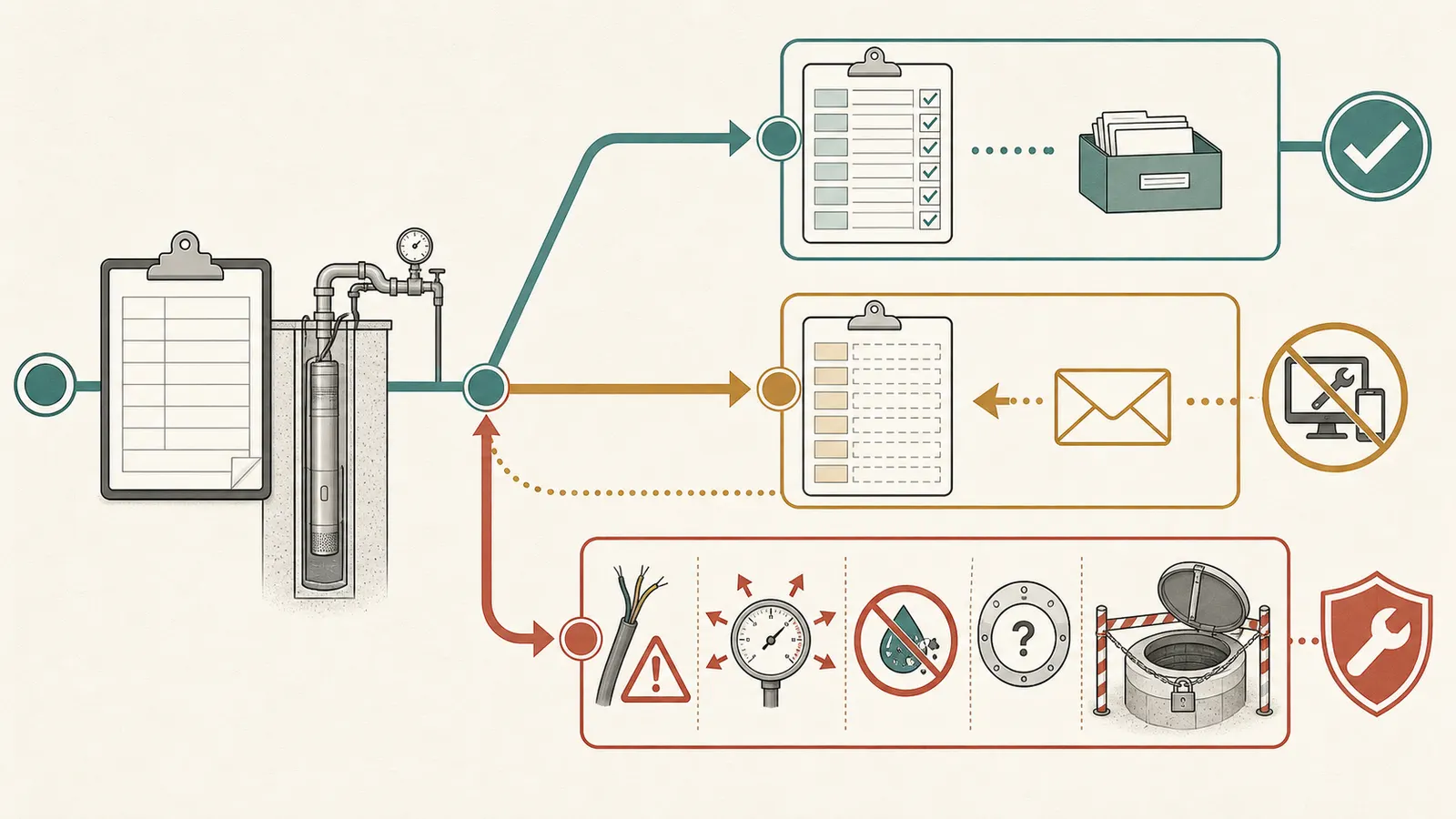
Use this decision surface after the system has been returned to service.
| Result of review | What it means | Safest next action |
|---|---|---|
| Accept and file | The well is identified; scope is itemized; pump, motor, controls and tank are identifiable; setting and baseline are documented; tests and limitations are stated; manuals and warranty are attached | Save the packet in at least two places and add the next inspection or testing reminder |
| Request missing paperwork | The work appears complete, but model or serial, setting, measured baseline, test result, warranty, manual, or filing copy is missing | Send a short written request listing the exact missing fields; do not fill them in from assumptions |
| Request a corrected record | The documents disagree about the well, equipment, units, reference point, or installation date | Ask the provider to reconcile the discrepancy and identify which record is authoritative |
| Escalate to a qualified professional | The record shows unexplained pressure behavior, unsafe electrical observations, contamination concerns, a missing or uncertain pump setting, repeated cycling, or a test that could not be completed | Arrange professional evaluation and provide the full packet; do not open, adjust, pull, or test the system yourself |
| Pause the interpretation | The only “evidence” is an invoice or a verbal claim such as “everything is fine” | Treat the record as incomplete, not as proof of failure or proof of safety |
The short request to send the installer
“Please send the complete homeowner copy for the work at [address/well ID] on [date]. Please include the itemized scope; pump and motor manufacturer, model, serial and date code; horsepower, voltage, phase and type; pump setting and well/casing/drop-pipe details; pressure tank and controls; static or pumping level, flow, pressure and run-time results with date, method and units; any water-test report; manuals and warranty terms; photos or transcriptions of nameplates; corrections still needed; and any permit, completion report or filing receipt that applies.”
That request is specific without asking the homeowner to perform a hazardous test. It also gives the installer a way to mark a field “not measured” or “not applicable.”
Keep the record useful for the next service call #
Store the packet with the well log, property map, water-test reports, treatment-system manuals, emergency contacts, invoices, and photos. Update it after every service event, even when the pump was not replaced. The NGWA recommends keeping well logs, pump installation records, current equipment manuals, and warranty information together. The Oklahoma State University owner-file model likewise keeps construction, maintenance, warranty, inspection, water-quality, and well-ID records together.
The decision rule is simple: a complete record preserves identity, setting, baseline, result, and responsibility. If one of those is absent, request the missing evidence. If the gap involves opening, energizing, pressurizing, or pulling equipment, stop at the paperwork boundary and use a qualified professional. A missing number is a reason to improve the handoff—not a reason to diagnose a well remotely.
Cite this guide
Brictale. “What Should Be on a Well Pump Installation Record?.” Published 2026-09-01; updated 2026-09-01.
https://brictale.com/water/pumps/well-pump-installation-record-checklist · Read the Markdown version
Sources and scope
Evidence behind this page
- A homeowner-side well installation and maintenance record should identify the well and service providers, date installation or repairs, pump manufacturer, model, date code, serial numbers, horsepower, voltage, phase, diameter, static water level, flow rate, pump-on and pump-off pressures, run time, water-quality laboratory details, observations, and corrections needed.
University of Arizona Cooperative Extension’s owner record form and guidance; used for the core field checklist, not as a national legal form.
Accessed · Link to this claim - Owners should keep copies of filed well records and a current summary of construction and maintenance activities because up-to-date pump type, pressure-tank replacement date, and related information can reduce time and cost during later repair or replacement.
Arizona Guide to Domestic Well Registration and Record-Keeping
Arizona Cooperative Extension owner record-keeping guidance; supports the owner-preserved history principle, not a nationwide filing requirement.
Accessed · Link to this claim - A private-well owner file should include a property map and well location, construction log and contractor information, maintenance and warranty information for key components, annual inspection reports, annual water-quality results, and the well identification number.
Oklahoma State University Extension’s private-well record-keeping guidance; presented as a broadly useful owner file model, while state systems and requirements vary.
Accessed · Link to this claim - Mississippi’s current State Well Report pump-installer section illustrates state filing fields including pump type, installation date, rated capacity, new/repaired/replacement status, motor horsepower, setting depth, pump-test duration, static and pumping water levels, drawdown, test pumping rate, and measurement method.
Mississippi State Well Report, Part 2 Pump Installer’s Completion Report, Form OLWR-SWR-P2 (2/26)
Mississippi Department of Environmental Quality form; used as a current example of state-dependent filing fields, not a national requirement.
Accessed · Link to this claim - The Mississippi form states that the report is prepared by the responsible license holder and filed with the department within 30 days of completion of drilling of the well or borehole; that deadline and filing responsibility must not be generalized to every state or every repair.
Mississippi State Well Report, Form OLWR-SWR-P1/P2 (2/26)
Mississippi-specific filing instruction; included to label the state boundary clearly.
Accessed · Link to this claim - Illinois public-health and state-water-survey guidance recommends that well owners keep a file containing well depth, service records, emergency instructions, and contact information for the local health department and drilling contractor.
IDPH, State Water Survey Remind Private Well Owners to Test for Potential Contaminants
Illinois Department of Public Health and Illinois State Water Survey owner-file guidance; the record categories are useful elsewhere, but Illinois contacts and testing advice are local.
Accessed · Link to this claim - Illinois recommends annual testing for total coliforms and nitrate/nitrite, metals testing every three years, and additional investigation when contamination is suspected or water changes; it also says private wells should be inspected yearly even when testing finds no contaminants.
IDPH, State Water Survey Remind Private Well Owners to Test for Potential Contaminants
Illinois public-health recommendation; used to explain why a post-service water-test report belongs in the file when testing is performed, not to impose Illinois intervals nationally.
Accessed · Link to this claim - The National Ground Water Association’s homeowner guidance identifies the well construction log and pump installation record as important troubleshooting tools, recommends asking the contractor for them, and says an annual checkup report should include recommendations and laboratory or other test results.
Well Owner Routine Maintenance Practices
National Ground Water Association / WellOwner.org recommended practice; not a legal or code requirement.
Accessed · Link to this claim - NGWA homeowner guidance says to consult a water-well system professional anytime the well needs to be opened and when there is loss of capacity or pressure, a possible well-system problem, or a water test showing a health risk.
Well Owner Routine Maintenance Practices
National Ground Water Association / WellOwner.org safety and escalation guidance; used for the homeowner boundary, not as a substitute for local licensing or code rules.
Accessed · Link to this claim - Franklin Electric’s installation-record example includes manufacturer and model identity, serial number and date code, operating current and voltage, pump design rating and actual delivery, controls, casing and drop-pipe details, static and pumping levels, pump inlet setting, well depth, and control-panel and surge-arrestor information.
Franklin Electric Form 2207 Submersible Motor Installation Record
Franklin Electric’s manufacturer-specific record example; use it to show the depth of technical handoff detail, not to require every brand’s exact fields or invite homeowner electrical testing.
Accessed · Link to this claim - Franklin Electric’s record instructions call for verifying motor nameplate data, pump nameplate and curve data, operating voltage and current limits, and installation details; those technical checks belong in the provider-completed evidence section of a homeowner record.
Franklin Electric Form 2207 Submersible Motor Installation Record
Manufacturer installation guidance; used to distinguish evidence a qualified installer should document from actions a homeowner should perform.
Accessed · Link to this claim