Well Pump Hums but Won’t Start: A Safe Homeowner Decision Surface
Identify a jet, two-wire, or three-wire well system, log where the hum occurs, and know when to shut off power and call a professional.
The short answer
A hum is a symptom, not proof of a bad capacitor or motor. Identify the arrangement and whether the control box or pump hums. If it hums continuously and will not start, shut off the pump circuit only from a dry, safe location; if the route is wet, stay clear. Record duration, breaker behavior, gauge, flow, and weather without opening equipment. A professional must test the system.Well Pump Hums but Won’t Start: A Safe Homeowner Decision Surface
A humming well pump is a symptom, not proof of a failed capacitor, seized impeller, locked rotor, or burned-out motor. The first decision is architectural and safety-related: identify what system you have, where the sound is coming from, and whether the pump is trying to start, stopping on protection, or never receiving a start command.
From a dry, normal standing position, record the sound location, approximate duration, breaker or controller behavior, pressure-gauge movement, water flow, and weather. Do not open a control box, pressure switch, breaker panel, well cap, or variable-speed drive. Do not test live wiring, replace a capacitor by guess, force a start, pull a pump, enter a well pit, or manipulate pressurized equipment.
If the pump or control box is humming continuously and the system is not starting, turn off the dedicated pump breaker or disconnect only if it is reachable from a dry, unobstructed, safe location. If the route is wet, flooded, smoky, hot, or otherwise unsafe, do not approach it; keep away and call a professional. If the hum has already stopped, do not create another start. If the hum repeats, the breaker or protective device trips, the enclosure or floor is wet, there is a burning odor, smoke, arcing, unusual heat, shock, flooding, or unsafe access, stop. Keep the pump circuit off, keep people and pets away, and arrange qualified electrical and well-pump evaluation. If there is active smoke or fire, move away and call emergency services. This boundary is consistent with the Goulds Water Technology jet-pump manual, which assigns electrical work to qualified technicians and warns that thermal overload protection can permit an overheated pump to restart unexpectedly.
1. Decide whether this is an observation or a stop event #
You do not need to reproduce the hum to make the first useful decision. If the sound has stopped, do not open a faucet, start irrigation, or reset a controller just to hear it again. A second start is another electrical and mechanical event, not a harmless confirmation.
Use this boundary:
| What you observe | Homeowner action | What it means—and what it does not mean |
|---|---|---|
| One unexplained hum, no visible water, odor, smoke, heat, or trip | Do not induce another cycle. Write down the event and arrange evaluation if the cause is unknown or it recurs. | A single hum cannot identify a part. It may be a pump, a control, a drive, a pressure command, or a supply issue. |
| Hum repeats when pressure falls or water is used | Stop trying to reproduce it. Leave power off after the event and arrange evaluation. | The timing is useful evidence, but it does not prove a bad tank, switch, capacitor, or motor. |
| Hum is followed by a breaker, fuse, overload, or drive fault | Leave the circuit or equipment off. Do not reset repeatedly. | Protection operated or a controller reported a fault. The cause still needs qualified testing. |
| Burning smell, smoke, sizzling, arcing, shock, discoloration, or unusual heat | Stay clear. Call emergency services for active fire or immediate danger; otherwise arrange an urgent evaluation by a qualified, local-authorized electrical professional. | These are hazard signs, not diagnostic clues to investigate by touch. |
| Water, flooding, mud, or suspected submergence reaches the wellhead, controls, wiring, or pump area | Do not approach wet electrical equipment. Keep power off and call a qualified professional. | EPA says a flooded pump should not be turned on until the wiring and equipment have been checked by qualified help. |
| A pit, excavation, crawl space, open well, or confined area is involved | Do not enter. Keep others away and arrange qualified well service. | A homeowner cannot safely turn a confined or wet access problem into a sound check. |
If the breaker is already off, leave it off. If it is on but the event has stopped, do not create another demand. If you must turn off a dedicated pump disconnect or breaker during a current event, only do so from a dry, unobstructed location without standing in water or reaching past wet equipment. Never enter standing water to reach a switch. If the access route is wet or questionable, back away and call a professional.
Flooding is a separate water-safety decision. EPA’s updated flood guidance says not to turn on a flooded pump, to have the wiring checked by qualified electrical or well professionals, and not to drink or wash with water from a flooded private well. Local and state health authorities control the required testing, disinfection, and clearance procedure.
2. Identify the pump arrangement before interpreting the hum #
The same word—hum—can describe different equipment. Start with what is visible from a safe, dry location. Do not remove a cover or open the well to identify the system.
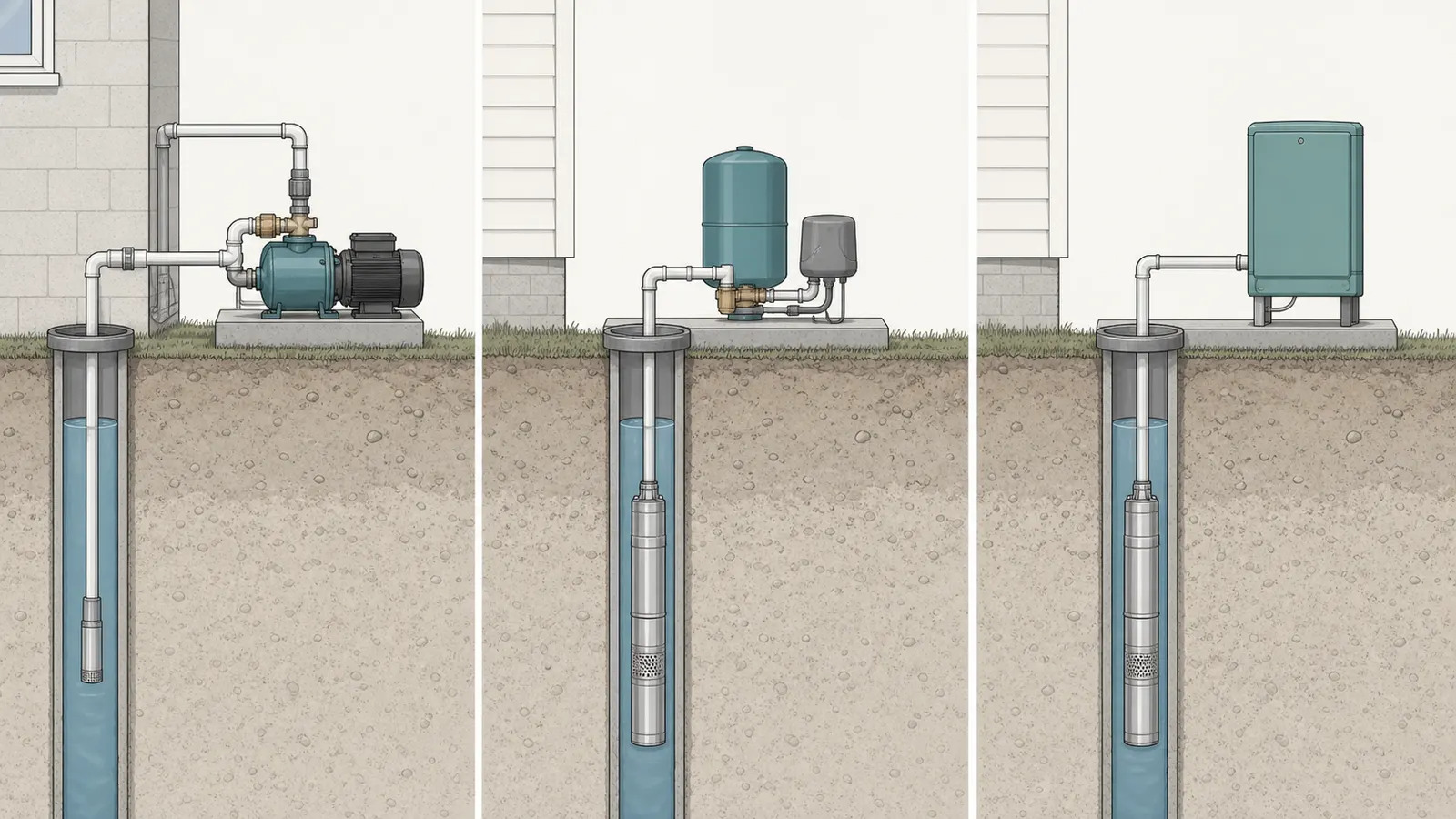
| Arrangement | What may be visible | What the arrangement lets you say | What it does not let you say |
|---|---|---|---|
| Above-ground shallow-well or convertible jet pump | A motor and pump body near piping, a pressure tank, gauge, and often a pressure switch | The sound may be near the motor/pump assembly or pressure controls; the pump is accessible to a professional without pulling a submersible unit | That the motor is seized, the pump has lost prime, or the pressure switch is bad |
| Two-wire submersible | No motor at the surface; a wellhead, pressure tank, gauge, pressure switch, and wiring may be visible | In the cited Goulds arrangement, the two-wire motor connects through the pressure switch rather than a separate motor control box | That every two-wire system has the same controls, or that no surface protection or drive exists |
| Three-wire submersible | No motor at the surface; a separate motor control box may sit near the pressure tank or wellhead | A separate box is a meaningful branch because the manufacturer may place starting and running components there | That a capacitor, relay, or box is defective merely because the box hums |
| Variable-speed submersible | An electronic drive or controller, sometimes with a display or fault code | A visible code, light pattern, or sound location can be recorded for the manufacturer and professional | That the code is a universal diagnosis or that a reset is a repair |
| Unknown or mixed arrangement | Surface equipment is hidden, labels are unreadable, or the installation has been modified | “Unknown” is a valid record; a professional can identify it from labels, wiring configuration, well records, and service history | That a generic internet diagram matches the home |
The Goulds submersible manual shows different connection arrangements for two-wire and three-wire single-phase motors and warns about hazardous voltage. Franklin’s current motor-control-box information says its listed control boxes are designed for Franklin three-wire, single-phase motors and identifies capacitor-start and, on CRC models, run-capacitor components. That makes “separate control box” a useful identification clue—not permission to open it or replace a component.
For a jet pump, record the pump and motor nameplate if it is already readable. For a submersible, record the visible controller or control-box brand and model, pressure switch or transducer label, tank label, and any fault code. A photo taken from a dry, safe position is useful; do not move equipment or remove a cover for a better image.
3. Record where the hum occurs and how long it lasts #
“It hums” becomes much more useful when it has a location and sequence. Stand where you normally would to use the equipment; do not put your ear against a cabinet, motor, pipe, or wall. If you cannot tell, write “unknown.”
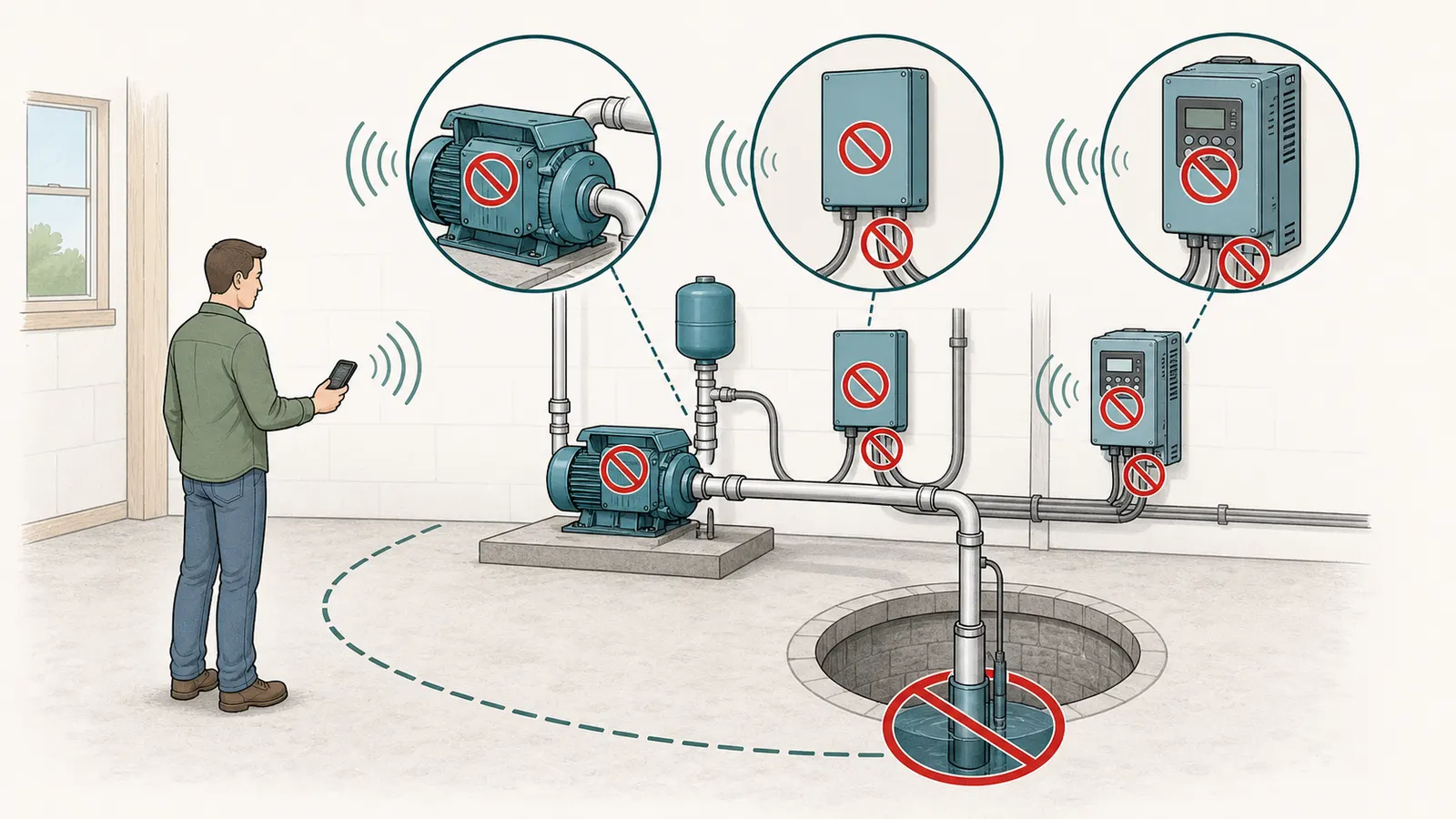
Log one row per event:
| Log field | Record the observation | Do not infer |
|---|---|---|
| Sound location | Above-ground pump, separate control box, electronic drive, pressure-switch area, indoors at a pipe or wall, or unknown | A sound at a control box proves a bad relay or capacitor; a sound at a pump proves a bad motor |
| Duration | Brief click or buzz, several seconds, continuous while the breaker remains on, repeated bursts, or an approximate number of seconds | A particular duration identifies a particular failed part |
| Trigger | Faucet, shower, toilet refill, irrigation, appliance, leak, or no known demand | The last fixture opened is necessarily the cause |
| Pressure | Gauge position before the event, whether the needle moved, and whether the gauge was unreadable or stuck | The gauge is accurate, the tank charge is correct, or the switch setting is correct |
| Water | Normal, weak, pulsing, absent, cloudy, sandy, or not checked; note which fixture | No water proves the pump is burned out, or clear water proves the pump is healthy |
| Protection behavior | Breaker trip, fuse or overload indication, drive code, lights changing, or no visible change | The protective device itself is defective, or a reset is safe |
| Weather and site | Rain, storm, lightning, snowmelt, flooding, recent excavation, wet floor, or visible damage | Rain alone caused the fault; correlation is a reason to preserve the timing |
| History | Recent service, pump replacement, tank work, wiring work, drought, sand, or prior faults | The newest part is the failed part |
Water-safety stop rule: if water has unexpected discoloration, odor, sediment, or suspected sewage or chemical contamination, do not taste it and do not treat clear water as proof that it is safe. Stop using it for drinking or cooking as appropriate, use a known-safe alternative, and follow the applicable local or state health authority or certified drinking-water laboratory process before normal use. EPA says a change in water quality such as odor or color is a reason to test immediately and recommends certified laboratories or the local health department; its guidance also notes that the right tests and treatment depend on the contaminant. See EPA’s private-well water guidance.
Use plain timing categories because they are repeatable without a meter:
- Hum with no water and no trip: the system may be receiving a command but not completing a start, or the sound may come from a control component rather than the pump. The observation narrows the handoff; it does not choose a capacitor or motor.
- Hum followed quickly by a breaker or overload event: record the order and approximate delay, then stop. The Goulds submersible-motor manual lists defective capacitors, wrong connections, locked-rotor conditions, and low insulation resistance among start-protection branches. Those checks belong to qualified service.
- Hum for a while, then protection operates: record how long it ran or hummed and whether pressure or flow changed. The same manual lists voltage, control-box mismatch, starting relay, sand-clogging, and an overheated protector among possible later-trip branches.
- Hum only when pressure falls: record the gauge position and the demand that preceded it. A pressure switch or transducer may be commanding a start, but the observation does not establish that the switch, tank, or pump is defective.
- Hum after rain or flooding: record precipitation and whether any component or access area is wet. Moisture changes the stop decision; it is not an invitation to open and dry a control box.
If a controller shows a code, photograph or transcribe it exactly, including letters, numbers, and blinking pattern. Franklin’s SubDrive/MonoDrive guidance distinguishes underload, undervoltage, overcurrent or locked-pump, open-phase, short-circuit, and pressure-transducer faults. A code is meaningful only in the correct controller family and installation.
4. Compare patterns with manufacturer branches, not guesses #
Manufacturer manuals are useful because they show how wide the diagnostic tree really is. They also show why a homeowner should not leap from a hum to a part.
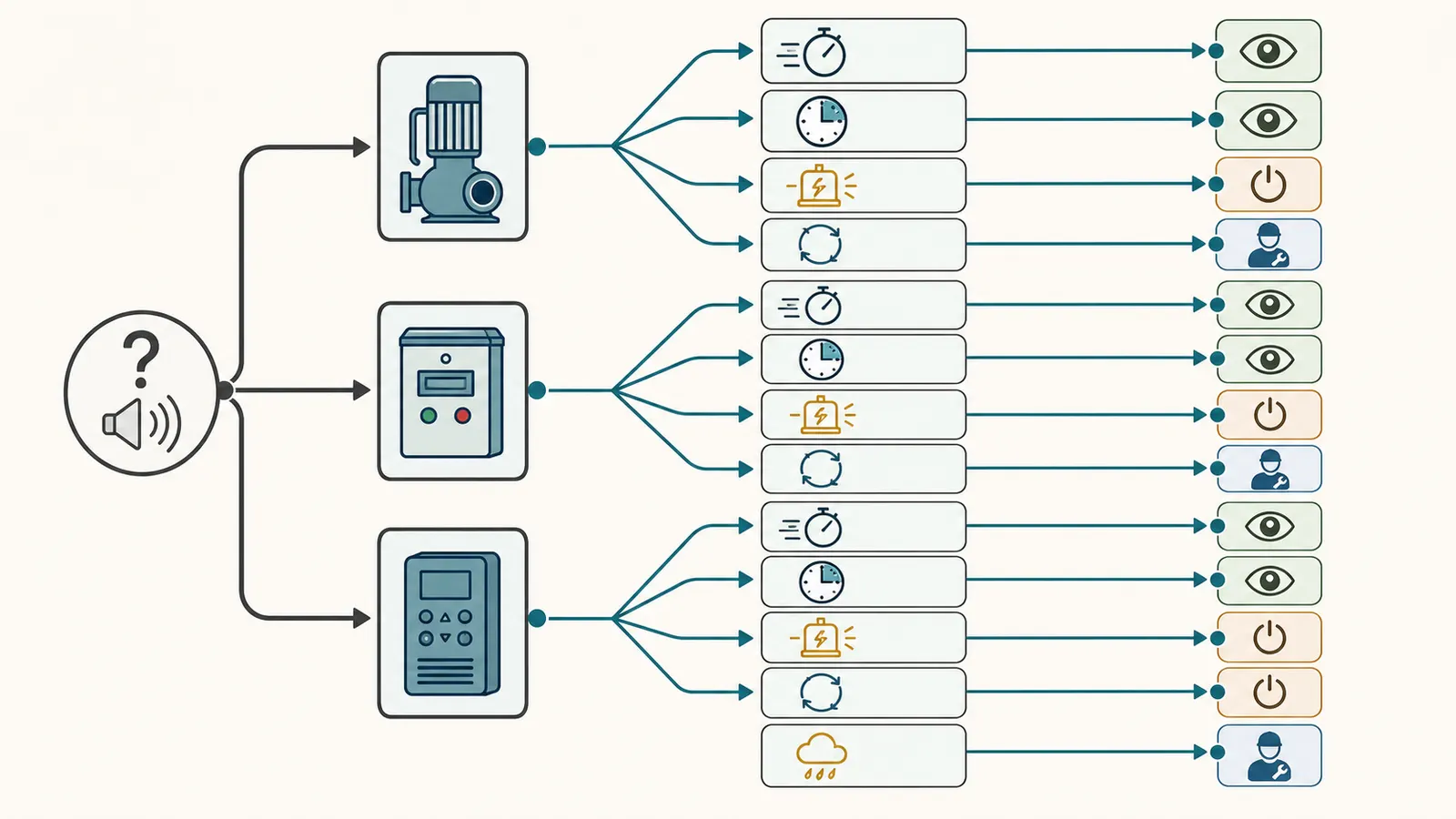
For an above-ground jet pump, Goulds lists no power, loose or incorrect wiring, a faulty pressure switch, a binding impeller or seal, and a defective motor under pump-will-not-start possibilities. For motor-overheat or overload behavior, it lists incorrect wiring, inadequate ventilation, prolonged low-pressure delivery, and incorrect line voltage. See the Goulds RJA/RJDS troubleshooting checklist. Its list is a professional differential, not a homeowner test sequence.
For a three-wire submersible, the control box can contain start and run components. A hum located at the box is therefore important to report, but it does not separate a relay problem from a capacitor problem, incorrect motor/control-box match, supply issue, cable issue, or a locked pump. The Franklin control-box page supports the architecture; the Goulds submersible motor manual shows the broader fault branches.
For a two-wire submersible, there may be no separate motor control box in the cited wiring arrangement. That does not make the system simple or safe to open. A pressure switch, disconnect, cable, motor, pump, protection device, voltage supply, and well condition can still be involved. A hum heard near the pressure equipment may be from a control or contact device; a hum heard at the wellhead may be transmitted through structure. Log the location without touching anything.
For a variable-speed system, record the code rather than translating it yourself. Franklin says, for example, that its F2 indicates undervoltage and F3 indicates overcurrent or a locked-pump fault, with multiple possible causes. It also says faults are logged and that some faults may restart after a timeout while others can stop the pump. Preserve the displayed code and fault log, and avoid repeated resets: restarting can create another start or change the sequence you observed. Automatic restart behavior is not evidence that the original fault disappeared.
What a hum cannot establish
A hum alone cannot establish:
- capacitor failure;
- a seized impeller or locked rotor;
- a failed motor;
- low or high line voltage;
- a bad pressure switch or transducer;
- a defective breaker or overload;
- an incorrect control box;
- a dry or low-yield well;
- sand or abrasive damage; or
- a pump-pull diagnosis.
Those are possible branches documented for particular equipment families. They require the correct manual, safe isolation, appropriate instruments, and professional judgment. The homeowner’s job is to preserve the sequence and prevent additional damage or exposure.
5. Do only dry, visual, non-contact observations #
The safe observation pass should be short. It is complete when you have enough information for a professional to understand the event.
Safe to observe from a normal standing position
- Whether the pump is visibly above ground or only surface controls are visible.
- The pressure gauge position and whether it moved during an event already in progress.
- Whether water is normal, weak, pulsing, absent, cloudy, or sandy at an ordinary fixture, provided the fixture is not near a hazard.
- Whether every fixture is affected or only one branch or treatment appliance.
- Visible pooling, spray, wet flooring, discoloration, melting, smoke, or damage from a distance.
- Sound location and approximate duration without touching the equipment.
- Weather and flooding history.
- Readable labels, model numbers, controller displays, and fault codes.
- Whether the breaker or controller is visibly in a changed state, without manipulating it to test the system.
Not a homeowner diagnostic
Do not remove a breaker-panel, control-box, pressure-switch, drive, well-cap, pitless-adapter, or motor cover. Do not use a multimeter, clamp meter, non-contact voltage tester, test light, ohmmeter, or megohmmeter on the system. Do not measure voltage, current, insulation resistance, winding resistance, capacitor condition, grounding, or cable continuity.
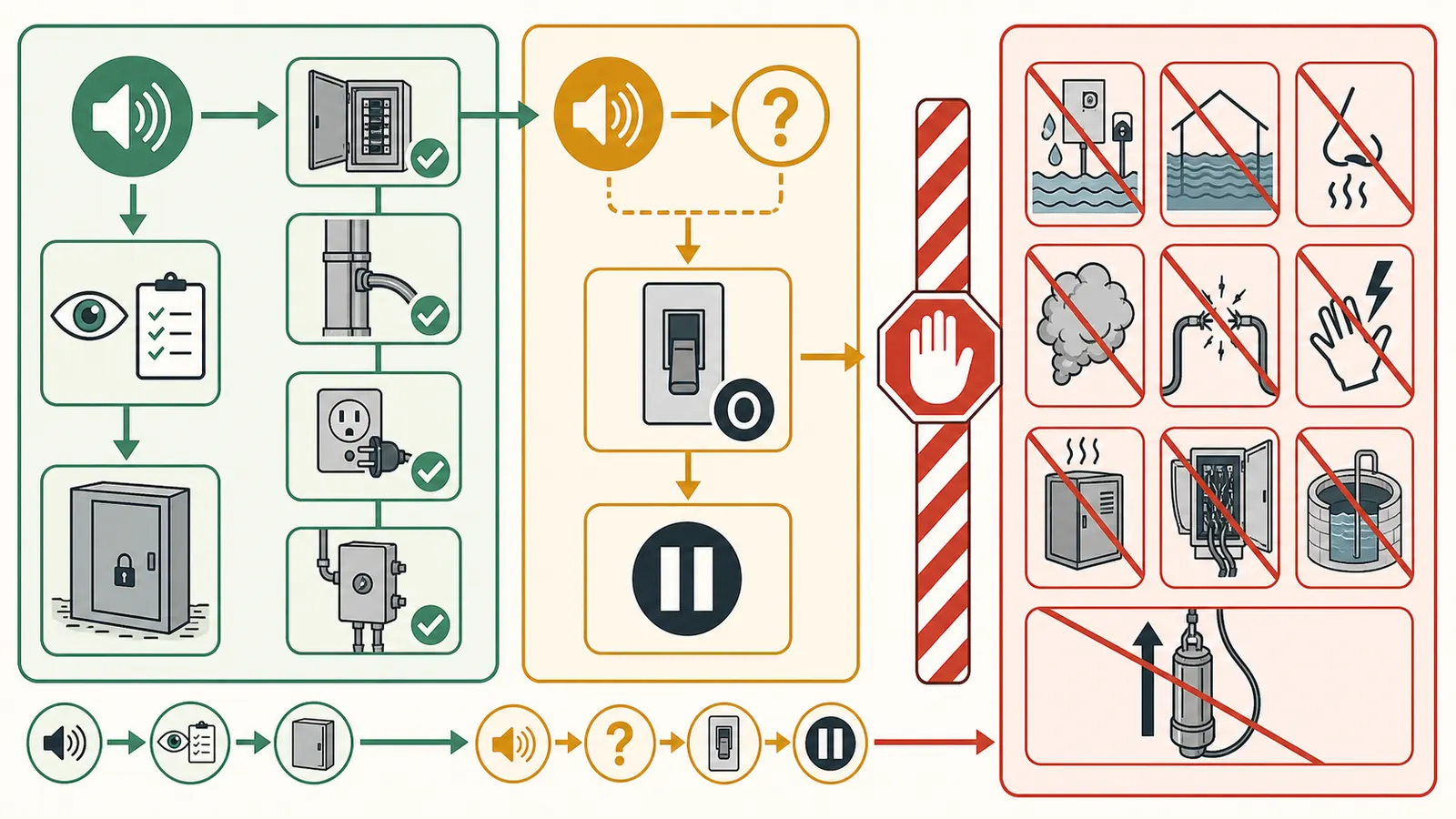
Do not tighten, disconnect, splice, move, or reconnect wires. Do not change a breaker size, pressure-switch setting, controller setting, tank charge, overload setting, or protection device. Do not bypass a switch, overload, GFCI, AFCI, disconnect, or drive. Do not open a drain, relief valve, tank fitting, or pipe to see what happens. Do not touch an enclosure or motor to decide whether it is hot or live.
Do not pull a submersible pump, lower anything into the well, open the well, enter a well pit, or work in an excavation or confined space. Do not repeatedly start the pump, hold a contactor, force a shaft, or replace a capacitor because an article says the sound is typical. A homeowner-safe symptom surface ends before energized electrical, buried pump, pressurized, or confined-space work.
The Goulds jet-pump manual says to disconnect and lock out power before service and warns against over-pressurizing the tank, piping, or system. Those warnings are why a gauge observation is enough for the homeowner; adjusting or testing the pressure system is not.
6. Choose the right professional handoff #
Use the pattern to choose the scope, not to choose a part. A qualified, local-authorized electrical professional can assess the supply, breaker, disconnect, wiring, grounding, and electrical protection. A qualified well or pump professional can assess the pump, motor, control box or drive, pressure system, well conditions, cable, and hydraulic performance. The scopes may overlap. Credentials, licensing, permits, code requirements, and the authorized scope for electrical or well work vary by jurisdiction; confirm them with the applicable local authority and use a professional authorized for the work in your area. Local or state health authorities also control water-use, testing, disinfection, and clearance requirements.
| Pattern in your record | Leave power off? | Handoff | Bring |
|---|---|---|---|
| Hum repeats at startup or pressure cut-in | Yes | Electrical and pump/well evaluation | Duration, gauge position, sound location, pump arrangement, model labels |
| Hum is followed by a breaker, overload, or controller fault | Yes | Electrical and pump/well evaluation | Exact sequence, trip or code, number of prior attempts, water behavior |
| Hum lasts, pressure or flow changes, then protection operates | Yes | Pump/well evaluation plus electrical assessment | Approximate run time, demand, pressure trend, flow decline, heat or noise change |
| Hum is isolated to a separate control box | Yes if it repeats or any warning exists | Pump professional and qualified electrical review | Box brand/model, sound duration, display or lights, motor arrangement; do not open box |
| Hum occurs after rain, flooding, or wet equipment | Yes | Qualified electrician and well/pump professional; local health authority if contamination is possible | Weather, visible water or damage, whether controls were submerged; do not approach wet equipment |
| No hum, no water, and no visible fault | Do not use resets as a test | Pump/well professional; plumber or treatment professional if only one branch is affected | Gauge reading, fixture pattern, treatment-device status, recent service |
| One historic hum with no repeat and no warning signs | Do not induce a second event | Record it and arrange review if unexplained or recurrent | Date, trigger, duration, sound location, weather, gauge, and water flow |
Do not accept “replace the capacitor” or “replace the breaker” as a complete explanation without equipment identification and a reasoned evaluation. Xylem’s manuals list several different branches for similar symptoms. A replacement part may be wrong for the motor, box, voltage, or controller. Restarting can create another start or change the observed sequence, so preserve the displayed code and fault log and avoid repeated resets.
If the professional uses a manufacturer controller, ask them to record the fault history before clearing it when the equipment procedure allows. Franklin says its SubDrive Connect faults are recorded for troubleshooting and that further fault-specific work may be required after a stopped condition. That is useful handoff information, not a DIY reset instruction.
7. Hand over a useful diagnostic packet #
Give the professional a compact record rather than a conclusion. The packet can be a phone note or printed page; it does not need to be an official inspection form.
Include:
- The event log. Date, time, trigger, sound location, duration, breaker or code behavior, gauge movement, water flow, weather, and whether the event repeated.
- A surface sketch. Mark the wellhead, visible pump or controller, pressure tank, gauge, pressure switch or transducer, treatment equipment, and breaker location. Do not enter a pit or open equipment to complete it.
- Equipment identity. Photograph readable labels from a dry, safe location. Include pump, motor, control box, drive, tank, and pressure-control brands and models when visible.
- Water behavior. Note whether all fixtures were affected, whether water was weak or absent, and whether it was cloudy or sandy. Do not taste water or use clear water as proof of safety. If there is unexpected discoloration, odor, sediment, or suspected sewage or chemical contamination, stop drinking or cooking use as appropriate, use a known-safe alternative, and follow the applicable local or state health authority or certified-laboratory process before normal use.
- Site history. Include rain, flooding, lightning, drought, excavation, recent plumbing, recent electrical work, prior repairs, and any well or pump record you have.
- Safety observations. Report odor, smoke, heat, wetness, exposed or damaged wiring, flooding, shock, or unsafe access from a distance. Do not return to a hazard to improve the record.
Ask the professional:
- What pump arrangement and control method are installed?
- Where was the hum actually located, and what did the timing support?
- Was the circuit, control, motor, pump, pressure system, cable, and well condition included in the evaluation?
- Which observations are facts, which are hypotheses, and which alternatives remain open?
- What must remain off, and what event would require an immediate stop?
- If a part is recommended, what evidence connects that part to the fault and what system checks prevent a repeat?
- If flooding or a well-system repair occurred, what water testing or local health-department steps apply before normal use?
After repair, retain the original log, the written diagnosis, the equipment model information, the work performed, professional test results, and any water-quality reports. Do not create repeated starts or open controls to “prove” the repair. EPA recommends local health-authority or certified-laboratory involvement after a flooded well; its guidance also notes that disinfection does not address every chemical contaminant. EPA’s flood guidance controls the water-safety branch, while local requirements determine the details.
The homeowner answer to “well pump hums but won’t start” is therefore a decision, not a part guess: identify the arrangement, locate and time the sound, observe pressure and water behavior, preserve any breaker or controller response, and stop at the electrical, wet, buried, pressurized, or confined-space boundary. A qualified professional can then test the right branch without asking you to turn a symptom into a hazardous experiment.
Cite this guide
Brictale. “Well Pump Hums but Won’t Start: A Safe Homeowner Decision Surface.” Published 2026-08-24; updated 2026-08-24.
https://brictale.com/water/pumps/well-pump-hums-but-wont-start · Read the Markdown version
Sources and scope
Evidence behind this page
- The Goulds Water Technology RJA/RJDS manual says electrical work must be performed by a qualified technician, power must be disconnected and locked out before electrical installation or service, and thermal overload protection may allow an overheated pump to restart unexpectedly.
RJA & RJDS Quick-Set Installation, Operation and Maintenance Instructions
Goulds Water Technology Red Jacket jet-pump manual; supports the electrical-service and unexpected-restart boundary for that equipment family, not a universal code rule for every pump.
Accessed · Link to this claim - The same Goulds jet-pump troubleshooting checklist lists no power, loose or incorrect wiring, a faulty pressure switch, a binding impeller or seal, and a defective motor among pump-will-not-start possibilities; it lists incorrect wiring, inadequate ventilation, prolonged low-pressure delivery, and incorrect line voltage among motor-overheat or overload possibilities.
RJA & RJDS Quick-Set Installation, Operation and Maintenance Instructions
Manufacturer-listed causes for the RJA/RJDS jet-pump series; these are branches for professional evaluation, not a homeowner diagnosis or permission to perform the manual's service checks.
Accessed · Link to this claim - Goulds Water Technology's submersible installation manual shows separate wiring arrangements for three-wire single-phase motors connected to a motor control box and two-wire single-phase motors connected through the pressure switch, with hazardous-voltage warnings and the disconnect or breaker off before wiring.
Goulds Water Technology Submersible Pump Instruction Manual
Goulds Water Technology wiring diagrams for the cited motor families; use as an identification clue and manufacturer-specific compatibility guidance, not as a universal layout for all submersible systems.
Accessed · Link to this claim - The Goulds CentriPro submersible-motor manual lists defective capacitors, wrong connections, locked-rotor conditions, and low insulation resistance when a motor-start protection device operates, and lists low or high voltage, a different control box, a defective starting relay, sand-clogged pump, and an overheated protector for a motor that runs and then trips protection.
Standard and Dual Voltage Motors Installation, Operation and Maintenance Manual
Goulds/CentriPro submersible-motor troubleshooting; the source supports a broad professional differential and specifically does not justify guessing at a capacitor or pulling a pump.
Accessed · Link to this claim - Franklin Electric says its listed submersible motor control boxes are designed for Franklin three-wire, single-phase motors; its QD and CRC boxes use capacitor-start components, and CRC boxes add a run capacitor.
Franklin Electric product-family information; supports identifying why a separate control box changes the diagnostic branch, not compatibility of an unverified replacement box.
Accessed · Link to this claim - Franklin Electric's SubDrive/MonoDrive guidance distinguishes underload, undervoltage, overcurrent or locked-pump, open-phase, short-circuit, and pressure-transducer faults, with possible causes including a running-dry or over-pumped well, low incoming voltage, loose connections, dragging or locked equipment, abrasives, and motor or cable faults.
SubDrive/MonoDrive Technical Support FAQs
Franklin Electric SubDrive/MonoDrive Connect controller families only; a visible code can be recorded, but the code is not a universal diagnosis and does not authorize homeowner enclosure opening or testing.
Accessed · Link to this claim - Franklin says SubDrive Connect faults are recorded in a log, some temporary faults may allow a restart after a timeout, and other faults can stop the pump and motor until further fault-specific troubleshooting is performed.
SubDrive/MonoDrive Technical Support FAQs
Franklin Electric SubDrive Connect guidance; supports preserving displayed codes and restart history, not repeatedly resetting a system to chase operation.
Accessed · Link to this claim - EPA's updated flood guidance says not to turn on a flooded pump, says wiring should be checked by a qualified electrician, well contractor, or pump contractor before equipment is re-energized, and says a submerged control box requires all electrical components to be dry before service is restored.
US EPA private-well flood guidance, updated October 2024; applies to flooding or suspected submergence and does not set a normal non-flood troubleshooting procedure.
Accessed · Link to this claim - EPA's flood guidance warns against drinking or washing with water from a flooded private well, directs owners to local health authorities or certified laboratories for testing, and notes that disinfection does not address pesticides, heavy metals, or other non-biological contamination.
US EPA flood-response guidance; local and state health authorities control the applicable water-use advisory, sampling, disinfection, and clearance procedure.
Accessed · Link to this claim - EPA says a private well should be tested immediately after a change in water quality such as odor or color, recommends certified drinking-water laboratories or the local health department, and says testing and treatment depend on the contaminant.
US EPA private-well guidance; supports the water-use and testing boundary for changed appearance or odor, while applicable local or state authorities determine the required response.
Accessed · Link to this claim