Should You Repair or Replace a Well Pump? A Decision Worksheet
Use a diagnosis-first worksheet to compare a well-pump repair with a complete replacement using the failed component, records, yield, demand, scope, and warranty.
The short answer
Repair is usually stronger when a qualified diagnosis isolates an accessible, compatible component and the rest of the system is documented as suitable. Replace when the pump or delivery equipment is the diagnosed limiting fault, or repeated failures and known equipment problems make targeted repair incomplete. A low-yield well alone calls for the documented system-design branch—demand management, storage, secondary pumping, rehabilitation, or other professional redesign—not an automatic larger pump. Age and price are evidence, not cutoffs.Repair is the stronger choice when a qualified diagnosis isolates an accessible, replaceable component and the rest of the system is documented as suitable. Replacement may deserve priority when a qualified diagnosis identifies a failing down-well pump or motor, or identifies the pump or delivery equipment as the limiting fault and includes that fault in the replacement scope. Repeated failures or known cable, control, pipe, or other equipment problems can also support replacement when the evidence shows a targeted repair would leave the cause in service. A well that cannot meet current demand is not, by itself, a pump-replacement trigger: follow the documented system-design branch for demand management, storage, a secondary pump, rehabilitation, or other professional redesign. Unresolved water-quality evidence means pause and investigate; age and price can inform the decision, but neither is a universal cutoff.
The useful decision is not “old pump versus new pump.” It is:
What failed? What evidence proves it? What exactly will the repair fix? What will remain at risk?
Use the worksheet below to turn a service call into a record you can compare across bids. It is a homeowner decision aid, not a pump selection, electrical test, engineering design, local-code interpretation, or permission to open a well system.
Start with the failed layer, not an age or price rule #
A private well may use an above-ground jet pump or a submersible pump installed inside the casing. EPA describes jet pumps as common for shallow wells and submersible pumps as common for deep private wells. That distinction changes what “repair” can mean: a pressure switch, gauge, control box, tank connection, or above-ground jet-pump component may be accessible; a submersible pump, motor, cable, or drop pipe may require professional retrieval. EPA’s private-well component guide describes these common arrangements and their locations.
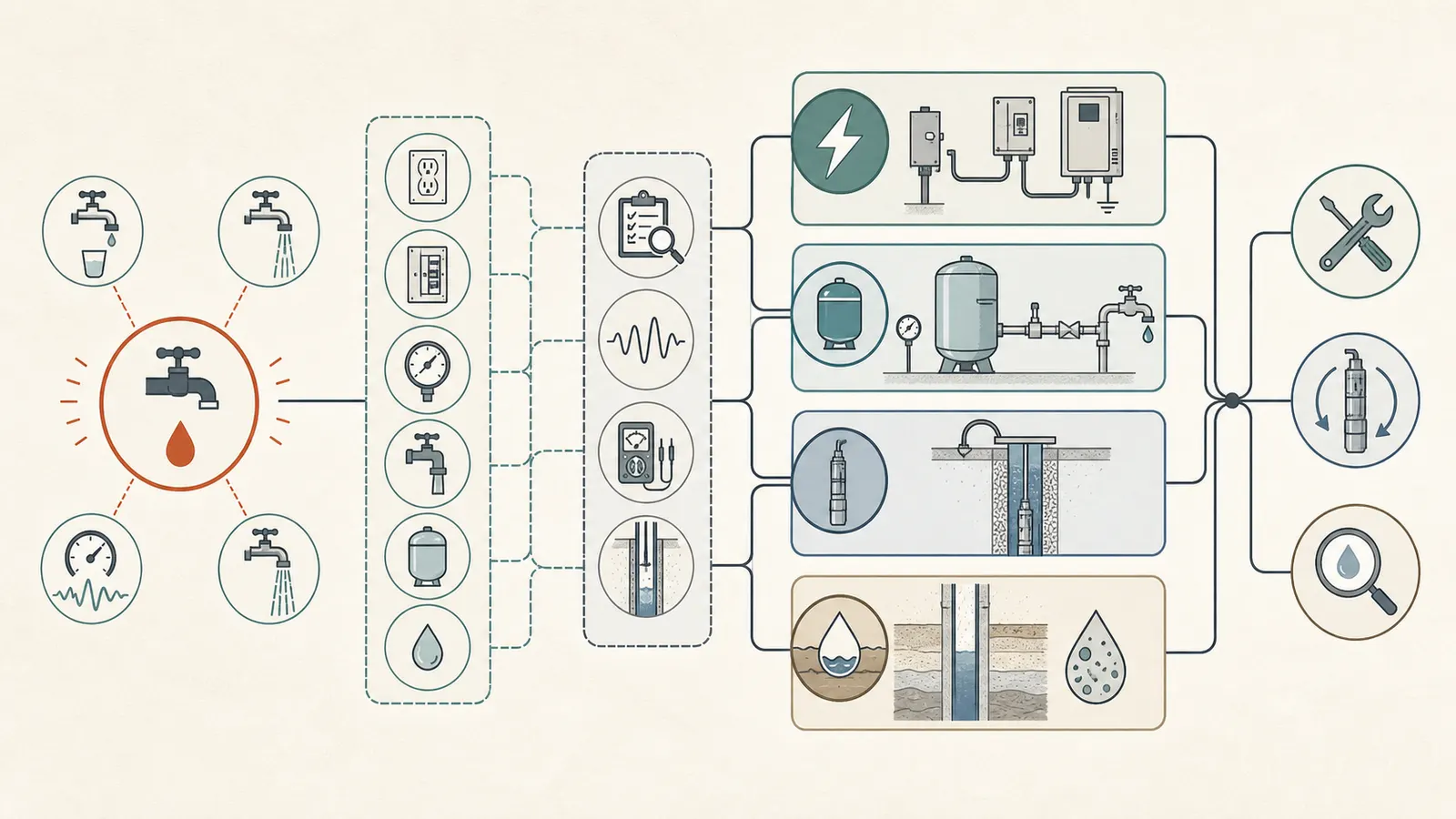
The first question for the contractor is therefore not “How old is the pump?” It is “Which component failed, and what test or observation supports that conclusion?”
The four layers to separate
| Layer | Examples | Evidence that helps | What a repair may leave unresolved |
|---|---|---|---|
| External power and controls | Breaker, disconnect, pressure switch, control box, sensor, wiring | Fault code, qualified electrical test, control model, voltage and configuration records | A new switch does not prove the motor, cable, or well is healthy |
| Pressure storage and plumbing | Pressure tank, gauge, check valve, filter, leak, shutoff, distribution pipe | Safe pressure observations, tank and valve records, leak investigation, filter condition | A new tank does not fix a low-yield well or worn pump |
| Down-well pumping unit | Pump, motor, cable, splice, drop pipe, check valve, setting | Professional diagnosis, installation record, model and setting, retrieval findings | A pump-only replacement may leave cable, pipe, sediment, or setting problems |
| Well capacity and water quality | Static level, pumping level, drawdown, recovery, sand, incrustation, contamination | Well log, flow or yield test, water test, service history, seasonal context | A larger pump can worsen over-pumping or fail to solve contamination |
This is why a pump replacement can be too much for a failed control component, while a cheap control repair can be too little for a pump that is repeatedly damaged by sand or a well that cannot recover. Penn State Extension lists lowered water levels, over-pumping, mineral incrustation, biofouling, sediment plugging, sand pumping, corrosion, and pump damage among causes of declining well performance. It also says pump and motor repair or replacement should follow the manufacturer’s recommendations. Read the Penn State maintenance and rehabilitation guidance.
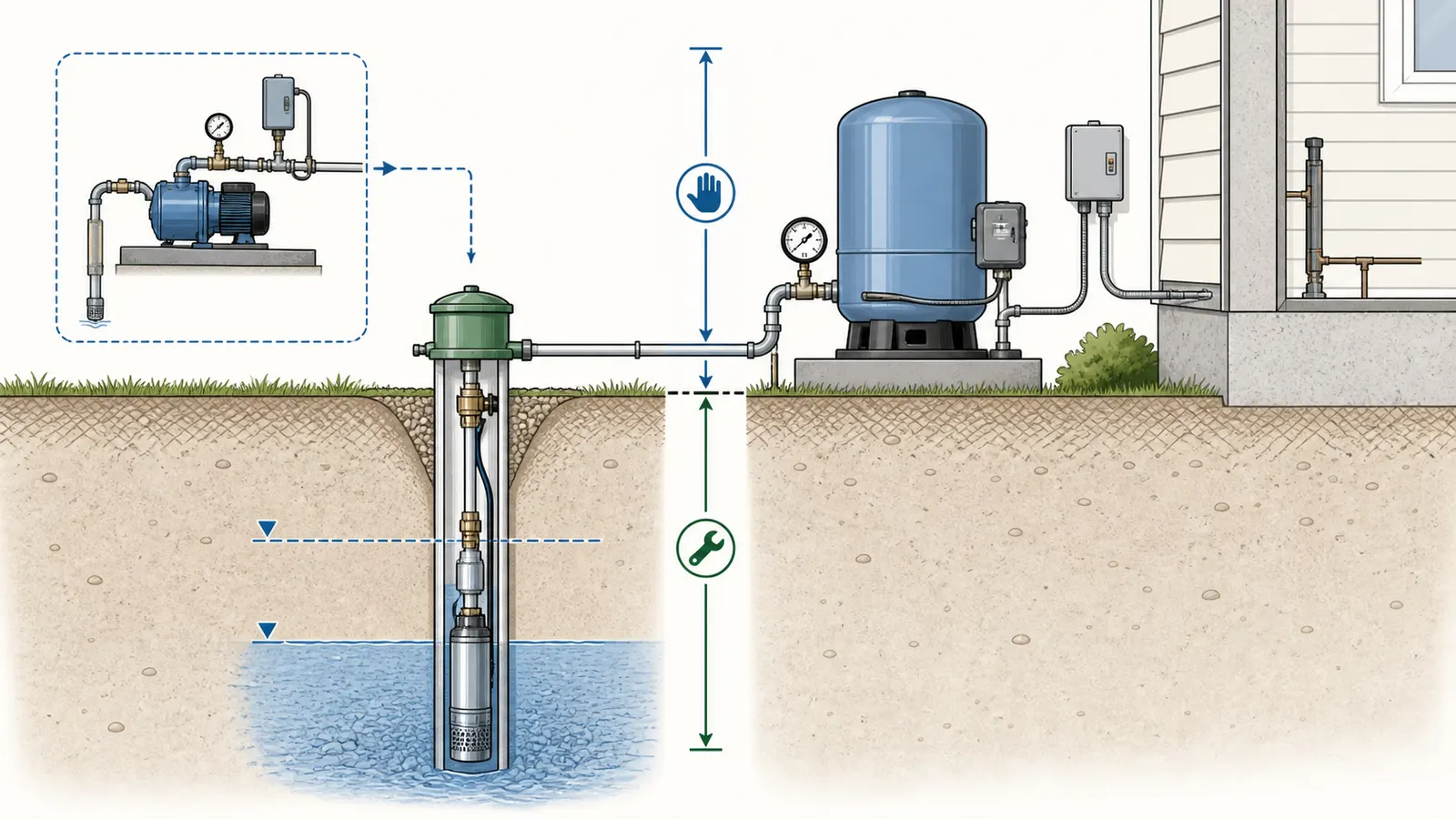
What counts as a diagnosis
A useful diagnosis names the failed component, the symptom, the test condition, and the alternative causes considered. Example worksheet wording: “The pressure switch is not closing at the documented cut-in pressure; the pump and motor have not yet been ruled out.” This is sample wording, not a report of a real test. A stronger record might say: “The submersible pump does not produce the documented flow at the stated pumping level; controls and supply were checked by a qualified professional; retrieval showed worn hydraulic components and damaged cable insulation.” This is also sample wording and must be replaced by actual professional findings.
The second record supports a broader replacement scope because it identifies both the failed unit and the conditions that could make a new unit fail again.
Do not treat a symptom as a component. Low pressure may come from a pump, well level, restriction, filter, pressure tank, leak, check valve, control, or wiring problem. A breaker trip may involve the motor, cable, control box, voltage, or mechanical load. Continuous running may reflect demand, leakage, low yield, a pump that cannot reach cut-out, or a control fault. Your worksheet should preserve the symptom and the diagnosis as separate fields.
Build the evidence record before comparing quotes #
Before approving either a repair or a replacement, gather what the property already knows. NGWA recommends retaining the well log, pump installation record, manuals and records for current equipment, maintenance history, and water test results. A well log can include depth, casing, static level, aquifer or formation information, pump-test results, and pump setting. NGWA’s routine-maintenance guidance explains why these records matter when a system needs troubleshooting.
The homeowner evidence packet
Create one folder—paper or digital—with:
- The well completion report or state well record, including drilled depth, casing, screen, original yield, and static water level if available.
- The last pump installation invoice, exact model, horsepower, voltage, phase, frequency, wire count, setting depth, drop-pipe material, and warranty terms.
- Photos of labels on the pump, motor, control box, pressure switch, pressure tank, gauge, filters, and treatment equipment. Photograph from outside closed covers; do not remove covers.
- Service invoices that show dates, symptoms, parts changed, retrieval or pull-out work, water-level observations, sediment or sand findings, and whether the same failure has returned.
- The current pressure-switch settings if already documented by a professional, plus safe observations of gauge behavior.
- Water-quality reports and any recent change in taste, odor, color, turbidity, or sediment.
- Changes in household demand: added bathrooms, occupants, irrigation, livestock, a pool, high-flow fixtures, or a new treatment system.
- Access facts: well location, buried or exposed equipment, restricted driveway, winter conditions, distance to the tank, and anything that could affect professional retrieval or restoration.
Do not fill missing values with guesses. Mark each as measured, documented, professional test, estimated, or unknown. An unknown pumping level is not a reason to invent one from the well’s drilled depth. It is a question for the bidder.
The minimum diagnosis entry
Use this sentence structure in your notes:
On [date], symptom [what happened] occurred under [water-use condition]. [Professional or homeowner observation] supports/does not yet support failure of [component]. [Alternative causes] remain open. Next evidence: [test or inspection] by [qualified professional].
This format protects you from a common failure in service decisions: a recommendation becomes the only record of the diagnosis. A second contractor can challenge the evidence without having to repeat the entire story.
What age and price can—and cannot—do
Age can make a replacement more reasonable when the system is inaccessible, parts are obsolete, the pump has repeated failures, or the cost of retrieving and repairing one component would still leave a worn system in place. Price can show whether a repair has enough remaining value or whether a complete scope is economically sensible. But neither fact tells you the cause, the well yield, or the compatibility of the proposed replacement.
Do not use “the pump is over X years old” as a diagnosis, and do not use “the repair is more than half of replacement” as a universal rule. Those are decision inputs only after you know what each option includes. A repair price that excludes pull-out, cable, disinfection, testing, or a return visit is not comparable with a replacement price that includes them.
Check yield, water level, and current demand #
The pump must serve the well that exists and the household that exists now. Water Systems Council says pump selection is determined by well yield and household needs, and recommends sizing for normal peak demand rather than average use. It also warns against installing a pump with greater capacity than the well. See the Water Systems Council pump-sizing sheet.
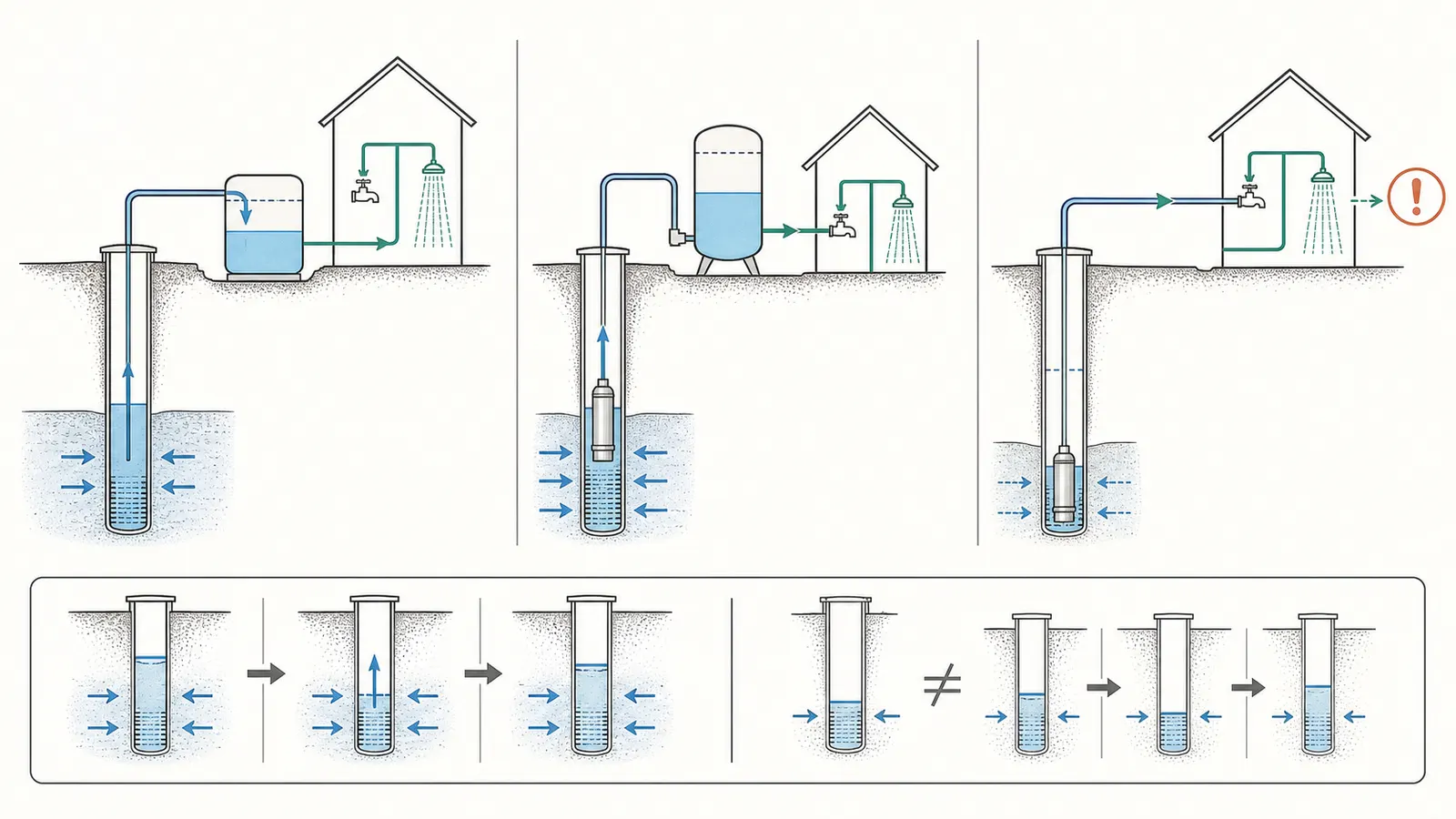
Separate drilled depth, static level, and pumping level
These are not interchangeable:
- Drilled depth is how far the borehole extends according to the well record.
- Static water level is the water level when the pump is not drawing water, usually recorded under a stated condition.
- Pumping water level is the level while water is being drawn at a stated flow and duration.
- Drawdown is the change from static level to pumping level.
- Recovery is how the water level returns after pumping stops.
A pump setting may be hundreds of feet deep while the current pumping water level is much shallower—or much lower than the original record suggests. A new pump recommendation should state which level it uses and how that level was obtained.
Treat a flow test as a snapshot
Water Systems Council’s home-inspector guide says a flow test can pump from an outside hose bib for 30 minutes with observations at intervals, but also warns that the result does not represent actual long-term recovery. A more extensive yield test determines static level, drawdown, and recovery. The guide describes minimum safe yield as dependable continuous output during a long drought, not merely the water available on a favorable test day. Review the WSC flow and yield guidance.
That distinction matters when deciding whether to repair a pump. If the pump is failing but the well has adequate yield, a like-for-like or better-documented replacement may be reasonable. If pressure is acceptable for a few minutes and then collapses, the pump may be exposing a drawdown or recovery problem. Replacing it with a larger pump can increase the demand on the well and repeat the failure.
Compare current peak demand with supply
Record what the home actually needs, not just how many people live there. Include simultaneous showers, laundry, dishwasher use, irrigation, livestock, a pool fill, treatment backwash, and any future addition you are likely to make. Water Systems Council’s example uses fixture count and a seven-minute peak-demand period, but its values are averages and do not cover every household. Use the document as a prompt for a professional discussion, not as a universal sizing command.
Use this simple worksheet:
| Demand question | Record | Why it changes the decision |
|---|---|---|
| Highest ordinary simultaneous flow | ___ GPM | A pump should meet normal peak demand, not only average daily use |
| Irrigation or other special demand | ___ GPM | Outdoor or process demand may dominate the peak |
| Current household changes | ___ | More fixtures or users can make a previously adequate system undersized |
| Documented well yield | ___ GPM | The pump should not exceed dependable well capacity |
| Pumping water level at test flow | ___ ft | Changes the lift the pump must overcome |
| Recovery evidence | ___ | Shows whether the well replenishes after drawdown |
| Storage already available | ___ gal | Storage can buffer timing, but does not create aquifer yield |
If dependable yield is lower than peak demand, the decision may become a system redesign: demand management, storage, a secondary pump, or well rehabilitation. WSC describes storage and a secondary pump as a possible arrangement for a low-yield well serving high demand. That is a professional design option, not an automatic add-on. Do not let a replacement quote quietly turn a yield problem into a larger horsepower sale.
Compare the repair scope with the complete replacement scope #
The repair-versus-replace decision is only as good as the scope comparison. Ask for two descriptions even if the contractor recommends only one: “What would the targeted repair include?” and “What would a complete replacement include?” The goal is not to force a contractor to price unsafe or unsuitable work. The goal is to see what risk each option accepts.
Repair is more defensible when all of these are documented
- The failed part is identified, and the proposed part is compatible with the exact system.
- The repair is accessible without opening the well, pulling the pump, or exposing a homeowner to energized or pressurized equipment.
- The pump, motor, cable, drop pipe, check valves, controls, tank, and well yield are either documented as suitable or specifically excluded with a reason.
- The same failure has not recurred without a root-cause investigation.
- The repaired system will be tested under a stated condition, with pressure, flow, cycling, and leak observations recorded.
- The warranty says whether it covers parts, labor, the original diagnosis, consequential pull-out work, and a return visit.
Examples include a failed gauge or an accessible switch that a qualified professional has diagnosed, provided that the symptom is not being used to conceal a deeper fault. A replacement pressure switch is not evidence that the pump motor is healthy; it is a repair to one control component.
Replacement is more defensible when the broader system evidence points there
- A qualified diagnosis identifies the down-well pump or motor as failed, and the scope includes safe retrieval and reinstallation.
- The pump has repeated the same failure, especially with sand, sediment, overheating, corrosion, or a recurring electrical fault.
- The existing model, cable, controls, pipe, and setting are obsolete, damaged, or incompatible with the proposed repair.
- The new pump’s exact model, duty point, well yield, pressure, controls, cable, tank, check valves, and protection are documented.
- The quote includes the items likely to be disturbed: drop pipe, cable and splice, pitless connection, well seal, disinfection, flushing, commissioning, disposal, and restoration where applicable.
- The repair would require the same expensive retrieval but would leave known wear or a repeated failure mechanism in service.
Penn State notes that abrasive sand pumping can damage pump parts and that recurring sand problems can become cost-prohibitive; it also describes well rehabilitation and, in severe cases, well replacement as decisions dependent on the cause and extent of deterioration. That supports asking whether a new pump is treating the cause or merely replacing the part that was damaged. It does not create a universal recommendation to replace a well. Use Penn State’s rehabilitation discussion for the cause-and-remedy context.
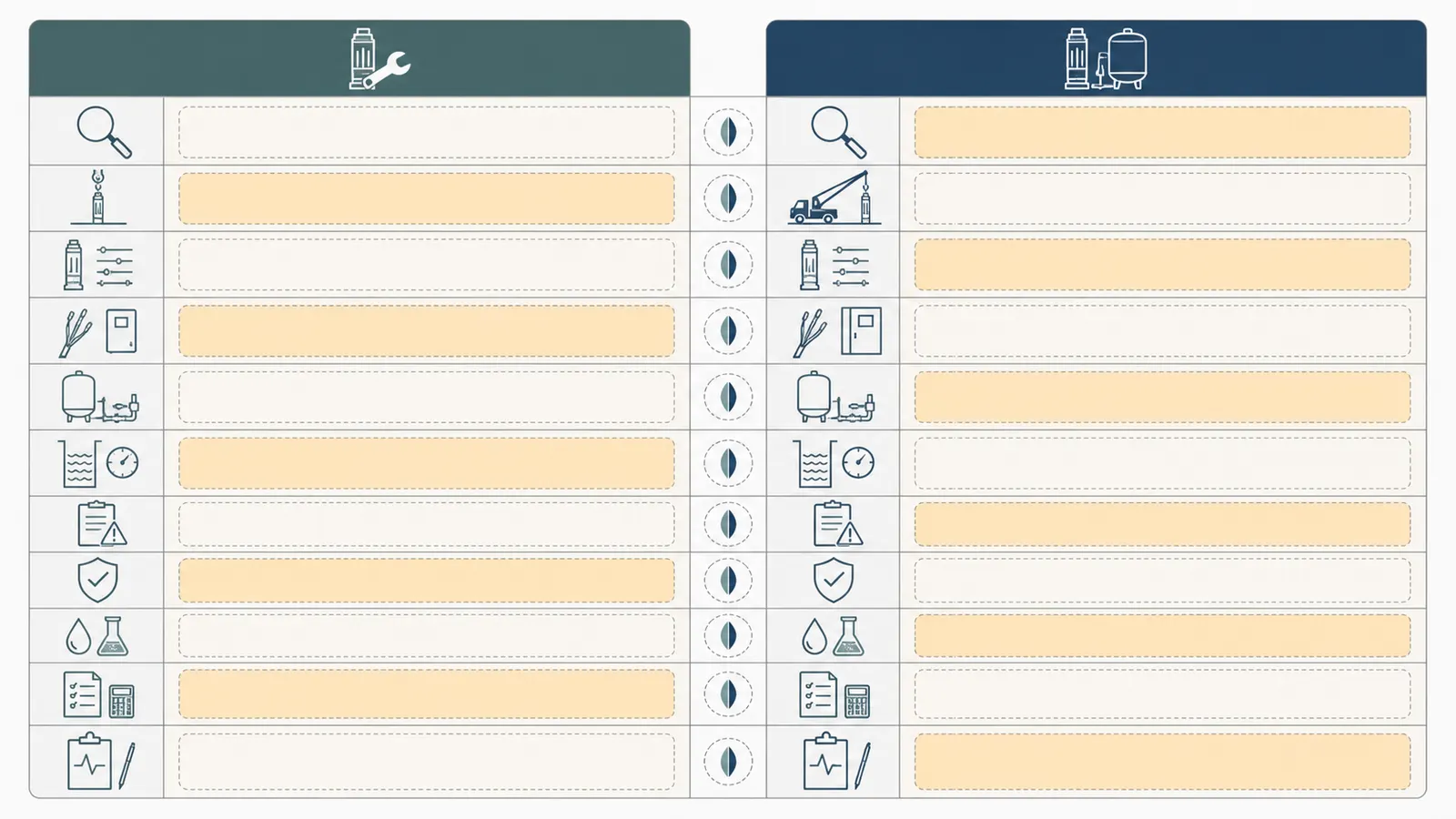
Use a complete-scope comparison table
| Scope line | Targeted repair | Complete replacement | Evidence to request |
|---|---|---|---|
| Diagnosed fault | ___ | ___ | Component, symptom, test, alternatives |
| Access and retrieval | ___ | ___ | Who opens, pulls, lifts, reinstalls, and restores |
| Pump and motor | ___ | ___ | Exact model, curve or performance data, motor details |
| Setting and hydraulic fit | ___ | ___ | Setting depth, pumping level, flow, pressure, well yield |
| Cable, splice, pipe, check valve | ___ | ___ | Condition, length, material, compatibility, replacement limits |
| Control box, switch, drive, protection | ___ | ___ | Exact models, voltage, phase, frequency, motor match |
| Pressure tank, gauge, filter, valves | ___ | ___ | Test results and items included or excluded |
| Water quality and disinfection | ___ | ___ | Who tests, what test, when, and local requirements |
| Commissioning | ___ | ___ | Pressure, flow, cycling, electrical readings by professional |
| Warranty and return visit | ___ | ___ | Parts, labor, exclusions, duration, documentation |
If a quote says “replace pump” but has blanks in the cable, control, well-yield, or commissioning rows, the price is not yet a complete replacement scope. If a repair quote says “replace switch” but has no diagnosis or test condition, it is a targeted part sale rather than an auditable repair decision.
Verify compatibility without opening the equipment #
A pump, motor, control box, pressure system, and electrical supply are a package. Franklin’s current control-box page says its submersible boxes are designed for particular Franklin three-wire, single-phase motors and lists box ratings by voltage, frequency, and horsepower. That is a manufacturer example of why “same horsepower” does not establish compatibility. Check the current Franklin control-box information.
Ask the professional to put these fields in the quote:
- Pump manufacturer, series, exact model, stages or configuration, and performance document.
- Motor manufacturer, exact model, horsepower, voltage, phase, frequency, service factor if relevant, and motor lead or wire configuration.
- Control box or drive manufacturer and model, including whether it is a matched control for that motor.
- Cable type, size, length, splice method, grounding or bonding, disconnect, and protective devices as applicable to the installation.
- Pressure switch or sensor model and the intended cut-in and cut-out settings.
- Pressure-tank model, size, precharge assumption, and whether the tank is being reused or replaced.
- Check valves, relief protection, filters, treatment equipment, and any pressure or flow limits.
- Exact pump setting and the evidence used to choose it.
Do not infer any of these values from a photograph, a horsepower label, or a familiar brand name. The same model family can have different voltage, phase, wiring, control, and performance variants. Franklin’s AIM resource currently lists a 2026 manual and installation-record forms; preserve the manufacturer documents and the completed record with your well history. Open the Franklin AIM resource page.
A model number is not a duty point
“One horsepower” describes motor size, not whether the pump can deliver your required flow at your well’s pumping level and working pressure. Water Systems Council’s sizing guidance says the pump should meet peak demand without exceeding well capacity and that pressure, power, installation materials, reliability, serviceability, and operating cost are part of selection. A replacement quote should therefore state the proposed flow, pressure, pumping level or design head, and exact model—not just horsepower.
Do not ask a homeowner to plot a curve or size a pump from a marketing label. Ask the bidder to provide the exact performance document and state the design point used. If the professional cannot state what measurement would change the recommendation, record the quote as incomplete.
Use symptoms as branches, then stop at the safety boundary #
The following matrix is for preparing a better professional conversation. It is not a homeowner diagnostic procedure involving live electrical or pressurized equipment.
| Observation | Plausible branches | What not to infer | Safest next step |
|---|---|---|---|
| No water anywhere | Power, control, pump, frozen or broken line, empty or damaged tank, well condition | “The pump is definitely dead” | Record when it began, check only normal user-accessible fixtures, and call qualified pump service |
| Low pressure at one fixture | Faucet restriction, treatment filter, local plumbing, fixture valve | “The well pump needs replacement” | Compare another fixture and record the condition without dismantling equipment |
| Low pressure throughout the home | Pump, water level, leak, filter, tank, pressure switch, control, demand | “A larger pump will fix it” | Request system diagnosis with pressure, flow, level, and yield evidence |
| Pump runs continuously | Leak, demand beyond supply, low yield, restriction, control, worn pump | “The motor is too small” | Avoid prolonged operation and ask for a professional diagnosis |
| Pump cycles rapidly | Tank, leak, check valve, switch, pressure setting, control, constant-pressure configuration | “The pump is worn out” | Record cycle behavior only if safely observable; get tank and control diagnosis |
| Breaker or overload trips | Supply, cable, control box, motor, mechanical load, water or heat condition | “Reset it until it runs” | Keep covers closed; use a qualified electrician or well professional |
| Sand, air, cloudiness, new taste or odor | Well screen, corrosion, pump setting, water level, plumbing, contamination | “A new pump makes the water safe” | Stop treating the water as automatically potable; obtain qualified testing and professional advice |
| Same part has failed repeatedly | Root cause may remain in the system | “Replace the same part again” | Ask what changed, what evidence identifies the cause, and what recurrence protection is included |
Safe observations a homeowner can make
From accessible, normal-use points only:
- Write down the date, symptom, weather or flood context, and what fixtures were operating.
- Photograph labels and visible leaks, corrosion, damaged conduit, or a gauge face without removing covers.
- If the gauge can be read safely, record its reading with no intentional water use and during one ordinary fixture flow. Do not treat a gauge reading as a diagnosis.
- At a safe outlet, measure a known volume and time the collection if you need an observation for the contractor:
GPM = gallons collected ÷ seconds × 60. Label the outlet, faucet opening, and other water use. This is outlet flow, not proof of pump capacity or well yield. - Note whether water clears, contains sediment, surges, contains air, or changes taste or odor. These observations trigger the water-quality branch; they do not prove a cause.
- Bring the evidence packet and ask each bidder to mark every input measured, documented, estimated, or unknown.
Do not open energized controls. Do not test live wiring. Do not open a well. Do not remove a well cap or seal, drop a probe or tape into the casing, pull a pump, enter a pit or confined space, manipulate pressurized equipment, or run a pump against a closed valve. NGWA says well opening, electrical concerns, repeated breaker trips, disinfection, pump retrieval, and unfamiliar well-system repairs should be handled by qualified professionals; it also warns about electrocution, gases, confined spaces, damaged property, and expensive mistakes. Read the NGWA safety and maintenance boundaries.
If the well or control equipment has been flooded, stay away from the pump because of electric-shock risk and keep it de-energized until a qualified professional inspects it. This is Brictale’s conservative safety boundary; installing a new pump does not resolve flooding or water-quality evidence. If water quality changes after service or repair, EPA recommends prompt testing, and it directs owners to certified drinking-water laboratories. See EPA’s private-well testing guidance. A hydraulic test cannot establish that water is safe to drink.
Make the approval decision auditable #
Use three verdicts rather than forcing a premature yes or no.
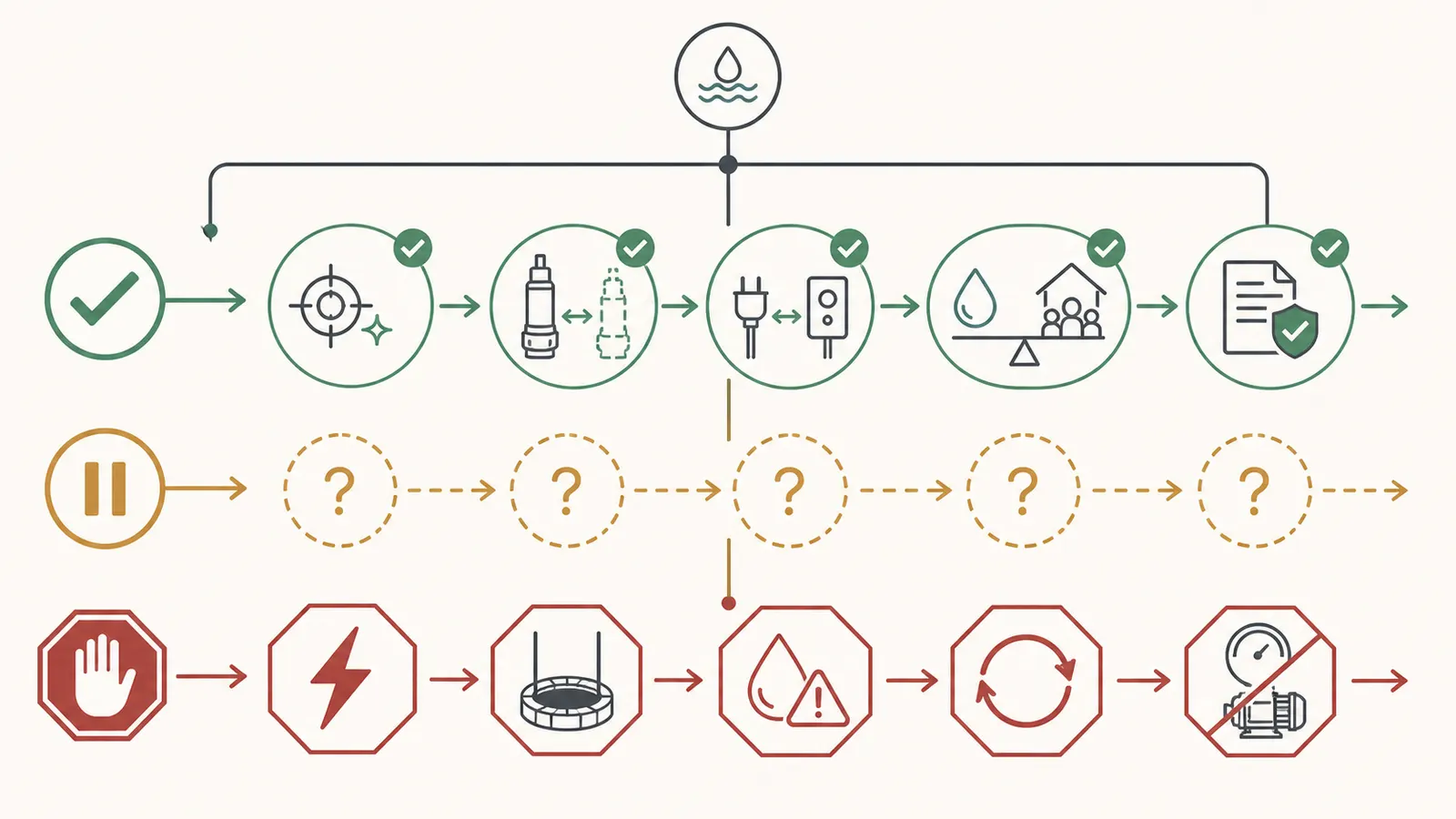
Green: approve the scope for professional scheduling
Use green only when the record contains:
- An isolated fault or a clearly documented system failure.
- An exact repair part or replacement model and a stated reason it fits.
- A complete scope for access, retrieval, pipe, cable, controls, tank, valves, disinfection, testing, disposal, and restoration as applicable.
- Well-yield and current-demand evidence, with unknowns clearly bounded.
- A written warranty that identifies exclusions and the response if the symptom returns.
- A commissioning record the installer will supply, including the model installed and relevant professional readings.
Green means “the decision record is complete enough to schedule.” It is not a performance guarantee and does not replace local permits, code, inspection, or professional judgment.
Amber: pause for one missing fact
Use amber when the recommendation may be reasonable but one material input is estimated or missing: pumping water level, well yield, exact model, control compatibility, cable condition, pressure-tank scope, or warranty boundary. Ask the bidder:
What measurement or document would change your recommendation, and who will obtain it?
If the answer is “we always replace pumps of this age” or “we use the 50-percent rule,” ask for the diagnosis and scope comparison again. A rule of thumb may be a business heuristic, but it is not a substitute for the evidence your particular well needs.
Red: do not authorize the proposed decision yet
Use red for a horsepower-only quote, unresolved live electrical hazards, a well that must be opened without qualified service, repeated failures with no root-cause plan, a water-quality change treated as a pump-only problem, or a replacement that exceeds documented well capacity. Red means the next action is diagnosis, testing, or professional design—not a larger pump by default.
The final quote request
Send every bidder the same request: “Please identify the failed component and the evidence for that diagnosis. Provide a targeted-repair scope and a complete-replacement scope, each listing access or pull-out work, exact model and setting, pump and motor compatibility, cable and controls, pressure tank and plumbing, well-yield and current-demand assumptions, water testing or disinfection, commissioning readings, warranty boundaries, permits, and exclusions. Mark each input measured, documented, estimated, or unknown.” This is sample request wording, not a contractor response.
This turns competing recommendations into comparable records. It also gives a second opinion a chance to challenge the right assumption rather than simply offer a different brand or horsepower.
Preserve the commissioning record
After professional work, save the invoice, exact installed model, setting depth, control and pressure settings, test condition, pressure and flow observations, electrical readings supplied by the professional, water test, disinfection record, warranty, and any changed well-level or yield evidence. Record what was not tested. A future repair decision should begin with this record rather than a vague memory that “the pump was replaced a few years ago.”
The decision in plain language: repair the diagnosed part when the rest of the system is supported; replace the pump when the pump or motor is truly the failed component or when the broader evidence shows that a targeted repair would leave a known failure mechanism in service. When yield, demand, water quality, controls, or access are unresolved, the correct answer is “not enough evidence yet.”
This page does not authorize homeowner electrical work, well opening, pump retrieval, pressure manipulation, confined-space entry, or pump selection. Assign those tasks to qualified well and electrical professionals, and check state and local requirements before work begins.
Well Pump Repair-or-Replace Worksheet
A standalone scope, evidence, and quote-comparison worksheet for documenting a qualified well-pump decision.
Download the worksheet (PDF)Cite this guide
Brictale. “Should You Repair or Replace a Well Pump? A Decision Worksheet.” Published 2026-08-24; updated 2026-08-24.
https://brictale.com/water/pumps/should-i-repair-or-replace-my-well-pump · Read the Markdown version
Sources and scope
Evidence behind this page
- A private well system may use a shallow jet pump above ground or a submersible pump inside the well casing; the service boundary and retrieval implications differ by pump type.
U.S. EPA — Learn About Private Water Wells
US private drinking-water wells; component descriptions are general and local construction and code requirements vary.
Accessed · Link to this claim - Pump sizing should account for well yield, working pressure, and household normal peak demand rather than relying on average use or a pump horsepower label.
Water Systems Council wellcare — Sizing a Well Pump
General private well pump-sizing education; examples and pressure ranges are not a universal design or local-code requirement.
Accessed · Link to this claim - Well records, pump installation records, equipment manuals, maintenance history, and water-test results are useful evidence when troubleshooting a well and pump.
NGWA WellOwner.org — Well Owner Routine Maintenance Practices
National homeowner best-practice guidance from the National Ground Water Association; local professional, regulatory, and site conditions vary.
Accessed · Link to this claim - A well inspection should review history and components and may include flow or yield testing; a short flow test is a snapshot and a true yield test considers static level, drawdown, and recovery.
Water Systems Council wellcare — Guide to Evaluating Water Wells
General US private-well evaluation guidance; HUD and state examples in the guide are program-specific and are not treated here as national requirements.
Accessed · Link to this claim - Franklin's current control-box information describes control boxes as optimized for particular three-wire single-phase motor configurations and lists ratings by voltage, frequency, and horsepower.
Franklin Water — Motor Control Boxes
Franklin Electric product information; compatibility must be checked against the exact motor, control, electrical system, and current manufacturer documentation.
Accessed · Link to this claim - Franklin currently provides a 2026 AIM manual and installation-record forms, supporting the practice of preserving model and installation context for future service.
Franklin Electric resource library; the existence of manufacturer records does not make any one form mandatory for every installation.
Accessed · Link to this claim - Declining well performance can be associated with lowered water levels, over-pumping, mineral incrustation, biofouling, sediment plugging, sand pumping, corrosion, or pump damage; repair and replacement should follow manufacturer recommendations.
Penn State Extension — Water Well Maintenance and Rehabilitation
Pennsylvania State University Extension educational guidance; mechanisms and remedies depend on the well, aquifer, water chemistry, and local professional assessment.
Accessed · Link to this claim - EPA recommends testing a private well annually for several baseline indicators and testing promptly after repairing or replacing part of the well system or noticing a change in odor, color, or taste.
U.S. EPA — Protect Your Home's Water
US private wells; the page notes that private wells are not regulated by EPA and local health or environmental agencies may provide additional requirements or advice.
Accessed · Link to this claim - NGWA guidance says well opening, electrical concerns, repeated breaker trips, pump retrieval, disinfection, and other hazardous well-system work should be handled by qualified professionals; it also warns about electrocution, gases, and confined spaces.
NGWA WellOwner.org — Well Owner Routine Maintenance Practices
National homeowner safety guidance; professional qualifications, permits, and task boundaries are subject to state and local rules.
Accessed · Link to this claim - Water Systems Council states that a low-yield well serving higher demand may need storage and a secondary pump, and that yield testing helps determine whether the well is adequate for the household.
Water Systems Council wellcare — Guide to Evaluating Water Wells
General private-well guidance; storage and secondary-pump design is a professional option, not an automatic remedy or code requirement.
Accessed · Link to this claim - A pump that cycles unusually quickly or slowly, or a system with pressure loss, should receive further investigation rather than an automatic pump replacement; constant-pressure systems are a special case.
Water Systems Council wellcare — Guide to Evaluating Water Wells
The guide's timing example applies to a stated conventional pressure-tank context; it explicitly notes special circumstances for constant-pressure systems.
Accessed · Link to this claim - Private-well water quality is a separate decision from pump hydraulic performance; EPA directs owners to use certified drinking-water laboratories and to contact public-health or environmental agencies when results raise concerns.
U.S. EPA — Protect Your Home's Water
US private wells; local agencies may have additional testing, response, or treatment guidance.
Accessed · Link to this claim