Will a Water Leak Detector Work With a Private Well?
A layout-first homeowner test for well-compatible leak protection: map the pressure tank, branches, treatment equipment, alerts, shutoff, power, and safety limits.
The short answer
Yes—but a private well changes what a device can interpret. A moisture sensor sees water only where it sits; a flow or pressure monitor sees use downstream of its installation; a pump-side monitor sees pump and pressure behavior. Map the pressure tank, house main, treatment equipment, irrigation, and separate branches first. Choose alert-only or shutoff only after confirming coverage, normal pump cycling, power, Wi-Fi, and a safe professional installation boundary.Will a Water Leak Detector Work With a Private Well?
Yes—but “works with a well” is not the decision. The decision is whether the device can observe the part of the system where the leak could occur, interpret the home’s normal pressure-and-pump behavior, and intervene without creating a new problem.
For a private-well home, map five things before buying anything: the pressure tank and pump controls, the house main, treatment equipment, outdoor hose and irrigation branches, and any separately plumbed buildings or buried lines. Then match the protection to the signal you need:
- A moisture sensor sees water only where the sensor is placed.
- A flow or pressure monitor sees water use or pressure behavior downstream of its installation point.
- A pump-side well monitor sees pump, pressure, voltage, or current behavior, depending on the model.
- An automatic shutoff can interrupt water or pump service, but only within the device’s plumbing and control scope.
The EPA WaterSense leak-detection taxonomy makes the same basic distinction between moisture detection and flow monitoring. A well does not make these technologies incompatible. It does make the pressure tank, pump cycle, treatment loads, and branch layout part of the compatibility test.
1. Start with the system map, not the product page #
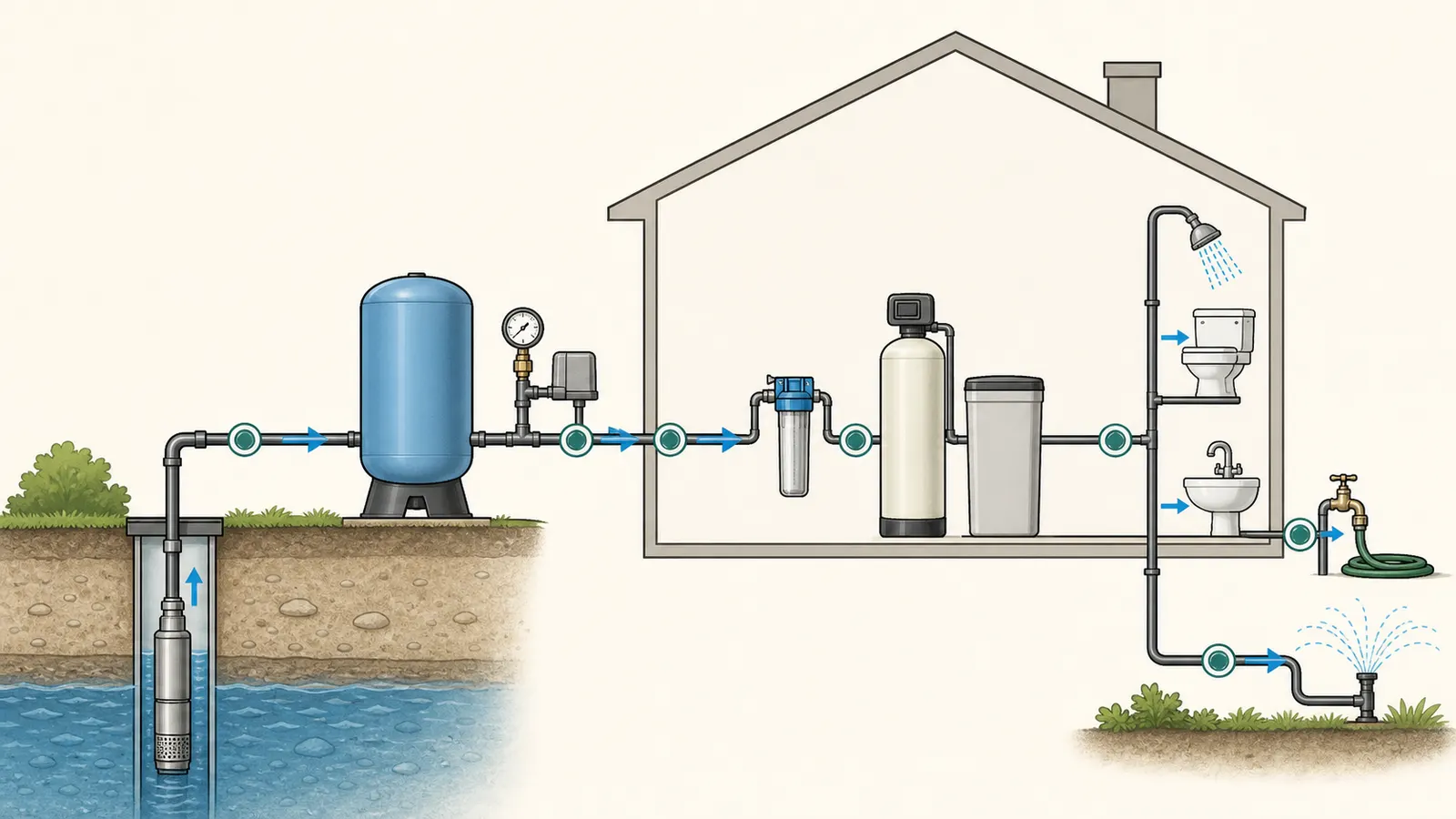
Stand at the pressure-tank location and draw the system as a path, not as a list of equipment. You are trying to answer one question: where does water travel before it reaches the proposed device, and where can it go without passing that device?
Use this order as a starting hypothesis, then verify it against your own pipes:
well pump → pressure tank / gauge / pressure control → house main → treatment equipment → indoor, outdoor, and irrigation branches
That sequence is common, but a branch can leave the line earlier. Irrigation may split before treatment or before a proposed monitor. A detached garage may have its own buried branch. A filter, softener, or reverse-osmosis system may have a drain or regeneration cycle that behaves differently from an ordinary fixture. A cistern or booster-pump arrangement may add another storage and control stage.
Record what you can observe without opening anything:
| Map item | What to record | Why it changes the decision |
|---|---|---|
| Pressure tank | Location, label, gauge, visible pressure-control enclosure | This is the reference point for normal pump cycling and the safe boundary for service work. |
| Proposed monitor point | Exact pipe or room, and whether it is before or after the tank | Placement is product-specific. For example, Phyn Plus guidance says the device must be downstream of the pressure tank and never between the well pump and tank; another pump-side or flow device follows its own manual and professional installation requirements. |
| House main | Pipe size if printed or documented; first branch after the tank | A point-of-entry monitor can cover downstream water use only. |
| Treatment equipment | Softener, filter, neutralizer, RO, storage tank, drains, regeneration schedule | Treatment cycles can look like unusual demand and some equipment may be harmed by interrupted water. |
| Outdoor water | Hose bibs, frost-free hydrants, pools, livestock, outbuildings | Outdoor use can be either protected or deliberately excluded, depending on the branch. |
| Irrigation | Controller, backflow device, branch location, zones, seasonal schedule | Irrigation before the monitor is invisible to that monitor; irrigation after it can cause normal high-flow alerts. |
| Separate supplies | Second well, cistern, booster, spring, or municipal backup | A device on one source does not automatically monitor another source. |
Use the phrase “downstream of the monitor” precisely. A pipe does not become visible merely because it is connected somewhere in the same home. If a branch leaves before the device, water on that branch does not pass through the device and cannot be counted by it.
This is not just a theoretical limitation. Phyn’s current irrigation guidance says that a well-home irrigation line must share the same well system and monitored piping configuration to be seen; separately plumbed irrigation is outside the device’s detection scope. That is a product-specific statement, but it is also a useful general mapping question: “Does the water cross the sensing point?”
A five-minute branch inventory
With every faucet, appliance, and irrigation zone off, walk the basement, utility room, crawlspace access area, and exterior perimeter. Do not remove covers or enter a confined space. Write down each visible branch and mark it before monitor, after monitor, or unknown.
If a branch is unknown, do not treat it as covered. Ask the installer to trace it, or use existing plumbing records, well records, treatment diagrams, or a professional inspection. A tidy-looking pipe layout can still conceal a buried or pre-treatment branch.
2. Match the leak type to the signal the device can see #
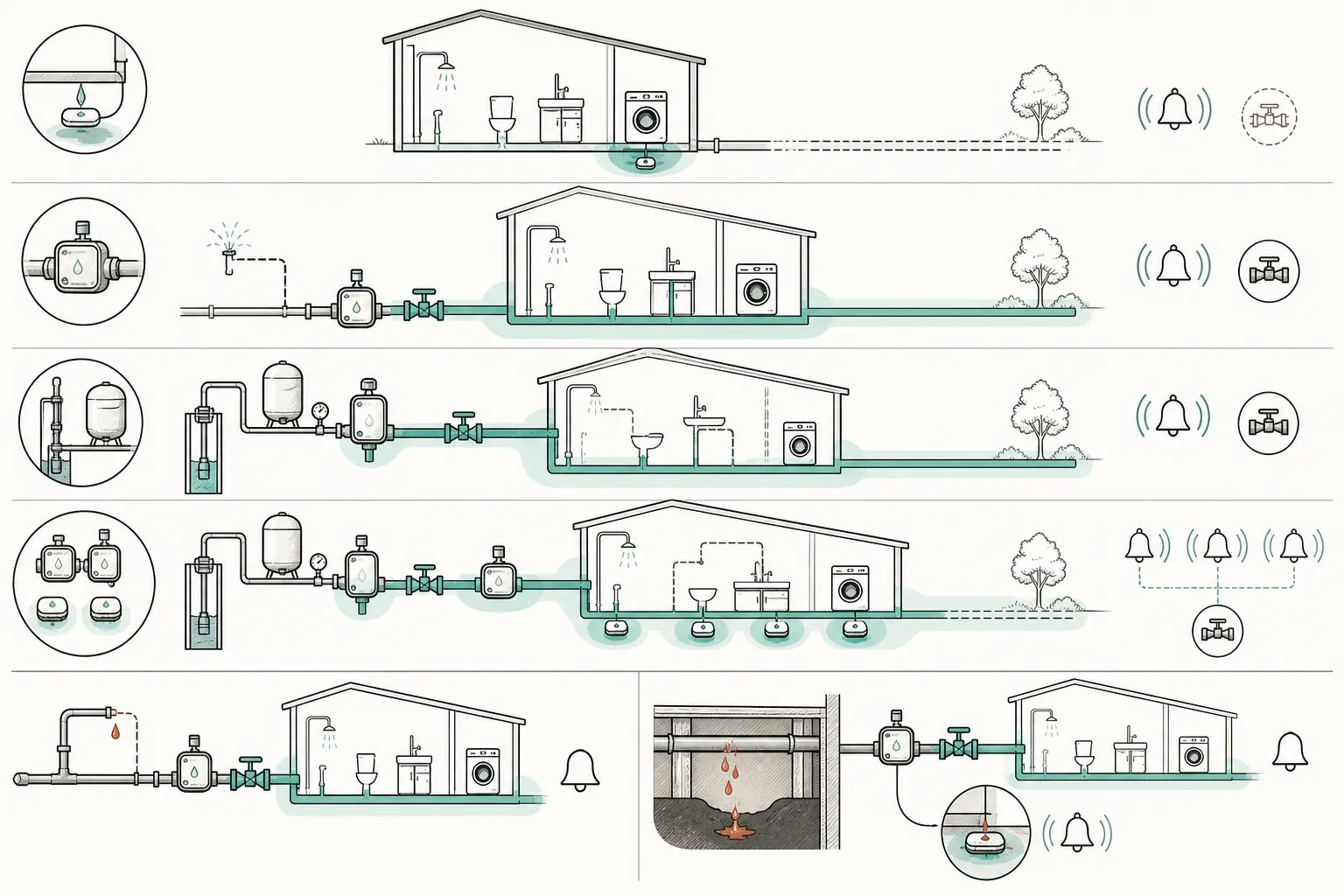
“Leak detector” covers several different jobs. The most useful comparison is not brand versus brand; it is signal versus blind spot.
| Protection type | It observes | It is good at | It can miss | Typical response |
|---|---|---|---|---|
| Point-of-use moisture sensor | Water physically reaching a sensor | Washer pans, water heaters, under-sink areas, condensate-prone locations, utility-room floors | A leak in another room, behind a wall, under a buried line, or upstream of the sensor | Local alarm or app alert; some systems can link to a shutoff |
| Point-of-use in-line flow device | Flow through one fixture branch | A toilet, appliance, or dedicated end use with a known line | Other fixtures and upstream pipe leaks | Alarm or alert; some models include a local shutoff |
| Point-of-entry flow or pressure monitor | Flow, pressure, or pressure patterns after the installation point | Water-use leaks across monitored downstream branches, including outdoor use when the branch is downstream | A roof, drain, condensate, or other leak that does not create the measured water-use pattern; branches before the device | Alert, and sometimes an automatic or remote valve |
| Pump-side well monitor | Pump cycling, pressure, current, voltage, dry-run, or tank-related behavior, depending on model | Pump and pressure-system faults; persistent demand that keeps the pump running; system-status notifications | Exact leak location, a non-water-use leak, or a branch not represented in its sensor/controller setup | Alert; some integrated systems can stop the well pump |
| Combined system | Two or more of the above | A layered approach: local moisture plus whole-system behavior plus pump protection | Anything outside the installed sensors, monitored pipe, or controller logic | Alerts and, if designed for it, water or pump shutoff |
The EPA’s 2026 guide says point-of-use devices may miss leaks upstream or at other uninstrumented fixtures. It also says point-of-entry devices can monitor water use downstream of the meter or installation point, but cannot identify leaks that are not associated with water use. That means a point-of-entry flow device and a floor sensor are complementary, not interchangeable.
What “whole home” should mean in a well home
Treat “whole home” as a coverage claim that needs a boundary. For this decision surface, it means “all water-use branches downstream of the device that are part of the same monitored pressurized system.” It does not mean:
- every buried pipe on the property;
- an irrigation branch that leaves before the device;
- water from another well, cistern, or municipal connection;
- drain, roof, foundation, or condensate water;
- a pump-control fault that the flow monitor is not designed to identify.
The EPA technical sheet also distinguishes devices aimed at one point of use from devices installed at the point of entry. Use that distinction when reading a product page: “works on well water” is not the same as “covers the irrigation branch and can safely control the pump.”
3. Decide whether you need alerting, pump monitoring, or shutoff #
Most homeowners start with the word “detector,” but the outcome they want may be one of three different things:
- Tell me that something is abnormal. An alert-only sensor or monitor is often the least disruptive starting point. It gives you a notification or alarm while leaving the water and pump controls alone.
- Tell me whether the well system itself is behaving abnormally. A pump-side monitor can add pressure-tank, dry-run, voltage, current, or cycle information that a room sensor cannot see.
- Stop the supply when a defined condition occurs. A valve or pump controller can reduce water loss, but it introduces an interruption decision that must include treatment equipment, irrigation, fire protection, backup water, and recovery steps.
The Pentair Pentek Well Defender illustrates the pump-side category: Pentair describes it as a retrofit for most locations with a mechanical pressure switch and lists notifications for conditions such as pressure-tank malfunctions, dry run, over-current, over- or under-voltage, and a waterlogged tank. That is useful system-status coverage. It is not a promise that the device can locate a wet floor in a distant room.
The Excalibur Well Home Protection Kit illustrates a more integrated architecture. Its product description combines a DROP Hub, pump controller, and leak detectors. The optional water-meter configuration adds flow-rate monitoring and gives the pump controller the ability to shut off the well pump for a high-water or continuous-flow condition. That may be the right architecture for a homeowner who explicitly wants pump-side intervention, but the meter option, product installation, and control requirements still need professional confirmation.
The practical choice is often layered:
- Put moisture sensors at high-consequence locations where a flow monitor cannot identify or even see the leak.
- Use a downstream flow or pressure monitor if you want water-use visibility across the branches that actually pass through it.
- Add pump-side monitoring when the pressure tank, pump cycle, dry-run, or electrical condition is part of the problem you want to observe.
- Enable shutoff only when you know what will be interrupted and how the system will be safely restored.
Do not assume that an alert-only device can control a pump, or that a pump controller can identify the exact room where water is escaping. Those are different capabilities.
4. Establish normal pressure-tank and pump behavior first #
A well system does not behave like a city-water line with a meter that simply records a continuous supply. The pressure tank stores pressurized water and the pump normally cycles as pressure falls and rises.
Penn State Extension’s explanation of low-yielding wells describes the typical pattern: a pressure-activated switch stops the pump when the system reaches its upper pressure point, and opening a fixture lowers pressure until the switch starts the pump again. Penn State uses example settings such as 20/40 and 40/60; those examples are not a license to assume your system uses either pair.
Before you interpret an alert, record a baseline from outside the controls:
| Observation | How to record it safely | What it may tell you | What it does not prove |
|---|---|---|---|
| Gauge at rest | Photograph or write the reading when no water is being used | The current static reading | That the gauge is accurate or the tank is healthy |
| Pump start and stop | With one ordinary fixture opened and closed, note the gauge reading and the audible start/stop if clearly observable | The installed cycle pattern | The correct pressure-switch adjustment or precharge |
| Pump run duration | Time a normal refill cycle from start to stop without touching equipment | A repeatable baseline for the monitor | That a longer cycle is a leak rather than a low well, filter restriction, or planned use |
| Cycling with no intentional use | After all fixtures are off, observe whether the pump restarts or pressure falls | A reason to investigate possible demand or system trouble | The exact leak location |
| Treatment cycle | Note softener regeneration, filter backwash, or other scheduled event | A normal high-flow or long-duration event to account for | That the treatment equipment is functioning correctly |
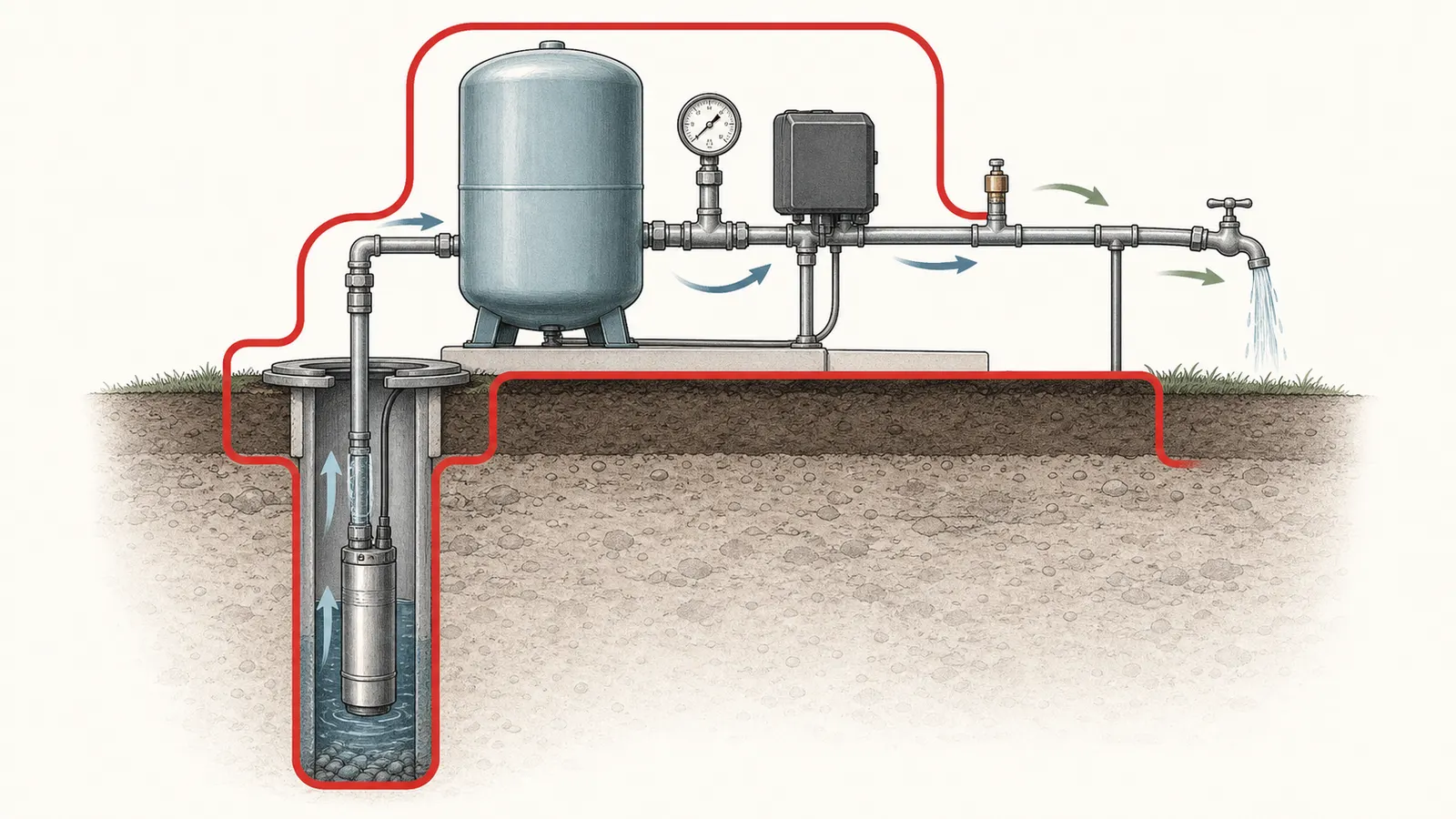
Do not use a generic online number as your alarm threshold. A pressure pattern can change because of a tank problem, pressure-switch behavior, a clogged filter, a low-yield condition, a pump issue, or a real leak. The baseline tells you what to investigate; it does not diagnose the cause.
What a pump that runs “too much” can mean
A pump that continues running or cycles repeatedly may be responding to a leak, but it can also reflect normal irrigation, a treatment cycle, low well yield, a waterlogged or damaged pressure tank, a pressure-control problem, or a pump that cannot reach its expected pressure. Penn State’s well maintenance guidance notes that well performance and pump condition can change over time and that pump and well problems warrant a qualified well professional’s evaluation.
Use the monitor’s alert as a reason to observe the baseline and isolate normal uses—not as permission to change pressure settings or service the pump controls.
5. Test treatment and irrigation branches before enabling automatic action #
Two branches create disproportionate confusion in well homes: treatment equipment and irrigation.
Treatment equipment
Water softeners, filters, neutralizers, reverse-osmosis systems, and storage arrangements can draw water on a schedule, send water to a drain, or depend on water flow to protect a motor or complete a cycle. Phyn’s current well-home installation guidance says treatment equipment downstream of the device will be visible to it and may produce unusual-activity alerts during learning; equipment upstream will not be monitored. The same guidance warns that some water-using equipment can be damaged if water is interrupted and says to confirm safe operation before enabling auto shutoff.
For each treatment device, record:
- normal operating days and times;
- whether it has a drain or discharge line;
- whether it contains a motor, pump, or control that expects water;
- what happens if water is shut off during regeneration or backwash;
- how the device is manually returned to service.
If you cannot answer those questions from the equipment manual or installer, use alert-only mode until a qualified professional confirms the shutoff behavior.
Irrigation and outdoor use
Irrigation can be either a major reason to monitor or a major source of false alerts. If the irrigation line is downstream of a point-of-entry monitor, scheduled watering becomes visible and must be learned or accommodated. If it is upstream, the monitor may be quiet while an irrigation leak wastes water.
Phyn gives both choices explicitly in its irrigation installation guidance: putting irrigation upstream excludes it from monitoring and auto shutoff, while putting it downstream includes it but can create unusual alerts during learning and seasonal schedule changes. This is not a universal installation prescription, but it is an excellent homeowner decision question: do you value visibility of irrigation enough to accept its high-flow patterns inside the monitored path?
Run this branch check before purchase or installation:
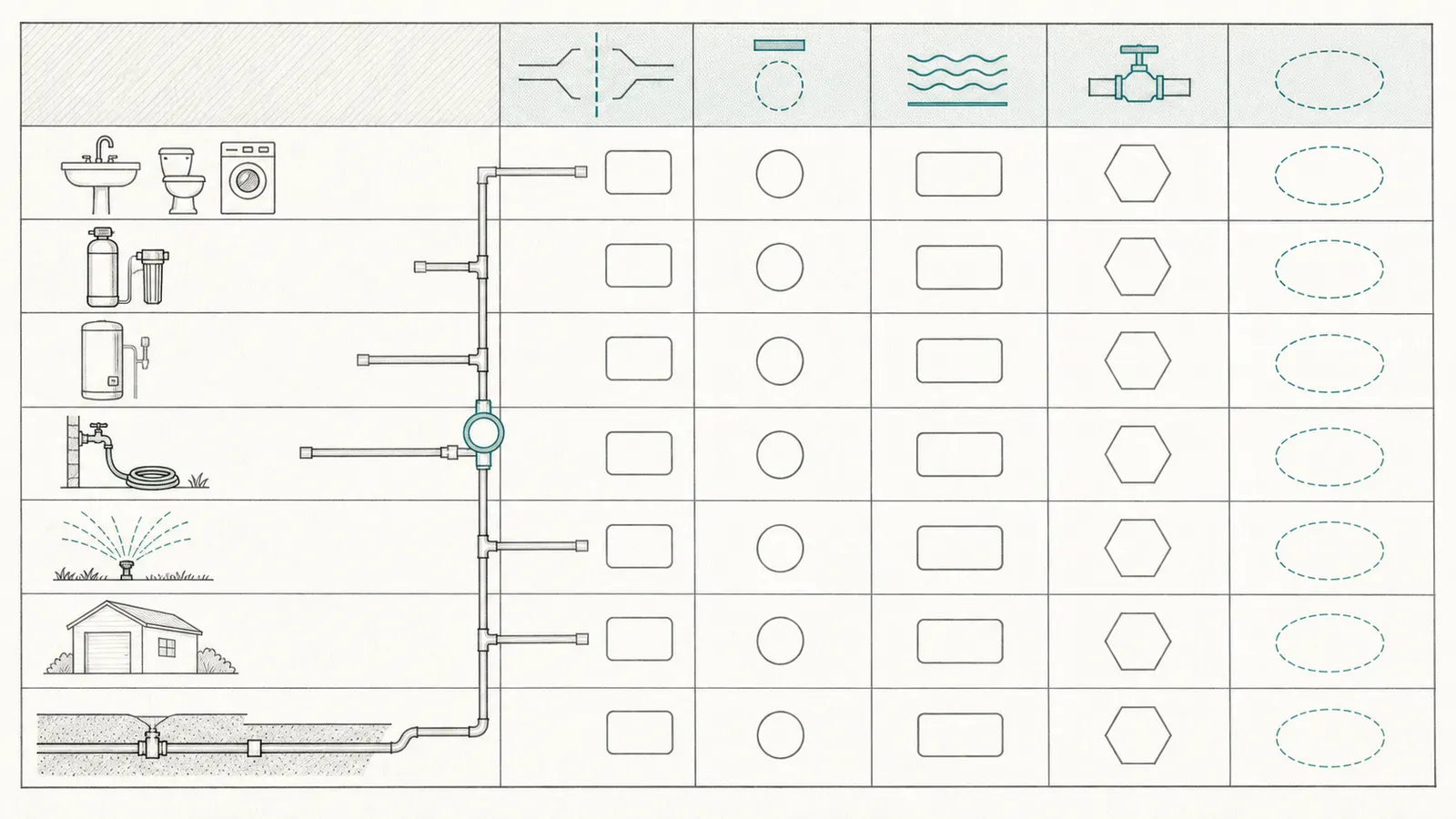
| Question | If “yes” | If “no” or “unknown” |
|---|---|---|
| Does the irrigation line leave after the proposed monitor? | It is a candidate for flow visibility; verify the product’s supported pipe size and flow range. | Treat irrigation as uncovered until traced. |
| Does the irrigation controller run on a known schedule? | Record the schedule for learning and alert review. | Expect unexplained events until the schedule is documented. |
| Would a shutoff interrupt irrigation or a pump? | Confirm the desired interruption and recovery procedure. | Do not assume the valve or controller will isolate irrigation safely. |
| Is there a separate well, cistern, or booster? | Map that source separately. | The single-system map may be adequate, subject to professional verification. |
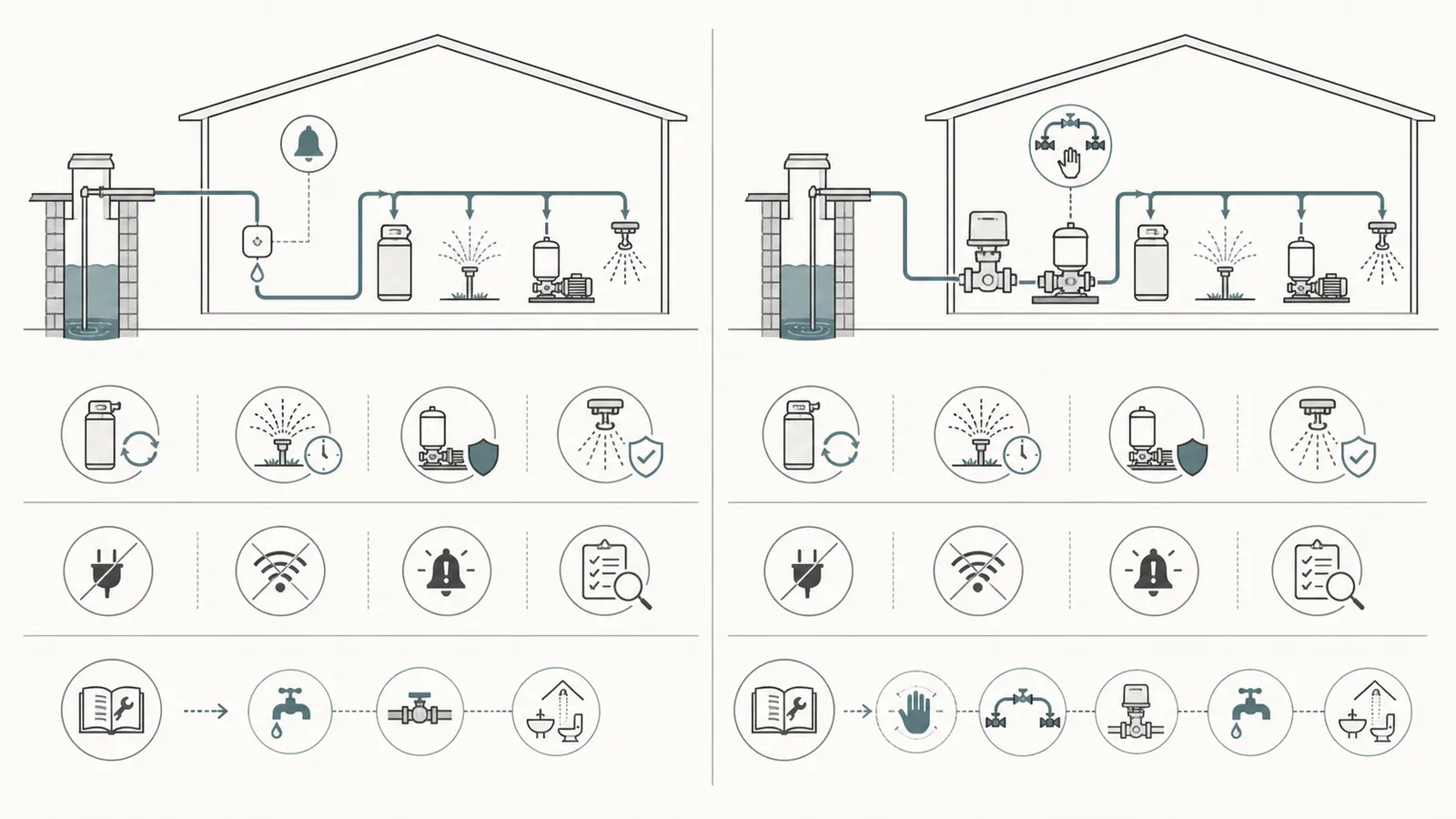
6. Check power, Wi-Fi, maintenance, and the recovery plan #
The device is part of the protection system only while its sensing, power, connectivity, and alert path are functioning.
The EPA WaterSense guide says point-of-entry in-line devices typically need external power, some systems provide battery backup, and a homeowner should consider how the device behaves during a power outage. It also recommends checking batteries, keeping moisture sensors clean and correctly placed, testing functionality, following model-specific calibration guidance, and reconnecting internet-connected devices after a power outage or Wi-Fi change.
Write down four dependencies:
- Power: Is the device, hub, pump controller, valve, and router on the same electrical service? What happens when power is out?
- Connectivity: Does the device still alarm locally without Wi-Fi? Is a mobile alert delayed or unavailable? How will you know it has reconnected after a password or router change?
- Sensor placement: Can a pet, stored item, condensation, dust, or cleaning move or wet a moisture sensor?
- Recovery: After a shutoff, who can safely restore water, reset a pump controller, inspect the leak, and verify treatment equipment?
For an unoccupied home, remote alerting may be more valuable than an audible alarm. For an occupied home with a sensitive treatment system, alert-only operation may be preferable until the normal patterns are proven. Neither preference is universal; it depends on the cost of missed detection versus the cost of an unnecessary interruption.
False alarms are a design input, not just an annoyance
Well systems can have pressure fluctuations and long or irregular demand events. Phyn says well pressure variation may require a longer learning period and can produce extra alerts, while its treatment and irrigation guidance calls out regeneration, seasonal watering, zone changes, and other normal events. EPA likewise advises considering programmability for irrigation schedules, seasons, planned vacancies, and other deviations from typical use.
Do not “solve” false alarms by ignoring every alert. Instead, label the event:
- planned fixture use;
- treatment regeneration or backwash;
- scheduled irrigation;
- pressure-tank or pump behavior;
- unexplained continuous or repeated demand;
- moisture at a sensor;
- power, Wi-Fi, or low-battery event.
If alerts remain unexplained after the normal schedule is documented, preserve the alert history and call the appropriate plumber, well contractor, or equipment service professional.
7. Stop before live pump, pressure, or well work #
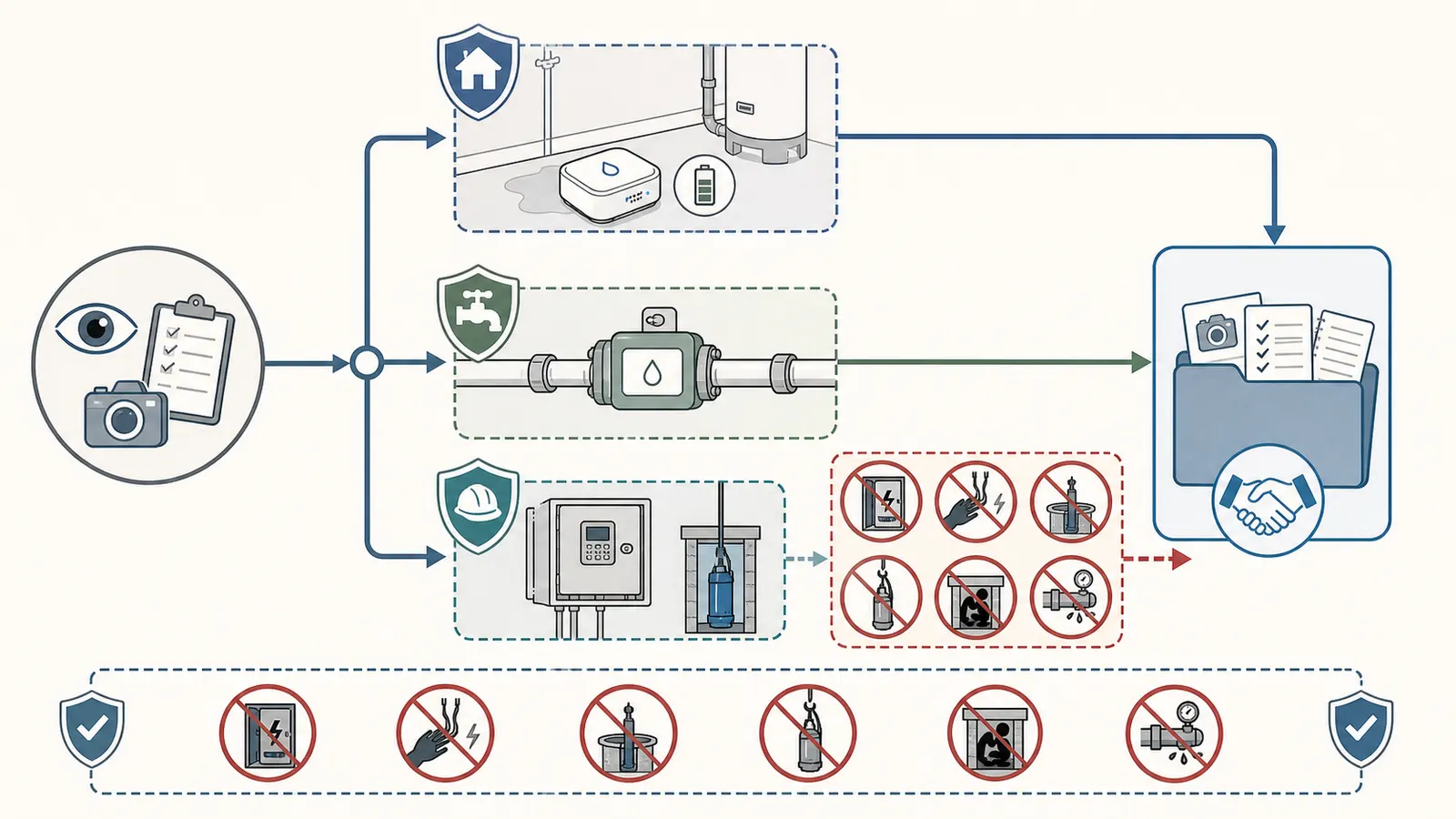
The homeowner task is to map, observe, document, and choose the protection boundary. It is not to open or modify the pump controls.
Do not open energized controls or an energized control enclosure, test live wiring, move or bypass a pressure switch, change pump-controller settings, adjust tank precharge, remove a relief valve, loosen pressurized fittings, open the well, pull a pump, or enter a confined space. Do not manipulate pressurized equipment. Do not treat shutting off a breaker as proof that a circuit is safe; a qualified professional must establish the safe electrical state and follow the equipment instructions.
Amtrol’s current Well-X-Trol installation manual is explicit that pressure-tank installation and maintenance belong to a licensed professional and warns that incorrect pressurization can create rupture or explosion hazards. Even its pressure check is described with the tank drained and the system off. That is a service procedure, not a casual homeowner test.
The same boundary applies to a pump-side monitor or shutoff. A product page may say that a controller turns a well pump on and off, but installing it can involve pump controls, line voltage, pressure settings, current limits, and a safe restart sequence. Have a qualified well or electrical professional verify the exact equipment, wiring, pressure-control arrangement, local requirements, and manufacturer instructions.
Leak protection is not a water-quality test
Brictale boundary: do not infer that well water is potable, or that treatment is working, from normal pressure, pump cycling, flow readings, or a cleared leak alert. If you suspect contamination or treatment failure, stop using the water for drinking until you have guidance, and contact a qualified well or water professional, your health department, and a state-certified drinking-water laboratory for appropriate testing. CDC says private-well owners are responsible for testing their water and should contact health officials or a well-water contractor when contamination or treatment is a concern.
Bring this handoff record to the professional
Save one page with:
- a sketch of the well pump, pressure tank, gauge, control enclosure, house main, treatment equipment, outdoor branches, and irrigation;
- every branch marked
before,after, orunknownrelative to the proposed monitor; - the tank and pump-control model numbers, if visible without removing covers;
- photos of labels, gauge readings, and visible pipe routing;
- your normal pump start, stop, and run observations;
- treatment regeneration or backwash schedules;
- irrigation schedules and zones;
- whether the goal is alert-only, pump-status monitoring, water shutoff, pump shutoff, or a layered system;
- what must remain operating during an interruption, including treatment, livestock, fire protection, or critical household use;
- the power, Wi-Fi, battery, and manual-recovery plan.
Ask the professional to answer these exact questions:
- Does every branch I want protected pass through the proposed sensing point?
- What does the device measure here: moisture, flow, pressure, pump current, voltage, or a combination?
- What normal pump and treatment events will look abnormal to this device?
- If shutoff is enabled, does it stop the house water, the well pump, or both?
- What happens during power loss, Wi-Fi loss, a sensor failure, or a false alert?
- Could shutting off water damage a softener, filter, RO system, irrigation component, pump, or other equipment?
- What can the homeowner safely reset, and what requires service?
Bottom line: use the smallest protection boundary that matches the risk #
A water leak detector can work with a private well, but no single device automatically sees every well-home leak. A moisture sensor is local. A flow or pressure monitor is path-dependent. A pump-side monitor is system-focused. A shutoff is an intervention, not proof that the leak has been located or repaired.
The defensible choice is the one that leaves a written map:
- Covered branches: water crosses the monitor or a sensor is placed at the risk location.
- Uncovered branches: water leaves before the monitor, uses another source, or creates moisture without the measured water-use signal.
- Normal events: pump cycles, treatment cycles, irrigation schedules, and planned absences are documented.
- Response choice: alert-only, pump monitoring, water shutoff, pump shutoff, or a layered combination is deliberate.
- Safety boundary: live controls, pressurized equipment, the well, pump, and confined spaces are assigned to qualified professionals.
If a product’s compatibility statement cannot be translated onto that map, it is not yet a fit for the home.
Cite this guide
Brictale. “Will a Water Leak Detector Work With a Private Well?.” Published 2026-09-04; updated 2026-09-04.
https://brictale.com/water/pumps/can-water-leak-detector-work-with-private-well · Read the Markdown version
Sources and scope
Evidence behind this page
- EPA WaterSense separates moisture detection, which senses unexpected dampness at a location, from flow monitoring, which measures water movement or pressure patterns that may indicate unusual use.
US EPA WaterSense — Leak Detection and Flow Monitoring Devices
EPA's national consumer taxonomy for household leak detection and flow monitoring; it does not certify a particular well product or establish universal alarm thresholds.
Accessed · Link to this claim - EPA's 2026 WaterSense guide says point-of-use devices target a fixture or leak-prone location and may miss leaks upstream or at other uninstrumented fixtures, while point-of-entry devices can track water use downstream of their installation.
US EPA WaterSense — Know Your Flow and Curb Water Waste: Leak Detection and Flow Monitoring Devices
The guide's point-of-use and point-of-entry descriptions for residential plumbing; coverage depends on the actual installation point and branch layout.
Accessed · Link to this claim - EPA says point-of-entry flow devices cannot identify leaks that are not associated with water use, such as condensate, roof, or drain-pipe leaks; it also notes that moisture sensors can cover places a flow monitor cannot.
US EPA WaterSense — Know Your Flow and Curb Water Waste: Leak Detection and Flow Monitoring Devices
EPA's examples of signal blind spots; the guide does not say that every flow monitor has identical behavior.
Accessed · Link to this claim - EPA says in-line point-of-entry devices usually need external power and often a plumber, while battery or backup power, connectivity after outages, sensitivity settings, and maintenance are selection and operating considerations.
US EPA WaterSense — Know Your Flow and Curb Water Waste: Leak Detection and Flow Monitoring Devices
EPA's consumer selection, installation, connectivity, and maintenance guidance; product-specific power and installation requirements still control.
Accessed · Link to this claim - Phyn says its Smart Water Assistant can work in a well home when installed correctly and connected to stable internet, but common well-system pressure fluctuations may require a longer learning period and can produce additional alerts during learning.
Phyn Help Center — Will Phyn Smart Water Assistant work if my home is on a well?
Phyn's current guidance for its Smart Water Assistant; it is a manufacturer-specific compatibility statement, not evidence that every monitor works on every well system.
Accessed · Link to this claim - Phyn's well-home installation guidance places the device downstream of the pressure tank, never between the well pump and pressure tank, and recommends space after the tank when possible; it also discusses the placement of sediment filtration and treatment equipment.
Phyn Help Center — Installing a Phyn Plus in a Well Home
Phyn Plus installation guidance for well homes; the placement is not a universal instruction for other products.
Accessed · Link to this claim - Phyn says irrigation is monitored only when it is connected to the same well system and piping configuration in the device's monitored path; separately plumbed irrigation is outside its detection scope.
Phyn Help Center — Will Phyn Monitor Irrigation Usage and Leaks?
Phyn's specific irrigation and well-system compatibility explanation; it supports the branch-mapping method, not a general claim about all flow monitors.
Accessed · Link to this claim - Phyn says treatment equipment installed downstream can be visible to the device but may create unusual-activity alerts during learning, while upstream treatment use is not monitored; it warns that some equipment can be damaged if water is interrupted and recommends checking before enabling auto shutoff.
Phyn Help Center — Installing a Phyn Plus in a Well Home
Phyn's current examples include softeners, conditioners, acid neutralizers, reverse-osmosis filters, whole-home filtration, and irrigation; the article does not establish that every model has the same risk.
Accessed · Link to this claim - Pentair says the Pentek Well Defender is designed to retrofit in most locations with a mechanical pressure switch and sends notifications for pressure-tank malfunctions, pump dry run, over-current, voltage conditions, and a waterlogged tank.
Pentair — Pentek Well Defender
Pentair's current product description for the Pentek Well Defender; it describes system-status monitoring and notifications, not whole-house leak localization or universal compatibility.
Accessed · Link to this claim - Excalibur says its Well Home Protection Kit combines a DROP Hub, pump controller, and leak detectors. The optional Water Meter monitors flow rates and gives the Pump Controller the ability to shut off the well pump for a high-water or long continuous-flow event.
Excalibur Water Systems — Well Home Protection Kit
Excalibur's current Well Home Protection Kit description; the flow-triggered pump-shutoff capability is conditional on the optional Water Meter and remains product-specific. It does not prove that a separate moisture sensor or flow monitor can control a pump.
Accessed · Link to this claim - Penn State Extension describes a typical private-well pressure tank as providing pressurized storage between pump cycles, with a pressure-activated switch stopping and starting the pump at system-specific pressure points; it presents 20/40 and 40/60 as examples rather than a universal setting.
Penn State Extension — Using Low-Yielding Wells
Penn State's explanation of a typical pressure-tank system and example pressure settings; installed systems may use other settings or variable-speed controls.
Accessed · Link to this claim - Amtrol says a Well-X-Trol precharge check or adjustment is performed with the tank drained and system off, and its current manual warns that pressure-tank installation and maintenance are for a licensed professional and that incorrect pressurization can create rupture or explosion hazards.
Amtrol — Precharged Well Tanks Installation and Operation Instructions
Amtrol's Well-X-Trol tank family and its installation manual; the safety boundary is intentionally conservative and does not replace the exact tank, pump, electrical, or local professional instructions.
Accessed · Link to this claim - EPA says leak detection systems may alert, sound an alarm, activate a water shutoff, or combine moisture and flow technologies; it also says a shutoff must be checked against pipe size and fire-sprinkler protection before installation.
US EPA WaterSense — Know Your Flow and Curb Water Waste: Leak Detection and Flow Monitoring Devices
EPA's discussion of intervention abilities and installation considerations; it does not recommend a particular brand or guarantee that a shutoff protects every branch.
Accessed · Link to this claim - EPA recommends following the device manual for maintenance, replacing batteries as needed, keeping moisture sensors correctly placed and clean, testing functionality, periodically calibrating flow monitors where applicable, and restoring internet connection after power or Wi-Fi changes.
US EPA WaterSense — Know Your Flow and Curb Water Waste: Leak Detection and Flow Monitoring Devices
EPA's general maintenance tips for household devices; model-specific procedures and intervals remain controlling.
Accessed · Link to this claim - CDC says private-well owners are responsible for testing whether their water is safe to drink; when contamination or treatment is suspected, it recommends contacting the health department or a well-water contractor and testing the water after treatment.
CDC — Guidelines for Treating Well Water
CDC's private-well drinking-water safety and treatment guidance; a leak, flow, or pressure monitor is not a water-quality test.
Accessed · Link to this claim