Why Does My Well Pump Pressure Switch Chatter?
Use the sound, timing, and pressure-gauge movement to separate well-pump pressure-switch chatter from normal cycling and a pump that will not shut off.
The short answer
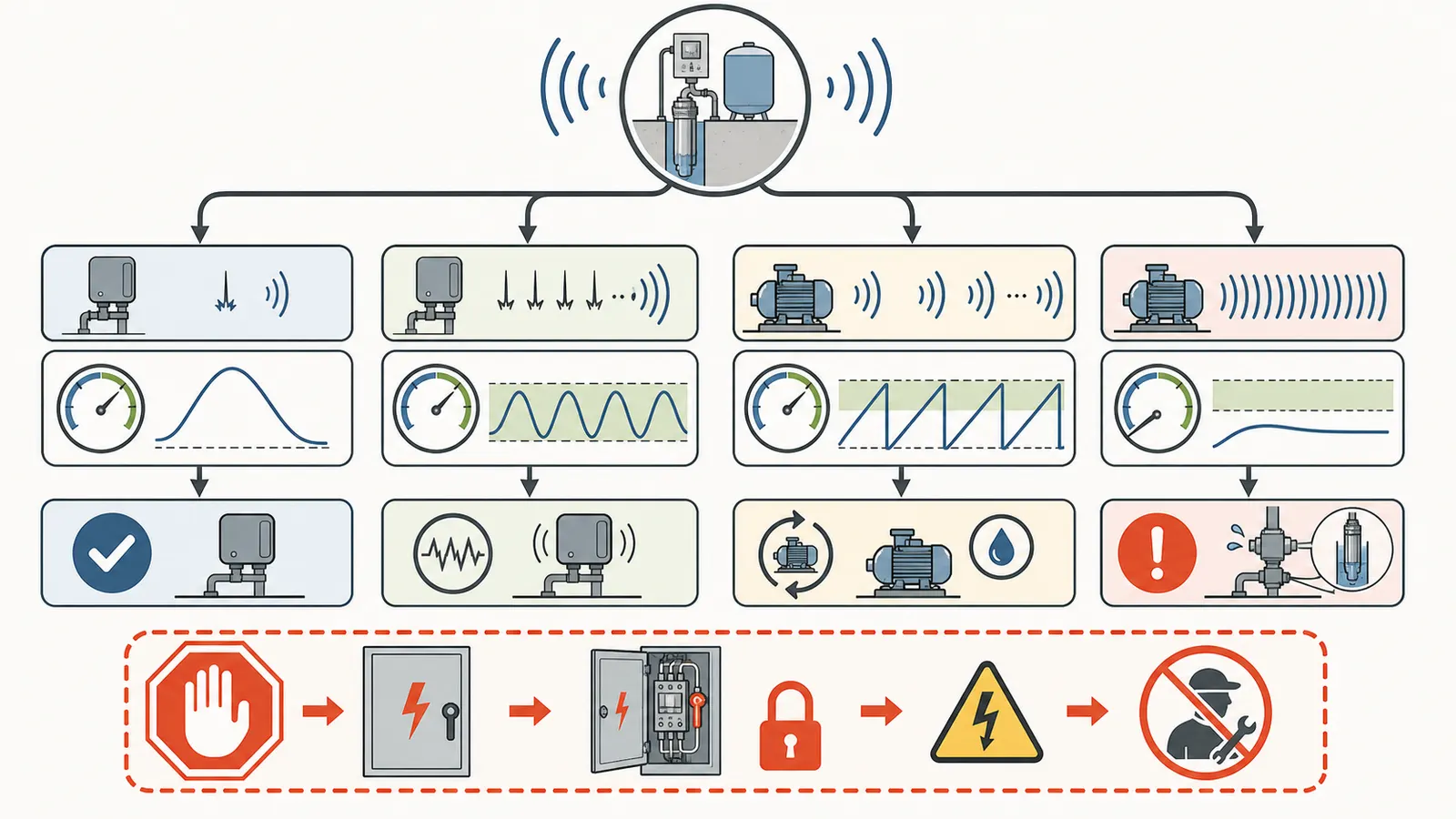
Pressure-switch chatter is repeated clicking or buzzing near pump start or stop, not simply a pump that cycles. Record whether it happens at cut-in or cut-out, how the gauge moves, the switch setting, tank location, and whether the sound stops when power is safely off. Common service paths include tank precharge, tank-to-switch piping, flow, check-valve behavior, sensing restrictions, vibration, and switch condition. Do not open an energized control.Observation flow
What is the system doing?
Choose the closest visible pattern. Stop immediately for sparking, hot wiring, uncontrolled pressure, or a damaged tank.
Pressure-switch chatter is a repeated click, buzz, or rapid contact sound clustered around pump start or stop. It is not the same thing as a pump that simply starts and stops often. The fastest useful triage is to record four observations: whether the sound occurs at cut-in or cut-out, what the pressure gauge does at that moment, what the switch setting is, and whether the tank is close to the pump and sensing switch. A qualified pump professional can then check tank precharge, tank-to-switch piping, flow, valve behavior, sensing restrictions, vibration, voltage, and switch condition in the right order. Do not open an energized switch cover or test live wiring.
1. Define the sound before naming the failure #
The word “chatter” is useful only if it describes a timing pattern. A normal pressure-switch event is usually one start decision and one stop decision: the switch closes as pressure falls to cut-in, the pump runs, and the switch opens as pressure rises to cut-out. The pressure gauge should move through that event rather than flicker unpredictably. A tank exists partly to prevent the pump from starting for every small demand; the University of Georgia describes the pump, tank, switch, and check valve as a connected system in which the switch responds to pressure changes and the tank maintains pressure. University of Georgia Extension explains the component roles in its pump-and-pressure-tank arrangement.
Use these working definitions while observing from outside the control enclosure:
| What you observe | What it means for triage | What it does not prove | Safest next step |
|---|---|---|---|
| One click at pump start and one click at pump stop; gauge moves smoothly | Likely ordinary switching or a normal cycle | It does not prove the tank, valve, or switch is healthy | Record the pressure readings and run time; investigate only if the behavior is new, noisy, or performance has changed |
| Several clicks, buzzes, or rapid on/off sounds clustered at start or stop; gauge bounces or hesitates | Pressure-switch chatter or contact bounce is plausible | It does not identify the failed part | Stop at observation; capture timing and call a pump professional if repeated |
| Pump starts and stops repeatedly with a run interval, but the switch makes one distinct decision each time | Short cycling is more likely than contact chatter | It does not prove the tank is waterlogged; leaks, low precharge, an open fixture, or other causes can produce it | Record start/stop times and check for an obvious open faucet or leak without dismantling anything |
| Pump keeps running and does not reach cut-out, or the gauge stalls below the usual stop pressure | The “will not shut off” branch is more likely | It does not prove the switch is bad; flow, a leak, a blocked pump component, low water, or valve behavior can be involved | Stop prolonged operation and arrange service; do not force a pressure reading by closing a discharge valve |
| Sound is a hum, grind, or vibration from the pump rather than a switch click or buzz | The noise may be motor, piping, or mounting related | It does not prove pressure-switch chatter | Record where the sound is loudest and whether the gauge changes at the same time |
Little Giant’s manufacturer FAQ uses this same distinction: it asks whether the chatter occurs during on/off moments and points the service path toward pressure difference, tank location and condition, piping, check or foot valves, switch blockages, and switch function. See the Little Giant chatter checks.
The three timing questions
Write down answers rather than relying on memory:
- Does the repeated sound happen as pressure falls toward pump start, as pressure rises toward pump stop, or at both points?
- Does the gauge move smoothly, jump back and forth, pause, or fail to reach the usual cut-out reading?
- Does the pump motor itself start and stop rapidly, or does the switch sound repeat while the motor appears to remain on?
These questions separate a pressure signal that is unstable near a threshold from a pump that is cycling because the system cannot store or maintain enough usable water pressure. They also keep “the switch is bad” from becoming the first and only conclusion.
2. Set the 240-volt safety boundary first #
Treat the pressure switch and any pump control box as energized electrical equipment. Residential pump controls are not all wired the same: Franklin Water lists 115 V and 230 V configurations for one family of pump controls. Franklin’s product page shows why the equipment label and manual matter. A nominal “240-volt” boundary is therefore a safety stop, not a claim that every home has the same voltage.
Pentair’s pressure-switch instruction sheet says hazardous voltage is present and power must be disconnected before working on the motor or pressure switch. Pentair’s instruction sheet sets the disconnect-power boundary. OSHA records a fatal 480-volt contact during replacement of a switch on an electric well pump; that incident is not a residential voltage rule, but it is a concrete reminder that switch replacement is electrical work, not a harmless sound check. Read the OSHA incident record and its limited scope.
For a homeowner, “observe” means staying outside the enclosure and using only normal user controls that are clearly identified and accessible without removing a cover. It does not mean proving voltage absence with a meter. The homeowner must not open an energized control, test live wiring, open a well, pull a pump, enter a pit or other confined space, or manipulate pressurized equipment. Those actions require a qualified professional with the correct isolation, pressure-relief, access, and equipment procedures. The practical boundary is:
- remove the pressure-switch or control-box cover while power may be present;
- touch terminals, contacts, adjustment nuts, wiring, capacitors, or motor leads;
- test live wiring, bridge contacts, hold a switch closed, or repeatedly reset a breaker to make the sound recur;
- open the well, pull a submersible pump, enter a pit or confined space, or work around an exposed well opening;
- loosen a fitting, valve, gauge, drain, relief device, or tank connection to “see what happens”;
- adjust a pressure switch or add air to a tank just because a generic 30/50 setting appears online;
- run a pump against a closed discharge to force a dead-head reading. Pentair specifically warns not to run against a closed discharge longer than needed to read pressure. See Pentair’s dead-head warning and pressure relationships.
If the pump is running continuously, the gauge is climbing beyond its normal range, water is leaking, the tank is visibly corroded or bulging, the relief device is discharging, wiring smells hot, or the breaker trips, stop using the system as much as practical and call a qualified pump or electrical professional. If there is an immediate electrical, flood, or pressure hazard, leave the area and use the appropriate emergency service.
Water-safety boundary
This pressure-switch triage does not assess drinking-water safety. If contamination is suspected, or the water has an abnormal taste, odor, or color, do not infer potability from pump operation; stop consuming the water as appropriate and contact the local health authority or a qualified water professional for testing and advice.
What “power off” can and cannot tell you
The handoff field “does the sound stop when power is off?” is useful only as an observation. If you need to shut the system down, use the clearly labeled normal disconnect or breaker from a dry, stable location only when you can do so without opening an enclosure or approaching exposed conductors. Do not infer that a switch is safe to touch because a motor stopped. A professional must verify isolation before service.
If the sound disappears when the pump is de-energized, that shows the sound is associated with powered pump-system operation. It does not distinguish contact bounce from vibration, motor noise, hydraulic surge, or a valve event. If a click or buzz continues with the pump safely off, record its source and timing; the noise may be unrelated to the pressure switch.
3. Use the gauge and a clock as the first decision tool #
The gauge is not a laboratory instrument, but its direction and timing are more useful than a verbal description such as “it clicks a lot.” Start with a normal household demand that does not require opening a service fitting. Do not create a test by running every fixture at once, closing a discharge valve, or making the pump operate continuously.
Record the following for one or two ordinary events:
| Field | Record exactly | Why it matters |
|---|---|---|
| Switch setting | The cut-in/cut-out numbers printed on the switch label or documented by the installer, if visible without opening anything | A 30/50 system behaves differently from a 40/60 system; do not guess from a generic setting |
| Starting pressure | Gauge reading immediately before the pump starts | Shows whether the pump is responding near the expected cut-in point |
| Stop pressure | Gauge reading when the pump stops, if it stops | Separates ordinary cut-out from a pump that never reaches stop pressure |
| Chatter timing | Start, stop, both, or not tied to a threshold | Points toward the part of the system a professional should examine first |
| Gauge motion | Smooth rise/fall, bounce, pause, or stall | A bouncing signal supports a sensing, hydraulic, mounting, or contact investigation; it is not proof of one cause |
| Pump run time | Seconds from start to stop during the same water-use condition | Very short repeated runs suggest a storage, leak, or flow problem; a long run that never stops is a different branch |
| Water use | Fixture, appliance, irrigation, leak, or no intentional use | A small demand can expose a weak tank; an open flow can prevent cut-out |
| Tank location | Approximate distance and whether the switch is at the tank tee or remote | Manufacturer guidance links tank-to-switch distance and piping arrangement to switch behavior |
| Power-off observation | Sound stops, pump stops, or not observed | Helps the professional separate system operation from an unrelated noise without live testing |
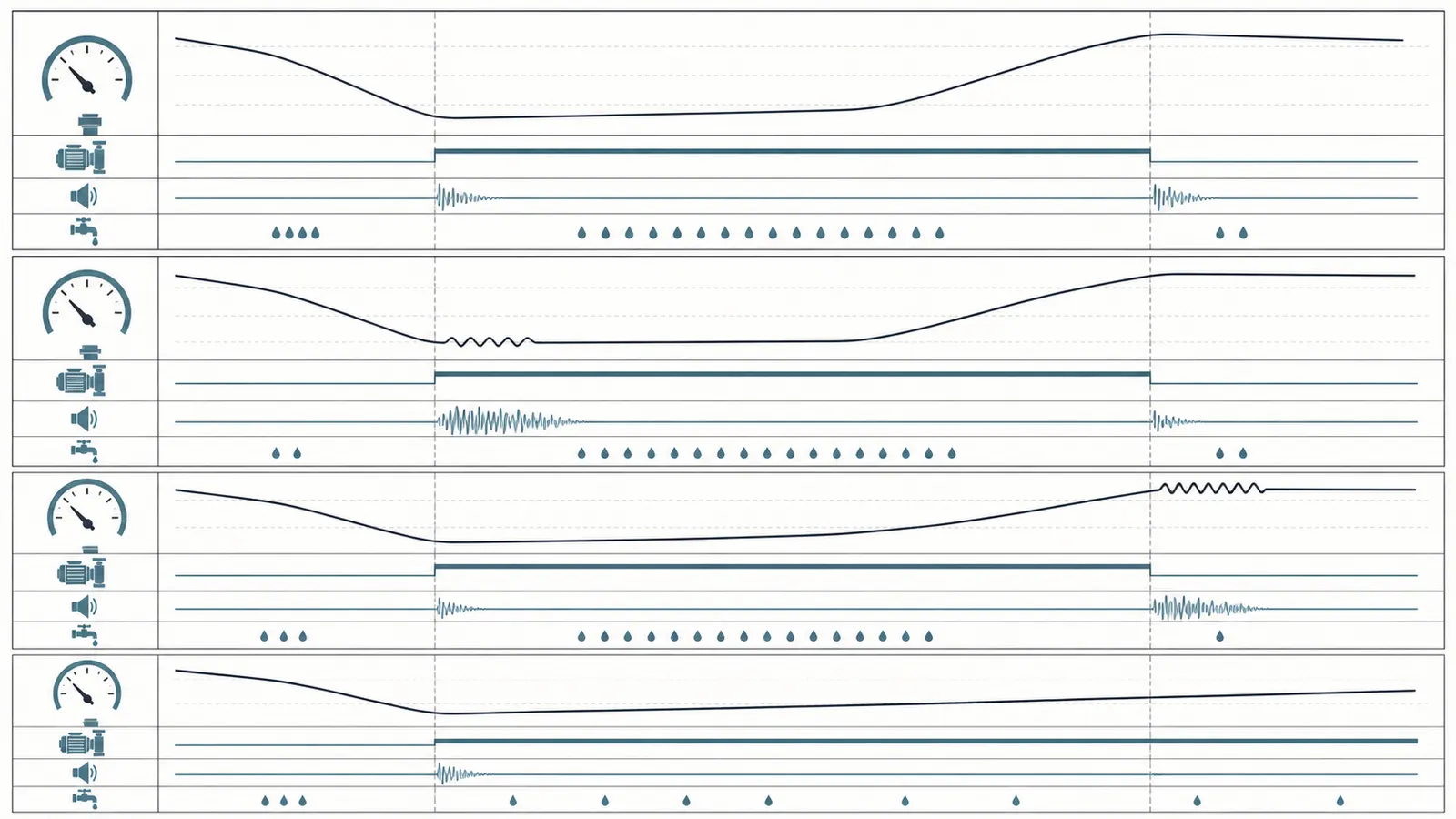
Read the four common gauge patterns
Smooth fall, clean start, smooth rise, clean stop. This is the ordinary reference pattern. A single switch click at each threshold is not chatter. If the water pressure still feels poor, that is a separate flow or sizing question.
Small back-and-forth movement near cut-in with repeated clicking. This is the strongest homeowner-observable pattern for start-side chatter. It can be consistent with a switch seeing unstable pressure, a sensing passage restriction, a tank or piping arrangement that transmits pressure poorly, vibration, or a control/contact problem. Little Giant lists pressure differences, tank placement, pipe size, check-valve behavior, and switch blockages among its checks. Use that list as a service scope, not a homeowner repair recipe.
A rise toward cut-out followed by repeated clicks and small pressure reversals. This is stop-side chatter. The professional may inspect whether flow is surging, the pump is near its operating limit, the sensing path is restricted, the switch is vibrating, or the contacts are worn. Schneider Electric’s pressure-switch guidance identifies excessive vibration near the operating point as a mechanism for contact bounce or chatter, while its discussion is for an industrial switch family rather than a residential specification. See the Schneider guidance and its industrial scope.
Repeated sawtooth cycles with one start and one stop per cycle. This is short cycling, not necessarily chatter. Pentair lists low precharge, a waterlogged tank, leaking pipes, leaking foot valves, open faucets, clogged pump components, and pressure-switch issues as possible causes when a pump cycles too frequently. See Pentair’s shallow-well troubleshooting table. For a submersible system, Pentair also lists system leaks, tank or bladder problems, a pressure switch too far from the tank, and other pump-side or valve conditions. See the submersible-pump troubleshooting table.
That difference matters because replacing a switch may not restore water storage or stop a leak. It can also leave the original hydraulic problem in place while the new contacts are exposed to the same rapid operation.
4. Follow the timing branch: start, stop, or no shutoff #
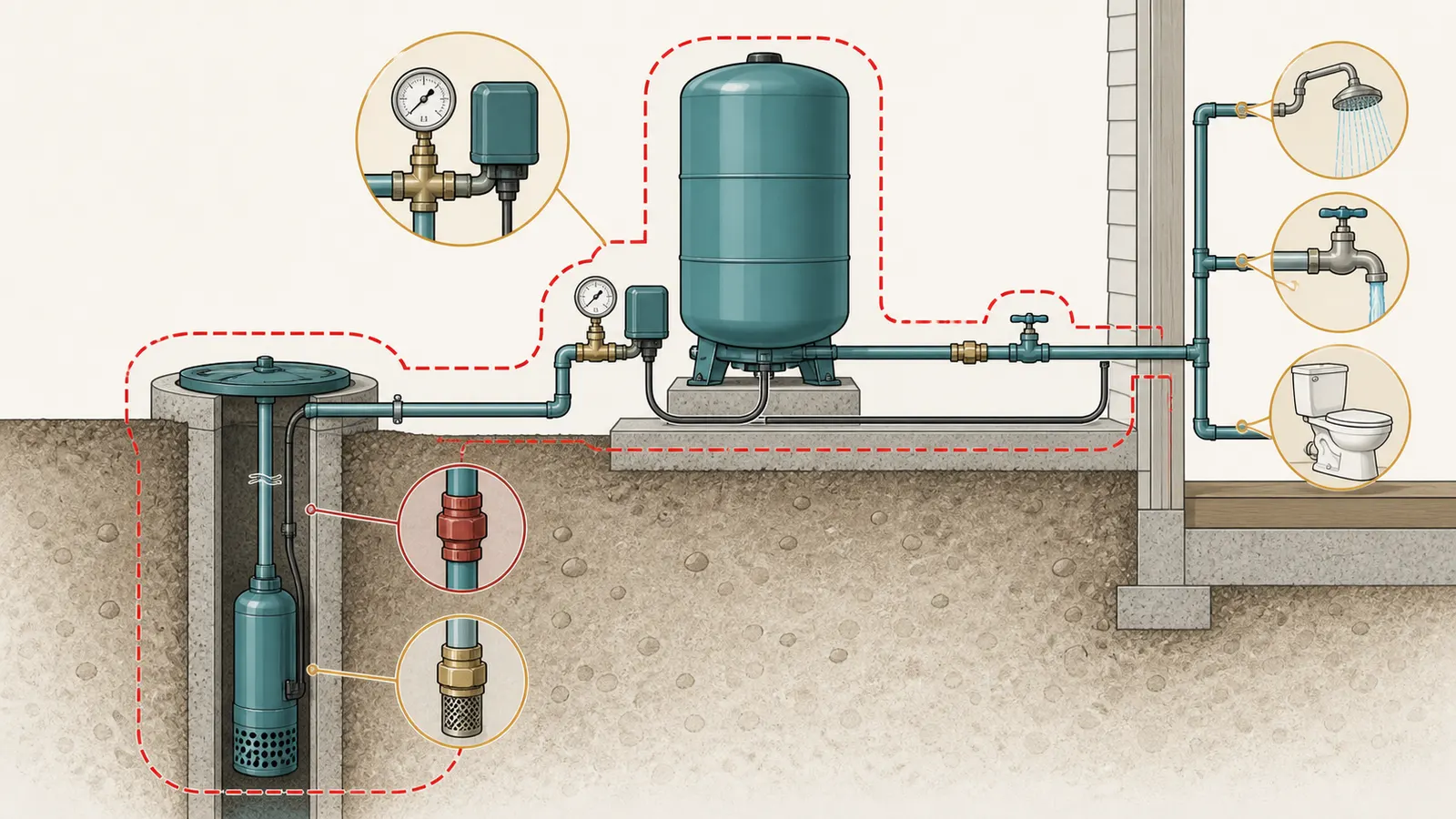
The pressure-tank troubleshooting flow below is deliberately model-agnostic. It uses observations for the homeowner and assigns energized, pressurized, buried, or disassembly work to a professional.
Branch A: chatter at pump start
This branch begins while the gauge is falling and the system is approaching cut-in. Record whether the pump starts immediately after the first click or whether the contacts repeat before the motor starts. Record whether the gauge bounces around the start reading.
Possible service directions include:
- Tank-to-switch relationship: Amtrol says the tank should be as close as possible to the pressure switch to reduce friction loss, elevation difference, and pressure-switch bouncing. Read Amtrol’s installation guidance. A professional should inspect the actual layout, pipe size, fittings, and sensing connection rather than assuming that “nearby” is close enough.
- Pressure signal restriction: A blocked or narrowed sensing passage can delay or distort what reaches the switch. Little Giant includes switch blockages in its chatter checks. The homeowner should not remove the switch, probe a port, or clean a passage while energized or pressurized.
- Tank precharge or tank integrity: A precharge that does not match the tank maker’s specification for the actual cut-in can change how the tank supplies the small amount of water before the pump starts. A failed bladder or waterlogged tank can reduce useful storage and contribute to frequent operation. These are checks for the exact tank and system condition, not a reason to add air blindly.
- Vibration or hydraulic movement: A tank, pump, pipe, or switch mounting problem can make the contact mechanism move near its threshold. Record whether the sound is a crisp electrical click, a metallic vibration, or a pump/motor hum.
- Valve behavior: A leaking check or foot valve can let pressure change when no fixture is open. A stuck, incorrectly placed, or leaking valve may make the gauge pattern misleading. Valve access and testing belong to the service visit.
Branch B: chatter at pump stop
This branch begins while the gauge is rising toward cut-out. The key question is whether the pump reaches its usual stop reading and then chatters, or whether the pressure climbs slowly and never reaches stop.
If the gauge reaches the normal stop range but the switch repeats, record the stop reading, the duration of the chatter, and whether the motor itself cuts out. The professional may inspect switch mounting, vibration, sensing restrictions, pressure surge, contact condition, and whether the tank and switch are arranged as intended. Schneider’s industrial guidance is useful here only as a mechanism reference: vibration and pressure surge can disturb a pressure switch near its operating point, but that does not establish a residential adjustment or a universal pipe distance. See the scoped Schneider source.
If the gauge never reaches the usual stop reading, treat the event as “pump will not shut off” until proven otherwise. Keep the pump from running indefinitely and arrange service. Pentair’s troubleshooting guidance includes open faucets, leaks, clogged venturi/nozzle/impeller components, foot-valve leaks, a waterlogged tank, and switch faults for this symptom. See the exact Pentair shallow-well branch.
Branch C: chatter at both start and stop
Chatter at both thresholds makes the system-level clues more important than a single contact diagnosis. Record whether the gauge bounces at both readings, whether the tank is remote from the switch, whether there is a long or reduced pipe run, and whether the noise began after a pump, tank, valve, plumbing, or electrical change. Little Giant’s list includes tank placement, one-inch pump-to-tank piping for the stated product context, excess tank pressure, check/foot-valve leakage, a check valve between tank and pump, and a blocked or failed switch. Those checks are model-specific service prompts, not a universal retrofit prescription.
Do not respond by turning adjustment nuts until a professional has identified the switch type, current setting, tank condition, and pump capability. Pentair notes that pressure switches may have one- and two-post arrangements and that adjustments change the relationship between cut-in, cut-out, and the tank. See Pentair’s adjustment boundaries.
Branch D: the switch buzzes but the pump does not behave normally
If the switch sound is present but the motor does not start, starts late, or trips protection, the problem may be electrical, motor-related, or a contact issue rather than a pressure-tank setting. Do not open the control to inspect contacts or measure voltage. Give the professional the voltage and horsepower information from the equipment nameplate only if it is readable without removing anything. Franklin’s product range illustrates why voltage assumptions are unsafe. Pentair’s pressure-switch instructions require power to be disconnected before work; Brictale’s conservative safety policy is to leave electrical checks and repairs to a qualified electrician or service professional. Pentair’s instruction sheet sets the disconnect-power boundary. Franklin lists both 115 V and 230 V controls in one product family.
5. The de-energized tank-precharge check: who should do it #
Tank precharge is often the first internet suggestion because the relationship is simple: Amtrol says its well-tank precharge should be 2 PSI below the pressure-switch cut-in, and Pentair gives the same relationship for a precharged tank when there is no water pressure. Amtrol publishes the relationship and examples. Pentair states that the measurement is made with no water pressure.
The safety qualification is not optional. Amtrol warns that a tank under pressure can corrode, leak, rupture, flood, or in rare cases explode; its manual says only qualified professionals should check, adjust, or recharge precharge and warns against adding pressure when corrosion, loss of air, or reduced cycle time could indicate compromised integrity. Read Amtrol’s tank safety warnings.
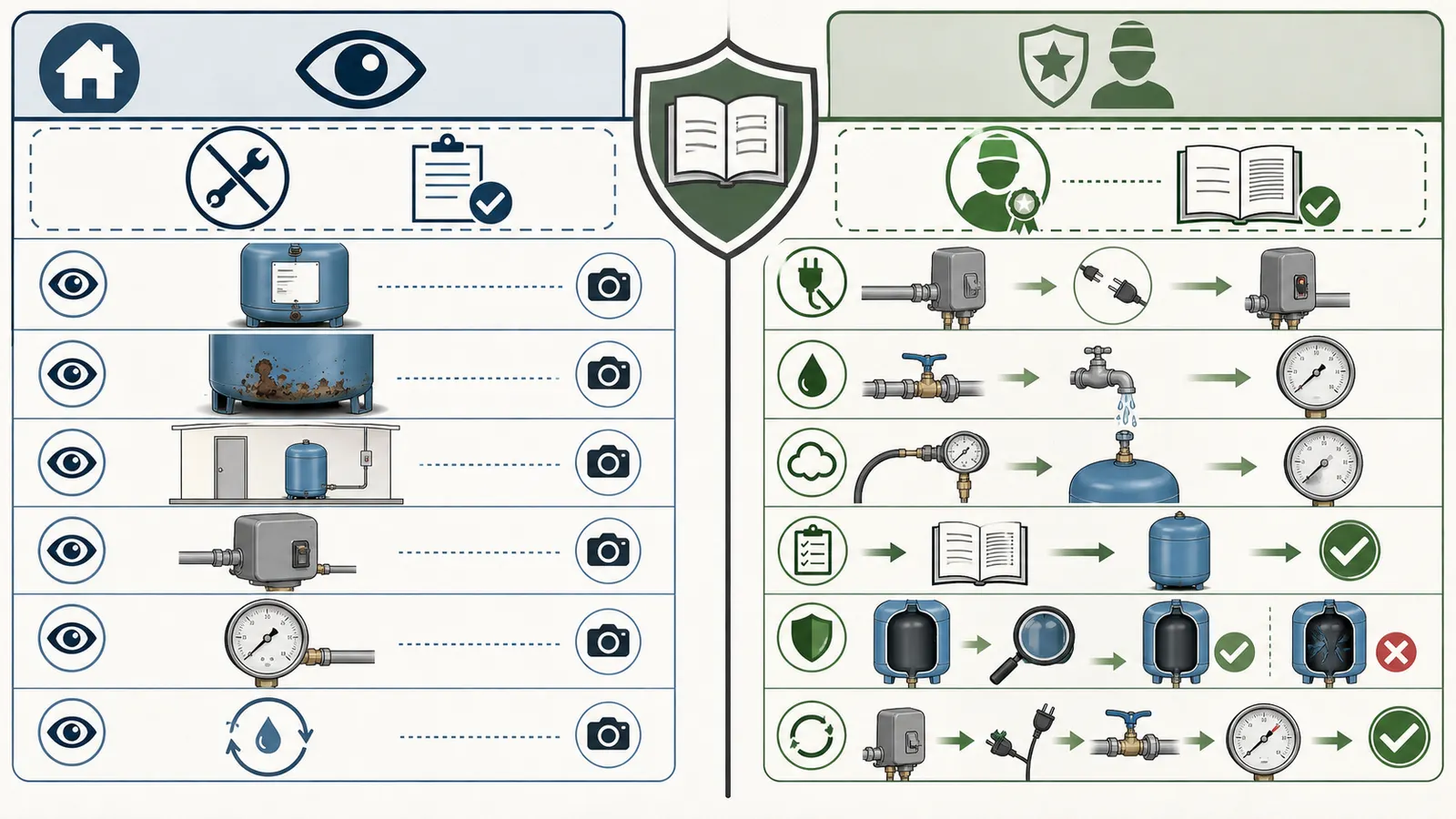
For a homeowner, make this an evidence handoff rather than an automatic repair:
- Record the tank make, model, approximate age, label information, and the pressure-switch setting if those can be read without opening or touching the control.
- Look from the outside for visible corrosion, a leak, deformation, an unsupported tank, or water damage. Do not tap the tank, remove a cap, touch the air valve, or add air.
- Record whether the symptom is chatter, short cycling, low pressure, or a pump that will not shut off. Note whether cycle time recently became shorter; Amtrol treats reduced cycle time as a reason not to re-pressurize blindly.
- Ask the professional to perform the exact tank-maker procedure with power disconnected, water pressure relieved, and the tank integrity assessed before any air is added. The measurement must be made with no water pressure, and the comparison must use the actual cut-in setting and the tank manual.
If the specific tank manufacturer’s current manual expressly permits a homeowner to perform the check, the homeowner still needs a safe disconnect, a safe means of relieving pressure, a suitable gauge, and a tank that has no warning signs. If any of those conditions is uncertain, do not perform it. A generic tire gauge and an internet chart are not enough to make an aged or corroded pressure vessel safe.
What the precharge result can and cannot tell you
Precharge matches the maker’s relationship and the tank is sound. That lowers the likelihood that a simple precharge mismatch is the primary driver, but it does not clear the switch, sensing path, tank location, piping, check valve, pump flow, or vibration.
Precharge is low but the tank is sound and the exact procedure permits correction. The professional may correct it and then repeat the timing and gauge observation. If chatter remains, continue through the decision path rather than replacing the switch automatically.
The tank has little or no air, loses air again, leaks water at the air valve, or shows corrosion or other damage. The likely service path is tank integrity and replacement assessment, not repeated inflation. Amtrol’s warning about internal corrosion is especially important when a shortened cycle time accompanies loss of air.
The reading was taken with water pressure still in the tank. Treat it as unusable for the standard comparison. Pentair and Amtrol both specify the no-water-pressure condition for the relationship.
6. Check the system clues before replacing the switch #
A pressure switch is the visible sound-maker, so it is easy to blame. The better repair decision asks whether the switch is receiving a stable pressure signal and whether the system can reach and hold its intended pressures.
Tank position, piping, and fittings
Measure or estimate the distance from tank to switch and from pump to tank without opening anything. Photograph the layout from a safe distance if useful. Record pipe size only if it is printed or obvious without disassembly. Amtrol says the tank should be as close as possible to the switch; Little Giant calls out tank distance, pipe size, and extra fittings in its chatter checks. Compare the two manufacturer scopes here. Little Giant’s list is specific to its jet-pump FAQ.
Do not turn those observations into a DIY repiping project. A switch can be relocated only after the professional confirms the pump, tank, pressure rating, pipe arrangement, electrical installation, and applicable local requirements. The useful homeowner action is to show the layout before someone buys a replacement switch.
Check or foot valves
A check or foot valve is intended to control the direction of flow in the system arrangement. Little Giant asks whether a check or foot valve is present and leaking, whether extra fittings separate the components, and whether a check valve has been placed between pressure tank and pump in the stated jet-pump application. Pentair’s submersible manual separately identifies leaking system components and a stuck or incorrectly installed check-valve component in a standard-tank arrangement. Read the Pentair scope before applying that branch.
What a homeowner can observe is a pressure drop or pump restart when no intentional fixture is using water, plus the presence of visible plumbing changes or a service history involving valves. What a homeowner should not do is isolate a buried valve, open a well, pull a pump, or dismantle a check valve. Ask the professional to test whether pressure is bleeding back and to identify the valve arrangement for the actual pump type.
Sensing passage, vibration, and contact condition
The pressure switch needs a pressure signal, a stable mounting arrangement, and electrical contacts capable of making and breaking the motor circuit. A blocked sensing passage can delay the signal. Vibration can move the mechanism near its threshold. Worn, dirty, or damaged contacts can make the sound without providing a clean motor command. Little Giant includes blockages and switch condition; Schneider’s industrial source describes vibration-related contact bounce and surge effects. Use the Little Giant FAQ for the residential symptom list. Use Schneider only for the mechanism and industrial scope.
The homeowner’s safe contribution is to describe the sound, photograph the exterior label and layout, and note whether the gauge bounces. The professional’s work is to isolate power, verify the pressure signal, inspect the sensing path and mounting, evaluate contacts and wiring, and confirm the switch is correctly selected for the motor and system.
Flow, leaks, and low water
If pressure rises slowly, stalls below cut-out, or falls again as soon as the pump stops, the system may have more water demand or loss than the pump can overcome. Pentair’s troubleshooting tables include open faucets, leaking pipes, leaking foot valves, clogged pump components, low water, and other pump-side conditions. See the shallow-well troubleshooting branches.
That is why “the pump will not shut off” needs its own branch. Do not close a valve to force the pressure up, do not run the pump unattended, and do not infer that the pressure switch is defective simply because it is the part associated with the symptom. A professional can measure flow, inspect above-ground restrictions, evaluate well recovery, and determine whether the pump can reach the switch’s cut-out under the actual demand.
7. Decide between observation, service, and replacement #
Use the following repair-versus-service matrix when deciding what to do next:
| Evidence you have | Reasonable interpretation | Action now | Ask the professional to verify |
|---|---|---|---|
| One clean click at start and stop, smooth gauge, no performance change | Normal switching is plausible | Monitor and record the baseline | Whether the switch settings and run time match the system design if the owner is concerned |
| Repeated click/buzz at start with gauge bounce | Unstable pressure signal, tank/piping relationship, vibration, valve behavior, or switch issue are all plausible | Avoid opening the control; capture a short written timing log | Tank location, sensing passage, piping/fittings, precharge under the tank procedure, valve behavior, mounting, and switch condition |
| Repeated click/buzz at stop but gauge reaches normal cut-out | Stop-side chatter or vibration/surge is plausible | Do not adjust the cut-out nut | Switch mounting, pressure signal, flow transition, surge, and contacts |
| Pump cycles every few seconds or minutes with one click per event | Short cycling, not necessarily chatter | Check for an obvious open faucet or visible leak; stop if rapid operation is severe | Tank waterlogging or bladder loss, precharge, system leaks, check/foot valve, switch setting, and pump flow |
| Pump runs and does not reach cut-out | No-shutoff branch | Avoid prolonged operation and arrange service | Open flow, clogged components, low water, leaks, valve condition, pump capability, and switch operation |
| Tank label is missing, tank is corroded, or precharge has been lost | Tank integrity and model-specific safety issue | Do not add air or pressurize the tank | Tank inspection and replacement decision by a qualified professional |
| Sound continues with pump safely off | May be unrelated to pump switching | Record source and timing | Whether the noise is plumbing, a different control, or unrelated equipment |
Replacing the switch becomes a reasonable service decision only after the professional confirms the switch is defective, incorrectly set for the application, damaged, or receiving an unstable signal that has been ruled back to the switch itself. A new switch cannot compensate for a waterlogged tank, failed bladder, leaking valve, remote sensing point, blocked passage, undersized or restricted piping, low water, or a pump that cannot reach cut-out.
The exact switch setting matters. Pentair describes typical 20 PSI cut-in/cut-out differential and a tank precharge 2 PSI below cut-in, but its instructions also show that switch type and adjustment arrangement vary. Use the manufacturer sheet for relationships, not as permission to adjust an unknown system. If a professional proposes a different setting, ask what the pump dead-head pressure, tank rating, fixtures, elevation, and equipment manuals require. Do not accept a setting that exceeds the tank or system rating.
8. Hand off a record that shortens the service visit #
Give the pump professional a compact record. The goal is not to diagnose the part from the driveway; it is to preserve the evidence before the sound disappears or a switch is replaced.
Chatter handoff checklist
- Date, time, and whether the observation was a normal household demand, no intentional demand, irrigation, or an appliance cycle.
- Pump type if known: jet, submersible, or another arrangement. Do not open the well or control to identify it.
- Pressure-switch cut-in and cut-out setting, only if printed on a visible label or in the service record.
- Gauge reading immediately before start, at the first click, during the sound, and at stop or stall.
- Timing: chatter at start, chatter at stop, both, or not tied to a threshold.
- Sound description: crisp repeated clicks, buzz, hum, grind, pipe vibration, or uncertain.
- Gauge behavior: smooth, bouncing, pausing, falling while the pump runs, rising slowly, or stalled below cut-out.
- Pump run time: approximate seconds from start to stop; note whether it never stopped.
- Tank make/model, approximate age, visible corrosion, visible leakage, and location relative to the switch and pump.
- Approximate tank-to-switch and pump-to-tank distance, plus obvious pipe-size or fitting changes if visible.
- Whether a faucet, toilet, water softener, filter, irrigation zone, or leak was using water.
- Whether the sound and motor stopped after using the normal labeled disconnect or breaker, if that observation was made without opening an enclosure. Never probe wiring to make this observation.
- Recent changes: tank, pump, switch, valve, filter, plumbing, electrical work, well yield, or pressure-setting change.
- A clear safety note: no control cover opened, no live test performed, no well opened, no pump pulled, and no pressurized fitting disturbed.
This record lets the professional begin with the branch that matches the evidence. It also prevents a common failure mode: a homeowner hears a switch click, buys a replacement, and loses the timing pattern that would have revealed a tank, valve, sensing, flow, or mounting problem.
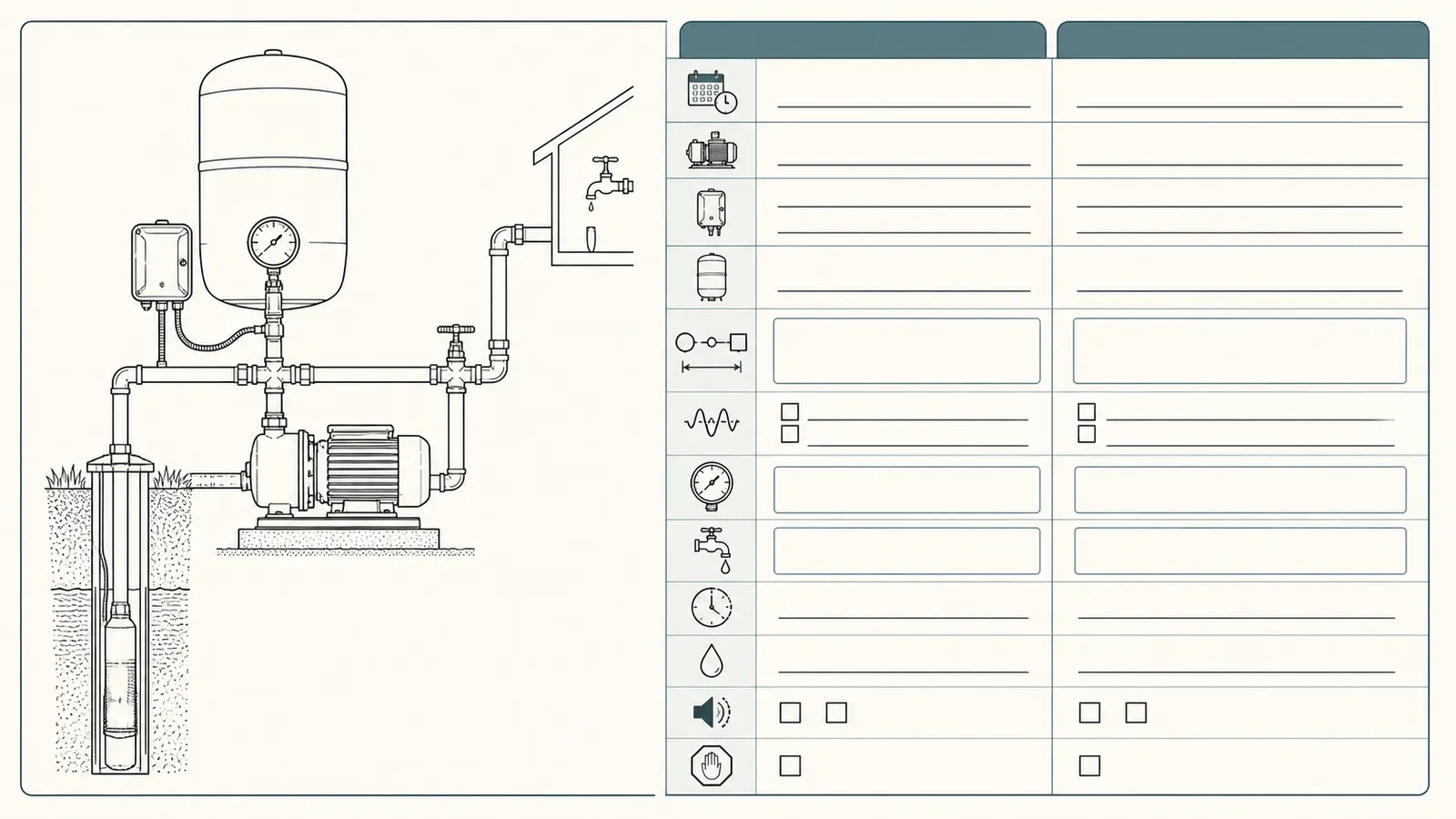
The practical answer
If the sound is one clean click at each threshold, the gauge is smooth, and the pump run time is normal, it may be ordinary cycling. If the sound repeats rapidly at start or stop and the gauge bounces at the same moment, treat it as pressure-switch chatter and arrange qualified service before opening the control. If the pump runs continuously without reaching cut-out, treat it as a no-shutoff problem, limit operation, and do not blame the switch without checking flow, leaks, tank condition, valve behavior, and pump capability. The homeowner’s most valuable evidence is timing plus gauge behavior—not a live voltage test and not a guessed adjustment.
Cite this guide
Brictale. “Why Does My Well Pump Pressure Switch Chatter?.” Published 2026-08-29; updated 2026-08-29.
https://brictale.com/water/pressure-tanks/why-well-pump-pressure-switch-chatters · Read the Markdown version
Sources and scope
Evidence behind this page
- Little Giant's pressure-switch chatter FAQ tells the reader to check for a large pressure difference during cycling, chatter at on/off moments, tank distance from the pump, pipe size between pump and tank, excessive tank pressure, tank condition, leaking check or foot valves, extra fittings, a check valve between the tank and pump, and switch blockages or failure.
Little Giant — Centrifugal Self Priming Pump FAQ
Manufacturer FAQ for Little Giant jet-pump applications; these are service checks and possible causes, not proof that any one cause is present on another pump model.
Accessed · Link to this claim - Amtrol says a well tank should be installed as close as possible to the pressure switch to reduce adverse effects of friction loss, pressure-switch bouncing, and elevation difference.
Amtrol — Pre-pressurized Water System Well Tanks Installation, Operation & Maintenance Instructions
Amtrol precharged well-tank installation guidance; location is a system-design and service clue, not a universal distance specification for every tank or pump.
Accessed · Link to this claim - Amtrol states that well-tank precharge should be 2 PSI below the pressure-switch cut-in setting and publishes example relationships such as 28 PSI for a 30/50 PSI switch.
Amtrol's support guidance for its well tanks; the exact tank manual and switch arrangement control, and the relationship assumes the tank is at no water pressure.
Accessed · Link to this claim - Amtrol warns that a pressure tank can corrode, leak, rupture, or flood, says only qualified professionals should check, adjust, or recharge precharge, and warns against adding pressure when there is visible corrosion, loss of air, or reduced cycle time that may indicate internal corrosion.
Amtrol — Pre-pressurized Water System Well Tanks Installation, Operation & Maintenance Instructions
Amtrol's product safety warning for its precharged tanks; it is a manufacturer-specific safety boundary and should not be weakened into a generic homeowner repair instruction.
Accessed · Link to this claim - Pentair's pressure-switch instructions identify hazardous voltage and require power to be disconnected before working on the motor or pressure switch; they also describe the switch as controlling pump start and stop.
Pentair — Adjusting Well Pump Pressure Switches Instructions
Pentair pressure-switch instruction sheet; it supports a no-energized-control boundary and does not authorize a homeowner to test live wiring.
Accessed · Link to this claim - Pentair says a typical pressure-switch cut-on is 20 PSI below cut-off, and tank precharge is 2 PSI below cut-in with no water pressure; it warns against running a pump against a closed discharge longer than needed to read pressure.
Pentair — Adjusting Well Pump Pressure Switches Instructions
Pentair's pressure-switch system relationships and warning; settings vary by application and should not be adjusted from a generic internet rule.
Accessed · Link to this claim - Pentair's shallow-well pump troubleshooting table lists an out-of-adjustment or welded pressure switch, open faucets, clogged pump components, a waterlogged standard tank, leaking pipes, leaking foot valves, and low precharge as possible causes when a pump does not shut off or cycles too frequently.
Pentair — Pro Shallow Well Jet Pumps Installation and Operation Manual
Pentair Pro shallow-well jet-pump troubleshooting; it supports branching and handoff questions, not a diagnosis of a different pump or a homeowner instruction to replace parts.
Accessed · Link to this claim - Pentair's submersible-pump manual lists system leaks, a defective or misadjusted pressure switch, a waterlogged tank or leaking bladder, a drop-pipe leak, and a pressure switch too far from the tank as possible causes when a pump starts too frequently; it also lists stuck or incorrectly installed check-valve components in a standard-tank setup.
Pentair — 4-inch Submersible Pumps Installation and Operation Manual
Pentair 4-inch submersible pump troubleshooting; check-valve details are specific to the stated standard-tank arrangement and must not be generalized to every installation.
Accessed · Link to this claim - University of Georgia's system description says a pump, pressure tank, pressure switch, and check valve work together: the tank helps prevent pump cycling for small demands, the switch responds to pressure changes, and the check valve prevents pressurized water from returning to an atmospheric source tank in the described arrangement.
University of Georgia Extension — Georgia Rainwater Harvesting Guidelines, Chapters 1–5
University of Georgia description of a pump-and-pressure-tank arrangement in a rainwater system; it supplies component-function context and is not a national well-system installation rule.
Accessed · Link to this claim - Franklin Water lists residential inline pump controls in both 115 V and 230 V configurations, showing why a homeowner should identify the equipment and use its disconnect procedure rather than assume the system voltage or probe live conductors.
Franklin Water — Inline Controls Pressure Boosting System
Franklin's inline-control product range; it demonstrates model-specific voltage variation and is not a claim that every well pump uses one of these controls.
Accessed · Link to this claim - Schneider Electric's pressure-switch guidance says excessive vibration can cause contact bounce or chatter, especially when system pressure is near the operating point, and discusses surge reduction by placing the switch close to an accumulator and away from a pump or quick-acting valve.
Schneider Electric — Industrial Pressure Switches and Vacuum Switches, 9012CT9701
Schneider's industrial 9012G pressure-switch guidance; it supports vibration and surge as mechanisms a qualified professional may investigate, not a direct residential installation specification.
Accessed · Link to this claim - An OSHA accident report documents a fatal electrical contact while an employee was replacing a switch on an electric well pump at 480 volts, illustrating that pump-switch replacement is electrical work with potentially fatal energy and is not a live troubleshooting exercise for a homeowner.
OSHA — Accident Report: Employee Replacing Switch on Electric Pump Is Electrocuted
OSHA workplace incident record at 480 V; it is an incident example, not a residential voltage rule or a substitute for applicable electrical requirements.
Accessed · Link to this claim