What Size Pressure Tank Do I Need for My Well Pump?
Model-neutral U.S. worksheet to size a well-pump pressure tank by required drawdown, exact manufacturer charts, pressure settings, and safe system checks.
The short answer
Size by usable drawdown, not nominal gallons. Start with pump flow × documented minimum run time; if the documented storage input is supplemental, add it to that minimum, while an already-total peak-demand requirement is compared as a total. Match the result to the exact model chart at verified cut-in/cut-out settings and use controller-specific guidance for constant-pressure or variable-speed systems.What Size Pressure Tank Do I Need for My Well Pump?
Start with usable drawdown, not the gallon number printed on the tank. For a conventional single-speed well pump with a documented cut-in and cut-out, calculate the water volume needed to keep the pump running for the specified minimum run time, then compare that required drawdown with the exact replacement model's manufacturer chart at your actual pressure settings. Check the tank's maximum pressure, connections, temperature range, dimensions, and relief protection separately. A constant-pressure or variable-speed system needs its controller-specific sizing method, not a conventional 30/50 worksheet.
The Water Systems Council describes a pressure tank as a way to reduce rapid pump cycling, supply water between pump cycles, and add pressurized storage when pump or well capacity cannot immediately meet demand. It also says tank selection requires system demand, pump capacity, and well capacity—not just household size or motor horsepower. (Water Systems Council's pressure-tank sizing guidance)
This page is a model-neutral decision worksheet for a homeowner preparing a replacement conversation. It does not select a brand, certify a tank, authorize a pressure adjustment, or replace the current manual for the installed pump, controls, tank, or local installation.
1. Decide whether this worksheet fits your system #
The calculation below assumes a conventional pressure-switch system with a repeatable pump stop at cut-out and pump restart at cut-in. In that arrangement, the tank supplies water while pressure falls through the switch band; the pump then runs to rebuild pressure. The inputs are meaningful only if those two events are real, documented, and measured consistently.
Use the worksheet when all of these are true:
| Fit check | What you need to observe or document | If missing |
|---|---|---|
| Pump behavior | The pump stops and restarts as separate events | Mark the result not comparable |
| Pump flow | A measured or documented flow in gallons per minute at the system's working condition | Do not substitute horsepower |
| Pressure band | Verified cut-in and cut-out readings, such as 30/50 or 40/60 psi | Do not borrow a common setting |
| Run-time target | A minimum run time from the pump, controller, or qualified system design | Do not invent a universal number |
| Tank identity | Exact manufacturer and model, or a candidate model with a current chart | Use no nominal-gallon shortcut |
| System type | Conventional fixed-speed, or a controller-specific constant-pressure system | Branch to the controller method |
| Installation fit | Height, diameter, connection, maximum pressure, temperature, and service access | Treat the model as unverified |
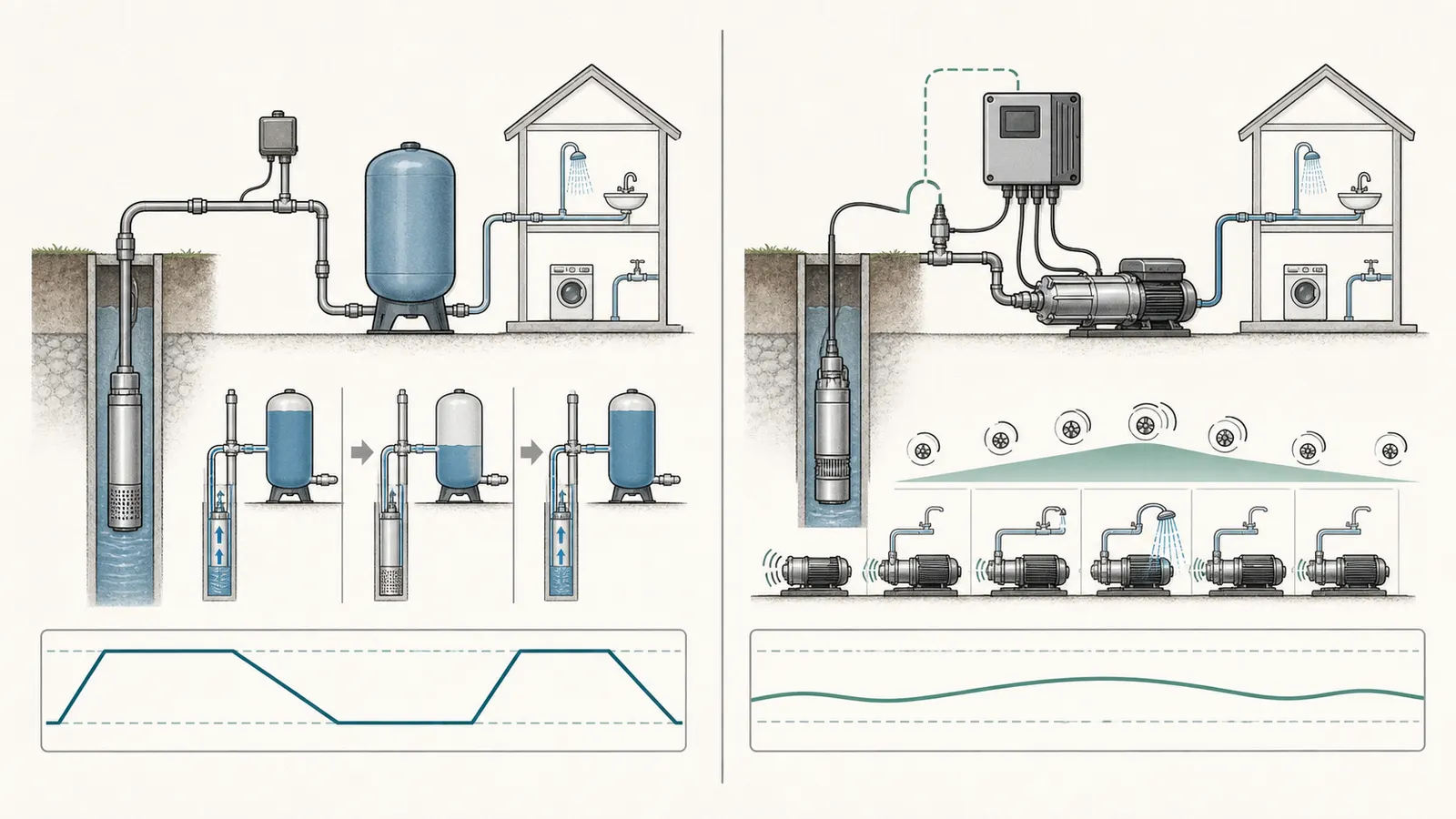
Do not use the conventional worksheet for a system driven by a variable-frequency drive, electronic pressure transducer, constant-pressure controller, or another arrangement that changes pump speed with demand. Pentair describes its Intellidrive constant-pressure system as using instantaneous pressure-transducer feedback to change motor speed as demand changes. That is not the same control pattern as a pump that simply switches on and off at fixed pressures. (Pentair's constant-pressure system description)
Xylem's Aquavar manual makes the same practical point from another manufacturer: its constant-pressure application has a pressure transducer and diaphragm tank, calls for motor-specific variable-frequency-drive compatibility and programming, and has a separate tank-sizing recommendation for that application. (Xylem/Goulds' constant-pressure application section) A variable-speed homeowner should record the controller and tank model and ask for the current controller manual or a qualified design review. Do not force the system into “30/50” because that is familiar.
Safety boundary before any measurement
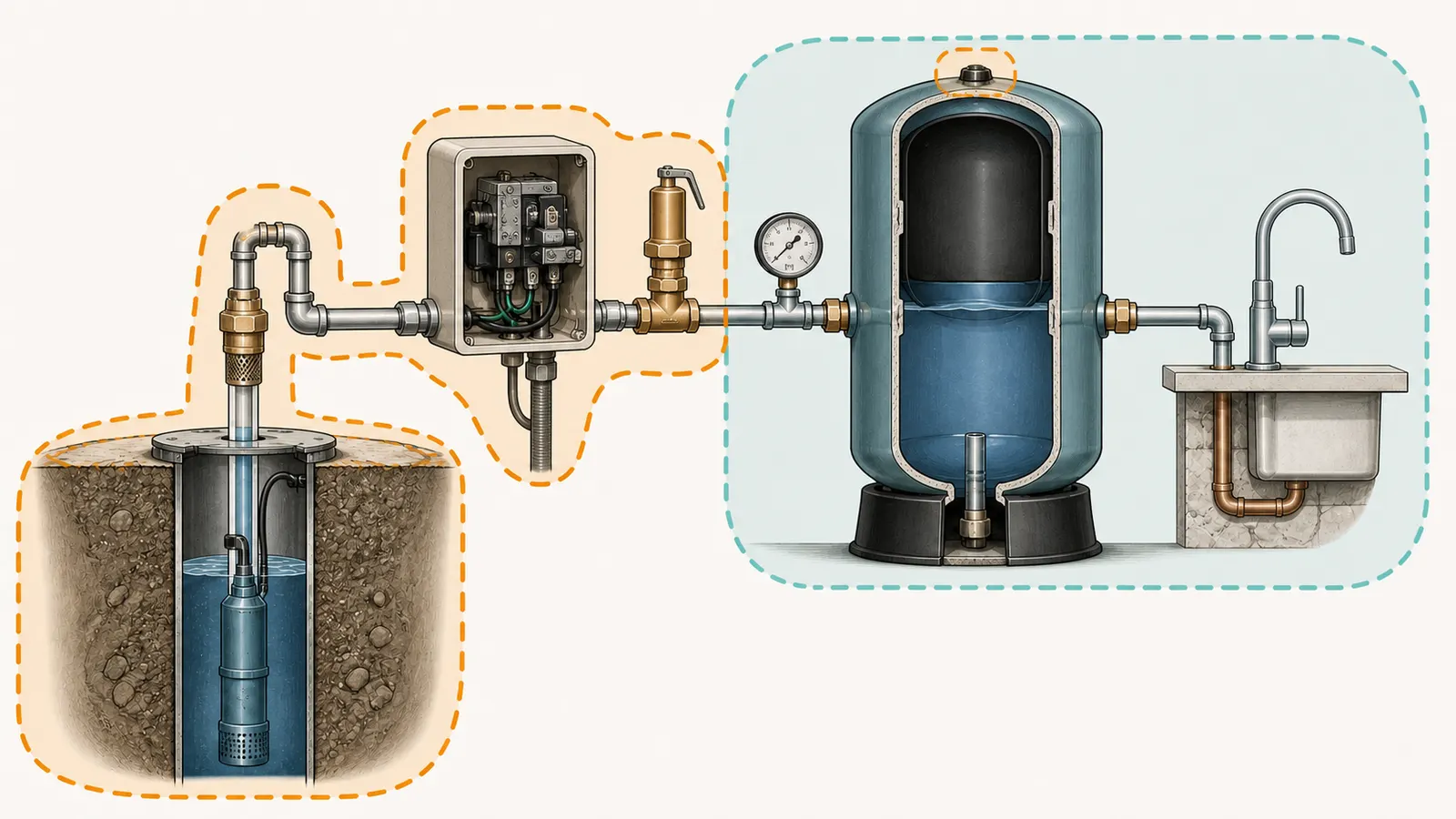
A pressure tank is a pressure vessel connected to plumbing and pump controls. Do not open an energized control enclosure, test live wiring, change pressure-switch settings, open the well, pull a pump, enter a well pit or other confined space, loosen pressurized fittings, remove a relief valve, or manipulate the tank air valve as part of this worksheet. Do not use a visual glance at the tank as proof that its internal bladder, diaphragm, air cell, gauge, or pressure rating is sound.
The homeowner-safe part of this page is recording labels, observing the gauge from a safe position, and collecting water from an ordinary downstream cold-water fixture if the discharge is safe and permitted. Electrical isolation, pressure release, precharge measurement, component replacement, wiring, well work, and any service inside a control box belong to a qualified professional following the exact equipment instructions.
2. Record the inputs before choosing a tank #
The worksheet has three separate jobs: calculate a required drawdown, compare that requirement with a published model chart, and decide whether the candidate can physically and safely live in the installation. Mixing those jobs is how a tank with a large label can pass a casual comparison while delivering too little water between pump cycles.
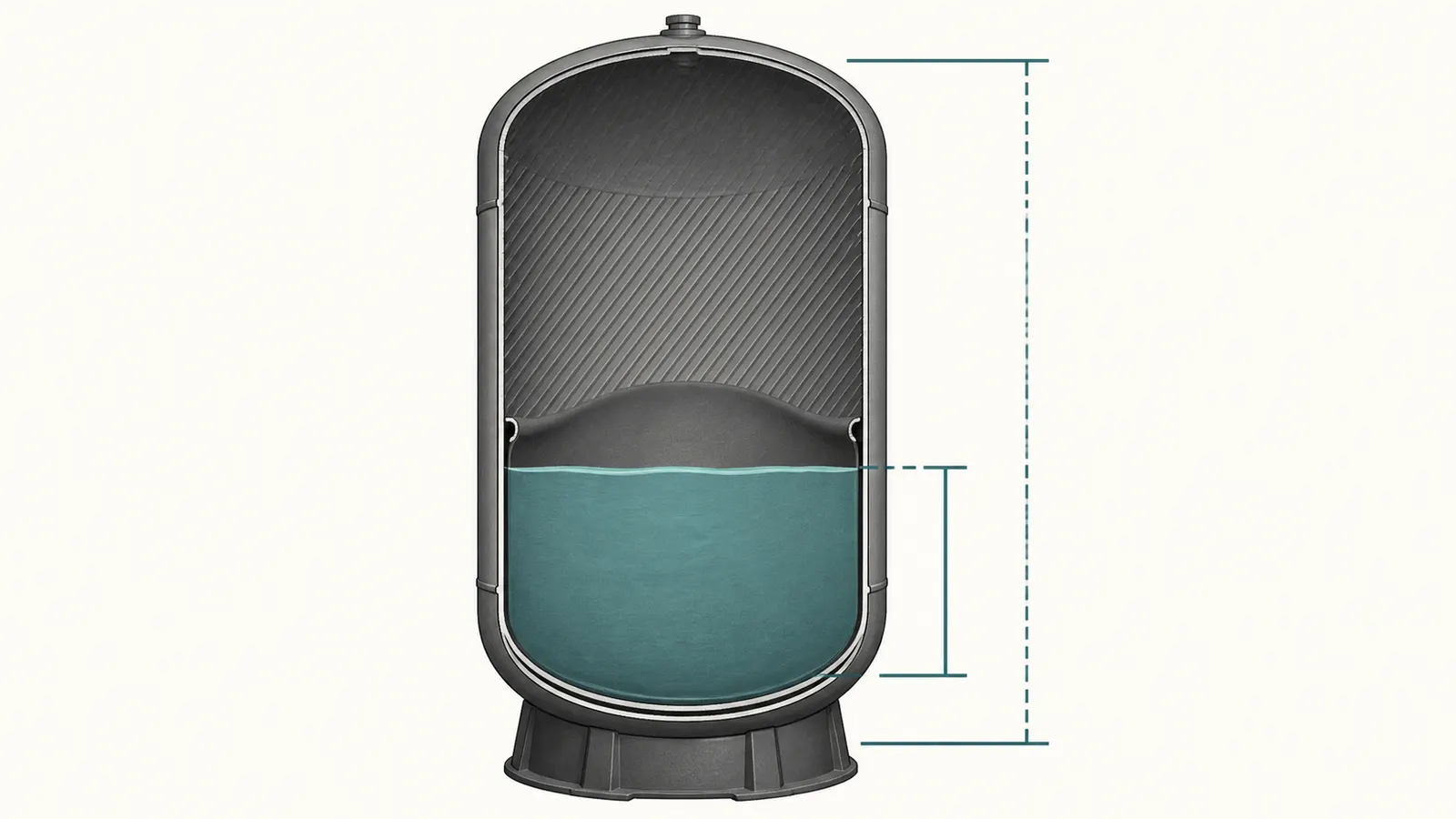
The calculation inputs
Record the following from documentation or a repeatable, safe observation:
| Input | Your value | Why it matters |
|---|---|---|
| Pump flow at the relevant operating point | ____ gpm | Sets how much water the pump must move during its target run time |
| Target minimum pump run time | ____ minutes | Sets the minimum drawdown needed for the pump cycle |
| Verified cut-in pressure | ____ psi | Selects the lower edge of the manufacturer chart |
| Verified cut-out pressure | ____ psi | Selects the upper edge of the manufacturer chart |
| Current observed drawdown | ____ gallons | Baseline for the existing system, not automatically the new requirement |
| Storage requirement type | supplemental / already-total peak-demand / none | Determines whether the documented amount is added or compared as a total |
| Supplemental drawdown, if it is additional | ____ gallons | Added to the pump-run-time minimum; leave blank when the documented input is already a total |
| Total peak-demand storage, if already calculated as a total | ____ gallons | Compared with the pump-run-time minimum; do not add it a second time |
Pentair's Wellmate sizing worksheet uses the same structure: pump delivery rate, desired minimum run time, and minimum and maximum system pressure. It multiplies pump flow by minimum run time to get minimum drawdown, then uses the pressure-range factor to determine the minimum total tank volume. (Pentair's tank-sizing worksheet)
Use measured or documented pump flow at the pressure and duty point that matter. A pump's free-flow rating, a motor horsepower label, or a retailer's “typical GPM” is not proof of flow at your house. The Water Systems Council says an existing pump's capacity must be determined, and its pump-sizing guidance frames capacity around normal peak household demand and well capacity. (Water Systems Council's pump-sizing guidance)
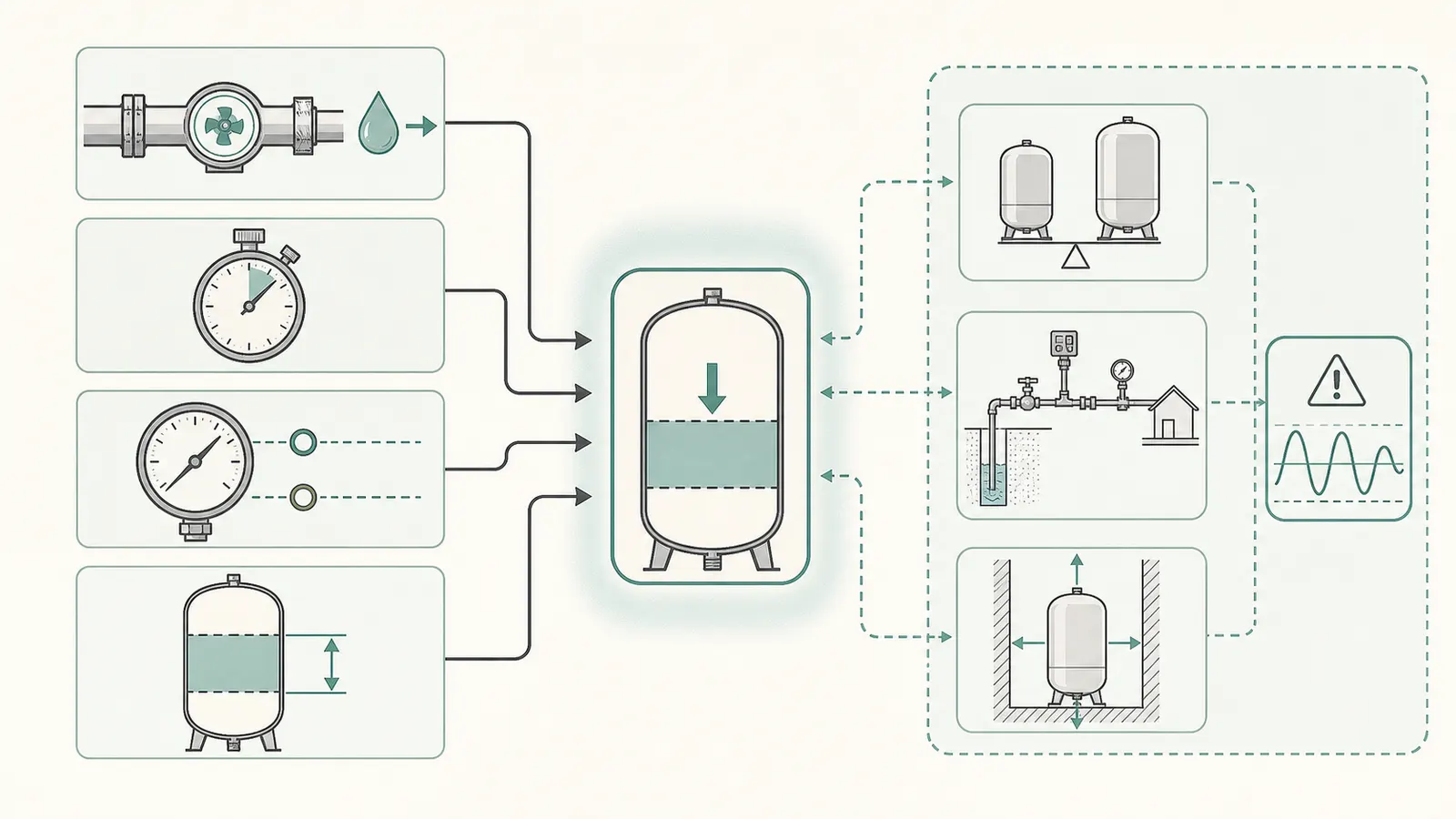
The comparison and fit inputs
Record these separately from the formula:
| Candidate-tank check | Record from the current model chart or installation instructions |
|---|---|
| Exact manufacturer and model | ______________________________ |
| Published drawdown at your cut-in/cut-out | __________________ gallons |
| Published total or nominal capacity | __________________ gallons |
| Maximum operating pressure | __________________ psi |
| Connection size and orientation | ______________________________ |
| Diameter and overall height | ______________________________ |
| Service-clearance requirement | ______________________________ |
| Temperature limits | ______________________________ |
| Relief-valve and installation requirements | ______________________________ |
| Chart assumptions or notes | ______________________________ |
Measure the available space without disconnecting anything. Record the narrowest doorway or path if the tank must be carried to the location, the floor footprint, the ceiling or overhead clearance, the connection height, and whether the tank can be serviced without blocking a shutoff or gauge. A tank that meets a drawdown target but cannot be installed with its required support, connection orientation, relief protection, or service access is not a valid selection.
3. Calculate the required drawdown #
For a conventional fixed-speed system, the first-pass calculation is:
minimum required drawdown = pump flow (gpm) × target minimum run time (minutes)
Example: if documented pump flow is 8 gpm and the equipment documentation calls for a 1-minute minimum run time:
8 gpm × 1 minute = 8 gallons of required drawdown
This is a water-volume target, not a tank-shell size. The tank selected must publish at least that drawdown at the exact pressure band, or the candidate fails the chart check. Pentair's catalog uses this same sequence and shows a product-specific example: 8 GPM × 1 minute produces 8 gallons of required available water, and a .30 chart factor yields a 26.7-gallon minimum total tank capacity for its stated 30–50 psig example. (Pentair's worked sizing example)
Do not carry the 26.7-gallon result into another tank line. The number is the result of the stated flow, run time, pressure band, and Pentair factor. A different tank design, precharge instruction, pressure range, or chart can produce a different relationship between total volume and drawdown.
Add supplemental drawdown; do not double-count a total requirement
The pump-run-time result is not the whole system design when the well or pump cannot satisfy peak demand. A pressure tank may need to provide supplemental drawdown during a demand period. Water Systems Council's pump-sizing guidance says that when peak demand exceeds the water available from the well, added storage can be used; its pressure-tank sheet describes total required drawdown as minimum drawdown plus supplemental drawdown when the pump cannot meet peak system demand. (Water Systems Council's pressure-tank sizing guidance)
First classify the documented storage input. “Supplemental drawdown” means additional gallons beyond the pump-run-time minimum. “Total peak-demand storage” means the source has already combined the system's storage needs into one total. Use the following decision rule:
minimum drawdown = pump flow × documented minimum run time

if the documented input is supplemental drawdown:
  required design drawdown = minimum drawdown + supplemental drawdown

if the documented input is already-total peak-demand storage:
  required design drawdown = the larger of minimum drawdown and total peak-demand storage

if no documented storage input exists:
  required design drawdown = minimum drawdown
Each nonblank storage input must come from a documented demand calculation, well-capacity assessment, pump design, or qualified professional—not from a guess based on the number of people in the home. The Water Systems Council offers fixture, peak-demand, and bathroom-based planning methods, but its examples are demand estimates, not a measurement of your pump's delivery at pressure. If the source does not say whether its gallons are supplemental or already total, record the result as not comparable until the source or a qualified professional clarifies it. (Water Systems Council's demand methods)
What current drawdown can and cannot tell you
Current drawdown belongs in the worksheet because it exposes what the old tank is actually delivering under the observed pressure cycle. It does not automatically become the new tank's required capacity, and it does not turn the old nominal label into a design specification.
Use it as a baseline:
current drawdown = gallons delivered from pump stop to pump restart
If the current tank supplies 6 gallons between events, that tells you about the existing installation under those conditions. It does not prove that a replacement should provide 6 gallons, because the pump flow, target run time, household demand, pressure band, and system type may have changed. A replacement should meet the documented design requirement and the exact model chart, not merely copy a possibly undersized or degraded tank.
4. Match the result to the exact manufacturer chart #
The chart check is the decision surface. A model passes only when its published drawdown at the verified pressure settings is at least the required design drawdown and the model's installation limits fit the system.

Use this comparison table
| Decision field | Required result | Candidate model result | Decision |
|---|---|---|---|
| Minimum design drawdown | ____ gal | Published at exact settings: ____ gal | Candidate must be equal or higher |
| Cut-in / cut-out | ____ / ____ psi | Chart band: ____ / ____ psi | Must match or be explicitly supported |
| Maximum operating pressure | System maximum: ____ psi | Tank maximum: ____ psi | Tank rating must cover the system |
| Connection and orientation | ____ | ____ | Must fit without unsafe rework |
| Space and service access | ____ | ____ | Must fit footprint, height, path, and access |
| Relief protection and local requirements | Confirmed by professional | Model instructions: ____ | Stop if unknown or incompatible |
Pentair defines a drawdown factor as the percentage of total tank volume that can be stored and delivered for a specific pressure range. Its catalog chart also warns that actual drawdown can vary with system variables, including the accuracy and operation of the pressure switch and gauge and the operating temperature. (Pentair's drawdown-factor chart and limitations) That is why the article does not give a universal “a 44-gallon tank supplies X gallons” answer.
If a chart gives a factor for the exact model family and pressure band, a manufacturer-specific calculation may look like this:
published drawdown = charted total capacity × chart factor
minimum total capacity = required drawdown ÷ chart factor
For example, Pentair's catalog shows a .309 drawdown factor for a named Comptec model at 30 psi on and 50 psi off, then multiplies 245 gallons by .309 to show 75.7 gallons of drawdown. That is a named-model example, not permission to multiply any tank label by .309. (Pentair's named-model chart example)
Treat “not comparable” as a real result
The worksheet should return not comparable rather than a number when any of these is true:
- The exact tank model is unknown, or the chart is for a related-looking but different model.
- Cut-in and cut-out are assumed rather than verified.
- The pressure band in the chart does not match the observed or documented band.
- The pump is variable-speed, constant-pressure, transducer-controlled, or otherwise lacks a conventional discrete cycle.
- The candidate's maximum pressure, temperature limit, connection, or installation requirement is unknown.
- The gauge is unreadable or unstable and no reliable pressure record exists.
- The pump never reaches cut-out, never restarts normally, or is running continuously.
“Not comparable” is safer than making a false calculation from nominal gallons. Bring the exact model label, photographs of readable labels without opening anything, the current manual, gauge observations, pump/controller model, measured or documented flow, and the space measurements to the professional who will select or quote the replacement.
5. Use a drawdown measurement as evidence, not as a diagnosis #
Water-contamination boundary before collecting any sample
This water observation is separate from the pressure-tank sizing decision. If contamination is suspected—for example after flooding, a sewage or chemical event, or a sudden unexplained change in water appearance, odor, or taste—treat the water as non-potable. Do not drink, touch, or otherwise use suspect water, and do not collect it for an ordinary household purpose. Stop the worksheet and contact the applicable local health or environmental authority for testing, containment, disposal, and return-to-use guidance. Use bottled water or another known-safe source until that authority says the water may be used again. CDC guidance likewise says not to drink a private well when contamination is suspected, to contact the local health department, and to test before returning to drinking or other use. (CDC's guidance for treating well water)
If the water-safety boundary is clear and the system is a conventional fixed-speed installation with the exact tank rating and relief protection known, a homeowner may be able to observe a drawdown cycle from a normal, tool-free downstream cold fixture. This is an observation worksheet, not a pressure-vessel service procedure.
Before collecting water, schedule the observation when irrigation, appliances, treatment regeneration, and other household demand are off. Do not close, move, bypass, or adjust unidentified valves. Confirm that the discharge will not flood the room, contact electrical equipment, damage a drain, or violate a local requirement. Use a container with a known volume or graduations, a timer, and one fixture only.
Record three trials if the first is safe and repeatable:
| Field | Trial 1 | Trial 2 | Trial 3 |
|---|---|---|---|
| Pump stop / cut-out | ____ psi | ____ psi | ____ psi |
| Pump restart / cut-in | ____ psi | ____ psi | ____ psi |
| Gallons from stop to restart | ____ gal | ____ gal | ____ gal |
| Refill time from restart to stop | ____ min | ____ min | ____ min |
| Other water use | none / known | none / known | none / known |
| Gauge behavior | smooth / unknown | smooth / unknown | smooth / unknown |
The definition matters: start collecting after the pump has stopped and the pressure has stabilized; stop counting at the pump's restart. Do not keep counting after restart and call that tank drawdown, because water after the pump starts includes pump delivery. Do not use a tank drain, relief-valve outlet, air valve, hot-water outlet, or any location near electrical equipment.
Calculate the repeatability range rather than hiding it in an average:
spread = highest valid gallons − lowest valid gallons
average = sum of valid gallons ÷ number of valid trials
A wide spread can come from an early or late restart, inconsistent faucet flow, competing demand, a sticky gauge, a treatment cycle, or a changing well condition. It does not identify a failed tank. A low observation that cannot be repeated under comparable conditions is evidence to improve the measurement or request professional diagnosis, not a reason to buy the largest tank on the shelf.
When the exact model and pressure band match, compare the observed gallons with the published drawdown and preserve the measurement uncertainty. Do not create a universal pass/fail percentage. Pentair specifically warns that actual drawdown varies with system variables, including switch and gauge accuracy and temperature. (Pentair's actual-drawdown limitations)
Interpreting common results
| Observation | Reasonable interpretation | What not to infer | Next safe step |
|---|---|---|---|
| Repeatable drawdown matches the exact chart, but pump starts often | Tank may be working while the design drawdown is small for the pump or demand | It does not prove the tank needs replacement | Review flow, target run time, demand, well yield, and cycle history |
| Repeatable drawdown is below the exact chart | A system condition or tank condition needs isolation | It does not identify the failed component | Give the record to a qualified professional before changing parts |
| Results vary widely | Test conditions, gauge, demand, or well recovery may be changing | It does not prove a waterlogged tank | Stop averaging; repeat only under controlled, safe conditions or escalate |
| Pump will not stop or pressure will not build | The system is outside this worksheet | It does not prove the tank caused the symptom | Stop the observation and arrange qualified service |
| Tank leaks, bulges, or has significant corrosion | Pressure-vessel integrity may be compromised | It does not justify adding air or tightening fittings | Keep clear and use qualified service |
6. Handle 30/50, 40/60, and pressure-setting changes carefully #
“30/50” means a 30 psi cut-in and a 50 psi cut-out in a conventional pressure-switch system. “40/60” means a 40 psi cut-in and a 60 psi cut-out. The shorthand is useful only when the settings have actually been verified and the tank's published chart includes that band.
Do not change the pressure switch to make a candidate tank chart appear to fit. A pressure-setting change can affect pump capability, fixtures, treatment equipment, relief protection, precharge, electrical controls, and the tank's maximum operating pressure. The Water Systems Council notes that typical systems commonly operate at 30/50 or 40/60 but also says pressure must be sufficient for the highest and farthest outlet and that a professional should be involved in final selection. (Water Systems Council's pump-pressure guidance)
The relationship between pressure settings and drawdown is not “higher is always better.” A different pressure band changes the chart factor. It may also expose a pump that cannot reach the new cut-out, reduce available flow at the fixture, or exceed a component rating. The correct sequence is to verify the system design and pump curve, select compatible tank and controls, confirm relief protection, and have qualified personnel make any adjustment.
Precharge is part of the engineering record, but the number is equipment-specific. Water Systems Council's typical sizing sheet describes precharge at 2 psi below cut-in. Pentair's Wellmate FAQ gives a Wellmate-specific example of 4 psi below cut-in and states that checking the air cell requires the pump power supply to be turned off and the tank drained. (Water Systems Council's precharge guidance) (Pentair's Wellmate air-cell instructions) The difference is exactly why a homeowner should not apply a remembered rule to a replacement tank.
Do not perform a precharge check yourself if it requires opening controls, isolating electrical equipment, releasing pressure, draining a pressurized vessel, removing a cap, connecting a gauge, adding air, or discharging water. A qualified professional should identify the exact tank manual, isolate and verify the electrical supply, relieve and drain the vessel using the equipment's safe procedure, and document the result before adjusting anything. If the tank has visible corrosion, a leak, deformation, unknown rating, or unknown relief protection, stop rather than attempting a precharge correction.
7. Make the replacement decision and hand off a complete record #
Use the result below as the final decision tree:
- Conventional system, complete inputs, candidate chart meets or exceeds required drawdown, and physical limits fit: the candidate is technically eligible for a professional quote. It is not yet an installation authorization.
- Conventional system, chart drawdown is below the requirement: reject that model for this design, or revisit the documented inputs with a qualified professional. Do not “round up” from nominal gallons without a published chart.
- Exact model or pressure band is unknown: return “not comparable.” Identify the model and verify the gauge or obtain a professional measurement.
- Current drawdown is low but the tank also has a symptom such as leaking, corrosion, continuous pump operation, or rapid cycling: stop the homeowner test. The result may involve the tank, controls, pump, plumbing, well, or demand pattern.
- Constant-pressure or variable-speed system: use the controller and motor manufacturer's tank-sizing instructions. The conventional fixed-speed formula is not the right decision surface.
- Space, pressure rating, connection, temperature, relief protection, or local requirement fails: reject the candidate even if its drawdown is large enough.
Pentair's installation notes require an adequately sized relief valve, say the relief path must not be isolated from the tank by a check valve, and state that plumbing should comply with local codes and standards. Those are product instructions for the referenced tank families, not a national code; the authority having jurisdiction and the current manual for the selected tank control the installation. (Pentair's pressure-relief and local-compliance notes)
Bring this packet to the professional
Keep one dated record with:
- Exact tank manufacturer, model, serial or date code, label capacity, and visible condition.
- Pump, motor, controller, pressure-switch, gauge, and treatment-equipment model information.
- Measured or documented pump flow and its measurement condition.
- Target minimum run time and its source.
- Verified cut-in and cut-out pressures, including gauge location and whether the gauge behaved normally.
- Current drawdown trials, container resolution, timing method, competing demand, and uncertainty.
- Required design drawdown and the calculation showing which input controls.
- Candidate model's charted drawdown at the exact pressure band.
- Maximum pressure, connections, temperature limits, dimensions, service access, relief requirements, and local questions.
Ask the professional to identify the selected tank's published drawdown, show how it meets the required design drawdown, confirm that the pump can operate at the proposed pressure band, and explain any change from the existing tank. If the quote lists only “same size” or “44-gallon equivalent,” ask for the exact model and drawdown value. The useful answer is not a tank label; it is a traceable chain from pump flow and run time to drawdown, chart match, and safe installation fit.
Cite this guide
Brictale. “What Size Pressure Tank Do I Need for My Well Pump?.” Published 2026-08-28; updated 2026-08-28.
https://brictale.com/water/pressure-tanks/what-size-pressure-tank-for-my-well-pump · Read the Markdown version
Sources and scope
Evidence behind this page
- The Water Systems Council identifies pressure-tank functions as reducing rapid pump cycling, supplying water between pump cycles, and providing additional pressurized storage; it says system demand, pump capacity, and well capacity must be known when selecting a tank.
Water Systems Council — Sizing a Pressure Tank
The Wellcare pressure-tank sizing sheet for typical private-well systems; its inputs and functions are not a substitute for the exact installed system's manufacturer documentation or local requirements.
Accessed · Link to this claim - Water Systems Council distinguishes total tank volume from acceptance volume or drawdown and says total volume varies with tank type; a nominal gallon label therefore cannot be treated as a universal usable-storage value.
Water Systems Council — Sizing a Pressure Tank
The distinction between total volume and available water volume on page 3 of the Wellcare sheet; it supports the article's model-neutral terminology, not a universal drawdown factor.
Accessed · Link to this claim - Water Systems Council describes precharge as 2 psi below pump cut-in for its typical pressure-tank sizing guidance and says the tank operates between pressure-switch settings; the instruction is presented in that program's sizing guidance and should not be generalized across tank designs without the exact manual.
Water Systems Council — Sizing a Pressure Tank
The precharge and acceptance-factor discussion in the Wellcare sheet; this claim is intentionally bounded because manufacturer instructions can specify different values.
Accessed · Link to this claim - Pentair's Wellmate catalog says tank selection considers pump delivery rate, recommended minimum pump running time, and minimum and maximum system pressure; it calculates minimum drawdown as pump delivery rate multiplied by minimum run time, then divides by the chart factor and selects a model with capacity at least that result.
Pentair — Wellmate WM900 Composite Pressure Tank Catalog
Pentair's hydro-pneumatic sizing worksheet for Wellmate and Comptec product families; it establishes the structure of a manufacturer-specific sizing check, not a universal model-independent factor.
Accessed · Link to this claim - Pentair defines its drawdown factor as the percentage of total tank volume that can be stored and delivered for the stated pressure range, and warns that actual drawdown varies with system variables including pressure-switch and gauge accuracy and operating temperature.
Pentair — Wellmate WM900 Composite Pressure Tank Catalog
Pentair's drawdown-factor chart instructions and catalog notes; values apply to the documented chart and product family, not to another tank model.
Accessed · Link to this claim - Pentair's worked example uses an 8 GPM pump, a one-minute minimum run time, and a 30–50 psig range to calculate 26.7 gallons of minimum total tank capacity using a .30 factor; that example is tied to its catalog chart.
Pentair — Wellmate WM900 Composite Pressure Tank Catalog
Pentair's example on the tank-sizing worksheet; it is included to show the calculation sequence and must not be applied to a different manufacturer or pressure-tank design.
Accessed · Link to this claim - Pentair's current Wellmate FAQ says an air-cell pressure check requires the well-pump power supply to be turned off and the pressure tank drained, and gives a Wellmate-specific example of 4 psi below pump cut-in.
Pentair's Wellmate FAQ and Wellmate tank family only; it supports the power-off and pressure-release boundary and demonstrates why a homeowner must use the exact model's instructions rather than a universal precharge number.
Accessed · Link to this claim - Pentair describes its Intellidrive constant-pressure system as using an electronic pressure transducer to adjust submersible pump motor speed as demand changes, so it is not the same control pattern as a conventional fixed cut-in/cut-out pressure switch.
Pentair — Pentek Intellikit Constant Pressure Systems
Pentair's product description of the Intellidrive constant-pressure system; it supports the system-type branch and does not prescribe a universal tank size for all variable-speed products.
Accessed · Link to this claim - Xylem's Aquavar manual has a separate single-pump submersible constant-pressure layout with a pressure transducer and diaphragm tank, says submersible variable-frequency installations require motor-specific programming and compatibility checks, and gives a controller-specific tank-sizing recommendation for smooth operation.
Xylem/Goulds Water Technology — Aquavar Controller Programming Manual
The Aquavar manual's constant-pressure application section; its recommendation is product- and application-specific and is not a replacement for a residential controller's current manual.
Accessed · Link to this claim - Pentair's catalog says a pressure relief valve must be adequately sized, must not be isolated from the tank by a check valve, and must keep the maximum operating pressure from being exceeded; it also says plumbing should comply with local codes and standards.
Pentair — Wellmate WM900 Composite Pressure Tank Catalog
Pentair's typical-installation notes for the referenced Wellmate/Comptec pressure vessels; these are product instructions, not a national plumbing or electrical code.
Accessed · Link to this claim - Water Systems Council's well-pump sizing sheet says pump capacity should meet normal peak household demand, pump capacity must be determined when a pump already exists, and a large pressure tank can provide added storage when well capacity is below peak demand.
Water Systems Council — Sizing a Well Pump
The Wellcare pump-sizing sheet for residential well systems; its demand examples are planning guidance and do not establish the installed pump's actual flow or well yield.
Accessed · Link to this claim - CDC says that when a private well is contaminated with harmful germs or chemicals, or contamination is suspected, the water should not be drunk; the owner should use a safe alternative, contact the local health department, test the water, and verify treatment before drinking or using it again.
CDC — Guidelines for Treating Well Water
CDC guidance for suspected or confirmed contamination of private-well water; it supports the page's stop-and-contact boundary and return-to-use condition, while local health or environmental authorities determine testing, containment, disposal, and reuse instructions.
Accessed · Link to this claim