Where Should a UV Water System Be Installed on a Private Well?
Audit a private-well UV installation: pressure tank, pretreatment, branch coverage, flow rating, water chemistry, alarms, and safe next steps.
The short answer
For a conventional private-well house, Brictale's conditional hydraulic default—not a universal code or manufacturer rule—is a whole-home UV unit downstream of the pressure tank and required pretreatment, then upstream of the cold-water branches and water-heater feed. Confirm the actual pipe path, model flow and water-quality limits, and every bypass. Holding tanks, point-of-use units, multiple branches, or manufacturer-specific designs can change the sequence.The default placement: after the pressure tank, before the branches #
For a conventional private-well house whose pressure tank feeds the pressurized distribution line, Brictale uses a conditional hydraulic default: put the whole-home UV reactor on the main line after the pressure tank and after every pretreatment stage required by the water test and the UV manual. It should be the final treatment stage on that line, before the pipe divides into the household branches. In a typical layout, that means the water path is:
well pump → pressure tank → required pretreatment → final UV reactor → cold-water main → water heater and household branches
That sequence is a Brictale audit default, not a universal code rule or a pressure-tank placement claim from the sources below. OSU Extension recommends UV at the end of a residential well system, right before water enters the home. The SpringWell UV manual places its point-of-entry unit after softeners or filters and before any branches. Those sources support end-of-system, after-treatment, and before-branches placement; they do not by themselves establish that every UV unit must be downstream of a pressure tank. The installed model, actual pipe layout, water chemistry, and local requirements control the final decision.
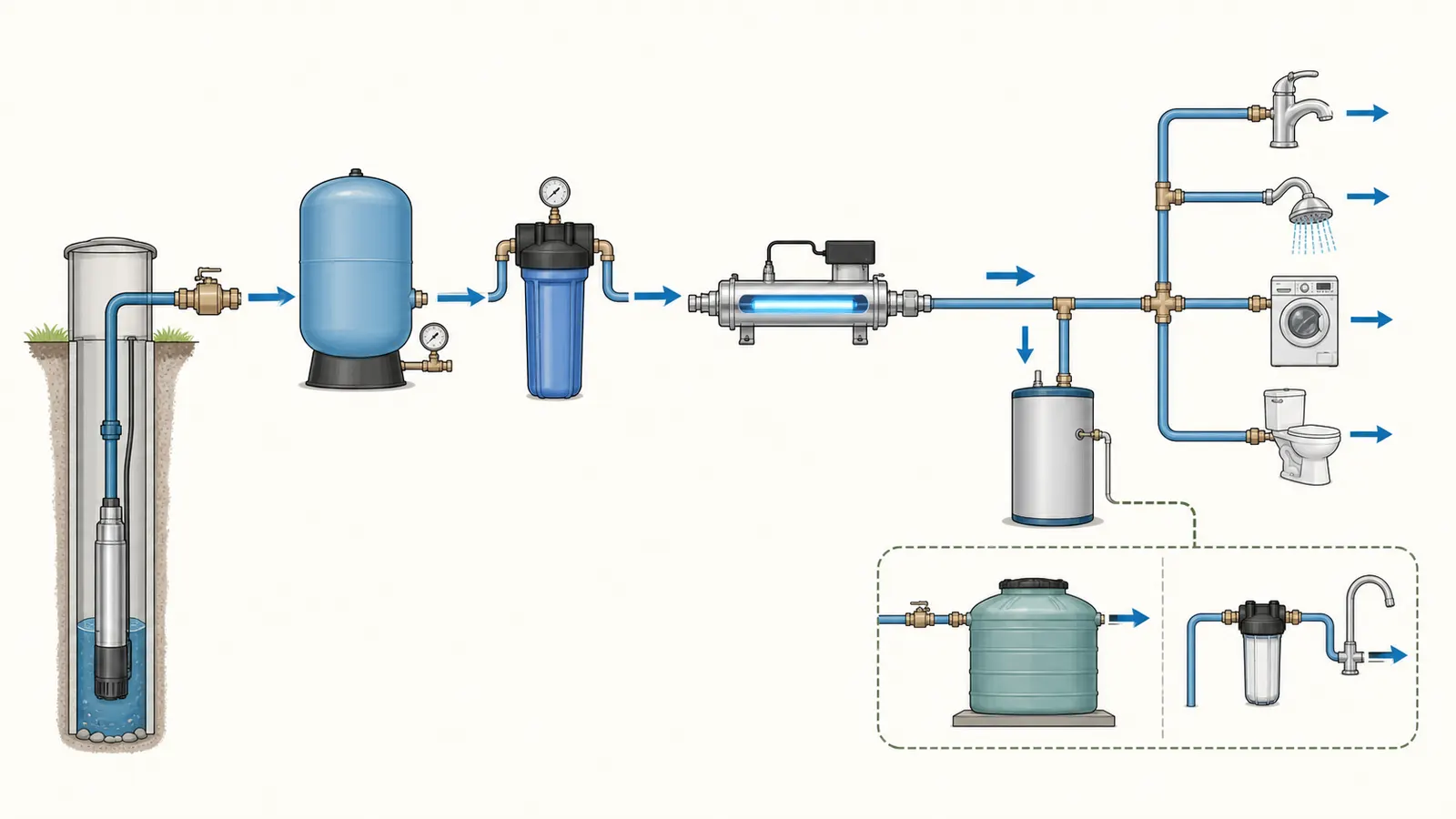
Do not approve a location until you can answer all five questions below:
- Is the proposed UV unit downstream of the pressure tank or other system that creates the house-water pressure?
- Is every pretreatment stage required by the water test and the exact manual upstream of the UV reactor?
- Is the reactor upstream of every drinking-water branch the owner intends to protect?
- Is the maximum flow through the reactor at or below the exact model's rating under the stated water-quality conditions?
- Is every bypass, storage tank, hot-water branch, alarm, and power-failure behavior understood?
If any answer is “unknown,” the location is unverified. That does not prove the system is unsafe, but it does mean the owner should not treat the UV as confirmed whole-home protection until the missing fact is resolved.
Draw the actual water path before changing anything #
The label “whole-house UV” describes the intended coverage, not necessarily the way a particular house was piped. Start at the well discharge or the first visible line entering the pressure system. Follow the pipe physically, photograph each tee and valve, and mark the direction of flow. Do not infer flow direction from where a tank or filter happens to sit.
Record these components in order:
| Order to record | What to identify | Why it changes the UV decision |
|---|---|---|
| 1 | Well pump discharge, pitless adapter, or incoming supply | Establishes where raw water enters the pressure system. |
| 2 | Pressure tank, pressure switch, pressure gauge, or booster pump | Shows where pressure is created or stabilized and whether the UV is being asked to sit on the correct side of that equipment. |
| 3 | Holding, cistern, or atmospheric storage tank | Creates an exception: water can be stored downstream of one treatment stage and exposed to later contamination or growth. |
| 4 | Sediment, cartridge, media, iron, manganese, carbon, or softening equipment | Determines whether the UV is seeing the clarity and chemistry its manual requires. |
| 5 | UV reactor, controller, sensor, flow meter, and any solenoid | Identifies the exact device and its rated conditions, not just the product family. |
| 6 | Water heater, cold manifold, pressure-reducing valve, or branch tee | Shows whether the reactor sits before the branches the owner believes are covered. |
| 7 | Kitchen, bathroom, refrigerator, laundry, outdoor, detached-building, and irrigation branches | Reveals covered, intentionally untreated, bypassed, or unknown outlets. |
Use a simple direction test only when it is safe: with normal valves untouched, observe which line warms when a known fixture is opened, or have a plumber identify the inlet and outlet. Do not loosen fittings, remove filter housings, open a pressure vessel, or manipulate a valve whose purpose is unknown merely to prove flow direction. A wrong valve movement can release pressure, interrupt water, send untreated water around the reactor, or start equipment unexpectedly.
What the default sequence does—and does not—mean
"After the pressure tank" is Brictale's conditional hydraulic placement rule for the common pressurized house arrangement, not a universal manufacturer or code requirement. It does not mean the UV must be physically next to the pressure tank. The best location may be farther downstream where the main cold-water line is accessible, the reactor can be serviced, the controller can reach a suitable electrical outlet, and all branches can be covered.
“Before the branches” also needs a precise definition. A UV on the cold line before the water heater can feed both the cold fixtures and the heater. A UV installed only on the line to the kitchen protects that point of use, not the bathrooms, shower, laundry, refrigerator, or outdoor taps. A UV on a line that is later joined by an untreated branch does not make the joined water whole-home treated.
The UV disinfects water as it passes through its reactor. Brictale design-scope conclusion: do not credit that pass-through stage as a continuing chemical residual for downstream storage or dead-end piping. Any tank or dead-end line after the reactor needs its own assessment. This is a conservative design boundary, not a quoted no-residual statement from the manufacturer; the SpringWell manual specifically warns that lines can become contaminated when the UV is shut down and directs a full-home disinfection procedure after service or an inoperative period.
Put pretreatment before UV—but let the water test choose it #
UV is a disinfection step, not a universal well-water filter. CDC explains that UV with prefiltration can remove or inactivate parasites, bacteria, and viruses, but does not remove chemicals. The pretreatment question is therefore not “Which filter do people usually put before UV?” It is “What does this water contain that could reduce UV performance, foul the reactor, or require a different treatment altogether?”
At minimum, collect the water-test report and the exact UV manual before choosing the sequence. CDC recommends annual private-well testing for total coliform bacteria, nitrates, total dissolved solids, and pH, with local advice about other contaminants. A recent test is especially important after flooding, a well repair, a change in taste, color, or smell, or a repair or replacement in the well system.
The SpringWell manual lists limits for its covered models, including hardness below 7 grains per gallon, iron below 0.3 mg/L, manganese below 0.05 mg/L, turbidity below 1 NTU, tannins below 0.1 mg/L, and UV transmittance above 85%. It recommends pretreatment when those limits are exceeded and recommends at least 5-micron prefiltration. Those are manufacturer-specific values, not a national UV standard. A different unit may require different limits, a different micron rating, a different order, or a different treatment process.
Use this matrix to decide what must be verified before the UV location is approved:
| Finding or condition | What to observe | What not to infer | Safest next step |
|---|---|---|---|
| Turbidity, visible sediment, or a dirty cartridge | Cloudy water, sediment in a housing, rising pressure drop, or a test result outside the manual | A clear faucet means the reactor receives clear water at peak flow | Confirm the pretreatment rating, service flow, and replacement condition; have the installer verify the final water before UV. |
| Hardness or scale | Scale on fixtures, a hardness result, or deposits on the quartz sleeve | A softener automatically protects every UV model | Match hardness to the exact manual and confirm the softener is sized and placed upstream. |
| Iron or manganese | Staining, deposits, or a laboratory result above the manual limit | A sediment cartridge alone removes dissolved iron or manganese | Select the chemistry-specific pretreatment and verify it does not exhaust or bypass before the UV. |
| Tannins, color, or low UV transmittance | Brown or tea-colored water, UV sensor alarm, or a measured UVT below the model limit | A high-wattage lamp fixes any water-quality problem | Obtain the model's UVT requirement and a treatment design for the measured water. |
| Bacteria, E. coli, or coliform concern | A laboratory result, not only an odor or visual symptom | UV repairs a contaminated well or removes the source | Follow public-health guidance, investigate the source, use another safe source when advised, then verify treatment after installation. |
| Nitrate, arsenic, VOCs, or other chemicals | A laboratory result or local contaminant concern | UV will remove dissolved chemicals | Choose a process with an exact claim for that contaminant and concentration; UV may be a separate microbial stage. |
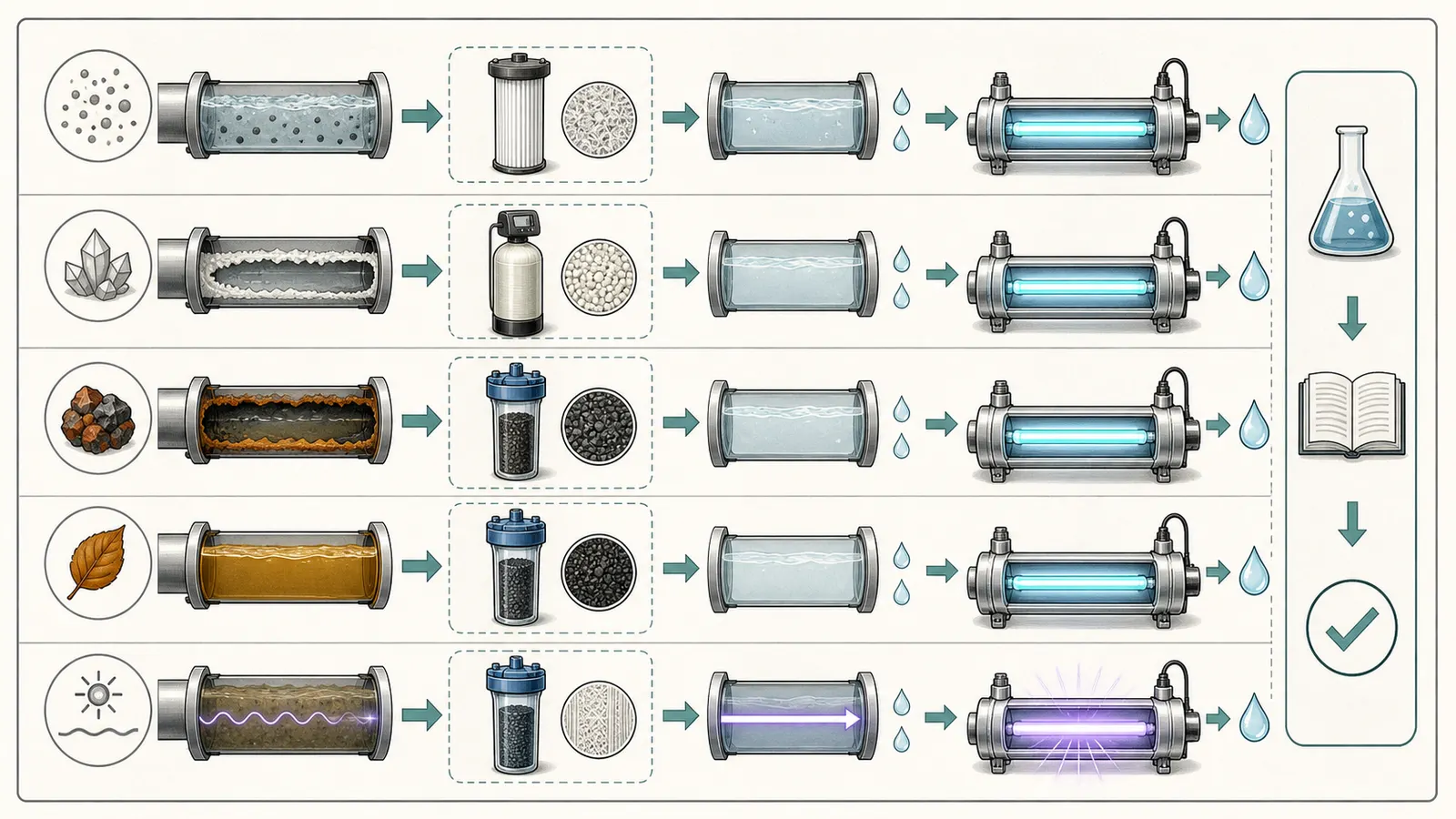
Avoid stacking pretreatment by habit. Each additional device can consume pressure, create a bypass, add a drain or electrical requirement, and introduce a maintenance failure. Every stage should have a documented job tied to a measured result, a manual requirement, or protection of a downstream stage.
Check pressure-tank position and exceptions #
In a normal well system, the pressure tank and pressure switch help the pump deliver pressurized water to the house. The homeowner audit should confirm that the UV is on the pressurized distribution side, after the pressure tank, unless the system was deliberately engineered with a different pump, storage, or treatment arrangement.
Do not turn that conventional sequence into a blanket rule. Stop and escalate when the system includes any of these:
- an atmospheric holding tank, cistern, or storage tank;
- a booster pump or a second pressure zone;
- a UV reactor before storage or before a tank that can be refilled from another source;
- multiple wells, cross-connections, or more than one incoming supply;
- a point-of-use UV unit serving one faucet rather than a whole-home unit;
- a detached building, irrigation system, or outdoor branch that joins the household line downstream;
- a treatment bypass that can send water around the reactor;
- a pressure-reducing valve, variable-speed pump, or flow-control device whose behavior is not documented.
The holding-tank exception is not theoretical. OSU Extension describes a case where UV was installed before a holding tank and says the tank and the rest of the system had to be shocked and flushed. The lesson is not that a pre-tank UV can never work; it is that a tank downstream changes what the reactor covers and how the system must be disinfected.
State guidance can also be system-specific. For example, the Massachusetts Private Well Guidelines discuss maintaining 30 psi in distribution lines when a storage tank is present and describe disinfecting the well, pressure tank, storage tank, and distribution lines. That is Massachusetts guidance, not a national pressure requirement. Use it as a reminder to check local health or plumbing requirements when storage exists, not as a number to apply to a different state automatically.
Before or after the water heater?
For a whole-home cold-water installation, the reactor belongs on the cold main before it divides to the water heater and cold fixtures, provided the UV model is approved for that location and the water temperature at the reactor stays within its limit. The SpringWell manual lists an operating-water-temperature range of 36–104°F for its covered systems. That is a reason to keep the reactor out of a hot-water line, not a reason to install it after every hot-water fixture.
If the water heater is fed from a line downstream of the UV, the heater receives treated incoming water. The UV dose still occurs upstream, however; the heater, branch piping, and fixtures remain downstream components that need to be included in the coverage and maintenance discussion. If a proposed design puts the UV after the hot-water split, ask exactly which cold and hot outlets are covered and whether the device is approved for that temperature and duty. Do not assume a hot-water loop is covered merely because a nearby cold line is treated.
Trace every branch and every bypass #
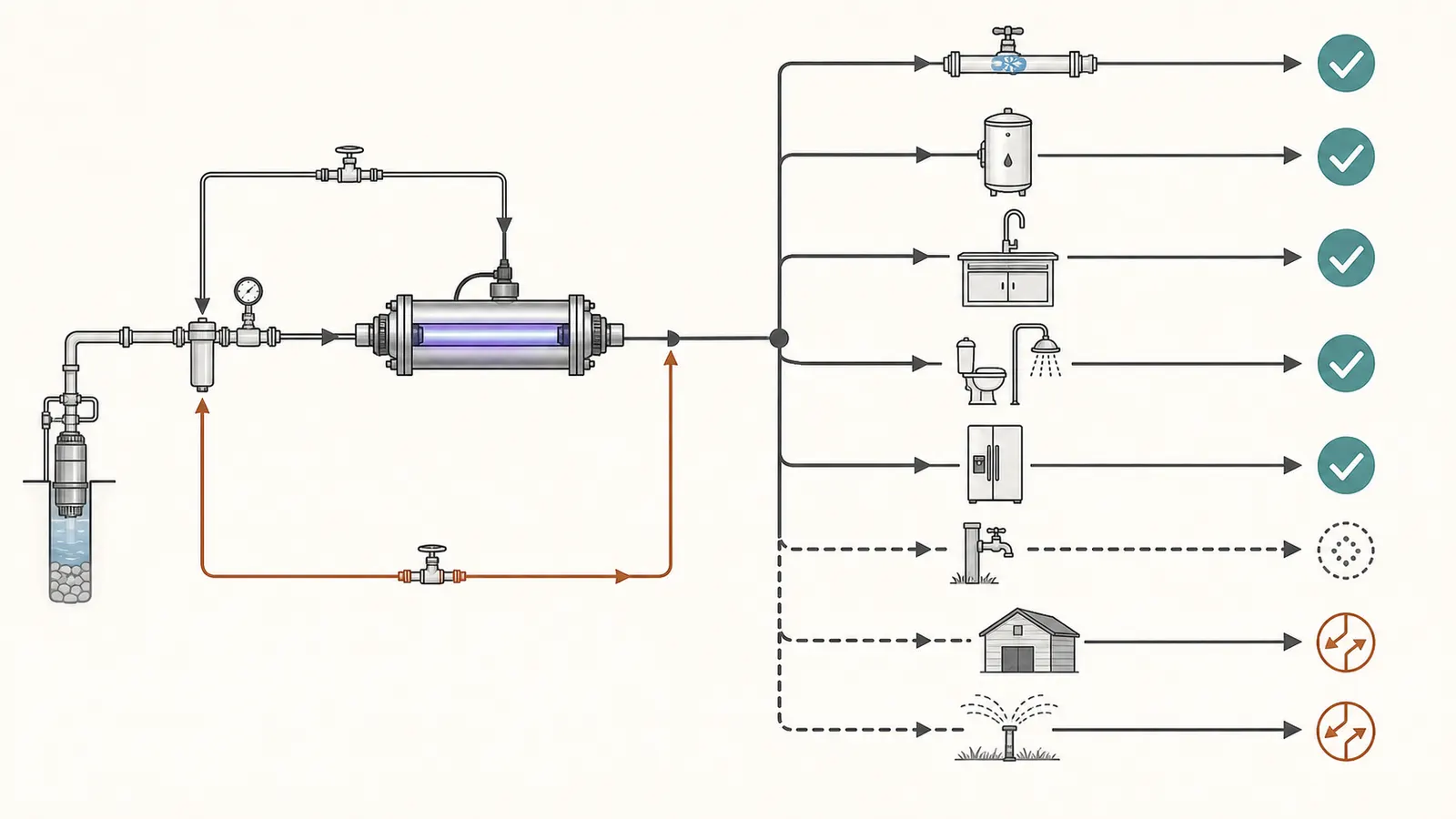
Branch coverage is where many apparently correct installations fail. The UV can be in the “right” place on one visible pipe while a tee, bypass, old supply line, or detached-building connection leaves an outlet untreated.
Walk the house with the treatment drawing. For each outlet, write one of four statuses:
| Status | Meaning | Decision |
|---|---|---|
| Covered | The outlet is downstream of the powered, maintained UV with no alternate supply or bypass open | Include it in normal treated-water use and maintenance checks. |
| Untreated by design | The owner intentionally leaves irrigation or another non-potable branch untreated | Label it clearly and prevent it from reconnecting to drinking-water plumbing. |
| Bypassed or uncertain | A valve, tee, abandoned line, or unknown branch can avoid the reactor | Do not call the system whole-home until a qualified person traces and labels it. |
| Point of use | A dedicated UV sits immediately before one faucet or appliance | Limit the claim to that faucet or appliance and its actual service conditions. |
Check these outlets individually: kitchen faucet, refrigerator dispenser or ice maker, bathroom sinks, showers, bathtub filler, laundry, dishwasher, basement sink, outdoor hose bibs, garage, guesthouse, barn, and any line feeding a water softener or other treatment equipment. Note whether a branch comes off before the pretreatment, between pretreatment stages, before the UV, or after the UV.
Why a bypass deserves a separate decision
A bypass is useful for maintenance, but it changes the safety state. The SpringWell manual recommends a bypass assembly so the reactor can be isolated for maintenance. It also says that water may be unsafe after a lamp has expired and provides alarm behavior for monitored models. A bypass that is convenient to operate but not labeled can create an unrecorded untreated-water path.
Label the normal valve positions. Photograph the valves with the system operating normally. Put the bypass procedure in the maintenance record. If a service person must place the system in bypass, record the time, reason, affected outlets, and the steps required to return to normal operation. Do not use a bypass as a permanent workaround for a failed lamp, fouled sleeve, excessive pressure loss, or an undersized reactor.
Size the UV for peak flow and actual water quality #
A UV unit is not sized by the number of bathrooms alone, by the lamp wattage printed on the carton, or by average daily water use. It is sized by the exact model's rated flow at a stated UV dose and water-quality condition, compared with the maximum flow that can pass through the reactor.
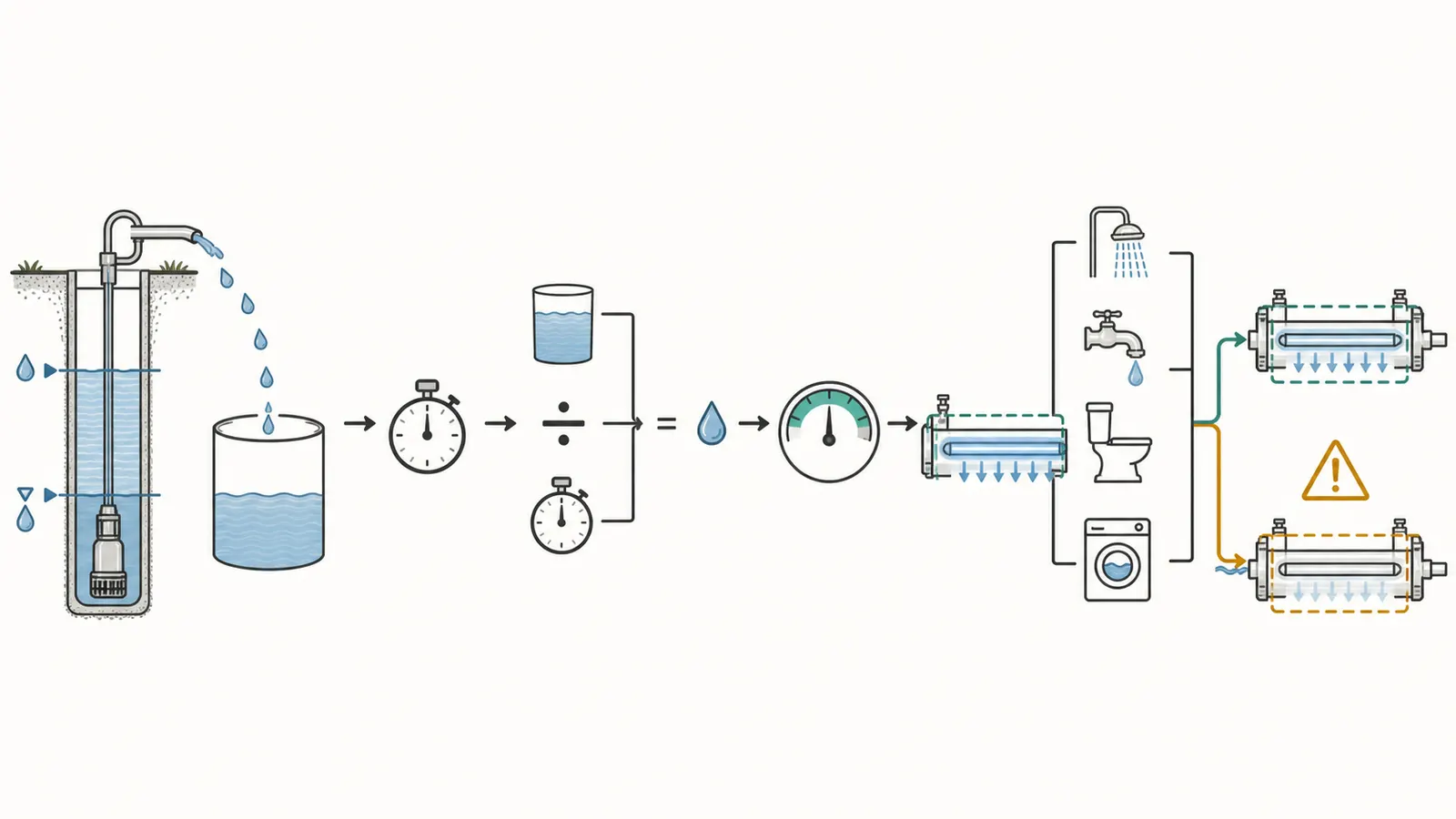
The SpringWell manual states that exceeding rated flow or treating water outside the listed quality parameters decreases UV dose and can compromise microorganism inactivation. Its standard-output table shows different flow ratings by model and dose—for example, its listed 30 mJ/cm² ratings range from 2 to 21 gallons per minute across the standard residential models. That is an example of why “a UV system” is not a sufficient specification. Record the installed model, dose basis, UV transmittance assumption, pressure range, and any flow restrictor.
A homeowner flow check
If the manual provides the same procedure and the observation can be made without opening equipment or touching energized controls, use this worksheet:
estimated pumping rate (gpm) = drawdown (gallons) ÷ cycle time (seconds) × 60
The SpringWell manual describes measuring drawdown and cycle time near the pressure system, then using this calculation. Complete the record like this:
| Measurement | Record |
|---|---|
| Faucet or outlet used | ______________________________ |
| Container volume | __________ gallons |
| Drawdown observed before pump restarts | __________ gallons |
| Seconds from pump start until pump stops | __________ seconds |
| Calculation | __________ ÷ __________ × 60 = __________ gpm |
| Exact UV model and dose rating | ______________________________ |
| Model-rated maximum flow at your UVT and dose | __________ gpm |
| Household peak-flow estimate or professional design flow | __________ gpm |
| Flow restrictor present and model-specific? | Yes / No / Unknown |
| Result | Pass / undersized / unknown |
This is an estimate of pressure-system pumping rate, not proof that every fixture can deliver that flow at the required pressure. It also does not measure every possible simultaneous demand. If the estimated pumping rate is above the reactor rating, or if household demand can exceed the rating, the system needs a qualified sizing review or a model-specific flow restriction. Do not install a restrictor blindly: it can reduce available flow, and its rating and location must match the manual.
Look for hidden flow problems
Record pressure at a defined flow if a gauge and safe test point already exist. A gauge reading with all faucets closed cannot tell you how the treatment train behaves while a shower, toilet fill, or laundry cycle is running. Compare pressure before and after the complete train only when the test can be performed safely and without opening pressurized housings.
Ask the installer to account for:
- pump capacity and pressure-switch settings;
- pressure-tank drawdown and recovery;
- the pressure loss of each pretreatment stage when clean and when loaded;
- the UV reactor's inlet and outlet size and rated flow;
- simultaneous fixtures and any automatic appliances;
- backwash, regeneration, or refill cycles;
- a low-flow or no-flow period that could heat the water around the lamp;
- the effect of a bypass or solenoid on the treated-water path.
If a proposal gives only “up to X gallons per minute” with no dose, UVT, pressure, temperature, or model number, it is not enough to approve placement.
Inspect the installation limits and safety boundary #
Placement is also a service and electrical decision. The reactor needs to be accessible for lamp and sleeve service, but that does not make it a safe DIY electrical or pressurized-plumbing project. The SpringWell manual recommends professional installation, calls for indoor installation away from leaking plumbing and a properly grounded GFCI outlet, and notes that a license may be required depending on location. It also recommends vertical installation with the inlet at the bottom for easier air purging, while allowing horizontal installation under its instructions.
Before approving the physical location, verify:
- the reactor and controller are indoors and protected from leaks, freezing, and weather;
- the lamp connector has the clearance specified in the manual for lamp and sleeve removal;
- the outlet is appropriate, grounded, and GFCI-protected as required by the model;
- the reactor is supported by the supplied or approved fasteners;
- shutoff valves and, where approved, a bypass can isolate the unit for service;
- a downstream faucet or safe pressure-relief method exists for service;
- the controller, alarm, sensor, and any solenoid are visible and not hidden behind storage;
- all water that the owner calls “treated” remains downstream of the reactor when valves are in normal positions;
- local plumbing, electrical, well, and health requirements have been checked.
Do not open energized controls. Do not plug in a wet unit. Do not remove a lamp, quartz sleeve, filter housing, or pressurized fitting until the water supply and electrical power are isolated and the manufacturer's pressure-release steps have been followed. Do not open a well cap, pull a pump, enter a confined space, or work on live wiring. Do not manipulate a pressure switch, pressure-tank valve, pump control, or unknown bypass to diagnose the sequence. Those tasks belong to a qualified plumber, well contractor, electrician, or water-treatment professional as appropriate.
The owner can safely gather labels, photograph piping, read the manual, observe the controller display, and record water-test results. The owner should stop and hire qualified help when the next step involves energized electrical parts, pressurized disassembly, well access, pump controls, chemical dosing, or uncertainty about whether water is safe to consume.
Commission, verify, maintain, and complete the placement audit #
An installation is not confirmed because water comes out of a faucet. Commissioning should show what was installed, what it covers, how it performs under the stated conditions, and what the owner must do when an alarm occurs.
Commissioning record
Ask the installer to leave a record containing:
- exact UV manufacturer, model, serial number, dose basis, and manual revision;
- all pretreatment manufacturers, models, settings, filter micron ratings, and service flows;
- the untreated-water laboratory report used for sizing;
- UVT, turbidity, hardness, iron, manganese, tannin, temperature, and pressure information where required by the manual;
- pressure readings at a stated flow before and after treatment;
- the measured or designed peak flow and the calculation behind it;
- normal positions for inlet, outlet, bypass, drain, solenoid, and pressure-control valves;
- outlets covered, outlets intentionally untreated, and outlets that remain unknown;
- lamp installation date, expected replacement interval, sleeve and sensor service date, and prefilter schedule;
- the first treated-water verification test, sample locations, laboratory, and acceptance target;
- the response to a power failure, low-UV alarm, expired lamp, fouled sleeve, or bypass condition.
Keep the record with the water test and manuals. If the installer substitutes a similar-looking model, repeat the flow, chemistry, coverage, and maintenance review. Similar port sizes or lamp shapes do not establish equivalent performance.
Maintenance schedule
The SpringWell manual calls for at least annual quartz-sleeve and sensor cleaning; its UV5 and UV6 controllers provide a six-month service reminder for UV and prefiltration. Do not assume a UV4 controller provides that reminder. Your own model may use different timing, so use the following as a record structure rather than a replacement for the manual:
| Interval or trigger | Owner observation | Action |
|---|---|---|
| Each visit | Controller ready, lamp status, alarm, normal valve positions | If an alarm or unknown bypass is present, stop relying on UV until the manual or a qualified professional resolves it. |
| Each prefilter change | Cartridge condition, pressure drop, date, part number | Replace with the specified cartridge and record the reason for change. |
| Six months or manual interval | Pretreatment service, leaks, labels, bypass, drain, controller reminder | Service the stages the manual identifies; inspect for a new untreated branch or altered valve. |
| At least annually or manual interval | Quartz sleeve, sensor, lamp age, power and alarm check | Isolate water and power using the manual; assign disassembly to a qualified person if the procedure is not demonstrably safe. |
| After a power loss, bypass, repair, flood, or contamination event | Water may have passed untreated or lines may have become contaminated | Follow the model's restart and disinfection procedure, then complete the recommended water test. |
| After a changed result, smell, color, or pressure pattern | The original design assumptions may no longer hold | Retest, check pretreatment and flow, and obtain a treatment review. |
An expired lamp is a stop condition when UV is the only microbial barrier. The SpringWell manual says water may be unsafe after lamp expiration and should not be consumed without another form of disinfection. Follow the exact manual for the installed system; do not silence an alarm and treat that as a repair.
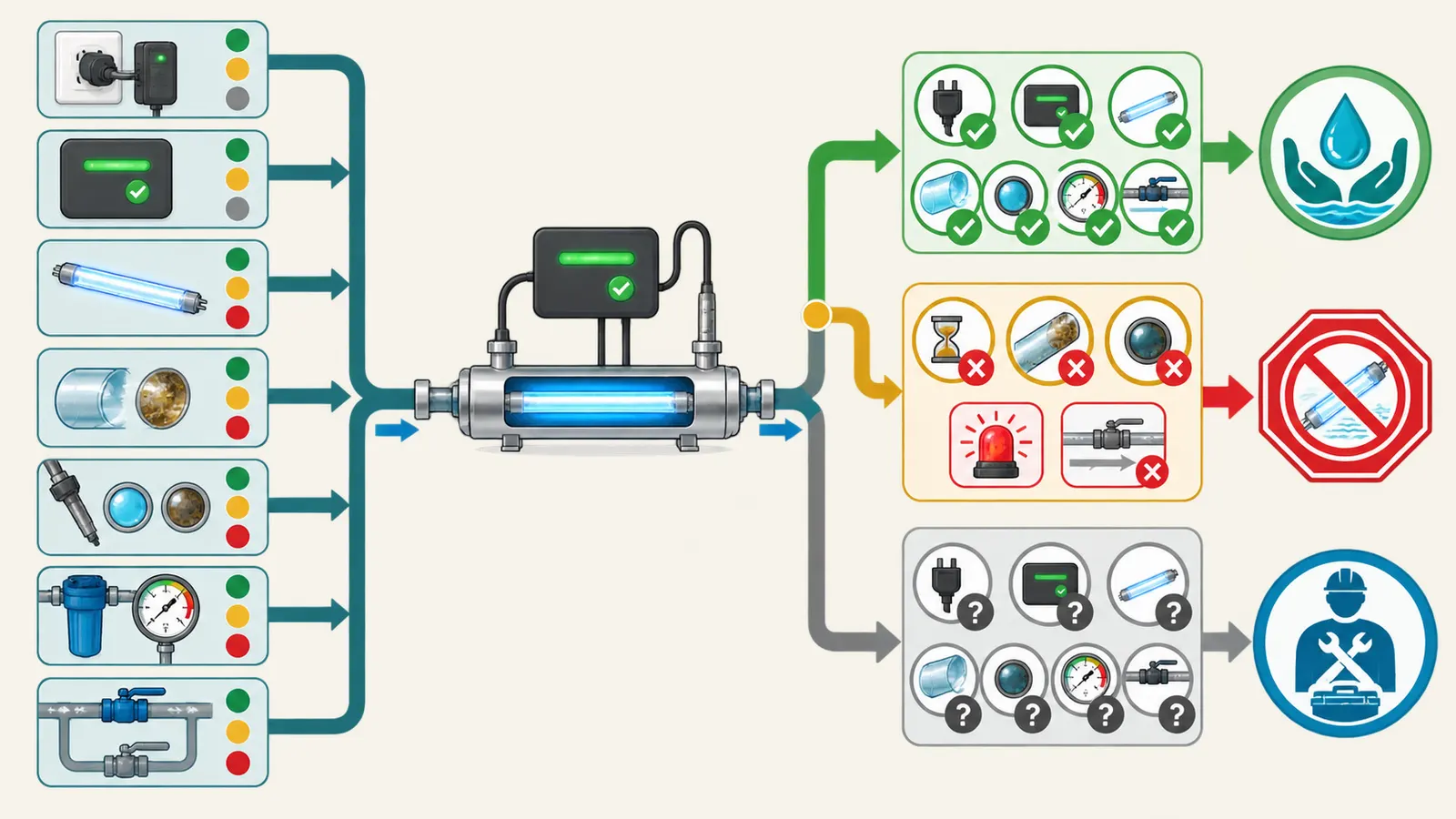
Use this worksheet before approving a new installation or relying on an existing one. “Unknown” is a valid result; it identifies the information a professional needs next.
Treatment-train audit
| Audit question | Pass / fail / unknown | Evidence to attach |
|---|---|---|
| Flow from well or incoming supply is identified | __________ | Photo or sketch |
| Pressure tank, pressure switch, and gauge are identified | __________ | Model label and location |
| Any holding, cistern, atmospheric, or storage tank is identified | __________ | Tank type and downstream connections |
| Required pretreatment is upstream of UV | __________ | Water test, manual, valve order |
| Exact UV model and manual are available | __________ | Model, serial, manual URL or copy |
| Water-quality limits match the test | __________ | Hardness, iron, manganese, turbidity, tannin, UVT, temperature |
| Maximum flow is within the model rating | __________ | Drawdown/cycle calculation or professional design |
| UV is before the cold-water branch and water-heater feed | __________ | Pipe trace and flow arrows |
| Kitchen, bathroom, refrigerator, laundry, and intended taps are downstream | __________ | Outlet-by-outlet list |
| Outdoor, irrigation, detached-building, or other untreated branches are labeled | __________ | Branch map and labels |
| Every bypass and valve's normal position is known | __________ | Photograph and written procedure |
| GFCI, dry location, service clearance, and support meet the manual | __________ | Installer confirmation |
| Lamp, sleeve, sensor, filter, alarm, and verification schedule exists | __________ | Commissioning and maintenance record |
Decision outcomes
Approve the placement for review when the conventional flow path is pressure tank → required pretreatment → UV → branches, the model limits match the water test, flow is within rating, all intended outlets are traced, and safety/service provisions are documented. This is a placement approval for the evidence available; it is not a certification that the water is safe.
Correct the layout before relying on it when the UV is before required pretreatment, after a branch the owner wants treated, downstream of an unknown storage tank, exposed to excessive flow, or reachable only through an unlabeled bypass. Ask for a revised drawing and a model-specific explanation of dose, flow, chemistry, and alarm behavior.
Pause and escalate when there is a positive health-related result, an active alarm, an expired lamp, a contaminated or flooded well, no safe way to isolate pressure or power, a live-wiring question, a well or pump access issue, or uncertainty about a storage or cross-connection. Use another safe water source when public-health guidance advises it, and bring the following to a qualified professional:
- the water laboratory report and sample dates;
- photos of the entire treatment train and every valve or tee;
- UV and pretreatment model numbers;
- the flow calculation and peak-demand assumptions;
- pressure readings with the test conditions;
- the outlet coverage list;
- maintenance dates, alarm history, and bypass events;
- local health-department or plumbing guidance that applies to the property.
The right UV location is therefore not simply “last” or “near the well.” It is the final verified point on the correct water path: after the pressure system and required clarification, before the branches the owner intends to protect, within the exact model's flow and water-quality limits, and maintained so that the position continues to mean what the owner thinks it means.
Cite this guide
Brictale. “Where Should a UV Water System Be Installed on a Private Well?.” Published 2026-08-27; updated 2026-08-27.
https://brictale.com/water/filtration/where-to-install-a-uv-water-system-on-a-private-well · Read the Markdown version
Sources and scope
Evidence behind this page
- For a residential well system with a conventional flow path, OSU Extension recommends installing UV at the end of the system, immediately before water enters the home; this supports end-of-system placement but does not itself establish a universal pressure-tank relationship or cover every holding-tank or point-of-use layout.
OSU Extension Service — How to test and treat my residential well water?
Oregon State University Extension response to a residential well question; useful general placement guidance, but not a national plumbing code or a substitute for the installed unit manual.
Accessed · Link to this claim - The SpringWell UV manual specifies that a point-of-entry system is installed after other water-treatment equipment such as softeners or filters and before any branches; it also recommends a 5-micron filter before UV as a final polishing step.
SpringWell — Operation & Installation Instructions, UV4/UV5/UV6 Series
Manufacturer-specific point-of-entry installation instruction for the SpringWell UV4, UV5, UV6, and crossover series covered by the manual; do not generalize its exact micron recommendation to another model.
Accessed · Link to this claim - CDC says UV systems work better when water is filtered before UV, can remove parasites, bacteria, and viruses with prefiltration, and do not remove chemicals; homeowners should test water and select a system for the specific concern.
CDC — About Home Water Treatment Systems
United States federal consumer guidance for home water treatment; general treatment capability statement, not a model-specific performance certification.
Accessed · Link to this claim - CDC recommends that private-well owners test at least annually for total coliform bacteria, nitrates, total dissolved solids, and pH, and ask local health or environmental officials about additional contaminants of concern.
CDC — Guidelines for Testing Well Water
United States federal consumer guidance for private wells; local health departments, geology, events, and state requirements can add tests or change timing.
Accessed · Link to this claim - The SpringWell manual lists water-quality parameters for its UV systems, including hardness below 7 gpg, iron below 0.3 mg/L, manganese below 0.05 mg/L, turbidity below 1 NTU, tannins below 0.1 mg/L, and UV transmittance above 85%; it directs owners to use pretreatment when limits are exceeded.
SpringWell — Operation & Installation Instructions, UV4/UV5/UV6 Series
Exact limits published for the SpringWell manual's covered models; these values are not a universal UV specification and must not be substituted for another manufacturer's limits.
Accessed · Link to this claim - The SpringWell manual states that each UV system is rated for a specific flow in water meeting its quality parameters, and that exceeding the rated flow or using water outside those parameters decreases dose and can compromise microorganism inactivation.
SpringWell — Operation & Installation Instructions, UV4/UV5/UV6 Series
Manufacturer-specific sizing and performance warning for the covered SpringWell UV series; exact dose and flow must be taken from the installed model's documentation.
Accessed · Link to this claim - The SpringWell manual provides a homeowner-accessible pressure-system flow calculation: measure drawdown, measure cycle time, and calculate drawdown divided by cycle time multiplied by 60 to obtain pumping rate in US gallons per minute.
SpringWell — Operation & Installation Instructions, UV4/UV5/UV6 Series
Manual procedure for the covered SpringWell systems; the result is a pressure-system pumping-rate estimate, not a guarantee of simultaneous household fixture flow or a substitute for professional hydraulic sizing.
Accessed · Link to this claim - The SpringWell manual recommends professional installation, calls for indoor installation away from leaks, a properly grounded GFCI outlet, and pressure release before service, and specifies at least annual quartz-sleeve and sensor cleaning; its UV5 and UV6 controllers provide a six-month service reminder for UV and prefiltration, while the manual does not establish that reminder for UV4.
SpringWell — Operation & Installation Instructions, UV4/UV5/UV6 Series
Safety, service, and maintenance instructions for the covered manufacturer systems; never use this manual to service a different model without checking its instructions.
Accessed · Link to this claim - Brictale's conservative design-scope conclusion is that a UV reactor should not be credited as a continuing chemical residual for downstream storage or dead-end piping: the reactor is a pass-through treatment stage, and the SpringWell manual warns that lines can become contaminated when UV is shut down and calls for full-home disinfection after service or an inoperative period.
SpringWell — Operation & Installation Instructions, UV4/UV5/UV6 Series
Explicit Brictale design-scope inference from the manual's shutdown-contamination warning; it is not presented as a quoted manufacturer statement that uses the phrase chemical residual.
Accessed · Link to this claim - A Massachusetts private-well guideline illustrates that systems with storage tanks have additional pressure and disinfection considerations; it says to maintain 30 psi in distribution lines when a storage tank is present and describes disinfecting the well, pressure tank, storage tank, and distribution lines.
Commonwealth of Massachusetts — Private Well Guidelines
Massachusetts guidance and procedures, not a national rule; used here to flag storage-tank exceptions and the need to follow local guidance.
Accessed · Link to this claim