What Micron Sediment Filter for Well Water? A Pressure-Tested Homeowner Guide
Choose a well-water sediment filter by measured particles, peak flow, pressure loss, housing fit, and maintenance—not a smaller micron number.
The short answer
There is no universal best micron rating. Start with a sediment observation or sample, measure peak flow and pressure, then compare a reusable spin-down screen with nominal or absolute depth cartridges. Choose the coarsest option that captures the problem while preserving required flow; verify clean and loaded pressure loss with gauges. A sediment filter does not prove bacteria, nitrate, PFAS, metals, or chemical removal.What Micron Sediment Filter for Well Water? A Pressure-Tested Homeowner Guide
If you own a private well, “What micron filter should I buy?” sounds like a question with one number for an answer. It is not. A 5-micron cartridge may catch particles that a 20-micron cartridge lets through, but it may also load sooner, restrict flow, or fail to fit the housing you already have. A reusable screen can protect a pump or appliance from coarse sand while doing little for fine silt. The right choice is the filter that solves a measured sediment problem at your household’s peak demand while leaving enough pressure for the fixtures that matter.
The useful buying sequence is:
- Identify whether the problem is visible sediment, a pressure-loss problem, or a health-related contaminant.
- Describe the particles and how often they appear.
- Measure peak flow and record pressure before and after filtration.
- Compare a screen or cartridge using its rating method, construction, rated flow, initial pressure drop, service life, and actual reduction claim.
- Install a bypass and gauges so the filter can be serviced without guessing.
That sequence matters because a sediment filter is a particle-control device, not a general bacteria, nitrate, PFAS, metal, or chemical treatment. CDC says taste, smell, and appearance are not reliable indicators of water safety, and recommends testing well water to identify germs or chemicals before selecting treatment. CDC’s home-filter guidance is the safety boundary for this comparison.
Start with the water problem, not the micron number #
First decide what you are actually trying to improve. Sand or grit in an aerator, a layer of material in a toilet tank, cloudy water after the pump runs, and a cartridge that loses flow are clues about particulate loading. They do not identify the particle size, the source, or whether a health contaminant is present. A change in color, odor, taste, or appearance is a reason to test, not proof that a finer cartridge is needed. EPA recommends annual private-well testing for total coliform bacteria, nitrates, total dissolved solids, and pH, with additional testing when local conditions or a water-quality change gives you a reason. EPA’s private-well testing and treatment guidance also says to test after a well-system repair or when water quality changes.
Make a simple observation record before shopping:
- What is visible? Note sand, grit, silt, rust-colored particles, black flakes, or only cloudiness. If possible, collect a clean jar sample from a cold tap after the water has run long enough to represent normal use. Label the date, tap, and whether the pump had recently run.
- When does it appear? Record whether it happens after heavy rain, a power outage, well work, a long period without water use, or every time the pump starts.
- Where is the damage? List clogged faucet screens, washing-machine valves, water heaters, toilets, softeners, or other equipment. A filter that protects one appliance may not need to treat every gallon in the house.
- What is the demand? Record the flow with one large fixture open and again with the likely simultaneous uses running. A filter that looks fine at a bathroom faucet can be restrictive when a shower, washing machine, and outdoor hose overlap.
- What does pressure do? Record the pressure-tank gauge with no demand, while water is flowing, and after the flow stops. If a filter is already installed, record separate inlet and outlet readings at the same demand.
If the well itself is sending unusual sediment, a cartridge can hide the symptom without fixing the source. EPA describes the well screen as a component intended to prevent too much sediment from entering the well; a sudden new load after repair, flooding, land disturbance, or a change in water quality deserves well and water-system investigation. EPA’s well-component overview explains the role of the well screen, while its testing guidance identifies when to escalate testing.
Know what the rating actually describes #
Micron size is only one field on a filter label. “Five micron” may describe a nominal or mean rating, an absolute rating, a test condition, or a manufacturer’s own classification. CDC explains that an absolute 1-micron filter has pores no larger than 1 micron, while a nominal or mean 1-micron filter can have some larger pores and allow some larger particles through. CDC’s explanation of absolute and nominal pore size is why two cartridges carrying the same number should not be treated as interchangeable.
Separate these questions when reading a data sheet:
| Specification | What it tells you | What it does not prove |
|---|---|---|
| Micron rating and method | The particle-size performance the maker describes, and whether the rating is nominal or absolute | That every contaminant, germ, or chemical is removed |
| Media and construction | Whether the cartridge is spun, pleated, wound, or made from another material | Which construction will last longest in your well without a test or operating history |
| Rated flow and initial pressure drop | The manufacturer’s stated flow condition and the pressure penalty when clean | That your installed plumbing will deliver the same result at peak demand |
| Service life or capacity | A stated time, gallon capacity, or replacement basis | A guaranteed calendar life in your sediment load |
| Reduction claim | The particles or named contaminants the product says it reduces | A broader health claim than the label or certification names |
The separation is not academic. The Pentek Dura-Series manual lists filtration rating, media construction, maximum flow/pressure drop, filter life, and reduction categories as separate columns. Its whole-house examples include nominal 5-micron spun polypropylene at 10 gpm with less than 1 psi listed pressure drop, nominal 10-micron cord-wound media at 7 gpm, nominal 20-micron pleated cellulose at 10 gpm, and nominal 30- and 50-micron pleated polyester options at 12 gpm. Those are examples for that product family, not universal promises for other cartridges. Pentek’s replacement-cartridge table shows why rating, construction, flow, pressure drop, life, and reduction claim must be compared together.
A label that says “sediment” also does not mean “safe drinking water.” CDC notes that filters have different functions and that products designed to remove germs may not remove chemicals, and vice versa. NSF likewise says to identify the contaminant, choose a certified treatment solution for that concern, and check both the applicable standard and the specific reduction claim. NSF’s home-treatment selection guidance is a useful check against turning a particle rating into an unsupported health claim.
Choose between a spin-down screen, cartridge, or staged setup #
A spin-down screen is usually the first comparison when the visible problem is coarse sand, grit, or debris and you want to flush material rather than buy disposable cartridges. Pentair’s named spin-down system is reusable, includes a flush valve, and is listed for sediment 152 microns and larger. Pentair directs customers needing smaller-particle reduction to a separate sediment/prefilter system, with examples as small as 5 microns. Pentair’s spin-down specifications are product-specific; they are not a rating for every screen on the market.
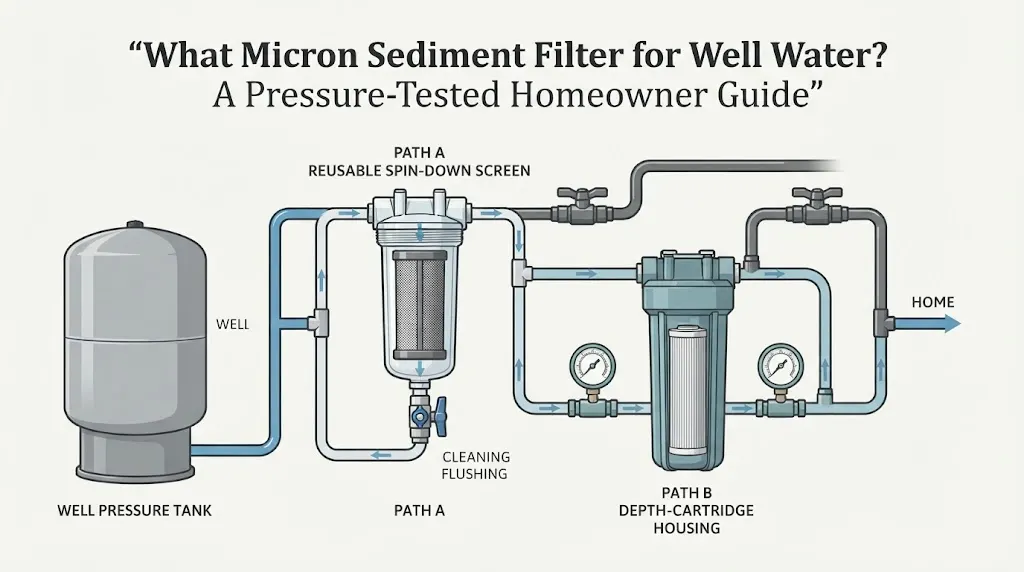
Choose a depth or pleated cartridge when the observed material is finer than the screen can handle, when downstream equipment needs finer protection, or when the cartridge’s documented flow and pressure behavior fit your system. A cartridge captures particles through its media rather than simply collecting coarse debris in a flushable chamber. That can be useful, but it makes maintenance and replacement cost part of the design. A finer cartridge is not automatically better if it causes a pressure problem before it has solved a demonstrated one.
Use staging when one device would otherwise face too much load. A coarse, cleanable screen can take the larger particles first; a cartridge downstream can then address the finer material that remains. Treat staging as a design to verify, not as a universal recipe: each stage adds fittings, space, pressure drop, and another maintenance point. Keep the bypass arrangement understandable, and make sure the downstream stage is not being credited with a contaminant reduction that its label does not claim.
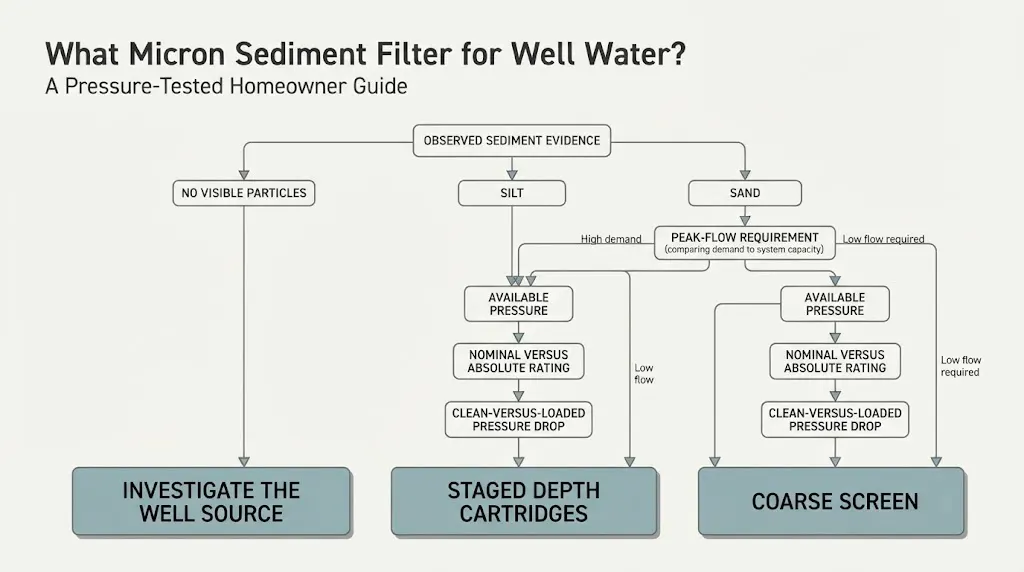
| Observed or measured situation | Reasonable starting comparison | Proof required before committing |
|---|---|---|
| Visible sand or grit; pressure remains stable | Reusable spin-down screen | Confirm the screen’s stated particle target, flush access, flow size, and whether the collected material is actually coarse |
| Fine silt or recurring cloudy particulate | Nominal 20-, 10-, or 5-micron cartridge options, compared by construction | Jar observation or testing, peak-flow requirement, housing fit, rated flow, clean pressure drop, and replacement cost |
| Coarse load quickly overwhelms a fine cartridge | Screen ahead of a cartridge | Measure pressure at each stage and verify that each stage can be isolated and serviced |
| No visible particles, but a health concern appears on a lab report | Contaminant-specific treatment | A certified product and exact reduction claim for that contaminant; a sediment rating alone is not enough |
| New or sharply increased sediment after a system event | Pause purchase and investigate the well/system | Well professional or health department input, appropriate testing, and a record of the event |
This matrix deliberately does not say “always buy 5 micron.” It makes the finer rating earn its place through the observed particle problem, required flow, pressure record, and documented claim.
Size the filter around flow and pressure #
Find your required flow before comparing cartridge numbers. List the fixtures that may run together and measure the combined flow at a safe outlet. If you cannot measure every branch, use the largest realistic demand you can observe and write down what was open. Then compare that number with the cartridge’s rated flow, connection size, housing size, and listed initial pressure drop. A data-sheet flow number is a test condition, not a guarantee that the whole house will feel the same at the fixture.
Use two gauges if the filter is intended for whole-house service: one immediately upstream and one immediately downstream. At the same flow, calculate:
filter pressure loss = upstream pressure − downstream pressure
Record the result when the cartridge or screen is clean. Repeat when the pressure or flow changes. The clean value is the installation baseline; the later value includes loading. Without both readings, a homeowner can see low pressure but cannot tell whether the filter caused it, whether the pump system is short of pressure, or whether another restriction is upstream or downstream.
Do not copy a change-out threshold from one product to another. A Watts strainer manual says a differential-pressure gauge across the inlet and outlet indicates clogging-related pressure loss and gives 5–10 psi as its normal cleaning guide for that strainer. The Watts differential-pressure instruction is a model-specific maintenance instruction, not a universal cartridge rule. For a cartridge, use the maker’s replacement guidance plus your own trend in pressure and flow.
Housing fit is part of hydraulic sizing. Check pipe connection size, cartridge length and diameter, sump clearance, maximum operating pressure, temperature, and the space needed to remove the cartridge. For example, the Pentek Dura-Series manual lists 30–125 psi for its 3/4-inch inlet/outlet housing, directs installation after the meter or pressure tank, and gives replacement instructions for that model. Pentek’s housing specifications and installation instructions should be read as limits for that housing only.
Build a purchase matrix and pressure-loss record #
Before you put a cartridge in a shopping cart, fill out this comparison. Empty cells are not permission to guess; they are questions for the manufacturer or installer.
| Field to record | Option A | Option B | Option C or staged setup |
|---|---|---|---|
| Device type | Spin-down screen / cartridge | ||
| Micron rating and method | |||
| Media or screen construction | |||
| Rated flow at stated pressure | |||
| Clean pressure drop at that flow | |||
| Reduction claim and certification | |||
| Housing, connection, and clearance fit | |||
| Flush or replacement method | |||
| Expected service interval or capacity | |||
| Replacement part cost and availability | |||
| Bypass and gauge plan |
Then start a pressure-loss record. Use the same test conditions each time: date, fixtures open, pump or tank state, upstream psi, downstream psi, calculated differential, visible sediment, and action taken. A compact record can look like this:
| Date | Demand tested | Upstream psi | Downstream psi | Difference | Filter condition | Action |
|---|---|---|---|---|---|---|
| ____ | ____ gpm / fixtures ____ | ____ | ____ | ____ psi | clean / loaded | observe / flush / replace |
| ____ | ____ gpm / fixtures ____ | ____ | ____ | ____ psi | clean / loaded | observe / flush / replace |
| ____ | ____ gpm / fixtures ____ | ____ | ____ | ____ psi | clean / loaded | observe / flush / replace |
The record turns “the water pressure feels worse” into a serviceable pattern. If the pressure loss rises as the cartridge loads, maintenance is implicated. If both gauges fall together, the filter may not be the main restriction. If the clean baseline is already unacceptable at the required flow, choose a larger housing, a different construction, a staged arrangement, or a different treatment location rather than waiting for the cartridge to clog.
Also budget the part you will repeatedly buy. NSF specifically says to understand replacement requirements and include ongoing replacement-filter cost in the treatment budget. NSF’s maintenance and replacement guidance supports treating cartridge availability and life as purchase criteria, not afterthoughts. The 3M residential catalog illustrates the point: it lists micron rating, reduction claims, service life, flow rate, and capacity as separate fields. Its AP717 example is listed at 5 microns, six months, 0.5 gpm, and sediment/CTO/scale claims. The 3M catalog specification table is an example of how to read a data sheet, not a recommendation for whole-house well filtration.
Install with a bypass and maintenance plan #
Place a whole-house filter where it can protect the intended fixtures and still be serviced. NSF describes point-of-entry treatment for well water as usually installed near the pressurized storage tank. NSF’s point-of-entry guidance supports that location as a planning reference, but your well layout, local code, pipe material, and equipment instructions control the actual installation.
A useful arrangement has an inlet shutoff, the filter, an outlet shutoff, a bypass route, and gauges that can be read without removing anything. Make sure the bypass cannot be mistaken for filtered flow. Label the valves and note the normal operating positions. Leave enough room to flush a screen or remove a cartridge without putting strain on the piping.
Follow the particular housing manual. For the Pentek Dura-Series example, replacement begins by turning off the water supply and relieving pressure before twisting off the housing. The manual also says the cartridge has limited service life and that decreased flow indicates replacement. Pentek’s cartridge-replacement instructions are not a substitute for the instructions for your housing.
After service, inspect for leaks, restore the intended valve position, flush according to the product instructions, and record the new clean pressure baseline. Wear gloves when handling a used cartridge, wash your hands afterward, and do not treat a visibly cleaner cartridge outlet as proof that the water is microbiologically safe. CDC includes maintenance as part of keeping a filter working properly and recommends following the manufacturer’s replacement directions. CDC’s filter-maintenance guidance is especially important for whole-house systems that sit in the plumbing between service events.
Stop and get help if the filter housing, fittings, or pressure readings exceed the product instructions; if the well suddenly produces heavy sediment; if the water-quality test shows a health contaminant; or if you would need to open energized electrical equipment, enter the well, or disturb pressurized equipment beyond the documented filter procedure. The safe homeowner task is to observe, measure, isolate only what the instructions allow, and preserve the record for a qualified well or water-treatment professional.
Know when a sediment filter is the wrong treatment #
Use the micron decision for particles only. A screen or depth cartridge can reduce sediment that reaches faucets and equipment when its rating and capacity match the problem. It cannot, by the number on its label alone, certify removal of bacteria, viruses, nitrate, PFAS, volatile chemicals, dissolved metals, or other contaminants. CDC says different filters have different functions and directs homeowners to check the specific substances a product can remove. CDC’s contaminant-specific filter guidance also distinguishes technologies and claims for germs and chemicals.
If a laboratory result identifies a health concern, use the result to choose treatment. NSF says manufacturers select the contaminants their products claim to reduce and that NSF verifies the certified claim; the label still needs to identify the applicable standard and contaminant. EPA says that filtration or disinfection may help, but the right response depends on the contaminant, its concentration, and the condition of the well, and some situations require a new source or well. EPA’s treatment guidance for private wells and NSF’s contaminant-claim guidance are the right escalation points.
The practical answer to “what micron sediment filter for well water?” is therefore conditional: start with the coarsest device that addresses the measured particle problem, then verify peak-flow performance and pressure loss. Choose a nominal or absolute cartridge only after confirming which rating you are buying. Compare the complete specification, not the smallest number. Keep a bypass, two readable pressure points, a replacement budget, and a record of what changes over time. And if the concern is a health contaminant rather than sediment, stop comparing micron numbers and choose a tested, contaminant-specific treatment path.
Cite this guide
Brictale. “What Micron Sediment Filter for Well Water? A Pressure-Tested Homeowner Guide.” Published 2026-08-22; updated 2026-08-22.
https://brictale.com/water/filtration/what-micron-sediment-filter-for-well-water · Read the Markdown version
Sources and scope
Evidence behind this page
- EPA recommends annual private-well testing for total coliform bacteria, nitrates, total dissolved solids, and pH, and says to test sooner after a water-quality change or well-system repair.
U.S. private domestic wells; testing guidance, not a micron-selection rule.
Accessed · Link to this claim - EPA says on-site filtration or disinfection may remove well contaminants, but the appropriate response depends on the contaminant, its concentration, and well condition; a new source or new well may sometimes be needed.
U.S. private domestic wells; treatment limits and escalation.
Accessed · Link to this claim - EPA describes well screens as components attached to the bottom of casing to prevent too much sediment from entering the well.
Learn About Private Water Wells
General private-well component description; does not diagnose a specific well.
Accessed · Link to this claim - CDC says taste, smell, and appearance are not reliable indicators of water safety and recommends testing water to choose a filter for identified germs or chemicals.
About Choosing Home Water Filters
Household water-filter selection; health-safety guidance.
Accessed · Link to this claim - CDC distinguishes an absolute 1-micron pore size, where pores are 1 micron or smaller, from a nominal or mean 1-micron rating, where some pores are larger and particles above 1 micron may pass.
About Choosing Home Water Filters
Pore-size explanation; it is not a guarantee of pathogen removal for an untested product.
Accessed · Link to this claim - CDC lists absolute pore size of 1 micron or smaller among options for cyst removal and 0.3 micron or smaller among options for bacteria removal, alongside specific treatment technologies.
About Choosing Home Water Filters
CDC's listed options for specific organisms; not a blanket claim for ordinary sediment cartridges.
Accessed · Link to this claim - NSF advises identifying the contaminants in the water, selecting a certified treatment solution for the concern, and checking both the applicable standard and the specific contaminant-reduction claim.
Home Water Treatment System and Solutions
Certified drinking-water treatment claims; certification is product- and claim-specific.
Accessed · Link to this claim - NSF describes whole-house point-of-entry treatment for well water as usually installed near the pressurized storage tank and says replacement requirements and ongoing filter cost belong in the treatment decision.
Home Water Treatment System and Solutions
General point-of-entry placement and maintenance budgeting.
Accessed · Link to this claim - Pentair's Sediment & Sand Spin-Down Filter System page describes a reusable screen, a flush valve, and a 152-micron-or-larger sediment target; it directs users needing smaller-particle reduction to a separate sediment/prefilter system.
Sediment & Sand Spin-Down Filter System
Pentair's named product page; not a universal specification for all spin-down screens.
Accessed · Link to this claim - Pentair's Dura-Series manual lists filtration rating, filter material/construction, maximum flow rate/pressure drop, service life, and reduction claims as separate cartridge specifications; its whole-house examples include nominal 5-, 10-, 20-, 30-, and 50-micron options with different constructions and flow data.
Pentek Dura-Series Water Filter Installation and Operating Instructions
Pentek Dura-Series housing and listed cartridges; examples, not cross-brand performance.
Accessed · Link to this claim - The Pentek Dura-Series manual specifies a 30–125 psi housing pressure range for the listed 3/4-inch I/O housing, calls for installation after the water meter or pressure tank, and instructs the user to turn off supply and relieve pressure before cartridge replacement.
Pentek Dura-Series Water Filter Installation and Operating Instructions
This Pentek housing model only; never generalize its pressure limits to another housing.
Accessed · Link to this claim - A Watts strainer manual says a differential-pressure gauge across inlet and outlet indicates clogging-related pressure loss and gives 5–10 psi as its normal cleaning guide for that strainer; the threshold is model-specific.
Installation, Operation and Maintenance Manual
Watts strainer maintenance guidance; not a universal cartridge change threshold.
Accessed · Link to this claim - The 3M Residential Water Quality Solutions catalog presents micron rating, service life, flow rate, filter capacity, connection size, and reduction claims as separate fields; its AP717 example is listed as 5 microns, six months, 0.5 gpm, and sediment/CTO/scale claims.
3M Residential Water Quality Solutions Catalog
3M catalog and AP717 example; catalog data is not a promise for other products or well conditions.
Accessed · Link to this claim