Should a Private-Well UV System Have an Automatic Shutoff?
Compare a UV timer, lamp alarm, intensity monitor, and normally-closed shutoff for a private well—then capture the exact quote and local rule.
The short answer
Usually, choose an automatic shutoff when UV is your primary disinfection barrier, the equipment is unattended, or your local rule requires a shutoff-or-alarm safeguard. An alarm can be acceptable when someone can respond quickly and the authority permits it. Neither safeguard replaces testing, pretreatment, lamp and sleeve service, or a backup-water plan.Should a private-well UV system have an automatic shutoff?
Usually, yes when the UV unit is the primary microbiological barrier, the equipment is in an unattended location, your well has a recurring or consequential bacteria problem, or your local authority requires a shutoff-or-alarm safeguard. An audible alarm can be a reasonable alternative when someone can hear it, respond quickly, and the applicable rule permits it. A timer or lamp-failure light alone is a weaker answer because it may tell you that service is due without proving that water is being stopped.
There is no single nationwide private-well rule that makes an automatic shutoff mandatory for every UV installation. Ohio, for example, requires a Class A system used as primary disinfection to have an automatic shutoff device or warning device when the UV device is not functioning; Wake County, North Carolina, uses a similar shutoff-or-audible-alarm structure for certain wells that require continuous disinfection. Those are jurisdiction-specific requirements, not a national default. (Ohio Administrative Code Rule 3701-28-15; Wake County Well Regulations)
The practical decision is not “alarm or no alarm.” It is: what does the quoted system detect, what does it do when that condition occurs, can untreated water pass, and what will your household do next? Use the Private-Well UV Safeguard Quote Checklist to capture the exact model, UV class, sensor, valve, bypass, power-loss behavior, pretreatment, maintenance, testing, and local requirement.
1. First decide what job UV is doing #
UV is a disinfection step, not a universal water purifier. The NSF explanation of water-treatment standards describes NSF/ANSI 55 Class A systems as intended for contaminated water and Class B systems as intended to reduce non-disease-causing bacteria in already disinfected drinking water. NSF also cautions that certification to a standard does not mean a system reduces every possible contaminant.
That distinction changes the shutoff decision. If the UV unit is only a polishing step on water that is already microbiologically safe, a maintenance timer and a visible alarm may be proportionate—provided the local authority, installer, and the system’s certification allow that arrangement. If the unit is the primary barrier against bacteria, a missed alarm can expose every faucet, shower, ice maker, and appliance downstream. In that case, a shutoff is the more conservative control when it is compatible with the equipment and household needs.
Before comparing valves, establish why treatment is present:
| Situation | What it means for the safeguard decision | What not to infer |
|---|---|---|
| One isolated positive bacteria result | Investigate the well, plumbing, sample, and contamination event; UV may or may not be the long-term answer. | Do not assume a UV system cures the source. |
| Repeated bacteria results after corrective work | Continuous disinfection may be part of the risk-control plan; a shutoff becomes more attractive if UV is the only barrier. | Do not assume the same local rule applies in another county. |
| New well or new home with no treatment history | Start with required and risk-based testing and well-construction review. | Do not buy a Class B “bacteria” claim as a substitute for a Class A evaluation. |
| UV added for a known microbiological hazard | Treat controller failure, low intensity, power loss, and maintenance as water-safety events. | Do not treat the alarm as proof that all contaminants are controlled. |
| Nitrate, arsenic, PFAS, fuel, or other chemical concern | UV does not establish a solution for that contaminant; choose treatment from laboratory results and health guidance. | Do not infer that disinfection removes dissolved chemicals. |
EPA says treatment suitability depends on the contaminant, its concentration, and the condition of the well, and that a new source may sometimes be needed. The agency recommends using a certified drinking-water laboratory and contacting public health authorities when results exceed a health standard. (EPA: Protect Your Home’s Water)
A positive bacteria result is not a shutoff specification
A bacteria result tells you something about the water sample and the timing of the sample. It does not, by itself, tell you whether a particular UV unit is adequately sized, whether the wellhead is sound, whether the sample was collected correctly, or whether a solenoid will close when the controller loses power. A qualified well or water-treatment professional should connect those facts.
Bring the complete laboratory report, the well record if available, prior repair and disinfection records, and a list of any flooding, construction, septic, agricultural, or fuel risks near the well. EPA recommends accurate well-maintenance records and periodic inspection of exposed well components such as the cap, casing, and surface seals. (EPA: Protect Your Home’s Water)
2. Separate the four controls that quotes often blur #
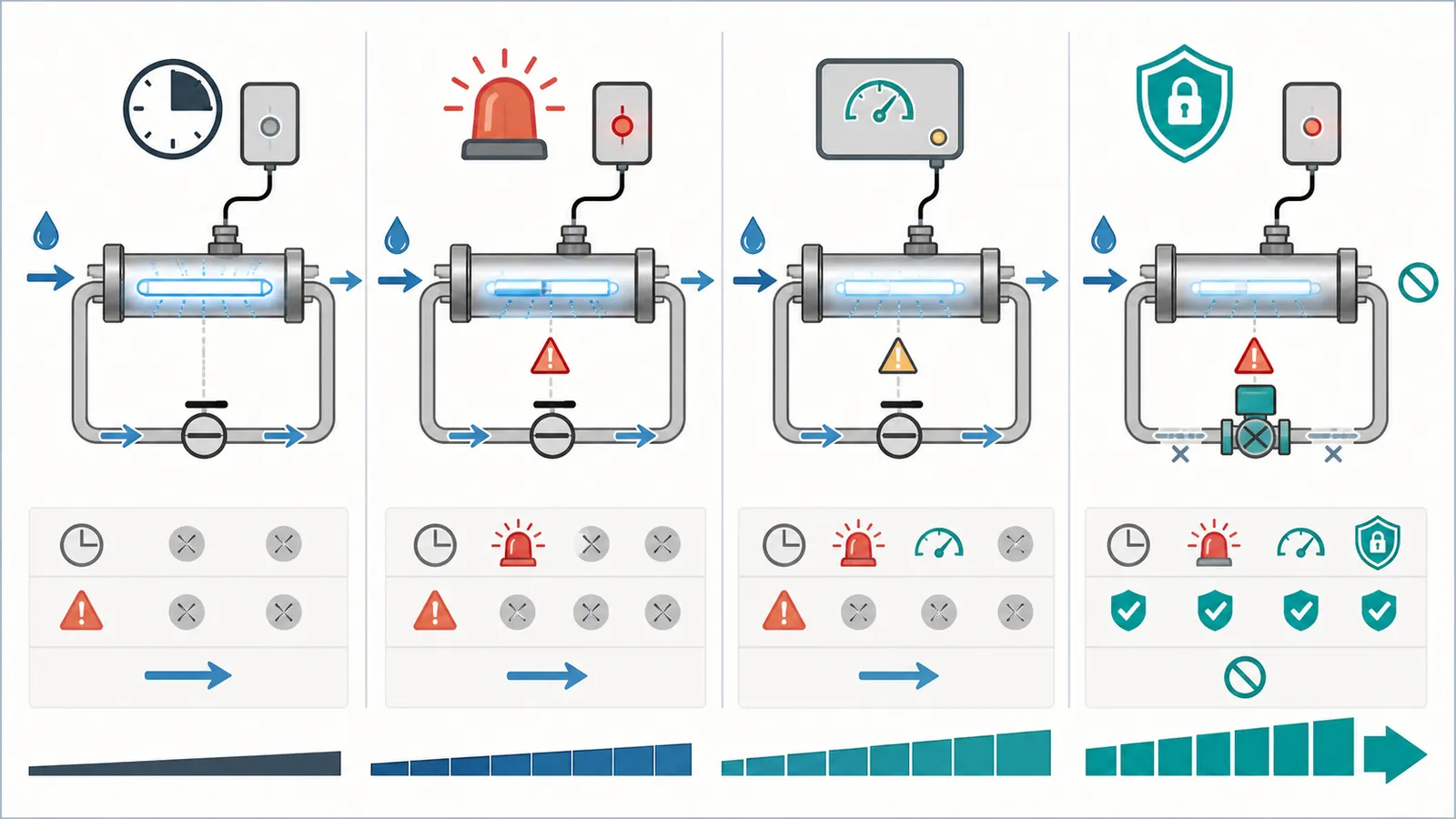
The words “UV alarm” can describe several very different functions. Ask the salesperson or installer to put the exact detection method and the exact water-flow response in writing.
| Control | What it watches | What it can tell you | What it does not prove | Can it stop untreated water? |
|---|---|---|---|---|
| Lamp-life timer | Elapsed lamp run time | The lamp has reached the manufacturer’s service interval | That the lamp is producing enough usable UV today | Usually no |
| Lamp-failure alarm | Lamp current, ballast, or controller fault, depending on model | The controller detected a defined electrical or lamp fault | That the dose is adequate when the lamp is on | Only if linked to a shutoff |
| UV-intensity monitor | Sensor reading at the reactor, with model-specific setpoint | Output has fallen below the controller’s defined range | That flow, water quality, sensor calibration, and the entire treatment train are correct | Only if linked to a shutoff |
| Automatic shutoff | A valve commanded by one or more fault signals | Flow has been interrupted after a detected condition | That the water upstream is safe or that the well source is fixed | Yes, if valve, wiring, and trigger logic are correctly designed |
The distinction is visible in a VIQUA owner’s manual: it describes a lamp-life display separately from a lamp-failure state, and describes a UV sensor that measures the lamp’s 254 nm output. In that specific controller family, the low-intensity condition can activate a solenoid output; the manual’s described normally-closed valve remains closed without power until the UV level returns above the controller threshold. The threshold, wiring, and behavior belong to that manual—not to every UV system sold to homeowners.
What a timer is good for
A timer is a maintenance reminder. It is valuable because lamp output declines with age even while the lamp still glows. But a timer is not a live measurement of treatment performance. The manufacturer may specify a replacement interval in operating hours, calendar time, or both. Record the lamp part number, reset procedure, and whether the controller alarms at the end of life.
Do not accept “the lamp is new” as the complete commissioning answer. A new lamp can still be paired with poor water quality, a dirty quartz sleeve, an incorrect flow rate, a failed sensor, or an underspecified system.
What a lamp-failure alarm is good for
A lamp-failure alarm catches a defined electrical or controller condition. It is better than a timer-only system because it can react to an event before the scheduled replacement date. Still, the alarm may be audible only at the equipment location, may be muted, may require someone to be home, or may not cover a low-output lamp, fouled sleeve, low water quality, or excessive flow.
The VIQUA manual says its lamp-failure state occurs when no current is running through the lamp and remains until the condition is remedied. That is a precise product behavior, not a universal definition. Ask whether the quoted unit also detects ballast failure, sensor failure, controller failure, low dose, high flow, or only loss of lamp current.
What an intensity monitor adds
An intensity monitor is closer to the treatment condition than a timer because it observes UV output at the reactor. It can expose a dirty sleeve, mineral deposits, an aging lamp, a changed influent condition, or a voltage problem—issues the VIQUA manual lists among possible causes of low-UV alarms. It still does not replace laboratory testing or pretreatment, and it may not evaluate every variable used to establish the unit’s rated performance.
For context, EPA’s UV Treatment Toolkit lists reactor status, lamp status, UV intensity, lamp run time, and flow as signals to specify as applicable. The toolkit is primarily a technical resource for states evaluating UV technology in public-water settings, so use it here as a control-design vocabulary, not as a private-well installation mandate.
3. Choose alarm, shutoff, or both using the household risk #
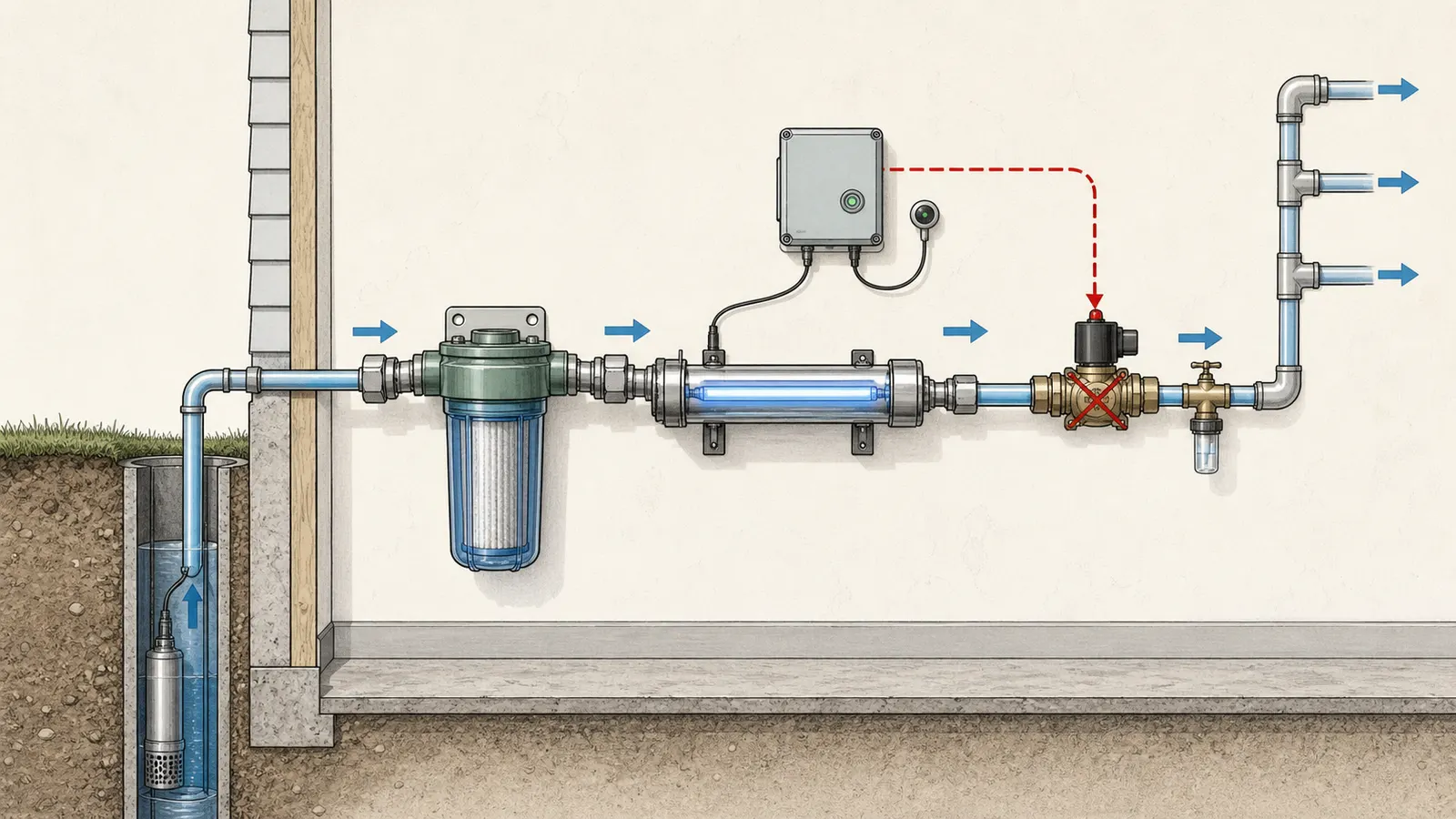
Use the matrix below as a decision surface, then confirm it against the applicable authority and the exact equipment manual. “Higher” does not mean the well is unsafe; it means the consequence of a missed or delayed response is higher.
| Condition | Alarm only may be reasonable when… | Automatic shutoff is favored when… | Add to the quote |
|---|---|---|---|
| UV is the primary disinfection barrier | A person is present, can hear the alarm, and the authority accepts an alarm | There is no reliable rapid response or the household wants the water path closed on a detected fault | Class A status, alarm location, shutoff trigger list, reset instructions |
| Repeated or serious bacterial contamination history | The health authority has approved the operating plan and response is documented | Untreated water could be consumed before anyone notices, or continuous disinfection is a condition of use | Test history, local rule, post-trip water plan, commissioning test |
| Equipment is in a detached pump room, crawlspace, garage, or rental property | A remote alarm is supervised and tested | The alarm may not be heard, acknowledged, or serviced promptly | Audible location, remote relay, valve fail state, notification owner |
| Frequent outages or poor power quality | The manual explains restart and the household has safe backup water | Loss of power must prevent treated-water flow and the valve is designed to close on the defined loss-of-power condition | Power-loss sequence, generator/UPS limits, restart delay, valve state |
| Young children, medically vulnerable residents, or guests | A responsible adult is always present and trained | A warning could be missed or misunderstood | Written response card and physical alarm visibility |
| Local rule says shutoff or alarm | The authority confirms the proposed alarm satisfies the wording and location requirement | The authority or permit specifically requires a shutoff | Rule citation, permit condition, inspector signoff |
| Planned bypass for service | The bypass is controlled, labeled, and locked out from routine use | A bypass could be opened without a safeguard or water-use restriction | Bypass drawing, lockout, key holder, warning label |
This is a risk-and-response choice, not a product ranking. A shutoff reduces the chance that a detected fault becomes a flow-through exposure, but it also creates a no-water event. That tradeoff is acceptable only if the household knows how to get safe water, how to restore the system, and what professional verification is required before resetting it.
Unattended equipment changes the answer
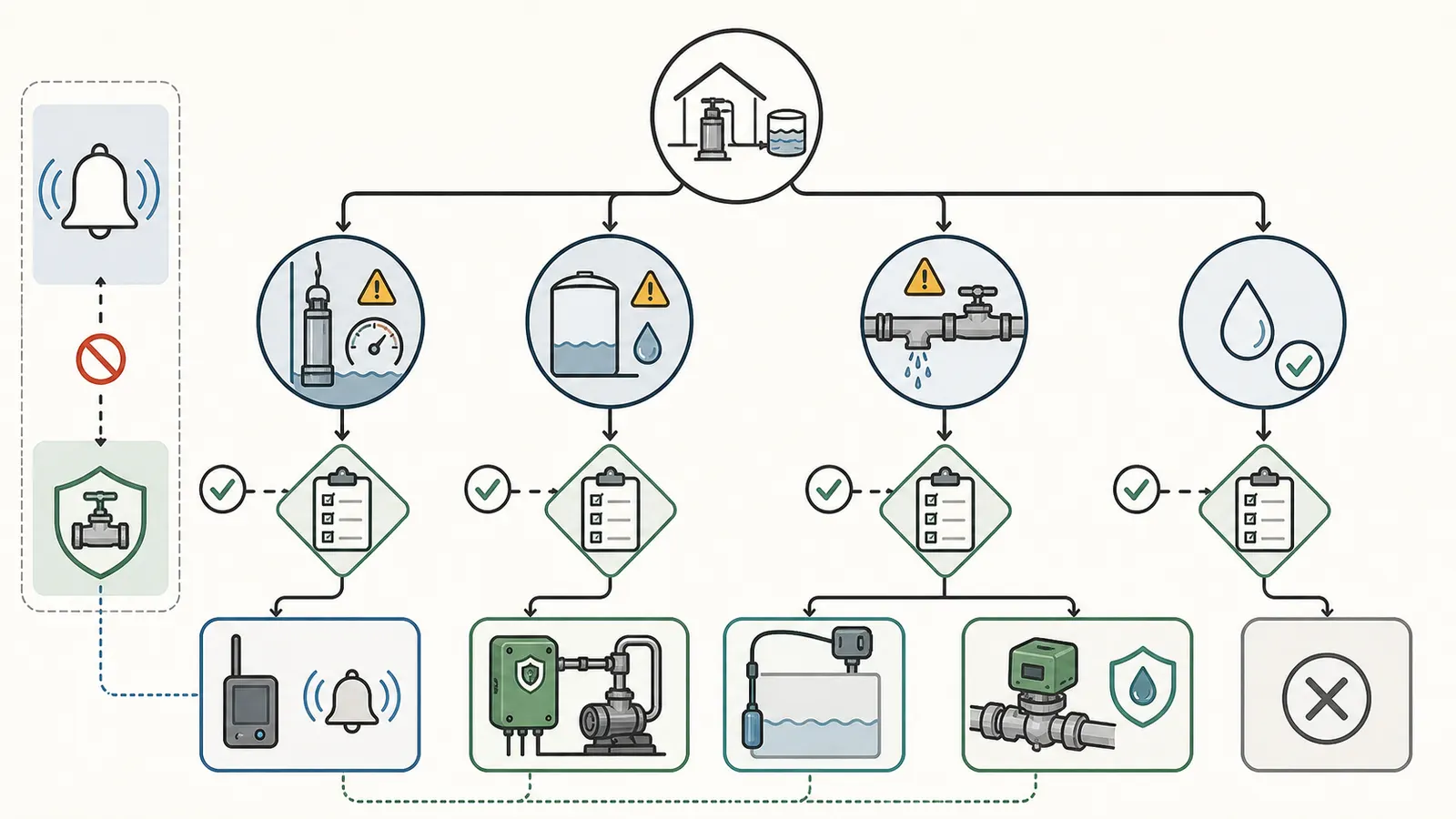
If the controller is in a basement utility room beside bedrooms, an audible alarm may be noticed. If it is in a detached well house or a rarely visited crawlspace, the alarm may be technically present but practically ineffective. A remote dry contact can improve visibility, but it is still an alert unless it is connected to a valve or monitored service.
VIQUA’s Arros 9-DC page is a useful example of that distinction: its dry-contact option can connect to a junction box and solenoid to stop flow during a power outage or critical alarm, or it can trigger a remote indicator or monitoring system. That is an available integration path on specified Arros models, not evidence that every controller has a dry contact or that a valve is included in a standard quote. (VIQUA Arros 9-DC)
Power outage behavior must be written, not guessed
Power loss is where “automatic” and “fail-safe” claims become ambiguous. Ask all four questions:
- Does the controller lose its ability to monitor when the power fails?
- Does the valve close, open, or stay in its last state when control power is lost?
- Does water flow before the lamp reaches full operating output after restart?
- Is there a delay, interlock, generator, or battery arrangement that changes the sequence?
The VIQUA manual states that its monitoring system does not operate during power failures and separately describes a normally-closed solenoid output for its particular controller. That combination illustrates why the controller model and valve wiring matter. Do not infer that a generic “UV alarm” closes a generic valve during an outage. (VIQUA Owner’s Manual MNL520110)
If the installer proposes a backup generator or UPS, ask whether it is approved for the controller, lamp warm-up sequence, solenoid, and household electrical installation. A backup power source may keep water available, but it does not automatically prove the UV unit is producing the required treatment condition.
4. Apply local rules without turning one jurisdiction into a national rule #
The local-rule question belongs near the top of the buying process, not after the quote is signed. Ask the health department, permitting office, or other authority with jurisdiction:
- Is continuous disinfection required for this well, property, contamination history, or occupancy type?
- If UV is used, must it be Class A under the current referenced standard?
- Does the rule accept an automatic shutoff, an audible alarm, or either?
- Where must an alarm be audible or visible?
- Is a particular pretreatment step, sample tap, commissioning test, or follow-up test required?
- Is a bypass allowed, and how must it be controlled?
- Does the rule apply to a single-family private well, a shared well, a rental, or a semi-public supply differently?
Ohio’s rule shows why exact reading matters. It applies continuous-disinfection requirements to listed private water systems and says that a UV system used as the primary means of disinfection must meet NSF 55 Class A and have an automatic shutoff device or warning device when the device is not functioning. The same rule also specifies pretreatment and filtration conditions in defined situations. It does not say that every private well in the United States needs a solenoid valve. (Ohio Administrative Code Rule 3701-28-15)
Wake County provides a different but related example. Its December 19, 2024 regulation says certain private wells that fail to test absent for coliform bacteria on three consecutive post-disinfection sampling events, after a satisfactory well-construction inspection, must use continuous disinfection. For a UV unit, the rule calls for an automatic shutoff control or an alarm audible within the dwelling that engages upon a failure or malfunction, plus pretreatment when required by the manufacturer or Department. That trigger and wording are local to Wake County’s regulation. (Wake County Well Regulations)
Put the rule into the quote file
A good quote should not merely say “meets code.” It should identify the authority, rule or permit condition, date checked, UV class, alarm location, shutoff status, and any required test or sample tap. If the installer says “an alarm is all that is required,” ask for the exact section and confirm it with the authority. If the installer says “a shutoff is mandatory,” ask whether that is a rule, a manufacturer requirement, an insurer condition, or the installer’s preferred design.
Those may all be valid reasons to choose a shutoff, but they are not interchangeable. Separating them protects the homeowner from both under-specifying a safety control and paying for an unsupported claim about local law.
5. Treat pretreatment, flow, and maintenance as part of the shutoff decision #
An automatic valve cannot make a poorly prepared UV feed water safe. Sediment, turbidity, iron, manganese, hardness, scale, temperature, flow, and other conditions can affect the unit’s operation or maintenance. Connecticut’s Department of Public Health specifically warns that iron and manganese may increase turbidity and suspended solids that interfere with UV performance, and advises homeowners to ask what water-quality conditions will affect the proposed treatment. It also says equipment not serviced according to manufacturer recommendations may contribute to increased contaminant levels. (Connecticut DPH: What to Ask When Purchasing Water Treatment Equipment)
Ohio’s rule provides a concrete local example: for the systems covered by that rule, influent water must be pretreated to meet the manufacturer’s or Class A parameters, and specified UV applications require an absolute filter no larger than five microns before the UV equipment. That five-micron requirement should not be copied into every quote without checking the governing rule and the manufacturer’s design. (Ohio Administrative Code Rule 3701-28-15)
Ask the installer to show the treatment train in flow order and to state the operating assumptions:
- What is the maximum household flow the UV unit must treat?
- What is the unit’s rated flow at the specified UV condition?
- What filter, softener, iron or manganese treatment, or other pretreatment is upstream?
- Where can raw and treated samples be collected?
- What water-quality result would cause the controller to alarm or the unit to be serviced?
- What happens if a cartridge plugs and household pressure drops?
- What happens if a bypass is opened around pretreatment or UV?
Do not confuse a pressure problem with a UV-safety problem. A clogged filter may reduce flow and protect the UV dose, or it may cause a homeowner to open a bypass. The installer should explain whether the bypass is permitted, locked, alarmed, or prohibited, and what water-use restriction applies while it is open.
Maintenance is a control, not a footnote
Your written maintenance plan should identify the person responsible for lamp replacement, sleeve cleaning, filter changes, sensor cleaning or calibration, alarm testing, valve exercise, and water testing. It should also explain what evidence shows that the system is back in service: a normal controller display, a cleared alarm, a valve position, a pressure check, or a laboratory result.
Connecticut DPH recommends asking who is responsible for changing ultraviolet lights or filter media, what supplies and costs are expected, and whether follow-up testing is included. It recommends testing about a month after installation and periodically thereafter at a state-certified laboratory, with a raw-water sample tap available for comparison. (Connecticut DPH: What to Ask When Purchasing Water Treatment Equipment)
That testing does not turn the shutoff into a laboratory instrument. The valve reacts to the controller’s defined signal. Testing checks whether the overall treatment plan is accomplishing its intended job at the time and place sampled.
6. Know the safest response when the unit trips #
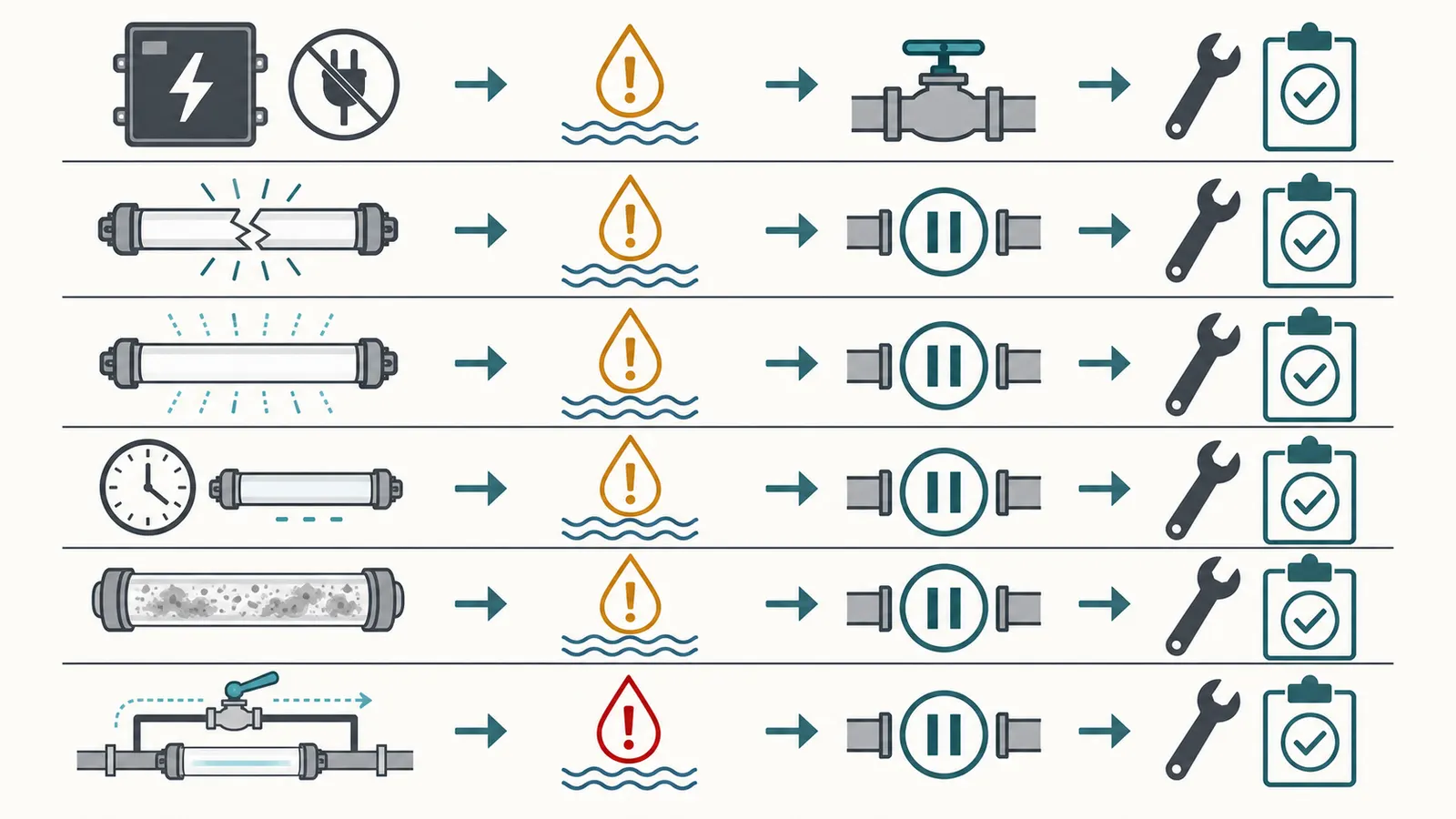
Treat a UV trip as “water treatment status unknown” until the cause is identified. Do not silence an alarm and resume normal drinking-water use simply because water is flowing again. The exact response depends on the manual and local health guidance, but this sequence is a safe planning baseline:
| Observation | Safe homeowner interpretation | Immediate action | Professional follow-up |
|---|---|---|---|
| Audible alarm, display still lit | A defined fault or maintenance condition exists; severity is unknown | Stop using water for drinking, cooking, ice, brushing teeth, and infant preparation until the manual or authority says otherwise; use backup water | Identify the alarm code and test the unit, sensor, lamp, sleeve, flow, and water quality |
| Blank display or lamp-failure indication | The controller may have detected lamp or controller failure, or may have lost power | Treat treated-water status as unknown; check only the normal external power indication without opening controls | Qualified professional verifies power, controller, ballast, lamp, and valve logic |
| Low-intensity indication | The sensor reports a low output condition; causes can include lamp age, sleeve deposits, voltage, water quality, or sensor installation | Do not consume until the condition is corrected and the manual’s restart procedure is complete | Service the sleeve/lamp/sensor and investigate influent water and electrical conditions |
| Valve closed, no water | The safeguard may be doing its job | Do not force the valve or open an unapproved bypass; use backup water | Resolve the triggering fault and document reset approval |
| Power outage | Treatment and monitoring may not be operating; valve behavior is model-specific | Use backup water and follow the written power-restoration sequence | Verify lamp warm-up, controller status, valve state, and any generator/UPS arrangement |
| Bypass open or suspected open | Water may be moving around a treatment step | Close it only if the manual says a homeowner can safely do so; otherwise stop using the water and call the installer | Confirm bypass lockout, labeling, and post-service test |
The VIQUA manual gives a useful model-specific warning: it says that, during a temporary solenoid bypass on the described system, the water should not be consumed until the system returns to a safe condition. That instruction should not be generalized to another brand, but it is exactly the kind of sentence you should locate in the manual before installation. (VIQUA Owner’s Manual MNL520110)
What not to do yourself
Do not open an energized UV controller, test live wiring, alter the solenoid wiring, bypass an interlock, open the well, pull a pump, enter a confined space, or manipulate pressurized equipment unless a specific manufacturer instruction clearly identifies the action as safe for a homeowner and the system has been isolated as directed. Electrical, pressure, chemical, and well work belong to appropriately qualified professionals.
A homeowner can usually read the display, photograph the model and alarm code, check whether a faucet has flow, review the manual, move to the backup-water plan, and call the installer or health authority. If a valve trips repeatedly, do not repeatedly reset it to keep the house supplied. Repeated trips are information about the system or source, not an inconvenience to work around.
7. Approve only a quote that makes the failure state explicit #
Before you approve installation, request these items in writing:
Equipment identity
- Manufacturer, complete model number, controller model, lamp part number, and exact certification or listing.
- NSF/ANSI 55 class, rated flow, and the water-quality assumptions used for that rating.
- Whether the lamp timer is display-only, alarmed, or connected to a shutoff.
- Whether the controller detects lamp current, UV intensity, flow, dose, sensor fault, controller fault, or only some of these.
Valve and controls
- Solenoid manufacturer and model.
- Normally-closed or normally-open state, and what “closed” means in the installed flow path.
- Faults that close the valve: power loss, lamp failure, low intensity, controller fault, high flow, sensor fault, or other conditions.
- Whether the valve is powered by the controller, a junction box, or a separate circuit.
- What happens during startup, brownout, generator operation, and controller reset.
- Whether a dry contact is an alarm output only or is actually wired to an automatic shutoff.
Water path and service
- Pretreatment order, filter micron rating, softener or iron/manganese treatment, and sample-tap locations.
- Maximum expected household flow and the unit’s matching rated flow.
- Lamp, sleeve, filter, and sensor maintenance intervals.
- Freeze protection, access for service, replacement parts, and the responsible service provider.
- Bypass location, lockout method, label, and water-use instructions.
Verification and handoff
- Local authority contacted and exact rule or permit condition.
- Commissioning test, treated-water and raw-water sampling plan, and follow-up laboratory test.
- Written alarm-response and backup-water plan.
- Owner’s manual, wiring diagram, valve data sheet, as-built flow diagram, and photos of labels.
- A demonstration of the alarm, shutoff, reset, and restoration sequence that does not require the homeowner to open live controls.
If a quote cannot answer whether the valve closes on power loss, it is not yet specific enough for a primary disinfection barrier. If it says “alarm included” without naming the alarm condition, location, audibility, and water-flow response, it is not yet specific enough for a high-consequence equipment location. If it says “Class A” without a complete model and certification evidence, it is not yet specific enough to compare.
The record to take to a quote review #
Use the Private-Well UV Safeguard Quote Checklist as a printable worksheet. Fill it from the water laboratory report, the UV label, the exact owner’s manual, the installer’s written quote, and the local authority’s answer. The important fields are:
- why UV is being used and whether it is the primary disinfection barrier;
- the exact UV class, model, controller, lamp, rated flow, timer, alarm, and intensity monitor;
- the solenoid model, normal state, fault triggers, power-loss response, and bypass behavior;
- pretreatment and water-quality assumptions;
- lamp, sleeve, filter, and sensor maintenance responsibility;
- raw and treated sample taps, commissioning and follow-up testing; and
- the local rule, permit condition, or written interpretation.
The final choice can be simple once those facts are visible:
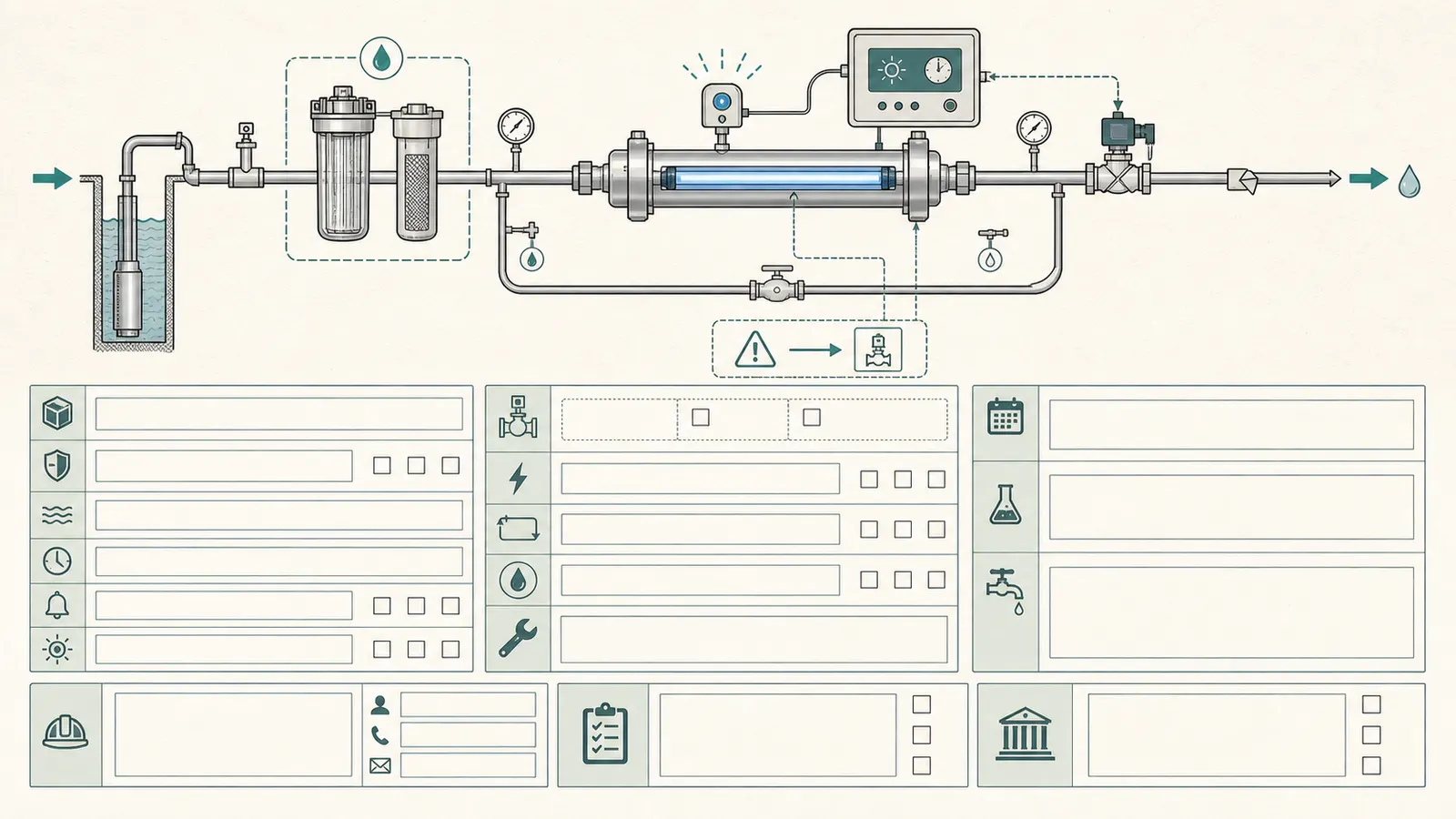
- Choose an alarm-only design when the authority accepts it, someone can reliably respond, the equipment is supervised, and the written treatment plan makes the response safe.
- Choose an automatic shutoff when UV is the primary barrier, the equipment is unattended, a missed alarm has unacceptable consequences, or the authority or manufacturer requires flow to stop on a detected failure.
- Choose alarm plus shutoff when you want immediate local awareness as well as a physical barrier, especially where a valve trip will leave the household without water.
In every case, keep testing, pretreatment, maintenance, and backup water in the plan. A shutoff prevents a detected failure from continuing to pass through the valve; it does not repair a contaminated well, validate the lamp dose, remove nitrate or arsenic, clean a sleeve, replace a filter, or create safe water while the system is locked out.
Private-Well UV Safeguard Quote Checklist
A reusable worksheet for recording UV class, monitoring, shutoff behavior, pretreatment, maintenance, testing, bypass, and local requirements.
Download the worksheet (PDF)Cite this guide
Brictale. “Should a Private-Well UV System Have an Automatic Shutoff?.” Published 2026-09-07; updated 2026-09-07.
https://brictale.com/water/filtration/should-a-private-well-uv-system-have-an-automatic-shutoff · Read the Markdown version
Sources and scope
Evidence behind this page
- NSF/ANSI 55 distinguishes Class A UV systems for contaminated water from Class B systems for reducing non-disease-causing bacteria in disinfected drinking water; certification does not mean a system reduces every contaminant.
NSF Standards for Water Treatment Systems
General explanation of NSF/ANSI 55 Class A and Class B and the limits of certification; not a statement of a local installation requirement.
Accessed · Link to this claim - Ohio Administrative Code Rule 3701-28-15 requires a UV system used as primary disinfection on a private water system to meet NSF 55 Class A and to have an automatic shutoff device or warning device when the UV device is not functioning.
Ohio rule effective January 1, 2020; applies to the rule's defined private water systems and is not a nationwide requirement.
Accessed · Link to this claim - The same Ohio rule requires pretreatment to meet manufacturer or Class A water-quality parameters and requires an absolute filter no larger than five microns in specified UV applications.
Ohio-specific continuous-disinfection rule; the five-micron requirement is tied to the rule's listed systems, not a universal homeowner specification.
Accessed · Link to this claim - Wake County, North Carolina regulations require certain private wells with repeated post-disinfection coliform failures to use continuous disinfection; a UV unit must have an automatic shutoff control or an alarm audible within the dwelling that engages on failure or malfunction.
Regulations Governing Well Construction and Groundwater Protection in Wake County
Wake County, North Carolina regulation amended December 19, 2024; applies to the conditions and well types covered by that local regulation.
Accessed · Link to this claim - Wake County's continuous-disinfection provision is triggered by three consecutive post-disinfection sampling events that fail to test absent for coliform bacteria, and it calls for pretreatment when required by the manufacturer or Department.
Regulations Governing Well Construction and Groundwater Protection in Wake County
Wake County, North Carolina local trigger and installation condition; not a general rule for all private wells.
Accessed · Link to this claim - EPA advises private-well owners to use certified drinking-water laboratories, contact public health authorities when a contaminant exceeds a health standard, and recognize that treatment suitability depends on the contaminant, its concentration, and well condition; a new source may sometimes be needed.
EPA homeowner guidance for private wells; supports testing and treatment limits, not a UV-specific shutoff mandate.
Accessed · Link to this claim - EPA recommends keeping accurate records of private-well maintenance and periodically inspecting exposed well components such as the casing, cap, and surface seals.
EPA private-well protection guidance; supports the recordkeeping and source-protection portions of this buying guide.
Accessed · Link to this claim - Connecticut Department of Public Health advises homeowners to ask whether treatment equipment has an alarm or indicator, whether backup or shutoff functions prevent untreated-water consumption, and whether follow-up testing is included; it recommends state-certified laboratory testing after installation and periodically thereafter.
Publication #19: What to Ask When Purchasing Water Treatment Equipment for Your Home
Connecticut homeowner purchasing guidance; useful as consumer due diligence and not a national equipment mandate.
Accessed · Link to this claim - Connecticut Department of Public Health notes that iron and manganese can increase turbidity and suspended solids that interfere with UV disinfection performance, and says treatment must be serviced according to manufacturer recommendations.
Publication #19: What to Ask When Purchasing Water Treatment Equipment for Your Home
Connecticut Department of Public Health consumer guidance; supports the need to discuss water-quality conditions and service intervals with the installer.
Accessed · Link to this claim - The VIQUA controller manual describes a lamp-life display and separate lamp-failure alarm behavior; the lamp-failure state is triggered when no current is running through the lamp and remains until the condition is remedied.
VIQUA Owner's Manual MNL520110
VIQUA controller manual; exact alarm behavior varies by controller and model and must not be generalized to every UV system.
Accessed · Link to this claim - For the VIQUA controller described in the manual, a UV-intensity sensor measures the lamp's 254 nm output, a low-intensity condition can activate a solenoid output, and the described normally-closed valve remains closed without power until the UV level rises above the controller threshold.
VIQUA Owner's Manual MNL520110
Model/controller-specific example; the manual's threshold and wiring behavior are not a universal UV specification.
Accessed · Link to this claim - The VIQUA manual states that its monitoring system does not operate during power failures and lists voltage drops and changed influent water quality among possible causes of a low-UV alarm.
VIQUA Owner's Manual MNL520110
Model/controller-specific operating behavior; a homeowner must obtain the exact manual for the quoted unit.
Accessed · Link to this claim - VIQUA's Arros 9-DC product page describes a dry-contact relay option that can connect to a junction box and solenoid valve to stop water flow during a power outage or critical UV alarm.
VIQUA Arros 9/15/22 dry-contact option; product capability, not a claim that all UV systems include or require it.
Accessed · Link to this claim - EPA's UV Treatment Toolkit lists reactor status, lamp status, UV intensity, lamp run time, and flow among signals to specify as applicable, and says safeguards should prevent inadequately treated water from entering through a bypass.
EPA technical resource for states evaluating UV technology, primarily public-water context; used here for control-design concepts and explicitly not treated as a private-well mandate.
Accessed · Link to this claim