What to Record in a Private Well UV Service Log
Use this model-agnostic private-well UV service log to track lamp and sleeve work, alarms, bypasses, flow, pretreatment, and water tests.
The short answer
Record the UV unit’s identity, pretreatment and intended flow at installation; then log every lamp or sleeve service, alarm, power loss, bypass, filter change, and water test. Capture exact model readings—not invented universal thresholds—plus what was done and whether treatment was verified afterward. An unresolved alarm, damaged sleeve, uncontrolled flow, or failed post-service test means stop treating the water as potable and call qualified help.What to Record in a Private Well UV Service Log
Record enough that another person can answer four questions without guessing: what exact UV system is installed, what condition was it in at the last service, what happened when treatment was interrupted, and what evidence shows the water was checked afterward. At installation, capture the manufacturer, model, serial number, lamp and sleeve details, pretreatment, intended flow, sample points, alarm behavior, and commissioning tests. At every service, record the date, reason, shutdown and pressure-release checks, lamp or sleeve work, readings actually shown by the controller, bypass time, disinfection, and follow-up test. The Connecticut Department of Public Health specifically recommends a logbook for UV maintenance and repairs, and its guidance recommends recording raw and treated water testing after installation and annually thereafter (Connecticut DPH UV guidance).
Treat the log as a safety record, not proof that an unfamiliar system is working. A muted alarm, a newly installed lamp, or clear-looking water does not by itself verify disinfection. If the lamp is expired, an alarm remains unresolved, water flow may exceed the unit’s documented limit, the quartz sleeve is cracked or cannot be cleaned, a bypass was opened, or a post-service result is unacceptable or unclear, use another known-safe drinking-water source and contact a qualified water-treatment or well professional. The installed model’s manual and local health guidance control the exact service and testing requirements.
1. Establish the installation baseline #
The first page of the record should describe the system as it exists when it is commissioned, before the first routine replacement. This baseline prevents a later service person from treating a missing field as a harmless omission. It also separates what the equipment is designed to do from what a homeowner merely observes at a faucet.
Record these items once, then update them whenever the treatment train changes:
| Baseline field | What to write down | Why it matters |
|---|---|---|
| Equipment identity | Manufacturer, exact model, serial number, controller or sensor model, installation date, and manual URL or file location | Lamp life, alarms, sensor readings, flow limits, parts, and service steps are model-specific |
| Water path | Well or pressure-tank outlet, pretreatment stages in order, UV inlet and outlet, house line, drains, and any post-UV branches | A UV record is not useful if nobody knows whether a sample or fixture is before or after the chamber |
| Pretreatment | Sediment filter type and micron rating if stated, cartridge size, last change, turbidity or color observations, and any iron or manganese treatment | The Connecticut guidance identifies turbidity, color, films, dissolved compounds, flow, and solids on the sleeve as factors that can affect UV efficiency (Connecticut DPH UV guidance) |
| Intended operating conditions | Rated or certified maximum flow, installed flow restrictor or flow meter, pressure range if the manual gives one, and the normal controller display | Contact time and flow are part of the treatment condition; do not substitute a generic gallons-per-minute number |
| Controls and safeguards | Alarm types, sensor or intensity display, automatic shutoff behavior, power source, bypass arrangement, and location of the main water shutoff | A later alarm or outage entry needs a reference for what the system is supposed to signal or stop |
| Sample points | Raw-water tap before UV, treated-water tap after UV, representative household tap, and labels or photos identifying each | Paired samples are interpretable only when the collection points and treatment status are recorded |
Attach a photo of each data plate, controller screen, valve position, filter housing, sample tap, and warning label. Photos are useful evidence of identity and configuration, but they are not a substitute for a dated reading or laboratory report. If the model, serial number, flow rating, or pretreatment cannot be identified, write “not verified” and ask a qualified installer or service professional to identify it. Do not fill the blank with a similar-looking product number.
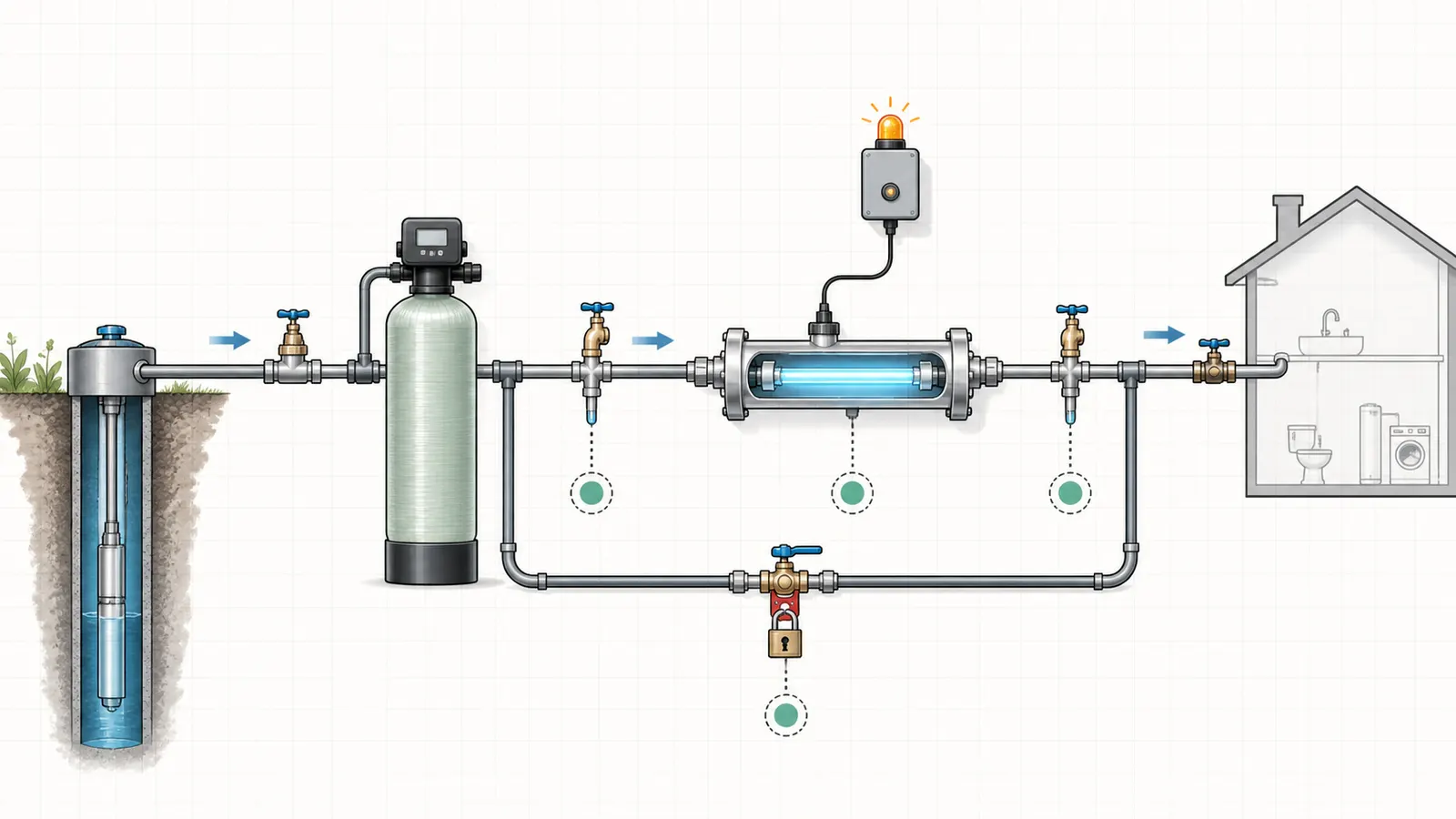
At commissioning, also record who installed or inspected the system, the date it was first energized, the initial lamp-hour or service counter value, the initial intensity or sensor value if available, and the alarm test result. Record the raw and treated sample collection dates, laboratory name, analytes, result, units, and report number. The Connecticut recommendation for raw and treated testing is a useful paired baseline, not a claim that one state’s guidance is a universal private-well legal requirement.
2. Make every lamp and sleeve service traceable #
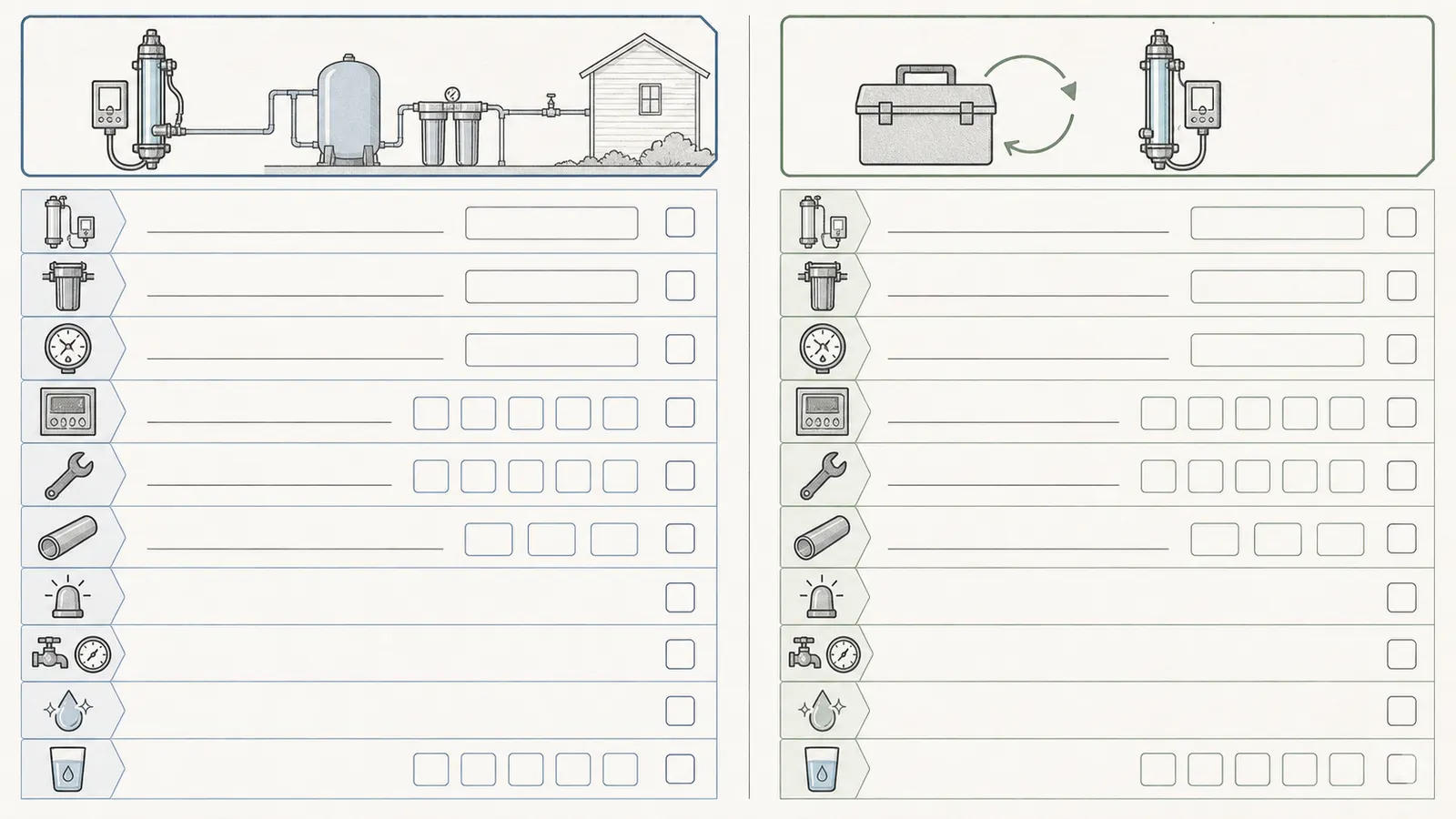
Use one service entry for each lamp replacement, sleeve cleaning, sleeve replacement, sensor cleaning, filter change that affects UV performance, or other work on the treatment train. A short entry such as “changed bulb” cannot tell a future homeowner whether water was shut off, whether the chamber was depressurized, whether the sleeve was inspected, or whether the system returned to a verified state.
For each entry, record:
- date and time work began and ended;
- person or company doing the work, with contact information if available;
- reason for service: scheduled age, hour counter, alarm, low reading, leak, cloudy sleeve, power event, or other observation;
- lamp part number, lot or serial information if present, installation date, and the old lamp’s displayed hours or removal reason;
- sleeve condition: clean, mineral-coated, stained, chipped, scratched, cracked, leaking, or not inspected;
- cleaning product and method only if the actual manual permits it, or the professional’s service note;
- replacement sleeve part number and seals or O-rings changed, if applicable;
- controller, sensor, intensity, lamp-life, or alarm readings before and after service exactly as displayed, including units;
- filter condition and replacement details when pretreatment was serviced;
- disinfection method, contact time or other documented steps, and who performed them;
- post-service leak check, alarm check, flow check, and water-test plan; and
- whether the unit was returned to normal service, left shut down, or left on a documented temporary bypass.
Lamp life is not a universal calendar rule. For example, the VIQUA D4/E4/F4 manual describes approximately 9,000 hours, or about one year of continuous operation, for the listed models (VIQUA owner’s manual). Record the rule from the installed model’s manual, then record both the replacement date and the counter or estimated hours. If the controller has no reliable hour display, use the energizing date and the manufacturer’s stated replacement interval, marking any estimated date as estimated.
The sleeve entry needs its own observation. Mineral coating reduces UV light reaching the water, while a sleeve that remains dirty after the permitted cleaning or is scratched or cracked may need replacement under the VIQUA instructions (VIQUA owner’s manual). “Looks clear from the outside” is not a sleeve inspection. Record what was actually seen after the chamber was safely opened by someone following the unit’s instructions. A cracked sleeve or water leak is a stop-and-escalate condition, not a reason to increase a setting or continue using the water.
3. Log alarms, power loss, and bypass events as incidents #
Routine maintenance and treatment interruptions belong in separate parts of the record. An incident entry should allow a professional to reconstruct how long the barrier may have been unavailable and what happened to the water afterward.
Record the following for every alarm, outage, controller fault, unexpected shutdown, bypass, or automatic shutoff:
| Incident field | Record the observation, not a guess |
|---|---|
| Start and end | Date, time noticed, time power or treatment was restored, and how the time was determined |
| Trigger | Exact alarm text or code, lamp-life status, low-intensity status, sensor fault, power loss, leak, high flow, filter blockage, or unknown |
| System state | Lamp on or off, controller energized or not, automatic shutoff active or not, valve positions, and whether the bypass was open |
| Water exposure | Fixtures or occupants that may have used water, alternate drinking-water source used, and whether cooking, brushing teeth, or ice-making was affected |
| Response | Safe manufacturer-directed checks, service call time, parts replaced, disinfection, flushing, and who authorized return to service |
| Verification | Final alarm state, displayed reading, flow observation, leak check, sample collection, laboratory report, and unresolved questions |
Write the exact alarm wording or take a photo before resetting it, if doing so is safe and allowed by the manual. The VIQUA manual lists lamp, low-UV, controller, and sensor alarms and warns that water may be unsafe for consumption when its lamp-life counter reaches zero (VIQUA owner’s manual). Other brands can use different alarm names, delays, and shutdown behavior, so never translate “green,” “quiet,” or “reset” into a universal disinfection conclusion.
For a power outage, record whether the controller and lamp actually restarted, whether the alarm cleared, and whether the system has an automatic shutoff or merely an alarm. For a bypass, record who opened it, why, the exact time, the valve position when closed, and the disinfection and testing steps required before normal use. A bypass is a change in treatment status, even if it was open for only a few minutes. Maine’s UV policy for public water systems illustrates why shutdown, bypass restrictions, monitoring, and sampling are tracked together; its public-system policy point is not a universal private-well rule (Maine UV Disinfection Policy).
4. Record flow, pretreatment, and model-specific readings #
UV performance depends on the conditions under which water passes the lamp. The record should preserve the installed system’s intended flow and the observations that show whether those conditions were maintained. Do not copy a flow or intensity threshold from another brand, a web forum, or a public-water policy into a private-well log.
At installation and after plumbing changes, record the documented maximum or certified flow, the actual flow-control device, and where flow is measured. The VIQUA manual describes a flow restrictor as limiting flow over a model’s certified maximum, a sensor as monitoring UV output on equipped models, and sample valves before and after the chamber for checking water and operation (VIQUA owner’s manual). If no flow meter is installed, record “flow not measured” rather than presenting faucet pressure or pipe size as proof of an acceptable rate.
The pretreatment log should include filter changes, clogged or bypassed housings, sediment, cloudiness, color, films, and any treatment added upstream. Note whether a filter was changed before an alarm, after an alarm, or as unrelated routine work. If flow changed after a cartridge replacement, record the reason and the next check. The Connecticut guidance specifically connects water quality and sleeve condition with UV efficiency, so “filter changed” is incomplete without the observed condition and the model’s relevant operating reading.
Use a small model-specific reading card inside the log:
| Reading or control | Installed system’s label or unit | Before service | After service | Manual or source reference |
|---|---|---|---|---|
| Lamp life or hours | __________________ | __________ | __________ | __________________ |
| UV intensity or dose display | __________________ | __________ | __________ | __________________ |
| Alarm text or code | __________________ | __________ | __________ | __________________ |
| Flow or restrictor status | __________________ | __________ | __________ | __________________ |
| Pressure or leak observation, if manual requires it | __________________ | __________ | __________ | __________________ |
This format deliberately leaves the threshold blank until the exact manual or qualified professional supplies it. A value is useful only with its units, display name, time, and operating condition. “Intensity 80” without knowing whether the display reports percent, a sensor unit, or a dose estimate cannot support a safety decision. Similarly, a flow reading is not meaningful unless its units and the unit’s documented limit are known.
5. Pair raw and treated water tests with the service event #
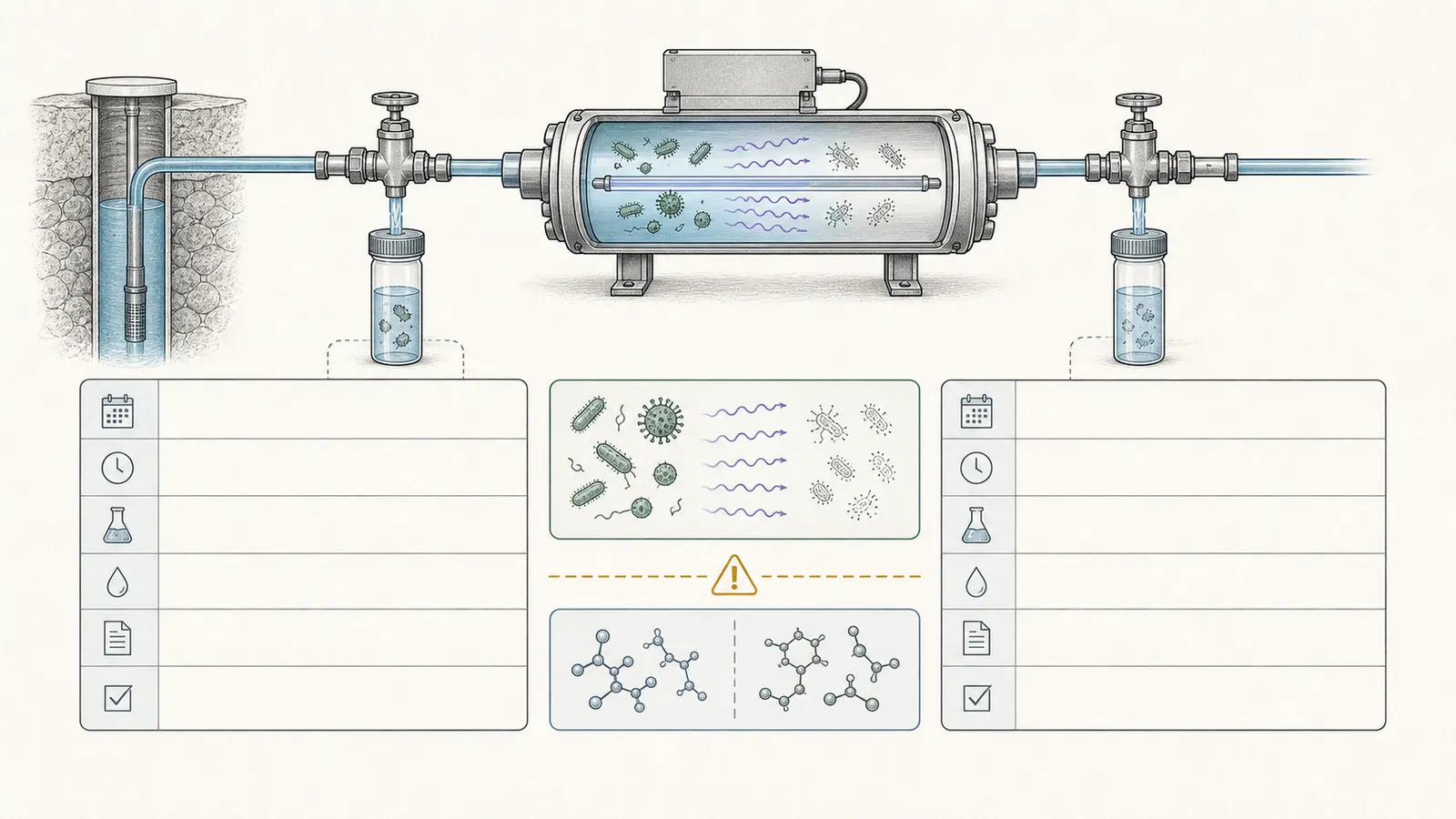
A water-test record needs more than a result. Record the sample point, whether it is before or after UV, the date and time collected, the collector, the laboratory, the analyte, method or panel when shown, result, units, reporting limit if supplied, report identifier, and follow-up action. Keep the complete laboratory report with the log rather than transcribing only “pass” or “fail.”
Use paired records where the testing plan calls for them:
| Sample record | Raw water before UV | Treated water after UV |
|---|---|---|
| Tap or valve label | __________________ | __________________ |
| Collection date and time | __________________ | __________________ |
| UV status and flow during collection | __________________ | __________________ |
| Laboratory and certification | __________________ | __________________ |
| Analyte and method | __________________ | __________________ |
| Result and units | __________________ | __________________ |
| Report number | __________________ | __________________ |
| Action or retest date | __________________ | __________________ |
The CDC recommends private-well testing at least yearly for total coliforms, nitrates, total dissolved solids, and pH through a state-certified laboratory, with additional contaminants guided by local conditions (CDC Guidelines for Testing Well Water). The Connecticut UV guidance separately recommends raw and treated testing after installation and annually thereafter. Record which recommendation, local requirement, treatment professional, or health department instruction set the schedule; do not label an annual panel as a universal UV certification.
Add an event-triggered test entry after a relevant repair or a change in the water. EPA advises testing after significant nearby changes such as flooding or construction, after replacing or repairing part of the well system, or after a change in odor, color, or taste, using certified drinking-water laboratories (EPA Protect Your Home’s Water). Record the event that triggered the sample and whether the sample was taken before or after the UV chamber. A treated sample cannot explain a source-water change if the raw sample was not collected or the sample point is unknown.
Do not turn a clean-looking sample, a single negative result, or a test from one faucet into proof that every branch is protected. UV treatment status, sample quality, plumbing condition, and source-water quality are separate parts of the record. If results show harmful germs or chemicals, CDC advises using bottled water or another safe source and contacting local health or environmental authorities (CDC Guidelines for Testing Well Water).
6. Use the record to set a stop-use boundary #
The log should make the safe next action obvious when evidence is incomplete. The conservative homeowner rule is: if the system cannot be shown to be operating within the installed model’s documented conditions, do not treat the water as verified potable water until the cause is corrected and the required verification is complete.
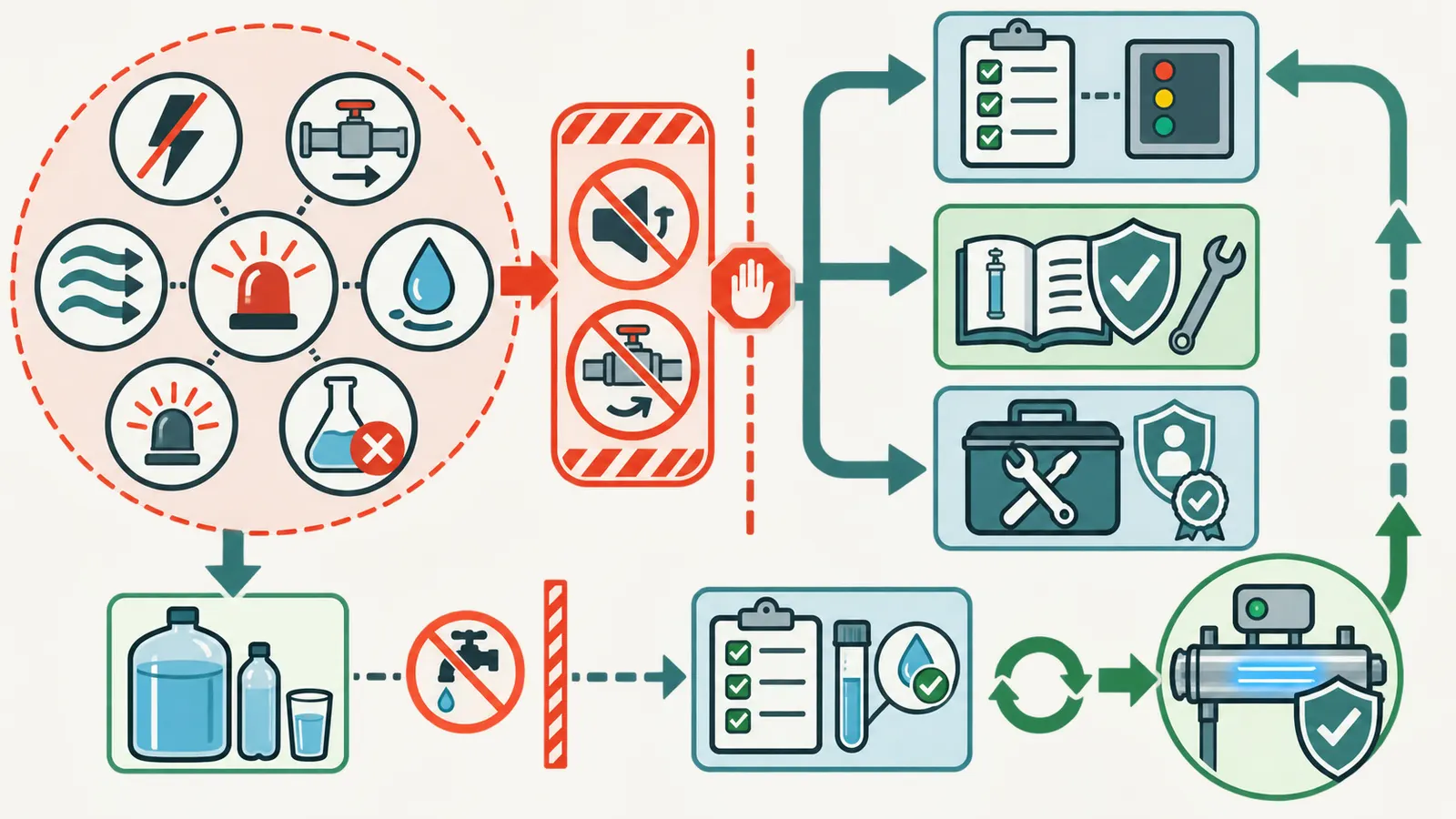
Stop using the well water for drinking, cooking, brushing teeth, making ice, and other consumption-related uses, and switch to a known-safe source while arranging qualified help when any of these apply:
- the lamp is at or past the model’s replacement limit, the lamp is broken, or the controller reports an unresolved lamp-life fault;
- a low-intensity, sensor, controller, or other treatment alarm remains active, returns after reset, or has an unknown meaning;
- a power outage or automatic shutdown occurred and the restart, alarm state, or treatment period cannot be verified;
- a bypass was opened and the required disinfection, flushing, return-to-service check, or testing was not completed;
- flow is uncontrolled, exceeds the model’s documented limit, or cannot be measured when the treatment design requires flow control;
- the sleeve is cracked, scratched, leaking, heavily scaled, or not safely inspectable;
- the chamber, seals, sensor, controller, or wiring shows damage; or
- a post-service laboratory result is positive, failed, inconsistent, or not interpretable because the sample point or treatment status is unknown.
This is a use restriction while uncertainty is resolved, not a diagnosis of contamination. A public-system policy may specify automatic shutdown or a numeric alarm point, but that does not make the same number a private-well standard. Likewise, a manufacturer warning applies to its model and controls. Write “water held from consumption” in the incident record, with the time it began, the alternate source used, the professional contacted, and the evidence required for return to service.
For a moderate-safety system, the homeowner-safe work is limited to reading labels, photographing displays, checking for obvious external leaks without touching energized or pressurized parts, replacing an accessible sediment cartridge only when the system instructions clearly permit it, and arranging sampling. Do not open energized controls, remove a lamp or sleeve from a pressurized chamber, defeat an interlock, alter live wiring, change a flow restrictor beyond the manual, open the well, enter a confined space, pull a pump, or manipulate pressurized equipment unless the exact action is demonstrably safe for a homeowner under the installed manual. Power disconnection, water shutoff, and pressure release are explicit prerequisites in the VIQUA lamp-service instructions (VIQUA owner’s manual); another model may require additional steps.
7. Keep a reusable service-record worksheet #
Copy this compact worksheet for each service or incident. Fill it with observed values and attach photos, invoices, manual pages, and laboratory reports. Leave a field blank or mark it “not verified” when the evidence is missing.
System identity
- Manufacturer / model / serial: ______________________________________________
- Controller / sensor model: __________________________________________________
- Installation location and water-path order: __________________________________
- Lamp part number and documented life rule: __________________________________
- Sleeve part number or size: _________________________________________________
- Pretreatment and last filter change: _________________________________________
- Documented flow limit and installed flow control: ______________________________
- Raw sample tap / treated sample tap / representative tap: ______________________
Service or incident
- Date, start time, end time: __________________________________________________
- Person or company: _________________________________________________________
- Reason or trigger: __________________________________________________________
- Exact alarm, code, or display photo attached: yes / no
- Power disconnected, water shut off, pressure released where required: yes / no / not applicable
- Lamp: retained / replaced; part number: ______________________________________
- Sleeve: clean / cleaned / replaced / damaged / not inspected
- Sensor, seals, filters, and leaks observed: ___________________________________
- Before readings with units: __________________________________________________
- After readings with units: ___________________________________________________
- Flow and bypass status: _____________________________________________________
- Disinfection or flushing completed according to the actual manual: ______________
- Returned to normal service, held shut, or temporary bypass: _____________________
Verification and handoff
- Raw sample date, tap, lab, analyte, result, units, report ID: _____________________
- Treated sample date, tap, lab, analyte, result, units, report ID: _________________
- Follow-up action and due date: ________________________________________________
- Stop-use or alternate-water period: ___________________________________________
- Professional contacted and advice received: ___________________________________
- Remaining uncertainty: _______________________________________________________
8. Hand the next professional a complete history #
The most valuable record is chronological and honest about uncertainty. Keep the installation baseline, each service entry, each alarm or bypass event, laboratory reports, invoices, photos, and the current manual together. Use one date format and write the time zone or local time when an outage or bypass could affect exposure. Never replace an original report with a hand-written summary.
Before a service visit, send the professional the exact model and serial photos, treatment-train sketch, last lamp and sleeve service, controller readings, alarm history, flow information, pretreatment changes, bypass duration, and raw-versus-treated results. Ask the professional to identify which missing field prevents a return-to-service decision. A useful invoice or service note should state what was observed, what was changed, what model-specific instruction was followed, what alarm or reading remained, and what testing is still due.
Review the record at least annually with the well-water testing schedule and after any flood, construction, well-system repair, water-quality change, or treatment-train change. CDC and EPA guidance support annual and event-triggered private-well testing, while the manufacturer manual controls lamp, sleeve, alarm, pressure, and disinfection steps for the installed unit. If those records disagree, pause consumption-related use and ask the local health department or a qualified professional which instruction applies. The goal is not a perfect-looking form; it is a defensible chain from equipment identity, through treatment interruption and service, to verified water and a documented decision to resume use.
Cite this guide
Brictale. “What to Record in a Private Well UV Service Log.” Published 2026-09-05; updated 2026-09-05.
https://brictale.com/water/filtration/private-well-uv-service-log · Read the Markdown version
Sources and scope
Evidence behind this page
- Connecticut Department of Public Health advises owners to keep a logbook recording UV equipment maintenance and repairs.
Publication No. 25: Ultraviolet Radiation Treatment of Private Drinking Water Systems
Connecticut private drinking-water guidance; used here as a practical recordkeeping model, not as a national homeowner mandate.
Accessed · Link to this claim - The Connecticut guidance says UV lamps lose effectiveness, recommends regular lamp cleaning and replacement at least annually, and recommends raw and treated water testing after installation and annually thereafter.
Publication No. 25: Ultraviolet Radiation Treatment of Private Drinking Water Systems
Connecticut Department of Public Health guidance; the article preserves the annual and paired-testing recommendation without converting it into a universal legal requirement.
Accessed · Link to this claim - The Connecticut guidance identifies contact time and flow rate, turbidity, color, films, dissolved compounds, and solids on the sleeve as factors affecting UV disinfection efficiency.
Publication No. 25: Ultraviolet Radiation Treatment of Private Drinking Water Systems
Connecticut private drinking-water guidance; supports recording pretreatment, intended flow, and condition observations rather than inventing one flow or intensity value for every model.
Accessed · Link to this claim - Maine’s UV policy for public water systems addresses record keeping, continuous intensity monitoring, automatic shutdown below the policy’s alarm point, sampling before and after UV, and restrictions on bypass use.
UV Disinfection Policy DWP0047
Maine Drinking Water Program public-water-system policy; its 40 mJ/cm² policy point, automatic shutdown, and bypass conditions are not presented as universal private-well requirements.
Accessed · Link to this claim - The VIQUA D4/E4/F4 manual specifies approximately 9,000 hours for the lamp, approximately one year of continuous operation, and requires power disconnection, water shutoff, and pressure release before lamp service.
VIQUA D4 Premium, E4, F4 and validated models Owner’s Manual
Manufacturer-specific instructions for the listed VIQUA models; the article uses the values as examples and tells homeowners to record their own manual’s hours or date rule.
Accessed · Link to this claim - The VIQUA manual says mineral coating on the quartz sleeve reduces UV light reaching water, and a sleeve that cannot be cleaned or is scratched or cracked must be replaced; it also calls for disinfection after lamp or sleeve replacement or a temporary bypass.
VIQUA D4 Premium, E4, F4 and validated models Owner’s Manual
Manufacturer-specific maintenance and post-service instructions; cleaning chemistry, part handling, and disinfection steps must follow the actual unit manual.
Accessed · Link to this claim - The VIQUA manual describes the flow restrictor as limiting flow over the model’s certified maximum, the sensor as monitoring UV output on equipped models, and sample valves before and after the chamber for checking water and operation.
VIQUA D4 Premium, E4, F4 and validated models Owner’s Manual
Manufacturer-specific component functions; model-specific flow, sensor availability, and sample-port arrangement must be recorded from the installed system.
Accessed · Link to this claim - The VIQUA manual lists lamp, low-UV, controller, and sensor alarms and warns on its display that water may be unsafe for consumption when lamp life reaches zero.
VIQUA D4 Premium, E4, F4 and validated models Owner’s Manual
VIQUA controller behavior for the listed models; other brands may use different alarm names, codes, delays, and shutdown behavior.
Accessed · Link to this claim - CDC recommends testing private-well water at least yearly for total coliforms, nitrates, total dissolved solids, and pH, using a state-certified laboratory and local guidance for additional contaminants.
Guidelines for Testing Well Water
CDC national homeowner guidance; testing panels and frequency may need to be expanded by local conditions, health department advice, or a treatment professional.
Accessed · Link to this claim - EPA says to test a private well immediately after significant nearby changes such as flooding or construction, after replacing or repairing part of the well system, or after a change in odor, color, or taste, and to use certified drinking-water laboratories.
EPA private-well homeowner guidance; it does not prescribe a universal UV pass/fail threshold or replace state and local health-department direction.
Accessed · Link to this claim - CDC advises considering bottled water or another safe source and contacting local health or environmental authorities when well-water results show harmful germs or chemicals.
Guidelines for Testing Well Water
CDC health guidance for private wells; the article applies the precaution to unresolved UV treatment status without claiming that every alarm proves contamination.
Accessed · Link to this claim