How to Measure Reverse Osmosis Wastewater on a Private Well
Measure RO permeate and reject water, calculate ratio, recovery, and well demand, then check your model manual and septic guidance.
The short answer
Collect permeate and reject water over the same timed test interval, using the unit's documented test condition. Calculate reject-to-product ratio as reject ÷ permeate, recovery as permeate ÷ (permeate + reject), and daily well demand from your actual treated-water use. Compare the result with your model documentation and EPA WaterSense benchmark; do not alter a flow restrictor or route concentrate to a septic system, yard, or dry well without qualified guidance.How to Measure Reverse Osmosis Wastewater on a Private Well
Measure reverse osmosis wastewater by collecting the permeate and reject streams over the same timed interval, under the test condition stated for your exact unit. Then calculate three separate results:
- Reject-to-product ratio = reject volume ÷ permeate volume.
- Observed recovery = permeate volume ÷ (permeate volume + reject volume) × 100.
- Daily well demand = the water that becomes permeate plus the reject water, with automatic flushes, leaks, and any whole-house RO load added separately.
The number is only useful when you also record whether the system is point-of-use or whole-house, tank or tankless, the exact model, pressure, filter and membrane age, and the manufacturer's test conditions. EPA reports that a typical point-of-use RO system may send five or more gallons of reject water down the drain for each gallon of treated water, while WaterSense-labeled point-of-use systems must demonstrate 2.3 gallons or less per gallon treated. EPA's current WaterSense guidance makes those benchmarks useful comparison points—not a universal pass/fail rule for every existing private-well installation.
If the reject line goes to a septic system, do not assume that a lower ratio makes the routing safe. Connecticut's Department of Public Health strongly recommends that RO reject directed to a septic system not exceed 30 gallons per day, but that is Connecticut guidance, not a national septic capacity limit. Minnesota Extension's septic guidance also separates under-sink point-of-use systems from whole-house RO and says the volume and concentration of whole-house reject should be evaluated by a wastewater professional.
1. Decide what question the measurement must answer #
There are three different homeowner questions, and each needs a slightly different observation.
| Your question | Measurement that answers it | Decision it supports |
|---|---|---|
| “How much reject water does this RO make while producing water?” | Collect permeate and reject simultaneously over the same timed interval under the documented membrane test condition | Compare an observed ratio or recovery with the exact manual or data sheet |
| “How much water is this RO drawing from my well?” | Use daily permeate demand, measured reject ratio, and a log of flushes, drain time, and leaks | Estimate daily and annual well demand |
| “Could the reject load matter to my septic system?” | Convert measured reject into gallons per day and identify whether the unit is point-of-use or whole-house; document what contaminants are being concentrated | Ask the local septic or wastewater professional whether the route and load fit the site |
Do not combine these questions into one vague “waste ratio.” A ratio describes two streams during a test. It does not tell you how many gallons your household produces unless you know how much permeate you use. It also does not tell you whether a private well, pressure system, drain, septic tank, or disposal route can accept the resulting load.
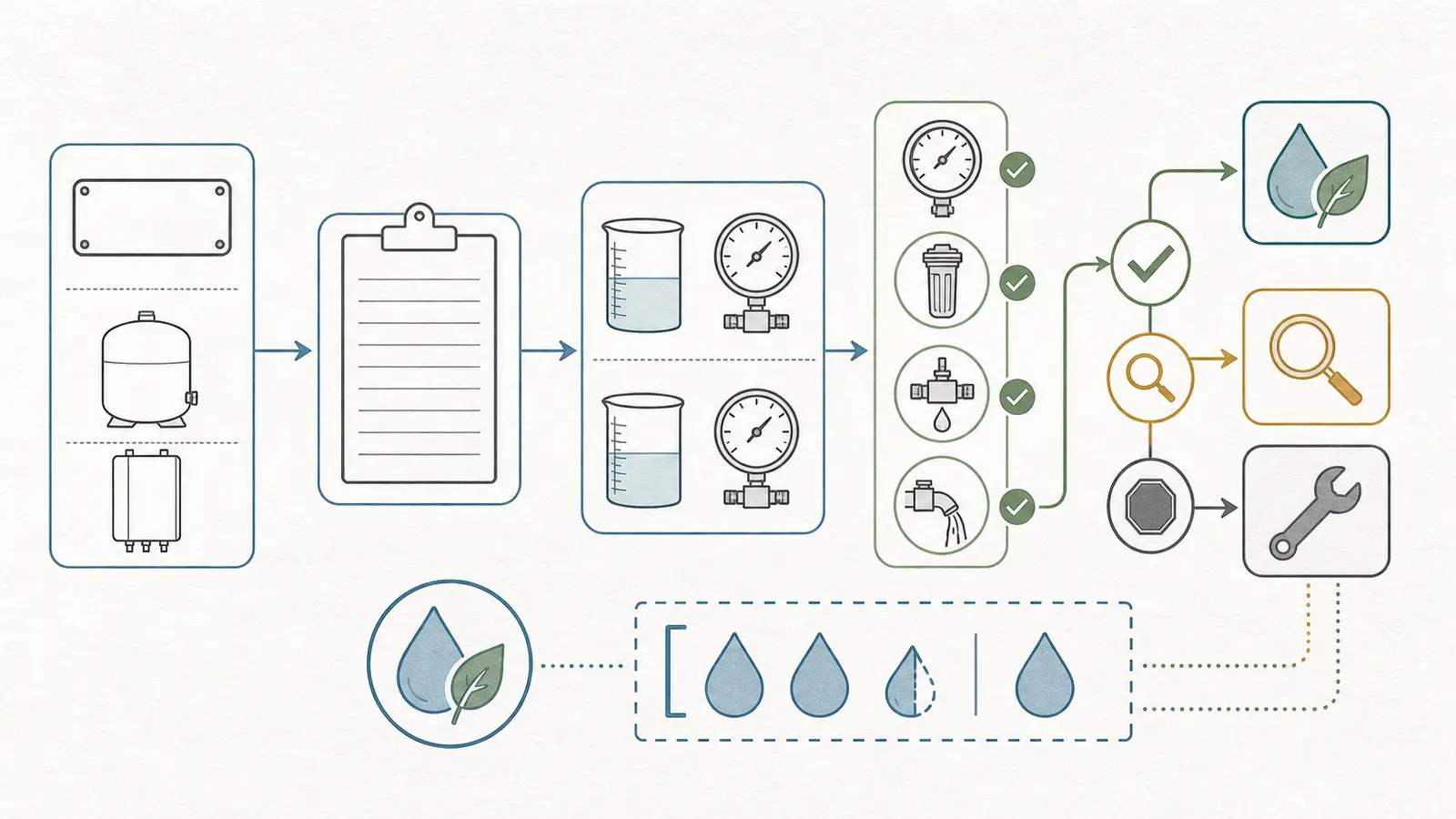
The safest answer is therefore a small evidence record:
- Identify the unit and its documented test condition.
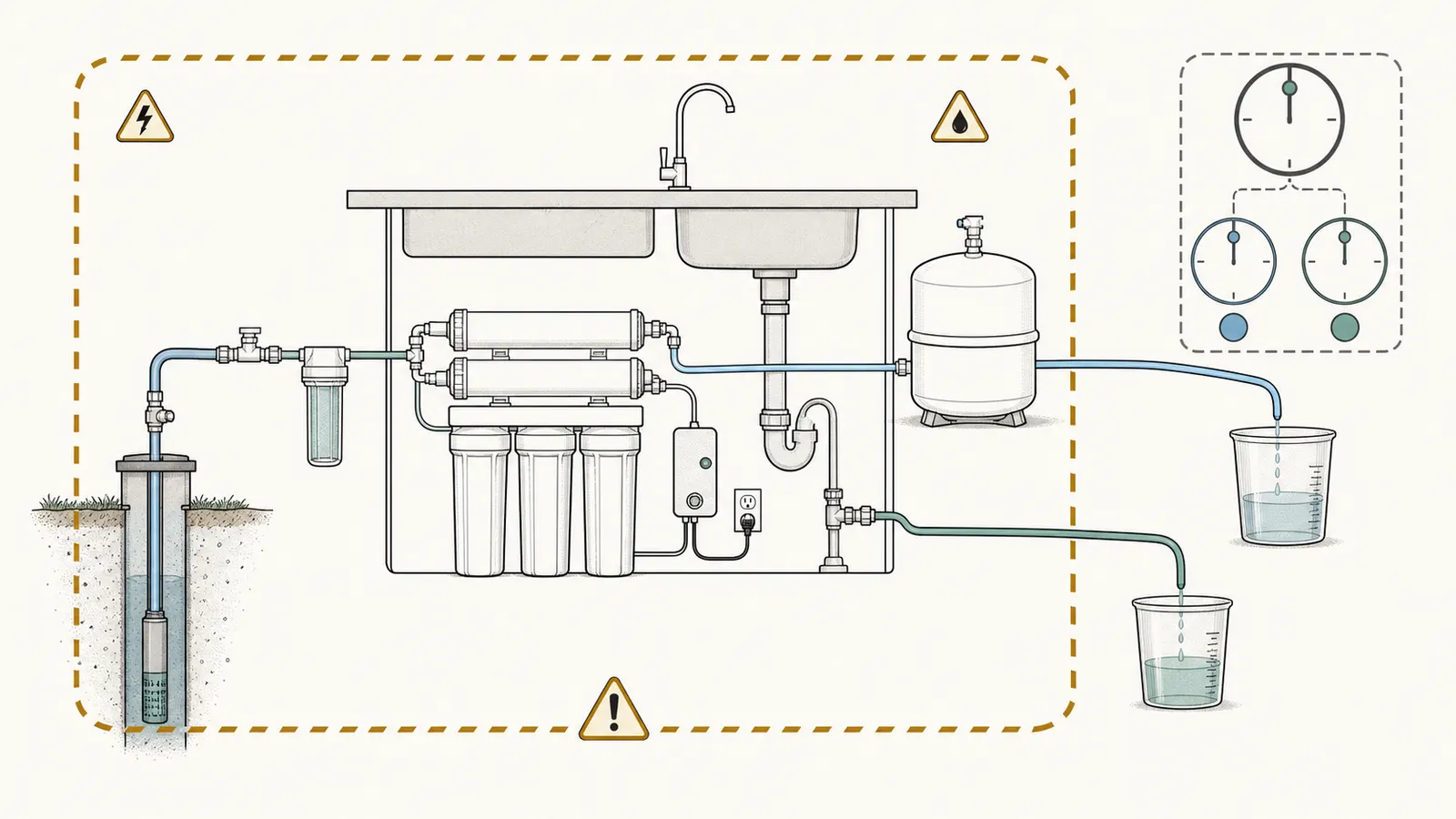
- Measure both streams without opening unsafe equipment.
- Calculate the ratio and observed recovery.
- Convert the result to the household's actual daily and annual use.
- Compare with the model documentation, then check local well and septic guidance.
That sequence matters because certified performance and household performance are not the same observation. NSF's overview of NSF/ANSI 58 says the standard covers, among other things, TDS reduction, efficiency rating, recovery rating, contaminant reduction, structural integrity, and end-user information. Certification is tied to the product, claims, and test conditions; it does not prove that a unit with old filters, low pressure, a full tank, a leak, or a different feed-water chemistry is operating at that condition.
2. Record the system before touching a container #
Start with the label, manual, and installation diagram. Take a photograph of the label for your records, but do not treat a marketing phrase such as “1:1” or “high recovery” as a measured household result.
Record these fields:
| Field | What to write down |
|---|---|
| Manufacturer and exact model | Include suffixes, pump versions, UV options, and tank or tankless designation |
| System type | Under-sink point-of-use, countertop, or whole-house point-of-entry |
| Storage | Pressurized tank, non-pressurized tank, or tankless |
| Rated permeate production | Use the units in the manual: gallons per day, gallons per minute, or a timed fill claim |
| Stated reject ratio | Copy the wording and test condition; do not convert a vague “low waste” claim into a number |
| Efficiency or recovery rating | Record the percentage and whether it is called efficiency or recovery |
| Feed-water conditions | Pressure, temperature, TDS, hardness, pH, and any other stated challenge conditions |
| Maintenance state | Prefilter age, carbon-filter age, membrane age, tank service, and any recent sanitizing or repair |
| Automatic features | Auto-flush, pump, leak shutoff, automatic shutoff valve, and drain-flow behavior |
| Disposal route | Sewer, septic, dry well, separate holding system, or unknown—never assume the route from the visible drain line |
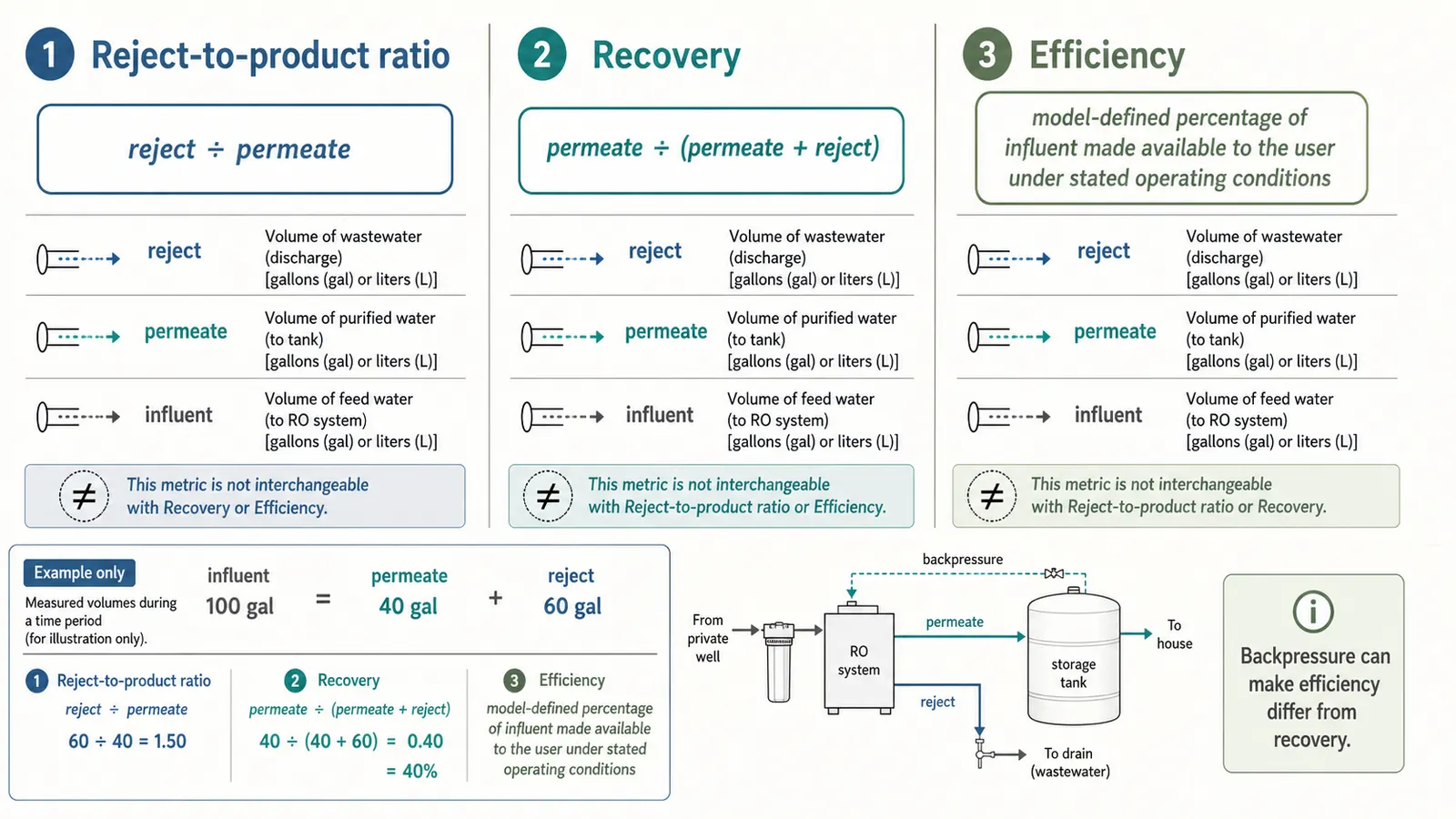
EPA explains why the tank field matters. Under the WaterSense framework, recovery rating describes permeate relative to the water entering the membrane under a tankless or tank-bypassed condition. Efficiency rating describes the percentage of system influent that becomes treated water available to the user under operating conditions that approximate typical use. A storage tank creates backpressure as it fills, so efficiency can be lower than recovery. The EPA supporting statement says a recovery number can be misleading when applied to a tank system because it does not reflect real-world use with tank backpressure.
That distinction changes the test plan:
- For a tankless unit, collect the product stream and reject stream while the unit is actively producing water, unless the manual gives a different test condition.
- For a tank system, do not assume that water dispensed from the faucet while the tank is full is the same as membrane permeate produced during that moment. Use the manual's documented efficiency test if it provides one.
- If the manual requires closing a tank valve, removing a tube, exposing an internal connector, bypassing a shutoff, or working around a pump or electrical component, stop. Ask the manufacturer or a qualified service person to perform that test.
APEC's published instructions are a useful example of why model documentation matters: the procedure for its referenced systems closes the tank valve and collects a pure-water stream and the drain stream in separate containers. It also uses a 4:1 to 5:1 ratio as an APEC reference point. That is not a universal residential range, and its connection-removal steps should not be transplanted to another brand.
3. Use a safe paired-stream measurement #
Before the test
Use two clean containers with known graduations, a stopwatch or phone timer, a notebook, and a towel or shallow tray. A kitchen measuring jug is useful for small volumes; a larger bucket is useful for the reject stream. Do not use a container that previously held a cleaner, fuel, pesticide, or other chemical.
Choose a test interval long enough to measure a practical volume but short enough that the conditions remain stable. A one- to five-minute interval may work for a tankless unit. A tank system may require a full documented production cycle. The manual controls the choice.
Before starting, note:
- whether the tank is empty, partly full, or full;
- whether the product faucet is open or closed;
- whether an automatic flush has just occurred;
- the pressure shown on an already installed, non-invasive gauge, if available;
- the water temperature if the manual specifies it;
- whether any other fixture is using water; and
- whether the reject line normally drains continuously or stops when the storage tank is full.
Do not turn on a pump, open an electrical control box, remove a pressure switch cover, open the well cap, pull a pump, enter a pit or confined space, or work on live wiring. Do not open a pressurized housing, disconnect a fitting that may be under pressure, or manipulate a flow restrictor to improve the ratio. A bucket test is not a reason to change a safety-critical or membrane-protection setting.
Preferred observation for an accessible tankless unit
- Read the manual's test condition and confirm that the product outlet and reject outlet are accessible without disconnecting pressurized tubing.
- Put the permeate container at the product outlet and the reject container at the existing drain discharge point. Keep the drain container stable and below the discharge point if gravity is involved.
- Start both collections at the same time. Use the same start signal and timer.
- Let the unit run for the documented interval. Do not use a faucet demand that makes the unit switch modes unless that is part of the stated test condition.
- Stop both collections at the same time. Record permeate volume, reject volume, interval, pressure observation, and any automatic flush or cycling event.
- Repeat once if the first result was interrupted, a container overflowed, or the unit changed modes. Do not average two different operating conditions into one number.
Tank-system branch
For a tank system, the cleanest homeowner measurement is often a manual-approved production test, not an improvised disconnection. Follow the manufacturer's exact condition. If the manual does not provide a consumer test, record normal drain behavior and ask the manufacturer or service professional how to obtain a comparable permeate and reject measurement.
If the manufacturer explicitly permits collection at accessible outlets, write down whether you measured:
- membrane permeate with the storage tank isolated;
- product water dispensed from the tank during normal use; or
- a complete tank refill cycle, including any automatic flush.
Those are different measurements. Labeling the condition prevents a later service call from comparing your “tank faucet” volume with a membrane-bypass rating.
Measurement log
| Test | Configuration | Start | Stop | Permeate | Reject | Pressure observation | Flush or interruption | Notes |
|---|---|---|---|---|---|---|---|---|
| 1 | ||||||||
| 2 |
Use one unit for both streams. If one container is marked in cups and the other in gallons, convert before calculating. Eight fluid ounces is one U.S. cup; 16 cups is one U.S. gallon. Keep the original readings in your notes so someone can audit the conversion.
4. Calculate the three numbers separately #
Assume one matched test produces:
- Permeate: 0.50 gallon
- Reject: 2.25 gallons
- No recycling or separate flush during the interval
Reject-to-product ratio
reject-to-product ratio = reject ÷ permeate
                         = 2.25 ÷ 0.50
                         = 4.5 gallons reject per gallon permeate
Write this as 4.5:1, and say what it means in words. “The measured reject-to-product ratio was 4.5 gallons to 1 gallon during a tank-bypassed test at the recorded conditions.” Do not write simply “the RO is 4.5:1,” because that sounds like a permanent equipment specification.
Observed recovery
When the two measured streams are the complete water balance for the same interval, calculate:
observed recovery = permeate ÷ (permeate + reject) × 100
                  = 0.50 ÷ (0.50 + 2.25) × 100
                  = 18.2%
This is a recovery-style calculation from your paired volumes. EPA gives the same general relationship, but the official rating still depends on the standard's test method and the system configuration.
Efficiency
Efficiency is not automatically the same as the number above. EPA's WaterSense explanation says efficiency represents treated water available to the user relative to system influent under typical operating conditions. A tank system can have lower real-world efficiency because the tank's backpressure slows production and because automatic flushes or other water use may be included in the rated condition.
If your test includes every influent gallon and every output over a complete, documented operating cycle, you may describe the result as measured water-use efficiency for that cycle. If you collected a tank-bypassed membrane stream, label it observed recovery instead. Do not turn an observed recovery percentage into a claimed certified efficiency rating.
Daily and annual demand
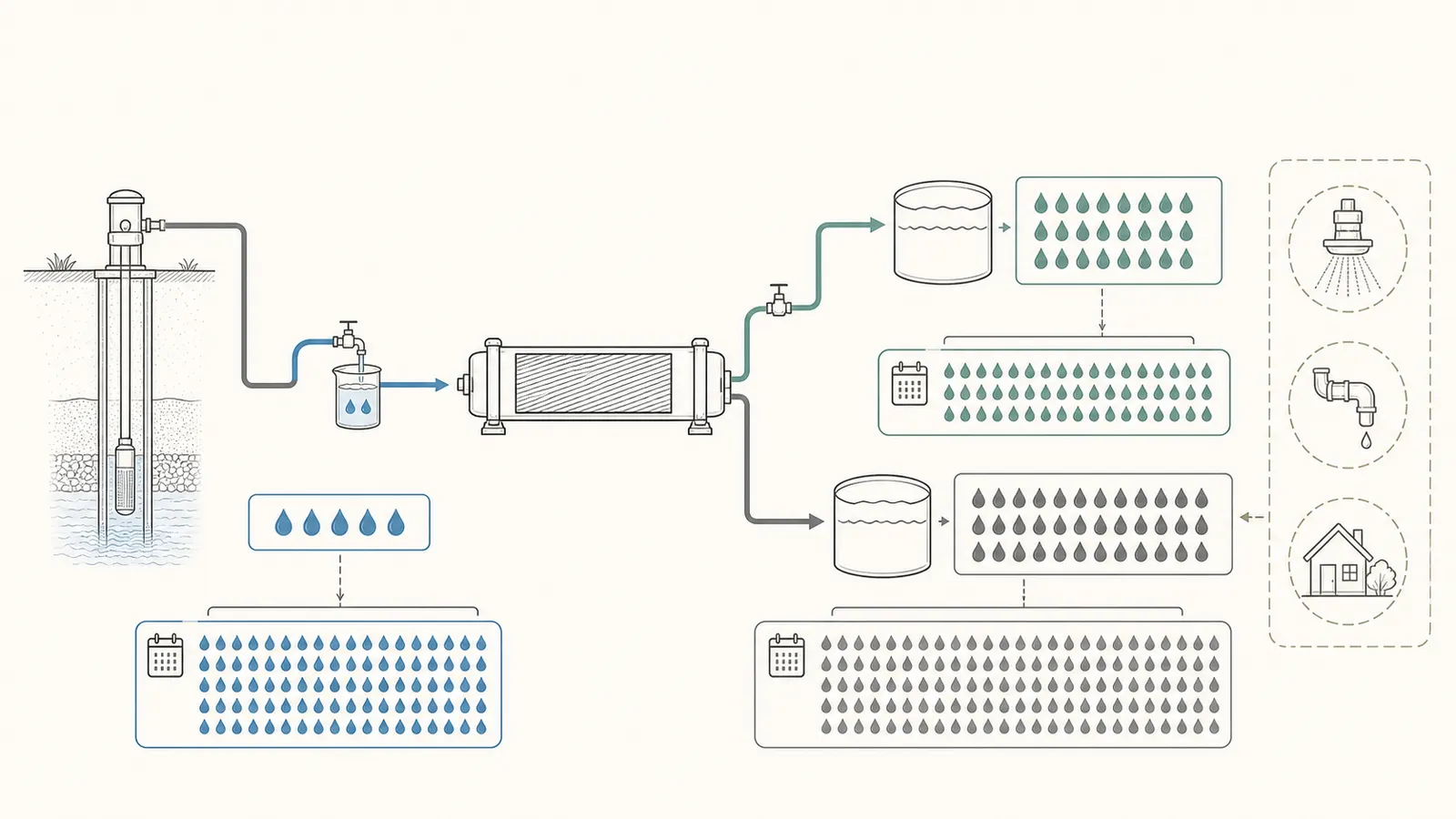
If the household uses 2 gallons of permeate per day and the observed reject ratio is 4.5:1:
daily reject = daily permeate × ratio
             = 2 × 4.5
             = 9 gallons per day

daily RO intake = daily permeate + daily reject
                = 2 + 9
                = 11 gallons per day

annual reject = 9 × 365
              = 3,285 gallons per year

annual RO intake = 11 × 365
                 = 4,015 gallons per year
The well-pump and septic questions use different lines in that calculation. The well sees the total RO intake unless some feed water is recycled or supplied from another source. The septic system sees the reject flow only if the reject is actually routed there. The permeate is consumed, stored, or sent to another fixture and is not automatically septic flow.
This example is illustrative, not a normal household result. Add these items to the daily estimate if they exist:
- automatic membrane flushes;
- reject flow while a tank is already full;
- a leak at the faucet, tubing, or shutoff;
- whole-house RO production for showers, laundry, or appliances;
- startup or shutdown water that your timed test excluded; and
- any reject water routed to another drain or holding system.
For a more reliable household estimate, keep a seven-day log of permeate use, tank refill events, reject runtime, and unusual drain flow. A seven-day log is not a substitute for the model test, but it can reveal whether a small point-of-use unit is being used twice a day or whether a whole-house system is producing continuously.
5. Compare the result with the right reference #
Use this order of comparison:
| Comparison | What a match means | What it does not mean |
|---|---|---|
| Measured result versus exact model manual | Your test may be comparable if configuration, pressure, temperature, tank state, and maintenance state match | It does not prove contaminant reduction or drinking-water safety |
| Measured result versus the manufacturer's service threshold | A possible maintenance or service branch if the test is valid | It does not authorize changing a flow restrictor or bypassing a safety control |
| Measured result versus EPA WaterSense's labeled benchmark | A broad water-efficiency comparison; labeled point-of-use systems demonstrate no more than 2.3 gallons reject per gallon treated | It is not a universal pass/fail limit for an older, unlabeled, whole-house, or differently tested unit |
| Daily reject versus local septic guidance | A reason to ask the right local professional about loading and disposal | It does not establish a national septic design capacity |
EPA's current WaterSense product search converts a 30 percent efficiency rating into approximately 2.33 gallons of waste per gallon treated and says a lower waste-to-treated-water ratio is more water-efficient. Use that page to understand the terminology and compare labeled products. Do not use it to declare an existing well installation defective merely because its measured ratio is higher.
EPA also says that some point-of-use systems generate five or more gallons of reject per gallon treated and some inefficient units may generate up to 10. That broad range explains why a homeowner should measure rather than assume, but it is not a target range and not permission to send any volume to a septic system.
What a surprising result can mean
| Observation | Plausible branch | Safest next step |
|---|---|---|
| Ratio is lower than the manual's minimum or the drain stream is weak | Incorrect test condition, blocked or altered flow path, high feed pressure, or a model-specific membrane-protection issue | Stop changing parts; send the model, conditions, and readings to the manufacturer or qualified service professional |
| Ratio is much higher than the manual or production is slow | Low pressure, cold feed water, clogged prefilters, membrane fouling, tank backpressure, or a configuration mismatch may be involved | Check only visible gauges and service dates; use the manual's service path |
| Reject continues after the tank should be full | A continuous-drain or shutoff problem is possible | Document duration and model; call service rather than adjusting the flow restrictor |
| Ratio changes materially between two valid tests | Pressure, temperature, tank state, automatic flush, or water demand changed | Repeat under one documented condition or ask for a professional test |
| Product volume appears normal but source-water quality has changed | Flow is not a contaminant test | Use a certified drinking-water laboratory and check both raw and treated water as appropriate |
iSpring's support page for named RCC-series systems illustrates the last service branch: it says drain flow should stop after the storage tank fills and lists possible model-specific causes such as the automatic shutoff valve, check valve, flow restrictor, or low tank pressure. Treat that as manufacturer-specific troubleshooting, not as a universal diagnosis. The homeowner action is to document the symptom and contact the correct service channel.
6. Translate gallons into a private-well and septic decision #
Private-well demand
An RO system can be small at the faucet and still add meaningful pump runtime over a year. Use the total RO intake, not just the water poured into a glass. In the worked example, 2 gallons per day of permeate created 11 gallons per day of RO intake. That is 4,015 gallons per year before flushes or leaks.
This does not mean the well cannot supply that amount. It means the number belongs in the home's water-budget record, especially when the well has low yield, the pressure tank cycles frequently, or several water-using systems operate at once. Do not open the well or alter pump controls to investigate. If the home already has low pressure, frequent cycling, brownouts, or a recovery problem, give the well professional your RO log, pressure observations, model number, and any recent water-quality report.
Connecticut DPH says RO effectiveness can depend on water pressure, the contaminant and its concentration, and the membrane, and that pressure may need to be increased for RO to work effectively. That is a design and service observation, not permission for a homeowner to raise a pressure switch or change a pump setting. The Connecticut guidance also says high particulate matter such as iron particles can foul or clog a membrane and decrease flow.
Septic loading
First classify the RO:
- Point-of-use: normally serves a drinking-water faucet or a small number of connected appliances. Measure the reject gallons per day rather than applying a whole-house assumption.
- Point-of-entry or whole-house: can treat water for sinks, showers, appliances, and other uses. A small change in household demand can create a large reject load.
The University of Minnesota says whole-house RO can create a wastewater load that a septic system may not have been designed to handle and that the volume and concentration of reject should be understood before selecting a discharge location. Its guidance says a wastewater professional should evaluate the best location for point-of-entry reject water. Do not improvise a trench, dry well, yard discharge, or irrigation connection. Reject water can carry a higher concentration of the substances removed from the feed water, and the legality and suitability of a disposal route are site- and jurisdiction-specific.
Connecticut's private-well program strongly recommends no more than 30 gallons per day of RO reject directed to a septic system and warns that larger flows could affect septic function. Apply that number only within its Connecticut scope. If you are elsewhere, ask the local health department, septic designer, or wastewater professional for the applicable design and disposal guidance. If your measured reject approaches or exceeds the local guidance—or if the unit is whole-house—pause any routing change until that review happens.
What to bring to the professional
Give the well, RO, and septic professionals the same packet:
- exact RO model and photographs of the label;
- tank or tankless configuration and point-of-use or whole-house scope;
- manual page or data sheet showing the rated ratio, efficiency, recovery, or test condition;
- two timed test records with permeate and reject volumes;
- daily permeate-use estimate and calculated daily and annual reject;
- pressure observations without opening controls;
- filter, membrane, tank, and service dates;
- feed-water and treated-water laboratory reports;
- reject-water destination and whether it enters septic, sewer, or an unknown route; and
- any continuous-drain, low-pressure, odor, taste, or recent plumbing symptoms.
That packet lets the professional separate a measurement problem, a maintenance problem, a well-capacity problem, a septic-loading problem, and a water-quality problem.
7. Use the measurement as a maintenance record #
An RO ratio is a snapshot. It becomes valuable when repeated under comparable conditions.
Record the ratio after a documented filter or membrane change, after a pressure or pump service, and whenever the reject line begins to run longer than usual. Keep the original conditions with each entry; a result taken with a full storage tank is not directly comparable with a tank-bypassed membrane test.
EPA recommends that private wells be tested annually for total coliform bacteria, nitrates, total dissolved solids, and pH, and immediately after a change in color, odor, or taste. EPA also lists iron, copper, and manganese when plumbing fixtures or laundry are stained and says to use laboratories certified for drinking-water testing. Use EPA's private-well testing guidance to build the water-quality side of the record. A flow ratio cannot show that the water is safe to drink or that the RO removes a contaminant the system was not certified to reduce.
Connecticut DPH advises maintaining the RO according to the manufacturer's instructions, keeping a maintenance and repair log, and retesting raw and treated water at a state-certified laboratory. It also warns that a system's effectiveness depends on the membrane, pressure, contaminant, and concentration. Those are good reasons to log filter and membrane changes alongside the water measurements rather than treating a ratio as an isolated score.
Stop points
Stop the homeowner test and use a qualified professional when:
- the manual requires opening a housing, disconnecting a pressurized line, or bypassing a valve;
- the system has an electric booster pump, exposed wiring, or a control fault;
- the reject line runs continuously after the documented full-tank stop condition;
- you suspect a leak inside a cabinet or near an electrical component;
- the RO is whole-house or the reject volume is near or above local septic guidance;
- you are considering a new drain route, dry well, trench, irrigation connection, or discharge to soil;
- the well has a recent water-quality change, flooding, land disturbance, or well repair; or
- the measured ratio is accompanied by low pressure, pump cycling, no permeate, or a failed water-quality result.
Never open energized controls, test live wiring, open the well, pull a pump, enter a confined space, or manipulate pressurized equipment as part of this measurement. Do not change a flow restrictor to force a “better” ratio. The result you want is a defensible record of how the installed system behaves under its stated condition—not a setting that may shorten membrane life, reduce contaminant rejection, or create an unreviewed discharge problem.
The finished decision is simple: keep the paired measurements, label the test condition, calculate ratio and observed recovery, convert actual use to well demand, and route any pressure, water-quality, septic, or service question to the source that governs it—the exact manual, a certified laboratory, the local health or septic authority, or a qualified professional.
Cite this guide
Brictale. “How to Measure Reverse Osmosis Wastewater on a Private Well.” Published 2026-09-04; updated 2026-09-04.
https://brictale.com/water/filtration/private-well-reverse-osmosis-wastewater-calculator · Read the Markdown version
Sources and scope
Evidence behind this page
- EPA defines point-of-use reverse osmosis as producing treated permeate and reject water, reports that a typical point-of-use unit may generate five or more gallons of reject per gallon of treated water, and says WaterSense-labeled point-of-use units must send 2.3 gallons or less down the drain per gallon of treated water.
U.S. EPA — Point-of-Use Reverse Osmosis Systems
EPA WaterSense guidance for point-of-use residential RO systems; these are broad program benchmarks, not a universal repair limit or septic-system capacity rule for every private well.
Accessed · Link to this claim - EPA's WaterSense product search defines efficiency rating as the percentage of RO influent that becomes treated water available to the user and translates it into a waste-to-treated-water ratio; a 30 percent efficiency rating corresponds to 2.33 gallons of waste per gallon treated.
U.S. EPA — WaterSense Product Search: Point-of-Use Reverse Osmosis Water Treatment Systems
WaterSense's consumer-facing definition and conversion for labeled point-of-use RO products; it does not establish the measured performance of an untested or differently configured unit.
Accessed · Link to this claim - EPA's WaterSense supporting statement distinguishes recovery rating from efficiency rating: recovery describes permeate relative to membrane influent under a tankless or tank-bypassed condition, while efficiency accounts for typical user availability and storage-tank backpressure; EPA also gives permeate divided by permeate plus concentrate as the general percentage formula.
U.S. EPA — WaterSense Specification for Point-of-Use Reverse Osmosis Systems Supporting Statement
EPA's explanation of NSF/ANSI 58-related efficiency terminology and WaterSense test context; a homeowner's paired bucket calculation is an observed recovery-style calculation unless it follows the exact documented efficiency test condition.
Accessed · Link to this claim - NSF says NSF/ANSI 58 covers point-of-use RO systems and includes requirements or test claims related to materials safety, structural integrity, TDS reduction, efficiency rating, recovery rating, contaminant reduction, and end-user information.
NSF — NSF/ANSI 58: Reverse Osmosis Drinking Water Treatment Systems
NSF's overview of the voluntary consensus standard and its claim categories; certification is product- and claim-specific and is not proof that a household installation is operating to the certified condition.
Accessed · Link to this claim - Connecticut Department of Public Health says RO wastewater volume varies by make and model and strongly recommends that reject flow directed to a septic system not exceed 30 gallons per day because larger flows could affect septic function.
Connecticut private-well program publication; the 30-gallon-per-day figure is jurisdiction-specific guidance and must not be presented as a national septic limit.
Accessed · Link to this claim - Connecticut Department of Public Health says RO performance depends on the membrane, water pressure, contaminant, and concentration; it advises operation and maintenance according to the manufacturer's instructions and retesting raw and treated water at a state-certified laboratory.
Connecticut's private drinking-water treatment guidance; it supports documentation, pressure, chemistry, and maintenance checks but does not authorize a homeowner to modify pressurized components.
Accessed · Link to this claim - University of Minnesota Extension distinguishes under-sink point-of-use RO from whole-house point-of-entry RO: point-of-use systems commonly treat drinking and cooking water, while whole-house systems can create a large wastewater load that a septic system may not have been designed to handle; the volume and concentration of reject water should be evaluated by a wastewater professional.
University of Minnesota Onsite Sewage Treatment Program — Reverse Osmosis and Septic Systems
University of Minnesota Extension guidance for septic-system design and management; it is a technical decision aid, not a permit or a nationwide disposal authorization.
Accessed · Link to this claim - EPA recommends annual private-well testing for total coliform bacteria, nitrates, total dissolved solids, and pH, immediate testing after a change in color, odor, or taste, and use of laboratories certified for drinking-water testing; EPA lists iron, copper, and manganese for stained fixtures or laundry.
U.S. EPA — Protect Your Home's Water
EPA guidance for U.S. private domestic wells; local health departments may add location-specific contaminants or requirements.
Accessed · Link to this claim - APEC's manufacturer guidance illustrates a model-specific waste-ratio test that closes the storage-tank valve and collects pure and waste streams in separate containers, and it states that its referenced systems use a 4:1 to 5:1 waste ratio as a reference point.
APEC Water — Waste Water Ratio Test: Importance, Methods, and Results
APEC's instructions for its systems and test arrangement; the ratio is not a model-agnostic normal range and should not be applied to another brand or configuration without that unit's documentation.
Accessed · Link to this claim - iSpring says its referenced residential RO systems should stop draining after the storage tank fills and identifies model-specific service possibilities including an automatic shutoff valve, check valve, flow restrictor, or low tank pressure.
iSpring Customer Support — Troubleshooting Continuous Drain Flow
iSpring support for named iSpring RCC-series systems; it supports a stop-and-service branch, not a universal diagnosis or permission to adjust a flow restrictor.
Accessed · Link to this claim - Connecticut Department of Public Health says reject water remains on the untreated side of the RO membrane and is discharged as wastewater, and notes that RO effectiveness can be affected by turbidity, iron, manganese, hydrogen sulfide, chlorine, water pressure, and contaminant concentration.
Connecticut private-well RO guidance; the statement supports measuring both water volume and source-water context, not a claim that all reject streams have the same contaminant concentration.
Accessed · Link to this claim