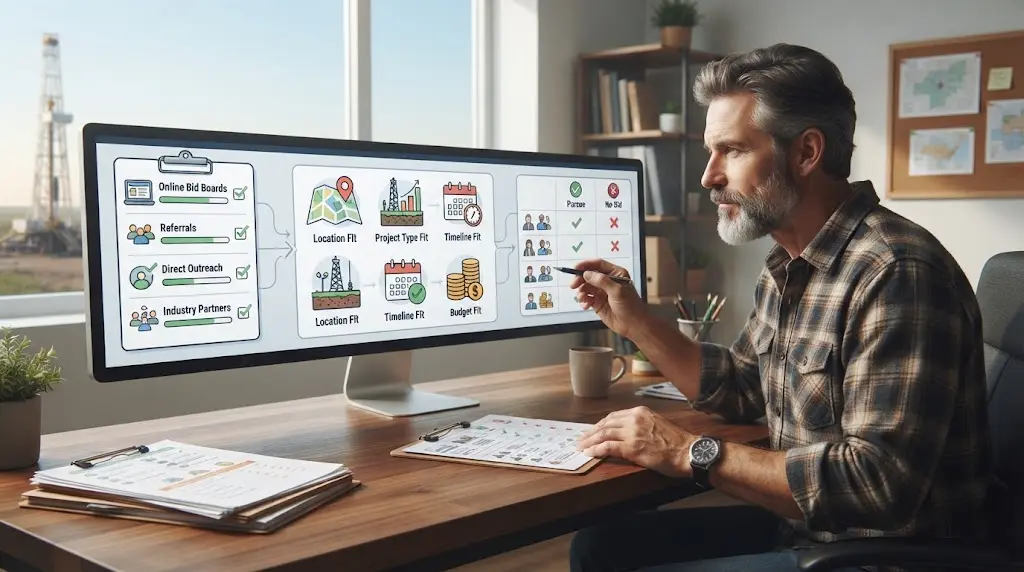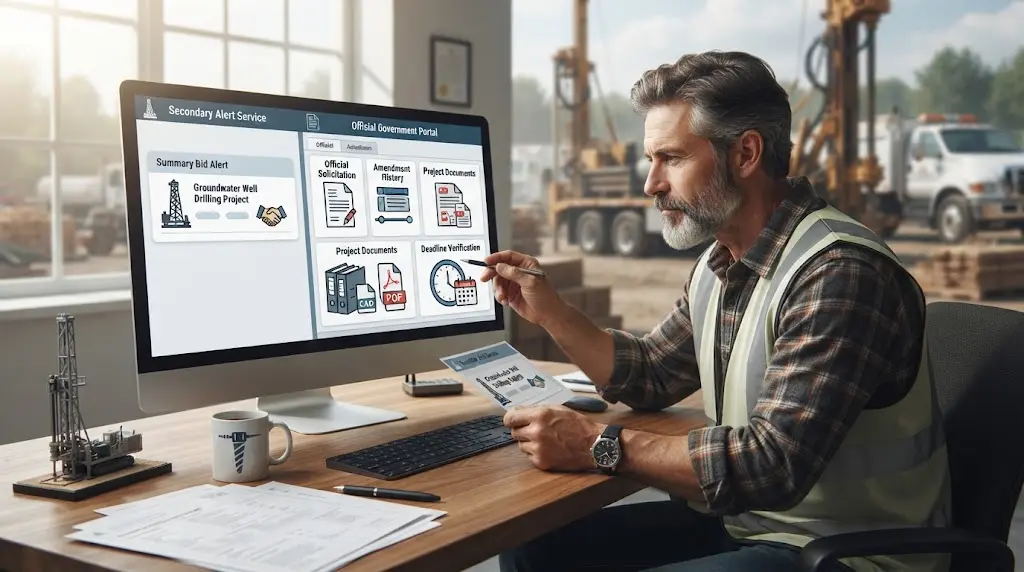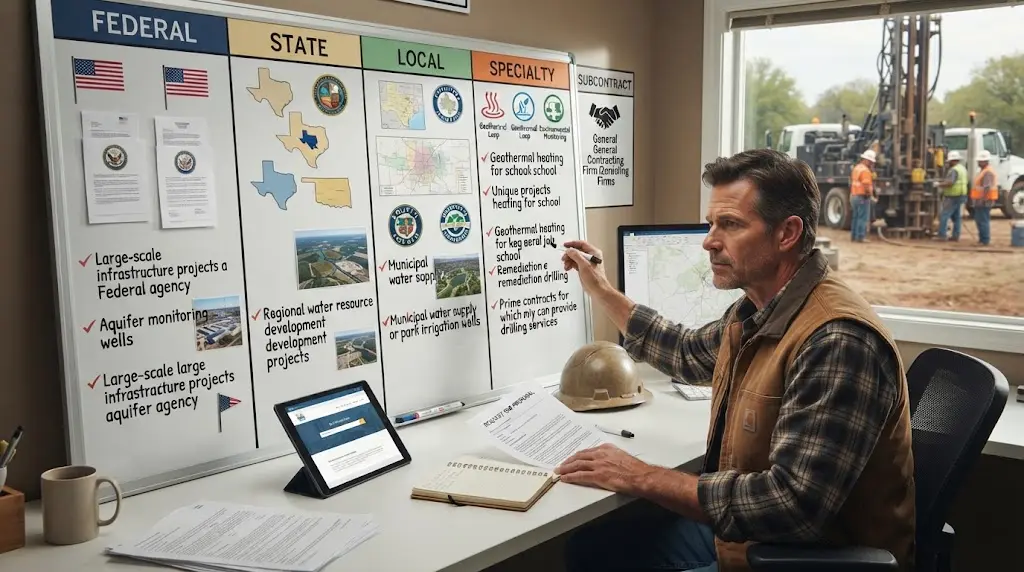
Well drilling bid sources are spread across federal notices, state purchasing systems, city and utility portals, specialty water databases, engineer plan rooms, and prime-contractor vendor lists. The hard part is not finding one more list. It is knowing which source fits the work your company can perform, where it can perform it, and when the opportunity is real enough to justify estimating time.
For federal work, start with SAM.gov. For state and local work, find the official procurement portal and the buying agencies inside your territory. Add water and wastewater bid networks for discovery, SBA SUBNet for subcontracting, and relationships with engineers, utilities, and primes for work that never reaches a broad public search.
Then verify every opportunity at the original source. The issuing agency, public owner, plan room, or prime contractor controls the scope, addenda, response method, and deadline.
Which sources count as well drilling bid sources?
A useful bid source is any repeatable place or relationship that exposes a buyer’s planned, active, or subcontracted work early enough for your company to qualify and respond. That includes more than an open invitation for bid.
You may find a project in a formal solicitation, a request for qualifications, a source-sought notice, a pre-solicitation, a plan room, a utility vendor list, or a prime contractor’s request for quotes. You may also find it in award data, which is not an open bid but can reveal the buyer, incumbent, project language, and prime contractors to approach next.
The distinction matters. A source-sought notice can be a chance to introduce your company before a solicitation is released. An award notice can be useful account intelligence but cannot be treated as work still available. A subcontracting notice may be more realistic than a federal prime bid if your company has the field capability but not the administrative capacity to contract directly with the government.
The U.S. Federal Acquisition Regulation says contracting officers must publicize actions to “Broaden industry participation in meeting Government requirements.” That is a useful reason to monitor public notices, but it is not a promise that every opportunity will fit a small local driller. Acquisition.gov, FAR Part 5
A bid source is valuable only when it gives you enough time and information to make a sound pursuit decision.
The source categories below cover the market without pretending they are equal.
| Source category | What you may find | Best use | Main risk |
|---|---|---|---|
| Federal procurement portals | Federal well drilling, testing, rehabilitation, pump, water-system, and site work | Direct federal bids and early notices | Administrative requirements, bonds, set-asides, and travel can make a local-looking job impractical |
| State procurement portals | State agency, university, park, environmental, and infrastructure work | Public work within a state or a defined regional market | One state portal may not expose every county, city, utility, or district opportunity |
| City, county, utility, and district portals | Production wells, pump stations, maintenance, rehabilitation, and water-system projects | Local public work and recurring buyer relationships | Notices may live in separate systems or require vendor registration |
| Specialty water and wastewater bid networks | Aggregated public and private opportunities, alerts, and project names | Discovery across many owners | Listings may be incomplete, stale, gated, or secondary to the original notice |
| SBA SUBNet and prime-contractor directories | Subcontract scopes, construction packages, and prime contacts | Entering federal work as a subcontractor | Scope, insurance, certification, and timing are controlled by the prime |
| Engineer, construction manager, and plan rooms | Private, municipal, utility, and commercial project plans | Finding work before or outside broad public search | Access rules, fees, and invitation lists vary |
| Direct buyer and prime relationships | Informal notice, vendor lists, capability requests, and invited quotes | Repeat work and better-fit opportunities | Takes consistent follow-up and a credible capability packet |
| Award and spending data | Incumbents, buyers, primes, project language, and historical patterns | Account mapping and timing research | It is intelligence, not proof that an open bid exists |
What is the Bid Source Stack for a well contractor?
The Bid Source Stack is a practical way to allocate attention across sources. It starts with authoritative discovery, adds coverage, then adds relationship-based work that may never appear in the same search results.
Use four layers:
- Source of truth. The original agency, city, county, utility, district, owner, plan room, or prime-contractor notice. This layer controls the documents and deadline.
- Coverage layer. Aggregators and specialty databases that help you discover notices across many owners. This layer saves scanning time but does not replace verification.
- Intelligence layer. Award records, agency forecasts, past solicitations, incumbent names, and buyer history. This layer helps you choose whom to contact and what language to search.
- Relationship layer. Engineers, construction managers, utilities, primes, and public purchasing staff who can place your company on a relevant vendor or invite list. This layer compounds, but it requires a clean introduction and reliable follow-through.
Do not build the stack backward. A contractor that buys three bid databases before identifying its service territory, scope, and target public owners will collect more irrelevant notices, not more work.
| Layer | Owner of the information | What the contractor does | Evidence to save |
|---|---|---|---|
| Source of truth | Issuing public owner, agency, plan room, or prime | Download the solicitation, attachments, addenda, instructions, and contact details | Original URL, notice ID, amendment dates, closing time, downloaded documents |
| Coverage | Bid network or search service | Use keywords, codes, geography, and alerts to surface possibilities | Listing URL and the date it was found |
| Intelligence | Award database or public record | Identify repeat buyers, incumbents, prime contractors, project terms, and likely cycles | Buyer name, award record, project type, date, and next contact |
| Relationship | Engineer, utility, prime, or purchasing contact | Send a relevant capability introduction and ask how the firm gets invited | Contact, scope discussed, requested documents, follow-up date |
The stack also gives you a clean answer to a common office argument. If an estimator says a bid board is wasting time, ask whether it is being used for discovery or treated as the source of truth. If it is discovery, measure the qualified opportunities it surfaces. If it is being used as the final authority, change the process.

Which federal bid sources should you search first?
SAM.gov should be the first federal source because it is the government’s public contract-opportunity search. SAM.gov says anyone can search notices, including pre-solicitations, solicitations, awards, and sole-source notices. A user account adds saved searches, followed opportunities, and interested-vendor lists. SAM.gov Contract Opportunities
Search SAM.gov in more than one way. Start with your service language, then repeat the search with the official classification and buyer language described later in this article. The U.S. Census Bureau places water-well drilling and water-well pump and well-piping-system installation in NAICS 237110. U.S. Census Bureau, NAICS 237110
The search sequence should include:
- water well;
- well drilling;
- production well;
- test well;
- monitoring well;
- well replacement;
- well rehabilitation;
- well abandonment or capping;
- submersible pump;
- well pump maintenance;
- water system;
- pumping station;
- water supply facilities;
- NAICS 237110;
- the product or service code shown on a relevant notice;
- your state, nearby states, or an agency that regularly buys your kind of work.
SAM.gov also provides award and contracting data. Its contracting hub connects opportunities, awards, and subcontract reports, while the award search can help you investigate agencies, businesses, and recurring procurement language. SAM.gov Contracting
Use awards as a map. If a nearby agency repeatedly buys production-well work, identify the agency, incumbent, engineering firm, and prime-contractor pattern. That gives your business-development lead a target list. It does not prove the next job is open.
The Environmental Protection Agency’s contracting guidance directs businesses to SAM.gov for federal contracting opportunities and points to prime-contractor resources for subcontracting. EPA, How to Do Business with EPA
What should you save from every federal notice?
Save the notice ID, contracting office, place of performance, NAICS, product or service code, set-aside, response type, due date and time, site-visit rules, bond language, required registrations, attachments, questions deadline, amendments, and point of contact. A notice that looks like a simple drilling job can include casing, development, test pumping, water-quality testing, pump installation, mobilization, bonds, and a defined completion period. A public SAM well-drilling notice demonstrates how those items can sit in one solicitation. SAM.gov well drilling opportunity example
Do not copy a scope from a search-result snippet into your estimate. Open the attachments. Read the instructions to bidders. Check the amendment history. Confirm that the deadline is still active.
How can a small contractor use SBA SUBNet?
Use SBA SUBNet when a project may be more accessible as a subcontract than as a federal prime contract. SBA describes SUBNet as a way for large federal prime contractors to find small subcontractors. The public listings can be filtered by state or keyword. SBA SUBNet
Search SUBNet with the same vocabulary you use in SAM.gov, but think in scopes instead of whole projects. A prime may need well drilling, test boring, dewatering, water-system work, pump installation, site restoration, traffic control, or a specialty field crew inside a larger construction package.
SBA’s prime and subcontracting guidance explains the commercial difference. A prime contractor works directly with the government and is responsible for the contract. A subcontractor works for another contractor. SBA also points small businesses toward SAM.gov, SUBNet, the Small Business Search profile, and APEX Accelerators. SBA, Prime and subcontracting
That difference changes your pursuit file. For a prime bid, you may need a full response to the agency’s instructions, registrations, representations, bonds, and compliance documents. For a subcontract quote, the prime may care first about scope coverage, availability, equipment, insurance, safety, references, and price format. Read the prime’s request rather than sending the same generic packet to every contact.
APEX Accelerators can help companies entering the government marketplace with no-cost guidance and support. The program connects businesses with federal, state, and local contracting assistance. APEX Accelerators
Use that help for registration questions, bid-reading discipline, and introductions to procurement resources. It does not replace your estimator’s responsibility to decide whether a project fits your equipment, territory, schedule, and risk tolerance.
SUBNet is not a smaller version of SAM.gov. It is a different route to the work.
Which state and local bid sources should you search?
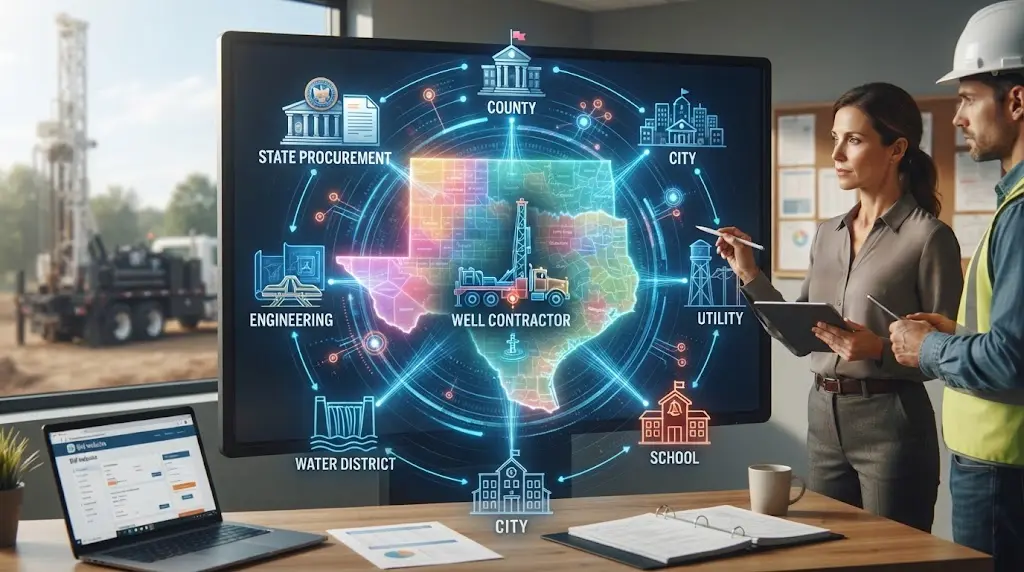
Search state procurement systems first, then work outward to counties, cities, utilities, water districts, school systems, universities, parks, and public works departments inside the territory you can serve. A state directory can help you find the state procurement office, but a state portal is not a complete substitute for local buyer research.
NASPO provides state procurement profiles and a directory of public links to official state procurement websites. Use it to reach the correct state purchasing office, then verify the state’s current vendor-registration and solicitation instructions. NASPO Procurement Website directory NASPO Procurement by State
From the state office, identify the systems or departments that buy work relevant to you. Depending on your market, that may include environmental agencies, natural-resource departments, transportation agencies, state parks, corrections, universities, agriculture, emergency management, or statewide water infrastructure programs.
Then build a local owner list. Start with:
- counties and county water or public works departments;
- cities and towns with municipal water systems;
- water and sewer utilities;
- water management districts, conservation districts, and groundwater authorities;
- public universities, community colleges, and school systems;
- state parks and federal facilities inside your service radius;
- engineering firms that design wells, pump stations, water mains, and treatment work;
- construction managers and general contractors who bid public infrastructure.
The goal is not to bookmark every government page in the United States. The goal is to identify the owners and intermediaries that buy the type of work your company can staff.
Your service territory, not a nationwide portal list, should define your first bid-source stack.
How should you search a public owner’s site?
Use the owner’s own vocabulary. Search the site for bid opportunities, purchasing, solicitations, request for qualifications, invitation for bid, request for proposal, water well, production well, well rehabilitation, pump station, water system improvements, on-call well services, and vendor registration. Search the agency plus those terms in a general search engine when the portal’s internal search is weak.
Check whether the owner uses a third-party procurement system. The public agency’s purchasing page may link to a vendor portal, plan room, or e-bidding system. Register only after confirming the site is an official route and the account is appropriate for your company.
Local work often sits in a different channel from state work. A county may use a public notice page, a city may use an e-procurement portal, and a utility may post a PDF under its engineering or capital-improvement section. A water district may maintain a vendor list and invite quotes without appearing in a broad state search.
Are water and wastewater bid networks worth paying attention to?
They can be useful as coverage and alert layers when your target market spans many public owners. Waterwell Bid Network presents itself as a specialist water-well opportunity site, with public examples of well drilling, irrigation well, water-system, inspection, pump-efficiency, and related scopes. Waterwell Bid Network
H2Bid presents a water and wastewater bid database and exposes a well-drilling contractor search result page with public project examples. H2Bid well drilling contractor bids
Treat both types of source as scouts. They help you discover a notice or compare the language buyers use. Before your team spends hours estimating, follow the original link or contact the listed owner. Confirm:
- The opportunity is still open.
- The response deadline and time zone are current.
- The scope is actually water-well or pump work rather than oil, gas, mining, geotechnical, or unrelated directional drilling.
- The issuing owner accepts responses from your company type.
- The original solicitation and all addenda are available.
- The project is inside a territory and schedule you can support.
Aggregators vary in coverage, cost, filters, document access, and how quickly they remove closed notices. Do not treat a public listing count as evidence of value. Run a controlled test with a defined territory, a small set of services, and a source log. After a review period, compare qualified opportunities and estimates to the time and subscription cost.
The right question is not “Which bid database has the most listings?” It is “Which source consistently surfaces opportunities that survive our fit and verification checks?”
Which private sources produce work before a public bid appears?
Engineer, construction-manager, utility, and prime-contractor relationships can expose work before a broad solicitation appears, or can expose scopes that are packaged inside a larger project. These sources are especially important for contractors that want recurring commercial, municipal, agricultural, or infrastructure work.
Start with engineering firms that design or manage the kind of work you perform. Their project teams may need a drilling subcontractor, pump specialist, testing crew, or local field partner. A good introduction is specific. Name the service, geography, equipment, licenses, and project conditions you support. Do not send a list of every service you have ever considered.
Then identify primes and construction managers that win water, wastewater, utility, and site-infrastructure work. SBA’s guidance notes that prime contractors may maintain subcontracting directories and use small-business profiles to find partners. SBA, Prime and subcontracting
Plan rooms can sit between public and private work. Some are run by an owner, an engineer, a construction manager, or a trade association. Some require an account or payment. The plan room’s job is to distribute documents, not to decide whether your company is a fit. You still need the project location, scope, bid date, pre-bid requirements, and contact route.
Utilities and water districts also deserve direct attention. A utility may have recurring maintenance, emergency response, pump testing, well inspection, rehabilitation, or on-call needs. Those services may be procured through a formal request for qualifications, a contract roster, a prequalified vendor list, or a public solicitation. Ask the procurement contact how vendors learn about opportunities. Record the answer and the next registration step.
What should a direct introduction include?
Keep it to the buyer’s decision. Include:
- company name and direct contact;
- primary service scope;
- the territories and travel boundary you can support;
- relevant license or registration information;
- equipment and crew capability that matters to the target scope;
- public, commercial, agricultural, or subcontract experience you can verify;
- insurance, bonding, or certifications if relevant and current;
- your capacity window if you can state it honestly;
- a link to the capability material or a short PDF;
- one clear question about vendor registration, plan-room access, or future bid notification.
For a fuller verification process, use Brictale’s water well contractor prequalification checklist. If the buyer is a prime contractor, the water well drilling subcontractor qualifications checklist covers the evidence and fit questions that should be answered before a subcontract introduction.
Do not ask an engineer to “keep you in mind” without saying what work you want and where. Make it easy for the recipient to decide whether your company belongs on a relevant list.
Which search terms find more work than “well drilling”?
Search the way buyers describe a project, not only the way your company describes its service. The Census Bureau’s current NAICS material is a strong starting point because it explicitly includes water-well drilling and water-well pump and well-piping-system installation under NAICS 237110. U.S. Census Bureau, NAICS 237110
Use the following map as a starting vocabulary, then add the terms that appear in your state and buyer documents.
| Search family | Terms to test | What it may uncover |
|---|---|---|
| Core drilling | water well, water-well drilling, well construction, well boring, artesian well, individual well | New wells, replacement wells, rural and public supply projects |
| Public supply | production well, public water supply well, municipal well, community well, water supply facility | Utility, city, district, and public-facility work |
| Investigation | test well, exploratory well, monitoring well, observation well, test hole | Environmental, research, resource, and pre-construction work |
| Pump and mechanical | well pump, submersible pump, pump installation, pump replacement, pump maintenance, pump efficiency testing | Pump, controls, rehabilitation, and maintenance scopes |
| Rehabilitation | well rehabilitation, well redevelopment, well development, well cleaning, well inspection, downhole video | Existing-well improvement and assessment work |
| Closure | well abandonment, well plugging, well capping, decommissioning | Closure and environmental scopes, subject to applicable licensing |
| System work | water system improvements, water main, pumping station, storage tank, water treatment, well house | Larger civil or utility projects with a drilling or pump component |
| Procurement language | IFB, ITB, RFP, RFQ, request for qualifications, sources sought, presolicitation, on-call services | The notice type and stage of the buying process |
| Buyer language | water district, groundwater authority, public works, state park, university, school district, engineering | The organization that may publish or influence the opportunity |
Do not assume every result with “drilling” belongs in your pipeline. Oil and gas, mining, geotechnical, foundation, directional drilling, and equipment-supply notices can appear beside water-well work. Open the scope and classify it before recording it as a qualified source.
Use combinations. Examples include:
"production well" + [state];"well rehabilitation" + [county or utility];237110 + well + [state];"pump efficiency testing" + water district;"on-call well" + maintenance;"water system improvements" + pump;site:state.gov "water well" bid;site:city-or-utility-domain.gov well solicitation.
Keep a record of which terms produced relevant notices. After several weeks, your source log becomes a local vocabulary file. That file is more valuable than a generic keyword list because it reflects the buyers, projects, and language in your actual market.
How do you verify that a bid is real and still open?
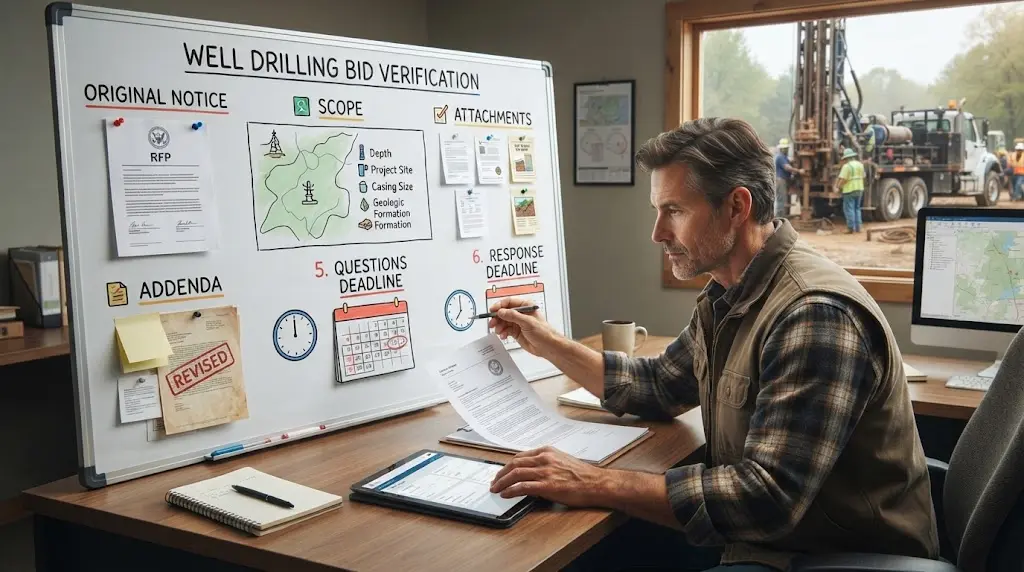
Verification means moving from a discovery listing to the original notice, then checking the documents and status yourself. Do this before estimating, scheduling a site visit, or telling a buyer you intend to bid.
Use this procedure:
- Open the original notice. Prefer the issuing agency, public owner, official plan room, or prime-contractor link. Record the original notice ID and URL.
- Read the notice type. Label it as source sought, pre-solicitation, IFB, ITB, RFP, RFQ, request for qualifications, award, or another category. The label changes the action you should take.
- Check the status and dates. Record the publication date, questions deadline, site visit, response deadline, time zone, and any amendment. Do not rely on a search snippet.
- Download the package. Save the scope, drawings, specifications, forms, pricing schedule, wage or labor requirements, bonding language, insurance terms, and submission instructions that apply.
- Read the scope for fit. Confirm whether the work is water-well, pump, system, environmental, mining, oil and gas, geotechnical, foundation, or something else.
- Check qualification gates. Look for license, registration, set-aside, bonding, insurance, experience, safety, equipment, certification, site-visit, and geographic requirements.
- Find the questions route. If questions must go through a portal or by a named deadline, do not improvise a different channel.
- Check amendments again before submission. A changed drawing, due date, form, or answer can change whether your number is responsive.
- Record a pursuit decision. Mark pursue, clarify, refer to partner, monitor, or no-bid. Write the reason in plain language.
Federal notices are a good example of why this matters. A SAM.gov well-drilling opportunity may carry a specific NAICS, a product or service code, a set-aside, a bid guarantee, a performance bond, a payment bond, testing requirements, and a defined completion period. Those are not universal requirements. They are reminders that a title alone never tells you what a responsive bid requires. SAM.gov well drilling opportunity example
Should you pursue the job as a prime or a subcontractor?
Choose the route that matches your administrative capacity, risk, relationships, and scope. Prime work can give you direct control of the customer relationship, but it also puts the full solicitation and contract burden on your company. Subcontracting can reduce that burden and open larger projects, but the prime controls the commercial relationship, payment path, schedule, and package of work.
| Question | Prime may fit when | Subcontract may fit when |
|---|---|---|
| Contract path | You can satisfy the buyer’s registration, forms, compliance, and reporting requirements | A prime is already managing the government contract and needs your field scope |
| Scope | Your company can perform the full defined requirement or a clearly separable lot | Your strength is one package such as drilling, pump installation, testing, or rehabilitation |
| Relationship | You have the buyer, engineer, or agency contact and can manage clarification | You have a credible relationship with the prime or construction manager |
| Risk | You can price mobilization, unknowns, bonds, schedule, and contract terms | You understand the subcontract terms, payment timing, insurance, and change-order path |
| Capacity | Your office can prepare and administer the response and contract | Your field team can perform the work while the prime handles broader administration |
| Best source | Official owner or agency solicitation | SBA SUBNet, prime directories, plan rooms, engineer introductions, and direct prime outreach |
Do not treat subcontracting as informal work. Ask for the prime’s scope, schedule, drawings, site access, insurance requirements, safety rules, payment terms, change-order process, and point of contact. A quote that is profitable as a field package can become poor work if mobilization, standby, retainage, or rework is left undefined.
The same is true for prime work. A public notice may look like a direct drilling job but include site restoration, traffic control, temporary water, environmental protection, testing, reporting, or coordination with other trades. Decide whether those items are inside your company, a partner’s scope, or a reason to decline.
How do you decide whether to pursue an opportunity?
Use a no-bid gate before the estimator builds a number. The gate protects the business from opportunities that are technically interesting but commercially wrong.
Score each question as yes, unclear, or no. A single no in the legal, territory, scope, or deadline category usually ends the pursuit. An unclear answer becomes a clarification task with an owner and due date.
| Gate | Decision question | Pursue when | No-bid or hold when |
|---|---|---|---|
| Scope | Is the requested work inside our actual service capability? | The crew, equipment, and experience match the scope | The notice is a different drilling category or requires a capability you do not have |
| Territory | Can we reach and support the site at an acceptable cost? | Travel, mobilization, and site access are understood | Travel, access, or logistics make the job uneconomic or uncertain |
| Eligibility | Can we meet licensing, registration, certification, set-aside, insurance, and bonding rules? | Required evidence is current and available | A mandatory condition cannot be met before the deadline |
| Capacity | Can the crew perform within the required schedule? | The schedule fits confirmed capacity | The calendar would force a promise you cannot keep |
| Information | Are the drawings, scope, site conditions, and commercial terms clear enough to price? | Questions can close the meaningful gaps | Unknowns are too large and no clarification path exists |
| Buyer fit | Is the buyer or prime worth a serious pursuit? | Payment path, contact, and project legitimacy are clear | The notice is stale, unverifiable, or inconsistent |
| Economics | Can the opportunity justify estimating, site visits, bonds, and mobilization? | A conservative estimate can cover the work and risk | The job requires effort you cannot rationally recover |
| Strategic fit | Does this open a buyer, service line, or territory you actually want? | It supports the company’s stated work mix | It would pull the company into work it does not want to repeat |
The table is a decision framework, not a margin formula. Do not insert invented industry margins or generic bid-win percentages. Use your company’s real labor, equipment, subcontract, travel, insurance, bonding, overhead, and contingency inputs.
What should the pursuit file contain?
Keep one short pursuit record for every serious opportunity:
- opportunity name and notice ID;
- original source and discovery source;
- buyer, engineer, prime, and contact;
- project location and site access notes;
- service line and scope;
- response type and deadline;
- classification, set-aside, license, bond, and insurance gates;
- site visit, questions, and amendment dates;
- estimated field days, mobilization, equipment, materials, and partners;
- owner of each unanswered question;
- pursuit decision and reason;
- final outcome, including no-bid reason, submitted, lost, won, or booked.
This record makes the source itself accountable. If the same source produces twelve listings but ten are outside your scope and two are already closed, you have evidence to change the subscription or alert rules.
The no-bid decision is a productivity tool, not a sign that your company lacks ambition.
What should a well contractor send before a formal bid?
Send a concise, verified capability packet when a buyer or prime is seeking qualified sources, when you are introducing your company to an engineer, or when a subcontract opportunity asks for qualifications. Do not use the packet as a substitute for a solicitation response.
The packet should match the audience. For a public agency, include relevant identifiers, licenses, capabilities, territory, staff or equipment details, and verifiable past performance where allowed. For a prime, emphasize the field scope, availability, insurance, safety, equipment, and communication path it needs to manage the package.
Before sending, check that:
- Your company name and contact information are current.
- Your service description matches what the crew actually performs.
- Your territory is specific and honest.
- Licenses, certifications, and insurance language is current.
- Project examples state your actual role and do not imply work you did not perform.
- Equipment claims are accurate and available for the proposed period.
- The packet tells the reader what to do next.
Use the water well contractor prequalification checklist to verify the evidence. Use the water well drilling subcontractor qualifications checklist when the route is through a prime. A good capability packet reduces uncertainty. It does not make a poor-fit bid become a good one.
How should you track bid sources through booked work?
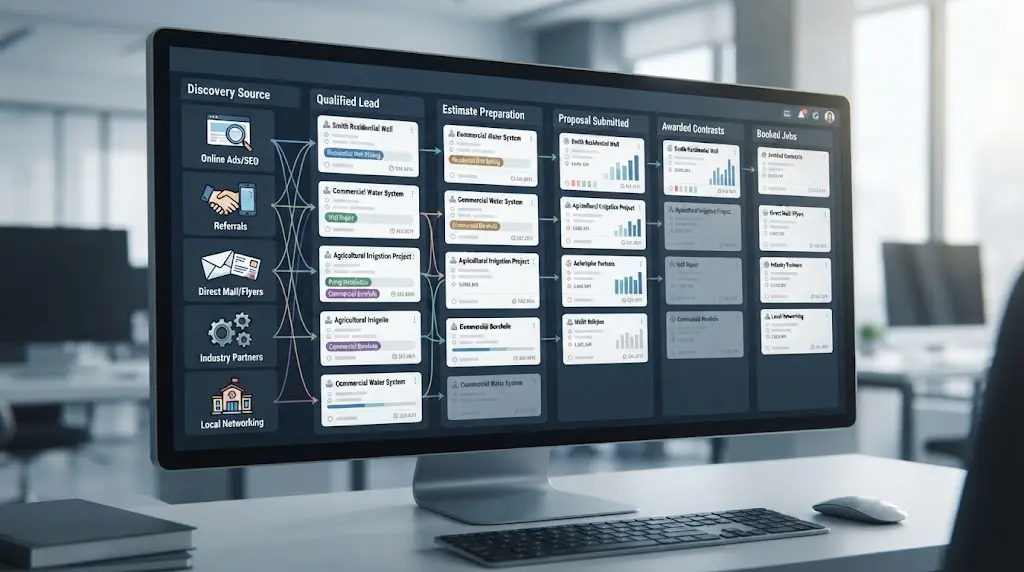
Track the source as an operating channel, not just as a bookmark. A source should be traceable from first discovery to a real business outcome.
Use one row per opportunity. Suggested fields are:
| Field | What to record | Why it matters |
|---|---|---|
| Discovery source | SAM.gov, state portal, H2Bid, engineer, prime, utility, referral, or other | Shows where attention originates |
| Original source | Official notice or prime URL | Protects against stale or secondary information |
| Date found | Date your team first recorded it | Measures lead time and source freshness |
| Buyer and intermediary | Agency, city, utility, engineer, construction manager, or prime | Builds account intelligence and relationship history |
| Project type | New well, pump, rehab, testing, water system, or other | Shows which sources fit which service line |
| Territory | Project location and service boundary | Protects dispatch and margin decisions |
| Status | Found, verifying, monitor, pursue, no-bid, submitted, awarded, lost, booked | Separates activity from progress |
| No-bid reason | Territory, scope, deadline, eligibility, capacity, economics, or information | Improves future filtering |
| Estimate outcome | Requested, delivered, revised, or not applicable | Shows commercial movement |
| Bid outcome | Submitted, withdrawn, lost, won, or unknown | Keeps the pipeline honest |
| Booked work | Job scheduled or contract committed, if applicable | Connects source activity to revenue work |
| Next action | Clarification, capability packet, follow-up, or archive | Prevents good opportunities from dying in a spreadsheet |
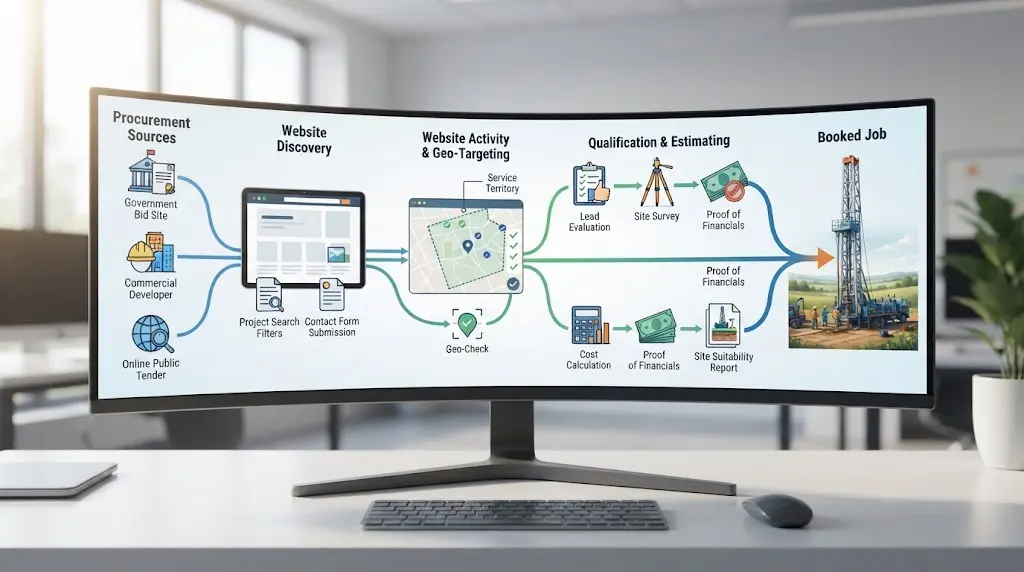
The source log can be a spreadsheet, CRM, or procurement tool. The tool matters less than consistent definitions. Decide what “qualified” means before you compare sources. A qualified opportunity may be inside your territory, match your service, have a real buyer and next step, and meet basic eligibility. A booked job is later in the funnel.
Do not claim a source caused revenue when your record only shows that it appeared in a listing. Use precise labels: discovered, qualified, estimated, submitted, awarded, and booked. The same discipline should apply to calls and forms. Brictale’s well drilling lead generation guide uses the same source-to-qualified-to-booked logic for inbound demand.
What should you review each month?
Review the source log by source, service line, territory, buyer, and status. Look for:
- sources that surface many notices but few qualified pursuits;
- sources that produce fewer opportunities but better-fit estimates;
- buyers who repeatedly publish work you want;
- no-bid reasons you can fix through registration, licensing, bonding, or a partner;
- opportunities found too late for a responsible response;
- projects that keep appearing under a different vocabulary;
- primes and engineers who need a direct introduction;
- gaps between the work you want and the work your website or capability packet makes visible.
The point is not to force every source into a lead-generation dashboard. The point is to make the owner’s next resource decision evidence-based.
What should the weekly bid-source workflow look like?
A weekly workflow works when it has a narrow territory, named search terms, a fixed review slot, and a clear owner for every next step. It should not depend on one person remembering every portal.
Use this operating sequence:
- Set the week’s target. Decide which services and territories have capacity. A drilling line, pump-service line, and rehabilitation line may need different searches.
- Run official searches. Check SAM.gov, your state portal, priority county and city pages, utilities, districts, and identified prime or engineer sources.
- Run coverage searches. Check the specialty water and wastewater databases and any plan rooms you have chosen to test.
- Review intelligence. Look at recent awards or project records for your target buyers. Add names and vocabulary to the account list.
- Triage. Run every candidate through scope, territory, eligibility, capacity, information, buyer, economics, and strategic-fit gates.
- Verify. Open the original source and save the current package, addenda, deadlines, and contact path.
- Assign. Give each pursue or clarify action to an estimator, owner, field lead, or business-development person with a due date.
- Follow up. Send a specific capability introduction to the right prime, engineer, utility, or agency contact when the route is relationship-based.
- Close the loop. Update the status after every site visit, estimate, submission, award, or no-bid decision.
- Review the source mix. Remove or refine sources that repeatedly create irrelevant or unverifiable work. Increase attention to sources that produce qualified opportunities in the service lines you want.
The workflow is intentionally repetitive. Procurement pages change. People change jobs. A source that was quiet for six weeks can matter when a utility publishes a planned project. The answer is a controlled cadence, not random checking every time someone remembers a bid board.
When should you not use a bid source?
Do not use a source just because it contains the word “drilling.” Stop or reduce attention when the source repeatedly fails one of four tests: fit, authority, timing, or economics.
Common stop conditions include:
- the source combines water wells with oil, gas, mining, geotechnical, and foundation drilling without useful filters;
- listings do not link to an original owner or the original link is consistently unavailable;
- closed projects remain mixed with active opportunities and your team cannot verify status;
- the source requires a subscription but does not produce a measurable increase in qualified pursuits after a defined test;
- the project is outside your actual service territory or creates unacceptable mobilization;
- your company cannot satisfy a mandatory license, certification, bond, insurance, or registration requirement;
- the deadline leaves no responsible time for a site visit, questions, estimate, review, and submission;
- the buyer’s scope is too incomplete to price and there is no meaningful clarification path;
- the opportunity would fill the calendar with work your company does not want to repeat;
- a source encourages bypassing the official solicitation, paying an unverified intermediary, or using unapproved contact details.
The correct move is not always deletion. Put a weak source on monitor, change the filters, narrow the geography, or assign it to a lower-frequency review. If it still produces no qualified opportunities, remove it from the active stack.
More bid alerts can create less capacity when nobody owns the verification and no-bid decisions.
How should bid sourcing and marketing support each other?
Bid sourcing and inbound marketing are different acquisition paths, but they share the same business controls: accurate service scope, service territory, proof, fast response, and source-level measurement.
A public buyer or prime may check your website after receiving a capability packet. An engineer may search your company before inviting a quote. A commercial property manager may compare your company with other bidders. If the website says one thing about your services and the bid packet says another, the inconsistency adds buyer risk.
Your marketing should make the work you want easy to verify. That does not mean publishing a page for every bid keyword or implying that you serve every state. It means clarifying the services, territory, project types, qualifications, and contact path that are true for your company.
The same source discipline applies to inbound calls. If a website, referral, paid campaign, or map listing produces a call, log the source and disposition. If a bid source produces a project, log the original notice and the outcome. Then the owner can compare channels by qualified opportunities, estimates, booked work, and capacity consumed.
This is where Brictale can be useful. A free territory audit can examine the gap between the work your company wants, what competing contractors make visible, the public proof a buyer can find, and whether calls or inquiries are being connected to the source and booked-job outcome. The audit is a next step for an owner who has the source list but still cannot see where demand or credibility is leaking.
What should you do in the first 30 days?
Use the first month to build a small, measurable source stack. Do not subscribe to every database, register with every agency, or pursue every project that matches a broad keyword.
Days 1-5: define the operating boundary
Write down the services you want to sell, the services you do not perform, the territory you can support, the crews and equipment available, the earliest credible start windows, and the buyer types you want. Separate new drilling, pump service, rehabilitation, testing, agricultural work, commercial work, and other lines when their qualification rules differ.
Create the source log before you search. Add fields for discovery source, original source, buyer, project, territory, status, no-bid reason, estimate, submission, award, and booked work.
Days 6-10: build the official source list
Find your state procurement office through NASPO. Add the state systems and departments relevant to your services. Add the priority counties, cities, utilities, water districts, universities, schools, parks, and public owners in your territory. Add SAM.gov, SBA SUBNet, and the APEX Accelerator serving your area.
Do not mark a portal as active until you have checked how it publishes notices, whether registration is required, and whether it links to the current solicitation package.
Days 11-15: build the relationship list
Identify engineers, construction managers, and prime contractors who publish or win projects in your target territory. Use public award data and project pages as intelligence. Write a short, specific capability introduction for each group. Ask one operational question: how does this firm notify or qualify well and pump subcontractors for relevant work?
Days 16-20: test specialty discovery sources
Run a defined search in Waterwell Bid Network, H2Bid, and any other source under consideration. Record every candidate, then verify the original notice. Count qualified opportunities and estimate-ready opportunities, not total listings.
If you cannot make the source specific enough to measure, do not expand the subscription or review time.
Days 21-25: run the no-bid gate
Review every candidate with the scope, territory, eligibility, capacity, information, buyer, economics, and strategic-fit table. Write why you declined each one. Those reasons tell you whether the problem is source quality, registration, capability, territory, timing, or internal discipline.
Days 26-30: review and narrow
Compare sources by the quality of work they surfaced. Keep a short active stack. Move noisy sources to monitor. Add the best buyers and intermediaries to the relationship calendar. Update the vocabulary list with the terms that produced relevant notices.
At the end of the month, you should know which sources deserve weekly attention, which need a monthly check, which are relationship channels, and which should be removed. You should also know the reason for every serious no-bid.
What should an owner do on Monday morning?
Start with the work you can actually take. Open the service-line capacity note, then run the official sources for the territory you can support. Search SAM.gov if federal work is relevant, your state and local portals for public work, the priority specialty databases for coverage, and the relationship list for primes, engineers, and utilities.
For every candidate, answer four questions before forwarding it to an estimator:
- Is it the kind of work we perform?
- Is it in a territory we can serve?
- Is the original notice active and complete enough to inspect?
- Is there a credible next action before the deadline?
If the answer is no, record the reason and move on. If the answer is yes, assign verification and estimating work with a deadline. If the opportunity is a relationship lead, send the specific capability note and ask how to enter the next relevant procurement.
The best bid source is not the one that fills your inbox. It is the one that repeatedly brings your company into contact with work it can qualify for, price responsibly, perform well, and track through the result.
That is the source stack Brictale recommends: official notices for truth, specialist databases for coverage, awards for intelligence, and people for relationships. Keep the stack narrow. Keep the records honest. Use a free territory audit when you want an outside view of where your company’s service coverage, proof, and demand tracking are not lining up.