Most water well drilling companies do not need a prettier brochure. They need a qualification check that lets a prime or buyer answer five questions quickly:
- What work do you actually perform?
- Where can you perform it?
- Do you have the people, rigs, pumps, and controls to do it?
- Can you prove similar work and current credentials?
- Who should the prime contact next?
That is what a subcontractor qualifications checklist should verify. It supports a capability statement, project sheet, vendor packet, or prequalification response for a government agency, engineering firm, general contractor, developer, commercial operator, or referral partner. It is not a proposal, a bid response, or a list of every service your company has ever touched.
Quick Answer: A water well drilling subcontractor qualifications checklist should verify the work you can perform, drilling methods, rigs and crew, licenses, insurance or bonding, service territory, relevant project proof, identifiers, safety and documentation practices, and a clear contact path. Match it to the prime's scope, verify every claim, and submit only what your company can support.
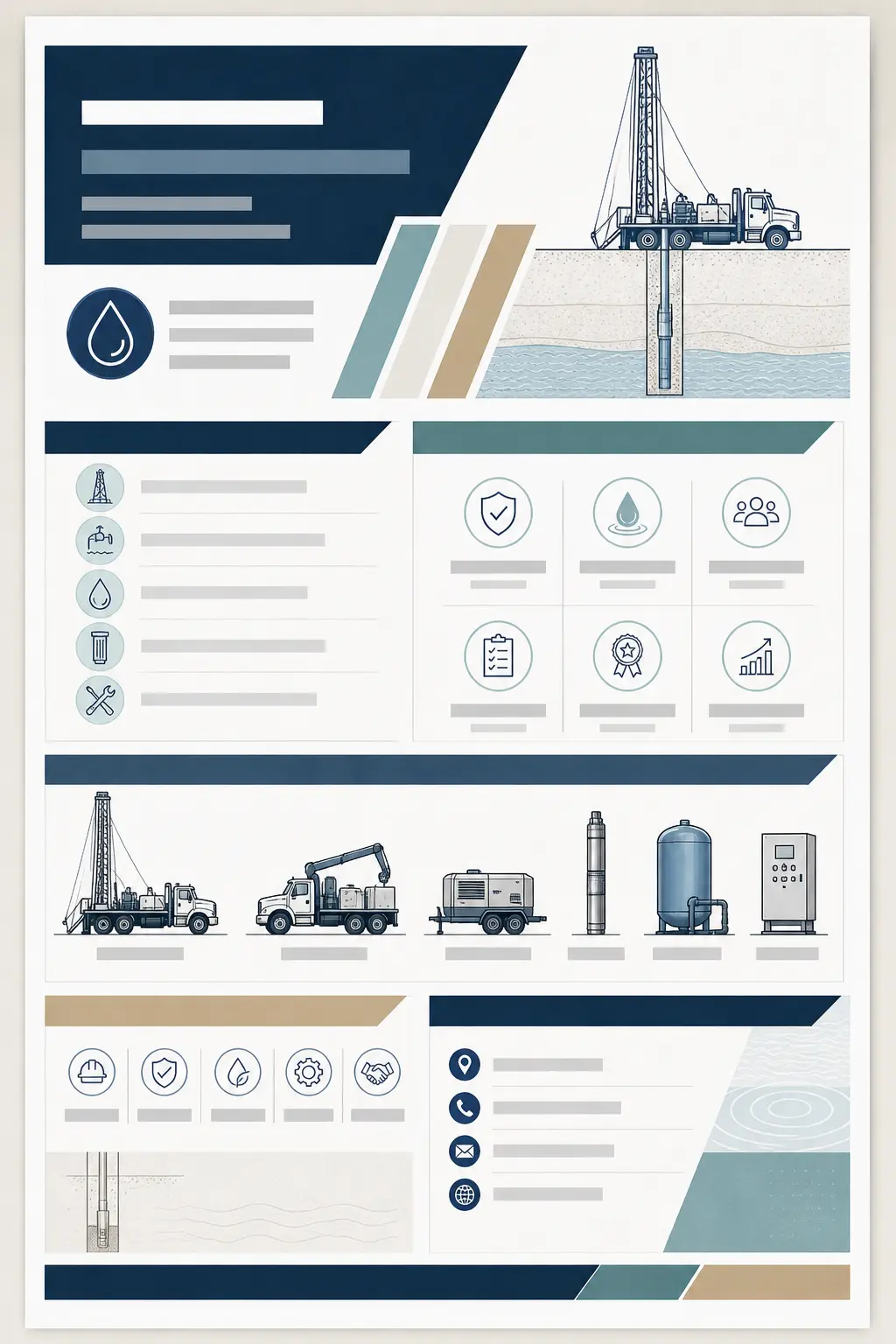

What does a subcontractor qualifications checklist need to prove?
A subcontractor qualifications checklist is a working control that helps a prime or buyer verify your fit before it asks for a quote, project sheet, formal qualifications package, or proposal. The buyer might be a public agency assembling a vendor list, a prime contractor looking for a subcontractor, an engineering firm building a project team, a developer checking site-service capacity, or a commercial operator looking for a reliable well and pump partner.
Empire State Development's government-contracting resource guide calls it “a brief, 1- to 2-page document, specific to government contracting” and describes it as a marketing tool for introducing a business to agencies and prime contractors. Empire State Development's guide also identifies five critical components: core competencies, past performance, differentiators, company data, and contact information.
That five-part structure is a useful starting point for the summary document that may accompany the checklist. A water well contractor needs to add one more discipline: every technical or compliance claim must be specific enough to check.
“Water well drilling” can mean several different kinds of work. It may mean new residential wells, agricultural wells, commercial production wells, monitoring wells, test holes, well rehabilitation, pump installation, pump repair, pressure-system work, flow testing, water testing coordination, or abandonment. The document has to show which meaning applies to your company and to the buyer in front of you.
A subcontractor qualification checklist is valuable when it reduces buyer uncertainty, not when it contains the most services.
Do not treat the checklist as a compressed version of your website. A website can support several audiences and explain a service in depth. The qualification package has a narrower job: help the right buyer decide whether a conversation, site visit, request for information, bid invitation, subcontract discussion, or vendor review is worth the next step.
When should a well contractor use a subcontractor qualifications checklist?
Use one when the buyer needs a quick, portable description of your fit before a full proposal or formal quote. The best use cases are early conversations and targeted introductions, not replacing a solicitation response.
Common situations include:
| Situation | What the buyer is trying to learn | What your statement should emphasize |
|---|---|---|
| Government market research or sources-sought notice | Whether your company can meet the likely scope | Relevant work, staff, capacity, identifiers, credentials, and ability to meet the described requirement |
| Engineering-firm outreach | Whether you can support the engineering team in the field | Methods, technical scope, reporting, documentation, safety, and coordination |
| General-contractor or prime outreach | Whether you can self-perform or manage your part of the work | Scope ownership, crew and rig resources, schedule coordination, insurance or bonding, and comparable projects |
| Commercial or industrial buyer introduction | Whether you understand the asset and can support it reliably | Service scope, response or project approach, documentation, territory, and accountable contact |
| Developer or builder relationship | Whether you fit the project type and geography | New construction experience, site coordination, permitting responsibilities, capacity boundaries, and service area |
| Referral or partner relationship | Whether sending a customer to you will create risk | Exact jobs accepted, jobs declined, territory, qualifications, response path, and handoff process |
The U.S. Small Business Administration currently lists capability-statement instruction under government contracting and describes a workshop that reviews components and sample documents. The SBA listing is a reminder that this is a recognized business-development asset, not merely a graphic-design exercise.
A completed qualifications checklist is especially useful when you are known locally but not yet known by the prime's procurement or project team. It gives that team something concrete to forward internally. That only works if the content is accurate and specific.
Should the checklist be one page or a full qualification package?
Start with one page, or one sheet printed front and back, unless the buyer or solicitation gives a different instruction. Concision makes the statement easier to scan and easier for another person to forward without explanation.
HHS recommends a one-page front-and-back format and says a capability statement should present information concisely, with bullets, simple tables, and highlighted sections for readability. HHS's capability-statement guidance also suggests having someone outside the company read it before sharing it.
Empire State Development offers a similar one- to two-page range and recommends short sentences, bullets, targeted documents, PDF distribution, and current contact information. Those are useful defaults, not a universal procurement rule.
Use this decision rule:
| Buyer context | Default format | Why |
|---|---|---|
| First introduction to a buyer or partner | One page | The reader can understand your fit in one sitting and forward it easily |
| Front-and-back company introduction | Two sides of one sheet | You can add proof and company data without turning the document into a brochure |
| Formal sources-sought or solicitation response | The buyer's stated limit and format | The notice controls, even if it conflicts with your normal one-page version |
| Complex project team or multi-service qualification | A short capability statement plus separate project sheets | Keeps the introduction concise while giving the buyer deeper evidence when requested |
Do not solve a weak statement by making it longer. First remove generic language, unrelated services, old identifiers, repeated logos, and proof that does not match the buyer's scope. Then add the one missing fact that would change the buyer's decision.
One page is a useful default. The current buyer instruction is the rule.
Which prime or buyer is reviewing your qualifications?
Choose the buyer before you write the first sentence. A statement that tries to address a county procurement office, a residential builder, an engineering firm, and a commercial facility at the same time usually becomes vague.
The same company can maintain several tailored versions. That does not mean creating several identities. It means changing the order, proof, and scope emphasis so the document answers the buyer's real question.
What does a government buyer need to see?
A government buyer needs a concise, current description of whether your company can perform the likely requirement and whether the buyer can identify you in its systems. The relevant fields can include your legal business name, doing-business-as name, UEI, CAGE code when applicable, NAICS codes, size or certification status where relevant, service scope, past performance, key staff, capacity, insurance or bonding, and contact information.
Do not assume every agency wants the same fields. A current SAM.gov notice may request staff expertise, current in-house capability and capacity, similar completed projects, corporate experience, management capability, and examples of government contracts. This SAM.gov opportunity is one example of a tailored request. It is not a national template.
If you intend to bid directly on federal contracts, check your current SAM.gov status. SAM.gov says a prime awardee needs registration to bid on government contracts, that a UEI is assigned during registration, and that an active registration must be renewed every 365 days. It also distinguishes full registration from requesting a UEI only when direct bidding is not the goal. Check the current SAM.gov registration guidance before listing identifiers in your statement.
What does an engineering firm need to see?
An engineering firm usually needs to know whether your field capability matches the design or investigation scope. Put the technical work near the top: drilling methods, bore or well types, casing and completion work, development, testing, logging, pump installation or coordination, reporting, and the geographic or geologic conditions you genuinely handle.
The engineering buyer may care less about a broad slogan and more about whether you can follow a specification, communicate field conditions, produce required documentation, and coordinate with the design team. If you do not provide a service in-house, say who performs it and what your role is. Do not present a referral or subcontract arrangement as self-performance.
What does a general contractor or prime need to see?
A prime contractor needs to know what part of the work you can own, what part you can self-perform, and what resources you can commit without creating a schedule problem. Give the buyer a clear scope boundary.
Useful fields include:
- Work packages you can self-perform.
- Work you coordinate through named partners or subcontractors.
- Rig, crew, pump, and support-equipment availability as of the review date.
- Service territory and mobilization boundary.
- Safety, insurance, bonding, and site requirements you can document.
- Relevant project examples with your role clearly identified.
- A person who can answer project questions during the buyer's normal workday.
The Federal Acquisition Regulation is not a capability-statement design guide, but Part 9 provides useful context for why buyers ask for these details. It says a prospective contractor must affirmatively demonstrate responsibility and identifies financial resources, performance record, organization, experience, operational controls, technical skills, quality assurance, and safety programs among relevant standards. FAR Part 9 supports a proof-first approach, but do not copy its language into a statement unless the buyer's requirement calls for it.
What does a commercial buyer or developer need to see?
A commercial buyer or developer needs a clear answer to a practical fit question: can your company perform this kind of work at this site, in this time window, with this level of documentation and coordination?
Lead with the service and project type. Show the territory, site constraints you understand, project contact, and what the buyer receives at completion. If the work involves permits, logs, test results, water quality coordination, pump commissioning, or as-built documentation, describe your actual responsibility instead of promising a vague “turnkey solution.”
What should the qualification summary say?
The header should identify your legal or operating business clearly and tell the buyer what you do in one sentence. It should not force the reader to decode a slogan before seeing your services.
Use this fill-in structure:
[COMPANY NAME]
[One-sentence buyer fit statement]

Water well drilling | Pump systems | [Other true priority service]
Serving [specific states, counties, regions, or project territory]
Qualification Summary | Reviewed [MONTH YEAR]
Example language with blanks:
[Company Name] performs [priority well and pump services] for [buyer or project type] across [territory], with [licensed or certified role where true], [equipment or method], and [documentation or project support] available for [scope boundary].
That sentence is not a place to claim “the best,” “full-service,” “all-inclusive,” or “anywhere in the state.” It is a fit statement. A buyer should be able to tell within seconds whether to keep reading.
Put the current date or review month on the document. Equipment, territory, availability, identifiers, and contact ownership change. A dated statement gives the owner a reason to review it instead of allowing an old PDF to circulate indefinitely.

How should you describe subcontractor capabilities?
List the work in the order that matters to the target buyer, using service names that a project owner or procurement team can recognize. Each capability should answer what you do, for whom, and within what boundary.
The U.S. Census Bureau's 2022 NAICS entry includes water well drilling, digging, boring, or sinking and water well pump and well piping system installation under NAICS 237110. The Census classification is useful context for industry identification, but a code alone does not prove that your company can perform a specific scope.
Use a service list like this, then delete anything that is not true or not relevant to the buyer:
CORE CAPABILITIES

Water well drilling
- [Residential | agricultural | commercial | municipal | monitoring]
- [New wells | replacement wells | test holes | other true scope]
- [Drilling methods actually used]
- [Depth, diameter, formation, or site conditions you can document]

Well and pump systems
- [Pump installation or replacement]
- [Pump repair or diagnosis]
- [Pressure tanks, controls, pitless units, or water lines]
- [Testing, commissioning, or coordination]

Related groundwater services
- [Well development or rehabilitation]
- [Flow testing, water-level measurement, or logging]
- [Sampling or laboratory coordination]
- [Abandonment, monitoring, or other licensed scope]
The list should not read like a menu. Group the services into two or three useful families and use a short sentence to explain the job types you want the buyer to associate with you.
For example:
[Company Name] drills and completes [well types] for [buyer or property type] in [territory]. The crew performs [methods] and can provide [completion, development, testing, pump, or documentation services] within the scope described below.
If your company drills wells but does not install pumps, say that. If you install pumps but do not perform the well construction, say that. EPA explains that drilled wells are constructed by percussion or rotary-drilling machines and require casing, while pump types and installation conditions vary. EPA's private-well guidance is written for public education, not procurement, but it reinforces why a broad “water systems” label is not enough to describe technical responsibility.
A service list becomes credible when every line has an owner, a boundary, and a proof item.
Which technical details prove drilling subcontractor fit?
Add the technical details that help the target buyer judge fit, but only at the level you can support. The statement is not a drilling manual. It is a compact record of methods, scope, resources, and documentation.
Use this matrix when deciding what to include:
| Capability claim | Useful detail | Proof to hold internally | Do not claim unless verified |
|---|---|---|---|
| Drilling method | Air rotary, mud rotary, cable tool, air percussion, auger, dual rotary, or another method you actually use | Rig specifications, crew qualifications, project logs, equipment records | A method performed by a partner as if your crew performs it |
| Well or bore type | Residential, agricultural, commercial, monitoring, test, production, or other scope | Project records, permits, completion documents, photos where permitted | A project type you have not performed or cannot staff |
| Depth or diameter range | A documented range relevant to the target work | Completed well records, rig limits, job files | A maximum borrowed from a manufacturer or competitor |
| Casing and completion | Materials, diameters, screens, grouting, seals, development, or completion role | State reports, project documentation, specifications, qualified staff | A regulated installation claim outside your license or role |
| Testing and reporting | Yield or flow testing, water levels, logging, sampling coordination, completion reports | Sample reports, forms, equipment, lab relationships, responsible person | Certified laboratory or engineering work you do not perform |
| Pump and controls | Submersible or jet pumps, pressure systems, controls, commissioning, repair | Technician qualifications, service records, inventory, insurance scope | Pump work outside your license, training, or insurance |
| Site and environmental practice | Access, cuttings, fluids, cleanup, disinfection, protection, or restoration | Written procedures, permits, training, project records | Guaranteed outcomes or regulatory compliance you have not checked |
The target buyer determines how much detail belongs on the page. An engineering firm may need method and completion information. A developer may first need service area, project type, schedule coordination, and permits. A prime contractor may care most about scope ownership, staffing, equipment, safety, and schedule.
Do not fill the page with specifications that the buyer did not ask for. Put the most decision-changing facts first and keep supporting documents ready if requested.
How should pump and related services be classified?
Include pump and related services when they help the target buyer understand the work you can own. Separate them when they involve a different buyer, different urgency, different licensing, or different proof.
The water well and pump categories often sit close together in a company's name, but they can be different operating offers. New drilling may involve planning, access, geological uncertainty, casing, development, and documentation. Pump repair may involve diagnosis, parts, electrical controls, service response, and a different customer conversation. A capability statement that merges everything into “complete water solutions” leaves the buyer to ask the basic question: which part will you perform?
Use one of these three structures:
- Drilling-led statement. Lead with drilling methods, well types, casing and completion, development, testing, and project coordination. Mention pump work only if it is a real part of the target scope.
- Pump-led statement. Lead with installation, repair, replacement, controls, pressure systems, commissioning, service area, and response model. Mention drilling only as a supporting capability.
- Integrated statement. Use this only when the company truly owns both scopes and the target buyer wants an integrated provider. Separate the work into named families and state whether each is self-performed, coordinated, or subcontracted.
The Census classification includes both water well drilling and water well pump and well piping system installation in the same 2022 industry entry. That can help a company describe its industry, but it does not remove the need to distinguish the actual services, people, and responsibilities in the statement.
What licensing, insurance, and compliance proof should you attach?
Use precise, state-specific language that tells the buyer what is current and what the credential covers. Never use “licensed and insured” as a decorative trust badge with no details behind it.
EPA advises readers to check the state water-well contractor licensing agency or local health department for appropriate construction information. It also says well drillers and pump installers should be bonded and insured and licensed or certified where required. EPA's guidance is not a substitute for a state rule, but it supports the basic practice of putting real credential and coverage information in front of a buyer.
NGWA shows why the template must leave room for local verification. Its contractor licensing page says requirements vary by state and county, lists different exam categories, and notes that application requirements can include experience, references, and bonds or insurance. NGWA's current licensing page should be treated as an orientation point, not a license lookup for your specific job.
Use fields like these:
LICENSES AND COMPLIANCE

State or local license: [agency, license type, number if appropriate, expiration or status]
Pump or water-system credential: [credential and jurisdiction, if applicable]
Bonding: [bond type or available amount only if current and permitted to disclose]
Insurance: [coverage types and limits only if current and approved for disclosure]
Safety programs or training: [specific current program, certification, or training]
Registrations and certifications: [only those relevant to the target buyer]
Verification note: [where the buyer can verify, if the buyer requests it]
Do not publish an expired number, a credential held by an individual who is no longer with the company, a partner's license as if it were yours, or a broad claim that ignores state boundaries. If a license is required for a specific scope, verify the current requirement with the responsible state or local agency before you send the document.
If your insurance certificate or bond letter is available only on request, say “certificates available upon request” only if that is true and someone owns the request. A capability statement should not promise a document that the office cannot produce.

How should you verify rigs, crew, equipment, and capacity?
Show the resources that make the promised work believable. A buyer does not need a complete asset register, but does need enough information to see whether the company can perform the target scope.
Organize resources into four categories:
| Resource category | Include | Keep out unless requested |
|---|---|---|
| People | Key roles, relevant experience, licenses or certifications, field and project-management ownership | Full resumes for every employee on a one-page introduction |
| Drilling equipment | Rig types, method capability, support equipment, access or mobility constraints | A long equipment list with no connection to the target scope |
| Pump and testing equipment | Service equipment, test pumps, controls, logging or measurement tools, sampling process | Brand names that do not help the buyer judge fit |
| Delivery capacity | Crew structure, self-performance, partner role, service territory, project-size boundary, review date | Unqualified claims such as “available anytime” or “no job too large” |
The word “capacity” needs care. It can mean the physical ability of a rig, the number of crews available, the ability to mobilize, the ability to manage several jobs, or simply whether you have room on the schedule. State which one you mean.
Better:
[Company Name] maintains [number or type of] drilling crew(s) and [equipment description] for [scope]. Current availability and mobilization are confirmed for each project before commitment. [Specific work] is self-performed; [other work] is coordinated with [partner role] when required.
Worse:
“We have unlimited capacity and can handle any project anywhere.”
The second sentence creates a promise no buyer can verify and no operator can safely maintain. If your current capacity is seasonal or constrained, use a boundary. “Scheduled project work in [territory], subject to site review and crew availability” is more credible than a nationwide claim.
The same principle applies to equipment. Do not list a rig because it appears in an old brochure. List equipment that is operational, owned or contractually available, and suitable for the work you want the buyer to consider.
Capacity language should tell the truth about availability, not perform confidence.
How should you choose subcontractor past performance?
Choose the closest comparable work, not the most impressive project title. Past performance earns space when it helps the buyer picture your company performing this scope for this kind of customer.
Empire State Development recommends listing three to five past customers and prioritizing government customers when relevant, while also allowing similar private customers when a business is new to government contracting. Its resource guide is general guidance, so follow the target buyer's confidentiality and reference rules.
For each project, collect:
PROJECT EXAMPLE [01]

Client or buyer: [name, if permitted]
Project type: [commercial well, municipal well, agricultural well, pump replacement, monitoring, etc.]
Location: [city and state or broader geography, if permitted]
Period: [month/year to month/year]
Your role: [prime, subcontractor, drilling contractor, pump contractor, coordinator]
Scope performed: [specific work]
Relevant resources: [crew, rig, method, equipment, testing, reporting]
Buyer need solved: [one sentence]
Reference: [name, title, phone/email, if permitted and requested]
A project example should show relevance in one or two lines. Avoid “successful completion” unless you can explain what you completed. Avoid dollar values unless the buyer requests them and you are permitted to disclose them. Avoid a customer name if the contract or relationship makes disclosure inappropriate. Use “available upon request” only when the reference really is available and someone has confirmed permission.
What if the company is new to subcontracting?
Use comparable private, commercial, agricultural, municipal, or subcontracted work if it is relevant and can be disclosed. Identify the role honestly. A private project can show drilling method, well type, crew, documentation, or site coordination even if it was not a government contract.
If the company itself has limited history, separate company experience from individual experience:
[Company Name] was established in [year]. Proposed project lead [name] brings [relevant, verifiable experience] in [scope] from [prior role or company], subject to buyer approval and availability.
Do not turn an employee's previous employer into your company's project history. Do not turn a partner's work into your own. Buyers can ask for clarification, and the correction will cost more trust than a careful limitation would have cost.
What makes a subcontractor differentiator believable?
A differentiator is a specific approach, resource, or operating fact that changes the buyer's risk or effort. It is not an adjective.
Weak differentiators:
- Quality service.
- Experienced team.
- Customer focused.
- Reliable and professional.
- State of the art equipment.
Those may be true. They do not tell a buyer why your company fits this project.
Stronger differentiators have a structure:
Because we [specific capability or process], the buyer gets [specific operational benefit], within [scope or proof boundary].
Examples with blanks:
- “Because we [maintain a dedicated [method] rig and support setup], we can [perform [scope] without relying on [unacceptable dependency]], subject to [site or availability condition].”
- “Because [licensed role] reviews [permit, well, pump, or completion requirement], the project receives [specific documentation or coordination] before [handoff or closeout].”
- “Because [crew or service team] handles [named service] in [named territory], buyers get [specific response or scheduling process], not a generic statewide promise.”
- “Because we record [field data or completion information] in [specific form or report], the buyer receives [documented handoff] at [project stage].”
The claim-to-proof matrix below can help you decide which differentiators deserve the page:
| Differentiator type | Buyer question | Evidence to prepare |
|---|---|---|
| Specialized method | Can you perform this ground or well scope? | Equipment details, project records, trained personnel |
| Local operating knowledge | Can you work in this territory? | Service area, prior relevant projects, permits or local process knowledge |
| Documentation | Will we receive the records we need? | Sample redacted report, completion form, testing workflow, named owner |
| Coordination | Will you work cleanly with our team? | Project communication process, schedule ownership, past coordination examples |
| Response or scheduling | Can you meet the required window? | Current dispatch or project process, stated availability rule, capacity review |
| Compliance | Can you perform the work lawfully and safely? | Current license, insurance, bond, training, safety program, buyer-required forms |
Pick two or three differentiators. If you list seven, none will stand out. If the differentiator cannot be supported by a document, process, person, or observable fact, rewrite it as a goal or remove it.
Which company data and codes belong in the qualification package?
Include the identifiers and company facts that help the target buyer find, classify, and contact you. The exact list depends on the buyer and the work.
HHS lists company branding, core capabilities, services, certifications, contract vehicles, clients, NAICS codes, partners, staff credentials, registered company information, DBA, state of incorporation, business type, CAGE code, and contact information among important content. HHS's official page also says to present the information concisely and check spelling and grammar.
Use a controlled company-data block:
COMPANY DATA

Legal name: [legal entity]
DBA: [if applicable]
Business type: [LLC, corporation, partnership, other]
Established: [year, if useful and accurate]
UEI: [current UEI, if applicable]
CAGE: [current CAGE code, if applicable]
Primary NAICS: [current code and description]
Additional codes: [only relevant codes requested by the buyer]
Certifications or set-aside status: [only current, verified designations]
Service territory: [specific states, counties, or project area]
Website: [company website]
The current federal system matters here. SAM.gov's registration guidance centers the UEI for registered entities, while older capability-statement materials may mention D-U-N-S. Do not copy a legacy identifier because it appears in a template. Use what the current buyer and registration system require.
NAICS codes also need judgment. Use the code that describes the work and that aligns with the buyer's notice. The Census Bureau currently lists water well drilling and water well pump and well piping system installation under 237110 in its 2022 classification. That does not mean every buyer will use that code or that it should be your only code. Check the specific opportunity.
Never include a certification because it sounds persuasive. Include it because it is current, relevant, and verifiable.
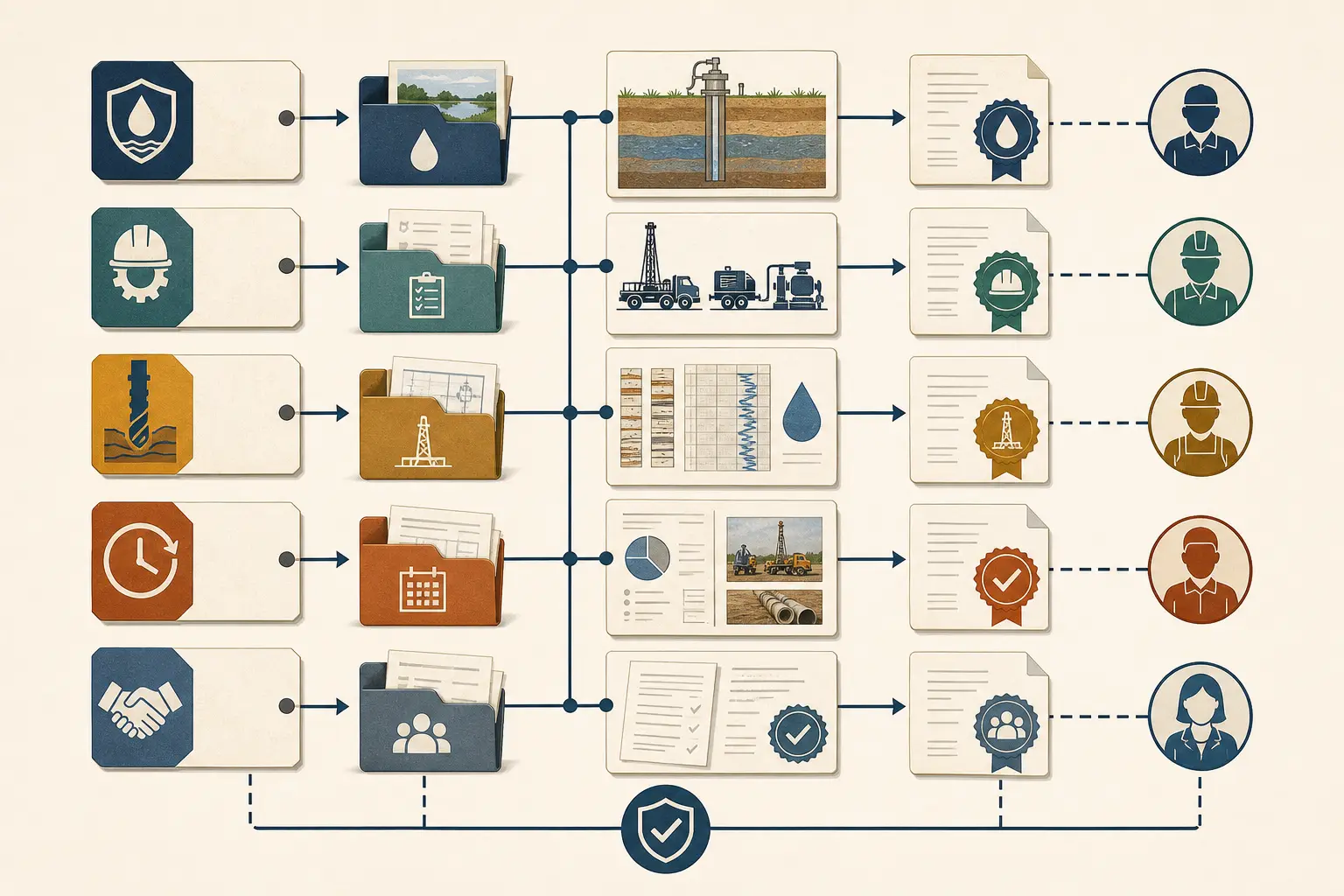
What is the complete water well drilling subcontractor qualifications checklist?
Use the following structure as your first draft. Replace every bracket, delete every field that does not apply, and move the sections to match the buyer's scope. The brackets are instructions, not copy to leave in the final PDF.
SUBCONTRACTOR QUALIFICATIONS SUMMARY

[COMPANY NAME]
[One-sentence buyer fit statement]
Water well drilling | [pump or related priority service]
Serving [specific territory]
Reviewed [month year]

CORE CAPABILITIES
[Two-sentence summary of the work you want this buyer to consider.]

• [Well type or project scope] using [method] in [territory or site condition].
• [Casing, completion, development, testing, or documentation service].
• [Pump installation, repair, replacement, pressure-system, or control service].
• [Monitoring, rehabilitation, sampling coordination, abandonment, or other true scope].

TECHNICAL FIT
Methods: [actual drilling or service methods]
Well or bore types: [actual project categories]
Documented range: [depth, diameter, formation, capacity, or other relevant limit]
Equipment: [rigs, support equipment, pumps, controls, testing tools]
Project support: [permits, reports, testing, coordination, commissioning, or closeout]
Scope boundary: [work you do not perform or perform through a named partner]

PROOF OF PERFORMANCE
[Project 1: buyer, location, period, role, scope, and relevant result or deliverable]
[Project 2: buyer, location, period, role, scope, and relevant result or deliverable]
[Project 3: buyer, location, period, role, scope, and relevant result or deliverable]
References: [available with permission, or named contacts if requested]

DIFFERENTIATORS
• [Specific method, resource, process, or documentation practice]
• [Specific territory, response, coordination, or capacity fact]
• [Specific credential, quality, safety, or project-control fact]

LICENSES, INSURANCE, AND REGISTRATIONS
License: [jurisdiction, type, number or status, expiration]
Pump or water-system credential: [if applicable]
Bonding: [current information or available upon request]
Insurance: [current coverage information or certificate process]
Registrations and certifications: [relevant current items only]

COMPANY DATA
Legal name: [entity]
DBA: [if applicable]
UEI: [if applicable]
CAGE: [if applicable]
NAICS: [current relevant codes]
Business type and established: [accurate information]

CONTACT
[Name, title]
[Phone]
[Email]
[Business address]
[Website]
[Best next step: site review, capability call, vendor intake, or RFI response]
The summary should look like a document a prime can use, not a worksheet. After filling it in, remove the directions, reduce repetition, and check that the first half of the page answers the buyer's main qualification question.
How do you tailor the checklist to a prime or project?
Keep the company facts stable and change the buyer-fit layer. The stable layer includes legal name, current identifiers, real licenses, base territory, equipment, operating history, and approved contact information. The tailored layer includes the lead capability sentence, order of services, project examples, buyer language, and requested attachments.
Use this tailoring table:
| Target buyer | Lead with | Put near the top | Use carefully |
|---|---|---|---|
| State or local agency | Ability to meet the described public scope | Relevant license, service area, similar work, documentation, identifiers, and contact | Do not claim eligibility for a set-aside or contract vehicle without verification |
| Federal agency or prime | Fit to the work statement and current registration | UEI, CAGE when applicable, relevant NAICS, staff, in-house capacity, past performance, safety, and management | Follow the notice's page, font, link, and submission rules |
| Engineering firm | Technical method and field execution | Method, well construction or testing scope, field data, reporting, and coordination | Do not imply engineering or laboratory authority you do not hold |
| General contractor | Self-performance and schedule fit | Work package, crew, equipment, site coordination, insurance or bonding, and comparable project | Do not promise schedule capacity before an internal check |
| Developer or builder | Project type and reliable coordination | Site review, permitting role, construction phase, service boundary, and documentation | Avoid broad promises about yield, water quality, or timing |
| Commercial operator | Asset support and accountability | Service scope, response or project process, reporting, maintenance, and named contact | Do not use emergency language unless the operation supports it |
| Referral partner | Fit and clear handoff | Jobs accepted, territory, qualification questions, response path, and boundaries | Do not imply the partner's services are yours |
Tailoring is not keyword stuffing. It is choosing the evidence that answers the specific buyer's risk.
What should stay consistent across qualification submissions?
Keep these facts consistent across your statement, website, profile, proposal, and sales conversation:
- Legal or operating identity.
- Service area.
- Licenses and certifications.
- Equipment and methods.
- Relationship between self-performed and subcontracted work.
- Contact person and response path.
- Current capacity boundary.
If one version says you serve three counties and another says the entire state, a buyer cannot tell which statement is current. If the PDF says you install pumps but the office sends pump work to another company, explain the relationship.
What should change from prime to prime?
Change the first sentence, service order, project examples, differentiators, and requested next step. A municipal buyer may care about documentation and compliance. A developer may care about site coordination and schedule. An engineering firm may care about method and field data. A prime may care about your exact work package and whether you can self-perform.
The strongest version is not the one with the most company history. It is the one that makes the target buyer feel seen without pretending to be something you are not.
How do you build a claim-to-proof library before submitting?
Build the evidence folder before you write the statement. This keeps the document from turning into a collection of attractive claims that no one can verify.
Create one row for every claim you want to publish:
| Claim | Category | Proof location | Owner | Review date | Safe wording |
|---|---|---|---|---|---|
| We perform [method] | Technical scope | Rig record, project log, crew qualification | [name] | [date] | [precise scope and limit] |
| We serve [territory] | Operating area | Dispatch or project history | [name] | [date] | [area and conditions] |
| We hold [license] | Compliance | State agency record or current credential | [name] | [date] | [jurisdiction and status] |
| We have [equipment] | Resource | Asset record or availability agreement | [name] | [date] | [equipment and availability boundary] |
| We completed [project] | Past performance | Contract, work order, report, permission | [name] | [date] | [role and relevant scope] |
| We provide [report or test] | Documentation | Redacted sample or process owner | [name] | [date] | [actual deliverable] |
| We are [certified or designated] | Company data | Current certification or registration | [name] | [date] | [exact designation and expiry] |
This library has a second use. It can reveal gaps in your website and sales process. If you cannot produce proof for a priority service, the problem may not be the PDF. You may need to document the service, clarify the role, renew a credential, or stop selling the claim.
The well drilling service page coverage benchmark uses a related discipline for website pages: name the service, show job fit, identify the territory, provide proof, and give a clear action. A capability statement is a different asset, but the evidence should agree.

How do you prepare and send a subcontractor qualification package?
Use a repeatable procedure that begins with the buyer's scope and ends with a named follow-up owner. The procedure below is Brictale's operating recommendation, not an external procurement requirement.
- Name the buyer and opportunity. Record the agency, prime, engineering firm, developer, operator, or partner, the project or service scope, the territory, and the reason you are sending the document.
- Read the current instructions. Check whether the buyer asks for a capability statement, qualifications package, sources-sought response, proposal, quote, or another document. Note page, file, font, attachment, link, and submission rules.
- Choose the lead capability. Write one sentence that names the work, buyer fit, territory, and the resource or proof that makes the sentence credible.
- Select two or three project examples. Choose by relevance, role, scope, geography, size, or documentation. Confirm permission before naming a client or reference.
- Verify current company data. Check legal name, DBA, UEI, CAGE, codes, certifications, licenses, insurance, bonding, address, phone, email, and website.
- Confirm operational capacity. Ask the owner or operations lead whether the stated crew, rig, pump, testing, partner, and schedule resources are actually available for the likely work.
- Tailor the middle of the page. Reorder services and proof to mirror the buyer's scope. Delete services that will distract the buyer or create an inaccurate expectation.
- Run the claim-to-proof check. Every technical, geographic, compliance, capacity, or result claim needs a record, person, or current verification path.
- Export and inspect the PDF. Check page count, text size, links if allowed, spelling, phone number, email, file name, margins, image quality, and whether the page still scans when printed in grayscale.
- Assign the follow-up. Record who sent it, when, to whom, for what scope, and what happens next. A document without an owner becomes an old attachment.
Use a file name a buyer can understand:
[Company-Name]-Capability-Statement-[Service-or-Buyer]-[YYYY-MM].pdf
Do not name it final-final-new.pdf. The file may be forwarded outside your office.
What should you leave out?
Leave out anything that increases the buyer's reading burden without increasing confidence in your fit.
Remove:
- Every service you do not want the target buyer to associate with you.
- Claims such as “best,” “leading,” “unmatched,” or “turnkey” unless the buyer's definition and your proof make the wording meaningful.
- Unsupported depth, diameter, yield, response-time, statewide, or project-size claims.
- Expired licenses, certifications, insurance, bonds, identifiers, and contract vehicles.
- A partner's equipment or license presented as company-owned or self-performed.
- A customer logo or project name you do not have permission to use.
- Confidential project values, drawings, data, or contact details.
- A list of every employee when the buyer needs only the key roles.
- A generic mission statement that pushes the actual capability below the fold.
- A second page that repeats the first page in different words.
Do not use a capability statement to hide an operating limitation. If you do not serve a county, say where you do serve. If pump work is referred, define the role. If a project requires a license your company does not hold, do not imply that a related credential covers it.
When should you not pursue a subcontractor qualification request?
Do not create one yet when the target buyer, target scope, or company facts are unclear. The document will not fix an undefined offer.
Pause and resolve the underlying issue when:
- You cannot name the work you want more of.
- You cannot verify the license, insurance, equipment, or partner claim you plan to publish.
- You have no current contact person who can answer a buyer's questions.
- You are using a broad document to cover a service your crew is not ready to perform.
- The buyer asked for a formal proposal, qualifications package, or quote instead.
- Your only differentiator is a generic adjective.
- Your project examples are unrelated, too old, confidential, or not actually your company's work.
- The document would promise availability that operations has not approved.
The right next step may be to collect project records, update your license information, clarify the service boundary, or build a better service page. The well drilling contractor capacity planning guide can help an owner decide whether the company is ready to support more demand before a statement creates more conversations.
How should qualification materials connect to your website and lead flow?
The PDF is an offline asset, but its claims should line up with the pages and contact paths that a buyer sees next. A buyer who receives the statement may search your company, visit a service page, check a map listing, call the number in the header, or forward the document to another decision maker.
Check these handoffs:
| Capability-statement element | Website or sales handoff | What to verify |
|---|---|---|
| Priority service | Matching service page | The page names the same service and scope |
| Territory | Service-area and contact language | The stated area is accurate and operationally possible |
| Project proof | Project, photo, or reference material | The proof is permitted, specific, and not contradicted elsewhere |
| Phone and email | Call and contact path | The person or team answers and records the inquiry |
| Next step | Form, call, site review, or vendor intake | The path matches what the statement promises |
| Buyer language | Page titles and body copy | The language is clear to the same commercial reader |
If the statement says you perform commercial well drilling but the website only explains residential pump repair, the buyer has a reason to hesitate. If the statement lists a phone number that reaches a voicemail no one owns, the document did its job and the handoff failed.
The well drilling SEO guide covers how a contractor's services, territory, proof, and commercial search visibility fit together. This template is narrower. It gives you a document to use in direct business-development conversations and a fact pattern your public pages should be able to support.
Brictale helps well and pump companies turn service, territory, proof, and contact data into clearer paths to qualified calls and booked jobs. If you want a second set of eyes on whether the statement and your market presence tell the same story, the free territory audit is the practical next step.

What should the final qualification pre-send audit ask?
Before sending, read the document as the buyer would and then verify it as the owner should. A clean design cannot compensate for a wrong phone number, expired credential, vague service boundary, or project example that does not match the requirement.
Buyer-read test
Ask a person outside the daily operation to answer these questions from the first page:
- What work does this company want me to call about?
- Is the work self-performed or coordinated?
- Where does the company perform it?
- What makes the company relevant to my project?
- Which project example is closest to my need?
- Who do I contact, and what should I ask for?
If the reader has to use your website to answer the first three questions, the statement is not doing enough work.
Owner fact test
Check each statement against a current source inside the company:
| Test | Pass condition |
|---|---|
| Identity | Legal name, DBA, address, phone, email, and website are current |
| Scope | Every service is performed, coordinated, or explicitly labeled as a partner scope |
| Territory | The company can actually mobilize and operate in the stated area |
| Method | The listed drilling or service method matches available equipment and trained people |
| Equipment | The listed rig, pump, control, or testing equipment is current and usable |
| Credentials | Licenses, certifications, insurance, bonds, and registrations are current and relevant |
| Codes | NAICS or other codes match the target work and current buyer instruction |
| Past performance | Each example is relevant, accurate, permitted, and clear about your role |
| Capacity | The operations lead approves the availability and project-size language |
| Contact | One person owns the response and knows what the PDF was sent for |
| Format | The file follows the buyer's current page, font, attachment, and submission rules |
| Review date | The statement has a date and a scheduled owner for the next review |
Treat the checklist as a publishing gate. If one item fails, either fix the source fact or remove the claim.

What is the verdict on this water well drilling subcontractor qualifications checklist?
Start with one buyer, one work scope, and one page. State the services you can actually perform, show the methods and resources that support them, include current licenses and company data, choose comparable project proof, and give the buyer a direct contact path.
Then review the statement with operations. If the PDF promises more territory, capacity, licensing, or technical scope than the company can support, it is not a marketing asset. It is a future sales problem.
The best capability statement is not the one that makes your company sound largest. It is the one that makes the right buyer confident that a conversation will be relevant.