A negative review is not just a reputation problem. For a well drilling or pump company, it can point to a missed expectation, an unclear scope, a technical handoff that never happened, or a customer who felt abandoned after the crew left.
The public reply is only one part of the work. The owner also has to check the job record, protect private facts, choose the right escalation path, and stop the same complaint from returning.
What is the right first move after a negative well drilling review?
Do not answer while angry and do not start by asking Google to delete the review. First classify the complaint, locate the job record, and decide what the company can safely say in public. Then publish a short reply that acknowledges the issue and gives one real private next step.
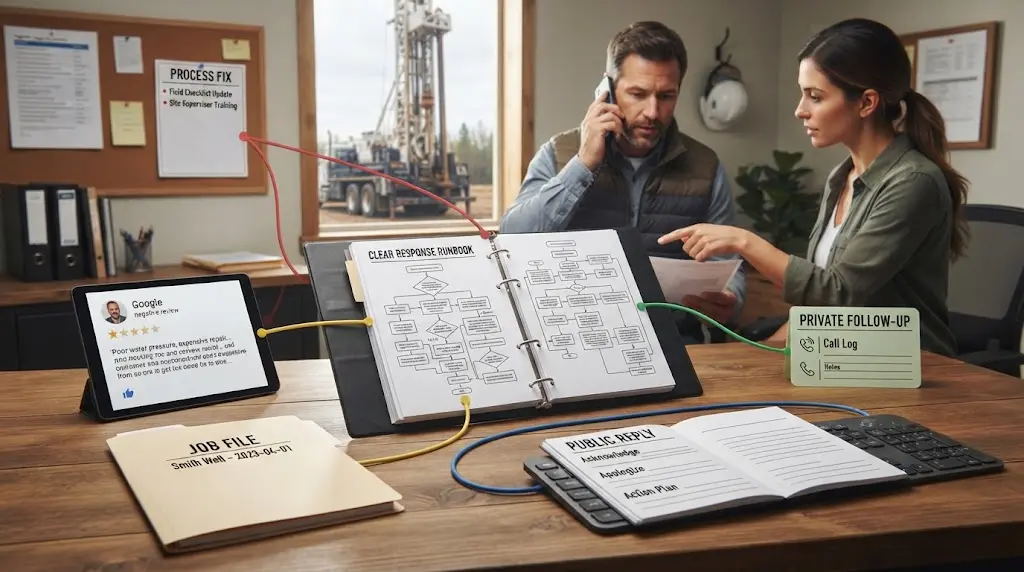
That sequence is the core of this guide. It is called the CLEAR response runbook:
| Step | What you decide | What you produce |
|---|---|---|
| Classify | Is the review real and resolvable, real and disputed, policy-violating, no-record, or sensitive? | A response path |
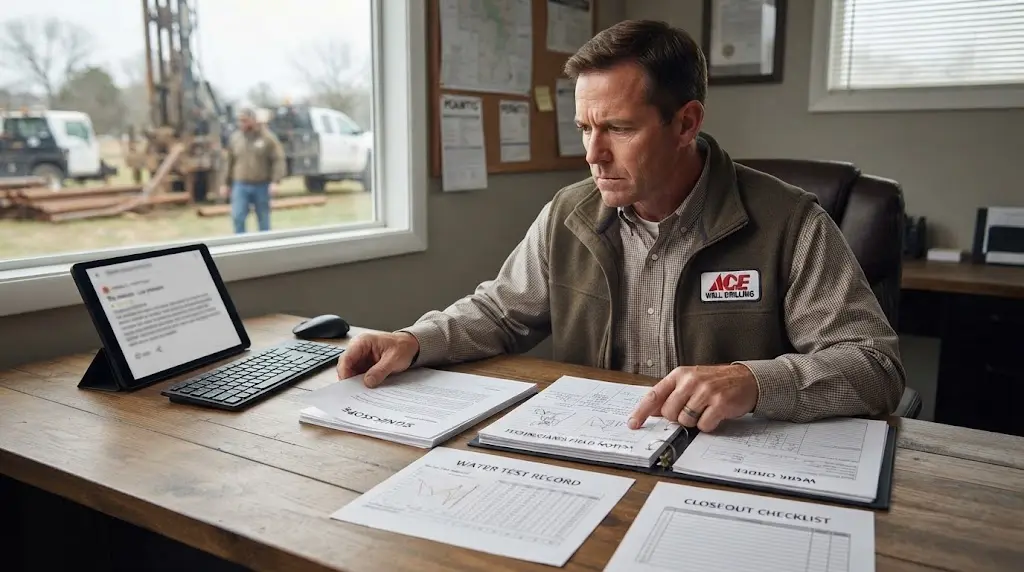
| Locate | What do the contract, estimate, work order, notes, test records, messages, and closeout status show? | Verified internal facts |
| Explain | What one public-safe fact helps a future buyer understand the situation? | A short, non-defensive reply |
| Ask | What private next step can the company support, and who owns it? | A named contact and action |
| Record | What happened, what was promised, and what process needs to change? | A closed-loop operating record |
The runbook prevents two common mistakes. The first is treating every negative review as a fight to win in public. The second is treating every complaint as a marketing message while the underlying service problem remains open.
Google's official guidance supports the basic shape. A verified business can reply to a review, and the response is public. Google advises businesses to be professional, keep the response concise, avoid private information and personal attacks, inspect their records, be honest about what they can and cannot do, apologize when needed, and respond in a timely way. Google Business Profile Help says, in five useful words, “Keep it short and simple.”
That is a good platform rule. A well contractor still needs an operating system around it.
The public reply is a trust signal; the job file is the source of truth.
How should you classify the review before writing?
Classify the review by the action it requires, not by how insulting it sounds. The same one-star rating can represent a correctable closeout failure, a contract disagreement, a false or unrelated post, or a safety allegation that should not be handled in a marketing inbox.
Use this first-pass table. It is an operating framework, not a claim that Google or any regulator uses these categories.
| Review pattern | What to verify | Public response path | Internal owner |
|---|---|---|---|
| Real complaint with a clear service failure | Work order, dates, notes, messages, closeout status | Acknowledge the specific failure, apologize if warranted, invite a direct resolution | Owner or service manager |
| Real complaint with facts in dispute | Contract, estimate, change orders, photos, test or completion records | Acknowledge the concern without litigating the facts; invite a record-based review | Owner plus operations |
| Project still active | Current scope, next milestone, promised callback, open warranty or punch list | State that the company is contacting the customer to complete the open step | Project manager |
| Scheduling or communication complaint | Dispatch log, call history, arrival window, cancellation messages | Own the communication gap and give a private contact path | Dispatcher or manager |
| Price or scope complaint | Signed estimate, exclusions, change order, invoice, approval trail | Explain that the company will review the written scope privately; do not publish prices | Owner or estimator |
| Pump repair or replacement complaint | Diagnosis, parts, function check, callback history, warranty terms | Acknowledge the service concern and offer a manager review | Service manager |
| Water quality or testing allegation | Test report, sample chain, lab, disinfection or treatment records, state requirements | Avoid public diagnosis; route to a qualified manager and relevant authority when needed | Technical lead or owner |
| No identifiable customer record | Name, service date, address, phone, invoice or job number held privately | Say the company cannot identify the job from the public information and invite contact | Owner or manager |
| Off-topic, fake, abusive, or personal-information content | Policy category and evidence | Preserve a calm public reply if useful and report through the platform when policy supports it | Profile manager |
| Threat, extortion, privacy breach, injury, or regulator allegation | All records, correspondence, insurance and legal contacts | Pause ordinary copywriting and escalate before publishing details | Owner, counsel, insurer, or regulator as appropriate |
The first question is not “How do we get this removed?” It is “What kind of event is this?”
Is the review about a real customer experience?
Check whether the reviewer appears to have experienced the company's service. Search the internal system for a name, service date, job reference, phone number, email address, property, invoice, or related correspondence. Do not post those identifiers in the response. They are for internal verification and private contact only.
If the record exists, keep looking. A reviewer can be a real customer and still describe the event inaccurately, incompletely, or from a different point in the job than the office expects. “Real customer” does not mean “every sentence is proven.” It means the company should investigate rather than dismiss the review as fake.
If no record exists, do not jump to “This is a fake review.” The reviewer may have used a different name, a family member may have posted it, the interaction may have been a phone call that never became a work order, or the company may have a recordkeeping gap. Ask for enough information to locate the matter privately.
Is the complaint still open?
An open job needs a different response from a completed dispute. If the customer is waiting for a callback, a test result, a warranty decision, a correction visit, a document, or a promised closeout item, the public reply should not pretend the matter is finished.
The company can say that it is reviewing the concern and will contact the customer through a named manager. It should not promise a repair date, refund, replacement, or outcome until the person with authority has confirmed it.
Is the review sensitive enough to escalate?
Escalate before replying when the review alleges injury, contamination, unsafe work, fraud, discrimination, retaliation, illegal conduct, privacy exposure, a regulator complaint, a threatened lawsuit, or a demand tied to removal of the review. The article is an operating guide, not legal advice. A state rule, contract, insurance policy, or live dispute may change what you should say.
What should a well contractor check in the job file?
Check the smallest set of records that can establish what happened and what remains open. The purpose is not to build a public case against the reviewer. It is to stop the response from contradicting the contract, the crew, the customer, or the company's own documentation.
Use a two-pass review. The first pass takes a few minutes and tells you whether the issue is urgent. The second pass happens with the person who owns the work.
What belongs in the first pass?
Look for these items:
- The service line and job type.
- The customer or account record.
- The agreed scope, estimate, contract, and exclusions.
- Any approved change order or written scope change.
- Arrival, delay, cancellation, and callback notes.
- Technician notes, photos, measurements, test results, and equipment details.
- Invoice, payment, warranty, and unresolved-balance status.
- Closeout items such as records, testing, disinfection, cleanup, commissioning, or handoff documents where they apply.
- Every contact after the work, including calls, voicemails, texts, and email.
- The person with authority to approve a correction, callback, credit, or explanation.
The National Ground Water Association's public contractor handout gives a useful reason to look beyond the invoice. It names written contracts, itemized charges, well logs, testing, insurance, code familiarity, reputation, and a finished-well checklist among the matters buyers may discuss when selecting and evaluating a water well contractor. NGWA's handout is written for well owners, not as a review-response rule, but its list shows why a drilling complaint can involve more than a star rating.
The EPA also advises accurate records for well maintenance and recommends using a contractor with relevant experience for inspection and testing in applicable situations. EPA guidance is not a response template, but it reinforces the operational point: technical claims should be checked against records and qualified people, not improvised in a public comment.
What should the second pass answer?
The second pass should produce five plain-language answers:
| Question | Example internal answer |
|---|---|
| What did we agree to do? | “The signed scope covered pump replacement and startup testing. A separate water-quality test was not included.” |
| What did we actually do? | “The crew replaced the pump, documented the pressure check, and noted a follow-up visit for the control box.” |
| What remains unresolved? | “The callback was requested on Tuesday and has not yet been assigned.” |
| What can we offer now? | “The service manager can review the work order with the customer and schedule the callback.” |
| What must stay private? | “The property address, invoice, test report, staff details, and contract price.” |
That final column should never become a public reply word for word. It is the internal fact set from which the public reply is written.
Never use the review reply to discover what happened. Discover it first.
What can you safely say in public?
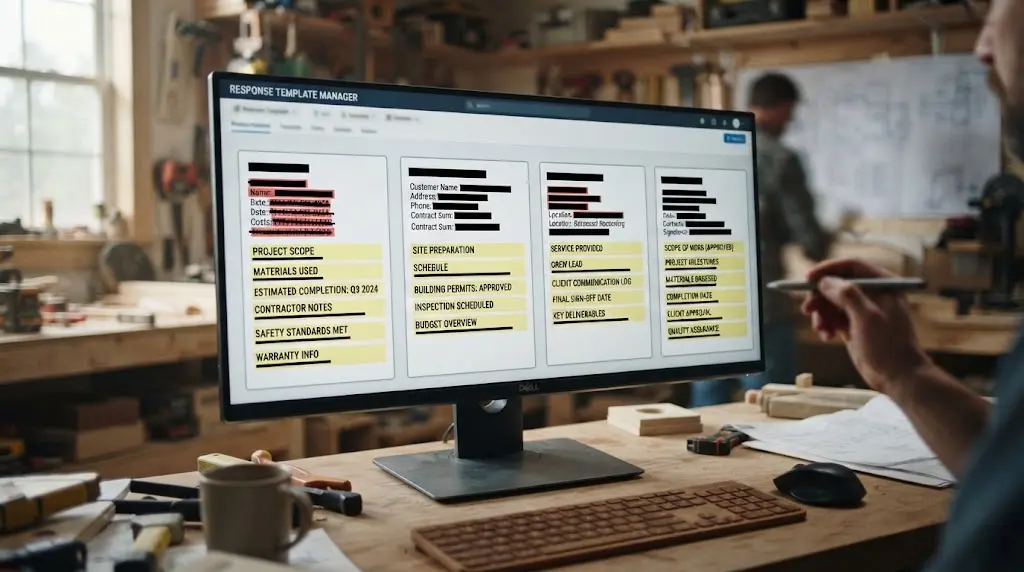
Say enough to show that the company understands the issue and has a real next step. Do not publish enough to expose the customer's identity, reveal private job facts, or turn a technical dispute into a permanent public argument.
Use the public-safe fact test. Before including a sentence, ask:
- Is it necessary for a future customer to understand our response?
- Is it true according to the records we checked?
- Would we be comfortable saying it if the customer, employee, regulator, insurer, or judge read it?
- Does it avoid private information and personal attack?
- Does it avoid diagnosing a technical or health issue in public?
- Does it avoid promising an outcome that has not been approved?
If the answer to any question is no, remove the sentence or move it to a private conversation.
What belongs in the public layer?
The public layer usually needs four things:
- Recognition of the concern.
- A specific but bounded fact, such as the service type or the fact that the company is reviewing the open job.
- Responsibility for the part the company can own, if the records support it.
- One private next step with a named role or contact path.
For example:
We’re sorry the pump service did not leave you confident in the result. We’re reviewing the work order and callback history now. Please contact our service manager through the number on our profile and reference the service date so we can inspect the details with you.
What belongs in the private layer?
Move these details to a direct call, email, secure customer portal, or other appropriate channel:
- Property address, access instructions, or location details.
- Phone number, email address, invoice, account number, or payment information.
- Contract price, change-order amount, credit, refund, or collection status.
- Water-quality result, health information, lab report, or treatment recommendation.
- Employee name and performance details when not necessary for a public answer.
- Photos that reveal the property, equipment layout, family members, license plates, or private documents.
- Detailed claims about causation, code compliance, negligence, warranty coverage, or who is legally responsible.
Google's review guidance specifically warns businesses not to share the reviewer's private information or attack them personally. The FTC's Consumer Review Fairness Act guidance also recognizes that some content can be prohibited or removed when it contains confidential or private information, is abusive or unrelated, or is clearly false or misleading. That does not mean a contractor should decide every disputed opinion is removable. It means the public response needs discipline.
Should you mention the contract?
You can say that the company will review the written scope or contract with the customer. Avoid posting the contract language, price, exclusions, or a line-by-line rebuttal. A public answer such as “You signed a contract that says...” may be factually correct and still make the company look eager to win an argument instead of solve the customer's concern.
If the contract clearly controls the issue, the customer can receive that explanation privately from the owner or manager. The public reply can remain short:
We understand your concern about the additional work. We’ll review the written scope and the approved change with you directly so we can explain what was included and what changed.
How should you write the actual response?
Write the response for two readers: the reviewer who wants to be heard and the next customer who is deciding whether your company handles problems professionally. Use four moves in order: recognize, clarify, route, and close.
What are the four moves?
Recognize. Name the concern without repeating inflammatory language. “We’re sorry the scheduled callback did not happen” is stronger than “We’re sorry you feel that way.”
Clarify. Add one verified, public-safe fact. “We’re reviewing the pump work order and follow-up notes” is enough. Do not write your entire timeline.
Route. Give one private next step. Identify the role that will handle it, the channel the customer can use, and any non-sensitive reference they should provide, such as a service date.
Close. End with a calm statement of intent. “We want to understand what remains unresolved and address it through the proper process” works. Do not ask the reviewer to delete the review, change the rating, or accept a private offer in exchange for changing it.
What are safe response templates?
These are structures, not scripts to paste without checking the job. Replace every bracketed field with verified information, and remove any sentence that does not fit the facts.
Template for a real service failure
We’re sorry that [specific service or follow-up failure] happened. We’ve reviewed the matter and [brief public-safe action the company is taking]. Please contact [role or manager] through [approved contact path] with the [service date or job reference] so we can address the remaining issue directly.
Use this when the company can identify a failure and has authority to act. If the repair, callback, or correction is not yet approved, say “we’re reviewing” rather than “we will fix.”
Template for a delayed callback or scheduling complaint
We’re sorry we did not communicate clearly about [appointment or callback]. That is not the experience we want to provide. Our [dispatcher or service manager] is reviewing the schedule and will contact you through the information we have on file. We appreciate the opportunity to address the missed step directly.
Do not publish the customer's address or the crew's private schedule. Do not blame weather, traffic, a supplier, or another employee unless the detail is necessary and the company has decided it is appropriate to disclose.
Template for a price or scope dispute
We understand your concern about the final scope and cost. We’ll review the written estimate, any approved changes, and the work completed with you directly so we can explain the record clearly. Please ask for [owner or manager] through [approved contact path] and reference the service date.
This avoids a public invoice fight. If the company made an estimating mistake, the owner can acknowledge that privately and decide the remedy before changing the public response.
Template for a disputed technical complaint
We’re sorry the result did not meet your expectations. We’re reviewing the service notes and relevant test or completion records before commenting on the technical details. Please contact [qualified role or manager] through [approved contact path] so we can understand the issue and determine the appropriate next step.
Use this for claims about well yield, pressure, water quality, pump performance, contamination, disinfection, or other matters where a public guess could mislead the reviewer or future customers.
Template for a review you cannot identify
We take service concerns seriously, but we cannot identify the job from the information in this review. Please contact [owner or manager] through [approved contact path] with the service date or another private job reference so we can investigate. We do not want to discuss personal or job details in this public forum.
Do not write “We have no record of you” unless the company has checked carefully and is prepared for the statement to be read as an accusation. “We cannot identify the job from the public information” is precise and less inflammatory.
Template for a review that violates policy
We’re sorry to see this concern. We cannot discuss private customer or job details here, but our team is available through [approved contact path] to review a genuine service issue. We have also reported content that appears to violate the platform’s review policy.
Only include the last sentence if the company has actually reported the review and has a policy basis. Do not claim that Google will remove it.
A good reply gives the public a process, not a performance.
How should drilling and pump complaints be handled differently?
Match the response to the service line and the job's completion point. A response that fits a missed pump callback may be wrong for a new drilled well, where scope, testing, records, cleanup, and handoff can determine whether the project is actually complete.
What should you do with a new well drilling complaint?
Start with the agreed scope and the project status. Check the drilling depth, casing or materials described in the contract, any approved changes, test-pumping or yield records, disinfection or completion notes where applicable, well construction records, cleanup status, and the customer's outstanding questions.
Do not publish well depth, yield, property details, or test results unless the customer has clearly authorized the disclosure and the company has a strong reason to do so. Even then, a public review reply is usually the wrong place for a technical report.
The public response can acknowledge a project milestone or gap without turning the reply into an engineering memo:
We’re sorry the closeout process left you with unanswered questions. We’re reviewing the project records and will have our project manager contact you to go through the remaining items directly.
If the review alleges the well failed to produce a promised supply, check what the company actually promised. A contractor may have promised a drilling process, a test procedure, or a target under stated conditions, while the customer may read that as a guaranteed water outcome. The response should not silently accept or reject the technical claim. Route it to the person who can explain the scope and records.
What should you do with a pump repair complaint?
Check the diagnosis, the equipment installed or serviced, the function check, pressure or control observations, the callback history, parts or supplier issues, and the warranty terms. Then decide whether the complaint is about the original repair, a different system fault, a delayed callback, or an expectation the estimate did not set.
The response can be direct because the next step is often easier to identify:
We’re sorry the pump service did not leave you with reliable operation. Our service manager is reviewing the work order and callback notes. Please contact us through the number on our profile with the service date so we can arrange the appropriate review.
Do not diagnose the system from a review. Do not tell the customer to keep operating equipment that may be unsafe. If the allegation involves an electrical hazard, flooding, contamination, or immediate risk, escalate it before publishing.
What should you do with a pressure or performance complaint?
Separate the symptom from the cause. “Low pressure” could relate to a pump, pressure switch, tank, piping, power, source, leak, treatment equipment, or another part of the system. A public reply should acknowledge the reported symptom and route the matter to a qualified person. It should not announce a diagnosis based on the text of a review.
What should you do with a water quality or testing complaint?
Treat it as technically and potentially health sensitive. Check the test report, sample date, laboratory status, chain of custody where relevant, disinfection or treatment records, and the scope of the company's work. Do not publish the customer's result or give health advice in a review reply. Direct the person to the appropriate qualified contact and, where the circumstances require, the relevant state or local authority.
The EPA's private-well guidance explains that private-well owners are responsible for safe drinking water and recommends testing in several circumstances, including after certain repairs or changes. That guidance is directed to households, but it is a reminder that water-quality allegations should not be handled as ordinary copywriting.
What should you do with a rehabilitation or treatment complaint?
Check the baseline condition, stated objective, treatment or rehabilitation method, monitoring period, test or inspection records, and what the company said the work could and could not achieve. If the outcome depends on groundwater conditions, equipment condition, or a follow-up period, the public response can state that the company is reviewing the project records without making a new guarantee.
What should you do with a scheduling or no-show complaint?
This is often the easiest category to own clearly. Check the dispatch record, arrival window, cancellation notice, crew status, and callback attempts. If the company failed to communicate, say so plainly. A customer does not need a paragraph about the office's internal chaos.
We’re sorry we did not communicate the schedule change clearly. We’re reviewing the missed update and would like our service manager to contact you directly to close the loop.
The operational fix may be a dispatch status rule, a same-day cancellation message, an after-hours voicemail process, or an owner review of open callbacks. The review is useful when it changes that system.
What should you do with a price or change-order complaint?
Check the original estimate, exclusions, approved changes, labor and materials records, and invoice. A public review reply should not reveal the price or say the customer “refused to pay.” Explain that the company will review the written scope privately and assign someone with authority to do it.
If the company routinely receives price complaints, the issue may be an estimating or change-order problem rather than a review problem. Update the sales and field handoff so the customer knows what is included, what can change, who approves it, and what happens when site conditions differ.
When should you reply, flag the review, or escalate it?
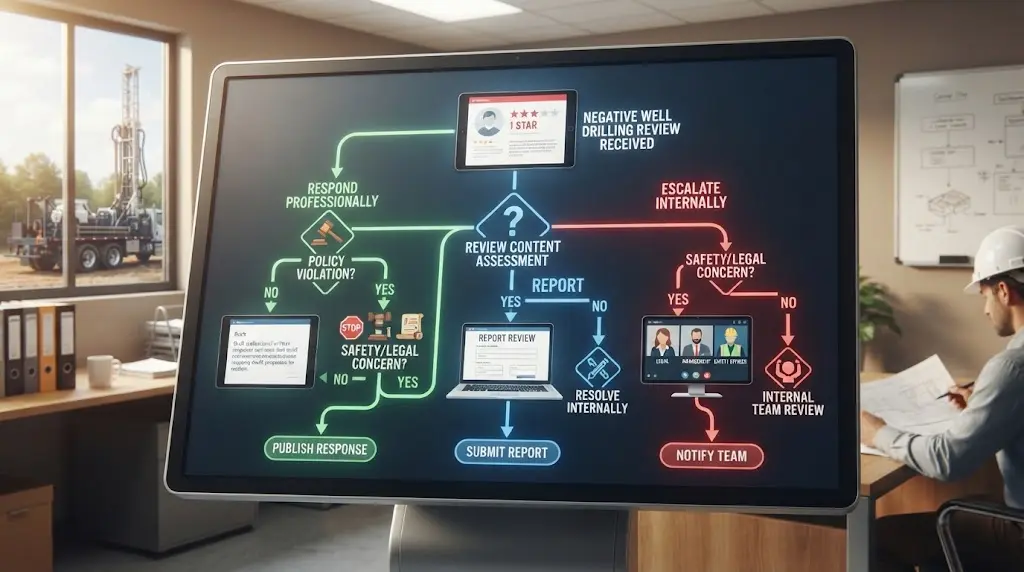
Reply when the company can add a calm, relevant, public-safe response. Flag when the content appears to violate the platform's policy. Escalate before replying when the issue involves safety, privacy, legal rights, regulators, insurance, or a live dispute. These paths can overlap.
| Situation | Reply? | Flag? | Escalate first? | Why |
|---|---|---|---|---|
| Genuine complaint with a known service failure | Yes | No | Usually no | The company can acknowledge and route the issue. |
| Genuine but disputed facts | Yes, carefully | No | Sometimes | Explain the review process, not the whole case. |
| Off-topic or clearly unrelated post | Optional short reply | Yes | No | Report based on policy, not dislike. |
| Profanity, threats, personal attack, or private data | Usually short or delayed | Yes | If threat or privacy risk | Preserve evidence and avoid repeating the content. |
| No record found | Yes, neutral reply | Only if policy basis exists | No, unless broader risk | Ask for private identifiers without accusing the reviewer. |
| Safety, contamination, injury, or regulator allegation | Delay ordinary reply | Maybe | Yes | A technical or legal response may be required. |
| Demand for money in exchange for removing a review | Preserve evidence | Report through the platform if appropriate | Owner and counsel as needed | The conduct may be more than an ordinary complaint. |
| Review from an employee, vendor, competitor, or related party | Follow platform policy | Maybe | If material or coordinated | Conflict and fake-engagement rules may apply. |
What counts as a reason to flag a review?
Google says only reviews that violate its policies are eligible for removal. Its review-removal guidance says not to report a review merely because the business disagrees with it or dislikes it. The Google Maps user-generated content policy identifies examples of prohibited content such as deliberately fake content, off-topic reviews, defamatory language, personal attacks, and certain unnecessary or incorrect content.
Use the platform's own categories and preserve a short internal note describing the evidence. Do not write a public reply that says “Google is removing this” unless the platform has actually confirmed that outcome.
The practical sequence is:
- Screenshot or export the review and note the date.
- Identify the policy category that appears to apply.
- Report it through the Business Profile or the platform's review-management tool.
- Check the status and appeal only when the platform makes that option available.
- Keep a neutral public response path in case the review remains live.
Google's current guidance says a flagged review is evaluated, that review of a report typically takes several days, and that an appeal may be available if no violation is found. Platform flows change, so check the linked Google instructions when acting.
What does the FTC say about negative reviews?
The FTC's Consumer Review Fairness Act protects honest consumer opinions about a company's products, services, or conduct, including customer service. It prohibits contract terms that bar or penalize people for posting honest reviews. The FTC's business guidance says companies may address content that includes confidential information, is abusive or unrelated, or is clearly false or misleading, but an opinion the company dislikes will not usually meet that standard.
The FTC's review-rule Q&A also addresses fake or false reviews, sentiment-conditioned incentives, insider reviews, and review suppression. The FTC says contacting a customer to resolve an issue is not prohibited. It also warns that paying someone to change or remove a truthful negative review may create risk under the FTC Act. Google's guidance on incentivized or biased reviews separately warns against benefits that influence review content.
That leads to a straightforward operating rule: solve the complaint on its merits, do not threaten the reviewer, do not buy a rating, and do not make a remedy conditional on deleting or changing the review.
Removal is a policy decision; resolution is an operating decision.
What should you do when the review is false, hostile, or from no customer record?
Stay factual and avoid public accusations. A review that feels unfair can still be based on a real call, a different name, a family member's account, or a misunderstanding of the service. Your first public job is to show that the company is available to investigate without exposing the case.
What if the review is clearly about another company?
If the name, service, location, or facts show that the review is unrelated, save the evidence and report it under the applicable platform policy. You may reply with a short neutral line:
We cannot identify this service experience with our company from the information shown. Please contact our manager through the information on our profile if you believe this review concerns us. We have reported the review for platform review.
Do not name the other company. Do not publish your search for the reviewer. Do not ask the public to investigate.
What if the reviewer demands money to remove the review?
Preserve the messages, timestamps, profile details, and review URL. Do not negotiate publicly. Escalate to the owner, counsel, insurer, platform support, or law enforcement when appropriate to the facts. The FTC's rule and Google policies address different pieces of review conduct, so do not make a legal conclusion in the reply.
If a public response is needed, keep it narrow:
We want to address genuine service concerns through the appropriate channel. We cannot discuss private communications here. Our team has reported the matter through the platform's process and is available to review a legitimate service issue.
Use this only after the owner has approved it. Publicly repeating an extortion allegation can create a second dispute.
What if the review contains private information?
Do not quote or repeat the private information in your reply. Capture what you need for the platform report, notify the person responsible for privacy or operations, and ask the reviewer to contact the company privately if a correction is needed. If the information creates a security or safety risk, treat it as an incident rather than ordinary reputation work.
What if the review is hostile but accurate?
Tone does not erase the underlying issue. Separate the unacceptable wording from the service facts. If the review contains a real complaint plus a personal attack, reply to the service concern without repeating the attack and flag only the policy-violating part if the platform permits that action.
How should the owner handle safety, quality, and regulatory allegations?
Treat them as operational incidents first and review responses second. A public reply should not become a technical opinion, legal admission, health instruction, or regulator argument.
Use this escalation matrix:
| Allegation | Immediate internal question | Who should review before a public reply? | Public boundary |
|---|---|---|---|
| Electrical or physical safety | Is anyone at immediate risk and is equipment still in service? | Owner and qualified technical lead; emergency services or authorities when appropriate | Do not give operating instructions or publish site details. |
| Water contamination or illness | What was tested, when, by whom, and under what scope? | Technical lead and relevant authority or counsel | Do not diagnose or publish test results. |
| Code or licensing violation | What jurisdiction and requirement are being alleged? | Owner, licensed professional, counsel, or state authority as appropriate | Do not argue compliance from memory. |
| Injury or property damage | What happened and what notifications or insurance steps apply? | Owner, insurer, and counsel as appropriate | Do not assign blame or discuss settlement. |
| Fraud or intentional deception | What records support the allegation? | Owner and counsel | Do not call the customer a liar or criminal. |
| Discrimination or harassment | What conduct is alleged and what records exist? | Owner and counsel or HR adviser | Do not disclose personal details or debate protected characteristics. |
| Privacy or security exposure | What data was published or exposed? | Owner, privacy lead, and technical support as needed | Do not repeat the exposed information. |
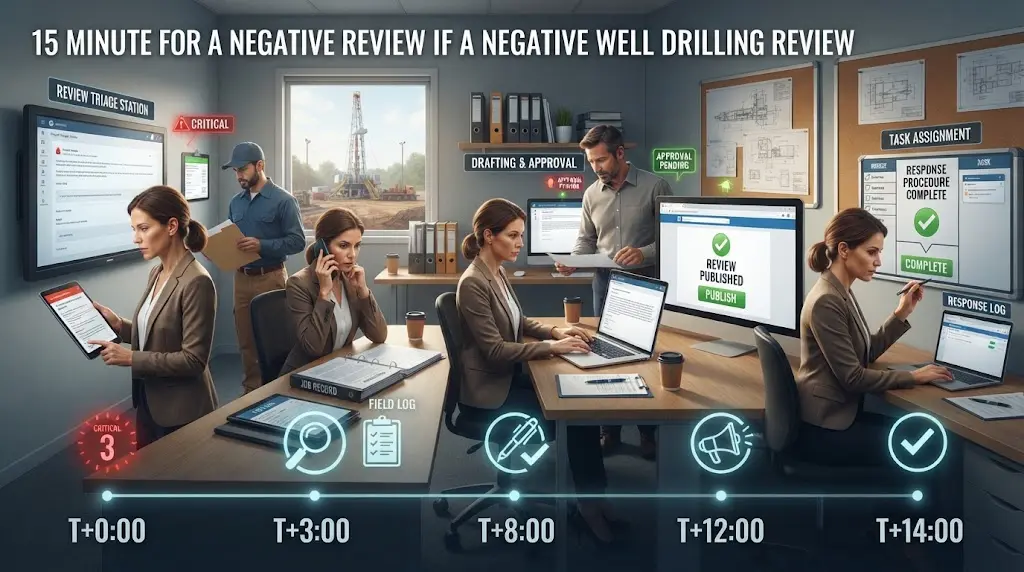
How can an owner publish a response in 15 minutes?
Use a short internal procedure with a hard stop for escalation. The objective is not to resolve every dispute in fifteen minutes. It is to make a safe first decision, publish a bounded reply when appropriate, and assign the real follow-up.
What should happen in minutes 0 to 3?
- Save the review URL, date, rating, text, reviewer name, and any attached media.
- Do not answer from the phone notification or while the crew is still arguing about the job.
- Mark the review as new in the internal log.
- Identify whether the text includes safety, privacy, legal, regulator, or extortion language.
If it does, stop the ordinary procedure and escalate. If it does not, continue.
What should happen in minutes 3 to 8?
- Search the job system by name, phone, email, service date, job address, invoice, and project reference.
- Confirm the service line and whether the work is open, complete, under warranty, or disputed.
- Read the estimate, contract, change order, notes, and communication trail that relate to the complaint.
- Ask the responsible manager for one sentence describing what is known and one sentence describing what is still unknown.
The “known” sentence might be “The callback was promised but no visit was scheduled.” The “unknown” sentence might be “We have not yet confirmed whether the reported pressure issue is related to the replacement pump.” Those sentences keep the public draft honest.
What should happen in minutes 8 to 12?
- Choose the review category and response template.
- Draft the four moves: recognize, clarify, route, close.
- Delete addresses, phone numbers, prices, test results, employee details, and unsupported conclusions.
- Verify the private contact path. It must reach a person who can actually see the job and act on it.
Read the reply once as the reviewer and once as a future customer. If it sounds like an argument, shorten it. If it sounds like a brush-off, add the real next step.
What should happen in minutes 12 to 15?
- Publish the reply if no escalation hold applies.
- Report the review only if there is a platform-policy basis.
- Assign the private follow-up with a due time.
- Record the disposition, owner, and next operational action.
If the company cannot produce a safe reply in fifteen minutes, that is a signal to escalate or ask the owner to approve the response. Speed is useful. It is not more important than accuracy.
Who should own the response inside a well company?
Assign one accountable owner, even if several people provide facts. A review process fails when the dispatcher assumes the service manager will answer, the service manager assumes the owner saw the notification, and the owner discovers the review after a second complaint.
| Company role | Should provide | Should not do alone |
|---|---|---|
| Profile manager | Monitor, save, classify, draft, report policy issues | Approve technical conclusions or legal responses without the owner |
| Dispatcher | Scheduling timeline, arrival windows, callback history | Debate workmanship publicly |
| Technician or field lead | Work performed, equipment, notes, test observations | Publish private job details or diagnose from a review alone |
| Estimator or project manager | Scope, change orders, closeout, customer expectations | Promise a refund or correction without authority |
| Service manager | Repair history, warranty, next visit, remedy options | Hide an open issue behind a generic apology |
| Owner or general manager | Final accountability, sensitive escalation, policy, remedy authority | Delegate every response without reviewing patterns |
For a small company, one person may wear every hat. The role table still helps because it separates fact gathering from public publishing.
What mistakes make a negative review worse?
Most bad responses fail by adding heat, detail, or promises. They rarely fail because the owner lacked a clever phrase.
What should you stop doing immediately?
- Do not argue line by line. A detailed rebuttal makes the public profile look like a courtroom and gives the dispute more searchable language.
- Do not publish private proof. An invoice, address, phone number, water test, employee detail, or job photo can create a second problem.
- Do not call the reviewer a liar. If the review is false, use the platform's reporting process and a neutral reply.
- Do not request a five-star edit. The FTC and Google both address practices that distort or condition review sentiment.
- Do not offer a remedy in exchange for removal. Solve the issue without tying the remedy to a changed review.
- Do not blame another employee or subcontractor. Customers experience the company as one operation.
- Do not promise a date you have not confirmed. A second missed promise will deepen the complaint.
- Do not use the same canned reply for every review. Google says responses should be helpful and relevant. A copied sentence can signal that no one read the complaint.
- Do not delete your own response every time the customer replies. Edit when a factual correction is needed, but keep an internal record of the exchange.
- Do not ask staff to bury the review with a sudden burst of incentivized praise. Google identifies incentives and bias as review-integrity concerns, and the FTC addresses sentiment-conditioned incentives and suppression.
When should you not respond immediately?
Pause when:
- The review alleges immediate danger or contamination.
- The company has received a demand, legal notice, regulator contact, or insurance notice.
- The account contains a privacy or security exposure.
- The public reply would need a technical diagnosis.
- The owner has not confirmed who has authority to offer a remedy.
- The customer is actively communicating through a private channel and a public reply could disclose the dispute.
Pause does not mean ignore. Assign an owner, preserve the evidence, and decide when the company will provide the next update.
A fast reply is valuable only when the facts and the next step are ready.
How should the company turn one review into a process fix?
Close the loop after the public reply. The best outcome is not always a changed star rating. It is a corrected customer issue, a clearer expectation, or a process that prevents the next complaint.
Use a root-cause record with five fields:
| Field | Question | Example |
|---|---|---|
| Trigger | What did the customer say went wrong? | “No one explained why the return visit was delayed.” |
| Evidence | What do the records show? | “Supplier delay was noted, but no customer update was logged.” |
| Gap | Where did the process break? | “No owner for same-day delay notifications.” |
| Fix | What changes next time? | “Dispatch sends an approved update when a delay exceeds the promised window.” |
| Check | How will the owner know it changed? | “Review open callbacks and delay notices weekly.” |
What repeat patterns matter?
One complaint can be a one-off. Three similar complaints in a quarter may reveal a system. Do not invent a benchmark or assume a fixed threshold applies to every company. Use a simple pattern review by service line:
- New drilling expectations and closeout.
- Pump diagnosis, function checks, and callbacks.
- Schedule changes and arrival windows.
- Estimates, exclusions, and change orders.
- Testing, records, disinfection, and handoff.
- Warranty boundaries and return visits.
- Call answer, voicemail, and after-hours routing.
If the same complaint appears across different crews, the issue is likely a process or training gap. If it appears only on one type of job, inspect that service's estimate, handoff, and closeout. If it appears only after missed calls, the reputation issue may start before the job is sold.
Should you ask the customer to update the review?
You can contact the customer to resolve the underlying issue. Do not make a remedy conditional on changing or removing a truthful review. If the customer independently chooses to update the review after the matter is resolved, that is their decision.
The FTC's review guidance distinguishes between resolving an issue and paying for a review change. Google also permits customers to edit their review after reading a business reply. The contractor's job is to make the resolution real, not to script the customer's conclusion.
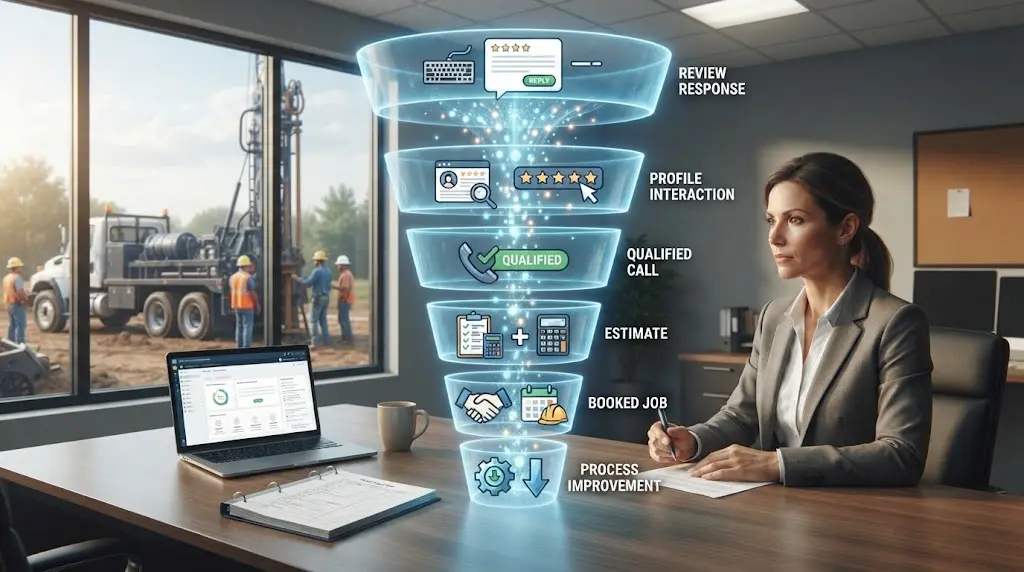
How do negative reviews affect qualified calls and booked jobs?
Measure review handling as part of the call and booking path, not as a star-rating project. A response may help a future customer understand the company, but no responsible operator should promise that one reply will improve rankings, produce a call, or change a review.
Use the same disposition model you use for other local demand:
| Stage | What to record | Why it matters |
|---|---|---|
| Review event | Platform, rating, service line, date, response status | Shows volume and response coverage |
| Profile action | Views or interactions when available, review URL, reported status | Separates platform handling from customer outcome |
| Contact | Call, form, message, or direct inquiry source | Ties the profile to a real lead |
| Qualification | Service requested, territory fit, urgency, budget or scope fit, capacity | Distinguishes a useful call from noise |
| Estimate | Estimate requested, issued, accepted, or declined | Shows commercial progress |
| Booked job | Scheduled and completed status | Connects visibility to work |
| Review-related learning | Complaint category and process fix | Shows whether the operation improved |
For measurement architecture, Brictale's existing guides on measuring Google Maps leads for well contractors and the Google Maps visibility scorecard for well contractors provide the surrounding framework. This article adds the reputation-response layer.
What should you compare?
Compare periods and service lines carefully. Look at:
- Qualified call rate before and after a response process is introduced.
- Answered versus missed calls from the profile.
- Estimate rate by service line.
- Booked-job rate by qualified inquiry.
- Complaints about the same process before and after a fix.
- Time from review publication to owner-approved reply.
- Time from review to private follow-up.
- Number of reviews flagged, removed, or left live.
Do not claim causation from a simple before-and-after change. Seasonality, weather, crew capacity, competitors, advertising, local demand, and job mix can all move the numbers. The point of measurement is to tell the owner where the bottleneck is, not to prove that a reply caused every later booking.
What if the company has a strong rating but weak calls?
Do not assume reviews are the main problem. Check profile accuracy, service coverage, distance, phone answer, website conversion, service-page clarity, and call qualification. Google's local guidance says local results are mainly based on relevance, distance, and prominence, and that reviews and helpful replies are only part of the local picture.
What if calls are strong but booked jobs are weak?
The review response process may be working while sales or operations are not. Inspect territory fit, response time, estimate follow-up, pricing clarity, capacity, and the handoff from office to crew. A good public profile cannot compensate for a company that cannot accept or complete the work it attracts.
How should you build a standing negative-review policy?
Write a one-page policy before the next difficult review arrives. The policy should make ownership and boundaries clear without trying to script every possible complaint.
Include:
- Who monitors the profile and how often.
- Where new reviews are logged.
- Which categories require owner approval.
- Which records the responder checks before drafting.
- What information must never be posted publicly.
- Which platform policy pages the company uses when reporting content.
- Who owns private follow-up by service line.
- How remedies, warranty decisions, and credits are approved.
- How the company handles safety, privacy, legal, and regulator-sensitive allegations.
- How a completed response is measured and reviewed.
- How repeated complaints become a process or training action.
What should the response log look like?
Keep it practical. Suggested fields:
| Field | Example value |
|---|---|
| Review URL | Stored internally, not pasted into a public reply |
| Published date | Date shown on platform |
| Service line | Drilling, pump repair, testing, rehabilitation, scheduling, other |
| Customer record | Match found, uncertain, or no match |
| Complaint status | Open, complete, disputed, sensitive |
| Policy report | No, pending, removed, appeal, not applicable |
| Public response owner | Person responsible for approval and publishing |
| Private follow-up owner | Person who can see the job and act |
| Next action date | Date and time for the customer contact |
| Disposition | Resolved, explanation given, correction scheduled, no response, escalated |
| Process fix | Dispatch, estimate, closeout, training, documentation, other |
The log is not a place to store unnecessary customer health or private information. Keep access limited and follow the company's retention and privacy practices.
Negative-review handling belongs inside the broader local growth system. If the profile is visible but the phone path fails, the company has a conversion problem. If the company has good service proof but weak local visibility, the problem may be profile completeness, service relevance, territory, website coverage, or the way the market finds the business. If the company receives calls but cannot classify or follow up on them, the issue is operational.
Brictale's free territory audit can examine the public gap around your company: competitor visibility, review patterns, profile information, service coverage, website conversion points, and the path from searcher to qualified call. It should not replace an owner review of the job file or legal advice for a live dispute. It can show where the public market sees friction and which next decision deserves attention.
The practical verdict is simple. Read the review. Check the record. Keep private facts private. Reply like a professional who expects future customers to read it. Then fix the process that made the complaint possible.