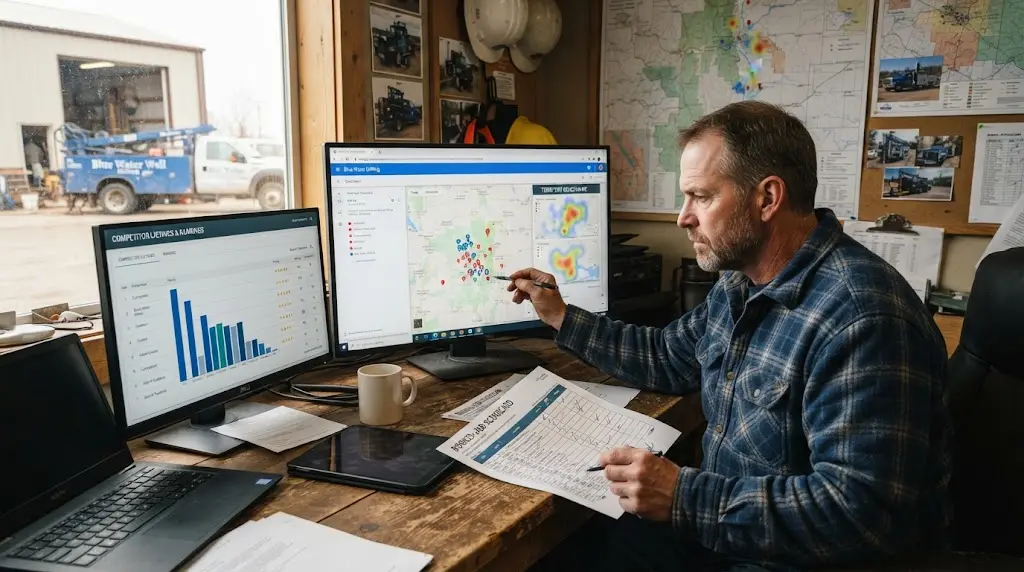
Google Maps can create attention without creating acceptable work. A well contractor needs a measurement system that shows where the profile was seen, what actions followed, and which inquiries became estimates and booked jobs.
That system has to respect the way local search works. Visibility changes with the searcher’s location, the service wording, the profile category, the company’s real territory, and the strength of nearby competitors. A profile can look excellent in one town and nearly disappear in the next.
That makes a national target such as “get 100 reviews” a poor lead-measurement tool. It may be useful context, but it cannot tell you whether your company appears for pump replacement in the towns you actually serve, whether the profile produces qualified calls, or whether your team can turn those calls into booked work.
This article gives you a repeatable measurement method: a fixed territory scan, a 100-point scorecard, and a decision process that connects Google Maps visibility to estimates and jobs.

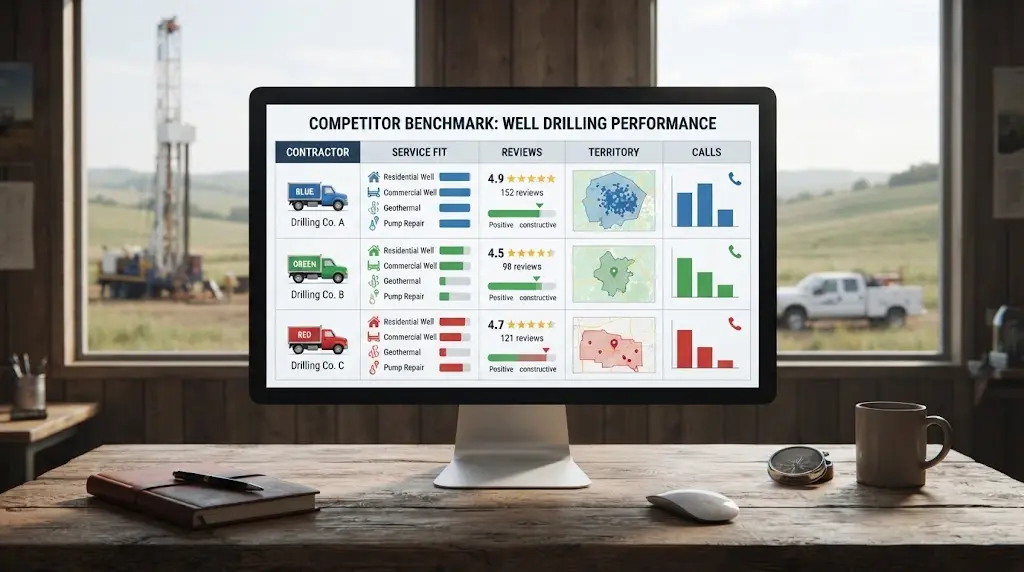
What should Google Maps lead measurement include for a well contractor?
A useful lead-measurement system measures five separate layers: relevance, territory, prominence, action capture, and measurement integrity. It should tell you both how visible the profile is and whether that visibility can create work your company wants.
Google describes local results as mainly based on relevance, distance, and prominence. Its guidance also says that complete business information, review replies, and photos can help a business stand out, while links and reviews can contribute to prominence. Google’s local-ranking guidance does not publish a weighting formula or a universal score.
The framework in this article is not a ranking prediction. It is an operating scorecard for deciding what to repair, what to monitor, and whether a territory is ready for more marketing investment.
The five layers answer different owner questions:
| Layer | Owner question | Evidence to collect | What a weak result usually means |
|---|---|---|---|
| Relevance | Does Google and the buyer understand exactly what we do? | Category, services, business name, description, website service pages | The profile is too broad, mismatched, or incomplete |
| Territory | Do we appear where our crew can actually work? | Nine-point search grid, address or service area, drive-time fit | The company is invisible outside its base or promising places it cannot serve |
| Prominence | Do we have enough public proof beside direct competitors? | Reviews, ratings, review recency, replies, links, photos, corroborating business details | Buyers see a thin or less credible profile |
| Action capture | Does visibility create a useful next step? | Calls, website clicks, directions, contact paths, qualified call rate | The profile gets attention but not usable opportunities |
| Measurement integrity | Can we trace an opportunity to a booked job? | Source, call status, estimate, booking, completion, revenue or margin record | The owner is making budget decisions from impressions or anecdotes |
The separation matters. A profile can score well on relevance and poorly on action capture if calls go to voicemail. It can score well on reviews and poorly on territory if the verified location is far from the searcher. It can generate calls and still be a bad channel if the calls are outside the company’s service mix.
Google Maps lead measurement is useful only when it connects visibility to the business outcome that visibility is supposed to create.
The benchmark has two outputs, not one:
- A profile and territory score from 0 to 100.
- A market position record from a fixed search grid, showing where the company appears and which competitors appear instead.
Keep both. The score makes internal work easier to prioritize. The grid keeps the score honest.
Why isn’t there a universal review-count or ranking benchmark?
There is no defensible national review count that guarantees a well drilling company a top Google Maps position. Distance changes the result, and Google does not publish enough algorithm detail to turn a review count into a reliable rank forecast.
Google’s own local-search explanation is blunt. Google Maps Product Manager Jeremy Sussman wrote that “three of the primary signals are relevance, prominence and distance.” The official Google Maps post is older, but Google’s current local-ranking guidance still describes relevance, distance, and prominence as the main concepts.
That has four practical consequences for a well contractor.
Distance changes the comparison set
A pump company located near the searcher may have a distance advantage over a larger regional contractor. A company can be strong in its home town and weaker at the edge of its claimed market. That is not necessarily a profile failure. It may be a normal result of local proximity.
The benchmark should therefore use search points that reflect the territory, not one search made from the shop address. If the company serves a rural area, include the communities that produce acceptable work and the corridors crews already travel.
Relevance changes with the service phrase
“Well drilling contractor,” “well pump repair,” “pump replacement,” “pressure tank repair,” and “water well inspection” can produce different competitors. A company known for drilling may not be the best visible result for an emergency pump query. A pump specialist may appear for repair but not for new well construction.
Benchmark the service lines that matter commercially. Do not average ten unrelated searches into a flattering score.
Prominence is more than stars
Review count and rating are visible, but they are not the whole proof set. Google says it may use information from the company, public web content, licensed data, users, reviews, photos, and interactions with a local place. Its profile-source documentation makes the important point: the profile is part of a wider information system.
That is why your comparison sheet should record business name consistency, phone and address consistency, service coverage, website quality, customer photos, review replies, and relevant third-party corroboration. Do not treat one high review count as the complete benchmark.
Visibility is not revenue
Google’s Business Profile performance report can show searches, views, calls, website clicks, directions, messages, and bookings where the feature applies. Google’s performance documentation gives you the profile-side action data.
It does not tell you whether a call was for a service you accept, whether someone answered, whether an estimate was sent, whether the job was booked, or whether the job was profitable. Those statuses live in your phone system, CRM, dispatch records, or job-management workflow.
The result is a simple rule: use Google data to benchmark attention, and use your own job records to benchmark value.
How should you run a fair territory scan?
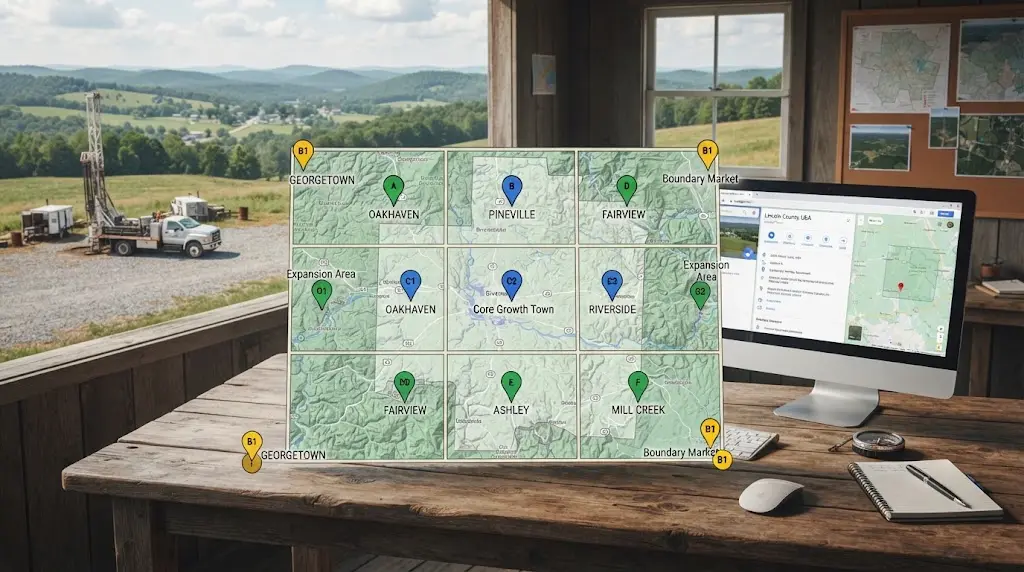
Run the scan from nine fixed points, using the same service phrases and the same device or browser conditions each time. Record the date, search location, query, visible competitors, position, profile fields, and available actions.
The scan is the part that turns “we rank in Maps” from an opinion into evidence.
Choose the territory before opening Maps
Start with the company’s actual operating area. Divide it into three groups:
- Core towns: places where crews work frequently and travel is straightforward.
- Growth towns: places the company wants more of, provided the work is commercially and operationally suitable.
- Boundary towns: places near the edge of the serviceable area where travel time, permitting, crew availability, or job size changes the decision.
Choose three points from each group. That gives you nine locations. For a tightly concentrated company, the points may be neighborhoods or nearby communities. For a regional contractor, they may be town centers or postal codes.
Do not choose only the locations where you expect to win. A benchmark must expose weak areas.
Use service phrases tied to the job mix
Choose two to four phrases. A practical set might include:
- water well drilling
- well drilling contractor
- well pump repair
- well pump replacement
Use only phrases that match current services and crew capacity. If the company does not offer pump work, do not include pump repair to create more data. If the company wants agricultural or commercial drilling, include that phrase only if it is a real target.
Keep collection conditions stable
Google Maps results can vary with location, personalization, and time. The scan is not a scientific measurement of Google’s complete ranking system. It is a repeatable management sample.
Record:
- collection date and local time,
- search phrase,
- search point or town,
- device type,
- whether the search was signed in,
- whether a map move or “search this area” action was used,
- the first visible local results,
- the company’s position or absence,
- rating and review count when visible,
- category,
- address or service-area presentation,
- website, call, directions, message, or booking actions,
- any obvious mismatch between the query and the listing.
If a result is not visible, mark it as “not in observed set,” not “does not rank.” That distinction protects the record from overclaiming.
Score visibility without pretending the grid is the algorithm
For each of the nine search points, use a simple observation code:
| Observation | Code | Interpretation |
|---|---|---|
| Visible in the first three local results for the target phrase | 3 | Strong observed presence at that point |
| Visible in the next visible local results or map list | 2 | Present, but not in the strongest observed positions |
| Visible only after expanding or moving the map | 1 | Weak or inconsistent presence |
| Not in the observed result set | 0 | No observed presence for that point and phrase |
Average the codes separately for each service phrase. Do not combine drilling and pump scores unless the same decision depends on both. A company may have a solid drilling footprint and a weak pump-repair footprint. That is useful information.
The grid is not part of the 100-point profile score below. Keep it separate so a high-quality profile does not hide poor territory visibility and a strong home-town position does not hide weak coverage elsewhere.
What should the 100-point Brictale Maps Benchmark include?
Use the scorecard to prioritize work, not to predict a Google ranking. The points are Brictale’s operating recommendations built around Google’s published concepts and the contractor’s real acquisition path.
| Section | Points | What you are judging |
|---|---|---|
| Relevance and service fit | 25 | Whether the profile clearly and accurately matches the work you want |
| Territory accuracy and coverage | 20 | Whether the company is represented honestly and the grid shows useful presence |
| Prominence and public proof | 20 | Whether direct competitors have a stronger visible proof set |
| Action capture | 20 | Whether a profile visitor can call or contact the company for the right reason |
| Measurement integrity | 15 | Whether the owner can connect Maps activity to qualified and booked work |
| Total | 100 | Operating readiness, not Google’s algorithm score |
The score is deliberately weighted toward the parts an owner can inspect and improve. Distance still matters, but it is not a profile defect that can always be fixed. The grid captures the distance effect separately.
Use four bands:
| Score | Operating meaning | Decision |
|---|---|---|
| 0-39 | The foundation is unreliable | Repair representation, service fit, contact paths, or tracking before expansion |
| 40-59 | The company is discoverable in parts of the market but has material leaks | Fix the lowest-scoring section and rescan the affected towns |
| 60-79 | The foundation is competitive enough to test controlled growth | Protect the strong sections and fund only measurable opportunities |
| 80-100 | The system is ready to defend and scale carefully | Monitor competitor movement, response quality, job fit, and cost per booked job |
These bands are not industry averages. They are management thresholds. A 72 in a low-competition rural market does not mean the same thing as a 72 in a dense metro market. That is why the score must sit beside the grid and competitor table.
The score tells you what to repair; the territory grid tells you where the repair matters.
How should you score relevance and service fit?
Give relevance and service fit 25 points. A well contractor should be unmistakable to both the buyer and the platform, without stuffing the business name or claiming services the company does not provide.
Business identity and category: 8 points
Give up to 4 points when the Business Profile name matches the company’s real-world name. Give up to 4 points when the primary category and visible service selection accurately describe the main business.
Google’s guidelines say the business name should reflect the real-world name used consistently on the storefront, website, stationery, and by customers. The Business Profile representation rules also say unnecessary information in the business name is not permitted and can create suspension risk.
Do not add town names, service keywords, phone numbers, or taglines to the business name simply because they might look useful. Put service and territory information in the fields intended for those details.
Scoring:
- 8: real-world name and primary category are accurate and consistent.
- 5-7: minor category or service ambiguity, but the core business is clear.
- 2-4: the profile mixes unrelated categories or uses a name that needs review.
- 0-1: the profile appears misleading, duplicated, or materially mismatched.
Service clarity: 7 points
List the services that produce the desired calls. Examples may include new water well drilling, well rehabilitation, pump installation, pump replacement, pressure tank work, well inspection, or water testing. Use only services the company actually offers.
The test is not “does the profile contain many services?” The test is “would a buyer know whether this company handles the job they need?”
Score 7 when priority services are explicit, correctly grouped, and supported by the website. Score 4-6 when the core service is clear but one priority line is buried or absent. Score 1-3 when the profile uses broad terms such as “water services” without showing the specific work. Score 0 when the visible services are materially wrong.
Google says it can use public website content and other sources alongside owner-provided information. That means service wording should agree across the profile and the site. Google’s explanation of profile information sources supports checking those surfaces together.
Website match: 5 points
Give 5 points when the website linked from Maps immediately confirms the service, territory, contact path, and next step. Give 3-4 when it confirms the company but requires searching for the right service. Give 1-2 when it is generic, slow to explain the fit, or sends every query to one broad page. Give 0 when the link is broken or unrelated.
This is not a website design review. It is a relevance check. If a Maps visitor clicks through and cannot tell whether the company drills new wells, repairs pumps, or serves their town, the profile has not completed the job.
Description and profile completeness: 5 points
Score the description, hours, phone, photos, and other visible fields as one practical completeness test. The profile should state what the company does, where it works, how to contact it, and when someone can expect a response.
Avoid stuffing. A complete profile is not a paragraph full of every town and keyword. It is a clear business record that a customer can understand.
How should you score territory accuracy and coverage?
Give territory 20 points. A contractor earns this section by being accurate about where it works and by appearing in enough of the selected grid to support the commercial plan.
Representation accuracy: 10 points
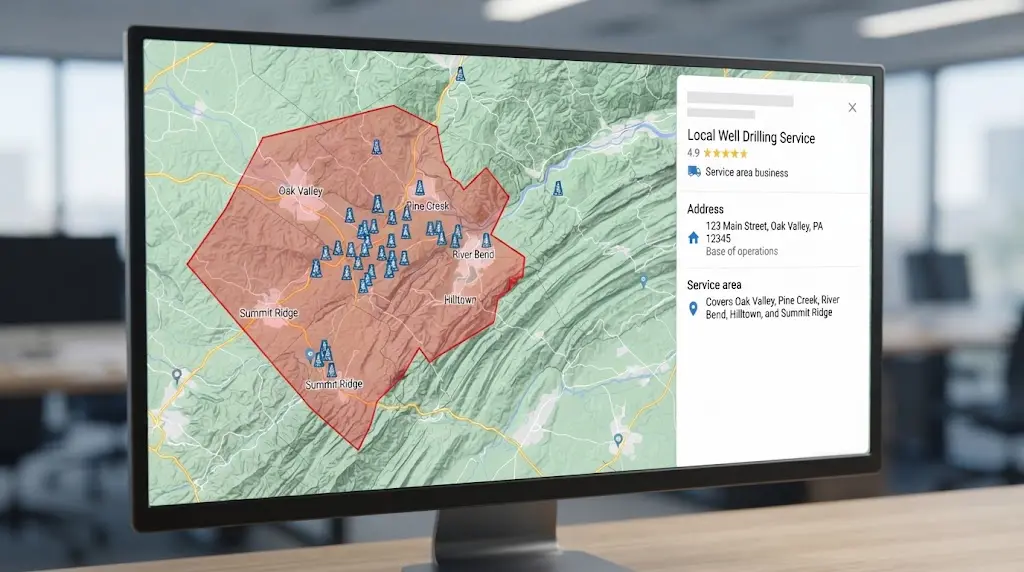
Google’s current service-area guidance says service-area businesses can define up to 20 areas using cities, postal codes, or other areas. It says the overall area should generally not be more than about two hours of driving time from the business base and should be as specific and accurate as possible. Read the current service-area guidance.
Score 10 when the profile type, address display, service area, phone, and website all agree with the real operating model. Score 6-9 when there are small omissions or stale towns. Score 2-5 when the company claims a broad area that dispatch would not actually support. Score 0-1 when there is a virtual office, a false storefront, a duplicate location, or another material representation problem.
A wide service area is not a substitute for local relevance. If a town matters, the website should explain the service and the profile should represent the area accurately. Do not add every nearby city just to make the map look larger.
Grid coverage: 10 points
Use the nine-point scan. Convert the average observation code for your priority service phrases into 10 points:
- 3.0 average: 10 points
- 2.0 to 2.9: 7-9 points
- 1.0 to 1.9: 4-6 points
- 0.1 to 0.9: 1-3 points
- 0.0: 0 points
This conversion is a Brictale recommendation, not a Google metric. It gives you a stable way to compare the same territory month over month.
Keep the raw grid. An average can hide a gap. For example, a company might be strong in core towns and absent in all growth towns. The average alone could make the result look acceptable while the expansion plan is failing.
What if the company is a service-area business?
Do not treat the lack of a public storefront address as a defect when the company legitimately travels to customers. Google distinguishes service-area and hybrid businesses and says service-area businesses can have one profile for the whole area they serve. Its service-area documentation is the source of truth for the profile setup.
The benchmark should then focus on accurate service areas, the verified base, the grid pattern, service fit, and contact paths. Never create a fake office in a town just to gain a perceived distance advantage.
A service area earns its place on the profile only when dispatch can serve it profitably.
How should you score prominence without chasing vanity metrics?
Give prominence and public proof 20 points. Compare the company with the direct competitors that appear for the same services and grid points, not with a national average or a famous home-service brand.
Reviews and rating: 8 points
Record the company’s review count and rating beside the median or range of the direct competitors in the observed set. Then record review recency and whether the company replies.
Do not score only the largest number. A company with many reviews but a long period of silence may present a different signal from a company with a smaller base and steady, genuine recent activity. The right comparison is the public proof a buyer sees in the same market and service category.
Suggested scoring:
- 8: review count, rating, recency, and replies are competitive with the observed direct set.
- 5-7: the profile is credible but trails the strongest competitors on one dimension.
- 2-4: the company has a thin or stale proof set, or replies are inconsistent.
- 0-1: the profile has serious trust or policy problems.
Google says reviews can help a business stand out, but it also says reviews must reflect a genuine experience. Google’s review guidance allows businesses to remind customers to leave a review through a link or QR code, while incentives are prohibited.
The benchmark does not tell the owner to buy reviews, gate reviews, or ask for a particular rating. Those tactics create policy risk and make the data less trustworthy.
Review quality and response: 4 points
Read a sample of recent reviews. Look for evidence of the services and problems the company wants more of: drilling, pump replacement, pressure issues, well testing, emergency response, communication, or project completion.
Score 4 when reviews make service fit and customer experience easy to understand and responses are calm and specific. Score 2-3 when the profile has useful proof but replies are sparse or generic. Score 0-1 when reviews are off-topic, unanswered, or show a pattern of unresolved service problems.
Do not ask customers to include keywords. Ask for an honest account of their experience. Google’s prohibited and restricted content policy says fake engagement and review manipulation are not allowed.
Website and third-party corroboration: 5 points
Google says profile data may come from public web content, licensed sources, users, and business owners. Your benchmark should therefore check whether the company’s name, phone, address or base, service lines, and credentials are consistent on the website and important public profiles.
Score 5 when the public record is consistent and the site gives buyers meaningful proof such as project details, qualifications, service coverage, or clear operating information. Score 3-4 when minor inconsistencies exist. Score 1-2 when the website is thin or business details disagree. Score 0 when the public record is materially confusing.
This is not a demand for every directory on the internet. Check the sources customers and search engines are likely to encounter. Quality beats a long list of weak listings.
Photos and visible work evidence: 3 points
Score 3 when the profile shows current, relevant photos that help a buyer recognize the company and understand the work. Score 2 when photos exist but are dated or generic. Score 1 when the profile has very little visual evidence. Score 0 when the images are misleading or unrelated.
The purpose is not decoration. A rig, pump equipment, crew vehicle, completed installation, or jobsite detail can help a buyer understand fit. Use images the company owns or has permission to publish. Do not use stock photos as if they show company work.
A useful proof benchmark asks whether the visible evidence supports the job you want, not whether your profile has the biggest review count.
How should you score action capture?
Give action capture 20 points. A listing that gets seen but makes a buyer hesitate, dial the wrong number, or land on a generic page is not performing its commercial job.
Call path: 8 points
Score the call path from a buyer’s point of view:
- 8: the phone number is correct, answered or returned promptly, and the team can identify the service and territory from the call.
- 5-7: calls work but hours, routing, or response standards are inconsistent.
- 2-4: calls frequently go unanswered, route to the wrong person, or produce no source record.
- 0-1: the number is wrong, disconnected, or not usable for the target work.
Google’s profile performance report counts clicks on the call button as calls. That is useful, but a click is not a conversation and a conversation is not a qualified opportunity. Google defines the calls metric here.
A profile action is not a booked job until your own records show what happened next.
Your own call review should mark at least:
- answered or missed,
- new or existing customer,
- target service or non-target service,
- target territory or outside territory,
- qualified or unqualified,
- estimate opportunity,
- booked or not booked.
Website and contact path: 5 points
Score 5 when the profile link opens a page that matches the query and offers a clear phone or quote action on mobile. Score 3-4 when the page is useful but contact requires extra searching. Score 1-2 when the page is generic or the contact action is buried. Score 0 when the link is broken or sends the buyer to an unrelated destination.
The right landing page depends on the query. A pump repair search should not always land on a broad drilling home page. A new well project may need different proof, qualification, and response language from an emergency pump call.
Action data: 4 points
Use the verified profile’s performance report to record searches, views, calls, website clicks, directions where relevant, messages, and bookings where available. Score 4 when the owner reviews the data on a consistent date range and can explain changes. Score 2-3 when the data exists but is not tied to service lines or towns. Score 1 when someone occasionally checks views. Score 0 when no one has access or the profile is not verified.
Google says performance data is available for verified Business Profiles and can be viewed over a selected date range. It also cautions that not every metric appears for every business. That makes the report useful for trend tracking, not a universal comparison table across every contractor.
Contact expectations: 3 points
Score 3 when the profile and website tell the buyer what happens next, such as a call-back window, service-area qualification, or emergency instruction. Score 2 when the process is implied but not clear. Score 1 when the buyer has to guess. Score 0 when expectations conflict with actual operations.
Do not promise 24-hour response, same-day service, free estimates, or emergency availability unless the company can deliver them. A clear limitation is better than a promise the dispatcher cannot keep.
How should you score measurement integrity?
Give measurement integrity 15 points. If you cannot tell which Map-driven opportunities became acceptable jobs, you cannot make a sound budget decision from the channel.
Source record: 4 points
Score 4 when every inbound call or form records a source such as Google Business Profile, organic website, paid search, referral, or repeat customer. Score 2-3 when some sources are tracked but staff rely on memory for others. Score 1 when the owner sees only total calls. Score 0 when source data is absent.
Use Google’s profile metrics for the platform-side view. Use call tracking, web analytics, form fields, CRM notes, and dispatch records for the business-side view. A source label should survive the handoff from marketing to sales and operations.
The existing well drilling call tracking checklist goes deeper into the path from visibility to call, qualification, estimate, and booked job.
Outcome stages: 5 points
Score 5 when the company records a consistent progression:
profile action -> conversation -> qualified opportunity -> estimate -> booked job -> completed job
Score 3-4 when most stages exist but one handoff is weak. Score 1-2 when the company records leads but not booked work. Score 0 when the only reported outcome is calls or clicks.
A contractor does not need a sophisticated platform to begin. A shared sheet with a stable source field and outcome fields is better than a dashboard that nobody updates.
Commercial fit: 3 points
Score 3 when the owner can separate acceptable work from out-of-territory, low-value, non-service, duplicate, warranty, vendor, and spam inquiries. Score 2 when the team records some disqualification reasons. Score 1 when every call is called a lead. Score 0 when the business cannot tell whether Maps is sending the work it wants.
This protects the benchmark from a common failure: a channel looks strong because it creates activity, while the crew spends time chasing jobs it cannot profitably perform.
Review cadence and owner: 3 points
Score 3 when one person owns a monthly benchmark review and the same definitions are used each time. Score 2 when reviews happen irregularly. Score 1 when data is collected but no decision follows. Score 0 when nobody owns the record.
The review does not need to become a meeting about every marketing metric. It needs to answer three questions:
- Did visibility change in the target towns?
- Did qualified opportunities change?
- Did the company book and complete the right work?
What do the score bands tell you?
The score is most useful when it leads to a specific decision. Use the lowest-scoring section as the first repair target, then rescan the affected phrases and towns.
If the score is 0-39, repair the foundation
Do not buy more traffic to a profile that misstates the business, points to the wrong phone, claims an unsupported territory, or cannot record outcomes. Check ownership, verification, name, category, address or service area, phone, website, hours, priority services, and the call path.
The first week should produce a clean evidence sheet, not a review-count campaign. If the profile has a policy issue, resolve that before building more activity around it.
If the score is 40-59, fix the largest leak
At this range, the company may appear in some searches but lose the buyer at a predictable point. The leak could be service ambiguity, weak territory coverage, thin proof, missed calls, or missing job outcomes.
Choose one section. Do not make fifteen unrelated edits and then claim the score improved because of all of them. A benchmark is more useful when the owner can see which repair changed the observed result.
If the score is 60-79, test controlled growth
This range means the foundation may be good enough for a controlled test, not that the company should expand everywhere. Choose one service line, a defined group of towns, and a clear outcome threshold. Keep the existing profile and response system stable while the test runs.
If calls increase but qualified work does not, the problem may be service fit or intake rather than visibility. If qualified calls increase but booked jobs do not, review estimates, follow-up, pricing, availability, and sales process before investing more in Maps.
If the score is 80-100, defend the system
A high score means the operating foundations are strong by this framework. It does not make the profile immune to competitor movement, seasonality, service changes, reviews, policy updates, or crew constraints.
Maintain a monthly grid scan for the priority services. Watch changes in the direct competitor set. Keep photos, services, hours, and proof current. Review missed calls and booked-job rate, not just the score.
How should you compare competitor scores?
Use the same evidence sheet for the company and the direct competitors that appear in the scan. You can record visible rating, review count, category, distance or address context, service match, website quality, and available contact actions. Do not assign hidden points to factors you cannot verify.
The competitor sheet should support questions such as:
| Question | What to record | What it can tell you |
|---|---|---|
| Who appears for the same service? | Company, observed position, search point, date | Whether the competitive set changes by town |
| What proof is visible? | Rating, review count, recent review pattern, replies, photos | Whether your proof gap is real or assumed |
| Is the profile relevant? | Category, service wording, website match | Which companies are aligned with the query |
| Can a buyer act? | Phone, website, directions, messages, booking | Whether the result set makes contact easy |
| Can you serve the same work? | Service, territory, project type | Whether the competitor is a true comparison |
Do not copy a competitor’s business name, service area, reviews, photos, or claims. The purpose is to learn what buyers see, not to imitate a profile in ways that violate platform rules.
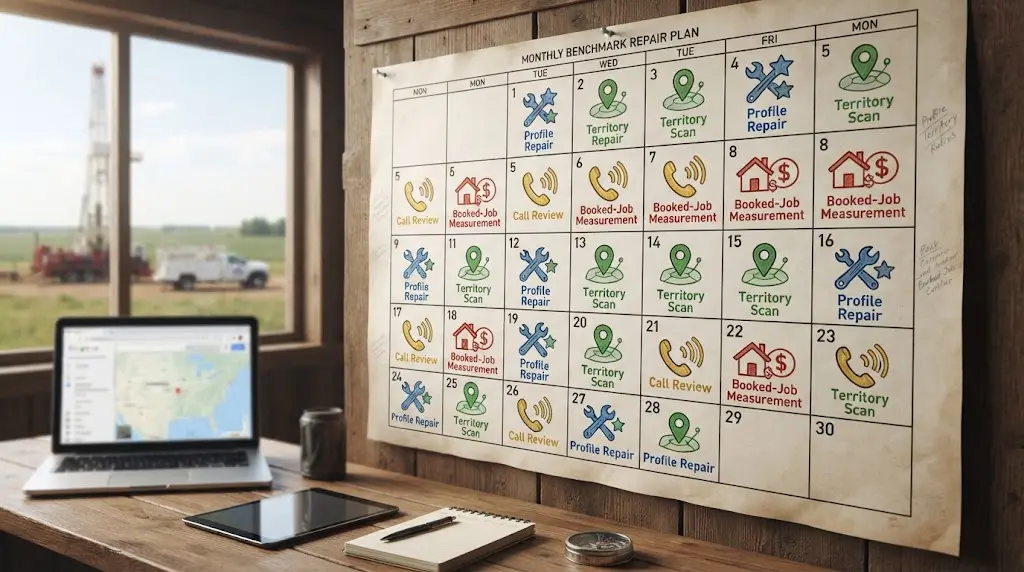
How should you turn the score into a 30-day repair plan?
Use a 30-day sequence that fixes representation first, then visibility, then capture and measurement. The sequence is designed for an owner or operator who cannot spend every day inside a marketing dashboard.
Days 1-3: Freeze the baseline
Create one evidence sheet. Record the profile URL, company name, category, address or service area, phone, website, hours, services, rating, review count, recent review dates, visible photos, profile actions, and the nine-point grid results.
Write down the collection conditions. Capture the exact service phrases and towns. Save screenshots or links where company policy and platform terms allow. The point is not to create a gallery. It is to make the baseline reproducible.
Also record current business-side numbers for a comparable period:
- inbound calls,
- answered calls,
- qualified calls,
- estimates,
- booked jobs,
- completed jobs,
- cancellations,
- out-of-territory inquiries,
- source-known opportunities.
If the team cannot provide some of these numbers, mark the gap as a measurement problem rather than filling it with an estimate.
Days 4-7: Repair identity and territory
Check that the name reflects the real-world business. Confirm the profile type, address visibility, service area, phone, website, hours, and primary category. Remove towns the company does not actually serve. Add priority towns only when they reflect real operations.
Google says service areas should be specific and accurate and that service-area businesses can set up to 20 areas. Follow the current platform guidance, then apply the operational test: can dispatch accept and complete the work there?
Do not create a new profile for every town. A service-area business can have one profile for the whole area it serves, and Google’s guidelines prohibit creating more than one page for each location.
Days 8-14: Repair service relevance and proof
Put priority services in the profile’s service fields and on the corresponding website pages. The site should support the same service language without turning every town into a duplicate page.
Review the last several customer reviews for service fit and unresolved issues. Reply to reviews in a way that is factual and useful. Start a compliant request process after completed work, using an honest review link or QR code. Do not offer a discount or other incentive for a review, and do not ask for a particular rating.
Replace generic or stale photos with current company-owned images that show the actual operation. If the company performs pump work, show relevant equipment and job context. If it focuses on drilling, show the kind of work and equipment a buyer needs to understand.
Days 15-21: Repair the contact path
Call the number from the profile at different times. Test the website link on a phone. Ask a neutral person to find the answer to three questions:
- Does this company perform the service I need?
- Does it serve my town?
- What should I do next?
If the answer requires a long search, revise the landing page and contact path. Update call routing, voicemail, after-hours instructions, and response ownership. Do not change the public promise beyond what the team can deliver.
Review a sample of calls. Mark why each person called, whether the call was answered, and what happened next. That process usually reveals more than another profile edit.
Days 22-30: Connect activity to jobs and rescan
Pull a comparable Business Profile performance period. Record profile searches, views, calls, website clicks, directions where relevant, messages, and bookings where applicable. Match the date range to your call and job records.
Run the same grid again. Compare the result by town and service phrase, not only as one total. Re-score the five sections. Then choose one of four decisions:
- Repair: a foundational error remains.
- Monitor: the profile is stable but evidence is too thin for expansion.
- Defend: the company is competitive in its core territory and needs maintenance.
- Scale carefully: the target service and town have qualified, booked-job evidence and the team has capacity.
The last decision belongs to the owner. A Maps score cannot decide whether another crew, another service area, or more advertising is operationally wise.
Which mistakes make the benchmark useless?
Most benchmark failures come from inconsistent collection or from measuring a platform signal as if it were revenue. Avoid these errors.
Mistake 1: Searching once and calling it a ranking
One search from one location is a snapshot. It cannot represent a whole service area. Use the nine-point grid, save the conditions, and repeat the scan.
Mistake 2: Treating review count as the finish line
Reviews matter, but they are one public proof signal. A large count cannot repair a wrong phone, a mismatched service, a weak website, or an unanswered call. Compare relevant proof with direct competitors and check the rest of the profile.
Mistake 3: Adding keywords to the business name
Google’s guidelines require the business name to reflect its real-world name. Keyword stuffing may create suspension risk and gives the benchmark a false reading. Score the profile as it is, then fix it compliantly.
Mistake 4: Claiming every town in the region
A long service area can make the business sound larger while weakening operational honesty. Google says service areas should be specific and accurate. Dispatch should be able to stand behind the places listed.
Mistake 5: Counting every call as a lead
A call can be a wrong number, an existing customer, a vendor, a job outside the territory, or a service the company does not offer. Record qualification and booked-job outcomes.
Mistake 6: Comparing different queries and competitors
“Well drilling contractor” and “well pump repair” may have different result sets. Compare the same query, town, date, service intent, and direct competitor group.
Mistake 7: Editing everything at once
If you change the category, services, site, reviews, phone routing, photos, and advertising at the same time, you will not know which repair mattered. Fix the lowest-scoring section first and keep a change log.
Mistake 8: Using old data as a current benchmark
Review counts, ratings, competitor positions, and profile actions change. Date every scan. Google also changes its metric definitions and profile features. Recheck the official documentation before comparing periods.
Mistake 9: Treating a high score as permission to ignore capacity
A strong profile can create more demand than a crew can accept. If the company cannot answer, estimate, schedule, and complete the work, more visibility may create customer frustration instead of growth.
When should you not invest more in Google Maps?
Do not expand Maps activity when the bottleneck is outside visibility. Fix the narrowest broken step first.
Pause expansion when:
- the phone is frequently missed and there is no callback owner,
- the business cannot accept more work in the target towns,
- the profile claims services or places the company does not support,
- calls are mostly outside the target service or territory,
- estimates are not followed up,
- the team cannot distinguish Google Maps from other sources,
- the job margin or completion economics do not support acquisition cost,
- a policy or verification issue threatens the profile,
- the website makes service fit unclear,
- the benchmark is being built from one unrepeatable search.
This is not an argument against Maps. It is a capacity and evidence gate. A contractor should be able to say what the next qualified call is worth before funding a larger acquisition effort.
Google says there is no way to request or pay for a better organic local ranking. That means paid campaigns and profile work should be managed as different channels. Paid exposure can be useful, but it does not turn into organic Maps authority simply because money was spent. Google’s local-ranking guidance is clear on that point.
Paid campaigns should also use their own call and conversion records. Google Ads call-reporting guidance explains how advertising calls can be measured, but advertising conversions are still not the same as booked or completed jobs. The contractor’s own outcome record remains the final business test.
How should you connect the benchmark to SEO and lead generation?
Google Maps should not sit in a separate marketing silo. The profile, website, calls, reviews, and job records describe the same business entity and the same territory.
Use the website to explain the service mix
The benchmark will often show a relevance gap. The repair may be a clearer service page, better proof, or a more direct contact path. It does not necessarily mean publishing dozens of town pages.
For a drilling company, the service architecture might separate new well drilling, commercial or agricultural drilling where relevant, well rehabilitation, pump installation, pump replacement, and testing. The exact structure depends on the company’s services and territory.
The existing well drilling SEO guide covers the larger search system. Use this benchmark to decide which local-search gap deserves attention first.
Use calls to identify buyer language
Call reviews can reveal that customers use different language from the profile. They may ask for “no water,” “low pressure,” “a new pump,” “a dry well,” or “drill a well for a new house.” That language can improve service pages and intake questions, as long as the company describes the work accurately.
Do not turn every phrase into a new page. Add a page when the service, buyer need, or commercial decision is materially different. Otherwise, improve the page that already owns the intent.
Use the job record to decide what to defend
The most valuable local result may not be the one with the highest call count. A smaller number of well-qualified commercial drilling inquiries may matter more than a larger number of low-fit repair calls, depending on crew capacity and margin.
Track the service line, town, response time, qualified rate, estimate rate, booking rate, completion rate, and source. Then decide which part of the territory deserves defense, improvement, or less attention.
Use the benchmark as a sales and audit artifact
A territory audit should not say “your SEO is bad.” It should show:
- which target phrases were scanned,
- which towns were included,
- which competitors appeared,
- where the company appeared or did not,
- which profile sections were weak,
- how the call path behaved,
- what the company knows about booked-job outcomes,
- what should happen next.
That is the level of specificity an owner can act on. It is also the level of specificity Brictale should bring to a free territory audit.
What should an owner record every month?
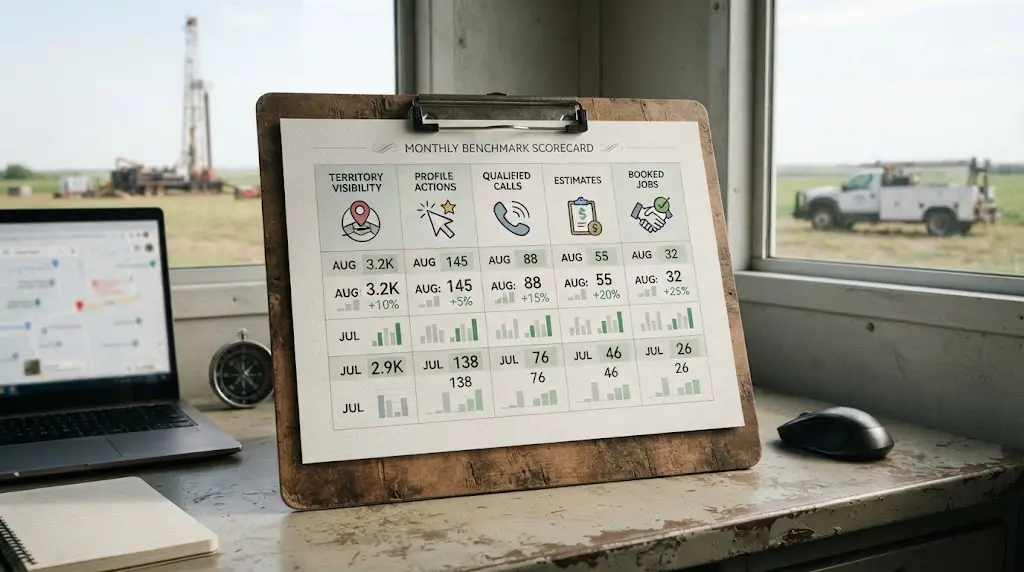
Use one monthly record with the same fields and definitions. The goal is trend visibility, not a growing dashboard.
Territory and visibility fields
- collection date,
- target service phrase,
- nine search points,
- observation code for each point,
- average grid score by service,
- direct competitors appearing,
- changes in the company’s profile details,
- changes in the competitor set.
Profile and proof fields
- rating,
- review count,
- approximate review recency,
- review response coverage,
- priority services visible,
- hours and phone accuracy,
- website status,
- new relevant photos or proof,
- unresolved policy or verification issue.
Action fields
- profile searches,
- profile views,
- calls,
- website clicks,
- directions where relevant,
- messages,
- bookings where applicable,
- answered calls,
- qualified calls,
- estimates,
- booked jobs,
- completed jobs.
Decision fields
- current score,
- lowest-scoring section,
- one repair owner,
- repair due date,
- next scan date,
- repair, monitor, defend, or scale decision,
- reason for the decision.
If a field cannot be measured, leave it blank and mark it as a gap. Do not fill it with a guess to make the report look complete.
What is the practical benchmark for a well drilling company?
The practical benchmark is not “rank number one everywhere” and it is not “collect more reviews than a national average.” It is a territory-specific record showing that the company is accurately represented, relevant for the services it wants, competitive beside direct alternatives, easy to contact, and able to connect activity to acceptable booked work.
Use this sequence:
- Pick the actual territory.
- Choose the services that matter.
- Scan nine fixed points.
- Record the visible result set and actions.
- Score the five operating layers out of 100.
- Compare only with direct competitors.
- Repair the lowest-scoring layer.
- Rescan before adding more demand.
- Judge the channel by qualified and booked jobs.
The benchmark becomes more valuable after two or three consistent cycles. You will see whether a service is gaining visibility in the towns you want, whether competitors are changing, whether profile actions are becoming more useful, and where the handoff to sales or dispatch breaks.
Brictale’s role is to help a well or pump company turn that evidence into a practical territory decision. If the company’s score is low, the free territory audit should identify the first repair. If the score is high but booked work is weak, the audit should look beyond Maps at service fit, response, website clarity, and follow-up.
The next step is simple: run the scan, keep the raw evidence, and make one accountable repair before you buy more attention.