
More well drilling jobs are not automatically good news. A crew can be busy with long drives, poor-fit estimates, and jobs that crowd out better work. The target is not more noise. It is more suitable, profitable booked work.
That changes the plan. Start with the work your company can deliver well this month. Then choose the territory, proof, and demand sources that are most likely to produce it.
What does “more well drilling jobs” mean for your company?
It means more jobs that match your crews, equipment, licenses, service territory, and financial requirements. A website inquiry is not a job. A phone call is not a job. Even a site visit is not necessarily a job worth taking.
An owner can be frustrated by an empty schedule and still make the wrong move by buying every inquiry available. A drilling company has physical constraints that a software company does not. There is rig availability. There are crews, drill depths, geology, hauling, casing, pump capacity, permits, travel, cash flow, and the work already promised to customers. There may be a seasonal surge in pump service that requires an entirely different response model than a new-well request.
So define the outcome before you choose the marketing channel. Write one sentence for each work type you want more of.
| Work type | A useful outcome definition | What to protect against |
|---|---|---|
| Residential drilling | Suitable in-territory drilling requests that can be inspected, quoted, and scheduled within your normal operating window | Distant prospects, unclear access, work outside license or rig capability |
| Agricultural or irrigation wells | Projects that match your equipment, seasonal capacity, and water-system experience | Last-minute work that collides with higher-value commitments |
| Commercial drilling | Opportunities with a realistic scope, decision path, and bidding timeline | Chasing every plan room notice with no relationship or fit |
| Pump replacement or rehabilitation | Service work the crew can reach and complete quickly, with a clear dispatch path | Treating urgent service calls like slow-moving drilling estimates |
| Inspection, testing, or related services | Work that creates a fair margin and can lead to an appropriate next service | Giving away time without a defined business reason |
The U.S. Small Business Administration recommends that market research look at demand, market size, location, saturation, and pricing. That is a useful discipline here because “there are houses being built” or “a competitor looks busy” is not enough to justify a campaign. The question is whether a specific job type, in a specific area, is available to your company at a price and workload you can support (SBA market research and competitive analysis).
A qualified call is only valuable when the company has a good reason to want the job that follows.
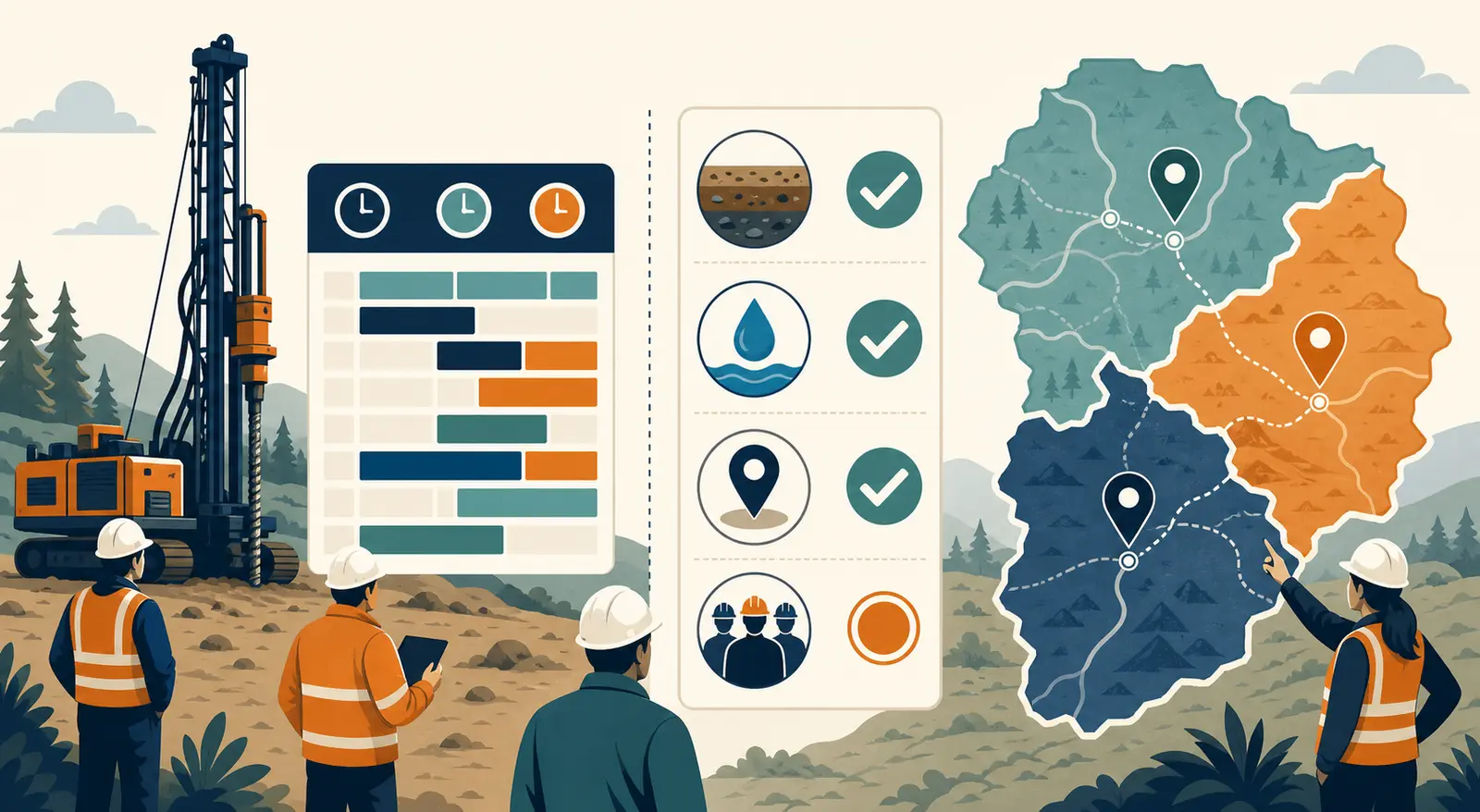
This guide uses a Brictale framework called the Capacity-First Territory Job Engine. It is not a claim that one channel always wins. It is a sequence for deciding what to improve first, before an owner spends more money or asks the office to chase more leads.
Should you chase demand before you check capacity?
No. Check capacity first, because the right job source changes when the schedule, crews, and equipment change.
If one rig has an open week, the immediate job may be filling a specific operating window in a familiar territory. If the office is already missing calls, more advertising will magnify an intake failure. If your best driller is booked but the pump crew has room, the next push may be pump replacement or rehabilitation rather than new drilling. And if you have more estimates than your estimator can handle, your problem is selectivity and follow-up, not visibility.
Use the capacity gate before you open another channel.
The Capacity-First Territory Job Engine
The framework has four gates. A channel must clear all four before it deserves sustained effort.
- Capacity gate: Can we perform this job type on the needed schedule without hurting better work?
- Territory gate: Can we serve the location within a sensible operating radius and with a competitive chance of winning?
- Proof gate: Can a buyer quickly verify that we are a credible fit for this job?
- Closed-loop gate: Can we identify the source and see whether it becomes a suitable booked job?
This keeps the conversation grounded. Google Maps, organic search, paid search, referral partners, builder relationships, and past customers are not competing religions. They are routes into the same four-gate system.
Start a one-page capacity board. Do not make it elaborate. It only needs to be honest.
| Question | Write down | Why it matters for demand generation |
|---|---|---|
| What work can we start in the next 30 days? | Job types, crews, rig days, pump-crew slots, estimator availability | Stops you promoting work you cannot schedule |
| What work do we want more of over 90 days? | A short ranked list, not every service you offer | Gives each page, ad, and partner conversation a purpose |
| What work should we avoid for now? | Geography, depth, project profile, response-time conflicts, low-margin work | Prevents “more leads” from becoming more waste |
| What proof do we have? | Licenses, service scope, equipment, project examples, reviews, process, insurance, credentials | Reveals whether the sales surface matches the job you want |
| Who owns first response? | Named person, backup, coverage hours, escalation path | Makes speed and accountability real |
You do not need a perfect forecast. You need a current operating decision. Revisit it weekly during a busy season and monthly when demand is stable.
Do not market a service simply because it appears on your truck. Market it when you can deliver it well and want more of it.
How do you score whether an opportunity fits?
Use a simple job-fit score before sending a field visit or a full estimate. This is an internal recommendation, not an industry benchmark. The weights should reflect your business.
Give each item a 0, 1, or 2. Zero means poor fit, one means possible fit, and two means strong fit.
| Job-fit factor | 0 points | 1 point | 2 points |
|---|---|---|---|
| Territory | Beyond normal operating area or impractical drive | Edge of territory | Established service area |
| Service fit | Outside capability or licensing | Possible with exception | Core service and equipment fit |
| Timing | Cannot meet required schedule | Schedule needs coordination | Fits a known opening |
| Scope clarity | Critical facts missing | Some facts known | Access, desired work, location, and decision path are clear |
| Buyer readiness | Browsing or unclear authority | Researching options | Decision maker, funding path, or bid process is known |
| Margin potential | Likely poor after travel and risk | Uncertain | Fits minimum economic threshold |
Set your own action bands. For example, a high score can trigger fast inspection or estimate handling. A middle score can trigger a short discovery call before spending field time. A low score may need a respectful decline, a referral, or a later follow-up. The point is not to force every inquiry into a sale. It is to preserve capacity for the work you should win.
This also improves marketing judgment. If a paid campaign produces 50 calls but most score low because they are far outside the route, the campaign is not a success. If a partner produces five high-scoring opportunities, it may be more valuable even before the final closed jobs are counted.
What territory should you try to win next?
Choose territory by operational fit and observable demand, not by a giant circle around your yard.
Service-area businesses are often tempted to list every town they might possibly reach. That confuses the operation and can create a weak promise. Google allows a service-area or hybrid business to list up to 20 cities, postal codes, or other areas, but it says service areas should be specific and accurate. Its guidance also says the overall area generally should not extend beyond about two hours of driving time from the business base (Google service-area guidance). That is a product rule of thumb, not a guarantee that a business will rank across two hours of territory.
Google puts the ranking constraint plainly:
"Local results are based primarily on relevance, distance, and prominence."
- Google Business Profile Help, How to improve your local ranking on Google
A company can make its information more complete, earn a stronger reputation, and build better pages, but it cannot make distance disappear.
That is why a territory plan needs three layers.
Layer 1: Core territory
This is where you can answer, inspect, drill, return for service, and solve a problem without the job becoming a travel problem. It should be the area where your Business Profile, service pages, referral relationships, yard logistics, and review history reinforce one another.
Layer 2: Selective territory
This is where you will work when the project type, scope, schedule, or economics justify it. You do not need to promise immediate availability there. You need a clear internal rule for when a lead qualifies for the additional drive and coordination.
Layer 3: Do-not-chase territory
This is not a failure. It is a boundary. The work may be too distant, too competitive for your present position, too incompatible with the crew's schedule, or simply not worth serving today. A boundary gives the office permission to decline bad-fit requests quickly and focus on better ones.
Build a territory worksheet for each market you are considering. The SBA's own market-research checklist calls out demand, location, saturation, and pricing. Use the same inputs, but add contractor operations (SBA market research and competitive analysis).
| Territory question | What to check | What you are deciding |
|---|---|---|
| Is there a reason to expect the right work? | Your past jobs, calls, permits, builder activity, agricultural activity, local groundwater context, referral feedback | Whether to spend attention there |
| Can we operate there well? | Drive time, crew hours, fuel, access, county rules, return-trip risk | Whether a job remains attractive after logistics |
| Can a buyer find evidence of our fit? | Local ranking checks, relevant service page, reviews, partner mentions, known projects | Whether the market can realistically trust and choose you |
| What are competitors visibly offering? | Job types, response promises, reviews, project proof, service areas, pages | Whether you need a clearer position or a different segment |
| Is there a route to market besides search? | Builders, excavators, engineers, agricultural suppliers, realtors, property managers | Whether you can create a second demand path |
Public construction data can improve the first line of that worksheet, but it should never be treated as a drilling forecast. The Census Building Permits Survey provides new privately owned residential construction data at national, state, CBSA, county, and place levels, with monthly, year-to-date, and annual availability (U.S. Census Building Permits Survey). Permit activity may be a useful directional clue in a market where new homes commonly need private wells. It does not tell you which lots use wells, who will win the work, when drilling will happen, or whether the work fits your company. Use it to ask a better question, not to make a promise.

A territory is not a radius on a map. It is a promise your crews can keep.
Should you create a page for every town?
Not by default. A town page earns its place when it contains distinct, useful information for the work you perform there: a specific service availability statement, relevant local proof, a clear service path, local constraints you can responsibly discuss, and a real reason a buyer in that place should choose your company. Swapping town names into the same drilling page creates little value for buyers and eventually creates a maintenance problem.
Start with strong service pages that explain the service, who it fits, what information starts the conversation, and how your company operates across your actual territory. Add local pages only where you can make them meaningfully different and maintain them. The goal is not more URLs. It is a more credible answer when a nearby prospect searches.
Which job sources should come first?
Start with sources closest to existing demand and existing trust. Then add sources that fit your sales cycle and capacity.
Most contractors hear “marketing” and picture advertising. Advertising can be useful, but it is only one demand source. In well work, the strongest early improvements often sit in the places where a buyer already expects to verify a local service provider, where a past customer already knows your name, or where another professional can make a qualified introduction.
Here is the practical order to examine.
| Source | Best use | What must be true before it deserves more budget or time | Common failure |
|---|---|---|---|
| Google Business Profile and local search | Capture nearby high-intent demand | Accurate profile, real service area, call coverage, clear service pages | Treating the profile as a one-time setup |
| Existing customers and past estimates | Reactivate trust and create appropriate repeat/referral work | Clean records, useful reason to contact, no pressure | Sending a generic blast with no segmentation |
| Referral partners | Reach projects before the public search | Clear mutual fit and an easy referral handoff | Asking for referrals without explaining which jobs you want |
| Organic service pages | Build durable visibility for specific services and territory | Pages answer buyer questions better than a generic home page | Publishing thin location pages or vague service copy |
| Paid search | Fill a defined capacity gap or test a narrow service-market pair | Tracking and fast call handling are already in place | Buying broad terms and counting clicks as success |
| Commercial relationships and bid channels | Reach larger or planned projects | You can show qualifications, scope fit, and a reliable estimating process | Bidding everything with no qualification rule |
| Reputation and reviews | Improve trust across every demand source | A neutral request process, real completed work, response ownership | Buying, filtering, or incentivizing only positive reviews |
Google Business Profile is a core intake surface for service companies because a verified profile can show business information such as phone, website, service area or location, photos, and reviews across Google Search and Maps (Google Business Profile Help). That does not make it a magic listing. It makes it a high-visibility place where an operator must keep basic information correct and make the next step easy.
How should you improve the demand you already receive from Google?
First, check the basics as if you were a buyer with a broken pump or a planned well project. Is the company name correct? Is the phone number monitored? Are hours accurate? Is the service area honest? Do the categories and listed services reflect the work you want? Does the website click lead to a page that answers the searcher's problem? Are there current photos and credible proof of work, without overstating what they show?
Then inspect the handoff. A caller coming from a profile does not need a history lesson about your company. They need to know whether you serve the address, whether the job type is something you handle, what information you need, and what happens next. The office should not make that person hunt for an email address or wait days for a return call.
Google's local guidance says complete and accurate information can help it understand a business and match it to relevant searches, while prominence incorporates signals such as links, articles, reviews, ratings, and the business's wider web presence (Google local ranking guidance). Read that as a case for basic truthfulness and durable reputation, not for shortcuts.
How should you use past customers without turning into a nuisance?
Segment the list by work completed, location, and likely reason for a useful follow-up. A past drilling customer may not need another well soon, but may know a nearby builder, family member, farm operator, or property owner who will. A past pump customer may need a seasonal check-in, a pressure-tank conversation, or a reminder of the response route. A past commercial contact may need a capability update when your team adds relevant capacity.
The word is useful. Do not email every contact simply because a marketing calendar says so. Send a short note when you have a legitimate reason: a service you now offer, a territory change, a seasonal planning window, a safety or maintenance reminder within your competence, or a request for an introduction to the exact kind of project you now want. Keep the ask easy to decline.
Most importantly, record the source properly. “Past customer” is not enough. Was it a prior pump repair customer? A prior drilling estimate? A builder who met you through a past job? That detail helps you decide which relationship is truly producing suitable work.
How should you build referral partners that send good work?
Make the referral target narrow. “Send us any well work” is weak. “We are looking for residential drilling projects within these counties, with access for our rig, or commercial pump rehabilitation that needs a field visit within this radius” gives a partner something usable.
The partner types depend on your market and services. They can include excavators, septic contractors, site-prep companies, general contractors, home builders, engineers, agricultural suppliers, real estate professionals, water-treatment providers, lenders involved in rural properties, and property managers. Do not assume every category fits you. Build a short list from the jobs you actually want and the people already encountered around them.
Use a straightforward partner packet or page. It should state service scope, normal territory, basic qualification criteria, insurance and licensing evidence where appropriate, how to make an introduction, and who responds. This is not glossy branding. It is operational friction removal.
The National Ground Water Association's public guidance for selecting a contractor highlights the kinds of proof buyers commonly care about, including credentials, experience, insurance, references, and written contract terms (NGWA, How to Hire a Water Well Contractor). A partner needs the same confidence before putting their own reputation beside yours. Give them a clean way to verify it.

The best partner asks describe a job, a territory, and a handoff, not a vague wish for leads.
Should you use paid search for more drilling work?
Use paid search when you have a specific gap to fill, a defined geographic area, a responsive intake team, and a way to see what happens after the phone rings. It can create useful speed. It can also create expensive confusion.
Do not begin with a giant campaign for every drilling, pump, water, and repair phrase across a wide map. Begin with a service-market pair you can actually fulfill. For example: one core service, in one core territory, during a period when you have capacity. Make the landing page and the person answering the phone match that promise.
Google's documentation is especially useful here because it explains the gap between a marketing event and a business outcome. It can track calls from ads or a website using a chosen minimum duration, but a mobile number click may be only a click, not proof a call occurred. It also allows advertisers to import call conversions from another system and choose to count a call only when it includes a sale or another selected outcome (Google Ads phone call conversion tracking).
That distinction should shape your scorecard. An ad-generated 90-second call might be promising, but it is not a booked drilling job. An imported qualified-estimate outcome is stronger. A booked job with a revenue and margin band is stronger still.
When does commercial outreach deserve priority?
Give commercial outreach priority when your company has a distinct commercial offer, the capability proof to support it, and a disciplined estimating process. Commercial jobs can carry longer cycles and more stakeholders. They need a different route from someone typing a local emergency query into a phone.
Build a target list around real project influence, not generic company names. Ask which engineers, general contractors, site developers, agricultural operations, municipalities, industrial sites, and property groups operate within your realistic territory. Learn which work types you can price competitively and perform safely. Then make your first contact about fit, not about marketing.
Your commercial page or qualification document should answer basics without forcing a project manager to call just to find out whether you are plausible: services, geography, equipment or scope where appropriate, licensing and insurance confirmation, safety or compliance documents you can provide, estimating contact, and the information needed for a productive first conversation. Do not claim specialized expertise you cannot substantiate. A clean no is better than a future reputation problem.
How do you make a prospect choose your company before the first call?
Show concrete proof of fit, then remove the uncertainty around the next step. A visitor does not need generic claims about quality. They need evidence that you handle their job type in their territory and know how to move the work forward.
The proof gate has five parts.
| Proof element | What the prospect should be able to confirm | Where it belongs |
|---|---|---|
| Service fit | The specific drilling, pump, rehabilitation, inspection, or related work you do | Dedicated service pages and profile services |
| Territory fit | The areas you actually serve and how far you can reasonably travel | Contact page, profile, and service copy |
| Operating proof | Relevant credentials, insurance, equipment, experience, process, and project evidence you can truthfully share | About, capability, and commercial pages |
| Social proof | Genuine reviews and references handled honestly | Google profile, site, and sales follow-up |
| Next-step clarity | What the office needs to assess the inquiry and when the prospect should expect a response | Every high-intent page and call path |
The public information should be exact enough to reduce bad-fit calls without becoming an overlong technical manual. A good drilling page can say who it is for, what the company handles, what locations it serves, what inputs help with an estimate or site review, and how the inquiry is handled. It should not promise a final price or a specific subsurface result before the necessary site information exists.
This is where many contractor sites lose work. The page says “quality service” and lists a phone number. It does not say whether the company handles the actual job, how to reach a decision maker, what happens after contact, or what proof distinguishes it from five similar listings.
Your Google profile and site must agree. A verified profile lets you maintain visible basics such as hours, phone, website, and location or service area, and lets customers see business information on Search and Maps (Google Business Profile Help). If the profile says one thing and the site says another, a skeptical prospect sees friction before your office ever has a chance to explain.
What should a drilling service page answer?
Treat every service page as a pre-qualification conversation. The exact order can vary, but a buyer should be able to find these answers fast:
- What service is this page about?
- Who is a likely fit for it?
- What service area do you normally cover?
- What facts should the prospect have ready before calling or requesting a visit?
- What credentials, scope proof, or process can you state honestly?
- What happens after first contact?
- Who will respond, and how can they reach the right person?
There is a reason this helps organic search and answer engines too. A page that names a service, geography, decision criteria, and source-backed claims gives a retrieval system more clarity than a generic brochure. For the broader principle, see Brictale's guide to generative engine optimization. But do not write pages for a robot. Write them so a project owner, builder, or property contact can decide whether a call is worth making.
How should you collect reviews without creating risk?
Ask consistently after completed work. Ask for honest feedback, not a particular rating. Do not filter the request list down to only customers you think will praise you. Do not use staff, relatives, or fabricated accounts. Do not make an incentive contingent on a positive review.
The FTC's guidance explains that the Consumer Reviews and Testimonials Rule bars businesses from conditioning an incentive on a particular sentiment, and its marketer guidance warns against selective solicitation and fake reviews (FTC consumer reviews Q&A). This is not legal advice. It is a simple operating warning: build a real review process around completed work and neutral language.
The workflow can be plain:
- Mark the job complete only when the responsible person considers the customer handoff finished.
- Send a short neutral request to every eligible completed-job customer, subject to your own legal and platform requirements.
- Give one easy link or instruction.
- Route any unhappy response to an owner or service manager for real resolution, not suppression.
- Record that the request was sent, so the office does not nag the same person.
- Reply to published reviews professionally and without exposing private job details.
The goal is not to “hack” prominence. It is to make the public record reflect the experience of real customers over time. That is far more durable.

How should the office turn an inquiry into a booked job?
Give every call a clear owner, a minimum information set, and a next action. Marketing cannot repair an intake process that drops calls, fails to ask the right questions, or leaves a good prospect with no promised follow-up.
For well drilling, the intake does not need to diagnose the site. It needs to establish fit and preserve the information a qualified estimator or operator needs. Keep it professional. Avoid asking a dispatcher to promise well depth, yield, price, or schedule before the appropriate review.
What should the first-call script capture?
Use a short, consistent form. The person answering should be able to complete it while speaking normally.
| Field | Why it matters | Example response type |
|---|---|---|
| Caller name and callback method | Makes follow-up possible | Phone, email, preferred contact time |
| Project address or approximate location | Tests territory and travel | Address, county, town, parcel reference if available |
| Requested work | Routes to the correct crew or estimator | New well, pump issue, rehabilitation, inspection, commercial inquiry |
| Timing and urgency | Separates dispatch needs from planned work | Today, this week, planning, bid date |
| Property or project context | Helps judge scope without false promises | Existing well, new build, agricultural site, commercial project |
| Decision path | Helps the team schedule the right next conversation | Owner, builder, engineer, property manager, bid contact |
| Source | Enables attribution | Google Maps, search, referral partner, past customer, ad, other |
| Next action and owner | Prevents a dead end | Call back, schedule visit, request documents, refer out, decline |
Use the job-fit score after this information is captured. Do not make staff invent a score while a stressed caller waits. The script exists to secure facts, state the next step, and give the inquiry a home.
Then set a response standard you can actually meet. For an urgent pump issue, that may mean dispatch triage. For a drilling request, it may mean an estimate coordinator responds by a defined time with the next required information. The standard can be different by service. It cannot be “someone will get back to you” with no ownership.
The call is the handoff between visibility and operations. If nobody owns it, both investments leak.
What should happen after an estimate is sent?
This is where an owner often discovers that “we need more jobs” really means “we are not following up on the jobs already in motion.” Put an estimate in one of four states:
- Awaiting information from prospect
- Awaiting internal site review or pricing
- Estimate delivered and follow-up scheduled
- Won, lost, deferred, or declined with a reason
Each state needs a next date and a named owner. The follow-up should add value, not chase the prospect with “just checking in.” For a planned well job, you might confirm that the site information was reviewed, restate what remains unknown until a visit or permit step, answer an open question, or clarify the scheduling decision. For commercial work, you might confirm receipt, request a missing document, or ask about bid timing.
Lost reasons matter. “Price” is too vague. Was the job outside the territory? Did the customer choose a known local competitor? Was the response too slow? Did the scope not fit? Did the buyer never have authority? Did the timing change? The answer will improve your marketing, sales process, and capacity plan more than a vanity dashboard ever will.
How do you measure which source produces booked work?
Track the source from first touch to a disposition that matters. Clicks, impressions, raw form fills, and raw calls are diagnostic signals. They are not the final score.
Google's own call-tracking documentation makes the distinction clear. With call reporting, advertisers can review call details such as duration, start time, connection status, and in some cases caller information. But Google does not know whether the call became a profitable drilling job unless you bring that outcome back through a connected system or an import process (Google Ads call reporting).
Build one shared source-to-booked-job ledger. It can live in your CRM, field-service platform, spreadsheet, or a simple database. The tool matters less than the routine.
| Field | Definition | Why it changes a decision |
|---|---|---|
| Lead ID | One unique inquiry | Prevents duplicate counts |
| First-source answer | What the caller says prompted contact | Captures channels tags miss |
| Tracked source | UTM, call-tracking, referral label, campaign, or profile source | Verifies paid and digital attribution |
| Job type | Drilling, pump, rehabilitation, commercial, other | Reveals channel-job fit |
| Territory tier | Core, selective, or do-not-chase | Shows whether demand matches operations |
| Job-fit score | Your internal 0-12 score | Separates noise from viable work |
| Disposition | Qualified, inspection, estimate, booked, lost, declined, deferred | Shows where the process breaks |
| Booked date | Date work was committed | Lets you count actual jobs |
| Revenue band and margin band | Your own ranges, not public promises | Helps compare source economics without exposing sensitive detail |
| Lost reason | A controlled list plus notes | Creates a feedback loop |
Ask the source question even when tracking says you know. “How did you first hear about us?” catches word of mouth after a Google search, a builder referral after a profile visit, or a past customer who saw a new ad. Keep the caller's answer and the system's source as separate fields. Both can be true.
Which metrics should an owner review every week?
Review a small funnel by job type and territory. A weekly 20-minute meeting can be more useful than a monthly report nobody acts on.
| Stage | Questions to review | What a weak result suggests |
|---|---|---|
| Inquiries | How many inquiries arrived by source? What job types were requested? | Visibility or seasonality issue, but do not act yet |
| Qualified opportunities | What share passed basic territory and job-fit checks? | The source is targeting the wrong work or territory |
| Site visits or estimates | How quickly did qualified leads reach the next step? | Intake, staffing, scheduling, or follow-up friction |
| Booked work | Which sources generated actual committed jobs? | The only meaningful early verdict on source quality |
| Margin band | Are booked jobs economically sound after delivery reality? | A channel may be filling the schedule with bad work |
| Lost and declined reasons | Why did good-looking inquiries fail? | The next operating fix |
Avoid false precision. If you only have three bookings from a source, that is not enough to declare a permanent winner. It is enough to ask whether the source is producing the right pattern and whether you should keep learning. A high-ticket contractor business often needs fewer, better data points than a high-volume ecommerce store, but it still needs honest records.
How should you attribute referrals and repeat business?
Create a source taxonomy that people can use consistently. For example:
- Google Maps or Business Profile
- Organic search
- Paid search
- Past customer
- Customer referral
- Builder or general contractor
- Excavator or site-prep partner
- Engineer or architect
- Agricultural supplier or industry partner
- Yard sign, truck, or local visibility
- Direct outreach
- Other, with a note
Do not let staff invent a new label every time. “Google,” “website,” “online,” and “internet” should not become four separate sources. If a caller says “I found you online,” train the team to ask one gentle follow-up: “Was it Google Maps, a Google search, or did someone recommend us?” If they do not know, record unknown. An honest unknown is better than made-up attribution.
Once a month, read the winning source records, not just totals. You may find that a builder partnership produces excellent drilling jobs only in one county, while organic search produces a better mix of pump work. That is the level at which you can make a sensible capacity decision.
What should you do in the first 30 days?
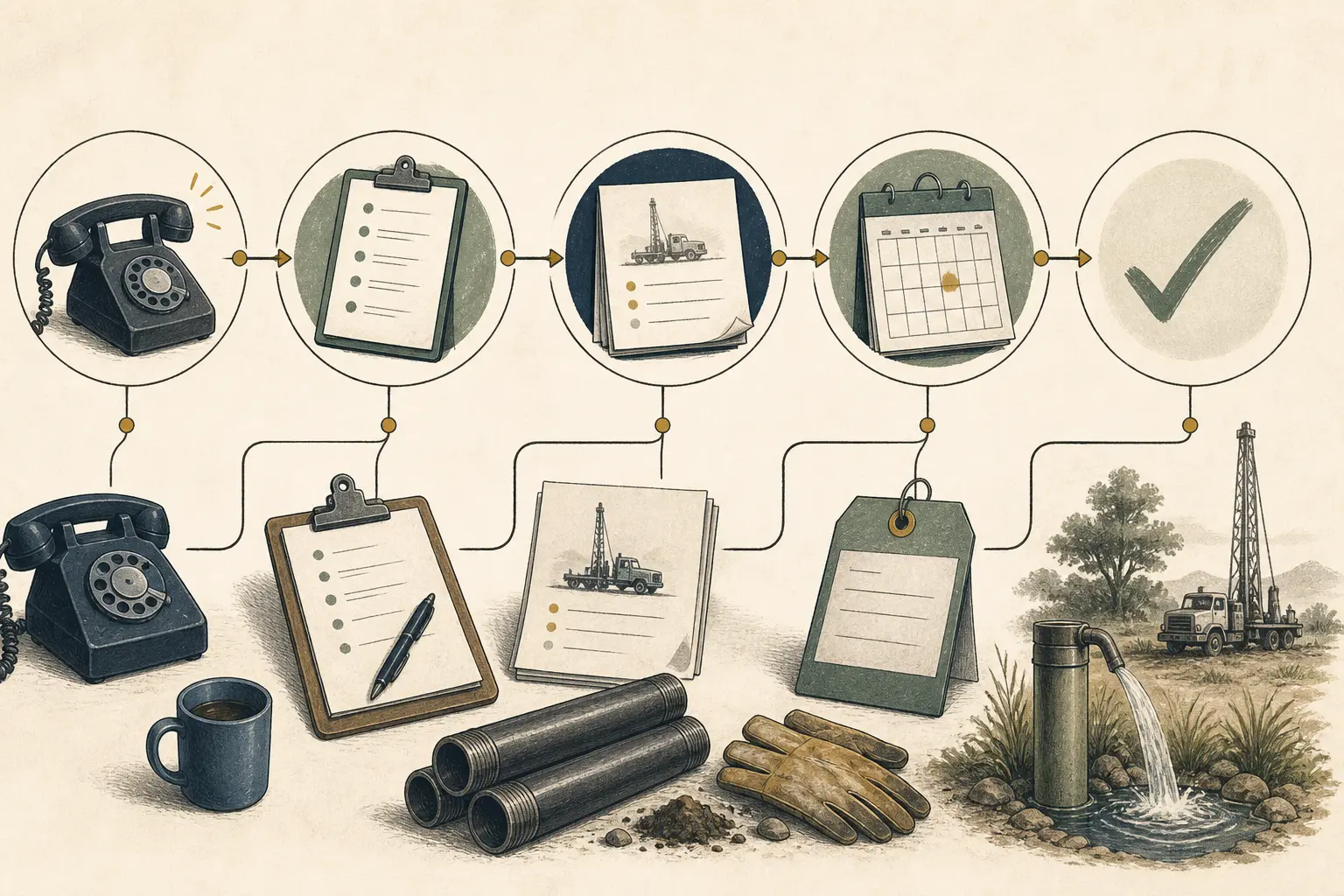
Fix the handoffs before expanding demand. The first month is for baseline truth, not for launching every channel at once.
Week 1: Decide what work and territory you want
Hold a short owner, operations, and office meeting. Build the capacity board. Rank desired job types for the next 30 and 90 days. Mark core, selective, and do-not-chase territory. Define the job-fit score and the action for high, medium, and low scores.
Then inspect ten recent inquiries. Could you tell where they came from, whether they fit, what happened next, and why they were won or lost? If not, you have found the first problem.
Week 2: Repair the public and intake basics
Check your Business Profile, website contact path, service descriptions, phone routing, and office coverage. Update only what you can stand behind. Make sure the same core service and territory language appears across the profile and relevant pages.
Create the first-call form and source taxonomy. Train the person who answers calls. Run a few role-play calls that include an urgent pump issue, a planned residential drilling request, a distant inquiry, and a commercial bid request. The point is not polished scripts. The point is clear routing.
Week 3: Activate low-friction trust sources
Review past customers and past estimates for legitimate follow-up opportunities. Build a short list of referral partners based on the work you want more of. Send useful, individual outreach. Publish or update one service page that makes a clear promise about work type, territory, proof, and next step.
Start a neutral review-request process for completed jobs. The FTC's guidance is a reason to keep it consistent and sentiment-neutral, not a reason to avoid asking satisfied and dissatisfied customers alike for honest feedback (FTC consumer reviews Q&A).
Week 4: Review and choose one controlled demand test
Look at qualified opportunities, not visitor counts. If the capacity board shows a real gap and the intake record is working, choose one test. It might be a narrow paid-search campaign, a more focused local service page, a specific partner relationship, or commercial outreach to a defined project type.
Define the test before it starts:
- Which job type are we trying to win?
- Which territory counts?
- Who owns response?
- What does a qualified opportunity look like?
- What data will tell us to continue, revise, or stop?
- What capacity limit makes us pause the test?
One clean test teaches you more than five overlapping campaigns.
What should the next 60 days look like?
Use days 31 through 90 to deepen the sources that clear the four gates. This is where a contractor can build a system rather than chase a short burst of activity.
Days 31 to 60: Prove one route to market
Pick the route that showed the strongest job fit in the first month. If it is local search, improve the service and territory evidence rather than posting generic updates. If it is referral partners, create a repeatable referral handoff and keep partners informed about the job types you can take. If it is paid search, tighten queries, geography, call handling, and negative exclusions based on actual bad-fit inquiries. If it is commercial outreach, improve your capability material and pursue relationships that match your scope.
Do not add a second major route simply because the first one is taking effort. It should take effort. You are establishing whether the work is repeatable.
Days 61 to 90: Build the second route and improve conversion
The first demand route may weaken because of seasonality, changing capacity, a competitor, or a temporary market shift. That is normal. A healthy operator eventually has more than one route, but not ten neglected ones.
Choose the second route based on the gaps exposed in the ledger. If Google produces good local drilling inquiries but no commercial work, the second route may be project influencers. If referrals are excellent but irregular, the second route may be organic service pages that capture existing demand. If paid search produces good pump calls but nothing for drilling, keep the channel narrow rather than forcing it to do both jobs.
At day 90, compare channels by booked jobs, job fit, territory fit, and margin band. Also compare effort. A referral relationship that produces one excellent job after three focused conversations may deserve more attention than a campaign that produced many raw calls and several bad estimates.
The winning channel is the one that produces work you want, in places you can serve, through a process you can repeat.
What mistakes keep well contractors from getting more work?
Most failures are not exotic. They are mismatches between what the company promotes and what it can operationally handle.
Mistake 1: Asking for “more leads” with no job definition
This creates a poor brief for anyone who helps with marketing and a poor filter for the office. Define services, territory, timing, minimum economics, and excluded work first. Otherwise every vendor, employee, and campaign optimizes for volume.
Mistake 2: Treating all calls as equal
An emergency pump call, a request to drill well beyond your territory, a builder inquiry, and a commercial bid invite should not all enter the same unqualified bucket. Give them different routes and response standards. The source-to-booked-job ledger makes this visible.
Mistake 3: Expanding the service area because a map has blank space
Blank space is not an opportunity by itself. It may represent distance, travel cost, poor response coverage, stronger local competitors, difficult permitting, or a market that does not contain the job type you want. Expand deliberately after a territory review.
Mistake 4: Running ads without tracking final outcomes
Google can give useful call and conversion data, but its documentation makes clear that different call actions measure different things. A mobile click can be a click rather than a completed call, and a duration threshold is not the same as a sale (Google Ads phone call conversion tracking). Track the job outcome in your own system.
Mistake 5: Writing generic service pages
Generic phrases create generic confidence. A useful page describes service fit, territory, relevant proof, and the next step. It should reduce uncertainty. It should not pretend every drilling job has the same scope, price, or subsurface condition.
Mistake 6: Ignoring old estimates and lost reasons
An estimate pipeline without follow-up states is a pile of memory. Add a next date, owner, and reason code. Some lost work will stay lost. But the pattern can show whether you have a response-time problem, a territory problem, an offer problem, or a source-quality problem.
Mistake 7: Trying to manufacture reviews
Fake, selectively solicited, or positivity-conditioned reviews are a legal and reputation risk. The FTC warns that the rule covers deceptive review practices and specifically prohibits conditioning incentives on a particular sentiment (FTC consumer reviews Q&A). Real completed-job requests are slower. They are also worth defending.
Mistake 8: Confusing a busy schedule with profitable growth
If the company is booked with poor-fit, distant, low-margin, or chaotic work, demand generation succeeded only in the narrowest sense. Review job mix and margin bands with the same seriousness as call count.

When should you not try to get more well drilling jobs?
Pause demand expansion when the bottleneck is delivery, safety, staffing, cash flow, or customer experience. More inquiries do not fix a crew shortage. More traffic does not resolve slow estimates. More booked work does not help if the office cannot return calls or the schedule cannot absorb another commitment.
Use a pause rule. Stop or reduce a campaign when any of these are true:
- Response times exceed the promise you made to prospects.
- The current backlog is beyond what crews can deliver responsibly.
- The inquiry mix is repeatedly outside your territory or capability.
- The company cannot track booked outcomes well enough to judge source quality.
- A safety, licensing, insurance, or cash-flow issue needs management attention.
- The estimated work is consuming field time without enough qualified or won jobs.
The right alternative may be a conversion improvement, partner qualification, estimate follow-up process, hiring plan, or territory reduction. None of those are glamorous. All can be more valuable than another lead source.
This is also when you should resist “visibility at any cost.” Google says local ranking is not something a business can buy on request. Relevance, distance, and prominence combine in the results (Google local ranking guidance). A promise to put you everywhere immediately should trigger skepticism, especially when your real service capacity is narrower.
How can answer engines and search content support this plan?
Make your public information easier to verify and easier to quote. This is a secondary benefit of running the proof gate well, not a separate marketing trick.
When someone asks an answer engine which local provider handles a particular kind of work, the engine needs clear, public facts. Service pages, profile data, genuine reviews, relevant third-party mentions, and an accurate statement of territory give it something to retrieve. The same materials help a human compare companies.
Do not expect a guarantee that an assistant will mention your company. No one can responsibly promise that. But you can make your company less ambiguous: name your services accurately, show who you serve, publish proof you can verify, keep your contact data current, and create pages that answer real buyer questions. Brictale's guide on getting your brand mentioned in ChatGPT explains the retrieval side in more detail.
The important guardrail is the same one that makes the site useful to a buyer. Google advises creators to focus on helpful, reliable, people-first content rather than content made primarily to manipulate rankings (Google Search Central). A well contractor's best answer-engine strategy is not to publish fifty thin town pages. It is to build a public record that makes accurate matching easier.
What is the owner’s weekly operating checklist?
Use this checklist every week until the system is ordinary. Then use it when a schedule gap, territory change, or new service creates a demand question.
- Review open rig, crew, pump, and estimator capacity by job type.
- Confirm which job type and territory you are actively trying to win this week.
- Check missed calls, response times, and inquiries with no next action.
- Review new leads by source, job-fit score, and territory tier.
- Follow up on all qualified estimates with a next date and named owner.
- Read lost and declined reasons for patterns.
- Check that the Business Profile, website phone path, and service messages are still accurate.
- Make one useful touch with a referral partner or past relationship that fits the work you want.
- Request honest reviews through the standard completed-job process.
- Continue, revise, or stop one demand test based on booked-work evidence.
The checklist is deliberately plain. It produces an operating rhythm. And a rhythm beats a burst of marketing activity that nobody owns after the first week.
What is the verdict?
To get more well drilling jobs, do not begin by trying to be visible everywhere. Begin by deciding which work deserves more capacity, where it is worth serving, what proof a buyer needs, and how your office will record the result.
Then strengthen the sources nearest to real demand: accurate local visibility, past relationships, referral partners, focused service pages, and narrow paid tests when tracking is ready. Keep only the routes that generate suitable booked work. Cut the ones that create noise.
If you cannot see which territory, service page, competitor gap, call path, or local-search problem is holding back the work you want, Brictale's free territory audit is the right next step. It is built to identify the gap before you spend more on promotion.