How to Verify New-Home Plumbing Tests Before Drywall
A homeowner release worksheet for verifying potable-water pressure and DWV test records before drywall, slab close-up, or other concealment.
The short answer
Authorize concealment only when the permit scope, adopted local test method, installed material, test conditions, visible result, and AHJ or qualified-trade sign-off are all documented. Treat potable-water pressure and DWV evidence as separate rows. If a pressure, head, duration, material, isolation, cure, or inspection record is missing or conflicts with the adopted code, stop the handoff and assign repair or retest to the builder, licensed plumber, or AHJ.How to Verify New-Home Plumbing Pressure and Drainage Tests Before Drywall
Before insulation, drywall, slab close-up, or another concealment step, authorize the plumbing handoff only when the permit scope, adopted local test method, installed material, test conditions, visible result, and responsible-party sign-off are documented. Keep potable-water and DWV evidence separate. A passed inspection without a test record is incomplete evidence; a pressure number without material, isolation, duration, and jurisdiction is not a release.
The release decision is evidence completeness, not a pressure number #
The safe release decision is approve concealment, hold for missing evidence, or return to the builder and plumber for repair and retest—not “the gauge showed a large number.” In the United States, the exact requirement comes from the code adopted by the project’s authority having jurisdiction (AHJ), its amendments and permit conditions, and the installed product instructions. The model-code examples below help you read a record, but they do not replace the local rule.
The evidence packet should let a person who was not standing at the test answer five questions:
- What was tested? Identify the completed section, floor, branch, water-supply zone, DWV section, underground segment, or other boundary. A whole-house statement is not enough if only one phase was tested.
- Under what rule? Record the adopted code edition and section, AHJ form or written direction, permit number, and any approved alternative method.
- Under what conditions? Name the medium, pressure or water head, duration, gauge, temperature, cure condition, isolation, and date/time.
- Who verified it? Separate the builder or licensed plumber’s test record from the AHJ’s inspection approval. The two people may rely on the same test, but they are different responsibilities.
- What happens next? The packet should say either “release to insulation/drywall or slab close-up” or identify the defect owner, repair, retest boundary, and next inspection.
This page’s original contribution is a Pre-concealment plumbing release matrix. It is a decision matrix and worksheet, not an official inspection form.
Original contribution method: Compare the adopted-code test scope confirmed by the authority having jurisdiction with the installed pipe and fitting manuals, then map each required condition to an owner, record, observation, defect status, and next handoff.
Original contribution limitations: This is an evidence-collection and handoff tool, not an official inspection form, engineering determination, laboratory result, or instruction for a homeowner to perform pressure testing. The adopted code, permit, AHJ form, licensed plumber, and product instructions control.
Those limits mean the matrix cannot determine whether an unseen joint is correctly assembled, certify a code-compliant installation, or authorize work in a specific jurisdiction. Only the AHJ and qualified trade professionals can do that within their roles.
Originality brief: the missing decision and how to check it
Current answers usually explain a model-code water test, an inspector’s rough-in visit, or a manufacturer’s pressure-test procedure in isolation. The missing decision is whether the homeowner has enough separate, material-appropriate, jurisdiction-aware evidence to release concealment. This article contributes a source-comparison matrix that distinguishes water-supply pressure evidence from DWV evidence, then adds a release gate and failure branches. You can check it by matching each matrix row to the permit, AHJ form, test sheet, installed pipe marking, gauge photo, inspection result, and retest record. If a row cannot be matched, the packet is not complete.
What “complete” means
“Complete” does not mean that every line has a homeowner’s signature. It means the right party owns each fact and the packet contains enough information to reconstruct the event. For example, the homeowner can request and store the plumber’s signed test report; the plumber is responsible for performing the test safely and accurately; the builder or general contractor coordinates the sequence; and the AHJ inspector decides whether the inspection satisfies the permit. The homeowner should not become the tester by default.
The model-code framework illustrates why the rows must be separate. ICC’s public code-adoption guidance explains that an authority having jurisdiction adopts a model code through an ordinance, regulation, or law and may include amendments. ICC’s accessible plumbing testing excerpt describes testing DWV work before cover. Use both as background, not as your local permit office’s final instruction.
The result you want before concealment is a closed chain of evidence:
installed scope → applicable rule → correct test method → recorded conditions → visible outcome → sign-off → repair/retest closure → next handoff
If any arrow is missing, stop the release and ask the builder to close the gap. You are not accusing anyone of defective work; you are preventing an irreversible evidence gap while the piping remains accessible.
Use the matrix in a short coordination review before the test date, not only after a disagreement. The builder can mark the rooms and branches that are scheduled for release, the plumber can fill in the material and test-method rows, and the permit applicant can confirm what the authority having jurisdiction expects to see. The homeowner’s review is then a completeness check: compare the packet with the matrix, circle blanks, and ask who owns each blank. This keeps the conversation about an evidence boundary rather than about whether a single gauge photograph looks convincing.
The matrix also makes partial release possible without turning it into a shortcut. If the first-floor supply branches and DWV stack have separate records but the garage branch is deferred, the first floor may be considered for release only if the builder and local inspection process allow that phase and the plan markup makes the boundary unmistakable. A complete packet for one area is not permission to cover an adjacent area. Record the release as a location and scope decision, with the remaining section visibly held for the next test event.
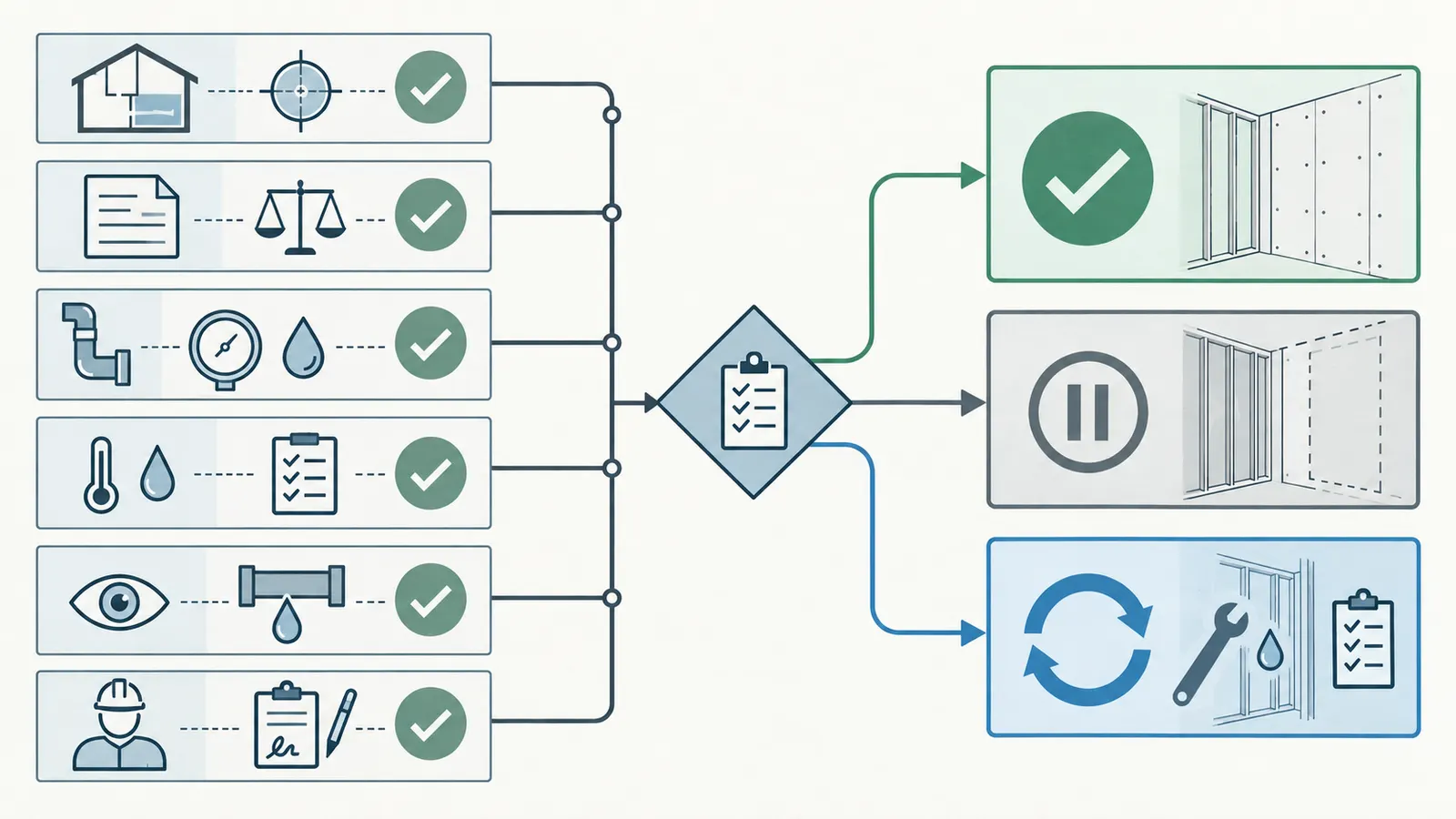
Confirm the governing code, permit and test scope before anyone tests #
The first action is to identify the actual AHJ and adopted rule for the project, then ask the builder or licensed plumber to confirm the test plan in writing before test equipment is connected. The United States has no single national plumbing inspection procedure that automatically controls every new home. A city, county, state, tribal, or other governmental AHJ may adopt the International Plumbing Code, the International Residential Code plumbing provisions, the Uniform Plumbing Code, a state plumbing code, or amendments and local administrative procedures.
Identify the jurisdiction precisely
Record the project’s:
- state;
- county, city, town, or other permitting jurisdiction;
- permit-issuing office and permit number;
- AHJ name or department;
- code edition named on the permit or approved plan;
- plumbing code family and adopted amendments;
- inspection type and required notice method; and
- written local direction on accepted water, air, vacuum, or other alternatives.
Do not write “the code requires” in your project log until this row is filled. Write “the 2024 IPC model text says…” or “the City of [actual jurisdiction] permit office’s rough plumbing form says…” until the local adoption is confirmed. If you do not know the jurisdiction, the builder or permit applicant should obtain the permit record and the AHJ contact. An online code page without the adoption ordinance is not proof that the page controls your home.
ICC’s public adoption guidance makes the distinction explicit: the code becomes enforceable through adoption by the governmental jurisdiction, which may amend it. The accessible ICC testing excerpt says DWV work should be tested before cover; your AHJ may use different inspection names, forms, timing, or code sections. Use the ICC code-adoption resources and ICC testing excerpt to prepare questions, then get the project-specific answer from the permitting office.
Ask for the AHJ’s test answer in a narrow format
The question to send is not “Can we pressure test the plumbing?” Send a short request that forces scope and responsibility into the open:
For permit [number] at [project address], before [drywall/insulation/slab close-up], please confirm the required pre-concealment tests for (1) potable-water supply piping and (2) DWV piping; the accepted test medium for each installed material; required pressure or water head; test duration; required gauge or equipment; whether fixtures and equipment must be isolated; the required test record; and whether AHJ attendance or a signed inspection approval is required before concealment.
Ask the builder to attach the answer to the permit file. If the AHJ answers by telephone, the permit applicant should write down the date, staff name if provided, department, exact direction, and any form or code section referenced. The homeowner can keep that note, but it remains the builder’s responsibility to resolve conflicting directions with the AHJ.
Verify the scope boundary on the drawings and in the field
Before testing, mark the boundary on the plumbing plan or a simple floor sketch. Include:
- service entry or source connection;
- cold and hot potable-water branches;
- recirculation, hose-bib, exterior, or accessory branches if part of the permit;
- water-heater connections and equipment stubs;
- fixture valves and capped outlets;
- building drain, branches, stacks, vents, cleanouts, traps, and underground segments;
- any hydronic or fire-sprinkler system, if present, kept separate from this record; and
- sections intentionally deferred to a later phase.
The purpose is not to make the homeowner redraw the plumbing. It is to prevent a record for “house plumbing” from silently excluding the guest wing, garage, slab piping, exterior wall, or a later-added branch. A phased test can be valid if each section and overlap is documented. The record should state whether the section was tested alone, overlapped with a preceding section, or connected to the whole system.
Put the sequence on the construction schedule
The builder should schedule, in order:
- complete the permitted rough-in section and make all joints accessible;
- confirm pipe material, fitting system, solvent-cement or connection cure, temperature, and protection from freezing;
- isolate fixtures, equipment, appliances, valves, or other components not rated for the test;
- perform the water-supply and DWV tests using the method approved for the jurisdiction and material;
- correct visible leaks, pressure loss, blocked sections, unsupported piping, or documentation gaps;
- notify the AHJ and provide the required records;
- complete the rough plumbing inspection or required sign-off;
- photograph accessible conditions and approved repairs; and
- release the specific area to the insulation, drywall, slab close-up, or next trade handoff.
US EPA moisture-control guidance supports the construction logic behind this sequence: it says plumbing should be installed to facilitate discovery and repair during construction and recommends scheduling testing before piping and components are closed in. See the official EPA Moisture Control Guidance PDF. This is moisture-management guidance, not an AHJ approval, but it explains why a late “we tested it after drywall” conversation is a poor substitute for the pre-concealment release.
Responsibility should move in a visible sequence. The plumber or plumbing contractor owns the safe test setup, the observed result, and the technical record. The builder or general contractor owns coordination: making sure the tested boundary is complete, the inspection is scheduled, and no downstream trade closes an area on an unresolved hold. The permit applicant owns communication with the AHJ when the rule or acceptance method is unclear. The homeowner owns the request for records and the decision to withhold a contractual or owner release when the packet is incomplete; the homeowner does not take over the tester’s professional duty.
Before the scheduled test, ask for three confirmations in the same email or project log: the drawing or room list that defines the boundary, the written method or AHJ instruction that governs it, and the time by which the signed result will be delivered. After the test, ask for the same three items updated with the result, exceptions, and next handoff. If a trade says the inspection itself is the only record, ask whether the jurisdiction actually supplies that record and whether the inspection covered both systems. The answer may be “the AHJ form is the record,” but that answer should be attached to the permit file rather than assumed.
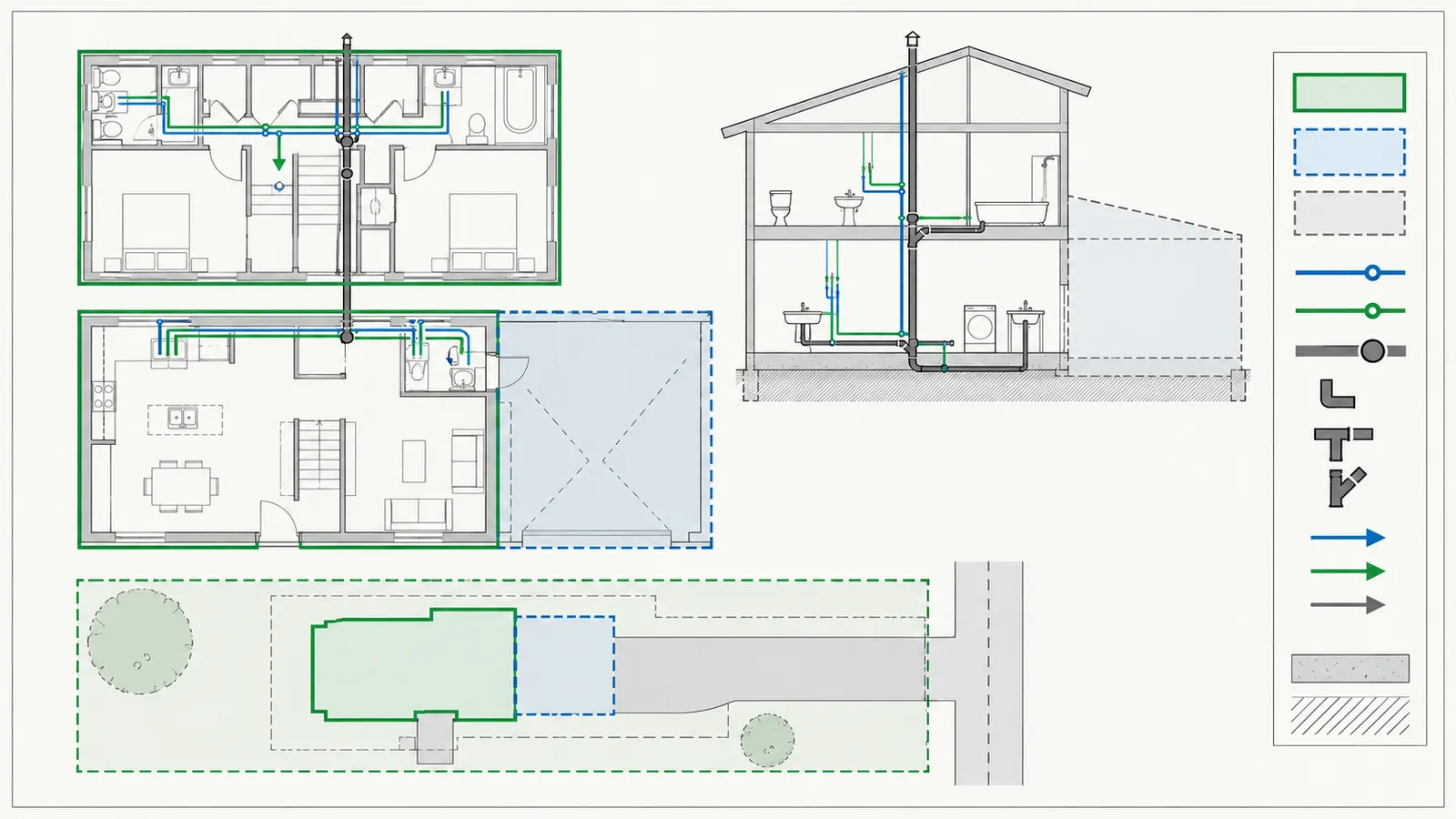
Separate potable-water pressure evidence from DWV evidence #
Potable-water supply piping and DWV piping are different systems with different material uses, test methods, and failure consequences. Keep separate records even if the same plumber and inspector visit the site on the same day. A signed water-supply pressure sheet cannot prove that the drainage and vent system was tested, and a DWV water test cannot prove that the potable-water supply piping held its required pressure.
Potable-water supply: prove the pressure test belongs to the installed system
For potable-water supply, the record should identify the piping material and system, the section tested, the source of test water, the test pressure, the duration, the gauge, the components isolated, visible inspection results, and the person who performed and reviewed the test. The installed product manual may add conditioning or pressure rules. For example, Uponor’s US PEX guide says residential Uponor PEX should be pressurized to 25 psi above working pressure or 100 psi and tested in accordance with local code. That is product-specific guidance, not a universal rule for every PEX brand, every water-supply material, or every jurisdiction. See the Uponor PEX pressure-testing section.
The corrected 2024 IPC Section 312.6 model text uses a different formulation: water pressure not less than the system working pressure, held for at least 15 minutes, with test water from a potable source. The wording is reproduced in ICC’s official 2024 IPC code-development PDF; that PDF is a reader-accessible ICC source, not proof that your jurisdiction adopted the 2024 IPC. The 50 psi-above-normal-working-pressure and 150 psi minimum wording belongs to New York City’s local Plumbing Code Section 312.5, as shown in the New York City Plumbing Code. If the project is in New York City, that local rule may control; elsewhere, confirm the actual adopted code, amendments, permit conditions, and product manual rather than choosing the highest number you find online.
This apparent difference is exactly why the record needs a “governing rule” row. A homeowner should not resolve a conflict by asking the plumber to use the most demanding value or by assuming the manufacturer’s number overrides the code. The permit applicant and licensed plumbing professional should obtain the AHJ’s direction, especially when equipment, valves, filtration, water heaters, expansion tanks, appliances, or specialty fittings have lower pressure ratings.
DWV: water head, not supply pressure, is the usual reference for plastic drainage piping
DWV means drain, waste, and vent piping. For plastic DWV, the question is normally whether the system remains tight under the approved water head or another AHJ-accepted method, not whether the pipe can safely be treated like a pressurized water-supply line. Charlotte Pipe identifies its PVC DWV as non-pressure-rated, with zero maximum working pressure, and recommends a 10-foot hydrostatic test head equal to about 4.3 psi. Read the Charlotte Pipe DWV product and installation manual for that product-specific distinction.
The 2024 IPC model text gives this requirement in Section 312.2 of ICC's official 2024 IPC PDF: a section must be filled with water to at least a 10-foot head, held for at least 15 minutes, and tight at all points. That is still model-code text, not proof that the AHJ for your home adopted the 2024 IPC without amendments. The older ICC Plumbing Code Essentials testing excerpt is retained as historical explanatory context from the 2018 series. Ask the permit holder to reconcile the adopted local rule with the installed material and the plumber’s record.
A worked illustrative head calculation
The relationship between water depth and pressure is useful for reading a record:
pressure in psi ≈ 0.433 × water head in feet
Illustrative example, not a field test:
- 10 ft head × 0.433 psi/ft ≈ 4.33 psi;
- 8 ft head × 0.433 psi/ft ≈ 3.46 psi;
- 12 ft head × 0.433 psi/ft ≈ 5.20 psi.
The 10-foot example aligns with the roughly 4.3 psi value in Charlotte Pipe’s DWV guidance and the 10-foot model-code water-head concept. The calculation is a reading aid. It is not permission to use 8 ft because it is “close,” to pressurize plastic DWV to a supply-piping value, or to substitute a gauge reading for the required head and visual inspection.
| Illustrative water head | Approximate pressure | What the number does and does not tell you |
|---|---|---|
| 8 ft | 3.46 psi | Shows why a shorter standpipe is not the same as a 10-ft head; it does not establish acceptance. |
| 10 ft | 4.33 psi | Illustrates the model-code and Charlotte Pipe reference; acceptance still depends on section, duration, material and AHJ. |
| 12 ft | 5.20 psi | A higher head may add load but does not cure an untested branch, uncured joint or wrong test medium. |
Water density varies slightly with temperature, and field geometry may make the actual head measurement harder than the arithmetic suggests. The plumber should document the point from which the head is measured, the highest fitting or opening, the plugged openings, and the start and end of the hold. The homeowner’s role is to request that record and check whether it answers the required rows.
Do not accept “pressure tested” as a universal phrase
Ask which of these the record means:
- potable-water supply pressure test;
- DWV water or hydrostatic head test;
- permitted DWV air test for nonplastic piping;
- AHJ-accepted DWV vacuum test;
- fixture, shower receptor, or appliance-specific test;
- underground building sewer test; or
- a manufacturer’s installation quality check.
These are not interchangeable. The 2024 IPC model text says in Section 312.3 of ICC's official 2024 IPC PDF that plastic piping shall not be tested using air; it describes the 5 psi or 10-inch mercury-column air method for nonplastic piping and a 15-minute hold, subject to the adopted code and AHJ. The older ICC Plumbing Code Essentials testing excerpt remains historical explanatory context from the 2018 series. Verify the adopted edition, amendments and current AHJ procedure before treating any method as accepted on this project.
Read the test record like a verifier #
A useful test record makes the event reproducible enough for a qualified professional or AHJ to understand what happened without relying on memory. It does not need to be elaborate, but it must be specific. A photograph of a gauge is supporting evidence, not a complete record: it may show a number but not the test boundary, duration, material, medium, isolation, cure condition, or whether the gauge was at the correct location.
The minimum record fields
Request a record with these fields for each tested system or section:
| Record field | What to request | Why it changes the decision |
|---|---|---|
| Project identity | Address, permit number, date, floor/phase | Connects the sheet to the correct home and event. |
| Governing rule | Adopted code edition and section, AHJ form, amendment or written alternative | Prevents a model-code number from being treated as a local rule. |
| System | Potable water, DWV water, DWV air, vacuum, sewer, or other named test | Prevents one test from standing in for another. |
| Boundary | Room, floor, branch, stack, underground segment, or complete system | Shows what was actually included and what remains open. |
| Material | Pipe, tubing, fittings, joining system and manufacturer where relevant | Determines compatibility with the test medium and product instructions. |
| Test medium | Potable water, air, vacuum, or other AHJ-approved medium | A medium can be disallowed for a material or component. |
| Pressure or head | Gauge pressure, negative pressure, or measured water head with units | Allows comparison with the governing rule and product limit. |
| Gauge/equipment | Gauge range and increment, location, pump or vacuum equipment, calibration/verification if required | Makes a reading interpretable and flags a gauge too coarse for a low-pressure test. |
| Conditioning/cure | Solvent-cement cure, PEX conditioning, temperature, humidity, freezing protection | A test too early or under the wrong condition may not represent the installed system. |
| Duration | Start, end, hold time and any permitted adjustment before the test | Separates a snapshot from the required hold. |
| Isolation | Fixtures, water heaters, appliances, valves, filters and low-rated components isolated or included | Protects components and shows whether the result covers them. |
| Observation | Visible leaks, movement, wet joints, pressure change, head loss, blocked openings or other result | States what happened rather than just “passed.” |
| Defect status | None, repair required, unresolved, or accepted exception with authority | Prevents an open issue from hiding inside a pass label. |
| Sign-off | Plumber/contractor, builder/GC, AHJ inspector or other named role | Assigns responsibility without confusing roles. |
| Attachments | Plan markup, gauge/head photos, repair photos, inspection card, AHJ email | Lets the next handoff audit the record. |
| Next handoff | Release area, hold, repair/retest, or additional inspection | Turns evidence into an actual construction decision. |
Gauge evidence is not the whole test
For a low-pressure DWV test, gauge resolution matters. ICC's 2024 IPC Study Companion sample states that a test requiring 10 psi or less should use a gauge with increments of 0.10 psi or less. That is a reason to ask what gauge was used and where it was connected, not a reason for a homeowner to buy a gauge and repeat the test. The older ICC testing guidance also describes the need to verify the gauge for the test.
For a water-head test, a gauge may supplement the record, but it cannot replace the measured vertical head if the governing rule specifies head. Conservative boundary of this worksheet: Brictale does not infer from a number alone that the required head was created, that the measurement point was correct, or that the test assembly and site conditions were appropriate. The responsible tester should record the fill point, highest opening, measurement location, test assembly, and any conditioning or adjustments so the qualified professional and AHJ can verify the stated condition.
For a potable-water pressure test, the record should not imply that a gauge was left connected to an unprotected component merely to create a photograph. Uponor’s guide says components, fixtures and equipment not rated for the test pressure should be isolated in its procedure and says to visually check for leaks while monitoring pressure for the local-code duration. See the Uponor isolation and monitoring procedure.
Understand the difference between a result and a permit approval
There are at least three different statements that may appear in the packet:
- The system was tested. This is a contractor or plumber record describing an event.
- The system was observed to be tight under the stated conditions. This is a result bounded by the test medium, time, temperature, scope and visible access.
- The AHJ approved the inspection. This is a governmental inspection outcome tied to the permit and local process.
One does not automatically prove the others. A plumber can perform a test before the inspector arrives. An inspector can approve the rough-in based on required observations and records. A builder can keep a photo packet even when the AHJ does not issue a detailed test sheet. Your release packet should preserve whichever records the actual process provides and name what is missing.
Do not infer that a passed rough inspection guarantees future leak-free performance. The inspection is a point-in-time review of accessible work; concealment removes access and can make later failures more expensive to locate. EPA’s guidance links pre-close testing with finding and repairing problems while they are still accessible. That is a risk-management reason for the release gate, not a claim that testing detects every future defect.
What photos can safely establish
The homeowner can request photos that show:
- a wide shot locating the test section in the room or floor;
- the test assembly and gauge/head reference without obscuring the reading;
- capped or plugged openings and the highest point for a DWV water test;
- material markings or product labels where visible;
- accessible joints before concealment;
- any wet joint, repair, replacement, or reassembled connection; and
- the inspection card, approved tag, or AHJ result if the jurisdiction uses one.
Conservative boundary of this worksheet: Brictale treats photos as context for the record, not as proof of hidden slope, support spacing, joint insertion, vent termination, pipe sizing, cross-connection protection, or gauge accuracy. Those questions require the responsible professional’s review, plans and specifications, or the AHJ’s inspection process. Do not enter an excavation, climb framing, stand below suspended work, open energized electrical equipment, disconnect a test assembly, or touch pressurized plugs or caps to obtain a better photo.
Use the pre-concealment release worksheet #
Use the worksheet below as a coordination tool. The homeowner can fill the request and evidence columns from documents supplied by the builder, plumber, and AHJ. The homeowner should not fill a blank pressure or duration from a guess. A blank is a hold, not permission to estimate.
Part A: prerequisites and responsibility
| Check | Evidence to collect | Primary owner | Homeowner verification question |
|---|---|---|---|
| Permit exists and covers the plumbing scope | Permit number, approved plan, inspection type | Builder/permit applicant | Is this the permit and address for this home? |
| AHJ identified | Government office, contact, adopted code edition and amendments | Builder/permit applicant | Which actual jurisdiction controls this address? |
| Test method confirmed | AHJ form, written direction, or permit instruction | Builder and licensed plumber | Is each method accepted for this material and phase? |
| Installed materials identified | Product names, markings, submittals or delivery records | Licensed plumber | Does the record name the actual pipe and fitting system? |
| Test boundary marked | Plan markup or room-by-room list | Builder and plumber | Which branch, stack, floor or underground section is included? |
| Test timing scheduled | Date/time before concealment and inspection notice | Builder/GC | Will the test occur while joints and connections remain accessible? |
| Safety plan in place | Qualified workers, exclusion zone, pressure-release plan, PPE | Builder and plumber | Am I observing from a safe location without interfering? |
| Downstream handoff reserved | Insulation/drywall/slab-close-up sequence | Builder/GC | Which exact area remains on hold until the packet closes? |
Part B: source-comparison and test record matrix
| Decision row | Potable-water supply | DWV water test | AHJ-accepted alternative, if any |
|---|---|---|---|
| Governing rule | Record adopted code, AHJ form and product manual | Record adopted code, AHJ form and product manual | Record the written acceptance and code section, not a verbal shortcut |
| Installed material | PEX, copper, CPVC, pressure-rated plastic, or other exact system | PVC, ABS, cast iron, or other exact DWV system | Name the material that makes the alternative acceptable |
| Test medium | Usually water if required by code/product; record actual medium | Water head if required; record actual medium | Air or vacuum only when the AHJ and material permit it |
| Pressure/head | Record psi and/or working-pressure relationship | Record measured vertical water head and units | Record negative pressure or other accepted condition with units |
| Duration | Record required hold, start/end, and permitted conditioning | Record required hold, start/end and visible result | Record the exact AHJ duration, not “overnight” |
| Gauge/equipment | Gauge range/increments and location | Head measurement, gauge if used, plugs and fill point | Pump/vacuum equipment, regulator and relief controls where required |
| Temperature/cure | Product conditioning, ambient temperature, freeze protection | Solvent-cement cure, water/air temperature and humidity if relevant | State why the alternative is valid under these conditions |
| Isolation | Water heater, fixtures, appliances, filters, valves and low-rated components | Components or openings that must be protected or excluded | Record what was isolated and whether the approved scope excludes it |
| Visual result | No visible leak or other stated defect | Tight at all points or named leak/defect | State the accepted result in the AHJ’s terms |
| Sign-off | Plumber/contractor and AHJ role if required | Plumber/contractor and AHJ role if required | Name the approving authority and record number |
| Photos | Gauge, scope, material and repairs | Head, plugs, scope, material and repairs | Alternative equipment and boundary photos |
| Release status | Release, hold, or repair/retest | Release, hold, or repair/retest | Release only for the scope actually accepted |
Part C: the release gate
Mark each row yes, no, or not applicable with explanation:
- The correct permit and actual AHJ are identified.
- The adopted code edition, amendment, AHJ form, or written alternative is attached.
- Potable-water evidence is separate from DWV evidence.
- The test boundary includes every area being released to the next trade.
- The installed pipe, fittings and joining system are named.
- The test medium is permitted for that material and accepted by the AHJ.
- The pressure, water head, or negative pressure is recorded with units.
- The gauge/equipment and location are recorded where relevant.
- Required cure, conditioning, temperature and freeze-protection conditions are recorded.
- Fixtures, equipment and components outside the test rating are isolated or the record explains why they are included.
- The duration has start/end times or an accepted measured hold.
- The visible result and any pressure/head change are recorded.
- Defects are either closed with repair evidence or assigned to a retest branch.
- The required plumber/builder/AHJ signatures or inspection result are present.
- Photos and plan markup identify the actual tested section.
- The builder has stated the next handoff and held concealment for any open row.
Release rule: if any required row is “no” or blank, do not authorize the affected area for concealment. Ask the builder to identify whether the gap is documentation-only, requires a witnessed review, requires a new test, or requires repair. A documentation gap can be corrected with the responsible party’s record; a suspected leak or wrong test medium needs qualified professional action.
A modeled example of a complete packet
The following is an illustrative modeled example, not a report from a real home and not a recommended universal test value.
Suppose a builder asks to close the walls on the first floor. The packet says:
- permit: local residential building permit, exact AHJ and adopted code recorded;
- tested area: first-floor cold and hot supply branches from the manifold to capped fixture outlets, excluding a water heater because it was not rated for the test condition;
- material: a named PEX product and fitting system;
- test medium: potable water;
- product condition: the plumber checked the PEX manual and local code before selecting the test condition;
- test condition: the exact psi and duration are recorded, with a gauge photo and start/end times;
- result: no visible leaks and no unapproved pressure reduction;
- DWV: first-floor branch and stack section filled to the recorded head, held for the required time, and recorded as tight at all points;
- inspection: AHJ rough plumbing result attached, or the record states the inspection is scheduled and concealment remains held until approval if required;
- next handoff: builder releases only the first-floor walls included in the packet, while the garage and slab section remain open.
That packet is stronger than a photo labeled “plumbing passed” because it has scope, material, rule, condition, result, owner, and boundary. It still does not prove that every future fixture will function, that hidden supports meet every code detail, or that a later alteration will not create a leak.
Sensitivity: why missing inputs matter more than a dramatic number
In the modeled DWV calculation, changing the head from 10 ft to 8 ft changes the approximate pressure from 4.33 psi to 3.46 psi, a difference of about 0.87 psi. That number is not the main concern. The main concern is that the test may no longer match the rule. Similarly, on a PEX supply test, a record that says “100 psi” but omits whether the line was conditioned, whether a water heater was isolated, and how long it was held cannot be interpreted safely from the number alone.
Use this sensitivity prompt:
| If this input changes… | Ask what changes in the decision |
|---|---|
| Pipe material | Is the test medium still permitted, and do the manufacturer instructions change? |
| Section boundary | Did a new branch or concealed area escape the test? |
| Head/pressure | Does the recorded value still meet the adopted code or AHJ direction? |
| Duration | Was the required hold actually completed, and were adjustments made before it began? |
| Temperature or cure | Was the joint or material ready for testing under the stated conditions? |
| Isolation | Were fixtures or equipment exposed to a pressure they cannot accept, or excluded from the claimed scope? |
| Inspection timing | Was the required sign-off obtained before concealment, or is the area still on hold? |
This is the practical meaning of the source-comparison method: compare inputs, not just outputs.
Reconcile the packet in two passes
Start with a scope pass. Put the plan markup, permit description, test sheet, and inspection result beside one another. Highlight every room, branch, stack, stub, underground segment, or deferred phase that appears in one document but not the others. A missing name does not prove that the piping was omitted, but it prevents the reviewer from knowing whether the record covers the area being closed. Ask the builder to resolve the mismatch before the next trade arrives; do not let a broad phrase such as “rough plumbing complete” do the work of a boundary.
Then make a condition pass. For each included system, compare the installed material and joining method with the allowed medium, pressure or head, duration, isolation, cure, and observation. The pass should end in one of three statements: the record supports release for the named area; the record is incomplete and the area remains on hold; or the evidence indicates a defect or method conflict that requires qualified repair, AHJ clarification, or retest. A number can be transcribed accurately and still fail this pass if the record omits the condition that gives the number meaning.
The two-pass approach is especially useful when the plumber uses one visit to test multiple systems. A single date and signature do not merge the systems. Keep one row group for potable water and another for DWV, then attach the same inspection result to both only if the result clearly covers both boundaries. If the inspector’s form uses a single rough-plumbing checkbox, preserve the detailed contractor sheets alongside it and note what the checkbox does and does not identify.
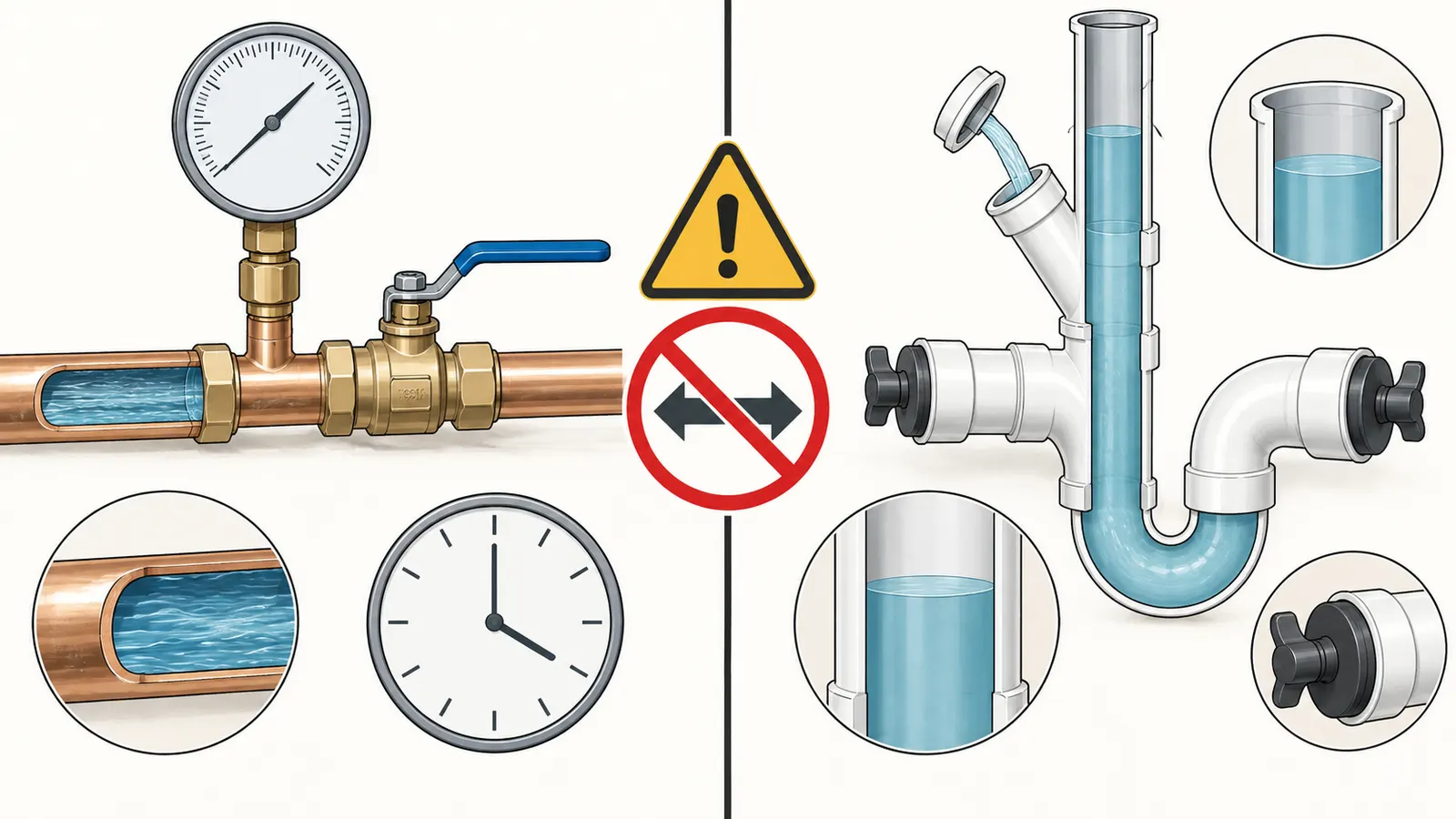
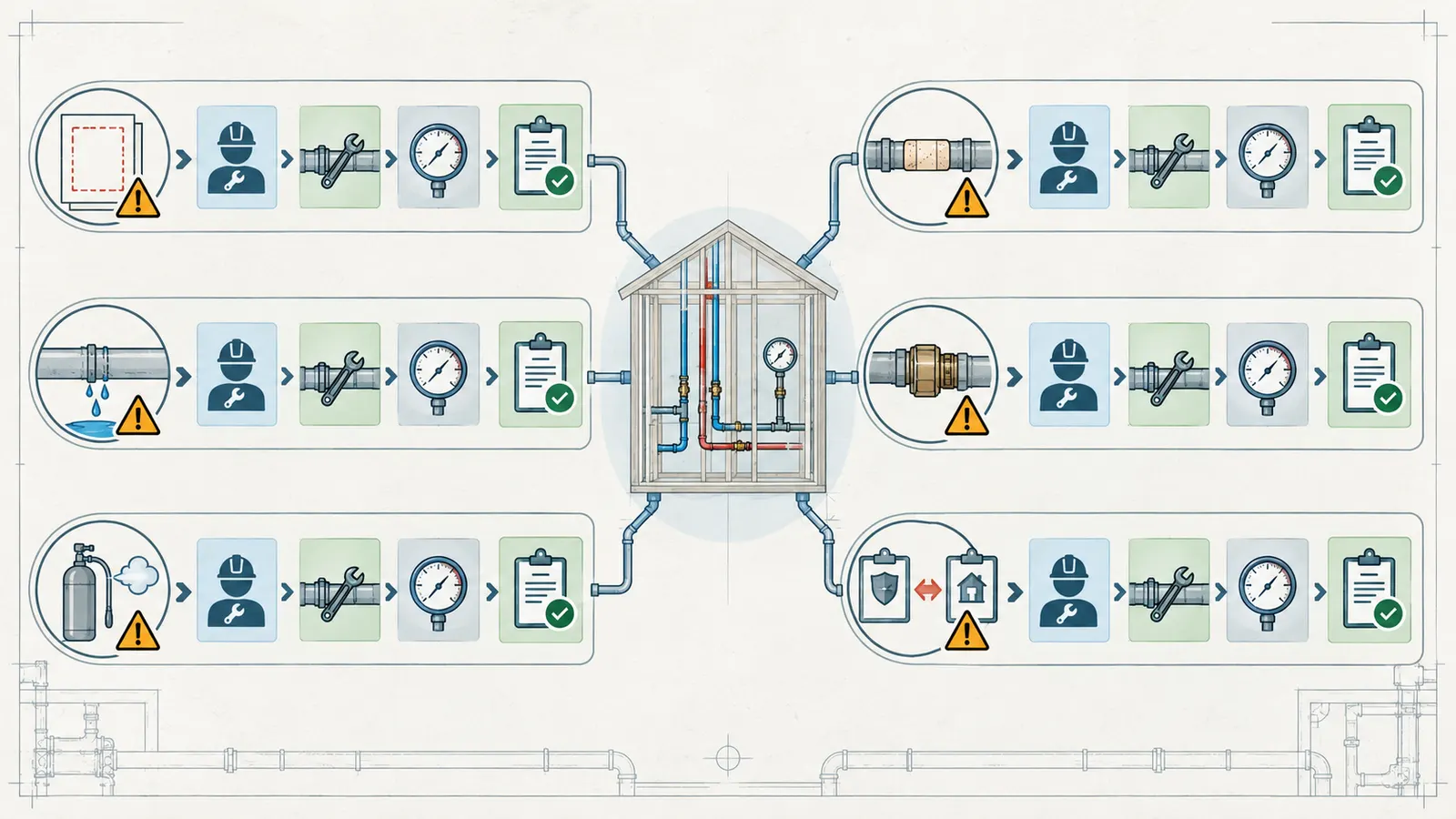
Branch failed, missing, or conflicting evidence into repair and retest #
When evidence fails, the next step depends on the failure type. Do not compress every problem into “retest” or “pass anyway.” Some issues are records gaps, some are visible defects, some are unsafe test choices, and some are scope conflicts that require the AHJ’s answer.
Branch 1: no record exists
If the builder says the test happened but cannot provide a record, request a written statement from the responsible plumber identifying the date, system, boundary, material, medium, pressure/head, duration, result, and inspector coordination. If the plumber cannot reconstruct those facts, treat the affected area as unverified. The safe next decision is a new qualified test or AHJ-directed inspection while the piping is accessible.
Do not backfill the sheet from a memory such as “we always test at 100 psi.” Product instructions vary, local codes vary, and a house can contain more than one material. The objective is not paperwork for its own sake; it is to preserve a decision while the evidence can still be obtained without opening finished surfaces.
Branch 2: pressure dropped, head fell, or a leak is visible
Stop the release for the affected boundary. Keep people away from pressurized plugs, caps and temporary assemblies. Notify the builder and licensed plumber. They should depressurize using their procedure, identify the leak or cause, repair or replace the affected connection, and repeat the required test for the defined section. The retest record should connect the repair to the original failure and state whether the retest covered only the repaired segment, an overlapping section, or the whole system.
Uponor’s guide says to visually check for leakage and monitor pressure for the local-code duration, and it treats no pressure reduction after its procedure as leak tight while noting that slight temperature-related fluctuations can occur. Use the Uponor pressure-test instructions to understand why the record needs both visual observation and pressure history. Do not decide that a pressure change is “just temperature” without the qualified tester documenting the basis and the AHJ accepting it where required.
Branch 3: plastic DWV was air-tested
Hold concealment and ask the builder and plumber to resolve the method with the AHJ. ICC’s accessible Plumbing Code Essentials testing excerpt says air testing is not allowed for plastic pipe, and Charlotte Pipe’s PVC DWV guidance also says not to air test the cited system. Neither source authorizes a homeowner to select a substitute method; the adopted jurisdiction and installed product instructions control.
Do not assume the remedy is simply to repeat the same air test at a lower pressure. The correct remedy may be a water-head test, a permitted vacuum test, or another AHJ-directed method, but the material, temperature, freezing risk, access, and product instructions all matter. ICC describes a 2024 IPC DWV vacuum-test option at Section 312.4 with negative 5 psi or negative 10 inches of mercury held for 15 minutes, but that is a model-code description. It is not automatic permission to substitute vacuum testing on your project. The ICC vacuum-test explanation should be paired with written AHJ confirmation.
Branch 4: solvent-cement cure is undocumented or too short
Hold the test or concealment until the plumber verifies the jointing system, cement instructions, temperature, humidity, pipe size and required cure. Charlotte Pipe says solvent-cement joints must cure before hydrostatic testing, that cure times depend on air and water temperature, humidity and pipe size, and that its example table is conditioned on a particular test pressure, humidity and cold-water condition. See the Charlotte Pipe cure-time guidance.
Do not copy a cure time from one pipe diameter or temperature band to another. A record should state the applicable manufacturer instruction and the conditions at the site. If conditions were more demanding than the example, the plumber should obtain the cement manufacturer’s direction or wait the required time. The homeowner’s action is to keep the area accessible and record the resolution.
Branch 5: the test pressure could have damaged a component
Hold the release and have the plumber identify every component that was exposed. Uponor’s guidance calls for isolating components, fixtures and equipment not rated for the test pressure in its procedure. If a water heater, filter, softener, appliance valve, expansion tank, pressure-reducing valve, fixture cartridge or other component was connected during a test above its rating, ask the qualified professional to inspect it and document the result before concealment.
Do not assume that “nothing leaked” proves no component was harmed. A pressure test can be leak-tight while a rating or warranty condition was violated. This is a compatibility and responsibility question, not a visual homeowner judgment.
Branch 6: the AHJ result and contractor record conflict
If the plumber’s sheet says passed but the AHJ inspection says correction required, the correction controls the permit path until resolved. If the AHJ approved but the contractor’s record is missing required conditions, ask the builder whether the permit approval covered that exact boundary and whether the project file still needs the contractor record for warranty and future maintenance. If the two records refer to different areas or dates, do not merge them.
The builder or permit applicant should ask the AHJ for clarification in writing. The homeowner should retain both records and note the open decision. Never edit an inspection record or ask an inspector to sign a sheet that was not their form.
Pressure testing is hazardous work
Pressure, stored energy, wet floors, temporary plugs, ladders, open framing, excavations, electrical equipment and contaminated construction water can all create hazards. OSHA’s interpretation on compressed-air pressure testing notes that compressed-gas containers used for pressure testing must meet applicable DOT requirements and that recognized compressed-gas hazards still matter even where no specific OSHA standard addresses the exact test. Read the OSHA pressure-testing interpretation.
The homeowner should not perform the pressure, air, vacuum, or water-head test; install or remove test plugs; enter a trench or confined space; climb unfinished framing for a photo; work near energized electrical equipment; or improvise a compressed-air test. Ask to observe from a safe location, or ask for records and photos supplied by the qualified professional. If a leak is found, keep clear until the responsible professional makes the system safe.
There is also a potable-water boundary. Test water should follow the adopted code and product instructions, and a temporary construction connection is not proof that water is ready for drinking. At final commissioning, follow the builder’s and product manufacturers’ flushing or disinfection instructions and any local health or utility requirements. Do not drink from an unfinished system merely because a pressure test passed.
Authorize the handoff only after the packet closes #
The final decision is area-specific: release only the plumbing scope that has complete evidence and the required approval, while keeping unresolved areas open and visible. Once drywall, insulation, slab, backfill, cabinets or other finishes conceal the work, a missing test record becomes harder to recreate and a defect becomes more expensive to locate.
The homeowner-to-builder handoff
Send a short release note that names the status rather than using a casual text such as “looks good.” For example:
The first-floor plumbing release packet for [address/permit] is complete for the areas listed on the attached plan markup. It includes separate potable-water and DWV records, the applicable AHJ/adopted-code reference, material and test conditions, visible results, inspection status, and repair/retest closure. The garage and slab sections remain on hold because [specific missing item]. Please confirm that no insulation, drywall, slab close-up, or other concealment will proceed in the held areas until the listed item is closed.
If the packet is complete but the AHJ inspection is not yet required or has not occurred, say that clearly: “Contractor record complete; AHJ rough inspection pending; concealment held where required by the permit process.” If the AHJ has approved the inspection but photos are missing, say “AHJ approval recorded; photo documentation incomplete,” then decide with the builder whether the owner’s contract requires the photos before the next trade. Separate legal approval, construction quality evidence, and contract deliverables.
The builder-to-next-trade handoff
The builder should attach the packet to the construction record and communicate a boundary to insulation, drywall, concrete, backfill, or cabinetry trades. The instruction should state:
- which rooms, walls, floors, and chases are released;
- which sections remain open;
- where photos or as-built measurements are needed before close-in;
- whether an AHJ approval tag or inspection number is required;
- whether any temporary caps, gauges, or test assemblies must be removed by the plumber; and
- who approves changes after the release.
This prevents a drywall crew from treating one signed sheet as permission to cover an untested area. It also protects the builder from a later dispute about whether the owner released a scope that was never listed.
Keep the packet for later ownership
Save the final test records with the permit, inspection results, approved plan, product manuals, repair photos, as-built plumbing plan, fixture schedules, shutoff locations, cleanout locations, water-heater documentation, and any warranty conditions. At handover, convert the pre-concealment packet into an ownership record:
- note where main and branch shutoffs are located;
- identify which areas contain concealed supply and DWV piping;
- retain product names and joining systems for future repairs;
- record any pipe sections that were deferred or excluded;
- store the AHJ approval and final inspection results;
- record any test failures and repairs rather than deleting them; and
- document the final flushing, disinfection, or commissioning steps required by the project and manufacturers.
The test packet is not a maintenance schedule and cannot prove long-term performance. It is a baseline showing what was tested before concealment and what remained open. If a future leak appears, the packet helps a plumber narrow the original section and understand material compatibility. If a future remodel is planned, the as-built record helps the designer or plumber avoid drilling or cutting into concealed services.
Preserve changes as part of the evidence chain
Construction rarely follows the first drawing perfectly. A relocated sink, added hose bib, changed manifold, shifted vent, or substituted fitting can create a new boundary even when the original test passed. The builder should update the plan markup and identify whether the change was made before the test, after the test but before concealment, or after the area was released. The homeowner should ask which of those events occurred, because “tested” without a change history may describe an earlier configuration rather than the one behind the wall.
When a change occurs after a successful test, the next decision is not automatically to reopen the entire house record. The responsible plumber and builder should define the changed segment, determine whether the connection overlaps a previously tested boundary, obtain the AHJ direction if the permit process requires it, and record the retest or inspection that closes the change. The packet should retain the earlier pass and add the new event; deleting the earlier record makes the sequence harder to audit. This is a documentation discipline, not a claim that a homeowner can determine the correct retest extent without the qualified trade.
At handover, sort the records by system and phase: supply, DWV, specialty or deferred sections, repairs, inspection results, and final commissioning. Put the plan markup immediately beside each phase record. This organization lets an owner answer a future plumber’s first questions—what material is here, which section was tested, what remained open, and where is the shutoff or cleanout—without treating the old test as proof of present performance. It also gives the builder a clear record of what the next trade was authorized to cover.
EPA guidance on building water quality emphasizes that water systems may require flushing and that flushing time varies with the plumbing configuration and outlet; it also notes that flushing may need to occur in segments based on plumbing design and water pressure. It is aimed at occupied buildings and water-quality management, not this rough-in release, but it is a useful reminder that a pressure test is not a potable-water commissioning result. Review EPA’s building water-quality and flushing guidance PDF with the project’s water professional when the home is ready for occupancy.
The next decision after release
Once the plumbing packet is closed, the next decision is not “forget plumbing.” It is whether the construction team has enough location and maintenance information for the next irreversible layer. Before concealment, ask whether the builder has captured as-built locations, valve and cleanout access, photos at useful scale, and any approved changes from the plans. That handoff belongs in the wider Brictale construction journey, while material substitutions and system details belong with materials and systems planning. At completion, preserve the documents for handover and ownership.
If any test row remains unresolved, the next decision is narrower: who must act before concealment?
- Missing AHJ direction: builder or permit applicant contacts the actual AHJ.
- Missing or incorrect material instruction: licensed plumber confirms the installed system and manufacturer manual.
- Suspected leak or pressure loss: qualified plumber makes the system safe, repairs, and retests.
- Wrong medium for plastic DWV: builder and plumber obtain the AHJ-accepted replacement method.
- Missing cure or conditioning record: plumber verifies conditions and timing before testing or release.
- Missing inspection approval: builder schedules the required inspection and holds concealment.
- Missing photos or plan markup: builder documents the accessible work before the next trade covers it.
That is the release surface: not a homeowner’s substitute for code enforcement or professional testing, but a disciplined way to decide whether the evidence is complete enough to let the next irreversible construction step begin.
Cite this guide
Brictale. “How to Verify New-Home Plumbing Tests Before Drywall.” Published 2026-09-25; updated 2026-09-25.
https://brictale.com/build/materials/verify-new-home-plumbing-pressure-and-drainage-tests-before-drywall · Read the Markdown version
Original contribution: Pre-concealment plumbing release matrix. A jurisdiction- and material-aware worksheet that separates potable-water pressure evidence from DWV evidence and turns both into a documented release or a retest branch.
Sources and scope
Evidence behind this page
- ICC's reader-accessible Plumbing Code Essentials testing excerpt says all portions of the DWV system should be tested before cover and describes a standing-water test to the highest point for at least 15 minutes to verify watertightness.
ICC Plumbing Code Essentials: Testing
ICC's accessible excerpt from the 2018 Plumbing Code Essentials series; it is explanatory background, not 2024 code text or a statement of the rule adopted by any particular US jurisdiction. The AHJ's adopted code and amendments control.
Accessed · Link to this claim - ICC's reader-accessible Plumbing Code Essentials testing excerpt says air testing is not allowed for plastic pipe and describes a 5 psi minimum air test for nonplastic material held for at least 15 minutes as explanatory code background.
ICC Plumbing Code Essentials: Testing
ICC's accessible excerpt from the 2018 Plumbing Code Essentials series; it is not a universal rule and cannot replace the adopted code, amendments, AHJ direction, or installed-material instructions.
Accessed · Link to this claim - 2024 IPC Section 312.2 requires a drainage-system water test in its entirety or in sections; a section must be filled with water to at least a 10-foot head, the pressure must be held for at least 15 minutes, and the system must then be tight at all points.
2024 International Plumbing Code (IPC), Section 312.2 Drainage and vent water test
2024 IPC model-code text published by the International Code Council. It is not proof that a particular US jurisdiction adopted the 2024 IPC or this section without amendments; the actual AHJ, permit and local code control.
Accessed · Link to this claim - 2024 IPC Section 312.3 says plastic piping shall not be tested using air; for permitted nonplastic piping it describes a 5 psi or 10-inch mercury-column air test held for at least 15 minutes, with pressure adjustments made before the test period begins.
2024 International Plumbing Code (IPC), Section 312.3 Drainage and vent air test
2024 IPC model-code text published by the International Code Council. It is not a project-specific authorization for an air test; the adopted code, amendments, AHJ direction and installed product instructions control.
Accessed · Link to this claim - ICC's 2024 IPC Study Companion sample reproduces the test-gauge rule that tests requiring 10 psi or less must use a gauge with increments of 0.10 psi or less; it explains that a coarser gauge may not show a small pressure drop.
2024 IPC Study Companion sample, Topic: Test Gauges
Official ICC study-companion sample reproducing 2024 IPC Section 312.1.1 text and commentary; use it to interpret a record, not as proof that the project jurisdiction adopted the 2024 IPC or as permission for a homeowner to perform a pressure test.
Accessed · Link to this claim - The corrected 2024 IPC Section 312.6 text reproduced in ICC's official 2024 code-development PDF requires a completed water-supply section or system to prove tight under water pressure not less than the system working pressure, held for at least 15 minutes, with test water from a potable source; the text also points to the applicable inspection procedure.
ICC 2024 IPC Committee Action Hearing PDF, Section 312.6 text
Official ICC 2024 code-development PDF reproducing the corrected Section 312.6 wording; not proof that a particular US jurisdiction adopted the 2024 IPC or this wording. One- and two-family dwellings may be governed by the adopted IRC or a local plumbing code, and amendments may change the procedure.
Accessed · Link to this claim - ICC's public code-adoption guidance says an authority having jurisdiction adopts a model code through an ordinance, regulation, or law and includes the adopted code's amendments or changes; therefore the project permit and local AHJ control instead of an unadopted model-code page.
ICC public guidance on model-code adoption; it does not identify the code, amendments, inspection timing, or forms for a particular project.
Accessed · Link to this claim - ICC describes the 2024 IPC addition of a DWV vacuum-test option at Section 312.4, with a uniform negative 5 psi or negative 10 inches of mercury held for 15 minutes, and notes its use as an alternative when water testing may be impractical, including freezing conditions.
ICC explanation of a 2024 IPC model-code option. It does not authorize a homeowner or contractor to substitute vacuum testing without the AHJ confirming the adopted code and accepted procedure.
Accessed · Link to this claim - Uponor's US PEX installation guide says residential Uponor PEX systems should be pressurized to 25 psi above working pressure or 100 psi and tested in accordance with local code.
Uponor PEX Piping Systems Installation Guide, Pressure testing, residential applications
Uponor product-specific guidance for Uponor PEX systems in US residential applications; the installed product manual, adopted code, and AHJ requirements may be more restrictive.
Accessed · Link to this claim - Uponor's guide says components, fixtures, equipment, and other thermoplastic piping not rated for the test pressure should be isolated for its commercial pressure-test procedure; it also describes conditioning at 1.5 times test pressure for 30 minutes before relieving to the desired pressure.
Uponor PEX Piping Systems Installation Guide, Pressure testing, commercial applications
Uponor's procedure for its PEX system and commercial application section; use as a record prompt, not as a substitute for the actual installed product's instructions or local code.
Accessed · Link to this claim - Uponor says to visually check for leakage and monitor pressure for the duration specified by local code, notes a typical pressure test can range from 2 to 24 hours, and treats no pressure reduction after the prescribed procedure as leak tight while allowing slight temperature-related fluctuations.
Uponor PEX Piping Systems Installation Guide, Pressure testing, steps 8-10
Uponor PEX installation guidance; duration is explicitly local-code-dependent and cannot be generalized to all materials or jurisdictions.
Accessed · Link to this claim - Charlotte Pipe identifies PVC DWV as a non-pressure-rated piping system with zero maximum working pressure and recommends a 10-foot hydrostatic head, equal to 4.3 psi, for its PVC DWV system.
Charlotte Pipe Plastic Pipe and Fittings: PVC DWV and ABS DWV product information
Charlotte Pipe product guidance for the described PVC DWV system; it is not a pressure rating for potable-water supply piping and does not replace the AHJ's adopted test requirement.
Accessed · Link to this claim - Charlotte Pipe instructs installers to allow solvent-cement joints to cure before hydrostatic testing, says cure time depends on air temperature, water temperature, humidity, and pipe size, and states not to air test the cited PVC DWV system; its example cure table is conditioned on 4.3 psi, 60% humidity, and cold water.
Charlotte Pipe Plastic Pipe and Fittings: Installation, cure times and special considerations
Charlotte Pipe product and installation guidance for its PVC DWV system; actual cement, pipe, temperature, humidity, and AHJ requirements must be checked for the installed assembly.
Accessed · Link to this claim - New York City's Plumbing Code Section 312.5 requires a completed water-supply section or system to prove tight at 50 psi above normal working pressure but not less than 150 psi, held for at least 15 minutes, with potable test water; this is a New York City rule, not the 2024 IPC model text.
New York City Plumbing Code, Chapter 6, Section 312.5 Water supply system test
Current New York City Plumbing Code provision; it applies to the City of New York and is included to identify the local source of the 50 psi/150 psi wording. It does not establish a requirement for other US jurisdictions.
Accessed · Link to this claim - US EPA moisture-control guidance says plumbing installation should facilitate discovery and repair of problems during construction and recommends scheduling installation so testing can be done before piping and components are closed in.
US EPA Moisture Control Guidance: Plumbing System Installation
US EPA Moisture Control Guidance PDF, including plumbing-system installation and verification guidance; it is not a plumbing code, inspection approval, or project-specific test procedure.
Accessed · Link to this claim - US EPA says flushing time can vary by plumbing configuration and the type of outlet being cleared, and explains that flushing may need to occur in segments based on the building's plumbing design and water pressure.
Information on Maintaining or Restoring Water Quality in Buildings with Low or No Use
US EPA guidance for maintaining or restoring water quality in buildings with low or no use. It addresses occupied-building water-quality management, not rough-in test acceptance, code compliance or project-specific commissioning.
Accessed · Link to this claim - OSHA explains that compressed gas containers used for pressure testing must meet applicable DOT requirements and that recognized compressed-gas hazards remain relevant even when no specific OSHA standard addresses a particular test.
OSHA Standard Interpretation: Pressure testing using compressed air
OSHA interpretation addressing workplace compressed-gas pressure testing; it is not a homeowner plumbing test method and does not replace the project safety plan or AHJ rule.
Accessed · Link to this claim