How to Verify an Advanced Septic Treatment Unit Is Approved Before Buying
Verify an advanced septic treatment unit’s exact model, capacity, certification, state approval, tank pairing, permit, service plan, and warranty before buying.
The short answer
Do not treat an NSF mark or contractor quote as complete approval. Before ordering, match the exact model and suffix to the NSF listing, confirm rated gallons per day, identify the state or tribal approval path, and obtain the parcel’s permit or written decision from the responsible authority, naming its jurisdiction. Reconcile tank pairing and design load, then obtain written service, alarm, sampling, records, and warranty terms. If any field is unresolved, pause the purchase.How to Verify an Advanced Septic Treatment Unit Is Approved Before Buying
Do not treat an NSF mark or contractor quote as complete approval. Before ordering, match the exact model and suffix to the NSF listing, confirm rated gallons per day, identify the state or tribal approval path, and obtain the parcel’s permit or written decision from the responsible authority, naming its jurisdiction. Reconcile tank pairing and design load, then obtain written service, alarm, sampling, records, and warranty terms. If any field is unresolved, pause the purchase.
This guide is for a United States homeowner buying equipment for a new or replacement onsite wastewater system before the unit is ordered or the permit is released. “Approved” is not one document. It is a chain: the exact equipment identity, a certification record where relevant, the state’s product path, the responsible local authority’s site-specific permit, the approved tank and dispersal configuration, and the operating obligations that keep the system supportable after installation.
The authority named in a permit controls the property. Depending on the jurisdiction, that may be a county health department, state environmental or health agency, municipal program, tribal authority, or a state-authorized local agent. EPA’s national septic guidance says that individual onsite systems are regulated by states, tribes, and local governments, and that local health or environmental departments generally issue permits under state law. Read the exact rule and permit for the state, county, municipality, or tribal jurisdiction where the home will be built; this article cannot substitute for that decision.
Read the approval chain from left to right: identify the actual equipment, confirm what its certification covers, follow the state or tribal technology path, obtain the parcel-specific permit, and document the operating obligations. A missing link sends the question back to the person or authority that owns it; it does not become an approval by repetition in a sales quote.
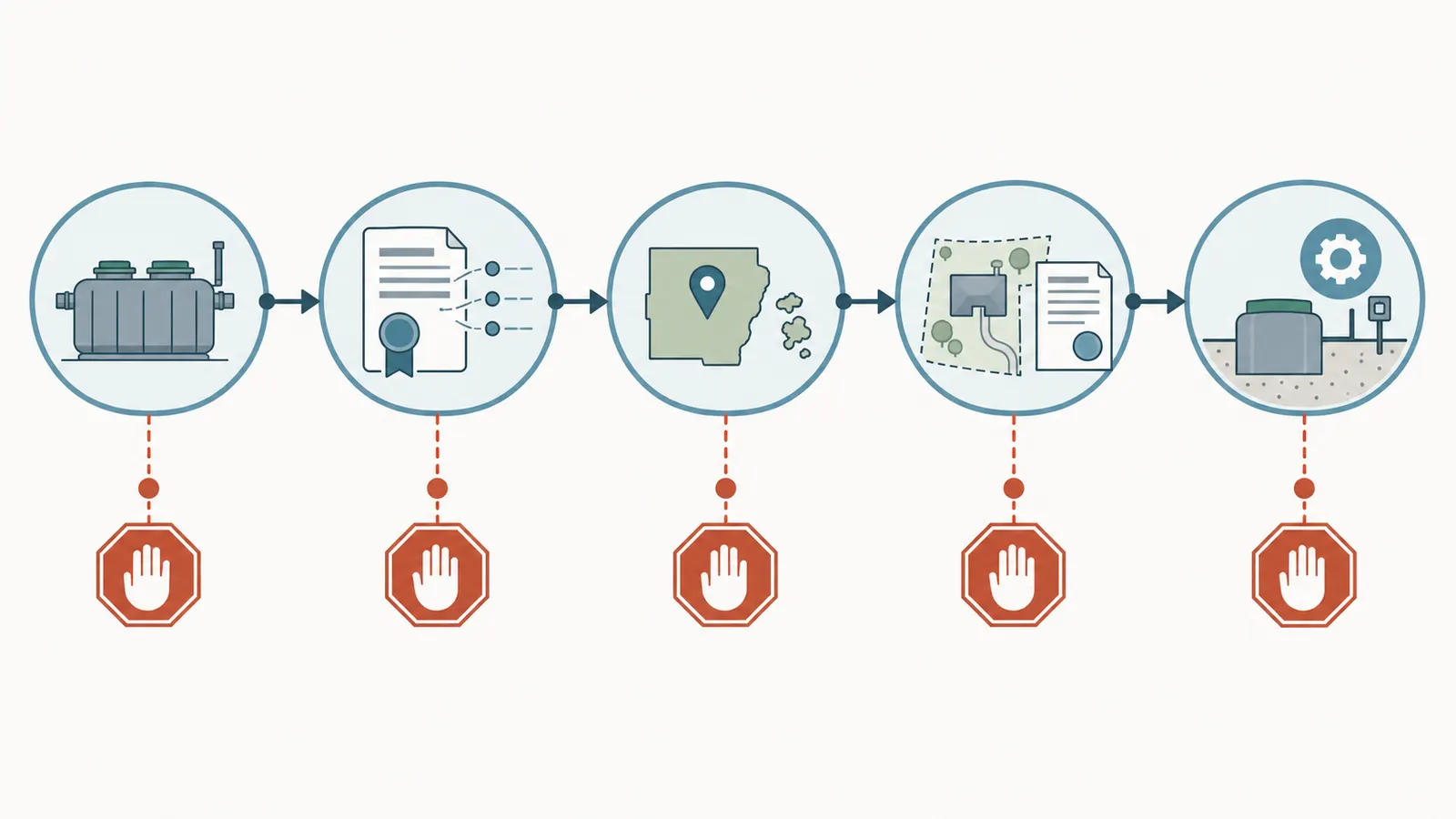
Use the following stop rule before you spend a deposit on the treatment unit:
- Stop if the proposal says only “aerobic unit,” “advanced treatment,” or a brand family without a complete model number, suffix, revision, tank arrangement, and rated capacity.
- Stop if the proposal cites NSF certification but the current listing shows a different capacity, vessel, flow mode, component, or footnote than the item being sold.
- Stop if the state approval source and the local permit reviewer have not confirmed that this exact unit and configuration may be used at this site.
- Stop if the permitted design load, tank pairing, dispersal method, alarm response, monitoring, sampling, service agreement, records, and warranty conditions are not written down.
- Stop if anyone proposes a substitution after approval without telling the designer and permitting authority what will change and whether the permit must be amended.
The safest homeowner role is document control and decision control. You can collect the proposal, compare identifiers, request the listing and manuals, ask the authority focused questions, and refuse an unresolved substitution. A designer, installer, electrician or other controls professional, service provider, and engineer where required must be appropriately licensed or otherwise authorized and qualified under the named jurisdiction and the applicable scope for site-specific design, physical inspection, electrical work, excavation, lifting, or sewage handling. The responsible permitting authority retains the permit and approval decisions.
Start with jurisdiction and permit, not product marketing #
An advanced septic treatment unit is buyable only when the exact product and configuration can be accepted for the permitted site by the responsible authority; national certification is supporting evidence, not a nationwide installation approval. Start by identifying who issues the construction or replacement permit, who approves the treatment technology, who inspects installation, and who enforces operating or reporting conditions in the actual jurisdiction.
EPA’s septic regulatory overview is useful precisely because it limits the federal claim. EPA says it does not regulate single-family home septic systems and that individual onsite systems are regulated by states, tribes, and local governments. In most states, local health departments issue construction and operating permits under state law. That means “EPA approved,” “NSF approved,” and “approved by the county” are not interchangeable phrases. The first may be a seller’s imprecise wording; the second usually refers to a certification listing; the third is the property decision you need.
Separate the five decisions hidden inside “approved”
Ask the proposal owner to identify each decision separately:
- Product identity. What manufacturer, product family, exact model, suffix, revision, vessel material, flow mode, pod count, tank pairing, control panel, pump, and disinfection components are included?
- Certification or test evidence. Is the complete system listed by NSF/ANSI 40, NSF/ANSI 245, another recognized program, or not certified? What capacity and classification appear beside the exact model? Are the notes and footnotes part of the claim?
- State or tribal technology path. Does the state have a product approval list, an innovative-system process, a performance-based treatment process, a state-specific design approval, or no separate product list? Which agency owns that path?
- Site permit. Has the county, municipality, state office, or tribal authority approved this exact unit with this design load, soil evaluation, setbacks, tanks, dispersal field, dosing, controls, and operating conditions at this property?
- Operating authorization. After construction, does the system need an operating permit, maintenance contract, annual or periodic inspection, sampling, reporting, alarm response, records, or a responsible management entity?
The chain is only as strong as the unresolved link. A unit can be listed by a certification body and still be unusable at the site because the state does not accept that technology, the county will not approve that configuration, the soil or setbacks require a different design, the proposal exceeds the listed capacity, or no compliant service provider is available. Conversely, a state may allow a technology through a process that is not identical to an NSF listing. The answer is not “NSF or no NSF”; it is “what evidence does this jurisdiction require for this design?”
Find the actual authority before asking for a quote revision
Begin with the property address, parcel or lot identifier, new-versus-replacement status, and the existing permit number if one exists. Ask the building department, county health department, state onsite wastewater office, tribal environmental office, or other named permit office these questions in writing:
- Which office issues the construction, repair, replacement, or modification permit for this parcel?
- Does another office approve advanced treatment products or performance claims before the local permit review?
- Is the proposed unit categorized as an aerobic treatment unit, advanced treatment unit, performance-based system, innovative system, or another local term?
- What exact documents must accompany the design: manufacturer approval, NSF listing, state listing, engineer’s design, treatment performance data, service contract, operating permit, or sampling plan?
- Does the authority approve the product family, the exact model, the complete system, the tank pairing, or all of these?
- Who signs off on the final installation and who receives operating or maintenance records?
Use the EPA advanced-treatment state directory to reach the relevant state page, but do not mistake the directory for the approval itself. EPA explains that the links point to state pages containing approved products and approval processes, and that where a state has no product-approval process the link goes to the state agency with authority over decentralized wastewater management. The directory is a routing tool. The named state or local office supplies the controlling answer.
Texas shows why local administration matters. The Texas Commission on Environmental Quality’s onsite sewage page describes state permitting, maintenance, and construction requirements and also provides information for local governments that become authorized agents of the Texas OSSF program. That does not tell a homeowner in another state what to do, and it does not prove that every Texas county handles a proposal identically. It does show why the question should name the actual state and local program instead of asking whether an item is “nationally approved.”
Florida provides a different illustration. The Florida Department of Environmental Protection product-approval page separates approval requirements, approved products and components, advanced systems, maintenance entities, and links to NSF-certified aerobic treatment unit lists. Those are separate checks inside one state program. Florida is not a national template, but it is a useful reminder that a product list, a maintenance provider list, and an operating obligation may live in different records.
Assign responsibility before the proposal becomes a purchase order
The homeowner should own the question “what exactly are we buying and what must I maintain?” The designer should own the site-specific design and the explanation of why the proposed capacity, tank volumes, dosing, dispersal, and treatment target fit the permit. The installer should own construction to the approved drawings and manufacturer instructions. The electrician or qualified controls technician should own compliant wiring and controls work. The service provider should own the contracted inspection, maintenance, alarm response, sampling, and reports. The authority should own the permit decision, inspection, and any state or local approval that only it can issue.
Do not let a salesperson answer for the permitting authority. Do not let a permit reviewer assume the homeowner has accepted a service obligation that is absent from the contract. Do not let the installer choose a physically convenient tank or controller that changes the approved configuration. Write down the handoff between each role. A strong proposal has a named person for each question and a record that can be carried into the permit file.
What you can safely verify from a desk
You can safely do these document checks without opening a tank or touching a control panel:
- Transcribe the exact unit identity from the proposal and compare it with the current certification listing.
- Compare the rated gallons per day, classification, vessel, flow mode, pod count, and notes with the design.
- Ask the authority to confirm the product path and the exact permit condition.
- Ask the installer to identify the tank model, volume, material, pump, floats, alarm, controller, disinfection equipment, and replacement parts.
- Request the O&M manual, startup procedure, warranty, service agreement, emergency contact, and record-retention requirements.
- Mark every unanswered row as Hold, not as an assumed pass.
You cannot safely verify a tank’s structural condition, excavation stability, electrical isolation, sewage exposure, confined-space atmosphere, pump wiring, soil absorption, or final treatment performance from a remote document review. Those tasks belong to qualified professionals under the applicable jurisdiction. A clean PDF packet is not proof that the field installation matches it.
Originality brief: what this page adds and how to check it
Current answers usually do one of two things: EPA explains that advanced treatment may be needed and points homeowners toward state-approved technologies, while NSF explains standards and publishes certified listings. Manufacturer pages then describe features and product families. The missing decision is the homeowner’s pre-purchase handoff: whether the exact item in a proposal is the listed model, fits the permitted load and tanks, is accepted by the actual authority, and can be operated under a written service and warranty plan.
The original contribution here is the Approval-and-operating-obligation matrix. It combines exact model identity, rated capacity, certification, state or county approval, tank pairing, design load, service, alarms, sampling, records, warranty conditions, and unresolved evidence in one auditable surface. You can check it by attaching a source or named record to every row: the NSF listing for the model, the state approval page, the permit or approved design, the signed service document, and the manufacturer manual. A blank cell is a visible decision blocker, not a reason to fill in a guess.
The Method: copy each proposal field into a row, match it to the exact NSF listing, the actual state approval source, the permitted design, and the written operating documents, then mark Pass, Hold, or Fail with an evidence record. The Limitations: this is an illustrative homeowner audit, not an engineering design, permit decision, laboratory test, legal opinion, or guarantee that any unit will meet a site-specific treatment target.
The method is deliberately conservative. It does not rank brands, predict service life, claim a treatment result, or turn one state’s form into a nationwide rule. It makes missing evidence visible early enough to change a proposal without excavating or replacing equipment.
Freeze the exact product identity before comparing proposals #
Compare complete equipment identities, not brand names or marketing families: the proposal, current certification listing, approved design, manufacturer manual, tank schedule, controls, and service documents must all describe the same unit. If the model suffix, capacity, vessel, tank, discharge mode, pod count, revision, or included accessory is unclear, you do not yet have a comparable proposal.
Build an identity block for every proposal
Ask the installer or designer to place this block on the proposal and design drawing before you compare price:
| Field | What to record | Why it can change approval or support | Status |
|---|---|---|---|
| Manufacturer | Legal manufacturer and product family | Different families can have different certifications and manuals | Pass / Hold / Fail |
| Exact model | Full model number, including letters, numbers, stars, dashes, and spaces | The listing may distinguish a component, capacity, vessel, or flow mode | Pass / Hold / Fail |
| Revision | Drawing, manual, firmware, or model revision if shown | A revised assembly may change tanks, controls, or conditions | Pass / Hold / Fail |
| Rated capacity | Listed gallons per day and classification | Capacity is not interchangeable with a larger or smaller family member | Pass / Hold / Fail |
| Vessel and tank | Material, manufacturer, volume, chamber arrangement, pretreatment and dosing tanks | Tank pairing can be a certification footnote or permit condition | Pass / Hold / Fail |
| Hydraulic mode | Gravity, pump, recirculation, dosing, level controls, discharge point | Flow and controls can be part of the tested or permitted configuration | Pass / Hold / Fail |
| Treatment additions | UV, chlorine, nitrogen process, filters, media, alarms, sampling ports | A treatment objective may require a specific addition and operating duty | Pass / Hold / Fail |
| Electrical and controls | Panel model, power supply, floats, telemetry, alarm contacts | Controls affect installation, maintenance, alarm response, and outage behavior | Pass / Hold / Fail |
| Service route | Named authorized service provider and response terms | A unit that cannot be maintained may not be supportable under the permit | Pass / Hold / Fail |
Do not accept “equivalent” as a completed field. “Equivalent” is a conclusion that belongs in a written change review by the designer and authority. Record the proposed substitute by its own full identifier, then show the evidence for equivalence and the permit consequence. A different tank material, a different pump tank, a different controller, a different UV assembly, or a different pod count can change more than the price.
Read the NSF listing line by line
NSF’s residential wastewater treatment page says NSF/ANSI 40 provides material, design, construction, and performance requirements for testing and certifying residential onsite systems. That makes an NSF/ANSI 40 listing useful evidence, but it does not answer the property’s state or parcel-specific permit question. It also does not make every product in a manufacturer’s brochure certified under the same standard.
Open the current NSF/ANSI 40 public listing and locate the manufacturer and exact model. Capture the surrounding heading and every footnote attached to the line. The listing presents model number, rated capacity in gallons per day, and classification, and the footnotes can specify vessel material, flow mode, tank volumes, alternate tanks, components, pod arrangements, or exclusions. Save the URL and access date in your project record because public listings can be revised.
Check the following in order:
- Does the exact model text appear, or only a family name?
- Does the listed rated capacity match the proposal and design, in gallons per day?
- Does the classification match what the proposal claims?
- Is the listed item a complete system, a treatment component, a pod, a control, or a tank-associated assembly?
- Do footnotes require a particular pretreatment tank, dosing tank, vessel, manufacturer, or installation arrangement?
- Does the proposal include anything outside the listing, such as a UV unit, alternate tank, disinfection method, or modified control panel?
- Does the listing say the company has authorized representatives for distribution, installation, or service, and does the proposal name one?
Do not turn a component listing into a complete-system listing
The NSF listing gives a concrete warning. In the AquaKlear section, AK500C is listed as a 500-gallon-per-day Class I model, but a footnote says that the component is also part of complete system AK5B1 and that the complete model has not been tested by NSF. The practical rule is simple: if the proposal says AK5B1, you cannot use the AK500C component line as proof that the complete system is NSF tested. You must ask for the complete-system evidence and state or local approval for the actual configuration.
This distinction matters even when all pieces come from the same manufacturer. A component may be certified for a particular use, but the completed assembly can change hydraulic retention, pretreatment, dosing, pumping, controls, or disinfection. The evidence must follow the complete assembly that will be installed, not the most favorable component line.
Treat model suffixes as engineering information
A suffix can encode a vessel, a discharge mode, a tank, a pod count, or a capacity. In the NSF listings, for example, different suffixes can distinguish concrete, fiberglass, or polyethylene vessels, gravity or pump discharge, and different configurations. Do not assume that a suffix is cosmetic because the main brand and family name are the same.
Use a “same or unresolved” comparison:
| Proposal field | Certification field | Design field | What counts as a pass |
|---|---|---|---|
Model-600-P | Model-600-P | Model-600-P | Text matches exactly, including suffix and capacity |
Model-600 | Model-600-P | Model-600-P | Hold; vessel or configuration is not the same on the face of the records |
Family X, 800 gpd | Family X-800 | Family X-800 | Hold until the full proposal is corrected to the exact listed identifier |
Component A | Complete system System A | System A | Pass only if the complete system is separately supported |
Unit 600 gpd | Unit 600 gpd | Unit 600 gpd, 450-gpd load | Potential pass on capacity only; other approval and operating rows remain open |
The goal is not to make every document look identical by clerical force. It is to expose where they are not identical so the designer, installer, and authority can decide whether the difference is allowed, requires a revised design, or means the proposal must change.
Request a model-specific document packet
Before signing, ask for one PDF folder or shared record containing:
- The signed proposal with full identifiers and included components.
- The current certification listing or certificate for the complete system, including footnotes.
- The manufacturer installation manual for the exact model and tank arrangement.
- The startup and O&M manual, including normal inspection, cleaning, replacement, alarm, and sampling instructions.
- Design drawings showing tanks, pipe sizes, elevations, dosing, pump, floats, controls, alarm, and dispersal interface.
- The state product approval or acceptance record, if the state has one.
- The site-specific permit application, approved plans, design flow, conditions, and required inspection or operating documents.
- The service agreement, response time, inspection frequency, parts policy, sampling responsibility, and record-delivery terms.
- The warranty, exclusions, start date, registration requirement, labor coverage, and conditions that could void it.
If the installer says the packet will be supplied after the deposit, ask which parts are necessary to release the permit and which are necessary to bind the order. A buyer can reasonably condition the order on receiving and approving the exact packet. The permitting authority may still require a different document or an amended plan.
Treat the packet as one synchronized identity bundle, not as unrelated attachments. The comparison is complete only when the same model, capacity, tanks, controls, treatment objective, and service route can be followed across the proposal, listing, drawing, permit, manual, and contract. Any mismatch belongs in the issue log with an owner and a due date.
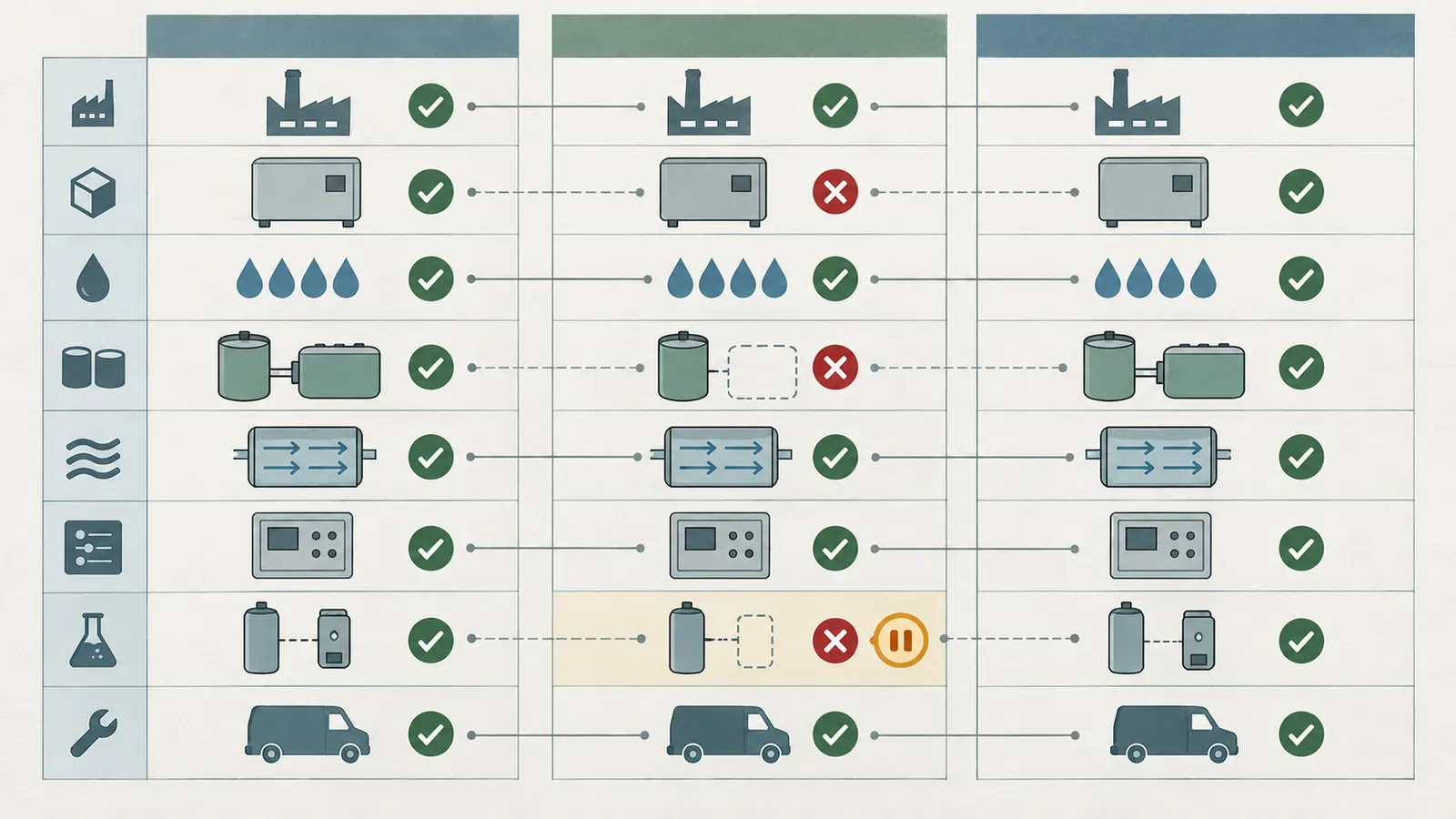
Match certification evidence to the treatment claim and the site objective #
Certification answers a defined testing question; it does not prove that a unit meets every possible treatment objective, local requirement, or site condition. First identify the pollutant or public-health objective in the permit, then match the certification, state approval, design, and operating conditions to that objective without inferring a stronger result from a weaker label.
Name the treatment objective in plain language
“Advanced treatment” is a category, not a single outcome. The design may be trying to reduce organic strength, suspended solids, nitrogen, phosphorus, pathogens, odors, or a combination. It may also be trying to make a difficult site workable through an alternative dispersal arrangement. The unit may be upstream of a soil absorption field, downstream of a septic tank, or part of a performance-based treatment system with sampling and reporting.
Write the objective as a field in the matrix:
- Organic treatment: What parameter is regulated, and what limit appears in the permit or approval?
- Suspended solids: Is the requirement a performance limit, a design assumption, or a filter-maintenance condition?
- Nitrogen: Is total nitrogen reduction required, and under which state, local, watershed, or site program?
- Disinfection: Is a pathogen or fecal-indicator limit required, and is UV, chlorine, or another component specified?
- Reuse or discharge: Is effluent being dispersed to soil, reused, or discharged to a surface water? If it is a surface-water discharge, a different regulatory program may apply.
- Site constraint: Is the advanced unit required because of soil, lot size, setbacks, high groundwater, receiving-water sensitivity, or a local ordinance?
EPA’s septic FAQ says that system choice depends on lot size, slope, soil conditions, home size or occupancy, local or state regulations, and budget. It also notes that some sites require advanced technologies or alternative drainfields. That is why a product’s advertised treatment result cannot be separated from the site’s soil evaluation, hydraulic design, receiving environment, and permit.
Understand what NSF/ANSI 40 does and does not say
NSF/ANSI 40 is a defined residential onsite wastewater certification standard. NSF describes it as covering material, design, construction, and performance requirements. Treat the listing as evidence that the exact listed model was evaluated against that standard’s scope, capacity, and classification. Do not paraphrase it as “approved everywhere,” “safe for any site,” “nitrogen-removing,” “disinfecting,” or “guaranteed to protect groundwater.” Those are separate claims that require separate evidence and, often, a permit condition.
NSF also describes NSF/ANSI 245 as a nitrogen-reduction standard and says it requires a minimum 50% reduction of total nitrogen. That is a useful distinction from NSF/ANSI 40. A Class I NSF/ANSI 40 listing by itself should not be presented to a homeowner as proof of compliance with a nitrogen-reduction requirement. If nitrogen is the design objective, ask the designer and authority to identify the required standard, performance limit, sampling method, operating condition, and record path.
Likewise, a UV component or NSF/ANSI 385 reference does not automatically mean the installed system has an approved disinfection configuration. Confirm the complete system, the required dose or operation, lamp or chemical maintenance, alarm, sampling, and permit condition. The exact authority may accept only listed combinations or may require a performance-based review.
Use a three-column evidence test
For every treatment claim, fill three columns instead of copying a brochure sentence:
| Claim you need to make | Evidence you have | What is still not established |
|---|---|---|
| “The proposed model is certified at 600 gpd” | Exact model and 600-gpd line in the current NSF listing | State approval, local permit, and site performance |
| “The system is approved for this state” | State agency record naming the product or approval process | Parcel-specific permit and local conditions |
| “The unit meets the nitrogen target” | Certification or performance record for the required nitrogen standard | Actual operation, sampling, maintenance, and site-specific permit compliance |
| “The system includes a dosing tank” | Drawing and tank schedule with model and volume | Whether that tank volume and pump duty match the certification and permit |
| “The warranty covers the installation” | Written warranty with installed model and exclusions | Whether service, parts, power, use, and records conditions will be met |
This prevents a common failure: one true statement is used to support three unproven statements. A certification listing can support the identity and listed capacity. It cannot by itself support the parcel-specific permit, the chosen drainfield, the service contract, or a warranty promise.
Ask whether the listing is current and whether the proposal is within its scope
Use the access date and capture a copy or project record of the listing. Ask the seller:
- Is the listing active for the exact model and manufacturer facility?
- Is the model name on the invoice identical to the listing?
- Is the proposed rated capacity one of the listed values, or is the seller using a family range?
- Do the notes limit tank material, pretreatment, dosing, or discharge?
- Does the authority require a certificate or test report rather than a public listing screenshot?
- Has the manufacturer changed the controller, media, pump, vessel, or assembly since the approval record?
If the seller will not provide a model-specific listing or says the public listing is “close enough,” mark the row Hold. If the authority confirms a different approval path, record that written answer and identify its scope. A state-approved product page may control a local permit even where the product’s national certification is not the deciding document.
Do not infer treatment from a class label
The NSF listing’s classification is one field in a larger record. It can help you identify the listed category, but it is not a universal performance guarantee across all contaminants or loading patterns. The permit should state the treatment target and the operating conditions that make the target enforceable. If a proposal relies on a class label but never states the target, ask the designer to translate the label into the permit’s language.
Also separate normal operation from upset conditions. A manufacturer may specify limits for hydraulic loading, power, temperature, influent strength, chemicals, solids, or maintenance. The certification test conditions do not erase those limits. Ask where they appear in the manual and what the homeowner must do if a control alarm, power outage, freezing event, unusual inflow, or service delay occurs.
Reconcile rated capacity with permitted design load and configuration #
Rated capacity is a property of the listed equipment; permitted design load is a property of the home, site, jurisdiction, and approved design. The unit passes this check only when the designer shows that the permitted design flow and treatment conditions fit the exact listed capacity and tank arrangement, and the authority accepts that design for the parcel.
Use the permit’s design load as the controlling input
Do not size the unit from a sales conversation such as “four bedrooms usually needs 500 gallons per day,” and do not replace the permit’s design flow with a rough estimate from current water bills. Those numbers may be useful questions for the designer, but they are not interchangeable inputs. Ask for the design flow written on the site evaluation, permit application, approved plans, or operating permit, and record its units and basis.
Gather these inputs before comparing capacity:
- The jurisdiction’s design-flow method and the approved gallons-per-day value.
- Number of bedrooms, dwelling units, occupants, or other uses used by that method.
- Whether the home includes a guest suite, accessory dwelling, rental use, home business, food service, or other nonstandard source.
- Expected water-use pattern, including laundry, fixtures, hot tub discharge, water treatment backwash, or other flows that the designer must address.
- Influent-strength assumptions and any commercial-strength or high-strength wastewater classification.
- The unit’s listed rated capacity, classification, and required operating conditions.
- Pretreatment, treatment, dosing, pump, and dispersal tank volumes.
- The drainfield or alternative dispersal design, including the interface between treated effluent and soil.
- Power, alarm, sampling, and reserve requirements that appear in the permit or manual.
EPA’s guidance on system choice identifies home size or occupancy and site conditions as factors, but it does not publish one national sizing rule for every home. A state or county formula may use bedrooms, fixture counts, flow assumptions, or other criteria. Name the actual jurisdiction on the worksheet and let the licensed designer explain the calculation.
Calculate a transparent capacity check without calling it a design
The matrix can show arithmetic while leaving design authority with the professional. Use:
capacity margin (gpd) = listed rated capacity (gpd) − permitted design load (gpd)
relative margin = capacity margin ÷ permitted design load × 100
These formulas are decision aids, not a universal code requirement. They reveal whether a proposal is below, equal to, or above the design input. They do not prove that a larger unit is acceptable, that a smaller unit will perform, or that the soil dispersal system has matching capacity.
Illustrative capacity and sensitivity example
The following is a modeled example, not a measurement or a recommendation. Suppose the proposal identifies the NSF-listed Puraflo Coir P200C*4 configuration at 800 gpd, and the permitted design load supplied by the designer is 600 gpd. The NSF listing identifies Puraflo Coir pods as rated at 200 gpd and states that the P200C configurations require specified pretreatment and dosing tank volumes. It lists the P200C*4 configuration at 800 gpd and specifies a 2,000-gallon septic tank and 1,000-gallon dosing tank in the relevant footnote. Those are product-listing inputs, not a reason to choose the model for a real site.
The arithmetic is:
- Listed capacity: 800 gpd.
- Permitted design load: 600 gpd.
- Capacity margin:
800 − 600 = 200 gpd. - Relative margin:
200 ÷ 600 × 100 = 33.3%. - Required tank pair from the cited listing note: 2,000-gallon pretreatment or septic tank plus 1,000-gallon dosing tank for this configuration.
Now hold the equipment identity constant and change only the design input:
| Illustrative permitted design load | Listed capacity | Capacity margin | Relative margin | Interpretation |
|---|---|---|---|---|
| 450 gpd | 800 gpd | 350 gpd | 77.8% | Capacity is above the modeled load; tanks, permit, and treatment target still require review |
| 600 gpd | 800 gpd | 200 gpd | 33.3% | Potential capacity fit in the arithmetic only; the approved design controls |
| 800 gpd | 800 gpd | 0 gpd | 0% | No arithmetic headroom; ask the designer how the authority treats the exact match |
| 960 gpd | 800 gpd | −160 gpd | −16.7% | The proposal is below the modeled load; do not order without a changed design and authority decision |
The sensitivity shows why “it is rated for 800” is incomplete. If a future accessory dwelling, bedroom count, occupancy change, or use change causes the design load to become 960 gpd, the same equipment no longer passes the simple capacity comparison. That does not mean a homeowner may multiply occupancy by a universal factor and declare failure; it means the designer and authority must re-evaluate the permitted use before the change is made.
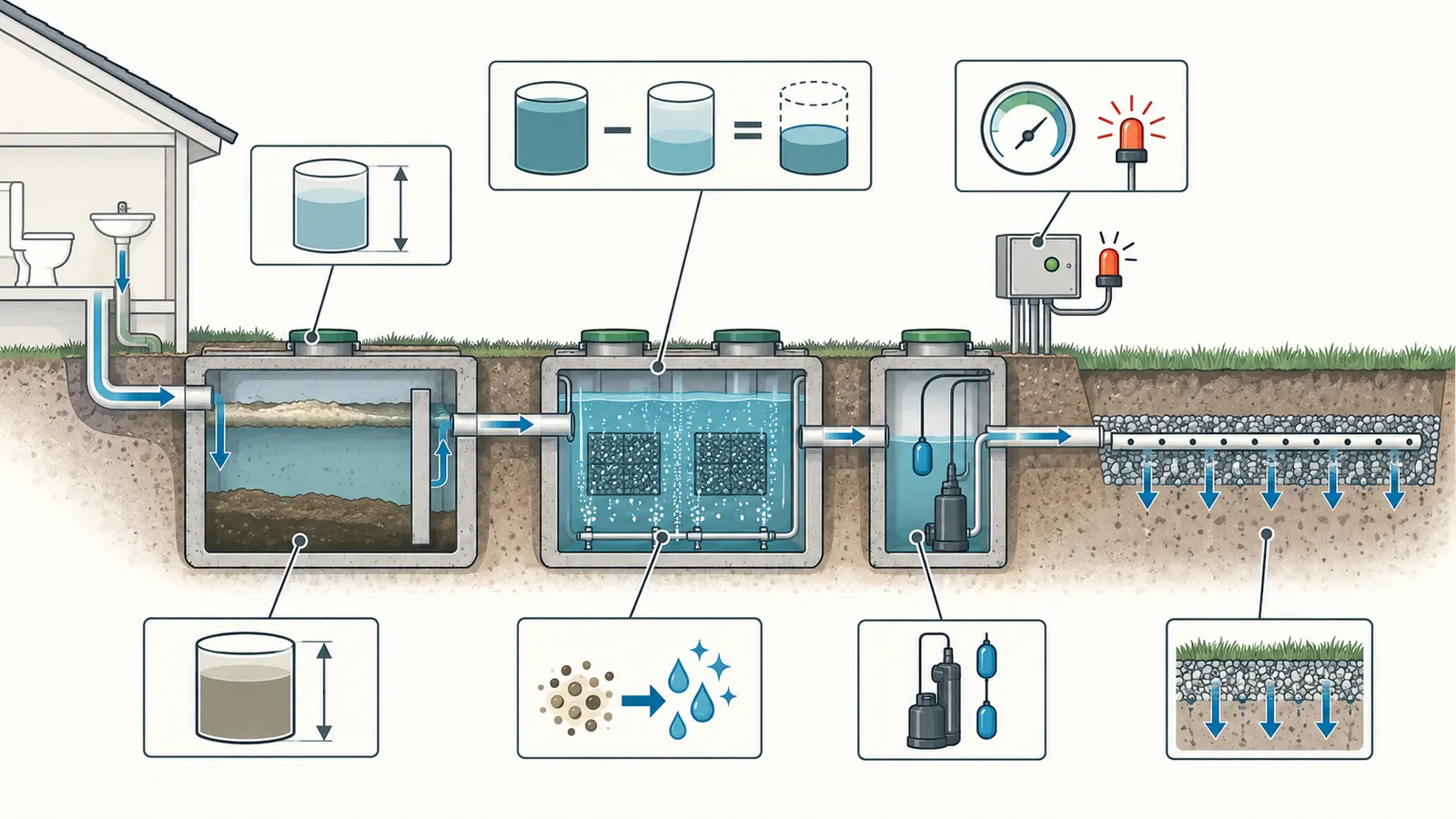
Also do not assume that unused capacity in the treatment unit creates unused capacity in the whole system. The soil dispersal field, pump, dosing volume, tanks, pipes, electrical service, alarm, setbacks, and permit conditions can be the limiting element. A unit with a larger listed capacity does not automatically authorize a larger house or a larger drainfield flow.
Match tank pairing, not just gallons per day
The NSF listing can make tank pairing a certification condition. For the illustrative Puraflo Coir example, the listing notes specify different pretreatment and dosing volumes for the P200C configurations. The same page also contains other examples where alternate tanks, vessel materials, or manufacturer instructions are part of the listing note. Use the tank schedule as a first-class identity field.
For each tank, record:
- Manufacturer and model, if specified.
- Material: concrete, fiberglass, polyethylene, or another specified construction.
- Nominal and usable volume in gallons.
- Pretreatment, treatment, dosing, pump, and reserve function.
- Inlet and outlet elevations and access riser requirements.
- Structural or traffic-loading rating where the site requires it.
- Pump model, flow, head, duty point, floats, check valve, and alarm levels.
- Venting, electrical, and control-panel connections.
- Whether the tank is included in the certification listing or accepted by the designer and authority as an approved alternate.
The tank may be physically larger than the minimum listed volume, but do not infer that any larger tank is acceptable. A changed volume can alter hydraulic retention, dosing, installation depth, structural design, pumping, or permit assumptions. Ask the designer to identify the permitted tank requirement and the procedure for an alternate tank.
Confirm the design-to-installation handoff
A strong handoff has four matching records:
- The product proposal names the exact unit and all supporting components.
- The design drawing shows the same unit, tanks, controls, pipes, and dispersal interface.
- The permit or approval record names the same model or the accepted technology and configuration.
- The installer’s purchase order and field startup record show what was actually delivered and installed.
If any document uses a broad family name, add a written clarification before ordering. If the installer says the shipped model will be selected later, ask how the permit will be amended and who pays for redesign, reinspection, restocking, or service changes. Do not let a delivery schedule create a silent engineering decision.
Treat occupancy sensitivity as a design handoff, not a homeowner calculation
A future occupancy change can affect design flow, wastewater strength, tank loading, pump cycles, drainfield loading, service, or permit status. Tell the designer about plans for an accessory dwelling, multigenerational use, short-term rental, home business, additional bedroom, or frequent guests before the final model is selected. The relevant next question is not “does this unit have extra capacity?” but “does the approved system remain permitted and supportable for the intended use?”
Record the answer in the project file. If the answer depends on a future permit amendment or operating approval, mark that dependency. A homeowner should not rely on a verbal statement that the design can be expanded later unless the responsible authority and designer put the path, limits, and cost responsibility in writing.
The capacity check is therefore a linked system check: the arithmetic compares two flow inputs, while the configuration review follows the water path through tanks, treatment, pumping, controls, and dispersal. The diagram below is a reading aid for that relationship; it is not a substitute for the approved drawing or a field inspection.
Verify operating obligations and who owns the risk #
An advanced unit is supportable only when the homeowner can identify the service provider, alarm response, inspection or sampling schedule, power and access requirements, records, replacement parts, and warranty conditions that apply in the actual jurisdiction and to the exact model. The operating plan belongs in the buying decision because an approved unit can fail or lose support when its required maintenance is omitted.
Put operating obligations beside the purchase price
Ask for a five-year operating picture, even if the purchase quote is for equipment only. The purpose is not to produce a speculative lifetime cost. It is to expose duties that must be accepted before ordering:
- Who signs the service or maintenance agreement?
- Is the service provider authorized by the state, county, manufacturer, or another program?
- How often are inspections, cleanings, pump-outs, sampling, calibration, filter changes, media changes, or lamp or chemical replacements required?
- Who receives the alarm, how quickly must the response occur, and what happens during nights, weekends, power outages, or a provider closure?
- Does the homeowner pay for travel, parts, labor, sampling, laboratory analysis, emergency pumping, or reinspection?
- What records must be kept, for how long, and who submits them to the authority?
- What access must be maintained to tanks, panels, sample ports, vents, and drainfields?
- What water-use, cleaning-chemical, garbage-disposal, or discharge restrictions apply?
- What happens if the service agreement expires, the property is sold, or the system changes ownership?
- Which conditions void or limit the warranty?
EPA states that the system owner is responsible for overall operation, maintenance, upkeep, repairs, and replacement, while users are responsible for proper use and water-use behavior. That is a useful national ownership warning, not a substitute for the contract. A permit or state program may add duties for a service provider, responsible management entity, or property owner.
Use state-specific examples without universalizing them
Florida’s ATU and PBTS maintenance reporting system says that Florida law requires ATU and PBTS systems to have a maintenance contract with a permitted service contractor. It also says those systems must be inspected and maintained two or more times a year depending on permitted use, and that operators must obtain and record the maintenance contract. Those obligations apply to the Florida program described by the source. They do not establish a national schedule for a homeowner in Colorado, Maine, Texas, or another jurisdiction.
The Florida example is still useful as a checklist prompt. Ask the actual authority in your state whether an operating permit, service contract, inspection interval, sampling plan, or reporting system applies. If the answer is yes, obtain the form and contract before purchase. If the answer is no, record who confirmed that and what operating documents still apply under the permit and manufacturer instructions.
The Florida OSTDS operating-permit application illustrates the kind of information a program may track: manufacturer, treatment-unit model, estimated gallons per day, monitoring status, active service agreement, agreement expiration, and maintenance entity. It is a Florida form, not a national requirement. Its value for a homeowner elsewhere is to show why model identity, design flow, and service should be resolved before the system reaches operating approval.
Read the manufacturer manual as a contract input
Certification and state approval do not replace the manufacturer’s manual. The manual may set conditions for startup, access, pump settings, floats, filters, media, controls, sampling, cleaning, parts, and troubleshooting. Orenco’s AdvanTex O&M manual, for example, describes product-specific startup and routine-maintenance activities and equipment, including checks of pumps, controls, floats, filters, and wastewater indicators. That is evidence about the AdvanTex manual’s scope, not proof that another brand uses the same intervals or tools.
Ask the installer to highlight the pages that affect the homeowner:
- Normal control-panel state and alarm meanings.
- What can be reset by the homeowner and what requires a qualified service provider.
- Required power, generator, surge, freeze, ventilation, and access conditions.
- Inspection and cleaning points.
- Pump, float, filter, media, UV, chlorine, or other component replacement intervals.
- Approved replacement parts and substitutions.
- Sampling ports, sample handling, laboratory requirements, and reporting forms.
- Actions after an extended vacancy, power interruption, flood, sewage backup, or chemical upset.
- Warranty registration, service records, and exclusions.
If the manual is not available for the exact model, ask whether the quote is for an older or newer revision and request the current manual before signing. A family brochure is not enough when the operating obligation attaches to a particular control panel or tank configuration.
Make alarm ownership unambiguous
An alarm is useful only if someone recognizes it, can reach the panel, knows what the safe homeowner action is, and can obtain service. Orenco’s residential homeowner FAQ says an AdvanTex control-panel alarm alerts the homeowner and directs the homeowner to call a local septic installer or service provider if the alarm returns. For another product, use its own manual and contract. Do not promise a universal reserve time or universal alarm response based on one manufacturer’s page.
Your written plan should answer:
- Where is the alarm visible or audible?
- Is there remote notification, and who receives it?
- What should the homeowner do immediately: reduce water use, stop a source, call service, or leave the system alone?
- What should the homeowner never do: enter a tank, bypass an alarm, defeat a float, open a live panel, or handle wastewater?
- Who is the primary and backup service provider?
- Is there a stated response time, and is it available in the property’s county?
- What event makes the homeowner call the authority as well as the service provider?
The service contract should refer to the same unit and panel model on the proposal and permit. If the contract says only “septic maintenance” but the system requires advanced-treatment service, sampling, or controls work, ask for a corrected scope.
Build a records chain from installation to ownership
At minimum, keep one project folder with:
- Site evaluation, soil report, approved design, permit, amendments, inspection approvals, and as-built drawing.
- Exact product invoice, serial number, model suffix, tank identifiers, and control-panel information.
- Certification listing or certificate captured at purchase and the state or local approval record.
- Installation, startup, commissioning, and final inspection records.
- Service agreement, maintenance visits, alarm calls, sampling results, lab reports, pump-outs, repairs, and parts.
- Warranty, registration confirmation, exclusions, and any manufacturer correspondence.
- Emergency contacts and instructions for a sale, vacancy, power outage, flood, or malfunction.
EPA’s typical inspection guidance includes review of permits, design and installation records, maintenance records, tanks, filters, leaks, pumps, controls, wiring, drainfield conditions, and required monitoring or reporting. Preserve those records because they are useful not only for maintenance but also for future inspections, refinancing, resale, replacement design, and proving what was actually approved.
Use the records chain as a handoff map: each role should receive the document it must verify, each obligation should have a named owner, and the homeowner should receive the final operating packet after startup. This exposes a practical failure that a brochure cannot: equipment may be listed and permitted while nobody has accepted alarm response, sampling, maintenance records, or warranty conditions.
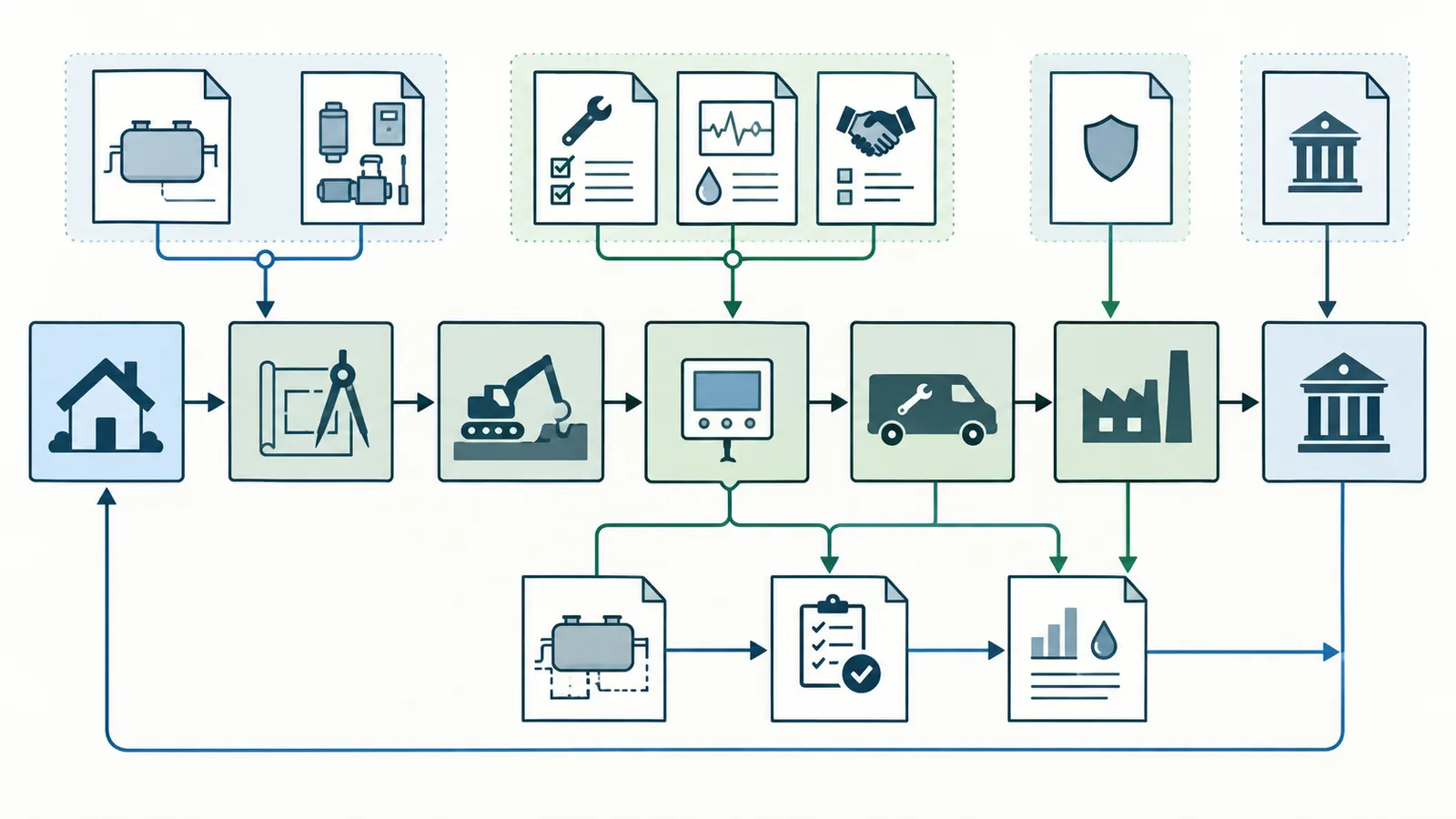
Audit the proposal, permit, warranty, and records as one package #
The purchase is ready only when the proposal, certification record, state or local approval, approved design, operating plan, and warranty describe the same equipment and obligations. Use a row-by-row audit with a named evidence record; a verbal “yes” is not a pass when a permit or warranty could later depend on the missing field.
The approval-and-operating-obligation matrix
The following is the core decision surface. Copy it into your project record and replace the example entries with the actual property and product. Pass means the evidence is attached and the scope matches. Hold means someone responsible must answer or revise a document. Fail means the evidence contradicts the proposal or the authority will not accept the configuration.
| Row | Input to copy from the proposal | Evidence to attach | Pass condition | Common failure |
|---|---|---|---|---|
| Exact manufacturer | Legal manufacturer and facility if listed | Current certification listing, certificate, quote | Same manufacturer and product family across records | Dealer uses a private-label name not found in the certification record |
| Exact model and revision | Full model, suffix, revision, serial or family | NSF listing, manufacturer manual, invoice | Text matches or written authority-approved equivalence exists | Quote says “800-gpd unit” but omits suffix and configuration |
| Rated capacity | Gallons per day and classification | Certification listing and approved design | Listed capacity is at least the approved design input under the authority’s method | Salesperson compares household size to a brochure range |
| Certification scope | NSF/ANSI 40, 245, 385, other, or none | Standard-specific listing and footnotes | The claimed standard addresses the stated treatment objective | Class I is used as proof of nitrogen removal or disinfection |
| Complete-system status | Complete unit versus component or pod | Listing line and footnote | Complete installed system is covered or separately accepted | Component line is used to support an untested complete system |
| State approval path | State, tribal, or no-product-list process | State agency page, approval letter, application | Actual authority confirms the path for the property | EPA directory is treated as the approval |
| Local permit | County, municipal, state, or tribal permit number | Application, approved plans, conditions | Exact unit and configuration appear in the permit or approved design | Permit says alternative system but does not name approved equipment |
| Design load | Approved gallons per day and use basis | Site evaluation and permit | Equipment and dispersal design are matched to the approved load | A bigger treatment unit is assumed to fix a small drainfield |
| Pretreatment tank | Model, material, volume, chambers | Listing note, drawing, tank approval | Required volume and tank type are present | Local tank substitution is made without review |
| Treatment or dosing tank | Model, volume, pump, floats, alarm | Listing note, pump schedule, drawing | Tank and controls match the tested or permitted configuration | Pump tank is changed for excavation convenience |
| Hydraulic mode | Gravity, pump, recirculation, dose cycle | Design drawing, manual, controls schedule | Mode is identical across proposal, design, and manual | “Pump included” does not state head, duty, or alarm levels |
| Treatment objective | CBOD/TSS, nitrogen, phosphorus, pathogen, reuse, or other | Permit limit, approval, certification, sampling plan | Every claimed outcome has a scoped source and permit condition | “Advanced” is treated as a universal treatment guarantee |
| Service provider | Legal name, authorization, county coverage | Signed agreement, state or manufacturer directory | Provider accepts this exact model and response scope | Installer sells equipment but no qualified service route exists |
| Service frequency | Inspection, cleaning, pump-out, sampling, reporting | Manual, contract, permit | Frequency and responsible party are written | Homeowner receives only “annual maintenance” language |
| Alarm response | Panel, notification, response time | Manual, contract, emergency plan | Homeowner and service provider know exactly what happens | Alarm is installed but no one is responsible for it |
| Sampling and records | Ports, analytes, lab, reports, retention | Permit, contract, forms | Sampling and record handoff are assigned | Sampling is promised in marketing but absent from the permit |
| Power and controls | Voltage, panel, floats, generator or outage plan | Electrical schedule, manual, permit | Qualified installer confirms code and operating needs | Homeowner is told to reset a panel they cannot safely open |
| Warranty | Coverage, exclusions, registration, labor, parts | Signed warranty and invoice | Conditions can be met and correspond to installed model | Warranty depends on service records nobody agreed to keep |
| Unresolved evidence | Every blank or contradiction | Issue log with owner and due date | No open blocker remains before order | Open questions disappear into “installer will handle it” |
The matrix is not an official inspection form. It is an auditable comparison tool. Its value is the relationship between rows. A capacity pass with a tank fail is not a pass. A state approval pass with a missing permit is not a pass. A warranty pass with no service provider is not a supportable purchase.
Compare three records, not one brochure
Perform a three-way reconciliation:
Proposal versus certification. Confirm exact model, capacity, classification, tank, vessel, footnotes, and included components. If the proposal is broader than the listing, ask for the full system evidence.
Certification versus design. Confirm design load, tank volumes, hydraulic mode, pump and dosing, treatment objective, and any alternate component. If the design uses an alternate tank or a locally sourced tank, ask the designer to identify the approval basis.
Design versus permit and operating documents. Confirm the permit names or accepts the configuration, the service and monitoring obligations are included, and the final installer will produce an as-built and startup record. If the permit is still pending, keep the purchase conditional and identify what changes trigger a revised price or order.
This approach catches the “right brand, wrong system” failure. A quote may be for a real product, the NSF listing may be real, and the site permit may be real, yet the three records may describe different tank volumes or capacities. The mismatch is the issue.
Request warranty conditions before the order is binding
Warranty language is part of approval risk because the system may depend on service, power, maintenance, and exact configuration. Ask the manufacturer or seller to state in writing:
- Which model, serial range, and components are covered.
- Whether the warranty covers parts only, labor, excavation, shipping, service calls, or replacement.
- When coverage begins: shipment, installation, startup, acceptance, or registration.
- Whether an authorized installer or service provider is required.
- What records, inspections, sampling, or maintenance must be completed.
- What happens after a power failure, flood, chemical discharge, freezing event, high-strength waste event, or unauthorized modification.
- Whether a tank or component substitution voids coverage.
- Who pays if the authority requires a change after a product is ordered.
- Whether the warranty transfers to a future owner.
Do not invent a warranty exclusion. Read the actual warranty. If it is not supplied, label the row unresolved rather than filling it with a generic assumption. A seller’s statement that “the manufacturer stands behind it” is not a warranty term.
Define an order condition that protects the handoff
Ask the seller to add a condition similar in substance to this, adapted by your attorney or project professional if needed: the equipment order is contingent on written confirmation from the responsible design professional and permitting authority that the exact model, revision, tank arrangement, controls, treatment objective, and operating obligations match the approved or approvable design for the property. The condition should identify who bears redesign, restocking, and permit-amendment costs if the authority rejects the configuration.
This is not a legal template and does not override a signed contract. Its purpose is to force the open decision into the record. The authority may not pre-approve a purchase, and a designer may not guarantee a permit. What they can do is state what documents are needed and whether the proposed configuration is consistent with the design path.
Make the go-or-hold decision and prepare the next handoff #
Choose Go, Conditional go, or Hold/replace only after every critical matrix row has an evidence record and a responsible person. The next decision after a successful audit is not “install it immediately”; it is to release the exact approved package to the permit, procurement, installation, startup, and operating-record handoffs without silent substitutions.
Use three decision states
Go means the exact product identity matches the current certification or other required evidence, the state or tribal path is documented, the site-specific permit or written authority decision accepts the configuration, design load and tanks reconcile, and the service, alarm, sampling, records, and warranty obligations are assigned in writing. The next handoff is controlled procurement against the approved model and revision.
Conditional go means the designer or authority has clearly identified a remaining document that is routine and non-contradictory, such as a final serial number after manufacture, a service agreement signature, or a permit record awaiting issuance. The purchase contract should state the condition and who bears the risk. Do not treat a missing approval, unresolved model suffix, unconfirmed capacity, or unaccepted tank as a routine administrative detail.
Hold or replace means the listing, design, permit, operating plan, or warranty contradicts the proposal; the complete system is not supported; the product is not accepted by the actual authority; capacity or tank pairing is below the permitted requirement; or no service route exists. The next decision is a corrected proposal or a different technology, not an informal substitution.
The homeowner’s final pre-order checklist
Before authorizing the order, put initials and dates beside these statements:
- I have the property’s responsible permitting authority and the state or tribal approval path in writing.
- The proposal names the manufacturer, complete model, suffix, revision, rated gallons per day, classification, vessel, tanks, controls, pump, alarm, and treatment additions.
- I checked the current certification listing and captured the exact line and footnotes.
- I know whether the listing covers a complete system or only a component, pod, or assembly.
- The designer has identified the permitted design load and shown the capacity and tank calculation.
- The tank volumes, materials, pump, floats, controls, dosing, and discharge or dispersal interface match the approved design.
- The treatment objective is stated in the permit or design, and I know what the certification does and does not establish.
- The authority has accepted or will review this exact configuration under the named process.
- A service provider has accepted the exact model and written the inspection, maintenance, alarm, sampling, response, and record scope.
- I know who pays for parts, laboratory work, emergency calls, pumping, and permit changes.
- I have the manual, startup procedure, warranty, emergency instructions, and required record forms.
- The order condition addresses rejection, substitution, redesign, restocking, and permit amendment.
- No unresolved critical row is being treated as “the installer will handle it.”
If any answer is no, mark the purchase Hold and send the issue list to the designer, installer, service provider, or authority that owns the answer. The purpose of the list is to send a precise handoff, not to make the homeowner act as the engineer.
Send the right questions to the right person
To the designer, ask: “Please identify the exact unit, rated capacity, design flow, treatment target, pretreatment and dosing tanks, pump and controls, alternate components, and permit conditions. Show the calculation and identify which parts depend on the authority’s approval.”
To the installer, ask: “Please revise the proposal so every model, tank, controller, pump, float, alarm, and disinfection component is identified. Confirm that procurement will not substitute a model or tank without written design and authority review. Provide the installation, startup, and as-built record deliverables.”
To the service provider, ask: “Please confirm that you service this exact unit in this county. State inspection frequency, alarm response, sampling, parts, records, emergency coverage, and the conditions that the homeowner must meet for warranty support.”
To the authority, ask: “For this parcel and permit type, what office approves the technology and what document confirms that the exact model and configuration are accepted? Please identify required operating permits, maintenance agreements, sampling, inspections, and records, naming the state, county, municipality, or tribal jurisdiction.”
To the manufacturer, ask: “Please identify the current manual, listing or certification record, approved tank pairings, authorized service route, warranty conditions, and any model or revision differences between the quoted unit and the documents supplied.”
Keep the responses in the project record. A later change in personnel should not erase the decision trail.
Know when the homeowner must stop work
Do not open or enter tanks, climb into excavations, handle sewage, lift tank components, modify pumps, open energized panels, bypass floats or alarms, or test wiring unless the task is being performed by a qualified professional under the applicable safety procedures. Septic tanks and pits can present toxic gases, oxygen-deficient atmospheres, biological contamination, collapse, fall, and drowning hazards. Excavation and tank placement add cave-in and lifting hazards. Pumps and controls add electrical and moving-equipment hazards.
Treat every pump discharge line, pressurized pipe, fitting, valve, pressure-relief component, and connected hose as potentially pressurized until a qualified professional verifies isolation and zero pressure under the exact product manual, electrical controls, design, and applicable jurisdictional procedures. The homeowner must not loosen, open, manipulate, disconnect, or test any of those components. Do not infer safe pressure, flow, or hydraulic head from an alarm, photograph, gauge, listing, or other document. OSHA’s general pressure-line safety guidance calls for securing high-pressure lines and positively confirming that lines are not pressurized before loosening connections. That OSHA guidance is not a septic-specific rule, but it supports this conservative stop-work boundary. The qualified professional must verify pressure, head, energy isolation, valve position, fittings, and pump condition under the applicable procedures before touching the system.
You can observe a displayed alarm from a safe location, reduce water use if the manufacturer or service plan directs it, keep people and pets away from surfacing wastewater, and call the named service provider or authority. You cannot diagnose a treatment failure remotely from an odor, a photograph, a product listing, or a single alarm. EPA notes that typical inspections may involve opening tanks, evaluating pumps and wiring, and sometimes excavating parts of the drainfield; those are professional inspection tasks, not a homeowner document check.
If untreated wastewater is surfacing, backing up into the home, reaching a well or surface water, or creating an exposure, keep people and pets away and contact the local health or environmental authority and a qualified septic professional. Name the jurisdiction when reporting. The response may involve public-health instructions that vary by state and county.
Next decision: release procurement or return to design
When the matrix is complete, give the final package to the designer and installer together: approved plan, exact equipment schedule, listing or approval evidence, service agreement, startup requirements, warranty, and issue log. Ask the installer to acknowledge the exact model before shipment and again at delivery. Ask the designer or authority what field change requires a stop and written review.
At delivery, a qualified installer should compare the nameplate, model, serial, tanks, controls, pumps, and accessories with the purchase and approved design before installation. At startup, collect the commissioning record, alarm test, control settings, pump and float checks, sampling or monitoring setup, and as-built changes. Do not accept “installed per plan” as a substitute for the actual record.
At handover, the homeowner should receive the operating manual, service contact, warranty, permit and approval documents, alarm instructions, maintenance calendar, records folder, and a clear list of prohibited changes. If the system is also served by a private well, keep the wastewater records separate from drinking-water testing and maintenance records; Brictale’s private-well maintenance checklist is a separate adjacent record-keeping guide, not septic approval evidence.
The decision surface is successful when it leaves you with one defensible answer: “This exact unit, in this exact configuration, is documented for this permitted site, and I know who must operate and support it.” If the answer is instead “the brand is reputable” or “the installer says it is approved,” the buying decision is not finished.
Cite this guide
Brictale. “How to Verify an Advanced Septic Treatment Unit Is Approved Before Buying.” Published 2026-10-04; updated 2026-10-04.
https://brictale.com/build/materials/verify-advanced-septic-treatment-unit-approval-before-buying · Read the Markdown version
Original contribution: Approval-and-operating-obligation matrix. A model-first matrix that tests certification, jurisdiction approval, design load, tank pairing, service, monitoring, records, alarms, and warranty conditions as one purchase decision.
Sources and scope
Evidence behind this page
- For individual onsite wastewater systems, regulation is handled by states, tribes, and local governments rather than by EPA; in most states local health departments issue construction and operating permits under state law.
Frequent Questions on Septic Systems | US EPA
United States federal overview; the page describes the general regulatory boundary and explicitly directs readers to the local permitting authority for specific requirements.
Accessed · Link to this claim - EPA says homeowners can obtain the property’s septic record drawing and permits from the local permitting authority, and that permits may contain installation dates, soil properties, and other system information.
Frequent Questions on Septic Systems | US EPA
United States federal homeowner guidance; record availability and record names can vary by state, county, tribe, or municipality.
Accessed · Link to this claim - EPA’s advanced-treatment directory links to state pages for approved products and approval processes; where a state has no product-approval process, EPA links to the state agency with authority over decentralized wastewater management.
Advanced Technology for Onsite Treatment of Wastewater, Products Approved by State | US EPA
United States directory and jurisdiction-routing page; it is not itself an approval for a particular property or product.
Accessed · Link to this claim - EPA identifies lot size, slope, soil conditions, home size or occupancy, local or state regulations, and budget as factors in selecting a septic system, and notes that some sites require advanced technologies or alternate drainfields.
Frequent Questions on Septic Systems | US EPA
United States federal overview; it does not replace the site evaluation or design criteria of the responsible authority.
Accessed · Link to this claim - NSF/ANSI 40 covers material, design, construction, and performance requirements for testing and certifying residential onsite wastewater systems.
Residential Wastewater Treatment Systems | NSF
NSF description of the NSF/ANSI 40 certification standard; certification is separate from state approval and a site-specific permit.
Accessed · Link to this claim - NSF says NSF/ANSI 245 requires a minimum 50% reduction of total nitrogen, which is a different performance standard from NSF/ANSI 40.
Residential Wastewater Treatment Systems | NSF
NSF description of a nitrogen-reduction standard; the statement does not establish a property’s local nitrogen limit or permit condition.
Accessed · Link to this claim - The NSF/ANSI 40 public listing presents model number, rated capacity in gallons per day, and classification, with footnotes that can identify tank, vessel, flow, or configuration conditions.
NSF/ANSI 40 Residential Wastewater Treatment Systems Listing Category Search Page
Public NSF listing page accessed for the model-first verification method; individual manufacturer listings and footnotes change as certifications are updated.
Accessed · Link to this claim - In the NSF listing, some components are shown as parts of larger complete systems while the footnote expressly says the complete system has not been tested by NSF; a component match therefore cannot be treated as complete-system certification.
NSF/ANSI 40 Residential Wastewater Treatment Systems Listing Category Search Page
Specific NSF listing footnotes for AquaKlear models and associated complete systems; use the current footnote attached to the reader’s exact model.
Accessed · Link to this claim - The NSF listing states that Puraflo Coir systems use pods rated at 200 gallons per day and require specified pretreatment and dosing tank volumes; the P200C configurations have different required tank volumes.
NSF/ANSI 40 Residential Wastewater Treatment Systems Listing Category Search Page
Specific Puraflo Coir NSF/ANSI 40 listing notes; the tank requirement is not a national rule for other treatment units.
Accessed · Link to this claim - Florida’s Department of Environmental Protection separates product approval requirements, approved products and components, advanced systems, maintenance entities, and links to NSF-certified ATU lists, illustrating a state-specific approval path.
Product Listings and Approval Requirements | Florida Department of Environmental Protection
Florida only; the page is an example of state administration and must not be generalized to another state.
Accessed · Link to this claim - Florida DEP’s ATU and PBTS maintenance system says Florida law requires a maintenance contract with a permitted service contractor and requires inspections and maintenance two or more times per year depending on permitted use, with records entered into the system.
ATU & PBTS Maintenance Activity Reporting System | Florida Department of Environmental Protection
Florida-specific operating and reporting information for ATU and PBTS systems; not a national maintenance schedule.
Accessed · Link to this claim - Florida’s OSTDS operating-permit application asks for the treatment unit manufacturer, model, estimated gallons per day, monitoring status, active service agreement, agreement expiration, and maintenance entity.
Application for Onsite Sewage Treatment and Disposal System Operating Permit | State of Florida
Florida DEP form DEP 4081, revised July 2025; the fields are an example of records a jurisdiction may require, not a nationwide form.
Accessed · Link to this claim - The Orenco AdvanTex O&M manual describes manufacturer-specific startup and routine-maintenance activities and equipment, including checking pumps, controls, floats, filters, and wastewater indicators; those instructions are product-specific operating documents.
AdvanTex O&M Manual, Part 1: Start-Up and Routine Maintenance | Orenco
Orenco AdvanTex systems covered by the manual; not evidence that every advanced treatment unit uses the same tasks, intervals, or equipment.
Accessed · Link to this claim - Orenco’s homeowner FAQ says an AdvanTex control-panel alarm alerts the homeowner and directs the homeowner to call a local septic installer or service provider if the alarm returns; this is manufacturer guidance for that product family.
Orenco residential AdvanTex homeowner guidance; alarm response, reserve capacity, and service obligations for another product must be read from its own manual and permit.
Accessed · Link to this claim - EPA states that the owner of an onsite system is responsible for overall operation, maintenance, upkeep, repairs, or replacement, while users are responsible for proper use and water-use behavior.
Frequent Questions on Septic Systems | US EPA
United States federal homeowner guidance; contracts and state permits can assign additional duties to installers, service providers, or responsible management entities.
Accessed · Link to this claim - EPA’s description of a typical septic inspection includes reviewing permits and design records, opening tanks, checking sludge and scum, looking at filters, leaks, pumps, controls, wiring, and drainage, and reviewing required monitoring and reporting.
Frequent Questions on Septic Systems | US EPA
United States federal overview of a typical inspection; actual inspection scope and authority requirements vary by jurisdiction and system type.
Accessed · Link to this claim - OSHA guidance for pressurized pumping and flowback lines calls for securing pressure-relief discharge lines and high-pressure lines, positively confirming lines are not pressurized before tightening or loosening connections, and accounting for pressure limits set by the weakest component.
Hydraulic Fracturing and Flowback Hazards Other than Respirable Silica | OSHA
General OSHA pressure-line safety guidance for hydraulic fracturing and flowback workplaces, not a septic-specific rule; used here only to support the conservative boundary that a homeowner must not disturb a pressurized wastewater line and that qualified personnel must verify pressure and isolation.
Accessed · Link to this claim