How to Maintain Wood, Fiberglass, and Vinyl Windows
A source-linked maintenance workflow for wood, fiberglass and vinyl windows: identify the product, clean surfaces, preserve finishes, verify records and route claims.
The short answer
Maintain each window from its exact product documents: identify the frame, finish and glass coating; clean with permitted products; inspect wood, seals, drainage and operation; record what you did and what changed. Do not paint non-wood parts, pressure-wash windows or use a ladder beyond safe access. Escalate damage, moisture, glass failure or warranty questions with the label, photos, dates and purchase route.How to Maintain Wood, Fiberglass, and Vinyl Windows
Maintain each window from its exact product documents: identify the frame, finish and glass coating; clean with permitted products; inspect wood, seals, drainage and operation; record what you did and what changed. Do not paint non-wood parts, pressure-wash windows or use a ladder beyond safe access. Escalate damage, moisture, glass failure or warranty questions with the label, photos, dates and purchase route.
The sequence: identify, clean, inspect, record, and route #
The safest maintenance decision is to identify the exact window and glass first, then clean, inspect, record and route anything outside the care instructions. Wood, fiberglass and vinyl are not interchangeable maintenance categories because a window is a stack of materials: frame or sash, exterior cladding, interior wood, glass, coating, sealants, weatherstrip, hardware, screens and drainage paths. A generic cleaner or paint recommendation can be correct for one surface and harmful to another.
The sequence below works for a homeowner in the United States during design handoff, new-home closeout or ordinary ownership:
- Assemble the prerequisites. Find the purchase order, product schedule, installation or owner manual, warranty, serial or unit identifier, NFRC label, glass marking and any finish schedule. Photograph labels before they fade or disappear. If the home is under builder warranty, include the builder's closeout contacts.
- Create one row per unit or per genuinely identical group. Record manufacturer, series, unit number, operation type, frame and cladding material, interior and exterior finish, glass type or coating, location, orientation, exposure, access and the document revision used. Do not group a wood interior with a vinyl unit merely because both are double-hung.
- Check the glass and frame rules. Confirm whether the pane has a special coating, film, art-glass treatment, tint, or label instruction. A finish safe for a bare pane may not be safe on a coating. The Andersen cleaning instruction tells owners to identify the glass type before cleaning and restricts HeatLock glass to mild soapy water.
- Clean from least aggressive to more specific. Remove dry dust first, use the exact permitted cleaner on a soft cloth, keep frame and weatherstrip contamination under control, rinse when the document says to, and dry. Do not start with a razor, abrasive pad, solvent, pressure washer or unapproved coating.
- Inspect while surfaces are visible. Look for cracked, peeled or bubbled paint; open glass-to-wood seals; failed caulk; wet or soft wood; blocked weep paths; damaged weatherstrip; loose or corroded hardware; torn screens; condensation between panes; and changed operation. Observation is not diagnosis: each symptom can have several causes.
- Verify and record. Write down date, weather or exposure context, surface cleaned, product used, observed condition, photograph ID, result after cleaning, responsible person and next date or handoff. A “done” mark without the product identity and result cannot defend a warranty claim or reveal a recurring pattern.
- Route the exception. Send finish questions to the manufacturer or a finish professional; installation, water-entry and operation questions to the builder, installer or retailer; warranty claims to the route in the applicable warranty; and unsafe access, lead-paint disturbance, glass replacement or suspected structural movement to qualified professionals.
This sequence separates a maintenance action from a repair decision. Washing dirt off a frame is an owner task when access is safe and the product document permits it. Repainting a wood sash, removing a sealed glass unit, changing a sealant joint, diagnosing water intrusion or altering a coated pane is a different task with different evidence and responsibility.
The handoff matters most at new-home closeout. The builder or window installer should deliver the unit schedule, serial or order references, installation instructions, warranty documents, glass and finish selections, approved-care documents and the party who will receive a service request. The homeowner should verify that the delivered documents match the installed units rather than accepting a generic “windows” folder. If the project team cannot identify a unit, put that gap in the closeout list before the warranty contact becomes difficult to find.

The next decision after this section is simple: do you have enough identity information to assign a permitted task? If not, stop cleaning beyond a dry dust removal and complete the record. If yes, move to the surface-specific routine below.
What the labels can and cannot answer
A label can identify a product, glass configuration or performance rating; it does not tell you that the unit was installed correctly or that a failure is covered. The NFRC label guide explains that the label reports U-factor, visible transmittance, condensation resistance, Solar Heat Gain Coefficient and air leakage. Use those data to preserve the installed product record and compare the ordered unit with the delivered unit. Do not use a U-factor or SHGC value as evidence that a leak is caused by glass, or as a promise about comfort in one room.
ENERGY STAR selection guidance is also a selection and performance framework, not a maintenance calendar. ENERGY STAR says qualifying residential windows are evaluated against U-factor and, where applicable, Solar Heat Gain Coefficient requirements by climate zone, and its climate-zone finder uses state and county to identify a zone. That means the location belongs in the register when you are preserving design and closeout records. It does not mean a homeowner in a humid or coastal location may invent a quarterly repainting rule. Use the manufacturer’s exposure language for maintenance cadence.
What to prepare before the first maintenance visit
Prepare two kits, but do not assume either kit is approved for every unit:
- A documentation kit: phone or camera, unit list, printed or digital manuals, warranty, pencil, painter’s tape for temporary unit numbers, and a way to name photos consistently.
- A basic cleaning kit: clean soft lint-free cloths, clean water, a soft brush, a squeegee where the product instructions allow it, mild soap, and only the cleaner named or approved by the exact manufacturer document.
Do not stock one “window cleaner” for the house until you have reconciled glass and finish rules. Pella’s owner manual directs owners toward ammonia-free glass cleaner or a vinegar-and-water solution on a soft lint-free cloth and warns against getting cleaning solutions on wood, fiberglass or vinyl frames. Andersen’s care article lists approved products for most of its glass and frame surfaces but excludes HeatLock glass from those products. These are manufacturer-specific examples, not permission to generalize across all brands.
Start with a window identity and exposure record #
Before assigning a task, identify the installed product, its surfaces and the exposure that can change the manufacturer’s instruction. The useful unit of maintenance is not “all windows”; it is one documented window or a group whose product, glass, finish, orientation, access and care document are truly the same.
Record the installed identity
Use a durable unit ID that matches the plan or room schedule, such as W-07 / north bedroom / second floor. Then record:
| Register field | What to enter | Why it changes the decision |
|---|---|---|
| Unit ID and location | Plan ID, room, floor, inside/outside access | Lets a person find the same unit and makes a service photo meaningful |
| Manufacturer and series | Brand, product family, series, year if known | Care and warranty rules are not interchangeable within one brand |
| Operation | Fixed, casement, awning, single-hung, double-hung, slider or specialty | Determines whether tracks, hinges, sash edges and hardware are present |
| Frame and sash material | Wood, fiberglass, vinyl, aluminum-clad wood, composite or unknown | Separates paintable wood from surfaces the document says not to paint |
| Interior finish | Bare, primed, painted, stained, clear-coated or unknown | A bare or primed wood surface may need prompt finishing; a finished surface needs inspection |
| Exterior finish or cladding | Paint, stain, factory coating, vinyl, aluminum or unknown | Determines whether field refinishing is permitted and what can be exposed |
| Glass and coating | Insulating glass, low-E mark, HeatLock or other named coating, tint or unknown | Cleaning products and claim evidence can depend on the glass surface |
| NFRC or etched label | Photo, text, QR or label location | Preserves product and performance identity for closeout or claim routing |
| Orientation and exposure | North/east/south/west, shade, direct sun, salt, dust, agriculture or industry | Use only when the manufacturer says exposure changes cleaning or finish attention |
| Access | Interior reach, ground-level exterior, safe platform, professional-only | Prevents a maintenance schedule from silently becoming a fall-risk schedule |
| Baseline condition | Date-stamped photos and concise observations | Distinguishes construction damage from later deterioration |
| Responsible person | Homeowner, builder, installer, retailer, finish pro or window service pro | Makes the handoff explicit instead of assuming the homeowner owns every defect |
For a new home, the builder, architect, window supplier or installer may be responsible for assembling the initial identity record, depending on the project contract. The homeowner is responsible for checking that the record matches what is visible. This is an administrative division, not a statement about legal warranty responsibility. The applicable contract and warranty control.
Record exposure without turning it into an invented interval
Exposure is a reason to consult the source document, not a license to calculate a universal service life. Note direct sun, shade, wind-driven rain, salt spray, industrial dust, agricultural dust, nearby masonry work, tree debris, sprinklers and whether the window is difficult to reach. Then write the source’s cadence or condition trigger in the row.
Andersen gives a concrete example: at least annual cleaning for the listed glass and frame materials, or at least every three months in coastal, industrial or agricultural locations with higher airborne particles. That Andersen schedule belongs in an Andersen row, with the applicable exposure noted. It should not be copied into a Marvin or Pella row as if it were a national standard.
Marvin’s wood guidance uses a different trigger: remove surface dirt and check the exterior at least once a year for failing caulk or paint that is cracked, peeled or bubbled and exposing wood. The Marvin care and maintenance page supports an annual inspection entry, but it does not give this article permission to promise that every wood window needs repainting annually, every five years or on any other invented schedule.
Use two separate columns:
- Scheduled review: a source-supported calendar event, such as annual cleaning or annual wood-finish inspection.
- Condition trigger: an event that moves the task forward, such as a crack, peeling, bubbling, exposed wood, failed glass seal, blocked drainage path or change in operation.
The condition trigger is often more important than the calendar. A recently cleaned window with a new finish crack still needs attention. A shaded, lightly soiled window may not need a stronger chemical merely because a quarterly reminder appeared. Record the observation and ask whether the exact product document requires action.
Closeout records are maintenance inputs
At closeout, request these items for each family of windows:
- The signed or final window schedule showing room or opening ID.
- Manufacturer, series, configuration, frame material and finish selections.
- Glass order description, coating or tint information, and photographs of etched marks or labels.
- Installation and operation instructions, including how to tilt, remove or ventilate a sash if that is an owner operation.
- The warranty version and effective-date range that applies to the delivered product.
- The retailer, distributor, builder and installer contact path.
- The date installed, date handed over and any pre-existing scratches, finish damage, fogging or operation notes.
Do not scrape off a label to improve the appearance before recording it. If a label has adhesive residue, follow the product document. Marvin, for example, says labels and adhesive residue should be removed from glass as soon as possible after installation, but warns not to remove labels in direct sunlight and not to let cleaning agents contact weatherstrip or finishes. The Marvin cleaning guidance is a useful example of why “remove all labels immediately with a solvent” is too broad.
The next decision is whether the row has enough information to select a cleaner and a finish boundary. If the product, glass coating or surface is unknown, the correct action is document retrieval or manufacturer support—not a test patch on the most visible pane.
Use different cleaning rules for glass, frames, and screens #
Clean a window by surface and by product document: dry dust first, then the least aggressive permitted cleaner on the intended surface, followed by the specified rinse or drying step. Glass, wood, fiberglass, vinyl, weatherstrip and screen mesh should not be treated as one surface.
Glass: identify the pane before applying chemistry
Glass can contain low-E or other coatings on an interior or exterior surface. Some units also have applied films, tint, art glass or special room-facing surfaces. The fact that a cleaner leaves ordinary clear glass streak-free does not establish compatibility with a coating.
Andersen’s instructions show the decision boundary clearly. For most listed Andersen glass and frame surfaces, it names approved cleaners and a 50/50 solution of distilled white vinegar and water, but for HeatLock glass it says to use only mild soapy water and warns that abrasive cleaners, cerium oxide, Soft Scrub and toothpaste can damage the interior coating. Follow the Andersen glass-specific instruction only after identifying the etched glass mark.
Pella’s owner manual is another bounded source. It describes ammonia-free glass cleaner or a premixed vinegar solution—one part white vinegar to 10 parts water—for the glass, applied to a soft clean lint-free microfiber cloth or paper towel. It says to keep cleaning solutions off wood, fiberglass and vinyl frames and not to use a razor blade because scratches can cause permanent marks or glass breakage. Those directions are in the Pella Owner’s Manual cleaning appendix, whose product-family scope and special-glass exceptions still need to be checked against the installed unit.
A conservative glass routine is:
- Photograph or read the glass mark and look up the exact product instruction.
- Choose a cloudy, moderate-temperature day when the product document recommends it; direct sun can dry cleaner too quickly and create streaks.
- Remove loose grit with a dry soft cloth. Do not grind grit across the pane.
- Apply the permitted cleaner to the cloth or as instructed, keeping runoff off wood, weatherstrip, hardware and frame finishes.
- Wipe in more than one direction when the Pella instruction applies, or follow the exact manufacturer’s sequence.
- Rinse or dry as directed. Record what you used and whether haze, scratches, film or coating damage became visible after cleaning.
Do not infer that a pane is defective because a film looks different from another pane until the glass configuration is confirmed. Do not infer that a pane has coating damage because it looks streaky immediately after washing. Re-clean with the permitted process, use a clean cloth, observe in consistent light and photograph the result. If a persistent haze, scratch, seal failure or coating irregularity remains, stop experimenting and route the record.
Frames: keep cleaner in the surface lane
The frame routine depends on whether the surface is painted wood, stained wood, factory-coated fiberglass, vinyl, aluminum cladding or a composite. Use a damp soft cloth or the manufacturer’s named cleaner first. Keep concentrated cleaner out of weatherstrip, gaskets, moving joints and unfinished edges. Rinse residue when the product document says residue can damage the finish.
For Andersen, the approved-cleaner article covers aluminum, vinyl, Fibrex, fiberglass and Flexacron surfaces but lists abrasives, metal razor blades, alcohol-based products, power washers, pressurized cleaning tools, MEK, MIBK and xylene among products or tools to avoid. It also says to cover or protect windows before an acid-based masonry cleaner is used and to rinse immediately if acid contacts the product. Use the Andersen surface-cleaning warnings as a stop list for Andersen units, not as a promise about every manufacturer’s finish.
For Marvin wood surfaces, the care page says to wash painted wood exteriors with water and a soft-bristled brush, wash top to bottom, rinse detergent solutions with clean water, and avoid solvents, abrasives, strong detergents, ammonia and harsh substances on finished exterior surfaces. It describes touch-up with a matching high-quality latex primer and paint for nicks and scratches, but a touch-up recommendation is not a remote diagnosis of the underlying wood or water path. Use the Marvin wood-surface steps only for the product and finish they cover.
Screens, tracks, drainage and hardware
Screens are easy to damage when cleaned in place. Marvin says to remove a screen, lay it on a flat clean area, remove dust with light water spray or a soft-brush vacuum attachment, and let the screen air-dry before reinstalling. The Marvin screen-care guidance also distinguishes door screens from window screens. Record tears, bent frames, missing springs and a screen that no longer seats; do not stretch mesh until the frame or replacement part is identified.
For tracks and drainage paths, remove loose dirt with a soft brush or vacuum attachment if the product instruction allows it. Do not drill new holes, enlarge weeps, caulk over drainage openings or fill a track with lubricant just because the sash feels stiff. A drainage opening is part of a designed water-management path; a blocked path may be a cleaning issue, while water appearing at the interior may involve installation, sealant, flashing or pressure effects outside a homeowner maintenance diagnosis.
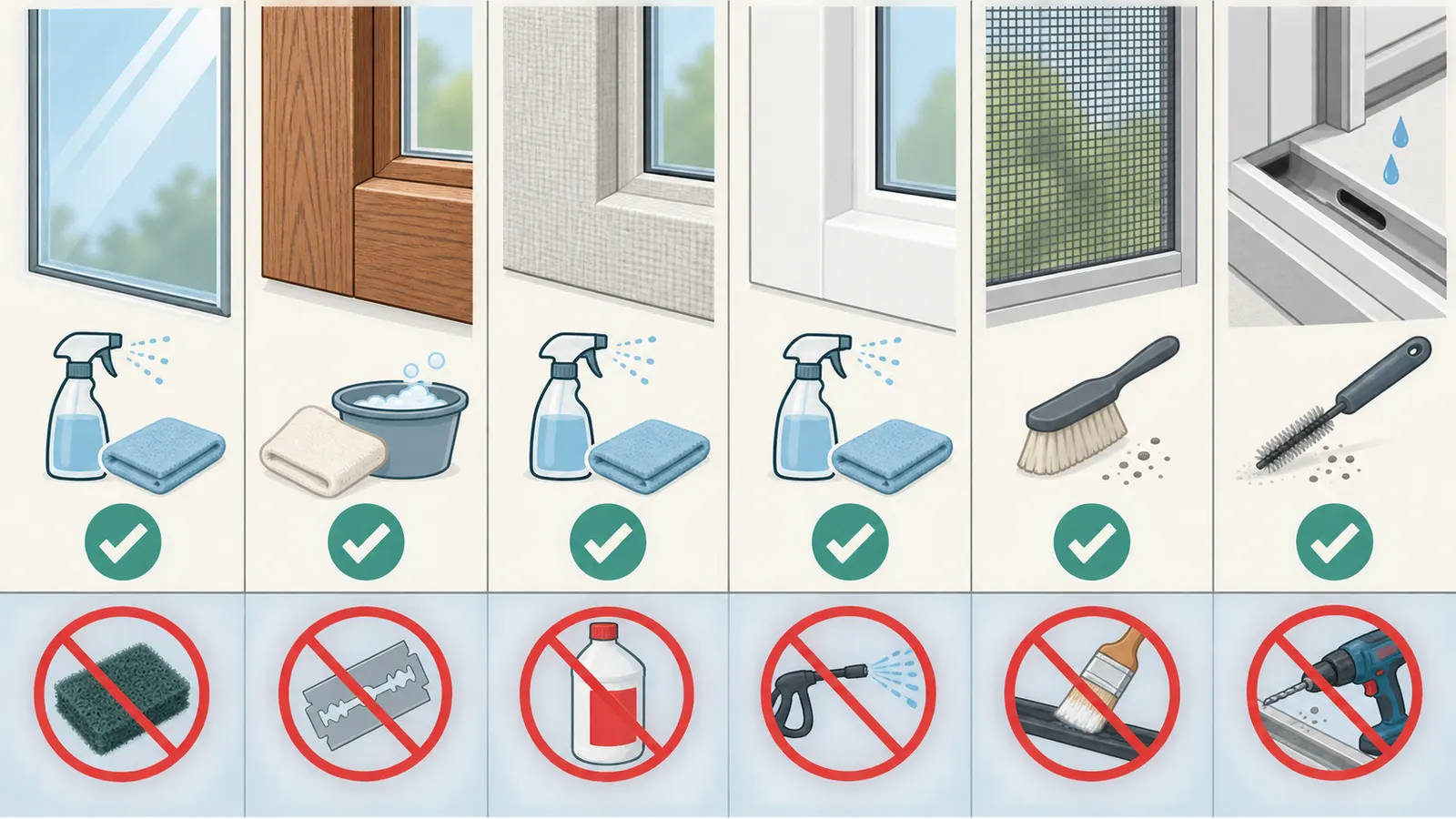
For hardware, follow the exact operation and lubrication instructions. A stiff handle can reflect dirt, misalignment, a failed balance, sash distortion, pressure from paint or a damaged operator. The safe owner action is to observe, clean only accessible debris, document the location and stop if force is required. Never defeat a lock, remove a balance spring, disassemble a hinge or force a sash to prove that it is “working.”
The “never” list is product-specific but useful
Across the inspected manufacturer guidance, several failure patterns recur:
- Do not use a pressure washer directly on a window. Marvin’s care page states that exterior house-cleaner overspray can be safe in its listed context but says never to use a pressure washer directly on any part of a window or door. The Marvin pressure-washer warning is a hard boundary for Marvin care, and Andersen separately warns against power washers or pressurized cleaning tools.
- Do not use a razor blade, steel wool or sandpaper on glass or factory finishes unless the exact document expressly requires a controlled repair process. Pella warns that a razor can scratch glass and potentially cause breakage; Andersen lists abrasive tools and metal razor blades among items to avoid.
- Do not let solvents, paint, stain or strong cleaners contact weatherstrip, vinyl, plastic, hardware or factory cladding.
- Do not use an acid masonry cleaner near unprotected glass or frames. Protect the opening first and follow the masonry cleaner’s instructions; the window document controls what happens if contact occurs.
- Do not convert an exterior washing task into ladder work without checking access. If safe access is unavailable, the next action is a qualified service provider or a safer method, not a longer reach.
The next decision after cleaning is whether the visible condition is soil, finish deterioration, a component defect, a water-management symptom or an unsafe-access problem. Use the inspection matrix instead of choosing a repair from the appearance alone.
Decide when wood needs finish work #
Wood windows need a separate finish decision: inspect the coating and exposed wood, preserve the glass-to-wood seal, and finish only the wood surfaces and products that the exact manufacturer permits. A primed surface is not automatically a finished surface, and a painted wood interior does not authorize painting exterior cladding or moving parts.
Separate four conditions that look similar
Use this observation matrix before buying paint:
| What you observe | What it may mean | Safe verification | Next handoff |
|---|---|---|---|
| Surface dirt with intact coating | Cleaning need | Wash with permitted process and compare before/after photos | Owner records result |
| Small nick or scratch in an otherwise intact painted finish | Local coating damage | Photograph scale and check whether wood is exposed or wet | Manufacturer document, finish professional or builder |
| Cracked, peeled or bubbled paint or caulk | Finish or joint no longer sheds water reliably | Photograph all edges; check for dampness without cutting into the assembly | Manufacturer/installer or qualified finish professional |
| Soft, swollen, darkened or repeatedly wet wood | Possible moisture damage or deterioration | Do not probe aggressively or seal over it; record location and history | Qualified window/wood repair professional |
| Gap or void at glass-to-wood edge | Compromised finish seal or glazing interface | Photograph close and wide views; do not smear generic caulk over the glass edge | Manufacturer or qualified service provider |
| Condensation between panes | Possible insulating-glass seal failure | Confirm it is between panes, record weather and pane location | Retailer, builder or manufacturer warranty route |
| Paint on weatherstrip, hinge or sliding contact | Field-finishing error or friction problem | Do not scrape or force the unit; document | Installer/manufacturer or qualified repair provider |
Do not infer from one dark spot that rot is present, or from one paint crack that the entire window must be replaced. Likewise, do not infer that cleaning a wet sill resolves the cause of recurring water. Maintenance can document a symptom and prevent additional contamination; it cannot establish the condition inside a concealed joint.
New wood in design handoff and closeout
The highest-value wood decision can occur before ownership. Andersen recommends finishing interior wood before or immediately after installation and says newly purchased units should not be stored without finishing the interior. Its guidance says units must be finished, sealed or suitably protected no later than 14 days after arriving at the job site, while also requiring the actual finish manufacturer’s instructions. That Andersen finishing guidance is a project-handoff requirement to assign, verify and record; it is not a universal 14-day rule for every manufacturer.
Marvin similarly says a new window that is bare wood or primed must be painted immediately because primer maximizes adhesion but does not provide protective qualities. It says to clean and dry the wood, sand lightly with 220- or 320-grit paper where its instructions apply, keep the sash open or removed until dry, and avoid finish contact with weatherstrip, vinyl, plastic, metal and sliding-contact surfaces. The Marvin wood-finishing instructions also describe a 1/16-inch, or 1.5-millimeter, tape gap at the glass edge to allow a proper finish seal.
The homeowner’s closeout verification is not “the windows look painted.” Verify:
- Which surfaces were intended to be finished in the field.
- Which finish product, sheen and color were used, if recorded.
- Whether the glass edge, sash edges, top and bottom rails, pockets and cutouts are sealed where the document requires it.
- Whether weatherstrip, locks, hinges and sliding surfaces are free of finish.
- Whether sashes operate without sticking after the finish has dried.
- Whether the record names who will correct a missed or damaged finish.
Andersen warns that it is not responsible for final field-finishing results and says certain wood species, particularly oak, can react adversely with some finish materials; it recommends testing the finish when possible. That means a homeowner should not select a stain from a color card and assume compatibility. Record the finish manufacturer’s technical data and a small controlled test where the product directions allow it, then obtain approval from the responsible party for a new-home finish correction.
Refinish only after the cause is controlled
If the coating is cracked, peeled or bubbled, first ask why. Possible causes include weather exposure, wet wood, failed caulk, incompatible finish, impact, abrasion from operation, or a joint that was never protected. Repainting over moisture or a failed joint can hide the symptom while allowing deterioration to continue.
For a homeowner, the preparatory decision is to document and route, not to strip a whole sash from a ladder. If the exact product document permits touch-up, keep the repair within the stated surface, preparation, temperature and drying instructions. Do not paint over weatherstrip, hardware, exterior cladding, vinyl, fiberglass or a sliding contact surface. Andersen expressly says not to paint non-wood parts and identifies fiberglass, Flexacron, vinyl cladding, Fibrex and aluminum cladding as surfaces that should not receive paint or finish under its warranty guidance. Recheck the Andersen non-wood finishing boundary before using a brush.
Marvin says exterior wood products should be inspected and repainted periodically, with blistering, peeling or cracking repaired quickly; it also says to caulk cracks before repainting with a high-quality or paintable-grade caulk. Its guidance for disturbed millwork includes a water-repellent wood preservative containing at least 0.5% IPBC, following the preservative manufacturer’s instructions. These are Marvin-specific instructions, not a reason to apply an IPBC product to an unidentified unit or to assume that caulk can close an installation defect. Route an uncertain cut, exposed end grain or recurring wet area to the manufacturer or a qualified finish professional.
The finish decision in humid, coastal and high-sun locations
Climate affects the observation burden, but it does not create a single national schedule. Record relative context such as direct sun, salt, high humidity, wind-driven rain and irrigation spray, then use the exact manufacturer’s instructions. Marvin specifically discusses high-humidity and high-moisture environments and says accessible wood portions should receive a finish before installation, with a grade that protects against moisture while allowing water vapor to diffuse to the exterior. That Marvin high-moisture guidance is a product-care condition, not a local building code.
Dark exterior finishes can also be a product-specific risk. Andersen advises avoiding dark-colored finishes on product surfaces exposed to direct sunlight to reduce the risk of warping or cracking. Do not convert that advice into a prohibition on every dark window finish. It is a reason to verify the exact product, finish system, orientation and warranty before changing color.
The next decision is whether the unit is truly wood and field-finishable. If the surface is fiberglass or vinyl, move to the no-paint lane. If the materials are mixed, record each surface separately.
Keep fiberglass and vinyl in a no-paint maintenance lane #
Fiberglass and vinyl generally shift the homeowner’s decision from recurring field finishing to correct cleaning, drainage, hardware, weatherstrip and warranty care, but “low maintenance” does not mean maintenance-free or universally paintable. Use the manufacturer’s product document to establish whether any field coating is allowed.
Fiberglass: protect the factory surface
For fiberglass, the default register entry should be “clean and inspect; do not field-paint unless the exact manufacturer document expressly allows it.” Andersen’s painting guidance lists fiberglass material among surfaces that should not be painted or finished under its Owner-2-Owner warranty guidance. Its cleaning article, by contrast, includes fiberglass among surfaces that can be cleaned with the listed approved products in the applicable conditions, subject to HeatLock glass restrictions. Keep those two decisions separate: a cleaner approval is not a paint approval.
Marvin’s guidance names Ultrex fiberglass and provides an approved-cleaner list for that product context, including glass cleaners and general-purpose cleaners. It also warns that outdoor cleaner overspray may be safe in the listed context but a pressure washer must never be used directly on a window or door. The Marvin approved-cleaner and pressure-washer guidance should be copied into a Marvin Ultrex row only with its product scope preserved.
A fiberglass maintenance visit should check:
- surface dirt, pollen, salt or construction residue;
- scratches, gouges, chalking, fading or a color change;
- frame joints and corners;
- sealants and perimeter conditions without cutting them;
- screen fit and mesh;
- operating force, locks and hinges;
- water remaining in tracks or on the sill after a normal rain;
- fogging or moisture between insulating-glass panes.
If a homeowner sees a scratch, do not assume a polishing compound is safe. A compound can change gloss or remove a factory surface. Photograph the defect in diffuse light, record dimensions in inches or millimeters if measured, and ask the manufacturer or retailer for an approved repair method.
Vinyl: clean, inspect and avoid incompatible finish work
For vinyl, treat the frame as a finished product unless the exact manual says otherwise. Andersen identifies vinyl cladding as a surface not to paint or apply finishes to under its warranty guidance. Pella’s owner manual warns against getting glass cleaning solutions on vinyl frames because they may discolor the finish. These are different warnings with the same practical result: keep the cleaner on the pane or frame surface for which it was approved, and do not improvise a coating to solve discoloration.
Vinyl inspection should focus on movement, drainage, weatherstrip, hardware and evidence of heat or impact. A bowed or warped-looking sash may be a manufacturing, installation, exposure or operation problem; a dark color change may be soiling, chemical damage or UV-related appearance change. Do not diagnose cause from a photo alone. Do not drill, trim, heat-form, solvent-wipe or paint vinyl to make the symptom disappear.
If a vinyl window has become hard to operate, first document whether the difficulty is at the handle, lock, sash travel, track or hinge. Check whether a removable screen, loose debris or a piece of protective film is interfering, but do not remove a component whose function you cannot restore. Record the force qualitatively—normal, increased, requires two hands, cannot operate—rather than inventing a force threshold. If you have a force gauge and the manufacturer specifies a method, use that method; otherwise the responsible next handoff is the installer, retailer or service provider.
Mixed-material windows need multiple rows
Many homeowner errors happen because “fiberglass window” hides a wood interior, vinyl weatherstrip, metal hardware and coated glass. A single window can therefore need separate care fields:
| Surface | Likely maintenance decision | What must be verified |
|---|---|---|
| Interior wood | Clean gently; finish or touch up only per product document | Finish type, exposed edges, glass seal and moisture condition |
| Exterior fiberglass or vinyl | Clean and inspect; generally no field finish without permission | Series, factory surface and approved cleaner |
| Glass | Clean only with compatible process | Coating, tint, etched mark and special-glass warning |
| Weatherstrip | Keep clean and unpainted; inspect compression and damage | Exact replacement part and solvent restrictions |
| Hardware | Operate gently; clean or lubricate only per instructions | Operator type, corrosion, missing fasteners and warranty path |
| Drainage | Keep designed paths clear; do not modify openings | Weep location, recurring water and installation responsibility |
The register is valuable precisely because it prevents a material label from hiding a finish boundary. If the records are incomplete, use the most conservative permitted action—dry dust removal, visual inspection from safe access and document retrieval—until the manufacturer identifies the surface.

The next decision is whether a visible performance symptom is maintenance or an installation/product claim. ENERGY STAR and NFRC data can preserve selection and rating records, but they cannot answer that question alone.
Verify performance without misdiagnosing installation #
Use a repeatable observation and handoff process for drafts, condensation, water, fogging and operation; do not treat cleaning or a rating label as a remote diagnosis of installation, structure or warranty coverage.
Drafts, cold glass and condensation
Record where and when the symptom occurs: room, unit ID, pane, sash position, outdoor weather, indoor humidity if measured, HVAC state, blinds or curtains, and whether the condition is on the room-side surface, exterior surface or between panes. A photo with a date and a nearby reference helps, but it does not prove cause.
The NFRC label can tell you what performance ratings were assigned to the product. NFRC explains that lower U-factor means better resistance to heat escaping a room, higher condensation resistance means better resistance to condensation, and SHGC describes solar heat admitted. Use the NFRC label definitions to read the record correctly. Do not infer that a high condensation-resistance rating guarantees no room-side condensation in every home, or that a low U-factor proves a particular draft is caused by the glass.
ENERGY STAR likewise says even certified products can be drafty if poorly installed and advises following manufacturer installation instructions and seeking trained professionals. Its installation guidance belongs in the handoff column: if a new or recently installed window has a draft, ask the builder or installer to verify installation before buying weatherstrip or changing the frame.
Useful homeowner observations include:
- Is the condensation on the room side, outdoor side or inside the sealed insulating-glass unit?
- Is it one unit, one sash, one edge or multiple windows on the same exposure?
- Does it occur after cooking, bathing, humidification or a weather change?
- Is an air vent, supply register, curtain or furniture changing air movement?
- Does the window lock and close fully without force?
- Is water present only on the sill after cleaning, or after rain when the window was untouched?
Do not drill a pane, insert a tube, add interior plastic film, replace weatherstrip or apply caulk as a first response to fogging or drafts. Those actions may destroy evidence, interfere with drainage or affect warranty coverage. Send the record to the builder, installer, retailer or manufacturer according to the closeout and warranty route.
Water at the sill or interior trim
Water on a sill is a symptom, not an explanation. It can result from condensation, cleaning runoff, an open sash, blocked drainage, failed sealant, installation conditions, wind-driven rain or a leak elsewhere that arrives at the opening. The homeowner can identify timing, location and recurrence; a qualified professional should determine concealed water paths, flashing, rough-opening conditions or damage.
Use this bounded protocol:
- Stop any active interior cleaning and dry only what is safely reachable.
- Photograph the wet area before disturbing trim or caulk.
- Mark the unit, room, pane and exact location; note whether water is at the interior stool, jamb, head, track or wall below.
- Record weather, wind direction if known, recent washing, irrigation and whether the window was open.
- Check visible drainage openings for obvious loose debris without enlarging, sealing or poking into the assembly.
- Do not remove interior trim, cut sealants or spray water onto the window to reproduce the event.
- Route a new-home or recent-installation issue to the builder or installer first, with the retailer or manufacturer copied as the warranty requires.
If paint or drywall is swelling, an electrical outlet is wet, mold-like growth is extensive, or water is entering during weather, stop the maintenance experiment and arrange qualified assessment. Do not touch a wet outlet, continue cleaning around it, or handle nearby electrical equipment; keep clear and route the hazard to a qualified electrician or emergency service as appropriate. The article does not establish a local building-code violation or insurance determination. The governing jurisdiction for a code or permit question is the city, county or other authority having jurisdiction for the property; ask that authority or the responsible licensed professional rather than treating this article as a local rule.
Operation and hardware
Operation is verified by controlled movement, not by force. Open and close the unit as the product instructions describe, using the handle or operator without leaning, prying or overextending. Record the exact point of resistance and whether the sash is square in the opening, but do not attempt to re-square a frame, adjust a balance spring or remove a hinge unless the manufacturer’s owner instruction clearly assigns that task to the homeowner.
If a new window binds, the first handoff is normally the builder or installer because the closeout record and installation warranty are closest to the event. If an older window changes after years of operation, the retailer, manufacturer or qualified window service provider may be the next route. If the issue follows painting, staining, replacement of weatherstrip or installation of blinds, preserve those dates and products. Andersen’s product-conversion and modification FAQ says damage resulting from product modifications is not covered under the applicable Andersen warranty, while Pella’s warranty FAQ says tinting or drilling modifications that contribute to a defect would not be covered. Both are product-specific boundaries: read the warranty for the installed series before stating a coverage conclusion.
When a replacement pane is not a maintenance task
Fogging between panes, cracked glass, a broken seal, a damaged coating or a pane that will not remain seated belongs in a service or warranty route. Do not remove a sealed insulating-glass unit because the glass “looks replaceable.” Record the etched identifier, approximate pane size only if measured safely, location, date noticed, photos and whether damage may have occurred during construction.
For a claim, keep the evidence chronological:
- baseline photo at closeout;
- first date the symptom was noticed;
- cleaning or maintenance dates and exact products;
- weather or exposure context;
- any installer or builder service visit;
- correspondence and reference numbers;
- current photos showing the full unit and close detail.
This record supports a handoff; it does not prove coverage. The applicable warranty controls exclusions, remedy, timing and responsible party.
The next decision is whether the record can be handled by a manufacturer-retailer route, a builder or installer route, a qualified maintenance professional, or a safety escalation. The register below makes that routing explicit.
Build the Window Material, Finish and Warranty Maintenance Register #
The Window Material, Finish and Warranty Maintenance Register is the article’s reusable worksheet for turning exact product documents into per-window maintenance decisions. It is intentionally neutral: it does not rank wood, fiberglass or vinyl, and it does not promise a service life, maintenance cost or warranty result.
Summary: The register captures product, glass, finish, exposure, task, cadence, permitted products, verification, owner and claim-route fields so each window receives a document-backed action instead of a material stereotype.
Method: For each window, copy the exact product and glass identifiers from the order, label or closeout record, then assign only the care task supported by the applicable manufacturer document and record the verification and next handoff.
Limitations: This is a source-linked homeowner planning worksheet, not a product warranty, inspection report, code determination, structural diagnosis or substitute for qualified access and repair decisions.
Blank register
Copy one row for every window or identical group. If a group later develops different exposure or a different condition, split the row. Keep the source URL or document name in the row even if the same manufacturer appears elsewhere in the house.
| Field | Entry for this unit | Verification or evidence | Owner / next handoff |
|---|---|---|---|
| Unit ID / room / floor | Plan, photo or closeout schedule | ||
| Manufacturer / series / configuration | Order, invoice, label or manual revision | ||
| Operation type | Operate only as instructed; record resistance | ||
| Frame / sash / cladding materials | Closeout record plus visual confirmation | ||
| Interior finish | Bare, primed, painted, stained, clear-coated or unknown | ||
| Exterior finish / cladding | Paint, stain, factory coat, fiberglass, vinyl, aluminum or unknown | ||
| Glass type / coating / tint | Etched mark, label, order record or manufacturer confirmation | ||
| NFRC label / certificate reference | Photo or preserved document | ||
| Orientation / shade / direct sun | Site plan and observation | ||
| Salt / industrial / agricultural / dust exposure | Site context; do not infer a cadence | ||
| Safe access available? | Interior reach, ground level, platform or professional-only | ||
| Approved glass cleaner | Exact product document and revision | ||
| Approved frame cleaner | Exact product document and revision | ||
| Prohibited products / tools | Record coating, finish and pressure-washer limits | ||
| Cleaning cadence | Annual, quarterly, event-triggered or source-specific | ||
| Finish inspection cadence | Manufacturer’s condition or calendar instruction | ||
| Last cleaning date / result | Product used, photos, residue or change | ||
| Last finish inspection / result | Cracks, peeling, bubbling, exposed or wet wood | ||
| Drainage / track / screen result | Clear, damaged, recurring water or unknown | ||
| Operation / hardware result | Normal, increased force, stuck or damaged | ||
| Glass result | Clear, scratched, cracked, fogged or coating concern | ||
| Photograph IDs | Wide, medium and close views with dates | ||
| Responsible person | Homeowner, builder, installer, retailer or qualified pro | ||
| Claim or service route | Warranty version, retailer, builder or manufacturer | ||
| Next decision date | Calendar date or condition trigger |
Completed illustrative rows
The following are illustrative modeled examples, not records from a real house. The materials, exposures and actions are chosen to demonstrate the method; do not treat them as evidence that a particular product has been installed or that the homeowner’s local conditions match them.
| Unit | Identity and exposure | Permitted maintenance action | Verification | Owner and handoff |
|---|---|---|---|---|
| W-01 living room | Andersen unit; glass mark confirms HeatLock; exterior ground-level; south-facing direct sun | Use only the HeatLock glass instruction’s mild soapy water; dry with a soft cloth; do not use abrasive glass cleaner or toothpaste | Photograph glass mark before work; record cleaner; compare haze before/after | Homeowner cleans; manufacturer support if coating appearance persists |
| W-02 bedroom | Marvin wood window; painted exterior; north-facing; second floor | Annual visual inspection for failing caulk or cracked, peeled or bubbled paint; clean with the Marvin wood-surface process if safely accessible | Wide and close photos of glass edge, joints and lower rail; record whether wood is exposed or wet | Homeowner records; qualified finish or window professional if finish failure is beyond touch-up |
| W-03 office | Pella vinyl window; coating and series confirmed in closeout folder; ground-level | Use the applicable Pella manual and exact cleaner; keep solution off vinyl frame; do not use a razor | Photograph product and glass identifiers; note frame color change, drainage and operation | Homeowner cleans; retailer/builder/manufacturer route for discoloration or failure |
| W-04 stair landing | Fiberglass exterior, wood interior; exterior access would require extension ladder | Clean interior only if permitted; schedule a professional for exterior inspection; do not create a ladder task | Record access limitation and condition visible from safe position | Homeowner records; qualified service provider for exterior |
| W-05 kitchen | Unknown series; recurring moisture at sill after rain; closeout record missing | Dry and document; no caulk, drilling or pressure washing; retrieve identity and report symptom | Weather/date, exact location, photos, recent cleaning and window position | Builder/installer first for a new home; manufacturer or retailer after identity is established |
The important feature is not the brand name. It is the chain from identity to permitted action to verification to handoff. If the row cannot answer which product document applies, the action remains “identify,” not “try a stronger cleaner.”
Illustrative workload formula
The register can also expose how a maintenance plan’s workload changes when rows are split by material, exposure or access. This is a planning calculation, not a price estimate and not a measured labor study.
Use:
annual visits = Σ (number of rows × visits per row per year)
For a simple illustrative example, assume a home has:
- 8 ground-level rows that each receive 1 visit per year;
- 4 upper-level rows that each receive 1 visit per year but require separate access planning;
- 3 Andersen rows in a coastal, industrial or agricultural exposure that the Andersen document assigns at least 4 visits per year;
- 2 wood rows that receive 1 annual finish inspection in addition to ordinary cleaning.
If the 3 exposure-sensitive rows are already among the 12 cleaning rows, the cleaning workload is:
(12 rows × 1 visit) + (3 rows × 3 additional visits) = 21 cleaning visits per year
The wood inspection workload is:
2 wood rows × 1 finish inspection = 2 finish inspections per year
The combined register event count is therefore:
21 cleaning visits + 2 finish inspections = 23 recorded events per year
This does not mean 23 hours, 23 visits by a contractor or 23 whole-house cleanings. A “visit” here is one planned row-level event. Several rows may be completed in one safe session, while a single upper-level row may require a professional service call. Keep event count, access complexity and paid service scope as separate fields.
Sensitivity is more honest than one number. If the exposure-sensitive group is 1 row instead of 3:
(12 × 1) + (1 × 3) = 15 cleaning visits per year
If the group is 6 rows:
(12 × 1) + (6 × 3) = 30 cleaning visits per year
The change is driven by the source-supported cadence and the number of rows, not by a claimed lifetime for a material. If you instead collapse all 15 windows into one row, the formula may look simpler, but it hides different glass coatings, finish boundaries and safe-access decisions. A smaller spreadsheet is not necessarily a safer maintenance plan.
Sensitivity limits and what the formula cannot tell you
The formula is sensitive to five choices:
- Row definition. Splitting unlike units increases record quality and may increase event count.
- Source cadence. A manufacturer may say annual, quarterly for a named exposure, immediately for unfinished wood, or condition-triggered. Do not convert “periodically” into a made-up number.
- Exposure classification. Coastal, industrial and agricultural are source terms in Andersen’s cleaning guidance. A homeowner should not label a neighborhood “coastal” and apply the interval to another brand without checking its document.
- Access. A safe ground-level visit and an upper-level professional visit are not equivalent workload, even if both count as one event.
- Task type. Cleaning, finish inspection, touch-up, operation check, service and claim preparation are different events.
The formula does not calculate labor hours, material quantities, contractor prices, product life, energy savings or warranty probability. It also does not establish that more frequent cleaning is always better. More chemistry and more access can add risk. Use it to plan records and compare scenarios, then obtain a scoped quote if paid work is required.
The next decision is whether a row ends with “owner complete,” “builder or installer,” “retailer or manufacturer warranty,” “qualified finish/window professional,” or “safety stop.” That routing is the final maintenance control.
Route defects, warranty claims, and professional work #
Route a window issue by the evidence available and the responsibility most closely tied to the event: homeowner care for permitted cleaning and observation, builder or installer for closeout and installation questions, retailer or manufacturer for product and warranty questions, and qualified professionals for hazardous access, lead-paint disturbance, glass replacement or concealed damage.
Four claim routes
Builder or installer route. Use this first for a new-home defect, missing closeout record, finish that was never completed, a window that binds from first use, water appearing soon after installation, or damage documented at handover. Send the unit ID, room, installation date, closeout photo, current photo, symptom chronology and the exact action already taken. Ask the builder to state whether the issue is being treated as installation, product, finish or owner maintenance.
Retailer or distributor route. Use the selling channel named in the warranty or purchase record for a product failure, replacement part, glass seal concern or a question about the applicable warranty. A retailer often has the order and series data needed to distinguish a product claim from a field-finish issue. Avoid buying a replacement component from a photograph alone.
Manufacturer route. Use manufacturer support when the series, glass coating, approved cleaner, finish boundary or warranty version cannot be resolved locally. Provide the label or serial information, product date, retailer or builder, exact symptom and maintenance history. Ask for the written care instruction that applies to the unit rather than relying on a generic page for another series.
Qualified service route. Use a qualified window, glass or finish professional for work that requires high access, sealed-glass removal, finish restoration beyond a documented touch-up, suspected wood deterioration, water-intrusion investigation, or a correction that could affect the installed assembly. Ask for a written scope that names which surfaces will be cleaned, repaired, sealed, painted or replaced, what will remain untouched, and how the result will be verified.
What a warranty handoff should contain
The claim record should be compact but complete:
| Claim field | Example of a useful entry |
|---|---|
| Product identity | W-02, Marvin series, serial or label photo attached |
| Purchase and installation | Purchase date, installed date, builder closeout date |
| Location | Room, floor, orientation and exact sash or pane |
| Symptom | “Fogging between panes at lower-right pane, first noticed 2026-08-14” |
| Evidence | Wide and close photos, weather notes, maintenance history |
| Actions taken | “Cleaned on 2026-07-01 with the product-listed process; no solvent, razor or pressure wash” |
| Contacts | Builder, installer, retailer, distributor and reference numbers |
| Requested decision | Inspect, identify coating, replace part, determine coverage or advise approved repair |
| Access constraint | “Exterior second floor not safely reachable by homeowner” |
| Warranty document | Title, effective date, version or URL used |

Marvin’s warranty page gives a concrete claim-routing pattern: contact the retailer that sold the product, provide the serial number, and if the retailer or distributor has not responded after five days, send written notice with the homeowner’s contact details, purchase date, serial number, retailer, problem description and prior contacts. Read the Marvin warranty route as a Marvin process, not a national warranty law. Its page also says repair or replacement may involve parts or labor charges, so do not promise the homeowner a free remedy.
Pella’s warranty index lists separate documents for wood, fiberglass and vinyl product groups and names current product date ranges on the page. It also says a glass tinting or drilled modification that contributes to a defect would not be covered. Use the current Pella warranty index to identify the applicable product document, then read the document itself before stating a coverage conclusion. A manufacturer’s webpage is not a substitute for the warranty attached to the unit.
Ladder and elevated-access boundary
Window cleaning becomes a fall-risk decision when the exterior cannot be reached from a stable, intended position. OSHA’s construction-falls guidance describes portable ladders moving or slipping when they are not safely positioned and says to inspect them before each use for cracked or broken parts. See the OSHA construction-falls ladder guidance for the workplace/construction source scope.
For this article, the homeowner boundary is:
- clean ground-level or safely reachable interior surfaces only when the product document permits;
- do not stand on a sill, counter, chair, roof edge or improvised platform;
- do not carry a bucket, squeegee or pressure equipment while climbing;
- do not lean sideways or stretch beyond stable contact;
- do not place a ladder where its feet or top support can move, where a door can open into it, or near electrical hazards;
- stop and hire a qualified window-cleaning or maintenance provider when safe access is not obvious.
This is a conservative safety boundary, not a complete ladder training course and not a local law. State and local occupational, property, rental and permitting rules may differ by jurisdiction; the applicable authority for a local rule is the state, county or city authority having jurisdiction, and a homeowner should ask that authority or a qualified professional.
Lead-paint boundary for older homes
Ordinary dusting and cleaning do not automatically become lead-renovation work, but sanding, scraping, cutting, replacing windows or disturbing old painted surfaces can create lead dust. EPA says homes built before 1978 are more likely to contain lead-based paint and recommends that homeowners hire a lead-safe certified contractor for pre-1978 renovation work that disturbs painted surfaces. Review the EPA consumer guidance for the federal RRP context before sanding a painted wood window or preparing a replacement.
The jurisdictional limit matters. EPA guidance is federal U.S. guidance; some states, tribes and local programs administer or add requirements. The article does not determine whether a specific project is covered. If the home was built before 1978 and the work will disturb paint, ask EPA or the relevant state, tribal or local program for the current rule and use a certified lead-safe professional where required or recommended. Do not treat a small planned patch as automatically safe, and do not dry-sand a deteriorated surface merely to obtain a smooth finish.
Red flags that change the next action
Stop ordinary maintenance and route the issue when you see:
- active water entry, wet wall or swelling trim;
- soft, swollen or repeatedly wet wood;
- cracked glass, broken insulating-glass seal or suspected coating damage;
- a sash, operator or hinge that requires force or is no longer secure;
- a gap at the glass-to-wood edge, failed perimeter joint or missing cladding;
- paint or finish on weatherstrip, locks, hinges or sliding surfaces;
- a window that cannot be safely reached without a ladder or elevated platform;
- unknown glass coating after a cleaner has already caused a visible change;
- a pre-1978 painted surface that would be sanded, scraped, cut or replaced;
- a product identity or warranty route that the builder, retailer and manufacturer cannot reconcile.
For each red flag, provide the smallest complete record: unit ID, symptom, date, photos, weather or exposure, prior maintenance, product identifier and requested decision. Do not include a confident diagnosis you cannot support. “Fogging between panes; please determine whether this is a sealed-unit issue and advise the warranty route” is more useful than “the window is defective because the low-E coating failed.”
A final owner workflow
At the beginning of each scheduled maintenance period, filter the register by due date and condition trigger. Before visiting a row, read its cleaner and finish boundary. After the visit, complete the result and schedule the next decision. At closeout or a claim, export the row and its photos rather than forwarding an unstructured message that says “the windows need work.”
The complete decision loop is:
- Identify: product, series, glass, material and finish.
- Scope: location, exposure, access, source document and responsible person.
- Act: permitted cleaning, visual inspection or documented finish task.
- Verify: compare condition, operation, drainage, glass and finish with the baseline.
- Record: date, product, photos, result and unresolved symptoms.
- Route: owner, builder, installer, retailer, manufacturer or qualified professional.
- Recheck: confirm the handoff was answered and set the next source-supported cadence or condition trigger.
The practical result is not a promise that wood, fiberglass or vinyl is “maintenance-free.” It is a visible chain of responsibility. Wood may require finish protection and careful glass-edge inspection. Fiberglass and vinyl may avoid field painting but still need compatible cleaning, drainage and operation checks. Coated glass can impose a stricter cleaner rule than the surrounding frame. A warranty claim may depend less on how clean the unit is than on whether the homeowner can show its identity, purchase route, history and the exact care instructions followed.
If you are still in design handoff, require the product and glass records before approving closeout. If you have just taken ownership, create the register from the delivered labels and manuals before choosing supplies. If a symptom already exists, preserve the evidence and route it before altering the assembly. For Brictale’s editorial method and source-scope approach, see How Brictale researches and reviews its guides; for the broader homeowner decision feed, see the Brictale blog.
Cite this guide
Brictale. “How to Maintain Wood, Fiberglass, and Vinyl Windows.” Published 2026-10-07; updated 2026-10-07.
https://brictale.com/build/materials/maintain-wood-fiberglass-vinyl-windows · Read the Markdown version
Original contribution: Window Material, Finish and Warranty Maintenance Register. A per-window worksheet that reconciles product identity, glass, finish, exposure, maintenance tasks, verification, responsibility and claim routing.
Sources and scope
Evidence behind this page
- Andersen recommends cleaning glass and frame surfaces at least annually, increasing the interval to at least every three months in coastal, industrial or agricultural areas with higher airborne dirt, dust, smoke or salt spray.
Andersen windows and doors; cleaning cadence for listed glass and frame materials; manufacturer guidance, not a universal service interval for every brand or product.
Accessed · Link to this claim - Andersen's product-conversion and modification FAQ says damage resulting from modifications is not covered under the applicable Andersen Owner-2-Owner limited warranty and directs owners to review the warranty for the specific product.
Andersen Product Conversion or Modification FAQs
Andersen product-conversion and modification FAQ; the applicable product warranty controls the exact exclusion, terms, remedy and claim procedure.
Accessed · Link to this claim - For Andersen HeatLock glass, Andersen says to use only mild soapy water and warns that abrasive cleaners such as cerium oxide, Soft Scrub or toothpaste can damage the interior coating.
Andersen HeatLock coated glass; the restriction does not establish the cleaning rule for other brands or unidentified coated glass.
Accessed · Link to this claim - Andersen says exposed wood sides and edges must be finished or sealed, while weatherstripping, hardware, exterior cladding, fiberglass, Flexacron, vinyl cladding, Fibrex and aluminum cladding should not be painted or finished; it also says cracks or voids in the glass-to-wood finish seal should be repaired immediately.
Information for Painting and Staining Andersen Products
Andersen products and Owner-2-Owner warranty guidance; field finishing results remain product-, finish- and installer-dependent.
Accessed · Link to this claim - Marvin says to remove surface dirt and check the exterior of wood windows and doors at least once a year for failing caulk or paint that has cracked, peeled or bubbled and exposed wood to the elements.
Window and Door Maintenance: Cleaning and Care
Marvin wood windows and doors; annual inspection guidance is not a universal repainting interval.
Accessed · Link to this claim - Marvin says a new primed or bare-wood window must be painted immediately, with the sash open or removed until dry; it says not to paint weatherstrip, vinyl, plastic, metal or sliding-contact surfaces, and gives a 1/16-inch glass-to-wood tape gap for a finish seal.
Window and Door Maintenance: Cleaning and Care
Marvin wood windows and doors; exact finish products, conditions and preparation follow the finish manufacturer and product instructions.
Accessed · Link to this claim - Marvin directs warranty claimants to the retailer that sold the product and asks for the serial number; if a retailer or distributor has not responded after five days, Marvin provides a written-notice route with purchase date, serial number, retailer, problem description and prior contacts.
Marvin brand product warranty support page; claim eligibility and remedy remain controlled by the applicable warranty document.
Accessed · Link to this claim - Pella publishes separate current warranty documents for wood, fiberglass and vinyl product groups, with the listed current date ranges and named product series on its warranty page; Pella also says a tinting or drilled modification that contributes to a defect would not be covered.
Window and Door Warranties | Pella
Pella warranty index and FAQ; the applicable series warranty controls coverage, exclusions, terms and claim procedure.
Accessed · Link to this claim - Pella's owner manual instructs owners to use an ammonia-free glass cleaner or a vinegar-and-water solution on a soft lint-free cloth, avoid solutions on wood, fiberglass or vinyl frames, and avoid razor blades that can scratch glass or cause glass breakage.
Pella Owner's Manual, Appendix: Cleaning
Pella owner-manual cleaning appendix for the listed product families; special glass and product-specific instructions can supersede the general cleaning steps.
Accessed · Link to this claim - ENERGY STAR says residential windows must meet U-factor and, where applicable, Solar Heat Gain Coefficient requirements based on climate zone.
Residential Windows, Doors, & Skylights
ENERGY STAR qualification and selection guidance in the United States; it does not prescribe a homeowner cleaning cadence or establish local building code.
Accessed · Link to this claim - ENERGY STAR's climate-zone finder asks for state and county to identify the applicable climate zone.
ENERGY STAR Climate Zone Finder
ENERGY STAR United States climate-zone lookup for residential windows, doors and skylights; the lookup does not establish local building code or a homeowner maintenance cadence.
Accessed · Link to this claim - NFRC says its label provides energy performance ratings for windows, including U-factor, visible transmittance, condensation resistance, Solar Heat Gain Coefficient and air leakage, and explains that U-factor is better when lower while condensation resistance is better when higher.
National Fenestration Rating Council: What does the NFRC label tell you?
NFRC label definitions and comparison guidance; ratings describe the labeled product and do not diagnose an installed window or predict a maintenance interval.
Accessed · Link to this claim - OSHA's construction-falls guidance says portable ladders can move or slip when they are not safely positioned, recommends securing the side rails, says to inspect ladders before each use for cracked or broken parts, and limits the guidance to OSHA construction-safety scope.
OSHA workplace/construction safety guidance for misuse of portable ladders; used here to set a conservative homeowner boundary, not to determine every residential work practice or local rule.
Accessed · Link to this claim - EPA says homes built before 1978 are more likely to contain lead-based paint and that sanding, cutting, replacing windows and other renovation or maintenance work can create lead dust; EPA recommends homeowners hire a lead-safe certified contractor for pre-1978 renovation work that disturbs painted surfaces.
Renovation, Repair and Painting (RRP) Program: Consumers
U.S. Environmental Protection Agency consumer guidance for pre-1978 housing; federal RRP applicability and state or tribal program administration can vary by project and jurisdiction.
Accessed · Link to this claim