How to Maintain Rooftop Solar After an Output Drop or Storm
Decide when a rooftop solar change means monitor, inspect, claim, coordinate roof work, or call for an emergency safety response.
The short answer
Start with safety, then compare like-for-like production records with the system's own baseline. A weather-only or communications change can be monitored; a persistent or material output change needs qualified diagnosis. Visible storm damage, roof leakage, flooded electrical equipment, exposed wiring, smoke, arcing, or loose panels moves the issue to immediate isolation and professional or emergency response. Route warranty, insurance, roof, utility, and ownership questions separately.How to Maintain Rooftop Solar After an Output Drop or Storm
If rooftop PV produces less than usual, first separate a normal weather or communications change from a physical or electrical hazard. Compare like-for-like production records, read only the indicators your installed system exposes safely, and document the change. Monitor a weather explanation; arrange a qualified inspection for a persistent or material change; route defects to the warranty owner; coordinate roof work with the PV provider; and treat smoke, arcing, flooding, exposed wiring, broken glass, or loose panels as an emergency.
This guide is for a United States homeowner living with an owned or transferred rooftop photovoltaic system after move-in. “United States” is the market scope, not a single rulebook. The actual city or county building department, state or local electrical authority, local fire authority or fire marshal, serving electric utility, roof manufacturer or roofer, insurer, financing company, lease or power-purchase-agreement owner, and equipment manufacturer may each control a different part of the decision. DOE says rooftop solar permitting and inspection details and fees vary by local jurisdiction, so do not convert this national workflow into a claim about your address.Permitting and Inspection for Rooftop Solar
The safe homeowner task is to collect useful evidence from the ground, records, app, meter, and paperwork. It is not to walk a panel-covered roof, open an inverter, disconnect live conductors, pull modules, torque racking, wash a roof array, or reset a repeated fault until it disappears. Treat the PV electrical path as hazardous whenever the installed procedure or warning label says it is energized; OSHA identifies electrical hazards and training requirements in solar energy work, while NREL/Sandia identifies roof falls, electrocution, arc flash, lockout/tagout, and heat stress as important PV maintenance hazards.Green Job Hazards – Solar Energy: Electrical Best Practices for Operation and Maintenance of Photovoltaic and Energy Storage Systems; 3rd Edition
1. Make the first decision: monitor, inspect, claim, coordinate roof work, or respond to danger #
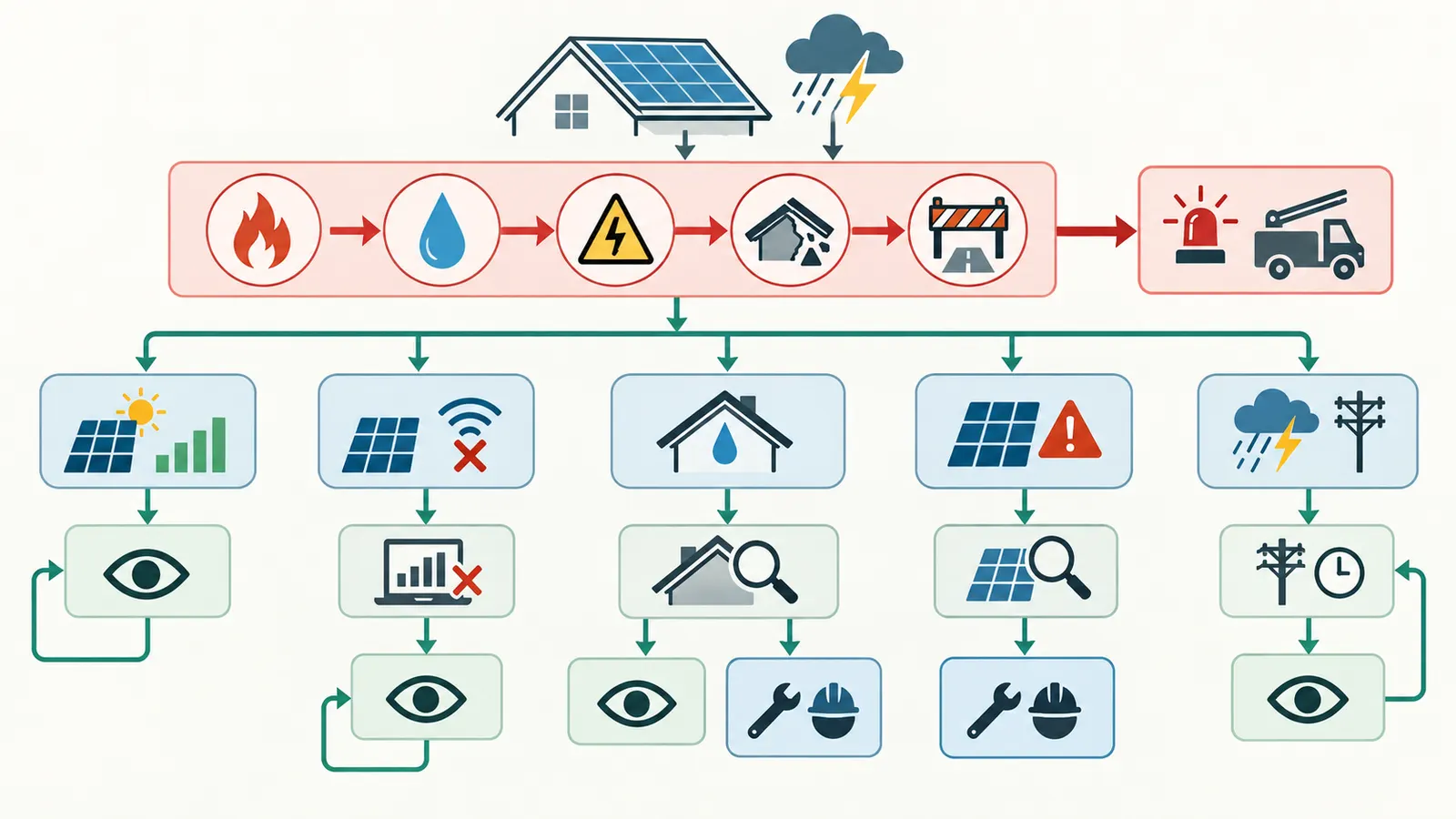
Choose the next handoff by asking two questions in order: “Is anyone or anything in immediate danger?” and “Is the output change persistent after a fair comparison?” A clean, dry, intact system with one unusual cloudy month can remain on a monitoring plan. A sustained change without visible damage merits a qualified solar inspection. A physical defect or storm event calls for an inspection plus insurance or warranty routing. Any roof leak requires roof-and-PV coordination. Fire, arcing, exposed conductors, flooded electrical equipment, or a loose array requires immediate safety control before production troubleshooting.
The five outcomes are deliberately separate because the person who can prove the cause is not always the person who pays for the remedy:
| Outcome | Evidence that points here | Immediate homeowner action | Responsible next handoff | What closes the branch |
|---|---|---|---|---|
| Monitor | Output tracks the system's historical pattern after weather, season, and communications are considered; no hazard is visible | Save the production snapshot, weather context, and next review date | Homeowner, with exact installer or manufacturer manual available | Two or more comparable periods return to baseline or a documented trend remains explainable |
| Qualified inspection | Persistent or material output change, repeated inverter fault, unexplained string or panel difference, or a monitoring alert that remains | Stop experimenting; capture model, serial, messages, dates, and production records | Qualified solar professional, electrician, or installer familiar with the equipment | Written finding identifies cause, test method, and repair or monitor recommendation |
| Warranty claim | Suspected product or workmanship defect within the actual coverage period and claim procedure | Preserve serials, invoices, photos, logs, and the unaltered fault record; do not promise coverage | Warranty administrator, manufacturer, installer, or contract owner | Written coverage decision and scope for parts, labor, removal, shipping, and reinstallation |
| Roof-work coordination | Leak, roof damage, aging roof, flashing concern, reroofing, or access needed around attachments | Keep off the roof; photograph interior and exterior signs from safe locations | Roofing contractor plus PV installer/O&M provider, with roof warranty holder included | Agreed detach-and-reinstall scope, roof repair scope, permits if required, and commissioning record |
| Emergency response | Smoke, fire, burning smell, visible arcing, hot or damaged enclosure, exposed conductors, flooded energized equipment, broken glass or loose panels overhead | Keep people away; call 911 for fire or immediate life danger; call the utility for utility-side hazards; only operate a labeled disconnect from a dry safe position if the exact procedure permits it | Fire department, utility, certified electrician, qualified solar professional, and insurer as applicable | Site is declared safe, damaged components are tested/replaced, and the system is recommissioned |
The table is a routing aid, not a technical test. It keeps a homeowner from treating “the app is blank,” “the roof is leaking,” and “the inverter is smoking” as three versions of the same maintenance ticket. DOE's PV lifecycle guidance separates preventive O&M, performance confirmation, pre-storm work, and post-damage recovery. It recommends securing the site, inspecting and electrically testing components, replacing damaged equipment before energizing, recommissioning, and resuming monitoring.Life Cycle of Photovoltaic Systems: Operate and Maintain an Existing Photovoltaic System
Stop before troubleshooting when the symptom is a hazard
Treat the following as a stop condition rather than an invitation to look closer:
- Smoke, flame, popping, buzzing, a burning odor, visible arcing, melted plastic, scorch marks, or a rapidly hot enclosure.
- A panel, rail, conduit, junction box, inverter, or battery that is visibly displaced, cracked, hanging, submerged, or struck by a tree or other object.
- Roof leakage near an electrical route, water inside an inverter or combiner, floodwater around equipment, or a wet electrical area.
- Dangling or exposed PV conductors, broken connectors, loose modules overhead, or a damaged roof edge.
- Broken glass where people, pets, or workers may walk, even if the app still reports production.
- A fire department, utility, installer, or local authority instruction to keep the system isolated.
From the ground, move people and pets away. Do not touch a downed conductor, wet enclosure, broken module, metal racking, or a fallen tree that may contact the system. For this guide, Brictale uses a conservative safety boundary: treat the array and any battery as potentially hazardous until the installed equipment instructions and a qualified responder establish a safe condition. Do not infer safety from a dark app, a tripped breaker, nighttime, or a single disconnect. Give emergency responders the system location, battery presence, labels, and the handover packet if it is accessible without entering the hazard area.
For a fire or immediate threat to life, use 911 in the United States. If the problem involves the utility service drop, meter, pole, or conductors beyond the home's equipment, call the serving utility's emergency number and keep clear. If the problem is damaged customer-owned PV equipment without immediate fire or life danger, ask the fire department or utility for direction and arrange a qualified solar electrician. Emergency stabilization comes before preserving a perfect warranty photograph.
What “qualified” means for this guide
“Qualified professional” is a routing description, not a credential Brictale can award remotely. Ask for the license, certification, insurance, training, and local authorization required for the actual work in your state, city, county, or utility territory. A solar O&M provider may be able to inspect production and racking; an electrician may be needed for energized fault testing; a roofer may be needed for the roof membrane or flashing; and a structural engineer may be needed if attachments, roof framing, or wind damage are in question.
The contractor should explain which portion of the work they are accepting. “Solar service” does not automatically mean roof repair. “Roof inspection” does not automatically mean the person can isolate PV strings or reinstall an array. Make the boundaries visible in the work order: roof, racking, modules, DC wiring, inverter, AC connection, monitoring, battery, permits, utility notification, insurance documentation, and final testing.
2. Establish whether the output drop is real #
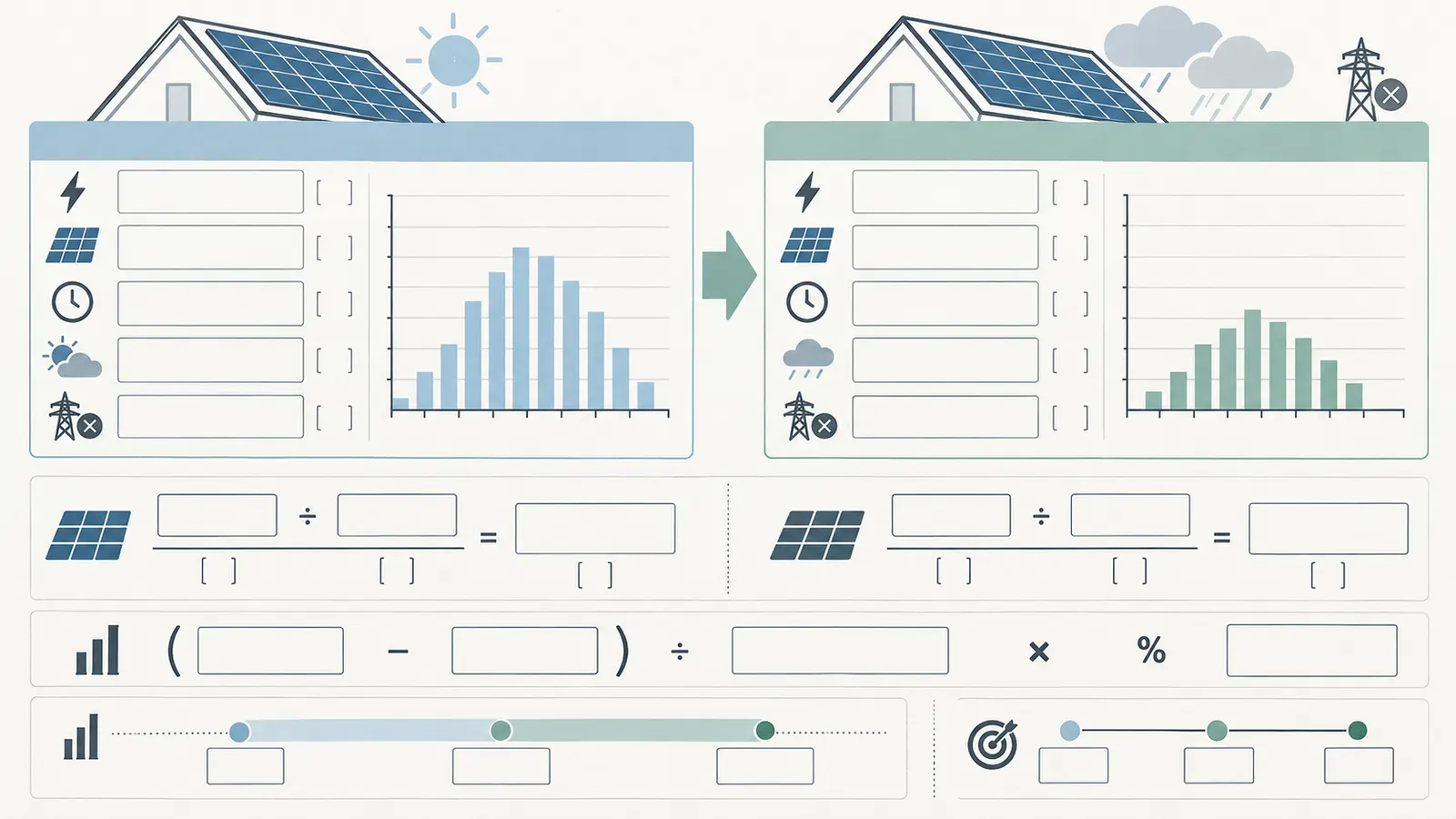
Use a like-for-like production comparison before interpreting a number. Compare the same array, the same AC production meter or monitoring channel, the same calendar interval, and similar weather and shade conditions. A single low day is weak evidence because clouds, snow, smoke, seasonal sun angle, utility outages, and a communications interruption can change the record. A persistent change across comparable weeks or months is stronger evidence and should move from casual monitoring to a documented decision.
DOE explains that PV output varies with solar availability, daily weather, system age, and severe weather. It also defines performance ratio as actual production divided by modeled production and availability as (1 - downtime) / total time.Optimizing Solar Photovoltaic Performance for Longevity Those definitions are useful because they discourage a common mistake: comparing today's instantaneous watts with the panel nameplate and calling the difference a failure. The nameplate is a rating under specified test conditions; household production is an accumulated result under changing conditions.
Build a comparison set, not a single screenshot
Collect these inputs before asking a professional to diagnose the system:
- System nameplate DC size in kilowatts (kWdc), panel count, installation or commissioning date, and whether the system includes a battery.
- Inverter architecture: one or more string inverters, microinverters, power optimizers, a hybrid inverter, or an unknown arrangement.
- Exact make, model, and serial number for the inverter, gateway, battery, and modules when accessible from labels or the handover file. Do not climb or remove covers to find them.
- Production in kilowatt-hours (kWh) for the current month, prior month, same month last year, and any complete-year records available.
- The monitoring channel used: app, gateway, inverter display, utility production meter, or a combination. Record whether the number is production, consumption, export, or an estimate.
- Dates and duration of the alert, outage, storm, roof event, tree work, construction dust, snow, smoke, or shading change.
- Whether the utility had an outage, voltage event, meter exchange, service work, or permission-to-operate issue during the period.
- Photographs from safe locations and a log of what was visible before anyone touched the equipment.
The exact system records matter. A homeowner who sees no data in an app may have a cloud, gateway, Wi-Fi, or account-access problem while the inverter continues to make power. Conversely, a system that reports “online” may still have a partial string, module, or production problem. Keep the production record and the communications record as separate columns.
Normalize the number for system size
For a simple first screen, calculate specific yield:
Specific yield (kWh/kWdc) = AC production (kWh) ÷ installed DC size (kWdc)
This is a comparison tool, not a promise of what a system should make. If an 8.4 kWdc array produced 1,030 kWh in a chosen reference month and 824 kWh in the same type of current month, the illustrative change is:
Change = (824 - 1,030) ÷ 1,030 = -0.20 = 20% lower
The specific yields are 122.6 kWh/kWdc and 98.1 kWh/kWdc. The useful result is not that 98.1 is universally bad; it is that the current period is materially lower than this system's selected reference under the stated assumptions. Now ask whether the current month had less sun, more snow, new shade, an outage, or a different export meter.
Sensitivity matters. If the reference value is 1,000–1,060 kWh because the prior records differ by weather or meter timing, the same 824 kWh current record represents a 17.6%–22.3% reduction. If the current number is an app estimate rather than a production meter, the uncertainty is larger. If the reference includes a full utility outage and the current period does not, the comparison is misleading. Record the range and why it exists rather than choosing the baseline that gives the most alarming result.
DOE's consumer guide says a production drop greater than 10% from year to year could indicate maintenance issues, but it does not make 10% a universal fault threshold.A Consumer’s Guide to Buying a House with Solar Panels Use that number as a prompt to investigate comparable records, not as permission to file a claim or climb the roof. The local climate, array orientation, system age, shade, data quality, utility behavior, and contract performance guarantee all matter.
Separate weather, shade, age, and downtime
Use a short cause screen before a service call, while accepting that the screen cannot prove the cause:
| Pattern in the records | Plausible explanation to test | What the pattern does not prove | Next action |
|---|---|---|---|
| Low output only during cloudy, smoky, snowy, or unusually hot periods | Lower solar resource, snow cover, smoke, or temperature effects | That modules or inverter are healthy | Compare to a weather-matched period and monitor recovery |
| Output declines gradually over years | Normal aging, persistent soiling, vegetation growth, or a slowly developing equipment issue | That the decline is within a particular warranty curve | Compare age-adjusted records with the module and installer warranties |
| Whole system drops to zero while home and neighborhood had an outage | Grid outage or inverter anti-islanding response | That the PV equipment failed | Check utility event and inverter history; do not alter settings |
| App is missing data but a production meter rises | Gateway, Wi-Fi, cellular, account, or cloud communication issue | That the array is producing correctly under all conditions | Document meter reading and route communications support |
| One string, one orientation, or one module is consistently lower | Shading, connector/wiring issue, module damage, optimizer/microinverter issue, or sensor mismatch | Which component is defective | Arrange qualified inspection with the map and records |
| Drop begins immediately after wind, hail, lightning, tree impact, flood, or roof work | Mechanical, roof, electrical, or weather damage | That the event is covered by a warranty or insurance policy | Preserve evidence and open the correct inspection and claim routes |
Age is a context variable, not a diagnosis. DOE describes PV module efficiency degradation at about 0.5% per year as a typical figure, while also noting that failure rates are higher as equipment ages.Optimizing Solar Photovoltaic Performance for Longevity That does not mean an older array should be accepted at any arbitrary output, nor that a new array cannot have a defect. It means a professional should compare the decline with the actual module warranty, design model, weather resource, downtime, and service history.
3. Read the system without touching energized equipment #
Read only the indicators exposed for the homeowner in the installed manual, app, production meter, or labeled display. Record the exact wording, code, LED state, timestamp, and whether production is zero, reduced, or merely unreported. Do not remove an inverter cover, open a combiner, pull a fuse, unplug a connector, operate a roof disconnect, or repeatedly reset a fault. The safest diagnostic information is often the information that lets the qualified person avoid a first unnecessary visit.
The architecture changes what a homeowner can observe. A string inverter aggregates several module strings at one ground-level device, so a single inverter alert may represent a broad loss or a device problem. Microinverters and optimizers can provide panel-level or group-level data, but a missing panel report may be a communications problem, a production problem, or both. A battery or hybrid inverter introduces additional operating states and stored-energy hazards. Never use a menu, button sequence, or shutdown order from a different brand or model.
Treat production and communication as different signals
If the app says “offline,” record the production meter before assuming the array is down. If the meter is also low, record that as a production symptom. If the meter is normal but the app is blank, route a communications issue. If the app shows the system online but output is materially lower, route a production investigation. If only one device or panel has stopped reporting, preserve that device identifier and last-report time.
SolarEdge's current U.S. system-owner guidance makes this distinction explicit: its indicator guidance separates a production LED from a communication LED, says not all error codes imply a production problem, and directs owners to contact the installer rather than repair an inverter or optimizer themselves.PV Production and System Issues The exact indicators on another system may be different, so use this as a reasoning pattern, not as a universal LED legend.
For an Enphase-specific example, its homeowner troubleshooting guidance says a microinverter-not-reporting alert does not always indicate a production issue, recommends checking when the affected panel last reported in the app, and routes wiring-related current-transformer errors to a certified solar professional.Troubleshooting and support The relevant question is not “which brand is better?” It is “does the installed evidence identify a data path problem, a power path problem, or an unresolved combination?” Use the exact installed manual and monitoring instructions for that answer; do not transfer a menu, alert meaning, or reset sequence from another vendor.
What to record from an inverter or gateway
From a safe standing position, capture the following without entering the equipment or electrical work area:
- Display or app state: producing, standby, fault, night, grid unavailable, offline, gateway not reporting, or another exact state.
- Exact error code and the screen or manual page that defines it. A paraphrase such as “red light” loses information.
- Current AC watts, today's kWh, and the date/time zone if the system exposes them.
- Last successful report time for the gateway, inverter, microinverter, optimizer, or battery.
- Whether the utility meter shows export or the normal production channel has changed.
- Whether the home had a power outage, generator operation, electrical panel work, Wi-Fi change, or utility meter work.
- Whether the alert clears and returns, persists, or appears only at dawn, dusk, high heat, or after an outage.
- A photograph of the manufacturer label and warning label only if it can be taken without touching the equipment or crossing a hazard boundary.
The handoff should include the manual version if visible, the monitoring account owner, the installer or O&M contact, and the system's permission-to-operate record if available. A professional may need the single-line diagram, array layout, module map, commissioning report, shade study, utility interconnection agreement, and previous service history. DOE recommends documenting installed components, manuals, warranties, operational indicators, error messages, performance estimates, and a chronological O&M log as part of a comprehensive plan.Optimizing Solar Photovoltaic Performance for Longevity
Avoid the “reset until green” failure case
A temporary reset can make a system appear to recover while leaving the underlying fault undocumented. DOE advises an electrical inspection after inverter nuisance tripping and warns that simply turning the system off and on is unlikely to address the root problem.Life Cycle of Photovoltaic Systems: Operate and Maintain an Existing Photovoltaic System Repeated resets also blur the timeline a technician needs to tell a weather event from an intermittent ground fault, grid condition, communications failure, or failing component.
If the installed manual explicitly gives a homeowner a safe, ground-level reset procedure for a defined non-hazard condition, follow that procedure once and record the result. If the alert returns, stop. If the system has any sign of water, damage, heat, burning, arcing, exposed wiring, or a roof event, do not perform a casual reset. Ask the qualified provider whether they want the system left in its current state for testing or isolated under the exact emergency shutdown procedure.
4. Inspect storm and roof clues from a safe position #
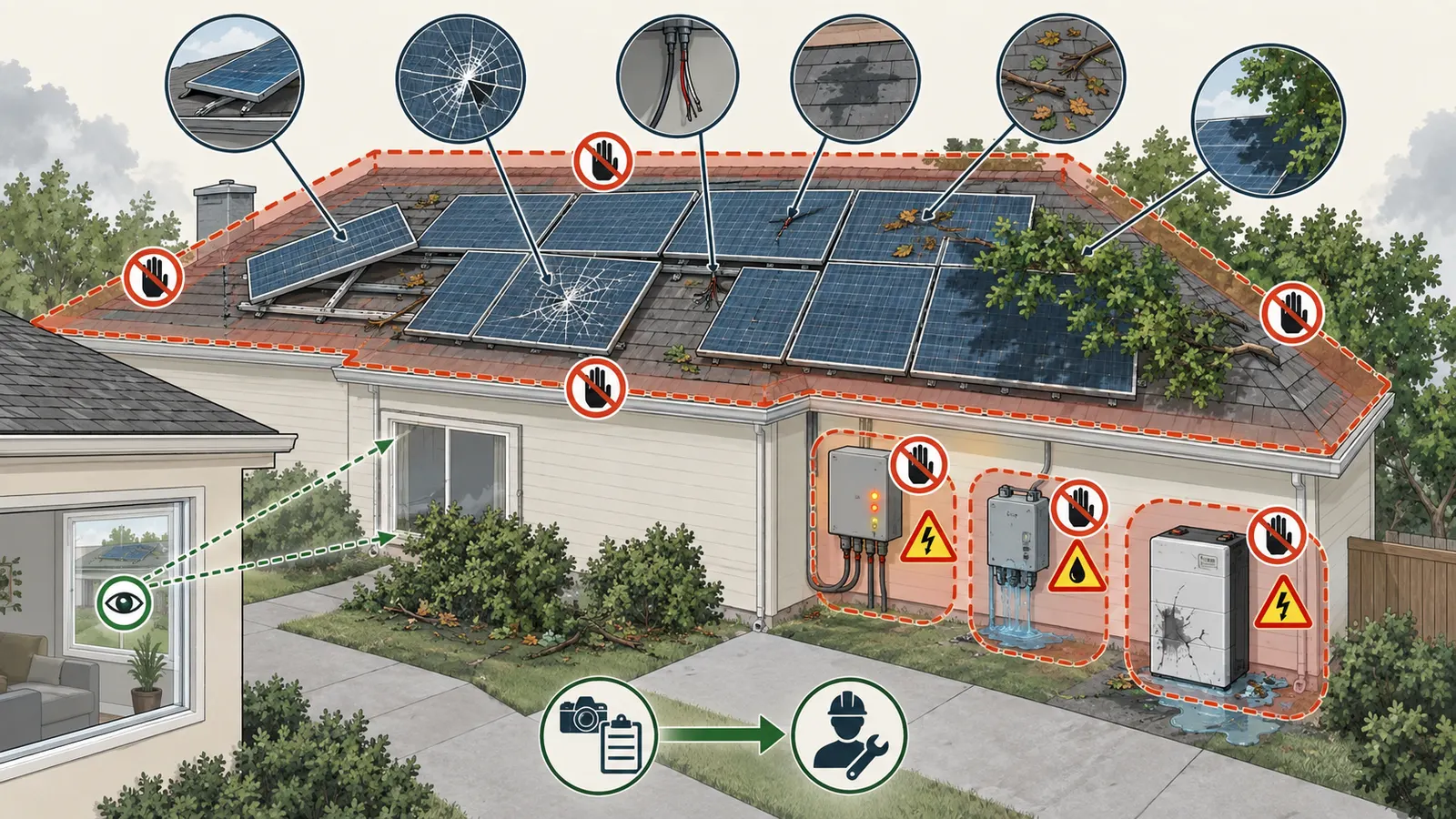
Inspect the roof from the ground, windows, or an interior position that is already known to be dry, stable, normally occupied, and adequately ventilated; do not access a panel-covered roof to confirm a suspicion. Interior observation is remote-only in this guide: do not enter an attic, crawlspace, utility closet, basement, or other confined or poorly ventilated space if it is flooded, wet, structurally compromised, electrically unsafe, contaminated, or affected by mold-like growth or odor. Do not touch mold, flood residue, damp insulation, or suspect debris. Leave the area, keep people and pets out, and route water damage, contamination, or structural concerns to a qualified roofer, electrician, and—where cleanup or contamination is involved—a qualified remediation provider under the actual local or state requirements. Look for the change that follows the weather event: a new roof stain, displaced module, broken glass, bent rail, dangling cable, shifted conduit, missing flashing, standing water, debris, tree contact, or a new shade source. A clear ground view does not certify the array. It only determines whether the next handoff needs immediate safety control, roof coordination, or qualified testing.
NREL's storm guidance identifies cracked glass, hot spots, damaged backsheets, loose or melted connections, corrosion, missing hardware, shading, dangling or tightly pulled cables, exposed wiring, and electrical equipment concerns as damage categories to investigate.Preparing Solar Photovoltaic Systems Against Storms These are not homeowner repair tasks. They are vocabulary for a useful call and a way to label photographs without guessing which component failed.
Make a ground-level event record
Take wide and close photographs from safe ground locations, ideally from the same positions used for earlier records. Record the date, approximate storm time, weather type, wind or hail report if available from a public weather source, nearby tree or debris impact, outage duration, roof leak location, and first time the output change appeared. Preserve the original files with timestamps; do not edit away context. If a photo cannot safely show the detail, write “not visible from ground” rather than zooming into a misleading pixel pattern.
Use binoculars or a camera zoom only from a stable, dry location. Do not stand beneath a loose module, enter a flooded area, move a fallen branch, touch racking, or use a ladder to get a better angle. Do not walk on modules. Glass can break, surfaces can be slippery, and the roof route may be blocked by the array. OSHA's solar fall guidance notes that roof-mounted PV can reduce the walking area available to workers and identifies fall-protection measures for the work conditions.Green Job Hazards – Solar Energy: Falls
Roof clues and PV clues must be kept separate
A roof leak is not automatically a PV failure. A production drop is not automatically a roof leak. A storm can cause both, and the repair sequence must allow each professional to inspect the interface without assigning blame prematurely.
Record roof clues separately. An attic clue is valid only when it was visible from a safe, occupied position; “not observed” is the correct entry when reaching the area would require unsafe entry or handling residue:
- Interior ceiling or attic stain, dripping, damp insulation, mold-like odor, or a change after rain.
- Missing, lifted, cracked, or displaced roofing material visible from the ground.
- Water tracking near a roof penetration, conduit route, attic junction, or inverter location.
- Clogged roof drainage, ponding, erosion, ice dam, or snow load concern.
- Roof age, prior reroofing, roof warranty holder, and any recent roofing work.
Record PV and support clues separately:
- Module glass that appears cracked, shattered, delaminated, or visibly displaced.
- Rail or clamp that appears bent, missing, separated, or shifted relative to neighboring rows.
- Wiring that appears unsupported, pulled tight, dangling, abraded, or exposed.
- Inverter, combiner, disconnect, conduit, or battery enclosure that appears flooded, corroded, burned, open, or physically damaged.
- New shading from a tree, branch, construction equipment, chimney, or adjacent structure.
Do not infer from a single clue. For example, a roof stain below an attachment could come from flashing, roof age, condensation, or a separate plumbing route. A single lower-producing panel could be shading, data loss, a connector, a module, or a mismatch in the monitoring layout. The professional's job is to test the hypothesis safely.
Storm-specific branches
Wind or tornado
Look from the ground for a row that is no longer aligned, missing fasteners, raised edges, bent rails, loose skirts, or debris near the array. Secure the area below a visibly loose panel and keep everyone away. Do not try to push a panel down or retrieve a loose piece. Wind can damage the roof attachment while leaving the module visually intact. Ask for a mechanical and electrical inspection and a roof-envelope inspection if attachments or flashing may have moved.
Hail
Do not use production alone to dismiss hail. Microcracks, backsheet damage, or localized electrical damage may not create an immediate whole-system zero. Record the storm time, hail evidence on other property, ground-visible module damage, output before and after, and insurer notice requirements. Do not scrape or wash the array to make a claim photo; preserve its condition until the appropriate professional or insurer gives direction, except for emergency measures needed to keep people safe.
Lightning or utility event
Record the outage, surge, inverter fault, burning smell, and any other affected household electronics. Do not assume that replacing a fuse or resetting a breaker is the remedy. A qualified electrician or solar professional may need to test the AC and DC sides, grounding, surge protection, inverter, and monitoring equipment. If utility equipment is involved, the serving utility controls its portion of the response.
Flooding or wind-driven rain
Keep away from flooded electrical equipment. NREL's storm checklist says that where flooding risk remains high, the system should be powered down and not energized again until checked by a certified electrician.Preparing Solar Photovoltaic Systems Against Storms In a homeowner context, that means use only a clearly labeled, accessible, dry, ground-level control if the installed manual gives an appropriate safe procedure; otherwise wait for qualified help. Do not wade through water to reach a disconnect.
Snow and ice
Snow can be a normal temporary production limitation, but heavy accumulation, ice dams, roof loading, and falling snow can also create hazards. NREL's O&M guidance says snow removal is generally not recommended because it can damage modules, while exceptional roof-load or ice-dam conditions require a professional method.Best Practices for Operation and Maintenance of Photovoltaic and Energy Storage Systems; 3rd Edition Do not shovel, scrape, use a pressure washer, or climb onto a snowy roof. Ask a roofer or solar provider who is equipped for the actual condition.
5. Choose the responsible party and make the handoff complete #
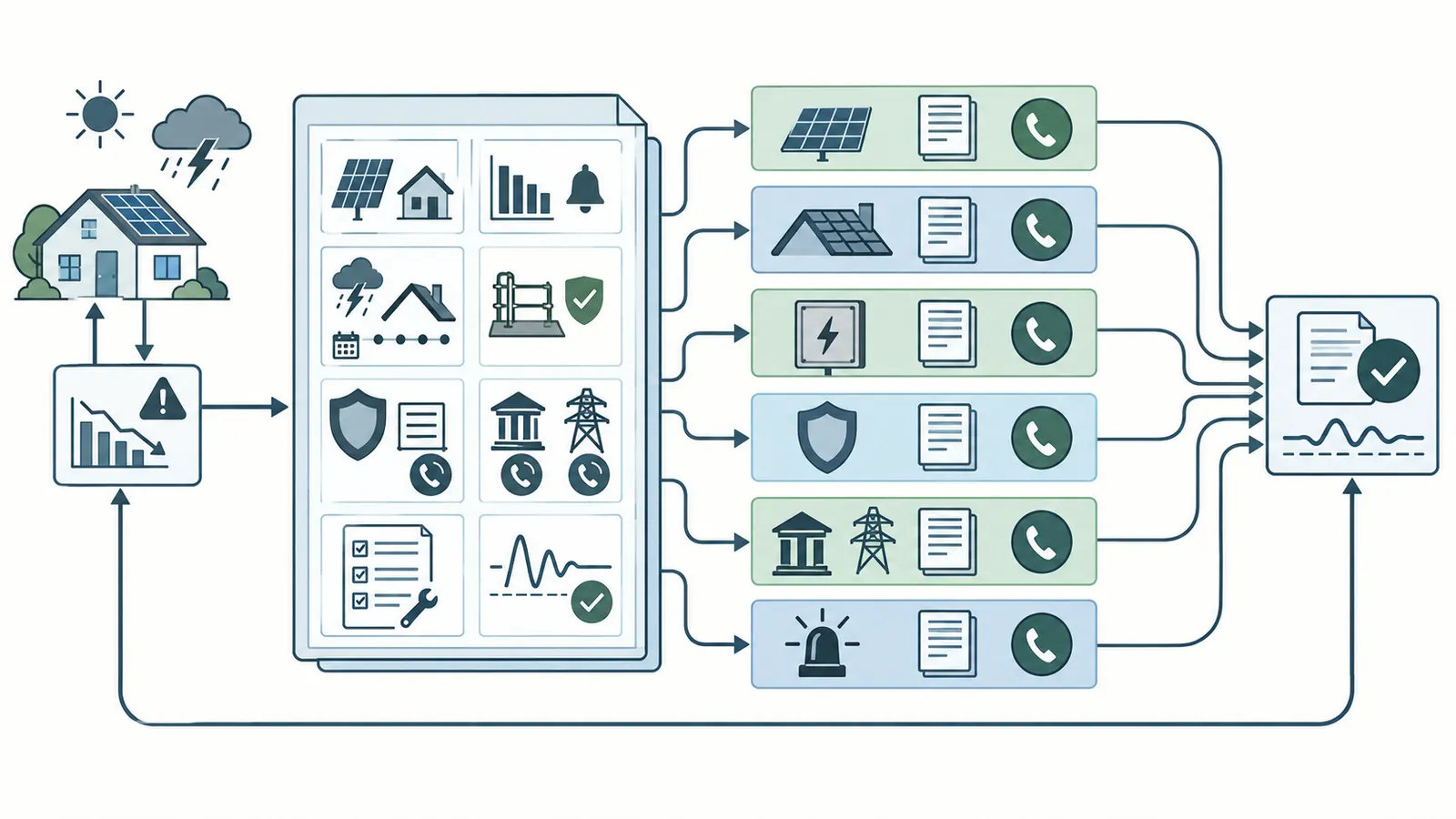
Send the same evidence packet to the party who controls the next decision, but do not assume that one party owns every obligation. The system may be owned by the homeowner, a lender, a lease company, or a power-purchase-agreement provider. The roof may be covered by a separate installer or manufacturer warranty. The PV equipment may have separate module, inverter, labor, and workmanship terms. The utility may control permission to operate and interconnection changes. Local building, electrical, and fire authorities may control permits, inspection, access, or altered equipment.
DOE advises a homeowner acquiring a solar-equipped house to identify the system age, inverter type, installer, warranties, production history, monitoring access, and ownership structure.A Consumer’s Guide to Buying a House with Solar Panels Rebuild that file after move-in even if the system appears healthy. A missing password or serial number can turn a simple alert into avoidable downtime.
Ownership first: who is allowed to authorize work?
Use this order:
- Read the closing file, loan, lease, PPA, transfer documents, and O&M agreement. Identify who owns the modules, inverter, battery, monitoring account, and roof penetrations, and who must approve a service call.
- Identify the current monitoring account owner and transfer access if needed. Do not create a second account that loses historical data without understanding the consequence.
- Identify the original installer and whether it still services the system. If not, identify a qualified provider familiar with the exact brand, model, and architecture.
- Identify the warranty start date, expiration date, registration status, transfer deadline, exclusions, notice method, RMA rules, and labor terms for each major component.
- Ask the contract owner before authorizing removal, rewiring, replacement, or roof work unless immediate emergency stabilization is required.
Vendor account procedures illustrate why this matters. SolarEdge's current U.S. owner page says that site ownership transfer gives the new owner monitoring access and can simplify future maintenance requests, but the stated process and fee are SolarEdge-specific.Site Transfer or New User Access For warranty coverage, the applicable loan, lease, power-purchase agreement, installer terms, manufacturer warranty, and labor terms control. Ask the responsible contract or warranty owner for a written coverage decision before authorizing non-emergency removal, replacement, or roof work; do not infer a transfer deadline, fee, or labor promise from another vendor's documents.
Assign the right scope to the right professional
| Scope | Likely lead | Ask for | Do not assume |
|---|---|---|---|
| Roof covering, flashing, membrane, shingles, tile, drainage | Roofing contractor or roof warranty holder | Roof condition report, leak source hypothesis, protected access plan, PV detach/reinstall coordination | That the roofer can disconnect or reinstall PV |
| PV output, array map, racking, module, optimizer, microinverter, string diagnosis | Qualified solar O&M provider or original installer | Test method, affected component, photos/map, repair scope, commissioning result | That app data alone identifies the failed part |
| AC panel, wiring, grounding, overcurrent, disconnect, surge or fault testing | Qualified electrician with PV experience where required | Electrical test scope, isolation procedure, code/AHJ questions, safe re-energization plan | That a general handyman can open PV equipment |
| Structural attachment, roof framing, wind damage, unusual movement | Qualified structural professional and/or experienced PV engineer | Attachment and framing assessment, repair design, manufacturer concurrence where needed | That tightening a visible bolt restores structural capacity |
| Utility meter, interconnection, permission to operate, service-side issue | Serving electric utility | Case number, required inspection or approval, exact reconnection steps | That a homeowner can change grid settings or interconnection terms |
| Covered storm loss or falling-object loss | Home insurer or claims administrator | Claim number, adjuster scope, coverage position, mitigation instructions | That insurance covers every production loss or maintenance issue |
| Manufacturer defect or product warranty | Equipment manufacturer or authorized warranty channel | RMA/claim number, coverage decision, parts and labor terms | That a product warranty pays roof work, removal, shipping, or reinstallation |
NREL notes that PV warranties can depend on following instructions, that underperformance may require testing, and that a manufacturer warranty may cover replacement without covering removal, shipping, or reinstallation labor.Best Practices for Operation and Maintenance of Photovoltaic and Energy Storage Systems; 3rd Edition Ask for those cost boundaries in writing before approving a non-emergency repair. A low parts estimate can still leave a large labor, roof-access, permit, or lost-production scope.
Local approvals are a checkpoint, not a universal assumption
If a repair replaces an identical component in the same location, the local process may differ from a system expansion, roof alteration, inverter relocation, battery addition, changed nameplate capacity, or reconfiguration. The city or county building department, electrical inspector, fire marshal, and serving utility may not use the same process. Ask each actual authority, in its jurisdiction, whether the proposed work needs a permit, inspection, revised drawings, fire-access review, utility notice, or permission to operate.
DOE says local governments have different rooftop-solar permitting and inspection rules, details, and fees, and that the utility connects the system after the applicable approval process.Permitting and Inspection for Rooftop Solar Do not tell a contractor “no permit is required” because a neighbor had a similar repair. Ask the contractor to name the authority they checked and to put the answer in the scope. Keep the permit number, inspection result, utility case, and final operating authorization with the system records.
6. Work the maintenance plan by month, season, and event #
Use condition-based maintenance anchored by the installed manuals, warranties, roof plan, and local conditions rather than a universal cleaning promise. A small residential array normally needs more disciplined recordkeeping than hands-on intervention. Schedule a monthly record review, a safe visual check after meaningful events, and qualified inspection when the evidence crosses the escalation branch. NREL's residential O&M discussion emphasizes the homeowner's responsibility for onsite inspection and the importance of a homeowner manual with operational indicators and permissible procedures.Best Practices for Operation and Maintenance of Photovoltaic and Energy Storage Systems; 3rd Edition
Monthly: read, record, and look from safe locations
Once each month, preferably on a consistent date, record current production and the monitoring status. Use the same channel each time and keep a second source, such as the utility production meter, when available. Compare the current value with the prior month and the same month in prior years. Note cloud, smoke, snow, dust, new shade, outages, and unusual household or utility events.
From the ground or interior, check for visible changes: a new roof stain, debris, tree growth, animal activity, blocked drainage, damaged conduit, a displaced module, or a change in the inverter's exposed indicator. Do not open anything. “No visible change” is a valid entry because it helps isolate an output-only change from an obvious storm event.
Check that the monitoring account still works, but do not confuse an app login with system health. Save the report or screenshot with date, time zone, production channel, and account name. Update the contact list if the installer, O&M provider, insurer, utility program, or equipment manufacturer has changed.
Quarterly or seasonally: review shade, weather, and access
At least each season, review whether trees, vegetation, construction, a new neighboring structure, chimney deposits, bird activity, agricultural dust, pollen, or coastal salt exposure has changed the array's environment. Trim vegetation only from a safe ground-based work position or use a qualified arborist where trees, ladders, roof edges, or conductors are involved. Do not cut branches that may fall on the array without a plan for electrical and roof safety.
The original shade study, layout, and roof photos are valuable baselines. A shadow that covers only a few modules may be invisible in a whole-system monthly number but obvious in panel-level data. Conversely, panel-level differences can be caused by orientations, clipping, data errors, or expected design behavior. Ask the solar professional to compare the current pattern with the original layout rather than ranking panels solely by today's watts.
Before a forecast storm, perform only actions that can be completed safely several days before the event and that the system manual assigns to the owner. NREL says its pre-storm checklist is not for completing after storm elements begin affecting the site; it also divides checks into site, mechanical, and electrical areas.Preparing Solar Photovoltaic Systems Against Storms A homeowner may clear loose yard debris from a safe location, secure ordinary outdoor items, save current monitoring data, and confirm contacts. Mechanical fastener checks, electrical enclosure work, and roof access belong to trained personnel with the correct equipment.
Cleaning: decide from evidence, not a sales schedule
Soiling can lower output, and uneven deposits such as bird droppings can create localized hot-spot risk. NREL/Sandia directs operators to follow the module manufacturer's recommendations, use only permitted materials, and avoid high-pressure water, brushes, solvents, abrasives, and harsh detergents.Best Practices for Operation and Maintenance of Photovoltaic and Energy Storage Systems; 3rd Edition The same guidance says local rainfall, dust sources, power value, accumulation rate, and cleaning cost affect whether and how often cleaning is worthwhile.
For a roof array, safe access is the gating condition. If the panels are visibly dirty from the ground but the roof is steep, wet, snowy, fragile, or without a safe access system, do not clean them. Hire a provider that can document its roof and electrical safety plan. Do not use a pressure washer from a ladder or ground if it can drive water into edges, connectors, vents, or enclosures. Do not assume a generic detergent is compatible with the module glass, coating, seals, or warranty.
A simple illustrative cleaning screen is:
Expected recoverable value = array production value × estimated avoidable soiling fraction
If a homeowner estimates that an array's relevant annual production is worth $1,800 and a qualified assessment supports a 3% avoidable soiling loss, the gross recoverable value is 1,800 × 0.03 = $54 per year. If a safe professional cleaning costs $220, one cleaning would not pay back from that assumed production value alone. If site evidence instead supports 15% loss after construction dust, the gross value is $270, but the calculation still needs the provider's scope, frequency, roof access, water, warranty, and whether rain will remove the deposit. These are illustrative inputs, not a quote or a measured loss.
Sensitivity makes the decision honest:
| Assumed avoidable soiling loss | Annual production value | Gross annual value of recovered production | Meaning |
|---|---|---|---|
| 1% | $1,800 | $18 | Routine paid cleaning is unlikely to be justified on energy value alone |
| 3% | $1,800 | $54 | Compare cleaning price with roof safety, appearance, warranty, and local conditions |
| 8% | $1,800 | $144 | Investigate the source and ask for a site-specific maintenance proposal |
| 15% | $1,800 | $270 | A professional assessment may justify corrective cleaning or source control |
The formula cannot prove the fraction. It is a decision prompt for comparing a documented estimate with a real service scope. NREL's report also notes that rain can change the benefit quickly and that cleaning frequency should be site-specific.Best Practices for Operation and Maintenance of Photovoltaic and Energy Storage Systems; 3rd Edition
Inverter, wiring, and battery maintenance
Homeowners can record the outside indicator, keep ventilation paths clear of ordinary household storage, note unusual noise or heat from a safe distance, and arrange service. They should not remove covers, tighten terminals, inspect energized connectors, replace fuses, or alter settings. “The display is accessible” is not the same as “the inside is safe to service.”
For a string inverter, ask the service provider how it will distinguish a grid event, inverter failure, string fault, ground fault, isolation fault, and communications problem. For microinverters, ask for the array map and the last-report history of any affected units. For optimizers, ask how the provider will test the power path and communications path without swapping components blindly. For a hybrid inverter or battery, include battery model, state-of-charge event, enclosure location, alarm history, ventilation, and the manufacturer's emergency guidance.
Never store combustible materials against electrical equipment or block required clearances. If an installed battery shows an unusual odor, a change in shape such as swelling or bulging, too much heat, leaking, smoke, or odd noises, treat it as a stop condition: keep people at a safe distance, follow the exact manufacturer emergency instructions if available, and contact emergency services or a qualified responder as appropriate. The U.S. Fire Administration’s ESS/BSS guidance says to report unusual noises, odors, smoke, or heat from an energy-storage installation, stay at a safe distance, and wait for trained professionals; its flooding guidance for lithium-ion batteries says to notify the local fire department for potentially flooded batteries and move away if smoke, gases, popping, or hissing appears. Mechanical damage is also an escalation condition; do not open a battery enclosure or attempt a “safe shutdown” from an unfamiliar guide.Risks and Response Strategies for Lithium-ion Battery Fires
Roof maintenance and PV maintenance must meet
NREL/Sandia recommends that the roof maintenance provider and PV O&M provider understand each other's roles. It notes that roof maintenance may be needed to preserve a roof warranty and that roof failure can require PV removal for repair or replacement.Best Practices for Operation and Maintenance of Photovoltaic and Energy Storage Systems; 3rd Edition Treat this as a coordination requirement even when the roof leak looks small.
Before roof work, ask for a joint scope that identifies:
- Who photographs and labels modules, clamps, rails, wiring, and penetrations before detachment.
- Who isolates, disconnects, removes, stores, and reinstalls PV equipment.
- Who protects modules and connectors during staging and transport.
- Who repairs flashing, underlayment, membrane, shingles, tile, decking, or structural framing.
- Who maintains the roof warranty and who documents compatible materials.
- Whether the local AHJ or serving utility needs a permit, inspection, revised plan, or notice.
- Who pays for removal, reinstallation, testing, lost production, damage discovered after opening the roof, and any code-triggered upgrade.
- What final electrical, monitoring, roof, and visual verification will be delivered.
Do not let a roof contractor disconnect PV as a courtesy, and do not let a solar contractor patch a roof without the roof warranty holder's scope. The interface is exactly where records and responsibility are most often lost.
Annual record review and qualified inspection
Once a year, assemble production history, event logs, manuals, warranty terms, roof records, monitoring access, and prior invoices. Check whether the annual comparison is consistent with age, weather, shade, and the actual performance guarantee. Ask a qualified provider whether a condition-based inspection is appropriate; do not create an arbitrary annual roof walk for a homeowner if safe access is unavailable.
For a qualified inspection, ask the provider to state the planned methods before work begins. Depending on the symptom, the scope may include visual inspection, IV-curve or electrical testing, thermal imaging, connector and wiring inspection, racking and attachment assessment, roof-envelope coordination, inverter event review, meter comparison, and recommissioning tests. Not every method is needed for every home. The point is to connect the method to the symptom.
Request a written report that separates observations, measurements, interpretation, recommended action, urgency, and verification. Ask which finding is confirmed, which is only suspected, and what evidence would change the conclusion. A report that says “clean panels” without production comparison may not answer an output-drop question. A report that says “replace inverter” without event history or testing may not answer a warranty question.
7. Use the PV maintenance-and-escalation worksheet #
The PV maintenance-and-escalation worksheet is the original contribution for this guide: a reusable record that joins output, alerts, weather, roof observations, ownership, warranty, and safe access before a homeowner chooses the next handoff. It is not an official inspection form, code document, engineering report, laboratory result, or insurer's claim form.
Originality brief
Current answers usually split the decision across generic cleaning checklists, inverter-life notes, production-monitoring advice, storm articles, warranty pages, and professional O&M reports. The missing decision is the homeowner's safe next move when those signals disagree: continue monitoring, order an inspection, open a warranty route, coordinate roof work, or respond to an emergency.
The original contribution is this worksheet, which can be checked by reproducing its calculation from the home's production meter or monitoring export, comparing the selected reference periods, tracing each alert to the exact installed model manual, and asking a qualified provider to verify any physical or electrical conclusion. Use the exact system records, compare like-for-like production periods, screen the hazard first, and route the result to monitor, inspect, claim, coordinate roof work, or emergency response without treating the worksheet as a technical test.
This worksheet is illustrative and cannot determine electrical safety, roof integrity, code compliance, warranty coverage, insurance coverage, or the cause of an output change from remote homeowner observations alone. It is most useful when a system has incomplete handover records because it makes unknowns visible instead of filling them with assumptions.
Part A — system identity and control
| Field | Homeowner entry | Why it changes the decision |
|---|---|---|
| Property address and actual jurisdiction | City, county, state, ZIP: __________ | Local AHJ, fire, roof, utility, and permit questions attach to the actual place |
| Date of record | __________ | Establishes the event and claim timeline |
| System owner | Homeowner / lender / lease / PPA / unknown | Determines who may authorize work and who may own the remedy |
| PV provider and contact | __________ | Routes production diagnosis and service |
| Roof warranty holder and contact | __________ | Routes roof-envelope and flashing work |
| Serving electric utility and account/contact | __________ | Routes meter, outage, interconnection, and permission-to-operate questions |
| AHJ and fire authority contacts | City/county/state office: __________ | Confirms local permit, inspection, fire-access, or emergency requirements |
| DC size and panel count | ______ kWdc; ______ modules | Enables normalized comparison and array mapping |
| Inverter architecture | String / micro / optimizer / hybrid / unknown | Changes what the app and qualified provider can isolate |
| Inverter, gateway, module, battery models and serials | __________ | Exact manuals, warranty terms, and compatible parts depend on model |
| Installation and permission-to-operate dates | __________ | Establishes age, coverage, and utility history |
| Monitoring account owner and access | __________ | A lost account can hide data without proving production failure |
If a field is unknown, write “unknown” and list how it will be recovered: closing file, installer, manufacturer, utility, AHJ permit record, roof contractor, or contract owner. Do not substitute a guessed model or serial number.
Part B — output record
| Period | AC production kWh | Source and channel | Weather or outage context | Comparable? |
|---|---|---|---|---|
| Current period: ______ | ______ | App / meter / gateway / other: ______ | ______ | Yes / no / uncertain |
| Prior period: ______ | ______ | ______ | ______ | Yes / no / uncertain |
| Same period last year: ______ | ______ | ______ | ______ | Yes / no / uncertain |
| Best comparable period: ______ | ______ | ______ | ______ | Yes / no / uncertain |
Calculate the first screen only when the periods are comparable:
Specific yield = AC production kWh ÷ system size kWdc
Current specific yield: ______ kWh ÷ ______ kWdc = ______ kWh/kWdc.
Reference specific yield: ______ kWh ÷ ______ kWdc = ______ kWh/kWdc.
Change from reference: (current kWh - reference kWh) ÷ reference kWh × 100 = ______%.
State the uncertainty: reference range ______ to ______ kWh; current meter or app uncertainty ______; missing outage or weather information ______. If the result changes materially across reasonable baselines, choose “inspect” or “monitor with a defined review date,” not a confident failure label.
Part C — message and event log
| Date/time | Exact message or indicator | Production at the time | Weather, outage, roof, or work event | Action taken | Returned? |
|---|---|---|---|---|---|
| ______ | ______ | ______ kWh / ______ W | ______ | ______ | Yes / no |
| ______ | ______ | ______ kWh / ______ W | ______ | ______ | Yes / no |
| ______ | ______ | ______ kWh / ______ W | ______ | ______ | Yes / no |
Write the exact message before searching the manufacturer's support site. A phrase such as “low solar production,” “gateway not reporting,” “grid fault,” “isolation,” or “rapid shutdown” may lead to different safe instructions. Save the manual or support-page URL and note the model and software version if shown. Do not use another model's shutdown order or assume that a warning is only a communications issue.
Part D — safe observations only
Check one box for each item, from ground, interior, or a permitted safe observation location:
Interior observations are remote-only. Do not enter an attic, crawlspace, utility closet, basement, or other confined or poorly ventilated space that is flooded, wet, structurally compromised, electrically unsafe, contaminated, or affected by mold-like growth or odor. Do not handle mold, flood residue, damp insulation, or suspect debris. Leave and keep people and pets out; route the condition to a qualified roofer, electrician, or remediation provider under the actual local or state requirements. If the area cannot be safely observed, mark it “unsafe or unknown,” not “clear.”
- No visible smoke, flame, arcing, burning odor, melted component, or unusual heat.
- No flooded, wet, open, corroded, or physically damaged inverter, disconnect, combiner, conduit, or battery enclosure.
- No loose, hanging, visibly shifted, or broken module or rail.
- No exposed, dangling, abraded, or pulled-tight wiring visible from a safe position.
- No broken glass or debris creating a public, pet, or worker hazard.
- No new roof leak, ceiling stain, or safe-to-observe interior moisture; attic condition is clear only if visible without unsafe entry.
- No new shade from trees, branches, construction, chimney deposits, or adjacent structures.
- No recent roof, electrical, utility, tree, construction, or monitoring-account work.
- The exact safe-access status is known: ground-only / qualified roof access available / unsafe or unknown.
If any item in the first five is not checked, stop the routine worksheet and use the emergency or qualified-inspection route. If roof access is unsafe or unknown, do not turn “not observed” into “not present.” If a roof symptom is checked, add the roof warranty holder to the handoff.
Part E — route decision
Use the most conservative branch supported by the record:
| Question | Yes | No or unknown |
|---|---|---|
| Is there an immediate life, fire, water, electrical, overhead, or public-access hazard? | Emergency response; secure people and site | Continue |
| Is there a roof leak or work that touches PV attachments or penetrations? | Coordinate roofer and PV provider before work | Continue |
| Is production lower across comparable periods or is a fault persistent? | Qualified inspection; include output math and exact alerts | Continue |
| Is only monitoring unavailable while the production meter is normal? | Communications/account support | Continue |
| Is a product or workmanship defect plausible and coverage may remain? | Preserve evidence and open warranty route | Continue |
| Is the change explained by weather, shade, snow, or a documented outage? | Monitor with a date and trigger | If not, inspect |
Record one selected route: monitor / inspect / warranty claim / roof coordination / emergency response / communications support.
Record why: __________________________________________________________________.
Record the responsible next party and contact: ________________________________________.
Record the next decision date or deadline: ____________________________________________.
Record what will verify completion: _______________________________________________.
Part F — handoff packet
Send only the information needed, but make it complete enough to avoid a blind visit:
- System identity, ownership, exact model and serial information, and safe-access limits.
- Current and reference production records with formulas, units, dates, source channel, and weather context.
- Exact alerts, screenshots, indicator photographs, and last-report times.
- Storm, outage, roof, tree, construction, utility, or monitoring-account timeline.
- Ground-level photographs of visible damage and interior roof evidence where relevant.
- Original installation, commissioning, permit, inspection, permission-to-operate, single-line, layout, shade, roof, and warranty records available.
- A statement of what the homeowner did not do: no roof access, no covers opened, no connectors touched, no repeated resets, no cleaning, or no disconnection beyond an exact manual procedure.
- The requested output: diagnosis, safe isolation, repair estimate, warranty decision, roof coordination, utility routing, or recommissioning plan.
Ask the recipient to confirm receipt, the person responsible, the expected response time, and whether the system should remain operating, monitored, or isolated pending inspection. A contractor's response time in a contract may differ from the utility's storm queue or the insurer's adjuster schedule; write down the actual promise.
8. Verify repair, close the claim, and reset the baseline #
Do not close the issue when the inverter turns green or the app begins reporting. Close it only when the repaired scope has been documented, the correct parties have accepted their portions, the system is safe to operate, local approvals have been addressed when applicable, and production monitoring has a new verified baseline. DOE's recovery sequence ends with repair or replacement, full recommissioning, return to service, and resumed performance monitoring.Life Cycle of Photovoltaic Systems: Operate and Maintain an Existing Photovoltaic System
What a satisfactory closeout contains
Request a closeout packet with:
- Date, provider, personnel, license or certification information where relevant, and exact scope performed.
- Before-and-after photographs or an array map showing affected modules, rails, wiring, roof penetrations, inverter, battery, or monitoring device.
- Parts removed and installed, including make, model, serial number, compatibility information, and warranty start or continuation information.
- Electrical, mechanical, roof, or monitoring tests actually performed, with units, conditions, instruments or method where material, and results.
- Any roof repair or flashing material and the roof warranty holder's acceptance.
- Permit, inspection, fire-authority, utility, or permission-to-operate records required by the actual jurisdiction or service territory.
- Exact shutdown and recommissioning steps used, without claiming that every circuit is safe merely because one indicator is green.
- The monitoring baseline after repair, including date, production channel, expected operating state, and any known exclusions.
- Warranty or insurance claim number, coverage decision, deductibles, approved scope, excluded labor, and remaining owner obligations.
- A next-review date and the condition that would reopen the issue.
The report should distinguish “tested and passed,” “observed,” “not accessible,” “not tested,” and “recommended for future work.” Those words have different value. A roof area hidden below modules may be “not accessible,” not “sound.” A panel that produces a normal value after a cloudy week may be “operating on the test date,” not “proven free of latent damage.”
Re-baseline production with comparable inputs
After repair, choose a new baseline period long enough to avoid overreacting to one weather day. Keep the same meter and monitoring channel used in the original calculation. Record weather, utility outages, shade, snow, smoke, and any curtailment. If the provider promises a performance ratio, ask what model, measured solar resource, temperature, age adjustment, and availability definition it will use. DOE's formulas are useful reference points, but a homeowner should not claim a contractual performance failure without the contract's defined method.Optimizing Solar Photovoltaic Performance for Longevity
For a system with a module or inverter replacement, preserve the old baseline and create a new equipment map. A replacement module may have a different electrical characteristic or warranty record; a replacement inverter may change monitoring behavior, firmware, clipping, or interconnection paperwork. Ask whether the repair changed nameplate capacity, rapid-shutdown equipment, circuit configuration, or utility settings. If it did, the AHJ and serving utility may need to review it under their own local process.Permitting and Inspection for Rooftop Solar
What to do when the output does not recover
If production remains low after a repair, do not accept a new part as proof that the cause was corrected. Reopen the decision with the original symptom, new records, and closeout tests. Check whether the “repair” addressed the production path, communication path, roof or shade condition, and utility status. Ask whether the system was fully recommissioned or merely restarted.
Escalate the questions in order:
- Was the original baseline valid and weather-comparable?
- Did the provider test the whole system or only the reported component?
- Is the monitoring layout mapped to the physical array?
- Is one orientation, string, or device still different?
- Was a roof or storm condition left unaddressed because it was outside the solar scope?
- Did the replacement part require a local approval, utility notice, or warranty registration?
- Does the warranty measure product output, system output, or a specific defect, and does it pay labor?
- Is an insurer, contract owner, manufacturer, utility, roofer, electrician, or structural professional now the correct lead?
DOE's Federal Energy Management Program says complex weather vulnerabilities may require specialized engineering and manufacturer concurrence, especially when fasteners, structural attachments, or recurring loosening are involved.PV System Owner's Guide to Identifying, Assessing, and Addressing Weather Vulnerabilities, Risks, and Impacts A repeated low-output symptom after a superficial repair is a reason for a better-scoped assessment, not a reason to authorize increasingly invasive DIY work.
Build the next owner's handover now
Put the completed worksheet, production baseline, system map, manuals, warranties, contracts, permits, utility correspondence, roof records, service invoices, and emergency contacts in a durable property file. Store monitoring credentials in a secure transfer process; do not print passwords in an exposed maintenance folder. Give future owners the exact system owner, installer, O&M, roof, insurer, utility, and AHJ contacts.
The file should say what the homeowner may safely observe, what only the qualified provider may touch, how to identify the exact model, where the ground-level labels and disconnects are, whether a battery is present, and what event triggers an emergency response. A clear “unknown” field is better than an invented shutdown order or an assumed warranty date.
Keep the completed worksheet with the home's broader Materials & systems journey records. When the property changes hands, place the same packet in the home's ownership records, and use the Brictale homeowner blog as the single cross-subject route for future maintenance decisions.
Maintenance decision summary
When the next output record arrives, use this compact sequence:
- Make people safe. Stop for fire, smoke, arcing, water, exposed wiring, broken glass, loose panels, flooded equipment, or any overhead hazard.
- Preserve the state. Photograph from safety, record the exact alert, and avoid repeated resets or touching components.
- Compare fairly. Use same-period AC kWh, system size, weather, outages, shade, and communications status; calculate the change with units and sensitivity.
- Identify control. Confirm ownership, installer/O&M, roof warranty, equipment warranty, insurer, utility, and actual local AHJ/fire requirements.
- Route one next handoff. Monitor, inspect, claim, coordinate roof work, communications support, or emergency response.
- Verify completion. Require tests, scope, approvals, parts, warranty/claim records, recommissioning, and a new baseline.
The decision is complete only when the record tells the next responsible person what changed, what is known, what remains uncertain, what is safe to do, and what evidence will trigger the next escalation. That is the durable form of rooftop solar maintenance: fewer assumptions, cleaner handoffs, and a clear boundary between homeowner observation and energized or elevated work.
Cite this guide
Brictale. “How to Maintain Rooftop Solar After an Output Drop or Storm.” Published 2026-09-20; updated 2026-09-20.
https://brictale.com/build/materials/maintain-rooftop-solar-after-output-drop-or-storm · Read the Markdown version
Original contribution: PV maintenance-and-escalation worksheet. A source-derived worksheet that joins production records, inverter messages, storm and roof observations, ownership, warranty routing, and safe-access status into a documented next action.
Sources and scope
Evidence behind this page
- The U.S. Department of Energy recommends regular PV site monitoring, preserving monitoring information, inspecting after inverter nuisance trips rather than simply restarting, and using a post-damage sequence that secures the site, tests components, replaces damaged equipment before energizing, recommissions the system, and resumes monitoring.
Life Cycle of Photovoltaic Systems: Operate and Maintain an Existing Photovoltaic System
DOE Federal Energy Management Program guidance for PV operation, preventive maintenance, pre-storm maintenance, and post-damage recovery; used here as a homeowner workflow reference, not as a local code or a substitute for qualified diagnosis.
Accessed · Link to this claim - PV production varies with solar availability, weather, age, and severe weather; DOE defines performance ratio as actual production divided by modeled production and availability as (1 - downtime) divided by total time, and reports module efficiency degradation at about 0.5% per year as a typical figure.
Optimizing Solar Photovoltaic Performance for Longevity
DOE FEMP performance guidance; the degradation figure is a typical reference and neither formula establishes a universal residential alarm threshold.
Accessed · Link to this claim - DOE says residential solar panels usually last 20–25 years, string inverters usually last 10–15 years, and a year-over-year production drop greater than 10% could indicate maintenance issues; DOE also advises buyers to identify warranties, monitoring data, and whether the system is owned or third-party owned.
A Consumer’s Guide to Buying a House with Solar Panels
DOE consumer guidance for a U.S. homeowner acquiring a home with an existing solar system; the 10% figure is a screening signal, not a warranty or diagnosis rule.
Accessed · Link to this claim - NREL/Sandia O&M guidance says soiling reduces array energy output and uneven soiling can contribute to localized hot spots; it directs operators to follow the module manufacturer's cleaning recommendations, avoid high-pressure water, brushes, solvents, abrasives, and harsh detergents, and use local cost-benefit and site conditions when deciding cleaning frequency.
Best Practices for Operation and Maintenance of Photovoltaic and Energy Storage Systems; 3rd Edition
NREL/Sandia technical report covering residential rooftop, commercial, and utility PV; homeowner cleaning decisions remain subordinate to the installed module manual and safe access.
Accessed · Link to this claim - NREL/Sandia recommends coordination between the roof maintenance provider and PV O&M provider, notes that roof maintenance may be needed to preserve a roof warranty, and explains that roof damage or roof work can require PV removal and additional scope.
Best Practices for Operation and Maintenance of Photovoltaic and Energy Storage Systems; 3rd Edition
NREL/Sandia rooftop O&M coordination guidance; it is not a warranty term for a particular roof, installer, or manufacturer.
Accessed · Link to this claim - NREL/Sandia identifies roof falls, electrocution, arc flash, lockout/tagout, and heat stress as important PV maintenance hazards and states that roof and live-circuit work requires task-appropriate protection, training, and qualified workers.
Best Practices for Operation and Maintenance of Photovoltaic and Energy Storage Systems; 3rd Edition
Technical O&M safety guidance for PV workers; used to define the homeowner observation boundary, not to certify any person or establish an employment-law determination.
Accessed · Link to this claim - OSHA identifies solar energy work as involving electrical hazards and notes that workers in the solar energy sector may be covered by electrical-generation and distribution safe-work and training requirements.
Green Job Hazards – Solar Energy: Electrical
OSHA workplace hazard guidance; used here to support a conservative homeowner boundary and not to determine which employment standard applies to a particular repair.
Accessed · Link to this claim - NREL's storm checklist says high-risk flooding calls for powering down and not re-energizing until a certified electrician checks the system; it also describes racking deformation, loose fasteners, exposed or dangling wiring, and electrical enclosures as storm-related concerns.
Preparing Solar Photovoltaic Systems Against Storms
DOE/NREL storm-preparation fact sheet with residential roof-mounted checklists; it is general guidance and does not replace the installed system shutdown procedure or local emergency direction.
Accessed · Link to this claim - The U.S. Department of Energy's Federal Energy Management Program says severe weather can damage PV systems and its owner guide covers pre- and post-storm operations and maintenance, field-audit vulnerabilities, corrective actions, and complex repairs that may require an experienced consulting engineer or manufacturer concurrence.
DOE/FEMP and General Services Administration guidance developed for federal PV asset managers; used here to route recurring or complex weather vulnerabilities to qualified assessment, not as a residential code, warranty, or engineering conclusion.
Accessed · Link to this claim - DOE says rooftop solar permitting and inspection requirements, details, and fees vary by local jurisdiction, and the utility connects the system to the grid after the applicable approval process; repairs or changes must therefore be checked with the actual city or county authority having jurisdiction and serving utility.
Permitting and Inspection for Rooftop Solar
DOE overview of U.S. rooftop solar permitting and inspection; it does not identify the rules of a particular state, county, city, fire authority, or utility.
Accessed · Link to this claim - SolarEdge's U.S. homeowner support page distinguishes inverter production indicators from monitoring communication indicators, says an error code does not necessarily mean a production problem, directs owners to contact the installer, and says not to repair an inverter or power optimizer without a SolarEdge-certified installer or electrician.
PV Production and System Issues
SolarEdge system-owner guidance for SolarEdge equipment; it cannot be generalized to another inverter brand or model.
Accessed · Link to this claim - SolarEdge's U.S. owner-access page says transferring site ownership enables monitoring access and can simplify future maintenance requests, while its stated transfer process and fee are SolarEdge-specific and subject to change.
Site Transfer or New User Access
SolarEdge U.S. account and monitoring transfer page; it is an example of model/vendor routing, not a national rule or a promise about another system.
Accessed · Link to this claim - Enphase says a microinverter-not-reporting alert does not always indicate a production issue, suggests checking the affected panel's last report in the app, and says persistent issues may need further troubleshooting; it routes wiring-related CT errors to a certified solar professional.
Enphase homeowner guidance for Enphase Energy Systems; alert names, menus, and remedies are product- and software-specific.
Accessed · Link to this claim - NREL/Sandia notes that PV warranties can depend on following instructions, that proving underperformance may require testing, and that a manufacturer warranty may cover replacement without covering removal, shipping, or reinstallation labor; exact contract and warranty terms control.
Best Practices for Operation and Maintenance of Photovoltaic and Energy Storage Systems; 3rd Edition
Technical report discussion of common PV warranty complications; it is not a warranty for any homeowner's system.
Accessed · Link to this claim - The U.S. Fire Administration says unusual noises, odors, smoke, or heat from an energy-storage or battery-storage installation are potential trouble signs that should be reported while people stay at a safe distance and wait for trained professionals; it also advises routine inspection for cracking, bulging, or leaking lithium-ion batteries.
U.S. Fire Administration community education for lithium-ion batteries and ESS/BSS installations; general safety and emergency-routing guidance, not a model-specific shutdown procedure or local fire rule.
Accessed · Link to this claim - The U.S. Fire Administration says to notify the local fire department when a lithium-ion battery may have been exposed to flooding and to move to a safe distance and notify the fire department if smoke or gases, popping, or hissing are observed.
Lithium-Ion Battery Safety After Flooding
U.S. Fire Administration flooding handout for lithium-ion battery-powered products; used here for conservative homeowner routing and not as permission to handle, disconnect, remove, or dispose of a flooded stationary battery.
Accessed · Link to this claim - The U.S. Fire Administration identifies cracking from mechanical damage, bulging, popping or hissing, visible gas venting, and rising temperature as signs associated with lithium-ion battery damage or thermal runaway and emphasizes that emergency response requires trained responders.
Risks and Response Strategies for Lithium-ion Battery Fires
U.S. Fire Administration fire-response education on lithium-ion battery incidents; signs are escalation indicators, not a diagnosis of a particular rooftop battery or a substitute for its emergency response guide.
Accessed · Link to this claim - OSHA's solar fall-hazard guidance notes that roof-mounted PV can reduce the walking area available to workers and identifies fall-protection measures such as guardrails, personal fall-arrest systems, or safety nets when required by the work conditions.
Green Job Hazards – Solar Energy: Falls
OSHA workplace hazard guidance; homeowners should not treat it as permission to access a roof or as a substitute for a qualified contractor's site-specific fall plan.
Accessed · Link to this claim