How to Verify a Vacant-Land Drainage Easement Before Closing
Reconcile the plat, deed, title records, stormwater approvals and local acceptance evidence to identify drainage limits, access and maintenance responsibility before closing.
The short answer
Before closing, match every drainage facility to the parcel and recorded instrument, then confirm with the actual local authority whether it accepted ownership or maintenance. Record who may enter, who inspects and repairs, what the O&M documents require, and how shared costs are allocated. If any answer is missing or contradictory, negotiate a document or maintenance-cost contingency or pause closing.How to Verify a Vacant-Land Drainage Easement Before Closing
Before closing, match every drainage facility to the parcel and recorded instrument, then confirm with the actual local authority whether it accepted ownership or maintenance. Record who may enter, who inspects and repairs, what the operation-and-maintenance documents require, and how shared costs are allocated. If any answer is missing or contradictory, negotiate a document or maintenance-cost contingency or pause closing. An easement alone is not proof of public maintenance.
This guide is for a homeowner evaluating a vacant parcel or subdivision lot in the United States. It covers a recorded drainage easement, stormwater control measure, private outfall, pipe, swale, channel, detention feature or maintenance obligation discovered in a plat, deed, title commitment, GIS map, inspection or seller packet. It does not predict flooding, give a title opinion, declare a parcel buildable or replace confirmation from the authority, a local real-estate attorney, a surveyor or a civil engineer.
The closing decision is known only when five records agree #
You can decide whether to proceed only when the parcel map, recorded rights, stormwater approval, responsibility assignment and physical facility can be reconciled into one explanation. If the documents disagree, the disagreement is itself a closing fact: you need a correction, a written allocation, a defined contingency, a price or escrow response, or a pause.
The most common mistake is treating the word “easement” as an answer to an ownership question. An easement is a right to use part of another person’s land for a defined purpose. It can give a county, utility, homeowners’ association, neighboring owner or private entity access without transferring the underlying land. It can also restrict what the landowner may build, fill, plant or fence. Fairfax County, Virginia, explains that its storm drainage easements are generally permanent, run with the land and survive a sale; the same page says they may limit permanent structures to preserve function and maintenance access. That is a useful local illustration of why an easement must be read as a recorded property right, not summarized as “the government owns the drainage.” Fairfax County’s storm drainage easement explanation
Use five separate questions for every facility:
- Where is it? Identify the parcel, the facility, the easement limits, the outfall and any off-site connection.
- What right exists? Identify the recording number, plat book and page, deed reference, right of entry, covenant, access agreement or other instrument.
- Who owns or accepts it? Distinguish the landowner, facility owner, easement holder, public agency, HOA or shared private entity.
- Who must act? Identify the routine maintainer, inspector, repair payer, replacement payer and person who must provide access.
- What must happen before closing? Decide whether the evidence is complete enough to proceed, whether a condition must be written into the contract, or whether uncertainty is too material to accept.
Those questions deliberately separate legal location from physical performance. A line shown on a plat may not be where an older pipe was actually installed. A GIS layer may show a public asset but not the private maintenance agreement behind a pond. For Brictale’s editorial scope, a seller’s statement is not enough to mark a future buyer duty or public acceptance as verified. Whether a statement is a disclosure, representation, warranty or binding contract term—and what legal effect it has after closing—must be determined under the purchase agreement and applicable state or local law with local counsel. A county may inspect, respond to emergencies or maintain a public structure while leaving mowing, debris removal, access, inspection fees or replacement to another party; identify that allocation from the actual program and records.
The named local examples show why a national shortcut fails. Cobb County, Georgia, describes public maintenance for certain residential drainage pipes only when the pipe is shown on the recorded final plat or is in a dedicated drainage easement formally accepted by the County; it also says a pipe in an easement without those conditions remains the property owner’s responsibility under its guidance. Parker, Colorado, states a different but compatible decision rule: the parcel owner generally bears operation, maintenance, repair and replacement unless a recorded legal agreement says otherwise, and an easement does not automatically mean the Town owns or maintains the facility. These are jurisdiction-specific illustrations, not a rule for every county. Cobb County’s easement guidance and the Town of Parker’s maintenance-responsibility guidance
Your first decision is therefore not “Is there a drainage easement?” It is “Can I show, row by row, what the easement permits, what the facility does, who is obligated to maintain it and what evidence makes that obligation enforceable or operational?” If yes, move to cost, layout and risk acceptance. If no, do not let the closing calendar convert an unanswered maintenance obligation into an assumed one.
What counts as a sufficient answer
A sufficient answer is specific enough that a new owner, HOA manager, contractor and local authority would describe the same facility and the same handoff. It names the facility, parcel and instrument; it states the responsible party; it identifies access; it points to the O&M requirements; and it explains the consequence of a missed inspection, blocked flow path, damaged structure or future replacement.
“The county takes care of it” is not sufficient. Ask: Which county department? Which asset? Under what acceptance status? Does the program include private property? Does it include the open channel, the pipe, the pond, the outlet structure and routine vegetation? Does it include replacement or only emergency response? Where is that decision recorded? If the answer is verbal, record it as an unresolved confirmation request until the authority supplies a written record or the contract makes the seller responsible for obtaining it.
“It is on the plat” is also not sufficient. A plat can show a drainage easement without identifying the maintenance agreement, acceptance status, inspection frequency or cost share. “There is no structure on the lot” is not sufficient either: an upstream or downstream facility, outfall or access route can still affect the home site and the owner’s obligations.
Originality brief: the missing decision
Current answers usually explain that drainage easements can restrict structures or that stormwater facilities need maintenance. The missing decision is how a buyer reconciles the plat, deed or title commitment, recorded easement, stormwater approval, acceptance or GIS record, and seller handoff packet before committing to a vacant-lot closing.
The original contribution in this article is the Drainage-obligation ledger. It is a source-derived worksheet, not a government form. Its method is to enter one row for each facility, reconcile the records and local authority evidence, and make contradictions visible. Its limitations are important: it cannot interpret title, establish boundaries, forecast drainage performance or replace a local attorney, surveyor, civil engineer, stormwater authority or qualified inspector. The ledger can be checked by asking whether each populated field points to an actual record, a named authority response or a clearly labeled unresolved question. The contribution is supported by the record sets and responsibility distinctions described by Montgomery County, Maryland, the Town of Cary, North Carolina, Cobb County, Georgia, the Town of Parker, Colorado and Fairfax County, Virginia.
The package follows Brictale’s editorial method for separating source-backed facts, local scope and unresolved questions.
Method: Enter one row per pipe, swale, pond, inlet, outlet, private outfall or other stormwater control measure. Reconcile the recorded plat, deed and title documents, recorded easement or right of entry, authority acceptance or GIS record, approved stormwater file and seller or HOA handoff packet; mark contradictions and missing records instead of assuming public maintenance.
Limitations: This is an editorial decision aid, not a title opinion, survey, engineering report, buildability determination, drainage-performance forecast or local-government confirmation. A local real-estate attorney, surveyor, civil engineer, stormwater authority and qualified inspector must resolve site-specific legal, boundary, design and maintenance questions.
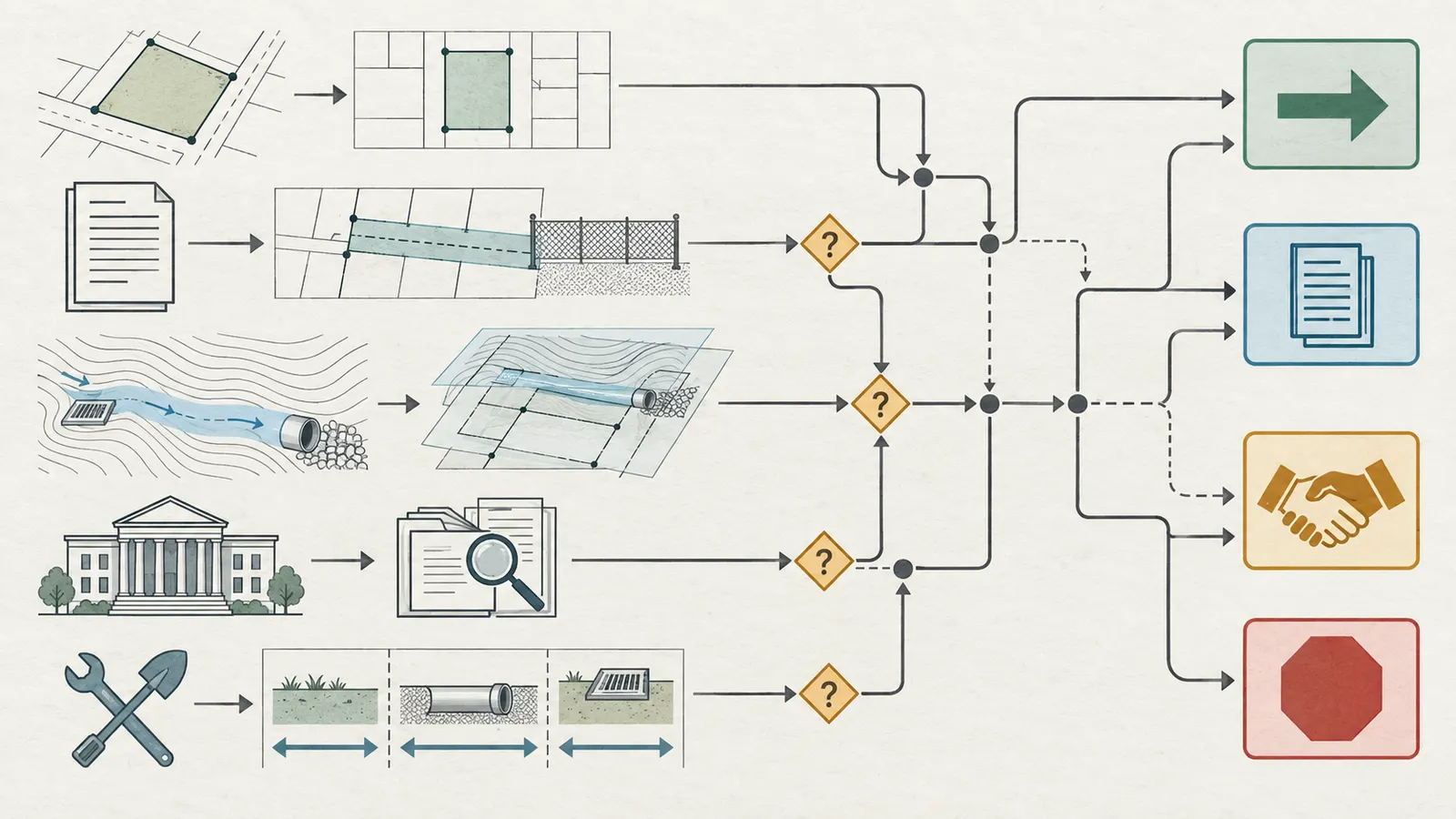
Start with the parcel, facility, and jurisdiction #
Start by fixing the identity of the land and the government that can actually answer the maintenance question; an address, subdivision name or listing map is not enough. The buyer, title professional, surveyor, seller, designer, civil engineer, HOA and public authority have different responsibilities, and the verification sequence fails when one person is assumed to have done another person’s work.
Define the parcel before reviewing the drainage
Collect the legal description from the offer or title commitment, the parcel identification number, the subdivision and lot number if applicable, the county and state, the municipality or town, and the location of any private street or shared tract. Note whether the property lies inside city limits, an incorporated town, an unincorporated county area, a special district or an HOA-managed subdivision. The responsible stormwater program may change at those boundaries.
Create a one-page parcel identity block:
| Field | Record the exact value | Why it matters |
|---|---|---|
| State and county | Legal jurisdiction, not only mailing city | Land records and local stormwater programs are jurisdiction-specific |
| Municipality or town | City, town or unincorporated area | Public-works ownership and maintenance can change at the boundary |
| Parcel ID | Assessor or GIS identifier | Lets the authority and records office locate the same parcel |
| Legal description | Lot, block, subdivision, metes and bounds or other description | Identifies the land being conveyed |
| Plat reference | Book, page, cabinet, slide or instrument number | Ties the drawing to the recorded land record |
| Contract date and closing date | Dates and deadline for each missing record | Prevents a verbal promise from surviving without a deliverable |
| Intended home area | A preliminary envelope, clearly labeled non-final | Shows which constraints must reach the designer and surveyor |
Do not infer buildability from a tax map, listing boundary or GIS outline. Those tools are useful for orientation. For this guide’s handoff, route exact boundary and easement-location questions to a surveyor engaged for the relevant scope, flow-path, control-measure, grading and repair questions to a civil engineer, and legal interpretation or contract language to a local real-estate attorney. These are Brictale’s recommended work assignments, not a universal statement of licensing or legal responsibility; the applicable jurisdiction and each professional’s engagement control.
Inventory the visible and documented facilities
Walk the parcel only from safe, accessible ground and take notes rather than making engineering judgments. Look for headwalls, culverts, curb inlets, yard inlets, manholes, pipes, swales, ditches, channels, detention or retention basins, outlet structures, level spreaders, bioretention areas, riprap, access drives and signs or markers. Note facilities that cross a boundary or appear to serve more than one lot.
At the same time, search the documents for less visible obligations: “drainage easement,” “stormwater,” “detention,” “retention,” “pond,” “outfall,” “access,” “right of entry,” “maintenance,” “covenant,” “stormwater control measure,” “SCM,” “public,” “dedicated,” “accepted,” “private,” “common area,” “HOA,” “POA,” “shared,” “inspection,” “as-built,” “conservation,” “channel,” “ditch,” “culvert” and “temporary.” The words are clues, not conclusions. The instrument’s definitions, exhibits, recording reference and exceptions control the question that a professional must answer.
Build a facility inventory even if you expect only one easement:
| Facility ID | What you can observe or read | Parcel or tract | Upstream and downstream connection | First unresolved question |
|---|---|---|---|---|
| F-01 | Swale along rear boundary | Subject lot and rear common tract | Carries runoff to outlet at side street | Is the swale private, public or shared? |
| F-02 | Buried pipe and headwall | Subject lot | Appears to discharge to adjacent tract | Which recorded instrument permits the outfall and access? |
| F-03 | Detention basin and outlet control | Common tract | Receives several subdivision lots | Who owns the basin and who pays for inspection and repair? |
The entries above are an illustrative inventory format, not observations from a real parcel. Use the facility IDs consistently in the ledger, survey comments, authority email and closing addendum. If two people use “the ditch” for different facilities, the transaction is not ready for a responsibility decision.
Assign the people who must answer each part
The buyer owns the decision and the request log. For this guide, treat seller-provided documents as records to collect and reconcile, not as proof that a future duty or public acceptance exists. Route recorded-instrument and title-exception questions to the title professional or local attorney within their engagement, location questions to the surveyor, facility and grading questions to the civil engineer, program and acceptance questions to the actual stormwater or public-works authority, and covenant, budget and allocation questions to the HOA or shared-maintenance entity. These are recommended handoffs, not universal legal assignments; applicable jurisdictional rules and each engagement control.
Make those assignments explicit in the request log. “Buyer to verify” is too vague. Use “buyer requests county acceptance record,” “title professional confirms instrument 2021-004321 is in the commitment,” “surveyor overlays instrument limits on boundary survey,” “civil engineer reviews outlet and access,” and “seller delivers current O&M manual and inspection records.” A clear owner and due date convert a research task into a closing control.
Confirm the actual jurisdiction before using a local example
The five authorities in this guide are illustrations from different states. Cobb County, Georgia, describes a plat-and-acceptance test for certain residential drainage pipes. Montgomery County, Maryland, explains its easement, right-of-entry and covenant documents and points to Maryland land records. Parker, Colorado, uses a recorded-agreement exception to its general parcel-owner responsibility rule. Cary, North Carolina, connects responsibility to parcel ownership, recorded agreements, GIS and certification records. Fairfax County, Virginia, explains its local maintenance split and Circuit Court Land Records path. None of those pages supplies a universal rule for a different county.
Before relying on an example, identify the authority for the actual parcel. It might be a county stormwater division, city engineering department, town public works department, watershed district, drainage district, state transportation department, HOA or a combination. If a public road, state right-of-way, private street or HOA common area is involved, ask each potentially responsible entity about its own asset. One agency’s map does not establish another agency’s acceptance.
Reconcile the recorded plat, deed, title commitment, and easement #
Reconcile records in a fixed order: identify the current title and parcel, locate every referenced instrument, read the easement or right-of-entry terms, overlay the limits on a survey, and then compare the legal rights with the facility and maintenance documents. Do not stop at the document title or a plat label.
Use the title commitment as an index, not a final answer
The title commitment can reveal exceptions, easements, covenants, restrictions and prior instruments that need to be obtained. Ask for the actual recorded documents listed in the exceptions rather than relying on a one-line commitment description. Record instrument numbers, recording dates, grantor and grantee, affected parcels, exhibit references, amendments and releases.
This is a document-retrieval and reconciliation step, not a title opinion. Whether an instrument is valid, released, subordinate, enforceable, omitted, ambiguous or applicable to the buyer’s intended use is outside this worksheet’s scope. Route those questions to the title professional or local attorney under the engagement and applicable jurisdictional law. The buyer’s ledger should preserve the exact question and the professional’s written answer without pretending that the worksheet decides the legal issue.
In Montgomery County, Maryland, the county explains that the easement and right-of-entry documents describe the area the County is permitted to enter for inspection and maintenance, while the covenant or maintenance agreement describes who is responsible for maintenance. The same page directs owners seeking recorded copies to the Montgomery County Circuit Court Land Records Department or Maryland Land Records. That is a concrete example of why the instrument itself matters and why a buyer should obtain the recorded copy rather than accept a seller’s summary. Montgomery County’s record and document guidance
Read the plat for geometry and the instrument for rights
The recorded plat usually helps you see the easement’s position relative to lot lines, roads, common tracts, structures and drainage features. It may label a strip as a drainage easement, stormwater easement, access easement, conservation area or similar. It may show a pond, pipe, channel or outfall, but the label may not state who maintains it.
The recorded easement, declaration, covenant or right of entry explains the granted rights and restrictions. Look for:
- the exact beneficiary or easement holder;
- whether the right is exclusive or shared;
- whether it runs with the land or is temporary;
- the permitted purposes, such as conveyance, access, inspection, repair, replacement or emergency work;
- who may enter, how notice works and what route or gate is available;
- which structures, fences, grading, fill, landscaping or plantings are prohibited or at risk;
- who owns the facility and who pays for routine work, inspection, repair, replacement and restoration;
- whether the obligation is allocated by lot, frontage, percentage, benefit, tax parcel, HOA assessment or another formula;
- whether a public dedication or acceptance is required before maintenance changes;
- whether an O&M manual, maintenance agreement, declaration, exhibit or later amendment is incorporated by reference;
- what happens if the owner fails to perform, including notice, self-help, assessment, liens or reimbursement; and
- whether the instrument identifies a successor owner, HOA, county, town, district or utility.
If the instrument says “as shown on the plat,” retrieve the referenced plat. If it says “in accordance with the approved plans,” retrieve the stormwater approval and plans. If it says “maintain the facility,” determine whether that means mowing and debris removal, sediment removal, inspections, structural repairs, outlet replacement, erosion repair or all of the above. If it uses an undefined term, flag it for counsel or the authority.
Compare the plat to the field and survey
An easement width on paper does not establish the exact built facility location, and the apparent swale or pipe does not prove the legal easement boundary. Ask the surveyor to show the recorded easement, the facility evidence and the planned building envelope together. If a fence, driveway, septic area, well, retaining wall, foundation, pool, deck or grading plan may enter the easement, the survey and civil design must resolve the conflict before closing or before the contract’s feasibility period expires.
Use the map comparison as a four-way check:
| Check | If the records agree | If they disagree | Handoff |
|---|---|---|---|
| Plat versus instrument | Geometry and recording reference are consistent | Obtain the missing exhibit or ask counsel to interpret | Title professional or attorney |
| Instrument versus survey | Legal strip and observed features can be overlaid | Order survey clarification or boundary/easement location work | Surveyor |
| Survey versus facility | Facility sits where the documents suggest | Investigate encroachment, undocumented work or wrong record | Civil engineer and authority |
| Facility versus approval/as-built | Constructed feature matches approved design | Request revised as-built, acceptance file or engineering review | Civil engineer and authority |
Do not “solve” an offset by scaling a scanned plat on a phone or measuring from a listing image. Preserve the source document and use the surveyor’s control. A visual mismatch may be a drafting issue, a coordinate issue, a changed facility, a private feature outside the easement or an actual encroachment. Each possibility changes the next decision.
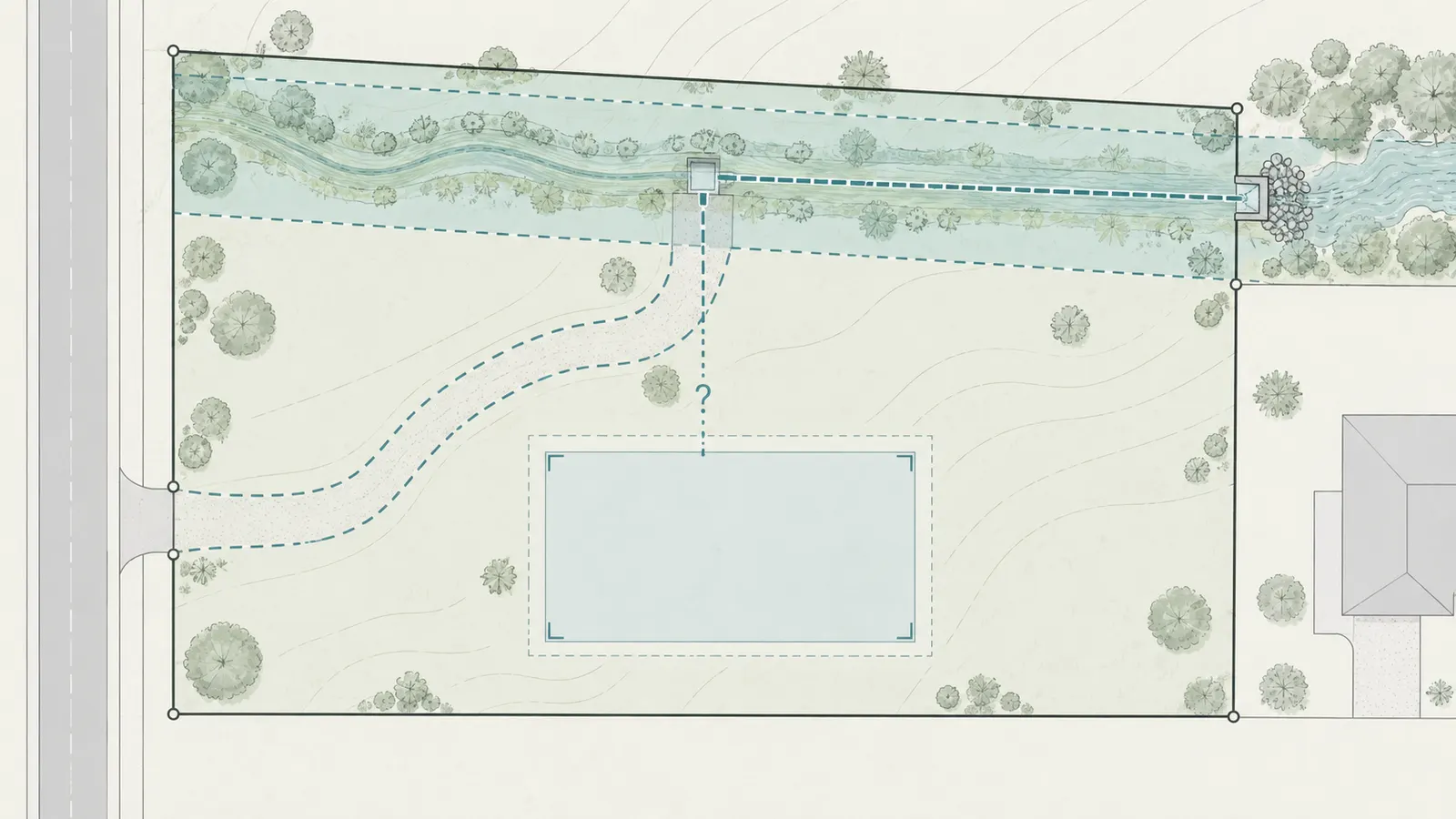
Do not confuse access with permission to alter
An access or right-of-entry clause may let an authority or maintenance party enter to inspect, repair or replace a facility. It does not necessarily give the landowner permission to move the facility, redirect water, fill the easement, install a fence, plant a tree, grade the swale or build over the strip. Conversely, a drainage easement may preserve flow without giving a public agency ongoing maintenance responsibility.
Write two separate ledger fields: access right and landowner use restriction. For example, “County may enter for maintenance” is an access fact; “no permanent structure or fill within the easement” is a use constraint; “owner maintains grass and removes debris” is a maintenance fact. They can appear in the same instrument but are not interchangeable.
What to request before the closing deadline
Ask for legible, complete records with the recording or approval identifier, not cropped screenshots. A practical request package includes:
- current title commitment and all listed easement, covenant, declaration, access and restriction instruments;
- recorded subdivision final plat and later replats or amendments;
- deed, legal description and any referenced exhibits;
- stormwater approval, approved plans, drainage report or stormwater-control approval;
- acceptance, dedication, inspection or closeout record from the actual authority;
- operation-and-maintenance manual, maintenance agreement and maintenance schedule;
- as-built drawings, certification and any recorded access agreement;
- inspection reports, violation notices, repair invoices and open corrective actions;
- HOA or POA declaration, rules, budget, reserve information and maintenance contract if a shared facility is involved; and
- seller’s written statement identifying known drainage work, failures, flooding, erosion, repairs and authority contacts.
The seller packet is useful evidence of history, but it does not replace recorded documents or authority confirmation. Cary, North Carolina, lists an executed deed, O&M manual, maintenance agreement, recorded final plat, recorded access and easement agreement, professional certification, as-built record drawings and HOA or POA covenants among commonly required stormwater-control records. Cary also notes that certification documents for existing SCMs may be available through its repository, subject to access limits for some sensitive sites. That local list is a strong checklist for what to request elsewhere, not a national minimum document set. Cary’s SCM record list
Test ownership, public acceptance, and maintenance responsibility #
Test responsibility by tracing the facility from land ownership to recorded rights to written acceptance and the actual maintenance scope; never assign responsibility from the existence of an easement alone. The answer may be split: one party owns the land, another owns the pipe, a third maintains the public structure, the owner mows, and an HOA pays a shared inspection invoice.
Use the responsibility stack
For each facility, fill these layers in order:
- Underlying landowner. Who owns the parcel or tract where the facility sits?
- Facility owner. Who owns the pipe, basin, outlet, channel, control structure or SCM?
- Easement holder. Who has the right to enter, inspect, convey, repair or replace?
- Public acceptance. Has the responsible authority formally accepted ownership or maintenance, and for which asset?
- Routine maintainer. Who mows, removes debris, clears sediment, manages vegetation and keeps access open?
- Inspector. Who must inspect, at what interval, using what qualification or report?
- Repair and replacement payer. Who pays when the facility fails, erodes, clogs, settles or reaches the end of its useful life?
- Enforcement and escalation. Who can issue a notice, enter, repair, assess, recover costs or require corrective action?
Do not compress these eight answers into one “owner” column. A county can maintain a drainage structure without owning the underlying lot. An HOA can pay for a shared contractor while each lot owner remains responsible under a covenant. An owner can be responsible for mowing while a public agency handles a pipe. Parker, Colorado, expressly says that acceptance into the Town’s stormwater utility maintenance program does not transfer ownership of the facility or underlying property to the Town, and that an easement does not automatically mean the Town owns or maintains a facility. Parker’s local ownership and acceptance explanation
Ask the authority a bounded question
Public agencies answer more reliably when the request names the parcel, facility, instrument and desired record. Send a map with the facility ID and ask questions that can be answered with a record or a defined program statement:
“For parcel [ID], at [address or legal description], is facility F-02 shown on your current asset or stormwater map? Is the facility located in a recorded easement? If so, what is the instrument or plat reference? Has your agency formally accepted ownership or maintenance of the pipe, headwall, outfall, channel, pond or outlet? Which portions are excluded? Who is responsible for routine grounds maintenance, inspection, repair, replacement and access? Are there open violations, missing inspections or pending corrective actions? Please identify the record or program page supporting the answer.”
A response such as “we do not see a problem” is not the same as acceptance. A response such as “we may help in an emergency” is not the same as ongoing maintenance. Parker, Colorado, says its Town may perform emergency maintenance on private stormwater facilities within drainage easements when necessary to protect public safety, infrastructure or property, but that emergency work does not transfer ownership or ongoing maintenance responsibility. Keep those categories separate in the ledger. Parker’s emergency-maintenance limitation
Compare the five local examples without generalizing them
The following comparison is useful because it shows different evidence tests. It is not a ranking and it does not predict the answer for an unlisted jurisdiction.
| Authority and jurisdiction | What the official guidance makes visible | What a buyer must still confirm |
|---|---|---|
| Cobb County, Georgia | Recorded final plat or formal County acceptance can matter to maintenance of certain residential drainage pipes; open channels and other exclusions remain important | Whether this parcel and this facility meet the County’s exact program conditions; whether a city or HOA has a separate role |
| Montgomery County, Maryland | Easement/right-of-entry documents describe County entry; covenant or maintenance agreement describes responsibility; recorded copies are available through land records | The actual recorded instrument, current owner, facility scope and transfer packet for this property |
| Town of Parker, Colorado | Parcel owner is generally responsible unless a recorded agreement says otherwise; acceptance does not necessarily transfer ownership; emergency work is not ongoing responsibility | The facility-specific agreement, eligibility status, access and the line between utility assistance and owner work |
| Town of Cary, North Carolina | Parcel ownership, recorded easements and maintenance agreements establish responsibility; GIS, plat and Register of Deeds records help locate it | The facility’s current approval, O&M manual, as-builts, inspection status and shared-entity obligations |
| Fairfax County, Virginia | Easements run with the land; plats and Circuit Court Land Records can reveal them; the County’s program assigns system maintenance while owners handle routine grounds work | Whether the actual parcel is in the described County program and which structures, vegetation and access duties are included |
Cobb County’s guidance is especially useful as a warning against the phrase “it is in an easement, so the County maintains it.” Its page says the County maintains certain residential drainage pipes when the pipe is shown on the recorded subdivision final plat or is in a dedicated drainage easement formally accepted by the County; it also states that a pipe in an easement without those conditions is the property owner’s responsibility. The same page distinguishes open-channel maintenance and excludes nonresidential and HOA-owned property from the stated pipe-maintenance rule. Cobb County’s drainage-easement conditions
Fairfax County gives a different local split: its page says property owners are responsible for routine grounds maintenance such as mowing and debris removal, while the County maintains the drainage system and structures within the easement. That statement is valuable precisely because it shows that “maintenance” can be divided into grounds work and system work. It should not be imported into a neighboring Virginia county or any other state without confirmation. Fairfax County’s maintenance allocation
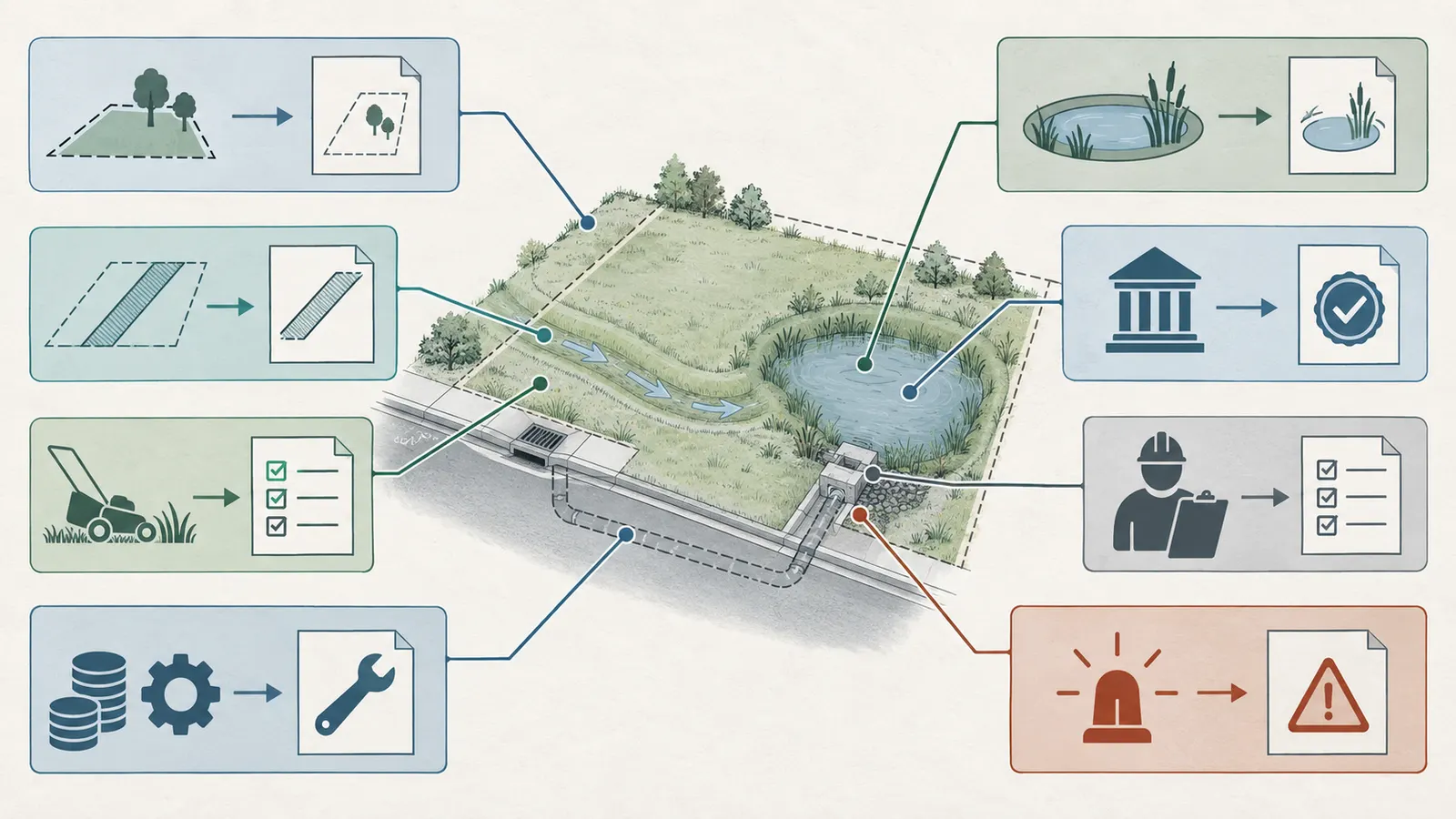
Separate current duty from past performance
Past maintenance records answer what someone says happened. They do not necessarily answer what the buyer will be obligated to do after closing. Record the date, performer, facility, work description, invoice, inspection result and open recommendation. Then identify the legal or program source for the future duty.
For Brictale’s worksheet, an example such as “seller had the pond mowed twice last year” is evidence of a past event only; it is not enough to mark the buyer’s future mowing duty, sufficiency of the work, HOA payment, or public outlet-repair obligation as verified. Likewise, “the County cleaned the pipe once” is not an acceptance record, and “the inspector said it was fine” is not a title or cost determination. Whether any statement or past act has legal effect after closing must be answered under the applicable jurisdiction and contract by local counsel.
Ask for the maintenance agreement, O&M manual, declaration, approved plan and authority status that convert history into an ongoing obligation. If a document is missing, write “unknown—do not assume” rather than filling the blank with the last invoice.
Identify shared-lot and HOA allocations
A subdivision facility often serves several lots while sitting on one lot, a common tract or an easement across multiple lots. Find the allocation mechanism before agreeing that “the HOA handles it.” Read the declaration, maintenance covenant, budget, reserve policy, maintenance contract and enforcement provisions. Determine whether vacant lots pay assessments before construction, whether owners can be assessed specially, and whether the HOA can enter a lot to perform work.
If there is no functioning HOA, ask who currently performs the work and what agreement keeps the system operating. If there is a private maintenance association, obtain its governing documents and current financial information. If the facility serves an upstream development or downstream neighbor, identify reciprocal rights and any cost-sharing instrument. The buyer should not rely on a builder’s customary practice to create a right or obligation that is absent from the recorded or governing documents.
Map access, constraints, and buildability handoffs #
Treat the drainage verification as a design handoff: the surveyor locates the legal and physical constraints, the civil engineer evaluates the facility and proposed grading, the authority confirms its program, and the designer keeps the house, driveway, septic area, utilities and construction access outside unresolved conflict areas. A drainage-easement check does not itself declare the lot buildable.
Translate the records into a site constraint map
Give the designer and surveyor one coordinated packet containing the legal description, survey, recorded plat, easement instruments, stormwater plans, as-builts, GIS screenshots with dates, authority correspondence, O&M documents and facility inventory. Mark each line or area with its evidence status:
- Recorded and located: the instrument exists and the surveyor has shown its limits.
- Recorded but not located: the right exists, but exact field position needs professional work.
- Mapped but not recorded in the packet: GIS or inspection suggests a facility; retrieve the land record or authority file.
- Observed but not documented: a field feature exists; investigate ownership, approval and maintenance.
- Reported but not verified: seller, neighbor or contractor describes a facility; do not design around the statement.
- Contradictory: documents and field evidence disagree; escalate before layout or closing.
This status map prevents an attractive conceptual house plan from silently assuming that a swale can be filled, a pipe can be relocated, a driveway can cross an access route or a basin can be graded. It also helps the engineer distinguish a legal easement from a drainage feature outside the easement and identify whether the proposed house would change runoff or block access.
Identify access that must remain usable
Access is a physical design requirement as well as a legal right. Locate gates, driveways, slopes, bridges, maintenance roads, turning areas, headwalls, manholes and the route from a public road to each facility. Ask whether a maintenance truck, inspection vehicle or contractor can reach the facility without crossing a proposed foundation, septic field, utility corridor, retaining wall or locked gate.
Record who opens the gate, who bears restoration responsibility, whether notice is required, and whether the right includes equipment of a particular size. Do not promise a future fence or landscaping plan until the access route and notice requirements are understood. A right to enter that cannot be exercised because a driveway, wall or locked gate blocks the route is an operational problem even if the document is clear.
Preserve flow paths and construction sequencing
During construction, soil disturbance, stockpiles, temporary crossings and grading can block or redirect runoff. The buyer’s construction team must use the jurisdiction’s applicable erosion, sediment and stormwater requirements and the approved plans. The pre-closing ledger should flag whether the easement or O&M agreement restricts temporary access, fill, excavation, tree removal, discharge or staging.
The homeowner can ask the civil engineer and builder to identify:
- how the proposed building pad relates to the easement and facility;
- whether finished grades preserve the approved flow path;
- whether temporary construction water could enter an inlet, pond or outfall;
- where equipment can cross without damaging a pipe or channel;
- how an existing outlet, headwall or swale will be protected;
- which permits, plan revisions or authority approvals are needed before changing drainage;
- who documents damage or repairs during construction; and
- what will be handed to the next owner after completion.
The homeowner should not enter a pipe, manhole, culvert, pond outlet chamber, confined space or unstable channel to verify anything. Do not remove a grate, walk on an embankment, excavate to find a pipe, cut vegetation near a headwall, operate a control structure or test an outlet. Falls, engulfment, contaminated sediment, hidden voids, unstable slopes and electrical or mechanical equipment can create serious hazards. Use a qualified surveyor, civil engineer, utility locator, inspector or contractor for site work and confined-space or structural assessment.
Use the right professional for the right uncertainty
| Uncertainty | Professional or authority | Deliverable to request | What the buyer can safely prepare |
|---|---|---|---|
| Does an instrument affect the parcel? | Local real-estate attorney or title professional | Written interpretation or title response | Instrument list, recording references and intended use |
| Where is the boundary or easement? | Licensed surveyor in the relevant state | Survey or easement-location exhibit | Plat, deeds, instruments and field photos from safe areas |
| What does the facility do and what will the home change? | Civil engineer familiar with local stormwater rules | Drainage/site review and design constraints | Facility inventory, proposed house envelope and approvals |
| Is the facility accepted or on a public program? | Actual county, city, town, district or agency | Written status, map or record reference | Parcel ID, facility ID, survey and instrument copy |
| What work is required now? | Qualified stormwater inspector or engineer | Inspection report and corrective-action list | O&M manual, prior reports and safe access information |
| Who pays in a shared development? | HOA/POA, association manager and attorney | Declaration, maintenance agreement, budget and allocation | Lot number, facility ID and closing timeline |
The handoff is complete only when the next professional receives the source records and the unresolved questions. A surveyor cannot answer a maintenance question from a plat alone. An engineer cannot cure a missing recorded right. A public agency cannot necessarily interpret private covenants. A title commitment cannot tell you whether a basin outlet is clogged or whether an as-built matches the field.
Do not use flood maps as a substitute for this review
This article excludes flood prediction. A flood map, elevation product or online drainage layer may be relevant to broader land due diligence, but it does not answer who has the right to enter a private lot, who must mow a swale, whether a pipe was accepted, or how an HOA allocates repair cost. Keep flood, wetland, soil, septic, slope, utility and stormwater questions as separate but coordinated feasibility workstreams.
Build and use the drainage-obligation ledger #
Use one ledger row per facility and do not close an unresolved row merely because another record looks favorable. The ledger is the original worksheet in this guide: it converts a collection of maps, instruments and statements into a testable handoff and exposes the exact question that must be resolved before the buyer accepts the obligation.
The ledger fields
Copy this table into a working document or spreadsheet. Add rows rather than combining facilities that have different owners, instruments or maintenance scopes.
| Field | What to enter | Acceptable evidence or status |
|---|---|---|
| Facility ID | F-01, F-02 and so on | Consistent ID on survey comments, requests and documents |
| Facility type | Pipe, swale, channel, basin, inlet, outlet, outfall, SCM | Observed, approved or mapped description; label uncertainty |
| Parcel or tract | Where the facility sits and every served parcel | Legal description, parcel ID, plat or survey |
| Easement or right-of-entry recording number | Book/page, instrument number, plat reference or “not located” | Recorded copy, not only a title summary |
| Map location | Limits, centerline, feature and access route | Survey overlay, recorded plat, authority GIS or field evidence |
| Landowner | Underlying parcel or common tract owner | Current title record or association record |
| Facility owner | Owner of the physical asset if different | Recorded agreement, authority record or unresolved |
| Public acceptance status | Accepted, dedicated but not accepted, private, unknown or excluded | Written authority record or program response |
| Responsible maintainer | Routine grounds, inspection, pipe, basin, outlet and replacement parties | O&M manual, covenant, maintenance agreement or authority statement |
| Access rights | Who may enter, route, notice, gates, equipment and restoration | Easement/right-of-entry terms and site plan |
| O&M manual | Title, revision date and facility covered | Actual manual or “missing” |
| Inspection frequency | Interval, due date, qualification and report recipient | O&M manual, local rule, certificate or authority record |
| Repair triggers | Sediment, debris, erosion, vegetation, blockage, failure, noncompliance | O&M manual, inspection report, agreement or authority response |
| HOA/shared allocation | Lot formula, assessment, common tract, reserve or private agreement | Declaration, maintenance agreement, budget and contract |
| Records received | List file names, dates and recording or approval identifiers | Packet index with gaps marked |
| Unresolved cost question | Work, unit, payer, timing and requested estimate | Quote, reserve record, engineer scope or unknown |
| Closing action | Proceed, obtain document, negotiate contingency, renegotiate or pause | Buyer decision with owner and deadline |
The word “unknown” is a useful value. It prevents the ledger from implying that the person who owns the lot automatically owns the pipe, that an authority which maps a facility maintains it, or that an inspection record is an acceptance record. Add a source note to every field: plat p. 4, instrument 2019-12345, Cary GIS response dated ..., seller email dated ..., O&M manual rev. 3, or unresolved request sent ....
Reconcile records row by row
Use this sequence for each facility:
Step 1: Anchor the facility. Match the facility ID to a parcel, plat label, survey feature, GIS feature or approval plan. If two documents use different names, write both names and ask whether they describe the same asset.
Step 2: Anchor the right. Retrieve the recorded instrument that creates the easement, right of entry, covenant, declaration or access agreement. Record the instrument number, beneficiaries, burdened land and permitted purpose.
Step 3: Anchor the duty. Find the clause or program record that assigns mowing, inspection, sediment removal, repair, replacement, access and restoration. Quote only the short operative phrase in your notes and link the full record; do not paraphrase an ambiguous clause into certainty.
Step 4: Anchor acceptance. Ask the actual authority whether the asset is accepted, dedicated, eligible, private or excluded. Keep acceptance of a facility separate from acceptance of a drainage easement and from emergency assistance.
Step 5: Anchor current condition. Request inspection reports and an engineer or qualified inspector review where the condition affects cost, safety or the home plan. A record gap is not a clean bill of health.
Step 6: Anchor the handoff. Put the documents, access instructions, inspection due date, repair history, contacts and open actions into the closing and future-owner packet.
Worked illustrative ledger entry
The following is a modeled example for method only. It is not a real parcel, local rule, contractor quote or measured condition.
Assume a vacant subdivision lot in an unnamed U.S. county has a rear drainage swale and a buried pipe that discharges through a headwall on a neighboring tract. The final plat labels a 20-foot drainage easement. The title commitment references a recorded easement, but the seller has not provided the instrument. The county GIS shows a public stormwater line near the street but not the rear pipe. The HOA declaration mentions common drainage but does not identify the headwall.
The first ledger row might read:
| Field | Illustrative entry | Status |
|---|---|---|
| Facility ID and type | F-02, buried pipe and headwall | Observed from safe ground; exact alignment unverified |
| Parcel or tract | Subject lot to neighboring outfall tract | Two parcels require confirmation |
| Recording number | Title commitment exception 12; instrument copy missing | Do not close row |
| Map location | Rear easement on plat; pipe alignment unknown | Survey/civil review needed |
| Landowner | Subject lot and neighboring tract owners | Current title confirmation needed |
| Facility owner | Unknown | No assumption from GIS proximity |
| Public acceptance | Unknown; GIS does not establish acceptance | Written authority request needed |
| Maintainer | Seller says HOA; no agreement supplied | HOA documents and current manager response needed |
| Access | Easement label; no route or gate detail | Instrument and field access review needed |
| O&M manual and inspections | Not received | Request from seller, HOA and authority |
| Repair trigger | Unknown | Civil engineer or O&M review needed |
| Cost question | Who pays pipe, headwall, erosion and shared access repairs? | Contract protection needed |
| Closing action | Obtain records and written allocation before acceptance | Deadline set in contract |
That row is already useful even though it does not answer the question. It tells the buyer what is known, what is not known, who must answer, and why the unresolved issue can affect the decision. It also prevents a designer from assuming that a 20-foot strip is the only constraint: access, outfall ownership, neighboring entry and shared repair may matter just as much.
Add a bounded maintenance reserve without inventing a price
If a recurring private obligation is likely, calculate a transparent planning reserve from actual scopes rather than quoting a generic national cost. The basic annual planning formula is:
annual planning reserve = routine grounds work + inspection cost + expected shared maintenance + repair reserve + administration or access cost
For each term, identify whether it is an annual quote, a per-visit quote, a reserve contribution or an unknown. For example, if an HOA provides a written annual inspection quote of $I, routine maintenance is quoted at $M per visit for n visits, and the association sets a documented annual repair reserve of $R, then:
annual planning reserve = I + (M × n) + R
This is not a prediction of actual future spend. It is a way to expose the inputs and compare scenarios. If one shared headwall is the buyer’s proportional share p of a documented repair estimate $E, then the modeled share is:
buyer share = p × E
Both p and E must come from the governing allocation and a current qualified scope. A seller’s guess is not a source. A county’s general maintenance page is not a repair quote. An engineer’s inspection can identify a repair need without determining who pays it.
Show sensitivity instead of hiding uncertainty
Use sensitivity when a missing record could change the decision. Suppose an illustrative association budget has an inspection input of $600 per year, routine work of $90 per visit for four visits, and a reserve contribution of $400 per year:
$600 + ($90 × 4) + $400 = $1,360 per year
If the inspection is annual but routine visits range from two to six, the same inputs produce:
| Routine visits | Formula | Illustrative annual total |
|---|---|---|
| 2 | $600 + ($90 × 2) + $400 | $1,180 |
| 4 | $600 + ($90 × 4) + $400 | $1,360 |
| 6 | $600 + ($90 × 6) + $400 | $1,540 |
These numbers are illustrative arithmetic, not market data. The sensitivity is useful because it shows that the unknown is not “stormwater costs a lot”; the unknown is the number and type of required visits, the inspection standard, the allocation and the reserve. If the governing documents instead assign one major repair directly to the lot owner, an annual mowing estimate is not an adequate reserve. If a public program maintains the structural system but leaves grounds work private, the ledger should show two different budget lines rather than one blended assumption.
Verify the contribution before relying on it
The ledger passes an editorial check when every material field is traceable to a recorded document, official authority source, current seller or HOA record, survey, engineering report or clearly marked unresolved question. It fails when a row uses “public,” “HOA,” “shared,” “accepted” or “maintained” without naming the evidence. It also fails when a map and a legal instrument are treated as interchangeable.
The method is intentionally conservative: reconcile first, price second. Its limitation is equally intentional: it does not decide legal meaning. If the instrument is ambiguous, preserve the ambiguity and transfer it to counsel. If the facility location is uncertain, transfer it to the surveyor or engineer. If acceptance is uncertain, transfer it to the authority. If the cost allocation is uncertain, transfer it to the contract and attorney rather than silently assigning it to the future homeowner.
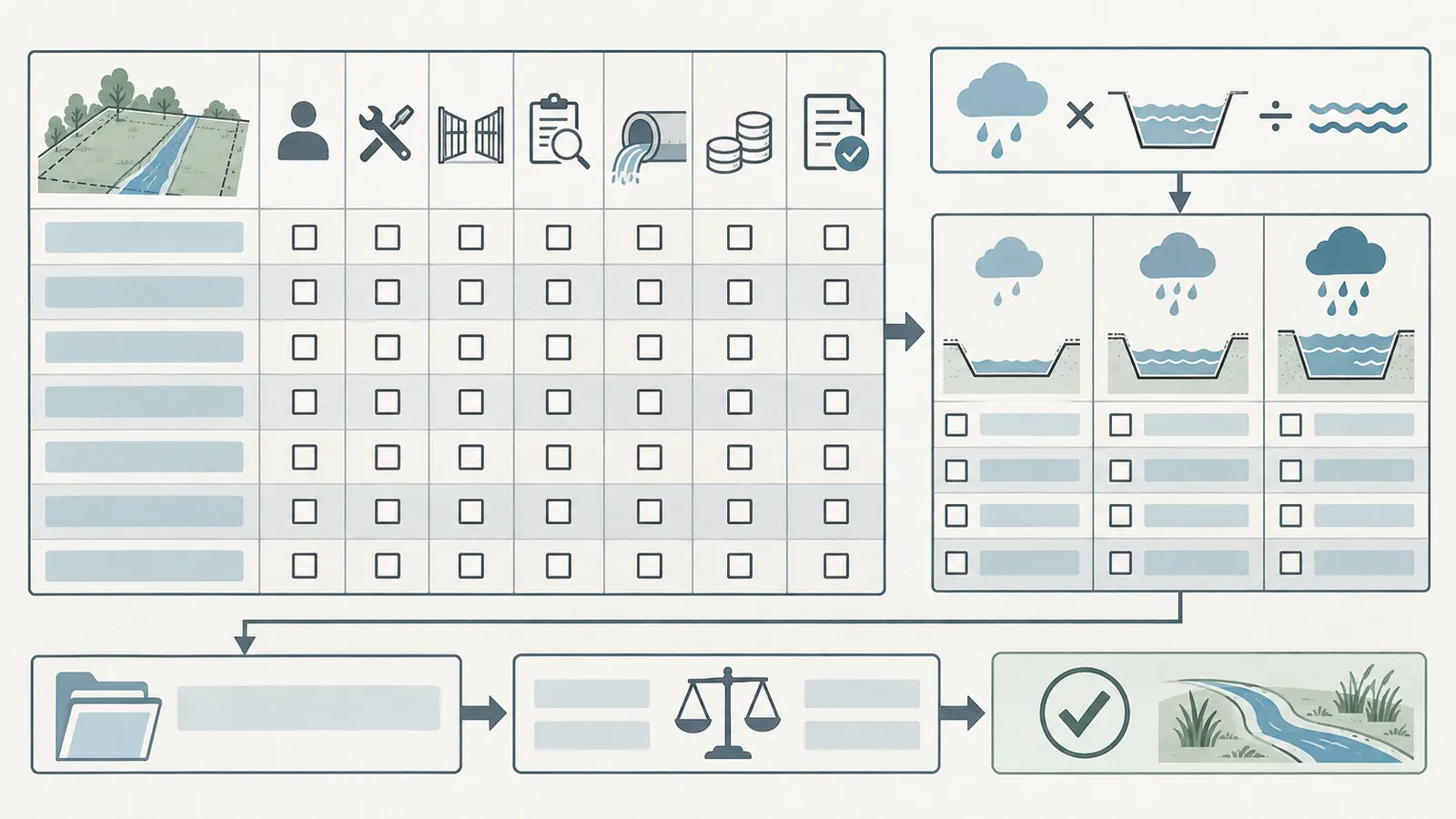
Choose proceed, renegotiate, contingency, or pause #
Choose a closing path based on the severity of the unresolved fact, its effect on the house plan and its ability to be cured by a specific document or professional review. The four useful outcomes are proceed, obtain a missing document or confirmation, renegotiate with a defined protection, or pause until the risk is understood.
Use the decision matrix
| Evidence state | Effect on home or ownership | Safer next action | Closing posture |
|---|---|---|---|
| Instrument, location, responsibility and access agree; no open deficiency | Constraint can be designed around and obligation is budgeted | Put the packet and future due dates in the project records | Proceed if professionals confirm scope |
| Easement is recorded but facility owner or maintainer is missing | Ongoing cost or entry could change | Obtain recorded maintenance agreement, authority response or HOA allocation | Do not treat as resolved |
| Facility is visible but absent from plat or approval | Possible undocumented work, encroachment or private obligation | Survey, engineer and authority investigation; ask seller to cure or disclose | Contingency or renegotiation |
| Public GIS shows a line but acceptance is not documented | Buyer may inherit private repair duty | Request facility-specific acceptance status and maintenance scope | Contingency or pause |
| Access route crosses proposed house, driveway or utility area | Construction and future repair may be blocked | Redesign, obtain written permission or establish access route before closing | Pause until resolved |
| O&M manual or inspection records show overdue work | Immediate cost, enforcement or performance issue may exist | Qualified inspection, repair scope, cost allocation and written cure | Renegotiate, escrow or pause |
| HOA allocation is clear and funded | Shared obligation is quantifiable | Review budget, reserves, contract and future assessment exposure | Proceed only with accepted allocation |
| Legal description, plat or instrument conflicts | Boundary and rights are uncertain | Local attorney/title professional and surveyor reconcile records | Pause |
The table is a decision aid, not a legal standard. The correct path depends on the contract, state law, professional advice, lender requirements and the buyer’s risk tolerance. “Proceed” means the buyer has accepted a known obligation, not that the facility is guaranteed to perform or that the lot is declared buildable.
Negotiate a document contingency, not a vague promise
If the problem is a missing record, specify the record and the acceptance test. A useful contingency request identifies the facility, instrument, authority, deadline and remedy. For example: seller must deliver the recorded easement and maintenance agreement for F-02, obtain written authority confirmation of acceptance or private responsibility, provide current inspection and O&M records, and allow the buyer’s surveyor and civil engineer to review them. If the documents are not delivered or the review identifies a material unpriced obligation, the buyer may terminate, extend, require a credit or require another remedy agreed with counsel.
Do not draft contract language from this article. The buyer’s local attorney should convert the desired outcome into enforceable language that fits the purchase agreement and applicable law. The ledger helps the attorney see what the condition must actually cover.
Negotiate a maintenance-cost contingency with defined inputs
If responsibility is known but cost is not, define the missing inputs. A useful request might require a current inspection, a written scope for identified repair, an actual maintenance agreement, the allocation percentage, the last two inspection reports, the current association budget and any open violation or assessment notice. A dollar cap or escrow amount should be based on professional scope and contract advice, not a generic allowance.
Distinguish three different protections:
- Document contingency: protects against missing or contradictory records.
- Inspection or feasibility contingency: protects against an engineer or qualified inspector finding a material physical or design issue.
- Cost or assessment protection: allocates a known or reasonably bounded obligation.
One clause may not cure all three problems. If the seller says the HOA will repair a headwall, obtain the HOA’s written authority, funding source and schedule. If the county says it maintains the pipe, ask whether it also maintains the headwall, channel, outfall, access and vegetation. If the authority will not confirm before closing, treat that as an unresolved risk rather than a favorable inference.
Renegotiate when the house loses useful area
An easement can change the usable building envelope even if it creates no immediate repair cost. Measure the effect on setbacks, foundation location, driveway grade, septic reserve, well location, utility routes, outdoor space, retaining walls, tree removal and future additions. An easement that leaves room for a small house may still make the intended house, garage or driveway impractical.
For this guide, use the surveyor as the handoff for locating the easement and boundary, the civil engineer for grading, drainage and access implications, and the designer for testing the actual home program against the constraint. These are Brictale’s recommended coordination steps, not universal statements of what a professional is legally required to deliver; confirm scope, licensing requirements and reliance limits in the relevant jurisdiction. If the resulting home is materially different, the decision is not only about maintenance responsibility; it is a land-feasibility issue. The buyer can ask counsel about renegotiating price or terms, but should not assume that a future variance, relocation or permission will be granted.
Pause for contradictions that can compound
Pause when the parcel has a recorded easement but no accessible instrument, a facility that is visible but absent from approved records, a public map that conflicts with a private agreement, an access route that cannot be used, a shared facility with no functioning maintainer, an overdue inspection, or a known erosion or structural issue without a defined repair scope. These are not necessarily deal killers. They are facts that need a responsible party and a verifiable cure.
The cost of waiting is easier to evaluate than the cost of accepting an unknown obligation that affects design, financing, construction, ownership and resale. Put a date on each request. If the response does not arrive, use the contract’s deadline and the attorney’s advice to decide rather than allowing silence to become consent.
Close the loop before signing and hand over the records #
Finish the review with a documented sequence: collect, reconcile, inspect, decide, contract, close and hand off. The buyer should be able to explain the facility and obligation to the title professional, designer, builder, HOA and future self without reopening the entire search.
The pre-closing sequence
1. Open the parcel file. Save the legal description, parcel ID, jurisdiction, contract deadlines, contact list and intended home assumptions. Label every document with its source and date.
2. Request the record set. Obtain title exceptions and underlying instruments, final plat, deeds and exhibits, stormwater approvals, O&M materials, as-builts, inspection records, HOA documents and seller disclosures. Ask the authority for acceptance, GIS and violation records using facility IDs.
3. Walk the safe portions of the site. Photograph and map visible features without entering pipes, chambers, unstable slopes, standing-water areas or construction zones. Note access routes, gates, headwalls, inlets, outlets, swales and signs.
4. Have the surveyor reconcile location. Request the recorded easement and relevant facility evidence be shown against the boundary and preliminary house envelope. Resolve whether a field feature is within, outside or crossing the record right.
5. Have the engineer review function and effect. Ask for a site-specific review of flow paths, grading, proposed improvements, facility condition, access and any repair or redesign scope. Do not treat a desktop review as a guarantee of performance.
6. Ask the authority a facility-specific question. Confirm acceptance, eligible assets, exclusions, routine maintenance, inspection, repair, replacement, emergency work and access. Save the written response.
7. Reconcile the ledger. Every row gets evidence, a named unresolved question or a closing action. Contradictions remain visible.
8. Review with counsel. Give the local real-estate attorney the commitment, instruments, ledger, survey comments, authority response, engineer scope and desired contingency. Ask which obligations bind successors and how the purchase agreement should address them.
9. Make the decision. Select proceed, obtain a document, negotiate a contingency or pause. Write the reason, deadline and person responsible.
10. Preserve the handoff. Put the final ledger, records, inspection due dates, access instructions, contact information and open maintenance actions in the property and construction files.
What to verify at the final walk-through or closing packet review
At the final review, compare the document index to the files actually delivered. Check that the recorded document is complete, legible and matches the instrument number in the commitment. Check that the map version is identified and that the surveyor has not relied on an outdated plat. Check that the O&M manual covers the facility ID and that inspection records identify the same asset. Check that the HOA or maintenance agreement names the lot or common tract and explains future assessment or access.
Ask whether anything changed after the original review: a new notice, repair, grading change, subdivision replat, authority response, HOA assessment, construction activity or access restriction. A cosmetic update to a date is not substantive review; a new fact requires the ledger and decision to be revisited.
Handoff fields for ownership and construction
Give the future owner and project team a concise handoff page containing:
- facility ID and plain-language description;
- parcel and easement recording reference;
- map or survey sheet showing the facility and access route;
- responsible parties by task, not one generic owner;
- inspection due date, qualification and report recipient;
- O&M manual revision and maintenance agreement;
- open repair, violation or corrective-action item;
- access notice, gate, key or contact process;
- HOA or shared-lot allocation and current budget source;
- prohibited or at-risk improvements in the easement;
- emergency contact and the difference between emergency response and ongoing duty; and
- next review date or event, such as transfer, construction completion, annual inspection or authority acceptance.
Cary, North Carolina, provides a useful local example of why this packet should be more than a photograph. Its guidance says owners must retain maintenance records, that routine work can include sediment and debris removal, vegetation management, erosion or structural repair, restoration of inlets, outlets or flow paths, and that deficiencies must be corrected within the timeframe specified by the Town. It also states that all SCMs must be inspected annually under its local program and that reports must be prepared by a qualified professional identified by its land-development rules. For a Cary parcel, those are local requirements to verify and follow; elsewhere, ask the actual authority for its own schedule and qualifications. Cary’s maintenance and inspection guidance
Common failure cases and the next action
Failure: “The listing says the county maintains it.”
Next action: ask the authority to identify the facility, program and acceptance record. Put the response in the ledger. A listing is not an acceptance document.
Failure: “The drainage easement is shown, so the house can go elsewhere.”
Next action: have the surveyor and designer overlay the exact easement and access limits on the preliminary plan. The usable envelope, not the label, controls the design question.
Failure: “The GIS map shows a public pipe.”
Next action: ask whether the actual pipe, outlet and appurtenances were accepted, and retrieve the written program or acceptance record. A GIS layer is a location clue unless the authority says what the layer means.
Failure: “The HOA handles stormwater.”
Next action: obtain the declaration, maintenance agreement, budget, reserve, contract and assessment rules. Identify what the HOA handles and what remains with each lot owner.
Failure: “The seller has an old inspection report.”
Next action: identify the facility, report date, deficiencies, corrective action and current condition. Ask whether a current qualified inspection is needed before accepting the obligation.
Failure: “The county repaired it once.”
Next action: ask whether that was routine maintenance, emergency response, a capital project or a one-time assistance action, and whether it changed ownership or ongoing duty. Parker, Colorado, specifically warns that emergency work on a private facility does not transfer ownership or ongoing responsibility to the Town. Parker’s emergency-work statement
Failure: “The easement is old, so it probably no longer matters.”
Next action: have the title professional and attorney review the current record and surveyor locate it. Fairfax County, Virginia, describes storm drainage easements in its program as generally permanent and running with the land, but another jurisdiction’s instrument and law may differ. Fairfax County’s local explanation
Failure: “The swale is just landscaping.”
Next action: compare the field feature to the plat, approved plan and O&M manual. Do not fill, regrade, fence or plant in a flow path until the authority and engineer confirm the permitted work.
Failure: “There is no pipe on the lot, so there is no obligation.”
Next action: check for downstream outfall access, shared basins, flow acceptance, covenants and rights benefiting another tract. The obligation may be to allow water, preserve access or contribute to shared maintenance rather than own a visible pipe.
Failure: “A verbal answer will be enough at closing.”
Next action: ask for the record, written confirmation or contract protection. If it cannot be obtained before the deadline, make the pause or risk acceptance explicit with counsel.
The final yes-or-no test
Before closing, answer these questions in writing:
- Can I identify every drainage facility and the parcel or tract where it sits?
- Do I have the actual recorded easement, right of entry, covenant or maintenance agreement, not merely its title summary?
- Does a surveyor or equivalent professional show the legal right and facility against the intended home and access plan?
- Do I know who owns the land, owns the facility, may enter, inspects, performs routine work, repairs and replaces it?
- Do I have authority confirmation for any claimed public acceptance, and do I know what the program excludes?
- Do I have the O&M manual, inspection schedule, current condition, open deficiencies and repair history?
- Do I know the HOA or shared-lot formula, reserve exposure and future assessment risk?
- Are all access, use restrictions, safety hazards and construction handoffs visible to the builder and designer?
- Is every remaining unknown assigned to a person, deadline and contractual remedy?
- If the answer stays unknown, have I consciously chosen a contingency, renegotiation or pause rather than assuming the most favorable outcome?
If the answers are yes, you have a defensible basis for the next land decision: proceed to coordinated site design and budgeting with the obligation carried into the project file. If an answer is no, the next decision is not automatically to walk away. It is to identify whether the missing evidence can be obtained, whether a professional can resolve it, whether the contract can allocate it, or whether the uncertainty is too material to accept before closing.
The durable lesson is simple: verify the right, the facility, the acceptance, the access and the duty as separate facts. The drainage-obligation ledger makes that separation visible. A local authority’s page can show how one jurisdiction handles the question; only the actual parcel’s recorded instruments, current authority records, professional review and closing terms can establish what the buyer is accepting.
Cite this guide
Brictale. “How to Verify a Vacant-Land Drainage Easement Before Closing.” Published 2026-10-06; updated 2026-10-06.
https://brictale.com/build/land/verify-vacant-land-drainage-easement-maintenance-before-closing · Read the Markdown version
Original contribution: Drainage-obligation ledger. A source-derived worksheet that reconciles the facility, parcel, recording, map, owner, acceptance, access, operation, inspection, repair and shared-cost facts before a vacant-land closing.
Sources and scope
Evidence behind this page
- In Cobb County, Georgia, a drainage easement preserves a legal path for stormwater conveyance; the underlying property owner retains the land, while restrictions can apply to dumping, filling, fencing and plantings.
Cobb County, Georgia; drainage easements and related owner restrictions. This is a local illustration, not a national rule.
Accessed · Link to this claim - Cobb County, Georgia, describes county maintenance of certain residential drainage pipes only when the facility is shown on the recorded subdivision final plat or is in a dedicated drainage easement formally accepted by the County; a pipe in an easement without those conditions remains the property owner's responsibility under the cited guidance.
Cobb County, Georgia; residential drainage-pipe maintenance. The page also states exclusions for nonresidential and HOA-owned property.
Accessed · Link to this claim - Montgomery County, Maryland, says easement and right-of-entry documents describe the area the County may enter for inspection and maintenance, and directs owners seeking recorded copies to the Circuit Court Land Records Department or Maryland Land Records.
Easements, Right of Entry & Maintenance Agreements
Montgomery County, Maryland; stormwater easements, rights of entry and recorded land records.
Accessed · Link to this claim - Montgomery County, Maryland, distinguishes the legal document describing inspection and maintenance access from the covenant or maintenance agreement describing who is responsible for maintenance, and says developers should transfer related documents to a property-management company or HOA/CA after ownership transfers.
Easements, Right of Entry & Maintenance Agreements
Montgomery County, Maryland; stormwater systems and ownership-transfer records.
Accessed · Link to this claim - The Town of Parker, Colorado, states that the owner of the property where a stormwater facility is located is generally responsible for operation, maintenance, repair and replacement unless a recorded legal agreement says otherwise.
Maintenance Responsibilities and Services
Town of Parker, Colorado; private stormwater-facility responsibility. The stated default is local and subject to recorded agreements.
Accessed · Link to this claim - The Town of Parker, Colorado, says emergency maintenance on a private facility within a drainage easement does not transfer ownership or ongoing maintenance responsibility to the Town.
Maintenance Responsibilities and Services
Town of Parker, Colorado; emergency work on private stormwater facilities.
Accessed · Link to this claim - The Town of Cary, North Carolina, says responsibility for a stormwater control measure is established by parcel ownership and can also be established through recorded easements and maintenance agreements; it directs users to GIS and recorded plats or county Register of Deeds records.
Town of Cary, North Carolina; stormwater control measures and record lookup.
Accessed · Link to this claim - The Town of Cary, North Carolina, lists an executed deed, O&M manual, maintenance agreement, recorded final plat, access and easement agreement, professional certification, as-built record drawings and HOA/POA covenants among commonly required stormwater-control records.
Town of Cary, North Carolina; development and certification records for stormwater control measures.
Accessed · Link to this claim - The Town of Cary, North Carolina, says stormwater control measures must be inspected annually, with reports prepared by a qualified professional identified by its local land-development rules, and that owners must retain maintenance records and complete corrective actions within the Town's specified timeframe.
Town of Cary, North Carolina; annual SCM inspection and recordkeeping requirements.
Accessed · Link to this claim - Fairfax County, Virginia, explains that storm drainage easements are generally permanent and run with the land, surviving a sale, and can limit permanent structures to preserve system function and maintenance access.
Fairfax County, Virginia; storm drainage easements and property-use restrictions.
Accessed · Link to this claim - Fairfax County, Virginia, says storm drainage easements may appear on the parcel plat and are recorded in Circuit Court Land Records; its page assigns routine grounds maintenance to property owners while the County maintains the drainage system and structures within the easement under that local program.
Fairfax County, Virginia; local storm-drainage easement records and maintenance allocation.
Accessed · Link to this claim