How to Check a Vacant Lot’s Public Water or Sewer Service Boundary Before Buying
A jurisdiction-labeled workflow to verify public water or sewer eligibility, annexation, capacity, costs, deadlines, and offer conditions before closing.
The short answer
Before buying, identify the actual water and sewer authority by APN and legal description, then request a parcel-specific written determination. Classify the lot as in-boundary, conditional on annexation or another approval, or outside with no confirmed path. Make the offer and closing contingent on the required letter, capacity, easements, costs, and expiration—or reject the parcel if the path cannot be verified in time.How to Check a Vacant Lot’s Public Water or Sewer Service Boundary Before Buying
Before buying, identify the actual water and sewer authority by APN and legal description, then request a parcel-specific written determination. Classify the lot as in-boundary, conditional on annexation or another approval, or outside with no confirmed path. Make the offer and closing contingent on the required letter, capacity, easements, costs, and expiration—or reject the parcel if the path cannot be verified in time.
Originality brief. Current answers scatter maps, annexation pages, sewer-area rules, and real-estate checklists; they rarely connect a specific parcel to the responsible authority, approval body, service condition, cost, deadline, and closing decision. The missing decision is whether to proceed, condition the offer, or walk away before design and land work. The Three-State Public-Utility Boundary Matrix and Handoff Worksheet below is the original contribution: it records the evidence needed to classify the parcel and the next written handoff. You can check it by matching every row to the authority’s current map, letter, policy, fee schedule, or recorded document. For the broader land-planning sequence, use Brictale’s land-planning hub alongside this parcel-specific utility check.
Decide the parcel’s service state before you treat “utilities nearby” as proof #
A vacant parcel is ready for the next buying decision only when the named water and sewer authorities have confirmed both service eligibility and the conditions for the proposed home; a nearby main, subdivision label, or seller statement is only a lead. Use three states: in-boundary, conditional, and outside or unconfirmed. The third state does not prove service is impossible; it means you do not yet have a confirmed path that is safe to rely on in an offer or closing schedule.
The distinction matters because a public main and a service right are different things. A main may be on the opposite side of a road, in another district, across a city boundary, or available only to parcels with a recorded participation right. A parcel may be inside a district’s planning area but outside its legally authorized service area. A property may be inside a boundary but lack an easement, capacity, permit, or acceptable route for a lateral. A service letter may say “will serve” while making connection conditional on annexation, a valid building permit, current capacity, or a future agency decision.
The three-state decision matrix
| State | What must be documented | What it allows you to assume | What it does not allow you to assume | Buying response |
|---|---|---|---|---|
| In-boundary | The APN or legal description is shown inside the serving authority’s current service boundary or approved service area; the authority confirms the proposed use and the connection path; access, easements, capacity, and fees are identified. | There is a recognized authority and a defined route to continue due diligence. | That a building permit, tap, capacity allocation, extension, or final connection is automatic. | Proceed only with written conditions for remaining permits, cost, capacity, and expiration. |
| Conditional | The authority identifies a path that depends on annexation, boundary or service-area amendment, LAFCO or council action, a water-supply approval, a development agreement, a permit, or another named condition. | The parcel has a possible path worth pricing and scheduling. | That the approval will occur, that the seller’s timeline is enough, or that the letter survives expiration or a change in capacity. | Condition the offer on the specified approval and documents, or assign a long-stop date and exit right. |
| Outside or unconfirmed | No current written determination ties the parcel and proposed home to a public service path, or the authority says the request is not eligible. | Only that more investigation is needed, if the seller and contract allow it. | That a main can be extended, annexation is available, or a different utility will serve the site. | Pause or reject before design, excavation, subdivision work, or an unconditional closing. |
“In-boundary” is a status about authority and geography, not a guarantee of construction. “Conditional” is a real category, not a soft version of approval. “Outside or unconfirmed” is the correct classification whenever a person has only a map screenshot, a verbal statement, an old letter, or an unverified promise. Keep water and sewer rows separate: the water provider may be a city or district while the sewer provider is a county service area, a separate district, or unavailable.
The strongest evidence is parcel-specific and dated. A map that does not identify the APN can help you ask the question but should not close it. A letter addressed to a previous owner may not transfer. A letter for “future development” may not cover one single-family residence. A letter for water may say nothing about sewer. A letter for one dwelling may not cover an accessory dwelling unit, a second unit, a workshop with plumbing, a subdivision, or a change in use.
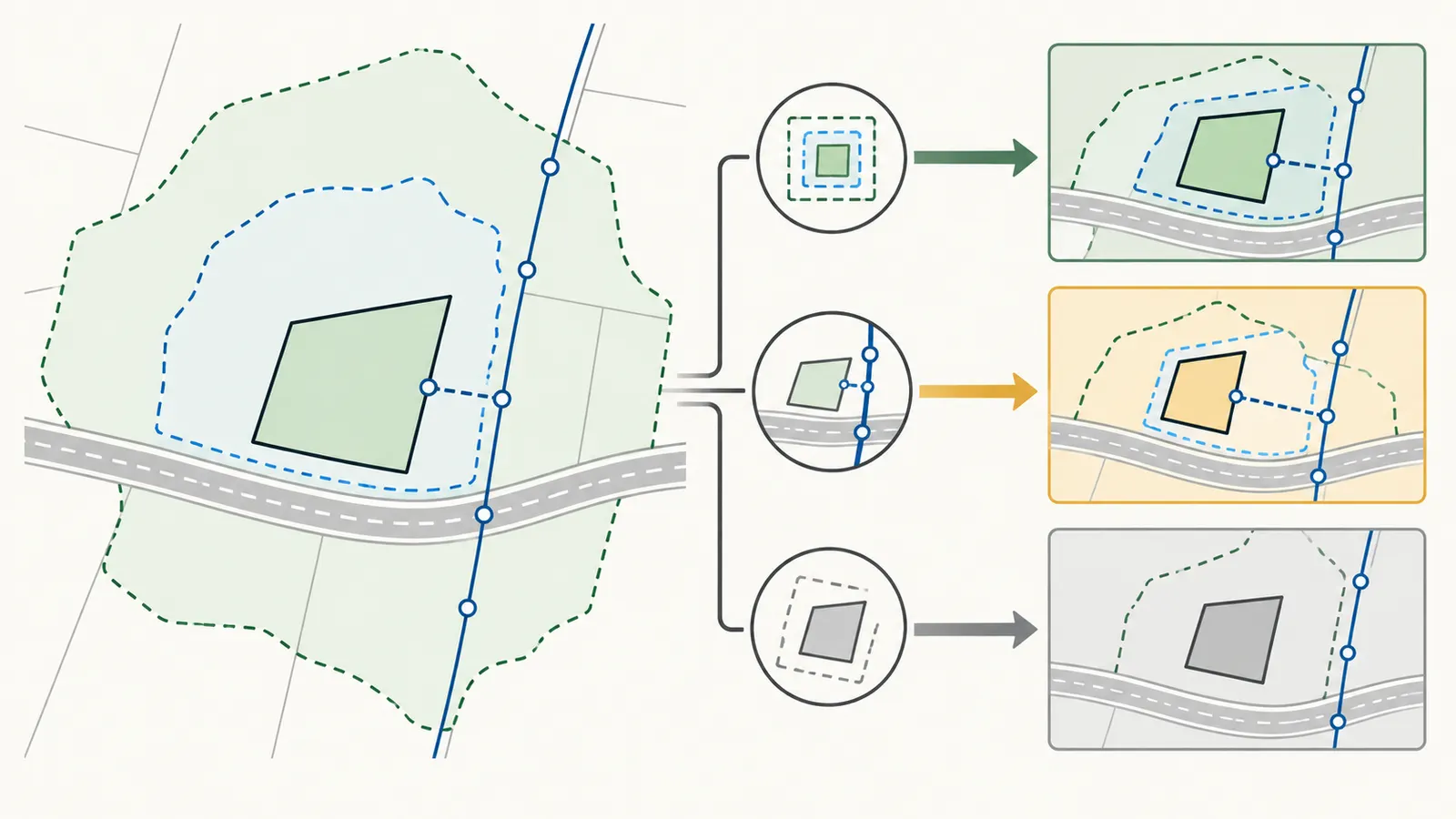
This page uses local examples to show how the same word—available, served, eligible, or will serve—can have different consequences. Fairfax County, Virginia, the City of Coeur d’Alene, Idaho, Clear Creek Community Services District in Shasta County, California, Del Norte County, California, and the Town of Dinosaur, Colorado do not create a national rule. They show why the buyer must name the actual jurisdiction and request that authority’s current answer.
What the first decision should be
Do not ask, “Are utilities close?” Ask: “For APN or legal description [identifier], will [named authority] provide [water, sewer, or both] for one proposed single-family residence at [proposed location], and what must happen before connection?” That question produces a decision record rather than a proximity opinion.
If the authority cannot answer from the parcel information you provide, that is a process problem to resolve before you spend on building design. If it can answer only after an application, survey, development concept, annexation pre-application, or capacity review, record that as the next gate and its cost, owner, and deadline. Do not silently promote an unresolved gate into an “available” utility.
Assemble the parcel packet and name the people responsible for each answer #
The buyer should build one parcel packet containing the APN, legal description, proposed dwelling, authority names, maps, easements, written responses, fee questions, capacity questions, and deadlines; the buyer’s agent can coordinate delivery, but the serving authority, planning body, title professional, surveyor, engineer, and attorney each own different parts of the verification. A complete packet prevents a common failure: asking a utility a vague location question and receiving a general service-area answer that cannot be used for the lot under contract.
Required inputs before contacting a utility
Collect these inputs before requesting a determination:
- Parcel identity: APN, tax parcel number, legal description, street address if one exists, recorded lot or subdivision name, county, state, and any parcel-split or boundary-adjustment history.
- Proposed use: one single-family residence, number of dwelling units, likely accessory dwelling unit, expected occupancy, and whether the request includes irrigation, fire service, commercial use, livestock, or a future subdivision.
- Proposed service: water, sewer, or both; gravity sewer if that is the normal design assumption; and whether the authority is being asked for a tap, a main extension, a lateral, a lift or pump arrangement, or only a service-availability statement.
- Site location: a sketch showing the parcel boundary, likely building envelope, road frontage, driveway, utility corridor, and the side of the road where a main appears to be located. Keep the sketch labeled “preliminary,” not an engineered design.
- Transaction timing: offer date, due-diligence deadline, expected closing date, design start, and the last date by which annexation or a service-area action would still work.
- Existing records: seller disclosures, prior will-serve letters, subdivision approvals, recorded utility easements, development agreements, annexation ordinances, water-main participation agreements, and utility correspondence.
The project description must be specific enough for the authority to evaluate the intended use but modest enough not to pretend that engineering is complete. For example: “One detached single-family residence, one dwelling unit, domestic water and sanitary sewer, no commercial use, no subdivision proposed, APN [number], proposed building area shown on attached preliminary sketch.” If an accessory dwelling unit is a possibility, ask whether it changes the authority’s category, capacity calculation, connection count, or fees. Do not omit it merely to obtain an easier letter.
Del Norte County, California’s engineering guidance illustrates the minimum identity information a utility generally needs for a will-serve request: owner contact information, APN, detailed project description, and related permit references when available. The county says a resulting letter generally identifies the utility, issuing representative, owner, APN, service description, and expiration date. Use this as a request checklist, not as a rule that binds a different state or utility. See Del Norte County’s will-serve letter guidance.
Separate authority roles before you assume one office controls everything
Make a responsibility map with a named person or office for each row:
| Question | Likely responsible body | What the buyer needs in writing |
|---|---|---|
| Is the parcel inside the public water service boundary? | City water department, water district, community services district, or other provider | Current map or staff determination tied to APN/legal description. |
| Is the parcel inside the sewer service area? | City wastewater department, sanitary district, county service area, or other sewer provider | Service-area status, access rule, and proposed service type. |
| Can a boundary or service area change? | City council, county board, district board, LAFCO, state agency, federal water-contract administrator, or another named body depending on jurisdiction | Required application, approval body, public process, costs, and realistic schedule. |
| Is the use allowed on the parcel? | City or county planning and zoning authority | Confirmation of the proposed residential use and any permit or land-use dependency. |
| Is there a recorded route to the parcel? | Title company, county recorder, surveyor, utility, road authority, or easement holder | Easement document, access rights, road or highway permit requirement, and affected owner. |
| What will it cost? | Utility, authority fee office, engineer, surveyor, title professional, and contractor as applicable | Written fee schedule, preliminary estimate, exclusions, expiration, and who pays. |
| Can a lender rely on the result? | Lender plus utility and closing professionals | Letter format, addressee, validity period, conditions, and lender acceptance. |
The seller may authorize access to records or sign an application, but the seller does not decide whether the parcel is eligible. A buyer’s agent can transmit a question but does not replace the authority’s determination. A surveyor can locate boundaries and easements, but does not grant service. An engineer can study grades, flow, extension routes, and constructability, but does not approve annexation. A title company can report recorded interests, but does not confirm current utility capacity. Keep the handoffs visible.
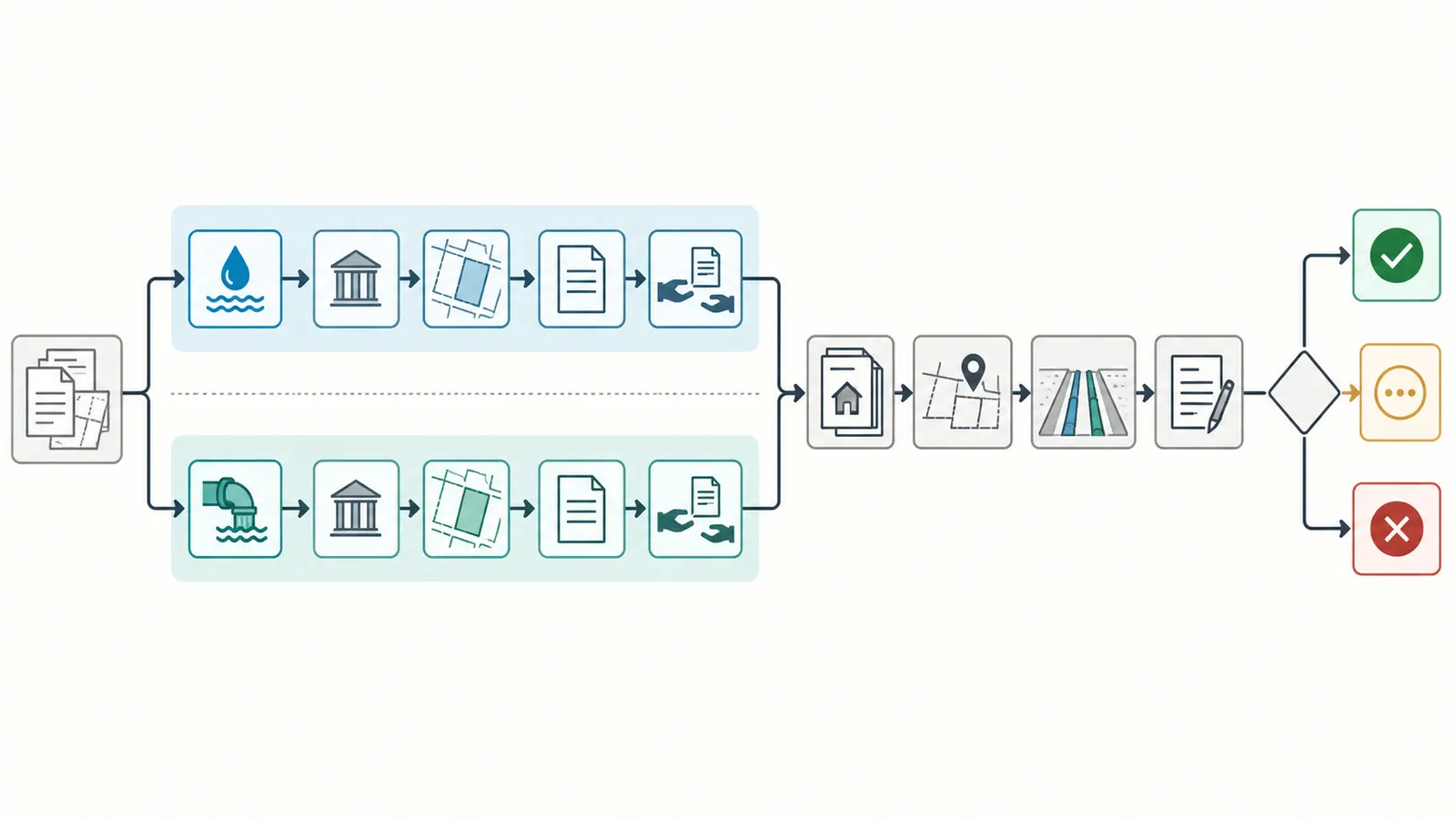
Ask the title professional a different question from the utility
Ask the title professional to search for recorded utility easements, rights-of-way, declarations, participation agreements, annexation documents, restrictions, and prior service rights affecting the specific parcel. Ask whether the legal description used by the utility matches the legal description insured or being conveyed. A utility’s “we can serve this location” answer does not create an easement across a neighbor’s land, a right to cross a highway, or a right to occupy a private road.
Ask the utility whether the proposed connection point is on public property, within an existing easement, or dependent on a new easement. Ask who must sign, record, maintain, relocate, and pay for that easement. If a main is close but on the far side of a road, include the road authority in the handoff. A crossing permit and restoration condition can be as important to the offer as the tap fee.
Verify the boundary, service area, sphere, and physical access separately #
Verify four separate facts—service territory, legally usable service area, physical main access, and connection route—because a parcel can pass one test and fail another. Use the authority’s current records and a parcel-specific response; treat online maps, listing diagrams, and neighboring connections as screening evidence only.
Service territory is not always the same as a city limit
Some cities serve land outside their incorporated boundaries under special policies, while some districts do not serve every parcel inside a map or sphere. The City of Coeur d’Alene, Idaho, describes three outside-city water-service categories: approved subdivisions with guaranteed access from the acquired system; lots that abut a main but are not contiguous to city limits, which may petition for one connection and must sign a Water Service Agreement about future annexation; and lots contiguous to city limits, which must annex before connection. The city’s Water Service Area page links the summary, policy, parcel list, and maps.
The Coeur d’Alene example shows why “outside the city” is not a sufficient classification. A parcel could be outside the city and still have a defined policy path; a different parcel could be equally close to a main but not appear in the eligible records. The policy also says main extensions are allowed only under annexation and does not permit an owner to extend a main to a parcel that does not currently abut an existing City water main just to become eligible. Read the City of Coeur d’Alene Water Service Outside City Limits policy with the parcel list and current Water Department determination.
Do not transfer the Coeur d’Alene categories to another city. The useful transferable lesson is the workflow: identify the boundary, find the policy category, ask whether the parcel is in the authority’s current eligible records, identify the annexation or agreement trigger, and get the final responsible official’s written answer.
A sphere or planning boundary is not necessarily a service connection right
In the Clear Creek Community Services District example in Shasta County, California, a sphere of influence can be part of a path toward a district service boundary without being the same thing as current service authorization. The district’s policy says it will not issue a Will Serve Letter for property outside its Sphere of Influence Boundary at the time of request. It separately describes letters for property inside the District’s Service Boundary or property inside the sphere that is to be annexed into the Service Boundary. That distinction is visible in the Clear Creek Community Services District Will Serve Letter Policy; it is a local example, not a rule for every California district.
For a California parcel, ask the district and the applicable Local Agency Formation Commission (LAFCO) to state which of these applies:
- The parcel is inside the district’s current service boundary.
- The parcel is inside the district’s sphere of influence but outside the service boundary.
- The parcel is outside both.
- The parcel’s map status is uncertain because a parcel split, annexation, or boundary action is pending.
Then ask whether the proposed residence can be served in that status, which body must act, and whether an agency outside the district must approve the service-area change. A sphere label without a written connection path belongs in the conditional or unconfirmed state, not the in-boundary state.
Physical proximity is a separate measurement
Measure the route from the proposed building location—not merely the parcel line—to the likely main or connection point. Record units and assumptions: feet from building to main, road width, crossing side, grade, gravity direction, likely lateral length, manhole depth if sewer, and whether the route crosses a neighbor’s parcel. Do not call a main “available” because it is within walking distance of the driveway.
Fairfax County, Virginia illustrates how local rules can attach a numeric availability test to a proposed structure. Fairfax says a sanitary sewer main is considered available for a single-family home when it is within 300 feet of the building; it also says wastewater must flow by gravity when public sewer is available except in rare cases where gravity connection is technically impossible, and that a property owner requesting an extension pays for it. Those are Fairfax County, Virginia rules, not a nationwide 300-foot standard.
Fairfax County also distinguishes service-area eligibility from distance. Its page says the building or structure must be inside the approved sewer service area and that public access must be available. An extension across the approved service area cannot exceed 400 feet or a 12-foot manhole depth unless the Board of Supervisors approves an exception. If a request is more than 400 feet outside the approved sewer service area, the county says expansion requires Board review and has historically not approved expansion for new development or redevelopment; the page points to health or environmental conditions and a Department of Health confirmation for the exception path. See the county’s approved sewer service area and extension guidance.
The correct conclusion from Fairfax is not “300 feet always means sewer.” It is: the county uses both a service-area test and an availability-distance rule, and the authority must confirm how the proposed building location, route, and exception rules apply to the parcel. A different county may use different distances, a different definition of availability, or no public sewer at all.
Do not combine water and sewer into one “utility” checkbox
Create separate rows for domestic water, sanitary sewer, stormwater, fire protection if applicable, and any private system that remains necessary. The water authority may have a main at the frontage while the sewer authority requires a lift station, a different route, or on-site treatment. The sewer provider may be a county service area even where the city provides water. Each can have different boundary maps, fees, easements, capacity limits, and expiration dates.
Del Norte County, California is a useful warning against guessing the provider. The county says it does not provide public water; the City of Crescent City and several Community Services Districts provide public water, and the county’s Engineering and Surveying Division may be able to identify the provider for a specific project location. The county also lists project-dependent permitting, plan-check, inspection, bonding, and water-line or service-construction costs. Use Del Norte County’s provider and connection-cost guidance as a reason to identify the actual provider first, not as a promise that every rural California parcel has a public option.
Request the written determination that matches the decision you need #
Request a parcel-specific availability, will-serve, boundary, or annexation determination that names the service, proposed use, conditions, responsible authority, expiration, costs, and next approval; a generic “utilities are nearby” response is not enough to commit earnest money. Ask the authority which document it issues and whether the document is informational, conditional, lender-ready, or an approval to connect.
Use the right words without assuming they mean the same thing
Different authorities may use “availability letter,” “will-serve letter,” “capacity letter,” “service confirmation,” “utility commitment,” “preliminary determination,” or “annexation feasibility.” Ask the office to define its document. A will-serve letter can be useful and still conditional. Clear Creek Community Services District, California, describes its Will Serve Letter as a conditional commitment or refusal, says it informs a regulatory agency and applicant that water and facilities are available subject to policy and letter conditions, and notes that lenders normally require such letters for financing. It does not say that the letter eliminates every later permit or connection condition. Read the Clear Creek policy’s purpose and letter provisions.
Your request should include these questions in plain language:
- Is this APN and legal description inside the authority’s current service boundary, approved service area, or other eligible category?
- If not, is it inside a sphere, planning boundary, or other area where a service-area amendment or annexation may be requested?
- Which body must approve the action: utility board, city council, county board, LAFCO, state agency, federal agency, or another body?
- Does the authority support one single-family residence at the proposed building location, and does that include an accessory dwelling unit or second connection?
- Is the main physically reachable from the proposed building or service point, and what easement, road, or crossing approvals are required?
- Is capacity currently available for the proposed use, and can the authority reserve or commit it through closing and construction?
- What fees, connection charges, capacity charges, extension costs, inspection costs, bonds, deposits, legal costs, or reimbursement agreements apply?
- Who pays for each item, when is it paid, and is the fee amount fixed, scheduled, estimated, or subject to later rates?
- What permit or building approval must exist before the connection can be made?
- When does the letter or determination expire, what event can terminate it earlier, and how can it be extended or renewed?
- Can the letter be addressed to the buyer, seller, lender, planning agency, or parcel rather than only to a current owner?
Ask for a signed or otherwise officially issued response, the name and title of the issuing representative, and the document date. Save the original PDF or letter and the email that transmitted it. A phone call can help identify the right office, but record the call as an informal lead until the authority confirms it in writing.
Include the proposed service scope in the letter
A letter that says “water service” may not answer whether it covers domestic water only, irrigation, fire flow, multiple units, a meter size, or a temporary construction connection. A letter that says “sewer service” may not answer gravity availability, a pump or lift requirement, capacity, a main extension, or maintenance responsibility. State one proposed home and each additional use you realistically expect.
If the proposed home has not been designed, use a bounded description rather than a fictional exact demand. For example: “one detached residence, one dwelling unit, normal domestic use, no commercial operation, no subdivision; accessory dwelling unit is not included in this request and will be evaluated separately.” Then ask what change would trigger a new review. This preserves flexibility without misleading the authority.
Ask for a cost estimate with exclusions
Ask for a preliminary estimate in a table, with separate lines for authority fees, capacity, meter or tap, main extension, service lateral, road or highway crossing, easement, inspection, bonding, design review, annexation, LAFCO or council process, attorney or engineering reimbursement, and restoration. Ask whether the estimate includes physical construction. Del Norte County, California expressly recommends requesting a preliminary cost estimate with a will-serve letter and warns that the estimate may or may not include the physical cost to connect, so the applicant should request clarification. See the county’s estimate guidance.
Do not convert a fee schedule into a total project cost. A fee schedule can omit private work, rock, traffic control, road restoration, survey, trenching, an easement, a pump, a lift station, or a main extension. Ask whether the utility will design or construct the public portion, whether the buyer must hire a licensed contractor, and which costs remain private. Ask whether the estimate is valid through the expected closing and construction dates.
Treat expiration as a closing input
Record four dates: letter date, application date, expiration date, and any earlier termination event. Then compare the expiration to the offer deadline, closing, design approval, building permit, annexation, and physical connection. A letter expiring after closing but before connection is not automatically safe; the authority may require a new review under different fees or capacity.
Clear Creek Community Services District, California gives a concrete example. Its policy provides an 18-month period after the District Board first approves annexation to complete required annexation and service-area modification, subject to a possible Board extension. It also says a Will Serve Letter terminates at the sooner of five years, connection, expiration of a use permit, tentative map or parcel-division approval, or expiration of the building permit. Those are Clear Creek’s stated local deadlines; do not treat five years or 18 months as a general California or United States rule.
Write the expiration into the offer schedule. If the seller says the letter can be renewed, ask the authority—not the seller—whether renewal is discretionary, whether fees are recalculated, whether capacity is reconsidered, and whether the renewal must be requested by the same owner or applicant.
Compare the local paths without turning one jurisdiction into a national rule #
The parcel should be compared against the actual authority’s path, not against a generic “public utilities available” checklist; the local examples below show four distinct patterns: a sewer area plus distance rule, outside-city water tiers, conditional service-area annexation, and a county that directs the buyer to the actual provider.
Fairfax County, Virginia: approved sewer area plus availability distance
For Fairfax County, Virginia, first confirm the approved sewer service area and public access. The county says a building or structure must be in the approved sewer service area to connect, and that the service-area boundary was defined around land that can be served by the smallest allowable gravity lines. It separately says a single-family sewer main is considered available within 300 feet of the building and that other buildings use a 500-foot distance. The building location, not a listing pin or parcel edge, is therefore a critical input. See Fairfax County’s public sewer connection page.
If the parcel is outside the approved sewer service area, Fairfax says an extension across the approved area cannot exceed 400 feet or a 12-foot manhole depth without Board of Supervisors approval. For a request more than 400 feet outside the area, the county describes an expansion path involving Board review, proof of health or environmental issues, and Health Department confirmation, while noting that new development and redevelopment expansions have historically not been approved. The practical buying question is not whether an application can be submitted; it is whether the authority will confirm a credible path for this proposed residence within the contract timeline.
Fairfax also says the requesting property owner pays for required public sewer extensions. A connection permit is required when service is determined available; only a licensed plumber may obtain a permit to tap the sewer main, and required sanitary sewer fees must be paid before issuance. These details turn “sewer at the street” into a financial and responsibility question. The buyer should request as-built information, likely tap location, route, extension need, current charges, and the authority’s position on the proposed building site before removing a utility contingency. See Fairfax County’s connection permit and fee guidance for those local requirements.
Fairfax decision: classify as in-boundary only if the authority confirms the approved area and access; classify as conditional if a Board exception, extension, easement, or unusual gravity determination is needed; classify as outside or unconfirmed if the only support is a nearby main or listing statement. The responsible handoff runs from buyer to Fairfax Wastewater Planning and Monitoring, Department of Planning and Development when an area expansion is implicated, title and survey professionals for access, and a licensed plumber or engineer for connection feasibility.
City of Coeur d’Alene, Idaho: outside-city tiers and annexation triggers
For the City of Coeur d’Alene, Idaho, being outside city limits does not produce one universal answer. The city’s summary identifies three basic tiers. Approved outside-city subdivisions have a stated access history; lots that abut mains but are not contiguous to city limits may petition for one connection and must sign a Water Service Agreement regarding future annexation; lots contiguous to city boundaries must annex before service connection. The City’s Water Service Area page points to the policy, parcel list, and maps that must be checked together.
The policy adds several conditions that matter before buying. The owner must verify eligibility for one single-family residential connection. A qualifying non-contiguous parcel may need to show that it abuts an existing City water main, that existing customers will not be reduced below adopted standards, that the owner consents to subsequent annexation at the City’s discretion, and that the owner will convey attached water rights without cost upon request. The owner pays applicable connection fees, capitalization fees, meter-system fees, highway or county permit fees, and adverse-condition charges where applicable. See the City of Coeur d’Alene’s outside-city water policy.
The city policy says the Water Superintendent makes the final property-eligibility determination and may execute the agreement once eligibility and service are determined. See the City of Coeur d’Alene’s outside-city water policy for that responsibility. That tells the buyer whom to ask for the final local answer. It also means that a neighbor’s connection or a seller’s interpretation of the map is not the final record.
Coeur d’Alene decision: use the city’s parcel list and maps to screen the APN, then request the Water Department’s written classification, agreement form, annexation requirement, fees, connection route, and final decision-maker. If the parcel is contiguous to city limits, treat annexation as a precondition. If it is non-contiguous and abuts a main, treat service as conditional until the City accepts the petition and agreement. If it is not in the policy’s eligible records or does not abut a main, do not price a main extension as if it were an available option; the policy says main extensions are allowed only under annexation.
Clear Creek Community Services District, California: boundary, sphere, LAFCO, federal service area, and capacity
For Clear Creek Community Services District in Shasta County, California, a letter can be conditional at several layers. The district’s policy says outside-service-boundary applications are processed only after the applicant agrees the letter will be conditioned on the District Board’s approval of annexation, completion of annexation through the Shasta County Local Agency Formation Commission, and payment of those costs by the applicant. If the property is outside the District’s Bureau of Reclamation service area, the letter is also conditioned on Bureau approval, at the applicant’s cost. See the Clear Creek Will Serve Letter Policy.
The buyer must distinguish the district’s service boundary from its sphere of influence and from the Bureau of Reclamation service area. The district policy says it will not issue a Will Serve Letter for property outside the sphere at the time of request. It describes a Will Serve Letter as an indication of willingness and ability to serve property inside the service boundary or property inside the sphere that is to be annexed. These are three different facts to record: current district boundary, sphere status, and contracted or federally controlled service area.
Capacity is a separate gate. Clear Creek’s policy makes connection contingent on sufficient water based on contractual entitlements and owned water and sufficient treatment and delivery capacity. It also says drought-contingency provisions can apply. A letter that is valid today does not erase the policy’s condition at the time of connection. Ask whether the letter reserves capacity, merely describes current availability, or requires another determination at connection; see the Clear Creek policy’s capacity and drought conditions.
The district’s application form asks for the location, legal description, APN, service address, planning development number, type of use, and number of units. Residential developments of four or fewer parcels may be approved by the General Manager, while subdivisions and commercial developments must be approved by the Board. The policy says the application is not considered received until required information and execution are complete, and the district may request additional information, fees, or deposits. A complete application may receive an initial review within up to 21 days, but that is not an 18-month annexation approval or a connection promise; the Clear Creek application, review, and approval provisions control the local details.
Clear Creek decision: classify an outside-boundary parcel as conditional, not in-boundary, until the Board, Shasta County LAFCO, and—if applicable—the Bureau of Reclamation path are documented. Put the 18-month annexation window, five-year or earlier letter termination events, capacity condition, building-permit dependency, updated fees, and development-agreement responsibility into the offer review. If the owner cannot obtain the required approval or the authority will not confirm capacity within the contract’s long-stop date, the conditional path has failed for this purchase.
Del Norte County, California: identify the actual provider and ask for exclusions
For a parcel in Del Norte County, California, the county itself is not the public-water provider. The county says the City of Crescent City and several Community Services Districts provide public water, and that the county’s Engineering and Surveying Division is usually able to determine a provider for a specific project location. That is a direct reminder to identify the actual authority before requesting service. See Del Norte County’s Engineering and Surveying FAQ.
The county’s will-serve guidance gives a practical request structure: identify the owner, APN, detailed project, related permit application when available, service description, issuing utility and representative, and expiration. It recommends a preliminary cost estimate and warns that the estimate may not include the physical connection. It also notes that a utility may accept full payment documentation in lieu of a letter in some circumstances, but physical connection cannot occur until a development permit has been issued for the use. The buyer should therefore ask the authority whether a letter is required, whether payment transfers, and which permit unlocks physical construction; those payment and permit qualifications come from Del Norte County’s will-serve guidance.
The county’s sewer guidance also distinguishes capacity and assessment boundaries. It identifies local sewer capacity charges and mitigation fees by assessment district and says the City of Crescent City must be contacted for its capacity charge. Do not copy those listed amounts into a budget without confirming their current schedule, parcel district, ESFC basis, and whether an updated fee applies. The decision is provider- and parcel-specific; use Del Norte County’s sewer capacity and assessment-fee guidance for the applicable local categories.
Del Norte decision: obtain the provider name from the county or recorded records, send the APN and one-home scope to that provider, request the will-serve letter and a line-item preliminary estimate, and ask what physical connection costs are excluded. Keep any county sewer assessment or capacity question separate from the city or district water response.
Town of Dinosaur, Colorado: annexation can be discretionary and process-heavy
For the Town of Dinosaur, Colorado, the municipal code shows why a buyer must ask whether annexation is a right, a petition, or a discretionary action. The code says annexation is generally discretionary for the Town Council, the petitioner pays the Town’s full processing cost, and annexed land must not create an additional cost or burden on existing residents for public facilities. See the Town of Dinosaur Municipal Code.
The code describes a pre-application conference, letter of intent, petition, application, maps, supporting documents, staff completeness review, Town Council compliance review, public-hearing steps, and final ordinance or termination. That is a local process, not a template for every city; see the Town of Dinosaur’s annexation procedure. But it supplies a useful question for any jurisdiction: is there an initial feasibility conversation, a completeness gate, a public hearing, a council or board discretion point, an election, a recording step, and a reimbursement agreement?
Dinosaur decision: do not treat “the town can annex” as “the town must annex.” Ask the Town or applicable authority for the current pre-application requirements, estimated review cost, public process, public-facility conditions, and written indication that the proposed parcel can enter the process. If annexation is discretionary and the purchase contract has no effective exit, the buyer is taking land risk before the core utility question is resolved.
Convert conditions, costs, capacity, and deadlines into an offer decision #
The offer should reflect the utility state: an in-boundary parcel needs ordinary connection and permit contingencies, a conditional parcel needs approval-specific contingencies and a long-stop date, and an outside or unconfirmed parcel should not be bought on the assumption that a future extension or annexation will succeed. Have a real-estate attorney in the property’s jurisdiction draft or review the language; this page is a planning worksheet, not legal advice.
The decision record to attach to the transaction
For each water and sewer service, write one record with these fields:
| Field | Entry to make | Why it changes the decision |
|---|---|---|
| Parcel | APN, legal description, service address, county and state | Prevents a letter or map from applying to the wrong lot or an old parcel configuration. |
| Proposed use | One residence, units, accessory dwelling unit, irrigation, commercial or other use | Determines whether the response covers the actual project. |
| Authority | Full name of city, county, district, CSA, utility, LAFCO, state or federal body | Names the office with authority rather than relying on a broker or neighbor. |
| Boundary status | In boundary, sphere, outside, map conflict, or unconfirmed | Determines whether a current connection or another approval is needed. |
| Physical path | Main, tap, lateral, road crossing, easement, gravity or pump condition | Separates legal eligibility from buildable access. |
| Capacity | Available, conditional, not evaluated, reserved, or denied | Prevents a current map status from being treated as future capacity. |
| Approval | Permit, annexation, service-area amendment, LAFCO, council, Board, federal approval, development agreement | Identifies the decision-maker and handoff. |
| Cost | Fee, capacity, extension, private connection, easement, survey, engineering, legal, bond, restoration | Turns a vague allowance into a bounded budget. |
| Expiration | Letter date, expiration, earlier termination, renewal method | Aligns utility proof with closing and construction. |
| Responsible next person | Name, title, contact, promised document, due date | Creates ownership for the next verification instead of leaving it with “someone.” |
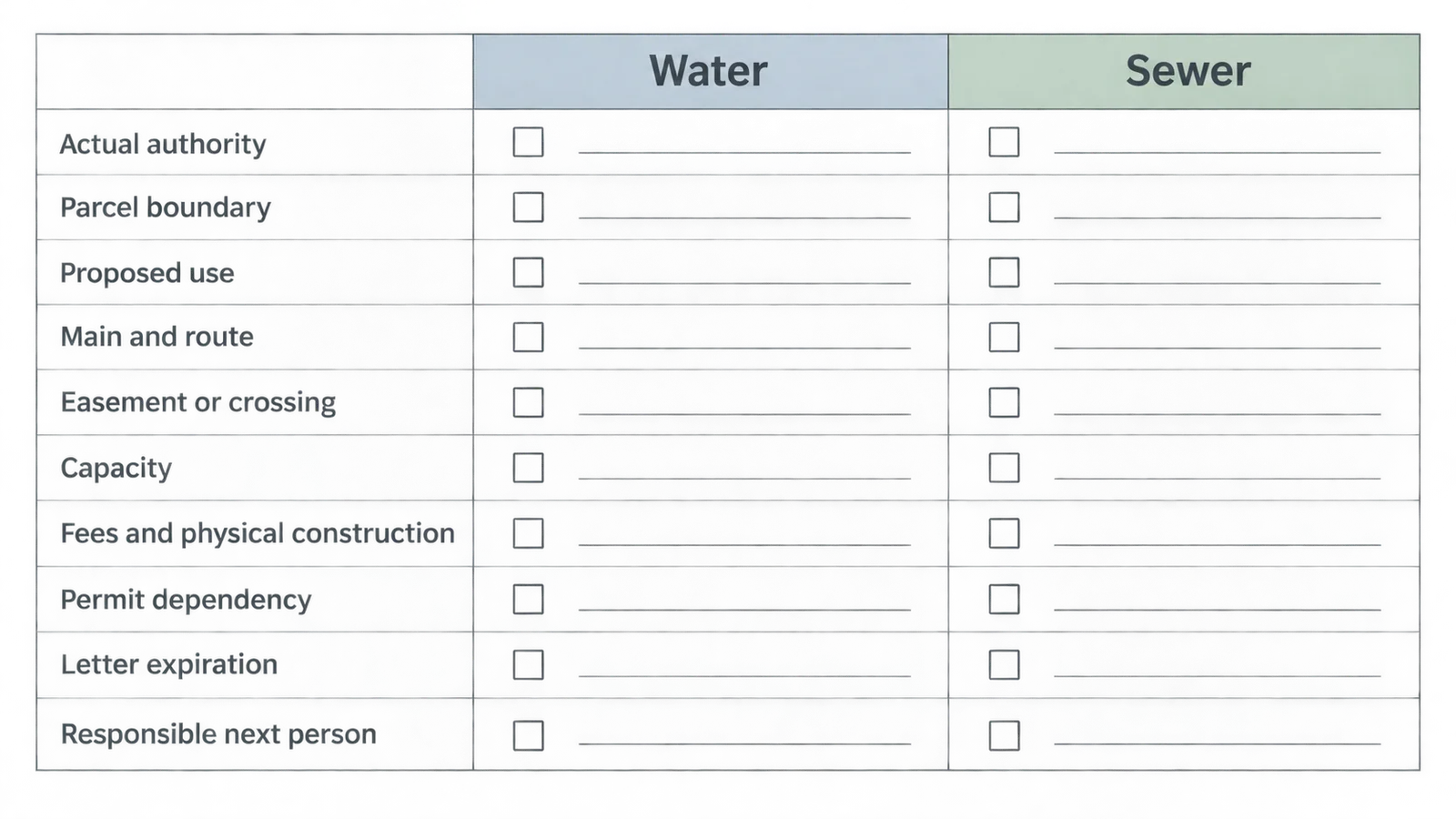
Original contribution: Three-State Public-Utility Boundary Matrix and Handoff Worksheet
The Three-State Public-Utility Boundary Matrix and Handoff Worksheet is a decision matrix and handoff record, not an official utility form. Its Method: combine the parcel identifier, authority map, written service response, annexation trigger, cost, capacity, expiration, and responsible decision-maker into one record; classify only from documented inputs. Fill one copy for water and one for sewer, even when the same city provides both.
| Input | Water entry | Sewer entry | Evidence to attach | Owner of next verification |
|---|---|---|---|---|
| APN and legal description | [write exact text] | [write exact text] | Current assessor record and title legal description | Buyer and title professional |
| Proposed use and units | [one residence / ADU / other] | [one residence / ADU / other] | Written project description | Buyer, planner, architect if engaged |
| Authority and contact | [name, office, title, phone/email] | [name, office, title, phone/email] | Official directory or written referral | Buyer or agent |
| Current boundary status | [in / sphere / outside / unknown] | [in / approved area / outside / unknown] | Current authority map and parcel-specific response | Authority |
| Main and route | [location, side of road, distance] | [location, gravity route, distance] | Utility record, survey or preliminary sketch | Utility and qualified surveyor/engineer |
| Easement and crossing | [recorded/new/none/unknown] | [recorded/new/none/unknown] | Recorded instrument and road authority response | Title professional and authority |
| Annexation or amendment | [not needed / body / status] | [not needed / body / status] | Application, resolution, ordinance, or written authority response | Buyer and approval body |
| Capacity | [status and conditions] | [status and conditions] | Will-serve/capacity response and conditions | Authority |
| Fees and construction | [line items and exclusions] | [line items and exclusions] | Fee schedule and preliminary estimate | Authority and qualified estimator |
| Permit dependency | [permit and issuer] | [permit and issuer] | Permit checklist or letter condition | Planning/building authority |
| Expiration | [date and earlier triggers] | [date and earlier triggers] | Dated letter and renewal rule | Buyer and authority |
| Classification | [in-boundary / conditional / outside-unconfirmed] | [in-boundary / conditional / outside-unconfirmed] | Completed rows above | Buyer with attorney/advisors |
| Next written handoff | [document, person, date] | [document, person, date] | Email or signed response saved to file | Named responsible person |
Use these classification tests:
- In-boundary: the current authority record identifies the parcel, the proposed use is within scope, and no unresolved boundary or annexation approval is required. Remaining permit, route, easement, capacity, and fee questions must still be listed.
- Conditional: the authority identifies a path but names a future approval, agreement, service-area action, capacity condition, permit, easement, development agreement, or expiration that has not yet been satisfied.
- Outside or unconfirmed: the parcel is outside the relevant current area, the authority has not identified a path, the response is only verbal or generic, or a key record cannot be matched to the parcel and proposed use.
The worksheet is deliberately conservative. It prevents “conditional” from becoming “yes” merely because an application can be filed. It also prevents “outside or unconfirmed” from becoming “impossible” without a written denial or a qualified local analysis. The next decision is not made from optimism; it is made from the documented condition that must be satisfied and the date by which it must be satisfied.
Limitations: local examples are not a legal opinion, title opinion, survey, or engineering determination, and an authority can change its map, policy, fees, capacity, or deadline. The matrix cannot decide whether a particular annexation will pass, whether a sewer route is physically constructable, whether a private easement is enforceable, or whether a lender will accept a letter. It tells you what to request and what remains open.
A modeled illustrative cost and schedule example
The following is an illustrative modeled example, not a quote, measurement, or local estimate. It shows how to expose unknowns before choosing an offer strategy.
Assume:
- one vacant parcel and one detached residence;
- one water connection and one sewer connection;
- a possible 150-foot public main extension;
- a preliminary unit rate of
$180 per linear footsupplied for modeling only, not asserted as a market or authority price; - known authority fees of
$8,000; - private lateral and site connection allowance of
$14,000; - survey, easement, and legal allowance of
$7,500; - annexation or application allowance of
$12,500; - an unpriced restoration or geotechnical risk of
$0in the base model because no estimate exists.
The formula is:
Known utility exposure = authority fees + lateral/site work + (extension length × modeled unit rate) + survey/easement/legal + annexation/application
Substituting the illustrative inputs:
$8,000 + $14,000 + (150 ft × $180/ft) + $7,500 + $12,500 = $69,000
The arithmetic is inspectable, but the result is not a budget to carry into a contract. The major uncertainty is the extension length and unit rate, and the model excludes restoration, traffic control, rock, design, inspection, bonds, capacity changes, utility-owned work, and authority fee updates. That is exactly why the buyer should ask the authority for a line-item estimate with exclusions.
Sensitivity for extension length at the same illustrative rate:
| Extension assumption | Extension component | Modeled total before unpriced risks |
|---|---|---|
| 100 ft | 100 ft × $180/ft = $18,000 | $60,000 |
| 150 ft | 150 ft × $180/ft = $27,000 | $69,000 |
| 250 ft | 250 ft × $180/ft = $45,000 | $87,000 |
If the buyer applies an illustrative 20% reserve to the modeled total for unpriced risks, the three scenarios become $72,000, $82,800, and $104,400. That reserve is not an industry rule and does not replace an estimate. It simply shows the decision effect of uncertainty. A parcel that appears affordable at $60,000 can cross a buyer’s limit at $104,400 before land, house, road, financing, and other site costs.
The correct use of the model is to set a question threshold. For example: “I will not remove the utility contingency until the authority identifies whether the extension is public or private, the route and easement are feasible, capacity is confirmed, the approval path is named, and the estimate separates fees from physical construction.” The model does not tell you to spend $69,000; it tells you what a missing number can do to the purchase decision.
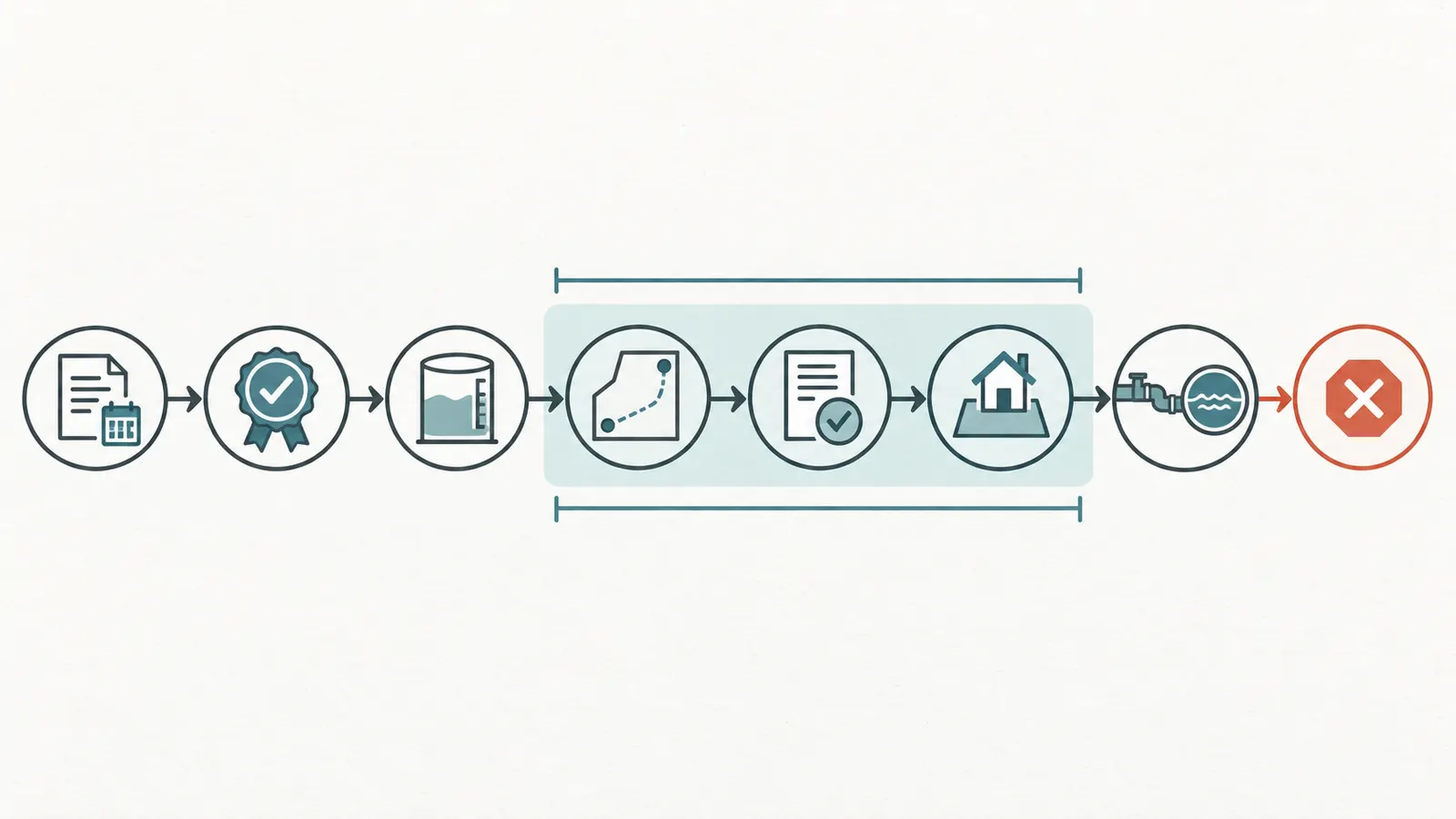
Offer and closing conditions to discuss with local counsel
Ask counsel to consider conditions tied to objective documents and dates, such as:
- the buyer’s receipt and acceptance of a parcel-specific water determination and sewer determination;
- confirmation that each letter covers the proposed residence and stated unit count;
- approval of annexation, service-area amendment, or other boundary action by the named body;
- confirmation of capacity and the authority’s ability to maintain the commitment through the stated construction milestone;
- acceptable easements, road crossings, and access rights recorded or committed in writing;
- a line-item cost estimate with identified exclusions and a buyer-approved maximum exposure;
- a letter expiration date that extends beyond the relevant construction or permit milestone, or an agreed renewal mechanism;
- a long-stop date after which the buyer may terminate and recover deposits if the required action is unresolved;
- seller cooperation with applications, signatures, site access, records, and transfer of any authority-approved request;
- a prohibition on starting irreversible site work before the buyer accepts the service path and cost.
Avoid vague language such as “utilities to be verified” without naming the document, authority, proposed use, due date, and buyer remedy. A contingency that expires before the authority can act is not meaningful protection. A condition that requires a discretionary approval but allows no exit if it is denied transfers the risk to the buyer.
Sequence the handoffs before design, excavation, or an unconditional closing #
The safest sequence is identity, authority, boundary, written status, physical route, cost, approval, transaction condition, and only then design or land work; each handoff should produce a record that the next person can verify. The sequence can be shortened for a simple in-boundary parcel, but no step should be silently skipped when the parcel is outside a boundary or the authority uses a conditional letter.
Gate 1: buyer and agent establish the parcel record
The buyer obtains the APN, legal description, current map, seller records, offer timing, and proposed use. The agent confirms that the inquiry is about the exact parcel under contract or contemplated purchase. If the lot is a new split, confirm that the APN and legal description used by the authority will be the final ones, not only the parent parcel. If the parcel boundary is disputed, stop and involve a title professional and surveyor.
Handoff: send the parcel packet to the actual water and sewer authorities and request the correct application or determination format.
Gate 2: each authority identifies its service area and decision-maker
The authority or county identifies whether it serves the location, whether another authority serves it, and which map or record controls. In Del Norte County, California, the county may help identify the provider, but the city or CSD issues the water response. In Coeur d’Alene, Idaho, the City Water Department policy and the final Water Superintendent determination matter for outside-city water; the City’s policy identifies that local decision-maker. In Fairfax County, Virginia, wastewater planning and the county’s approved sewer area control the public sewer path. The buyer should save the referral itself because it explains why one office, not another, is responsible.
Handoff: request the current map or parcel status and the official contact for the written determination.
Gate 3: the buyer submits a bounded project description
Submit one residence, unit count, water and sewer scope, preliminary building location, and known timing. State what is not included, such as a future ADU or irrigation, and ask what change would trigger a new review. Provide the APN and legal description exactly as the authority requests. Pay an application fee only after understanding whether the request is an informational screening, a formal will-serve application, or an annexation-related review.
Handoff: the authority returns a written status, requests more information, or identifies a different approval body.
Gate 4: a qualified professional checks physical route and records
After the authority identifies a plausible service path, a surveyor or civil engineer can examine the route, grades, building location, utility records, easements, crossings, and likely extension. The professional should receive the authority’s written conditions, not merely the buyer’s summary. Ask for a bounded feasibility review that says what was assumed and what was not checked.
A parcel map, will-serve letter, email, phone call, or remote review cannot establish the water pressure, available flow, residual pressure, fire-flow adequacy, or hydraulic performance at the proposed connection. It also cannot establish that a stated capacity condition will remain available through construction. Ask the actual water authority what measurements or hydraulic review it has performed, and route any required pressure, flow, fire-flow, or system-capacity verification to the authority and a qualified local professional before relying on public water for design, permitting, or fire protection. A service letter is not a pressure or fire-flow test.
Do not excavate, expose a main, enter a manhole, enter a confined space, or alter public infrastructure to answer a buying question. Excavation can encounter buried utilities, unstable soil, traffic, contaminated material, or energized systems. A sewer manhole or vault can be a confined-space hazard. Utility locating, excavation, tapping, sewer work, electrical work for pumps, and public-road work belong to qualified and authorized professionals under the actual jurisdiction’s rules.
Handoff: the professional returns route, easement, grade, distance, and constructability questions to the authority and title professional.
Gate 5: authority and approval body confirm conditions and schedule
If annexation, a boundary change, or service-area amendment is needed, ask for a written process map. It should name the application, pre-application conference if any, required maps and legal descriptions, public notice or hearing, approval body, fees, expected review sequence, and conditions that can cause denial. Town of Dinosaur, Colorado’s code is an example of a pre-application, petition, completeness, council, public-hearing, and ordinance sequence; another jurisdiction may use a district board, LAFCO, county, state, or federal process instead. See the Town of Dinosaur local annexation code only as a local illustration.
For Clear Creek Community Services District, California, the process can require District Board approval, Shasta County LAFCO completion, and Bureau of Reclamation approval for the relevant service area. Treat each as a separate gate, with its own cost and deadline, rather than putting “annexation” in one undifferentiated checkbox.
Handoff: attach approval status, cost responsibility, capacity condition, and expiration to the offer decision.
Gate 6: buyer makes the proceed, condition, or reject decision
Proceed when current written evidence covers the parcel and proposed use and the remaining work is ordinary permitting and priced connection work. Condition the offer when the path is plausible but depends on approval, capacity, easement, or a cost that can be controlled by a specific document and long-stop date. Reject or pause when the only support is proximity, a stale letter, an unapproved map, a seller promise, an authority referral with no response, or an approval that cannot occur within the transaction schedule.
Only after this gate should the buyer authorize substantial design, geotechnical work tied to a chosen building location, land clearing, driveway construction, trenching, or a non-refundable connection payment. Design can be useful earlier if it is explicitly exploratory and does not assume public service; do not let preliminary drawings create a sunk-cost pressure to buy an unresolved parcel.
Catch the failure cases that make a “served” lot unbuildable #
The most expensive failures are not always a missing main; they are mismatched records, unrecognized conditions, expired approvals, and responsibility gaps that surface after the buyer has closed. Run the failure matrix before the utility contingency expires and assign each issue to a named person.
| Failure case | What you observe | What it may mean | Safest next step |
|---|---|---|---|
| Main visible near the lot | A pipe, manhole, hydrant, or neighboring tap is nearby | Physical infrastructure exists, but the parcel may be outside the service area or lack a right to connect | Ask the authority to identify the APN’s eligibility and the connection point in writing. |
| Listing says “water and sewer at street” | Listing copy or seller statement has no authority letter | The phrase may mean a main is nearby, not that a tap is available or paid | Treat as unconfirmed until the actual provider responds. |
| Water confirmed, sewer missing | Water letter names a city or district, but no sewer authority is identified | Separate providers, on-site requirement, or sewer boundary issue | Start a separate sewer request; do not infer sewer from water. |
| Parcel is inside a sphere | Map shows a planning boundary | A sphere may support a future path but not current service | Ask whether annexation and service-area approval are required and by whom. |
| Parcel abuts a city limit | Boundary line touches the parcel | Local policy may require annexation before service | Obtain the exact city policy and approval sequence; do not rely on adjacency. |
| Letter names previous owner | Old will-serve or capacity letter is in the file | Letter may be non-transferable, expired, or tied to a different use | Ask the authority to reissue or confirm transfer and scope. |
| Letter says “subject to capacity” | Conditional language appears in the letter | Capacity is not reserved or may be rechecked at connection | Ask whether capacity is allocated, for how long, and what event ends it. |
| Estimate has one total | No exclusions or physical-construction breakdown | Main extension, road restoration, easement, or private lateral may be omitted | Request a line-item estimate and exclusions in writing. |
| Main is on neighbor’s land | Route crosses an adjoining parcel | New easement, consent, recording, and maintenance rights may be needed | Title professional and authority should verify the route before closing. |
| Main is across a public road | A road or highway separates parcel and main | Encroachment, traffic-control, restoration, and road-agency permits may apply | Ask the road authority and utility who designs, permits, and pays. |
| Sewer distance appears acceptable | Map measurement is under the local distance threshold | Building location, gravity grade, manhole depth, or service-area status may fail | Have the utility and qualified professional confirm the actual proposed route. |
| Annexation is “possible” | Staff says the owner may apply | Approval may be discretionary, public, slow, or conditioned | Obtain the process, approval body, cost, denial risk, and contract exit. |
| Application is complete but no letter | Authority requests more information or fees | Review clock may not have started | Ask what makes the application complete and obtain a dated receipt. |
| Approval is near closing | Seller proposes closing before the decision | Buyer may own land before the utility risk is resolved | Extend due diligence, make the approval a closing condition, or walk. |
| Permit is required before connection | Authority will not physically connect yet | Letter does not authorize construction or use | Coordinate planning, building, and utility permit sequence. |
Do not infer a right from a neighbor’s service
A neighboring home may have a grandfathered, vested, historic, or separately negotiated service right. Coeur d’Alene’s policy, for example, distinguishes approved subdivisions, service agreements, grandfathered rights, and other parcels that may petition under conditions. A neighbor’s meter therefore proves only that the neighbor has a connection under some record; it does not prove that the vacant parcel shares that status. Ask the authority to identify the parcel-specific basis for service.
Do not let a will-serve letter hide a future approval
Read every condition, footnote, exhibit, and attachment. Search for words such as “subject to,” “conditioned upon,” “provided that,” “at applicant’s cost,” “capacity,” “annexation,” “service area,” “building permit,” “development agreement,” “expiration,” “drought,” “renewal,” and “not a guarantee.” Translate each into the worksheet as a task with an owner and date. Clear Creek’s policy is explicit that an outside-boundary letter can depend on Board approval, LAFCO, federal service-area approval, capacity, fees, and a valid building permit. That is why a letter can be valuable evidence and still be a conditional path.
Do not make the engineer solve a legal boundary question
A civil engineer can evaluate route, grade, flow, and construction assumptions; an engineer’s opinion does not amend a city limit, district boundary, approved sewer area, or water-contract service area. Conversely, a planning office’s annexation indication does not prove that a gravity sewer can reach the proposed building or that an easement exists. Keep legal authority, title, surveying, engineering, and construction responsibility separate.
Do not perform hazardous site work to answer a pre-purchase question
The buyer can safely collect documents, observe from public areas, photograph general context where permitted, measure approximate distances on a map, and ask written questions. The buyer should not open manholes, enter vaults, dig test pits, expose utility mains, cut pavement, operate valves, connect to a main, enter a confined space, or energize a pump or service. Buried utilities, unstable trenches, traffic, contaminated wastewater, and electrical hazards require qualified professionals and the authority’s authorization. A remote article or map review cannot establish soil stability, exact depth, flow, structural condition, or safe work procedure.
Make the final go/no-go call and preserve the handoff record
Proceed only when the parcel’s public water and sewer paths are documented at the level your contract and project require; condition or reject when a named boundary, approval, capacity, route, cost, or deadline remains outside your control. The final record should let a lender, attorney, designer, surveyor, engineer, and future owner see what was known on the decision date and what remained conditional.
A final pre-closing checklist
- APN, legal description, county, state, and proposed building location match across title, utility, planning, and offer records.
- The actual water authority is named and has issued a parcel-specific response.
- The actual sewer authority is named and has issued a separate parcel-specific response.
- Each response identifies the proposed service, number of dwelling units, and included or excluded accessory uses.
- Current boundary, approved service area, sphere, or outside status is recorded for each utility.
- Any annexation, service-area amendment, LAFCO, city council, county board, district board, state, federal, or other approval body is named.
- The application or approval path, public process, estimated schedule, fees, and applicant responsibility are documented.
- Capacity is confirmed for the proposed use, or the conditional capacity test and decision date are written down.
- The physical main, tap, lateral, gravity route, crossing, and building-to-main distance have been reviewed at an appropriate professional level.
- Recorded or required new easements and road or highway permits are identified.
- The preliminary estimate separates authority fees from physical construction and states exclusions.
- Letter date, expiration, earlier termination events, renewal process, and fee-update risk are recorded.
- The offer names the required documents, deadline, long-stop date, buyer approval standard, and termination remedy.
- No one has started irreversible or hazardous site work based only on a map, listing, verbal statement, or conditional promise.
- Every open question has a named responsible person, next document, and due date.
The three final decisions
Proceed when the authority has confirmed current eligibility for the proposed home, the route and easement are credible, capacity and fees are understood, and the remaining permits are ordinary and scheduled. Keep the letters and conditions in the project file; do not assume a verbal update supersedes them.
Condition the offer when the parcel has a plausible but incomplete path. State the approval and evidence required, the maximum acceptable exposure if counsel approves one, the date by which the condition must be met, and the buyer’s right to terminate. For a conditional parcel, the closing should not be the moment at which the buyer first discovers that annexation is discretionary, capacity is unreserved, or the service letter expires.
Reject or pause when no authority will confirm service, the parcel is outside the relevant area with no documented path, an approval is too discretionary or slow for the transaction, costs are unbounded, the required easement cannot be obtained, or the seller will not cooperate. A vacant lot with no confirmed public-utility path may still be valuable for another use, but it is not the same purchase as a lot with verified public service for the planned home.
The most useful next action is usually a short, precise written request to the actual authority with the APN, legal description, one-home scope, proposed service, and timing. Ask for the current boundary status, conditions, approval body, capacity, costs, route, and expiration. Save the answer, classify the parcel, and hand only the unresolved items to the qualified professional who owns them. That record turns an ambiguous utility claim into a decision you can defend before closing.
Cite this guide
Brictale. “How to Check a Vacant Lot’s Public Water or Sewer Service Boundary Before Buying.” Published 2026-09-25; updated 2026-09-25.
https://brictale.com/build/land/manage-vacant-land-public-utility-service-boundary-before-buying · Read the Markdown version
Original contribution: Three-State Public-Utility Boundary Matrix and Handoff Worksheet. Classifies a vacant parcel as in-boundary, conditional, or unserved and records the written proof needed before closing.
Sources and scope
Evidence behind this page
- In Fairfax County, Virginia, a building or structure must be inside the approved sewer service area and public sewer access must be available; an extension across the approved area is limited to 400 feet or a 12-foot manhole depth unless the Board of Supervisors approves an exception.
Connect to the Public Sanitary Sewer System
Fairfax County, Virginia public sanitary sewer service-area policy and exception path; not a national rule.
Accessed · Link to this claim - Fairfax County, Virginia says its approved sewer service-area boundary includes land immediately next to areas that can be served by the smallest allowable gravity lines.
Connect to the Public Sanitary Sewer System
Fairfax County, Virginia description of the approved sewer service-area boundary; this local policy basis is not a national sewer-service rule.
Accessed · Link to this claim - For a request more than 400 feet outside Fairfax County, Virginia’s approved sewer service area, the county says the Board of Supervisors must review and approve an expansion, proof of serious health or environmental risk from a broken or failing on-site sewage system must be provided and confirmed by the Health Department, and the county has historically not approved expansions for new development or redevelopment.
Connect to the Public Sanitary Sewer System
Fairfax County, Virginia outside-approved-service-area expansion guidance and stated historical practice; not a guarantee of a future Board decision and not a rule outside Fairfax County.
Accessed · Link to this claim - Fairfax County, Virginia treats a sanitary sewer main as available for a single-family home when it is within 300 feet of the building, requires gravity flow when public sewer is available except in rare technically impossible cases, and places the cost of required public sewer extensions on the requesting property owner.
Connect to the Public Sanitary Sewer System
Fairfax County, Virginia distances, gravity-flow rule, and owner-paid extension statement for the county system.
Accessed · Link to this claim - Fairfax County, Virginia says a sanitary sewer main is considered available within 500 feet of the building for all other types of buildings, while single-family homes use a 300-foot distance.
Connect to the Public Sanitary Sewer System
Fairfax County, Virginia public sanitary sewer availability distances; the 500-foot category is for buildings other than attached or detached single-family homes and is not a national rule.
Accessed · Link to this claim - In Fairfax County, Virginia, a permit is required when sewer service is determined to be available, only a licensed plumber may obtain a permit to tap the sewer main, and required sanitary sewer fees must be paid before permit issuance.
Connect to the Public Sanitary Sewer System
Fairfax County, Virginia connection permit and fee process; applies to the county system and does not establish rules elsewhere.
Accessed · Link to this claim - The City of Coeur d’Alene, Idaho describes three outside-city water-service tiers: approved subdivisions with guaranteed access from the acquired system, lots abutting mains but not contiguous to city limits that may petition for one connection with a future-annexation agreement, and lots contiguous to city limits that must annex before connection.
City of Coeur d’Alene, Idaho summary of its outside-city water-service policy; parcel eligibility still requires the City’s records and determination.
Accessed · Link to this claim - The City of Coeur d’Alene, Idaho policy says a property owner cannot extend a water main to a parcel that does not currently abut an existing City water main to become eligible for service; main extensions are allowed only under annexation.
Water Service Outside City Limits, Policy 17.001
City of Coeur d’Alene, Idaho Water Department policy effective April 1, 2017 and marked for review April 1, 2027; not a general Idaho rule.
Accessed · Link to this claim - For a qualifying non-contiguous parcel outside the City of Coeur d’Alene, Idaho, the policy requires that the parcel abut an existing City water main, that service to other City customers not be reduced below adopted standards, that the owner sign a Water Service Agreement consenting to subsequent annexation at the City’s discretion, and that the owner agree in writing to convey attached water rights to the City without cost upon request.
Water Service Outside City Limits, Policy 17.001
City of Coeur d’Alene, Idaho policy conditions for a possible one-SFD residential connection outside city limits; the conditions must be evaluated with the policy’s exceptions and parcel records.
Accessed · Link to this claim - The City of Coeur d’Alene, Idaho policy distinguishes approved subdivisions, existing service agreements or grandfathered rights, and other residential parcels that may petition for one SFD connection; a grandfathered right must be supported by a written City or predecessor agreement or by the developer’s participation in funding the water-main extension, while other-parcel requests are reviewed case by case and require annexation if contiguous or a Water Service Agreement and applicable fees if non-contiguous.
Water Service Outside City Limits, Policy 17.001
City of Coeur d’Alene, Idaho outside-city residential water-service categories and proof requirements; this local policy does not establish rights for a neighboring parcel or another jurisdiction.
Accessed · Link to this claim - Under the City of Coeur d’Alene, Idaho outside-city water policy, contiguous parcels must annex before service, non-contiguous qualifying parcels require a Water Service Agreement, the owner pays applicable service fees and charges, and the Water Superintendent makes the final property-eligibility determination.
Water Service Outside City Limits, Policy 17.001
City of Coeur d’Alene, Idaho outside-city water connections for qualifying parcels; the policy limits certain residential connections to one SFD connection per existing parcel.
Accessed · Link to this claim - Clear Creek Community Services District, California defines a Will Serve Letter as a conditional commitment or refusal that, as of the letter date and subject to stated conditions, treated water supply and facilities are available for the proposed project; letters provide notice to a regulatory agency and are normally required by lenders to finance a project.
Will Serve Letter Policy, approved August 30, 2023
Clear Creek Community Services District, Shasta County, California water-service letter policy; a conditional commitment is not an unconditional connection approval.
Accessed · Link to this claim - Clear Creek Community Services District, California states that it will not issue a Will Serve Letter for real property outside the District’s Sphere of Influence Boundary at the time of the request.
Will Serve Letter Policy, approved August 30, 2023
Clear Creek Community Services District, Shasta County, California policy limitation on Will Serve Letters outside its sphere of influence; not a general California or United States rule.
Accessed · Link to this claim - The Clear Creek Community Services District, California Will Serve Letter application asks for the property location, legal description, assessor’s parcel number, service address, planning-development number, type of use, and number of units.
Will Serve Letter Policy, approved August 30, 2023
Clear Creek Community Services District, Shasta County, California application form fields in Exhibit A; the form does not determine eligibility by itself.
Accessed · Link to this claim - Clear Creek Community Services District, California says a Will Serve Letter application is not considered received until required information is provided and the form is executed; after a complete application and required fees or costs are received, the District may take up to 21 days for initial review and may request more information or additional fees.
Will Serve Letter Policy, approved August 30, 2023
Clear Creek Community Services District, Shasta County, California application-receipt and initial-review provisions; the stated period is not an annexation or connection guarantee.
Accessed · Link to this claim - Clear Creek Community Services District, California will process an outside-service-boundary Will Serve Letter only when the applicant agrees it will be conditioned on Board approval of annexation, completion through the Shasta County Local Agency Formation Commission, and applicant-paid costs; Bureau of Reclamation approval is also required when the property is outside the District’s contracted service area.
Will Serve Letter Policy, approved August 30, 2023
Clear Creek Community Services District, Shasta County, California boundary, sphere, LAFCO, and Bureau of Reclamation conditions for water service.
Accessed · Link to this claim - Clear Creek Community Services District, California gives an applicant 18 months after the District Board first approves annexation to complete required annexation and service-area modification, subject to a possible Board extension; a Will Serve Letter terminates at the sooner of five years, connection, expiration of specified land-use approvals, or expiration of the building permit.
Will Serve Letter Policy, approved August 30, 2023
Clear Creek Community Services District, Shasta County, California stated timelines and expiration conditions.
Accessed · Link to this claim - Clear Creek Community Services District, California makes connection under a Will Serve Letter contingent on sufficient contractual or owned water and sufficient treatment and delivery capacity, and says drought-contingency provisions can apply.
Will Serve Letter Policy, approved August 30, 2023
Clear Creek Community Services District, Shasta County, California water capacity and drought condition at the time of connection.
Accessed · Link to this claim - Clear Creek Community Services District, Shasta County, California states that residential developments of four or fewer parcels may be approved by the General Manager, while subdivisions and commercial developments must be approved by the District Board of Directors.
Will Serve Letter Policy, approved August 30, 2023
Clear Creek Community Services District, Shasta County, California Will Serve Letter approval routing; the policy’s categories and other annexation or service-area conditions still apply.
Accessed · Link to this claim - Clear Creek Community Services District, California states that connection is made only to property with a valid building permit, that fees and costs can be updated, and that a complete Will Serve Letter application may receive an initial review within up to 21 days while additional information or costs can be requested.
Will Serve Letter Policy, approved August 30, 2023
Clear Creek Community Services District, Shasta County, California application, fee, building-permit, and review provisions.
Accessed · Link to this claim - Del Norte County, California says a will-serve letter generally identifies the utility and issuing representative, owner, assessor’s parcel number, project or permit reference when available, service description such as one single-family residence, and an expiration date; the request generally includes owner contact information, APN, and project description.
Engineering and Surveying Frequently Asked Questions
Del Norte County, California guidance for utility will-serve documentation; it describes general contents and does not replace the named utility’s own requirements.
Accessed · Link to this claim - Del Norte County, California recommends requesting a preliminary utility cost estimate with a will-serve letter and warns that the estimate may or may not include the physical cost to connect, so the applicant should request clarification.
Engineering and Surveying Frequently Asked Questions
Del Norte County, California preliminary utility estimate guidance; it is not a construction quote or a statewide California rule.
Accessed · Link to this claim - Del Norte County, California states that the County does not provide public water, that the City of Crescent City and several Community Services Districts provide public water, and that permitting, plan-check, inspection, bonding, and water-line or service construction costs are project dependent.
Engineering and Surveying Frequently Asked Questions
Del Norte County, California public-water provider and project-cost guidance; the actual provider depends on project location.
Accessed · Link to this claim - Del Norte County, California says a property owner may provide documentation that the utility has received and accepted full payment for the proposed use in lieu of a will-serve letter in circumstances where that letter would otherwise be included, but physical connection cannot occur until a development permit such as a building permit has been issued for the use.
Engineering and Surveying Frequently Asked Questions
Del Norte County, California county engineering guidance for will-serve documentation and physical connection; it does not guarantee that a particular utility will accept payment documentation or waive its own requirements.
Accessed · Link to this claim - Del Norte County, California says the City of Crescent City charges a sewer capacity charge for each equivalent single-family connection and should be contacted for the amount; the County’s sewer system can also require mitigation fees when a connection is outside the assessed Community Services Area boundaries, with amounts listed by assessment district, plus project-dependent permitting, plan-check, inspection, bonding, and sewer-line or lateral construction costs.
Engineering and Surveying Frequently Asked Questions
Del Norte County, California sewer connection guidance; fee amounts and applicable assessment district must be rechecked with the County or City of Crescent City for the parcel and current schedule.
Accessed · Link to this claim - The Town of Dinosaur, Colorado municipal code states that annexation is generally discretionary for the Town Council, that the petitioner pays the Town’s full processing cost, and that proposed annexation must not create an additional cost or burden on existing residents for public facilities.
Town of Dinosaur Municipal Code, Chapter 14 Annexation
Town of Dinosaur, Moffat County, Colorado municipal annexation code; included as a local example, not a national annexation rule.
Accessed · Link to this claim - The Town of Dinosaur, Colorado municipal code describes an annexation sequence beginning with a pre-application conference, followed by a letter of intent, petition, application, maps and supporting documents, staff completeness review, Town Council compliance review, public-hearing steps, and final ordinance or termination.
Town of Dinosaur Municipal Code, Chapter 14 Annexation
Town of Dinosaur, Moffat County, Colorado local annexation procedure; other states, towns, cities, and districts use different bodies and steps.
Accessed · Link to this claim