How to Verify a Paid Water or Sewer Tap Before Buying Vacant Land
Verify whether a vacant lot's claimed paid water or sewer tap is transferable, current and usable—or still leaves connection, size, inspection or capacity costs.
The short answer
Treat “tap paid” as an unverified claim until the serving utility matches the parcel and confirms in writing what was paid, what exists, what transfers, when it expires, what service size and demand it supports, and what remains due. A receipt may establish payment without proving current capacity, a permitted connection, an installed lateral, or a service commitment for your home.How to Verify a Paid Water or Sewer Tap Before Buying Vacant Land
Treat “tap paid” as an unverified claim until the serving utility matches the parcel and confirms in writing what was paid, what exists, what transfers, when it expires, what service size and demand it supports, and what remains due. A receipt may establish payment without proving current capacity, a permitted connection, an installed lateral, or a service commitment for your home.
This guide applies to a United States vacant-lot purchase before design or closing. Its examples name the actual jurisdiction because utility rules are not national defaults. The process is about public water and public wastewater claims. It does not determine private-well yield or water quality, inspect a sewer with a camera, or replace a title, civil, plumbing, land-use, or legal review.
1. Decide what the claim is worth before you rely on it #
You should value a claimed paid tap or capacity reservation only after the serving authority confirms the parcel-specific status, the exact service covered, the transfer and expiration rules, the proposed home's demand, and every remaining step or fee in writing. Until then, carry the lot in your comparison as having uncertain utility access and an unresolved cost—not as “utilities connected.”
The seller's phrase may describe any of these very different conditions:
| Status a seller may mean | What may be true | What it does not prove | Decision treatment before closing |
|---|---|---|---|
| Payment made | A utility accepted a fee for a named use, lot or project | That the fee is current, transferable, refundable, sized for your home, or tied to installed work | Unverified asset until the utility matches its record |
| Tap fee paid | A fee for a public-system connection point or plant investment was paid | That the tap, meter, spur, lateral, permit or service line is installed | Price the unpaid and unbuilt connection scope |
| Tap installed | A physical connection may exist at a main, curb, property line or manhole | That it is accepted, open, correctly located, large enough, or connected to the house | Require as-built or field confirmation from the utility/professional |
| Service at property line | A public main, curb stop, meter box, sewer spur or lateral may be near the lot boundary | That a route, easement, grade, permit, private line or building connection is ready | Verify the boundary of public and private responsibility |
| Capacity reserved | A utility has set aside some quantity for a specified parcel or project | That the reservation is current, transferable to your project, sufficient, or a physical connection | Confirm allocation, scope, renewal and unused-capacity rules |
| Will-serve letter | A utility has given written availability information | That the letter is binding, paid, current, or a connection permit | Treat as a time-limited availability statement unless the utility says otherwise |
| Connected | A building or structure has an operating service account and accepted physical connection | That the service can be reused for a new home, enlarged demand or different use | Verify status, abandonment, meter, fees and new-construction conditions |
The distinction is not theoretical. Del Norte County, California, says a will-serve letter is written documentation that a utility is willing to provide service and identifies an assessor's parcel number, service description and expiration date among its typical contents. The same county warns that a preliminary estimate may or may not include the physical cost to connect. Read that as a model for the questions to ask your own authority, not as a rule for every state. Del Norte County's Engineering FAQ
Fairway Pines Sanitation District in Colorado publishes separate statuses for a fully connected house, a lot with a tap fee paid but connection fee unpaid, and a lot with neither a tap nor a connection. Its posted schedule says the rates are effective in the second quarter of 2025, lists a $500 tap-transfer fee and a $250 installation-inspection fee, and requires a district letter saying fees are paid and current before final approval and county building permits. That is exactly the kind of status vocabulary a buyer needs, even if the buyer's own district uses different names or amounts. Fairway Pines Sanitation District's services and fees
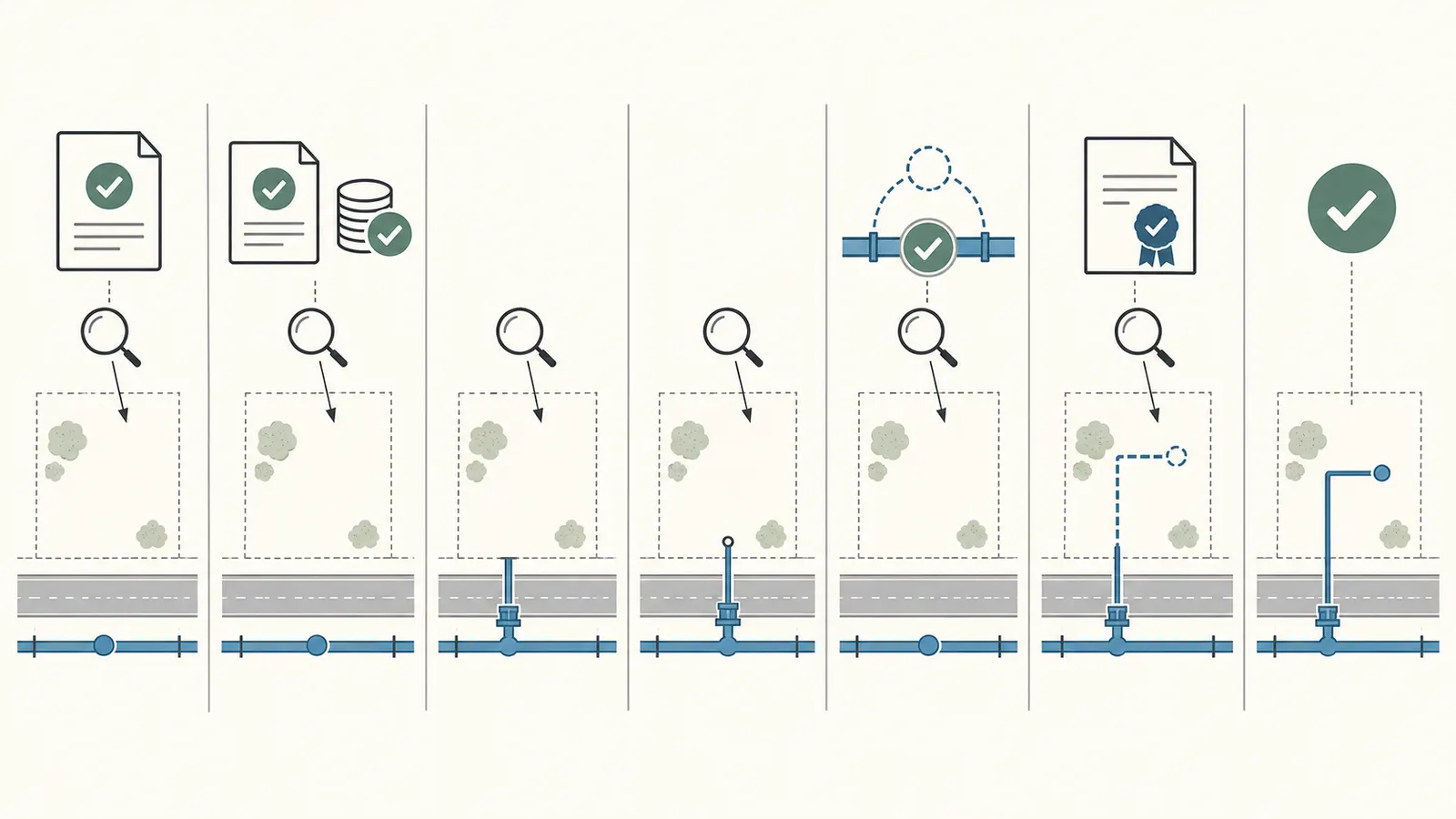
The safe conclusion is not “the seller is wrong.” The safe conclusion is “the claim has not yet been translated into a current, parcel-specific utility status.” A document can be genuine and still be incomplete for your purchase. It may prove a historical payment while leaving transfer, expiration, service size, inspection, easement, private lateral, capacity, or current-rate questions open.
The four outcomes
Use four outcomes so the negotiation does not get stuck in an argument about whether the word “tap” is technically fair:
- Accept as verified. The utility has identified the parcel and confirms the right or asset is current, transferable to your purchase and intended home, with no undisclosed prerequisite that affects feasibility.
- Price the remaining scope. The utility confirms the claim but identifies a connection fee, transfer charge, inspection, service-line installation, permit, size upgrade, extension, easement or other known obligation. Put those items in the budget with the responsible party.
- Condition the contract. The seller's documents are plausible, but the utility will not confirm before the offer deadline, or confirmation depends on your proposed use, design, payment, or a new application. Make utility confirmation a written due-diligence or closing condition with a remedy.
- Reject the claim. The record belongs to another parcel or project, the right expired, the utility says it is nontransferable, the proposed home exceeds the scope, required capacity is unavailable, or the remaining cost makes the lot fail your budget.
This classification prevents two costly shortcuts. First, do not treat an invoice as a capacity guarantee. Second, do not treat the absence of a visible meter as proof that nothing was done: some utilities collect a fee before a future connection, while others include a physical tap to a defined boundary. The authority's record and present rules decide what the evidence means.
Your next decision
Before spending money on a full house design, decide whether the seller will authorize the utility to speak with you, provide the parcel identifier and all documents, and accept a written verification contingency. If the seller will not, value the claim at zero until an independent title and utility review establishes otherwise. A paid fee is useful only when the right it purchased can follow the land and serve the home you intend to build.
2. Build the parcel and utility record before calling the utility #
Prepare one complete request packet before contacting the serving authority: the legal parcel identity, seller's documents, proposed home description, expected water or wastewater use, site plan if available, closing timeline, and specific questions about status, money, scope and transfer. A utility can answer a narrow question quickly and still leave the buyer with an unusable answer if the request does not identify the parcel or intended use.
Start with the land identity
Use the parcel's legal description and the identifier used by the local authority. Depending on the jurisdiction, that may be an assessor's parcel number, tax map and lot, block and lot, plat lot, service account, tap number, permit number or project number. Record the street address, but never use an address alone when vacant land has a new, shared, rural or unofficial address.
Create these fields before you read the receipt:
| Field | What to enter | Why it matters |
|---|---|---|
| State, county and municipality | Actual government jurisdiction | Rules and responsible records vary locally |
| Legal description | Deed or title commitment language | An address can change or be shared |
| APN or tax map/block/lot | Exact parcel identifier | The utility must match its file to the land |
| Plat and lot history | Original subdivision and later replat information | A payment may attach to an original lot, phase or project |
| Current owner and seller | Names as shown in title and utility documents | An applicant name is not necessarily the current owner |
| Serving water authority | City, town, county, district, authority or private regulated utility | The municipality may not be the service provider |
| Serving wastewater authority | Sewer district or collection/treatment authority | Water and sewer may have different owners and rules |
| Main location | Road, easement, opposite side, property line or unknown | Determines extension, crossing and private-line questions |
| Utility contact and date | Department, staff role, phone/email, date requested | Preserves the handoff and the date-sensitive answer |
In the Town of Clinton, New Jersey, a water-reservation application includes the property address and tax lot and block designation, existing use, proposed use, proposed development information, estimated average daily usage and anticipated connection and meter-installation dates. That list is a useful prompt for any buyer's request, while the one-year reservation, fee and transfer rules that follow are specific to Clinton. Town of Clinton, New Jersey Code, Chapter 142
Collect the seller's entire document chain
Ask for original or utility-issued copies, not only a listing screenshot. Request:
- the application, permit, reservation award, will-serve letter, receipt and canceled-payment evidence;
- all amendments, extension approvals, renewal notices, assignment or transfer forms;
- the original project name, subdivision phase, lot and block, APN, address and legal description;
- the tap size, meter size, service type, equivalent connection unit, gallons-per-day allocation or other quantity;
- plans showing the main, tap, spur, lateral, meter box, curb stop, manhole, easement and private service route;
- construction inspection, acceptance, as-built, final approval, cap-off or abandonment records;
- statements showing connection, standby, facilities, availability, reservation, inspection, maintenance or transfer charges;
- written correspondence in which the authority explained what the payment purchased;
- the fee schedule or tariff in effect when payment was made and the fee schedule the authority will apply now;
- any notice of deficiency, expiration, suspension, unpaid charge, service termination or project abandonment.
The seller may have only a receipt. Record that fact precisely: “Receipt supplied; no permit, plan or current utility confirmation supplied.” Do not convert missing records into a negative technical conclusion. Missing evidence changes the confidence and the contract decision; it does not establish that no tap exists.
Prepare a proposed-use brief
The authority may have approved the original applicant's use, not your final home. Give it enough information to test compatibility without pretending you already have construction documents:
| Input | Minimum useful version before design | Better version before closing |
|---|---|---|
| Building type | One detached single-family home, accessory dwelling, duplex or other proposed use | Preliminary site and floor plan showing all structures |
| Occupancy | Planned residents and expected peak occupancy | Occupancy assumptions used by the designer or code reviewer |
| Water demand | Utility's requested average daily use and any peak or fixture assumptions | Fixture schedule, irrigation, fire-flow or other special demand if relevant |
| Wastewater demand | Equivalent single-family connection, average daily flow or authority's unit | Local engineer or utility calculation for unusual homes or nonresidential use |
| Service size | Existing or claimed tap/meter size, if documented | Proposed service size confirmed by licensed designer/utility |
| Construction sequence | Expected permit and connection date | Milestones tied to reservation expiry and closing |
| Site constraints | Approximate main-to-house route and elevation | Survey, easements, grades and preliminary civil plan |
Do not inflate the demand to force approval, and do not understate it to preserve a historical fee. If the proposed home is materially different from the original project, tell the utility. The Town of Clinton, New Jersey, says an increase in allocation caused by a changed project scope is treated as a new water-reservation application. That is a local example of why “same lot” does not necessarily mean “same entitlement.” Town of Clinton's transfer and scope provisions
Who owns each action?
Assign responsibility before you make the call. The buyer can assemble records, authorize a utility inquiry, hire professionals and compare scenarios. The seller can provide documents, consent to release information and cure an old owner or project name. The utility can verify its own record, explain current rules, identify remaining fees and state whether the proposed use is acceptable. A title company or real-estate attorney can investigate recorded easements, covenants, assignments and legal descriptions. A civil engineer or utility designer can assess route, grade, service size and constructability. A licensed plumber or qualified utility contractor can address connection work under the local permit process.
Do not ask the utility to certify a site condition it does not control. It may confirm a fee, allocation or permit record but not whether an underground private line is intact, whether the proposed house will drain by gravity, or whether an excavation route is free of other constraints. Those are separate handoffs.
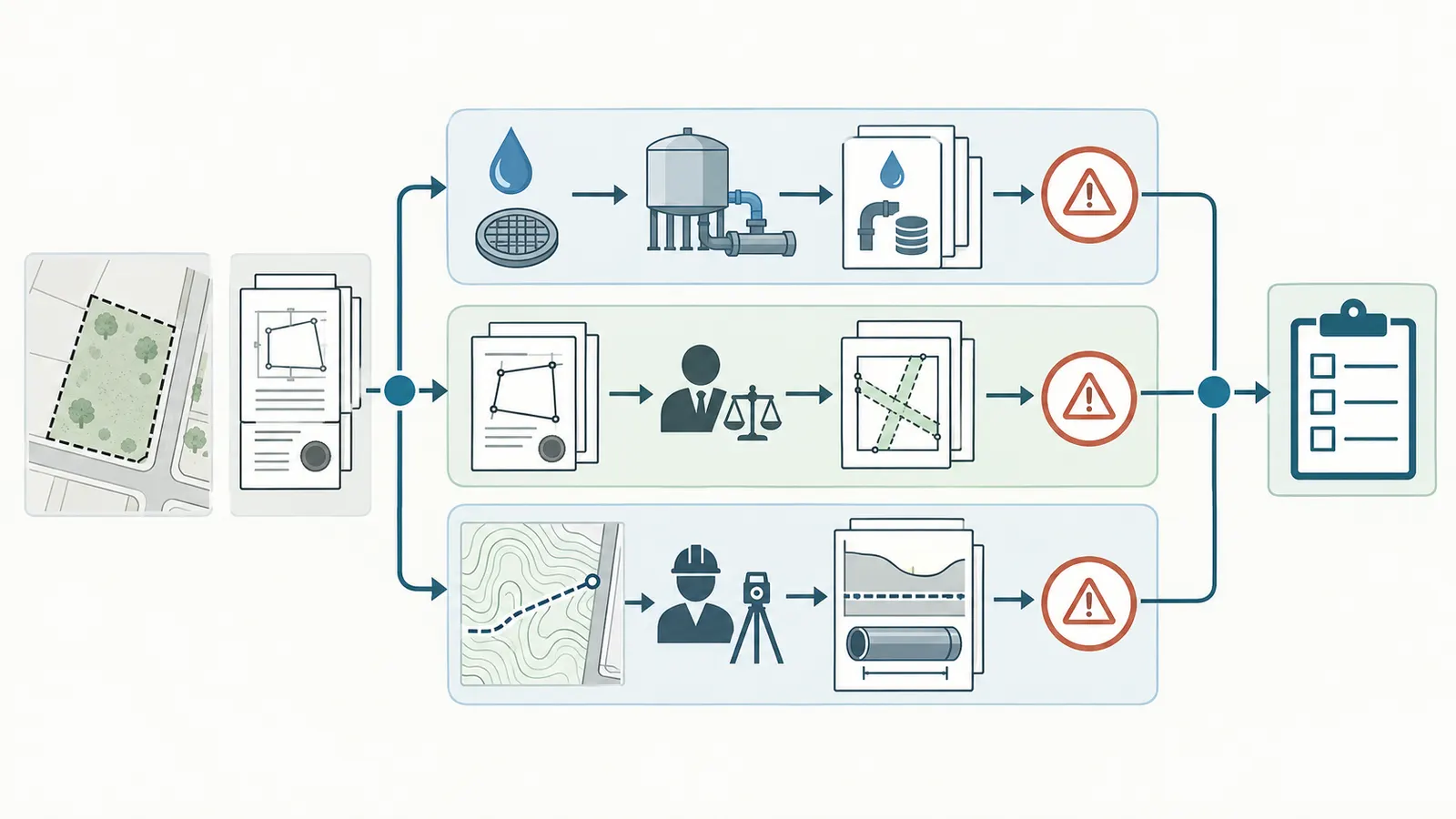
Your next decision
Once the packet is assembled, send a written request to the actual serving authority—not the listing agent and not only the municipality's planning counter. Ask for a parcel-specific record search and a written response. Keep the request, attachments, staff name, date and reply in the ledger. If the utility says it needs a current owner or applicant, have the seller sign the release or request the answer jointly.
3. Identify whether you are buying payment, a connection, or capacity #
Ask the authority to label the claimed asset in its own terms: fee paid, reservation, commitment, permit, physical tap, service line, spur, lateral, meter, account, accepted improvement, or another defined status. Then record what that status includes and excludes. If the authority will not use the seller's word “tap,” do not force the label; translate the official status into your ledger and budget.
Payment is a financial record, not a complete service record
A receipt can answer “did money move?” It may not answer “what did the money buy?” Match the receipt to:
- payer and applicant;
- date and fee schedule;
- parcel and lot phase;
- water, sewer, or both;
- fee category and unit of service;
- tap or connection size;
- use or project scope;
- transfer or assignment terms;
- expiration or renewal terms;
- balance, credits and current status.
Del Norte County, California, says that a property owner may provide documentation that full payment was made and accepted for a proposed use in lieu of a will-serve letter, but it separately states that physical connection cannot occur until a development permit such as a building permit has been issued for the use. In that jurisdiction, payment documentation can satisfy one availability-documentation question while leaving the physical connection sequence ahead. Del Norte County's Engineering FAQ
This is why a buyer should not say “the utility is paid” in a purchase worksheet without a second clause: “paid for what, for which parcel, and with what remaining action?” Use a status such as “payment accepted; physical status unknown” when that is the evidence.
A tap, spur, lateral, meter and service line are different physical things
The vocabulary changes by utility, but the physical questions are stable:
- Main: the public distribution or collection pipe in the road, easement or right-of-way.
- Tap or connection at the main: the point where a service or lateral joins the public main; it may require utility work or licensed work.
- Spur, stub or service stub: a segment brought toward the parcel, sometimes ending at a property line or easement.
- Meter, meter box or curb stop: water-side equipment that may mark a service point but does not prove the private line reaches a building.
- Building sewer or private lateral: the private line between the building and public connection, with ownership and maintenance set by local rule or agreement.
- Cap, abandonment or inactive service: evidence that a prior connection is not available for immediate use.
Fairfax County, Virginia, says that when sewer service is available, a permit is required to connect a building; only a licensed plumber may obtain the permit to make the connection or “tap” to the sewer main. The county also notes that if an existing spur is present, the homeowner may connect to the spur and install the sewer line to the house. That distinction shows why “spur at lot” and “connected house” should be separate ledger statuses. Fairfax County's public sewer connection guidance
The Town of Dinosaur, Colorado, assigns a different boundary in its code: the owner pays for the building sewer service line and installation costs, while the town proceeds with the tap to the main; if no main is adjacent, the owner pays to extend the main to the property line. Dinosaur's rule is not a national standard, but it demonstrates how the remaining physical scope can be substantial even when a public tap is part of the process. Town of Dinosaur Municipal Code, Chapter 8.36
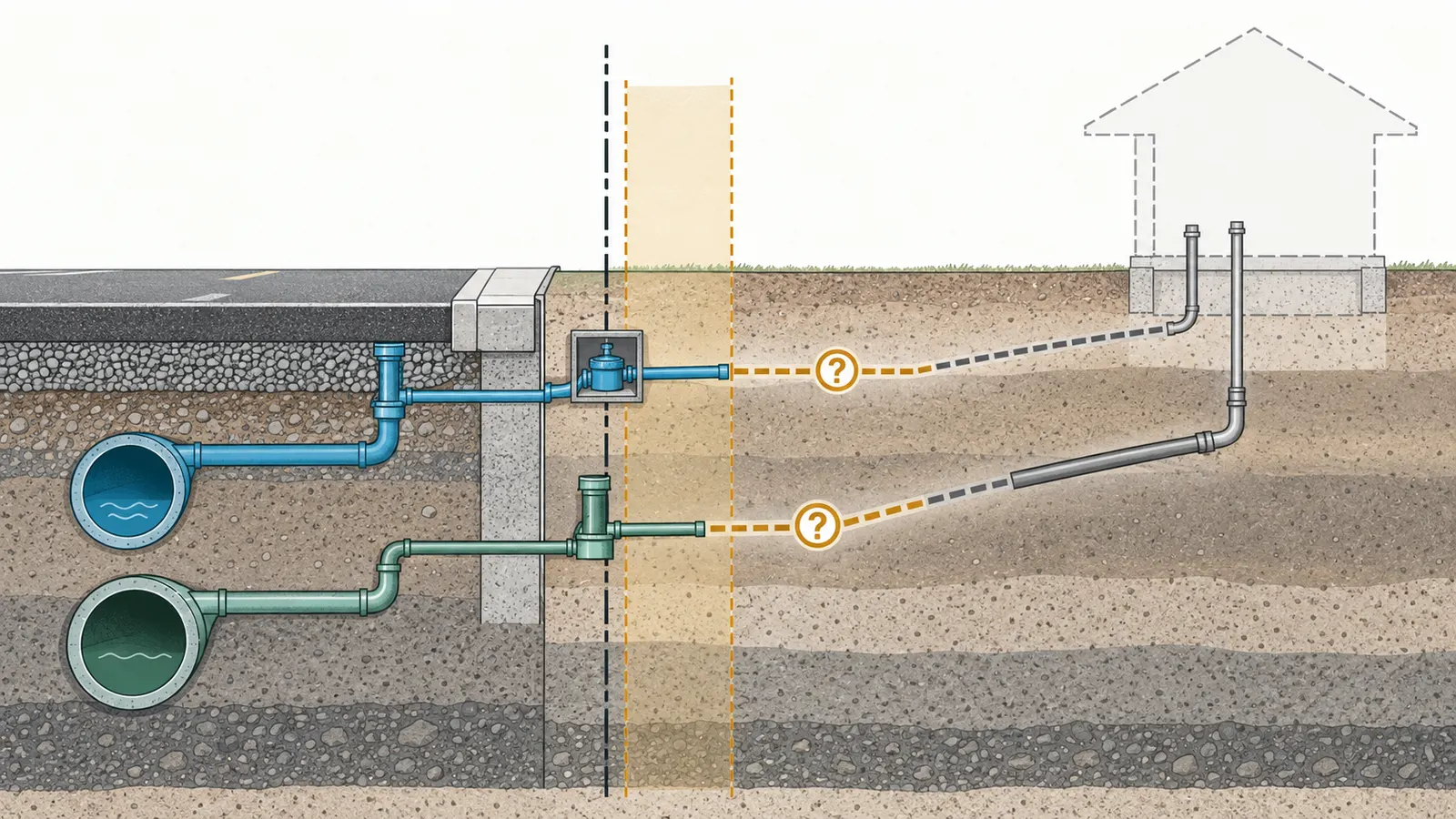
Capacity reservation is not a pipe
A capacity reservation may be a utility's commitment to set aside a quantity or service opportunity for a named parcel and project. It may have a demand unit, priority number, approval date, fee, deadline, renewal process and reversion rule. It is not necessarily a physical improvement and does not necessarily make the future connection automatic.
The Town of Clinton, New Jersey, expressly distinguishes its water reservation from a water system connection. The reservation is a binding commitment to provide potable water service in sufficient quality and quantity for a proposed project, while the physical connection includes a connection fee, meter installation and other improvements required by the Water Department. Clinton also calls a will-serve letter a nonbinding written confirmation of water availability and says receiving one does not prevent an applicant from applying for a reservation. Town of Clinton, New Jersey Code, Chapter 142 definitions
Treat this as a three-way reconciliation:
| Capacity question | Evidence to request | What failure means |
|---|---|---|
| Is there an allocation? | Reservation number, approved quantity, demand basis, parcel and project | You may be starting a new capacity application |
| Is it still alive? | Current status, expiry, renewals, required periodic fees, reversion history | The old claim may have no current value |
| Does it cover your home? | Proposed use, average/peak demand, number of connections, service size | A new or supplemental allocation may be required |
Never infer current system capacity from the fact that a prior applicant once received a letter. Clinton's code bases its local will-serve and reservation review on available system capacity and allocation, and says that a changed scope requiring more allocation is new treatment. A utility may have changed its system, tariff, priorities or approvals since the seller's document was issued.
Check water and sewer separately
A paid water tap does not prove public sewer service. A sewer capacity payment does not prove potable-water service. They may be operated by different departments, districts, municipalities or private regulated providers, and the connection routes may cross different easements. Build two rows in the ledger even when the seller uses “utilities paid” as a single phrase.
For each service, record “not claimed,” “claimed,” “documented payment,” “reservation,” “physical point,” “installed private line,” “accepted,” “active account,” or “rejected/expired.” A blank row is a prompt for research, not permission to assume the service is included.
Your next decision
After the authority labels the status, decide whether it is a financial credit, a current right, a physical improvement, or a combination. If the answer contains “we cannot confirm until the owner applies,” keep the claim conditional. Your next handoff is to the professional who can test the physical scope and your contract advisor who can make the seller responsible for the evidence the authority cannot release before closing.
4. Check transfer, expiration, fees, easements, and record ownership #
Require written confirmation of transferability and current validity for the specific parcel and proposed use; never infer either from a receipt, a prior owner's name, or the fact that the land is being sold. A useful answer states whether the asset follows the land, follows an applicant, requires an assignment or new application, expires on a date, depends on renewal fees, or is void when project scope changes.
Transfer can follow the land, the applicant, or neither
Ask the serving authority five direct questions:
- Does the right or credit run with this legal parcel when title transfers?
- Must the seller and buyer execute a transfer, assignment, or new service application?
- Is the transfer limited to the same use, house count, service size, project phase or demand?
- Does a sale to a new owner preserve priority and paid fees, or only preserve a chance to reapply?
- Can the right be moved to another parcel, combined with another right, sold separately, or used by a different project?
The Town of Dinosaur, Colorado, says a commitment to extend water service cannot be transferred to a property other than the property for which the commitment and permit were made. This protects the parcel-specific boundary but does not answer whether a buyer may inherit the commitment on that same parcel; ask Dinosaur directly for the current transfer process and status of the named permit. Town of Dinosaur Municipal Code, Section 8.12.040(D)
The Town of Clinton, New Jersey, has a more nuanced local rule. Its code prohibits transfer of an approved water reservation in general, then says that when the property identified in the reservation is sold to a new owner, the reservation will run with the land to the extent necessary to carry out its intent. It also says reservations are parcel-specific, cannot be assigned to another project, unused allocation reverts to the town when a project is abandoned or does not use the full reservation, and an increased allocation from a changed scope is treated as a new application. That combination is a warning against the simple statement “reservations transfer.” Town of Clinton's transfer provisions
Put the exact rule in the ledger. Example: “Clinton, New Jersey: same parcel sale may preserve the reservation to its intended extent; different project and increased allocation require separate treatment; written utility confirmation still required.” Do not rewrite it as “capacity transfers nationwide.”
Expiration is not always a date printed on the receipt
Find the controlling clock:
- issue date of the permit or reservation;
- date of payment or acceptance;
- construction or installation deadline;
- date of last renewal or extension;
- date of last required reservation or standby payment;
- date of project abandonment, permit expiration or scope change;
- date of sale or requested transfer, if the rule uses one;
- current date and time remaining before your design or closing milestone.
In the Town of Dinosaur, Colorado, an approved water tap application is void unless the tap is installed within one year after permit issuance, and the code says the plant investment fee is not refunded when the permit and application are voided. If a seller shows an old paid permit but no installation or extension record, ask Dinosaur whether the permit is still valid before assigning it any value. Town of Dinosaur Municipal Code, Section 8.12.040
In the Town of Clinton, New Jersey, an approved water reservation is valid for one year, can be renewed for two one-year periods under stated conditions, and an expired, unrenewed reservation returns unused allocation to the town. Clinton's code also provides for a quarterly reservation fee for applicable projects and says nonpayment terminates the reservation. The result is a different risk from Dinosaur: the payment may be real, but a missed renewal or carrying fee can change the current status. Town of Clinton's expiration and fee provisions
Clinton's will-serve letters have a shorter local clock: the code says they expire 90 days after issuance and permits up to three additional 90-day extensions when requested before expiration. A buyer who is closing months after the letter date should not call the letter current without a renewed written confirmation. Town of Clinton's will-serve expiration provision
These examples also show why “prepaid” and “current” are different fields. Prepayment may be preserved while the permit expires; a fee may have been credited to a reservation that later terminates; a district may require a transfer or inspection charge even when the original tap fee is still recognized.
Fees can be layered and time-sensitive
Separate the original payment from current obligations. Ask the utility to list, even if the amount is zero:
| Fee or charge category | Typical question to ask the authority |
|---|---|
| Tap or plant investment fee | Was the fee paid for this parcel and service size? |
| Connection fee | Is a second fee due when the home is built or connected? |
| Availability or capacity fee | Was a capacity charge paid, and is it still credited? |
| Reservation fee | Are periodic charges required to preserve the allocation? |
| Standby fee | Does an unbuilt lot with a paid tap incur a recurring charge? |
| Facilities fee | Does the absence of an installed connection trigger a current charge? |
| Transfer fee | What must the buyer pay to put the record in the buyer's name? |
| Inspection or testing fee | Is a construction, installation or final inspection required? |
| Permit and road-cut fee | Who obtains and pays for permission to work in the right-of-way? |
| Extension or improvement cost | Is a main, lateral, meter, pump or other improvement outside the original fee? |
| Supplemental size or demand fee | Does the proposed home need a larger tap or additional allocation? |
| Account and service charges | When do billing, standby or service charges begin? |
Fairway Pines Sanitation District in Colorado illustrates layered status and fee risk. Its published page lists a $6,000 tap fee collected separately on select lots before 2007, a $5,000 connection fee for those lots, a combined $11,000 tap-and-connection fee for lots without a prepaid tap, a $500 transfer fee and a $250 installation inspection fee. Those amounts are not a national estimate or a prediction of your district's charges; they show why “tap paid” can still leave a defined connection balance. Fairway Pines Sanitation District's fee table
The same page distinguishes a $250 quarterly standby fee for certain older lots with a tap fee paid but no connection fee from a $345 quarterly service fee for a fully connected house and a $200 quarterly facilities fee for a lot with neither tap nor connection. Record the exact applicability and effective date rather than importing those numbers into your budget. Fairway Pines Sanitation District's status descriptions
Search for easements and boundary obligations
An underground service route may need a recorded easement across a neighboring parcel, a subdivision utility easement, a right-of-way permit, or permission to cross the road. A utility letter may confirm availability without proving you have the legal right to install and maintain the private line. Ask the title company or real-estate attorney to locate recorded easements and compare them to the utility's plan.
Your record should show:
- easement book and page or instrument number;
- benefited and burdened parcels;
- width, route and permitted utility type;
- installation, access, repair and replacement rights;
- whether the easement reaches the claimed tap, spur or main;
- whether the proposed house can connect without crossing land you do not own;
- whether the route is inside a public right-of-way requiring a separate permit;
- whether the recorded description matches the current parcel after a subdivision or replat.
The Town of Clinton, New Jersey, ties reservation extensions to diligent progress and may require evidence that necessary rights-of-way or easements were acquired. That is a local rule for Clinton's water reservations, but it highlights the general closing question: a capacity or connection paper cannot substitute for the access rights needed to build the line. Town of Clinton, New Jersey Code
Do not enter a manhole, open a utility vault, expose a pipe, or dig to “see the tap.” Confined spaces can contain oxygen-deficient or toxic atmospheres, and excavation can collapse or strike buried utilities. Have the serving utility or a qualified, insured professional identify and inspect the relevant infrastructure under the local permit and safety process. The buyer's safe task is to collect records and observe accessible surface indicators; it is not to open public facilities or disturb soil.
Your next decision
At this stage, classify every claimed right as current, expired, transferable, conditional, or unknown; list every fee with payer and timing; and confirm the easement path. If any one of transfer, expiration, or access is unresolved, carry the claim into a contract condition and do not let a closing date outrun the utility's answer.
5. Reconcile the claimed service with the home you may build #
Ask the utility to compare the existing record with the proposed home, service type, size, connection point and demand; then have a qualified local designer or engineer check route, grade and constructability. A parcel-specific fee or reservation can be valid for the original use and still be inadequate for a larger, different, multi-structure or differently located home.
Service size is a compatibility input
For water, record the tap and meter size in the authority's units, the original use, any required fire-flow or irrigation assumptions, and whether a larger service triggers a supplemental fee. The Town of Dinosaur, Colorado, requires the water permit to state the size of the tap, the type of use, the establishment and the lot and block. It also says an existing tap cannot receive additional service or a change in use without permission, and permission may require a larger tap and supplemental plant investment fee. Town of Dinosaur Municipal Code, Sections 8.12.020 and 8.12.070
For sewer, record the connection unit or flow basis, the service lateral diameter and grade if documented, whether the building drains by gravity, and any pump or ejector requirement. Do not infer a workable sewer connection from a main shown on a map. A civil professional must reconcile building elevation, main invert, lateral route, easements, and local requirements. This guide deliberately excludes a physical sewer-camera conclusion because a vacant lot normally has no building drain to inspect and a remote record review cannot establish pipe condition.
Fairfax County, Virginia, explains that public sewer availability depends on an approved sewer service area and public access. Its public-facing guidance uses a 300-foot availability distance from the building for a single-family home and 500 feet for other buildings, requires gravity flow when public sewer is available except in rare cases, and assigns the cost of needed public sewer extensions to the property owner requesting the connection. Those are Fairfax County criteria, not a United States rule or a substitute for county confirmation of your parcel. Fairfax County's sewer availability guidance
Translate the future house into a demand record
The buyer's demand sheet should be transparent enough that another person can reproduce the comparison. Use these fields:
| Demand input | Example entry format | Source or responsible person |
|---|---|---|
| Service | Public water / public sewer | Utility record |
| Proposed use | One detached single-family home | Buyer and designer |
| Bedrooms or occupants | 3 bedrooms; 4 occupants (illustrative) | Buyer assumption; revise with design |
| Additional fixtures | Irrigation none; accessory dwelling no; fire service unknown | Buyer, utility and code professional |
| Daily water basis | ___ gallons/day or utility unit | Utility or engineer |
| Peak water basis | ___ gallons/minute or utility method | Utility/designer; do not invent |
| Wastewater basis | ___ ESFC, gallons/day or local unit | Sewer authority/engineer |
| Service size | Existing ___; proposed ___ | Utility and licensed designer |
| Building location | Approximate house pad and elevation | Survey/designer |
| Connection route | Main to property line to house | Utility map and civil review |
| Deadline | Permit by ___; connection by ___ | Buyer, seller, utility |
Mark unknowns visibly. An unknown proposed peak demand is not zero demand. An absent irrigation line is not proof that later irrigation is allowed. A one-home allocation is not permission to add an accessory dwelling or a second connection. A service size shown on an old permit is not approval for a changed use.
Separate legal availability from physical feasibility
You need both:
- Legal or administrative availability: the authority recognizes the parcel and use, the right is current, transfer is allowed, required approvals are obtainable, and the fee or allocation is still valid.
- Physical feasibility: a route can be built, the main or collection point is actually where the records show, grades and elevations work, the proposed service size is acceptable, easements exist, and construction can meet local standards.
One cannot cure the other. A valid reservation does not create a missing main. A main at the road does not create a transferable reservation. A paid fee does not create a recorded easement. A physical spur does not guarantee current acceptance or a permit.
The Town of Dinosaur, Colorado, makes the boundary explicit for water extensions: outside the town limits, the town is not obligated to extend service and may require an agreement, performance guarantees or consent to annexation. Its code also says out-of-town plant investment fees exclude certain extension materials and require construction under town specifications and inspection. A buyer outside Dinosaur's corporate limits would need the authority to confirm those conditions for the particular parcel. Town of Dinosaur Municipal Code, Sections 8.12.020 and 8.12.060
Handoffs for a useful feasibility check
The sequence should be explicit:
- Buyer to utility: parcel identifiers, seller authorization, claimed documents and proposed home summary.
- Utility to buyer: official status, current rules, transfer path, expiration, fee balance, permitted service size and connection boundary.
- Buyer to title professional: recorded legal description, easement records, plats and any utility agreements.
- Buyer to civil designer or engineer: utility map, main location, connection point, grade, easement and service requirements.
- Designer to buyer: route and grade feasibility, information gaps, preliminary scope, contingencies and design changes.
- Buyer to utility: revised demand, service size, connection date, plan or application if required.
- Contract advisor to buyer and seller: conditions, deadlines, document delivery, cost allocation, representations and termination or credit remedy.
No one handoff proves the next one. A utility employee may confirm the account while declining to approve a future building. A title search may show an easement while a field survey shows it does not reach the desired house pad. A designer may identify a feasible route while the utility requires a new capacity application.
What you can safely observe
From accessible areas, you may photograph and record:
- a labeled meter box, curb stop, cleanout, manhole or utility marker;
- the side of the road where the main is mapped;
- surface evidence of a service stub, trench or prior construction;
- the location and dimensions of the lot, driveway and likely house pad;
- visible easement signs or recorded plat references;
- standing water, settlement or exposed infrastructure that should be disclosed to a professional.
Do not remove covers, turn valves, open cabinets, test pressure on public equipment, excavate, connect hoses, enter a confined space, or direct a contractor to work in a right-of-way without the relevant permit and utility clearance. Call the responsible authority if an exposed or damaged public asset presents an immediate hazard.
Your next decision
If the utility says the claimed right covers a comparable single-family home and confirms service size and route, ask for a written preliminary connection scope and proceed to cost comparison. If the home is larger, farther away, lower than the sewer, in another service area, or dependent on an extension or easement, move to professional feasibility and price the risk before you waive the utility condition.
6. Use the paid-tap ledger to calculate the remaining obligation #
Use a ledger that records evidence, responsibility, timing and cost for each service; then calculate the buyer's remaining exposure as the sum of confirmed unpaid items plus bounded allowances for unresolved scope. The ledger is the original contribution of this guide: it is a reusable worksheet, not a new legal category or a claim that every utility uses the same statuses.
The paid-tap and capacity-reservation ledger
Copy this table into your project file. One row is one claimed asset, not one document. If water and sewer are separate, use separate rows.
| Ledger field | Record exactly | Verified by / date |
|---|---|---|
| Parcel/APN or tax lot/block | Legal identifier, not just street address | Utility and title record |
| Utility and jurisdiction | Name of provider; state, county, municipality or district | Serving authority |
| Service | Public water, public sewer or both | Utility |
| Official document number | Permit, reservation, tap, account, project or receipt number | Utility document |
| Original applicant/payer | Name and relationship to current seller | Seller and utility |
| Payment date and fee category | Tap, connection, capacity, plant investment, standby or other | Receipt and tariff |
| Amount and currency | Amount paid; note historical fee schedule | Receipt and utility |
| Tap/service size | Water tap/meter size or sewer connection unit/diameter | Permit, plan and utility |
| Quantity or demand | Gallons/day, ESFC, allocation or project use | Reservation/utility |
| Physical status | None, planned, spur, tap, meter, lateral, accepted, capped or unknown | Utility/as-built/professional |
| Installation boundary | Main, property line, meter, manhole, house or unknown | Utility scope |
| Transfer rule | Runs with parcel, assignment, new application, prohibited or unknown | Current utility rule |
| Expiration/renewal | Date, event, extension and fee conditions | Current utility record |
| Current balance | Connection, transfer, inspection, standby, extension or supplemental fee | Utility written response |
| Easement/ROW | Instrument, route, width, permit or missing | Title and utility |
| Proposed home demand | Use, occupancy, fixtures, flow/connection unit and size | Buyer, designer, utility |
| Responsible party | Seller, buyer, utility, licensed plumber, engineer or title professional | Contract and authority |
| Evidence quality | Official current record, old official record, receipt only, seller statement or unknown | Buyer review |
| Decision | Verify, price, condition or reject | Buyer after review |
| Next handoff and deadline | Who must answer what by when | Buyer project log |
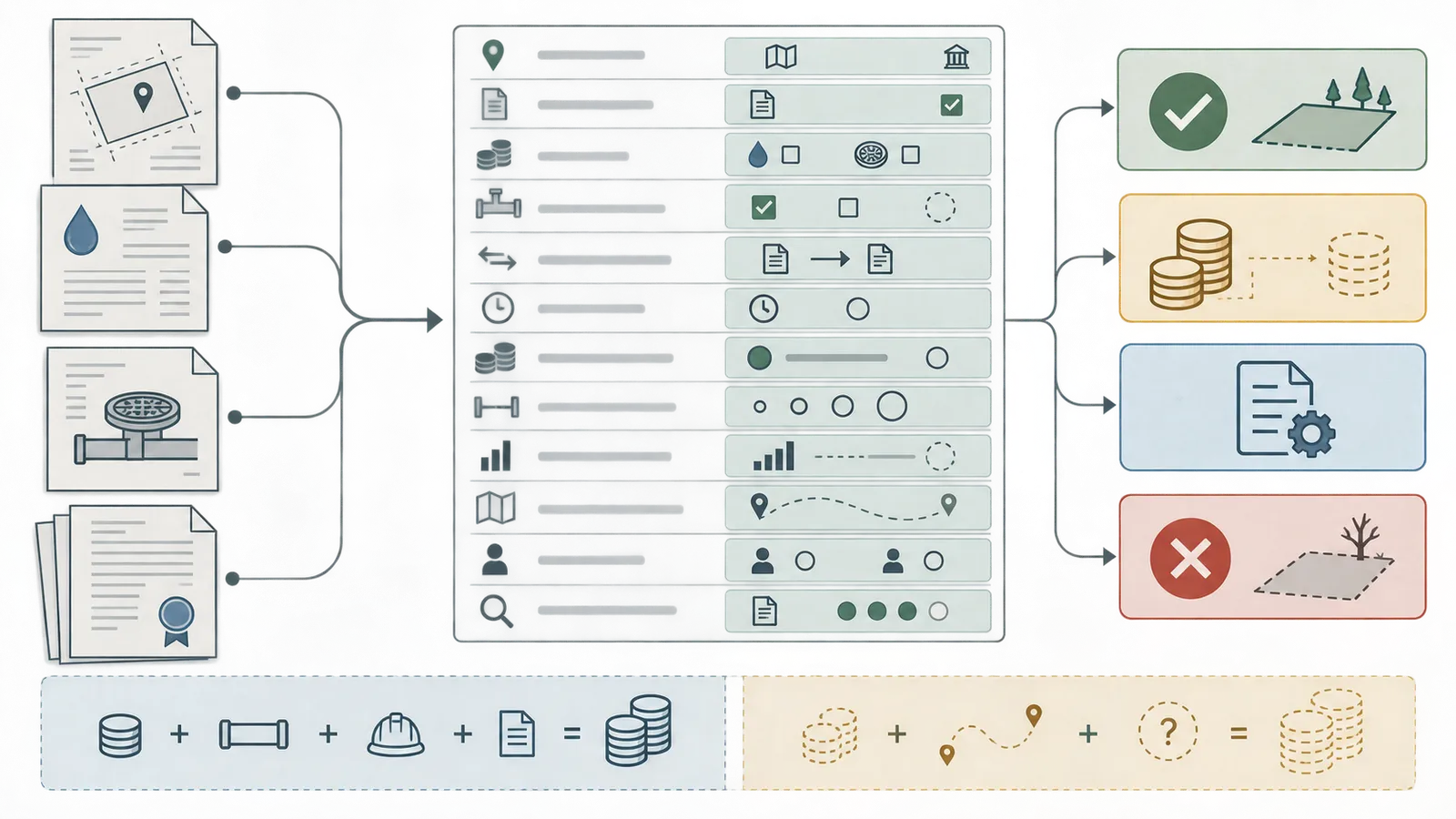
The ledger's method is deliberately conservative: the strongest status is limited by the weakest unresolved field. A current payment with unknown transfer is not “verified.” A transferable reservation with unknown demand is not “usable.” A visible spur with no permit or acceptance record is not “connected.”
Modeled illustrative example: a claimed prepaid tap
The following is a modeled illustrative example, not a real property, quote, test, survey or field observation. It shows how to use the ledger.
Assume a buyer is considering a vacant lot in a Colorado sanitation district. The seller provides a 2006 receipt labeled “tap fee paid” for a single-family lot. The proposed house is one detached home. The seller says the lot has utilities at the road. The district's current written response confirms:
- the receipt matches the parcel's historical tap fee;
- the connection fee is not shown as paid;
- a transfer fee applies;
- installation inspection is required;
- the district's posted amounts are $5,000 connection, $500 transfer and $250 inspection for this status;
- service cannot be treated as fully connected until the remaining requirements are met.
The known remaining district charges are:
remaining_known = connection_fee + transfer_fee + inspection_fee
remaining_known = $5,000 + $500 + $250 = $5,750
That $5,750 is not the complete project cost. It excludes private line construction, excavation, design, permits outside the district, road restoration, easement work, possible upgrades, and any fees the district has not yet quantified. The district page itself distinguishes the fees and statuses; the calculation is Brictale's arithmetic from those published inputs, not a district estimate. Fairway Pines Sanitation District's current published services and fees
Add a separate unresolved-scope line rather than burying it in the fee:
| Item | Amount used in example | Confidence | Who must confirm |
|---|---|---|---|
| Historical tap fee | Already paid; no new amount assumed | High for payment, pending current credit | District |
| Connection fee | $5,000 | High for this district status and posted schedule | District |
| Transfer fee | $500 | High for posted schedule | District |
| Installation inspection | $250 | High for posted schedule | District |
| Private service line | Not included | Unknown | Civil designer and qualified contractor |
| Easement or road work | Not included | Unknown | Title professional, utility and contractor |
| Size or scope change | Not included | Unknown | District and designer |
| Allowance for unresolved work | Buyer-selected scenario, not an invented quote | Scenario only | Buyer with professional bids |
Suppose the buyer creates three planning scenarios for unresolved private work: $4,000, $9,000 and $16,000. These are not market facts or contractor prices; they are buyer-controlled sensitivity cases used to show the decision boundary. The total utility-related planning exposure is:
planning_exposure = remaining_known + unresolved_scope_scenario
| Scenario | Known district charges | Illustrative unresolved scope | Planning exposure |
|---|---|---|---|
| Low unresolved scope | $5,750 | $4,000 | $9,750 |
| Middle unresolved scope | $5,750 | $9,000 | $14,750 |
| High unresolved scope | $5,750 | $16,000 | $21,750 |
The sensitivity is the slope of one dollar of unresolved work: every additional $1,000 of private scope increases exposure by $1,000. If the buyer has a $15,000 maximum utility allowance, the middle scenario nearly consumes it and the high scenario fails it. That is a better decision than subtracting the seller's claimed historical tap payment from an unknown construction bill.
Now add uncertainty branches:
| New fact from the authority or professional | Ledger result | Contract response |
|---|---|---|
| District says transfer is automatic and route is accepted | Verified district status plus priced private scope | Credit or price allocation can be negotiated |
| District requires an application under the buyer's proposed use | Conditional | Keep utility condition through written approval |
| District says the receipt covers tap only and a new size is required | Price plus supplemental fee | Require current size approval and exact balance |
| Title review finds no easement for the private line | Access unresolved | Seller cures access or buyer rejects/renegotiates |
| District record cannot match the receipt to the parcel | Claim unverified | Value at zero until cured |
| Inspection reveals no accepted spur or line | Physical scope expands | Obtain professional scope and revise budget |
The example earns its conclusion from inputs, units and formulas: the seller's statement is not the calculation; the district's status and current charges are. The limitations are equally important: the numbers are illustrative, and the ledger cannot establish whether a route can be built or whether the proposed home will be approved.
A second illustrative branch: reservation instead of tap
Assume instead that a seller provides a document called “water capacity reservation.” The document names a parcel and a past single-family project but has no current renewal approval. The buyer intends a main home plus an accessory dwelling and wants a larger service. The correct first calculation is not a dollar total. It is a scope delta:
additional_demand = proposed_home_demand - reserved_demand
If the proposed demand is not yet known, write unknown, not zero. If the utility confirms that the accessory dwelling and larger service require incremental allocation, record the incremental amount in the authority's units and ask for the new application fee, review timing and connection requirements. Under the Town of Clinton, New Jersey, code, a scope change requiring additional allocation is treated as a new water-reservation application, and unused allocation can revert if a project is abandoned or does not use the full reservation. Town of Clinton's water-reservation scope rule
If the reservation is expired, the calculation becomes:
usable_reserved_capacity = 0 until the utility renews or reissues it
That does not say the original payment has no possible credit. It says you cannot use the old quantity in the feasibility calculation until the authority identifies the current credit or application path. Keep “historical payment” and “current capacity” in separate columns.
Cost boundaries to carry into the purchase budget
Your budget should distinguish at least four numbers:
- Confirmed current fee balance: the utility's written amount for the exact parcel and status.
- Confirmed construction scope: items the utility or approved plan clearly assigns to the buyer, seller or utility.
- Professional design and permit scope: survey, civil design, application, inspection, testing, road-cut, restoration and permit items.
- Unresolved allowance: an explicitly labeled scenario range or open item awaiting a local quote or design—not a disguised national average.
Do not use the amount the seller paid as a proxy for the replacement cost of the same service today. Fees may change, service sizes may differ, and a historical fee may have purchased a narrower boundary than the buyer assumes. Del Norte County, California, specifically warns that preliminary connection estimates may not include the physical connection cost; Fairway Pines' Colorado district page separately lists tap and connection statuses; and Dinosaur's Colorado code distinguishes included and excluded installation work. Del Norte County's cost-estimate guidance, Fairway Pines' fee distinctions, Town of Dinosaur's installation boundaries
Your next decision
When the ledger produces a bounded exposure that fits your budget and the authority confirms status, move to contract allocation and professional design. When it produces only a historical payment plus unknown access, demand, or expiration, keep the condition open. If no responsible authority will confirm a current path, compare the lot as if a new connection and capacity review are required.
7. Make the offer and closing decision with explicit branches #
Choose one of four contract positions—verified asset, priced remaining scope, written utility contingency, or rejection—and put the evidence and deadline behind that choice. Do not rely on a generic representation that “utilities are available” when the actual issue is whether a particular fee, reservation, tap or spur is current and usable for a particular home.
Branch A: accept as verified
Use this branch only when the serving authority's current written response answers all material fields:
- parcel and legal identity match;
- water and sewer status are separately identified;
- payment or allocation is credited and current;
- transfer to the buyer is allowed or completed;
- expiry and renewal status are current;
- proposed home use and service size are within the approved scope;
- the physical connection boundary is stated;
- all remaining fees, permits, inspections and easements are identified;
- a qualified professional finds no unresolved route or grade blocker.
“Verified” does not mean the connection has no future cost. It means the claimed asset has passed the question the buyer assigned to it. A verified tap may still require private service-line construction, a permit, an inspection or a meter installation if those are not included. Write the qualification beside the status.
Branch B: price the remaining scope
Use this branch when the utility has confirmed the historical benefit and given a current balance or defined scope. Put the allocation into the purchase comparison only after identifying who pays and when. Possible structures include a seller credit, price adjustment, seller completion before closing, escrow holdback, or buyer assumption with a documented allowance. The contract advisor—not this guide—should draft the mechanism.
The closing file should contain:
- current utility letter or account statement;
- transfer form and signed authorization;
- fee schedule date and calculation;
- construction boundary or approved plan;
- easement and right-of-way evidence;
- inspection and acceptance requirements;
- responsible person and deadline for each open item;
- remedy if the utility's final answer differs from the seller's representation.
For example, Fairfax County, Virginia, says all required sanitary sewer fees must be paid before a connection permit can be issued and that only a licensed plumber may obtain the permit for a tap to the sewer main. A purchase contract that assigns the buyer the “remaining sewer work” should not silently assume the buyer can complete it without the local permit sequence. Fairfax County's permits and charges guidance
Branch C: make utility confirmation a condition
Use a condition when the authority will only issue a definitive answer to the owner, applicant, licensed plumber, engineer, or permit holder, or when the proposed home is not defined enough for a compatibility decision. Define:
- the exact documents the seller must deliver;
- the utility or district that must respond;
- the parcel and project description to be verified;
- the service types and minimum acceptable status;
- the maximum acceptable remaining cost or scope;
- the transfer, expiration, demand and size outcomes that satisfy the condition;
- the deadline and extension process;
- the buyer's right to terminate, renegotiate, or accept a credit;
- who pays for utility applications, surveys, design and inspections;
- whether a later house-design change reopens the condition.
A useful condition does not say only “utilities to be verified.” It states the decision test. Example: “Buyer may proceed only if the serving water and wastewater authorities confirm in writing that the parcel may receive the proposed single-family service, that the documented payment or reservation is credited or transferable to buyer, that it has not expired, and that all known fees and physical connection obligations can be completed within the approved route and budget.” Have a local attorney or other qualified contract professional adapt the language to the transaction and jurisdiction.
Branch D: reject the claim or the lot
Reject the claim when it is tied to another parcel, another project, a different service type, an expired permit, a nontransferable commitment, a capacity allocation that reverts, or a receipt that the authority cannot match. Reject the lot when the corrected connection and capacity scope fails your budget, schedule, access, design or risk limits.
This is not an accusation about the seller. It is a decision about evidence. Keep the rejection reason short and specific: “Dinosaur, Colorado, current record says commitment is for another property”; “Clinton, New Jersey, reservation expired and no renewal”; “Fairway Pines, Colorado, tap fee recognized but connection and inspection remain”; or “Fairfax County, Virginia, parcel is outside the confirmed service path and extension cost is unbounded.”
Closing checklist
Complete this checklist before waiving the utility condition or allowing the utility claim to affect the price:
- State, county, municipality or district named for every rule relied on.
- Water provider and wastewater provider identified separately.
- Legal description and APN/tax lot/block match the utility record.
- Seller's receipt, permit, reservation, letter and amendments collected.
- Official document number and original applicant recorded.
- Exact payment category and historical fee schedule identified.
- Current utility record confirms payment, credit or allocation.
- Physical status states none, planned, spur, tap, meter, lateral, accepted, capped or unknown.
- Installation boundary states main, property line, meter, manhole, house or unknown.
- Transfer rule is written for the parcel and proposed project.
- Expiration date, renewal requirements and recurring charges are written.
- Current connection, transfer, inspection and supplemental fees are listed.
- Water demand and wastewater basis are stated with units and assumptions.
- Proposed service size is compared with the claimed size.
- Easements, route and right-of-way permissions are checked by the appropriate professional.
- Main extension, private lateral, grade, pump and road-restoration scopes are assigned.
- Required licensed plumber, engineer, surveyor, utility inspection and permits are assigned.
- Written utility confirmation is dated and saved in the closing file.
- Contract condition or price treatment matches the unresolved fields.
- Post-closing transfer and permit deadlines are calendared.
The verification email you can send
Use plain language and ask the authority to correct the labels:
Subject: Parcel-specific water/sewer status request before purchase — [APN / lot and block]
I am evaluating the purchase of [legal description and address] in [jurisdiction]. The seller provided [document type, number and date] described as a paid [water tap / sewer tap / capacity reservation]. With the seller's authorization attached, please confirm in writing:
- whether the document and payment match this parcel;
- what service, fee, quantity, tap/service size or project the payment covers;
- whether a physical tap, spur, meter, lateral or accepted improvement exists, and the boundary included;
- whether the status transfers to a new owner and what form or fee is required;
- whether it is current, expired, suspended, capped or subject to renewal or recurring charges;
- all fees, inspections, permits, extensions, easements or improvements still required;
- whether the proposed [one detached single-family home / described use] and [demand or connection unit] fit the current status;
- whether a new application, size change, capacity review or project-specific approval is required; and
- which office or qualified professional must complete the next step.
Please identify the effective date of the fee or rule information and any conditions that would change the answer after purchase. I understand this request is not a field inspection or building approval.
The wording makes the next handoff visible. If the authority answers only three questions, put the other six in the “unresolved” column rather than treating silence as approval.
Your next decision
After receiving the written response, choose the branch and communicate it to the seller, contract professional, title professional and designer. A closing that happens before the transfer, expiry or access question is resolved transfers risk to the buyer; accept that only deliberately, with a budget and remedy that reflect the uncertainty.
8. Complete the handoff after closing and record the next decision #
After closing, transfer the utility record into the buyer's name, preserve the parcel-specific evidence, obtain the required permit or application, and confirm the service scope again when the home design becomes specific. A pre-purchase confirmation is a snapshot of the current record; it is not permission to build or a promise that a future design will remain within scope.
The first post-closing handoff
Make a dated handoff folder with:
- deed, title commitment, survey and legal description;
- utility confirmation, transfer approval and account information;
- tap, reservation, payment, permit, plan and as-built records;
- easement instruments and right-of-way permits;
- the current fee schedule and any unpaid balance statement;
- proposed home demand assumptions and service size;
- the contract allocation and deadlines;
- utility contacts and the name of the person who confirmed the status;
- photographs of accessible surface features, without opening or disturbing infrastructure;
- a list of unresolved questions and the professional assigned to each.
If the service is not yet active, ask the authority when billing, standby, facilities or reservation charges begin and how to avoid an administrative lapse. Fairway Pines Sanitation District in Colorado, for example, describes separate quarterly conditions for a fully connected house, an older lot with tap paid but connection unpaid, and a lot with no tap or connection. This does not set your district's billing, but it shows why the post-closing file needs the exact local status rather than a generic “utilities paid” note. Fairway Pines Sanitation District
Carry the record into design
The designer and civil professional need the utility's actual scope, not the listing language. Give them:
- service point and installation boundary;
- tap/meter size or sewer connection unit;
- main location, spur or lateral evidence;
- elevation and grade data when sewer routing depends on gravity;
- easement and access rights;
- permitted use and capacity quantity;
- expiry or construction deadlines;
- inspections and as-built requirements;
- fee and change-in-scope triggers.
Ask the designer to return a short “utility compatibility” note that says what was assumed, what was confirmed, what is outside the designer's scope, and what must go back to the authority. If the house moves, gains an accessory dwelling, adds irrigation, changes fixture count, or changes from one connection to multiple, reopen the demand and transfer review.
Fairfax County, Virginia, separates sanitary sewer from stormwater and identifies the private lateral from the building to the county sewer, including the connection, as the property owner's maintenance responsibility. That local boundary is a useful reminder to place future maintenance responsibility in the handoff, but it should not be copied as a national rule. Fairfax County Wastewater FAQ
Verification limits
This guide cannot remotely establish:
- whether a pipe, meter, spur or lateral is physically present below grade;
- whether an undocumented line is intact, correctly located or accepted;
- whether a sewer grade works from the future house to the main;
- whether a proposed water demand meets local hydraulic, fire-flow or allocation review;
- whether a title exception, private covenant or easement is legally sufficient;
- whether current fees will remain unchanged through construction;
- whether a utility will approve a changed plan after closing;
- whether the lot is suitable for a private well, septic system or other excluded service.
Those questions belong to the actual authority and qualified local professionals. The buyer can make the review efficient by bringing the ledger, source documents, site plan, survey, demand assumptions and exact questions. A professional should identify the applicable jurisdiction and the point at which the opinion depends on field measurements, a permit, a survey, a design or an official decision.
The compact originality brief
Current answers: Official utility pages and municipal codes explain individual tap fees, connection permits, will-serve letters, service reservations, standby charges and pre-serviced lots. Real-estate discussions often collapse “tap paid,” “service at the property line,” “capacity reserved” and “connected” into one phrase.
Missing decision: A buyer needs to know whether the seller's claim is usable for the intended home, follows the parcel, has expired, or still leaves a connection, size, inspection, access, capacity or fee obligation before closing.
Original contribution: The paid tap and capacity-reservation ledger records parcel/APN, actual utility, document number, tap size and service type, payment receipt, capacity versus connection, installation evidence, transfer rule, expiry, fees still due, proposed demand, responsible authority and written confirmation. The branch test produces four outcomes: verified, price the remaining scope, condition the contract, or reject.
How it can be checked: A reviewer can reproduce the result by matching each ledger row to the cited authority record, checking the stated jurisdiction and access date, recomputing the illustrative formula from its labeled inputs, and asking whether every unresolved field has a named responsible party and next decision. The contribution is a synthesis and worksheet, not firsthand testing, interviews, collected data, a legal opinion or a field inspection.
Method: Transcribe the current utility record and seller documents, then reconcile parcel, scope, transfer, expiry, fees and demand in the ledger before choosing an outcome. Illustrative examples show formulas and sensitivity.
Limitations: This worksheet is not a title search, legal opinion, engineering design, valuation, inspection or field verification; local rules and current utility confirmation control. The local examples are not national rules. The ledger cannot prove subsurface conditions, title rights, construction cost, utility capacity beyond the authority's written answer, or approval of a future design. Modeled numbers are illustrative only. The buyer must confirm the current tariff, record, permit path and responsible professional for the actual parcel.
The final next decision
The lot is ready for the next stage only when you can answer, in one sentence for water and one for sewer: “This parcel has [official status], for [service and demand], transferable to [buyer/project] until [date or condition], with [remaining fees and physical scope], confirmed by [authority] on [date], and the next action is [person] by [deadline].” If you cannot complete that sentence, the utility claim is still a due-diligence item, not a finished asset.
For a broader land-feasibility context, continue through Brictale's land and feasibility journey. Keep the completed ledger with the project record as you move from land into budget, design and construction, and use the Brictale editorial method to understand how source scope and limitations are handled. The article belongs to Brictale's single homeowner blog; it is not a substitute for the serving authority's current written determination.
Cite this guide
Brictale. “How to Verify a Paid Water or Sewer Tap Before Buying Vacant Land.” Published 2026-09-14; updated 2026-09-14.
https://brictale.com/build/land/manage-vacant-land-paid-utility-tap-reservation-before-buying · Read the Markdown version
Original contribution: Paid tap and capacity-reservation ledger. A parcel-level record that separates payment, reserved capacity, installed infrastructure, transferable rights, expiration, remaining fees, service size, and the proposed home's demand before a buyer treats a seller's utility claim as usable.
Sources and scope
Evidence behind this page
- Del Norte County, California, describes a will-serve letter as written utility documentation and lists the property owner, assessor's parcel number, service description, issuing representative and expiration date as typical contents.
County of Del Norte, California Engineering FAQ
Del Norte County, California guidance for proposed water or sewer service; this is not a national definition or a determination for another utility.
Accessed · Link to this claim - Del Norte County, California, advises requesting a preliminary utility cost estimate because a will-serve estimate may or may not include the physical cost to connect.
County of Del Norte, California Engineering FAQ
Del Norte County, California guidance; it illustrates the need to ask each serving utility what its estimate includes.
Accessed · Link to this claim - Del Norte County, California, says documentation that full payment was made and accepted for the proposed use may stand in lieu of a will-serve letter, while physical connection cannot be made until a development permit such as a building permit has been issued.
County of Del Norte, California Engineering FAQ
Del Norte County, California; payment documentation and physical connection are distinct in this local guidance.
Accessed · Link to this claim - Fairway Pines Sanitation District in Colorado distinguishes a fully connected house, a lot with a tap fee paid but connection fee unpaid, a lot with neither, and a prepaid tap; its page lists the rates as effective in the second quarter of 2025.
Fairway Pines Sanitation District Services and Fees
Fairway Pines Sanitation District, Colorado; the fee and status examples are district-specific and time-sensitive.
Accessed · Link to this claim - Fairway Pines Sanitation District in Colorado lists a $500 tap transfer fee and a $250 installation inspection fee, and requires a district letter stating fees are paid and current before final approval and county building permits.
Fairway Pines Sanitation District Services and Fees
Fairway Pines Sanitation District, Colorado; amounts and permitting condition are local and may change.
Accessed · Link to this claim - The Town of Dinosaur, Colorado, requires a water tap application and permit to identify the usage, tap size, establishment type and lot and block of the property, and says the application is made by the owner or authorized representative.
Town of Dinosaur Municipal Code, Chapter 8.12 Water Service
Town of Dinosaur, Colorado, municipal water system; not a general Colorado rule.
Accessed · Link to this claim - The Town of Dinosaur, Colorado, provides that an approved tap application is voided unless the tap is installed within one year of permit issuance, and the plant investment fee is not refunded when the application and permit are voided.
Town of Dinosaur Municipal Code, Section 8.12.040
Town of Dinosaur, Colorado; expiration and refund treatment is specific to that municipal code.
Accessed · Link to this claim - The Town of Dinosaur, Colorado, states that a commitment to extend water service may not be transferred to a property other than the property for which the commitment and permit were made.
Town of Dinosaur Municipal Code, Section 8.12.040(D)
Town of Dinosaur, Colorado; the local nontransfer rule must not be generalized to another utility.
Accessed · Link to this claim - The Town of Dinosaur, Colorado, says its in-town plant investment fee includes the town's installation of one tap from the water main to the applicant's property line, including a meter, while the out-of-town fee excludes listed extension materials and may require additional work and inspection.
Town of Dinosaur Municipal Code, Sections 8.12.050-8.12.060
Town of Dinosaur, Colorado; installation boundary and fee schedules are local.
Accessed · Link to this claim - The Town of Dinosaur, Colorado, requires a written sewer connection permit; its code assigns the owner the building sewer service line and related installation costs, while the town proceeds with the tap to the main, and requires the owner to pay for an extension when no adjacent main exists.
Town of Dinosaur Municipal Code, Chapter 8.36 Sewer Connections
Town of Dinosaur, Colorado, sanitary sewer system; responsibility allocation is jurisdiction-specific.
Accessed · Link to this claim - The Town of Clinton, New Jersey, defines a water reservation as a binding commitment for sufficient quality and quantity, defines a water system connection as physical connection including connection fee, meters and required improvements, and describes a will-serve letter as nonbinding written confirmation of availability.
Town of Clinton, New Jersey Code, Chapter 142 Water
Town of Clinton, New Jersey; these are the code's local distinctions, not a national taxonomy.
Accessed · Link to this claim - The Town of Clinton, New Jersey, provides that an approved water reservation is valid for one year, may be renewed for two one-year periods under stated conditions, and carries a quarterly reservation fee for the applicable projects; an unrenewed reservation expires and unused allocation reverts to the town.
Town of Clinton, New Jersey Code, Chapter 142, Sections 142-11(E)-(F)
Town of Clinton, New Jersey; conditions, fee treatment and timing are local and project-specific.
Accessed · Link to this claim - The Town of Clinton, New Jersey, states that a reservation is generally prohibited from transfer, but a reservation for the identified property runs with the land when the property is sold to a new owner to the extent needed for its intent; a different project or increased scope requires separate treatment.
Town of Clinton, New Jersey Code, Chapter 142, Section 142-11(G)
Town of Clinton, New Jersey; the parcel and project limits matter, and this does not establish transferability elsewhere.
Accessed · Link to this claim - The Town of Clinton, New Jersey, provides that will-serve letters expire 90 days after issuance and may receive no more than three additional 90-day extensions if requested before expiration.
Town of Clinton, New Jersey Code, Chapter 142, Section 142-11(I)
Town of Clinton, New Jersey; timing applies to its will-serve-letter process.
Accessed · Link to this claim - Fairfax County, Virginia, states that public sanitary sewer availability depends on the approved service area and access, uses 300 feet for a single-family building and 500 feet for other buildings in its availability explanation, and assigns the cost of a needed public sewer extension to the requesting property owner.
Fairfax County Public Works, Connect to the Public Sanitary Sewer System
Fairfax County, Virginia; the distances and service-area process are county-specific and do not prove a parcel is available without county confirmation.
Accessed · Link to this claim - Fairfax County, Virginia, requires a permit when sewer service is available, says only a licensed plumber may obtain the permit for a tap to the sewer main, and requires all sanitary sewer fees to be paid before permit issuance; an existing spur changes who may connect to it but does not remove the permitting framework.
Fairfax County Public Works, Connect to the Public Sanitary Sewer System
Fairfax County, Virginia; licensing, charges and permit roles are local.
Accessed · Link to this claim - Fairfax County, Virginia, identifies the private lateral from the home or business to the county sewer, including the connection, as the property owner's maintenance responsibility.
Fairfax County, Virginia; this is an example of a local responsibility boundary and not a nationwide ownership rule.
Accessed · Link to this claim