Should You Repair or Replace a Whole-Home Dehumidifier Before Humid Season?
Use homeowner observations, the actual model record, warranty, diagnostic, local rule and utility rate to choose a provisional repair, source correction or replacement path.
The short answer
Repair when a qualified diagnostic identifies a bounded, warrantable or reasonably priced fault and the moisture source is controlled. Correct the source first when leakage, ventilation, drainage, or building conditions add humidity. Replace when repair is unsupported or uneconomic and a correctly sized installed replacement has a defensible total cost. For a specific home, make no final authorization until its model, warranty, diagnostic, utility rate, and property jurisdiction are recorded.Should You Repair or Replace a Whole-Home Dehumidifier Before Humid Season?
Repair a whole-home dehumidifier when a qualified diagnostic identifies a bounded, warrantable or reasonably priced fault and the moisture source is controlled. Correct the source first when humidity is being added by leakage, ventilation, drainage, or building conditions. Replace before humid season when the unit is not economical or supportable to repair, the quote leaves the root cause uncertain, or a correctly sized installed replacement has a defensible total cost. Verify the handoff with records.
Originality brief. Current answers usually explain humidity targets, product capacity, or isolated troubleshooting. The missing decision is how a homeowner can distinguish moisture-source correction from equipment failure, protect a warranty handoff, and compare repair with replacement without invented national prices. This article’s original contribution is the Pre-season whole-home dehumidifier decision worksheet. Its method is to record homeowner observations and professional findings separately, reconcile them with the actual model manual and warranty, and calculate owner-supplied annual electricity cost with runtime and rate sensitivity. It can be checked by tracing each worksheet input to a nameplate, dated RH log, written quote, warranty document, utility tariff, contractor diagnostic record, or local authority response. No actual property packet, contractor visit, utility account, or city/county response was supplied for this package; the Aprilaire documents and EIA figures are source examples, not records from a named home. Its limitations are explicit: it is not a refrigerant, electrical, mold, building-envelope, code, or engineering inspection, and its examples are illustrative.
Scope qualification. This package is a provisional decision aid, not a property-specific authorization. The assigned brief called for the installed unit’s actual manual and warranty, the property’s utility rate, a contractor diagnostic record, and the actual city or county requirements. None of those records identifies a supplied property here. Accordingly, the article is requalified to show exactly how the homeowner should collect and verify those records before authorizing work. The Aprilaire 1750A/1770A manual, FTC guidance, EIA data, and ICC material are bounded source examples; they do not establish the requirements, coverage, price, or performance of an unnamed home.
Contribution method. Record model data, serial and age, RH readings, drain and filter observations, fault information, warranty balance, local electricity rate, written diagnostic scope, and installed replacement quotes. Calculate annual electricity cost as (watts × annual hours ÷ 1,000) × dollars per kWh, then run runtime and rate sensitivity. The worksheet also uses those inputs in sequence: identify the equipment, log RH and conditions, separate source evidence from equipment evidence, request a written professional diagnostic, reconcile the actual manual and warranty, compare like-for-like installed scopes, and verify the handoff. Contribution limitations. The worksheet is a decision aid, not a refrigerant, electrical, mold, building-envelope, code, or engineering inspection. Examples are illustrative; service life, repair prices, runtime, capacity, and permit requirements are not universal and must be verified for the actual home and jurisdiction.
1. Decide whether the problem is the moisture source, the dehumidifier, or both #
The first decision is not “repair or replace”; it is whether the evidence points primarily to a moisture source, a dehumidifier or control fault, or a combination that would make either repair or replacement fail to solve the complaint. A new machine cannot compensate for an active leak, uncontrolled outdoor air, a blocked drain, or a home condition outside the equipment’s design. Conversely, correcting a source will not restore a compressor, control, blower, or refrigeration circuit that a qualified technician has shown to be defective.
The United States Environmental Protection Agency treats moisture control as the central issue in mold control and says that cleaning without fixing the water problem is likely to allow the problem to return. It also advises drying wet or water-damaged areas within 24–48 hours when possible. That guidance sets the order of work: record and control obvious moisture before treating high humidity as proof that the dehumidifier itself has failed. See the EPA’s residential moisture guidance. This is a moisture-control boundary, not a promise that a particular humidity number will be reached by any particular machine.
A three-branch first decision
Use the three branches below as a triage record. “Likely” means “worth investigating next,” not “proven.”
| What you can document before service | What it may mean | Safest next action | Who owns the next handoff |
|---|---|---|---|
| RH rises after showers, laundry, cooking, open windows, or a visible leak; the dehumidifier has not been tested after the source is controlled | Moisture source may be driving the load | Control or investigate the source, then repeat a consistent RH log | Homeowner for observations; plumber, roofer, envelope professional, or HVAC professional for the source that matches the evidence |
| Unit has power, a clean or documented filter, an open drain path, a control demand, and a written HVAC test identifies a failed component | Equipment or control fault is more likely | Request a component-level repair quote and warranty review | Qualified HVAC professional; manufacturer or builder warranty contact where applicable |
| RH remains high after source checks, the unit cannot sustain operation, the quote is open-ended, or parts/support are unavailable | Repair may not produce a reliable result | Compare repair with a correctly sized installed replacement using the same scope | Homeowner authorizes; HVAC professional sizes, quotes, installs, and verifies |
| Water backs up, the unit leaks, an electrical protection device trips, there is burning odor, or suspected contamination is present | Immediate damage or safety concern may exist | Stop using the affected equipment as appropriate and arrange professional assessment | Qualified HVAC, electrical, water-damage, or remediation professional depending on the finding |
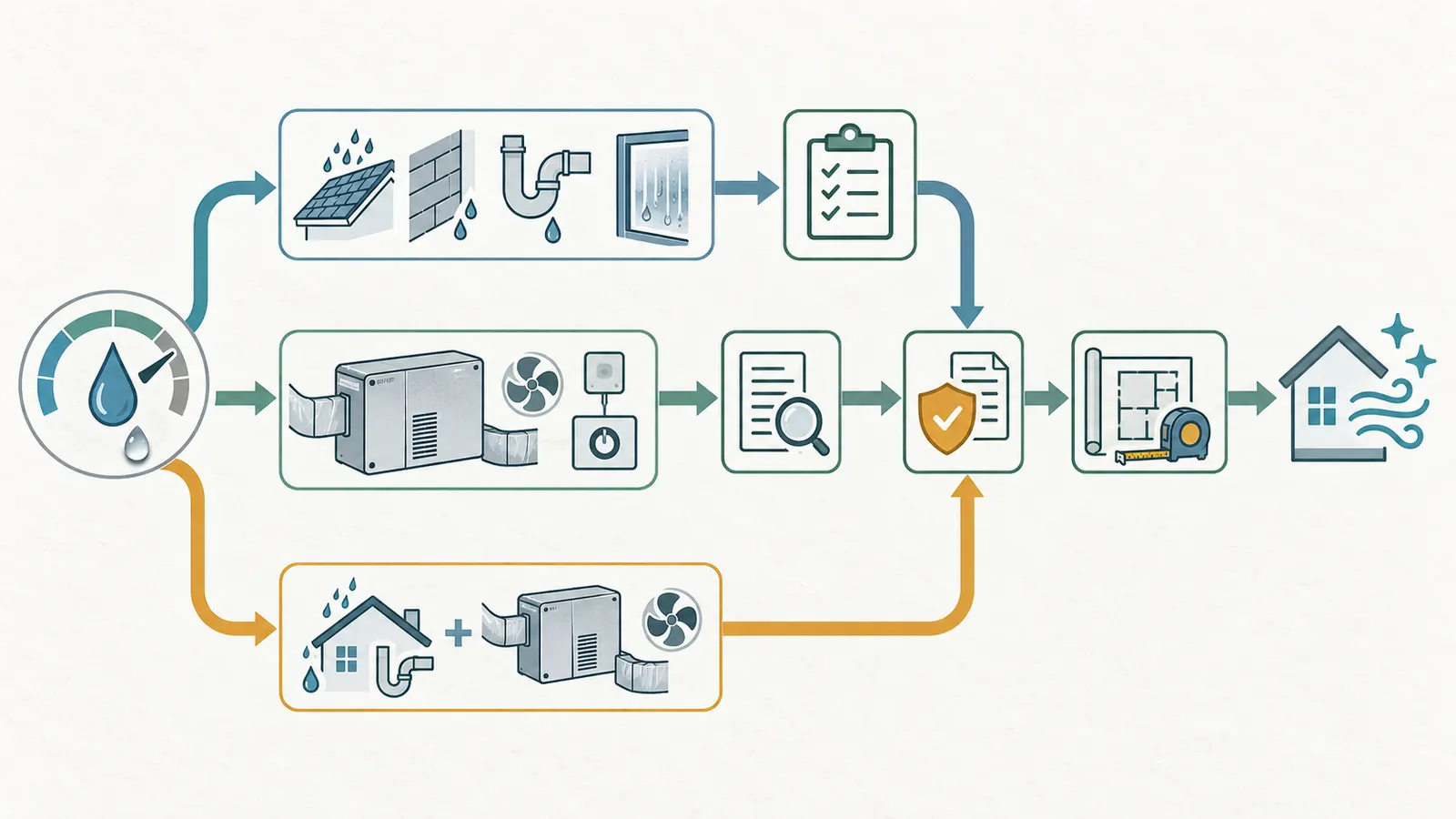
Do not infer a failed compressor from “the air feels warm.” A refrigeration dehumidifier commonly reheats air after removing moisture. The Aprilaire 1750A/1770A manual, for example, says that air leaving its unit is normally warmer than the air entering it because the air is reheated after moisture removal. That is a model-specific explanation, not a test result for your equipment; confirm the behavior in your own manual. The same manual describes a drain pan and routed drain tube rather than a daily bucket, which means a blocked or poorly routed drain can look like a machine failure while the refrigeration process is still operating. See the Aprilaire owner manual.
The first decision should therefore produce one of three written dispositions:
- Source correction first: a documented water, air, ventilation, drainage, or envelope condition is not yet controlled, so equipment economics are premature.
- Repair now: the unit is otherwise suitable, a qualified diagnostic identifies a bounded fault, the repair scope and warranty path are clear, and the post-repair verification is defined.
- Replacement now: the unit cannot be supported at a sensible total cost or the repair does not produce confidence, and a replacement proposal addresses capacity, controls, drain, ducting, electrical requirements, and local approval questions.
If the evidence fits more than one branch, do not force a binary answer. Record “source correction plus repair” or “source correction plus replacement.” That combined decision is common when a drain failure has allowed water damage or when an underspecified installation has operated in a high-moisture space. A replacement quote that leaves the suspected source unanswered is not a complete solution.
2. Build a pre-season evidence record before requesting a repair or replacement quote #
Before asking a contractor to price a repair or replacement, assemble a dated record that lets the contractor distinguish the equipment symptom from the home’s moisture load. The record should include the actual model and serial, installation or purchase date, control setting, RH readings, indoor temperature, drain path, filter condition, visible water, fault indication, recent weather or occupancy changes, warranty documents, and the question you want answered. This reduces the chance that a single high reading becomes an expensive but poorly scoped replacement recommendation.
The worksheet is designed for an existing or newly handed-over U.S. home with a ducted whole-home dehumidifier. It does not assume a particular brand, model, climate, utility, construction method, or installer. The homeowner’s role is to collect accessible records and non-invasive observations. The technician’s role is to test the machine and installation. The building-envelope, plumbing, roofing, electrical, mold-remediation, or code professional’s role begins when the evidence moves into that specialty.
Record the equipment identity first
Photograph or transcribe the nameplate without removing panels. Record:
- manufacturer and exact model number;
- serial number;
- rated capacity, if shown, in pints per day;
- rated voltage, phase, and current or watts, if shown;
- IEF or other efficiency rating, if shown;
- refrigerant information only as a record for the professional, not as a DIY service instruction;
- installation date, purchase date, or best-supported age;
- control model, remote sensor, ventilation accessory, dampers, or zoning accessories;
- filter part number and size;
- drain destination and whether a condensate pump is present;
- installation invoice, commissioning sheet, warranty registration, builder handover record, and prior service invoices.
Do not write “about ten years old” if the serial or handover record can establish a narrower date. Age is not a universal replacement threshold, but it affects parts availability, warranty balance, expected risk, and the cost of repeating labor. Likewise, do not write “80-pint replacement” without recording whether the old and new ratings use comparable test conditions. ENERGY STAR explains that DOE testing changed and that capacity is a pints-per-day result at specified conditions. Its comparison guidance means an old and new label should not be treated as identical measurements just because the printed number looks similar. See ENERGY STAR’s dehumidifier testing and capacity explanation.
Log RH in a repeatable way
EPA guidance says to keep indoor RH below 60% and ideally between 30% and 50%. ENERGY STAR separately says that, in colder climates during heating season, 30% to 40% RH can help prevent window condensation. Neither statement is a universal thermostat setting or a guarantee of comfort; the actual model, surfaces, climate, and occupants still matter. See EPA’s humidity guidance and ENERGY STAR’s RH explanation.
For the worksheet, use one consistent measurement location and a consistent time pattern. A practical owner record is:
| Field | Entry to make | Why it matters |
|---|---|---|
| Date and time | Local date, time, and whether the system was running | Shows whether the observation is a start-up, steady period, or recovery period |
| Room and elevation | Living area, basement, crawl-space control location, or other exact location | RH is local; one reading does not represent every zone |
| RH and temperature | Percent RH and °F from the same instrument | RH changes with temperature, so the pair matters |
| Dehumidifier state | Off, fan, compressor, fault, or unknown | A control demand without compressor operation is a different branch from no demand |
| Control target | Setpoint or dial position, with control model | A knob may be an approximation rather than a displayed RH value |
| Central HVAC state | Cooling, heating, fan-only, off, or unknown | Cooling and ventilation alter moisture and air mixing |
| Outdoor conditions | Rain, storm, open windows, unusually humid day, or unknown | Explains changes without pretending to measure the whole moisture load |
| Visible water or condensation | Location, extent, and whether it is new | Points to a source or a drain issue; do not disturb suspected contamination |
| Runtime observation | Started, stopped, short-cycled, ran continuously, or unknown | Helps the professional decide what to test; it is not an energy meter |
Take readings for long enough to expose a pattern rather than relying on one display. The worksheet’s suggested protocol is illustrative: take a baseline when the home is in normal occupancy, then log at consistent morning and evening times for three to seven days, including at least one normal operating day. This is a data-collection method created for the worksheet, not a manufacturer-mandated maintenance interval. If humid season or active water damage makes waiting unsafe, call sooner and state why. If the home is empty, newly finished, or recently wet, record that context because materials and occupancy can change the load.
Place a portable hygrometer away from a supply register, exterior wall, direct sun, bathroom door, laundry exhaust, or the dehumidifier’s discharge. Do not place it inside the machine or inside a suspected wet assembly. If two instruments disagree, record both rather than choosing the reading that supports a preferred purchase. A contractor may use calibrated instruments and different measurement points; your log is evidence of pattern and timing, not a certified measurement.
Check only what is safe and accessible
Without opening electrical or refrigeration compartments, the homeowner can usually document whether the control is set to a demand, whether the visible filter is loaded, whether the drain termination is visible, whether the floor or pan is wet, whether the unit has an error indicator, and whether the service switch or breaker is in an unusual state. Follow the actual manual before touching a filter or drain. Turn the unit off as the manual directs before any owner maintenance. Do not bypass an interlock, reset a repeatedly tripping protective device, move wiring, cut a refrigerant line, add refrigerant, or spray cleaner into an inlet.
If the unit, drain, or suspected moisture source is in a crawl space, attic, shaft, or other confined or restricted area, do not enter when access is unsafe, contaminated, poorly ventilated, unstable, or requires an unsafe climb. Do not treat the fact that a space is part of the house as proof that it is safe to enter. Stop at the access boundary and give that inspection to a qualified professional with the training and equipment appropriate to the space. This stop point is in addition to the electrical, refrigerant, water-damage, and suspected-contamination boundaries above.
The result you hand to a professional should be a small evidence packet, not a conclusion:
- one page of model, serial, age, and warranty records;
- the RH and temperature log;
- photographs of the nameplate, controller, filter access, drain termination, and any visible water, without opening unsafe panels;
- a list of symptoms and when each started;
- the last maintenance or service record;
- the exact question: “Can you identify the failed or missing condition, state what you tested, price a bounded repair, and tell me whether source correction or replacement is also required?”
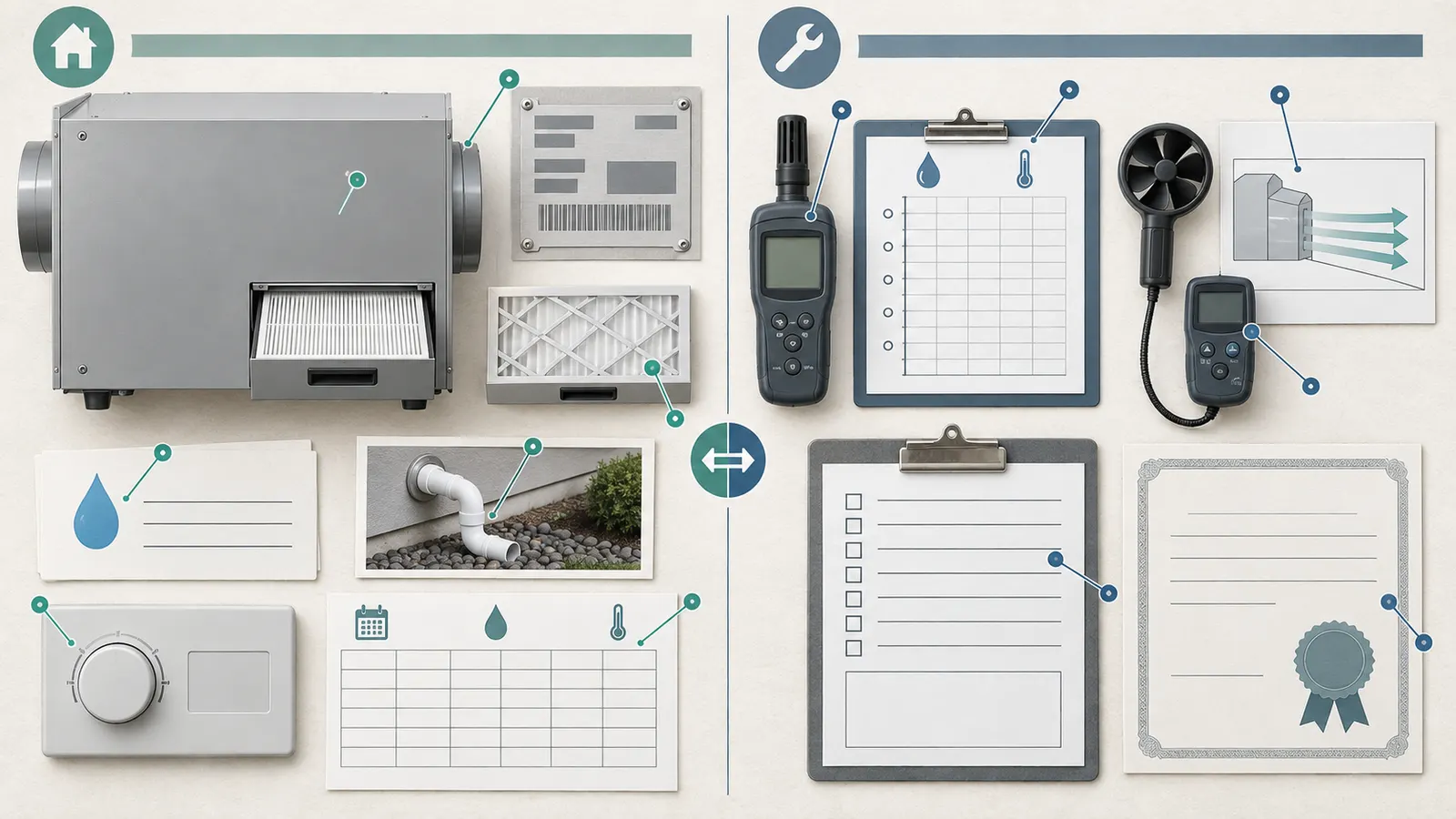
The next decision after this chapter is whether the evidence is strong enough to ask for a diagnostic or whether an obvious moisture source needs attention first.
3. Correct the moisture source before treating high RH as equipment failure #
Correct a moisture source before authorizing dehumidifier replacement when the record shows leakage, condensation, uncontrolled outdoor air, unvented moisture-producing activity, drainage problems, or wet materials that have not been dried. A dehumidifier is a control device; it is not a substitute for a sound roof, foundation drainage, plumbing system, exhaust path, or building enclosure. Replacement is premature if the same source would overload the new unit or keep the home wet.
EPA lists moisture control actions that include fixing leaks, drying wet materials, keeping indoor humidity below 60% and ideally 30–50%, venting moisture-producing appliances outdoors, using bathroom and kitchen exhaust, and addressing drainage around the foundation. Those examples help organize an investigation, but they do not identify the source in your property. See EPA’s residential moisture-control guidance. ENERGY STAR likewise notes that reducing moisture sources, improving foundation drainage, extending downspouts, keeping gutters clear, and properly venting dryers can reduce the need for dehumidification; see ENERGY STAR’s dehumidifier guidance.
Use the symptom’s location to choose the professional
The person who owns the next action should match the location and mechanism, not simply the word “humidity.”
| Observation | Do not infer | Better next handoff |
|---|---|---|
| Water at a pipe joint, fixture, appliance supply, or drain | That the dehumidifier is under-sized | Plumber or appliance professional to find and stop the leak |
| Damp foundation edge, seepage, saturated soil, or water after rain | That a larger dehumidifier solves the cause | Building-envelope, drainage, waterproofing, or foundation professional; local jurisdiction may apply |
| Wet roof framing, ceiling staining, or gutter/downspout overflow | That indoor RH is the only problem | Roofing or exterior drainage professional |
| Condensation on windows, cold ducts, or cold pipes | That the equipment has failed | HVAC or building-envelope professional to assess temperature, insulation, air movement, and RH together |
| Bathroom, kitchen, laundry, or drying clothes adds a repeatable RH spike | That the machine should run continuously | Homeowner changes for routine behavior; qualified ventilation or electrical professional if an exhaust system is defective |
| High RH only in a basement, crawl space, or closed zone | That the whole home has identical conditions | HVAC and building-envelope professionals to assess zoning, air movement, infiltration, and source conditions |
| Musty odor or visible mold near HVAC components | That a filter replacement is remediation | Stop and get appropriate HVAC or remediation assessment; do not circulate suspected contamination |
The last row matters because EPA says that when an HVAC system may be contaminated with mold, the homeowner should consult its duct-cleaning guidance before taking further action and should not run the HVAC system when contamination is known or suspected because it could spread mold through the building. See EPA’s mold guidance. This is a stop point, not a suggestion to diagnose contamination remotely.
Separate source correction from normal dehumidifier behavior
A unit may run for a long time after installation, after a wet event, or after a change in occupancy because the building materials and contents can release stored moisture. The Aprilaire example manual explains that a newly installed home can behave like a sponge and that extended operation can occur while the home dries. That observation does not prove that all long runtimes are normal, nor does it apply to every model. It tells you to document whether runtime changed after a known event and whether RH trends downward, rather than using runtime alone as a replacement trigger. See the Aprilaire manual.
If windows are being left open during humid weather, record that before you compare equipment. ENERGY STAR advises closing doors and windows to the space being dehumidified while a unit operates and warns that drainage should not create a tripping hazard or be near electrical connections. See ENERGY STAR’s operating guidance. In a ducted whole-home system, the equivalent question is whether outside air, ventilation accessories, dampers, or duct leakage are intentionally or unintentionally adding moisture. Those are professional installation questions, not reasons for a homeowner to seal, disconnect, or rebalance ducts.
Source correction can be the best answer even when the dehumidifier is old. If an exterior leak is repaired and the logged RH returns to the home’s intended band with the existing unit, replacing the machine would spend money without addressing an equipment need. Conversely, if the source has been corrected and verified but the unit still cannot maintain the target, the source-correction branch has produced useful evidence for repair or replacement.
4. Ask for a written HVAC diagnostic instead of a symptom-based replacement quote #
Authorize a repair quote only after the HVAC professional records what was observed, what was tested, what failed, what remains untested, and how the repair will be verified. “Not keeping up” is a symptom, not a diagnosis. A useful diagnostic record connects the complaint to the control signal, airflow, filter, drain, electrical supply, refrigeration circuit, duct connections, operating conditions, and the actual model’s manual. It also states which parts of the home or moisture source were outside the HVAC scope.
Assign the work by hazard and responsibility
The homeowner can provide access, records, observations, and a decision about budget. The qualified HVAC professional should inspect, test, and work on the equipment, controls, duct connections, electrical components, and refrigeration circuit within their license and qualifications. A licensed electrician may be required for circuit or disconnect changes. A plumber may own a condensate drain or pump issue. A building-envelope or drainage professional may own water entering from outside. A mold-remediation professional may be needed for contamination or a large or complex affected area. The city or county authority having jurisdiction decides local permit and inspection questions.
Refrigerant work is not a homeowner task. EPA says Section 608 requires certification for technicians who maintain, service, repair, or dispose of equipment where refrigerant could be released, including most substitute refrigerants. See EPA’s Section 608 certification page. Ask the contractor whether the assigned person is appropriately certified and licensed for the work in your location. Do not open the sealed circuit, connect gauges, measure or infer pressure or charge, release refrigerant, alter the charge, or add refrigerant. A pressure or charge observation is not a homeowner diagnosis and must be interpreted by an appropriately certified and qualified professional using the actual model’s service procedure. If a quote says only “needs charge” without stating what was tested, what leak or failed condition was found, and how the repair will be verified, record the diagnosis as incomplete rather than authorizing an open-ended intervention.
Electrical work also belongs to a qualified professional. Do not remove panels, probe live parts, change a breaker, defeat a float switch, or continue operating a unit with burning odor, melted wiring, repeated trips, or water near electrical equipment. A homeowner-safe evidence record can photograph the outside and note the breaker or disconnect condition if it can be seen without opening anything. It cannot establish that a circuit is correctly sized or safe.
Require these diagnostic fields
Ask for the following in the service record or quote. If a contractor declines to state the scope, mark that as uncertainty rather than filling the gap with an assumption.
| Diagnostic field | What the record should say | Why it changes the decision |
|---|---|---|
| Complaint and conditions | RH, temperature, location, control demand, weather/occupancy context | Makes the symptom reproducible and prevents a one-time reading from becoming a replacement rationale |
| Model match | Exact model and serial, manual used, accessories present | Parts, controls, ratings, warranty, and maintenance vary by model |
| Power and control | Whether the unit receives appropriate power and whether the control calls for operation | Separates no-demand or control issues from equipment failure |
| Airflow and filter | Filter state, airflow condition, duct connections, obstructions, and any limitation | A refrigeration unit cannot be judged fairly if airflow or ducting is outside the intended condition |
| Drain and pan | Drain route, slope or pump, blockage, overflow protection, water evidence | A blocked drain can cause leakage, shutdown, or property damage without proving refrigeration failure |
| Coil and blower | Condition and operational findings using the manufacturer’s service procedure | Provides a bounded explanation for poor moisture removal or noise |
| Refrigeration circuit | What was measured by an appropriately certified and qualified professional, what failed, and what remains unknown; no unsupported “needs charge” label | Determines whether regulated work, a part repair, or replacement comparison is appropriate |
| Electrical protection | Observed fault, disconnect, wiring, or protection issue, with responsible trade named | Avoids disguising an electrical installation issue as an appliance replacement |
| Capacity context | Space/zone, moisture load, ducting, temperature, and why the existing capacity is or is not adequate | ENERGY STAR says capacity depends on space and conditions, not floor area alone |
| Repair scope | Part numbers, labor, access, refrigerant or electrical scope, exclusions, warranty treatment, and quote validity | Turns an open-ended service call into a comparable decision |
| Verification plan | RH target or range, drain check, control operation, documented readings, and handoff records | Defines what “fixed” means before money changes hands |
Read the failure branches carefully
No start. No start may be a control, power, switch, safety, or equipment issue. A homeowner can document the displayed state, but should not use a reset as a diagnosis. Ask for the test result and what will happen if the fault recurs.
Runs but RH does not fall. This can reflect an uncontrolled moisture source, inadequate airflow, wrong operating conditions, control location, ducting or zoning problem, or a refrigeration failure. Ask the technician to explain which of those were tested. Do not accept “replace it” without a stated reason that connects to the actual home.
Water at the unit. Ask whether the water is condensate, a drain backup, a pan overflow, a leaking fitting, or another source. Do not assume that clearing the outlet verifies the drain path. The Aprilaire manual’s model-specific drain check illustrates why the entire path and outlet matter; it says the drain should be checked annually and that a blocked or air-locked system should be handled by a qualified service professional. See the manual’s maintenance section.
Short cycling or repeated trips. Record the pattern and stop if there is a hazard. The cause may be temperature, control, airflow, electrical protection, drain protection, or a component fault. A new unit installed into the same unresolved condition may repeat the problem.
Musty odor or suspected contamination. Do not use a consumer smell test to decide whether ducts or coils are contaminated. EPA’s guidance says not to run an HVAC system when contamination is known or suspected because it could distribute mold. Transfer the issue to the appropriate professional and keep mold remediation outside the dehumidifier replacement quote unless the scope is explicitly coordinated.
The next decision is whether the written diagnostic has enough specificity to compare a repair with a replacement. If not, buy clarity with a second qualified assessment or a narrower diagnostic visit, not with an immediate equipment purchase.
5. Compare source correction, repair, and replacement with the same worksheet inputs #
Compare repair-now, replacement-now, and source-correction-first only after each option states the same moisture problem, scope, verification, warranty treatment, and owner cost inputs. The cheapest line on a quote is not necessarily the lowest-cost decision if it excludes a drain correction, duct work, electrical work, source investigation, permit, disposal, control, or post-work verification.
The Pre-season whole-home dehumidifier decision worksheet
Use one row for each option. Leave a field blank and mark it “unknown” if no reliable record exists. Do not turn a blank into a zero.
| Input | Repair now | Correct source first | Replace now |
|---|---|---|---|
| Exact model and serial | Record | Record | Record existing and proposed model |
| Age and installation date | Record | Record | Record existing; record proposed availability and warranty |
| RH pattern and location | Attach dated log | Attach before/after source log | Attach baseline and design target |
| Moisture source status | Controlled, uncontrolled, or unknown | Name source and responsible trade | Show how proposal addresses or excludes source |
| Filter and coil condition | Findings from technician | Owner or professional observation | Proposed maintenance/access plan |
| Drain path and verification | Test result and repair scope | Source/drain trade scope | New drain, pump, overflow, and test scope |
| Fault code or failure | Exact code and diagnostic test | Not applicable or record | Why repair is not preferred |
| Repair installed cost | Written total with exclusions | Written source-correction quote | Replacement installed cost, disposal, controls, duct/electrical/drain work |
| Warranty balance | Parts and labor coverage; claim status | Source warranty or no coverage | Manufacturer, installer, builder, and service-contract terms |
| Rated capacity | Existing nameplate/manual value | Existing value | Proposed value and test-condition context |
| IEF or other rating | Existing value if available | Existing value | Proposed value from current data sheet |
| Watts or electrical input | Nameplate or technician record | Existing | Proposed nameplate or data sheet |
| Annual hours assumption | Low/base/high scenario | Low/base/high scenario | Low/base/high scenario |
| Utility rate | Actual tariff, bill, or labeled proxy | Actual tariff, bill, or labeled proxy | Same rate basis |
| Verification | RH, operation, drain, documents | RH and source evidence | RH, drain, control, nameplate, warranty, and local closeout |
This is an inspectable worksheet, not a market-price table. The article does not invent a national repair price, replacement price, expected life, or maintenance schedule because those inputs vary by model, access, climate, contractor, and jurisdiction.
Worked example and record boundary
The worked calculations below are illustrative, not a report from a real property. This package does not contain an actual installed model manual and warranty packet, a household utility bill or tariff, a contractor diagnostic record, or a response from the city or county where the equipment is installed. The Aprilaire 1750A/1770A manual and warranty language are manufacturer examples supplied for comparison; the EIA resource is a public rate source; no contractor or authority record is being claimed. That distinction resolves the research-scope boundary: this article provides a reproducible owner worksheet, not a property-specific repair-or-replace conclusion.
Before authorizing work on a particular home, attach the actual model and serial record, the current warranty and proof of installation or purchase, the household rate input, the written HVAC diagnostic, and the answer from the property’s authority having jurisdiction when approval may apply. The diagnostic should state what was tested, what failed or remains unknown, the bounded repair scope, and how the result will be verified. The jurisdiction record should name the city, county, state agency, or other actual authority, the date contacted, the project description, and any permit or inspection answer. If one of these records is missing, mark the field unknown and keep the decision provisional rather than filling the gap with the example below.
Calculate operating cost from owner-supplied inputs
For a simple owner estimate using nameplate watts and an annual runtime assumption:
Annual electricity cost = (watts × annual hours ÷ 1,000) × utility dollars per kWh.
The EIA publishes average electricity-price tables by end-use sector and state through its Electric Power Monthly, but a household bill or utility tariff is better for a property-specific comparison. EIA averages may not include the exact rate structure, delivery charges, taxes, riders, seasonal changes, or time-of-use rules that apply to your account. Label the source and month for any rate used.
Illustrative example only: suppose a nameplate or professional record supports 700 watts, the owner models 1,000 hours per year, and the household’s marginal electricity input is $0.24/kWh. The calculation is:
(700 W × 1,000 h ÷ 1,000) × $0.24/kWh = $168 per year.
The example does not claim that any particular model draws 700 watts or runs 1,000 hours. Replace both values with the actual equipment and a reasoned runtime range. If the proposed model is 450 watts, the same 1,000-hour assumption at $0.24/kWh gives (450 W × 1,000 h ÷ 1,000) × $0.24/kWh = 450 kWh × $0.24/kWh = $108 per year. The difference is $60 per year under those assumptions; it is not a guaranteed savings because runtime, controls, moisture load, and operating conditions may change.
Three-option worked example with an authorization branch
The following is a complete illustrative comparison for a hypothetical home. It is modeled to show the worksheet’s decision logic, not to report a real quote, market average, expected life, or property result. Assume the evidence packet contains a documented moisture source that a qualified source-correction trade can address for an illustrative installed $1,200. Assume the existing unit’s nameplate input is 700 W, the proposed unit’s input is 450 W, and the homeowner uses a $0.24/kWh marginal electricity rate. Those dollar inputs must be replaced with the actual written scopes and household tariff before authorization.
The three paths are deliberately stated as complete options:
| Illustrative path | Upfront scope | Operating-cost input | Five-year total at 1,000 h/year and $0.24/kWh | Authorization branch |
|---|---|---|---|---|
| Correct source first; defer equipment work | $1,200 source correction | Existing 700 W unit | $1,200 + (700 × 1,000 ÷ 1,000 × $0.24 × 5) = $2,040 | Authorize when the source is documented, the unit can be safely monitored, and equipment failure is not yet established |
| Correct source and repair the existing unit | $1,200 source correction + $950 bounded repair = $2,150 | Existing 700 W unit | $2,150 + (700 × 1,000 ÷ 1,000 × $0.24 × 5) = $2,990 | Authorize only when the diagnostic identifies a repairable fault, the warranty/parts path is recorded, and verification is defined |
| Correct source and replace the unit | $1,200 source correction + $4,800 installed replacement = $6,000 | Proposed 450 W unit | $6,000 + (450 × 1,000 ÷ 1,000 × $0.24 × 5) = $6,540 | Authorize when source work is included, the old unit is not supportable or economical to repair, and the installed proposal covers sizing, controls, drain, electrical, approval questions, and commissioning |
The formula is the same in every row: five-year total = upfront scope + [(watts × annual hours ÷ 1,000) × dollars per kWh × 5 years]. The $950, $4,800, $1,200, 700 W, 450 W, 1,000 hours, $0.24/kWh, and five-year horizon are all illustrative inputs with units. The comparison is not a claim that replacement is justified because its annual energy cost is lower. In this example, source correction first is the lowest-authority commitment because it buys evidence about the moisture load before equipment money is spent. Repair becomes authorizable only if its diagnostic branch is bounded; replacement becomes authorizable only if the same source is controlled and the larger installed scope is complete.
Runtime and rate sensitivity show how much the arithmetic can move without inventing a national price. At the low and high corners, the source-correction-first path uses the existing 700 W unit, the combined repair path uses that same operating input, and the combined replacement path uses 450 W:
| Annual hours and rate | Source correction first | Source correction + repair | Source correction + replacement |
|---|---|---|---|
| 500 h at $0.16/kWh | $1,480 | $2,430 | $6,180 |
| 1,000 h at $0.24/kWh (base) | $2,040 | $2,990 | $6,540 |
| 1,500 h at $0.36/kWh | $3,090 | $4,040 | $7,215 |
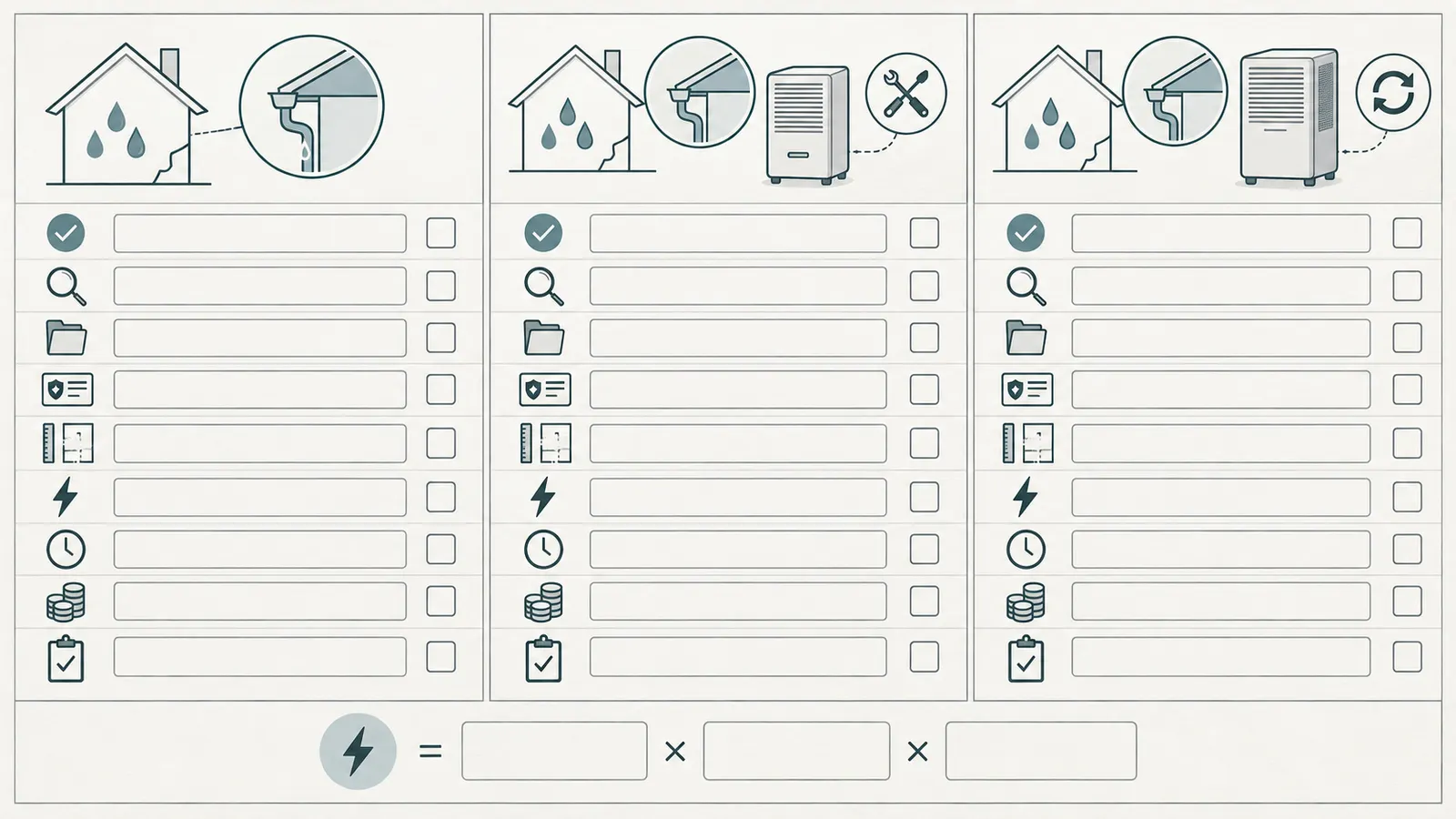
For example, the high-corner source-correction total is $1,200 + [(700 W × 1,500 h ÷ 1,000) × $0.36/kWh × 5] = $3,090; the high-corner replacement total is $6,000 + [(450 W × 1,500 h ÷ 1,000) × $0.36/kWh × 5] = $7,215. The sensitivity changes the cost gap but does not resolve a failed diagnostic, an uncontrolled leak, an omitted electrical scope, or a local approval requirement. If the actual rate is time-of-use, tiered, or subject to riders, use the tariff rule that applies to the property rather than averaging a bill without explanation.
This modeled branch produces a practical authorization record: choose source correction first when the source is the only established defect; choose source correction plus repair when the source is controlled and the written diagnostic supports the $950-like bounded scope; choose source correction plus replacement when the source is controlled, repair support is poor or the diagnostic shows an uneconomic fault, and the installed replacement quote passes the handoff checklist. If the actual figures reverse the arithmetic, keep the same evidence gates. If the source is not yet identified, do not treat any of these illustrative totals as permission to replace.
Run sensitivity instead of hiding uncertainty
Use the same illustrative 700-watt input to show how a decision changes with hours and rate:
| Annual hours | $0.16/kWh | $0.24/kWh | $0.36/kWh |
|---|---|---|---|
| 500 | $56 | $84 | $126 |
| 1,000 | $112 | $168 | $252 |
| 1,500 | $168 | $252 | $378 |
| 2,000 | $224 | $336 | $504 |
These are arithmetic illustrations, not a utility forecast. The sensitivity shows why an efficiency comparison should not be allowed to decide the purchase by itself. A higher-efficiency unit may have lower operating cost, but it can still be the wrong choice if it is undersized, poorly installed, incompatible with the duct/control arrangement, or exposed to the same moisture source. ENERGY STAR defines IEF as liters removed per kWh under a representative test method, and its criteria distinguish whole-home case-volume categories. Use IEF to compare eligible product data, then use watts, actual or modeled runtime, and the household rate for the owner’s bill estimate. See ENERGY STAR’s IEF criteria.
If a repair quote is R, a replacement installed quote is N, and the repair leaves a documented residual-risk allowance or expected follow-up cost F, a simple first comparison is:
Repair decision cost = R + F + estimated operating cost over the comparison period.
Replacement decision cost = N + estimated operating cost over the comparison period.
Do not assign a made-up probability to failure. Instead, write the risk facts: parts availability confirmed or unknown, warranty covers parts but not labor or not, diagnosis bounded or unresolved, source controlled or not, and whether the quote includes the work needed to verify the result. If you do model a failure scenario, label it as a scenario and show the assumed cost, timing, and source. The worksheet is designed to expose sensitivity, not to produce a falsely precise payback date.
Compare repair scope, not repair labels
A repair is more defensible when the failure is identifiable, the part and labor are specified, access and disposal are included, the warranty claim path is clear, and the professional states how operation will be verified. A repair is less defensible when the quote says “recharge and see,” “replace parts as needed,” or “repair not guaranteed” without stating the diagnostic limitation. A limitation can be honest; it still belongs in the decision record.
A replacement is more defensible when the proposal includes a load or capacity rationale, duct and control compatibility, drain and overflow path, electrical requirements, installation access, commissioning, disposal, warranty registration, and a post-installation test. ENERGY STAR says capacity depends on both space and moisture conditions and that whole-home units should be sized and installed professionally. See ENERGY STAR’s buying and installation guidance. A larger pints-per-day label is not automatically better if it is not suited to the zone or installation.
Source correction first is more defensible when a source is visible or documented, the source professional can state the corrective scope, the existing unit can be safely kept in service or protected, and a repeat RH log will verify whether the load changed. It is not a reason to postpone urgent action when water damage, electrical hazard, contamination, or property damage is active.
6. Reconcile the actual model manual, warranty, handover file, and local jurisdiction #
Before authorizing either repair or replacement, use the actual model manual and warranty as controlling documents, preserve the handover record, and ask the city or county authority having jurisdiction about any permit or inspection requirement for the proposed work. A general manufacturer example cannot override the installed model’s instructions, a written warranty, the builder’s contract, or local law.
The manual is an input, not a decorative attachment
The Aprilaire 1750A/1770A manual is useful here because it demonstrates the level of detail a homeowner should look for: control behavior, operating temperature, filter access, drain checking, installation fields, and warranty language. It says the unit works best when indoor temperature is above 65°F, gives a model-specific humidity-control example, describes a three-minute blower period before humidity measurement, and provides filter and drain procedures. Those details must not be copied to another brand or model. The manual is an example of a model-specific source, not a universal service schedule. See the Aprilaire 1750A/1770A owner manual.
For the actual unit, locate the manufacturer’s current manual and warranty by exact model number. Record the revision or publication date, because a search result or reseller page may describe a different revision. Look for:
- approved operating temperature range;
- minimum clearances and access requirements;
- filter type and service instructions;
- drain and pump requirements;
- control and sensor compatibility;
- duct connection and airflow requirements;
- electrical supply and disconnect instructions;
- fault-code meanings and reset instructions;
- whether installation by a qualified contractor is required for coverage;
- what is covered, for how long, and whether parts, labor, shipping, or disposal are excluded;
- required proof of purchase, installation date, model, serial, and installer;
- claim submission and authorization steps.
Never treat a manual’s “check annually” instruction as a national universal maintenance interval. In the Aprilaire example, the annual drain check and conditional six- or twelve-month filter interval are specific to that model’s instructions. Use your own manual first, and ask the contractor to identify any maintenance recommendation that is a service contract or professional inspection rather than an owner task.
Protect a product warranty and a new-home warranty separately
The FTC advises consumers to save the written warranty and receipt, check who handles repairs, and put spoken promises in writing. It also distinguishes a paid service contract from a product warranty and notes that implied-warranty rules vary by state. See FTC warranty guidance. For a home that was recently handed over, FTC new-home guidance says to check coverage and time limits, put a claim in writing, and keep records of dealings with the builder or warranty company. See FTC’s new-home warranty guidance.
Create two separate claim paths when both could apply:
- Equipment manufacturer or installer path: model, serial, proof of purchase, installation date, manual, warranty, diagnostic record, part failure, labor coverage, and claim number.
- Builder or handover path: closing or handover date, builder warranty, commissioning or punch-list record, dehumidifier specification, installation scope, drain and duct details, prior notice, photographs, and the written request for correction.
Do not authorize a third party to remove a component before confirming whether the warranty requires prior authorization, return of the part, or an approved service provider. The FTC says federal law generally prevents a manufacturer from conditioning warranty coverage on a specific part or service unless the part or service is supplied free or the FTC grants a waiver, but the exact claim still turns on the warranty and facts. Use the FTC warranty page for the general boundary and obtain the actual warranty instructions for the property.
For the Aprilaire manual supplied in the research brief, the stated five-year limited warranty is from installation, covers defects in materials or workmanship, excludes installer workmanship and labor costs, asks for the model number and installation date, and says the warranty may be void if the unit was not installed by a qualified heating and air-conditioning contractor, subject to the manual’s state-law language. This is a claim about that manual, not about every Aprilaire product. Use it as a checklist of questions, then apply the actual warranty. See the warranty section of the manual.
Ask the actual city or county, not the internet, about local approval
No property city or county was supplied for this worksheet, so no permit requirement is claimed here. The responsible local rule is the one administered by the property’s authority having jurisdiction, which may be a city building department, county building department, state agency, or another designated authority. Ask that office whether the proposed work requires a permit or inspection for any of the following:
- replacing the appliance in the same location;
- adding or altering a branch electrical circuit, disconnect, or receptacle;
- modifying supply or return ductwork;
- adding a condensate pump, drain, or overflow protection;
- altering ventilation or outdoor-air ducts;
- work in a finished attic, crawl space, or other restricted area;
- changes to a new-home warranty or final handover record.
ICC explains that model codes are adopted through governmental jurisdictions and may be amended for local practices and laws, so a model-code summary is not a nationwide permit answer. See ICC’s explanation of the International Residential Code. Record the office contacted, date, staff reference if provided, exact project description, answer, and any permit number. A contractor’s statement that “no permit is needed” is not the same as the authority’s answer unless that contractor is authorized to make the determination under local rules.
The next handoff is complete when the contractor has the actual model and warranty, the homeowner has written the claim status, and the local approval question has a named jurisdiction and documented answer.
7. Verify a replacement proposal and the installation handoff before humid season #
Approve a replacement only when the proposal makes the moisture-control objective, equipment compatibility, installation scope, warranty, local approval, and verification method visible. “New” is not a commissioning result. The installed unit must be connected, drained, controlled, and documented in a way that matches the home and the manufacturer’s instructions.
Check capacity and efficiency in the right order
Start with the zone and moisture condition, not the largest product number. ENERGY STAR says the capacity needed depends on the space and the conditions without dehumidification; its guidance also says correctly sizing and installing a whole-home unit is a professional task. See ENERGY STAR’s whole-home dehumidifier guidance. Ask the installer to state:
- which spaces and zones the unit serves;
- how air moves between those spaces;
- what moisture conditions the proposal assumes;
- why the proposed capacity is suitable;
- whether the existing ducts, dampers, and controls are compatible;
- whether the unit will run independently or with the central HVAC blower;
- what happens when the home is below the model’s recommended operating temperature;
- how condensate reaches the approved drain or pump;
- how overflow is detected or contained;
- how access for filters, service, and future replacement is preserved.
Then compare capacity labels and IEF values. ENERGY STAR defines capacity as the water removed per day at specified test conditions and explains that DOE changed dehumidifier test procedures. Its criteria define IEF in liters per kilowatt-hour and set separate thresholds for certified whole-home case-volume categories. See ENERGY STAR’s test explanation and IEF criteria. Do not use a simple “new number is lower, so it is worse” conclusion when test conditions changed. Do not use IEF alone to predict your bill.
Put the installed-cost scope beside the equipment price
A useful replacement quote should separate the equipment line from the installed project. Ask for line items or explicit inclusions for:
- equipment model, capacity, IEF, and availability;
- controls, sensors, dampers, and wiring;
- duct transitions, grilles, insulation, sealing, or balancing;
- drain, pump, trap, overflow, and discharge termination;
- electrical disconnect, circuit, protection, and any electrician scope;
- access, lifting, protection of finished surfaces, and cleanup;
- removal and lawful disposal of the old unit;
- permit and inspection allowances or exclusions;
- startup, operating test, and measured verification;
- registration, warranty documents, manuals, and as-installed photographs;
- price validity and excluded conditions discovered after opening the work area.
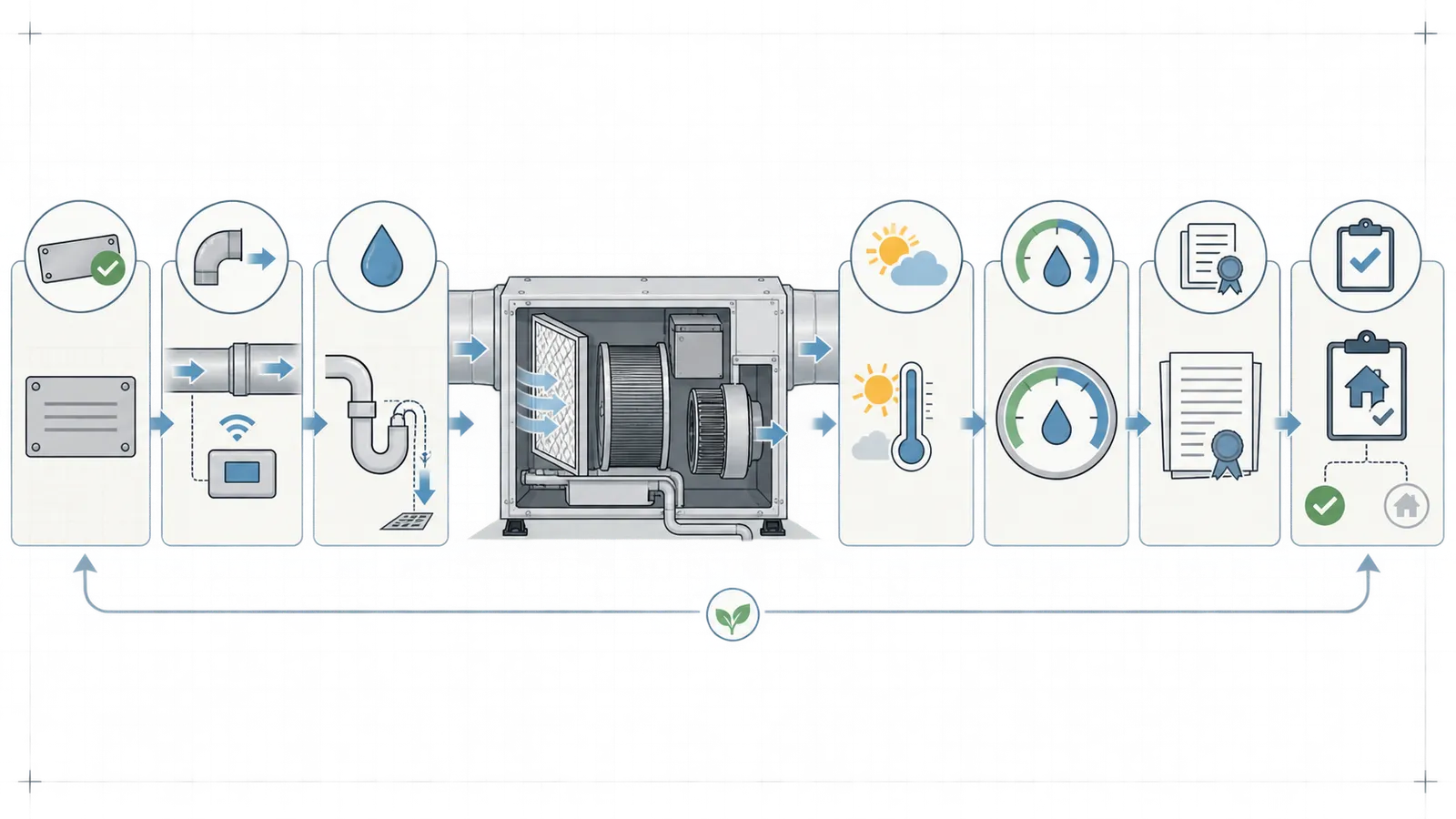
If the quote says “like-for-like,” ask what that means. A same-footprint replacement may not be the same control, capacity, duct connection, drain, electrical, or warranty arrangement. A new model may have a different label because test procedures changed. A larger unit may need different ducting or controls. A lower-watt nameplate may still run longer if the home’s moisture load or control arrangement changes. These are reasons to require an explicit proposal, not reasons to invent a preference.
Verify the handoff in a sequence
Use this handoff sequence after installation. The installer should perform the technical tests; the homeowner should collect records and observe the stated result.
- Identity: photograph the installed nameplate and record model, serial, rating, IEF, voltage, and installation date.
- Installation scope: compare the finished work with the quote. Note duct, control, drain, pump, overflow, electrical, access, and disposal changes.
- Control demand: confirm the control displays or responds as the actual manual describes. Do not assume a dial position equals a particular RH without the model’s documentation.
- Air movement: confirm the intended zones receive or return air as designed and that access panels and filters can be reached.
- Condensate: have the installer demonstrate the drain or pump path and the overflow response according to the model’s procedure. Do not pour water into a pan unless the actual manual authorizes the owner procedure and the installer has made the area safe.
- Operating condition: record indoor temperature, RH, control setting, system state, and any installer measurements. The first reading is a baseline, not proof of long-term performance.
- Warranty and records: receive the invoice, model manual, warranty, registration confirmation or instructions, permit/inspection records if applicable, diagnostic disposition, and service contact.
- Next observation: continue the consistent RH log and note whether the source condition was corrected. Escalate any leak, repeated fault, unsafe electrical condition, suspected contamination, or unexplained inability to control humidity.
The Aprilaire example manual describes a normal control sequence in which the blower circulates air before humidity is evaluated and the compressor operates when humidity is above the setting. Another model may behave differently. The verification step is therefore to compare observed behavior with the actual manual and installer’s stated sequence, not to demand a universal three-minute delay or universal setpoint.
Do not accept a handoff that consists only of “it turns on.” A working motor with a blocked drain, wrong control, inaccessible filter, poor duct connection, or unrecorded warranty can create the next failure. The homeowner’s acceptance record should state what was tested, by whom, when, under what conditions, and what remains outside scope.
8. Close the decision with a monitoring plan and an escalation rule #
After source correction, repair, or replacement, keep a short verification record and define the next decision before the first humid spell arrives. The outcome to monitor is not merely whether the unit runs; it is whether the home’s RH trend, moisture source, drain behavior, and equipment state match the documented scope without creating new damage or warranty ambiguity.
Use a post-work log that mirrors the pre-work log
Continue the same fields used before the decision: date and time, location, RH, temperature, control target, unit state, central HVAC state, outdoor conditions, runtime observation, and visible water or condensation. Add:
- work completed and date;
- repaired or replaced component;
- source correction completed or still open;
- filter condition and next manual-based check;
- drain or pump result;
- fault code status;
- warranty claim or invoice reference;
- contractor contact and next service boundary.
The purpose is comparison, not a promise that every house will reach the same RH. If readings improve only when windows are closed, record that operating condition. If readings improve after a plumbing repair, record that causal evidence. If readings remain high despite controlled sources and a verified operating unit, return to the HVAC professional with the log and ask whether the original capacity, control location, ducting, or load assumption was wrong. If new water appears, stop treating it as a normal humidity fluctuation and transfer it to the responsible trade.
Use the actual manual’s maintenance instructions
Do not set a universal calendar from this article. The supplied Aprilaire manual gives a concrete example: inspect the filter after six months initially, continue at six months when loading is heavy or at twelve months when it is light, and check the drain annually; it tells the owner to have improper drainage checked by a qualified service professional. See the manufacturer’s maintenance instructions. Your actual model may specify a different filter, cleaning method, interval, drain test, access procedure, or prohibition.
A homeowner maintenance record should show what was actually done, not a generic check mark:
| Record | Owner may record | Professional handoff when |
|---|---|---|
| Filter | Date, part number, visible loading, manual-based action | Filter access is unsafe, damaged, inaccessible, or airflow remains poor |
| Drain | Visible termination, water evidence, pump alarm, installer test record | Blockage, air lock, overflow, leak, pump failure, or water near electrical parts |
| Control | Setpoint, displayed RH if available, error code | Control does not respond, sensor location is questionable, or code recurs |
| Cabinet and area | Water, corrosion, unusual noise, burning odor, blocked access | Electrical hazard, refrigeration leak concern, structural/water damage, or contamination suspicion |
| RH pattern | Same-location readings and conditions | Persistent high RH after source correction or readings disagree materially |
Escalate by evidence, not by anxiety or sunk cost
Escalate promptly for active water damage, suspected HVAC contamination, electrical hazard, repeated trips, refrigerant-circuit work, or a drain that can overflow. EPA says visible mold and moisture problems require moisture control and that suspected contaminated HVAC equipment should not be run. See EPA’s mold and moisture guidance. If mold growth is extensive, water is contaminated, or health concerns exist, use the appropriate professional boundary rather than treating a dehumidifier service call as remediation.
Escalate the financial decision when the repair quote changes after disassembly, the warranty position is unclear, the proposed replacement omits source correction, the installer cannot state capacity and compatibility assumptions, or the contractor cannot explain how performance will be verified. A second opinion is most useful when it receives the first diagnostic record, not when each contractor starts with a different incomplete story.
Do not keep repairing solely because money has already been spent, and do not replace solely because a sales quote is easier to understand than a diagnostic. Return to the worksheet: Is the source controlled? Is the fault bounded? Is warranty coverage documented? Is the installed scope comparable? Are the cost and energy inputs owner-supplied and sensitivity-tested? Is the next verification observable? The best answer can be “repair after source correction,” “replace after a failed repair with documented limits,” or “do not replace yet; correct the source and monitor.”
The final decision record
Close the seasonal handoff with a one-page decision statement:
Decision: repair now / correct source first / replace now / combined path.
Evidence: model and age, RH pattern, source findings, drain and filter state, diagnostic test, quote scope, warranty status, local jurisdiction answer, utility rate, and energy assumptions.
Responsible parties: homeowner, HVAC professional, source-correction trade, builder or warranty contact, and authority having jurisdiction where applicable.
Verification: what was tested, the date, the measured conditions, the documents received, and the remaining limitations.
Next decision: what observation or date will trigger follow-up, and who receives the record.
This record is useful during the next humid season, a warranty claim, a home sale, or a future replacement. It also prevents a common handover failure: losing the model, installation, warranty, and moisture history and having to pay for the same uncertainty again. For the broader ownership journey, continue through Brictale’s Handover & ownership path; the article remains focused on this dehumidifier decision and does not substitute for local trade, warranty, or authority advice.
Cite this guide
Brictale. “Should You Repair or Replace a Whole-Home Dehumidifier Before Humid Season?.” Published 2026-10-06; updated 2026-10-06.
https://brictale.com/build/handover/repair-or-replace-whole-home-dehumidifier-before-humid-season · Read the Markdown version
Original contribution: Pre-season whole-home dehumidifier decision worksheet. A homeowner-recorded evidence sheet that separates a moisture-source problem from equipment failure and compares documented repair, source correction, and replacement.
Sources and scope
Evidence behind this page
- The EPA identifies moisture control as the key to mold control and says that cleaning without fixing the water problem is likely to allow the problem to return; it advises drying wet or water-damaged areas within 24–48 hours to help prevent mold growth.
A Brief Guide to Mold, Moisture and Your Home
U.S. Environmental Protection Agency homeowner guidance about residential moisture and mold; not a dehumidifier repair diagnosis or a mold-remediation standard for every situation.
Accessed · Link to this claim - EPA moisture guidance says to keep indoor relative humidity below 60 percent and ideally between 30 and 50 percent; it also lists condensation, leaks, ventilation, appliances, and drainage as relevant moisture-control considerations.
A Brief Guide to Mold, Moisture and Your Home
U.S. EPA residential moisture-control guidance. The range is guidance, not a warranty threshold or a universal control setting for every climate, room, or occupant.
Accessed · Link to this claim - If an HVAC system may be contaminated with mold, EPA advises consulting its duct-cleaning guidance before further action and not running the system when contamination is known or suspected because it could spread mold through the building.
A Brief Guide to Mold, Moisture and Your Home
U.S. EPA guidance for suspected HVAC contamination; it does not determine whether a particular system is contaminated.
Accessed · Link to this claim - ENERGY STAR says whole-home dehumidifier capacity depends on the size of the space and the moisture conditions without dehumidification, and says a whole-home unit should be sized and installed correctly by a professional.
ENERGY STAR U.S. consumer buying and installation guidance for dehumidifiers; it is not a site-specific load calculation or contractor quote.
Accessed · Link to this claim - ENERGY STAR's dehumidifier guidance describes 30% to 50% relative humidity as an optimum building range and separately says that, in colder climates during the heating season, 30% to 40% RH can help prevent window condensation.
ENERGY STAR U.S. consumer guidance; the range is not a universal control setting, comfort guarantee, or property-specific condensation calculation.
Accessed · Link to this claim - ENERGY STAR defines Integrated Energy Factor as liters of water removed per kilowatt-hour, accounting for dehumidification and standby/off energy under the representative test method; its whole-home criteria use different minimum IEF values for case volumes at or below 8.0 cubic feet and above 8.0 cubic feet.
Dehumidifiers Key Efficiency Criteria
ENERGY STAR certification criteria and definitions for certified whole-home dehumidifiers; do not treat IEF as a direct promise of this home's annual runtime or bill.
Accessed · Link to this claim - ENERGY STAR explains that DOE test procedures changed for dehumidifiers and that capacity is a pints-per-day result at specified test conditions; an old and new capacity label should not be compared as though the test conditions were identical.
Dehumidifier Testing and Capacity
ENERGY STAR explanation of DOE dehumidifier test procedures and rating changes; it is not a replacement-sizing result for an individual house.
Accessed · Link to this claim - The Aprilaire Model 1750A/1770A owner manual provides a model-specific example: check the filter after initial installation at six months, then use a six- or twelve-month cleaning interval based on loading, and check the drain annually for blockage or an air lock; improper draining should be handled by a qualified service professional.
Model 1750A/1770A Dehumidifier Owner’s Manual
Manufacturer instructions for the Aprilaire 1750A/1770A manual supplied as a concrete example; not a universal maintenance interval for other models.
Accessed · Link to this claim - The supplied Aprilaire 1750A/1770A manual states a five-year limited warranty from installation for defects in materials or workmanship, excludes installer workmanship and labor costs, requires the model number and installation date for a returned component, and says the warranty can be void if the unit was not installed by a qualified heating and air-conditioning contractor, subject to the manual’s state-law qualification.
Model 1750A/1770A Dehumidifier Owner’s Manual
The exact warranty language in the supplied Aprilaire manual; never generalize it to another Aprilaire model, current warranty, installer, or state.
Accessed · Link to this claim - FTC consumer guidance recommends keeping the written warranty and receipt, checking what the warranty covers and who handles repairs, and putting spoken promises in writing; it distinguishes a paid service contract from a product warranty and notes that state law affects implied warranties.
Federal Trade Commission consumer guidance about warranties and records; it is not legal advice about a particular state or contract.
Accessed · Link to this claim - FTC new-home warranty guidance says homeowners should check coverage and time limits, put a claim in writing, and keep records of dealings with the builder or warranty company; it distinguishes builder warranties from home-warranty service contracts.
FTC guidance for new-home warranties and service contracts in the United States; coverage and dispute procedures remain contract- and state-specific.
Accessed · Link to this claim - The U.S. Energy Information Administration publishes electricity sales, revenue, and average-price tables by end-use sector and by state; a homeowner may use the household’s actual tariff or an EIA value as a clearly labeled comparison input, not as a contractor quote.
EIA electricity data resource; state averages may not match a particular utility, tariff, season, riders, taxes, or customer bill.
Accessed · Link to this claim - ICC explains that model codes are adopted through governmental jurisdictions and may be amended for local practices and laws; its code-adoption resources direct users to the applicable state or local jurisdiction rather than treating a model code as a nationwide rule.
The International Residential Code
International Code Council explanation of model-code adoption; it does not answer the permit or inspection requirement for an unspecified property.
Accessed · Link to this claim - EPA says Section 608 of the Clean Air Act requires certification for technicians who maintain, service, repair, or dispose of equipment where refrigerant could be released, including most substitute refrigerants; a homeowner should not open or service the refrigerant circuit.
Section 608 Technician Certification
U.S. EPA refrigerant-certification requirements; state and local licensing, electrical rules, and contractor qualifications may impose additional requirements.
Accessed · Link to this claim