Should You Repair or Replace a Standby Generator Before Storm Season?
Use your exact manual, warranty, service history, transfer/load record and scoped quotes to choose safe generator preparation, repair or replacement planning.
The short answer
Repair is usually the defensible first path when the fault is identified, the remedy is covered or bounded, and the generator passes qualified transfer and load checks. Start replacement planning when the fault is unresolved, safety-critical, repeatedly recurring, unsupported, or when a defined repair cannot restore the required load before the locally relevant severe-weather season. Do not decide from age or a remote visual check alone.Should You Repair or Replace a Standby Generator Before Storm Season?
Repair is usually the defensible first path when the fault is identified, the remedy is covered or bounded, and the generator passes qualified transfer and load checks. Start replacement planning when the fault is unresolved, safety-critical, repeatedly recurring, unsupported, or when a defined repair cannot restore the required load before the locally relevant severe-weather season. Do not decide from age or a remote visual check alone.
The scope here is a permanently installed residential standby generator in the United States. It covers the homeowner's ownership and handover decision before the severe-weather season that matters in the homeowner's location. It excludes portable-generator operation, DIY fuel or electrical repairs, unsafe testing, and any claim that a remote review can clear a site for operation. A natural-gas, propane or diesel unit may look like a single appliance, but the decision depends on the engine, alternator, controls, battery, fuel path, automatic transfer switch, selected loads, enclosure, records and local authority having jurisdiction (AHJ).
For the wider ownership sequence, use Brictale's build planning hub and homeowner blog; this guide stays focused on the storm-season generator handoff decision.
The practical outcome is not a universal “repair under X percent of replacement” rule. It is a documented next action: complete homeowner preparation, book qualified service, authorize a defined repair, or start a replacement plan. The worksheet below is designed to make the handoff visible to the person who owns the decision and to the qualified generator, electrical, fuel-system or permitting professional who must verify the parts that cannot be established from a distance.
1. Make the decision from evidence, not the calendar #
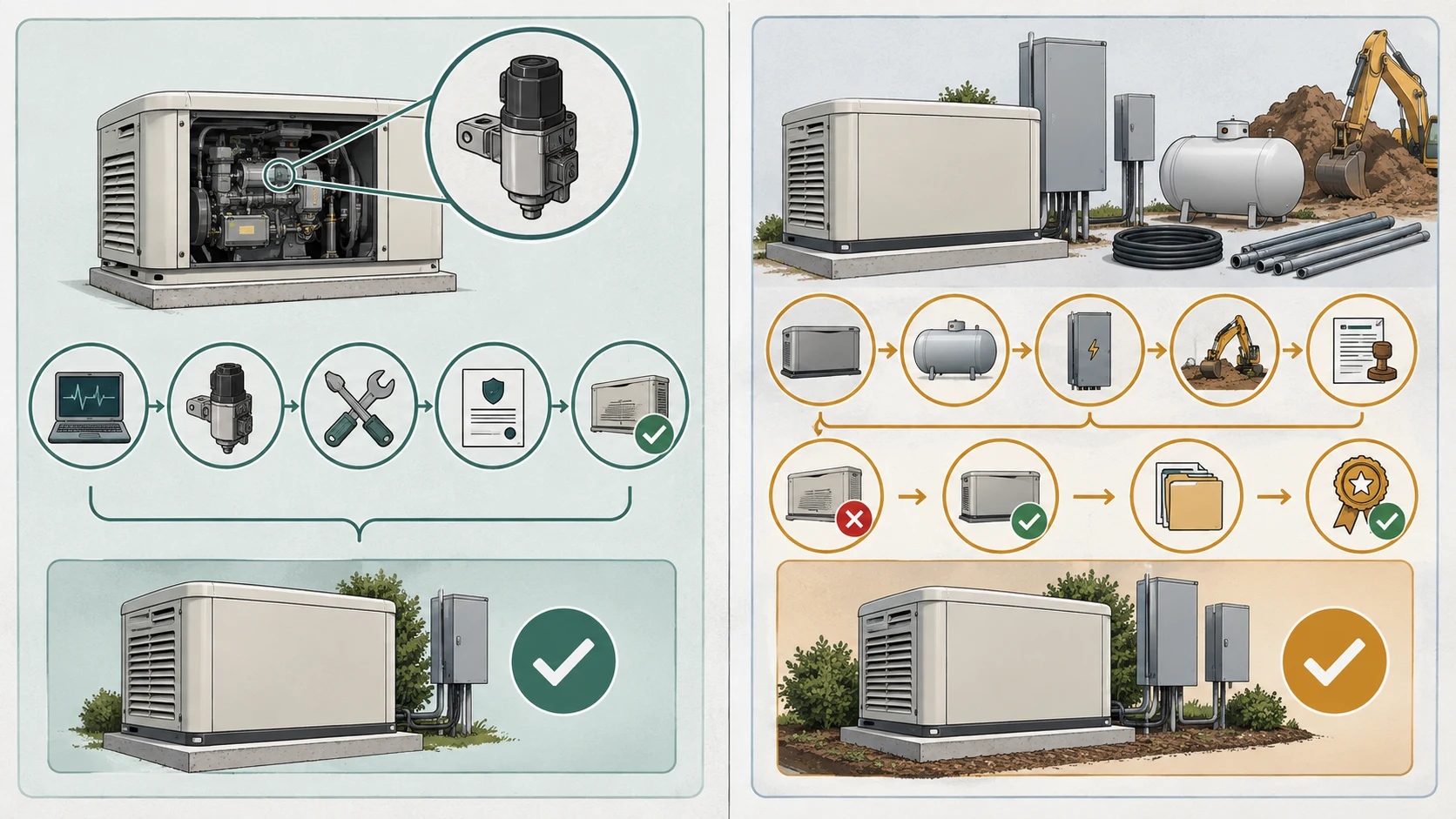
Before storm season, repair the generator when its failure mode is identified, the affected parts and labor are within a defined scope, the warranty or other remedy has been checked, and a qualified professional can verify starting, transfer and required-load performance. Plan replacement when those conditions are not true, when a safety-critical condition remains unresolved, or when the repair would still leave the home without a verified and supportable backup system for the relevant season.
“Before storm season” is a deadline for evidence and scheduling, not a diagnosis. The relevant season might be the Atlantic hurricane season for a Gulf or Atlantic property, a Pacific storm season, a winter ice or wind season, a monsoon season, or a local pattern the homeowner has identified from emergency-management guidance. The date belongs in the worksheet as a jurisdiction- and hazard-specific planning input. It is not a reason to skip testing or to accept a vague promise that the unit “should be fine.”
The CPSC's May 27, 2026 storm-safety release tells consumers to prepare before storms by testing smoke and carbon-monoxide alarms, reviewing generator instructions and ensuring backup-power equipment is working. That is a preparation principle, not a finding that a particular installed generator is ready. Readiness still requires the model manual, service history, warranty terms, transfer record and a qualified test of the system that serves the home.
The four possible outcomes
Use four outcomes so a homeowner does not force every uncertain situation into “repair” or “replace.”
| Recorded outcome | Choose it when the evidence says | Owner action | Professional handoff | Verification before the deadline |
|---|---|---|---|---|
| Homeowner preparation | No unresolved fault is recorded, required maintenance is current or scheduled, the fuel path and enclosure have safe visible conditions, and the manual allows the planned owner checks | Gather records, inspect only what the manual allows, test alarms as directed, clear ordinary debris without opening hazardous systems, and confirm access | Give the packet to the service provider if any item is overdue, unclear or abnormal | Written readiness note with manual section, date, run hours and open items |
| Qualified service | A fault, overdue task or missing verification exists, but the cause and remedy are not yet established | Book the right qualified provider and authorize diagnosis only within a written scope | Generator technician, licensed electrician, fuel professional, utility or AHJ as applicable | Fault cause, parts, labor, safety checks, transfer/load results and remaining risks are documented |
| Defined repair | A qualified diagnosis identifies a bounded repair, warranty remedy or maintenance task, and post-repair verification is available | Approve the exact scope, price, assumptions and completion date | Responsible trade performs work; installer or service provider coordinates the system test | Start, transfer, required loads, alarms and records are verified after repair |
| Replacement planning | Safety, support, parts, load capacity, repeated failure, site changes or schedule risk make restoration uncertain or inadequate | Obtain a replacement scope while preserving safe interim arrangements | Generator installer, electrician, fuel professional and AHJ coordinate the new system | Permit path, equipment compatibility, load design, fuel, transfer, commissioning, records and reserve are complete |
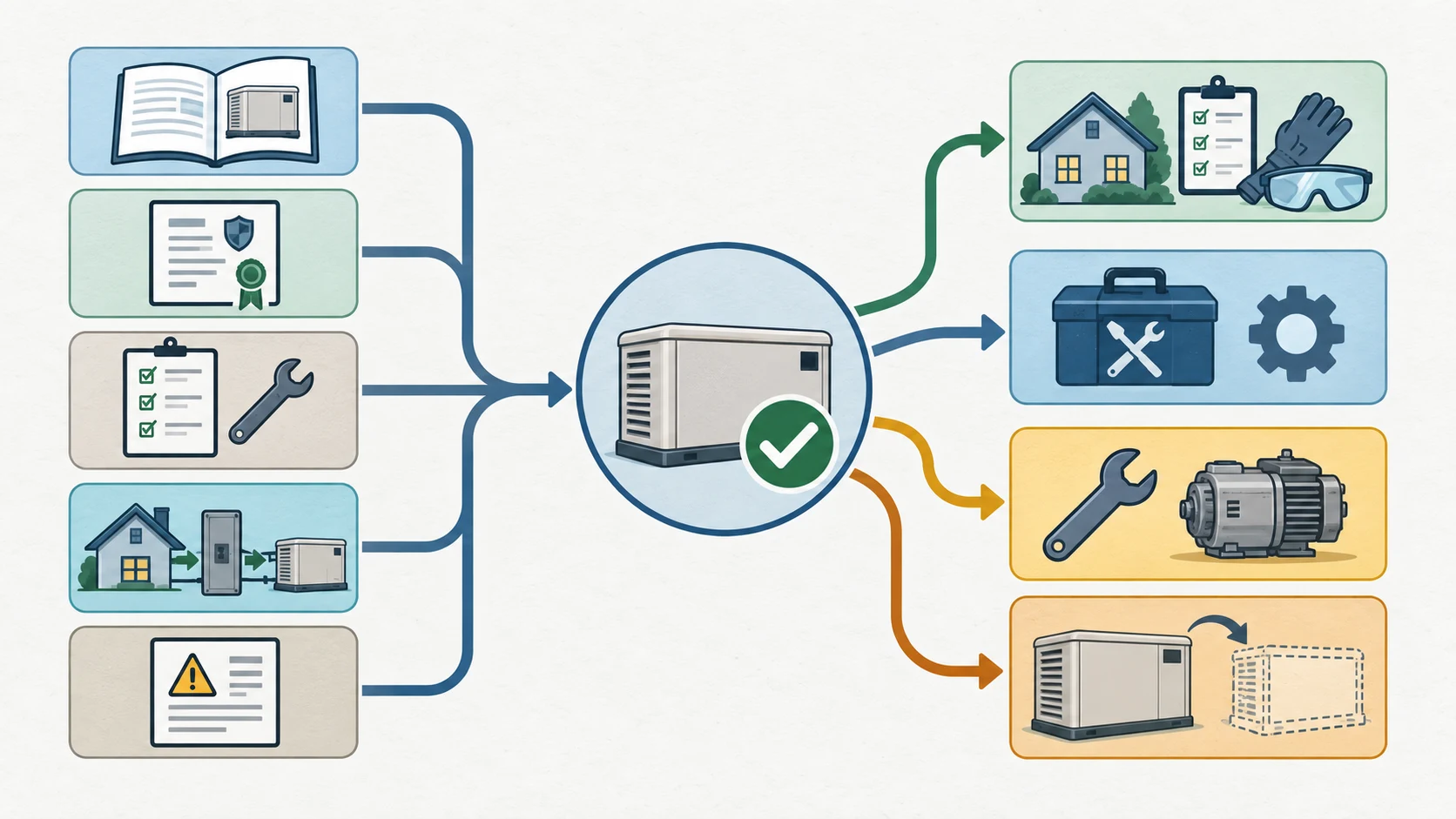
The “qualified service” outcome is important. It prevents a homeowner from approving a replacement because a battery was weak, and it prevents the opposite mistake of approving a cheap part without finding why the generator failed or whether the transfer system can actually carry the intended loads. The decision surface is a handoff between evidence stages.
What can be decided without opening the equipment
The homeowner can normally collect the model and serial number, photograph the data plate from a safe position, record displayed status or fault codes without bypassing a control, note run hours if the controller exposes them, find the manual, assemble invoices and ask the service provider for a written scope. The homeowner can also list the circuits or equipment expected to run during an outage, subject to confirmation by a qualified electrical professional.
The homeowner should not remove energized covers, bridge a safety switch, open a gas train, change wiring, bypass a transfer interlock, measure live voltage, change fuel settings, inspect combustion, reset a fault repeatedly, or perform a load test without the required qualification, isolation and equipment. A photograph of a clean enclosure is not a safety clearance. A “starts” observation is not a transfer or load result. A lack of an alarm is not proof that the unit is healthy.
First handoff: homeowner to service provider
Send a short packet before booking, even if the provider has serviced the unit before:
- exact brand, model, serial number, fuel and rated output;
- installation date if known, total run hours and recent outage hours;
- every fault code, date, symptom and whether it cleared or returned;
- the owner's manual, warranty certificate, registration record and any extended coverage;
- service invoices, parts replaced, maintenance dates and transfer or load-test records;
- battery installation date and any charger or monitoring warning;
- fuel source and whether the line or tank is above ground, underground or shared;
- the home loads that must remain available, including pumps, medical equipment, heating, cooling, refrigeration, communications and alarms;
- the city, county and state where the unit is installed, plus the utility and the likely AHJ contact;
- the storm-season date by which a verified system is needed; and
- the homeowner's budget ceiling or reserve constraint, clearly labeled as a planning constraint rather than a technical threshold.
If those inputs are missing, the first task is evidence recovery, not a replacement decision. The next decision is whether the gap can be closed by the homeowner in one sitting or requires a paid records review or site visit.
2. Build the model-first handoff packet #
The homeowner should assemble an evidence packet before comparing a repair proposal with a replacement proposal, because the exact model, fuel, transfer equipment, warranty and required loads determine what the proposals mean. A national average price or an age-based rule cannot replace this packet.
The exact manual is the controlling starting point for owner-permitted observations, service intervals, fuel requirements, fault descriptions, shutdown procedure and test warnings. Manufacturer manuals are not interchangeable. A Generac Protector manual for 15–50 kW units, for example, includes separate sections for activation, self-test, manual transfer-switch operation, electrical checks, testing under load and automatic operation, followed by service maintenance intervals and component procedures. That is evidence of the questions a model-specific handoff should answer, not permission to apply the procedure to a different generator. See the Generac 15–50 kW Protector owner's manual and locate the installed model's own manual before using any procedure.
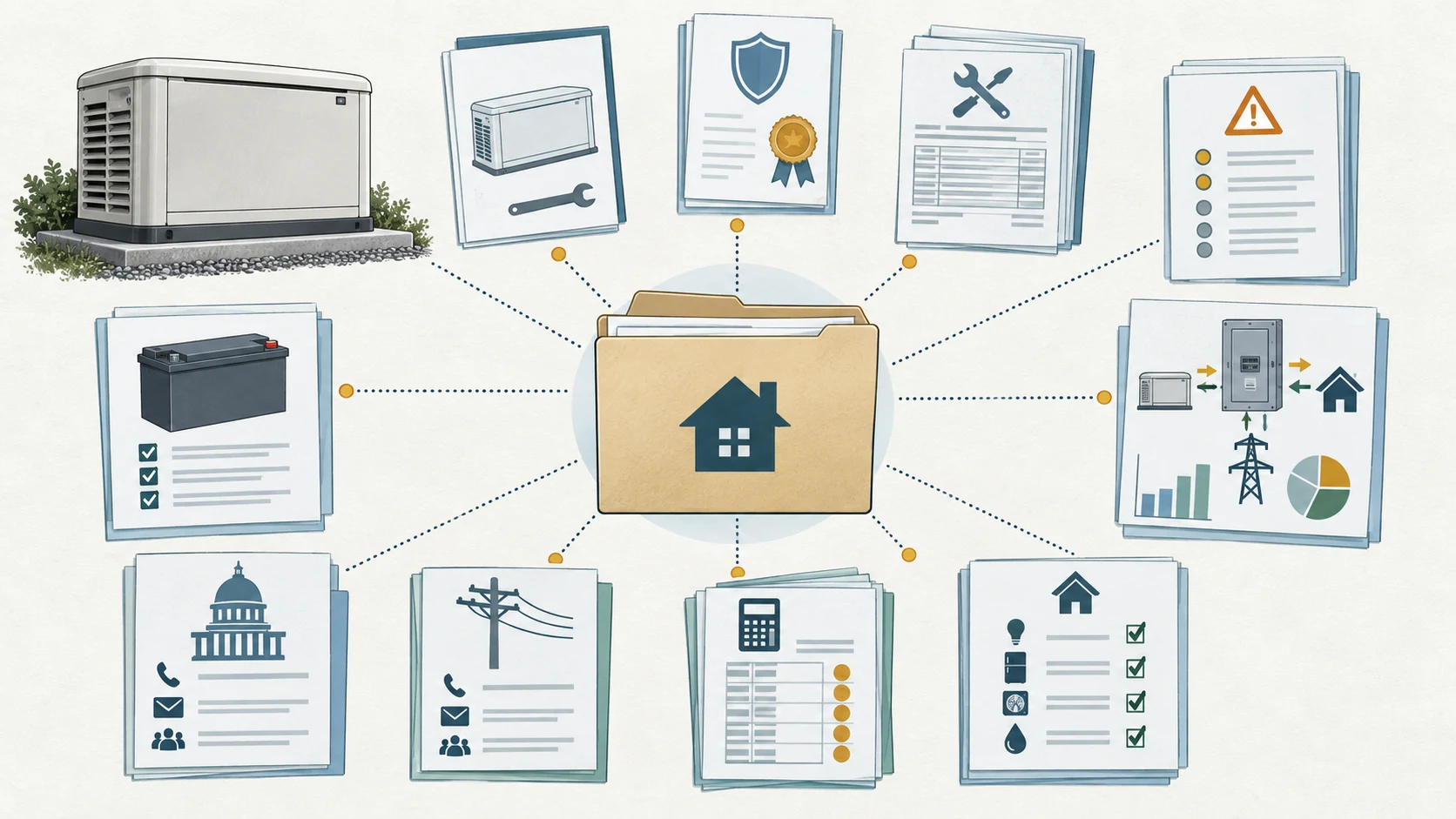
Packet table: record the fact, source and uncertainty
Use one row per fact. “Unknown” is a valid value; an unknown should not silently become “normal.”
| Field | Homeowner records | Source or proof | What it can support | What it cannot prove |
|---|---|---|---|---|
| Brand, model and serial | Exact text and a safe photograph | Data plate, manual, registration | Model-specific manual, parts and warranty lookup | Current condition |
| Fuel | Natural gas, propane, diesel or other exact fuel | Manual, installer record, utility or tank record | Correct diagnostic and replacement scope | Adequate pressure, quality or remaining supply |
| Rated output | Nameplate rating and units | Data plate and manual | Initial load discussion | That the home loads fit or transfer correctly |
| Run hours | Controller reading and date captured | Controller, monitor or service log | Maintenance context and trend | Remaining useful life |
| Fault history | Code, timestamp, symptom, weather and reset history | Alarm log, photos, invoices | Failure pattern and diagnostic priority | Root cause without qualified testing |
| Maintenance due | Manual task, interval, last completion and run hours | Exact manual and invoice | Service scope and scheduling | That a task was completed correctly if the record is absent |
| Battery | Install date, model, warning, charger status shown by controller | Invoice, label, manual | Battery-service question | Battery health without an appropriate test |
| Transfer record | Utility-loss simulation, transfer, return, observed loads and date | Signed service record or commissioning report | Whether qualified verification exists | A homeowner's start-only observation |
| Load record | Test method, connected load, measured result and limits | Qualified test report | Performance against the documented requirement | Compatibility with changed appliances if not reviewed |
| Warranty | Start/end date, covered components, labor, remedy, exclusions and transferability | Written warranty and registration | Whether diagnosis or repair should be routed first | Coverage based on a sales conversation |
| Site and AHJ | City, county, state, utility and named contact | Permit file, AHJ or utility response | Local handoff and permit questions | A nationwide code answer |
| Repair scope | Cause, parts, labor, access, assumptions, tax, permit and test | Itemized quote | Defined repair comparison | Future failures not included in scope |
| Replacement scope | Generator, ATS, fuel work, electrical work, pad/site work, permit, commissioning, disposal and credits | Itemized quote and design | Reserve planning | Final approval until site, AHJ and utility review |
The responsible person for each row should be visible. The homeowner owns the records and decision. A generator technician owns generator diagnosis and service-test results. A licensed electrician owns electrical measurements, transfer equipment and code-sensitive wiring work within the jurisdiction. A fuel professional or utility owns fuel-supply questions within its scope. The installer or general coordinator owns the interface between equipment, fuel, electrical service, permits and commissioning. The AHJ decides the jurisdiction's permitting or inspection requirements; the article cannot do that remotely.
Warranty comes before paid repair
Read the written warranty before authorizing disassembly or non-approved parts. Record the warranty start date, hours or time limits, covered component, labor coverage, required maintenance records, authorized service route, exclusions, remedy language, travel or freight treatment and whether transfer to a new homeowner matters. A warranty may cover a component but not the diagnosis, labor, consequential damage or a related installation condition. It may also require a particular service provider or maintenance evidence. Those terms must be confirmed with the manufacturer or warranty administrator.
If the owner cannot find the warranty, do not infer that coverage has ended. Use the model and serial number to ask the manufacturer or dealer for the correct warranty terms. Generac's product-information and manual page explains that model or serial lookup is used to find specifications and product manuals and that transfer switches have their own product information. This supports a model-first record-recovery step; it does not establish coverage for a specific unit.
Use the warranty route before a paid repair when a component may be covered, the fault appears within the written terms, or the repair could affect coverage. Ask in writing:
- Is diagnosis covered, and by whom?
- Which component or symptom is covered?
- Is labor covered, and what labor assumptions apply?
- Does the proposed repair preserve coverage for the remaining system?
- What records must be supplied?
- What is the stated remedy if the repaired unit fails the post-repair test?
- What is excluded, including fuel quality, installation, transfer equipment, corrosion, flooding, weather damage or unauthorized modifications?
The next decision is simple: proceed through the written remedy if the scope is accepted, or obtain a separate qualified diagnostic if coverage is denied or unclear. Do not count a verbal “probably covered” as a verified credit in the reserve calculation.
Service history is more useful as a sequence than as a single date
A service record should show date, run hours, fault symptoms, work performed, parts, fluids or filters, test method, test result and open recommendations. A single invoice marked “serviced” cannot show whether the automatic transfer switch was exercised, whether the required load was tested, or whether a recurring fault was corrected.
Cummins' seasonal guidance lists oil and filter changes, spark-plug replacement when needed, transfer-switch relay testing, debris removal and enclosure cleaning, and says maintenance frequency depends on hours used. The Cummins hurricane-preparation guidance is manufacturer guidance especially associated with its QuietConnect standby generators, not a universal schedule. Use it to ask better questions, then replace each interval with the installed model manual's requirement.
Create a chronological line like this:
| Date | Run hours | Event | Evidence | Result | Open question |
|---|---|---|---|---|---|
| 2024-08-10 | 214 | Annual service | Invoice 1042 | Oil and filter listed | Was transfer tested? |
| 2025-01-18 | 219 | Storm outage | Owner log | Started, stopped after 10 minutes | Which fault code? |
| 2025-01-22 | 219 | Service visit | Technician note | Battery replaced | Was load restored? |
| 2026-08-20 | 247 | Exercise warning | Controller photograph | Warning remains | Diagnose before storm deadline |
The rows above are a formatting example, not a claim about a real generator or measured condition. Replace every illustrative value with the homeowner's records. If a row cannot be supported, label it “reported by homeowner,” “invoice says,” “controller display says” or “not verified.”
3. Separate safe observations from qualified testing #
Before choosing repair or replacement, complete only the observations the exact manual permits the homeowner to perform and stop at any sign of a fuel, electrical, exhaust, fire, flood or structural hazard. A homeowner can collect evidence; a remote article cannot clear combustion, wiring, grounding, transfer, load, emissions or local-code performance.
The no-energizing boundary
Do not open energized panels, remove covers, defeat interlocks, bypass an emergency stop, bridge a low-oil or temperature switch, work on the battery terminals without following the manual, alter fuel piping, inspect a combustion setting, or connect a test instrument unless the person performing the work is qualified for that system and uses the prescribed isolation and protective methods. Do not “prove” a generator by plugging a household appliance into an improvised connection or by backfeeding a receptacle.
There is also a confined-space boundary. Do not enter a crawlspace, pit, generator enclosure, tank area or any other confined or poorly ventilated area to inspect or test fuel, exhaust or electrical equipment. A homeowner may photograph or record conditions from a safe location, but must hand off inaccessible or suspect conditions to the qualified generator, electrical or fuel professional; a gas odor, CO alarm, fire, floodwater, fallen line or other immediate hazard belongs with the utility or emergency responders for the exact jurisdiction. This is Brictale's conservative safety policy, not a remote clearance.
The CPSC carbon-monoxide fact sheet says fuel-burning appliances should be installed and operated according to manufacturer instructions and local building codes, that most appliances should be installed by qualified professionals, and that fuel-burning appliances should not be serviced without appropriate knowledge, skill and tools. Those are federal safety boundaries. The local rule remains the rule of the homeowner's city, county or state AHJ, and the homeowner must name that jurisdiction rather than assume a national requirement.
A bounded homeowner observation checklist
Complete the left column from a safe position. Mark “not observed” rather than moving a panel or reaching into the unit.
| Observation | Record | Stop and escalate if |
|---|---|---|
| Data plate and enclosure | Model, serial, rating, fuel and visible condition | Plate cannot be read without unsafe access, enclosure is damaged or unit has shifted |
| Controller status | Mode, displayed warning, fault code, run hours and timestamp | Active fault, repeated shutdown, alarm, burning smell or unexplained status |
| Exterior and louvers | Leaves, branches, nests, flood marks, corrosion, blocked airflow or impact | Water intrusion, damaged exhaust, heavy corrosion, blocked ventilation or storm damage |
| Fuel context | Fuel type, tank level display if present, visible line condition from a safe position | Gas odor, hissing, damaged line, regulator concern, buried-line uncertainty or flood damage |
| Battery record | Label date, service invoice and controller warning if shown | Swelling, leakage, corrosion, hot battery, loose connection or charger warning |
| Access and drainage | Safe path, standing water, snow, debris and service clearance | Standing water, unstable ground, fallen lines, contaminated floodwater or blocked access |
| Home alarms | Alarm locations, test result using each alarm's instructions and replacement signal | Alarm sounds unexpectedly, is missing, expired, damaged or cannot be tested as directed |
| Records | Manual, warranty, invoices, transfer/load report and permits | Any critical document is missing or contradictory |
Do not call a line “clear” because it looks intact. A visible natural-gas or propane line check does not measure pressure, leakage or regulator operation. Cummins specifically advises visually checking above-ground gas lines for branches and other objects after a major storm, while noting that underground lines are a different context. Its seasonal guidance does not authorize a homeowner to disconnect, test or repair a fuel line. If there is a gas odor or suspected leak, leave the area and follow the utility or emergency instructions for the exact jurisdiction. CPSC's storm guidance says to leave immediately, avoid operating electronics before leaving, and contact local gas authorities from outside.
CO and smoke alarms are a separate readiness gate
The generator decision is not complete if the home lacks working alarms. CPSC recommends battery-operated or battery-backup CO alarms on every level and outside sleeping areas, with interconnected alarms preferred, and says to follow the alarm manufacturer's instructions. CPSC also explains that a test button tests circuitry rather than sensor accuracy and that replacement age comes from the product literature or manufacturer. See the CPSC CO fact sheet.
Record alarm make, model, location, battery status, replacement date if known and the date of the test-button check. Do not use a passing button test as proof that a generator's exhaust or combustion is safe. Do not place a CO alarm near a heating vent or where furniture or draperies can cover it; use the alarm's instructions and the requirements of the homeowner's jurisdiction.
If a CO alarm sounds, leave immediately for fresh air, call emergency services, do not search for the source, and do not reenter until responders give permission. CPSC says that when the source is determined to be a malfunctioning appliance, that appliance should not be operated until it has been properly serviced by trained personnel. The CPSC emergency response instructions control that federal response branch. Brictale applies a broader conservative policy here: if the alarm sounds or a suspected exhaust or combustion problem is observed, do not run or retest the standby generator until the qualified handoff is complete. A storm deadline never justifies silencing an alarm or resetting the generator repeatedly.
Flood, wind and debris change the decision
A generator that ran last year may not be safe after a storm. Floodwater, salt spray, windborne debris, shifted pads, damaged exhaust, blocked louvers, wet controls, tree contact or a compromised fuel line can create a new hazard. Do not energize or restart equipment that has been flooded or visibly damaged until a qualified professional determines the safe disposition. CPSC warns that wet appliances still connected to electrical sources should not be touched and says qualified professionals or utility representatives should inspect affected systems before reuse. That CPSC storm guidance is a post-storm safety rule, not a repair estimate.
Record the hazard as an event, not as a maintenance item. “Flood exposure—inspection required” should not be converted into “clean and run.” The next handoff may be to the utility, electrician, fuel professional, manufacturer, insurer or AHJ depending on what was affected. The homeowner should preserve photographs from a safe distance, dates, weather information and any emergency shutdown or utility instruction.
4. Verify the whole backup path, not just the engine #
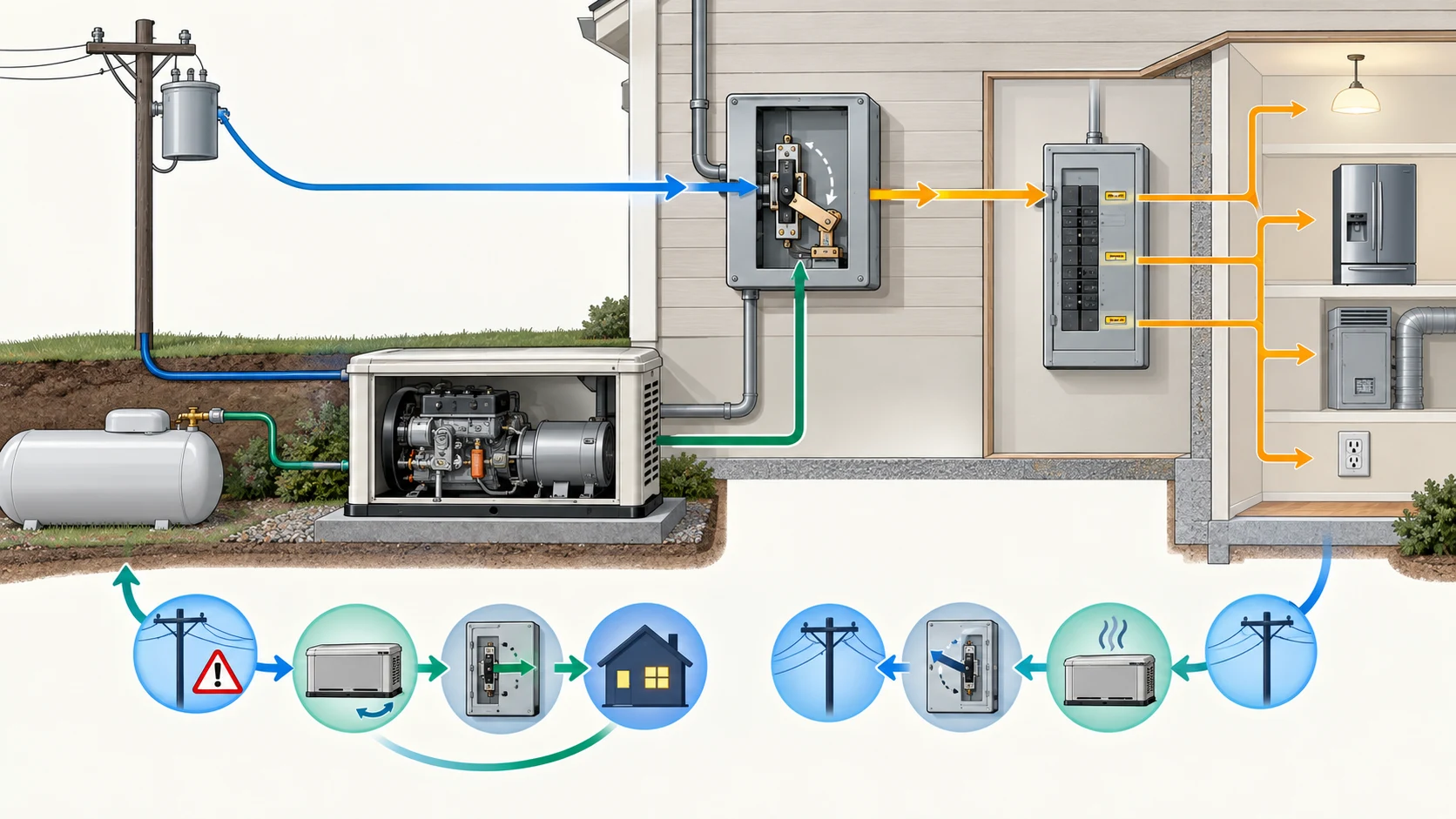
A standby generator is ready for the homeowner's required loads only when the generator, controls, automatic transfer switch, fuel system, distribution equipment and selected loads work together under the documented test conditions. A start-only observation cannot establish that result.
The system sequence
DOE FEMP describes the normal standby sequence: when utility power is unavailable, an automatic transfer switch signals the generator to start and transfers the load; when utility power returns, the load transfers back and the generator stops. It also identifies the ATS as a device intended to permit safe transfer without backfeeding the utility grid. See DOE FEMP's standby-generator and ATS summary.
Use that sequence to ask for separate evidence:
- Detection: How was loss of utility power simulated, and who controlled the simulation?
- Start: Did the engine start within the model's expected sequence, and were fault or warning logs clear?
- Transfer: Did the ATS transfer the documented essential or selected loads?
- Steady operation: Did the generator remain stable for the documented test duration and load?
- Return: Did the ATS return the load to utility power as designed?
- Cooldown and stop: Did the generator complete its stop sequence without a warning?
- Records: What readings, loads, limitations, faults and corrective actions were recorded?
The procedure belongs to the qualified professional and exact manual. The homeowner's job is to require the result in writing. If a provider says “tested,” ask whether that means a controller exercise, a no-load run, a transfer-only check, a measured load test, or the full sequence. Those are not equivalent.
Required load is a design input, not a guess
List what must remain available during an outage and why. A refrigerator, furnace controls, heat pump, well pump, sewage ejector, medical device, sump pump, internet equipment, alarm system or cooking appliance may have different starting behavior and priorities. A nameplate total is only a starting input: Cummins' generator-sizing application manual notes that many loads need more power during starting or peak operation than during steady running, that nonlinear loads can affect sizing, and that staged load control can sequence loads. A qualified reviewer must determine how simultaneous operation, control transformers, duty cycles and load-shedding logic affect this home's actual requirement; this article cannot infer those values from a nameplate total.
Use this worksheet before the service visit:
| Load or circuit | Normal running watts or VA | Starting or inrush information | Required during outage? | Priority | Verified by |
|---|---|---|---|---|---|
| Refrigerator | [record] | [record] | Yes | 1 | Electrician or equipment data |
| Heating controls or furnace | [record] | [record] | Yes | 1 | HVAC/electrical professional |
| Sump or sewage pump | [record] | [record] | [record] | [record] | Pump and electrical professional |
| Well pump | [record] | [record] | [record] | [record] | Pump and electrical professional |
| Medical equipment | [record] | [record] | [record] | 1 | Prescribing provider and electrician |
| Cooling system | [record] | [record] | [record] | [record] | HVAC/electrical professional |
| Communications and alarms | [record] | [record] | Yes | 1 | Owner and installer |
| Optional convenience load | [record] | [record] | No or later | 3 | Owner |
The rows are prompts, not measurements. Do not fill in a guessed wattage to make the system appear adequate. If the generator is too small for the required loads, an engine repair may restore the unit but not solve the homeowner's decision. The replacement path may instead require load management, circuit changes, a larger generator, a different transfer-switch arrangement or a change in what the home promises to power. Those are design and electrical decisions.
Transfer and load record: the minimum useful report
Ask the professional for a record with:
- generator model, serial, fuel and rated output;
- ATS model, rating and any load-management equipment;
- test date, ambient or site conditions when material, and run hours;
- test sequence and whether utility simulation was used;
- loads or circuits connected during the test;
- measured voltage, frequency, current, power or other values the professional's method requires;
- start, transfer, stable operation, return and stop results;
- fault codes or warnings before, during and after the test;
- limitations, excluded loads and recommended corrections;
- the person and business responsible for the test; and
- the next verification date or trigger.
Do not demand a number that the manual or professional method does not use, but do demand enough information to reproduce the decision. “Passed” without scope is not a transferable record. If the technician declines to provide a written scope, treat the service as incomplete evidence and do not use the invoice as proof of readiness.
Local jurisdiction and utility handoff
The homeowner's city, county or state AHJ is the source for permits, inspections and local code questions. The utility is the source for utility-interface requirements and safe coordination around electric or gas service. DOE says generator planning may involve federal, state or local permits, manufacturer instructions, utility specifications and building safety codes, and directs readers to state and local emergency-management authorities and local utilities. See DOE's utility-disruption guidance.
Record the actual jurisdiction instead of writing “local code.” For example:
| Question | Exact entry required |
|---|---|
| Installation address | City, county, state and ZIP |
| Electrical AHJ | Named city or county office, contact and date asked |
| Fuel AHJ or utility | Gas utility, propane supplier or fuel authority and contact |
| Permit question | Repair, replacement, ATS, fuel or pad scope being asked about |
| Utility question | Required notification, disconnect, inspection or interconnection step |
| Inspection evidence | Permit number, inspection date, result and unresolved corrections |
Do not copy a Tallahassee timeline into another market. Cummins' article reports a dealer example of six weeks for city permits in Tallahassee and says surrounding counties could differ. That Cummins example is useful as a scheduling warning, not a current legal fact for every Florida homeowner or any other state. Ask the actual AHJ early, especially if the replacement changes the generator, ATS, fuel piping, pad, enclosure or service equipment.
5. Original contribution: Storm-Season Generator Handoff and Replacement-Reserve Worksheet #
The original contribution is a source-linked handoff worksheet and decision matrix that turns the exact manual, warranty, service history, transfer/load record and scoped quotes into one recorded next action. Its method is to separate homeowner observations from qualified tests, verify coverage and local handoffs first, compare a defined repair scope with a defined replacement scope, and calculate only the nonnegative documented reserve gap while retaining any negative signed balance as surplus. Its limitations are deliberate: it uses no universal repair percentage, average price, assumed service life, remote safety clearance or invented measurement.
Method: Record the exact manual and warranty scope, separate safe homeowner observations from qualified tests, compare the documented repair path with a like-for-like replacement scope, and calculate a nonnegative documented reserve gap as max(0, (R + E - C) - F), while retaining any negative signed balance as a documented surplus.
Limitations: This is a planning aid, not a remote safety clearance, code interpretation, engineering opinion or price survey. It uses no universal service interval, average cost, assumed remaining life or invented quote; the installed model, fuel system, transfer equipment, AHJ and current contractor scopes control.
This is an editorial synthesis, not a field study. It has not been tested on a particular installation and does not claim firsthand inspection, interviews, contractor bids or collected price data. It can be checked by asking whether every nonblank decision field points to an exact manual section, written warranty, dated service record, qualified test, named AHJ or itemized quote. If a conclusion cannot be traced to one of those inputs, label it “unknown” or “planning assumption.”
Originality brief
- Current answers: Storm-preparation checklists and manufacturer guidance cover outdoor placement, carbon-monoxide alarms, fuel readiness, batteries, exercise cycles, debris and routine maintenance.
- Missing decision: Those answers generally stop before the homeowner assembles warranty, fault, transfer/load and quote evidence to choose preparation, qualified service, a defined repair or replacement planning.
- Original contribution: This article supplies the Storm-Season Generator Handoff and Replacement-Reserve Worksheet plus a four-outcome decision matrix and quote-normalization calculation.
- How to check it: Trace each decision field to the exact model manual, written warranty, dated service record, qualified test, named city/county/state AHJ or itemized quote; reject any unsupported value as unknown.
Part A: evidence readiness scorecard
Do not turn this into a fake universal numeric score. Use the status labels to reveal missing handoffs.
| Evidence gate | Ready | Needs service or records | Blocks a repair-only decision |
|---|---|---|---|
| Model and manual | Exact model and current manual matched | Model or manual uncertain | Repair scope may use wrong parts or interval |
| Fuel | Fuel type and supply context documented | Tank, line, regulator or utility record incomplete | Fuel safety or capacity unresolved |
| Warranty | Written terms and remedy checked | Coverage request pending | Paid repair could bypass a possible remedy |
| Fault history | Code and symptom pattern documented | Intermittent or repeated issue | Root cause is not bounded |
| Maintenance | Manual tasks and due status documented | Invoice or interval missing | Preventive work may be overdue or misapplied |
| Battery | Model/date/warning documented | Age or charger status uncertain | Start reliability not verified |
| Transfer | Transfer sequence tested and recorded | Start-only or controller exercise only | Home may remain without power after a start |
| Load | Required loads and test scope recorded | Loads changed or test excluded key circuits | Capacity decision is unresolved |
| Site | Enclosure, access, drainage and damage observed safely | Storm or flood history unclear | Unsafe operation or replacement scope possible |
| Jurisdiction | Named city/county/state AHJ and utility questions answered | Contact not yet made | Schedule and permit risk unresolved |
| Repair quote | Cause, parts, labor, test and exclusions itemized | Allowances or diagnosis open | Repair price is not comparable |
| Replacement quote | Generator, ATS, fuel, electrical, permits, commissioning and credits itemized | Design or enabling work open | Reserve gap is not comparable |
The “blocks” column does not mean replacement is mandatory. It means the evidence is insufficient to authorize repair as the final seasonal plan. The appropriate next action may be qualified service or replacement planning while the missing record is obtained.
Part B: decision matrix
Apply the matrix to the evidence, not to age alone.
| Condition observed in the packet | Repair path | Replacement-planning path | Recorded next action |
|---|---|---|---|
| Single battery, maintenance or known consumable issue; no active safety condition; transfer/load record current | Strong candidate if manual and provider confirm scope | Keep as a contingency if parts or schedule are uncertain | Complete defined service, then verify full sequence |
| Fault code has a confirmed cause, available part and fixed repair scope | Strong candidate if post-repair test is included | Compare only if repair lead time or support risk threatens deadline | Authorize repair with written test acceptance |
| Fault repeats after prior repair or cause is not identified | Do not authorize an open-ended repair | Obtain replacement scope while a safe diagnostic is performed | Qualified service plus replacement planning |
| Fuel leak, damaged exhaust, flood exposure, unsafe wiring or active CO concern | Repair cannot be treated as homeowner preparation | Replacement may or may not be required after professional disposition | Stop operation; emergency, utility, AHJ or qualified-service handoff |
| Generator starts but ATS does not transfer or required loads fail | Repair ATS, controls, wiring or load design if cause is bounded | Compare replacement if parts, compatibility or capacity are unresolved | Electrical/generator diagnosis and documented transfer test |
| Warranty remedy may apply | Route through written warranty before paid work | Include replacement only if remedy cannot restore needed performance | Obtain written coverage decision |
| Parts unavailable, model unsupported or repair schedule misses the deadline | A repair may be technically possible but not a seasonal plan | Replacement planning becomes time-critical | Secure interim plan and replacement scope |
| Replacement changes fuel, capacity, ATS, pad or service equipment | Repair may preserve current installation if adequate | Replacement requires AHJ, utility and design coordination | Treat as a project, not a box swap |
| Two proposals use different assumptions or omit enabling work | No fair repair-versus-replace comparison yet | No fair reserve calculation yet | Normalize scopes before choosing |
The matrix intentionally contains no age row that automatically decides the result. Age can be recorded and can affect parts, support, corrosion, efficiency or expected maintenance, but it does not by itself identify the failed component, prove unsafe operation or establish a replacement requirement. The manual, records, qualified test, warranty, site and support path are stronger decision inputs.
Part C: quote normalization sheet
Ask for two scopes that can be compared at the same level of completeness. A repair quote should include diagnosis, repair parts, labor, travel, access, consumables, taxes, permits if applicable, warranty handling, post-repair start/transfer/load verification, exclusions and a completion date. A replacement quote should include new generator, ATS or compatibility work, load-management equipment, fuel work, electrical service or panel changes, pad or site work, removal and disposal, permits, inspections, commissioning, owner training, records, monitoring, taxes, credits and a completion date.
Copy each quote into this table rather than comparing the headline totals:
| Cost or credit line | Repair scope ($) | Replacement scope ($) | Verified? | Included or excluded note |
|---|---|---|---|---|
| Diagnosis or design | [input] | [input] | Yes/No | [scope] |
| Generator or major part | [input] | [input] | Yes/No | [model/part] |
| Automatic transfer switch | [input] | [input] | Yes/No | [rating/model] |
| Fuel piping, regulator, tank or utility work | [input] | [input] | Yes/No | [fuel and jurisdiction] |
| Electrical service, panel or load management | [input] | [input] | Yes/No | [circuits and assumptions] |
| Pad, drainage, enclosure or site work | [input] | [input] | Yes/No | [site condition] |
| Permit, inspection and utility coordination | [input] | [input] | Yes/No | [named AHJ/utility] |
| Removal and disposal | [input] | [input] | Yes/No | [old equipment] |
| Commissioning and transfer/load test | [input] | [input] | Yes/No | [acceptance record] |
| Monitoring, training and handover documents | [input] | [input] | Yes/No | [owner deliverables] |
| Warranty credit or manufacturer remedy | [input] | [input] | Yes/No | [written reference] |
| Trade-in, salvage or other credit | [input] | [input] | Yes/No | [verified condition] |
| Tax, finance or allowance assumption | [input] | [input] | Yes/No | [not technical proof] |
| Comparable subtotal | [formula] | [formula] |
Do not count a possible warranty credit, trade-in, insurance payment or tax treatment until it is written and attributable to a responsible party. A sales allowance is not the same as money available to complete the work. A quote that says “permit allowance” without identifying the AHJ and what is included is not a verified local-cost input.
6. Calculate a replacement reserve without inventing a price #
The homeowner can calculate a transparent reserve gap from actual scopes and credits, but should not use a national average or a percentage-of-value shortcut as if it were a quote. The calculation below is a planning formula whose inputs come from the normalized replacement scope and the homeowner's available funds.
Formula and units
Let:
- R = replacement equipment and installation scope in U.S. dollars;
- E = verified enabling work in U.S. dollars, including electrical, fuel, pad, drainage, access or permit work that the quote identifies as required;
- C = verified credits in U.S. dollars, such as a written warranty remedy or confirmed trade-in credit;
- F = funds available for this decision in U.S. dollars;
- G = documented reserve gap in U.S. dollars.
Use:
B = (R + E - C) - F
G = max(0, B)
If B > 0, the documented plan has a funding gap, and G = B dollars. If B ≤ 0, the listed funds cover the documented scope on paper, G = $0, and the absolute value of B is a documented surplus against that scope. Neither result proves technical adequacy, permit approval, timing or final price. Every input must carry a source: quote line, written warranty, account statement or explicit homeowner planning constraint.
Illustrative worked example
The following is an illustrative modeled example, not a market quote, contractor estimate or observed installation. It uses invented planning inputs only to show the arithmetic; do not copy the amounts.
| Input | Illustrative value | Source label in a real worksheet |
|---|---|---|
| Replacement equipment and base installation, R | $11,800 | Itemized replacement quote, dated |
| Verified enabling work, E | $3,200 | Itemized electrical and fuel scope, dated |
| Written warranty credit, C | $1,500 | Manufacturer or warranty administrator letter |
| Confirmed trade-in credit | $0 | None received, so not counted |
| Available funds, F | $9,000 | Homeowner budget decision |
Calculation:
B = ($11,800 + $3,200 - $1,500) - $9,000 = $4,500
G = max(0, $4,500) = $4,500
The illustrative reserve gap is $4,500. It does not mean the homeowner should borrow $4,500, accept the quote, or choose replacement. It means the current documented scope is not covered by the stated funds. The next decision could be to seek a second scoped quote, confirm whether enabling work is actually required, route the repair through warranty, revise the required-load design, change timing, or choose a defined repair with a safe interim plan.
Sensitivity: which uncertainty matters most?
Change one input at a time and label the result. If enabling work is $1,000 higher, the illustrative gap increases to $5,500. If the written warranty credit is $500 rather than $1,500, the gap increases to $5,500. If the homeowner confirms a $2,000 trade-in credit, the gap decreases to $2,500. If the generator scope changes because the required loads need a larger unit, the base quote must be replaced; adding a percentage to the old quote is not a verified sensitivity.
| Scenario | R | E | C | F | B signed balance | G reserve gap | Interpretation |
|---|---|---|---|---|---|---|---|
| Base illustration | $11,800 | $3,200 | $1,500 | $9,000 | $4,500 | $4,500 | Documented funding gap |
| Enabling work +$1,000 | $11,800 | $4,200 | $1,500 | $9,000 | $5,500 | $5,500 | Fuel/electrical scope drives risk |
| Warranty credit -$1,000 | $11,800 | $3,200 | $500 | $9,000 | $5,500 | $5,500 | Coverage must be verified |
| Confirmed trade-in +$2,000 | $11,800 | $3,200 | $3,500 | $9,000 | $2,500 | $2,500 | Credit reduces, but does not erase, gap |
| Funds +$5,000 | $11,800 | $3,200 | $1,500 | $14,000 | -$500 | $0 | $500 documented surplus; scope covered on paper only |
The sensitivity table reveals where a follow-up is valuable. If the answer changes materially when a credit is assumed, ask for the written credit before treating replacement as affordable. If the answer changes because fuel or electrical work is uncertain, ask the appropriate qualified trade or AHJ. If the answer changes because of required loads, return to load design rather than negotiating only the generator price.
Reserve versus operating budget
Keep separate lines for replacement reserve, routine maintenance, emergency service, fuel, monitoring, permit fees, temporary power, and future load changes. DOE's planning guidance says backup-system planning includes adequate fuel, service contracts and periodic testing, but its guidance is not a residential price schedule or a promise of how many days a particular fuel supply will last. See DOE's utility-disruption guidance.
The reserve gap should not hide a recurring operating problem. If a repair reduces the immediate cash requirement but the same unresolved fault, poor fuel supply, inadequate transfer equipment or missing load design remains, the homeowner has not solved the decision. Record both:
- Seasonal readiness cost: what must happen before the deadline;
- Ownership reserve: what the homeowner expects to fund over the planning horizon based on the exact manual, service proposal and known support path.
Do not invent a remaining-life curve or average annual cost. Ask the service provider to distinguish maintenance from corrective repair and to identify which future tasks are in the written plan.
7. Choose, authorize and verify the next action #
Authorize only the next bounded action that closes the largest evidence gap while protecting people and property. A homeowner should not authorize an open-ended repair, an unscoped replacement, or a test that does not state what will be measured and accepted.
If the next action is homeowner preparation
Use this branch only when there is no active safety concern and the exact manual allows the planned observation. The homeowner should:
- save the manual, warranty and service record in one folder;
- record model, serial, fuel, run hours and controller status;
- check the enclosure, louvers, access and visible debris from a safe position;
- record fuel context without touching or altering fuel equipment;
- confirm CO and smoke alarm locations and test them according to their instructions;
- confirm the storm-season date and the service-provider availability;
- list required loads and changes since the last test;
- request any missing transfer/load or commissioning record; and
- set an escalation trigger for any fault, odor, flood exposure, damage, repeated warning or missing proof.
The output is a dated preparation log, not a claim that the generator is certified or safe for every condition. If the generator has not had a qualified transfer/load test after a major change or unresolved fault, the next action remains qualified service.
If the next action is qualified service
Write the service authorization as diagnosis first. It should identify the model, symptoms, permitted diagnostic scope, travel or access assumptions, whether the provider may perform a start or transfer test, safety stop conditions, the report the homeowner will receive, and how additional work must be approved.
Ask the provider to separate:
- immediate safety disposition;
- diagnostic findings;
- maintenance due regardless of fault;
- corrective repair recommended;
- warranty remedy or manufacturer escalation;
- replacement indicators or support constraints;
- post-service test scope; and
- items not inspected.
The owner should receive the fault cause or the statement that the cause remains unconfirmed. “Needs a new generator” is not a cause. “Battery failed the specified test; replacement proposed; transfer/load test not yet performed” is a usable handoff.
If the next action is a defined repair
Approve a written repair scope with an acceptance condition. The scope should name the part or system, labor, related consumables, warranty treatment, expected completion date, exclusions, price basis, and the test that determines whether the work is complete. If the repair reveals additional damage, stop and require a change order or a new decision; do not let a small repair become an unbounded replacement through accumulated assumptions.
The acceptance record should state whether the generator starts, transfers, supports the documented required loads, returns to utility, clears or explains the warning, and leaves no known unsafe condition. Some tests require utility coordination or work by a licensed electrician or fuel professional. The homeowner can observe the result if the professional permits it, but should not operate controls or enter restricted areas to improve the demonstration.
If the next action is replacement planning
Treat replacement as a coordinated handover, not a delivery of a metal enclosure. The plan should identify:
- required and optional loads;
- target output and load-management assumptions;
- exact generator and ATS models or a defined equipment basis;
- fuel type, supply capacity and responsible fuel professional or utility;
- electrical service, panel, grounding, disconnect and transfer scope;
- pad, drainage, flood, wind, access and enclosure constraints;
- removal and disposal of the existing unit;
- permit and inspection path for the city, county or state AHJ;
- utility notice or coordination;
- commissioning and transfer/load acceptance test;
- warranty registration, manuals, as-built or configuration records and owner training;
- temporary-power plan if the home will be without backup during the work; and
- the itemized replacement reserve and verified credits.
Obtain the replacement design early enough for the local permit and inspection path. A replacement that changes fuel piping, service equipment or transfer equipment can require more coordination than a like-for-like equipment exchange. Do not assume the old pad, conductors, clearances, ATS, fuel supply or selected circuits are compatible with the new model.
What a complete handover looks like
At completion, the owner should have a folder containing:
- installed model and serial records;
- final equipment and ATS manuals;
- warranty and registration confirmation;
- fuel and electrical permits or inspection results when applicable;
- final wiring, load or circuit schedule when provided;
- fuel-system or utility sign-off within its scope;
- commissioning or transfer/load test report;
- fault and maintenance history through completion;
- battery type and installation date;
- maintenance intervals copied from the exact manual;
- monitoring setup and alert contacts if used;
- emergency shutdown and restart instructions;
- service-provider contact and escalation route; and
- unresolved limitations, excluded loads and next service date.
The handover is not complete because the generator starts once. DOE's description of the ATS sequence and its emphasis on periodic testing show why the transfer path belongs in the record. The DOE FEMP equipment summary also says that neglecting maintenance can result in premature system failure and lack of power during an outage. Use that as the reason to preserve records, not as a prediction about this home's remaining life.
8. Common failure cases and the next decision #
The most expensive errors happen when a plausible observation is treated as a complete answer. Use the failure branches below to decide what evidence to obtain next.
“It is old, so replacement is obvious”
Age may increase the likelihood of worn parts, corrosion, unavailable support or obsolete controls, but age alone does not identify a failure or prove that replacement is safer or cheaper. Ask for the model, run hours, fault history, parts availability, maintenance status, transfer/load record and replacement scope. If the unit is otherwise supported and the problem is bounded, a repair may be the more defensible seasonal action. If support is unavailable or failures recur, replacement planning may be prudent. The next decision is based on those records, not the calendar age.
“The battery is bad, so the system is fixed”
A battery can prevent starting, and Cummins identifies dead batteries as a leading reason standby generators fail to start while recommending a three-year battery practice for its guidance context. The Cummins battery guidance does not prove the installed battery is bad, and it does not prove that replacing it resolves transfer or load performance. Verify the exact battery specification, charger condition and post-replacement full sequence. The next decision is whether the system passes the required test.
“It exercises every week, so it is ready”
An exercise cycle may show that the controller can command a start under the exercise conditions. It may not show that the ATS transfers, that the required loads are connected, that a motor starts, that the fuel path sustains operation, or that the unit returns to utility correctly. Ask what the exercise actually tested and compare it with the exact manual's operational checks. The next decision is qualified service or a documented transfer/load test if those records are absent.
“The invoice says serviced”
A service label without date, run hours, tasks, parts, fault history and test result is weak evidence. Cummins' guidance names multiple maintenance and transfer-related actions, and the Generac manual's maintenance section shows that a model may distinguish service intervals and components. That does not mean every provider performed them. Ask for the detailed report and reconcile it to the manual. The next decision is to schedule missing maintenance or accept the record if the scope matches.
“The quote is lower than replacement, so repair wins”
A repair quote is not comparable if it excludes diagnosis, parts lead time, access, warranty handling, enabling work, post-repair test or the unresolved cause. A replacement quote is not comparable if it includes a larger generator, new ATS, fuel changes, permits and commissioning while the repair quote does not. Normalize both scopes and calculate the reserve gap only from verified inputs. The next decision is a corrected quote, not a price verdict.
“The new generator will fit where the old one sits”
The new model may have different dimensions, clearances, weight, exhaust, fuel demand, electrical rating, ATS requirements, pad loads or drainage needs. A replacement that looks like a box swap can become a site, electrical, fuel or permit project. Ask the installer and the exact AHJ about the actual address and scope. The next decision is whether the replacement design can be permitted, supplied and commissioned before the deadline.
“The gas line looks fine”
A visible line can still have an unresolved leak, pressure, regulator, capacity, corrosion or utility issue. The homeowner may record visible debris or damage from a safe position, but should not test or modify fuel equipment. Cummins' advice about visually checking above-ground lines after storms is a bounded observation, not a fuel-system clearance. The next decision is a qualified fuel or utility handoff if any line, odor, supply or flood question exists.
“The generator is outside, so CO risk is solved”
Outdoor placement alone is not a remote safety clearance. Exhaust direction, openings, vents, installation, combustion, alarms, damage and local requirements still matter. CPSC's generator guidance says CO from a generator is deadly and can kill within minutes, and provides portable-generator guidance; CPSC's CO fact sheet also says appliances should follow manufacturer instructions and local building codes. Do not transfer portable-generator distance guidance to a permanently installed system without checking its manual and local AHJ. The next decision is qualified inspection if exhaust, ventilation or alarm conditions are uncertain.
“The old unit can cover the new home's loads”
Home loads can change when a heat pump, electric water heater, EV charger, well pump, sump pump, medical device or new refrigeration is added. Starting demand and load shedding can change the required design. List the present and required circuits, then obtain a qualified load review. The next decision is repair of an adequate system, load management, or a replacement design that matches the real requirement.
“The storm is coming, so test it myself tonight”
Urgency is a reason to narrow the work, not to bypass safety. Do the records and safe observations now. Call the qualified provider, utility or emergency authority for any active fault, gas odor, flood exposure, electrical damage, CO alarm or inaccessible system. CPSC's storm release says to prepare before power is lost and its CO guidance says not to service fuel-burning equipment without appropriate skill and tools. The next decision is a safe interim plan and a written service slot, not an improvised test.
Final decision record
Complete this sentence and sign it with the date:
“For the permanently installed [brand/model/serial] at [city, county, state], using [manual title and revision], [warranty status], [service history], [transfer/load record] and [quote references], we will [prepare / book qualified service / authorize defined repair / start replacement planning] because [documented reason]. Before the locally relevant [season or date], [responsible person] will verify [specific start, transfer, required-load, return, alarm, permit or handover result]. If [failure trigger] occurs, we will [next escalation].”
The record is complete only when the responsibility and verification are named. “Homeowner to monitor” is not enough; name what is monitored, how often, what counts as failure and who receives the escalation. “Contractor to test” is not enough; name the test sequence, required loads, acceptance record and date.
The shortest defensible rule
Choose repair when the fault, remedy, schedule and acceptance test are bounded. Choose replacement planning when safety, support, capacity, repeated failure or schedule remains uncertain after qualified review. If the evidence is incomplete, choose qualified service or replacement planning as the next action rather than pretending that a start, an old invoice, a low quote or a general storm checklist answers the repair-versus-replace question.
That is the purpose of the worksheet: to make the owner’s decision auditable, the professional’s scope comparable and the next handoff obvious without inventing a cost, local rule, measurement or safety clearance.
Cite this guide
Brictale. “Should You Repair or Replace a Standby Generator Before Storm Season?.” Published 2026-09-14; updated 2026-09-14.
https://brictale.com/build/handover/repair-or-replace-standby-generator-before-storm-season · Read the Markdown version
Original contribution: Storm-Season Generator Handoff and Replacement-Reserve Worksheet. A source-linked worksheet and decision matrix that converts the installed generator's model, fuel, run hours, history, warranty, transfer/load record and scoped quotes into one recorded next action.
Sources and scope
Evidence behind this page
- In its May 27, 2026 storm-season release, the U.S. Consumer Product Safety Commission tells consumers to prepare before storms by testing smoke and carbon-monoxide alarms, reviewing generator safety instructions, and ensuring backup-power equipment is working.
CPSC Warns of Generator, Carbon Monoxide and Fire Hazards Ahead of Hurricane Season
Federal CPSC consumer-safety guidance for storm preparation in the United States; it does not establish a generator-specific service interval or local installation rule.
Accessed · Link to this claim - CPSC's 2026 storm release says portable generators should be operated outdoors at least 20 feet from homes and buildings, with exhaust directed away from windows, doors and vents; this guidance is for portable generators and does not substitute for a permanently installed unit's manual or local requirements.
CPSC Warns of Generator, Carbon Monoxide and Fire Hazards Ahead of Hurricane Season
Portable-generator placement and exhaust warning; intentionally not broadened into a national siting rule for permanently installed standby generators.
Accessed · Link to this claim - CPSC recommends battery-operated or battery-backup carbon-monoxide alarms on every level of the home and outside sleeping areas, says interconnected alarms are best, and says a test button checks circuitry rather than sensor accuracy.
Federal CPSC household CO guidance; alarm installation and replacement must also follow the alarm manufacturer's instructions and applicable jurisdictional requirements.
Accessed · Link to this claim - CPSC says fuel-burning appliances should be installed and operated according to manufacturer instructions and local building codes, that most appliances should be installed by qualified professionals, and that fuel-burning appliances should not be serviced without appropriate knowledge, skill and tools.
Federal safety guidance for fuel-burning appliances; it does not identify the homeowner's city, county or state AHJ or interpret that jurisdiction's code.
Accessed · Link to this claim - CPSC says that if a CO alarm sounds, occupants should move outside to fresh air, call emergency services, not reenter until responders give permission, and, if the source is determined to be a malfunctioning appliance, not operate that appliance until it has been properly serviced by trained personnel.
Emergency-response guidance for a sounding CO alarm in a United States home.
Accessed · Link to this claim - Cummins seasonal guidance lists on-time oil and filter changes, spark-plug replacement when needed, transfer-switch relay testing, debris removal and exterior cleaning, and says maintenance frequency depends on hours used.
How to prepare your home generator for a hurricane
Cummins manufacturer guidance, especially for QuietConnect standby generators; it is not a universal interval for every brand, model, fuel or installation.
Accessed · Link to this claim - Cummins says dead batteries are a leading reason standby generators fail to start and recommends switching the generator battery every three years as a reliability practice, while noting dealer testing may be part of service.
How to prepare your home generator for a hurricane
Cummins seasonal guidance; a homeowner must verify the installed model's battery specification, warranty and manual before applying the interval.
Accessed · Link to this claim - Cummins advises visually checking above-ground gas lines serving a generator for branches and other debris after a major storm; it describes underground lines as a different observation context.
How to prepare your home generator for a hurricane
A visual debris check in Cummins' storm-preparation guidance; it is not permission to alter, test, disconnect or repair fuel piping.
Accessed · Link to this claim - Cummins' article gives a Tallahassee, Florida dealer's example that permits took six weeks there for generator installations and says surrounding counties could differ; the example is local and must not be treated as a national permit timeline.
How to prepare your home generator for a hurricane
A reported Tallahassee-area example in a Cummins dealer-authored article; not a current permit promise for Tallahassee or any other jurisdiction.
Accessed · Link to this claim - DOE FEMP describes standby generators as systems that provide electricity when utility power is unavailable and says an automatic transfer switch signals the generator to start, transfers the load, and transfers the load back when utility power returns.
Equipment Operations and Maintenance Summaries
DOE FEMP general equipment description and operations-and-maintenance context; it does not verify a particular home's actual transfer or load performance.
Accessed · Link to this claim - DOE says generator planning can require determining emergency loads, obtaining applicable federal, state or local permits, following manufacturer instructions, utility specifications and building safety codes, periodically testing the backup system, maintaining service contracts and maintaining adequate fuel; it directs readers to state, local and utility authorities.
Business Owners: Prepare for Utility Disruptions
DOE emergency-planning guidance written for business owners; used here for the planning handoff principles, not as a residential code or a guaranteed fuel-duration requirement.
Accessed · Link to this claim - The Generac 15-50 kW Protector standby-generator owner's manual includes self-test, manual-transfer-switch, electrical-check, under-load-test and automatic-operation checks in its activation and startup procedures.
Owner's Manual for 15-50 kW Protector Standby Generators
A specific Generac Protector manual; headings and procedures must be matched to the installed model rather than generalized to all standby generators.
Accessed · Link to this claim - The Generac 15-50 kW Protector owner's manual includes service maintenance intervals and maintenance procedures addressing fuel, fuel lines or filters, coolant, radiator clogging, lubricating oil, battery condition and replacement, belts and air filters.
Owner's Manual for 15-50 kW Protector Standby Generators
A specific Generac Protector manual's maintenance section; it is evidence that the manual contains model-specific maintenance scope, not a universal schedule.
Accessed · Link to this claim - CPSC's May 27, 2026 storm release says not to touch wet appliances that remain connected to an electrical source and says a qualified professional or utility representative should inspect the home before reuse, with submerged gas control valves, electrical wiring, circuit breakers and fuses replaced.
CPSC Warns of Generator, Carbon Monoxide and Fire Hazards Ahead of Hurricane Season
Federal CPSC post-flood consumer-safety guidance; it does not determine the disposition of a particular standby generator or replace the homeowner's utility, qualified professional or AHJ review.
Accessed · Link to this claim - CPSC's generator safety guidance states that carbon monoxide from a generator is deadly and can kill within minutes, and its portable-generator guidance applies to portable units rather than establishing siting requirements for a permanently installed standby generator.
Generators and Engine-Driven Tools
Federal CPSC carbon-monoxide warning and portable-generator guidance; intentionally not generalized into a permanently installed generator's manual, engineering or local siting rule.
Accessed · Link to this claim - CPSC's May 27, 2026 storm release says that if a person smells or hears gas leaking, they should leave immediately, avoid operating electronics before leaving, and contact local gas authorities from outside the home.
CPSC Warns of Generator, Carbon Monoxide and Fire Hazards Ahead of Hurricane Season
Federal CPSC emergency response guidance for a suspected gas leak after a storm; the responsible gas utility or emergency authority for the actual city, county or state controls the local response.
Accessed · Link to this claim - DOE FEMP says neglecting standby-generator maintenance can result in premature system failure and a lack of power during an outage, supporting the need to preserve maintenance records and periodic testing without predicting a particular unit's remaining life.
Equipment Operations and Maintenance Summaries
DOE FEMP general operations-and-maintenance guidance; it does not diagnose a residential generator, set a universal maintenance interval or estimate remaining service life.
Accessed · Link to this claim - Cummins Power Generation's application manual says many loads require more power during starting or peak operation than during steady running, that nonlinear loads can affect generator sizing, and that staged load control can reduce starting requirements by sequencing loads.
Electrical Load Impact On Generator Sizing
Cummins Power Generation application-manual guidance on generator-set load analysis and sizing; it is technical planning guidance, not a residential code rule or a model-specific acceptance criterion.
Accessed · Link to this claim - Generac's product-information page says that entering a product's model number or serial number can return specifications, product manuals and other support information, and provides a separate product-information path for transfer switches.
Product Information, User Manuals, & Support
Generac's own model and serial lookup workflow; it supports recovering model-specific documents but does not establish warranty coverage or the condition of a particular installed unit.
Accessed · Link to this claim