How to Prepare a Rooftop Solar Post-Storm Repair-or-Replace Budget
A safe US homeowner sequence for documenting rooftop-solar storm damage, assigning handoffs, verifying faults, and comparing repair or replacement budgets.
The short answer
Do not climb on or re-energize a storm-damaged rooftop PV system. Photograph what you can safely see, preserve monitoring and purchase records, notify your insurer and warranty contact, then hire a qualified solar/electrical professional to inspect, test, and separate module, racking, wiring, inverter, roof, and utility issues. Budget only from a written scope that names tests, permits, interconnection steps, and repair-versus-replace assumptions.Do not climb on or re-energize a storm-damaged rooftop photovoltaic system. Photograph what you can safely see from the ground, preserve production and purchase records, notify your insurer and warranty contact, and hire a qualified solar or electrical professional to inspect and test it. Your repair-or-replace budget should separate modules, racking, wiring, inverter, roof interface, debris, permits, utility steps, and downtime instead of pricing “the array” as one item.
How to Prepare a Rooftop Solar Post-Storm Repair-or-Replace Budget
This guide is for a United States homeowner after wind, hail, lightning, wildfire, heavy snow, falling trees, flooding, or another weather exposure. It stops at planning and handoff. It does not approve a live system from a distance, tell you that a roof is safe to enter, interpret a specific insurance policy, replace an electrician, or replace the authority having jurisdiction (AHJ), utility, equipment manufacturer, engineer, or qualified solar contractor.
The decision is not simply “Can the panels be fixed?” The useful decision is: what must remain out of service, what facts can be preserved without creating another hazard, who owns each next action, what technical evidence must support the scope, and whether the next comparable quote should cover a component repair, one array section, a roof-and-array repair, or a larger replacement. The answer changes with system ownership, roof condition, equipment age, storm mechanism, policy language, warranty terms, local approvals, and the utility’s interconnection process.
1. Make the safe stop-use decision before you investigate cost #
The safe first decision is to keep people away from visibly damaged roof and electrical areas and have a qualified professional establish the system’s isolation and test plan; a homeowner should not climb onto a damaged roof, handle loose PV hardware, open electrical enclosures, unplug connectors, or use a monitoring screen as proof of safety. DOE’s post-damage sequence starts with rendering the site safe, securing damaged areas, inspecting and electrically testing components, replacing damaged electrical systems before energizing, and only then recommissioning and monitoring the system. DOE’s post-damage PV recovery guidance is a planning reference, not remote authorization for work at your home.
What you can decide from the ground
You can decide whether to prevent access, call emergency services, preserve evidence, and start the handoff. You can also record whether the system is showing an error, whether the roof has a hole or interior leak, whether a module or piece of racking is on the ground, whether smoke or burning odor is present, and whether storm debris is contacting the array. You cannot infer the absence of hidden electrical, structural, or water damage from a clean-looking view.
Use this stop-use boundary:
| Observation from a safe location | What it means for the homeowner | Immediate handoff | What you must not infer |
|---|---|---|---|
| A module, rail, clamp, conduit, or cable is loose, displaced, hanging, cracked, shattered, or on the ground | Keep people and pets outside the fall and contact area; do not move the component | Qualified solar contractor; emergency services if there is immediate danger to people, traffic, or a neighbor’s property | That the remaining array is safe because only one piece looks damaged |
| Water enters through the roof, ceiling, attic, electrical room, or inverter area | Protect occupants from the affected area and document the leak without opening equipment | Roofer for temporary weather protection and qualified PV/electrical professional for system assessment; insurer for claim routing | That drying the room makes energized equipment safe |
| Burning smell, smoke, heat, arcing, repeated tripping, or fire damage is present | Leave the area and call 911 or the fire department for an active emergency; do not spray, touch, or reset equipment | Fire department first when active; then qualified electrical/PV professional | That an inverter reset clears the cause |
| Lightning or surge exposure is suspected | Keep the system out of service pending inspection and preserve error history | Qualified PV/electrical professional; notify insurer and equipment or installer warranty contact | That a lack of visible scorch marks means electronics are undamaged |
| Hail, wind, wildfire smoke/embers, snow, or debris exposure is visible but no obvious break appears | Record the event and arrange inspection; avoid walking the roof | Qualified PV professional and, where roof damage is possible, roofer | That output alone can prove module integrity |
| The app is offline or reports zero production | Preserve screenshots and timestamps; do not repeatedly reset the system | Installer or qualified PV/electrical professional | That an offline gateway proves module, inverter, utility, or grid failure |
If there is a threat to life, a downed utility conductor, an active fire, or an unstable roof, the emergency authority for your location owns the first response. Call the emergency number used by your actual state, county, city, or tribal jurisdiction. Do not approach a fallen line or assume a PV disconnect makes every conductor safe. If the immediate emergency has passed, keep the system status unchanged until the qualified professional gives you a written or otherwise documented next step.
“Keep the system status unchanged” means do not experiment with controls; it does not mean that a homeowner should leave an obviously damaged system in an uncertain energized state. You must not operate a disconnect, approach an unsafe area, or attempt a shutdown sequence yourself. A qualified responder or the emergency authority for the actual incident must establish isolation. The system, or the affected section, must not be re-energized until qualified testing is complete and the required repair, AHJ inspection, utility step, and operating authorization for the actual jurisdiction have been completed.
Why “turn it back on to test it” is a bad budget shortcut
A reset can erase a useful fault state, make a temporary condition appear normal, or send power through a damaged path. DOE specifically advises electrical inspection after inverter nuisance tripping rather than simply turning the system off and on, because the underlying fault may remain. The DOE operations and maintenance page also says monitoring records should be preserved and should report production over time. The practical homeowner instruction is narrower: save the error code and screenshot if you can do so from a normal app or display, then stop experimenting.
The same boundary applies to cleaning. Do not hose hail fragments, ash, glass, or fire residue from a module, and do not climb up to remove a branch. Cleaning can move sharp fragments, spread contamination, hide evidence, or put a person near live equipment. Ask the responding professional and insurer what may be removed, what must be retained, and whether temporary roof protection is needed.
Lightning, wildfire, and flood need different caution
Lightning may create damage that is not visible at the module face. NIST’s photovoltaic case histories conclude that lightning threatens arrays through direct or indirect effects and describe lightning-induced overvoltage as a possible mechanism for insulation breakdown; they also report cases in which surge-protective devices protected power-conversion electronics. Read the NIST lightning and surge report, but do not turn those historical cases into a diagnosis of your system. A surge can affect inverter electronics, communications, protection devices, or household equipment while leaving the array apparently intact. Treat “it restarted” as an operating observation, not a safety result.
Wildfire exposure can involve heat, embers, smoke or ash, and direct fire. DOE reports that ash and particulate matter can disrupt PV generation and that wildfire can ignite, melt, or otherwise thermally damage system materials. DOE’s wildfire-resilience guidance supports treating these as exposure questions, not as a remote diagnosis or a claim about a particular module-glass fracture mechanism. Water used for suppression is another reason to document wet areas and keep equipment out of service; this guide makes no claim that a particular wet component is damaged. The roof, attic, wiring, inverter, and structural attachments may therefore need separate inspection. Do not interpret an intact glass surface as proof that the backsheet, junction box, seals, wiring, or roof covering is fit for service.
Flooding and standing water can affect equipment at lower elevations, conduits, disconnects, meters, and roof or wall penetrations. DOE says submerged solar-system components—including modules, inverters, switchgear, meters, and other hardware—need replacement, and describes floodwater entering pull boxes and traveling through conduit into switchgear and inverters. DOE’s flood-damage guidance is a technical reference for this boundary, not a replacement order for your specific system. The correct flood response is site-specific: keep water-damaged electrical components out of service until the qualified professional and the exact equipment documentation establish a replacement or evaluation path. Do not treat drying as equivalent to testing.
The next decision
Once the area is controlled, decide whether the next call is an emergency response, a roofer for temporary protection, a qualified PV/electrical inspection, an insurer notice, or a warranty notice. In most non-emergency cases, make the insurer and warranty contacts early while arranging the inspection, because claim and warranty procedures may affect what can be removed, tested, shipped, or repaired.

2. Build an evidence packet before the first repair changes the story #
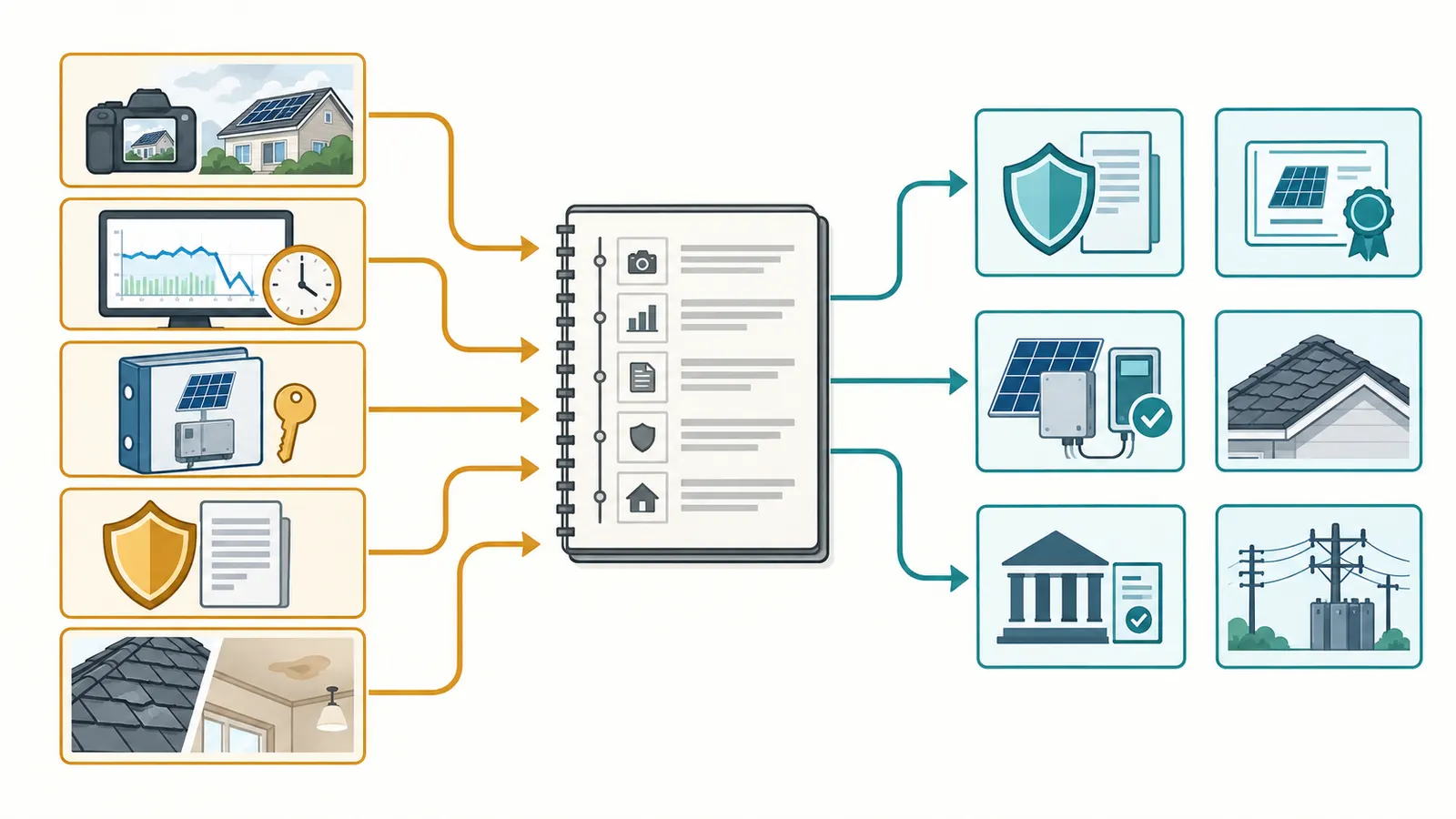
The right pre-quote packet contains dated event information, safe observations, system records, ownership and coverage documents, roof information, and the exact question you need answered. NAIC advises documenting losses before cleanup, preserving damaged items when possible, taking reasonable steps to prevent further damage, and keeping receipts for temporary repairs. NAIC’s disaster-claim guidance supports that sequence, but your policy, claim instructions, and state insurance rules control the actual claim.
The homeowner evidence log
Create one folder for the event. Use the local date and time, then add the time zone if the event crossed midnight or involved a monitoring timestamp. Do not make a roof inspection out of this folder. It is an evidence and handoff record.
Record:
- Property address, state, county, city or town, ZIP code, and the name of the local building or electrical AHJ if known.
- Electric utility name, customer number, service address, and whether the system is grid-tied, battery-backed, leased, financed, or owned outright.
- Date and approximate start/end time of the weather event, as reported by your local weather service or your own observation. Label outside reports as reports, not as a measurement you made.
- The event type: wind, hail, lightning, wildfire, smoke or ember exposure, snow or ice, falling tree or limb, flood, tornado, hurricane, or a combination.
- What you could see without climbing, touching, opening, resetting, or moving anything.
- Interior observations: leaks, staining, odor, smoke, tripped breakers, loss of monitoring, or water near electrical equipment. Keep occupants away from a wet electrical area.
- Photos and video from stable ground, public access, or another safe place. Include a wide image showing orientation and closer images made without entering a hazard area.
- Monitoring screenshots showing production, alerts, timestamps, and any pre-event baseline available from the same account.
- A list of all components you can identify: module brand and model, inverter brand and model, optimizer or microinverter model if applicable, battery, gateway, disconnect, meter, and racking brand.
- The original contract, permission-to-operate or interconnection record, final inspection record, one-line diagram, layout, equipment schedules, warranties, service agreement, financing or lease, and previous repair invoices.
- The policy number, insurer claim contact, deductible type and amount as shown in the policy, and the date and method of notice. Do not guess whether the PV system is covered as dwelling, other structure, equipment, or scheduled property.
Name files consistently, such as 2026-09-08_1430_west-roof-wide.jpg or 2026-09-08_monitoring-inverter-offline.png. Keep originals and make copies for sharing. Do not edit the original timestamps or add arrows to the only copy. If you annotate a copy, state that it is an annotation.
What evidence answers which question
| Decision question | Useful input | Who verifies it | What the input cannot prove |
|---|---|---|---|
| Did something change after the storm? | Pre-event and post-event production history, error log, dated photographs | PV professional compares records with inspection findings | Causation, safe energization, or coverage |
| Which equipment is installed? | Labels, original equipment list, one-line diagram, purchase file | Installer, manufacturer, or qualified PV professional | That a replacement part is compatible |
| Is the roof interface part of the loss? | Interior leak evidence, roof age and material, ground photos, prior roof records | Roofer and, when structural or attachment questions arise, appropriate design professional | That the PV contractor may repair roofing under its license or contract |
| Is a warranty route plausible? | Written terms, purchase date, serial numbers, owner-transfer record, installer agreement | Manufacturer, seller, installer, or service provider named in the terms | Coverage for storm, labor, shipping, or consequential damage |
| Is an insurance claim plausible? | Policy declarations, covered-peril language, deductible, event record, photos, mitigation receipts | Insurer and the state insurance department for consumer assistance | A guaranteed settlement or a repair scope |
| Can the system return to the grid? | Permit, final inspection, interconnection agreement, utility requirements, commissioning record | AHJ, utility, and qualified contractor | Permission to operate in another jurisdiction |
Do not discard a broken module, inverter, optimizer, cable, clamp, or piece of roof covering unless the responsible claim or technical party says it may be discarded. If the item is dangerous to retain, ask the insurer and contractor to document it before disposal. Record who took custody, on what date, and where it went. Chain-of-custody language does not turn a homeowner file into a laboratory record; it simply prevents confusion.
Ask for records without claiming a test occurred
Use careful language. “The monitoring app showed zero production from 14:12 to 17:45” is an observation. “The inverter failed” is a technical conclusion. “There is a crack visible in the module glass from the ground” is an observation. “The module has an insulation fault” requires a qualified inspection and test. “The roof leaks below the array” is an observation. “The flashing failed” is a diagnosis that belongs in a roof inspection report.
This distinction protects the budget. If you label every visible symptom as a failed part, the quote may overreplace. If you label a suspicious component as fine, the quote may under-scope hidden work. The packet should make uncertainty visible so that the first inspection resolves it.
The next decision
When the packet is assembled, send the same neutral summary to the insurer or claims contact, the installer or service provider, and the potential inspection professional. Ask each party what they require before dismantling, drying, moving, or replacing anything. The goal is not to obtain three opinions from three parties about the whole array. It is to preserve the handoffs before scopes diverge.
3. Run the inspection in a sequence that separates observation from proof #
The first qualified visit should answer whether the site can be made safe, what components are visibly affected, which tests are needed, whether the roof and attachments remain serviceable, and what evidence supports a repair or replacement scope. DOE says post-damage inspection and electrical testing are needed to itemize repairs and prepare a cost estimate; it also identifies regional variation, system size, array type, access difficulty, and extent of repair as cost variables. Read DOE’s cost-factor and recovery guidance before asking for a quote, while remembering that it does not produce a residential national price.
Visit 1: site control and visual inventory
The qualified professional should begin by confirming access conditions and documenting the array without assuming that the damaged roof can carry workers. That may require ground observation, a lift, a qualified attic or roof inspection, or another site-specific method. The homeowner should ask which person is responsible for each access method and whether the inspection itself is limited because of wind, wet surfaces, fire damage, unstable framing, or electrical exposure.
Remote-diagnosis boundary: The homeowner may record interior conditions only from a safe occupied area. Do not enter an attic, crawlspace, roof void, utility room, or any other enclosed or confined area when fire, smoke, floodwater, contamination, structural instability, or electrical conditions are unknown. Do not open a hatch, move through a contaminated or wet area, or reach toward equipment to obtain a better view. A qualified responder must own any attic, crawlspace, roof-void, or confined-space access, inspection, testing, and documentation; if the conditions are uncertain, withdraw and report what can be seen safely from outside.
The visual inventory should locate, not merely count, the suspected issue:
- Module row and column or a layout reference.
- Roof plane and approximate location.
- Racking rail, attachment, clamp, flashing, conduit, junction box, inverter, optimizer, microinverter, disconnect, or monitoring equipment involved.
- Whether the condition is displacement, fracture, missing hardware, deformation, corrosion, burn, contamination, water intrusion, cable damage, or an operational alert.
- Whether the issue affects one component, a contiguous section, multiple roof planes, or the balance of system.
- Whether the roof itself is damaged independently of the PV equipment.
This is where DOE’s vulnerability categories help prevent a “panel-only” inspection. The federal weather guide discusses loosened fasteners, inadequate mechanical attachment, clamp failure, poor wire management, and inadequate electrical enclosures, pairing conditions with corrective actions. DOE’s PV weather-vulnerability guide is based on federal field-audit work and is useful for question formation, but it is not a residential code inspection or a diagnosis of your array.
Visit 2: electrical and performance verification
Ask the professional to identify the tests needed before the system is energized or dismantled and to state what each test can and cannot establish. Depending on the system and suspected fault, the scope may involve inspection of conductors and connectors, insulation or ground-fault checks, open-circuit or operating measurements, inverter and protection-device checks, thermal or infrared imaging, module or string testing, monitoring review, and system recommissioning tests. The exact test list belongs to the qualified professional and the equipment documentation.
Do not write a generic request for “a solar test.” Write a request for test names, test conditions, affected circuit or component, instrument or method if the contractor normally reports it, result, acceptance criterion or manufacturer reference, and the decision enabled by the result. You are not asking the homeowner to perform the test. You are asking for a report that can be compared across quotes.
For example, a report can distinguish:
| Test or check category | Decision it may inform | It does not prove by itself |
|---|---|---|
| Monitoring history review | Whether output or alerts changed after the event; whether a section deserves investigation | That the roof, wiring, module, or inverter is safe |
| Visual module and connector inspection | Whether visible fracture, displacement, heat damage, or contamination is present | That hidden cell, insulation, diode, or water damage is absent |
| Electrical fault or insulation checks | Whether a circuit presents a measured fault under the stated test conditions | That every intermittent, mechanical, roof, or future failure risk is eliminated |
| Module, string, or array performance test | Whether measured output is consistent with the specified method and conditions | That a lower result is caused by the storm rather than age, shade, soiling, temperature, or pre-existing degradation |
| Inverter and protection inspection | Whether error states, protection behavior, or visible damage require replacement or manufacturer review | That replacing the inverter will cure a roof, wiring, or utility problem |
| Racking, attachment, and torque review | Whether fasteners, clamps, rails, and attachments need corrective work under the applicable design and manufacturer requirements | That the roof framing or flashing is acceptable without the appropriate roof or structural review |
| Thermal or infrared imaging | Whether an anomaly merits targeted investigation under the professional’s method | That a thermal image alone is a complete electrical sign-off |
The report should state date, weather or operating conditions when relevant, system configuration, test limits, inaccessible areas, observed damage, and photos tied to locations. If a test could not be completed because the system was isolated, flooded, unsafe to access, or missing a component, the report should say “not tested” with a reason. “Not tested” is more useful than an invented pass.
Visit 3: roof and building interface
The roof is not a platform for the PV contractor by default. A roofer should evaluate roof covering, underlayment or waterproofing where exposed, flashing, penetrations, age, storm impact, and temporary protection. If the attachment has pulled out, the roof framing appears damaged, or a repair changes the load path, the appropriate structural professional or licensed design authority for the actual jurisdiction may be needed. The PV contractor can describe the array interface; that does not automatically establish structural adequacy.
OSHA’s construction electrical standard requires employers to protect workers from electrical circuits by de-energizing and grounding them or by effectively guarding them. OSHA’s electrical construction standard is written for employers, not homeowners. OSHA’s construction fall-protection standard also requires employers to ensure that a roof has the strength and structural integrity to support workers before work begins. OSHA’s roof fall-protection standard explains why “the contractor can just take a quick look” is not a safe planning assumption; neither standard authorizes a homeowner to access a damaged roof or perform PV electrical work.
Ask the roofer to distinguish temporary mitigation from permanent repair. A tarp, board, or temporary covering can reduce further damage while a claim is investigated; it is not a complete roof repair or a PV recommissioning. NAIC recommends reasonable mitigation after documentation and retaining receipts. The NAIC claims sequence is useful for this handoff, but follow your insurer’s instructions and the actual policy.
Visit 4: equipment and compatibility review
Storm replacement often creates a compatibility problem even when the replacement item appears similar. Record the exact model, revision, voltage and current ratings, connector family, communications method, inverter architecture, rapid-shutdown behavior, mounting dimensions, module electrical characteristics, racking interface, and manufacturer approval requirements. The equipment owner’s manual and installation instructions for the exact model control. If the exact manual is unavailable, make obtaining it a quote prerequisite.
Do not approve “equivalent panel” as a sufficient description. The quote should identify the proposed replacement model or the conditions under which the model will be selected, and say who verifies compatibility. The same applies to inverter, optimizer, microinverter, rapid-shutdown device, disconnect, communications gateway, and roof flashing.
The next decision
After inspection and testing, you should have a defect list with confidence labels: observed, measured, inferred, inaccessible, or unresolved. The next decision is not yet “accept the cheapest quote.” It is to decide which scope is technically complete enough to price: component repair, array-section repair, roof-and-array repair, or larger replacement. If the report does not separate those alternatives, request a revised inspection scope before seeking replacement prices.
4. Turn damage into a component-by-component repair or replacement scope #
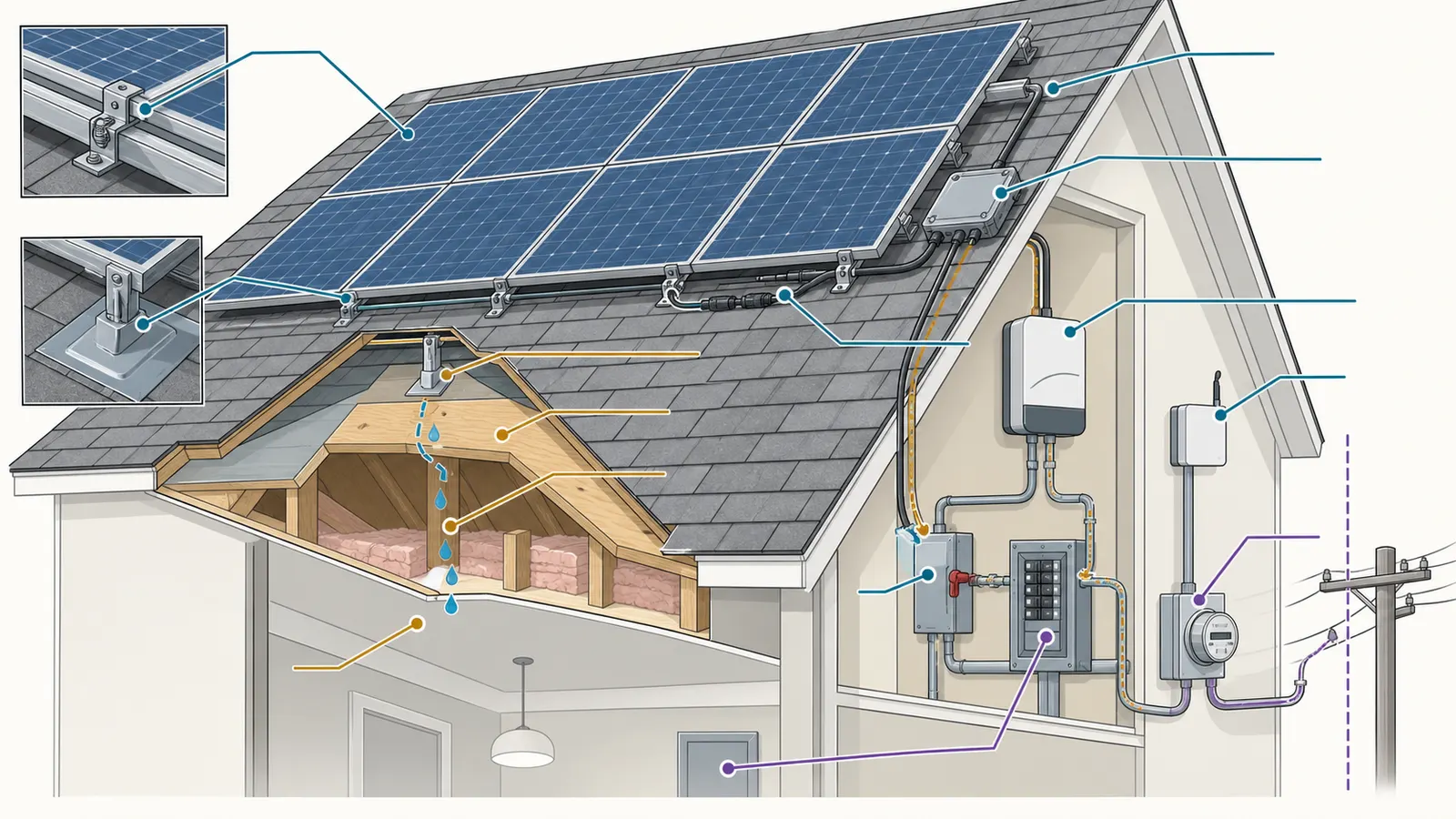
The array should be split into modules, racking and attachments, wiring and protection, inverter and electronics, roof interface, monitoring, and external coordination. A source-derived decision matrix makes the safety boundary and handoff visible: each row starts with an observation, states what remains out of use, assigns the responsible professional, names the evidence to preserve, specifies the proof needed, records the handoff packet, and ends with a next decision. It prevents the common failure in which a contractor quotes an entire new system because one category of damage was never isolated.
The post-storm PV decision matrix
| Component or interface | Observable trigger | Safe stop-use boundary | Responsible next party | Evidence to preserve | Verification requested | Handoff record | Quote branch |
|---|---|---|---|---|---|---|---|
| Modules | Cracked or shattered glass, delamination, burn marks, frame deformation, displacement, hail impact pattern, visible contamination | Keep the affected module and any connected section out of service; do not touch, clean, or remove it | Qualified PV professional; insurer; manufacturer or installer warranty contact as applicable | Dated location photos, model/serial, layout, monitoring history, retained fragment only if safe | Module/string/array assessment under the professional’s method; inspect connectors and backsheet/junction area where applicable | Send the dated observation, location, records, and preservation instruction to the PV professional and claim or warranty contact before disposal | Repair one or more modules if compatible and the supporting system is sound; replace a section if matching or code constraints make isolated repair impractical |
| Racking, rails, clamps, fasteners | Rail twist, uplift, missing or loose hardware, shifted row, failed clamp, attachment pullout, corrosion | Keep people outside the fall area and keep the affected roof plane and connected array section out of service; do not tighten or move hardware | Qualified PV professional; roofer; structural professional if load path or framing is affected | Wide and close photographs, row location, prior installation drawings, storm direction if known | Mechanical attachment and racking review under manufacturer and applicable design requirements; roof/framing review where required | Hand the location photos, layout, access limits, and roof-interface concern to the PV professional and roofer; add the structural professional when the load path is uncertain | Repair hardware or attachments; rebuild a roof plane or array section; replace larger scope if the support system is compromised |
| DC conductors and connectors | Abrasion, pulled connector, exposed conductor, hanging cable, melted insulation, poor wire management, water path | Keep the affected circuit and any equipment it feeds out of service; do not handle exposed conductors or connectors | Qualified PV/electrical professional | Ground photos, component location, alarm history, no handling of exposed parts | Electrical fault, insulation, polarity, connector, routing, and protection checks as appropriate | Transfer the photos, circuit or layout reference, alarms, and no-touch boundary to the qualified PV/electrical professional; preserve parts until claim or technical direction | Repair or replace affected wiring and clips; replace a circuit or section if fault boundaries cannot be reliably isolated |
| AC wiring, disconnects, breakers, protection | Tripped protection, damaged enclosure, water entry, heat or arc evidence, damaged conduit | Keep the affected equipment and circuit out of service; do not open enclosures, reset protection, or operate an uncertain disconnect | Qualified electrician or PV professional permitted for the work in the actual jurisdiction | Panel and equipment photos from a safe location, breaker state without repeated resets, labels, event time | Electrical inspection and test; enclosure and protection suitability; follow manufacturer instructions | Give the safe-location photos, breaker state, labels, and event time to the qualified professional, insurer, and AHJ or utility contact when configuration may change | Repair protection or wiring; replace equipment if damaged or not serviceable; coordinate AHJ/utility if configuration changes |
| Inverter, optimizer, microinverter, rapid-shutdown equipment | Fault code, no production, surge evidence, water or fire exposure, enclosure damage | Keep the affected equipment and connected section out of service; do not reset, open, dry, or re-energize it | Qualified PV/electrical professional and manufacturer or authorized service route | Model, serial, error code, monitoring history, photos, warranty terms | Manufacturer-directed diagnostics, electrical tests, and compatibility review | Transfer model/serial data, error history, photos, and warranty terms to the qualified professional and manufacturer or authorized service route; notify insurer as applicable | Component repair or replacement; section or system replacement only when the fault scope or compatibility evidence supports it |
| Roof covering, flashing, penetrations | Interior leak, torn or lifted covering, exposed flashing, damaged seal, attachment pulled out | Keep occupants away from affected interior or roof areas; do not enter the roof, attic, or wet electrical area and keep the related PV section out of service | Roofer; PV contractor for remove-and-reinstall coordination; structural professional when needed | Interior and exterior photos, roof age and material, prior repair records, temporary-repair receipts | Roof inspection and written interface scope; identify detach-and-reset quantities | Route leak photos and temporary-mitigation receipts to the insurer and roofer; route array location and detach/reset needs to the PV contractor; add the structural professional if required | Roof repair plus PV detach/reset; roof replacement plus PV removal/reinstall; unrelated roof work kept separate |
| Monitoring and communications | Offline gateway, missing data, incorrect alerts after event, damaged network equipment | Treat missing data as an unresolved condition; do not use an offline app as permission to operate or as proof the array is safe | Installer, monitoring provider, qualified PV professional | Screenshots, data export, account details, network changes, last known good time | Communications and production-history review; confirm whether offline is cause or symptom | Send screenshots, data, account access details, and last-known-good time to the installer or monitoring provider and qualified PV professional | Restore monitoring; do not price a new array solely because monitoring is offline |
| Utility meter and interconnection | Utility disconnect, meter change, permission-to-operate question, system configuration change | Keep operation paused until the qualified professional, AHJ, and utility establish the approved operating status; do not bypass a disconnect or PTO condition | Utility, AHJ, qualified contractor, and owner in the order required by the actual jurisdiction | Interconnection agreement, PTO, permit, utility notices, service details | Confirm utility and AHJ requirements before construction or re-energization | Give the interconnection record, permit history, proposed equipment changes, and test/inspection records to the qualified contractor, AHJ, and utility; retain written authorization | Administrative coordination, permit/inspection, utility review, or system redesign if the repair changes approved configuration |
The matrix does not say that a visible trigger causes a particular failure. It says what to ask next. For example, a cracked module can be a module replacement, but it can also be a symptom of a shifted rail or failed clamp. A zero-production alert can be a utility outage, inverter trip, damaged disconnect, communications failure, or a broader electrical fault. The inspection must locate the fault boundary before the quote treats the component as the cause.
Module-only repair is not automatically the smallest scope
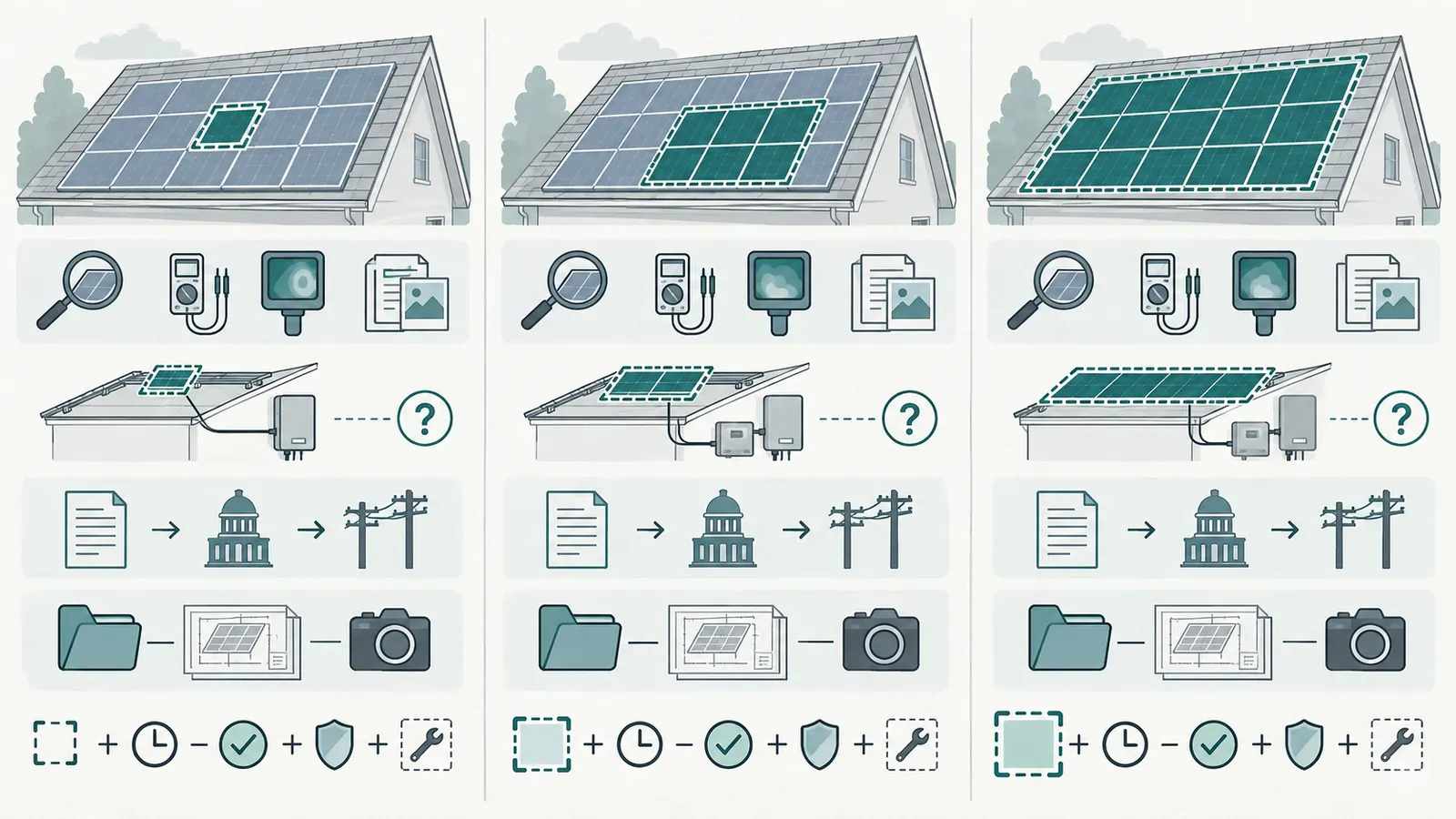
Replacing a module can be a sensible branch when the module damage is confirmed, the racking and roof are serviceable, the replacement model is compatible, the affected circuit can be tested, and the warranty or insurance route accepts the work. It can be a poor branch when the row shifted, clamps failed, connectors were pulled, multiple modules are damaged, the exact model is unavailable, or the roof interface needs removal anyway.
Ask the contractor to state whether the quote assumes:
- The original rail geometry and attachments are accepted as serviceable.
- The remaining modules have passed the stated inspection or are merely being left in place.
- Replacement equipment matches the electrical and mechanical requirements.
- The damaged components are being retained for insurer or manufacturer inspection.
- Testing occurs before and after work.
- Removal, disposal, shipping, and access equipment are included.
- Roof repair, flashing, detach-and-reset, and interior dry-out are included or excluded.
- Permit, inspection, interconnection, and permission-to-operate steps are included or assigned to the owner.
Array-section repair can be a more honest boundary
An array section is a useful scope when the damage follows a row, roof plane, string, or physically connected group. It can contain the modules, rails, clamps, conductors, connectors, electronics, and roof interface that must be worked on together. A section boundary should be shown on the layout and tied to tests. “North side” is less useful than “roof plane N, rows 2–3, modules N-2 through N-9, DC circuit 2, inverter input B,” if that is how the actual system is documented.
Section repair may be preferable to whole-system replacement when the unaffected portion is documented, compatible, and economical to recommission. It may not be preferable where the replacement parts are obsolete, a discontinued inverter architecture cannot accept the proposed equipment, the roof is being replaced, or the insurer’s settlement and policy terms make a broader scope appropriate. Those are separate technical, financial, and coverage questions.
Larger replacement is a decision, not a default
A larger replacement scope is supported when inspection shows damage across multiple component categories, the roof must be replaced, the supporting structure needs major work, the original system cannot be made compatible with available parts, or the cost and risk of preserving the remainder are not acceptable after comparable quotes. DOE notes that severe-weather damage and fire can affect a PV system’s performance period, but partial damage does not necessarily end system life; its refurbishment path includes inspection, testing, repair, and part replacement. DOE’s end-of-performance guidance describes that distinction for federal PV planning; a homeowner should not treat a storm as automatic proof that the whole system has reached end of life.
If a quote recommends total replacement, ask for the rejected repair alternative. The explanation should identify the components that make repair infeasible, the compatibility or availability evidence, the roof and attachment assumptions, the test results, and the incremental scope beyond the confirmed damage. “New is better” is not a technical scope.
The next decision
Choose a quote request type: component repair, array-section repair, roof-and-array repair, or full replacement with a documented repair alternative. Use the same scope language for every bidder. If each bidder is pricing a different boundary, the price comparison is meaningless even when the totals look precise.
5. Route insurance, warranty, AHJ, and utility handoffs in the right order #
The order is usually evidence and safety, then claim and warranty notice, then technical inspection, then approved scope, then local permit and utility coordination, then repair and verification. The exact order can change when an emergency, a lease or power-purchase agreement, a utility requirement, or a local permit office requires an earlier filing. The homeowner owns coordination unless a contract clearly assigns it to a provider.
Insurance: notify without promising coverage
Homeowners insurance is a contract. NAIC explains that coverage depends on listed or excluded perils, limits, and the deductible, and that states have rules governing claims. NAIC’s homeowners insurance overview notes that windstorm, hail, lightning, and fire are often among extended or named perils in policies, but it does not decide whether your policy covers your PV equipment, roof interface, lost production, flood, smoke, wildfire, or a particular deductible.
Send a factual first notice:
- Date and event type as currently known.
- Property and system address.
- Safe observations only.
- Immediate hazards and temporary mitigation already performed.
- Whether the system is currently out of service, without claiming who caused the outage.
- Photos, monitoring record, receipts, and documents available.
- A request for instructions on inspection, preservation, adjuster access, and temporary repairs.
Do not promise the insurer that a contractor has found a failed inverter when the contractor has only seen a fault code. Do not promise that every module is storm-damaged because hail fell. Do not promise that a quote will be accepted. The claim packet should preserve uncertainty until the technical evidence narrows it.
Ask:
- Is the PV system scheduled, part of the dwelling, or otherwise addressed in the policy or endorsement?
- Is the roof interface treated separately from the electrical equipment?
- What peril, exclusion, deductible, sublimit, depreciation rule, or matching rule may apply?
- Must the insurer inspect before disposal or replacement?
- Are emergency dry-out, tarping, tree removal, crane or lift access, storage, and temporary repairs treated differently?
- Who approves scope changes after hidden damage is found?
- What records are needed for labor, equipment, lost production, or detach-and-reset?
NAIC says insurers generally send an adjuster after a claim and that state insurance departments can help when a company is not responding in a timely manner or is not completing a reasonable investigation. Use NAIC’s claim-process guidance for the consumer sequence, then use the actual state department of insurance for local assistance. Do not turn NAIC’s general guidance into a promise of payment.
Warranty: route the exact product and the exact remedy
FTC advises keeping the written warranty and receipt, and says the warranty should explain coverage, remedy, and claim procedure. FTC’s warranty guidance is consumer guidance, not the text of your PV warranty. Collect separate terms for modules, inverter, optimizer or microinverter, racking, roof work, installer labor, service contracts, battery, monitoring, and financing or lease obligations.
The warranty route can be complicated because a storm may create both a covered product defect question and an excluded external-event question. It may also distinguish product replacement from labor, shipping, removal, reinstallation, roof repair, consequential damage, and transfer to a later owner. Do not collapse those categories into “the panels are under warranty.”
FTC says to contact the seller and, if the problem is not resolved, write to the manufacturer; it also notes that a company may have the right to repair before refunding. The FTC’s claim-routing explanation supports sending a written notice with the product identity and record of the problem. Ask the warranty contact to state whether inspection, serial numbers, prior registration, owner transfer, preapproval, or return of the component is required before work.
If an installer is out of business, the product manufacturer may still have a product route, but not necessarily a labor or roof route. If the system is leased or under a power-purchase agreement, the contract owner may control the inspection and repair. If the home was sold, transfer provisions may matter. Put the contract owner, current homeowner, installer, manufacturer, and insurer on the same coordination record without assuming one party represents the others.
AHJ and utility: identify the actual jurisdiction before pricing compliance
There is no single national homeowner permit decision in this guide. DOE says local governments have different rooftop-solar permitting and inspection rules, with details and fees varying across jurisdictions, and that the utility connects the system after the applicable process. DOE’s rooftop-solar permitting explanation is the national starting point, not your permit.
Fill these fields before approving a scope:
| Field | Write the actual name, not “local code” | Question to verify |
|---|---|---|
| State or tribal jurisdiction | State, tribal nation, or other governing jurisdiction | Which adopted codes, licensing, and insurance rules apply? |
| County | Exact county, if relevant | Does the county issue permits or inspections for this address? |
| City, town, or unincorporated area | Exact municipality or unincorporated designation | Which building, electrical, fire, and roof-repair office is the AHJ? |
| AHJ contact | Department name and official URL or phone | Does repair, detach-and-reset, roof replacement, or equipment substitution need a permit or inspection? |
| Utility | Legal utility name and program | Does the utility require an application, revised one-line, inspection, or PTO before operation? |
| System status | PTO, interconnection agreement, lease/PPA, battery, service change | Does the proposed work alter the approved configuration or agreement? |
| Contractor authorization | License and scope for the actual jurisdiction | Who is allowed to do electrical, roofing, structural, and permit work? |
Ask the AHJ a narrow question that can be answered in writing: “For this address, does replacing X modules and repairing Y attachments under the existing approved system require a permit, plan revision, electrical inspection, fire inspection, or final sign-off? If the inverter or roof covering changes, what additional review is required?” Ask the utility the parallel question about interconnection and permission to operate. Keep the jurisdiction name and the response with the quote.
For a concrete example only, Seattle City Light describes a Seattle, Washington process that includes permission to construct, electric permitting and inspection through the local jurisdiction, utility inspection, and permission to operate. Seattle City Light’s solar-array process applies to Seattle City Light’s service area; it is not a rule for another Washington city, county, state, tribal authority, or utility.
The handoff owner should be explicit. A contractor may submit a permit, but the homeowner should receive the permit number, approved plans, inspection result, utility correspondence, and final PTO or other written operating authorization where required. “We handle permits” is not a record.
The next decision
Do not compare final repair totals until the insurer, warranty route, AHJ, utility, and contract owner have been identified. You can request preliminary inspection pricing earlier, but label it as inspection or emergency mitigation, not as permission to rebuild or energize.
6. Build a variable repair-or-replace budget instead of inventing a national price #
The useful budget is a transparent sum of known, unknown, and conditional costs. DOE says post-damage cost depends on regional variation, system size, array type, access difficulty, and extent of repair. DOE’s PV cost guidance supports a variable model rather than a single national storm-repair number. A homeowner can use the model before a quote arrives and replace every temporary allowance with a written, scope-matched amount afterward.
The quote worksheet formula
Use this formula in U.S. dollars. Each variable should be a number from a quote, policy document, utility or AHJ fee schedule, contract, or clearly labeled homeowner assumption.
Gross technical scope cost =
  C_access
+ C_safe_isolation_and_inspection
+ C_testing
+ C_temporary_mitigation
+ C_modules
+ C_racking_and_attachments
+ C_DC_wiring_and_protection
+ C_inverter_and_controls
+ C_roof_interface
+ C_labor_and_supervision
+ C_lift_or_special_access
+ C_disposal_and_shipping
+ C_permit_and_inspection
+ C_utility_or_interconnection
+ C_recommissioning_and_documentation
+ C_contingency

Total modeled exposure before recoveries =
  Gross technical scope cost
+ C_downtime_or_temporary_power

Net homeowner exposure =
  Total modeled exposure before recoveries
- approved insurance payment
- warranty or service-contract contribution
- other contract contribution
+ deductible
+ uncovered work
- salvage or credit actually documented
Do not put the deductible into the gross contractor scope unless the contractor is explicitly collecting it as a payment arrangement. The deductible is a policyholder responsibility, not a technical repair cost. Do not subtract an insurance estimate before it is approved. Label a projected recovery as “not approved.”
Define each variable before you fill it
| Variable | Unit | Input to request | Common scope trap |
|---|---|---|---|
C_access | USD per visit or mobilization | Number of visits, travel, site setup, roof-access method | One low inspection fee hides a second mobilization, lift, or return visit |
C_safe_isolation_and_inspection | USD per visit or labor hour | Isolation, visual inventory, report, photos, emergency response | Inspection is omitted and repair labor is priced as diagnosis |
C_testing | USD per test, circuit, array, or visit | Test names, affected circuits, conditions, results report | “System test” has no defined boundary |
C_temporary_mitigation | USD per temporary repair | Tarp, boarding, debris control, dry-out, temporary protection | Temporary work is mistaken for permanent roof or PV repair |
C_modules | USD per module or section | Exact replacement model, quantity, availability, shipping | “Equivalent module” without electrical or mechanical verification |
C_racking_and_attachments | USD per rail, attachment, clamp, or section | Hardware, rail, attachment, flashing, engineering review if needed | The visible module is replaced while the failed support remains |
C_DC_wiring_and_protection | USD per circuit, connector, foot, device, or labor hour | Conductors, connectors, clips, fuses, combiner, rapid shutdown | A fault is isolated visually without electrical testing |
C_inverter_and_controls | USD per inverter, optimizer, microinverter, gateway, or labor hour | Exact model, compatibility, programming, warranty route | Replacement electronics do not match the approved design |
C_roof_interface | USD per roof plane, penetration, square, or task | Roof repair, detach/reset, flashing, underlayment, interior work | Roof scope and PV scope overlap or both exclude the same work |
C_labor_and_supervision | USD per labor hour or fixed scope | Crew, licensed roles, supervision, testing, documentation | Labor is buried in material percentage and cannot be compared |
C_lift_or_special_access | USD per day or mobilization | Lift, scaffold, fall-protection setup, traffic control | Access is priced only after work begins |
C_disposal_and_shipping | USD per item, load, or shipment | Damaged component retention, return freight, disposal, recycling | Damaged components are discarded before claim or warranty review |
C_permit_and_inspection | USD per permit or jurisdictional fee | AHJ application, plan revision, inspections | A general allowance is treated as the actual local fee |
C_utility_or_interconnection | USD per application, review, or utility work | Utility’s actual process and any service modification | Existing PTO is assumed to survive a configuration change |
C_recommissioning_and_documentation | USD per system or deliverable | Test report, as-built, labels, monitoring, final record, PTO | System is turned on with no closeout evidence |
C_downtime_or_temporary_power | USD per day, kWh, or service; tracked separately | Temporary generation, lost production estimate, critical loads | Downtime or temporary-power economics are mixed into the physical repair scope or treated as guaranteed insurance coverage |
C_contingency | Percentage or explicit allowance | What unresolved uncertainty it covers and how it is released | A round percentage disguises an incomplete scope |
The professional should not be required to estimate a cost for a component that the inspection has not bounded. If an unknown remains, put it in an allowance with a measurement or approval condition. Example: “Roof sheathing condition below attachment A-12: not visible; allowance applies only if opening confirms damage; owner and insurer approval required before change order.”
An illustrative sensitivity model, not a national price
The following is an illustrative model to show how the decision changes. It is not a market quote, a survey, a national range, or firsthand data. Replace every input with your own written amount. Suppose a homeowner has a 7.2-kW pitched-roof system with 18 modules, one inverter, and no battery. The system is 9 years old. Ground photos show two visibly damaged modules and a shifted rail; the inverter reports an alert; an interior ceiling stain appears below one attachment. The installer cannot yet state whether the rail attachment or roof covering is damaged.
Scenario A, component repair, uses these illustrative inputs:
Inspection and report                 $  650
Electrical testing allowance          $  500
Two compatible modules                 $1,000
Racking hardware and labor             $  850
Roof interface repair                  $  900
Access and return visit                $  700
Permit, inspection, utility allowance  $  350
Closeout testing and documentation     $  450
Contingency                            $  450
Gross illustrative technical scope    $5,850
Scenario B, array-section repair, assumes hidden connector and additional rail work are confirmed:
Inspection and expanded testing        $  900
Six compatible modules                 $3,000
Rail, clamps, attachments, wiring      $2,600
Roof interface and detach/reset        $2,000
Access and debris/disposal              $1,200
Permit, inspection, utility allowance  $  500
Closeout testing and documentation     $  650
Contingency                            $1,100
Gross illustrative technical scope   $11,950
Scenario C, larger replacement, assumes the roof plane is being replaced and the existing inverter architecture is not compatible with available modules. The correct model is not “multiply the original system price.” It is a new scope with removal, roof work, new equipment, structural and electrical review, permits, utility coordination, testing, monitoring, and closeout. Use a separate replacement worksheet so the quote does not bury new capacity or unrelated upgrades inside storm repair.
The formula for each scenario is the same. The decision is sensitive to the inputs that change the scope boundary, not just the price of the module. To test sensitivity, change one variable at a time:
Sensitivity to access = revised gross scope - base gross scope
Sensitivity to roof interface = revised gross scope - base gross scope
Sensitivity to module quantity = revised gross scope - base gross scope
Sensitivity to contingency = revised gross scope - base gross scope
Net exposure = total modeled exposure before recoveries - approved recoveries + deductible + uncovered work
The illustrative scenarios above exclude downtime and temporary power from the technical subtotal. For a separate modeled example, suppose temporary power is assigned an illustrative allowance of $300/day for 10 days: C_downtime_or_temporary_power = 10 days × $300/day = $3,000. Scenario A’s total modeled exposure before recoveries would then be $5,850 + $3,000 = $8,850; the $5,850 remains the gross technical scope. Replace both inputs with documented dates and actual temporary-power or qualified lost-production assumptions. If no such cost is incurred, enter $0, rather than forcing it into the repair price.
If the roof interface changes from $900 to $4,000 in the illustrative model, the difference is $3,100 and may also alter access, detach/reset, schedule, and permit variables. If the insurer pays an approved amount, show the gross scope and recovery separately. Never make a low net exposure look like a low contractor price.
Add downtime without turning it into a promise
A post-storm PV system may be out of service while inspection, claim review, parts, permits, repairs, and utility approval occur. Track downtime as a dated interval: outage start, temporary operation if any, repair complete, inspection passed, PTO or operating approval, and monitoring restored. If you estimate lost production, label the method and assumptions, such as a prior same-month production average adjusted for weather or a qualified model. Do not promise that an insurer or contract will reimburse lost production.
Compare gross, recoverable, and uncovered scope
Make three columns in the worksheet:
- Gross technical scope: everything required to make the quoted system physically and electrically complete under the stated assumptions.
- Potential recovery: insurance, warranty, installer, manufacturer, lease, service contract, or other contribution, marked pending until approved.
- Homeowner exposure: deductible plus uncovered work and any nonrecoverable coordination, access, or upgrade amount.
If a proposed replacement adds a battery, roof upgrade, capacity increase, monitoring service, or unrelated electrical work, put it in an owner-choice column. It may be reasonable, but it is not storm repair merely because it appears on the same proposal.
The next decision
Run three comparable scopes through the same worksheet: minimum confirmed repair, section repair with known uncertainty resolved, and larger replacement only if the technical report supports it. Then decide whether the outstanding uncertainty is worth paying to resolve. A higher inspection cost can be rational if it prevents a much larger and unsupported replacement scope.
7. Compare quotes, approve the next handoff, and close the ownership record #
The best quote is the one that makes the technical boundary, responsibility, assumptions, evidence, compliance path, and closeout verifiable. It is not necessarily the lowest total and it is not automatically the broadest replacement. Ask each bidder to answer the same questions and to identify what remains outside the price.
The comparable quote request
Send this short scope with your evidence packet:
Inspect and document the storm-exposed rooftop PV system at the property address. Do not assume remote safety or roof access. Identify visible and tested damage by component and location. State the isolation and test sequence, inaccessible areas, and limits. Provide separate prices for (A) confirmed component repair, (B) confirmed array-section repair, and (C) larger replacement only if supported by compatibility, roof, structural, or system-life findings. Separate modules, racking/attachments, DC wiring/protection, AC wiring/protection, inverter/electronics, roof interface, access, disposal, permits/AHJ, utility/interconnection, recommissioning, monitoring, and documentation. State which party handles insurer, warranty, AHJ, and utility handoffs. Identify exact equipment models or selection criteria. Do not discard damaged components without documented direction.
The quote should attach or reference the inspection report, photos, test results, layout, and assumptions. If a quote is prepared before testing, label it as preliminary and list the test or approval condition that can change it.
Quote review table
| Review item | Acceptable evidence in a quote | Follow-up question |
|---|---|---|
| Safety boundary | Access method, isolation responsibility, excluded hazardous work, emergency conditions | Who makes the system safe, and what will the homeowner be told before anyone enters the roof area? |
| Damage boundary | Component, row/section, photo or test reference, observed versus inferred | Which damage is confirmed, and which is an allowance? |
| Testing | Test name, circuit or equipment, condition, result or precondition | What decision does each test change? |
| Compatibility | Exact model or documented selection criteria and responsible verifier | Who confirms electrical, mechanical, communications, and code compatibility? |
| Roof interface | Roof trade, detach/reset quantities, flashing and waterproofing scope | Who owns the roof warranty and any interior repair? |
| Insurance/warranty | Preservation, inspection, preapproval, return, labor and shipping assumptions | What work waits for insurer or manufacturer direction? |
| AHJ | Exact state/county/city/tribal authority and permit assumption | What permit or inspection answer was obtained, and who submits it? |
| Utility | Exact utility and interconnection/PTO assumption | Does this repair change the approved configuration or require a new utility step? |
| Money | Fixed amount, unit, allowance, contingency, tax, recovery, deductible treatment | What event releases an allowance or change order? |
| Closeout | Test report, as-built, labels, photos, monitoring, warranty and permit records | What documents will the homeowner receive before operating? |
Common quote failures and the correction
Failure: “Replace all panels” after a hail event. Hail can damage modules, but the quote should show why the racking, wiring, inverter, roof, and unaffected modules are included. Request component-level evidence and a repair alternative.
Failure: “The roof is fine because there is no leak.” A lack of interior water at one moment does not prove that flashing, roof covering, or attachments are sound. Request a roof-interface scope, especially when hardware shifted or the roof is being worked on.
Failure: “The inverter is dead” based only on an app. An offline app or error can be a communications issue, utility condition, protection trip, or inverter fault. Preserve the alert and require qualified diagnostics.
Failure: “The warranty covers it” without terms. Ask which component warranty, date, owner, storm exclusion, labor term, shipping rule, and remedy apply. FTC emphasizes written warranty terms and records; keep the FTC warranty record guidance with the packet.
Failure: “Insurance will pay the quote.” Coverage depends on policy language, peril, deductible, limits, exclusions, and claim investigation. Keep gross scope and pending recovery separate; NAIC’s coverage overview explains why the policy controls.
Failure: “Permits are included” with no jurisdiction. Ask for the state, county, city or town, AHJ, application type, permit number when available, inspection result, and utility correspondence. A permit allowance is not a permit approval.
Failure: “We will turn it on when finished.” The closeout should identify tests, labels, monitoring, AHJ inspection, utility approval, and any permission-to-operate requirement. DOE explains that local requirements vary; use the rooftop-solar permitting guidance as a check against a vague national assumption.
Failure: inaccessible work is treated as completed. A report should say what was not observed or tested because of access, fire, water, or structural limits. Request a conditional scope and a safe method to resolve the uncertainty.
Failure: a homeowner is asked to operate an electrical disconnect during an uncertain condition. Follow only instructions that are appropriate to your actual equipment and situation and provided by the responsible qualified professional or emergency authority. Do not improvise a shutdown sequence from a generic article.
The closeout handover
Before the system returns to ordinary operation, collect a closeout packet:
- Final component list with model and serial numbers.
- Updated layout or as-built drawing showing any changed section.
- Inspection and electrical test report, including unresolved limitations.
- Roof repair and warranty record, if roof work occurred.
- Photos of completed work and labels from safe locations.
- Permit application, approval, final inspection, or written AHJ response for the actual jurisdiction.
- Utility correspondence, revised interconnection documents, and PTO or equivalent authorization if required.
- Monitoring account access, restored baseline, and date monitoring resumed.
- Manufacturer and installer warranty notices, transfer records, and remedy terms.
- Invoices, receipts, allowances, approved changes, deductible, insurance settlement, and warranty contribution.
- Disposal or retained-component record for damaged equipment.
- Next maintenance date and the person responsible for monitoring and records.
Recommissioning is a professional handoff. Ask the contractor to document what was energized, under which test result and approval, and what remains out of service. If the system is only partially returned, the record should say exactly which section, inverter, battery, or load is disabled.
A maintenance consequence belongs in the budget
Storm recovery is also a handover opportunity. Ask who will review monitoring alerts, retain the one-line and equipment manuals, inspect after future severe weather, and maintain roof and PV records. DOE recommends planning for repairs, preserving monitoring information, and budgeting for O&M. The DOE PV operations guidance gives a federal operations framework; a homeowner should adapt the frequency and responsibility to the system’s manuals, warranty, local conditions, and service agreement.
For the broader record-keeping and ownership questions that continue after this event, use Brictale’s homeowner blog and select the guide that matches the next build-journey decision. The blog route is a reading index, not a substitute for the actual AHJ, utility, insurer, warranty provider, or qualified professional.
Do not add recurring services merely because they appear on a repair quote. Record them as an owner decision: monitoring subscription, annual inspection, roof inspection, tree or debris management, spare parts, inverter service, battery maintenance, or storm-preparation work. Ask what failure or record each service is meant to prevent.
Originality brief: what this guide adds and how to check it
Current homeowner answers usually split into storm-damage explainers, installer checklists, insurance articles, generic maintenance advice, and product warranty pages. The missing decision is the handoff from safe stop-use boundary to evidence preservation, qualified inspection, claim and warranty routing, local approval, comparable scope, and repair-versus-replace budgeting. A reader should not have to infer whether a visible module, a failed clamp, a wet roof penetration, a tripped inverter, and a utility approval belong in one quote.
The original contribution is the Post-storm PV decision matrix and quote worksheet. It is a decision-matrix contribution, not a field study. The matrix maps each component or interface to an observable trigger, an explicit safe stop-use boundary, the responsible next party, evidence to preserve, verification request, an explicit handoff record, and a quote branch. The worksheet converts those branches into a gross scope formula, net homeowner exposure, explicit units, allowances, and one-variable-at-a-time sensitivity. This is the practical method: translate DOE post-damage recovery and cost-variable guidance, FTC warranty-routing and record guidance, NAIC claim documentation and policy-boundary guidance, OSHA roof/electrical limits, and actual jurisdiction checks into a component-level handoff tool. Use a source-derived component matrix and variable cost formula with homeowner inputs, units, and sensitivity.
You can check the contribution by taking one real inspection report and asking whether every reported condition has a row, an explicit safe stop-use boundary, a responsible party, a required verification, a scope branch, and a documented handoff. You can check the worksheet by replacing every illustrative input with a written proposal or policy amount, recalculating gross scope and net exposure, and comparing the same three scope branches across at least two qualified bidders. You can check jurisdictional accuracy by writing the actual state, county, city or tribal authority, AHJ, utility, permit answer, and operating authorization into the record.
The limitations are material: This is not a remote safety approval, engineering opinion, insurance coverage determination, code document, electrical test, or contractor quote. It is also not a legal interpretation, laboratory test, utility authorization, or substitute for exact equipment manuals, warranty terms, policy, AHJ, utility, or contract decisions. It does not establish a national repair price or identify hidden damage without qualified inspection and testing. All illustrative numbers are modeled examples for sensitivity only; they are not collected prices, quotes, measurements, interviews, photographs, or firsthand tests.
The final next decision
Approve only the next bounded handoff, not an undefined total rebuild. If the site is unsafe, approve emergency protection and controlled inspection. If the evidence packet is incomplete, approve record collection and notices. If the fault boundary is unknown, approve the needed qualified inspection and tests. If the technical scope is complete, approve comparable quotes for repair, array-section repair, and a larger replacement only when the evidence supports it. If a quote changes the roof, equipment, approved configuration, or operating status, pause for the actual AHJ and utility response.
The homeowner’s finish line is a documented decision: what stays out of service, what was observed, what was tested, who accepted responsibility, what was repaired or replaced, what the gross and net costs are, what remains excluded, and what authorization allows the system—or only a defined section of it—to operate. That record is more valuable than a single confident number produced before the damage boundary is known.
Cite this guide
Brictale. “How to Prepare a Rooftop Solar Post-Storm Repair-or-Replace Budget.” Published 2026-09-22; updated 2026-09-22.
https://brictale.com/build/handover/prepare-rooftop-solar-post-storm-repair-replacement-budget · Read the Markdown version
Original contribution: Post-storm PV decision matrix and quote worksheet. A source-derived matrix connects each observable rooftop-PV condition to the safe stop-use boundary, responsible party, evidence to preserve, required verification, handoff, and next repair-or-replace decision.
Sources and scope
Evidence behind this page
- After PV damage, inspection and electrical testing are needed to itemize repairs, and a cost estimate should be prepared to return the system to service.
Life Cycle of Photovoltaic Systems: Operate and Maintain an Existing Photovoltaic System
U.S. Department of Energy Federal Energy Management Program guidance for photovoltaic system owners; the page is written for federal systems, so the workflow is adapted here for a homeowner without treating federal procurement or performance thresholds as residential rules.
Accessed · Link to this claim - DOE identifies regional variation, system size, array type, access difficulty, and extent of repair as variables that affect PV damage-repair cost.
Life Cycle of Photovoltaic Systems: Operate and Maintain an Existing Photovoltaic System
DOE FEMP cost-factor guidance for PV corrective work; it establishes cost variables, not a national residential price list or a quote for a particular home.
Accessed · Link to this claim - DOE's general post-damage sequence is to render the site safe, secure loose or damaged areas, inspect and electrically test, replace damaged electrical systems before energizing, repair or replace, recommission, and resume monitoring.
Life Cycle of Photovoltaic Systems: Operate and Maintain an Existing Photovoltaic System
DOE FEMP post-damage recovery guidance; the homeowner-facing article uses it as a sequencing model and does not authorize a homeowner to perform electrical isolation, testing, or recommissioning.
Accessed · Link to this claim - DOE's PV weather guide identifies vulnerabilities such as loosened racking fasteners, inadequate structural attachments, clamp failure, poor wire management, and inadequate electrical enclosures, with corrective actions matched to each condition.
DOE and GSA guide based on federal PV field audits and industry collaboration; it is a vulnerability reference, not a residential code inspection or a remote diagnosis.
Accessed · Link to this claim - DOE says monitoring should preserve production history and that inverter nuisance trips warrant electrical inspection for faults rather than simply turning the system off and on.
Life Cycle of Photovoltaic Systems: Operate and Maintain an Existing Photovoltaic System
DOE FEMP PV operations guidance; production history is evidence for the professional, not proof that a component is safe or that a storm caused a particular failure.
Accessed · Link to this claim - DOE says rooftop PV permitting and inspection details and fees vary across local jurisdictions, and the utility connects the system only after the applicable process is complete.
Permitting and Inspection for Rooftop Solar
General U.S. DOE explanation of local permitting, inspection, and utility connection; it is not a permit rule for any particular state, county, city, utility, or tribal jurisdiction.
Accessed · Link to this claim - DOE identifies severe-weather damage or fire that prevents operation as a circumstance that can indicate the end of a PV performance period, while noting that partial damage does not necessarily trigger the end of system life; it describes inspection, testing, repair, and part replacement as refurbishment steps.
Life Cycle of Photovoltaic Systems: Prepare for the End of a Performance Period
DOE FEMP lifecycle guidance for agencies and federal PV planning; it supports the distinction between partial damage, refurbishment, and end-of-performance decisions but is not a residential service-life guarantee or a homeowner replacement rule.
Accessed · Link to this claim - NIST's PV case histories conclude that lightning threatens photovoltaic arrays through direct or indirect effects, describe lightning-induced overvoltage as a possible mechanism for insulation breakdown, and report cases in which surge-protective devices protected power-conversion electronics.
Lightning and surge protection of photovoltaic installations - Vulcano and Kythnos
NIST report based on two historical photovoltaic installation case histories; it supports inspection and uncertainty boundaries, not a diagnosis of a particular residential system or a universal protection design.
Accessed · Link to this claim - DOE says wildfire exposure can deposit ash and particulate matter on PV modules and can ignite, melt, or otherwise thermally damage PV system materials; the page supports exposure assessment, not a specific module-glass fracture mechanism.
Solar Photovoltaic Hardening for Resilience - Wildfire
DOE FEMP wildfire-resilience guidance for PV professionals, owners, and operators; it supports ash, particulate, fire, melting, and thermal-exposure questions but not a specific module-glass fracture mechanism or a remote finding about a particular module, roof, or fire event.
Accessed · Link to this claim - DOE says solar-system components that have been submerged, including modules, inverters, switchgear, meters, and other hardware, need replacement, and describes floodwater entering pull boxes and traveling through conduit into switchgear and inverters.
Preventing and Mitigating Flood Damage to Solar Photovoltaic Systems
DOE FEMP guidance focused on smaller on-site and elevated PV systems, with lessons that may apply to other sites; it is not a residential electrical evaluation or permission to dry and re-energize equipment.
Accessed · Link to this claim - FTC advises consumers to keep the written warranty and receipt because the written terms describe coverage and the receipt helps prove purchase date and original ownership.
Federal Trade Commission consumer guidance; the actual PV module, inverter, racking, installer, service-contract, and transfer terms still control coverage.
Accessed · Link to this claim - FTC says a consumer with a product problem should contact the seller and, if unresolved, write to the manufacturer; a warranty may allow the company to repair before refunding or replacing.
FTC general consumer warranty-routing guidance; the exact PV warranty controls notice, exclusions, labor, shipping, transfer, and remedy terms, while insurance and contract law can add other routes.
Accessed · Link to this claim - NAIC advises documenting damage before cleanup, preserving damaged items when possible, taking reasonable steps to prevent further damage, and retaining receipts for temporary repairs.
Navigating the Claims Process: Recover & rebuild
National Association of Insurance Commissioners consumer disaster-claim guidance; policy terms and the rules of the homeowner's state insurance department govern the specific claim.
Accessed · Link to this claim - NAIC explains that homeowners coverage depends on the policy's listed or excluded perils and that the deductible is the policyholder's portion before the insurer pays its share; coverage and claim rules vary by policy and state.
NAIC national consumer overview; it does not determine whether a particular wind, hail, lightning, wildfire, flood, or other loss is covered under a homeowner's policy.
Accessed · Link to this claim - OSHA's construction electrical standard requires employers to protect workers from electrical circuits by de-energizing and grounding them or by effectively guarding them against contact.
29 CFR 1926.416 - General requirements
U.S. Occupational Safety and Health Administration construction electrical standard for employers; it does not give a homeowner permission to access a damaged roof or perform PV electrical work, and it does not establish a residential permit rule.
Accessed · Link to this claim - OSHA's construction fall-protection standard requires employers to ensure that a roof has the strength and structural integrity to safely support workers before work begins.
29 CFR 1926.501 - Duty to have fall protection
U.S. Occupational Safety and Health Administration construction fall-protection standard for employers; it does not authorize homeowner roof access, establish structural adequacy for a particular home, or replace the actual jurisdiction's requirements.
Accessed · Link to this claim - Seattle City Light's published solar process is an example of a jurisdiction-specific handoff: permission to construct, local electric permitting and inspection, utility inspection, and permission to operate before the system is operated.
Installing a Solar Array - City Light
City of Seattle, Washington, and Seattle City Light only; this example must not be generalized to another city, county, state, tribal authority, or utility.
Accessed · Link to this claim