How to Prepare a New-Home Equipment and Warranty Register Before Closing
Build a row-by-row closeout register for every installed system, warranty, test record, open defect, owner and next handoff before taking a new home.
The short answer
Before signing or taking possession, reconcile the contract scope, installed labels, manuals, written warranties, permit or occupancy records, tests, training and open items into one row per system or durable component. Accept handover only when each safety- or occupancy-critical item has a responsible party and evidence; otherwise accept only with dated written conditions or pause the record review. Local rules and contract terms control.How to Prepare a New-Home Equipment and Warranty Register Before Closing
Before signing or taking possession, reconcile the contract scope, installed labels, manuals, written warranties, permit or occupancy records, tests, training and open items into one row per system or durable component. Accept handover only when each safety- or occupancy-critical item has a responsible party and evidence; otherwise accept only with dated written conditions or pause the record review. Local rules and contract terms control.
This guide is for a United States homeowner preparing to close on or take possession of a newly built single-family home. It is a documentation and decision method, not a legal conclusion, permit approval, commissioning report, inspection, or repair instruction. The practical goal is to answer one question: Can I identify what was installed, prove what has been checked, know who must act when it fails, and carry unresolved work forward in writing?
The useful unit is not the binder, USB drive, or shared folder. It is the installed asset and its evidence trail. A binder can be full while the heat pump has no serial number, the attic ventilation fan has no operating instruction, the appliance warranty is not registered, or the final inspection record is missing. A row-by-row register exposes those gaps before a handoff turns into a memory contest.
1. Decide what “complete enough” means before you sign #
A closeout record is complete enough for review when every installed system or durable component has an identity, governing document, warranty or service path, responsible owner, verification evidence, and a dated status for unresolved work. That definition is Brictale’s synthesis for this decision, not a national building-code threshold. Your purchase contract, lender requirements, local authority records, written warranties, and professional inspection remain controlling for their subjects.
The Federal Trade Commission separates several kinds of protection that homeowners often blend together. A builder warranty commonly addresses specified workmanship and materials in a newly built home, while a separately purchased home warranty is a service contract; the FTC also notes that household appliances and components covered under a manufacturer’s warranty are often outside a builder warranty. Read the documents that actually govern your home rather than treating “new construction warranty” as one universal promise. See the FTC’s explanations of warranties for new homes and written warranty records.
That distinction changes how you fill a row. A heat-pump condenser may have a manufacturer’s limited product warranty, an installer’s labor obligation, a builder’s workmanship obligation, and a service agreement offered separately. Those may have different triggers, exclusions, registration steps, claim addresses, and end dates. One row should show the paths separately or link to sub-rows. “Covered” is not a sufficient answer unless the register names by whom, for what, from which date, under which document, and how the homeowner opens a claim.
The closeout question also has two different clocks:
- The possession or occupancy clock: Is the home authorized for its intended use under the local authority’s process, and are any contract conditions or safety-critical items unresolved?
- The ownership clock: Can you operate, maintain, document, and claim against the installed systems after the builder’s team leaves?
Do not use one clock as proof of the other. A certificate of occupancy, where your jurisdiction uses one, is not a statement that every cabinet hinge, finish, label, manual, or manufacturer registration is complete. A signed punch list is not a permit approval. A manufacturer registration is not proof that an installer tested the system. A successful demonstration is not proof that the equipment matches the approved scope.
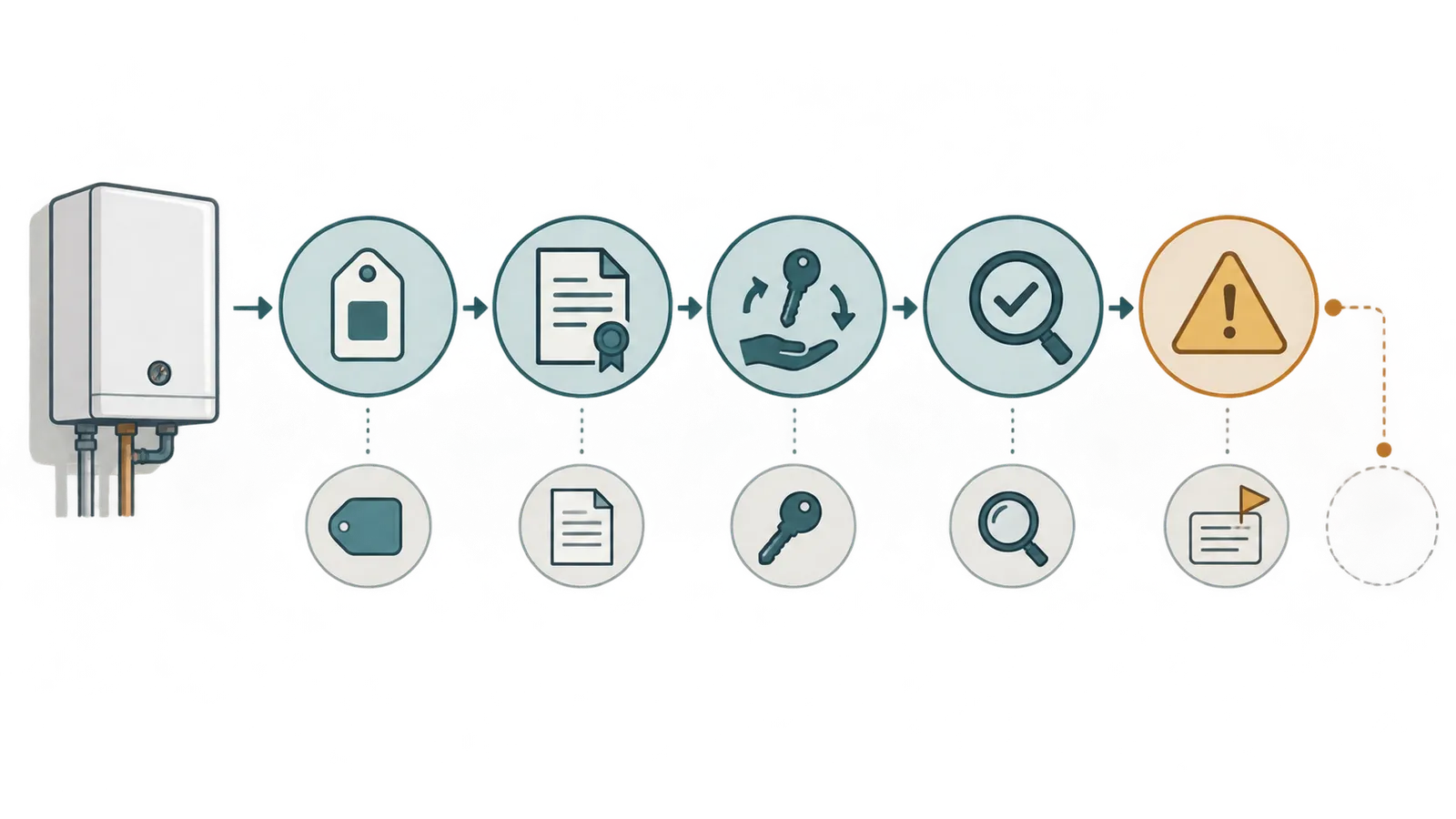
The five evidence gates
For each row, test five gates. A row can be “not applicable” for a gate only when the reason is recorded; blank is not the same as not applicable.
| Gate | Question to answer | Acceptable evidence examples | If missing, route it to |
|---|---|---|---|
| Identity | What exact thing is installed and where? | Manufacturer, model, serial, capacity or rating where relevant, location photo, plan reference | Builder or installing trade |
| Governing document | Which document defines the obligation or operating method? | Signed scope, approved submittal, manual, warranty, service agreement, permit record | Builder, trade, manufacturer, or local authority |
| Responsibility | Who acts when it is defective, unsafe, or due for maintenance? | Named company, contact, claim route, owner task, escalation route | Builder and warranty issuer |
| Verification | What was observed, tested, inspected, commissioned, or demonstrated? | Final inspection record, test report, commissioning checklist, demonstration note, photo | Builder, qualified trade, inspector, or authority |
| Exception | What is unfinished, conditional, or disputed? | Deficiency ID, location, impact, promised action, due date, acceptance condition | Builder or contract administrator |
The gates are deliberately different. A model number answers identity; it does not answer whether the system was commissioned. A warranty booklet answers coverage terms; it does not answer whether the installed unit is the model in the approved submittal. A final inspection record answers something about code or permit compliance in the issuing jurisdiction; it does not answer whether you received a filter size or learned how to reset a control.
Three outcomes, not one vague “ready” label
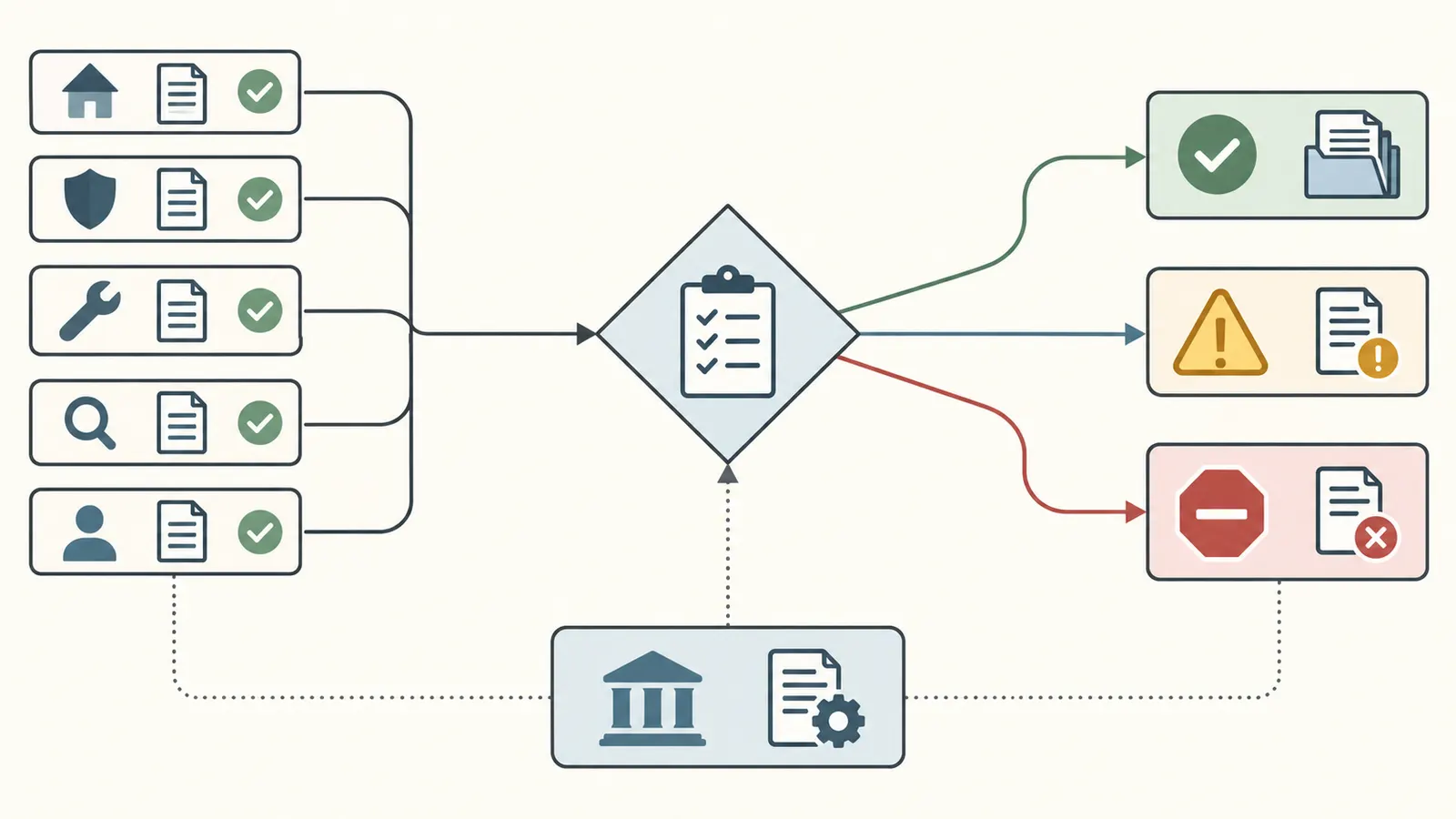
Use one of these outcomes for the record review. The labels are a homeowner decision aid, not contract language.
| Outcome | Use it when | Minimum written action before signing or possession |
|---|---|---|
| Ready to accept the record set | Critical identity, authority, warranty path, verification, and open-item fields are present and coherent; remaining low-impact omissions have an owner and due date | Save the accepted register version and the builder’s acknowledgement of any minor follow-up |
| Accept with written open items | The home can proceed under the applicable contract and local process, but noncritical records or work remain incomplete | Attach a numbered schedule with location, evidence gap, responsible party, date, remedy, and how completion will be verified |
| Pause the record review | A safety- or occupancy-critical item lacks required authority evidence, a system cannot be identified, a material mismatch is unresolved, or a defect has no responsible route | Ask the builder, qualified professional, lender, closing representative, or local authority the specific next question; do not self-sign off the gap |
“Pause” does not automatically mean “do not close.” The contract, financing, title, and local law may make that decision consequential. It means the evidence review has reached a decision boundary that needs a competent party’s answer. Put the question in writing and preserve the response with the row.
Originality brief: the decision this page adds
Current new-home answers generally tell buyers to perform a walkthrough, make a punch list, collect manuals, and understand the builder warranty. Those are useful starting points, but they often treat closeout as a pile of documents or visible defects. The missing decision is whether each installed asset has an identifiable evidence trail and a next responsible handoff.
The source-linked closeout register is the original contribution in this guide. It is a reusable worksheet and decision matrix with one row per system or durable component. Its method is to reconcile the signed scope, plans, submittals, installed labels, manuals, warranties, permit and occupancy records, test or commissioning records, demonstrations, and deficiency log. Each field is marked verified, supplied but unresolved, not applicable with a reason, or missing; each missing field is routed to the party who controls it. The method is informed by the FTC’s record and claim guidance, EPA operations-and-maintenance and closeout guidance, ENERGY STAR HVAC documentation examples, DOE commissioning concepts, and the labeled Virginia occupancy example.
Method: Reconcile the signed scope, plans, submittals, installed labels, manuals, written warranties, permit and occupancy records, test or commissioning records, demonstrations, and deficiency log. Mark each field verified, supplied but unresolved, not applicable, or missing; then route the missing evidence to the party who controls it.
Limitations: This is an illustrative homeowner recordkeeping method. It does not interpret the purchase contract, replace a permit approval, certify construction, perform commissioning, establish warranty coverage, or substitute for a qualified inspection or legal advice.
Its limitations matter. You can check the contribution by taking one installed asset at random—such as the air handler, water heater, electrical panel, or kitchen range—and asking whether another adult could locate the asset, identify its governing documents, contact the right party, understand the recorded test, and see the next action without relying on the original project manager’s memory.
For more journey context, keep this work within Brictale’s Handover & ownership guides, which sit in the broader Brictale homeowner blog. This page is about closeout records and handoffs, not about selecting a replacement product or doing a remote repair.
2. Separate the documents by what they prove #
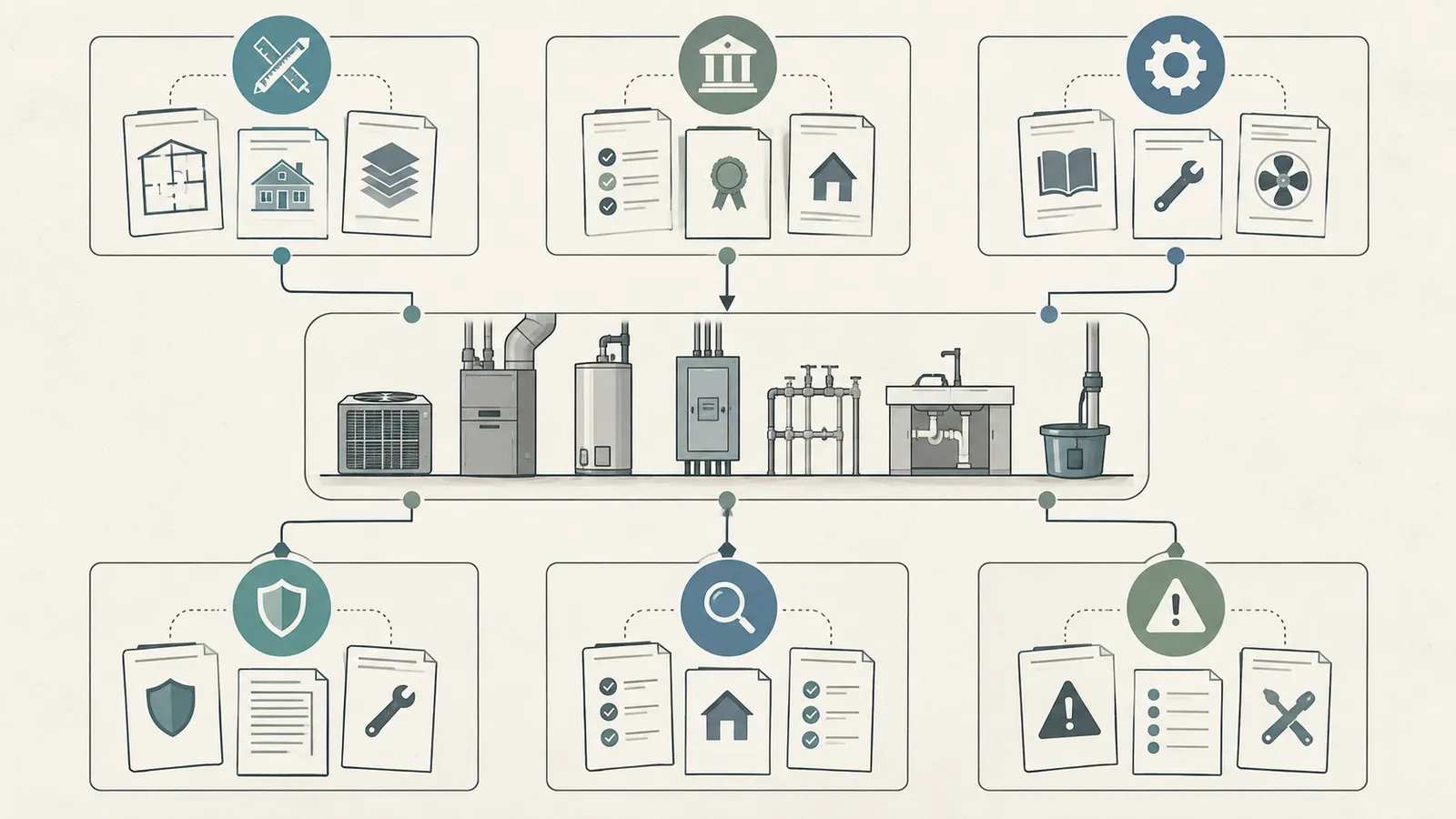
Sort closeout material into scope, authority, operation, protection, verification, and unresolved-work categories before judging whether it is complete. Different documents can refer to the same asset while proving different things; the register should preserve those distinctions instead of using one “manuals received” checkbox.
The FTC says written warranty details should be available to read before purchase and recommends keeping a copy of the warranty and the product receipt; it explains that the receipt helps establish the purchase date and original ownership. For a home, the exact accepted record may be a builder’s closing package, paid invoice, manufacturer registration confirmation, serial-number record, or another document named by the warranty. Treat the FTC guidance as a reason to preserve evidence, not as a promise that every manufacturer accepts the same proof. Start with the FTC’s warranty record guidance, then read each actual warranty’s claim and registration instructions.
Category A: scope and design intent
These records answer what was promised or designed:
- The signed purchase agreement, specifications, allowances, options, and change orders.
- Approved submittals, schedules, equipment selections, finish schedules, and product substitutions.
- Plans and details that locate concealed or distributed systems.
- Energy, accessibility, resilience, or certification commitments that apply to this project.
- Any owner-supplied equipment agreement and its interface requirements.
Scope records are your comparison baseline. They are not proof of installation. If a specification says “heat pump, 36,000 Btu/h matched system,” the installed model and matched coil still need to be identified. If the plan shows a whole-house ventilation system, the register needs the equipment identity, controls, operating instruction, and evidence that the intended system exists and is accessible.
Category B: authority and occupancy
These records answer what the relevant authority inspected, approved, or recorded:
- Building, electrical, plumbing, mechanical, fire, septic, well, or other permits, where applicable.
- Inspection results, correction notices, approved revisions, and final sign-offs.
- Certificate of occupancy, certificate of completion, final approval, or a jurisdiction’s equivalent.
- Utility release or connection confirmation where the local authority or provider requires it.
- Special inspection, testing, or professional certification records required by the permit or contract.
The actual authority and document names vary by state, county, city, tribal jurisdiction, utility district, and project type. In Virginia, for example, 13VAC5-63-160 states that a certificate of occupancy is obtained before occupancy or a change of occupancy, subject to the regulation’s exceptions, and describes issuance after final inspection approval and a compliance determination. The Virginia Department of Housing and Community Development says the Virginia Uniform Statewide Building Code applies to new construction and is enforced by the local government’s building inspections department. Those are Virginia rules, not a national rule; a project elsewhere must be checked with its actual building department. See the Virginia occupancy provision and Virginia USBC administration page.
Do not infer that a federal consumer warranty page, a builder’s warranty, or a Virginia example tells you whether your county issues a certificate, final approval, or another record. Put the authority name, permit number, code edition if shown, issue date, conditions, and source location into the register. If you cannot tell whether the document is final, ask the issuing authority or the builder’s permit contact rather than guessing from a screenshot.
Category C: operating and maintenance records
These records answer how the home is meant to be run after the handoff:
- Owner manuals and manufacturer installation or operation manuals.
- Control diagrams, sequences of operation, setpoints, normal modes, and reset instructions.
- Equipment schedules with model, serial, capacity, fuel, electrical service, filters, access points, and locations.
- As-built or record drawings showing routes, shutoffs, panels, valves, cleanouts, access panels, drains, and concealed equipment.
- Maintenance schedules tied to the actual equipment and warranty terms.
- Special tools, spare parts, filters, bulbs, batteries, touch-up material, or consumables delivered with the home.
- Contact information for the builder, installers, service providers, manufacturers, utility, and local authority.
EPA’s operations-and-maintenance guidance recommends preventive maintenance plans, periodic checks, work orders that track maintenance and costs for each equipment item, manuals, and training. It also recommends an owner manual with equipment instructions, maintenance schedules, and contact information, plus current as-built drawings for operation and future diagnosis. EPA wrote this guidance for school facilities, so it is a useful information architecture rather than a single-family legal requirement. Adapt the fields to the systems actually installed. See the EPA operations-and-maintenance guidance.
An as-built drawing need not be a beautiful architectural redraw to be useful. The key question is whether it helps someone find the shutoff, cleanout, controller, access hatch, panel, drain, or buried route without opening finished surfaces unnecessarily. If the builder provides a drawing, record its revision and date. If the drawing is marked “design” while the builder says conditions changed, ask for record information or a clear written statement of what changed.
Category D: warranties, service contracts, and claims
These records answer who stands behind what and what the homeowner must do:
- Builder warranty: covered scope, duration, exclusions, notice method, inspection process, dispute process, and required maintenance.
- Manufacturer warranty: exact model and serial scope, start trigger, registration requirement, parts-versus-labor treatment, exclusions, and authorized claim route.
- Installer or trade warranty: workmanship scope, labor duration, callback route, and relation to the builder warranty.
- Service contract: provider, price if relevant to your records, term, covered items, exclusions, dispatch rules, and whether it duplicates another warranty.
- Registration confirmations, receipts, invoices, closeout certificates, and claim correspondence.
The FTC specifically distinguishes a service contract from a warranty and warns that an extra contract may overlap with coverage already included in the product price. It also advises that a possible new-home warranty defect be checked against the warranty, submitted using its instructions, put in writing, and tracked through correspondence and conversations. Use those principles to build a claim path, but do not assume they override a notice period or dispute procedure in your documents. The relevant starting points are FTC coverage distinctions and FTC warranty claim records.
Category E: verification and unresolved work
These records answer whether the installed result was observed or tested and what remains:
- Pre-final and final inspection results.
- Equipment startup sheets, manufacturer startup forms, balancing reports, leak tests, pressure tests, test-and-balance reports, or functional test records where applicable.
- Commissioning plan, prefunctional checklist, functional test, issue log, final report, or certification record if the project or program uses commissioning.
- Owner demonstration notes: what was shown, by whom, when, and what manual was used.
- Punch list, deficiency log, photographs, correction records, reinspection records, and written acceptance of completed items.
EPA’s federal facilities manual treats closeout as a sequence that can include pre-final and final inspections, performance verification, system tests, commissioning, warranty information, as-built and record documents, O&M manuals, training, and occupancy. It also calls for documenting when and how punch-list items are addressed. A single-family project may not have the same federal deliverables, but the separation is valuable: a deficiency log should not be hidden inside a folder called “final.” See the EPA Facilities Manual closeout guidance.
A practical folder and naming structure
Use a stable identifier that connects the physical label, register row, photo, and file. For example:
HVAC-01 / Mechanical room / Heat pump air handler / 2026-08-22
Then name files with the identifier and record type:
HVAC-01-installed-label.jpgHVAC-01- approved-submittal.pdfHVAC-01-startup-and-commissioning.pdfHVAC-01-manufacturer-warranty.pdfHVAC-01-owner-training-2026-08-22.mdHVAC-01-open-item-003.pdf
The exact file system is your choice. The discipline is not. Keep the original file, do not overwrite a superseded revision, and record the date received. If the builder uses a portal that may expire, download the records permitted by your contract and retain the portal URL and retrieval date in the row.
3. Build one row for every installed system and durable component #
Start the register from the actual home and the approved scope, then reconcile the two; do not start from the documents the builder happened to upload. Walk room by room and service space by service space, record the installed item, and add a row whenever the failure, warranty, maintenance, or handoff path could differ.
The asset universe should be broad enough to capture the decision but not so granular that one screw becomes a project. A reasonable single-family register often includes:
- Site and access systems: service entrance, utility meters, exterior drainage features, sump or ejector equipment, septic components, well equipment if present, irrigation controls, gates, and retaining or drainage features documented by the project.
- Structure and enclosure: foundation or slab records, roof assembly, roof penetrations, windows, exterior doors, flashing or weather-protection records, siding or masonry systems, attic access, insulation or air-sealing certification, and exterior sealants with a distinct warranty or maintenance path.
- HVAC and indoor air: outdoor unit, indoor unit, coil, furnace or boiler, heat pump, thermostat, zoning, duct distribution, ventilation equipment, exhaust fans, humidifier or dehumidifier, filters, condensate management, and controls.
- Water and plumbing: water heater, recirculation pump, pressure-reducing valve if installed, expansion tank if installed, treatment equipment, backflow device, sump pump, sewage ejector, fixtures with product warranties, main shutoff, branch shutoffs, cleanouts, hose bibs, and leak detection equipment.
- Electrical and communications: service equipment, panelboards, subpanels, transfer or backup equipment, generator or battery, solar equipment, EV charging equipment, disconnects, smoke and carbon-monoxide devices, doorbell and security infrastructure, data cabinet, network equipment, and surge protection.
- Interiors and appliances: kitchen appliances, laundry equipment, fireplace or combustion appliance, garage-door operator, cabinetry hardware with a separate warranty, flooring or finish systems with specific care instructions, and any owner-selected equipment installed by the builder.
- Water intrusion and safety interfaces: roof drains, floor drains, sump alarms, radon mitigation if present, fire sprinkler documentation if present, egress-related devices, and access covers.
This list is a prompt, not a universal requirement. Delete rows for systems your home does not have and add rows for unusual systems. A home with a cistern, radiant heating, a central vacuum, a lift, a pool, a large battery, or a sophisticated automation system needs additional rows because the operating and service boundaries are different.
Use the row as a chain of proof
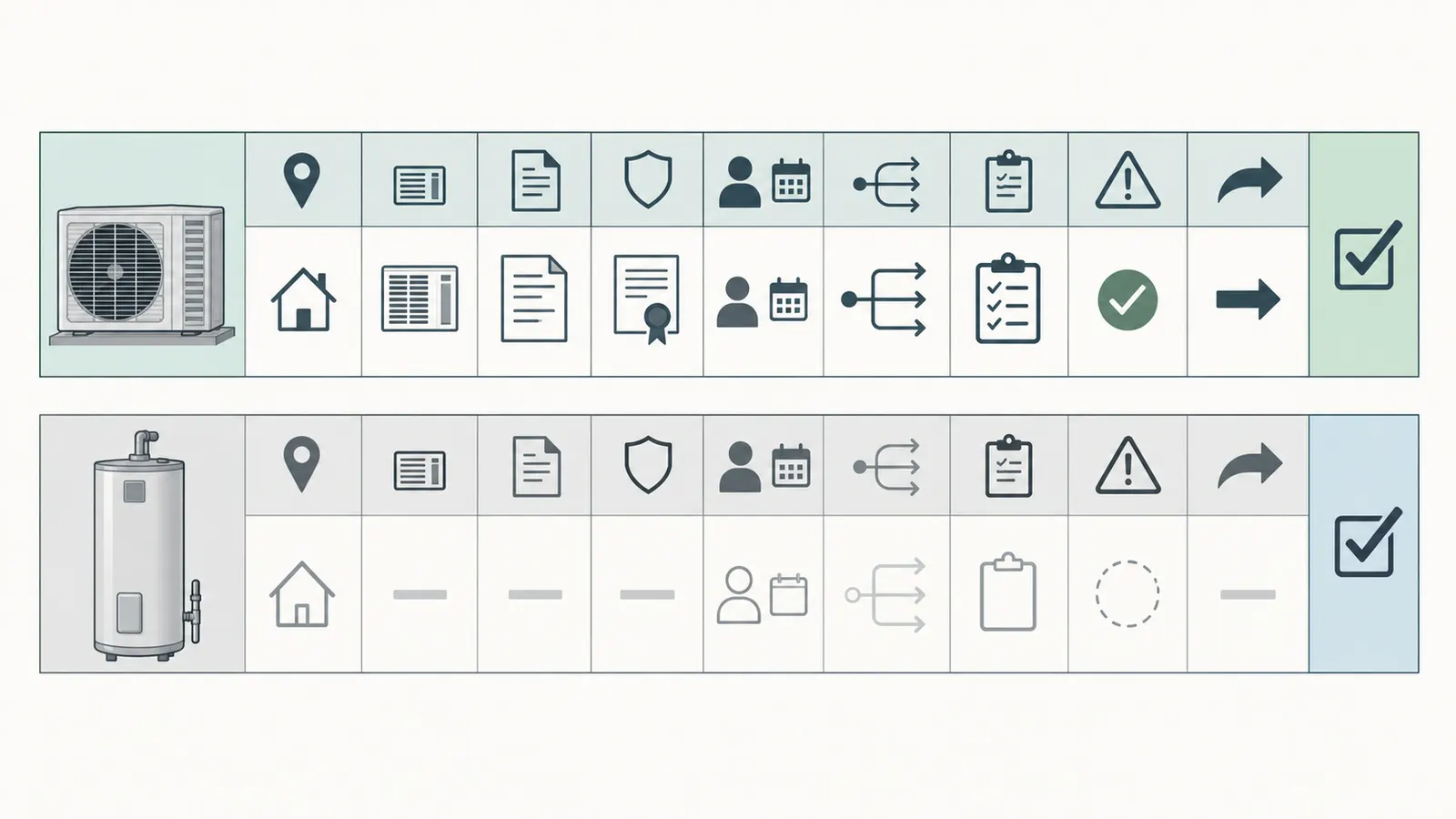
Use these columns in a spreadsheet or printed worksheet:
| Field | What to record | What “verified” means |
|---|---|---|
| Row ID | Stable identifier such as WH-01 | The ID appears on the row, related file names, and at least one location record |
| Asset and location | System, component, room, elevation, or service area | Another person can find it without the builder present |
| Installed identity | Manufacturer, exact model, serial, size or rating where relevant | Label, plate, registration, invoice, or professional record matches the installed item |
| Scope reference | Plan, specification, approved submittal, option, or change order | The governing scope record is linked and any substitution is visible |
| Governing document | Manual, warranty, service agreement, permit, certificate, or test protocol | The version and date are recorded; “manual received” alone is not enough |
| Warranty owner and trigger | Builder, manufacturer, installer, service provider; date or event that starts coverage | The written document states the path or the uncertainty is assigned to a named party |
| Claim route | Email, portal, phone, address, required form, notice period, escalation | The homeowner can open a claim without searching from scratch |
| Installer and contact | Company, trade, contact, license or credential if contractually relevant | The party’s role and contact are documented, not inferred from a logo |
| Homeowner task | Registration, filter, battery, seasonal setting, cleaning, inspection, or call | The actual manual or warranty supports the task; unknown tasks stay open |
| Verification record | Inspection, startup, test, commissioning, training, or observation | Evidence names what was checked, by whom, when, and with what result |
| Open deficiency | ID, location, condition, impact, interim protection, due date | The deficiency is actionable and not hidden in a general punch list |
| Next handoff | Person or organization, action, date, completion evidence | The next owner is named and the acceptance signal is defined |
The “warranty owner and trigger” field is especially important. The written warranty may identify a date or event that starts coverage; record only the trigger stated in the actual document, and ask the issuing party about any ambiguity. Do not calculate an end date from a generic one-year or two-year assumption. The FTC’s new-home warranty guidance says coverage length varies by component and that new-home warranties commonly have different periods for workmanship, systems, and major structural defects; those are general descriptions, not the terms for your home.
What belongs in one row versus linked rows
Use one row when the equipment and the evidence path are inseparable. For a simple bathroom exhaust fan, one row may capture identity, manual, warranty, installer, and operation demonstration. Use linked rows when different parties or triggers apply. A ducted heat pump might have:
HVAC-01for the system as a whole and the design or commissioning record;HVAC-01Afor the outdoor condenser;HVAC-01Bfor the indoor air handler and coil;HVAC-01Cfor the thermostat or zone controller;HVAC-01Dfor the ventilation unit;HVAC-01Efor the duct balance or airflow record.
Link the rows rather than copying the same warranty into all of them. This prevents a change to one serial number or claim route from leaving four stale duplicates.
The minimum identity check
For every durable asset, take or request a location record and a label record. The location record can be a plan mark, room description, or clear photo. The label record should show the model and serial when safely accessible. Do not remove covers, open energized equipment, climb onto a roof, enter a confined space, crawl into an unsafe attic, or disturb combustion, refrigerant, gas, pressure, or electrical components to obtain a label. Ask the builder or qualified trade to capture inaccessible information.
If the label is blurred or the serial is partly hidden, mark identity unverified, not “probably correct.” A model family is not an exact model. A sales brochure is not an installed serial. A photograph of a box in the garage is not proof that the boxed equipment was installed. Ask for the installed label, delivery record, or professional closeout record that ties the item to the address.
4. Reconcile the register in the right sequence #
Reconcile documents in a dependency order: scope first, installed identity second, operating and warranty records third, authority and verification records fourth, and open items last. This sequence makes mismatches visible before you spend time filing a manual for equipment that is not actually installed.
Step 1: create the baseline from the signed scope
Begin with the contract, specifications, options, allowances, change orders, and approved substitutions. Create a preliminary row for each named system or durable component. Add a column called expected and record the exact scope language, including model or performance requirement where the document provides one.
Do not treat an allowance as an installed item. If the contract says “appliance allowance,” the installed appliance must be captured from the actual invoice, approved selection, and label. If a builder supplied the appliance, the appliance may have a manufacturer warranty while the builder’s warranty excludes it; the FTC identifies appliances and components covered under a manufacturer warranty as items often not covered by a builder warranty. Read the actual warranty rather than assigning blame from a category label. Cite the FTC new-home warranty explanation in your internal notes if you need to explain the distinction to another decision-maker.
Step 2: walk the home and enumerate installed assets
Use a consistent route. For example: exterior and service entry, garage and mechanical spaces, main level clockwise, upper levels clockwise, attic or accessible service spaces, basement or crawlspace access, and site equipment. The homeowner’s job is to observe, photograph, note labels where safely accessible, and ask questions. The homeowner’s job is not to certify concealed construction.
At each asset, record:
- Where it is and what it appears to do.
- Whether the installed thing matches the expected scope.
- Whether the model and serial are legible.
- Which shutoff, disconnect, access panel, controller, drain, filter, or reset is associated with it, if visible and safe to observe.
- What the builder demonstrates and what remains unshown.
- Whether the item is complete, temporarily protected, damaged, dirty from construction, inaccessible, or not installed.
Use neutral descriptions. “No condensate drain visible from the access area” is better than “condensate drain missing.” “Thermostat powers on but no functional test report supplied” is better than “HVAC failed.” The first statements preserve what you know and invite the right next test.
Step 3: reconcile identity against submittals and manuals
For each row, compare the installed label to the approved submittal or equipment schedule. Look for model suffixes, voltage, fuel, orientation, capacity, accessories, matched components, and control versions. A replacement coil or thermostat can change the warranty or compatibility path even when the brand looks the same.
ENERGY STAR’s HVAC material demonstrates why this level of specificity matters: its sample HVAC verification documentation includes equipment model and serial, installation measurements, duct leakage or balance records, operating instructions, drawings or supporting drawings, architectural plans, equipment submittals, maintenance and warranty education, and sequence of operation. The protocol is not a homeowner testing license; it is a useful prompt for asking the installing contractor which records exist. Review the ENERGY STAR HVAC verification protocol and current contractor requirements.
When the actual model differs from the approved selection, request the approved substitution or change record and ask whether the design, load calculation, controls, warranty, or certification record was updated. Do not declare a substitution defective solely because it differs; do not accept it as equivalent solely because the builder says it is equivalent. Record the question and route it to the builder, designer, engineer, certification provider, or qualified trade who can support the equivalence.
Step 4: reconcile documents to the right asset
A PDF named final-manuals.pdf may contain many files without telling you which thermostat controls which air handler. For each document, add its row IDs. A useful cross-reference looks like this:
| Document | Rows linked | What it proves | What it does not prove |
|---|---|---|---|
| Approved HVAC submittal | HVAC-01A through HVAC-01C | Expected equipment and selected configuration | That the selected configuration was installed or commissioned |
| Startup sheet | HVAC-01A, HVAC-01B | A trade recorded startup information on a date | That every later deficiency is resolved |
| Manufacturer warranty | HVAC-01A | Written product coverage and claim conditions | Builder workmanship coverage or local code approval |
| Certificate of occupancy | Home-level authority row | The issuing jurisdiction’s recorded occupancy document | Product registration, punch-list completion, or future performance |
| Owner training note | HVAC-01, HVAC-01C | What was demonstrated and when | Professional commissioning or a warranty promise |
This cross-reference is the core of the register. It prevents the common failure where a document exists but cannot be tied to a particular installed asset.
Step 5: record verification without pretending to perform it
Classify each verification record as one of four types:
- Authority record: an issuing jurisdiction or utility records an inspection, approval, or certificate.
- Professional test: a qualified trade, engineer, inspector, rater, or commissioning provider records a measurement or functional result.
- Builder or installer observation: the project team demonstrates or documents a condition under its contract.
- Homeowner observation: you see, hear, operate, or photograph something within safe ordinary use.
Each type has a different weight and scope. A homeowner can record that a thermostat display turns on; that does not establish refrigerant charge, airflow, combustion safety, electrical compliance, or design capacity. A builder can show that a door closes; that does not establish the entire weather barrier. A final inspection can establish what the local inspector approved under the applicable permit process; it does not replace a warranty document or equipment manual.
DOE describes commissioning as a quality-assurance process that verifies a building performs according to original design and owner intent, using design reviews, functional testing, system documentation, and operator training in new construction. Many single-family homes do not receive a full formal commissioning process. Ask whether your contract, certification, utility incentive, or project specification requires one; if not, request the available startup, balancing, functional, and training records without labeling a missing formal report as a code violation. See DOE’s explanation of commissioning in new construction.
Step 6: register the deficiency at the moment you find it
Do not wait until the end of the walkthrough to reconstruct which room produced which issue. Assign an open-item ID immediately. Include:
- row ID and precise location;
- observed condition and date;
- evidence source, such as photo, document, or demonstration;
- practical impact, including whether the item affects safety, occupancy, weather protection, operation, warranty, or appearance;
- interim protection or restriction, if any;
- proposed responsible party;
- requested correction or record;
- due date from the contract or written agreement;
- completion evidence and who will verify it.
The EPA Facilities Manual closeout guidance requires its federal contractors to document when and how punch-list items are addressed. For a homeowner, the transferable idea is not the federal requirement; it is the traceability. “Fix HVAC” is not traceable. “HVAC-01B: supply grille in bedroom 2 has no airflow observed during the scheduled demonstration; builder to arrange HVAC trade functional check and provide result; due date 2026-09-12; verification is signed report plus homeowner demonstration” is traceable, even if the eventual diagnosis changes.
5. Verify high-consequence systems with the right person #
Use ordinary homeowner observation for access and operation questions, but assign electrical, gas, refrigerant, combustion, pressure, structural, concealed, and code-signoff questions to the qualified professional or authority responsible for them. A complete register records who verified a condition; it does not turn the homeowner into that verifier.
The page’s safety level is moderate because the closeout process often takes place around unfinished construction, energized systems, ladders, roofs, mechanical equipment, pressure, combustion, and concealed services. Stay on finished walking surfaces, use normal controls only as instructed, and stop when a check requires removing a cover, entering a restricted area, lifting a panel, climbing, touching wiring, opening a gas or refrigerant circuit, changing a safety device, or working around stored energy.
There is an additional contamination boundary: a homeowner cannot remotely diagnose potable-water, indoor-air, mold, microbial, chemical, radon, material, or other contamination from records, photos, odors, labels, or ordinary operation. Record only the observation and the date, avoid sampling or giving sampling or remediation instructions, and do not label a source, exposure, or treatment as confirmed. Route the concern to the appropriate qualified professional, public-health authority, utility, or laboratory under the actual jurisdiction and project scope. The register can identify the system, preserve the evidence trail, and name the next handoff; it cannot establish that water, air, a material, or a surface is safe.
HVAC, ventilation, and indoor-air systems
For HVAC, the homeowner can safely request and organize the record without independently measuring the system. Verify the visible identity, locations of equipment and controls, filter dimensions if the manual or label provides them, access to service areas, condensate discharge visibility where safely observable, thermostat zones, and the owner demonstration. Request the startup or commissioning record, equipment match information, balance report if one exists, ventilation airflow record if the project or certification requires one, sequence of operation, filter and maintenance instructions, and warranty route.
ENERGY STAR says that its certified new-home process includes HVAC commissioning tasks such as measuring blower airflow and watt draw and checking refrigerant charge, with the exact requirements determined by the program, track, and equipment type. It also says installed performance is assessed relative to design and that a contractor or rater completes the relevant task under its program. That is not a national requirement for every newly built home. Use it as a question: “Is this home enrolled in ENERGY STAR or another program, and which checklist applies?” If yes, request the applicable record. If no, ask the builder what startup and performance records the contract requires. See ENERGY STAR’s current contractor requirements.
Do not infer from cool air at one register that the entire system is balanced. Do not infer from a powered thermostat that the heating, cooling, ventilation, condensate, controls, and safety sequence all work. Do not infer from an equipment label that the selected capacity is appropriate for the completed home. Those are professional or project-record questions.
Useful HVAC open items include:
- exact outdoor and indoor model and serial are not tied to the approved matched system;
- startup sheet names a different address or serial;
- duct or ventilation test is promised but not supplied;
- no one has demonstrated emergency shutdown, normal mode, filter access, or seasonal operation;
- the thermostat has zones or modes no one can explain;
- condensate routing, drain termination, or access is unclear;
- the unit is installed but the manufacturer registration or warranty trigger is unknown.
Water heating and plumbing systems
For water systems, organize the water heater model and serial, fuel or power source, location, shutoff, drain or pan arrangement as visible, recirculation controls, manufacturer manual, warranty, installer, and any required inspection or test record. Ask the builder to identify the main water shutoff, individual appliance shutoffs, cleanouts, backflow or pressure-control devices, and the professional responsible for any unresolved leak, drainage, or temperature concern.
You may observe visible leakage, corrosion, missing access, damaged insulation, an alarm state, or a control display. Do not remove access covers, alter temperature or pressure controls, enter a crawlspace with unsafe conditions, open a relief valve to “test” it, work on gas connections, or modify electrical connections. A licensed or otherwise qualified local professional should diagnose those conditions under the local rules and the equipment manual.
A record that says “water heater warranty included” is weak. Record the exact model and serial, warranty document, start trigger, registration status, labor-versus-parts responsibility, installer, and claim route. If the builder says the equipment is covered only by the manufacturer, ask who handles the first call during the builder warranty period and how the responsibilities interact. The FTC’s distinction between builder coverage, manufacturer coverage, and separate service contracts is the reason to keep those paths separate. See FTC guidance for new-home warranties.
Electrical, backup power, and communications
For electrical equipment, the safe homeowner task is to record the service and equipment identity, panel and disconnect locations, labels, owner manuals, warranty, utility or authority records, and demonstration of ordinary controls by the qualified installer. Add generator, battery, solar inverter, transfer equipment, EV charging equipment, and surge protection as separate rows when they have separate controls or warranties.
Do not remove a panel cover, probe a receptacle beyond ordinary use, reset an unknown protective device repeatedly, open a generator or battery enclosure, or troubleshoot energized equipment. If a breaker label is unclear, a receptacle is dead, a device shows an alarm, or a backup system does not operate as demonstrated, record the observation and route it to the electrical contractor or other qualified professional. The register should state “homeowner observed” versus “qualified electrical verification supplied.”
Communications equipment deserves a row when it is built into the home or controls access, alarms, cameras, locks, or automation. Record account-transfer steps, reset ownership, network requirements, passwords handled through a secure method, and the party responsible for support. Do not place passwords or access codes in a broadly shared closeout PDF. Record that credentials were transferred securely, not the credentials themselves.
Life-safety and combustion equipment
Smoke alarms, carbon-monoxide alarms, fire-suppression interfaces, egress-related hardware, fireplaces, furnaces, boilers, and fuel-burning appliances need an explicit verification owner. Record the installed identity, location, manual, power or battery arrangement as documented, inspection or certification evidence, and the demonstration or test record permitted by the manufacturer and local authority.
Never treat a homeowner walkthrough as combustion or life-safety certification. Do not disable an alarm, cap a vent, alter a flue, relight a pilot, or change a safety control to make a demonstration pass. If a detector is missing, chirping, damaged, inaccessible, or not documented, mark it as a safety-related open item and contact the builder and the applicable qualified professional or authority. The exact requirements depend on the jurisdiction, adopted code, permit, and equipment; do not use a Virginia or federal example as a substitute for the local record.
Envelope, roof, structure, and concealed work
For roof, windows, doors, foundation, drainage, insulation, air-sealing, and other enclosure or structural items, the register should connect the installed product or assembly to the approved detail, inspection or certification record, installer, warranty, maintenance instruction, and open deficiency. Photograph accessible conditions and note signs of damage, incomplete sealant, blocked drainage, standing water, missing labels, or inaccessible areas without opening or climbing into hazardous locations.
A homeowner cannot remotely certify a roof assembly, structural connection, concealed flashing, foundation condition, or moisture performance from a few photos. If your observation suggests a material concern, request the builder’s qualified review and, when appropriate, an independent qualified inspection. Preserve the original observation and do not rewrite it into a technical diagnosis you cannot support.
Appliances and owner-supplied items
Appliances are often the easiest place to test the register because the model and serial labels are usually accessible, yet they are commonly lost in a general manual folder. Create one row per appliance when warranties or installers differ. Record delivery condition, model, serial, manual, warranty, registration task, installer, utilities connected, demonstration, and open damage or missing accessory.
For owner-supplied equipment, identify who was responsible for delivery, storage, installation, startup, damage, and warranty. A builder may have installed the item without being the seller or warranty issuer. A manufacturer may require authorized installation or registration. Do not promise coverage; capture the documents and ask the responsible party for the precise path.
6. Route missing evidence and unresolved work before the handoff #
Every missing field should become a dated handoff with one responsible party, one requested result, and one verification signal. A closeout register is useful when it routes work; it is not useful when it merely reports that “builder to provide” for twenty rows.
Assign responsibility by control, not convenience
Use this routing logic:
| Gap or question | First responsible party | Escalate or verify with | Evidence to close the item |
|---|---|---|---|
| Installed model or serial is missing | Installing trade or builder | Manufacturer if registration or identity is disputed | Clear label record, invoice, or signed professional record tied to location |
| Substitution is not documented | Builder or contract administrator | Designer, engineer, certification provider, or owner’s representative as relevant | Approved change or written scope reconciliation |
| Warranty coverage or trigger is unclear | Warranty issuer named in the document | Builder, manufacturer, installer, or consumer-protection/legal adviser for a legal question | Written warranty interpretation from the issuer or applicable adviser; do not invent a term |
| Claim route is unknown | Manufacturer, builder warranty administrator, or service provider | FTC or state consumer-protection resources for general process information | Saved claim instructions, contact, and required evidence |
| Startup, balance, or functional test is absent | Installing trade or builder | Qualified independent tester or commissioning provider if the contract or risk warrants it | Dated report naming asset, test, conditions, result, and deficiencies |
| Permit or occupancy record is absent | Builder’s permit contact and local authority | Closing representative, lender, or attorney for transaction implications | Authority-issued record or written jurisdiction-specific explanation |
| Training is incomplete | Builder or installing trade | Manufacturer representative or qualified service provider | Training note naming attendees, controls demonstrated, manuals used, and follow-up |
| Physical defect is present | Builder under the applicable written process | Qualified inspector or trade for technical diagnosis | Correction record, reinspection, photo, or professional report |
| Concealed or dangerous condition is suspected | Builder and qualified professional | Local authority or independent professional as appropriate | Professional assessment and any required authority record |
The first party is not always the final party. A builder may coordinate the HVAC contractor, but the manufacturer may control product registration. The local building department may control the occupancy document, while the builder is responsible for supplying the copy. The person who hands you a manual may not be the person who can cure a failed test.
Use evidence statuses that preserve uncertainty
Use a short controlled vocabulary:
- Verified: the supplied record or observation answers the field within its stated scope.
- Supplied—scope unclear: a document exists, but its asset, version, date, or responsibility is not clear.
- Supplied—result unresolved: a test, inspection, or report exists but includes an open issue or condition.
- Homeowner observed: you observed a safe ordinary-use condition; no professional conclusion is implied.
- Not applicable—reason recorded: the field does not apply to this home or asset, with the reason written.
- Missing—assigned: the evidence is absent, and a person or organization has a requested action and date.
- Disputed: two records or parties conflict; the conflict is preserved rather than silently resolved.
These statuses are part of the original Brictale method. They are not official legal labels. Their value is that “received” stops being mistaken for “verified.” For example, a PDF titled HVAC final may be supplied—scope unclear until you tie the serial numbers and address to the installed system. A certificate may be verified—authority record for occupancy while remaining irrelevant to a manufacturer registration field.
Write a good open-item line
Use this sentence pattern:
[Row ID] — [observed fact or missing record]. [Responsible party] will [specific action] by [date]. Completion will be shown by [evidence], and [person] will verify it.
Examples:
WH-01 — Water-heater serial is legible, but the manufacturer warranty document and registration status are missing. Builder’s plumbing trade will provide the exact warranty and confirm the registration route by 2026-09-10. Completion will be shown by the warranty PDF and registration confirmation or written instructions; homeowner will file both under WH-01.HVAC-01 — Installer supplied a startup sheet, but it names a model suffix that does not match the installed label. Builder’s HVAC coordinator will reconcile the approved submittal, installed label, and matched-system record by 2026-09-12. Completion will be shown by a corrected record or approved substitution; qualified HVAC professional will answer any performance question.AUTH-01 — Builder says final approval is complete, but the issuing authority record has not been supplied. Builder’s permit contact will obtain the jurisdiction-issued final record by 2026-09-09. Completion will be shown by the authority document or a written response from the authority; closing representative will assess transaction implications.
Avoid writing “builder to fix” without a location, requested result, due date, or completion evidence. Avoid writing “code violation” unless the authority or qualified professional has actually made that determination. Avoid writing “warranty denied” when what you know is only that the claim route has not answered yet.
Send a controlled request before the final walkthrough
Give the builder a short, indexed request rather than a folder dump. Request:
- The current closeout index and revision date.
- Asset schedule with model and serial for installed durable equipment.
- Approved substitutions and change records.
- Manuals, written warranties, registration instructions, and claim contacts.
- Startup, balancing, testing, commissioning, certification, and training records required by the scope or programs enrolled.
- As-built or record drawings and shutoff or access information.
- Permit, inspection, final approval, and occupancy documents issued for the project.
- Open deficiency list with correction and verification dates.
- The name of the warranty administrator and escalation contact.
Ask for missing items by row ID. If the builder responds with a general “all documents are in the portal,” ask for the file names or index entries that correspond to the row IDs. If a record cannot be provided before possession, ask for a signed dated commitment that identifies who will supply it and under what handoff process.
Contract, lender, and closing limits
This guide does not tell you whether to sign, withhold funds, delay closing, accept a credit, or waive a claim. Those decisions depend on your purchase contract, financing conditions, title and closing documents, applicable law, and advice from the professionals representing you. The register gives those people a more precise factual record.
Do not sign a broad “complete,” “satisfactory,” or “accepted” statement merely because the builder’s portal contains documents. Read what the statement means and ask your closing representative or attorney about consequences that you do not understand. Keep the register version and attachments that existed at the time of the decision. If the contract requires a notice in a particular form or time, follow that document and do not substitute an informal text message.
7. Make the handoff decision and keep the register alive #
Accept the handoff record only after you have classified each material gap, assigned its next owner, and separated authority evidence from system evidence; then carry the same register into the first 30 and 90 days of ownership. Closeout is a transition, not the moment a file is renamed “final.”
The illustrative completeness calculation
Use a simple score to prioritize review, not to manufacture a pass. The calculation below is a Brictale illustrative model. It is not a code threshold, warranty rule, inspection standard, or claim of measured performance.
For each row, assign five gates:
I= identity verified;D= governing document linked;R= responsible party and claim or service route known;V= verification record or clearly labeled homeowner observation supplied;O= open-item status and next handoff resolved or assigned.
Score each gate as 1 when verified or appropriately not applicable, and 0 when missing or disputed. For a row:
row completeness = (I + D + R + V + O) / 5 × 100
Illustrative example: A water heater has a clear model and serial (I=1), a manual but no written warranty (D=0), a plumber contact but no claim route (R=0), a builder demonstration with no professional startup record required by the scope (V=1, labeled as a demonstration), and a dated request assigned to the builder (O=1). Its score is (1+0+0+1+1) / 5 × 100 = 60%. That does not mean “60% safe” or “60% covered.” It means two evidence gates still need action.
For a portfolio view, calculate:
portfolio completeness = sum of row gate points / (5 × number of applicable rows) × 100
Use a weighted view if you need prioritization. Assign a weight of 3 to safety- or occupancy-critical rows, 2 to essential operation or weather-protection rows, and 1 to convenience or finish rows. Then:
weighted completeness = sum(row gate points × row weight) / sum(5 × row weight) × 100
The weights are a prioritization assumption, not a legal classification. A missing certificate or unresolved gas-combustion issue should not be hidden by dozens of complete appliance rows, so the decision matrix below uses overrides.
Sensitivity: how one missing gate changes the view
Suppose an illustrative register has 20 rows and 100 applicable gates. If four rows each lack one gate, 96 of 100 gates are present, or 96%. If one of those missing gates belongs to a safety- or occupancy-critical row, the portfolio can still be operationally unacceptable despite the high arithmetic score. Conversely, if the missing fields are four low-impact registration confirmations and each is assigned to a named party with dates, the record may be acceptable with written open items under the contract.
The sensitivity lesson is simple: the average cannot decide the handoff by itself. The result changes materially based on which gate is missing, which asset it belongs to, whether the gap is temporary, and whether the person who controls the fix has acknowledged it. Always display the arithmetic beside the exception list.
The handoff decision matrix
| Condition | Record outcome | Next decision |
|---|---|---|
| Identity, authority, warranty path, verification, and open-item fields are present for critical rows; minor gaps are assigned | Ready to accept the record set | Save the register revision, transfer files, and schedule the first ownership review |
| One or more noncritical fields are missing, but the home’s contract and local process permit the next step and the builder acknowledges dated obligations | Accept with written open items, if your advisers confirm the transaction terms | Attach the open-item schedule and define completion evidence before signing the handoff record |
| A critical system cannot be identified; authority evidence required by the jurisdiction is absent; a material safety, occupancy, weather-protection, or functional issue is disputed; or no responsible party accepts the gap | Pause the record review | Ask the builder, qualified professional, closing representative, lender, attorney, or local authority the specific unresolved question |
A high arithmetic score cannot override a missing critical authority record or an unresolved hazard. A low score caused by many harmless registration tasks does not automatically prove the home is unoccupiable. That is why the register has both gate scores and exception classifications.
Virginia as a local example, not a national shortcut
If the home is in Virginia, check the permit and occupancy records with the local building inspections department and compare the document to the Virginia code edition applicable to the permit. Virginia Administrative Code 13VAC5-63-160 says a certificate of occupancy is obtained before occupancy or a change of occupancy, subject to its exceptions, and that the building official issues it after final inspection approval and a compliance determination; it also describes conditions for a temporary certificate. The Virginia DHCD says local government building departments enforce the Virginia Uniform Statewide Building Code. Use the Virginia Administrative Code section and DHCD code page to identify the state-level example, then verify the actual project record with the local authority.
For a home in another state, do not copy “certificate of occupancy” into the register as if it must exist. The jurisdiction may use a certificate of completion, final approval, record of inspection, permit closeout, or another term; some permits or structures may have exceptions. The register field should be authority record required by [named jurisdiction], with the actual document name and permit number filled in after verification.
Run the owner demonstration as a handoff, not a performance show
Ask the builder or installing trades to demonstrate the controls you will actually use. Record attendees, date, asset rows, manual pages, and questions. A useful session can cover:
- main water, fuel, and electrical shutoff locations as identified by the responsible professional;
- thermostat modes, zones, schedules, filters, ventilation controls, and normal reset behavior;
- water-heater controls and maintenance access without altering safety settings;
- appliance operation, cleaning, filters, drain pans, and registration steps from the manuals;
- generator, battery, solar, EV charging, alarm, security, and automation ownership transfer;
- garage door, exterior lighting, irrigation, sump, leak detection, and drainage alerts;
- emergency contacts and what not to reset or repair yourself;
- seasonal settings and maintenance responsibilities that are specific to the installed equipment.
EPA’s guidance recommends training appropriate to the operator’s role and identifies designers, engineers, builders, equipment suppliers, and owner representatives as people who may participate in training. For a single-family homeowner, that supports a practical rule: ask the person who installed or designed the system to demonstrate its owner-level operation, and ask a qualified service professional to explain professional maintenance or test results. See the EPA training and owner-manual guidance.
Do not treat training as a substitute for a manual. People forget. Staff change. A written record lets the next service provider understand the intended operation without relying on your memory. Record the questions that were not answered and route them as open items.
First 30 days: establish the ownership baseline
After possession, do not immediately rewrite the register as if every unresolved item disappeared. Change the responsible handoff from builder-controlled to homeowner-controlled where appropriate, and preserve the original pre-closing status.
During the first 30 days:
- Confirm that every critical file opens and is backed up in a location you control.
- Complete manufacturer registrations that the actual warranty requires, keeping confirmation or written instructions.
- Verify that the builder and trade contacts answer the channels named in the warranty process.
- Record the initial condition of meters, equipment displays, alarms, visible leaks, finishes, and exterior drainage within safe ordinary observation.
- Add maintenance tasks only from the actual manuals, warranty terms, project documents, or a qualified professional’s written recommendation.
- Update open items with dates, replies, visits, reports, and photos.
- Ask for corrected documents where model, serial, address, or owner name is wrong.
Do not invent a universal maintenance interval. Filters, drains, batteries, treatment media, detectors, heat pumps, water heaters, generators, and pumps have different instructions and operating conditions. The EPA operations-and-maintenance guidance supports maintaining manuals, schedules, work orders, and training; the installed equipment manual and written warranty determine the actual task and interval for your home.
First 90 days: close the feedback loop
At 60 to 90 days, review every open row and ask four questions:
- Did the responsible party act?
- Does the evidence show the requested result, or only that someone visited?
- Did the correction change a model, setting, route, access point, or warranty record?
- What new maintenance or training task follows from the correction?
For a corrected HVAC issue, the useful closeout may be a revised startup record, an updated model or serial record, a functional test, and a new owner demonstration. For a corrected leak, it may be a repair invoice, a moisture or pressure record when appropriate, a reinspection, and a note about any affected finish. For a missing occupancy document, it is the jurisdiction-issued record or a written explanation from the authority—not a builder email saying “approved.”
Keep a version history. A clean closeout package should show what was true at possession and what was added later. This matters if a warranty claim, insurance question, sale, renovation, or service call requires you to explain when a condition was observed and who controlled the next action.
What to hand to a future professional
When calling a service provider, send only the relevant row and evidence set:
- asset ID, location, manufacturer, model, and serial;
- symptom or observed condition with date and normal operating context;
- relevant manual and warranty page;
- installation, startup, or prior repair record;
- photos that show the condition without exposing unnecessary personal information;
- whether the builder, manufacturer, installer, or service provider has already been notified;
- requested result and any deadline.
This is more useful than forwarding a 300-page closeout folder with no index. It also protects the distinction between an observation and a diagnosis. Tell the professional what happened and show the records; let the professional determine the test or repair.
Final reusable review checklist
Use this checklist at the final record review. Check a box only when the evidence is actually present or the field is marked not applicable with a reason.
- The signed scope, options, allowances, and change orders are saved.
- Every installed system and durable component has a unique row ID.
- Every row has a location that another person can find.
- Model and serial information is recorded or explicitly assigned as missing.
- Installed identity has been reconciled against the approved submittal or change record.
- Manuals are linked to the correct row, revision, and equipment.
- Builder, manufacturer, installer, and service-contract paths are separated.
- Warranty start trigger, term, exclusions, registration, and claim route are taken from the actual written documents.
- Receipts, invoices, registration confirmations, or other ownership records are stored where permitted and useful.
- Permit, inspection, final approval, and occupancy evidence is named for the actual jurisdiction.
- Test, startup, balancing, commissioning, certification, and training evidence is labeled by who performed it and what it proves.
- Homeowner observations are not represented as professional or authority verification.
- As-built or record drawings, shutoff locations, access points, and concealed-system information are indexed.
- Safety-related, occupancy-related, weather-protection, and critical operation gaps are separately flagged.
- Each open deficiency has a location, description, responsible party, action, date, and completion evidence.
- The builder or responsible trade has acknowledged the open-item register in writing.
- The closing representative, lender, attorney, or other adviser has the facts needed for any transaction decision.
- The final pre-possession register version is saved with its date and attachments.
- A 30-day and 90-day owner review is scheduled.
The result you want is not a thick packet. It is a defensible chain from installed thing to governing document, from document to responsible party, from responsible party to verification, and from unresolved condition to the next handoff. When that chain is complete, you can accept the record set with a clear understanding of what is known and what remains. When it is not complete, the register tells you exactly which question must be answered before the next decision.
Cite this guide
Brictale. “How to Prepare a New-Home Equipment and Warranty Register Before Closing.” Published 2026-10-05; updated 2026-10-05.
https://brictale.com/build/handover/prepare-new-home-equipment-warranty-register-before-closing · Read the Markdown version
Original contribution: The source-linked closeout register. A row-by-row worksheet that connects each installed system or durable component to its identity, governing document, warranty path, verification record, responsible party, open deficiency, and next handoff.
Sources and scope
Evidence behind this page
- The Federal Trade Commission says written warranty details should be available to read before purchase and that coverage, exclusions, remedies, and claims requirements should be stated in writing.
United States consumer guidance about written product warranties; it does not determine a particular builder contract or state warranty law.
Accessed · Link to this claim - The FTC recommends saving a copy of the warranty and the product receipt because the receipt helps prove the purchase date and original ownership.
United States consumer guidance for products with warranties; apply the recordkeeping principle to installed equipment without assuming a receipt is the only proof accepted by a manufacturer.
Accessed · Link to this claim - The FTC distinguishes a builder warranty for a new home from a separately purchased home-warranty service contract and says builder warranties commonly address workmanship and materials for specified components, while household appliances and manufacturer-warranted components are often excluded.
Warranties for New Homes | Consumer Advice
United States consumer guidance describing common new-home warranty arrangements; exact coverage, duration, exclusions, and dispute terms depend on the written warranty and applicable law.
Accessed · Link to this claim - For a possible new-home warranty defect, the FTC advises checking coverage, following the written claim instructions, putting the repair request in writing, and keeping correspondence and conversation records.
Warranties for New Homes | Consumer Advice
United States consumer guidance for documenting and submitting new-home warranty claims; it is not legal advice or a promise that a claim will be accepted.
Accessed · Link to this claim - EPA operations-and-maintenance guidance recommends a preventive maintenance plan, periodic checks, a work-order system that tracks work and costs for each equipment item, manuals, and training.
Operations and Maintenance, Part of Indoor Air Quality Design Tools for Schools
EPA guidance for school facilities, used here as a source-backed model for the record fields a homeowner can adapt; it is not a national single-family handover rule.
Accessed · Link to this claim - EPA guidance says an owner manual should contain information needed to maintain the building and equipment, including equipment instructions, maintenance schedules, and contact information for relevant design, construction, equipment, and product representatives.
Operations and Maintenance, Part of Indoor Air Quality Design Tools for Schools
EPA school-facility operations guidance; the article adapts the information architecture, not the school-specific requirements.
Accessed · Link to this claim - EPA guidance identifies current as-built drawings as important for operating and maintaining systems and diagnosing future problems.
Operations and Maintenance, Part of Indoor Air Quality Design Tools for Schools
EPA school-facility guidance; project-specific residential contract deliverables and local records requirements control.
Accessed · Link to this claim - EPA guidance recommends role-appropriate training and identifies architects, engineers, builders, equipment suppliers, and owner representatives as potential participants in operating-system training.
Operations and Maintenance, Part of Indoor Air Quality Design Tools for Schools
EPA school-facility guidance; a homeowner should request only the training relevant to the installed home and assign professional work to qualified people.
Accessed · Link to this claim - EPA's facilities manual describes closeout as including inspections, performance verification, testing, commissioning, warranty information, as-built and record documents, O&M manuals, training, and occupancy; it also calls for documenting how punch-list items are addressed.
EPA Facilities Manual: Volume 2 Architecture and Engineering Guidelines
EPA federal-facility project requirements, not a residential national rule; used as a primary-source model for separating evidence categories and tracking deficiencies.
Accessed · Link to this claim - ENERGY STAR says certified new homes must complete defined HVAC commissioning tasks, which can include measuring blower airflow and watt draw and checking refrigerant charge; installed performance is assessed relative to design under its program tracks.
Requirements & Resources for HVAC Contractors
ENERGY STAR Single-Family New Homes and related program requirements; these are certification requirements only when the home is enrolled and do not automatically apply to every new home.
Accessed · Link to this claim - ENERGY STAR's HVAC Quality Installation Verification Protocols sample documentation fields for equipment model and serial, airflow, refrigerant-charge deviation, electrical measurements, duct leakage, balance reports, drawings or supporting drawings, architectural plans, operating instructions, submittals, warranty education, maintenance education, and sequence of operation.
HVAC Quality Installation Verification Protocols (ANSI/ACCA 9 QVIP - 2009)
A published HVAC verification protocol and sample forms; it is a documentation model, not permission for a homeowner to perform electrical, refrigerant, combustion, or airflow testing.
Accessed · Link to this claim - The U.S. Department of Energy describes commissioning as quality assurance that verifies a building performs according to original design and owner intent and includes design reviews, functional testing, system documentation, and operator training for new construction.
Commissioning in Federal Buildings
DOE Federal Energy Management Program explanation of commissioning in federal buildings; use as a process concept, not as a universal residential commissioning mandate.
Accessed · Link to this claim - Under Virginia Administrative Code 13VAC5-63-160, a certificate of occupancy must be obtained before occupancy or a change of occupancy, subject to stated exceptions, and the building official issues it after final inspection approval and a compliance determination; a temporary certificate may be issued under its conditions.
13VAC5-63-160. Section 116 Certificates of occupancy
Virginia statewide building-code provision as an expressly labeled local example; it is not evidence of the rule in another state, county, city, or project.
Accessed · Link to this claim - Virginia's Department of Housing and Community Development says the Virginia Uniform Statewide Building Code applies to new construction and that enforcement is the responsibility of the local government's building inspections department.
Virginia Uniform Statewide Building Code (USBC)
Virginia building-code administration; local authority records and the code edition applicable to the permit control a Virginia project.
Accessed · Link to this claim