How to Prepare a New-Construction Punch List Before Closing When Defects Remain
Classify each new-home defect as verified, a handover hold, or a documented post-closing item with an owner, deadline, test, and warranty path.
The short answer
Build one evidence-linked row for every unresolved item. Hold handover for a safety, occupancy, essential-system, material-document, or contract-critical failure unless your contract and closing professionals approve a controlled remedy. Carry a noncritical item only when the written commitment states the scope, responsible party, due date, access, remedy, verification test, coverage route, and survival after closing.How to Prepare a New-Construction Punch List Before Closing When Defects Remain
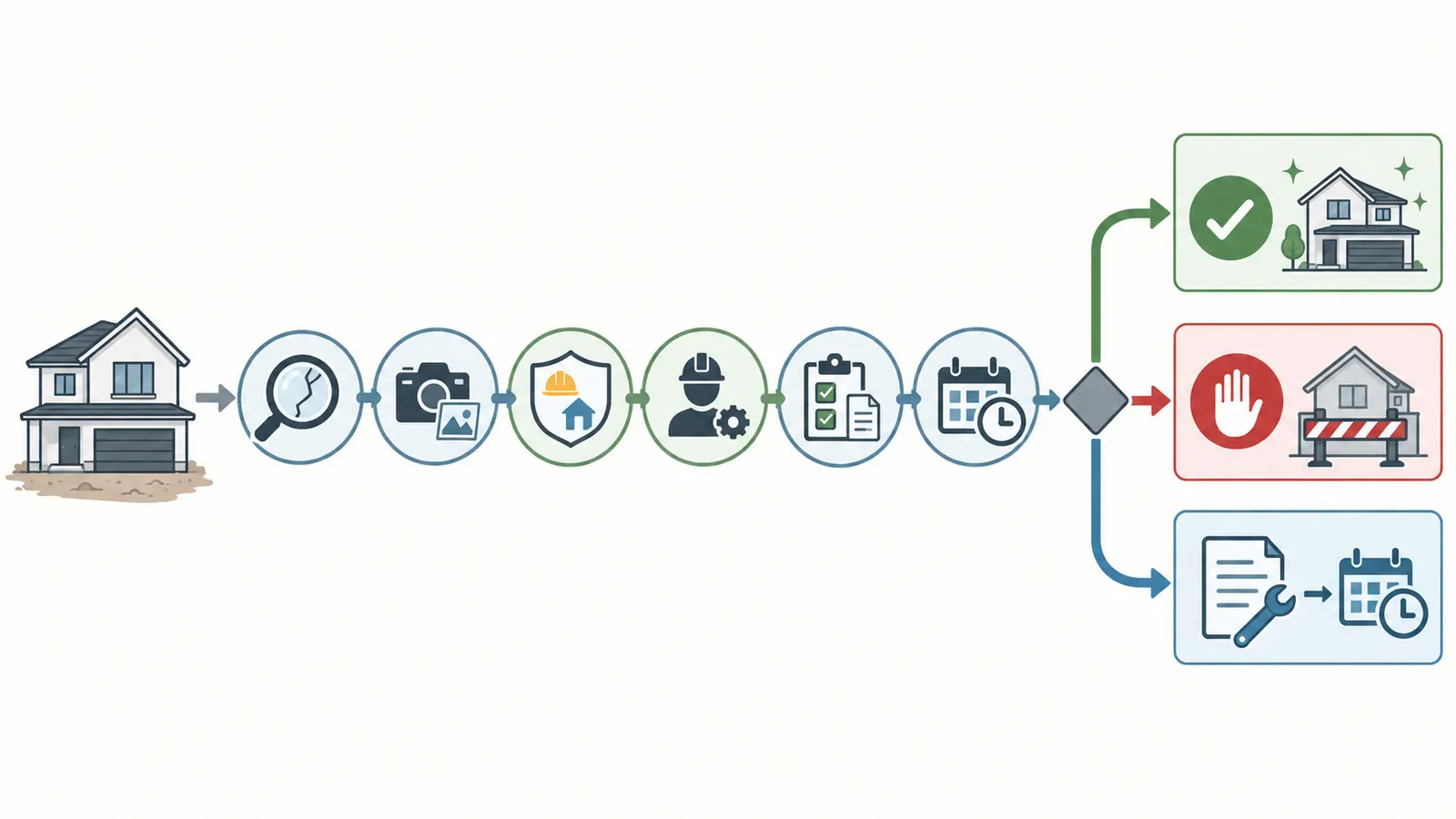
If defects remain, do not treat the punch list as a casual promise to “come back later.” Give every item one of three statuses: verified complete, hold handover, or post-closing only with a written commitment that survives closing. Record the evidence, responsible party, due date, remedy, access, retest, warranty route, and permit or occupancy record before deciding whether to sign.
Decide whether each unresolved item is verified, a hold, or a controlled carryover #
The correct pre-closing decision is to release only items that have been verified, hold for items that threaten safety, occupancy, essential use, required records, or a contractual condition, and carry a noncritical item only when the closing documents create an enforceable-looking operational record that your own contract and closing professionals approve. The labels organize the decision; they do not change your rights or replace legal advice.
“Punch list” can mean anything from a paint touch-up to an untested heating system. That is the problem. A count of defects is not a risk measure. One open cabinet door and one missing final inspection record should not receive the same treatment simply because each occupies one row. The first job is to convert a finding into a decision with an owner and a verification condition.
Use these three statuses:
| Status | Use it when | Minimum evidence before the status is credible | Next decision |
|---|---|---|---|
| Verified complete | The work or record is present, operates as required, and the verification is documented. | A dated recheck, photo or file ID, and the applicable test result, inspection record, certificate, manual, or signed acknowledgment. | Close the row and retain it in the handover file. |
| Hold handover | The item could affect safe occupancy, a required permit or certificate, essential service, concealed damage, structural integrity, water intrusion, or an express contract requirement; or the proposed remedy cannot be verified by the closing date. | A written hold or closing decision from the buyer’s closing team, with the builder’s response and any qualified professional or building-official input needed. | Repair, inspect, document, and retest before release, or obtain specific advice on an alternate closing structure. |
| Post-closing only with written commitment | The item is bounded, noncritical to safe occupancy, and the buyer’s contract and closing professionals permit the handover path. | A signed or otherwise contract-recognized document naming scope, responsible party, due date, access, remedy, verification, coverage path, and survival after closing. | Track to the due date; retest; escalate through the named route if the row fails. |
The third status is deliberately narrow. A builder’s text message saying “we’ll take care of it” may be useful evidence of a conversation, but it is not automatically a term of the purchase agreement, a warranty claim, an escrow arrangement, or a waiver of anything. The Federal Trade Commission’s guidance for new-home warranties tells consumers to file according to the warranty instructions, put a repair request in writing, and keep correspondence and conversation records. Use that discipline for the punch list, then ask the closing attorney or other authorized closing professional how the commitment must be incorporated into this transaction.
The New York State Attorney General describes the same control point in its co-op and condominium buyer guidance: the written defect list is a punch list, and if work is deferred the list and builder’s written commitment should be part of the closing documents and expressly survive closing. That is a New York example in an offering-plan context, not a nationwide rule for every single-family purchase, so treat it as a model for the question to ask rather than as automatic protection in your state. New York Attorney General guidance is especially useful because it connects the physical finding to the closing record.
Separate “the house may be occupied” from “the seller delivered the contracted house”
A Certificate of Occupancy, Certificate of Completion, or passed final inspection answers a public-authority question within a particular jurisdiction. It does not, by itself, prove that the builder has performed every promise in the purchase contract, included every selected upgrade, corrected every finish defect, or delivered every warranty and commissioning record. That separation is a practical inference from the different roles of the sources: local authorities describe permit closeout and occupancy records, while warranty and closing guidance describe contractual and consumer documentation.
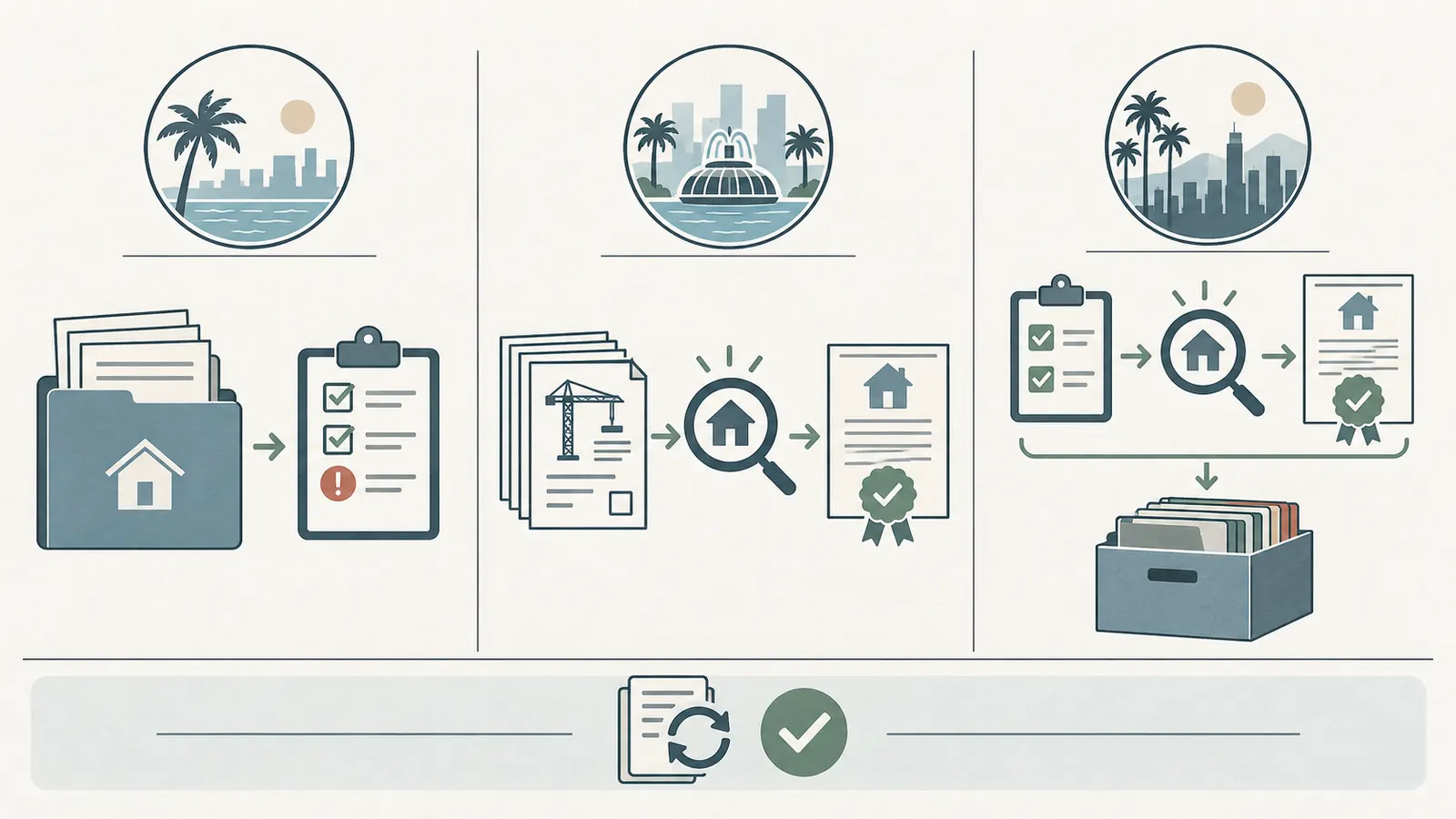
For example, the City of Los Angeles Department of Building and Safety says that after passing all inspections and completing the work, the applicant must request a final inspection to finish the process and, if applicable, obtain a Certificate of Occupancy; it advises retaining the certificate and Building Card B-8. LADBS homeowner guidance does not say that the certificate settles every private contract dispute. The City of Orlando, Florida likewise describes permit closeout documents that must be approved before a final inspection can be scheduled or a Certificate of Occupancy or Certificate of Completion can be obtained. Orlando permit-closeout guidance is a local process, not a national closing checklist.
Therefore, put two separate fields in your matrix:
- Public record status: permit number, final inspection status, Certificate of Occupancy or Completion, final utility or agency clearance if applicable, and the issuing jurisdiction.
- Private delivery status: contract scope, plans, selections, change orders, promised completion, defects, warranties, manuals, commissioning records, and the written remedy for anything left open.
Do not let a completed public record cause you to mark an unfinished private obligation “verified.” Conversely, do not ask a building department to resolve a cosmetic or contractual disagreement that is outside its inspection authority. Your next handoff for the first field is the building official or permit portal. Your next handoff for the second is the builder, closing team, warranty administrator, manufacturer, or qualified professional named by the row.
Use a hold trigger that another person can understand
The hold label should not depend on how worried you feel in the room. It should be triggered by a condition that a buyer, inspector, attorney, lender, builder, or official can review. Good triggers include:
- water entering the building, a roof or flashing leak, active drainage failure, or unexplained dampness that has not been diagnosed and retested;
- exposed or damaged electrical components, missing covers, failed protective devices, overheating, or work that a qualified electrician says is not ready for use;
- no functioning heating, cooling, plumbing, electrical service, hot water, smoke or carbon-monoxide protection where required, or another essential system that the contract or local approval requires to operate;
- a structural concern, significant foundation movement, unsafe stair or guard condition, incomplete fire-safety work, or concealed work that needs professional investigation;
- missing or unresolved final inspection, permit closeout, occupancy, utility, septic, fire, or other authority record that is required for the specific property or transaction;
- an unresolved item expressly required by the purchase contract, specifications, approved plans, change order, lender, insurer, or program commitment;
- a remedy that requires opening completed work, has an unknown extent, or cannot be verified before the proposed closing;
- a missing written warranty, commissioning certificate, or program record where the buyer is relying on that coverage or certification as part of the deal.
These are decision triggers, not legal conclusions. A roof leak may be a repairable warranty item, a permit issue, an insurance concern, or a reason to stop depending on the facts. A missing document may be a harmless administrative delay or evidence that an underlying inspection did not occur. The safe action is to preserve the evidence and route the question to the person who can decide it.
Do not use “cosmetic” as a synonym for “safe to defer”
The word cosmetic describes appearance, not risk. A loose tile can be a finish issue, a trip hazard, a sign of substrate movement, or a path for water. A cracked drywall joint can be normal shrinkage, a missed repair, or a symptom of movement. A door that will not latch can be an adjustment, a misaligned frame, a fire-door issue, or settlement. Record what is observed and what is unknown.
The New York Attorney General’s walkthrough list illustrates this distinction: it suggests consumer checks of appliances, plumbing, heating, air conditioning, air delivery, leaks, basements, electrical covers, doors, cabinets, attic insulation and ventilation, fireplaces, and conformity with the offering plan. It also notes that thin hairline concrete cracks can be normal as concrete dries, while excessive settlement can interfere with doors and cabinets. Read the New York Attorney General’s pre-closing prompts, but have a qualified professional interpret a condition that may be structural, electrical, combustion-related, or concealed.
Assemble the prerequisites and records before the final walkthrough #
Before you inspect, assemble the contract-side scope, the authority-side closeout record, and the system-side warranty and commissioning file; otherwise you may identify defects without knowing what “complete” was supposed to mean or who can verify it. Ask for the packet early enough that missing records become a decision before closing day rather than a surprise at the table.
Start with the delivery baseline
Create one folder for the home and one index for the evidence. Use the property address, lot or unit identifier, permit number, and a version date. Keep the original files; do not rename away dates or signatures. At minimum, collect:
- the signed purchase agreement and all addenda;
- the builder’s specifications, allowances, standard features list, and approved selections;
- every change order, credit, allowance reconciliation, and written promise made during construction;
- the approved plans or the contract drawings that define the promised work;
- inspection reports, third-party inspection findings, engineering letters, test reports, and builder responses;
- a current list of installed equipment with manufacturer, model, serial number, capacity or size where relevant, and installation location;
- permit numbers, inspection results, final approvals, Certificates of Occupancy or Completion when applicable, and closeout correspondence;
- warranty booklets, builder warranty terms, manufacturer warranties, registration instructions, and the name and contact information of any third-party warranty administrator;
- operation and maintenance manuals, shutoff locations, filter sizes, maintenance requirements, and emergency contacts;
- program records such as ENERGY STAR, DOE Efficient New Homes, Indoor air quality, energy-rating, or other certification documentation only if the home is represented as participating;
- a draft closing document or exhibit where unresolved items can be described with enough detail to identify them later.
Miami-Dade County, Florida’s homeowner guide is a useful local example of the breadth of this packet. It recommends obtaining contractor and subcontractor information, approved plans, a survey, applicable product approvals, roof insulation information, HVAC energy cards, and available soil, termite, radon, and association documents before closing. The guide is dated 3/05 and is a Miami-Dade checklist and recommendation, not a current nationwide rule. Miami-Dade’s newly constructed home guide should be supplemented with the current requirements of the local building department, the contract, lender, insurer, and closing team.
Convert promises into testable requirements
A specification is not yet a test. Translate it into a requirement that a person can verify. For example:
| Source of requirement | Vague statement | Testable row requirement |
|---|---|---|
| Selection sheet | “Kitchen faucet, brushed nickel” | Confirm the installed manufacturer and model or approved equivalent against the signed selection; photograph the label or fixture and record any approved substitution. |
| Change order | “Add recessed lights in office” | Count installed fixtures, confirm switch control, confirm the circuit is energized by a qualified person, and compare location to the marked plan. |
| HVAC scope | “Complete HVAC installation” | Record model and serial, confirm operation in the available mode, obtain the required startup or commissioning record, and note the conditions under which a full performance test can be repeated. |
| Drainage promise | “Grade away from foundation” | Photograph the finished condition and any standing water after appropriate weather; obtain the builder’s site or drainage verification where the contract or local requirement calls for one. Do not invent a slope threshold. |
| Program promise | “ENERGY STAR home” | Ask for the certificate or rater documentation and the program version or track; do not infer certification from an appliance label or marketing phrase. |
This step protects both sides from ambiguity. If the builder says a finish is complete, the row states what is being accepted. If you say it is defective, the row states the observed basis and what professional or document could confirm it. The row does not need to announce a legal remedy; it needs to preserve a reliable fact pattern for the person who decides the remedy.
Ask for the authority record from the actual jurisdiction
There is no single United States closing record that applies to every new home. The permitting authority may be a city, county, township, state program, or another agency, and some work may have separate plumbing, electrical, mechanical, fire, septic, stormwater, or utility closeout. Ask:
- Which authority issued each permit?
- What is the permit number and current status?
- Which inspections remain open, failed, conditional, or not applicable?
- Is a final inspection required before the occupancy or completion certificate?
- Does the authority issue a Certificate of Occupancy, Certificate of Completion, final approval, or another record?
- Are as-built drawings, engineer certifications, utility clearances, or stormwater video records part of closeout?
- Who can retrieve the record if the builder’s copy is incomplete?
Orlando gives a concrete example of why the details matter. Its page says applicable projects may require an as-built checklist, PDF and CAD files, an Engineer of Record certification letter, and approved hard copies before a final inspection can be scheduled or a Certificate of Occupancy or Completion can be obtained. It also points users to permit lookup and says the final inspection can be scheduled after complete approval. City of Orlando permit closeout applies to the City of Orlando, Florida; it is not evidence of the closeout process in another Florida municipality.
In the City of Los Angeles, California, LADBS tells homeowners to have the permit, approved plans when plan review was required, Building Card B-8, and necessary equipment available for an inspection; it says work must be visible and ready for review and that documentation or access problems can delay the inspection. After all inspections and completion, the applicant requests the final inspection and, if applicable, the Certificate of Occupancy, then retains the certificate and B-8. LADBS’s homeowner steps are a jurisdiction-specific handoff sequence. They do not establish what a different city or county requires.
Build a deadline calendar before you close
Use the earliest relevant date, not just the date you expect a problem to be fixed. Put these events on one calendar:
- contract closing date and any contractual completion or notice dates;
- final walkthrough date and the date of the last successful retest;
- warranty effective date, claim deadline, and notice method for the builder or third-party plan;
- manufacturer warranty registration or claim requirements;
- final inspection, certificate, utility, or program documentation dates;
- access windows promised for post-closing work;
- a reminder before each open item’s due date and another reminder for the verification visit.
The FTC’s new-home warranty guidance says coverage varies by component and that consumers should check the warranty’s length and claim instructions, put repair requests in writing, and keep correspondence. It describes common examples—one year for workmanship and materials on many components, two years for HVAC, plumbing, and electrical systems, and sometimes longer coverage for major structural defects—but those are general descriptions, not a promise about your builder’s warranty.
If your home is in New Jersey, the state’s Department of Community Affairs provides a more specific example: its consumer page states one year for defects in materials and workmanship, two years for heating, air-conditioning, plumbing, and electrical system defects, and ten years for major structural defects under the New Jersey New Home Warranty and Builders’ Registration Act. The booklet and plan administrator control the filing details and exclusions. New Jersey warranty periods should be read with the actual warranty documents.
The same New Jersey page makes a crucial operational distinction: telling or writing to the builder does not count as filing a formal warranty claim; the homeowner must file according to the warranty plan administrator’s requirements before the applicable coverage period ends. New Jersey’s filing guidance is a New Jersey rule and program instruction, not a national deadline. Put “formal claim filed?” in the matrix instead of assuming that a punch-list email preserves every right.
Record each finding so a different person can verify it #
The best punch list is not the longest list; it is the list with enough identity, evidence, ownership, and closure criteria that a person who was not in the walkthrough can understand what happened. Use one row per issue, not one row per room with several unrelated defects hidden in a paragraph.
Use the full disposition matrix
The original Brictale contribution for this guide is the Punch-list disposition matrix and release-gate workflow. Method: Record the observed condition, evidence, safety or occupancy impact, responsible party, verification test or document, retest date, coverage path, and closing-document reference; reconcile every row against the contract, final permit and occupancy records, warranty instructions, and any program-specific commissioning record. Limitations: This is a records and decision aid, not legal advice, an engineering inspection, a code document, or a universal acceptance threshold. The purchase contract, lender, closing counsel, building official, warranty plan, equipment manual, and qualified inspectors control the applicable decision.
Use these columns:
| Column | What to enter | Why it matters |
|---|---|---|
| Row ID | Stable ID such as K-004 or HVAC-002 | Lets the closing exhibit, email, photo, and retest refer to the same issue. |
| Room or system | Room, elevation, exterior area, or system | Makes the location unambiguous. |
| Observed condition | What you saw, heard, measured, or could not operate; use neutral language | Separates observation from diagnosis or blame. |
| Requirement source | Contract section, plan sheet, selection, change order, code/permit record, manual, or warranty | Shows why the row is open and who can interpret it. |
| Photo or file ID | Photo number, video ID, report page, email, or permit record | Preserves the evidence and the time it was captured. |
| Safety or occupancy impact | None observed, unknown, potential, or confirmed; explain | Helps the closing team prioritize without hiding uncertainty. |
| Responsible party | Builder, named subcontractor, manufacturer, warranty administrator, building official, rater, or buyer action | Prevents “builder will handle” from swallowing every handoff. |
| Required action | Repair, replace, clean, complete, investigate, obtain record, register, or provide explanation | Describes the deliverable, not just the complaint. |
| Required test or document | Functional test, inspection, certificate, report, photo, model number, or written determination | Defines what “done” means. |
| Retest condition and date | Conditions needed, such as utilities on or a suitable operating season, plus target date | Avoids declaring completion when the system could not be tested. |
| Builder/state/manufacturer coverage path | Builder warranty, state plan, manufacturer, local official, contract exhibit, or none identified | Keeps separate remedies from competing or being missed. |
| Closing-document reference | Exhibit, addendum, repair agreement, escrow instruction if authorized, or “not permitted to carry” | Shows how the item is treated at signing. |
| Status | Verified complete, hold handover, or post-closing written commitment | Makes the release gate visible. |
| Completion proof | Dated photo, invoice, test result, signed record, permit update, or buyer acknowledgment | Closes the loop. |
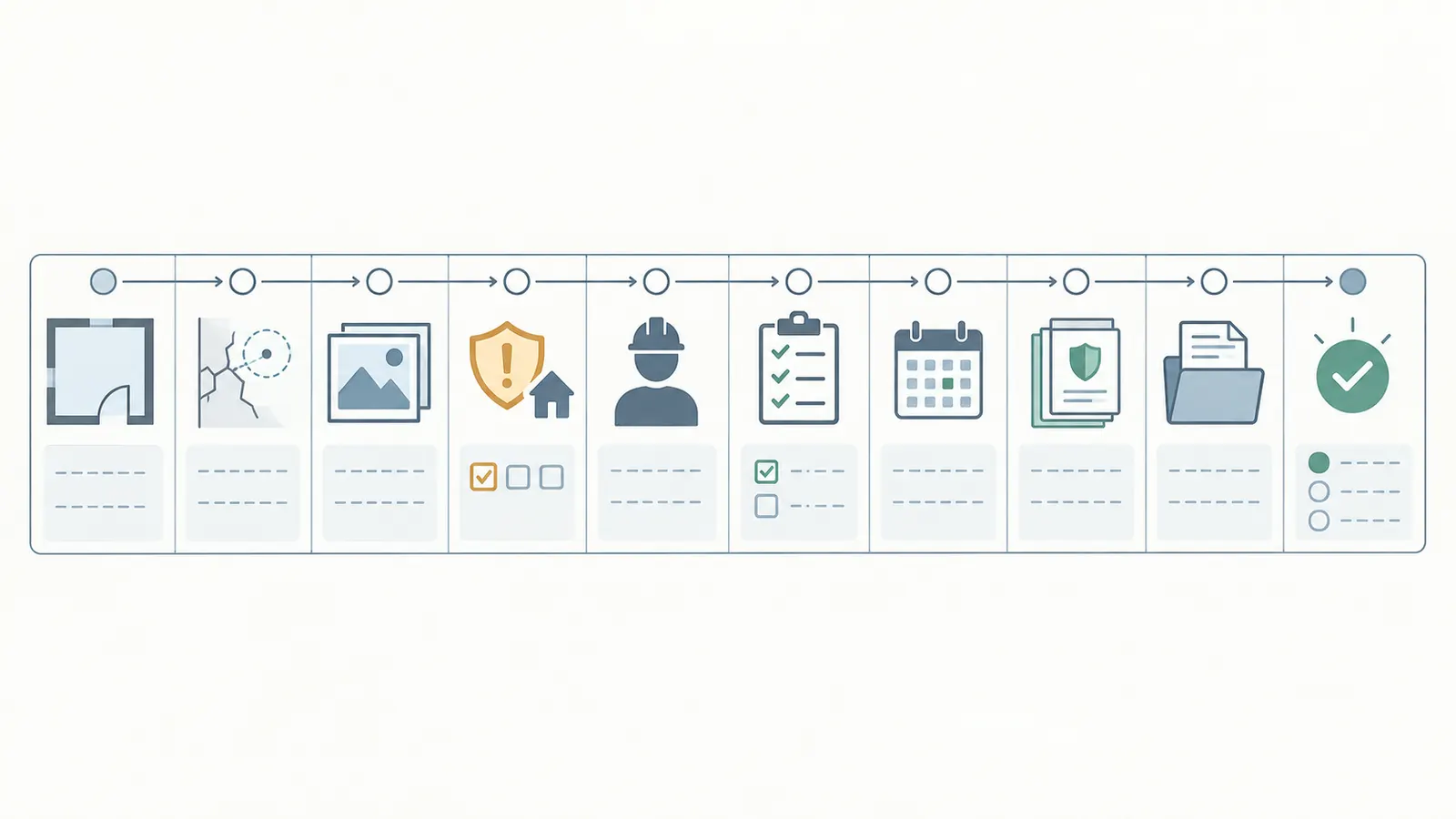
“Safety or occupancy impact” should not be a box you tick without explanation. Write “unknown—licensed electrician needed to inspect exposed conductor,” “potential water intrusion—attic access not safe for homeowner,” or “no observed safety impact; cabinet door adjustment only.” That language gives the next person a bounded question.
Give evidence a stable identity
For photographs, use a simple convention such as 2026-09-07-HVAC-002-01. Photograph the context first, then the detail, then any label or measuring reference that can be safely captured. Preserve the original file’s timestamp if possible. A photo shows a condition at a moment; it does not prove the cause, code compliance, future durability, or repair quality.
For documents, record the source and page: Permit 24-12345 final inspection status, portal screenshot, captured 2026-09-07; HVAC commissioning checklist, page 1; Change order CO-17, signed page 2. If you send the file to the builder, record the sent date and recipients. If a person gives a verbal explanation, summarize it in writing and ask for confirmation. The FTC’s new-home warranty recordkeeping guidance supports saving the warranty, purchase record, correspondence, and repair history; the matrix extends the same traceability to construction closeout.
Record units and conditions when measurements exist
Do not add numbers just to make a row look technical. When a measurement is relevant, record:
- the quantity and unit, such as inches, degrees Fahrenheit, gallons per minute, volts, or square feet;
- the instrument or source, if meaningful;
- the location and operating mode;
- the time and environmental condition;
- the expected reference, such as the manufacturer’s manual, approved design, or a professional report;
- who took the measurement and whether the person was qualified to interpret it.
For a room temperature observation, write “Office: 68°F at thermostat; 64°F at far register after 30 minutes of heating, outdoor temperature 41°F, homeowner observation, no conclusion about balance.” Do not write “HVAC fails code” unless a qualified person or authority has made that determination. For a door gap, write the visible location and whether the door latches; do not infer foundation movement from one observation.
Label unknowns instead of forcing a yes or no
Use an explicit unknown state when the item cannot be responsibly closed. Examples:
- Not tested: electrical service was not energized during the walkthrough.
- Not accessible: attic or roof area could not be reached safely.
- Seasonally constrained: cooling could not be commissioned under the available outdoor conditions; builder must provide the applicable startup record or a scheduled test.
- Document pending: local permit portal shows inspection pending or the builder has not supplied the certificate.
- Scope unclear: installed material differs from the selection and equivalence has not been approved in writing.
- Diagnosis pending: staining is visible but the source and whether it is active are unknown.
Unknown is not automatically a hold, but it is never verified complete. Decide whether the unknown affects a hold trigger, whether a qualified person can resolve it before closing, and what written record is required if the contract permits a carryover.
Run the walkthrough in a sequence that catches dependencies #
Run the walkthrough with the builder or designee, utilities available, your matrix open, and enough time for retests; inspect the building envelope and access first, then life-safety and essential systems, then fixtures and finishes, and finish by reconciling the paperwork. Miami-Dade County’s guide recommends a pre-closing walk-through with the developer or builder and a knowledgeable building-trade representative, and specifically notes that utility-dependent checks should occur after utilities are turned on. Miami-Dade’s walkthrough list is a local recommendation, but the sequence is a useful planning model.
Stage 1: Confirm access, identity, and the baseline
Before testing, confirm the address, lot or unit, date, attendees, weather, utility status, and areas that are unavailable. Ask the builder to identify shutoffs, panels, mechanical rooms, attic access, crawl-space access, cleanouts, exterior drainage paths, and any area that remains under construction. Photograph or note barriers. An inaccessible area should become a row, not disappear from the inspection.
Carry the latest plans, selection list, change orders, inspection report, and matrix. If the home has been cleaned or repaired since your prior inspection, compare the current condition with the previous row rather than starting a new list that loses history. If a builder says a listed item was fixed, ask what changed and what evidence confirms it.
Stage 2: Walk the exterior and water-shedding path
Look at roof edges from a safe ground position, flashing and penetrations that are visible without climbing, siding, trim, windows, doors, exterior penetrations, foundation edges, grading, downspouts, drainage outlets, decks, stairs, guards, handrails, walks, and required landscaping. Note ponding, erosion, exposed materials, missing sealant, damaged finishes, blocked drainage, and unfinished connections. Do not climb onto a roof, use an unstable ladder, enter a crawl space, or approach an electrical or utility hazard because it is on a checklist.
A stain is an observation, not a diagnosis. Ask whether the area is dry, whether the builder has a leak-test or repair record, and whether the repair requires a retest after rain or controlled testing by a qualified professional. If the source is concealed, active, or uncertain, the item usually deserves a hold discussion rather than a paint touch-up promise. If staining, wet insulation, plumbing odors, sewage, suspected mold, chemically affected materials or water, or possible concealed water impact raises a contamination concern, do not touch, sample, scrape, cut, dry, or otherwise disturb the material or water. Preserve the location from a safe distance, notify the builder, and route the condition to an appropriately qualified professional before treating it as cosmetic or verified complete. This Brictale boundary is a safety-and-routing instruction, not a diagnosis or a universal remediation protocol.
Stage 3: Test openings, barriers, and finishes
Open and close every exterior door, interior door, window, cabinet, drawer, and closet door. Confirm latches, locks, screens, stops, weather seals, and clearances. Look for cracked glass, damaged frames, chipped tile, loose trim, uneven finishes, missing caulk, incomplete paint, flooring damage, and deviations from selections. Record the exact location and quantity. A whole-room statement such as “paint is bad everywhere” cannot be retested efficiently; a row such as L-012: north wall, two unpainted patches beside receptacle, photo 12 can.
If an opening does not latch, do not assume an adjustment is trivial. Ask whether the problem is limited to hardware, whether the frame is plumb, whether the door is part of a required fire or egress assembly, and who must verify it. The answer may be a builder finish repair, an authority inspection, or a qualified professional review.
Stage 4: Test plumbing and drainage without opening systems
With water service on, operate each faucet, fixture, shower, tub, appliance connection, hose bib, and drain that you are permitted to use. Look under accessible sinks and around visible supply and waste connections for leaks. Note slow drainage, unusual noise, odor, missing trim, poor fixture operation, hot-water delay, or a fixture that cannot be tested. Check that toilets flush and refill normally without repeatedly cycling them. Do not remove cleanouts, disassemble valves, enter tanks, alter pressure controls, or use chemicals to force a drain.
Miami-Dade’s list specifically prompts buyers to check plumbing leaks and noisy water lines, clogged sewer lines, fixtures and drains, and operation of appliances, with utility-dependent checks after utilities are on. See the county’s buyer guide. The guide does not create a universal pressure, flow, temperature, or drainage acceptance number. Use the contract, equipment manual, applicable authority requirements, or a qualified plumber’s report for a threshold.
If there is evidence of a leak or drainage restriction, photograph the condition, stop using the affected fixture if continued use could cause damage, and notify the builder promptly. A leak behind a finished wall is not a cosmetic row. A slow drain could be a fixture adjustment, construction debris, a venting issue, or a larger obstruction; the next step is diagnosis by the responsible trade.
Stage 5: Test electrical function from the user side only
Operate switches, lights, accessible receptacles with an appropriate plug-in device if you know how to use it, exhaust fans, garage-door controls, doorbells, and other owner-facing controls. Confirm that covers and trim are present and that fixtures do not flicker, buzz, overheat, or show damage. Record circuits or locations if the builder’s electrician can identify them.
Do not remove a panel cover, probe energized conductors, reset an unfamiliar protective device repeatedly, or touch exposed wiring. The New York Attorney General’s guide tells consumers to look for loose wires and electrical fixtures without covers, especially in basements; that is an observation prompt, not permission for a homeowner to make an electrical repair. New York’s walkthrough guidance supports routing an unsafe-looking condition to the builder and a qualified electrician.
If a safety device trips, note what was operating, the time, and the device label if visible. Do not infer the cause from the trip. A qualified electrician should determine whether the issue is an appliance, circuit loading, protective device, wiring, moisture, or an installation defect.
Stage 6: Test heating, cooling, ventilation, and controls within their limits
Confirm the equipment labels, thermostat response, operating modes available on the day, airflow at representative registers, condensate routing, filters, access panels, outdoor-unit clearance, and visible duct or line-set insulation. Record the time from command to operation and unusual noise or odor. Use a thermometer only as an observation tool; do not turn one room reading into a conclusion about capacity, balance, refrigerant charge, or code compliance.
The ENERGY STAR HVAC commissioning checklist shows the type of record a program-specific commissioning process can contain: outdoor temperature, return-side air temperature, liquid-line pressure and temperature, suction-line pressure and temperature, manufacturer targets, external static pressure, measured airflow in CFM, and room-by-room airflow checks. It calls for a completed and signed checklist for each commissioned system and says the contractor retains it for at least three years for quality assurance and provides it to the builder, rater, and oversight organization upon request.
Those fields are not a homeowner acceptance test or a universal code threshold. ENERGY STAR says its single-family requirements use program tracks and that the contractor path requires an EPA-recognized credential; the equipment and distribution system determine whether the listed checklist applies. ENERGY STAR HVAC requirements should be read with the home’s actual certification path and design report.
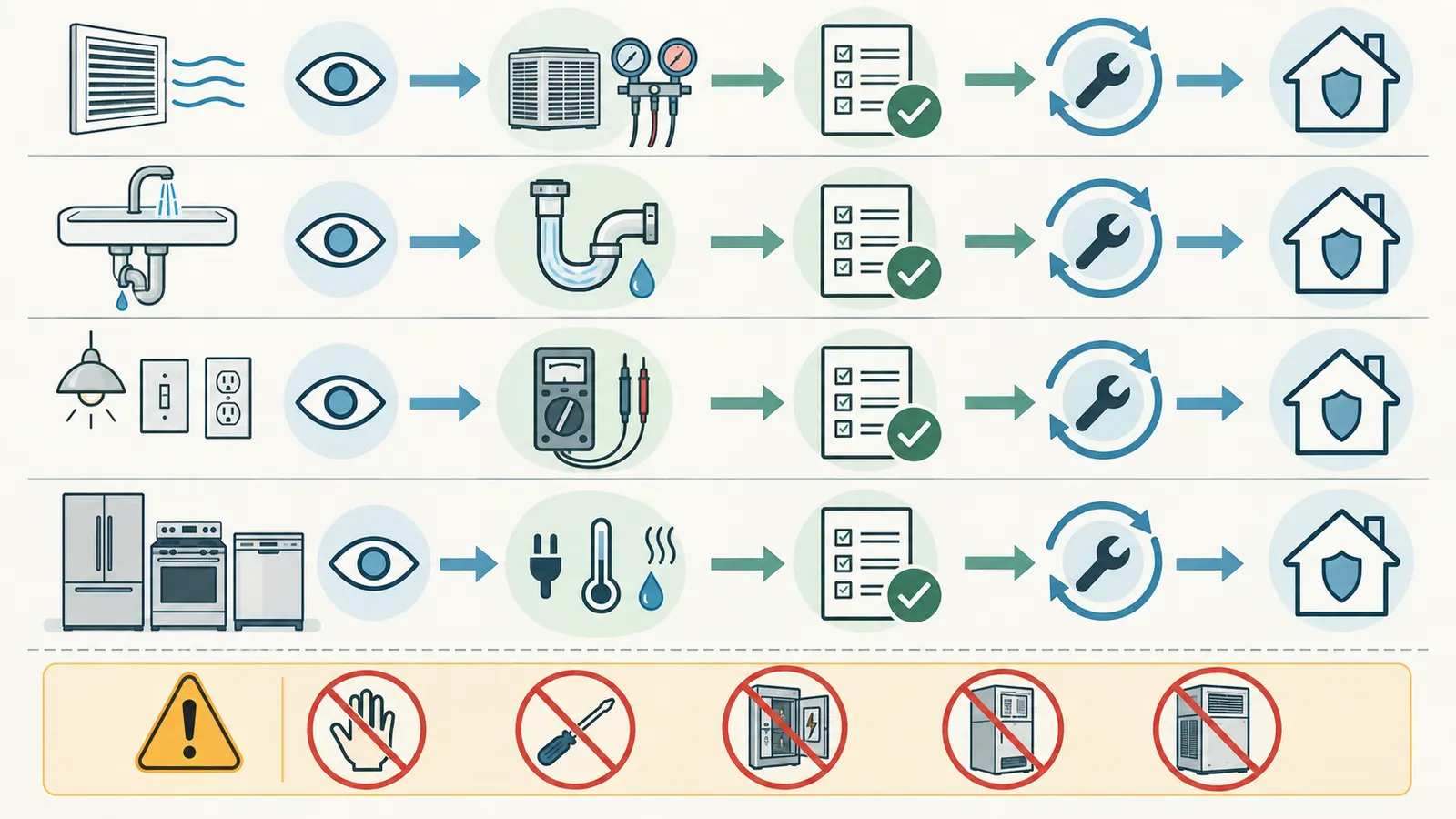
If the home is represented as a DOE Efficient New Home, request the program record, not just an ENERGY STAR logo. The U.S. Department of Energy’s program FAQ says the rater performs site testing and inspections after construction, checks the as-built home against the modeled design and mandatory requirements, sends documentation through an oversight organization, and may provide the certificate after approval. Missing program documentation is a contract and verification question; it does not automatically mean the building is unsafe, but it prevents you from marking the claimed certification verified.
Stage 7: Test appliances and owner controls, then conduct a handoff rehearsal
Run each included appliance through a normal user-facing function: range or cooktop controls, oven, dishwasher fill and drain, refrigerator water or ice features if connected, laundry valves and drain, disposal, exhaust hood, garage door, security or intercom, irrigation controls, and other selected equipment. Verify model and finish against the signed selection, and photograph serial labels where accessible. Do not operate gas-burning equipment in an abnormal way or defeat a safety control.
Ask the builder to demonstrate shutoffs and routine maintenance: main water, gas if present, electrical service disconnect, HVAC filter access, condensate route, water heater controls, exterior hose bibs, sump or drainage equipment, and any alarm or monitoring system. The handoff is not complete if the homeowner cannot identify the equipment, the responsible service path, or the records needed to operate it safely.
Stage 8: Reconcile the paperwork before leaving
At the end, compare the matrix to the contract, plans, selections, change orders, inspection report, permit portal, warranty documents, and program claims. Add rows for discrepancies discovered during reconciliation. Ask the builder’s representative to sign or acknowledge the list with the date, but do not assume acknowledgment is agreement with every requested remedy. Send the current version to the closing team and keep an unchanged copy.
Assign the right responsible party and verification path #
Assign each open item to the party that can perform or verify that specific action; the builder is often the coordinator, but it is not always the final authority, warranty provider, manufacturer, permit issuer, or commissioning verifier. A row should have one primary owner and any supporting handoff, with the buyer responsible for tracking and preserving records rather than for performing hazardous work.
Use a responsibility map
| Issue type | Primary route to ask first | What that route can verify | What it cannot automatically decide |
|---|---|---|---|
| Workmanship, finish, installation, missing included item | Builder or named subcontractor | Scope, repair, replacement, completion photo, invoice, and builder warranty process | Whether the buyer must accept the home or waive a contractual right. |
| Appliance or component failure | Builder for installation coordination and manufacturer for product coverage | Model, serial, installation condition, startup, manufacturer service record, warranty terms | Whether the builder’s delivery obligation is satisfied if the product is replaced with an unapproved equivalent. |
| Electrical, plumbing, HVAC or gas hazard | Qualified licensed trade through the builder or buyer’s inspector | Safe diagnosis, repair, test, and professional report within the person’s scope | Permit closeout unless the authority records the inspection. |
| Permit, final inspection, occupancy or completion record | Actual city, county, township, state or other issuing authority | Permit status, inspection result, certificate, required closeout documents | Private contract completion or warranty coverage. |
| Structural movement, concealed water, foundation, significant drainage | Qualified engineer, architect, building-science professional, or trade appropriate to the issue | A bounded assessment and recommended next investigation or repair | A legal conclusion or a universal acceptance threshold. |
| Builder warranty or third-party new-home warranty | The actual warranty administrator and builder | Coverage, notice method, claim deadline, required forms, inspection, and repair path | Whether a local building department will correct a non-code warranty defect. |
| Manufacturer warranty | Manufacturer or authorized service route | Product warranty, registration, service ticket, repair or replacement decision | Builder’s separate contractual responsibilities. |
| ENERGY STAR or DOE certification | Builder, rater, oversight organization, or program contact identified in records | Program track, rater documentation, certificate, and missing evidence | General code compliance or the absence of every future performance problem. |
| Closing treatment | Buyer’s attorney, lender, title or closing professional as applicable | Whether a written item can be incorporated, held, escrowed, or otherwise treated under the transaction documents | Engineering adequacy or a promise the builder will perform absent authorized terms. |
The New Jersey Department of Community Affairs offers a clear jurisdiction-specific warning about the code-versus-warranty handoff. It says the local building department’s role is to identify and correct code violations, while the warranty program can address covered materials or workmanship defects that are not code violations; it tells homeowners to file a warranty claim for covered defects. New Jersey’s warranty-versus-code guidance does not mean the same allocation exists in every state, but it demonstrates why a punch list should include both “code/permit route” and “warranty/contract route.”
Route builder-caused problems without losing the external route
Give the builder a complete, dated list and ask for a written response that identifies the trade, action, date, and proof. If the item concerns a permit, ask the builder for the permit record and contact the issuing authority if the status cannot be confirmed. If it concerns an appliance, ask for the manufacturer’s model and service process. If it concerns a program certification, ask the builder or rater for the certificate and applicable checklist.
Do not assume that sending the builder an email files a state warranty claim. In New Jersey, the Department of Community Affairs explicitly says it does not. In other jurisdictions, the contract or warranty may impose a different method. Record builder notified and formal warranty claim filed as separate fields.
If a builder refuses to characterize an issue, preserve the disagreement. A row can say “builder position: not a defect; buyer position: open; written architect or engineer determination requested.” The New York Attorney General’s guide gives a similar example for a disputed basement-floor crack, saying a buyer may ask for a written statement from the sponsor’s engineer or architect confirming that it is not significant in the applicable co-op/condo context. New York Attorney General buyer guidance is an example of documenting the disagreement, not a mandate for every single-family transaction.
Match the verification to the failure mode
The repair and the test must address the same risk. Examples:
- A leak repair needs a leak-source investigation and a retest under suitable conditions, not just fresh paint.
- A window that will not latch needs operation and alignment verification, not only a photo of new trim.
- A missing receptacle cover needs visual confirmation and, where appropriate, qualified electrical inspection; a photo cannot show all electrical safety conditions.
- A slow drain needs a trade diagnosis and a functional retest, not an invoice saying “snaked.”
- An HVAC comfort complaint needs the design, equipment, operating mode, temperature conditions, and qualified test record; a thermostat turning on is not proof of design performance.
- A missing occupancy record needs the actual authority record or a current official explanation, not a builder statement that “the inspector was here.”
- A missing ENERGY STAR or DOE document needs the certificate or rater/oversight record, not a marketing brochure.
Write the retest condition in the matrix. “Test HVAC cooling” is incomplete if the system cannot be tested below the manufacturer’s operating condition, if the rater has not completed the program record, or if the design report is missing. The ENERGY STAR checklist itself contains operating-condition rules and manufacturer-target fields; use the actual program and equipment documents rather than borrowing its values for a nonprogram home. ENERGY STAR’s checklist is evidence of documentation structure, not a universal acceptance standard.
Apply local permit and warranty rules without turning examples into national law #
Treat every public rule as belonging to its named jurisdiction and every warranty period as belonging to its named program or document. For a United States home outside the examples below, identify the issuing building authority, the state warranty or consumer-protection framework, and the contract before using any deadline or certificate language.
United States default: establish the governing documents first
At the national level, the FTC’s guidance is a consumer recordkeeping and warranty-routing baseline, not a new-home closing statute. It distinguishes a builder warranty from a separately purchased home-warranty service contract, says written coverage should be reviewed, and advises that claims follow the warranty instructions and be put in writing. FTC guidance for new-home warranties is useful for your file index, but it does not tell you whether a particular defect permits you to delay closing.
The FTC also says written warranties should be available to read before purchase, and consumers should examine length, coverage, exclusions, repair or replacement promises, claim routing, and recordkeeping. It explains that a spoken promise should be obtained in writing and that service contracts are different from warranties. FTC’s general warranty guidance supports the matrix fields “coverage path,” “deadline,” and “written promise.” Use the actual home contract and warranty booklet for the decision.
Miami-Dade County, Florida: use the county guide as a local checklist
Miami-Dade County’s Building Department homeowner guide recommends obtaining project and product records before closing and walking through the house with the builder or designee and someone knowledgeable in the building trade. It lists leaks, roof tiles, doors and windows, HVAC and condensate, drains, appliances, electrical outlets and lights, drainage, cabinetry, caulking, attic insulation, plan deviations, finishes, alarms, and landscaping. Miami-Dade County’s guide is dated 3/05, so verify current county procedures and do not cite it as a current rule for another Florida county or city.
The same guide discusses written defect notification within a year after closing and certified-mail recordkeeping, asks buyers to obtain warranty documents, and suggests including contractor and product records. Those are the guide’s recommendations and its description of available claim routes at the time of publication. The current contract, warranty, county office, and applicable Florida law control. Put the source’s date and scope in your notes so a future reader does not mistake an old local brochure for a nationwide statutory deadline.
City of Orlando, Florida: closeout is a documented authority handoff
For applicable projects in the City of Orlando, Florida, the city’s permit-closeout page says digital closeout submissions can include PDF and CAD files, a completed as-built checklist, and an Engineer of Record certification letter. It says signed and sealed paper sets and digital files are required after approval before final inspections can be scheduled or a Certificate of Occupancy or Certificate of Completion can be obtained. Orlando’s official closeout process also provides a permit lookup and describes a final-inspection handoff after document approval.
If your address is in Orlando, make a row for each required closeout submittal and record the permit portal status. If your address is outside Orlando, use the city or county that actually issued the permit. An Orlando record cannot establish a Miami-Dade, Los Angeles, New Jersey, New York, or other jurisdiction’s requirements.
City of Los Angeles, California: final inspection and certificate records
The Los Angeles Department of Building and Safety homeowner guide says a final inspection is requested after all inspections have passed and the work is complete; if applicable, the process may produce a Certificate of Occupancy. It says the certificate confirms that the building is safe to occupy and can be used for its intended purpose, and tells homeowners to retain the Certificate of Occupancy and Building Card B-8. LADBS homeowner steps apply to the City of Los Angeles, California.
For a Los Angeles home, add permit number, inspection status, final inspection date, certificate status, B-8 record, and any missing documentation to the authority layer of your matrix. Do not turn “safe to occupy” into “all private scope complete.” Compare the final authority record with the selection sheet, change orders, warranties, and closing exhibit. A different California city or county may use different forms or terminology.
New Jersey: separate warranty filing from builder notice and code complaints
New Jersey’s Department of Community Affairs says a new home sold in New Jersey comes with a warranty whose terms are in the warranty booklet provided at closing or settlement. Its consumer guidance states one-year coverage for defects in materials and workmanship, two-year coverage for heating, air-conditioning, plumbing, and electrical systems, and ten-year coverage for major structural defects. New Jersey’s homeowner warranty page says timely action matters and the warranty booklet and plan administrator’s requirements control.
The same state page says all defects in materials and workmanship are covered for the first year, systems continue into the second year, and formal filing must occur before the deadline; it warns that talking to or writing to the builder is not formal filing. Add three separate dates to a New Jersey matrix: the date the builder was notified, the date the warranty administrator was notified, and the deadline shown in the warranty plan. If the deadline is unclear, ask the plan administrator or qualified counsel before relying on the punch list.
New Jersey also explains that the construction official enforces the Uniform Construction Code while the warranty program can correct covered defects that are not code violations. The state page tells homeowners to use the warranty route for covered defects and the building department for code violations or items outside warranty coverage. Read the New Jersey distinction. It is a state-specific routing example, not permission to choose a route without reviewing the actual warranty.
New York: treat the Attorney General’s punch-list model as scoped guidance
The New York Attorney General source used for this guide is titled “Before You Buy a Co-op or Condo.” It says purchasers should examine physical systems and perform common-sense pre-closing checks; it identifies the written defect list as the punch list and says a deferred list and builder commitment should be part of closing documents and survive closing. New York Attorney General guidance is most directly applicable to the co-op and condominium offering-plan context described on that page.
The page also summarizes New York’s Housing Merchant Limited Warranty Law as one year for almost any defect, two years for mechanical systems, and six years for structural defects for a newly constructed home of five stories or less, with detailed written-notification provisions in the offering plan. Record those periods only as a New York example tied to that source and transaction context. For a New York single-family purchase, read the actual contract and applicable law with New York counsel; do not copy the co-op/condo workflow into a different transaction and call it a universal requirement.
Decide what to sign, what to hold, and what to verify after handover #
The final decision belongs in a release-gate meeting with the buyer, builder, and the authorized closing professionals: close only with rows verified or properly documented for post-closing treatment; hold or obtain specific advice when a row affects safety, occupancy, essential use, required records, concealed damage, or a contract-critical promise. Do not let the desire to keep a closing date replace a documented risk decision.
Use a release-gate meeting, not a hallway conversation
Schedule the meeting after the last walkthrough and before signing. Bring the current matrix, not a phone note. For every open row, ask:
- What exactly was observed?
- What requirement makes it open?
- What is the evidence file or photo ID?
- Is there a safety, occupancy, essential-service, or concealed-damage concern?
- Who is responsible for the next action?
- What test or document will verify it?
- What date and conditions apply?
- Which warranty, manufacturer, state plan, permit authority, program, or contract route applies?
- How is the item treated in the closing documents?
- What happens if the deadline is missed or the retest fails?
If an answer is “the builder knows,” the row is not ready. Ask for the person, document, date, or test. If the answer is “the Certificate of Occupancy covers it,” compare the authority record with the contract requirement. If the answer is “the warranty covers it,” confirm the warranty administrator, deadline, notice method, and whether a formal claim is required.
Examples of reasons to stop and get specific advice
The following situations are not automatic legal holds in every transaction, but they are strong reasons to pause the release decision and obtain qualified, jurisdiction-specific advice:
- an active or unexplained leak, wet insulation, standing water, or damage that could be concealed;
- an unfinished or failed life-safety, electrical, gas, structural, stair, guard, egress, or fire-protection condition;
- essential utilities or systems are not operating and no valid test or repair date exists;
- an authority record required for the property, contract, lender, or occupancy is missing, failed, conditional, or inconsistent;
- a repair could expand into walls, ceilings, floors, roof, foundation, or finished surfaces and the extent is unknown;
- an installed product, plan deviation, or substitution has not been approved where approval matters;
- the builder refuses to identify the responsible party, scope, completion date, or verification evidence;
- the proposed post-closing document does not state access, remedy, deadline, survival, or what happens if the builder fails;
- a warranty deadline may pass before the repair is complete or the proposed notice may not satisfy the warranty plan;
- the buyer’s lender, insurer, title company, or closing counsel says the proposed treatment is not acceptable.
Do not perform structural work, electrical work, gas work, roof work, excavation, confined-space entry, pressure-system repair, or unsafe ladder or attic access to improve the list. The homeowner’s role is to observe safely, preserve evidence, ask for records, and route hazardous work to qualified professionals. A remote article cannot see concealed conditions, confirm code compliance, or sign off a home.
Examples of a controlled carryover
A controlled carryover might be a small, visible paint repair or cabinet adjustment that does not affect safe occupancy and can be described precisely. It might also be a seasonal system verification where the contract and closing team approve a dated, written test path. Even then, the item needs:
- exact location and scope;
- a completion date that is earlier than the relevant contract or warranty deadline;
- the responsible company and contact;
- access windows and notice requirements;
- the remedy if the first repair fails;
- the test, document, or professional sign-off that closes the row;
- the warranty or contract route and whether a formal claim is needed;
- an explicit statement about survival after closing;
- the closing-document exhibit or other authorized treatment;
- a tracking owner and a retest appointment.
Do not use a vague dollar allowance as the only description. A dollar amount may relate to escrow or a credit, but it does not tell the person performing the work what to do or preserve the technical evidence. If a credit, escrow, holdback, extension, or amendment is proposed, ask the authorized closing professionals how it must be drafted and how it interacts with the loan, title, insurance, contract, and warranty.
Verify completion after the builder says “done”
When work is reported complete, reopen the original row. Do not delete the old photo or replace the row with “fixed.” Add:
- date and person reporting completion;
- description of the work actually performed;
- new photos or service records;
- permits or inspection updates if the work required them;
- the retest condition and result;
- any new damage or unfinished finish work caused by the repair;
- final warranty or manufacturer record;
- buyer acknowledgment only if the buyer can genuinely verify the result.
For a leak, inspect the source and downstream finishes. For a door, operate it repeatedly through the normal latch and lock cycle. For a fixture, check the original symptom and surrounding connections. For HVAC, obtain the appropriate qualified record and note operating conditions. For a permit item, retrieve the authority status. For a warranty claim, retain the submission and confirmation.
The FTC’s general product-warranty guidance discusses a rule for products reported during a warranty period: when a company does not fix the product properly, its warranty obligation may continue even if the warranty expires before the repair is completed. That general guidance does not establish a new-home builder’s obligation; for this home, the actual builder or third-party warranty, purchase contract, and applicable law control. FTC warranty problem-solving guidance supports preserving timely written records, not assuming that every home-construction disagreement has the same result.
Keep the closeout file useful for the first year of ownership
Handover does not end the decision process. Make a first-year file with the signed matrix, closing exhibit, contract, plans, permits, certificates, warranties, manuals, photos, repair requests, service tickets, and retest records. Add a calendar for warranty notices, seasonal commissioning, filter changes, water or drainage observations, and the first post-occupancy review of doors, windows, finishes, mechanical systems, and exterior drainage.
Do not create maintenance obligations from a generic checklist if the manual or warranty says something else. Use the installed model and manufacturer instructions. If the home is part of a certification program, retain the rater or oversight documents as part of the property record. DOE says the Efficient New Homes process depends on site testing, inspections, modeled-design comparison, and oversight review; that record is worth preserving because it explains what was verified under the program at the time of certification. DOE’s certification FAQ does not guarantee future performance or replace ordinary maintenance.
Use the matrix as an illustrative worked decision surface #
The matrix below is the complete original decision surface in compact form: it connects each observation to evidence, responsibility, verification, coverage, closing treatment, and status. The numbers are illustrative, not collected field data, inspection results, legal thresholds, or a recommendation to accept any particular defect.
Illustrative six-row example
Assume an owner-occupant is preparing to close on a newly built single-family home in a U.S. jurisdiction. The contract includes a signed selection sheet, standard builder warranty, and a promised energy-program certificate. The closing date is 2026-09-18. Utilities are on during the walkthrough. The example does not assume a particular state law, lender, permit system, climate, equipment model, or contract remedy.
| ID / room or system | Observed condition and evidence | Impact and owner | Required verification | Coverage and closing treatment | Example status |
|---|---|---|---|---|---|
| EX-01 / kitchen | Dishwasher completes a normal cycle but water remains in the bottom; photo K-01, video K-02, observation 2026-09-07. | Potential plumbing/appliance issue; builder coordinates plumber and appliance service. | Identify whether the drain, disposal connection, appliance installation, or appliance itself is responsible; run a documented retest after repair. | Builder installation/warranty plus manufacturer route if the appliance fails; exhibit identifies repair and retest. | Post-closing only if the contract team approves, scope and date are written, and the retest is scheduled. Hold if there is active leakage or concealed damage. |
| EX-02 / office | Two recessed lights shown on change order CO-17; one fixture present. Photo O-03; signed CO-17, page 2. | Contract-scope omission; builder/electrician. | Install the included fixture, verify switch control and trim, update permit record if the work requires it. | Change order and builder responsibility; no deletion from the exhibit until counted and tested. | Hold or unresolved contract item; not verified by a Certificate of Occupancy alone. |
| EX-03 / HVAC | Heating command starts the system. Office register observed at 68°F after 30 minutes; far bedroom at 64°F; outdoor 41°F; homeowner observation. | Comfort observation; HVAC contractor or rater must interpret. | Obtain design report and applicable startup/commissioning record; qualified contractor tests the relevant performance fields under the equipment and program conditions. | Builder warranty and, if represented, ENERGY STAR/DOE documentation; no invented acceptance threshold. | Hold if required commissioning or essential heat is missing; otherwise post-closing only with documented test path approved by closing team. |
| EX-04 / basement wall | 6 in × 4 in discolored area; photo B-07; dry to touch at 10:20 a.m.; source unknown. | Potential water intrusion; builder and qualified water-intrusion professional. | Diagnose source, inspect concealed impact if indicated, repair, and retest under appropriate conditions. | Builder/warranty/contract route; a paint-only promise is insufficient. | Hold pending diagnosis and verification. |
| EX-05 / permit file | Builder supplied final-inspection email but no certificate or portal record; permit number P-4421; authority not yet confirmed. | Occupancy/document uncertainty; builder and actual issuing authority. | Retrieve the current official permit and occupancy/completion record; reconcile with contract and lender requirements. | Authority record plus closing-document condition if required; not a warranty substitute. | Hold or escalate before signing, depending on the actual jurisdiction and closing advice. |
| EX-06 / guest bath | Cabinet door rubs at hinge side by approximately 1/8 in; photo GB-04; opens and latches. | Visible finish adjustment; builder/cabinet installer. | Adjust hinge, open and close three times, confirm no damage to adjacent finish, add completion photo. | Builder workmanship route; small bounded exhibit item. | Post-closing written commitment may be reasonable if contract and closing team permit it. |
The example shows why “six items remain” is not enough information. EX-01 is a functional failure with an unknown cause; EX-02 is a missing contracted item; EX-03 is an observation that needs qualified interpretation; EX-04 could be concealed water damage; EX-05 is an authority record gap; and EX-06 is a bounded adjustment. Each row requires a different owner and proof.
Show the method with inputs, units, formulas, and sensitivity
The matrix is not a score that declares a home acceptable. For prioritization only, you can model a row’s release risk using transparent binary gates. This is an illustrative editorial model, not a legal, engineering, lender, or insurance formula.
Let:
S= safety or essential-service concern, 1 if yes and 0 if no;O= occupancy or required-authority record concern, 1 if yes and 0 if no;C= contract-critical or concealed-condition concern, 1 if yes and 0 if no;V= verification missing, 1 if the required test or document is not complete and 0 if complete;D= deadline exposure, 1 if a contract or warranty deadline may pass before the action is complete and 0 if not;W= written carryover control, 1 if the scope, owner, due date, access, remedy, verification, coverage path, and survival treatment are all documented and authorized, and 0 if any required control is missing.
Use this conservative triage rule:
Hold trigger = max(S, O, C) + V + D
This is not a weighted score. It simply makes the escalation visible. If max(S,O,C) = 1, discuss a hold or professional/closing review. If V = 1, the row cannot be called verified complete. If D = 1, file and contract review become urgent. A row can be post-closing only when the noncritical conditions are satisfied and W = 1; that is a documentation gate, not permission to waive a right.
For EX-06, assume S=0, O=0, C=0, V=0 after the adjustment is witnessed, D=0, and W=1. The hold trigger is max(0,0,0)+0+0 = 0; a controlled carryover can be considered if authorized. For EX-04 before diagnosis, assume S=0 because no immediate hazard has been confirmed, O=0, C=1 because concealed water impact is possible, V=1, and D=0. The hold trigger is max(0,0,1)+1+0 = 2; the row should not be treated like a paint touch-up. For EX-05, O=1 and V=1; the model flags the missing authority record even if the house appears finished.
Sensitivity shows which missing fact changes the decision. If EX-03’s required commissioning record arrives and a qualified contractor documents the applicable test, V changes from 1 to 0. If the home is not represented as a program-certified home and the contract does not require that document, the program-document branch may disappear—but the essential heating test and contract scope still need their own rows. If a New Jersey warranty deadline is within days and only builder notice has been sent, D changes from 0 to 1 until the formal claim route is confirmed. If a local authority confirms that the certificate is not applicable to the property, O can change, but only the authority or closing professionals should make that jurisdictional determination.
Do not assign probabilities, dollars, or “risk scores” without evidence. The model’s value is traceability: a reviewer can see which input is unknown, which source controls it, and which action changes the status. It is not a substitute for a professional inspection or a negotiated contract decision.
Compact originality brief
Current answers: Generic new-construction walkthrough lists describe visible checks; local agencies describe their own permits or occupancy records; the FTC and state agencies describe warranties and claims; ENERGY STAR and DOE describe program-specific verification.
Missing decision: Those answers rarely connect one unresolved finding to its evidence file, requirement, responsible party, verification condition, warranty or permit route, closing-document treatment, and next decision.
Original contribution: The Punch-list disposition matrix and release-gate workflow, including a six-row illustrative example and a transparent gate model that shows how a missing record, deadline, concealed condition, or completed retest changes the disposition.
How it can be checked: A reviewer can trace every example row to a photo or document ID, contract or plan requirement, named owner, test or record, due date, coverage path, and closing reference; compare the jurisdiction rows to the linked primary sources; and confirm that the evidence IDs in page.json resolve to the claims in evidence.json. The example is illustrative and contains no firsthand testing or collected measurements.
Handoff checklist
Before you sign or authorize the next closing step, confirm:
- Every observed issue has a stable row ID and exact location.
- Every row distinguishes observation from diagnosis.
- Photos, documents, reports, and messages have file IDs and dates.
- Contract, selection, plan, change-order, permit, warranty, or program basis is identified.
- Safety, occupancy, essential-service, concealed-condition, and deadline impacts are explicit.
- A primary responsible party and next handoff are named.
- Every “complete” row has a matching test, document, or qualified verification.
- Every proposed carryover has scope, owner, due date, access, remedy, test, coverage path, and survival treatment in authorized closing documents.
- Builder notice and formal warranty filing are not being confused.
- Local requirements are named by actual jurisdiction, not copied from another city or state.
- Hazardous work is assigned to qualified professionals.
- Final permits, inspections, certificates, and applicable commissioning or certification records are reconciled with private contract completion.
- The buyer, builder, and closing team agree on the status of each row—or the disagreement is preserved and escalated before signing.
Once the file is complete, keep the matrix alive until every post-closing row has a dated retest and completion proof. Then archive the closed row rather than deleting its history. For broader homeowner planning and ownership topics, continue through Brictale’s homeowner blog or the learning library; this guide’s handover decision remains governed by your actual contract, authority, warranty, and professional advice.
Cite this guide
Brictale. “How to Prepare a New-Construction Punch List Before Closing When Defects Remain.” Published 2026-09-13; updated 2026-09-13.
https://brictale.com/build/handover/prepare-new-construction-punch-list-before-closing · Read the Markdown version
Original contribution: Punch-list disposition matrix and release-gate workflow. A row-by-row method for deciding whether an unresolved new-construction item is verified complete, a reason to hold handover, or safe to carry after closing with a controlled written commitment.
Sources and scope
Evidence behind this page
- The Federal Trade Commission distinguishes a builder warranty that comes with new construction and generally covers permanent components such as concrete floors, plumbing, or electrical work from a separately purchased home-warranty service contract.
Federal Trade Commission — Warranties for New Homes
United States; general consumer guidance. Coverage, exclusions, duration, and claim routing depend on the actual builder, third-party warranty, manufacturer warranty, contract, and state law.
Accessed · Link to this claim - The Federal Trade Commission advises consumers to obtain warranty details in writing, save the warranty and purchase record, and put a repair request in writing while keeping correspondence and conversation records.
Federal Trade Commission — Warranties for New Homes
United States; FTC guidance for new-home warranty claims and records, not a conclusion about a particular home contract or state deadline.
Accessed · Link to this claim - Miami-Dade County, Florida’s homeowner guide recommends obtaining records before closing such as contractor information, approved plans, a survey, product approvals where applicable, roof insulation information, HVAC energy cards, and available certificates or reports.
Miami-Dade County Building Department — Helpful Hints Regarding Buying a Newly Constructed Home
Miami-Dade County, Florida; public homeowner guide dated 3/05. It is a local checklist and recommendation, not a nationwide or current universal closing rule; confirm current county and contract requirements.
Accessed · Link to this claim - Miami-Dade County, Florida’s guide recommends a pre-closing walkthrough with the builder or designee and a knowledgeable building-trade representative, including checks of leaks, doors and windows, HVAC operation and condensate, drains, appliances, electrical fixtures, drainage, cabinets, caulking, insulation, plan deviations, finishes, and landscaping; utility-dependent checks should occur after utilities are on.
Miami-Dade County Building Department — Walk-Thru/Inspection List
Miami-Dade County, Florida; the guide’s recommended homeowner walkthrough prompts. It does not authorize unsafe testing or replace a licensed inspection.
Accessed · Link to this claim - The City of Orlando, Florida says permit closeout documents must be approved before a final inspection can be scheduled or a Certificate of Occupancy or Certificate of Completion can be obtained, and describes as-built, certification, digital-file, and signed-paper-submittal steps for applicable projects.
City of Orlando — Submit Your Documents for Permit Closeout
City of Orlando, Florida; applicable permit-closeout process on the cited page. Requirements vary by project and jurisdiction.
Accessed · Link to this claim - The Los Angeles Department of Building and Safety says that after passing all inspections and completing the work, the applicant must request a final inspection to finish the process and, if applicable, obtain a Certificate of Occupancy; it advises retaining the Certificate of Occupancy and Building Card B-8.
Los Angeles Department of Building and Safety — Homeowner Step-By-Step
City of Los Angeles, California; homeowner permit-process guidance. A different California city or county may use different records and procedures.
Accessed · Link to this claim - The New York Attorney General’s guide says a written walkthrough defect list is a punch list; when work is deferred, the punch list and builder’s written commitment should become part of the closing documents and be expressly listed as surviving closing. The cited guide addresses co-op and condominium purchases and should not be treated as a universal single-family rule.
New York State Attorney General — Before You Buy a Co-op or Condo
New York; Attorney General consumer guidance in the co-op/condominium offering-plan context, including newly constructed buildings. Contract and transaction type control.
Accessed · Link to this claim - The New York Attorney General’s guide summarizes the Housing Merchant Limited Warranty Law as one year for almost any defect, two years for mechanical-system defects, and six years for structural defects for a newly constructed home of five stories or less, with detailed written-notification provisions in the offering plan; the cited page is not a substitute for reviewing the applicable offering plan, contract, or law.
New York State Attorney General — The Housing Merchant Limited Warranty Law
New York; summary in a co-op/condominium buyer guide. Do not generalize these periods to another state or transaction without current legal review.
Accessed · Link to this claim - New Jersey Department of Community Affairs consumer guidance states that the New Jersey New Home Warranty and Builders’ Registration Act covers defects in materials and workmanship for one year, heating, air-conditioning, plumbing, and electrical system defects for two years, and major structural defects for ten years, subject to the program terms and deadlines.
New Jersey Department of Community Affairs — Consumer Information for New Home Buyers
New Jersey; state new-home-warranty consumer guidance. The warranty booklet and plan administrator’s process control filing details and exclusions.
Accessed · Link to this claim - New Jersey Department of Community Affairs warns that a homeowner’s notice to or conversation with the builder does not count as filing a warranty claim; a formal claim must be filed according to the warranty plan administrator’s requirements before the applicable coverage period ends.
New Jersey Department of Community Affairs — Filing a Claim
New Jersey; state warranty-program guidance. This is not a nationwide filing rule and does not resolve a particular claim.
Accessed · Link to this claim - New Jersey Department of Community Affairs distinguishes the building department’s role in correcting Uniform Construction Code violations from the warranty program’s role in correcting covered defects that may not be code violations, and tells homeowners to use the warranty route for covered defects.
New Jersey Department of Community Affairs — Warranty Versus Code Complaints
New Jersey; state consumer guidance. Local construction officials, the warranty plan, contracts, and applicable law determine the proper route for a specific issue.
Accessed · Link to this claim - The ENERGY STAR Single-Family New Homes HVAC commissioning checklist calls for a completed and signed checklist for each commissioned system, retention by the contractor for at least three years for quality assurance, and provision to the builder, rater, and oversight organization upon request.
ENERGY STAR — National HVAC Commissioning Checklist, Version 3 / 3.1
ENERGY STAR Single-Family New Homes program; revised 2020 checklist. It is not a universal building-code requirement or a promise that an HVAC system has no problems.
Accessed · Link to this claim - ENERGY STAR says its single-family new-homes HVAC requirements use either a rater assessment or a credentialed contractor commissioning path, and its listed checklist covers defined equipment and ducted-system permutations with specified tests such as airflow and refrigerant-charge checks.
ENERGY STAR — Requirements & Resources for HVAC Contractors
ENERGY STAR Single-Family New Homes certification; program track, equipment type, and project location determine applicable requirements.
Accessed · Link to this claim - The U.S. Department of Energy says DOE Efficient New Homes certification uses a rater who performs site testing and inspections after construction, checks the as-built home against the modeled design and mandatory requirements, and sends documentation through an oversight organization before a certificate may be issued.
U.S. Department of Energy — DOE Efficient New Homes Program FAQs
DOE Efficient New Homes program; certification documentation and third-party verification are program-specific and do not replace local permit closeout or contract completion.
Accessed · Link to this claim