New-Construction Home Warranty Handoff Checklist
Use a pre-closing handoff checklist to map each new-home warranty to its document, trigger, proof, owner, claim route and open follow-up.
The short answer
Use a handoff checklist that gives every builder, program, manufacturer and service-contract row a controlling document, written trigger, term, proof, claim route and responsible owner. Reconcile the dates before closing, but keep the local occupancy record separate from private coverage. If a certificate, serial number, portal record or trigger is missing, record the exception and assign its next follow-up instead of guessing.New-Construction Home Warranty Handoff Checklist
Before closing, use a handoff checklist rather than accepting a packet organized around one generic “warranty start date.” Give each builder, state-program, manufacturer and service-contract row its controlling document, written trigger, term, proof, claim route and responsible owner. Reconcile the dates as part of the handoff, but keep the local occupancy record separate from private coverage and assign every unresolved exception a next follow-up.
The decision is not whether the builder has handed you a document with the word warranty on it. The decision is whether the packet is ready to transfer into homeowner-controlled records and lets you answer, for each coverage line, five questions: what is covered, when does that coverage begin, when does it end, who receives the claim, and what record proves the date? If one answer is missing, you have an unresolved handoff item to document before accepting keys.
This guide is for a United States homeowner buying a new single-family home at pre-closing or handover. The sources used here show why the trigger must be checked at the level of the controlling source: New Jersey’s state program uses settlement or first occupancy, whichever comes first; the cited Washington statute addresses a qualified condominium warranty with a different title-or-occupancy rule; Trane’s product terms distinguish ordinary installation and startup from certain new-home closing circumstances; and GE Appliances says its initial warranty begins at purchase (New Jersey program guide, Washington statute, Trane warranty, GE warranty-start guidance). For your home, use the written contract, exact warranty certificate, manufacturer’s terms and the law of the property’s actual jurisdiction.
1. Decide whether the closing packet proves the warranty clocks #
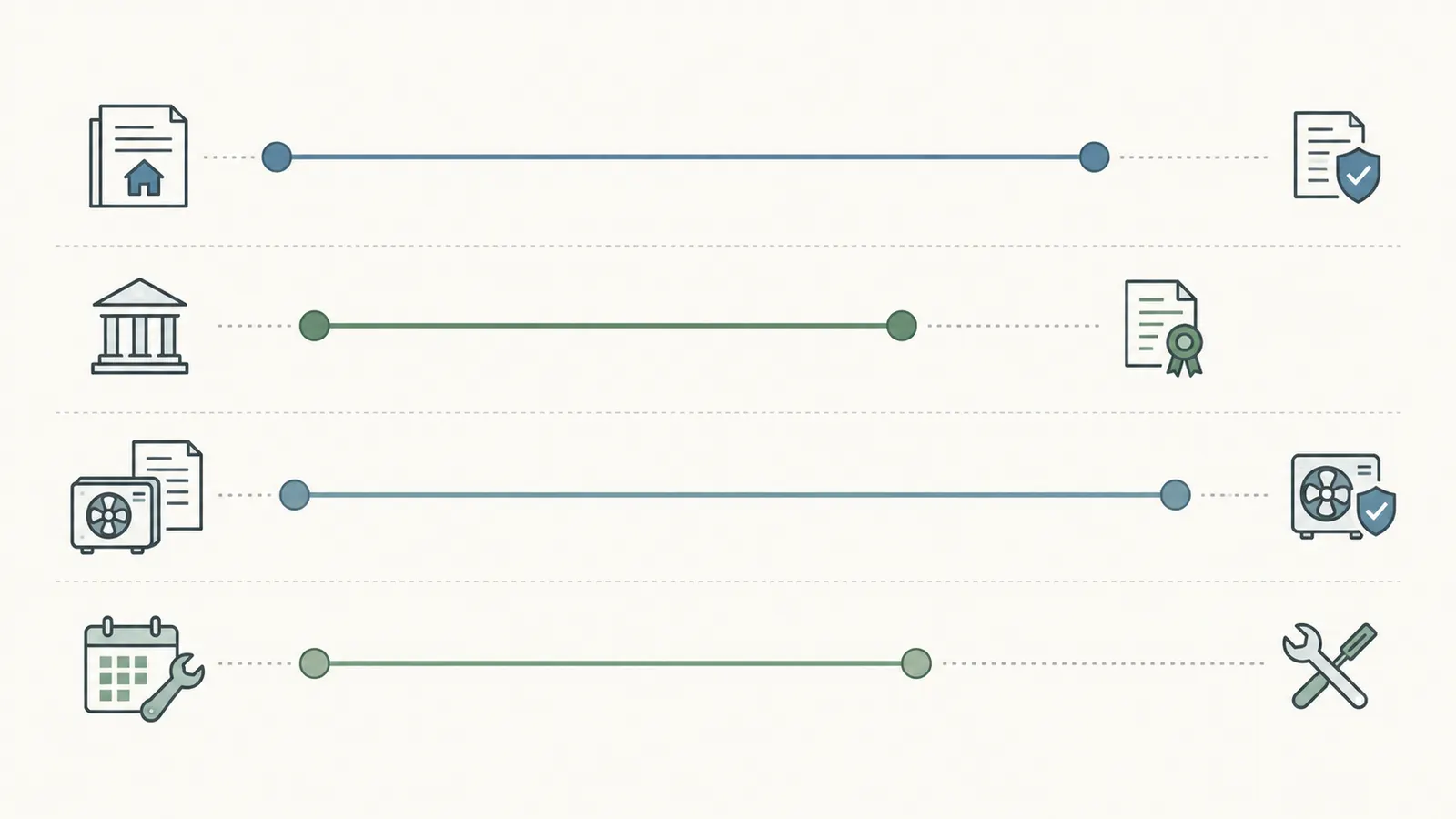
The closing packet proves the warranty clocks only when each separate coverage has a written trigger, a term or end-date formula, an owner and a record that can be produced later. A certificate of occupancy is evidence about legal occupancy in a particular jurisdiction; it is not automatically proof that every builder, state-program, manufacturer or service-contract warranty started that day.
The Federal Trade Commission separates a builder warranty from a home warranty or service contract. A builder warranty normally comes with new construction and may cover permanent parts of the home such as concrete, plumbing and electrical work. A home warranty is generally a separately purchased service contract, often aimed at appliances or air-conditioning equipment, and it is not the same product as the builder’s warranty. The FTC also notes that coverage lengths vary by component and advises homeowners to check the written warranty, submit claims in writing and keep correspondence and conversation records. Read the FTC’s explanation of builder warranties and service contracts before assuming that one “home warranty” document covers the structure, finishes, equipment and labor in the same way.
The five-part acceptance test
Use this test for every row in the packet:
- Identity: Does the document identify the builder, program, manufacturer, service-contract company, home address, lot or equipment serial number?
- Trigger: Does it state “commencement,” “effective date,” “date of installation,” “date of purchase,” “date of closing,” “first occupancy,” “registration date” or another defined event?
- Term: Does it state a duration, fixed expiration date, component schedule or renewal rule?
- Route: Does it say whether a claim goes to the builder, program administrator, manufacturer, dealer, service-contract administrator or another party?
- Proof: Does the packet include the evidence needed to establish the trigger, such as a signed certificate, permit record, settlement statement, paid invoice, installation invoice, serial number, registration confirmation or occupancy letter?
If the answer is “no” for any row, label the row unresolved. Do not silently substitute the date printed on another document. For example, a closing disclosure may prove a settlement date, but it does not by itself prove the date a furnace was installed, the date an appliance was purchased, the date a warranty certificate was issued or the date a service contract became effective.
What counts as a usable date
A usable date is more than a number written in an email. It should be tied to a named event and a source record. “Warranty starts at completion” is incomplete until you know whether completion means substantial completion under the sales contract, the final inspection, the certificate of occupancy, possession, settlement, first occupancy, installation, startup, registration or a term defined inside the warranty. Ask the person who supplied the document to identify the exact clause and page.
Use the date format YYYY-MM-DD in your worksheet, but keep the original date format in a note or filename. A date typed into a spreadsheet is a transcription; the signed or issued record is the proof. Record the time zone only when a portal, registration window or same-day closing could make a difference. For a term measured in months or years, keep the document’s calendar convention rather than converting it to an approximate number of days.
What you can conclude before you have a date
You can conclude that the packet is complete only for a coverage line whose trigger and proof are both clear. You can conclude that occupancy approval exists only if the named local authority has issued the relevant record or its system shows final approval. You can conclude that the builder received a claim only when you have a record of delivery or an acknowledged submission. You cannot conclude that a general statement from a salesperson changes a signed warranty, changes a local occupancy rule or extends a manufacturer’s term.
The safest pre-closing result is therefore not “all warranties start on closing.” It is a short schedule such as: builder workmanship—contract clause 12, trigger confirmed as settlement, one-year term, builder portal, signed closing statement; HVAC—applicable manufacturer warranty, trigger confirmed under the exact product terms for a new non-model home, any required registration window recorded, serial numbers attached; refrigerator—applicable manufacturer warranty, purchase date supported by builder invoice, model-specific manual attached; service contract—effective date and service fee confirmed in the service agreement. That schedule is actionable even if the dates differ.
Immediate decision and next handoff
If every row has a trigger, formula, proof and route, send the completed reconciliation to the closing agent, builder warranty contact and the manufacturer or dealer contact responsible for any equipment row. If a row is incomplete, send a written exception list before signing and ask for a corrected certificate, an addendum, a portal record or a written confirmation that names the controlling term. The next decision is whether the missing record is a correctable document gap, a contract question for your attorney, or a technical/equipment record that the builder’s trade must resolve.
2. Gather the documents and identify the responsible person #
The homeowner should gather the complete packet before closing, while the builder, closing professional, warranty administrator, local authority and installing trades each provide different records. The homeowner’s job is to reconcile and preserve the records, not to certify that the home complies with code or to interpret a contract as a lawyer.
The minimum input set
Request one digital copy and, where practical, one readable paper copy of the following:
- The signed purchase and sale agreement, all builder addenda, specifications, allowances, change orders and warranty provisions.
- The settlement statement or closing disclosure showing the legally named seller, property address and settlement date.
- The builder’s limited warranty, workmanship standards, claim instructions, exclusions, dispute process and component schedule.
- Any state or private new-home warranty certificate, certificate of participation, enrollment record, number, issue date, commencement date and assignment instructions.
- The permit record, final inspection approval, certificate of occupancy, letter of completion, temporary certificate, signed inspection card or equivalent local record, as the property jurisdiction uses them.
- The warranty and owner documents for HVAC, water heater, generator, solar, windows, roofing products, appliances and other separately warranted equipment or materials.
- Equipment model and serial numbers, installation or startup reports, paid invoices, commissioning records, registration confirmations and installer contact details.
- Any optional home warranty or service contract, with the effective date, service fee, exclusions, pre-existing-condition rules, claim phone number and cancellation or transfer terms.
- A list of open punch-list items, accepted deviations, allowances not yet selected, incomplete work and promises that are not yet in a signed change order.
The list is intentionally longer than a typical closing checklist because the decision concerns time-sensitive records. A missing paint touch-up is a construction closeout issue. A missing equipment serial number can make a future manufacturer claim harder to route. A missing state-program certificate can be a program-administration issue. A missing CO or final approval can be an occupancy issue. Do not put them in one undifferentiated “punch list.”
Assign ownership by record, not by blame
Use this responsibility map:
| Record or question | Primary source or responsible party | What the homeowner verifies | Handoff if missing |
|---|---|---|---|
| Purchase or settlement date | Closing agent and signed settlement file | Exact legal date, property and parties | Closing agent, then attorney for contract interpretation |
| Builder warranty trigger | Builder warranty department and signed contract | Clause, component, start event, term and claim route | Builder in writing; attorney if the contract conflicts |
| State-program certificate | State program or approved plan administrator | Certificate number, commencement date, covered home and owner | Builder and program administrator |
| Final inspection or CO | Issuing building department | Record type, status, address, permit number and issue date | Builder’s permit holder and issuing authority |
| Temporary occupancy | Building official and written TCO conditions | Expiration, open conditions, fees and who closes them | Builder and building official; do not infer permanent approval |
| Installed equipment | Trade installer, builder and manufacturer | Model, serial, installation/startup date, terms and registration window | Installing trade or manufacturer support |
| Appliance purchase | Builder invoice, appliance dealer or manufacturer | Model, serial, purchase/occupancy proof and model warranty | Builder, dealer or manufacturer |
| Service contract | Contract administrator | Effective date, covered items, fees, exclusions and claims process | Service-contract administrator |
The responsible person is the person who can produce or correct the record. A closing agent may preserve settlement evidence but cannot rewrite a manufacturer’s warranty. A builder may deliver a certificate but cannot change a local building department’s final status. An installer may provide a startup invoice but may not be authorized to amend a state warranty certificate. Put those boundaries in the worksheet so a missing item does not circulate indefinitely among parties.
Name the actual jurisdiction
Write the property’s city, county or other issuing authority and state at the top of the closeout file. Then write which authority issued the occupancy record. “The state says we can move in” is too broad when the document came from a county or city building office. “The builder says the house passed” is not the same as a final status visible in the local permit record.
The local record can vary even within one state. For example, Napa County, California says that for residential single-family dwellings its signed permit inspection card can serve as the certificate of occupancy and final approval after requirements are complete. Thurston County, Washington says that after required inspections are completed and approved, the homeowner receives a Certificate of Occupancy and should retain the approved plans, certificate of final inspection, permit card and construction documents. These are different local document practices, not competing national definitions. Compare the Napa County move-in guidance with Thurston County’s building inspection guidance, and then ask the actual issuing authority what record applies to your permit.
Inputs that should not be guessed
Do not guess the commencement date from the manufacture date printed on a serial number, the date the builder first advertised the home, the date a permit was issued, the date an inspector visited, the date the utility was turned on or the date you toured the house. Those dates may matter as evidence or as a fallback under a particular term, but they are not interchangeable.
Do not guess whether “possession” means occupancy. A homeowner might receive a key for a pre-closing inspection, the builder might retain possession for punch-list work, or a buyer might sign settlement and wait to move in. The warranty or jurisdiction may define these events differently. Record the event exactly as named and ask the controlling document to resolve the difference.
Next decision
When the inputs are assembled, sort them into four folders: builder, state or private new-home program, manufacturer, and service contract. Put local occupancy and permit records in a fifth authority folder because they may prove readiness for occupancy without controlling a private warranty. Then proceed to the date taxonomy before calculating anything.
3. Separate final inspection, inspection card, CO, TCO, closing and occupancy #
The document that authorizes occupancy is jurisdiction-specific, and it should be recorded separately from the event that starts a private or statutory warranty. Final inspection, signed inspection card, certificate of occupancy, temporary certificate, closing, possession and first occupancy are related events but are not interchangeable without written support.
Final inspection is an inspection result, not always a certificate
A final inspection is generally an authority’s inspection checkpoint. It may be the last inspection in a permit sequence, but the local process may still require fee payment, engineering approval, health approval, fire approval, grading approval or document processing before a CO is available. In Larimer County, Colorado, the final inspection must be requested and approved before the CO is released, and the county says the CO or Letter of Completion will attach to the online portal within 48 hours of final inspection approval. In Osceola County, Florida, the CO follows a final inspection with no code, life-safety or applicable-law violations and requires approvals from relevant departments. See the local limits in Larimer County’s CO page and Osceola County’s CO page.
Record at least: inspection type, date requested, date inspected, status, corrections, reinspection status, permit number, issuing authority and the next document expected. If the builder sends “final passed,” ask whether that means the building final, all trade finals, all site or health approvals, or the actual occupancy record.
A signed inspection card can carry different legal weight
Napa County, California gives a useful example of why the document name matters. Its move-in page states that for residential single-family dwellings, when inspections and requirements are complete, the permit inspection card signed by the Napa County Building Official serves as the certificate of occupancy and final approval for the building permit. That is a local practice stated by Napa County. It does not mean that an unsigned card, a contractor’s internal checklist or a card from another jurisdiction is equivalent. Treat the issuing authority, signature and address as essential fields.
A CO can be final, electronic or conditional depending on the authority
In Thurston County, Washington, a home ready for occupancy goes through the final building inspection, and after required inspections are completed and approved the county says the homeowner receives a CO. In the City of Marietta, Georgia, all trade finals and grading or zoning finals must pass before requesting a building final, no space may be occupied until a CO is issued, and the permit holder receives a link to print the CO after items and fees are cleared. The Marietta CO guidance is therefore both an occupancy rule and a reminder to check the permit system for outstanding items.
Do not treat a portal screenshot that says “inspection approved” as the CO unless the authority identifies it as the CO or final approval record. Save the full PDF, the permit number and the portal retrieval date. A portal can change, a link can expire and a status line can omit the conditions that appear on the issued document.
A TCO is not a permanent CO
A temporary certificate or temporary approval can permit a limited occupancy arrangement while specified work remains. Its effect depends on the local authority and written conditions. Larimer County, Colorado describes a TCO that may be issued for 180 days after final inspections and corrected life-safety issues, with a stated $600 fee and conditions such as a working bathroom, kitchen sink, heating, water heater, approved electric final and other applicable approvals. Harford County, Maryland says its final inspection precedes a CO and that temporary approvals are limited to non-life-safety or fair-safety items at the inspector’s discretion. Read the exact Harford County inspection guidance alongside Larimer County’s temporary-occupancy terms.
The local TCO record should show:
- the exact property and permit;
- the issue date and expiration date;
- the conditions that remain open;
- the person or permit holder responsible for closing them;
- any fee, bond, deposit or inspection requirement;
- whether the TCO permits your intended occupancy and any stated limits; and
- the process for converting it to a permanent CO.
Do not infer that a TCO starts every warranty. It might be the event that starts a program in one jurisdiction, irrelevant to a manufacturer warranty in another, or simply evidence that occupancy is permitted while the builder completes defined work. Put the TCO in the authority folder and let each warranty row cite its own terms.
Closing, possession and first occupancy are separate facts
Closing or settlement is the transaction event shown in the settlement file. For this worksheet, do not infer the warranty or title event from a general rule: transcribe the event named in the executed contract, deed or title papers, and warranty; if those documents conflict or use an undefined term, ask the closing attorney in the property’s jurisdiction to identify the controlling document. Possession is when the parties allow control of the home to change hands. First occupancy is when someone actually occupies the unit. Installation is when equipment is placed and started. Registration is when a manufacturer or program accepts an online record. They may happen on one date or six different dates.
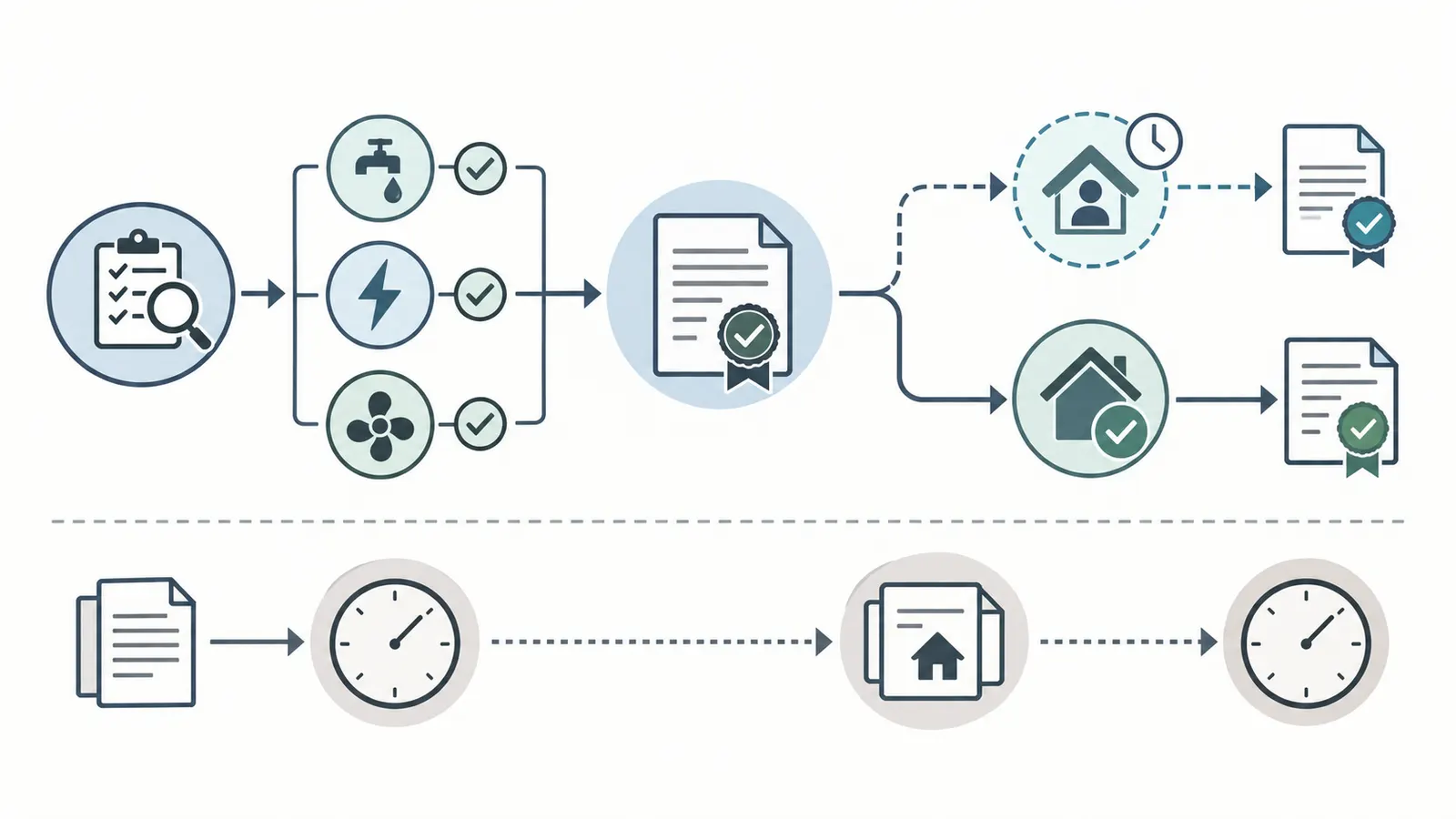
New Jersey’s state-administered New Home Warranty Program illustrates a program-specific rule: its submission guide says the Certificate of Participation’s commencement date should be the settlement date or first occupancy date, whichever comes first, and it asks builders to allow 20 business days for processing. That rule is not a national definition of a builder warranty. It is the trigger guidance for the named New Jersey program. Use the New Jersey submission date guide only when the home is within that program and the certificate is the controlling document.
Washington’s RCW 64.35.320 gives a different, narrower example for a qualified condominium warranty: for the unit, coverage begins at the earlier of actual occupancy or transfer of legal title; for common elements, the statute refers to a temporary or final CO for each separate multiunit building. That is a Washington condominium statute. It does not establish the rule for a detached single-family home in Washington, a private builder warranty or another state. Read the Washington statutory commencement rule and write the statute’s exact scope in your notes.
What the comparison means for a detached single-family buyer
For a detached home, use the jurisdiction’s authority record to decide whether you may occupy, then use each warranty’s written trigger to decide when coverage begins. If the builder says “closing,” require the builder warranty clause or certificate to say so. If an equipment manual says “installation,” find the installer’s date. If an appliance warranty says “purchase,” preserve the builder invoice or proof of occupancy that the manufacturer accepts. If a service contract says “effective date,” use the service agreement—not the CO.
Next decision
Once the authority record is classified, mark one of three states: final and unconditional, temporary or conditional, or not yet issued. A final and unconditional local record may support the handoff. A temporary or conditional record creates an exception list and a completion owner. No record means you should not claim that occupancy is authorized or that a warranty has started merely because keys are available.
4. Build the warranty-clock reconciliation worksheet #
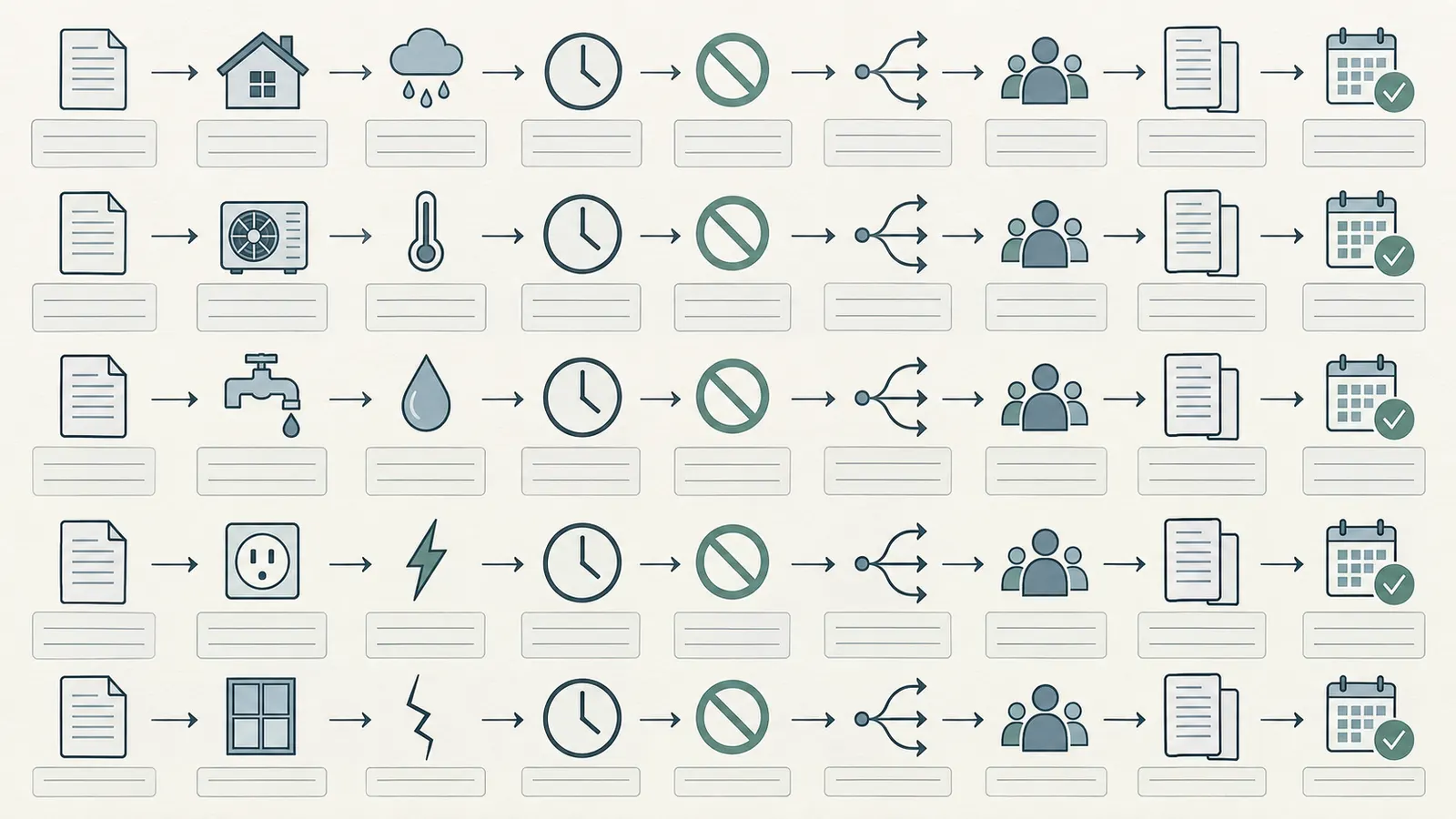
The “Warranty-clock reconciliation worksheet” is a row-by-row tool that forces the homeowner to preserve the document, component, trigger, end-date formula, exclusions, route, responsible party, proof and next follow-up for every coverage line. It is deliberately a worksheet rather than a single answer because a home can have several valid clocks running at the same time.
Original contribution: Warranty-clock reconciliation worksheet
Summary. The worksheet maps builder, state-program, manufacturer and service-contract coverage to a written trigger date, term, proof and next owner. It exposes conflicts such as “the builder says one year from closing” beside “the appliance says one year from purchase” instead of collapsing both into a generic warranty date.
Method. Transcribe only dates and terms visible in the contract, warranty certificate, manufacturer terms, settlement file and named jurisdiction records. For each row, identify the controlling document and event; calculate the end date using the term stated in that document; attach the proof; list exclusions and the claim route; assign a responsible party; and schedule the next follow-up. If a date is modeled because the actual date is not yet known, label it illustrative and replace it when the issued record arrives.
Limitations. This is a homeowner recordkeeping tool, not legal advice, an official inspection form, a certificate of occupancy or a finding that a defect is covered. The signed contract, exact warranty terms and law of the property jurisdiction control. A local authority page can explain an occupancy record but cannot amend a private warranty. A manufacturer page can explain one product’s term but cannot decide a builder-program dispute.
Worksheet fields
Copy this table into a spreadsheet or paper record. One row means one coverage or obligation, not one document bundle.
| Coverage row | Document and exact page/section | Component or scope | Trigger event and written date | End-date formula | Exclusions or conditions | Claim route | Responsible party | Proof held | Next follow-up |
|---|---|---|---|---|---|---|---|---|---|
| Builder workmanship | Builder limited warranty, §___ | Drywall, trim, paint, finishes or listed workmanship | YYYY-MM-DD; “settlement,” “first occupancy” or other defined event | Trigger + stated term; preserve calendar convention | Cosmetic tolerance, maintenance, owner work, listed exclusions | Builder portal/email/address | Builder warranty contact | Signed warranty and delivery receipt | Confirm claim deadline and portal login |
| Builder systems | Warranty schedule, §___ | HVAC, plumbing, electrical or other systems | Same method; do not borrow the workmanship date without text | Trigger + system term | Equipment-maker coverage, service conditions, owner maintenance | Builder or named warranty administrator | Builder/system trade | Schedule, serials and warranty number | Confirm who pays labor and dispatch |
| State or private program | Certificate of Participation or plan certificate | Covered home and defined construction defects | Date printed on certificate and program rule | Certificate term or component schedule | Enrollment, exclusions, notice, mediation or arbitration | Program administrator | Builder until handoff; then homeowner | Certificate, number, assignment record | Verify homeowner has account and claim instructions |
| Manufacturer HVAC | Manufacturer limited warranty, §___ | Model and serial number | Installation, startup, closing or defined event | Trigger + base/registered term | Registration, licensed installation, maintenance, labor exclusions | Manufacturer/dealer | Installing trade for records; homeowner for registration | Invoice, startup sheet, serials, certificate | Register or verify within stated window |
| Manufacturer appliance | Owner manual and limited warranty | Model, serial and appliance | Purchase, delivery, occupancy or fallback date | Trigger + model term | Misuse, installation, consumables, commercial use | Manufacturer or dealer | Builder/dealer supplies proof; homeowner files | Invoice, builder letter, proof of occupancy | Confirm purchase date and support path |
| Service contract | Service agreement, §___ | Listed appliance/system | Contract effective date | Effective date + contract term | Service fee, pre-existing condition, exclusions, authorization | Service-contract administrator | Homeowner after assignment | Executed agreement and policy number | Verify transfer and emergency procedure |
| Occupancy authority | CO, final approval, signed card or TCO | Permit, address and permitted occupancy | Issue date and status | Expiry only if temporary or conditional | Open corrections, agency approvals, fees | Building department/permit holder | Builder or permit holder | Issued record and portal receipt | Check permanent closeout if conditional |
The authority row is not itself a warranty row. It is included because the homeowner may otherwise attach the CO date to every other row. Keep the two concepts adjacent but distinct.
Transcription rules
Write the quoted trigger in a short note. “Date of closing” is stronger than “starts at closing”; the first points to a defined event, while the second may be marketing shorthand. Write who supplied the statement and when. If the term says “from the date of installation,” record whether the installer’s invoice shows completion and startup or only delivery. If the warranty says “registration within 60 days,” record the registration deadline separately from the commencement date unless the document defines them as the same.
Use one row for each component when the end dates, exclusions or claim routes differ. A single HVAC system may have a compressor term, parts term, labor term and registered term with different conditions. A kitchen appliance bundle may contain multiple manufacturer warranties. A builder’s one-year workmanship term does not prove that all equipment labor is included for one year.
Worked example: clearly labeled illustrative dates
The following is a modeled example, not a claim about a particular home, builder or product. Assume:
- settlement: 2026-10-15;
- first occupancy: 2026-10-18;
- a builder warranty expressly says one year from settlement;
- a manufacturer term expressly says one year from purchase;
- a generic HVAC limited-warranty term is five years from its defined commencement date; this is an illustrative input, not a Trane claim, model-specific table result, or statement about labor, diagnostic costs or registered coverage;
- a service contract expressly runs for 12 months from 2026-10-20;
- the local authority issues final occupancy approval on 2026-10-14.
The formulas are:
- Builder term:
2026-10-15 + 1 calendar year = 2027-10-15. - Appliance term: if purchase is documented as
2026-10-15,2026-10-15 + 1 calendar year = 2027-10-15. - HVAC term: if the exact product terms make the new-home closing date the commencement date,
2026-10-15 + 5 years = 2031-10-15. - Service contract:
2026-10-20 + 12 months = 2027-10-20, subject to the contract’s expiration convention.
The example does not prove those terms apply to your home. The generic five-year HVAC input is deliberately not attributed to Trane and does not assert a product model, component schedule, base-versus-registered term, labor benefit or diagnostic-cost benefit. It shows why the service contract can start after closing, why an appliance date can be tied to purchase, and why a local occupancy approval can precede both. The row must be rewritten if any document uses installation, first occupancy, title transfer, registration or another event.
Sensitivity: the date uncertainty is the decision
Suppose the actual builder trigger is unresolved between settlement on 2026-10-15 and first occupancy on 2026-10-18, with a one-year term. The difference is three days. That may look small, but it affects the final claim date and may matter if a defect is discovered near the anniversary. More importantly, the uncertainty tells you the packet is incomplete. The correct action is to resolve the trigger, not to round the dates together.
For a 10-year term, the same three-day uncertainty remains three days, but a missing commencement event can be more consequential if the warranty has notice deadlines, a definition of major defect, or a requirement that the homeowner notify the builder before taking another step. For a 30-day registration window, a three-day delay may be a larger share of the available time. Record the sensitivity as earliest plausible date, latest plausible date, and unresolved event, then ask the controlling party to confirm.
A practical status code
Use four statuses:
- Verified: the controlling document names the event, date and term, and the proof is attached.
- Partially verified: the event and term are stated, but the supporting record or serial number is missing.
- Conflicted: two controlling-looking documents state different triggers, terms or owners.
- Unresolved: the packet contains only a verbal statement, a blank field or a generic promise.
Do not use “verified” because the builder is reputable or because keys were released. Verification means the record can be handed to someone else and still explain the result.
Next decision
After every row is status-coded, calculate only the rows marked verified or partially verified. Send conflicted and unresolved rows to the party that controls that record. If the dispute is about the meaning of the sales contract or a state-law right, ask a licensed attorney in the property’s jurisdiction; if it is about an equipment serial number or startup record, ask the installing trade or manufacturer. Keep both the original conflict and the response.
5. Reconcile builder, state, manufacturer and service-contract coverage #
The safest reconciliation treats each coverage source as a different promise with its own scope and claim route, then checks for overlap and gaps without assuming that one source replaces another. Builder coverage may address workmanship, a program may address defined construction defects, a manufacturer may cover a product, and a service contract may offer separately purchased repair dispatch.
Builder warranty: start with the contract and schedule
The builder’s warranty is usually the first place to look for the commencement event, but the document may spread the answer across definitions, component schedules, exclusions, notice rules and dispute procedures. Read the definitions section before the duration table. Search for “commencement,” “warranty period,” “closing,” “settlement,” “first occupancy,” “substantial completion,” “possession,” “notice,” “claim,” “manufacturer” and “service contract.”
Build separate rows for workmanship, systems, structural items and any explicitly excluded manufacturer-covered product. Do not assume a one-year workmanship line means one year of labor for a failed HVAC part. The builder may route the homeowner to the trade, the manufacturer or a program administrator. The FTC’s general guidance is that new-home builder warranties commonly cover defined components for different periods and usually explain how repairs are made; its examples include one year for many workmanship and materials items, two years for HVAC, plumbing and electrical systems, and sometimes longer structural coverage. Those are general examples, not your contract’s terms. Cite the FTC’s component and claim guidance next to the row only as context, then cite the actual builder warranty for the decision.
State or private new-home program: verify the certificate and assignment
If the home is enrolled in a state program or private plan, identify the plan administrator, certificate number, named homeowner, covered address and commencement date. In New Jersey, the Department of Community Affairs FAQ says an approved warranty application produces a virtual Warranty Certificate with a warranty number, and directs that copies be printed for the homeowner at closing, the mortgage company, the municipality and the builder’s records. The New Jersey DCA FAQ also says the builder should provide the certificate letter to the first owner and describes assignment for a later owner.
The handoff question is not merely “do we have a certificate?” It is “does this certificate identify the home and the person who will make the claim, and can the homeowner retrieve it after closing?” If the portal requires an account, verify that the homeowner can access the record rather than relying on the builder’s login. If a certificate is not yet final, record the application status, expected issue date and responsible party.
For New Jersey, compare the certificate commencement date to the settlement and first-occupancy records because the program’s submission guide says the earlier of those dates should be used. Do not use that formula for a private warranty in Nevada, a builder warranty in Georgia or an unrelated state program. Jurisdiction is part of the row, not a footnote.
Manufacturer warranty: model, serial, installation and registration
Manufacturer coverage is product-specific. Preserve the owner manual and the limited warranty for the exact model, not only a marketing page for the product family. Record model and serial numbers exactly, including letters that resemble numbers. Photographing the rating plate can help preserve the record, but the photo does not prove the installation date or ownership by itself.
Trane’s current base limited warranty is a clear example of why new-construction equipment needs its own row. The terms say that for most installed products, the commencement date is the date the original installation is complete and product startup procedures are properly completed and recorded on the installer’s invoice. The same document says that if the product is installed in a newly constructed home that is not a builder’s model home, the commencement date is the date the purchaser closed on the residence from the builder. It also says proof of purchase, installation or closing may be required and that online registration within 60 days of commencement can affect the registered term. Read the Trane base limited warranty for the exact product and version before writing a closing date into the row.
This is not a universal HVAC formula. Another product, brand, warranty revision or jurisdiction may use installation, registration, purchase, delivery or a fallback manufacturing date. The responsible person should supply the exact terms that apply to the model and installation.
Appliances can use a different evidence chain. GE Appliances says the initial manufacturer warranty begins on the date of purchase and that a sales invoice, builder letter or proof of occupancy can validate the purchase date; if proof is unavailable, the manufacturing date may be used to determine age and warranty period. Use GE Appliances’ warranty-start guidance as an example of a manufacturer’s evidence hierarchy, not as a rule for another brand. For each appliance, ask for the actual model manual, purchase record and claim route.
Service contract: keep it separate from warranty coverage
A service contract may be offered at closing and described casually as a “home warranty,” but it is a different agreement. Record its effective date, term, service-call fee, authorization procedure, exclusions, pre-existing-condition rule, transfer requirement and emergency instructions. Ask whether the contract covers the same component as the builder or manufacturer warranty and which party must be contacted first.
Avoid creating a coverage gap by assuming that the service-contract administrator can decide a builder claim. Avoid creating duplicate work by opening a service call before reading an exclusion or before giving the builder the contractually required notice. The FTC notes that service contracts can overlap existing product warranty coverage, cover only part of a product or make repairs difficult, so compare the documents rather than treating the service contract as an automatic extension. The FTC service-contract guidance is a useful starting point, but the executed agreement controls.
Overlap and gap test
For each component, create a mini sequence:
- Who supplied or installed it?
- Which document promises coverage?
- What event starts that promise?
- What proof will the claim handler ask for?
- Who pays labor, diagnosis, removal, access or dispatch?
- What notice deadline applies?
- What happens if the first party says another party is responsible?
Then look for these common patterns:
| Pattern | What it may mean | Safe next step |
|---|---|---|
| Builder and manufacturer both list HVAC | Parallel coverage with different components, labor terms or claim routes | Ask for a written routing map and preserve both terms |
| Appliance is excluded from builder warranty | Manufacturer warranty may be the only product promise | Confirm purchase proof, model terms and who handles installation damage |
| Service contract begins 30 days after closing | A waiting period or delayed effective date may exist | Record the exact effective date and what happens during the waiting period |
| Builder says “registration is automatic” | Builder may have submitted data, but homeowner access may be missing | Verify the manufacturer portal and save confirmation |
| Warranty certificate has a date but no address | It may be the wrong unit or incomplete issuance | Ask for a corrected certificate before closing or document the exception |
| CO is issued but installation records are absent | Occupancy approval does not prove manufacturer trigger or startup | Get invoices, model/serial data and startup records from the trade |
| TCO is issued while work remains | Occupancy is conditional under local terms | Record conditions, expiration and permanent CO owner separately |
Next decision
If every component has at least one clearly identified claim route and no unexplained date conflict, move the worksheet to the closing file. If the homeowner cannot tell whether a failed item should go to the builder, manufacturer or service-contract administrator, the handoff is not complete even if the house has a CO. Ask for the routing decision in writing before the first failure occurs.
6. Complete the warranty handoff in the right sequence before accepting keys #
The warranty handoff should move from jurisdiction and contract, to issued records, to equipment identity, to date formulas, and finally to signatures, access and follow-up ownership. This sequence makes the packet transferable: a homeowner or future claim handler can see which record controls each row instead of inheriting a guessed universal date.
Step 1: confirm the property and authority
Start with the legal property address, lot or unit number, permit number, city, county and state. Identify whether the home is a detached single-family home, a condominium unit, a townhouse or another ownership form because a statute or warranty may use different terms. Verify the issuing building authority and the record type it uses.
Check the local permit portal or ask the permit holder for the issued record. In Marietta, Georgia, the city says trade finals and grading or zoning finals precede a building final and that the space cannot be occupied until a CO is issued. In Napa County, California, the signed inspection card can serve as the CO and final approval for residential single-family dwellings after all requirements are complete. Those examples show why you must match the record to the authority rather than insist on a document name that the jurisdiction does not use.
Step 2: confirm the settlement and first-occupancy facts
Ask the closing professional to confirm the settlement date on the final signed file. Ask the builder to state whether anyone has occupied the home, stayed overnight, used it as a model, or taken possession for reasons that the warranty defines as occupancy. If a local TCO or final approval is dated earlier, preserve it without assuming it starts private coverage.
If the buyer will close on one date and move in later, write both dates. If the buyer will move in before settlement, stop and obtain local and contractual advice because occupancy and title may create a different trigger. The question is not whether the arrangement is convenient; it is whether the named document defines the event and whether the local authority permits it.
Step 3: reconcile the builder and program certificates
Compare the buyer name, legal seller, home address, lot or unit, certificate number, issue date, commencement date, covered components, exclusions and claim contact. If the program certificate uses a date formula, apply that formula to the records you have and write the result as a check—not as a replacement for the certificate.
For a New Jersey state-program home, the guide’s settlement-or-first-occupancy rule should be checked against the certificate and the actual records. For a Washington condominium, the statutory earlier-of-occupancy-or-title rule has a specific qualified-warranty scope. If your home is elsewhere, ask the jurisdiction or program named in your own documents.
Step 4: inventory equipment before walls and records disappear
With the builder’s permission and without opening panels or disconnecting anything, compare installed equipment to the list. Record model and serial numbers for HVAC equipment, water heater, appliances, generator, solar inverter, battery, windows or other products with separate warranties. Photograph visible labels if permitted, and ask the trade to provide readable startup and installation records.
Do not remove access covers, test live electrical connections, open refrigerant circuits, operate gas shutoffs, climb unsafe roofs or enter crawlspaces or confined spaces to obtain a serial number. The homeowner can observe labels and request records. Electrical, gas, refrigerant, roof-access and confined-space work belongs to the appropriately qualified professional. If an installed component cannot be safely identified from an accessible label, mark the row missing rather than creating a hazard.
Use the same homeowner boundary for pressurized systems or lines and suspected contaminated water, air, soil or materials: do not open, test, repair or diagnose them remotely or by improvising a homeowner test. Use the appropriate qualified local professional or emergency service, as the immediate risk requires, and follow the instructions of the property’s actual jurisdiction. Record the concern and the requested response in the handoff file; do not treat a photo, odor, pressure reading or informal message as proof that the system or material is safe.
Step 5: run the date formula and status check
For each row, write:
controlling document → named trigger event → trigger date → term → calculated end date → proof → claim route → owner
Example: Generic HVAC limited warranty → defined new-home commencement event → 2026-10-15 → five years → 2031-10-15 → settlement statement + serials + product certificate → installing dealer → homeowner. Label the example illustrative until the actual model, component terms, commencement event, base-versus-registered term, labor and diagnostic-cost limits, and dates are confirmed.
Do not calculate an end date when the start event is conflicted. Write “not calculated—trigger unresolved” and list the two plausible dates. A false precision such as “expires October 15” can be worse than a visible exception because it may prevent timely follow-up.
Step 6: test the claim route
Send a short non-claim verification email to each relevant party: “Please confirm the controlling commencement event, date, expiration formula, owner and proof for the attached model/serial or warranty certificate.” Ask the response to identify the page or clause. Do not rely on a phone answer alone; if a phone call is necessary, write a same-day note with date, time, name, contact number and the response.
The builder should identify its warranty intake route. The manufacturer or dealer should identify equipment registration and service. The service-contract administrator should identify dispatch and authorization. The local authority should answer only questions within its permitting and occupancy role, such as whether a final record or CO has issued. Do not ask an inspector to opine on a private warranty term.
Step 7: make the handoff visible at closing
Create a one-page index containing:
- the property and jurisdiction;
- final or temporary occupancy status;
- builder warranty contact and certificate number;
- state or private plan contact and certificate number;
- manufacturer and installer contacts by equipment;
- service-contract number and effective date;
- unresolved rows with owners and due dates; and
- where the full digital file is stored.
Ask the closing file to include the warranty documents that the contract or program requires. In New Jersey, the DCA FAQ specifically describes printing copies of the Warranty Certificate for the homeowner at closing, the mortgage company, the municipality and builder records. That is a New Jersey program administration instruction, not a reason to demand the same copy count everywhere.
Step 8: close the exceptions after keys
Some documents arrive after settlement. Set a follow-up date for every partially verified row, such as 48 hours for a portal certificate, seven days for equipment registration or the earlier of a written program deadline and a builder promise. Do not use the follow-up date as a warranty start date. It is only a management date.
The handoff is complete when the homeowner can find the record, understands the next action and knows which party owns any remaining correction. A folder full of PDFs without an index is not a verified closeout.
7. Handle failure cases without losing the record #
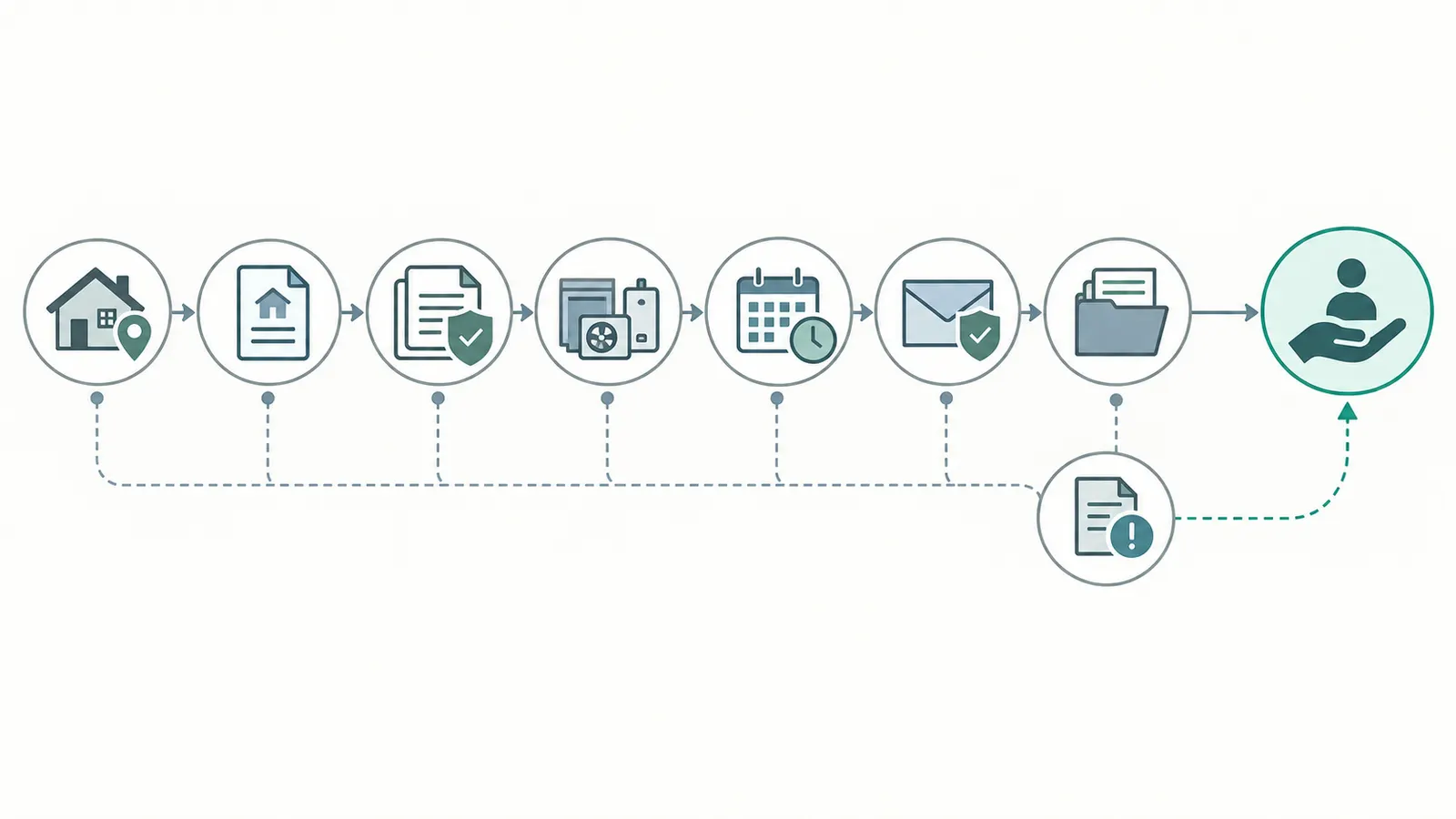
When documents conflict, preserve the conflict, stop making assumptions, and route the question to the party that controls the document or to a licensed attorney when the issue is contractual or legal. Do not edit a certificate, backdate a registration, or rely on a verbal promise to close a material gap.
“The builder says everything starts at closing”
Ask the builder to identify which coverage lines that statement describes. It might be correct for the builder warranty, a new-construction manufacturer term, or a state program, but it may not apply to an appliance warranty or service contract. Put the statement in the worksheet only as a claimed position until the signed document supports it.
Send a written request: “For each attached coverage, please identify whether the controlling trigger is settlement, title transfer, possession, first occupancy, installation, purchase, registration, final approval or another defined event. Please cite the document and page.” A precise question often reveals that “closing” was shorthand for only one row.
“The CO is dated before the closing date”
That is not automatically an error. A jurisdiction may issue the CO when the building is ready for occupancy before the sale closes. The CO date proves what it proves under local practice. Compare it to the warranty triggers rather than changing the warranty date to match it.
Ask whether the record is final, temporary or conditional; whether it applies to the exact property; whether open conditions remain; and who holds the permit. If the document is a TCO, record the expiration and conditions. If the builder claims the CO is also the warranty start date, ask for the exact warranty clause.
“The home has a TCO, but the builder wants full closing”
Do not infer that a TCO is either acceptable or unacceptable across all jurisdictions. Review the local document and your contract, then ask a real-estate attorney in the property’s jurisdiction if the rights and obligations are unclear. Ask the builder to list all open conditions, the responsible trade, the permanent-CO path, any fee or deposit, and the date by which the condition will be closed.
Larimer County’s page shows why a TCO can have explicit conditions, duration and a fee; Harford County’s page shows why a local inspector can limit temporary approvals to non-life-safety or fair-safety items. Those local examples support a verification method, not a national conclusion.
“The manufacturer record shows a date before I owned the home”
First determine whether the manufacturer’s terms allow the earlier date, whether the product was installed in a model home, whether the home was previously occupied, and whether the date is a manufacturing date rather than an installation or commencement date. Obtain the model-specific warranty and a written confirmation of the applicable term.
Trane’s terms illustrate why the answer may turn on the home being newly constructed and not a builder’s model home. GE Appliances illustrates a different approach for which purchase proof or proof of occupancy may establish the purchase date. Do not use one brand’s evidence hierarchy for another brand.
If the earlier date would reduce the remaining term, ask the builder to correct the installation or ownership record, provide the closing proof the manufacturer accepts, or state the remedy under the contract. Keep the original record; do not overwrite it.
“The serial number is missing or does not match”
Do not register a guessed serial number. Compare the physical label, builder equipment schedule, installer invoice, permit inspection record and manufacturer portal. A letter “O” can be mistaken for zero, and an equipment schedule can contain a planned model rather than the installed model. Ask the installing trade to confirm the model and serial in writing.
If the label is inaccessible, ask a qualified trade to document it during a normal service or commissioning visit. Do not remove panels or enter unsafe spaces. Record the row as partially verified until the exact identifier is confirmed.
“The certificate is in the builder’s portal, not mine”
Ask for a PDF and access instructions that remain usable after closing. Confirm that the account is associated with the homeowner, property and certificate number. In New Jersey, the DCA FAQ explains that warranty certificates can be accessed through the MyNJ-connected portal and that the builder should provide the certificate number. The relevant handoff is control of the record, not merely the existence of a builder screenshot.
Save the PDF with a stable filename such as 2026-09-07_builder-warranty_certificate-number.pdf. Keep the original email and portal download date. Do not store the only copy in a builder-controlled mailbox.
“The service contract says it covers everything”
Read the covered-item schedule, exclusions, waiting period, service-call fee, authorization rule and pre-existing-condition section. Ask whether the contract administrator can dispatch a technician when a builder or manufacturer warranty may apply. If the service contract is optional, compare its cost and route to the coverage already supplied with the home.
The FTC warns that a service contract can duplicate existing coverage or cover only part of a product. That is why the worksheet needs a separate row even when the service contract appears in the same closing envelope.
“A punch-list item is still open, but the builder wants keys accepted”
Separate physical completion from warranty commencement. A punch-list item may remain subject to the builder’s completion promise, while the warranty’s clock may begin under the contract or program. Obtain a written list of each open item, location, responsible trade, access plan, target date, protection against damage and effect—if any—on warranty rights. Do not assume that refusing keys automatically stops a warranty clock, and do not assume accepting keys waives a defect claim; those are contract and jurisdiction questions for an attorney.
Photograph visible conditions with the builder’s permission and tie each photo to a numbered list. The photo is evidence of an observed condition on a date, not a professional defect diagnosis.
“The local portal is delayed or unavailable”
Ask the permit holder and issuing authority for the official record or a written status. Record the date of the request and the answer. Marietta, Georgia says the CO link may arrive after items and fees are cleared and notes a 24-to-48-hour window; Larimer County says its CO or Letter of Completion automatically attaches to the portal within 48 hours after final inspection approval. These are local process timings, not a universal promise. Do not convert a processing delay into a warranty date.
Next decision
If a failure case changes the legal meaning of closing, occupancy, title, possession, waiver, notice or a limitation period, stop at the recordkeeping step and obtain advice from a licensed attorney in the property’s jurisdiction. If it changes only model, serial, installation or startup data, route it to the qualified installer or manufacturer. Keep the question narrow and attach the evidence.
8. Accept the handoff only when the next decision is visible #
Accept the warranty handoff when the homeowner can identify the controlling document and trigger for every material coverage line, prove the local occupancy status, preserve the claim route and assign a date for every unresolved correction. If the packet cannot do that, the correct outcome is a written exception list and a defined follow-up—not a guessed universal date.
The pre-closing decision table
Use this final decision table after completing the worksheet:
| Result | What the packet proves | What to do before closing | What happens next |
|---|---|---|---|
| Ready | Every critical row has a named trigger, proof, term, route and owner; occupancy record is final or the contract clearly addresses conditions | Sign the worksheet index and save all records | Register eligible products, calendar notice deadlines and complete handoff |
| Ready with documented follow-up | Coverage is clear, but a portal PDF, serial confirmation or noncritical closeout record is pending | Write the item, responsible party and due date into the closing file | Check the record on the due date; do not change the trigger date without the controlling document |
| Conflicted | Two documents state different triggers, terms, exclusions or responsible parties | Obtain written clarification or contract advice; preserve both documents | Update the row only when the controlling party resolves it |
| Not ready for occupancy decision | CO, final approval, signed card or TCO status is missing or does not match the property | Ask the builder and issuing authority to resolve occupancy status; consult local counsel if needed | Do not represent the home as finally approved based on keys or a sales statement |
| Not ready for warranty handoff | The homeowner lacks the certificate, model/serial, proof or claim route | Put the missing record in writing and assign an owner | Reconcile before the first claim or registration deadline |
“Ready with documented follow-up” is not a license to ignore the item. It is appropriate only when the homeowner has a written record of the gap, the responsible party, the next date and the effect of delay. A missing state-program certificate or an unclear occupancy status may be material enough that the closing professional or attorney recommends a different decision.
Handoff packet contents
Create a single index and name the files consistently. Include:
00_index_and_open_items.pdfor an equivalent readable index;- the signed contract, specifications, addenda and change orders;
- settlement and title records supplied by the closing professional;
- the builder warranty, schedules, exclusions and claim instructions;
- state or private warranty certificates and program contacts;
- the final inspection, CO, signed inspection card, TCO or local equivalent;
- equipment inventory with model and serial numbers;
- installation, startup, commissioning and registration records;
- appliance invoices, builder letters and model manuals;
- service contract and assignment or transfer proof;
- the worksheet with verification status and dates; and
- correspondence confirming any exception or correction.
Keep a backup in a homeowner-controlled location. Do not put account passwords in the worksheet. Record the portal name, account email and recovery method separately using secure storage. A future claim may occur after the builder’s staff, trade or portal has changed.
Calendar the dates that are not warranty starts
The following are management dates, not necessarily coverage triggers:
- the date the homeowner should register equipment;
- the date to confirm that a portal certificate is accessible;
- the date a TCO condition or temporary record expires;
- the builder’s promised punch-list completion date;
- the date to inspect seasonal operation under the owner manual;
- the date to review each component’s notice deadline;
- the date to transfer a warranty if the home is later sold; and
- the date to recheck a service contract’s renewal or cancellation term.
Separate these reminders from the calculated warranty end date. A registration deadline can come after commencement; a notice deadline can be earlier than expiration; a TCO expiration can be unrelated to a manufacturer term.
Keep a claim-ready record after closing
If a defect appears, record the observation, date, location, conditions, photos and immediate risk without diagnosing the cause. Check the applicable warranty and send the claim through the required route in writing. The FTC recommends written claims and keeping correspondence and conversations. Use the worksheet to select the first route, then preserve any referral to another party.
Do not authorize a repair that could alter evidence or warranty responsibility without checking the applicable terms, except where urgent action is reasonably necessary to protect people or prevent serious property damage. For urgent water, gas, electrical or structural hazards, use the appropriate emergency or qualified professional response first; document what happened and notify the relevant parties as soon as practical. This guide cannot assess a hidden defect or decide whether a repair is covered remotely.
Originality brief
Current answers. Consumer pages explain builder warranties, service contracts, typical component periods and written claims. Local government pages explain final inspections, COs, inspection cards, portals and temporary occupancy. Those answers are usually separated.
Missing decision. A homeowner needs to decide whether the closing packet is ready for handoff: which clock started, which date controls each coverage, who owns the next action and what must be corrected or recorded before keys are accepted. The missing step is a jurisdiction-aware handoff checklist with date reconciliation, not another generic warranty definition.
Original contribution. The Warranty-clock reconciliation worksheet compares builder, state or private program, manufacturer and service-contract rows using document, component, trigger, formula, exclusions, route, responsible party, proof and next follow-up. It is a recordkeeping synthesis, not collected field data.
How to check it. A reviewer can reproduce the worksheet by opening the cited FTC, New Jersey, Washington, local-authority and manufacturer sources, replacing the illustrative dates with the reader’s documents, and testing whether every row resolves to a controlling document and proof. The result should change when the jurisdiction, program, product terms or contract changes.
Final answer
If your packet contains a final local occupancy record and complete warranty documents, you can accept the handoff only after separating those records and assigning each coverage row a controlling document, trigger, proof, claim route and owner. If one clock is missing, conflicting or based only on a verbal statement, record the exception and assign the responsible party before closing. The contract, exact warranty terms and actual jurisdiction—not a generic “new-home warranty starts at closing” rule—control.
Cite this guide
Brictale. “New-Construction Home Warranty Handoff Checklist.” Published 2026-10-05; updated 2026-10-05.
https://brictale.com/build/handover/new-construction-home-warranty-handoff-checklist · Read the Markdown version
Original contribution: Warranty-clock reconciliation worksheet. A row-by-row handoff worksheet that maps builder, state-program, manufacturer and service-contract coverage to a written trigger date, expiry formula, proof and next owner.
Sources and scope
Evidence behind this page
- The Federal Trade Commission distinguishes a builder warranty that comes with new construction and covers permanent components from a home warranty that is a separately purchased service contract; coverage length and claim procedures vary by component and the homeowner should keep written claim records.
United States consumer guidance; general distinctions and recordkeeping, not a state-specific commencement rule or a substitute for the written warranty.
Accessed · Link to this claim - For New Jersey’s state-administered New Home Warranty Program, the submission guide says the commencement date on the Certificate of Participation should be the settlement date or first occupancy date, whichever comes first, and applications should allow 20 business days for processing.
Submission Date Guidelines for enrollment in the New Home Warranty Security Fund
New Jersey state-administered program guidance for the Certificate of Participation; not a national rule and not every private builder warranty.
Accessed · Link to this claim - New Jersey DCA says the approved warranty certificate is available through its portal, contains a warranty number, and should be printed for the homeowner at closing along with copies for the mortgage company, municipality and builder records.
New Jersey Department of Community Affairs New Home Warranty Program administration; document-handoff guidance, not a universal closing requirement.
Accessed · Link to this claim - Washington Revised Code 64.35.320 sets the beginning date of qualified warranty coverage for a condominium unit at the earlier of actual occupancy or transfer of legal title, and separately addresses common elements by temporary or final certificate of occupancy.
RCW 64.35.320: Beginning dates for warranty coverage
Washington condominium qualified warranty statute; the common-element provision is for condominium buildings and should not be generalized to a detached single-family home or another state.
Accessed · Link to this claim - Thurston County, Washington says a final building inspection is requested when a home is ready for occupancy, and that after required inspections are approved the homeowner receives a Certificate of Occupancy and should retain approved plans, the certificate of final inspection, permit card and construction documents.
Building and Construction Site Inspections
Thurston County, Washington residential permitting process; local record and occupancy practice, not a statewide warranty commencement rule.
Accessed · Link to this claim - Napa County, California states that for residential single-family dwellings, after inspections and requirements are complete, the permit inspection card signed by the county building official serves as the certificate of occupancy and final approval; the county also says the building may not be occupied before final approval.
Napa County, California guidance for the page’s covered permitting context; not evidence that every California jurisdiction uses an inspection card or that the card starts private warranties.
Accessed · Link to this claim - Larimer County, Colorado says final inspection approval precedes a Certificate of Occupancy, which can attach to the online permit within 48 hours; it also describes a Temporary Certificate of Occupancy that may last 180 days after final inspections and corrected life-safety issues, with a stated $600 fee.
Larimer County, Colorado building process and fee page; local temporary-occupancy terms, not a warranty rule for other jurisdictions.
Accessed · Link to this claim - Osceola County, Florida says a Certificate of Occupancy follows a final inspection with no code, life-safety or applicable-law violations and requires approvals from relevant departments; its residential checklist can include engineering documents, fees and health records for well or septic properties.
Certificate of Occupancy - Osceola County
Osceola County, Florida residential and commercial CO process; examples of local prerequisites, not a national closing checklist or warranty trigger.
Accessed · Link to this claim - Harford County, Maryland lists the final inspection before issuance of a Certificate of Occupancy and says temporary approvals are issued only for non-life-safety or fair-safety items at the inspector’s discretion.
Harford County, Maryland inspection guidance; local temporary-approval practice and not a general definition of a TCO elsewhere.
Accessed · Link to this claim - The City of Marietta, Georgia says all trade finals and grading or zoning finals must pass before a building final, no space may be occupied until a CO is issued, and the permit holder receives a CO link after outstanding items and fees are cleared.
City of Marietta, Georgia building inspection process; local occupancy rule and handoff timing, not a national warranty rule.
Accessed · Link to this claim - Trane’s current base limited warranty terms say that for most installed products the commencement date is the completed installation and recorded start-up, while for a product installed in a newly constructed home that is not a builder model home the commencement date is the date the purchaser closed on the residence; proof of purchase, installation or closing may be required, and online registration within 60 days can affect the registered term.
Trane products and the terms of this warranty document; product model, installation facts and applicable law can change the result.
Accessed · Link to this claim - GE Appliances says its initial manufacturer warranty begins on the date of purchase; the sales invoice, a builder letter or proof of occupancy can validate the purchase date, while the manufacturer date may be used when proof of purchase or ownership is unavailable.
GE Appliance - Warranty Begins
GE Appliances consumer guidance; the specific model owner’s manual and limited warranty control coverage and term.
Accessed · Link to this claim