New Construction Home Handover Checklist: Closeout, Keys, and Warranties
Use a U.S. new-construction handover checklist to separate occupancy, snags, system demonstrations, records, warranty notices, owners, evidence, and next steps.
The short answer
Accept keys only after you separate legal occupancy from practical completion, walk the home with utilities live, collect the contract and system records, assign every open item, and copy notice deadlines from the actual warranty or local procedure. A certificate of occupancy is jurisdiction-specific evidence of permitted use—not proof that finishes, equipment education, or warranty paperwork is complete.New Construction Home Handover Checklist: Closeout, Keys, and Warranties
A newly built home is ready for handover when its legal-occupancy evidence, practical completion, working systems, owner records, and unresolved-item plan have each been checked separately. Walk with utilities live, record every open item, name the person who owns the next action, and copy notice dates from the actual contract or warranty. A certificate of occupancy is jurisdiction-specific evidence of permitted use, not proof that every finish, demonstration, or warranty record is complete.
Decide what “ready for handover” means before you accept the keys #
A home is ready for handover only when you can show what is legally occupiable in the property’s jurisdiction, what is physically complete, what systems were safely demonstrated, what records were received, and how every unresolved item will move to its next owner. Those are five related gates, not one “passed inspection” feeling.
The word handover often compresses several events into one appointment: a builder’s final walkthrough, a lender or title closing, a local authority’s occupancy approval, transfer of keys, delivery of manuals, and the start of a builder or manufacturer warranty. Treating those events as interchangeable is the fastest way to lose evidence. Your first decision is therefore not “Does the house look finished?” It is “Which gate does this piece of evidence actually satisfy?”
| Gate | Decision question | Minimum record to request | What it does not prove |
|---|---|---|---|
| Occupancy and approvals | May this home be legally occupied under the actual local process? | Certificate of occupancy, temporary certificate, final inspection record, or other authority document named by the jurisdiction | That cosmetic work, owner education, or a product warranty is complete |
| Physical completion | Does the built work match the contract, approved selections, plans, and agreed scope? | Marked-up room list, photographs, change-order record, and signed closeout list | That concealed work is defect-free or that a local official has accepted every finish |
| System function | Do installed systems start, stop, drain, heat, cool, illuminate, ventilate, and respond as the manufacturer or installer demonstrates? | Demonstration notes, model and serial numbers, commissioning or start-up records where supplied | That you should open equipment, alter settings, test live conductors, or perform a professional inspection yourself |
| Ownership records | Can the next occupant operate and maintain the home without guessing? | Manuals, plans, permits, warranties, certificates, shutoff locations, filters, service contacts, and registration confirmations | That a manufacturer will cover a claim merely because a document exists |
| Open-item handoff | If something remains, is the issue described, owned, dated, and routed to the right party? | Ledger row with evidence, status, owner, document-specific deadline, and next handoff | That an oral promise to “take care of it later” is a warranty claim or a completed repair |
The distinction between legal occupancy and practical acceptance is clearest in a local example. New York City’s Department of Buildings says a new building must have a Certificate of Occupancy (CO) or Temporary Certificate of Occupancy (TCO) before legal occupancy, and describes the CO as stating the building’s legal use or permitted occupancy. It also describes the completed-work, paperwork, fee, violation, and approval conditions behind the City’s certificate. That page is a New York City rule and process, not a national definition of what every U.S. home needs. (New York City Department of Buildings certificate-of-occupancy guidance)
From that scope, a practical inference follows: even where an authority has issued its occupancy document, you still need a separate owner closeout record for damaged trim, a missing appliance manual, an unregistered HVAC unit, a door that does not latch, or a builder promise that is not yet completed. The CO answers an authority’s permitted-use question. Your ledger answers the ownership question.
Miami-Dade County gives a useful, different example. Its newly constructed home guidance recommends walking through the house with the developer or builder before signing closing documents, suggests bringing someone knowledgeable in the building trade, lists checks across plumbing, HVAC, electrical, drainage, appliances, finishes, doors, windows, and plan deviations, and says certain items should be checked after utilities are turned on. That is Miami-Dade County guidance; it is not a national inspection standard, and it does not replace the requirements of the authority, your contract, or a professional inspection you choose to obtain. (Miami-Dade County newly constructed home guidance)
Use five labels in your own notes:
- Occupancy evidence: a document or portal record from the named local authority, not a builder’s verbal assurance.
- Complete: the item is observed or demonstrated, matches the agreed scope, and has the supporting record where one is expected.
- Open: something is missing, damaged, unverified, or different from the agreed scope.
- Accepted with controlled follow-up: the home can proceed to the next contractual or closing step only if the open item is documented, assigned, and handled under the actual agreement.
- Blocked: the item affects legal occupancy, immediate safety, a critical function, or the ability to identify the responsible party and next action.
“Ready” is not a universal percentage. One missing certificate or an unsafe electrical condition cannot be neutralized by twenty finished rooms. The next decision is whether the appointment should proceed to a controlled handoff, pause for a responsible party to resolve a blocker, or involve a local professional or authority before you sign anything that changes your rights.
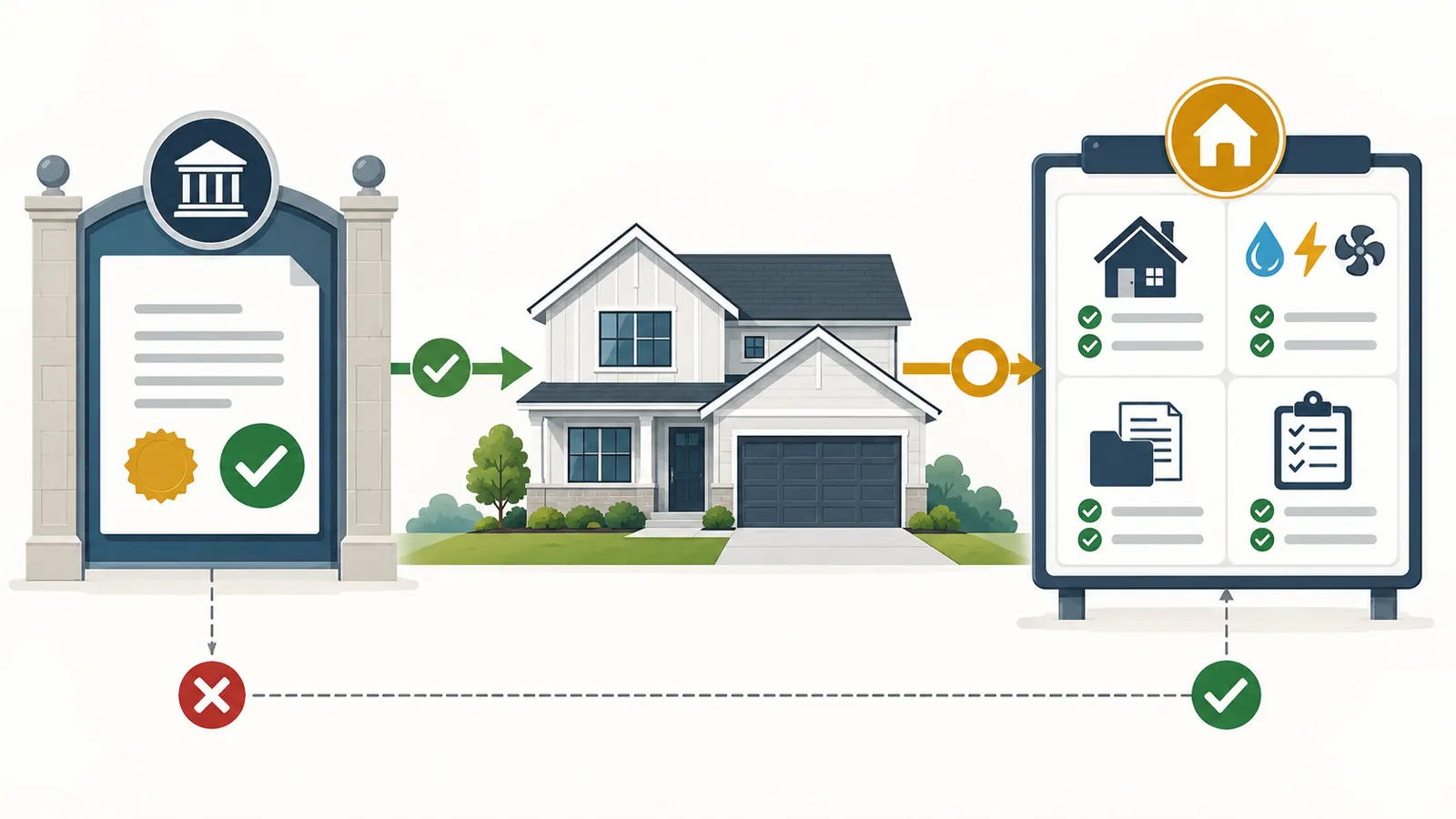
For the surrounding planning sequence, keep this handover record alongside Brictale’s build-your-home guide collection, where land, budget, design, materials, contractor, and construction decisions feed into closeout.
Assemble the handover packet and prerequisites before the walkthrough #
The walkthrough should start with a known scope, live utilities, and a document request—not with a blank phone camera. Ask the builder or seller for the closeout packet in enough time to compare it with your contract, selections, approved changes, and local occupancy record before the appointment.
Inputs to gather
Create one folder with these subfolders: agreement and scope, authority records, systems, finishes, warranties, and open items. Use a filename that includes the property address, document type, source, and date received. For example: 123-Main_CO_NYC-DOB_2026-09-07.pdf or 123-Main_HVAC_model-serial_photo_2026-09-07.jpg. The naming convention is your own control; it is not an official filing rule.
Request, as applicable to the actual project:
- The signed purchase or construction agreement, finish schedule, allowance schedule, approved selections, and change orders.
- The approved plan set or the final drawings the contract says will be delivered, along with any owner-approved substitutions.
- The occupancy document or authority record required by the property’s city, county, or state process. In New York City, search the Department of Buildings record as well as asking the builder for its copy; the City explains how to search by address through BIS or DOB NOW. (New York City Department of Buildings certificate search instructions)
- Final inspection or permit sign-offs that are part of the local record or contract package. Do not treat a builder checklist as the same thing as a government sign-off.
- A list of the builder, superintendent, subcontractors, installers, service contacts, and warranty administrator, including the role each one played.
- Manuals and maintenance instructions for HVAC, water heating, ventilation, appliances, controls, security, solar or battery equipment, irrigation, pumps, and any specialized system actually installed.
- Model numbers, serial numbers, installation dates, start-up or commissioning records, and registration confirmations for equipment whose warranty depends on those inputs.
- Roof, window, door, waterproofing, insulation, termite, radon, energy, indoor-air, and product-approval records only where the project, contract, jurisdiction, or claimed program makes them relevant.
- A written warranty index showing the issuer, covered item, start event, term, exclusions, claim channel, notice method, and any deadline copied from the actual document.
- Keys, remotes, access codes, shutoff locations, panel labels, filter sizes, spare materials, touch-up products, and emergency service instructions.
Miami-Dade County’s list illustrates how wide a closeout packet can be in one local context. Its guidance names contractor and subcontractor information, approved plans, a survey, flood-zone and insurance information, certain product approvals, roof-insulation information, air-conditioning energy cards, and available certificates or association documents. That list belongs to Miami-Dade County, Florida; use it as a prompt to ask what your own authority, contract, lender, insurer, and builder require, not as a universal national packet. (Miami-Dade County records to obtain before closing)
Make the appointment physically possible
Ask who will attend and who has authority to answer each category of question. A useful group is the homeowner, builder or superintendent, and the installer or responsible trade when a system needs a technical demonstration. A home inspector, architect, engineer, or other qualified professional may be appropriate for a separate inspection or specialized question. The builder’s representative is not automatically your independent inspector, and this guide does not turn a homeowner walkthrough into professional inspection sign-off.
Confirm that:
- electric, water, fuel, communications, and HVAC services needed for testing are on;
- the building is safe to enter, with dry floors, usable stairs, adequate lighting, and no active construction hazard;
- appliances and controls are installed, connected, and accessible for normal user demonstration;
- access panels that the owner is meant to use can be reached without moving construction materials;
- exterior areas can be viewed without climbing roofs, entering unsafe excavations, entering confined spaces, or disturbing guards and covers;
- the appointment is long enough to photograph and record each issue, not just initial a preprinted form;
- you have your agreement, selection schedule, plan excerpts, device list, ledger, phone charger, tape measure for non-invasive observations, flashlight, painter’s tape if the builder permits it, and a way to record room and location.
Do not energize an unfinished circuit, remove an electrical-panel cover, open a sealed appliance, adjust gas or combustion settings, enter a crawlspace or confined space, climb a roof, inspect a structural connection, excavate, or repair a defect to “test” it. If a concern touches electrical work, gas, pressure, structure, fall exposure, combustion, contamination, or a confined space, record the observation and route it to the builder and the appropriately qualified local professional. The safe homeowner action is to preserve evidence and ask for a controlled demonstration or professional verification.
Assign responsibility before you look at the first room
There are at least six different responsibilities:
| Responsibility | Typical owner | Handover question |
|---|---|---|
| Build scope | Builder or developer | Does the delivered work match the agreement, approved plans, selections, and change orders? |
| Trade installation | Licensed or otherwise qualified installer as required by the jurisdiction | Who installed, started up, labeled, and will service this system? |
| Authority approval | City, county, state, utility, or program verifier named by the actual process | Which record proves the required approval, and how is it retrieved? |
| Product coverage | Manufacturer or product warranty administrator | What exact model, serial, date, registration, exclusions, and claim channel apply? |
| Owner operation | Homeowner after instruction | What does normal operation look like, where are shutoffs and filters, and what maintenance is scheduled? |
| Closeout coordination | Builder’s superintendent or named warranty contact | Who receives the open item, by what method, by what date, and what closes it? |
The same physical issue can cross these boundaries. A missing HVAC start-up sheet may be a builder closeout issue; a failed component may be a manufacturer claim; incorrect installation may be the installer’s responsibility; an open permit may belong with the authority; and a filter-change reminder becomes the homeowner’s ongoing task after instruction. Do not assign all of those paths to the word “warranty.”
The next decision after assembling the packet is whether the walkthrough can verify the promised scope. If plans, utilities, or the responsible contacts are missing, record that as an open prerequisite before treating a visual tour as a final inspection.
Run the walkthrough in a repeatable order and verify only what is safe to verify #
Use the same route every time: establish the property and exterior, check water and drainage, move through rooms, demonstrate systems, compare records, then close the appointment by reading back every open item. A repeatable order reduces the common failure where a homeowner notices finishes but never tests a drain, identifies a serial number, or records who owns a missing certificate.
Pass 1: establish the property and exterior
Start at the street and work toward the house. Confirm that the address, lot, house number, plan orientation, and visible site features correspond to the documents. Photograph the front, sides, rear, drive, walks, retaining elements, drainage paths, exterior equipment, meters, service disconnects, hose bibs, vents, roof edges visible from the ground, windows, doors, decks, fences, and required landscaping. Compare what you can see with the agreed scope and approved site plan without claiming that a photograph proves concealed grading or waterproofing.
Observe whether water appears to have a clear path away from the building during ordinary conditions, whether drains and downspouts are present where shown, and whether any ponding, erosion, exposed material, damage, or incomplete surface remains. Do not create a flood test or move soil yourself. If the concern involves grading, a retaining structure, foundation performance, roof access, or concealed drainage, record the location and ask the builder to respond with the responsible trade or qualified professional.
Miami-Dade County specifically includes surrounding-property drainage, roof-leak indications, roof tiles, caulking, landscaping, and deviations from approved plans in its homeowner walkthrough suggestions. The local guidance is useful because it turns “look outside” into observable prompts, but it still does not tell a homeowner to climb a roof or make a structural determination. (Miami-Dade County walkthrough and inspection list)
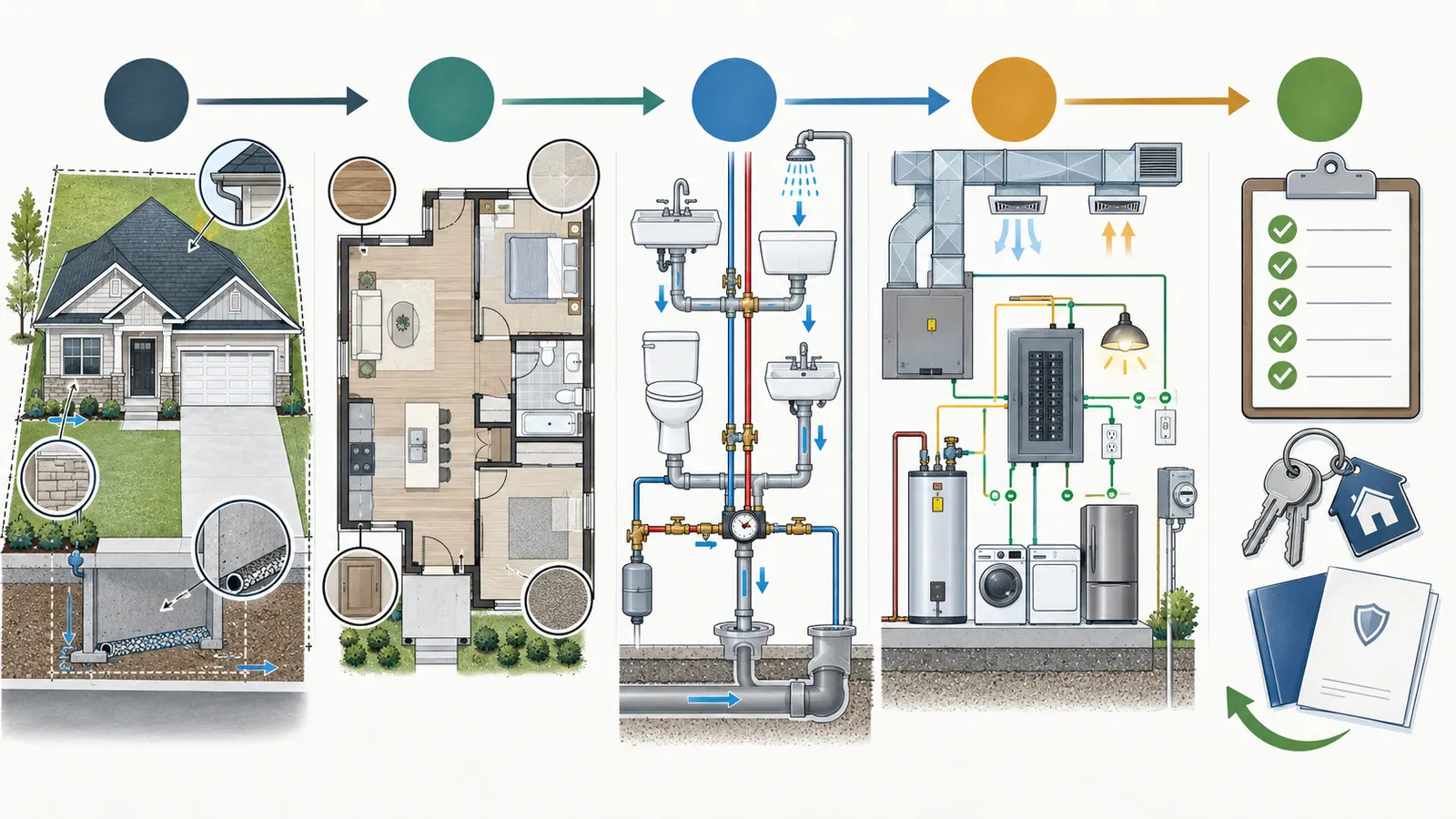
Pass 2: check envelope, access, and finishes room by room
Use one row per room and one additional row for each system that crosses rooms. For every room, record the room name, wall or elevation, exact location, observation, photograph number, contract or plan reference, status, responsible party, and next handoff. Avoid broad entries such as “paint is bad.” Write “north bedroom, west wall beside window, 180 mm horizontal scuff visible in photo 014, paint finish schedule section 3, builder to assess and repair or explain by date in written response.” The exact measurements in that example are placeholders for your own observation, not a claim that the home has that defect.
Check, without damaging the work:
- doors latch, close, lock, and clear the finished floor;
- windows open, close, lock, and show intact visible seals and screens where included;
- cabinets, drawers, vanities, counters, hardware, trim, flooring, tile, paint, and caulking match the selection and finish schedule;
- stairs, handrails, guards, and thresholds appear complete and stable to ordinary use;
- plumbing fixtures are present, drains flow during normal use, and no visible leak or unexplained moisture appears;
- toilets flush and refill without visible leakage, if utilities are live and the builder authorizes ordinary operation;
- lights, switches, receptacles, GFCI or AFCI test buttons intended for user operation, and smoke or carbon-monoxide alarms respond as their user instructions describe;
- appliances power up and show a normal user interface without opening panels or bypassing a safeguard;
- mechanical grilles, thermostats, dampers intended for occupants, and ventilation controls are present and identified;
- garage doors, openers, remotes, attic access, storage areas, and owner-accessible service spaces operate as demonstrated;
- visible labels, shutoff handles, filter racks, breaker directories, and emergency controls are present and understandable.
A failed light is not automatically an electrical defect, and a quiet drain is not proof that every concealed connection is correct. Record what happened, under what ordinary control or condition, and what you could not verify. “Not tested because utility was off,” “not accessible because construction storage blocked it,” and “not inspected because professional access is required” are useful evidence states; they are not passes.
Pass 3: demonstrate systems with the person who will own the handoff
Ask the installer or builder representative to show normal operation, the normal stop condition, the user controls, required maintenance, fault indication, shutoffs, filter or service access, and the emergency contact. Record the model and serial number from the equipment label rather than relying on memory or a brochure. Ask the demonstrator to explain what the homeowner may do, what requires a service professional, and where the manual says to start a claim.
For HVAC, record equipment type, indoor and outdoor model and serial numbers, thermostat or control model, filter dimensions, condensate path visible to the owner, service disconnect location, start-up or commissioning record if provided, and the name of the installing contractor. Observe a normal call for heating or cooling only when the system is ready for ordinary operation and the demonstrator authorizes it. Do not infer capacity, efficiency, airflow, refrigerant charge, combustion safety, or code compliance from a short temperature change.
For water heating, record fuel or electrical type, model, serial number, installation date, shutoff location, user control, temperature display if present, relief-discharge routing visible without disassembly, and the service contact. Do not remove covers, change combustion settings, or treat hot-water temperature as proof of safe delivery at every fixture. A manufacturer’s actual warranty can require precise installation, water quality, documentation, or qualified service conditions.
Rheem’s residential tankless gas water-heater warranty guide is a concrete example: it describes warranty status using the documented installation date or manufacturer verification, asks for model and serial information, directs an in-warranty owner to the installing plumber or mechanical contractor, and excludes certain costs or failures tied to installation, code compliance, and service qualifications. That is a product-specific example, not a rule for every water heater. (Rheem residential tankless gas water-heater warranty guide)
For electrical systems, record the panel location, directory condition, visible labels, owner controls, exterior disconnects, and any plainly visible damage. Operate only controls intended for the homeowner and only as demonstrated. Never remove a dead-front cover or probe a receptacle as a substitute for a qualified electrical inspection.
For plumbing and drainage, record fixture operation, visible leaks, drain behavior, cleanout locations if identified for the owner, and the builder’s explanation of any pump, treatment, recirculation, or frost-protection system. Do not make a contamination, backflow, pressure, or concealed-pipe determination from a brief walkthrough.
For ventilation, indoor-air, and energy features, collect the actual program or equipment record rather than accepting a marketing label. If the home is represented as EPA Indoor AirPlus, ask which version, what verification record applies, and who can provide it. EPA says Indoor AirPlus Version 2 includes design, construction, and verification requirements and identifies a verification checklist used by verification and home-certification organizations; it also publishes version eligibility dates that can change. (EPA Indoor AirPlus program documents)
The U.S. Department of Energy’s Building America homeowner guide makes the handoff principle explicit: owners should become familiar with the systems in a new home and how to maintain them, with education shared among the builder, sales team, and homeowner. The guide is old and should not be treated as a current schedule for a specific appliance, but it supports recording the actual demonstration and maintenance instructions instead of assuming the manual will be enough. (U.S. Department of Energy Building America homeowner guide)
Pass 4: close the appointment with a read-back
At the end, do not simply sign a page titled “final walkthrough.” Read each open row aloud. Confirm the exact location, evidence file, requested action, responsible person, route, and next date. Ask whether the item is a completion item, warranty item, authority item, manufacturer item, or owner education item. Ask for the written procedure for an item the builder says is “normal,” “within tolerance,” “covered later,” or “not our scope.”
The next decision is a status decision, not a mood decision: can the row be marked complete, can it be accepted with controlled follow-up under the actual contract, or does it block the next handoff because there is no safe or documented path forward?
Use the closeout-to-warranty ledger to make every open item defensible #
The Closeout-to-warranty ledger is a worksheet for linking each handover item to its prerequisite, responsible person, evidence, safe verification boundary, document-specific notice timing, unresolved-risk status, and next handoff. It is designed to answer “what remains and who owns it?” rather than merely produce a longer punch list.
Method: For each scope, room, or system, record its prerequisite, responsible person, evidence received, safe verification method, status, warranty route, notice deadline copied from the actual document, and next handoff; then apply the completeness rule before accepting the keys.
Limitations: This is an illustrative homeowner record, not a code certificate, professional inspection, legal opinion, repair instruction, warranty determination, or substitute for the actual contract, permit record, manufacturer document, or jurisdictional authority.
The ledger fields
Use one row for an item that can be independently owned and closed. Split a row when the same observation has two different owners or two different deadlines. For example, “HVAC does not start” could split into “builder confirms power and installation,” “installer diagnoses start-up,” and “manufacturer claim if a covered component fails.” Keep the original observation linked to all three rows.
| Field | What to enter | Example or boundary |
|---|---|---|
| ID | Stable row number | HVAC-01, KITCHEN-03, DOC-07 |
| Scope | Contract, authority, room, system, or record category | “HVAC start-up record” |
| Room or system | Exact location or equipment | “Attic air handler; model ABC; serial recorded” |
| Prerequisite | What must exist before verification is meaningful | “Utility live; system installed; access safe” |
| Responsible person | Named individual or organization and role | “Builder superintendent; HVAC installer” |
| Evidence received | File name, photo, record, demonstration note, or missing status | “Photo 014; start-up sheet missing” |
| Verification method | Safe observation or document comparison | “Normal thermostat call demonstrated; no cover removed” |
| Status | Complete, open, controlled follow-up, or blocked | “Open—installer response needed” |
| Warranty route | Builder, trade, manufacturer, administrator, authority, or none | “Builder first; manufacturer if covered failure” |
| Notice deadline | Date copied from the actual document, or “not stated” | “Not stated in packet; ask warranty administrator” |
| Risk note | Why the row matters and what cannot be inferred | “No claim of refrigerant charge or code compliance” |
| Next handoff | Exact next action, owner, channel, and date | “Builder emails start-up record by 2026-09-12” |
| Closure evidence | What will allow the row to close | “Record received; system re-demonstrated; photo linked” |
The “notice deadline” field is intentionally document-specific. Never calculate a deadline from a generic article, a neighbor’s warranty, a remembered one-year period, or the date on a product web page. Copy the language and the trigger from the actual warranty, contract, local procedure, or manufacturer record. If the document says “promptly,” “within X days of discovery,” “within X days of installation,” or uses a different trigger, preserve that wording and ask the issuer or a qualified legal professional what it means for your situation.
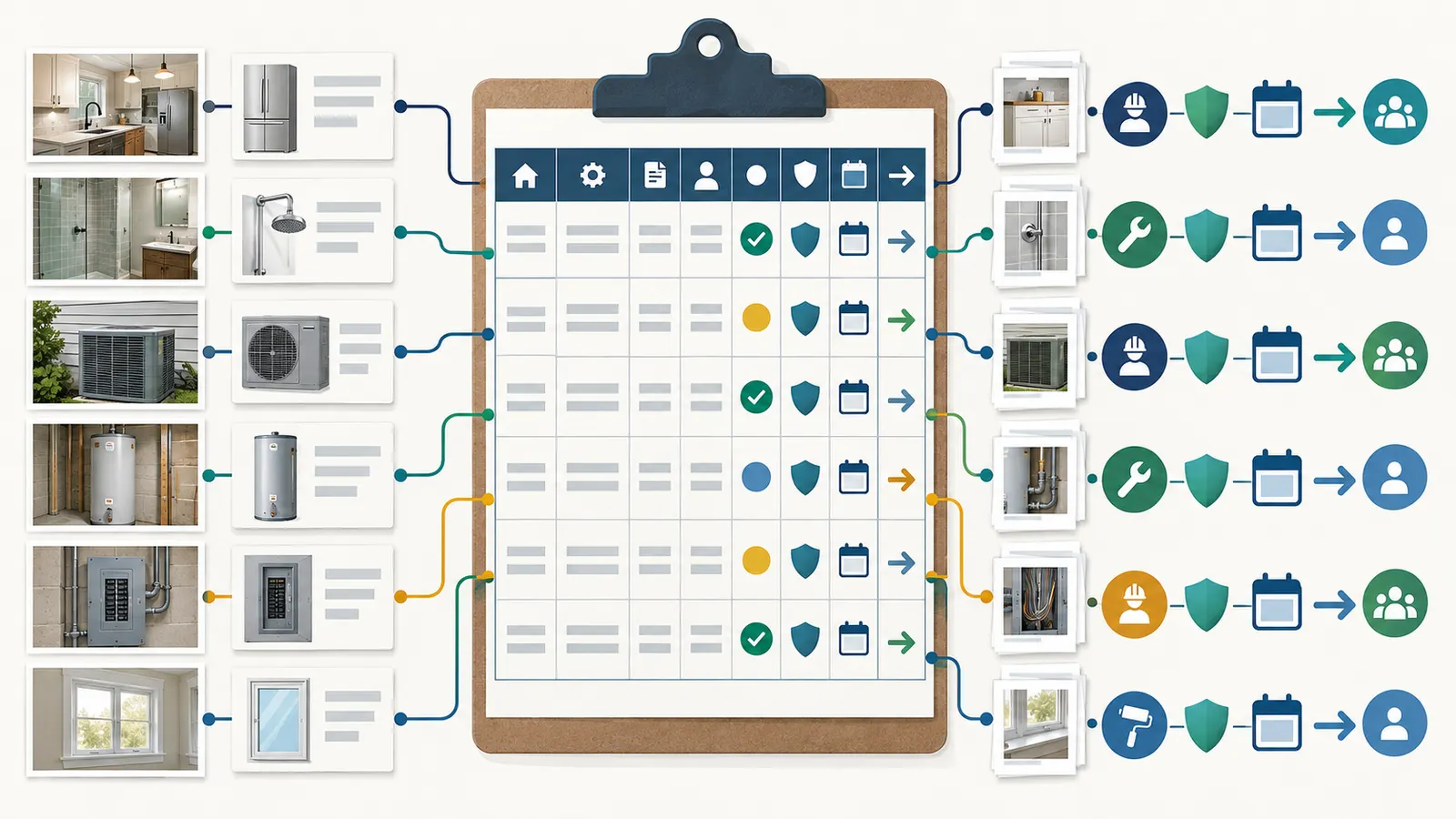
Illustrative ledger rows
The following rows are illustrative examples, not observations from a real house and not a promise that each item belongs in every project. Replace every value with the property’s actual document, photo, demonstration, and responsible contact.
| ID | Scope and prerequisite | Evidence and safe verification | Status, route, and next handoff |
|---|---|---|---|
| OCC-01 | Occupancy record; authority review must be complete | Copy of the document issued by the actual city, county, or state process; compare address and permitted use | Complete only when the named authority record is confirmed; builder or closing professional hands it over; local authority question if absent |
| EXT-02 | Exterior drainage; finished site and safe ground access | Ground-level photographs after ordinary conditions; compare visible drainage features with site scope; no excavation or roof climb | Open if ponding or incomplete work is observed; builder assigns site or drainage trade; professional evaluation if performance or structure is disputed |
| KIT-03 | Sink, dishwasher, cabinets; water, power, and appliance installation complete | Run ordinary fixture operation with representative present; photograph leak or finish; collect appliance model and manual | Open—builder or installer; manufacturer route only if the exact appliance warranty applies; re-demonstrate after correction |
| HVAC-04 | HVAC installation and utilities complete | Model/serial photo, thermostat demonstration, filter size, start-up record if supplied; no panel opening or performance claim | Controlled follow-up if start-up record is missing; builder/installer first; manufacturer route only under actual warranty |
| WH-05 | Water heater installed and documented | Model/serial, installation date, user control, shutoff and manual; observe normal operation only | Open if date or installer is unknown; builder supplies record; manufacturer claim path copied from product warranty |
| ELEC-06 | Electrical service energized and owner-accessible controls labeled | Operate normal switches and receptacles as demonstrated; photograph panel directory; no live testing or cover removal | Blocked for exposed conductors, heat, odor, arcing, or unsafe access; builder and qualified electrician; do not self-repair |
| DOC-07 | Manuals and maintenance schedule exist for installed systems | Index filenames, version/date, filter sizes, service contacts, and shutoff map | Open—builder closeout coordinator; close when complete packet is received and owner demonstration is recorded |
| WAR-08 | Each warranty’s start event and claim route identified | Read actual builder, trade, manufacturer, and administrator documents; record model, serial, installation/closing trigger and notice wording | Open if route or deadline is missing; builder or warranty administrator provides the document; ask legal professional about dispute implications |
| FIN-09 | Finish schedule and approved selections available | Room-by-room photos and comparison to the schedule; no assumption that a cosmetic issue is covered for a fixed term | Open—builder closeout or warranty contact; include location and requested response; close with photo and written resolution |
| EDU-10 | Owner can operate routine controls safely | Owner repeats thermostat, water shutoff, breaker reset if instructed, filter access, alarm test, and emergency contact steps | Complete when demonstrated and manual recorded; maintenance becomes homeowner responsibility after handoff within the actual instructions |
Apply a completeness rule without turning it into fake certainty
Use this simple record-level rule:
Handover readiness = occupancy gate passed AND every critical row is complete or controlled follow-up AND every open row has an owner, evidence, route, and next handoff.
For a private progress signal, you may also calculate an illustrative closure score:
closure score = (complete rows + 0.5 × controlled-follow-up rows) ÷ total rows × 100
Suppose a ledger has 20 rows: 14 complete, 3 controlled follow-up, and 3 open without a controlled path. The illustrative score is (14 + 0.5 × 3) ÷ 20 × 100 = 77.5%. That number is not a legal threshold, builder standard, inspection grade, or recommendation to accept the home. It simply makes the unfinished record visible. The home remains not ready under the rule because three rows lack an owner, evidence, route, and next handoff.
Sensitivity matters more than the average. If one of those three rows changes from “missing filter-size label” to “exposed energized conductor,” the score does not change, but the decision does: the electrical row becomes a blocker and must be routed to the builder and qualified electrician. If the missing row changes from “owner manual for a dishwasher” to “no occupancy document from the authority,” the score again does not change, but the occupancy gate does. The ledger must preserve risk categories; a single percentage cannot do that.
How to close a row
Close a row only when the original issue can be traced to a response. A useful closure packet contains:
- The original observation and date.
- The response from the responsible person or organization.
- New photograph, record, demonstration note, or authority document.
- The exact document or scope clause used to decide whether the response is sufficient.
- Any new warranty or maintenance deadline created by the response.
- The person who accepted the row and the date of acceptance.
If the builder repairs a scuffed door, do not erase the row because the door looks better. Add the repair date, photograph, and written confirmation. If the builder says the scuff is within an allowed tolerance, attach that written explanation and mark the row as accepted or disputed according to your agreement. If the builder provides a new appliance, replace the model and serial record; the original record may now be wrong.
The next decision is whether the ledger’s open rows are controlled enough to hand over under the actual contract. If not, seek the contract, closing, authority, or legal advice needed for that decision; do not invent a universal right to delay closing or a universal duty to accept keys.
Build the evidence packet and learn the home before the first warranty issue #
The best handover packet lets a future person answer five questions without calling the original salesperson: what was installed, who installed it, when it started, how the owner operates it, and where a covered problem must be reported. Collecting those answers is different from collecting glossy brochures.
Separate project records from product records
Project records describe the home as a whole: agreement, selections, change orders, plans, permits, occupancy evidence, surveys, site records, inspection sign-offs, subcontractor contacts, and closeout responses. Product records describe an individual unit: manufacturer, model, serial, installation date, installer, registration, coverage, exclusions, maintenance, and claim route.
Do not let a builder’s “one-year warranty” label replace the product warranty record. The FTC explains that a builder warranty and a separately purchased home-warranty service contract are different things, and that new-home builder warranties commonly cover permanent components with terms that vary by component. The FTC also gives general examples of one-year workmanship and materials coverage, two-year HVAC, plumbing, and electrical coverage, and longer structural coverage, but those are general descriptions—not the terms of your home. (FTC guidance on new-home warranties and coverage)
Build an index with one line per document:
| Document or record | Issuer or source | Property or product identifier | Trigger and deadline | Where stored | Missing action |
|---|---|---|---|---|---|
| Occupancy record | Actual local authority | Address, unit, permitted use | Issue date or local status | Authority folder | Ask builder or authority how to retrieve |
| Builder warranty | Builder or administrator | Agreement/property address | Closing, completion, or stated trigger | Warranty folder | Request complete terms and claim channel |
| HVAC warranty | Manufacturer, installer, or builder | Indoor/outdoor model and serial | Installation or registration rule in document | Systems folder | Verify exact program eligibility |
| Water-heater warranty | Manufacturer | Model and serial | Installation date or actual document trigger | Systems folder | Request installation record and installer contact |
| Appliance records | Manufacturer and builder | Each model and serial | Actual product terms | Systems folder | Photograph labels and ask who registers |
| Plan and closeout set | Builder/authority | Address and revision | Final revision or authority record | Project folder | Request marked-up or approved set |
| Owner education | Builder/installer | System and control name | Handover demonstration | Owner folder | Schedule a demonstration |
Never infer a product warranty from a registration webpage
Manufacturer pages can be narrower than the homeowner’s assumption. Carrier’s current Consumer Choice Warranty page says its described program requires timely registration within 90 days, but it also says the specific program is for existing residential applications and that new residential construction installations are not eligible. The practical lesson is not “register every Carrier product within 90 days and you are covered.” It is “identify the exact product, exact program, installation context, and actual builder or manufacturer document before recording a deadline.” (Carrier HVAC warranty registration and coverage)
For every product, copy rather than paraphrase:
- who is the warranty holder;
- what event starts coverage;
- whether a registration is required, optional, or irrelevant;
- whether the program applies to new construction or replacement;
- what labor, shipping, inspection, permit, removal, or reinstallation costs are excluded;
- what maintenance or installation conditions matter;
- how to submit a claim and what records must accompany it;
- whether the builder, installer, distributor, administrator, or manufacturer is the first contact;
- the notice wording and deadline, exactly as the document states.
If the document is silent, write “not stated” rather than inventing a date. Then ask the named issuer in writing. If an answer changes the financial, legal, or timing decision, preserve the question and response in the ledger.
Turn system education into a repeatable owner test
At the demonstration, ask the professional to show the action, explain the expected result, and state the boundary. Then repeat only the ordinary owner action yourself.
| System | Ask the demonstrator to show | Owner-safe repeat | Escalate instead of testing |
|---|---|---|---|
| HVAC | Normal call, mode selection, filter access, condensate or emergency response, service contact | Change the normal control setting and identify the filter and disconnect without opening equipment | Refrigerant, combustion, airflow, wiring, duct leakage, or performance diagnosis |
| Water heating | User controls, shutoff, drain or service contact, error display, manual | Identify controls and shutoff; observe ordinary hot-water operation | Gas adjustment, relief-valve testing beyond instructions, electrical covers, scald or combustion diagnosis |
| Electrical | Panel location, directory, owner reset procedure if applicable, exterior disconnect | Read labels and operate only intended switches or test controls as instructed | Removing covers, probing, exposed conductors, heat, odor, arcing, or unexplained trips |
| Plumbing | Fixture operation, cleanouts or shutoffs intended for owner, leak response | Run ordinary fixtures and observe visible connections | Concealed leak, backflow, pressure, contamination, drain-camera, or pipe repair |
| Ventilation and air quality | Controls, filters, sensors, maintenance record, program certificate if claimed | Use normal controls and record filter or service information | Mold, radon interpretation, combustion safety, or certification dispute |
| Appliances | Normal user operation, manuals, model/serial, service route | Run a short normal cycle when utilities and installation are ready | Opening panels, bypassing locks, gas/electrical repair, or modifying settings |
This table is a handoff method, not a test standard. The professional’s demonstration can show that a control responds; it cannot prove every concealed installation condition. A homeowner’s repeat can show that the manual is understandable; it cannot become a code inspection or warranty determination.
Route defects, missing records, and deadlines to the right owner #
Route an item first to the party that controls the next action, then preserve the manufacturer or authority path that may become relevant. Send a concise written record with the property, ledger ID, observation, date, evidence, requested response, and the deadline copied from the actual document. A phone call can be useful for urgency; it should not be the only record for a disputed or time-sensitive item.
Use a routing tree
Is the issue legal occupancy, an open permit, a violation, or an authority document? Contact the actual city, county, state, utility, or program authority through its published process, while copying the builder when the builder controls the submission. Do not cite New York City’s CO rules to a home in Florida, Texas, California, or another jurisdiction.
Is the issue a mismatch with the agreement, approved plans, selections, workmanship, incomplete finish, or site scope? Start with the builder or developer’s written closeout or warranty channel. Attach the contract or selection reference, location, photographs, and requested response.
Is the issue about installation, start-up, commissioning, or a trade record? Route to the builder and the installing trade. Ask for a qualified response when the issue concerns electrical, gas, structural, waterproofing, HVAC charge, pressure, or other technical conditions outside a safe homeowner check.
Is a specific component failing after proper installation and ordinary operation? Check the exact manufacturer document and route through its required first contact, often the installing contractor or dealer. Do not bypass the builder if the builder contract requires builder coordination, and do not assume a product warranty covers labor or removal.
Is the issue a dispute about scope, waiver, closing, delay, or legal rights? Preserve the record and consult the closing professional, contract administrator, or qualified attorney in the property’s jurisdiction. This guide does not tell you to withhold payment, refuse keys, waive a claim, or accept a release.
The FTC advises homeowners to check the warranty, follow the instructions, put a repair request in writing, and keep correspondence and conversation records. It also notes that many new-home warranties use or require mediation or arbitration for disputes. That is federal consumer guidance, not a universal procedure or deadline; your actual documents control the route. (FTC guidance on making a new-home warranty claim)
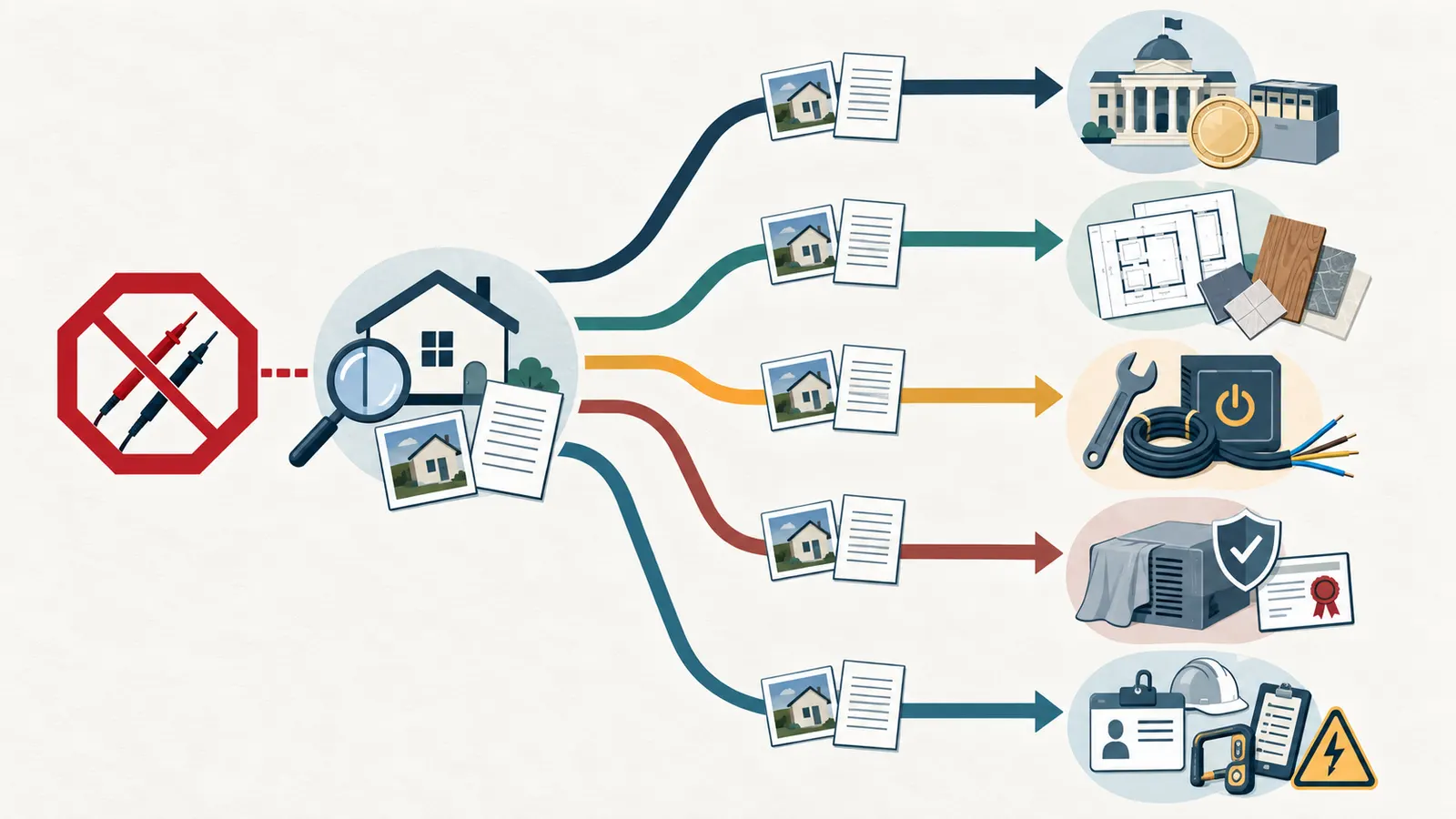
Miami-Dade County offers a local example of a written record path. Its guidance says homeowners should notify the developer of construction defects in writing within a year after closing, describes electronic or certified-mail documentation, and lists contract, warranty, complaint, and independently obtained engineer-report records for a possible enforcement complaint. The same page’s one-year language is Miami-Dade County guidance, not a national warranty period and not a substitute for reading the actual agreement or consulting a Florida professional about a legal deadline. (Miami-Dade County warranty and claims guidance)
California shows why jurisdiction must remain visible in the ledger. The California Department of Consumer Affairs says its construction-defect pre-litigation procedures apply to new residential homes purchased after January 1, 2003 and may give the builder an opportunity to repair before litigation, with inspections, document exchanges, mediation, and specified time frames under California Civil Code sections 910–938. This is a California-specific procedure, not a U.S. handover rule and not legal advice. If the property is in California, copy the actual applicable notice language and ask a California attorney or appropriate housing professional how it interacts with your facts. (California Department of Consumer Affairs construction-defect notice)
Common failure cases and the safer response
| Failure case | Why it creates risk | Record to make | Safer next step |
|---|---|---|---|
| “The CO means everything is finished.” | Occupancy evidence and private scope or warranty completion answer different questions | CO/TCO or local document plus separate finish and system rows | Verify the actual authority record and keep the closeout ledger open |
| “We will fix it after closing.” | The promise may have no named owner, evidence, route, or date | Exact defect, photo, contract reference, owner, requested action, and actual document deadline | Ask for a written controlled-follow-up entry and keep it open until closure evidence arrives |
| “The builder warranty covers the appliance.” | Appliance and builder coverage may be separate or excluded | Model, serial, issuer, term, registration, exclusions, and claim channel | Ask builder and manufacturer which party owns the first claim |
| “Register it online now; the warranty is protected.” | A registration program may exclude new construction or have product-specific rules | Screenshot or confirmation only after the actual terms are read | Confirm the exact product and installation context; do not invent a deadline |
| “The system turned on, so it passed.” | A short response does not prove sizing, installation, code, efficiency, or concealed safety | Demonstration conditions and limits | Request start-up or commissioning record and professional response where needed |
| “The punch list is too long; we will average it out.” | Critical risk is not diluted by many cosmetic completions | Status and risk category for each row | Apply the gate rule; escalate any occupancy or safety blocker |
| “The deadline is one year everywhere.” | Coverage and notice rules vary by contract, product, program, and jurisdiction | Exact document language and trigger | Record “not stated” until the actual document answers it |
| “The homeowner can test the wiring or gas.” | Live, combustion, pressure, fall, or structural work can cause injury or damage | Observation without invasive test | Stop and route to a qualified local professional |
| “A verbal ‘normal’ settles the issue.” | The explanation may not be traceable to scope, tolerance, or warranty terms | Speaker, date, exact explanation, and requested written basis | Ask for the written response and mark accepted, open, or disputed |
Write the first notice so a stranger can understand it
Use a subject line such as 123 Main — Handover ledger HVAC-04 — missing start-up record and owner demonstration. Include:
- property address and unit;
- ledger ID and date discovered;
- exact location or equipment identifier;
- factual observation, not a diagnosis you cannot support;
- attached photograph or document name;
- contract, selection, plan, or warranty section if known;
- requested action and who you believe should coordinate it;
- the actual notice date or “not stated” entry from the controlling document;
- a request for written confirmation of receipt and next step;
- the date by which you need a response, clearly labeled as your requested response date unless the document creates a different deadline.
Do not call an installer’s opinion a legal conclusion, call a cosmetic observation a structural defect, or call a missing manual proof of a defective system. Precision keeps the warranty route open and makes it easier for a professional to assess the issue.
The next decision is whether the issue can be safely and fairly assigned from the record. If not, obtain the missing contract, permit, manufacturer, or jurisdiction information before making a claim that depends on it.
Make the final handover decision and carry the ledger into ownership #
Use a three-way decision: accept and close, accept with controlled follow-up, or do not treat the handover as complete yet. The choice depends on the actual contract, closing process, authority record, safety conditions, and documented risk—not on a universal checklist score.
Green: accept and close
Use this state when the occupancy evidence required by the actual jurisdiction is present, critical work is complete, systems have been demonstrated within a safe homeowner boundary, the document packet is indexed, and remaining observations are either closed or clearly non-blocking with no unresolved ownership question. Record the acceptance date, who attended, the documents received, the final ledger version, and any routine maintenance date that starts after handover.
Amber: accept with controlled follow-up
Use this state only when the actual agreement and closing process permit it and the open rows have all of the following:
- a precise description and location;
- a named person or organization responsible;
- a written route and contact;
- supporting evidence or a record of what could not be verified;
- a deadline copied from the controlling document, or “not stated” plus a written request for clarification;
- a next handoff and requested response date;
- a closure test or document that will close the row;
- no known immediate safety or occupancy blocker.
Examples might include a missing touch-up kit, a manual that the builder has promised to upload, a non-critical finish repair with a written work order, or a later seasonal demonstration if the contract and warranty process expressly support that path. Do not label an item amber merely because the builder says it will be handled.
Red: do not treat the record as complete
Use this state for missing required occupancy evidence, unsafe conditions, exposed or damaged electrical or fuel components, active water intrusion, inaccessible critical systems, a material mismatch with the agreed scope, an unowned defect, or a warranty issue with no document, route, or responsible party. Stop the relevant test. Photograph from a safe location, notify the builder or authority, and obtain the qualified professional or legal/closing advice appropriate to the issue and jurisdiction.
This is not an instruction to unilaterally cancel a transaction or withhold funds. It is a record classification that says the next handoff is not defensible without another decision by the parties or a qualified authority.
Perform the key handoff as a controlled event
Before leaving the appointment, make a final copy of:
- The occupancy and authority evidence actually received.
- The closeout ledger with every row’s final status.
- The open-item register and written contacts.
- The plan, selections, change-order, and approved substitution record.
- The system and appliance index with model, serial, and installation fields.
- The warranty index with copied triggers, routes, exclusions, and document-specific notice language.
- The owner demonstration record, including what was not demonstrated and why.
- The photographs and filenames linked to ledger rows.
- Shutoff, panel, service, filter, alarm, access, and emergency-contact information.
- The first maintenance and inspection questions that belong in ownership, without inventing a schedule not stated by the actual manuals or professionals.
Signatures should identify what the signer is acknowledging. A signature on a walkthrough can acknowledge that the walkthrough occurred; it does not automatically prove the house is defect-free or waive rights. Read the actual document, ask what the signature means, and obtain contract or legal advice if the language affects acceptance, releases, claims, or closing.
Carry the ledger through the first month
Handover is a transition, not the end of observation. During the first days of normal occupancy, record the date and conditions for leaks, alarms, unusual noise, condensation, failed controls, drainage, door movement, moisture, temperature complaints, or other changes. Avoid diagnosing from a single event. Link each new observation to the original system or room row when appropriate, and preserve the first date discovered because a document may define notice by discovery or another trigger.
Pay attention to evidence that changes with season or occupancy. A heating system may not be demonstrable during a warm closing week, an exterior drain may not be observable during dry weather, and a roof or window concern may become clearer after ordinary rain. Mark the row “not yet seasonally verified” rather than “passed” when the relevant condition was absent. Ask the builder or installer whether the contract, start-up record, commissioning procedure, or warranty document supplies an alternative verification method. If a later condition reveals a problem, add the date, weather or operating condition, control setting, and photograph to the existing row instead of starting an unrelated complaint with no handoff history.
Also distinguish a missing record from a missing physical result. If the air conditioner cools but the start-up sheet is absent, the system demonstration and the record are two rows. If the sheet arrives but the equipment now trips or leaks, reopen the system row with the new observation and preserve the original document. If the builder changes a model after handover, update the model, serial, installer, warranty route, and maintenance instructions together. This prevents an apparently complete packet from pointing a future service call to equipment that is no longer installed.
At the first owner review, update:
- the contact for builder warranty service;
- the model and serial index after any replacement;
- product registration confirmations, if the exact product terms require or offer them;
- filter sizes and ordinary maintenance instructions;
- utility shutoffs and panel labels;
- the authority portal or record location;
- the status of every controlled-follow-up row;
- any new deadline that appears in a repair order or manufacturer response.
The DOE homeowner guide’s emphasis on system familiarity is especially relevant here: a home can be physically complete while its owner still does not know how to maintain or safely operate its systems. That gap belongs in the handover record, not in a later blame exercise. (DOE Building America homeowner education guide)
If the property uses a private well, carry the source, pump, treatment, and testing records into the same ownership folder before treating the water handoff as complete. After those records are received, use Brictale’s private-well maintenance checklist for the separate ongoing-maintenance decision; it is an existing compatibility route, not a replacement for the builder’s closeout documents or the local authority’s requirements.
Compact originality brief
Current answers: Generic search results tend to offer punch lists, document lists, or builder-facing closeout templates. Official guidance covers separate pieces: the FTC explains warranty categories and written claims; Miami-Dade County gives a local walkthrough, records, warranty, and complaint example; New York City defines a local occupancy document; EPA and DOE cover program verification and owner education; manufacturers illustrate product-specific records; California shows a state-specific defect-notice procedure.
Missing decision: Homeowners still need to decide whether the home is ready for handover when a certificate, finish, working system, manual, installer record, builder promise, and manufacturer warranty each belong to different people and documents.
Original contribution: The Closeout-to-warranty ledger connects scope, room or system, prerequisite, responsible person, evidence, safe verification boundary, status, warranty route, document-specific deadline, risk, and next handoff. Its worked closure score makes missing ownership visible while the gate rule prevents a percentage from masking an occupancy or safety blocker.
How it can be checked: Replace every illustrative row with the property’s contract, authority record, photograph, model/serial record, manufacturer document, and written response. A reviewer can inspect whether every evidence URL in the research file appears at the point of use, whether every ledger row has a real owner and route, whether local rules remain labeled by jurisdiction, and whether the final decision follows the actual documents rather than a generic one-year or “passed inspection” assumption.
The practical final answer is therefore conditional but usable: accept the keys only when the actual occupancy path is evidenced, the home has been walked with utilities live, critical systems have been demonstrated within a safe boundary, the closeout packet is indexed, and every unresolved item has a written owner, route, evidence, document-specific timing, and next handoff. If one of those is missing, the next decision is not “hope it is fine.” It is to obtain the responsible party’s written response, involve the actual local authority or qualified professional where needed, and preserve the record until the row can be closed.
Cite this guide
Brictale. “New Construction Home Handover Checklist: Closeout, Keys, and Warranties.” Published 2026-09-13; updated 2026-09-13.
https://brictale.com/build/handover/new-construction-home-handover-closeout-checklist · Read the Markdown version
Original contribution: Closeout-to-warranty ledger. A reusable homeowner ledger that turns each handover item into an owned closeout record with evidence, verification limits, document-specific notice timing, and the next handoff.
Sources and scope
Evidence behind this page
- The Federal Trade Commission distinguishes a builder warranty from a separately purchased home-warranty service contract and says builder warranties for newly built homes generally offer limited workmanship and materials coverage for specific components. The FTC gives these general duration examples: most workmanship and materials coverage expires after the first year; HVAC, plumbing, and electrical systems are generally covered for two years; and some builders offer up to 10 years for major structural defects. It also says the length of coverage varies by component.
Warranties for New Homes | Consumer Advice
Federal Trade Commission consumer guidance for newly built homes, including the page's general one-year, two-year, and up-to-10-year examples; these are not a promise about any particular builder contract, product warranty, or state warranty law, and the FTC says coverage varies by component.
Accessed · Link to this claim - The Federal Trade Commission advises homeowners to check the warranty, follow its claim instructions, put repair requests in writing, and keep records of correspondence and conversations; it notes that some warranties use mediation or arbitration for disputes.
Warranties for New Homes | Consumer Advice
Federal consumer guidance about documenting new-home warranty claims; it does not set a universal claim deadline or require a particular delivery method in every jurisdiction.
Accessed · Link to this claim - Miami-Dade County recommends a pre-closing walk-through with the developer or builder, suggests bringing a knowledgeable building-trade representative, lists checks for plumbing, HVAC, electrical, drainage, finishes, doors, windows, and deviations from approved plans, and says starred items should be checked after utilities are turned on.
Miami-Dade County, Florida homeowner guidance; recommendations and local process context, not a nationwide inspection standard.
Accessed · Link to this claim - Miami-Dade County lists records homeowners should obtain before closing, including contractor and subcontractor information, approved plans, a survey, flood-zone and insurance information, product approvals where applicable, roof-insulation information, air-conditioning energy cards, and available certificates or association documents.
Miami-Dade County, Florida list of suggested pre-closing records; availability and applicability of each item depend on the property and local process.
Accessed · Link to this claim - Miami-Dade County says its newly constructed home suggestions cover steps before purchase and during the first year of homeownership. In its Claims section, it says that within a year after closing of a newly constructed home, the owner should notify the developer of construction defects noticed, in writing either electronically or by certified postal mail with a return receipt requested. It also says a complaint to the county Contractor Enforcement Section requires the contract, warranty documents, letters of complaint to the developer or contractor, and any independently obtained engineer reports that apply. The same page recommends obtaining builder, contractor, subcontractor, and appliance-manufacturer warranties and returning manufacturer warranty certificates within the proper time frame.
Miami-Dade County, Florida homeowner guidance, including the page's stated within-a-year-after-closing notice suggestion and its county complaint-document list; this is not a universal warranty period, national legal deadline, or substitute for the actual agreement or advice about the property’s jurisdiction.
Accessed · Link to this claim - New York City Department of Buildings says a Certificate of Occupancy states a building’s legal use or permitted occupancy, and that a new building must have a CO or Temporary Certificate of Occupancy before legal occupancy; the certificate reflects completed-work and approval conditions defined by the City.
Certificate of Occupancy - Buildings
New York City Department of Buildings rule and process example; it does not establish the occupancy document or handover rule for every U.S. jurisdiction.
Accessed · Link to this claim - EPA says Indoor AirPlus Version 2 includes design, construction, and verification requirements, and identifies a verification checklist used by verification and home-certification organizations; the page gives version eligibility dates and warns that eligibility dates can change.
Indoor AirPlus Program Documents
EPA Indoor AirPlus program documents; applicable only when a home is represented as participating in that program, not a general requirement for all new homes.
Accessed · Link to this claim - The U.S. Department of Energy Building America homeowner guide says owners should become familiar with new-home systems and maintenance, and describes education as a shared responsibility of the builder, sales team, and homeowner; the guide also discusses scheduled HVAC service and maintenance practices.
U.S. Department of Energy Building America homeowner education guide, last updated 2009; use for the handoff principle, not as a current equipment-specific maintenance schedule.
Accessed · Link to this claim - Carrier’s current Consumer Choice Warranty page says the described registration program requires action within 90 days of installation, but also says that specific program is for existing residential applications and that new residential construction installations are not eligible; warranty coverage therefore must be matched to the actual product and program document.
Carrier Home HVAC Warranty Registration & Coverage
Carrier Consumer Choice Warranty program page; not a statement about every Carrier product, builder warranty, or jurisdiction.
Accessed · Link to this claim - Rheem’s residential tankless gas water-heater warranty guide says warranty status can depend on the documented installation date, model and serial information, or manufacturer verification, and directs an in-warranty owner to the installing plumber or mechanical contractor; it also excludes some costs and conditions related to installation, code compliance, and unqualified service.
Certificate of Limited Warranty: Residential Tankless Gas Water Heater
Rheem residential tankless gas water-heater warranty guide; illustrative product-record example, not a universal water-heater warranty or local code rule.
Accessed · Link to this claim - California Department of Consumer Affairs says the state’s construction-defect pre-litigation procedures apply to new residential homes purchased after January 1, 2003 and can give the builder an opportunity to repair before litigation, with inspections, document exchanges, mediation, and specified time frames under California Civil Code sections 910-938.
Construction Defect Notice To Owners Of New Residential, Single-Family Dwellings
California-specific construction-defect procedure; not a national notice rule and not legal advice.
Accessed · Link to this claim