How to Manage a New-Home Utility Bill That Exceeds the Energy Model
Use three comparable billing cycles to separate model assumptions, weather, occupancy, utility data, controls, and possible construction issues before escalating.
The short answer
Do not treat one high bill as proof of a defect. Collect three comparable cycles with the utility’s actual dates, kWh or therms, read type, weather, occupants, thermostat settings, equipment status, and the model’s matching assumptions. Reconcile units and periods first, then ask the utility to verify account and meter data, the builder or installer to investigate supported evidence, or an independent energy professional to assess unresolved gaps before warranty windows close.How to Manage a New-Home Utility Bill That Exceeds the Energy Model
After three comparable billing cycles, decide whether the gap is explained by the comparison, weather, occupancy, operation, utility data, or the installed home. Start by preserving the bills and model assumptions, not by changing equipment. Reconcile kWh or therms, dates, meter-read type, and tariff lines; then route a documented packet to the utility, builder, installer, or independent energy professional. The model is evidence, not a guarantee of your bill or proof of a defect.
First decide what the high bill actually proves #
A high first bill proves only that the utility recorded more billed use or cost than you expected for that billing period; it does not by itself prove that the new home failed its energy model. The first decision is whether you are comparing the same quantity, period, weather, occupancy, operating conditions, and model basis. If any of those are unknown, your next handoff is evidence collection rather than a defect claim.
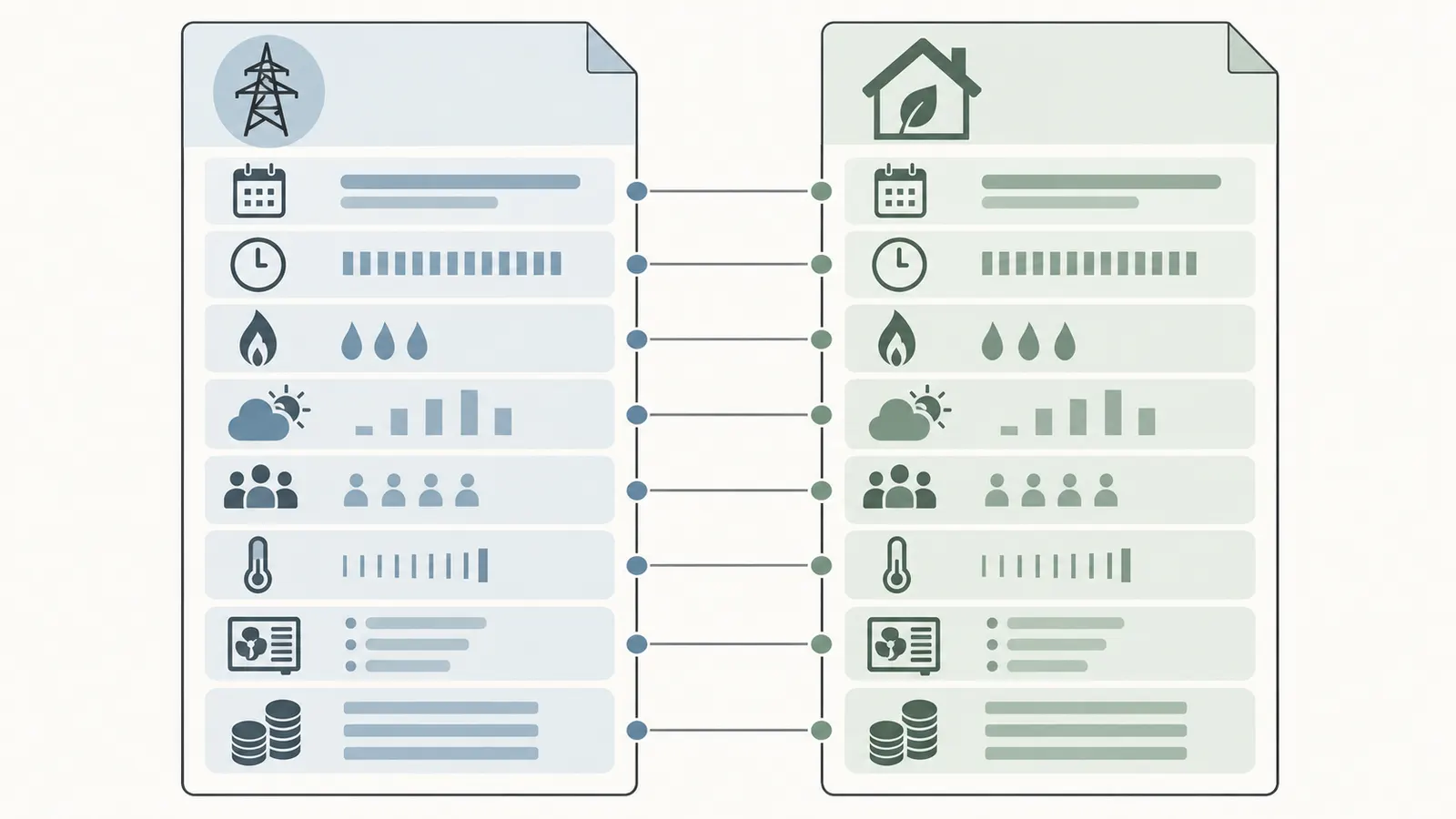
The distinction matters because an energy model and a utility bill answer different questions. A bill is a record of what a meter or utility billing system attributed to an account during stated dates, expressed in a unit and price structure selected by that utility. A model is a calculation made from assumptions about a building, its equipment, its controls, its occupants, schedules, and weather. DOE describes whole-building energy modeling as physics-based simulation that can include geometry, construction materials, HVAC, water heating, renewable systems, efficiencies, controls, occupancy schedules, plug loads, thermostat settings, and local weather. DOE’s building-energy-modeling explanation is therefore a reason to request the model inputs before arguing about its output.
The phrase “higher than the energy model” can also hide three different comparisons:
- The dollar charge is higher than an estimate, even though the physical energy use is close.
- The physical use in kWh, therms, gallons of propane, or another unit is higher than the model output, even though the rate or fixed charges changed.
- The model’s annual or rated result is being compared with one short, unusually hot, cold, humid, vacant, occupied, or partially settled billing period.
Treat those as separate investigations. If kWh are close but dollars are high, ask about the actual rate schedule, supply charges, delivery charges, taxes, minimum charges, demand charges, time-of-use periods, budget-billing reconciliation, and any service-transfer or deposit line. Those details belong to the utility serving the address and the tariff or terms applicable in that service territory, not to a national rule. If kWh or therms are high while the rate is expected, ask what changed in weather, occupancy, equipment mode, hot-water use, ventilation, appliances, controls, or the home's physical performance.
The model is not a promise of a monthly bill
DOE explains that modeling can be used to assess inherent performance while controlling for specific use and operation. That use is important: a rating can compare an asset under defined assumptions rather than predict the exact bill produced by an individual household. DOE’s description of inherent-performance ratings supports using the model as a structured baseline while asking which operation was controlled or assumed.
Certification does not make the distinction disappear. EPA says an ENERGY STAR certified single-family new home must meet strict requirements from its Residential New Construction program. EPA’s Single-Family Program Requirements page supports treating certification as evidence of compliance with a particular program, not as a universal national bill guarantee. The same page says mandatory requirements are verified in the field by a third-party rater credentialed by an EPA-recognized Home Certification Organization. For the program-specific version, location, and permit-date rule, use EPA’s Applicable Program Requirements, Versions, and Revisions by Location PDF, not the overview page. That PDF defines the program’s permit date as the date the permit authorizing building construction was issued, with stated alternatives for a rater’s first site visit or the home contract, and says the permit application date is not allowed. Read the applicable program document before assuming that a label means a particular version, climate treatment, or field checklist applied to your home.
DOE makes the same program-boundary point for its Efficient New Homes program: its training says the performance threshold is demonstrated through energy modeling and compliance is verified with third-party rater checklists, while the applicable requirements depend on building type, permit date, and location. Read the DOE Efficient New Homes training transcript before treating a program record as a general U.S. construction rule.
The practical opening question is not “Is the model wrong?” It is:
What exactly was modeled, what exactly was billed, and which inputs changed between those two records?
That question keeps you from making three expensive errors: blaming the builder for a rate change, blaming the household for a meter-account problem, or buying replacement equipment before anyone has shown a failed component. It also gives every later professional the same starting point.
For the wider ownership sequence, keep this record with the Brictale blog and use Brictale’s research and review method when you need to understand how a source-backed decision page handles scope and limits.
Safety boundary before data collection
You can safely collect bills, screenshots, manuals, model reports, thermostat history, visible display readings, dates, and photographs from a dry, accessible location. Do not remove electrical covers, open a gas appliance, alter a disconnect, bypass a control, handle refrigerant, climb into an attic or crawlspace to inspect ducts, or operate equipment with a warning label as an experiment. Do not use a utility-bill anomaly as a reason to enter a confined space or touch live equipment.
Do not test, open, release, or alter any pressurized gas, refrigerant, hydronic, plumbing, or duct system, and do not try to diagnose static pressure, blower-door results, combustion or venting, refrigerant charge, hydronic pressure, plumbing pressure, or duct pressure remotely from a bill, photograph, sound, or runtime graph. Those systems and measurements require a qualified professional working within the licensing, permitting, safety, and other requirements of the actual state or local jurisdiction. Your safe role is to record visible information and ask for a defined professional scope; do not create a pressure reading, open a system, release a substance, or change a valve, damper, fitting, control, or connection to make the bill comparison easier.
If you smell gas, hear hissing, see smoke, notice a burning-electrical odor, receive a carbon-monoxide alarm, see sparking or overheating, lose required heat during hazardous cold, or have water contacting electrical equipment, leave the unsafe area and use the emergency procedure for the utility, fire department, equipment provider, or local emergency service in the actual jurisdiction. This guide is for evidence management after occupancy; it does not replace emergency response.
A remote bill-and-model comparison cannot diagnose indoor-air contamination or combustion products, including carbon monoxide, mold, radon, or particulates, and the worksheet cannot identify or remediate those conditions. If a carbon-monoxide or smoke alarm sounds, anyone has acute symptoms, or there is an immediate combustion or air-quality concern, leave the area and contact the appropriate emergency service or utility from a safe location; do not re-enter until the responsible emergency or qualified professional says it is safe. For a suspected mold, radon, particulate, or other indoor-air issue without an immediate emergency, stop treating the worksheet as a diagnostic, avoid disturbing the suspected source, and arrange qualified testing through the actual state or local jurisdiction or its public-health guidance.
Your next decision after this chapter is simple: if the comparison is not yet like-for-like, open the worksheet and gather the missing fields. If it is comparable, proceed to calculate the size and pattern of the gap.
Build a comparable three-cycle record before escalating #
Use three billing cycles as a documentation minimum before making a non-emergency performance conclusion, unless the bill reveals an immediate account, meter, equipment, health, or safety problem. Three cycles do not prove a building defect; they make the pattern less dependent on one partial move-in month. Each cycle should have the utility’s stated start and end dates, days billed, read type, physical energy units, charges, weather context, occupants, thermostat operation, major equipment status, and the matching model output or model assumptions.
Original contribution: Three-cycle performance-gap worksheet and routing matrix
The Three-cycle performance-gap worksheet and routing matrix is Brictale’s original contribution for this decision. It is a reusable record for turning three billing cycles into a handoff rather than a vague complaint. The worksheet is designed to sit beside the bills and the model report. It does not ask you to estimate what you cannot observe; it gives unknowns their own place so that the next professional knows what is missing.
Method: For each cycle, copy the utility's stated dates, read type, kWh or therms, and charges; record occupants, thermostat settings, equipment status, and heating or cooling degree days; compare actual use with the model output for the same unit and period; calculate the absolute and percentage gap; then use the evidence pattern to select the next handoff.
Limitations: The worksheet is an illustrative screening and documentation method, not a calibrated building simulation, meter test, energy audit, code determination, warranty interpretation, or proof of a construction defect. Weather, tariff, model, and occupancy inputs must be verified for the actual home and jurisdiction.
The method deliberately combines two kinds of records. The first is a utility record: what the account was billed for. The second is a context record: why that period may differ from a model assumption. DOE’s Building America analysis spreadsheets are an example of why context belongs in the comparison: DOE describes standard operating conditions with hourly and monthly profiles for occupancy, lighting, appliances, and miscellaneous electric loads used to compare energy use against a benchmark new-construction building. DOE’s Building America analysis resource does not tell you what your household did; it shows why an operating profile is an input to a comparison rather than a footnote.
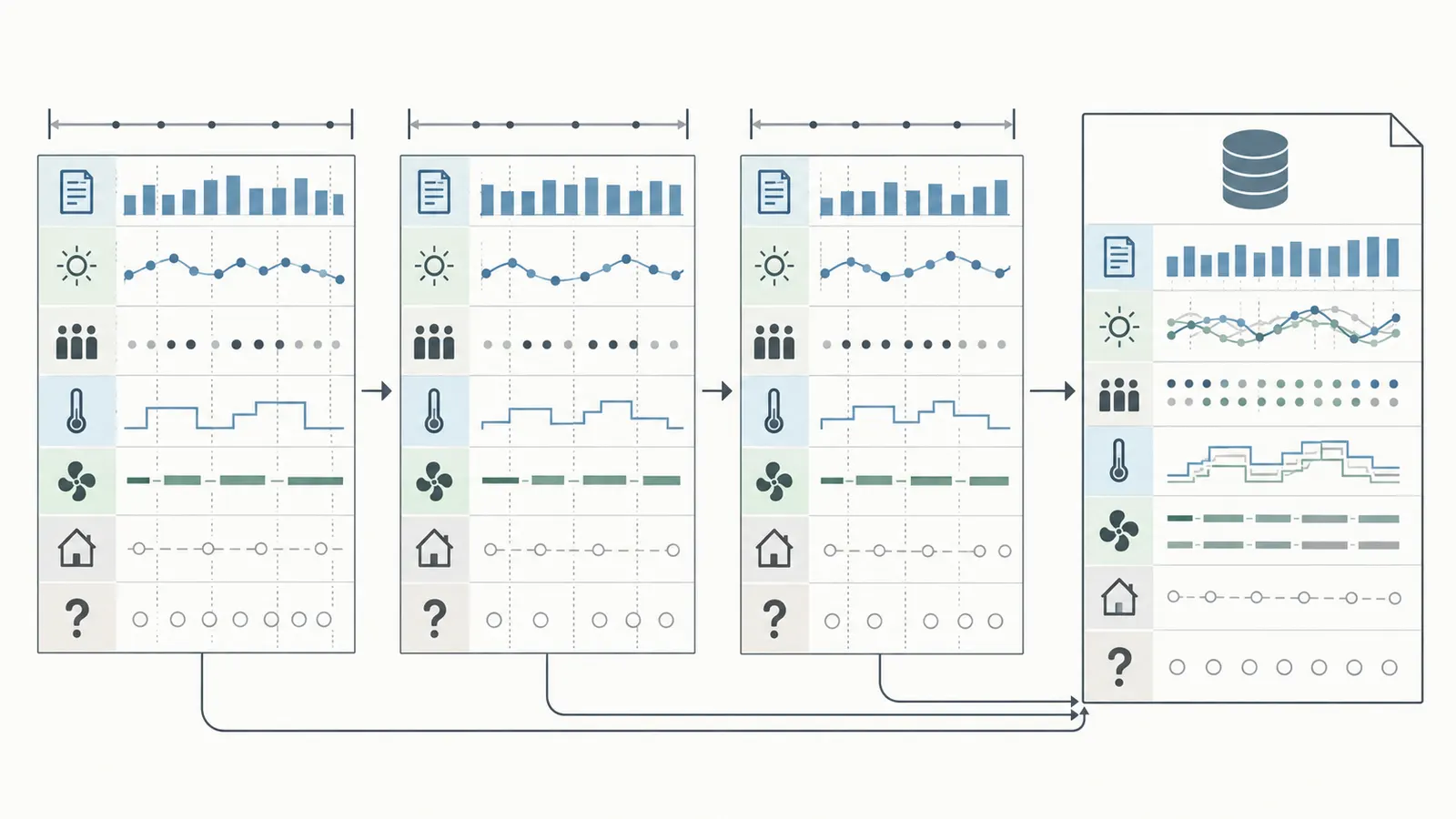
Complete one row per utility or fuel stream. If the home uses electricity and natural gas, do not combine them into a single number until you have preserved each stream separately. For electricity, record kWh. For natural gas, record the unit printed by the bill—therms, Ccf, Mcf, or another unit—and record any conversion or heat-content line the utility provides. EIA defines a kilowatthour as one kilowatt used for one hour and lists one therm as 100,000 Btu; it also lists 1 kWh as 3,412 Btu for comparison. EIA’s energy-unit definitions support consistent units, but the bill’s own conversion and local gas heat content control the account-level interpretation.
Fields to copy, not paraphrase
For each cycle, record:
| Field | What to enter | Why it matters | Who can verify it |
|---|---|---|---|
| Service address and account | Exact service address, account identifier, meter identifier if shown | Prevents a move-in transfer or neighboring meter record from being attached to the wrong home | Utility |
| Period | Start date, end date, number of days, bill issue date | A model month and a meter-read period may not cover the same days | Utility and modeler |
| Read type | Actual, estimated, customer-entered, remote, final, opening, or the utility’s exact label | A charge can be wrong even when the home's physical use was normal if the account record is wrong | Utility |
| Physical use | kWh, therms, Ccf, gallons, or other billed unit | Separates energy use from prices, fees, and taxes | Utility |
| Charges | Supply, delivery, fixed, demand, taxes, riders, credits, and total | Separates rate or account effects from physical use | Utility tariff and bill |
| Weather | Heating degree days, cooling degree days, unusual heat or cold, humidity, storm, smoke, or outage | Makes weather exposure visible for the actual billing days | NWS or another named weather record |
| Occupancy | Number of people sleeping there, work-from-home changes, guests, vacancy days, move-in dates | A model's household schedule may not match the first months of living there | Homeowner and modeler |
| Operation | Thermostat setpoints and schedule, fan mode, ventilation mode, windows open, setbacks, vacation mode | Controls and schedules can change use without a construction change | Homeowner and installer |
| Equipment | Installed model and status, error codes, filter change, defrost or backup mode, water-heater settings, EV or space-heater use | Finds a mode or accessory that the model may not include | Homeowner, installer, builder |
| Model basis | Model version, output unit, period, climate location, occupancy, schedules, rates, and exclusions | Makes it possible to compare the right output | Builder, rater, modeler |
Do not “correct” the utility’s dates to calendar months. NOAA’s National Weather Service explains that degree-day comparisons should account for the actual utility usage period because the meter may not be read on the first day of the month. Read the NWS degree-day explanation. Preserve the utility dates, then obtain weather data for those dates or use the utility’s weather-normalization record if it provides one.
What counts as comparable
Two periods are more comparable when they have the same energy stream, similar number of billed days, similar heating or cooling exposure, similar occupancy, similar thermostat policy, and the same operating equipment. “January versus January” is not enough. A 29-day bill and a 38-day bill are different exposures. A first bill covering construction drying, punch-list dehumidification, temporary electric heat, or a half-occupied month is not the same as a settled household cycle. A bill with a large credit or rate adjustment is not the same as a usage comparison.
Use the following comparability test for each pair of cycles:
- Did the bills cover the same service address and the same fuel stream?
- Were the opening and closing reads identified as actual or estimated?
- Were the billed days within a reasonable range, or have you normalized the display to daily use while retaining the original total?
- Was the home occupied for most of both periods, and by a similar number of people?
- Was the home conditioned with the same primary equipment, without an unusual portable heater, dehumidifier, EV charge, temporary construction load, or generator transfer?
- Did the periods have a similar heating or cooling burden, or have you recorded the degree days and treated the difference as a sensitivity rather than a conclusion?
- Is the model result for the same period and energy basis, or are you comparing a monthly bill with an annual rating?
If the answer to several questions is “unknown,” mark the cycle as “context incomplete.” Do not discard it; incomplete context is itself a handoff question. The worksheet should show that you did not silently turn a partial month into a model failure.
When three cycles are not the right waiting period
Do not wait for three cycles when the account appears to be attached to the wrong meter, the utility identifies a billing error, a meter or service line is damaged, a heat pump is locked out, a furnace is not venting safely, a water leak is causing continuous pumping or heating, or a builder or warranty notice deadline is approaching. In those cases, send a preliminary written notice with the first bill, the date you noticed the issue, the observed risk, and a statement that additional cycles are being collected.
The three-cycle method is a comparison discipline, not permission to let a known problem run. If an equipment manual requires a filter check or a visible user reset, follow only the manual’s homeowner instructions. If a reset could conceal a fault, erase a code, expose you to electricity or combustion, or change a warranty record, photograph the display and contact the responsible professional instead.
Your next decision after this chapter is whether the record is complete enough to calculate the gap. If yes, calculate physical use and cost separately. If no, request the missing bill, model, or equipment document from the person who controls it.
Calculate actual use against the model without creating false precision #
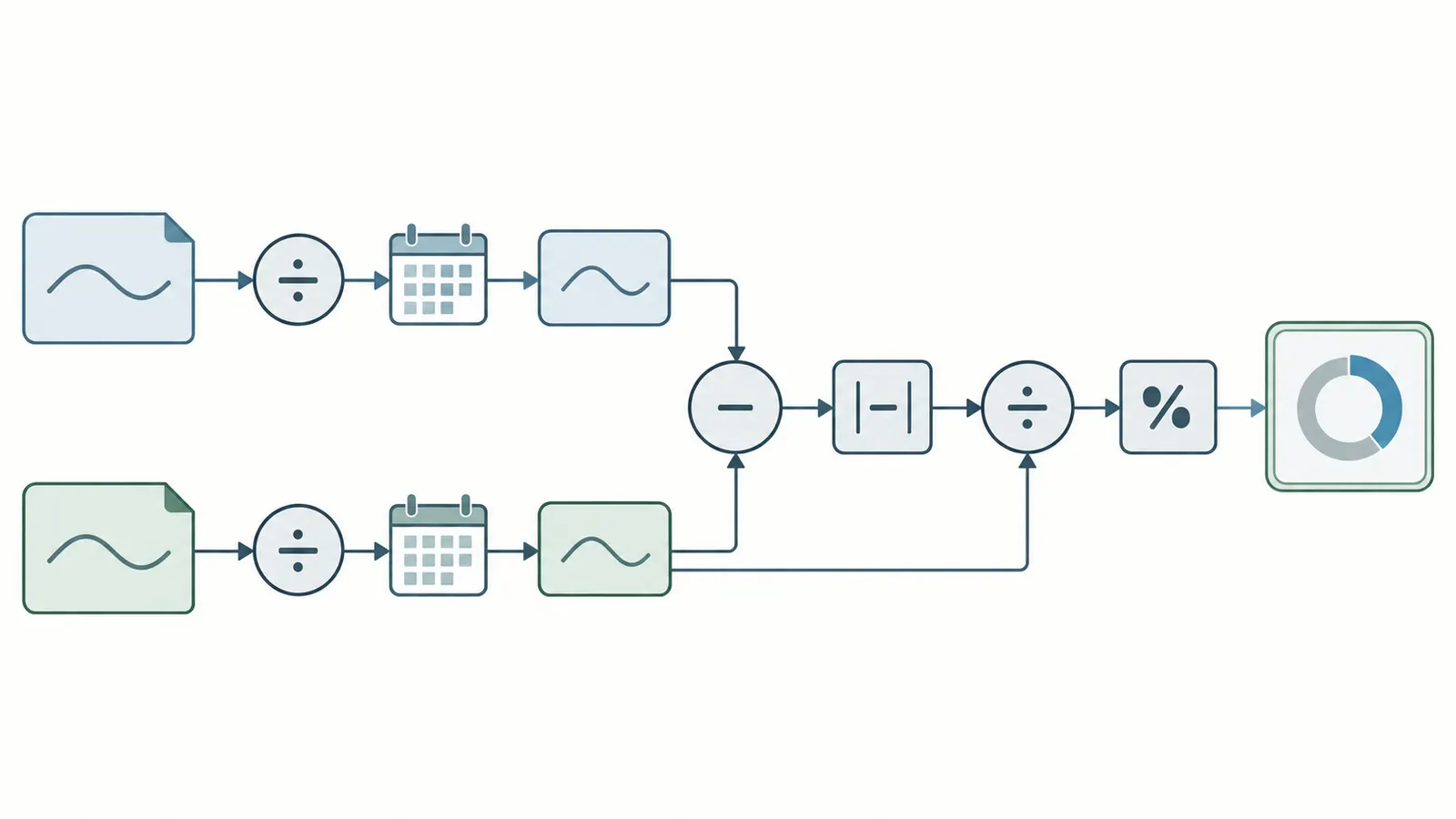
Calculate the gap only after you have put actual billed use and modeled use into the same energy stream, unit, period, and operating basis. Report the absolute difference and percentage difference, but label the result as a screening comparison. A percentage such as 31% is not proof of a 31% construction shortfall when the denominator, weather, occupancy, or model basis is uncertain.
The worksheet formulas
Use these formulas as a transparent record. They are arithmetic, not a claim that energy use is perfectly linear.
Daily billed use
daily use = billed use for the period ÷ utility-stated billed days
Example: if the bill says 1,020 kWh over 34 days, daily use is 1,020 kWh ÷ 34 days = 30 kWh/day. Keep 1,020 kWh as the official period total; the daily number is only a display aid.
Absolute model gap
absolute gap = actual use − modeled use
Example: if the model output for the same 34-day comparison is 780 kWh, the absolute gap is 1,020 − 780 = 240 kWh.
Percentage model gap
percentage gap = (actual use − modeled use) ÷ modeled use × 100
Example: (1,020 − 780) ÷ 780 × 100 = 30.8%, rounded to one decimal place. Label this “illustrative screening gap,” not “30.8% efficiency failure.”
Cost-to-use distinction
average billed energy price = variable energy charges ÷ billed physical use
Do not divide the entire bill by kWh and call that the energy rate if the total includes fixed charges, taxes, delivery charges, demand components, or a credit. Use the bill’s own labels. A high total with ordinary kWh can be a tariff or account question; high kWh with ordinary price can be an energy-use question; both can occur at once.
Worked example: illustrative, not a prediction
The following numbers are a modeled example created to show the method. They are not a forecast for a real home, a regional benchmark, a measured result, or evidence of a defect.
Assume a new all-electric home has a model report that gives monthly electricity outputs for the same service location and an initial two-person occupancy schedule. The homeowner enters three complete bills after moving in:
| Cycle | Utility dates | Days | Actual kWh | Matching model kWh | Absolute gap | Percentage gap |
|---|---|---|---|---|---|---|
| 1 | Jan 4–Feb 6 | 34 | 1,020 | 780 | 240 | 30.8% |
| 2 | Feb 7–Mar 7 | 29 | 860 | 720 | 140 | 19.4% |
| 3 | Mar 8–Apr 5 | 29 | 690 | 650 | 40 | 6.2% |
The arithmetic suggests the gap is shrinking as the weather and operation change, but it does not identify why. The homeowner should add the weather record, thermostat behavior, occupancy, equipment mode, and any temporary loads before escalating. A shrinking gap could reflect milder weather, settled operation, fewer move-in loads, or a model that happened to be closer in the third period. It is a pattern worth investigating, not a verdict.
Now calculate the three-cycle totals: actual use is 1,020 + 860 + 690 = 2,570 kWh; model use is 780 + 720 + 650 = 2,150 kWh; total absolute gap is 420 kWh; and the aggregate screening gap is 420 ÷ 2,150 × 100 = 19.5%. The aggregate is not the average of the three percentages because the periods have different modeled denominators. Record both the row values and the aggregate formula so another person can reproduce it.
Sensitivity: change one input at a time
The point of sensitivity is to show how much of the apparent gap depends on an input. It is not to choose the input that gives the answer you want. Ask the builder, rater, or modeler for a rerun or a model export when the change is material. Do not edit an official certificate yourself.
Suppose the modeler supplies a second output for the same three periods with four occupants instead of two. The values below are illustrative model outputs, not measured occupant effects:
| Comparison basis | Modeled three-cycle total | Actual three-cycle total | Screening gap |
|---|---|---|---|
| Original two-person assumption | 2,150 kWh | 2,570 kWh | 19.5% |
| Illustrative four-person rerun | 2,360 kWh | 2,570 kWh | 8.9% |
The lesson is not that two extra people explain 210 kWh in every home. The lesson is that the denominator changed because the model input changed. Ask the modeler to identify which schedules, hot-water events, plug loads, ventilation assumptions, or temperature settings changed. The DOE Building America material describes standard profiles for occupancy, lighting, appliances, and miscellaneous electric loads; those are assumptions that must be named when a comparison depends on them. Review the DOE operating-profile resource.
Run the same sensitivity process for:
- actual billed days versus a calendar-month output;
- measured or reported heating degree days versus the model weather file;
- occupied versus vacant or partial-occupancy days;
- thermostat schedule and setpoints;
- backup-resistance, emergency-heat, auxiliary-heat, or strip-heat operation where the equipment supports it;
- water-heater mode and hot-water schedule;
- ventilation or dehumidification run time;
- temporary construction loads, portable heaters, dehumidifiers, fans, EV charging, or workshop equipment;
- model fuel and source/site energy basis;
- utility rate structure, if the apparent issue is dollars rather than units.
Write down the input, old value, new value, result, and who supplied the result. A sensitivity is useful only if another person can tell whether it is a documented model rerun, a homeowner observation, or a simple screening assumption.
Weather normalization without overclaiming
Heating and cooling degree days are useful because they put a rough weather-burden number next to a bill. NWS defines heating and cooling degree days from the difference between daily mean temperature and a 65°F baseline, then says the accumulated values can be used for tracking energy use. NWS explains HDD and CDD here. The same page cautions that non-weather loads such as lights and appliances remain, and that the bill's actual usage period matters.
For a simple screening record, calculate:
use per degree day = billed use ÷ relevant HDD or CDD
Use heating degree days for a heating-dominated period and cooling degree days for a cooling-dominated period. Do not divide a mixed-use bill by zero or by a combined number without explaining the choice. Do not use degree days to pretend that water heating, refrigeration, lighting, appliances, and plug loads vanish. In a mixed season, preserve the raw bill and ask for a model comparison using the actual weather file or a professional normalization method.
The homeowner’s useful conclusion may be modest: “Cycle 1 had 42% more cooling degree days than Cycle 2, so raw kWh are not comparable without weather context.” That is stronger than “the house used 42% too much energy,” because it distinguishes an observed weather difference from a causal claim.
Site energy, source energy, and cost are not interchangeable
An energy model may show site electricity, natural-gas therms, total source energy, energy-use intensity, annual cost, an energy rating index, or another program metric. A utility bill may show only one delivered fuel and its account charges. If you compare unlike metrics, the arithmetic can be correct and the conclusion still wrong.
Use EIA’s definitions to preserve the unit distinction: electricity is commonly billed in kWh, natural gas can be billed in therms or volume units, and conversions into Btu are a way to compare energy quantities rather than a way to recreate the utility’s bill. EIA’s unit page notes that natural-gas heat content can vary by context, so use the actual utility’s stated conversion when available.
If the model report does not state the unit, period, climate location, fuel, weather file, occupancy, or cost assumptions, do not manufacture a conversion. Ask for the model report, input file, rating report, or a written explanation from the responsible modeler. An energy professional can later decide whether calibrated modeling is warranted; the worksheet should not pretend to be that calibration.
Your next decision after this chapter is whether the gap survives a units-and-period check. If it does not, correct the comparison and monitor the next cycle. If it does, separate the possible causes before choosing a handoff.
Test weather, occupancy, and operation before blaming the home #
Treat weather, occupancy, schedules, and equipment mode as first-order explanations to verify, not excuses to dismiss a real defect. The correct sequence is to record them, compare them with model assumptions, and ask whether the gap persists after the known differences are accounted for. EIA lists climate, home characteristics, devices, operating time, and number of household members as factors that affect household energy use. EIA’s household-energy overview supports a broad context check, not a diagnosis of your particular home.
Occupancy changes after handover
Move-in is not a stable operating condition. A model may assume a defined number of occupants and schedules, while the first months include unpacking, guests, remote work, children home from school, late construction access, or a household that is still learning the controls. Record facts rather than judgments:
- number of people sleeping in the home during each cycle;
- days the home was vacant or only partly occupied;
- days someone worked or studied from home;
- guests and unusual gatherings;
- cooking frequency and laundry frequency if materially different from the model schedule;
- newly used appliances, freezer, workshop, aquarium, server, sauna, EV charger, or portable heater;
- hot-water demand changes, including long showers, filled tubs, or repeated commissioning flushes;
- doors or windows left open while adjusting comfort or completing work.
Do not try to convert these observations into universal kWh multipliers. Record them so the modeler can decide whether the original schedule is still representative. EPA’s Yardstick asks for number of full-time occupants along with ZIP code, square footage, and fuels, which is a useful reminder that occupancy belongs in the comparison inputs. See EPA’s Yardstick input list.
Thermostat and ventilation records
Record the thermostat setting and schedule for each day or representative week, including heating and cooling setpoints, fan mode, hold or override periods, vacation settings, and whether separate zones were operated differently. If the system has an app, export or screenshot the relevant history rather than relying on memory. Preserve the unit shown: a thermostat percentage, runtime, compressor hours, auxiliary-heat hours, or temperature history are not interchangeable.
For ventilation, record the user-selected mode and any visible runtime or boost mode. A balanced ventilation system, exhaust-only fan, whole-home dehumidifier, or integrated control may add electric load while addressing indoor-air requirements. Do not disable required ventilation to reduce a bill without understanding the design, the equipment manual, and any applicable certification or local requirement. If indoor air becomes damp, stale, smoky, or uncomfortable, treat that as a separate performance and health question rather than optimizing one bill line.
For heat pumps, document only what the homeowner interface safely displays: operating mode, setpoint, backup or auxiliary indicator, error code, filter reminder, and whether the outdoor unit appears to be running when appropriate. Do not infer refrigerant charge, airflow, capacity, defrost correctness, duct leakage, or electrical condition from a runtime graph. Those require trained testing with the right instruments and boundaries.
Equipment modes that can distort the first cycles
High early use can be real and temporary. A new home may have residual construction moisture, temporary drying, commissioning, or a control mode that was not used in the model. Possible context flags include:
| Observation | What it may explain | What it does not prove | Safer next action |
|---|---|---|---|
| Portable heater, dehumidifier, or fan was used | Additional electric load during move-in or drying | That the home envelope or HVAC is defective | Record dates and wattage label; stop only if safe and appropriate; tell builder |
| Auxiliary or emergency heat indicator appears | A heat pump may be using a different operating mode | That the backup system is faulty or that the model omitted it | Save the history and have the installer explain the control sequence |
| Water-heater mode or temperature was changed | Hot-water energy may differ from model assumptions | That the water heater is inefficient or incorrectly installed | Record setting and manual; request installer confirmation |
| Filter alarm or airflow complaint | Restricted airflow can change comfort and runtime | That the filter, duct, or blower is the cause | Follow the user manual; ask HVAC professional for measured diagnosis |
| Ventilation boost ran often | Ventilation or moisture control load may be higher | That ventilation should be disabled | Ask the designer or installer to check settings and commissioning |
| EV, workshop, freezer, or server began operation | Non-HVAC base load increased | That the new home used too much for its design | Record the load and compare the model’s plug-load assumptions |
This table is a routing aid, not a failure diagnosis. One observation can have several causes. An auxiliary-heat icon can reflect weather, thermostat strategy, equipment sizing, sensor input, control settings, or a fault. A high water-heater load can reflect people, temperature, recirculation, leaks, distribution, or appliance use. Ask for measurements and the sequence of operation before accepting a replacement proposal.
Distinguish temporary loads from repeating loads
Mark each load as temporary, recurring, seasonal, or unknown. A temporary load that disappears in Cycle 2 should be preserved in the record but not used to justify permanent construction work. A recurring load that appears every cycle deserves a different handoff. A seasonal load may need a full heating or cooling season before the model comparison is meaningful, provided there is no immediate risk and no warranty notice deadline.
Use the base-load idea cautiously. A mild-weather month can help reveal lighting, appliances, refrigeration, electronics, ventilation, water heating, and other loads that do not track closely with outdoor temperature. NWS notes that these non-weather uses should be considered when comparing energy use, while also warning that a bill’s period may not match a calendar month. NWS’s degree-day guidance is the basis for using a temperate period as context, not for declaring a fixed “normal” baseload.
If the household’s baseload rose, do not ask the builder to repair an envelope until the added equipment is identified. If baseload is ordinary but heating or cooling use remains high after comparable weather and settings, the equipment or enclosure question becomes stronger. If both are high, split the investigation so one professional does not chase every system at once.
What a home-energy comparison can and cannot tell you
EPA says the Home Energy Yardstick uses actual energy use from the prior 12 months and adjusts for weather, home size, and occupants; it also says the tool is not a replacement for a professional audit when the goal is to identify root causes or uncomfortable spaces. Read EPA’s Yardstick method and limitation. That boundary applies to this worksheet too. A comparison can tell you that a pattern is worth investigating. It cannot tell you which assembly, duct, control, meter, or occupant practice caused it without appropriate verification.
Do not use a neighboring home’s bill as a defect baseline. A nearby home may have a different service rate, shape, insulation, equipment, occupants, thermostat policy, solar production, fuel mix, water-heating demand, or billing period. A national average is even less useful for a specific handoff. A comparison is most useful when it changes one known variable at a time and keeps the raw records visible.
Your next decision after this chapter is whether context explains the gap sufficiently to monitor, or whether the pattern remains after accounting for known differences. If the remaining uncertainty is the utility record, contact the utility. If it is equipment operation, contact the installer. If it is the home, model, or warranty scope, contact the builder or rater with the same worksheet.
Verify the utility account, meter data, and price before alleging a building problem #
Ask the serving utility to verify the account, meter identity, read type, billed dates, physical use, tariff, and adjustments before assigning a construction cause. A utility can resolve an account or data problem that no builder can fix, while a builder cannot correct a rate change or a meter-to-account mismatch. Because utility practice and consumer protections vary by state, commission, municipality, cooperative, and service territory, use the actual utility’s published tariff and dispute process rather than a generic national rule.
Make the utility handoff specific
Do not send “my new house uses too much energy.” Send a short request with a precise question set:
- Confirm the service address, account number, meter number, service start date, and whether the opening read was transferred from a prior account.
- Confirm the billing-period start and end dates and number of days for each affected bill.
- State whether the opening and closing reads were actual, estimated, remote, customer-entered, or another named status.
- Confirm the physical usage quantity in the billed unit and whether a correction, rebill, prior-balance transfer, deposit, credit, or estimated-read catch-up is included.
- Provide the rate or tariff name and ask which supply, delivery, fixed, demand, tax, rider, or time-of-use line created the charge.
- Ask whether the account is assigned to the correct meter and whether the meter data show an unusual continuous pattern, if the utility offers that information.
- Ask how to request a meter accuracy or billing investigation in that utility’s service territory, including any fee, access step, scheduling process, or appeal route stated by the utility.
Attach the affected bills and your worksheet row, but redact payment details that are not needed. Ask for a written response or a case number. Note the representative, date, exact answer, promised follow-up, and next escalation channel. If the utility says the account record is correct, record that as evidence about the account—not as proof that the building is correct.
Actual versus estimated reads
An estimated read is not automatically an error, and an actual read is not automatically proof that the meter or account is correct. Treat the read type as a branch in the investigation. A closing estimated read can distort one bill and reverse on the next; a move-in transfer can combine dates or balances; a final read can be charged under a different account process. The utility’s record is the authoritative place to ask what happened and how it will be corrected.
Do not conduct an informal meter test by turning off the main breaker, opening a meter enclosure, disconnecting equipment, or touching utility-owned hardware. The boundary between homeowner equipment and utility equipment varies by location and service arrangement. Request the utility’s approved procedure. If the utility requires a licensed electrician, meter technician, or inspection, follow the actual service-territory instruction.
Price, physical use, and bill shock
Build a two-line summary for every bill:
| Question | Use this value | Do not substitute |
|---|---|---|
| How much energy was attributed to the home? | Physical kWh, therms, Ccf, gallons, or utility-stated unit | Dollar total |
| How much did that use cost? | Variable energy charges plus separately labeled fixed, delivery, demand, taxes, credits, and adjustments | A national average rate |
For electricity, EIA says utilities generally measure use in kWh, with one kWh representing one kilowatt used for one hour. EIA’s electricity measurement page supports preserving kWh as the physical-use field. For natural gas, preserve the bill’s therm or volume unit, then record the utility’s stated heat-content conversion. Do not convert kWh and therms into one number simply to make the spreadsheet look tidy.
If the utility’s physical-use record is normal but the total is high, your next decision is a tariff/account review. If physical use is high but the tariff is expected, keep the utility response in the packet and route the remaining question to operation, installer, builder, or assessor. If both are uncertain, resolve the utility record first so other parties are not diagnosing a distorted input.
When a meter investigation should not wait
Escalate promptly if the bill is many times larger than the observed use, the meter identifier does not match the service record, the bill shows overlapping or impossible dates, the account includes another address, a continuous-use graph is inconsistent with occupancy, or a utility representative identifies a read or account anomaly. Also escalate before a warranty deadline if the unusually high bill could support a claim and the utility needs time to investigate.
Keep the original bill even after a corrected bill arrives. Store the correction, case number, utility explanation, and date. The builder or warranty administrator may need the original record to understand what triggered the request. A corrected bill does not erase a recurring equipment or enclosure problem; it simply removes one branch from the causal tree.
Your next decision after this chapter is whether the utility has verified the account and physical-use record. If yes, use the verified data for the equipment and building handoff. If no, keep the utility case open and tell the builder or installer that the comparison remains provisional.
Separate controls, equipment, enclosure, and model causes #
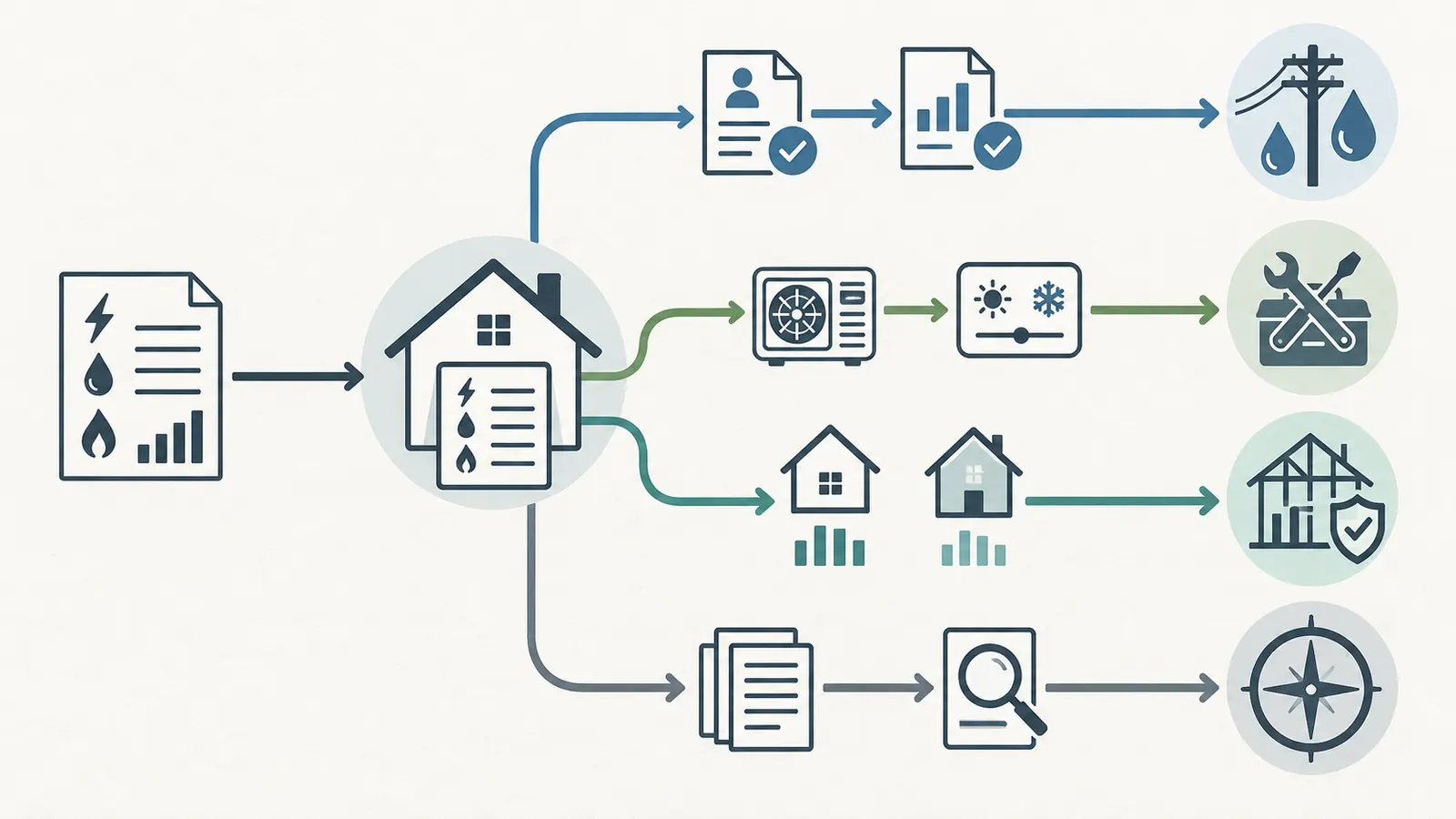
After the utility record is verified, route the remaining gap by the evidence it requires: homeowner operation, installer equipment performance, builder or rater documentation, or an independent professional assessment. Do not ask one party to certify a question outside that party’s scope. A builder may need the installer’s measurements; an installer may need the model’s design load; an independent assessor may need the utility’s verified dates and units.
The routing matrix
Use the first route that matches the strongest verified pattern. The categories overlap; the matrix is meant to order the work, not to label the defect remotely.
| Verified pattern after three cycles | Lead question | First responsible handoff | Evidence to send | Verification to request |
|---|---|---|---|---|
| Dollar gap, normal physical use | Is the tariff, rate, adjustment, or account charge different from the estimate? | Utility | Bills, tariff name, service dates, model cost assumptions | Written account and charge explanation |
| Physical use changes with weather and settings, then approaches model | Did the original model assume different weather, occupancy, schedules, or equipment mode? | Builder, rater, or modeler | Worksheet, model report, weather, thermostat and occupancy log | Written comparison of assumptions and a documented model rerun if appropriate |
| High use persists with comparable weather and stated operation | Is there a control, commissioning, equipment, distribution, or enclosure issue? | Builder and relevant installer | Three cycles, equipment labels, visible codes, commissioning/startup records, model inputs | Scope-specific measurements and findings, not a generic “working” statement |
| High use is concentrated in one equipment mode or end use | Is that mode expected, enabled by control logic, or caused by a fault? | Equipment installer or manufacturer channel | Runtime/history, setpoints, error codes, mode dates, manual | Diagnosis under the installed equipment’s manual and local licensing rules |
| High use occurs while the home is vacant or base load is otherwise unexplained | Is a device, circuit, water-heating, ventilation, or other continuous load operating? | Utility first, then qualified electrician/HVAC/plumbing professional as applicable | Daily use, visible equipment status, safe observations, no live-panel work | Approved load investigation and safe measurement |
| Model inputs or certification records are incomplete | What was actually promised, modeled, certified, or verified? | Builder, rater, certification organization, or warranty administrator | Contract, model, certificate, field checklist, plans, equipment schedule | Written document release or explanation of the record gap |
| Utility and responsible parties disagree after documented requests | What independent scope can resolve the factual disagreement? | Independent energy professional or applicable dispute process | Complete packet and written responses | Defined measurement, report, limitations, and handoff path |
The first row is not a judgment that the utility is wrong. It is a reminder that price is a separate variable. The last row is not a demand for litigation or an automatic paid audit. It is a point at which another round of informal guesses is less useful than a defined independent scope.
Ask the installer a question it can actually answer
An installer can usually address the equipment it installed and the controls it commissioned, subject to its contract, license, manufacturer requirements, and local rules. Ask for a visit or written review that names the actual equipment and measurements. A useful request could ask the installer to identify:
- installed model numbers, serial numbers, rated capacities, fuel, and control type;
- the intended operating sequence, including backup, auxiliary, defrost, lockout, staging, and setback behavior where applicable;
- startup or commissioning records and any design data used at installation;
- measured airflow, temperature split, static pressure, electrical readings, combustion or venting checks, refrigerant-side checks, or other tests that are appropriate to the equipment and technician’s qualifications;
- filter, duct, sensor, thermostat, water-heater, ventilation, or control findings;
- the exact error code or condition observed and how it was verified;
- whether the equipment is operating within the manufacturer’s published requirements and what was not tested.
Do not demand a measurement that the equipment or system does not support, and do not accept a generic statement that “the unit turns on” as a full energy-performance diagnosis. A unit can operate and still have a control, airflow, distribution, sizing, setpoint, or enclosure interaction that requires a wider scope. Conversely, a model-versus-bill gap can persist with fully functioning equipment because the modeled occupancy or weather differs.
Ask the builder or warranty administrator about the home as delivered
The builder or warranty administrator is the right first handoff for a possible mismatch between the delivered home, its documented design, and the warranty process, subject to the signed contract and actual jurisdiction. Send a written notice before the applicable deadline even if the cause is not yet proven. FTC guidance says new-home warranty coverage and duration vary by component, recommends checking the specific warranty, and recommends putting a covered repair request in writing while keeping correspondence and conversation records. Read the FTC’s new-home warranty guidance.
Ask for the records that define the model and handover:
- the energy model report, version, software, climate location, weather file or weather basis, and output unit;
- occupancy, thermostat, hot-water, ventilation, appliance, lighting, plug-load, and renewable-system assumptions;
- design drawings, as-built changes, equipment schedules, insulation and window specifications, and any certified pathway;
- certification name, applicable version, permit or project dates, rater or verifier identity, and field checklists where the program releases them to the owner;
- HVAC design or sizing documentation, duct or air-handler location information, commissioning/startup reports, and controls documentation;
- serial numbers, manuals, warranties, service contacts, maintenance requirements, and the process for opening a warranty claim;
- the builder’s written response to the three-cycle worksheet, including which evidence it accepts, which it disputes, and what inspection or test it proposes.
Do not describe a certification as a warranty unless the contract says so. EPA’s program page explains the certification requirements and third-party rater role, while the FTC explains builder-warranty coverage and claim records; those are different documents with different scopes. Compare the EPA certification process with the FTC warranty guidance rather than treating either as a substitute for the signed project documents.
Possible enclosure and distribution causes
If the verified utility use remains high, the homeowner can report symptoms without attempting invasive inspection: uneven temperatures, drafts, unusual equipment run time, noise, condensation, persistent humidity, rooms that cannot reach setpoint, visible damage, missing access panels, or a ventilation alarm. Do not infer a hidden insulation, air-sealing, duct-leakage, thermal-bridge, or window-installation defect from one symptom. Several causes can produce the same bill pattern.
Ask the builder or independent professional to define the scope and method. A defensible scope might state whether it includes a visual enclosure review, accessible attic or crawlspace review, duct inspection, airflow or pressure measurements, blower-door testing, infrared imaging, ventilation verification, thermostat and control review, or model calibration. The exact sequence depends on climate, construction type, equipment, safety conditions, and the professional’s qualifications. A remote article cannot decide which test is valid for a particular home.
If an inspection requires attic, roof, crawlspace, electrical, combustion, refrigerant, or structural work, assign it to a qualified professional in the actual state or local jurisdiction. Ask how the person is credentialed, licensed, insured, or recognized for that work; the correct credential is jurisdiction- and scope-specific. The homeowner’s role is to preserve the symptom record and access information, not to enter hazardous areas or alter construction to make a test easier.
Independent energy professional: define the deliverable
Hire an independent energy professional only after asking what question the person will answer and what the report will not answer. EPA says the Yardstick is not a substitute for a professional audit when investigating root causes, which supports escalation when the comparison remains unresolved. EPA’s limitation on the Yardstick is not a mandate to hire a particular credential or company.
Ask the candidate to put these items in writing before work begins:
- the exact service address, weather period, utility data, and model records to be reviewed;
- whether the work is a bill analysis, energy audit, diagnostic test, calibrated model, commissioning review, enclosure investigation, or another defined scope;
- measurements proposed, instruments or data sources used, and whether equipment must be operated or accessed;
- how the person will separate homeowner operation, utility records, equipment performance, distribution, enclosure, and model assumptions;
- the report format, raw-data release, photographs or readings, uncertainty, limitations, and recommended next handoff;
- conflicts of interest, including whether the person also sells replacement equipment or repairs;
- the credential, license, certification, or local authorization relevant to the work in the actual jurisdiction.
Do not accept a report that hides the input data, uses a single unverified bill as a baseline, promises to prove a defect before testing, or recommends replacement without stating the failed condition and verification method. A lower-cost document with a narrower scope may be useful if it answers the right question. A broad inspection may be wasteful if the utility has not yet verified that the meter data belong to your account.
Your next decision after this chapter is a responsible-party handoff with a stated deliverable. The handoff is complete only when the recipient has the evidence, the requested question, the deadline, and a way to verify the response.
Make the handoff documented, time-bound, and verifiable #
Send one packet with one issue statement, one worksheet, and clearly separated requests to the utility, builder, installer, or independent professional. The goal is not to prove a conclusion in the first email; it is to make the next person capable of checking the conclusion without reconstructing the first three months from memory.
The packet order
Use this order unless the recipient asks for a different format:
- One-page decision summary. State the service address, move-in date, affected cycles, physical units, model units, aggregate gap, current safety status, and the decision you need from the recipient.
- Three-cycle worksheet. Include the full rows, formulas, weather notes, occupancy, thermostat operation, equipment status, and unknowns.
- Original utility records. Attach full bills, not only screenshots of the total. Include corrected bills and utility case numbers.
- Model and certification records. Attach the report, certificate, rater or verifier record, and written assumptions available to you. Mark missing items as missing.
- Equipment records. Add manuals, model and serial photographs from safe locations, visible codes, service invoices, startup or commissioning records, and warranty contacts.
- Timeline. List move-in, service activation, first bill, each observation, each call, each response, and each requested next action.
- Scope questions. Name what you want verified, what you are not asking the recipient to decide, and the date by which a warranty or program notice must be made.
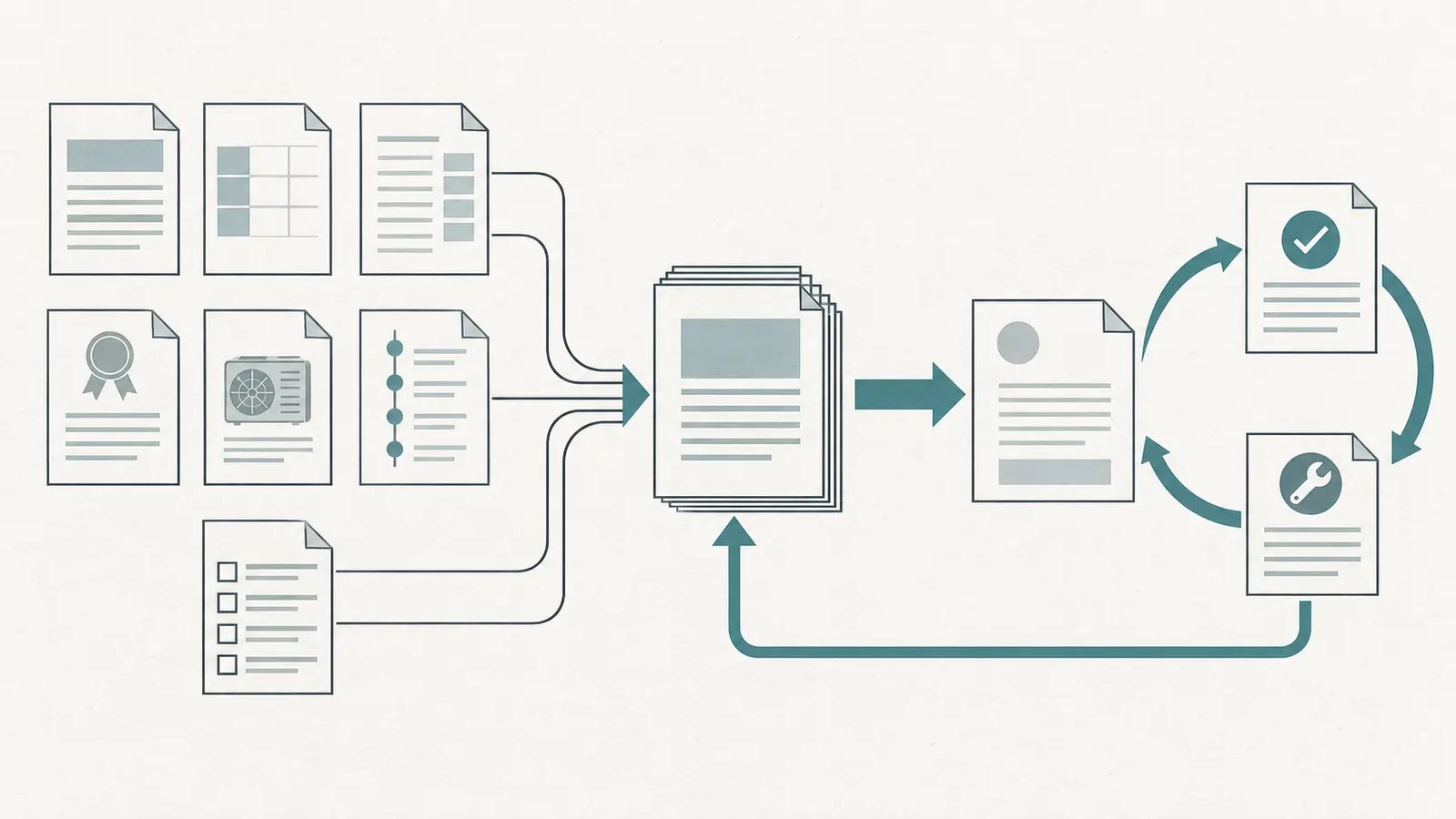
Keep the packet in a stable format and preserve the original files. If you revise the worksheet, do not overwrite the prior version; label it with the date and what changed. Do not edit a utility bill, certification report, or commissioning record. Add your notes in a separate column or document.
The written handoff template
Use plain facts and a bounded request:
I moved into [service address] on [date]. The attached utility records cover [dates] and show [units] across [days]. The corresponding model output I received is [units and period], based on [known occupancy, weather, thermostat, and equipment assumptions]. The attached worksheet shows an illustrative screening gap of [amount and percentage] and identifies [known differences or unknowns]. Please verify [specific question]. Please state the records or measurements used, what was not checked, the proposed next action, and the person responsible for that action. This request is being made under [named warranty, certification, service, or account process] and is not a claim that the cause has already been proven.
For the utility, replace “model output” with the account question if the main issue is a charge or meter record. For the installer, request equipment and control verification. For the builder, request model, delivered-condition, and warranty routing. For an assessor, request a defined independent scope. Do not send the same vague paragraph to everyone; a handoff fails when the recipient cannot tell what they own.
Verification questions after a response
Read the response against the worksheet. Ask:
- Did the recipient answer the exact question or provide only a general reassurance?
- Did the response use the same dates, units, and equipment identified in the packet?
- Did it distinguish observed data, modeled assumptions, and interpretation?
- Did it identify a responsible person and a date for the next action?
- Did it state what was not inspected or what remains uncertain?
- Does the proposed fix have a verification step after completion?
- Does the response preserve a warranty or service notice rather than closing it prematurely?
A good response may say “we need the actual closing read,” “the model used two occupants and no EV,” “the installer will measure airflow and auxiliary runtime,” or “the proposed test cannot be performed safely until access is corrected.” Those statements make uncertainty visible. A weak response says “new homes use more at first,” “the model is only an estimate,” or “the equipment is working” without connecting the statement to your dates, units, and evidence.
Verification after a repair, setting change, or correction
Do not close the issue when a setting is changed or a part is replaced. Record:
- what changed, by whom, on what date, and under what authorization;
- the old and new setting, model, serial, control mode, or component;
- what measurement or observation supported the change;
- what safety or warranty conditions were reviewed;
- which billing cycles will be compared afterward;
- what weather and occupancy similarity is needed for the comparison;
- who will review the next result and what outcome counts as unresolved.
If a repair is performed, request the work order and test record. If a model is rerun, request the changed inputs and outputs. If the utility corrects a bill, preserve both versions. If a professional says the home is operating as designed, ask “under which measured conditions, and what remains outside your scope?” A conclusion without its conditions is not portable to the next season.
Warranty windows and notice timing
FTC says new-home warranty coverage varies by component and duration, advises checking the specific warranty, and recommends written claims plus records of correspondence and conversations. FTC’s consumer guidance on new-home warranties is federal consumer guidance, not the terms of your contract or the law of your state. Name the actual warranty issuer, contract, state, and dispute procedure in your records.
If a deadline may be near, send a timely notice that preserves the issue without overstating the cause. Include the first available evidence and state that the worksheet and later cycles will supplement the record. Ask what form, portal, mailing address, inspection access, or notice language the signed warranty requires. Keep proof of delivery. Do not assume that a builder’s phone acknowledgement pauses a written deadline.
Some programs, manufacturers, lenders, or local agencies may have separate documentation requirements. Do not merge those requirements into one national rule. Ask the actual program or contract administrator what applies to the home’s location, permit date, certificate, equipment, and purchase documents.
Your next decision after this chapter is whether the issue is verified, still under observation, or escalated to an independent scope. Record that status and a date rather than leaving the packet open-ended.
Choose the next decision: monitor, correct, escalate, or close #
After three comparable cycles and the first handoffs, choose one of four explicit dispositions: monitor with a defined next review, correct an account or operating condition, escalate to the responsible builder or installer, or obtain an independent assessment. The decision should be based on verified evidence and the remaining uncertainty, not on how alarming the dollar total feels.
Monitor when the gap is explained and reversible
Monitoring is reasonable when the utility has verified the account, the difference is explained by documented weather, occupancy, temporary load, rate, or operating conditions, no hazard is present, and the next comparison is defined. Write the monitoring plan:
- the next billing-cycle dates;
- the physical unit and model output to compare;
- the weather metric or actual-weather basis;
- the occupancy and thermostat conditions you will record;
- the equipment mode or correction being observed;
- the person who will review the result;
- the trigger for reopening or escalating.
“We will see what happens” is not a monitoring plan. “We will compare the next two complete heating cycles after the installer confirms the control setting, using the utility’s actual read dates and the modeler’s same-period output, and reopen the builder notice if the unexplained gap persists” is a plan. It does not promise that the result will match the model; it states what decision comes next.
Correct when one known input caused the gap
Correct the input or account record when the utility, homeowner, or responsible professional identifies a documented cause and the correction is within that party’s scope. Examples include a corrected opening read, a utility rebill, an incorrectly entered model occupancy, a thermostat schedule that was not understood, a temporary heater removed after construction, or a documented control setting restored to the design intent.
Record the correction and repeat the comparison. Do not erase the high bill or original setting from the history. A correction is successful only if the intended effect is verified, the home remains safe and comfortable, and no other load increased to compensate. For example, lowering a thermostat setpoint may reduce one bill while creating discomfort or moisture; disabling ventilation may reduce electricity while creating an indoor-air problem. The verification must consider the home as a system.
Escalate when the gap persists under comparable conditions
Escalate to the builder or installer when three cycles show a persistent unexplained physical-use gap after the utility record, units, weather, occupancy, schedules, and equipment status have been documented. The word “persistent” is not a universal numerical threshold. It means the pattern survives the known explanations well enough to justify a scope-specific investigation under the project documents and warranty terms.
Ask for a written inspection plan, not a promise that someone will “take a look.” The plan should state which professional will inspect which system, which records will be used, what measurements will be taken, what safety limits apply, and how the result will be verified. If the proposed inspection cannot answer the question, say so before access or repairs begin.
Obtain independent assessment when the parties cannot resolve the record
An independent assessment is appropriate when the utility has verified its record, the builder or installer response is incomplete or disputed, the model or certification documents are unavailable, the warranty deadline requires a defensible notice, or the proposed repair is expensive and unsupported by a measured cause. Define the assessment before paying for it. The deliverable should identify inputs, measurements, assumptions, findings, limitations, and the next handoff.
Do not present an independent report as automatically controlling the builder, utility, warranty administrator, code official, court, or insurer. It is evidence for a decision. The actual contract, warranty, state law, local code, utility tariff, and certification program control their own procedures. If a dispute may become legal, ask an attorney licensed in the relevant jurisdiction about preservation, notice, inspection access, and admissibility; this guide does not provide legal advice.
Close only when the record has a durable conclusion
Close the issue when the utility record is corrected or confirmed, the responsible professional has answered the equipment or building question within a defined scope, the result is verified across an appropriate subsequent period, and the warranty or maintenance record contains the final documents. A closeout note should state:
| Closeout field | Example of a useful entry |
|---|---|
| Original symptom | Three post-move-in electric bills exceeded the model output |
| Evidence reviewed | Bills, meter-read status, model report, thermostat history, weather record, equipment work order |
| Cause status | Account correction confirmed / operating difference documented / equipment finding verified / unresolved |
| Action | Corrected opening read, changed documented control, repaired verified fault, or independent review completed |
| Verification | Subsequent cycles, measured test, corrected bill, or written program check |
| Limits | What was not inspected, modeled, or legally decided |
| Owner and date | Person responsible for maintenance or reopening, with review date |
If the issue remains unresolved, do not force a “closed” label. Mark it “open—next action assigned” and keep the packet with the home’s handover records. A future owner, builder representative, installer, or assessor should be able to understand what was observed, what was ruled out, and what still needs attention.
The compact decision rule
Use this final rule when the packet is complete:
- The bill is high but physical use is ordinary: ask the utility to explain the rate, account, or adjustment.
- Physical use is high but the model comparison is not like-for-like: fix the comparison and monitor the next comparable cycle.
- Physical use remains high after verified context, and one equipment mode dominates: ask the installer for scope-specific measurements.
- Physical use remains high across comparable cycles, with no documented operating or utility explanation: give the builder or warranty administrator written notice and request a defined investigation.
- The model, certification, utility response, or warranty response is incomplete or disputed: commission an independent assessment with explicit limits and preserve the applicable notice process.
- A safety symptom is present: stop observation and use the responsible emergency or qualified professional path for the actual jurisdiction.
The point of the worksheet is not to assign blame from a spreadsheet. It is to make the next decision visible, reversible where possible, and supported by records that another person can check.
Originality brief: what this page adds and how to check it
Current answers generally separate high-bill advice, energy ratings, new-home checklists, and builder-warranty guidance. The missing decision is how a homeowner moves from a surprising post-occupancy bill to the correct next handoff without mistaking a model estimate for a defect claim. The original contribution is the Three-cycle performance-gap worksheet and routing matrix, which joins utility dates and units to weather, occupancy, controls, model assumptions, calculations, and responsible-party routing. It can be checked by reproducing every worksheet formula from the attached bills, comparing each stated model input with the model report, checking the weather record against the utility dates, and confirming that each handoff asks only for a scope the recipient can verify. The evidence limits are stated in the worksheet itself; no firsthand measurements or interviews are claimed.
The article’s original worksheet has the same limitation as any remote screening tool: it cannot see hidden construction, measure live systems, inspect a meter, interpret a signed warranty, or prove that a model is calibrated. Its value is narrower and more practical. It keeps the bill, the model, the context, the responsible party, the requested verification, and the next handoff in one record so that a high bill becomes a manageable home-ownership decision rather than an argument based on one surprising number.
Three-Cycle New-Home Performance-Gap Worksheet
Record comparable utility cycles, weather, occupancy, model assumptions, calculations, handoffs, and verification limits in one reusable homeowner worksheet.
Download the worksheet (PDF)Cite this guide
Brictale. “How to Manage a New-Home Utility Bill That Exceeds the Energy Model.” Published 2026-09-26; updated 2026-09-26.
https://brictale.com/build/handover/manage-new-home-utility-bill-performance-gap-after-move-in · Read the Markdown version
Original contribution: Three-cycle performance-gap worksheet and routing matrix. A homeowner records three comparable billing cycles, operating context, weather, equipment status, and model assumptions, then routes the evidence to the utility, builder, installer, or independent energy professional.
Sources and scope
Evidence behind this page
- DOE describes whole-building energy modeling as physics-based simulation that uses building geometry, construction materials, lighting, HVAC, water heating, renewable systems, component efficiencies, control strategies, occupancy schedules, lighting schedules, plug loads, and thermostat settings, combined with local weather.
About Building Energy Modeling
U.S. Department of Energy overview of whole-building energy modeling; it describes model inputs and uses generally, not the correctness of a particular home's model or a warranty standard.
Accessed · Link to this claim - DOE says building energy modeling can assess a building's inherent performance while controlling for specific use and operation, and that inherent performance ratings underpin code compliance, green certification, and incentives.
About Building Energy Modeling
DOE description of a modeling use case; this does not mean a certification score is a guarantee of a homeowner's bill under different operation, weather, rates, or occupancy.
Accessed · Link to this claim - DOE Building America analysis spreadsheets provide standard operating conditions, including hourly and monthly profiles for occupancy, lighting, appliances, and miscellaneous electric loads, to compare energy use against a benchmark new-construction building.
Building America Analysis Spreadsheets
DOE Building America comparison resources; the profiles are standard analytical assumptions and are not a measurement of a particular family's behavior or a substitute for the home's project model.
Accessed · Link to this claim - DOE's Efficient New Homes training says the program's performance threshold is demonstrated through energy modeling and that compliance is verified using rater checklists completed by a third party; the applicable requirements depend on building type, permit date, and location.
DOE Efficient New Homes Single Family Version 2 (Rev. 3) Web Transcript
DOE Efficient New Homes Single Family Version 2 training transcript; program details and applicability are program- and project-specific, and the cited requirements are not a universal U.S. construction or warranty rule.
Accessed · Link to this claim - EPA says an ENERGY STAR certified single-family new home must meet strict energy-efficiency requirements established by the ENERGY STAR Residential New Construction program.
Single-Family Program Requirements
EPA ENERGY STAR program overview; certification is program-specific and does not itself establish a home's actual bill, a local code conclusion, or a builder's contractual responsibility.
Accessed · Link to this claim - EPA's Single-Family New Homes program page says mandatory requirements are verified in the field by a third-party rater credentialed by an EPA-recognized Home Certification Organization.
Single-Family Program Requirements
EPA ENERGY STAR Single-Family New Homes requirements page; the verification applies to the certification program, not to every new U.S. home.
Accessed · Link to this claim - EPA's ENERGY STAR Single-Family New Homes applicability PDF says the location and permit date determine the applicable program requirements, defines the permit date as the date the permit authorizing construction of the building was issued, and says the permit application date is not allowed to be used; it also allows the Rater's first site visit or the home contract date as alternatives under the program rule.
EPA ENERGY STAR Single-Family New Homes Rev. 14 applicability table and footnotes; this is a certification-program rule, not a universal U.S. building-code, utility, warranty, or bill-prediction rule.
Accessed · Link to this claim - EPA's Home Energy Yardstick asks for ZIP code, square footage, number of full-time occupants, and the fuels used in the home to calculate a score.
EPA homeowner comparison tool input requirements; these inputs support a broad comparison and do not identify the cause of a specific new-home bill.
Accessed · Link to this claim - EPA says the Home Energy Yardstick uses actual energy use from the last 12 months and adjusts comparisons for local weather, home size, and number of occupants; it also says the tool is not a replacement for a professional home energy audit when investigating root causes.
EPA Yardstick methodology and limitation; the statistical comparison is not a calibrated diagnosis of a builder, installer, meter, or envelope defect.
Accessed · Link to this claim - The National Weather Service explains that heating and cooling degree days use a 65°F baseline and says energy comparisons should account for the utility bill's actual usage period because meter reads may not fall on the first day of a month; it gives kWh or therms per degree day as a tracking concept.
What Are Heating and Cooling Degree Days
NOAA/National Weather Service educational explanation; 65°F degree days are a screening metric, not a universal building calibration or a promise that all end uses scale linearly with degree days.
Accessed · Link to this claim - EIA defines a kilowatthour as one kilowatt used for one hour and identifies kilowatthours as the common utility unit for electricity; EIA's energy-unit table lists one therm as 100,000 Btu and one kilowatthour as 3,412 Btu for comparisons.
Measuring Electricity and Energy Units and Calculators Explained
U.S. Energy Information Administration unit definitions and standard conversion factors; actual gas heat content and utility billing conventions can vary by location and supplier.
Accessed · Link to this claim - EIA explains that electric utilities generally measure electricity use in kilowatthours (kWh), and that a kWh represents one kilowatt used for one hour; it also says utilities use meters to measure customer electricity use.
U.S. Energy Information Administration educational page about electricity measurement and utility meters; it supports identifying the physical-use unit on an electricity bill, not the accuracy of a particular meter, bill, tariff, or energy model.
Accessed · Link to this claim - EIA says household energy use varies with geographic location and climate, home type and physical characteristics, the number, type, efficiency, and operating time of devices, and the number of household members; space heating and air conditioning were more than half of average household annual energy consumption in its 2020 summary.
Use of Energy Explained: Energy Use in Homes
EIA national explanatory statistics based on cited 2020 data; the averages do not predict an individual home or prove that weather, occupants, or equipment caused a particular bill.
Accessed · Link to this claim - FTC says new-home builder warranty coverage and duration vary by component, advises checking the warranty's coverage and deadlines, and recommends making a covered repair request in writing while keeping correspondence and conversation records.
Federal Trade Commission consumer guidance; actual warranty terms, notice procedures, exclusions, dispute mechanisms, and state-law rights depend on the signed warranty and the applicable jurisdiction.
Accessed · Link to this claim