New-Home Lift Handover: Platform Lift, Stair Lift, and Inclined Elevator Final Inspection
Use device class, state gate, acceptance record, maintenance plan, emergency instructions, and training to decide if a new-home lift is ready for handover.
The short answer
A lift is ready for handover only when its exact device class and jurisdiction are identified, the responsible installer and AHJ have completed the required permit or acceptance path, and you have the final record, manual, emergency procedure, warranty, maintenance plan, and training contact. Wisconsin, Michigan, and Minnesota use different gates. If any record conflicts or is missing, keep the lift out of service and route the gap to the licensed contractor or AHJ.New-Home Lift Handover: Platform Lift, Stair Lift, and Inclined Elevator Final Inspection
A lift is ready for handover only when its exact device class and jurisdiction are identified, the responsible installer and authority having jurisdiction (AHJ) have completed the required permit or acceptance path, and you have the final record, manual, emergency procedure, warranty, maintenance plan, and training contact. Wisconsin, Michigan, and Minnesota use different gates. If any record conflicts or is missing, keep the lift out of service and route the gap to the qualified lift contractor or AHJ.
Originality brief
Current answers are fragmented across state elevator offices and manufacturer pages: they explain one permit or one device class, but rarely show a homeowner how the records and responsibilities transfer when the builder exits. The missing decision is whether a particular lift is ready for occupancy and who owns the next action when it is not. This article contributes a state-aware comparison matrix for Wisconsin, Michigan, and Minnesota. You can check it by matching every row to the device data plate, the project permit file, the AHJ record, the manufacturer manual, and the final acceptance record; unresolved rows are not silently scored as safe.
The comparison is intentionally narrow. It covers a single-family new construction or lift addition in the United States, with jurisdiction examples limited to Wisconsin, Michigan, and Minnesota. It does not give a 50-state legal answer. It excludes live troubleshooting, bypasses, structural design, and homeowner electrical sign-off. “Ready” here means the handover record is complete enough for the responsible authority and qualified lift contractor to make the applicable approval decision; it is not a remote safety certification by Brictale.
Start by naming the device and jurisdiction before asking whether it passed #
The first handover decision is classification: write down whether the equipment is a stairway chairlift, vertical platform lift, inclined platform lift, or inclined elevator, then name the state and local AHJ before interpreting a permit or inspection record. A seller’s word such as “lift” or “tram” is not enough. Wisconsin DSPS specifically warns that a private-residence inclined elevator is different from an inclined platform lift and says the conveyance, not the product or installer name, determines the classification. Its private-residence guidance is for an elevator serving a singular one- or two-family dwelling, not a condominium or shared site. Wisconsin DSPS distinguishes private-residence inclined elevators from inclined platform lifts.
The four device labels that matter at handover
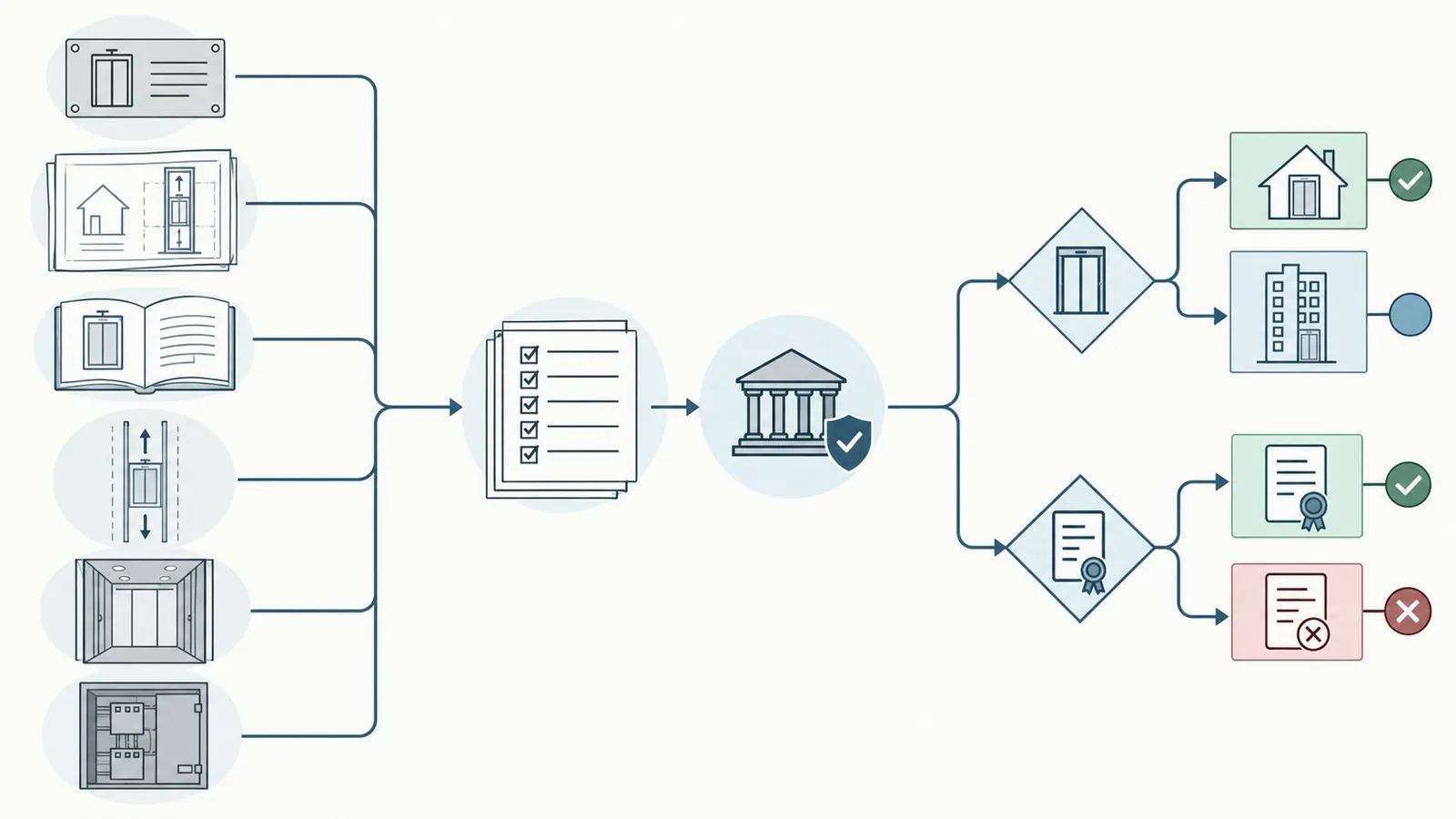
Use the installed nameplate, approved plans, contract description, and manual together. Record the manufacturer, model, serial number, rated capacity, travel, number of stops, drive type, enclosure configuration, and access arrangement. If those sources disagree, do not choose the label that produces the easiest permit path. Ask the installer to reconcile the record in writing.
| Device class | What the rider normally uses | Handover question | What not to infer |
|---|---|---|---|
| Residential stairway chairlift | A chair moving along a stair rail | Does the state treat this as a residential stairway chairlift, and is the acceptance record tied to this model and installation? | A chairlift is not automatically a platform lift or an elevator. |
| Residential vertical platform lift | A platform moving vertically between landings | What are the rated load, vertical travel, enclosure, drive, access, and local permit records? | A short platform lift does not automatically qualify for Michigan’s limited pathway. |
| Inclined platform lift | A platform moving diagonally along a stair or ramp | Is it classified as an inclined platform lift under the applicable state and code, or has it been described incorrectly as an inclined elevator? | Wisconsin’s private-residence inclined-elevator guidance does not automatically cover an inclined platform lift. |
| Private-residence inclined elevator | An enclosed or elevator-like carrier moving on an incline | Does the state elevator office require plan review, product approval, final acceptance, or a continuing maintenance control? | “Inclined,” “tram,” or “lift” in the brand name does not determine the legal class. |
The distinction is not semantic. A vertical platform lift may have a short travel and no full enclosure, while another unit may cross a floor, use hydraulic propulsion, or carry a full passenger enclosure. Those inputs can change the Michigan pathway. An inclined elevator on a hillside may also interact with shoreline, hillside, vegetation, local building, electrical, lake-district, river-district, HOA, or natural-resources approvals. Wisconsin DSPS says those local bodies should be contacted during planning and that a local building or electrical permit may also be required. Wisconsin DSPS lists the local approvals that may apply to an inclined-elevator installation.
Identify the AHJ instead of assuming the builder is the regulator
The AHJ may be a state elevator program, state labor or industry department, city or municipality operating under delegated authority, local building department, local electrical department, or a combination. The builder may coordinate the work, but coordination is not the same as approval. The lift contractor may schedule the final inspection, while the inspector or state office issues the report. The electrician may close an electrical permit, while the elevator or lift program controls a separate device approval. The homeowner needs the names and record numbers for each path.
Write a one-line jurisdiction header on the handover file:
Property: [street address], [municipality], [county], [state]. Device: [exact class], [manufacturer/model], [serial]. AHJ contacts: [elevator office or inspector], [building department], [electrical department]. Permit or case numbers: [numbers].
That header prevents a common failure: a project team says “the inspector signed off” while no one can say which inspector, which scope, or which record. It also makes a later service call faster. A service contractor should be able to tell whether a question concerns a loose landing guard, an electrical feed, a permit condition, a warranty issue, or a maintenance-control schedule without reconstructing the project from memory.
Verify the physical inputs without opening or adjusting anything
As a homeowner, you can photograph the data plate, measure the visible travel with a tape when no one is riding, count served landings, note whether the passenger space is enclosed, and record whether the drive appears to be hydraulic, screw, chain, rack-and-pinion, or another arrangement only if the label or manual names it. Do not remove covers, enter a hoistway, defeat an interlock, go under a platform, change a switch, or test a safety device. A visual note is an input for the professional; it is not a compliance finding.
Bring these inputs to the closing or pre-occupancy meeting:
- A clear photograph of every manufacturer and code data plate.
- The model, serial number, job number, rated load, travel, stops, and drive type.
- A simple sketch showing landings, gates, doors, stairs, rail or tower, enclosure, and access path.
- The approved plan set or shop drawing, including later change orders.
- The state, municipality, and every permit or inspection number.
- The installer’s legal business name, license or registration record, and service contact.
- The manual that matches the exact model, not a similar product in the same family.
If you cannot classify the device from the plate and documents, the next decision is not “can we move in?” It is “which qualified lift contractor and AHJ will identify the device class and required path?” Keep that decision open until the classification is documented.
Build the handover file before the final inspection is called #
The handover file should be assembled before the final inspection appointment, because the acceptance decision depends on the approved scope, completed installation, responsible installer, and records that remain with the owner. The builder owns coordination under the construction contract until the promised handover; the lift contractor owns installation and technical completion; the AHJ or state elevator office owns the applicable approval; and the homeowner becomes the record custodian and maintenance decision-maker after transfer unless a different written service arrangement exists.
Use a responsibility map, not a single signature
Ask the builder’s project manager to name the person responsible for each row. A blank owner is a future dispute.
| Handover item | Primary owner before acceptance | Verifier or issuing party | Homeowner receives |
|---|---|---|---|
| Device classification and model | Lift contractor and design team | AHJ when classification affects the program | Data-plate photo, plan reference, model and serial |
| Structural opening, landing, pad, rail, tower, or enclosure | Builder and lift contractor | Building inspector or lift inspector as applicable | Approved drawing and any field change record |
| Electrical supply and disconnect | Electrical contractor | Electrical AHJ | Permit closure or inspection record, circuit identification |
| Lift installation and adjustments | Lift contractor | Lift inspector or state program where applicable | Installer identity, license or registration, completion statement |
| Final acceptance | Lift contractor schedules; inspector conducts or records | AHJ, state office, or delegated inspector | Passing report or explicit written status |
| Manual and emergency procedure | Manufacturer and lift contractor | Homeowner checks model match and training | Exact manual, keys, tools designated for emergency use, instructions |
| Maintenance | Lift contractor proposes; owner funds and authorizes | Manufacturer requirements, state program, contract | Maintenance-control program or model schedule and service agreement |
| Warranty | Manufacturer, dealer, and contract parties | Warranty terms and registration channel | Warranty, exclusions, start date, registration confirmation |
| Open defects | Builder or lift contractor according to contract | Owner tracks closure | Written punch list, due date, and release condition |
This table is a coordination tool, not a transfer of legal responsibility. A builder cannot waive a state requirement in a private punch list. A homeowner cannot convert an incomplete acceptance into a passing result by signing a closing document. A contractor’s “substantial completion” phrase may describe payment or construction progress, not approval for operation.
Minimum record set for a new-home lift
The record set should be readable, model-specific, dated, and linked to the property address. Request it in one folder, with a printed emergency page where the manufacturer recommends one. Use the following checklist.
- Identity: manufacturer, exact model, serial number, job number, rated capacity, travel, number of stops, and installation date.
- Classification: chairlift, vertical platform lift, inclined platform lift, private-residence inclined elevator, or another class confirmed by the responsible professional.
- Approved scope: plan, shop drawing, permit application, revisions, field changes, and equipment schedule.
- Authority record: permit number, inspection date, inspector or agency, pass/fail status, conditions, correction notices, and final acceptance report if issued.
- Installer record: business name, contact, contractor license, field installer license or registration, manufacturer certification where relevant, and the name of the person who will service the unit. In Minnesota, keep both records: the licensed elevator contractor or limited elevator contractor is the responsible business, while a field worker may have a DLI license or a registered-unlicensed-constructor number under the device-specific pathway described below.
- Construction handoff: landing and enclosure completion, drainage or weather details for outdoor equipment, access clearances, electrical circuit identification, and any structural engineer or building-inspector record that belongs to the lift scope.
- Operation: owner manual, normal operating sequence, key-control instructions, stop and alarm behavior, loading limits, and rules for children, pets, mobility devices, and weather exposure as stated by the exact manual.
- Emergency: emergency phone or alarm instructions if provided, battery or manual-lowering instructions, location of the emergency device, who is trained to use it, and what to do after it is used.
- Maintenance: maintenance-control program, manufacturer schedule, service interval, inspection record, lubrication or battery instructions that the owner is allowed to perform, and the name and response channel of the service contractor.
- Commercial terms: warranty, exclusions, registration, start date, labor coverage, parts coverage, response limits, transferability, and any builder warranty relationship.
- Training: date, attendees, topics covered, trainer, model, and a signed acknowledgement that each intended operator can explain normal operation and the safe response to a power failure without improvising.
Some of these are owner-protection records rather than universal legal requirements. Label them that way. For example, the state may require a permit or acceptance report but not a particular training certificate. That does not make training optional as a handover control; it means the owner should ask the installer and manufacturer what training is required for the model and what evidence the warranty or service plan expects.
Separate “present” from “verified”
A file can contain a permit number without proving that the permit covers the installed device. It can contain a final report without proving that the model and address match. It can contain a manual without proving that the emergency device is accessible. Use two columns in the record index:
| Record status | Meaning | Action |
|---|---|---|
| Present | The document exists in the folder. | Check identity and scope. |
| Matched | The document names the correct address, class, model, and date. | Keep it in the final file. |
| Verified | The issuing AHJ, inspector, installer, or manufacturer confirms the relevant fact. | Note who confirmed it and when. |
| Pending | A promised record or correction is not complete. | Assign an owner and due date; do not mark handover ready. |
| Conflicting | Two records disagree. | Stop the approval decision and require written reconciliation. |
| Not applicable | A qualified professional documents why the row does not apply. | Keep the explanation; never leave the row blank. |
The distinction matters most for the final acceptance report. “The builder says it passed” is an observation about a conversation. “The inspector’s report for [address], model [x], serial [y], dated [z], says pass” is a verifiable record. If a state uses an online database instead of a paper report, save the record identifier and the retrieval date, then retain a copy or official export if permitted.
Run the Wisconsin, Michigan, or Minnesota gate that actually matches the lift #
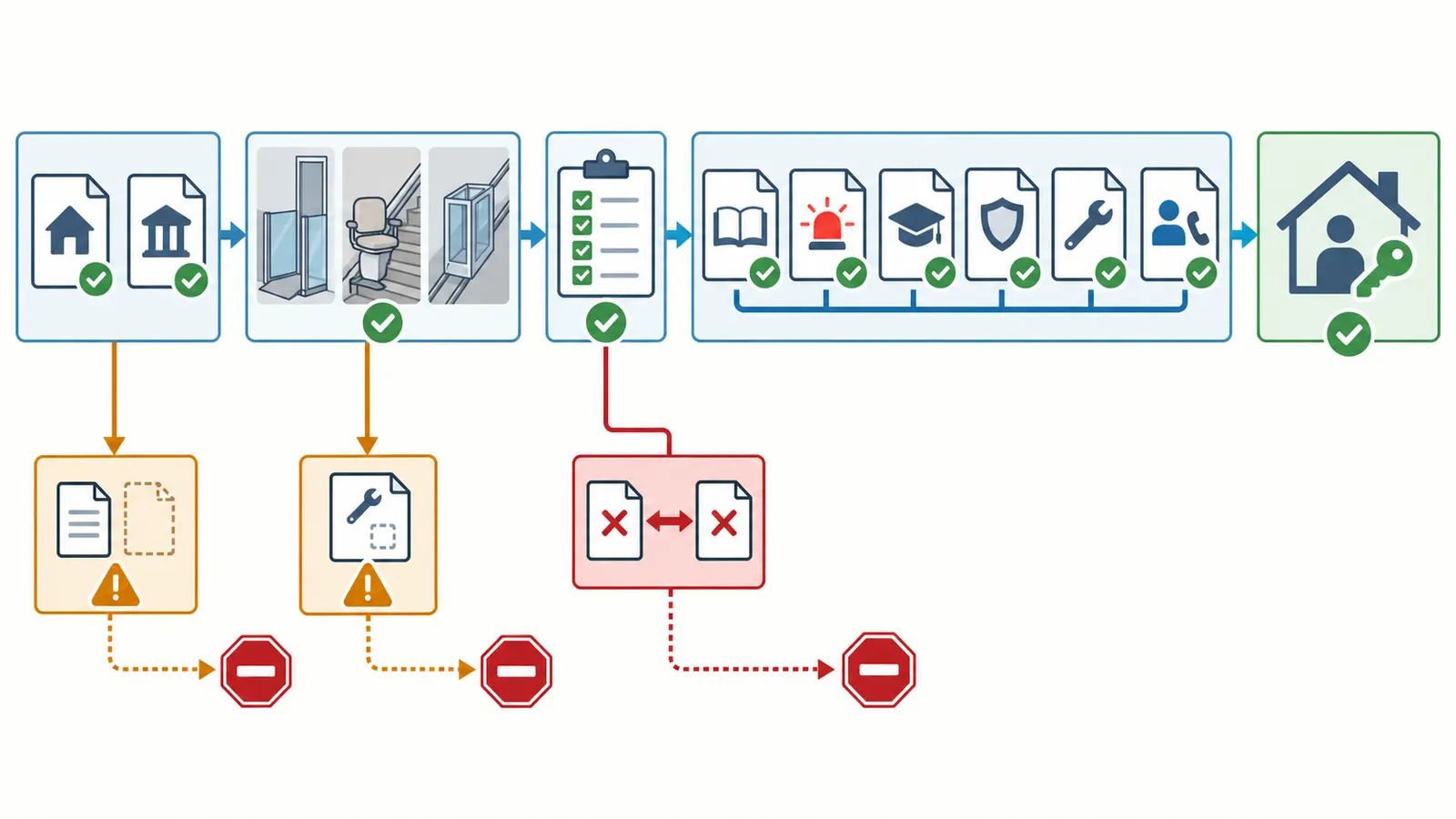
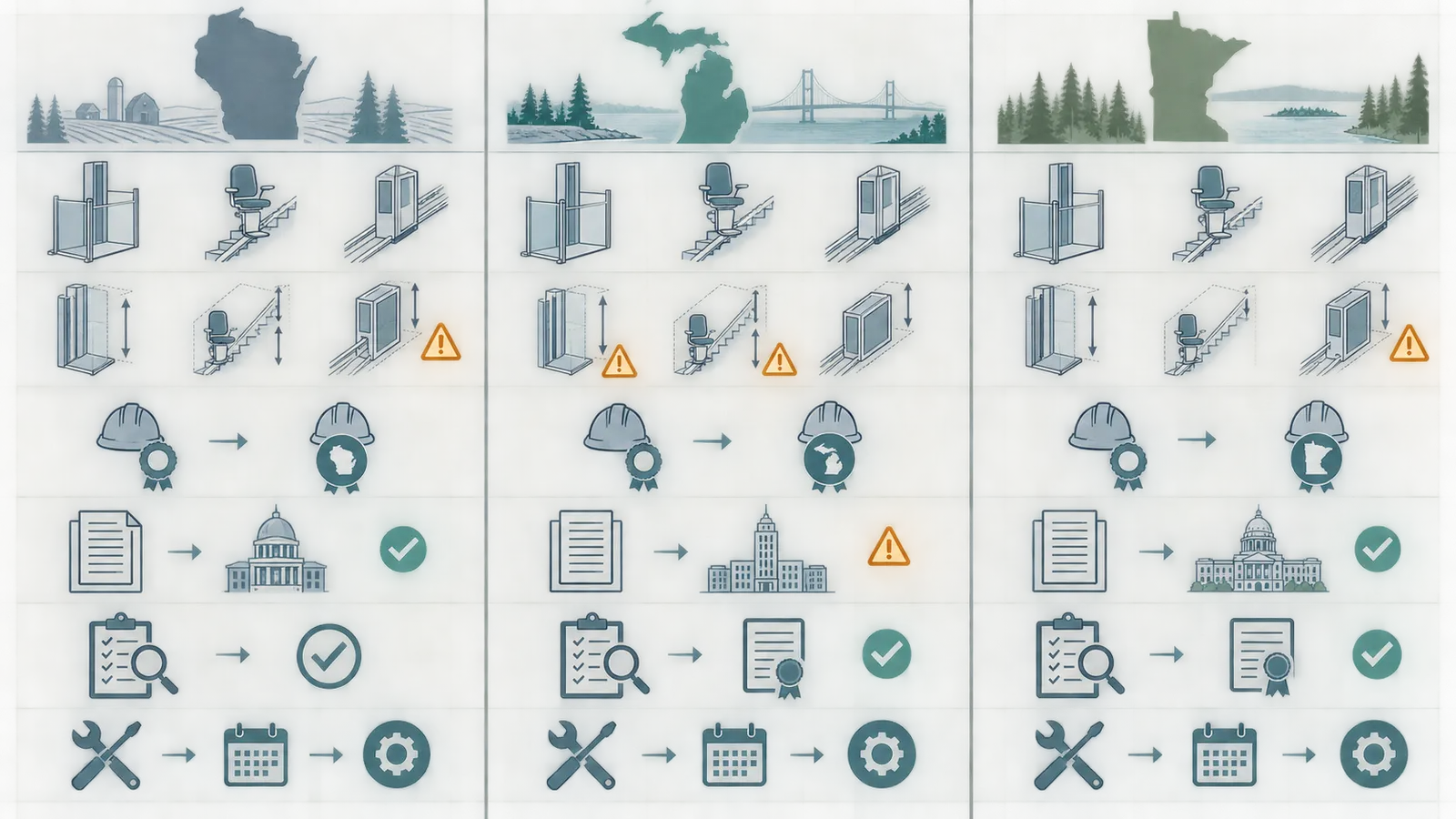
The state comparison is a routing tool: Wisconsin, Michigan, and Minnesota do not provide one universal residential-lift handover path. Apply only the row that matches the state, device class, and physical inputs, then confirm local building and electrical requirements with the AHJ. A “yes” in this matrix means the cited state source describes the gate; it does not mean your installation has passed.
State-aware residential lift handover comparison matrix
The following is the original contribution of this guide. It is an illustrative decision matrix, not an official inspection form.
| Input or gate | Wisconsin: private-residence inclined elevator example | Michigan: residential chairlift or platform-lift pathway | Minnesota: elevator and residential lift pathway | Homeowner proof to request | Next-action routing if missing or conflicting |
|---|---|---|---|---|---|
| State and local jurisdiction | Use the Wisconsin DSPS private-residence program, or Milwaukee or Madison authority where applicable, for the described scope; identify the municipality and any local approvals. | Name the Michigan municipality and its building and electrical AHJs, then identify whether LARA’s named residential-device pathway applies. | Name Minnesota DLI or the assigned area/local authority and the municipality; do not assume the general building department owns the lift record. | Property address, municipality, county, state, AHJ names, contacts, and record numbers | Owner asks the builder and lift contractor to write the jurisdiction header; builder routes unresolved authority questions to the named AHJ before acceptance. |
| Device class | DSPS’s cited guidance is for a private-residence inclined elevator; it expressly distinguishes that class from an inclined platform lift. | Use the limited route only for a residential stairway chairlift or residential platform lift that meets every listed condition. | Chairlift and residential vertical platform lift have separate DLI inspection materials; classify the installed device before choosing the record. | Data-plate photograph, approved scope, exact manual, manufacturer and model, written class statement | Lift contractor reconciles the plate, plans, contract, and manual; builder holds the scope while the contractor and AHJ resolve the class. |
| Travel | Record the installed travel, stops, and any floor penetration against the approved scope; the cited Wisconsin source does not make Michigan’s limit a Wisconsin rule. | The cited residential platform-lift pathway is limited to no more than 6 feet of vertical travel and no more than one floor penetration. | Record travel and stops for the exact device; the DLI checklist is not a universal travel exemption. | Measured or plan-based travel in feet, number of stops, floor-penetration statement, approved drawing | Lift contractor confirms the measurement and applicable code path; if outside a listed limit, contractor asks LARA, DLI, or the AHJ for the correct permit and acceptance route. |
| Enclosure and drive | Match the approved inclination, platform or carrier, enclosure, and drive to the DSPS-reviewed scope; do not substitute an inclined platform lift. | The cited limited platform-lift pathway excludes hydraulic propulsion and a full passenger enclosure. | DLI’s vertical-platform checklist separately records drive, platform, enclosure, guards, and related safety items; a checklist does not itself approve a different device. | Manufacturer specifications, drive identification, enclosure description, approved plans, safe field photographs | Lift contractor documents the exact configuration and submits any mismatch for professional and AHJ determination; homeowner does not open covers or alter the equipment. |
| Installer qualification | A new conveyance in the cited Wisconsin scope may be installed only by a licensed elevator contractor; confirm the current license. | A non-journeyperson installer qualifies for the described alternative only with manufacturer certification, required liability insurance, local permits, construction-code compliance, and ASME A18.1 installation; a licensed elevator contractor is another path. | The responsible business must be a Minnesota DLI-licensed elevator contractor or limited elevator contractor. For a residential platform lift or stairway chairlift, the field installer may be a DLI-licensed individual or a DLI-registered unlicensed elevator constructor employed by that business; the registered-unlicensed exception permits installation, maintenance, or repair without direct supervision, but not elevator-equipment electrical wiring. For alteration, testing, another device class, or a different employer arrangement, verify the applicable licensed-person path. Minnesota DLI explains the registered-unlicensed platform-lift and chairlift exception. | Legal business name and contractor license, field installer license or RC registration, employer relationship, authorized work scope, manufacturer certification where relevant, insurance proof where relevant, named mechanic or contractor | Builder and lift contractor provide both the business and field-worker records; owner confirms the RC registration or license with Minnesota DLI and routes any mismatch about device class, task, employer, or wiring to DLI or the AHJ rather than accepting “registered” as a universal qualification. |
| Permit status | DSPS or Milwaukee/Madison elevator-program approval and plan review are required for the described private-residence inclined-elevator scope; local building or electrical permits may also apply. | Department-permit treatment for the named devices is conditional under the cited Act; required Michigan building and electrical permits remain part of the pathway. | DLI says installation, alteration, and removal permits are required for elevators, with repair limits governed by rule; confirm the exact device route. | Application, issued permit, exemption basis if applicable, approved plans, inspection history, and local permit records | Builder and installer obtain the issuing record or written AHJ explanation; the lift stays pending if only a general building or electrical permit is shown. |
| Final acceptance | The contractor schedules final inspection after installation and landings are complete; a licensed mechanic is present and the inspector gives the homeowner a passing acceptance report. | LARA describes required final acceptance inspection as special service for the licensed-contractor path; confirm the project’s actual acceptance record and route. | DLI publishes residential chairlift and vertical-platform acceptance checklists and directs other devices through the applicable inspection path; obtain the assigned final record. | Signed report or completed checklist tied to address, class, model, serial, date, inspector, and status | Lift contractor or builder obtains corrected or closed records; inspector or AHJ confirms closure where required, and owner does not sign unconditional acceptance while status is pending. |
| Maintenance-control program | For elevators serving a single dwelling under the described program, DSPS says no periodic inspection or permit-to-operate renewal is required, but the contractor must provide an MCP with examination and maintenance schedules. | Do not infer an ongoing obligation or exemption from the installation pathway; ask LARA/AHJ and apply the exact manual and service contract. | Determine the exact DLI operating-permit and inspection obligation for the device; do not turn a checklist or webpage exception into “no maintenance.” | MCP or model schedule, state/local schedule if applicable, service agreement, interval, response number, and post-service record format | Installer or service provider names the continuing owner and schedule; unresolved responsibility goes to owner, contractor, and AHJ before the lift is treated as fully handed over. |
| Emergency-lowering instructions | The exact installed manual and contractor handoff control the emergency procedure; the Wisconsin program record does not authorize a homeowner to improvise one. | Confirm the model-specific emergency response and who may use it; the cited device pathway does not replace the manufacturer’s procedure. | Receive the exact model procedure and the responsible service contact; DLI acceptance materials do not authorize homeowner emergency experimentation. | Model-specific emergency page, power-failure response, device location, authorized user, post-use instruction, and contact | Installer or authorized dealer demonstrates and records the procedure within the manual’s limits; owner keeps the lift restricted and calls the designated professional if the instruction is absent or unclear. |
| Manual | Keep the owner manual for the exact model, serial or product family, controls, limits, keys, alarms, and permitted owner checks; a similar brochure is not a substitute. | Match the manual to the device that is installed under the actual Michigan pathway and record any model revision. | Match the manual to the DLI-recorded device and preserve it with the permit and inspection file. | Current manual, revision/date, model and serial match, language/accessibility needs, keys and designated tools | Installer or manufacturer supplies and confirms the exact manual; training pauses until the mismatch is resolved. |
| Warranty | The state acceptance report and the manufacturer or builder warranty are separate records; retain both and any DSPS-required maintenance-control record. | Check whether the selected installer, authorization, registration, local path, and documented maintenance affect warranty coverage. | Keep warranty terms alongside the DLI permit and inspection records; state approval does not define private warranty coverage. | Warranty certificate, exclusions, start date, registration confirmation, labor/parts coverage, transferability, and service conditions | Builder, dealer, or manufacturer answers coverage questions in writing; owner records the service channel and does not authorize work that conflicts with the warranty or manual. |
| Owner training | Record model-specific operation and the handover contact; state approval is not a substitute for teaching the owner how the unit may be used. | Train intended operators on the installed device and the conditional pathway’s limits; do not treat “residential” as a training record. | Obtain the installer or qualified contractor’s training record with the permit and acceptance file; DLI’s checklist is not homeowner training. | Date, trainer and qualification, attendees, model, normal operation, alarms/stops, emergency boundaries, maintenance contact, acknowledgement | Installer or authorized dealer repeats the handoff and closes questions; owner stores the record and routes any unsafe or unclear operating instruction back to the qualified professional. |
Method. Read the stated device class, travel, enclosure, drive, installer qualification, permit status, acceptance report, maintenance-control program, emergency-lowering instructions, manual, warranty, and owner-training record against the named state source. Mark each gate yes, no, pending, not applicable, or verify with the authority having jurisdiction; then route every pending or contradictory item to the responsible professional. In practice, start with the physical inputs in the first four rows, match the device to the state source, treat every conditional phrase as a required gate, and ask the installer and AHJ for the record named in the final column. A matrix cell is “complete” only when the record is present and matched to the address, device, model, and date. This method combines the cited state requirements with a homeowner record-control step; it does not create a new legal requirement.
Limitations. This is an illustrative editorial comparison, not an official inspection form or legal determination. Rules change, local building and electrical permits may add requirements, national coverage is incomplete, and only the AHJ and a qualified lift contractor can approve a particular installation or safety condition. Wisconsin’s cited source is specifically about private-residence inclined elevators. Michigan’s cited source is specifically about residential stairway chairlifts and residential platform lifts and lists limiting conditions. Minnesota’s webpage and checklists describe the DLI pathway, but the exact local or device-specific record still has to be confirmed. The matrix does not cover other states, commercial installations, condominium systems, live troubleshooting, structural design, or electrical sign-off.
Wisconsin: do not confuse local construction approval with elevator-program approval
For the Wisconsin private-residence inclined-elevator example, the handover gate is more than the building permit. Wisconsin DSPS says the conveyance requires product approval and plan review and inspection by DSPS or the cities of Milwaukee or Madison as applicable. It also says a building inspector, electrical inspector, lake or river district, HOA, or DNR approval is not sufficient by itself to begin the described work without elevator-program approval. Wisconsin DSPS explains the separate approval relationship.
Before closing, request the conditional approval letter and approved plans. DSPS says the plan review identifies features such as approved components, inclination, and platform size for the rated load, and that the letter identifies the owner, site, conveyance, reviewer, and inspector. A copy of the letter and approved plans must remain on site until the final inspection passes. If the project began without your copy, contact the licensed elevator contractor and the applicable DSPS, Milwaukee, or Madison program rather than treating the missing copy as a minor paperwork issue. Wisconsin DSPS describes the conditional letter and on-site plan requirement.
The final acceptance sequence also has a defined owner handoff. DSPS says that after all installation work is complete, including landings, the licensed elevator contractor schedules the final inspection with the agency identified in the conditional letter. A licensed elevator or lift mechanic must be present, and the inspection is not scheduled by the homeowner. The inspector provides the homeowner a copy of the final passing acceptance inspection report to keep in the maintenance records as proof of approval for use. Wisconsin DSPS describes who schedules and receives the final report.
For continuing responsibility, DSPS says the described elevators serving single dwellings have no periodic inspection or permit-to-operate renewal requirement, but the licensed contractor must provide a maintenance control program (MCP) with examination and maintenance schedules. Treat that as a transfer of control to the owner, not as permission to ignore service. Ask for the MCP, the name of the contractor who will follow it, the service interval, the response process, and the record you will receive after each visit. Wisconsin DSPS describes the single-dwelling inspection status and MCP.
Michigan: test the exemption conditions one by one
Michigan’s LARA page is easy to misread because it describes an exception to a department elevator-installation permit for certain residential devices, but the exception is conditional. A person other than a licensed elevator journeyperson may install the named residential stairway chairlift or residential platform lift without an elevator installation permit only when the installer is manufacturer-certified, carries the required liability insurance, obtains all required electrical and building permits from the AHJ, and installs to the state construction code and ASME A18.1. Michigan LARA states the conditions for the alternative installer pathway.
Build a Michigan exception file with four separate proofs, not one contractor email:
- Manufacturer certification naming the installer, company, device family, or scope as applicable.
- Evidence of the mandated liability insurance, with the policy holder matching the installer.
- Building and electrical permits or written AHJ confirmation of the required local pathway.
- Product and installation documentation demonstrating the state construction-code and ASME A18.1 basis.
Then test the physical limits. LARA lists a platform capacity of 750 pounds or less and vertical travel of no more than 6 feet. It excludes a device operated by hydraulic propulsion, a device penetrating more than one floor, and a device with a full passenger enclosure. All devices in the described pathway must be ASME A18.1 compliant. Michigan LARA lists the platform-lift limits.
If any limit is uncertain, mark the pathway “verify,” not “exempt.” For example, a 7-foot travel, a hydraulic drive, a full enclosure, or a lift that penetrates two floors is not resolved by saying that the product is sold as residential. Ask LARA or the AHJ which permit and inspection path applies. Do not extrapolate the listed exemption to an inclined elevator, a home elevator, a commercial installation, or another device class.
LARA also says the department permit is no longer required to alter or install a residential stairway chairlift or residential platform lift under the cited Act, while noting that the Elevator Section may issue installation permits to licensed elevator contractors and treat the required final acceptance inspection as special service. That means a record showing “no department permit” is not the end of the file. You still need local permit status, acceptance status, the exact device classification, and the installer’s qualifications. Michigan LARA explains the department-permit change and special-service inspection.
Minnesota: preserve the permit and the inspection pathway separately
Minnesota DLI’s permits page states the contractor-business rule broadly: only licensed elevator contractors may install, maintain, alter, repair, or test elevators and elevator-related devices, and permits are required for installation, alteration, and removal of elevators. Read that with DLI’s current licensing page. A registered unlicensed elevator constructor is an individual worker, not a substitute for the licensed contractor business. For a residential platform lift or stairway chairlift, that registered worker may install, maintain, or repair without direct supervision when registered with DLI, employed by the same licensed elevator or limited elevator contractor, and working within the employer’s authorized scope. DLI excludes installation, maintenance, repair, or replacement of elevator-equipment electrical wiring from this exception. The individual’s registration therefore reconciles the checklist wording; it does not erase the contractor, employer, scope, permit, or task limits. Minnesota DLI describes the contractor and permit requirement; Minnesota DLI defines the registered-unlicensed exception.
For a new-home project, ask the builder and installer for the permit application, issued permit, inspection appointment, correction history, and final record rather than assuming a general building permit covers the lift. Also ask for the responsible company’s Minnesota elevator-contractor or limited-elevator-contractor license and the field installer’s DLI license or RC registration. If the field worker is registered unlicensed, record the employing company, the device class, the work being performed, and the reason the exception applies. Do not accept a registration number by itself when the employer, scope, or wiring responsibility is unclear.
Minnesota DLI directs inspection scheduling for all devices except stairway chairlifts and residential vertical platform lifts through the area inspector and separately publishes inspection materials for those two categories. For residential vertical platform lifts, DLI says that, starting May 19, 2025, every installation must be inspected and reported by the installer before it is put into service, using an offline field report; the notice says licensed and registered unlicensed installers can submit that report through VuSpex Go. That is a device-specific reporting route, not a conclusion that an unlicensed person may perform every kind of elevator work or that the lift needs no record. Use the exact device label and ask DLI or the assigned AHJ what report closes the project. The DLI page also lists an annual operating-permit process; do not assume it applies to your exact residential device without confirmation. Minnesota DLI shows the inspection split and operating-permit pathway; Minnesota DLI explains the residential VPL offline field report.
The residential stairway-chairlift checklist provides a useful model for the record you should expect to see. It includes the permit number, installer license or registration, manufacturer data tag and capacity plate, code data tag and permit number, operating checks, and a completed signed acceptance report. Its “licensed or registered unlicensed installer” wording should be read with the DLI licensing rule: for this device-specific pathway, the registered individual must be registered with DLI, work for the licensed contractor, and stay within that employer’s authorized scope; the exception does not cover elevator-equipment electrical wiring. The checklist says that a licensed or registered unlicensed installer must not leave a residential chairlift in service if an unsafe condition exists. It is for Minnesota residential installations and does not authorize a homeowner to perform its tests. Minnesota DLI’s stairway-chairlift checklist identifies the record fields and unsafe-condition rule; Minnesota DLI states the limits on a registered-unlicensed installer.
The residential vertical-platform-lift checklist is even more explicit about the inspection scope: it lists door contacts, headroom, obstruction devices, ramps and guards, hydraulic or screw drive, belt or chain monitoring, braking, suspension, platform and enclosure, capacity and data plates, safeties, stopping devices, operating devices, stop switches, and a run in both directions with a capacity load. It also says a licensed or registered unlicensed installer must not leave the lift in service if an unsafe condition exists. DLI’s separate VPL notice says the installer submits the offline field report before service, so request the completed report and its permit, address, device identity, installer license or RC registration, media, signatures, and pass/fail results. These are professional inspection and reporting functions; the homeowner’s role is to receive the completed report and report visible discrepancies. Minnesota DLI’s vertical-platform-lift checklist lists the acceptance checks; Minnesota DLI describes the VPL report-before-service requirement.
Manage final acceptance as a controlled handoff, not as a casual walk-through #
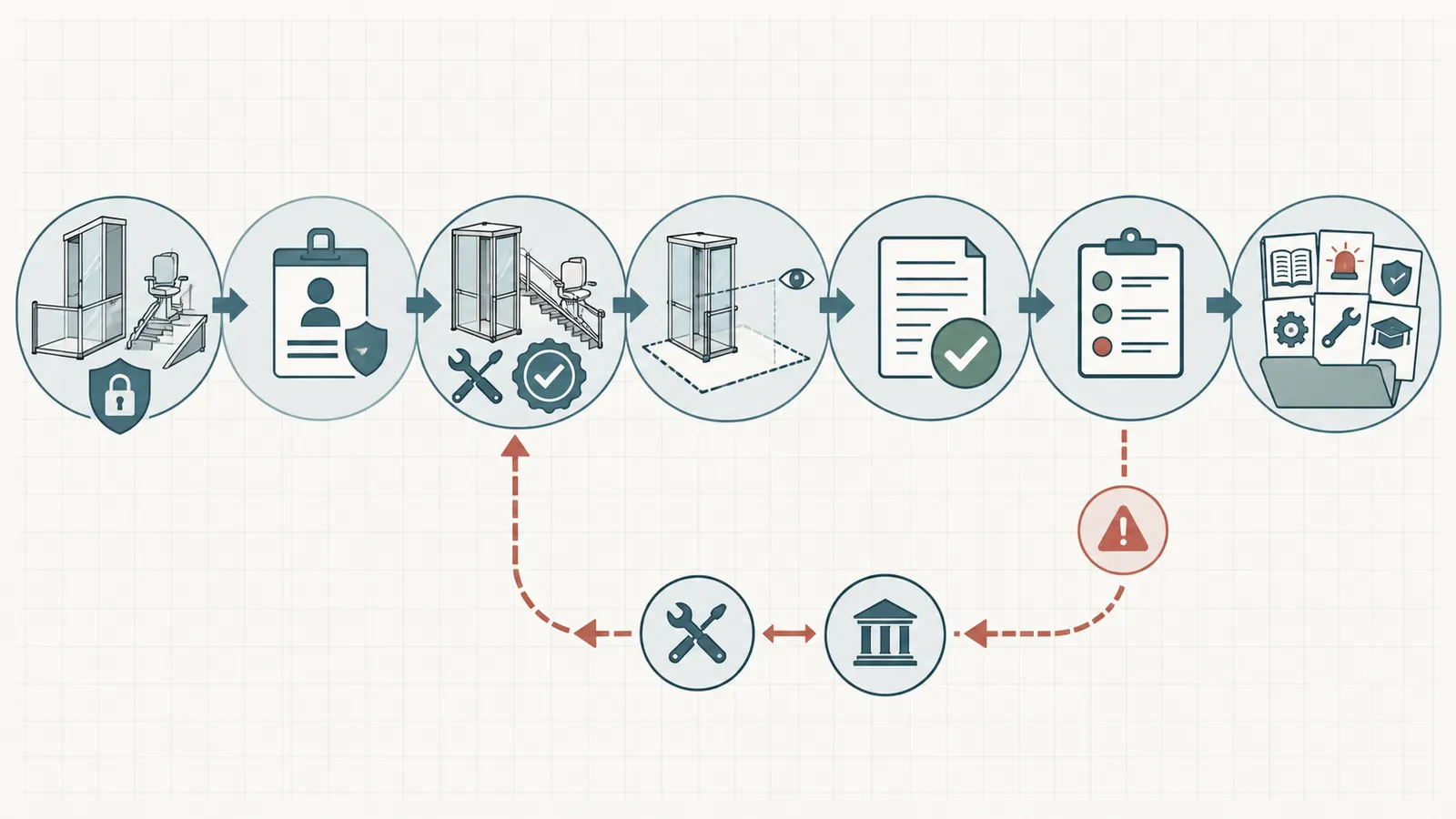
Final acceptance is complete only when the applicable authority or qualified inspection pathway has produced a status tied to the installed device, and all corrections, conditions, and records have a named owner. A builder’s walk-through can show you how to operate the lift, but it does not replace state or local acceptance. A contractor’s statement that the equipment runs can show normal motion, but it does not prove that interlocks, stopping devices, rated capacity, structural interfaces, permits, or required records are complete.
Sequence the appointment in a way the owner can verify
Use this order at the project meeting:
- Freeze the identity. Photograph the data plates before the appointment and compare model, serial, capacity, travel, and installation address with the plans and permit. If a component changed, request the approved revision or written technical reconciliation.
- Confirm the responsible inspector. Ask who is conducting or recording the acceptance, which state or local program owns the record, and which permit or case number is being closed.
- Confirm installation completion. The lift contractor should state that landings, gates, rails, tower, enclosure, controls, electrical connection, drainage or weather details, and labels are complete. The homeowner should not crawl under or inside the equipment to verify this.
- Observe from a safe public area. If the inspector allows it, observe normal operation from the landing or a designated safe position. Do not touch controls during a test unless the inspector or installer instructs you to do so.
- Capture the result. Request pass, fail, correction, or not-applicable status in writing. If the program uses photographs or short videos, ask where the official record is stored and how you receive a copy.
- Record conditions. A pass with a separate non-safety punch item is not the same as a failed acceptance, but only the issuing authority can define the meaning. Ask who decides whether the lift may remain in service.
- Close the handoff. Obtain the final report, manual, maintenance program, warranty, emergency instructions, training record, and service contact before signing the owner handover.
This order keeps the homeowner from treating a smooth ride as the acceptance test. It also exposes the handoff boundary. The inspector verifies the applicable code or program scope. The lift contractor corrects installation defects. The builder repairs surrounding construction defects. The electrician closes electrical work. The owner retains the final record and schedules maintenance.
Know what an owner observation can and cannot tell you
You may safely observe whether the platform or chair arrives at the intended landing, whether the controls respond during the contractor’s demonstration, whether doors or gates appear to close, whether the alarm or phone is identified, whether labels are legible, and whether the surrounding path is free of stored materials. These observations can reveal obvious incompleteness.
They cannot tell you whether a brake is correctly adjusted, a suspension component has the required factor of safety, a landing clearance meets the adopted code, a safety circuit is wired correctly, a concrete pad has the required capacity, a grounding path is compliant, a hydraulic component is leak-free under its rated condition, or the product is approved for the installation. Do not use a phone camera, ruler, passenger ride, or internet photograph as a substitute for that determination.
The Minnesota vertical-platform checklist illustrates why. Its scope includes headroom, door contacts, obstruction devices, braking, suspension, safeties, stopping devices, and a capacity-load run—items a normal homeowner ride cannot establish. Minnesota DLI’s checklist shows the difference between ordinary observation and formal acceptance testing.
Define the occupancy decision without inventing a universal rule
“Occupancy-ready” has at least three separate meanings:
- The home has the building, electrical, fire, utility, and local approvals required by the project and jurisdiction.
- The lift has the applicable state or local permit and acceptance status for its exact class.
- The owner has the information and service control needed to operate and maintain it without guessing.
Do not collapse these into one label. Wisconsin DSPS’s described inclined-elevator program says use before passing final inspection may result in a fine of up to $1,500, which is a strong reason not to use an unaccepted device; it does not make that amount a national rule or decide your home’s general occupancy status. Wisconsin DSPS warns about use before the described final inspection.
For your decision log, use three outcomes:
| Outcome | Meaning | Move-in action |
|---|---|---|
| Ready for lift handover | Correct class and AHJ are documented, required approval path is complete, no unresolved safety restriction is open, and owner records and training are complete | Accept the lift scope, store the file, activate maintenance, and record warranty start or registration. |
| Home handover possible, lift restricted | The broader home may have a separate occupancy status, but the lift has a pending permit, failed acceptance, missing record, unsafe condition, or incomplete training | Keep the lift locked or marked out of service as directed by the qualified contractor or AHJ; obtain a written alternative access plan and a correction date. |
| Cannot decide | Records conflict, device class is unclear, the responsible authority is unknown, or the installer cannot produce the required evidence | Pause the lift handover and escalate to the lift contractor, AHJ, and builder in writing. |
This table is a decision-control scheme from the article’s matrix, not a legal occupancy classification. The AHJ’s written direction controls the property. If a closing agent asks you to sign that the lift is “accepted,” define what document and authority that phrase refers to before signing.
Transfer normal operation, emergency instructions, and maintenance ownership #
The owner should leave the handover meeting able to name who may operate the lift normally, who may respond to an entrapment or power failure, who may perform maintenance, who pays for service, and where the records live. The homeowner owns the operating decision after transfer, but the manufacturer and qualified contractor control model-specific technical instructions. The builder should not disappear before these contacts and documents are transferred.
Make training model-specific
Training should use the installed unit, not a sales brochure or a similar model. Ask the installer to demonstrate normal operation from every intended station, keyed controls, loading and unloading, stops, alarms, doors or gates, and the response to a loss of normal power. Have each intended operator explain back the steps. Children, guests, caregivers, and anyone who may be alone with the device need a simple operating rule: use only as the manual allows, never defeat a safety feature, and call the designated service or emergency contact when the unit behaves unexpectedly.
The training record can be simple:
| Field | Record |
|---|---|
| Date and property | [date], [address] |
| Device | [manufacturer, model, serial, class] |
| Trainer | [name, company, qualification or installer role] |
| Attendees | [names and relationship to owner] |
| Normal operation | [stations, controls, keys, loading limits] |
| Emergency topics | [alarm, power failure, manual lowering location, do-not-open warnings] |
| Maintenance topics | [service contact, owner-permitted checks, schedule, record location] |
| Questions left open | [question, owner, due date] |
| Acknowledgement | [signatures or electronic confirmation] |
The purpose is not to certify a person as a lift mechanic. It is to prevent a handover where the owner receives a key but not the boundaries of safe use. The manufacturer manual may reserve emergency or maintenance steps for trained personnel. Savaria’s V-1504 manual, for example, describes battery and manual lowering but labels manual lowering as emergency use for trained personnel, warns not to leave the area unattended, and requires doors or gates to be secure and locked afterward. Savaria’s V-1504 manual sets model-specific emergency-training boundaries.
Treat emergency lowering as a procedure, not a demonstration trick
Ask the contractor to show you the location of the emergency device and explain who is authorized to use it. Do not pull a cable, turn a valve, open an emergency door, enter a hoistway, or place someone on a platform during a trial unless the exact manual and qualified trainer authorize the demonstration and control the hazard. Record the location with a photograph only if it can be done from a safe position.
The emergency page should answer five questions:
- How does the specific model respond to a normal power failure?
- What backup battery, manual lowering device, alarm, or communication system exists, and what are its limits?
- Who is trained and authorized to use the emergency function?
- What areas must be clear, closed, locked, or guarded before it is used?
- What must happen after use—service call, inspection, reset, battery replacement, or written record?
Do not generalize across models. A vertical platform lift may have a manual lowering box, crank, valve, battery backup, or other arrangement. A stairway chairlift may have a different failure response. An inclined elevator may have an emergency procedure tied to the drive and enclosure. The correct answer is in the exact manual and installer training record. If the manual is missing, the handover is incomplete even if the unit runs.
Turn maintenance into a named owner obligation
Ask who will schedule service after the builder’s warranty ends and what happens if the installing dealer closes, changes brands, or stops serving the area. Put the answer in the handover folder:
- Service company and after-hours number.
- Model, serial, and job number used when requesting service.
- Required visit frequency and what triggers more frequent service.
- Which checks the owner may perform, if any.
- Which checks require the dealer, licensed elevator contractor, qualified technician, or inspector.
- How service visits, repairs, parts, and safety restrictions are logged.
- Whether the warranty requires registration, authorized service, or documented maintenance.
- Who owns the keys, emergency tools, battery records, and maintenance-control program.
Wisconsin’s described single-dwelling inclined-elevator program makes this transfer especially visible: DSPS says there is no periodic inspection or permit-to-operate renewal requirement for the described class, but the contractor must provide an MCP with examination and maintenance schedules. “No periodic state inspection” therefore does not mean “no maintenance responsibility.” Wisconsin DSPS makes the maintenance-control program part of the owner record.
Manufacturer instructions can be more demanding than a state’s recurring inspection rule. Savaria’s M2LIFT manual says only Savaria licensed dealers and technicians may install, adjust, service, or maintain that product, warns that unauthorized work can void the warranty, and warns technicians to shore the lift safely when working below the platform. Savaria’s M2LIFT manual assigns technical service to qualified personnel.
The same manual lists model-specific residential maintenance frequencies: for several checks, normal and heavy residential use are listed at every year and excessive use at every six months, with more frequent service for high or excessive cycles, outdoor use, or harsh environments. Do not copy those intervals to another product. Use them as a reason to request the exact installed manual and a written schedule. Savaria’s M2LIFT manual illustrates why the model and use pattern matter.
Keep a maintenance and event log from day one
Use one row per event:
| Date | Event or observation | Device status | Person or company | Record or invoice | Next action |
|---|---|---|---|---|---|
| [date] | Acceptance or service visit | Pass, restricted, or out of service | [name] | [report] | [next due date] |
| [date] | Power failure or emergency function used | [status] | [name] | [service record] | [inspection/reset] |
| [date] | Unusual noise, stop, door, gate, or alarm behavior | Do not infer cause | [caller] | [ticket] | [qualified evaluation] |
| [date] | Battery, weather, or enclosure issue | [status] | [owner or technician] | [photo/report] | [repair] |
The log is not a substitute for an inspection. It is a continuity record. It lets the next service contractor see whether an event was a one-time power interruption, repeated stopping, overdue maintenance, water intrusion, or an unresolved acceptance correction. It also protects the owner from relying on memory when a warranty claim or property sale occurs.
Treat unknown fluids and contamination as an out-of-service boundary
Do not touch, clean, wipe up, sample, smell, or diagnose hydraulic fluid, battery electrolyte, an oily residue, crystals, a chemical odor, or any other unknown fluid or substance around the lift. Do not operate the lift to see whether the substance moves, open a cover to find its source, pressurize a hydraulic system, disconnect a battery, or use household cleaners or absorbents. A homeowner cannot safely determine from appearance whether a residue is hydraulic fluid, battery electrolyte, a construction chemical, contaminated water, or something else, and the source may be under pressure or connected to stored electrical energy.
Keep the lift and the immediate area out of service. From a safe location, prevent riders, children, and pets from approaching; do not step through a spill or reach around it to place a sign. If a barrier can be placed without contacting the substance or entering a hazardous area, use one. Otherwise leave the area and tell the qualified lift contractor exactly what was seen, where it was seen, when it was noticed, and whether anyone was exposed. If there is fire, smoke, a strong or spreading vapor, an electrical emergency, a person exposed to the substance, or a spill that threatens people or the building, leave the area and contact the appropriate emergency service. Do not ask the lift contractor to identify an unknown substance by a homeowner sample.
The service escalation is part of handover. The owner should already have the exact model, serial number, manual, service number, and emergency contact in the file. Give those records to the qualified lift contractor or authorized service provider and state that the unit is being held out of service pending evaluation. Do not return it to service because the residue dried, the water level fell, or the lift still moves. A qualified professional must decide whether cleaning, fluid replacement, electrical isolation, pressure work, inspection, or other correction is required, and whether the AHJ must be notified. The article’s document-and-observation method ends at reporting and isolating the condition; it does not turn contamination into a homeowner maintenance task.
Test the handover record without performing hazardous work #
The homeowner’s safest test is a document-and-observation audit. Do not turn it into a remote safety inspection. Lift equipment can involve falls, pinch and crush points, moving suspended or supported loads, electrical energy, hydraulic pressure, stored energy, and unsafe access around openings. Work below a platform, inside an enclosure or hoistway, on a structural support, or on energized electrical equipment belongs to appropriately qualified professionals.
Use a three-layer verification procedure
Layer 1: document match. Compare the data plate to the plan, permit, inspection report, manual, and warranty. Look for exact model and serial, not just the manufacturer name. Compare the property address, installation date, installer identity, capacity, travel, number of stops, drive, and enclosure. If a report omits a serial number, ask the issuing party how the installation is uniquely identified.
Layer 2: safe visual observation. From normal walking areas, look for obvious incomplete work: missing labels, loose-looking panels, blocked landings, stored construction material in the path, an open or unsecured gate, water entering an exterior enclosure, exposed conductors, damaged rail or finish, or a control that is not protected as described by the manual. Do not touch, reach through, climb around, or remove anything. Photograph only what you can see safely.
Layer 3: professional status check. Ask the contractor or AHJ to confirm whether the observation is a safety restriction, a construction punch item, a warranty item, or not a defect. Put the answer in writing. If the person who installed the lift says it is fine but the permit or inspection record says pending, the record remains pending until the issuing authority resolves it.
Use this homeowner observation matrix
| What you can observe safely | What it may indicate | What it cannot prove | Safest next step |
|---|---|---|---|
| Data plate is missing or unreadable | Identity and capacity cannot be matched | That the lift is unapproved | Ask installer to restore or document the plate and reconcile the report. |
| Model in manual differs from plate | Wrong manual or changed equipment | Which manual is safe to substitute | Stop training and request the exact manual from manufacturer or installer. |
| Gate or door appears open, damaged, or misaligned | Incomplete finish or a possible interlock concern | Whether the safety circuit works | Keep people away from the opening and call the lift contractor. |
| Platform moves during a demonstration | Basic motion is present | Brake, load, stopping, clearance, or code compliance | Ask for the official acceptance result and test record. |
| Lift does not move | Power, key, control, safety circuit, or fault may be involved | The cause or a safe reset | Do not bypass or repeatedly cycle it; use the service contact. |
| Emergency device is not identified | Training and emergency handoff are incomplete | Whether the model has backup lowering | Ask the installer to identify it from the manual without owner experimentation. |
| Water, ice, debris, or stored material is present | Weather or construction risk | Whether internal components are damaged | Keep the area clear if safe and request qualified evaluation. |
| Fluid, residue, crystals, fumes, or another unknown substance is present | A possible hydraulic, battery, chemical, or construction-contamination hazard | What the substance is, whether it is under pressure, or whether the equipment is safe | Do not touch, clean, wipe, sample, smell, or diagnose it; keep people and pets clear, take the lift out of service without approaching the substance if that can be done safely, and call the qualified lift contractor or appropriate emergency responder. |
| No permit or acceptance record is in the folder | Handover evidence is incomplete | Whether the AHJ record exists elsewhere | Ask builder and installer for the issuing record number and agency. |
| Service company will not name a schedule | Maintenance ownership is unresolved | That the state requires no service | Require a written manufacturer or contractor schedule before handover. |
Do not turn common “tests” into homeowner work
Do not test a door lock by manually defeating it. Do not place weight on the platform to recreate a capacity-load test. Do not stand below a raised platform. Do not enter a pit or hoistway to inspect a pad, drain, rail, chain, cable, screw, hydraulic line, or safety. Do not open an electrical panel or disconnect. Do not adjust a limit switch, pressure setting, brake, controller, interlock, sensor, or emergency lowering mechanism. Do not use a jumper, magnet, tool, or tape to hold a safety device open. Do not ask a child or mobility-impaired person to be the test subject.
These restrictions are not a refusal to help. They keep the homeowner’s useful role clear: gather the correct records, observe from safe areas, ask the right professional questions, and preserve a written trail. Savaria’s V-1504 manual reinforces this model-specific boundary by requiring an authorized Savaria mechanic for installation, adjustment, service, or modification of mechanical or electrical devices on the equipment, and warning that unauthorized work can compromise or defeat safety systems. Savaria’s V-1504 manual sets the authorization and safety-system boundary.
Account for surrounding construction hazards
Lift handover can fail because the machine is acceptable but the surrounding construction is not. Look for an unfinished landing, missing guard or gate, a threshold that conflicts with the approved plan, a drainage path that sends water toward the equipment, a concrete pad or anchor that has not been documented, damaged finish from other trades, or an electrical feed that is not identified. Do not diagnose the structural or electrical cause yourself. Give the professional a dated photo, location, and relation to the plan.
If the lift is outdoors, ask who owns snow, ice, leaves, salt, drainage, corrosion, and weather-exposure maintenance. If it is inside a new enclosure, ask who owns cleaning and protection during the remaining construction. If the lift serves a stair or elevated deck, ask the builder and lift contractor to confirm the surrounding guard, landing, and circulation work is complete. A lift contractor may not own a general stair guard, deck flashing, or building-envelope defect, but the defect can still affect safe access and warranty coordination.
Close failures by routing the next decision to the right party #
When a handover fails, the next action should be based on the failed gate: classify, permit, install, inspect, document, train, or maintain. A generic request to “fix the lift” often sends a homeowner to the wrong party. Use the failure branch below, preserve the device status, and never solve an approval problem by operating the equipment without permission.
Failure branch: the device class is unclear
Observed: The contract says “platform lift,” the data plate says “elevator,” or the physical enclosure and travel do not match the installer’s description.
Interpretation: The permit and inspection route may be wrong. Product marketing language is not a classification decision.
Owner action: Photograph the plate, collect the manual and plans, and ask the lift contractor to state the exact class, code basis, capacity, travel, drive, enclosure, and AHJ in writing.
Next handoff: The lift contractor sends the classification package to the state elevator office or local AHJ. The builder updates the project record if the class changes the scope. Do not accept “residential” as the answer.
Failure branch: the builder presents only a building or electrical permit
Observed: The project folder has a building permit or electrical inspection but no elevator or lift record where the state program requires one.
Interpretation: A local construction approval may not close the lift-specific path. Wisconsin DSPS expressly says certain other approvals are not sufficient for the described inclined-elevator program. Minnesota DLI has a separate elevator permit and inspection program. Michigan’s conditional alternative pathway still requires local building and electrical permits and code compliance. Wisconsin DSPS explains why other approvals may not substitute for the lift program; Minnesota DLI describes a separate elevator permit process; Michigan LARA lists local permits as a condition.
Owner action: Ask for the lift-program agency, permit or exemption basis, inspection status, and record number. Keep the lift out of service until the responsible authority says otherwise.
Next handoff: Builder and lift contractor resolve the record with the AHJ. The homeowner receives the issuing document, not only a contractor summary.
Failure branch: Michigan’s limited pathway does not fit the device
Observed: The platform exceeds 750 pounds, travels more than 6 feet, uses hydraulic propulsion, penetrates more than one floor, has a full passenger enclosure, or the installer cannot prove manufacturer certification and insurance.
Interpretation: The conditional pathway described by LARA has not been shown to apply.
Owner action: Mark “verify” and ask LARA or the AHJ what permit and acceptance route applies. Do not argue that a product brochure’s residential label overrides the listed conditions.
Next handoff: The installer submits the correct permit or licensed-contractor path. The builder holds the lift scope open in the punch list until the record is complete.
Failure branch: Minnesota shows only “registered installer”
Observed: The Minnesota file has an RC registration number or the DLI checklist names a registered unlicensed installer, but it does not identify the employing licensed elevator contractor or limited elevator contractor, the device class, or the work covered.
Interpretation: The registration may be valid for the residential platform-lift or stairway-chairlift exception, but a registration number alone does not establish the complete qualification path. Minnesota DLI says the registered individual must be employed by the licensed contractor, work within that employer’s authorized scope, and comply with the registration requirements. The no-direct-supervision exception is for installing, maintaining, or repairing platform lifts and stairway chairlifts; it excludes elevator-equipment electrical wiring. Do not extend it to an elevator, inclined platform lift, alteration, testing, or an unrelated company without a state-specific determination. Minnesota DLI explains the registered-unlicensed exception; Minnesota law states the contractor, registration, and platform-lift exception.
Owner action: Request the contractor business license, responsible licensed individual or limited licensed individual, field installer’s current DLI license or RC registration, employer relationship, exact device class, and description of the work. For a residential vertical platform lift, request the completed offline field report submitted before the unit was placed in service; for a chairlift, request the completed DLI checklist and the applicable permit or record. Do not put the lift into service while those records conflict or while the installer cannot explain the qualification path.
Next handoff: The lift contractor or builder reconciles the records with Minnesota DLI or the local AHJ. The owner retains the company and individual records together, and the electrical contractor separately closes electrical work under the applicable electrical pathway.
Failure branch: final report is missing, unsigned, or mismatched
Observed: A report is undated, lacks the address, identifies the wrong serial number, says “inspection scheduled,” or shows corrections without a closed result.
Interpretation: The owner cannot verify that the report belongs to the installed unit or that acceptance is complete.
Owner action: Do not sign an unconditional lift handover. Ask the issuing inspector or agency how to obtain the official record. Keep the exact discrepancy in the decision log.
Next handoff: The lift contractor or builder obtains the corrected record. In Wisconsin, the contractor schedules the final inspection and the inspector provides the passing report to the homeowner; the homeowner should not be left to arrange the inspection. Wisconsin DSPS identifies the contractor and inspector responsibilities.
Failure branch: the lift runs but a safety-related item is open
Observed: The platform moves, but a gate, stop, alarm, obstruction device, landing, guard, label, or enclosure issue is unresolved.
Interpretation: Motion is not acceptance. Minnesota’s residential checklists include those items and state that an unsafe device must not be left in service. Minnesota DLI’s chairlift checklist says an unsafe residential device must not remain in service.
Owner action: Keep riders away, follow the qualified contractor’s out-of-service instruction, and do not attempt a reset or bypass. Ask for the correction, responsible party, and reinspection or written closure.
Next handoff: Lift contractor corrects the technical issue; inspector or AHJ confirms closure when required; builder repairs adjacent construction.
Failure branch: training or emergency instructions are missing
Observed: The owner receives keys but no model-specific manual, emergency-lowering procedure, service number, or training record.
Interpretation: The physical handover may be complete, but operational control has not transferred.
Owner action: Ask the installer to identify the exact manual and train the intended operators. Do not experiment with a manual lowering device or emergency door.
Next handoff: Installer or authorized dealer supplies the record. Owner stores it with the acceptance report and records the service contact. Savaria’s V-1504 manual is an example of why: it limits manual lowering to trained personnel and requires secure doors or gates after emergency use. Savaria’s V-1504 emergency procedure is model-specific.
Failure branch: the maintenance owner is undefined
Observed: The builder says the manufacturer will handle service, the manufacturer says the dealer will handle it, and the dealer has not provided a schedule or response number.
Interpretation: The post-builder responsibility is not controlled. A state’s inspection frequency, or lack of one, does not identify a service relationship.
Owner action: Request a written maintenance schedule, service agreement or contact, warranty conditions, registration status, and escalation process. Ask what event requires taking the lift out of service.
Next handoff: The owner signs only after the service relationship is named. The dealer or qualified contractor receives the model, serial, job number, and acceptance report.
Keep a closeout register
Use a register that is more precise than “punch list complete.”
| Issue ID | Gate | Evidence of issue | Responsible party | Required closure evidence | Status |
|---|---|---|---|---|---|
| L-01 | Classification | Plate and contract disagree | Lift contractor | Written classification and revised scope | Open |
| L-02 | Permit | No lift permit or exemption basis | Builder and installer | Issued permit or AHJ letter | Open |
| L-03 | Acceptance | Report says pending or has corrections | Inspector and installer | Passing or closed report | Open |
| L-04 | Surrounding work | Landing or enclosure incomplete | Builder and installer | Photo plus professional closure | Open |
| L-05 | Training | Manual and emergency procedure missing | Installer or dealer | Exact manual and training record | Open |
| L-06 | Maintenance | No schedule or service owner | Owner and dealer | MCP or model schedule and contact | Open |
The closure evidence should answer “what changed?” and “who verified it?” A new photograph alone cannot prove that a hidden safety condition was corrected. A contractor invoice can prove a visit occurred, but not necessarily that the AHJ accepted the correction. Keep both the invoice and the acceptance or service record.
Make the next ownership decision after the builder leaves #
After the lift passes the applicable acceptance path and the records are transferred, the homeowner’s next decision is whether to operate under the manufacturer’s schedule, a state or local schedule, or a stricter service agreement, and how to preserve continuity when the property or service provider changes. The answer depends on the exact device, state, contract, and manual. Put the decision date in the maintenance log instead of assuming handover ends the process.
Choose a service-control model
There are three practical models:
Installer-dealer service. The installing company retains the service relationship. This is often the simplest first-year handoff because it knows the installation, has the job number, and can interpret warranty questions. Confirm its geographic coverage, emergency response, parts access, and what happens if the company no longer serves the area.
Manufacturer-authorized service. The manufacturer or authorized dealer network supplies service. This can help when the original builder used a subcontractor that is not a long-term service business. Confirm that the model is current, the dealer is authorized for this exact product, and the warranty requirements are understood. Savaria says its technical support and parts channels are limited to authorized dealers and directs owners to its manuals and warranty resources, which illustrates why an owner should not assume any general handyman can service a lift. Savaria explains its authorized-dealer service boundary.
Independent qualified service. A qualified lift contractor serves the owner under a written agreement. This may improve response options but requires careful verification of licensing, model capability, parts access, and warranty compatibility. In Minnesota, the service company must be the appropriate DLI-licensed elevator contractor or limited elevator contractor for the work. DLI’s individual-worker rule is narrower: a DLI-registered unlicensed elevator constructor employed by that contractor may install, maintain, or repair a residential platform lift or stairway chairlift without direct supervision, subject to the registration, employer, scope, and electrical-wiring limits. Do not use that exception to select an unlicensed company, assign electrical wiring, or authorize alteration or testing without confirming the applicable licensed path. In Wisconsin, the cited inclined-elevator guidance requires a licensed elevator contractor for a new conveyance. A state-specific requirement must be checked against the exact device and work, not generalized from this paragraph. Minnesota DLI states its contractor requirement; Minnesota DLI explains its individual-worker exception; Wisconsin DSPS states its contractor requirement for the cited inclined-elevator class.
Compare providers on the fields that control ownership:
| Service question | Why it matters |
|---|---|
| Does the company service this exact manufacturer and model? | Similar-looking lifts can use different controls, drives, locks, and emergency procedures. |
| What license or authorization is required in this jurisdiction? | Contractor status is state- and work-specific. |
| What is the normal and emergency response time? | A mobility route may be important even when the lift is not the only exit. |
| What parts, batteries, keys, and tools are stocked? | A visit without the correct part may extend an outage. |
| What condition requires immediate out-of-service status? | The owner needs a clear threshold, not a guess. |
| What records will be issued after service? | A log supports warranty, future service, sale, and dispute resolution. |
| What does the warranty require? | Unauthorized adjustments or missed service can affect coverage. |
| Does the service contract include inspections or only repairs? | State inspection and private maintenance are different responsibilities. |
Recheck the record at a property sale or service-provider change
The next owner needs the same identity, approval, emergency, and maintenance records. Transfer the acceptance report, manual, MCP or schedule, service log, warranty, registration, keys, and authorized service contact. If the property changes hands in Wisconsin, DSPS notes a specific inspection rule when a sales contract includes a provision requiring an elevator inspection; that inspection is to be performed by a licensed elevator inspector. This is a Wisconsin-specific sale condition described by DSPS, not a national closing rule. Wisconsin DSPS describes the sale-contract inspection circumstance.
If the service provider changes, ask the incoming provider to review the installation record before the first service call. Do not let a new technician infer the model from photographs when the serial and manual are available. If records are missing, classify the gap and decide whether the AHJ, manufacturer, or qualified contractor needs to recreate or verify it. A missing document is an evidence problem; it is not proof that the original work was unsafe, but it is also not proof that the work was accepted.
Preserve a compact annual owner review
Once a year, or at the interval stated by the exact manual or MCP, review the file rather than performing technical tests:
- Is the data plate legible and still matched to the manual and warranty?
- Is the service provider still authorized, licensed, insured, and reachable as required by the jurisdiction and contract?
- Is the next service visit scheduled, and does the record show the previous visit?
- Are emergency instructions still posted or stored where intended operators can find them?
- Has a power failure, stop, alarm, unusual noise, water intrusion, impact, or repair occurred since the last review?
- Has the space around landings, gates, rail, tower, and controls changed because of storage, remodeling, snow, ice, or landscaping?
- Has the state or local AHJ changed the inspection or permit status that applies to this device?
- If the home will be sold, can the entire handover file be exported without relying on the builder’s portal?
This is a records and condition review, not a DIY inspection. A new symptom, impact, water event, failed control, or emergency use should be reported to the service provider according to the manual. Do not wait for the annual review when the device behaves unexpectedly.
The final decision rule
Use the matrix one last time. The lift is ready for owner handover only when every applicable row has an evidence-backed status:
- The device class, state, municipality, and AHJ are named.
- Capacity, travel, enclosure, drive, and floor penetration match the approved scope.
- The installer’s qualification and the required local permits or state path are documented.
- Final acceptance or the applicable inspection record is complete and tied to the installed unit.
- Open safety-related corrections are closed by the responsible professional or the AHJ.
- The owner has the exact manual, emergency instructions, keys or controls, and model-specific training.
- Maintenance ownership, schedule, warranty terms, and service records are assigned.
- The owner knows what to do when the lift stops, alarms, loses power, takes on water, or shows a new condition.
If any item is missing, the answer is not that the lift is unsafe; that conclusion requires qualified site evaluation. The answer is that the handover evidence is incomplete or unresolved. Keep the lift restricted as directed by the qualified contractor or AHJ, write the next action and due date, and carry the record through closing. That is the homeowner’s most useful control after the builder leaves.
Source and evidence note
This guide uses a source-comparison method rather than a universal rule. The state claims are limited to Wisconsin DSPS, Michigan LARA, and Minnesota DLI pages, licensing guidance, statutes, notices, and checklists; the Minnesota licensing and VPL-process additions were substantively reviewed September 14, 2026, while earlier source records retain their actual access dates. The emergency and maintenance examples are limited to Savaria’s V-1504 and M2LIFT manuals and service page; they are not instructions for another model. The complete claim ledger, scopes, and access dates are in the package evidence record. For the workflow behind Brictale’s source, scope, and originality practice, see the Brictale editorial method, and use the Brictale blog to continue into other homeowner decisions.
Cite this guide
Brictale. “New-Home Lift Handover: Platform Lift, Stair Lift, and Inclined Elevator Final Inspection.” Published 2026-09-19; updated 2026-09-19.
https://brictale.com/build/handover/manage-new-home-residential-platform-lift-handover · Read the Markdown version
Original contribution: State-aware residential lift handover comparison matrix. A homeowner-facing matrix that checks device class, jurisdiction gate, acceptance record, maintenance control, emergency instructions, and responsibility transfer without treating Wisconsin, Michigan, or Minnesota as interchangeable.
Sources and scope
Evidence behind this page
- Wisconsin DSPS distinguishes a private residence inclined elevator from an inclined platform lift and states that Section 5.4 applies to an inclined elevator installed in or at a singular private residence; a condominium or shared site is outside that private-residence scope.
Private Residence Inclined Elevators Information for Homeowners
Wisconsin Department of Safety and Professional Services homeowner information, revised October 23, 2024; applies to Wisconsin private-residence inclined elevators and expressly distinguishes inclined platform lifts.
Accessed · Link to this claim - Wisconsin DSPS advises contacting the local municipality and applicable lake district, river district, homeowners association, and Department of Natural Resources about ordinances, and says a local building or electrical permit may also be required.
Private Residence Inclined Elevators Information for Homeowners
Wisconsin planning guidance for a new private-residence inclined elevator; local permits and shoreline or hillside approvals are site-specific.
Accessed · Link to this claim - Wisconsin DSPS states that a new conveyance may be installed only by a licensed elevator contractor and that the homeowner should confirm the contractor's current license; the contractor must use licensed elevator or lift mechanics, apprentices, or helpers during construction.
Private Residence Inclined Elevators Information for Homeowners
Wisconsin statutory and code guidance summarized by DSPS for new private-residence inclined elevators.
Accessed · Link to this claim - Wisconsin requires plan review and approval before construction or installation of a private-residence inclined elevator; the conditional approval letter identifies the owner, site, conveyance, reviewer, and inspector, and the letter and approved plans must remain on site until final inspection passes.
Private Residence Inclined Elevators Information for Homeowners
Wisconsin DSPS plan-review and site-record requirements for private-residence inclined elevators.
Accessed · Link to this claim - Wisconsin DSPS says the licensed elevator contractor schedules the final inspection after installation work, including landings, is complete; a licensed mechanic must be present, and the inspector provides the homeowner a passing acceptance inspection report to keep as proof of approval for use.
Private Residence Inclined Elevators Information for Homeowners
Wisconsin final acceptance process for a new private-residence inclined elevator; it is not a rule for every Wisconsin lift or another state.
Accessed · Link to this claim - Wisconsin DSPS states that single-dwelling elevators do not require periodic inspections or permit-to-operate renewals under the described program, but the licensed elevator contractor must provide a maintenance control program with examination and maintenance schedules that the owner should follow.
Private Residence Inclined Elevators Information for Homeowners
Wisconsin DSPS guidance for elevators serving single dwellings; do not extend this statement to shared, commercial, or differently classified conveyances.
Accessed · Link to this claim - Michigan LARA says a person other than a licensed elevator journeyperson may install a residential stairway chairlift or residential platform lift without an elevator installation permit only when the person is manufacturer-certified, carries the mandated liability insurance, obtains required electrical and building permits from the authority having jurisdiction, and installs to the state construction code and ASME A18.1.
Michigan Department of Licensing and Regulatory Affairs page for residential stairway chairlifts and residential platform lifts; conditions are conjunctive.
Accessed · Link to this claim - Michigan LARA limits the described residential platform-lift installation pathway to devices rated at 750 pounds or less, with no more than 6 feet of vertical travel, no hydraulic propulsion, no penetration of more than one floor, no full passenger enclosure, and ASME A18.1 compliance.
Michigan limits printed by LARA for the specified residential platform-lift pathway; these limits do not establish the permit path for an elevator, hydraulic unit, enclosed lift, or device outside the list.
Accessed · Link to this claim - Michigan LARA quotes 2015 Public Act 35 as removing the department permit requirement for altering or installing a residential stairway chairlift or residential platform lift, while noting that LARA may issue installation permits to licensed elevator contractors and that required final acceptance inspection is treated as special service.
Michigan LARA's stated interpretation and administrative description for the named residential devices; required local building and electrical permits still remain part of the conditions.
Accessed · Link to this claim - Minnesota DLI's permits page states that only licensed elevator contractors may install, maintain, alter, repair, or test elevators and elevator-related devices, and that permits are required for installation, alteration, and removal of elevators, with repair permits limited by rule; DLI's separate individual licensing guidance identifies the registered-unlicensed platform-lift and stairway-chairlift exception.
Elevator permits and inspections
Minnesota Department of Labor and Industry elevator-contractor and permit page; the contractor-business and permit statements apply as stated there, while individual field-worker exceptions are addressed in DLI's separate elevator-licensing guidance.
Accessed · Link to this claim - Minnesota DLI says elevator work may be performed by a DLI-licensed individual or a DLI-registered unlicensed elevator constructor employed by a licensed elevator contractor or limited elevator contractor; for platform lifts and stairway chairlifts, a registered unlicensed elevator constructor may install, maintain, or repair without direct supervision when the registration, same-employer, and employer-scope requirements are met, but the exception does not include elevator-equipment electrical wiring.
Minnesota Department of Labor and Industry current elevator licensing guidance, including the registered-unlicensed-constructor pathway and its platform-lift and stairway-chairlift exception; it distinguishes individual qualification from the licensed contractor business requirement and does not establish a path for every device or task.
Accessed · Link to this claim - Minnesota DLI says that, starting May 19, 2025, all residential vertical platform lift installations must be inspected and reported by the installer before being placed into service, using an offline field report, and that licensed and registered unlicensed installers may submit the report through the VuSpex Go process.
New process for residential vertical platform lift inspections
Minnesota Department of Labor and Industry one-page notice describing the residential vertical platform lift offline field report process implemented May 19, 2025; it does not replace the licensing, permit, code, or unsafe-condition requirements.
Accessed · Link to this claim - Minnesota DLI directs inspection scheduling for all devices except stairway chairlifts and residential vertical platform lifts through the area inspector, and separately publishes inspection materials for those two residential device categories.
Elevator permits and inspections
Minnesota DLI's current webpage navigation and inspection pathway; the exact device and local inspection route must still be verified with Minnesota DLI or the assigned authority.
Accessed · Link to this claim - Minnesota DLI's residential stairway-chairlift acceptance checklist includes the permit number, installer license or registration, manufacturer data tag and capacity plate, code data tag and permit number, operating-device checks, and a completed signed inspection report; it says a licensed or registered unlicensed installer must not leave a lift in service if an unsafe condition exists.
Stairway chairlift inspection checklist
Minnesota DLI checklist for residential stairway-chairlift installations, revised May 23, 2024; it is not an inspection checklist for every lift type.
Accessed · Link to this claim - Minnesota DLI's residential vertical platform lift acceptance checklist records the permit and installer license, and includes checks for door contacts, headroom, obstruction devices, ramps and guards, drive, brakes, suspension, platform and enclosure, capacity and data plates, safeties, stopping devices, operating devices, stop switches, and a capacity-load run; it says an unsafe lift must not be left in service.
Residential Vertical Platform Lift OFR Checklist
Minnesota DLI checklist for residential vertical platform lifts and the ASME A18.1:2017 references printed on that checklist; it does not authorize a homeowner to perform those tests.
Accessed · Link to this claim - Savaria's V-1504 owner manual describes battery and manual lowering for a power failure, says the manual-lowering procedure is for emergency use only by trained personnel, warns not to leave the area unattended, and requires doors or gates to be secure and locked afterward.
Savaria V-1504 model manual, Part No. 001561, dated September 2025; emergency steps are model-specific and do not replace the manual for another lift.
Accessed · Link to this claim - Savaria's M2LIFT owner manual says only Savaria licensed dealers and technicians may install, adjust, service, or maintain the product, warns that unauthorized work can void the warranty, and warns technicians to shore the lift safely when working under the platform.
Savaria M2LIFT model manual, Part No. 001103, dated January 2024; manufacturer instructions are not a state-wide licensing rule.
Accessed · Link to this claim - Savaria's M2LIFT maintenance schedule lists residential checks such as door and gate interlocks, underpan operation, phone where applicable, self-closing doors or gates, and stop-button operation at normal and heavy use of every year and excessive use of every six months; it separately notes more frequent service for harsher use or environments.
Savaria M2LIFT general maintenance table; use the installed model's manual and any state or local schedule instead of copying these frequencies to another product.
Accessed · Link to this claim