How to Route an Overlapping Home Renovation Warranty Claim
Route a post-renovation problem to the contractor, manufacturer, permit authority, insurer, or maintenance path with an evidence-first matrix.
The short answer
Preserve the condition, identify the affected work package, and assemble one evidence packet before authorizing permanent work. Compare the contract and change orders with the product warranty, receipt, installation date, permit and inspection record, maintenance log, and exclusions. Notify every potentially time-sensitive route without admitting fault or promising coverage; ask each party for a written next step and verify the repair before closing the file.How to Route an Overlapping Home Renovation Warranty Claim
Preserve the condition, identify the affected work package, and assemble one evidence packet before authorizing permanent work. Compare the contract and change orders with the product warranty, receipt, installation date, permit and inspection record, maintenance log, and exclusions. Notify every potentially time-sensitive route without admitting fault or promising coverage; ask each party for a written next step and verify the repair before closing the file.
Route a renovation problem before you call it a warranty claim #
The safest first decision is not “Who is guilty?” It is “Which records and routes must stay open while the cause is still uncertain?” A post-renovation symptom can be a workmanship defect, a defective product, an unfinished change order, an inspection or permit record gap, an insured event, ordinary maintenance, or a combination. The homeowner’s job is to preserve evidence, limit additional damage when safe, and send a factual notice to each party whose deadline or inspection right could matter.
That distinction matters because a contractor warranty, a manufacturer’s limited warranty, a building permit, a homeowners insurance policy, and a maintenance plan are different instruments. They have different subjects, proof requirements, exclusions, responsible people, and clocks. A manufacturer may inspect or replace a component while excluding installation labor. A contractor may be responsible for the installation or the interface between products while arguing that the product itself failed. For this guide, treat a permit authority as a record-and-status route: the authority for the property’s address determines the applicable permit process, while a private repair responsibility remains a question for the contract and the parties. Treat an insurer as a potential-loss notice and claim-handling route: the actual policy and applicable state process determine whether coverage applies. NAIC guidance describes prompt notice and state-varying reporting time, and Seattle’s official remodel guidance is a named local example, not a national rule.
This guide is for a United States homeowner after practical completion of an existing-home renovation. It excludes emergency repairs, legal conclusions, unsafe diagnosis, and coverage promises. If there is active flooding, fire, gas odor, electrical arcing, suspected structural instability, dangerous contamination, or another immediate hazard, leave the area and contact the appropriate emergency service or qualified professional. The matrix below is a routing method, not a finding that anyone owes money.
Originality brief: the decision this page adds
Current answers usually stop at a generic closeout checklist, a broad explanation of product warranties, lead-safe renovation instructions, or new-construction handover paperwork. They rarely join the homeowner’s actual failure state: a defect appears after a remodel, and the contractor and manufacturer each point to the other while the permit, insurance, and maintenance records sit in separate folders.
The missing decision is the next defensible handoff. The homeowner needs to know which facts to gather first, which route is primary, which route should receive parallel notice, who owns the next action, what evidence is missing, and how to verify that a response is complete.
The original contribution is the Warranty-Route Handoff Matrix. It converts the scattered project record into a documented working hypothesis. For each affected work package, it records the symptom, contract clause, change order, model and serial, receipt, install date, timeline, photos, permit status, maintenance records, exclusions, likely route, parallel notice, owner, deadline to confirm, and next verification. It is inspectable because another person can follow the same inputs and see why a route was selected. It does not predict coverage.
Method. Start with the narrowest affected work package, then compare four layers in order: scope and installation responsibility; written product terms and purchase evidence; authority and permit records; and policy or maintenance triggers. Mark the route “primary,” “parallel,” “not supported yet,” or “maintenance.” Send facts rather than conclusions. Ask for a written acknowledgment, inspection plan, requested evidence, and preservation of other remedies.
Reproducible categorical route rule. Treat each input as yes, no, or unknown; numeric units and formulas are not applicable because this matrix routes documentary and jurisdictional evidence rather than measuring a physical quantity, cost, probability, or coverage amount. Apply the rules to one work-package row in this order:
- Mark maintenance when the symptom matches a manual-directed cleaning, adjustment, consumable replacement, scheduled service, or ordinary-wear task, and there is no active defect, sudden loss, unresolved installation or change-order issue, permit-status concern, or policy-triggered damage.
- Otherwise mark primary for the single route whose written instrument most directly covers the observed work package and whose minimum evidence is present: the contract or change order for assigned installation or workmanship; the exact product warranty plus model, purchase, and normal-use records for a plausible product defect; the authority having jurisdiction for a permit, inspection, correction, or public-safety status question; or the insurer for a potential sudden loss or resulting damage under the policy. If two routes remain equally direct, split the symptom into narrower work-package rows; if it cannot be split, use not-supported-yet and preserve both routes by notice.
- Mark parallel for every other route with a plausible connection plus an independent notice deadline, inspection right, safety responsibility, or policy condition, even when it is not the primary route. A parallel label means “keep this route open,” not “this party is liable.”
- Mark not-supported-yet for a route that is merely possible but lacks its required instrument or input, has conflicting records, or has no present trigger. Examples include a product claim without an identifiable model or warranty, an insurance route without a plausible loss or policy trigger, and a permit route without an address-specific question. Update the category when the missing record or inspection result arrives.
This rule is deliberately limited: it produces a repeatable next-handoff category, not a legal conclusion, coverage decision, technical diagnosis, code determination, or payment forecast. The “most directly covers” test still depends on the actual contract, warranty, policy, jurisdiction, and site facts; when those sources conflict, record the conflict and use the qualified-inspection or professional-advice handoff rather than resolving it by judgment alone.
Limitations. This is a modeled decision surface, not a legal opinion, engineering assessment, insurance coverage opinion, code determination, laboratory report, product test, or firsthand inspection. Warranty versions change. Contracts, change orders, state law, local rules, policy language, manufacturer instructions, and actual site conditions control. A complete packet can improve routing without proving causation or payment.
For the record, the matrix method is stated precisely as follows: For each symptom, compare the renovation scope and change orders with written warranty terms, product identity and purchase records, installation and maintenance evidence, permit status, policy triggers, exclusions, and the next verifiable handoff. The route is a documented working hypothesis, not a coverage determination. Its precise limitations are: This is an illustrative evidence-routing method, not legal advice, an insurance coverage opinion, a code determination, a product diagnosis, or a guarantee that any party will pay. Contract terms, warranty versions, policies, state law, and local permitting rules control the real claim.
What “overlap” actually means
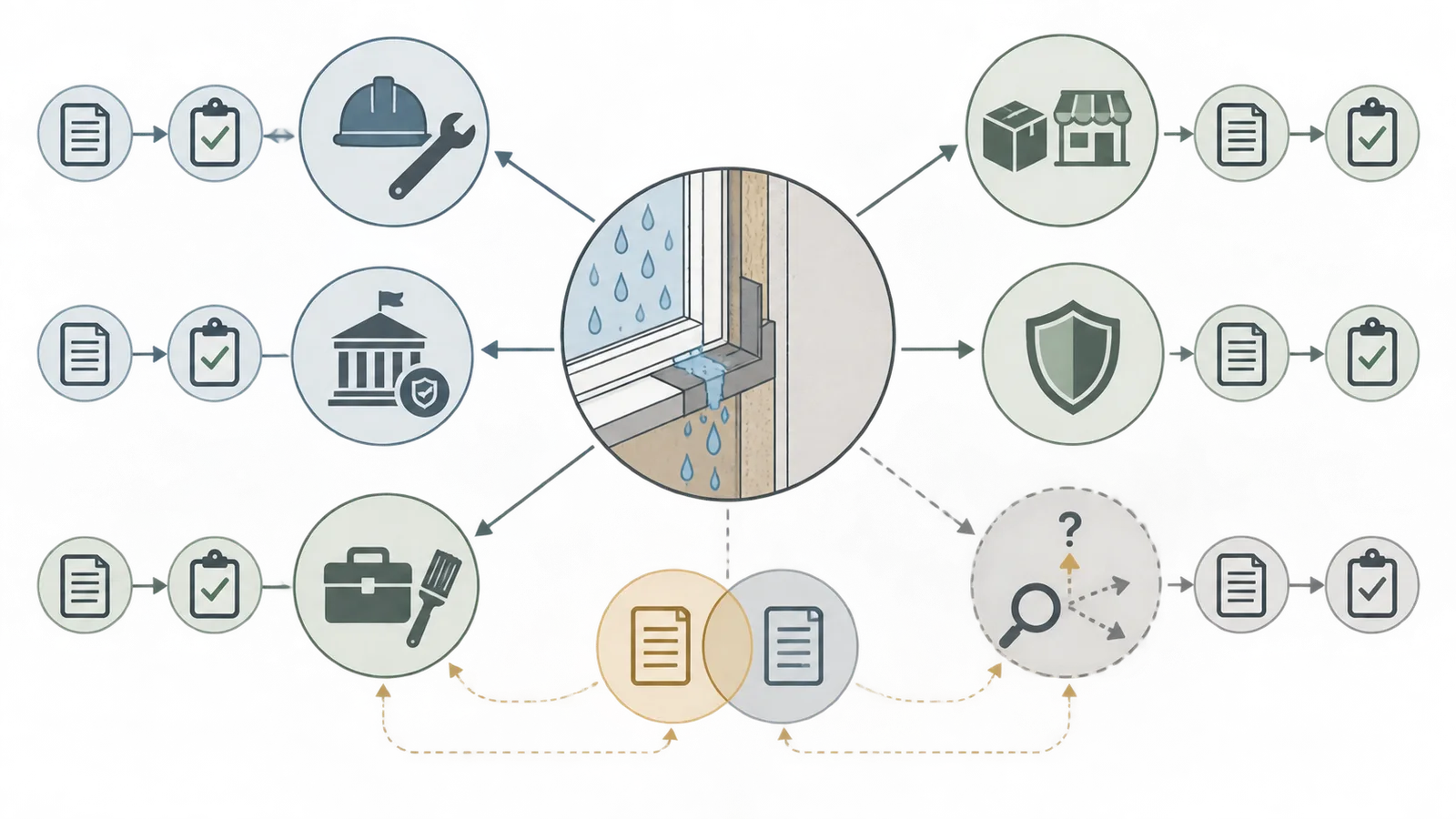
Overlap exists when more than one party has a plausible relationship to the same symptom, not when every party has equal responsibility. Consider a new bathroom faucet that drips from the connection behind a finished wall. The faucet manufacturer may have a parts warranty for defects in material and workmanship. The installer may have responsibility for the connection, shutoff, seal, support, or access panel. The renovation contract may allocate fixture installation, drywall closure, painting, and callbacks. The permit authority, if a permit was required, may have an inspection record relevant to plumbing work. The insurer may need notice if the leak caused sudden property damage under the policy. The owner may still be responsible for routine cleaning, freeze protection, or delayed maintenance depending on the facts.
Those are not contradictory statements. They are different questions:
| Question | Record that answers it | Likely next handoff |
|---|---|---|
| Was the work included and accepted? | Signed contract, scope, allowance, punch list, change order, payment record | Contractor or project manager |
| Was the product supposed to be covered? | Exact warranty version, model, serial, receipt, registration, exclusions | Manufacturer or authorized service route |
| Was the installation the cause? | Installation instructions, photos before closure, inspection notes, qualified diagnosis | Contractor or qualified trade |
| Was the work permitted and inspected? | Permit number, approved plan, inspection history, final approval, authority correspondence | Authority having jurisdiction |
| Was there a sudden covered loss? | Policy, declarations, loss date, damage photos, mitigation receipts, claim number | Insurer or agent |
| Is the symptom normal upkeep? | Manual, maintenance schedule, service history, use conditions | Owner or maintenance professional |
The first handoff is therefore a fact packet, not a demand for a final answer. The packet lets each party test the part of the problem they actually control.
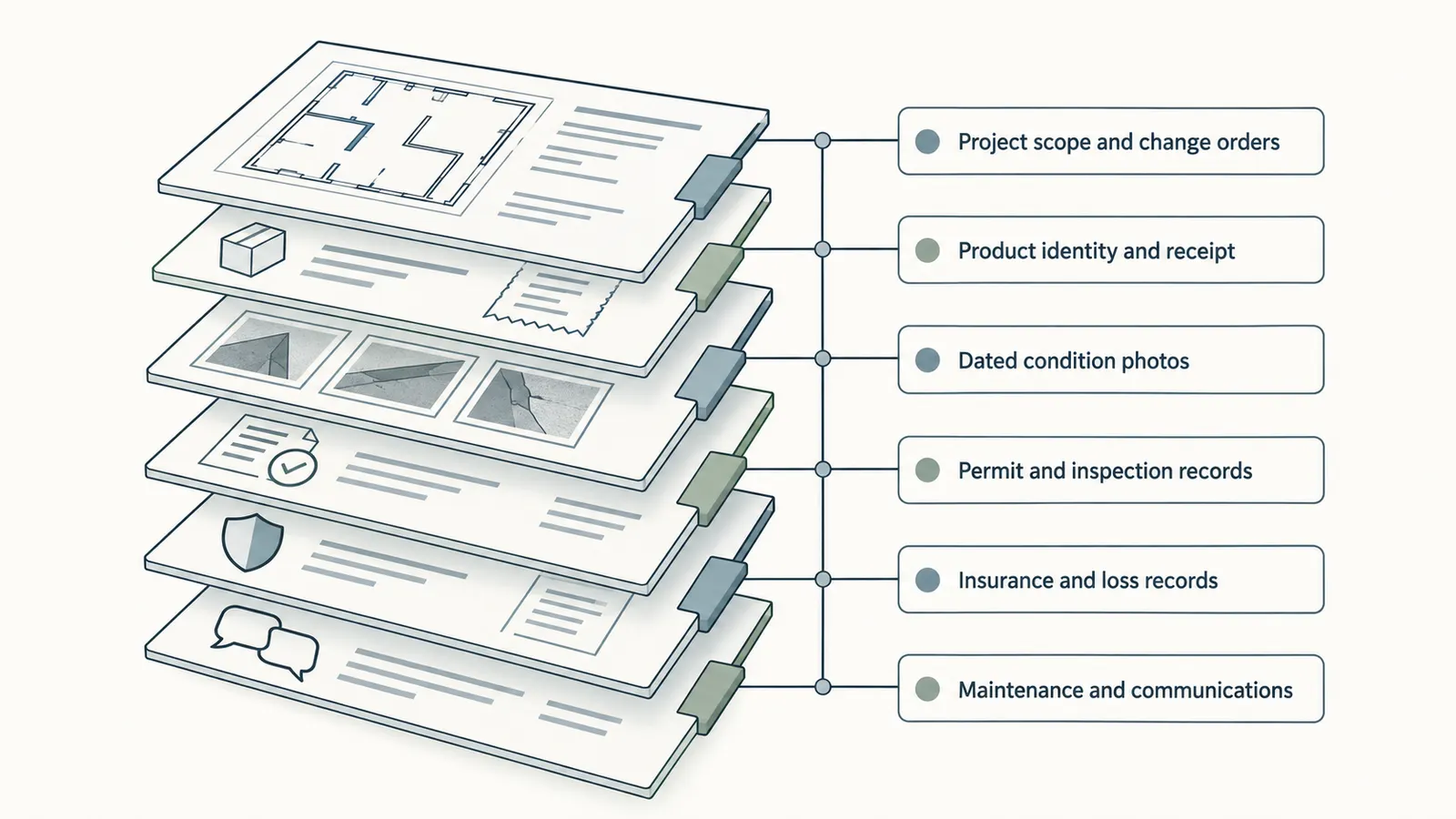
Keep this claim packet with the broader Brictale handover journey. If the record shows that a change, inspection, or unresolved field decision is central, cross-check the construction decision sequence and the contractor responsibility path before assigning the next owner.
What not to infer from an early response
Do not infer that a contractor’s statement “the part is under warranty” means labor, removal, reinstallation, drywall, paint, water damage, or consequential costs are covered. Do not infer that a manufacturer’s refusal to pay installation labor means the contractor is legally liable. Do not infer that a permit was unnecessary because the work was small, or that a permit guarantees workmanship. Do not infer that an insurer’s assignment of an adjuster confirms coverage. Do not infer that a symptom appearing after practical completion proves the newest trade caused it.
Treat each reply as one piece of evidence. Ask the responder to identify the term, observation, inspection finding, or policy provision relied upon. Preserve the unanswered questions for the next handoff rather than closing the file because the first party responds quickly.
Build the evidence packet without changing the condition #
Before contacting anyone, create a dated evidence packet that lets a person who was not present reconstruct what changed, where the symptom is, and which work package touched it. Preserve the condition unless a qualified professional must make a safe temporary repair. Photograph wide context, medium context, and close detail; save the original files; record the date, time, location, weather or operating conditions when relevant, and what you observed without diagnosing it.
The packet should have one index and separate folders for project records, product records, condition evidence, authority records, insurance records, and communications. Name files consistently, such as 2026-09-08-kitchen-faucet-under-sink-wide.jpg or 2026-09-08-contractor-callback-email.pdf. Keep an untouched copy. Do not crop away context, overwrite original photos, discard a failed component, or permit a party to remove evidence without recording what was removed and why.
The minimum packet
Use the following checklist before sending a non-emergency notice. “Unknown” is a valid entry; hiding a gap makes later routing harder.
- Work package: room, assembly, fixture, appliance, finish, exterior area, or system affected.
- Contract clause: the exact section or scope description that covers supply, installation, integration, testing, callback, warranty, or exclusions.
- Change order: signed change order, allowance, substitution, owner-supplied material note, or approved field change.
- Model and serial: product name, model, serial number, batch or lot if present, and photographs of labels before removing anything.
- Receipt: seller, purchaser, date, price if relevant, delivery record, registration confirmation, and proof of original ownership where the warranty asks for it.
- Install date: delivery date, rough-in date, final installation date, first use, practical completion, punch-list completion, and date the symptom was first observed.
- Symptom timeline: what changed, what happened first, whether the symptom is constant or intermittent, operating conditions, prior callbacks, and whether the condition is worsening.
- Photos and video: context, detail, labels, interfaces, water or staining paths, fasteners, clearances, and any visible damage. Add a simple ruler or known object only if doing so is safe and does not disturb the condition.
- Permit status: authority having jurisdiction, permit number, approved scope, inspection dates, inspection results, correction notices, final approval, or a documented answer that no permit was required.
- Maintenance records: cleaning, filter or cartridge changes, service invoices, owner actions, manuals followed, and any period the home was vacant, frozen, overloaded, or otherwise outside normal use.
- Exclusions: contract exclusions, warranty exclusions, policy exclusions, improper-installation language, owner-supplied work, non-authorized parts, misuse, ordinary wear, deferred maintenance, or pre-existing damage.
- People and companies: homeowner, general contractor, subcontractor, designer, installer, seller, manufacturer, service center, inspector, authority contact, insurer, adjuster, and emergency professional.
- Costs already incurred: temporary protection, diagnostic visit, materials, storage, lodging, and invoices. Label each cost as paid, quoted, estimated, or unknown.
- Communication log: date, recipient, channel, summary, promised response, attachments, and delivery proof.
The FTC recommends keeping the written warranty and receipt because the receipt helps establish the purchase date and original owner; use that as the baseline for the product folder, then add the contract and installation records that a generic product claim does not contain. The FTC’s warranty guidance explains what to save and why.
Record observation separately from interpretation
Write two lines for every important event. The first is an observation: “At 7:40 a.m. on September 8, a 3-inch damp area was visible on the cabinet floor below the right supply connection.” The second is a question: “Is the source the connection, the faucet body, the shutoff, or water traveling from another location?” Do not write “the faucet is defective” unless a qualified inspection or written manufacturer finding actually says that.
Use the same discipline for performance symptoms. “The exhaust fan did not start after the switch was pressed twice” is more useful than “the electrical installation failed.” “The tile grout darkened along the shower curb after use” is more useful than “the waterproofing is bad.” The neutral observation keeps the contractor, manufacturer, authority, and insurer from treating a homeowner’s early theory as a concession.
Preserve evidence while limiting further damage
If water is actively entering, shut off an accessible valve or the main supply only if you know how to do so safely; if electricity, gas, structural movement, or contamination is involved, use a qualified professional or emergency service. Take photos before moving items when that does not worsen the damage. Keep damaged components, packaging, labels, and removed materials if safe and practical. Record any emergency action, who performed it, why it was necessary, and what could no longer be observed afterward.
Insurance guidance is not universal coverage advice, but it illustrates the evidence discipline. The National Association of Insurance Commissioners recommends prompt notice when filing a claim, photos or video, policy and loss details, and repair receipts, while noting that reporting time varies by state. Read the NAIC consumer claim guidance. If you are in California, the California Department of Insurance gives the additional state-specific example of protecting the property, logging correspondence, and avoiding extensive permanent repairs before the adjuster assesses the damage. That California guide is not a national rule.
Ask for the missing records, not a confession
Your first written request should be narrow and usable. Ask the contractor for the installation date, installer identity, approved substitutions, commissioning or testing record, relevant subcontractor scope, callback history, and any photographs taken before concealment. Ask the manufacturer or seller for the current warranty version applicable to the model, required claim documents, authorized service route, inspection or return procedure, and whether removal should wait for inspection. Ask the authority for the permit and inspection record through its published process. Ask the insurer how to report and preserve a potential loss, not whether the insurer agrees with your cause theory.
Do not ask “Will you pay everything?” before the facts are assembled. Ask “What do you need to determine whether your route applies, who will inspect, what condition must be preserved, and when will you provide the next written decision?” This wording preserves the possibility that multiple parties respond to different parts of the same defect.
Use the Warranty-Route Handoff Matrix #
The right route is the one best supported by the current records, with a parallel notice where another party’s deadline, inspection right, safety responsibility, or policy condition could be affected. The matrix below does not assign liability. It assigns the next action and makes uncertainty visible.
The matrix
| Work-package inputs to complete | What the pattern may suggest | Likely route now | Parallel notice | Next-action owner | Deadline or clock to confirm | Verification before close |
|---|---|---|---|---|---|---|
| Symptom is a product component failure; model, serial, receipt, purchase date, and normal-use facts are available; no installation damage is visible | Product defect is plausible, but compatibility and installation remain untested | Manufacturer or seller warranty route | Contractor if it supplied or installed the product; insurer if resulting property damage may be covered | Homeowner opens the claim; manufacturer or seller states required inspection | Warranty period, claim-notice method, return authorization, and any state-law period | Written diagnosis or disposition, correct replacement, operating test, and updated records |
| Symptom is at a connection, seal, fastener, support, finish interface, or concealed transition; contract assigns installation | Workmanship or installation interface is more plausible than a factory defect | Contractor or responsible installer | Manufacturer if product may also be affected; insurer for resulting damage | Contractor schedules a qualified inspection and proposes scope | Contract callback/warranty language, notice clause, and any preservation requirement | Leak or performance test, photographs of opened and restored work, written scope, and punch-list sign-off |
| Product warranty excludes improper installation or labor, and the symptom is consistent with installation error | Manufacturer may decide only the part claim; install and removal costs may remain elsewhere | Contractor for installation; manufacturer may still inspect the component | Seller or manufacturer for a component decision; insurer if damage is a separate loss | Homeowner sends parallel factual notices | Confirm written terms, service authorization, and contractor contract deadline | Each party’s written scope states which cost and condition it accepted or declined |
| Work was changed by signed change order or owner-supplied substitution | Responsibility may follow the changed scope rather than the original bid | Party named in the change order or supplier/manufacturer | Original contractor if it coordinated or approved the substitution | Homeowner compares signed documents and sends the complete chain | Change-order notice, product warranty, and contract dispute deadlines | Replacement or correction matches the approved change, not just the original scope |
| Permit number, approved plan, or inspection record is missing or shows an unresolved correction | Authority record or permit status needs confirmation; it is not proof of a private remedy | Authority having jurisdiction for record/status questions | Contractor and designer; insurer if policy or underwriting questions arise | Homeowner or authorized applicant requests the record | Local request process, inspection scheduling, and any correction deadline | Written record, final inspection status, or clear local answer for the actual address |
| Sudden event caused separate property damage; policy is active and loss date is known | Insurance notice may be time-sensitive regardless of the product or contract dispute | Insurer or agent for claim notice and mitigation instructions | Contractor/manufacturer after evidence is preserved | Homeowner reports facts, policy number, date, damage, and mitigation | Policy notice, proof-of-loss, deductible, and state-specific deadlines | Claim number, adjuster scope, written coverage position, and receipts |
| No active defect is shown; symptom matches cleaning, adjustment, consumable replacement, or scheduled service | Maintenance route is more plausible than a warranty route | Owner maintenance or qualified service professional | Manufacturer if manual or warranty requires authorized service | Homeowner schedules service and records the action | Manual intervals, service terms, and any warranty maintenance condition | Measured or observed operation after service and next maintenance date |
| Cause remains unknown or evidence conflicts | More inspection is needed before permanent repair or blame | Qualified diagnostician appropriate to the system | Contractor, manufacturer, authority, insurer as applicable | Homeowner controls access, scope, and evidence preservation | Notice and evidence-preservation clocks for each plausible route | Written report states observations, testing performed, limitations, and recommended next handoff |
How to fill one row
Start with one row per affected work package, not one row per person you have contacted. If a shower has a failed door seal, swollen baseboard, and staining in the adjacent room, those may be related, but they are not automatically one route. Create a row for the door and seal, a row for the wall or floor assembly, and a row for the resulting property damage if the evidence supports those separations. A single broad row encourages everyone to answer only the portion most convenient to them.
For each row, fill the inputs in this order:
- Name the symptom and boundary. Record the room, assembly, and the first visible location. State what you know and what you do not know.
- Map the scope. Quote the contract clause, allowance, product schedule, change order, or owner-supplied note. Identify who supplied the product and who installed it.
- Identify the product. Record model, serial, purchase receipt, delivery date, install date, registration, instructions, and warranty version.
- Map the interface. List adjacent materials and systems that could contribute: substrate, framing, flashing, sealant, fastener, valve, wiring, drain, vent, finish, control, or software connection. Do not open concealed work without a qualified reason and a preservation plan.
- Check the authority record. Identify the actual city, county, state, tribal, or other authority with jurisdiction over the address. Record permit number, inspection status, and unresolved notices. Never copy a local rule from one city into another.
- Check the policy trigger. Distinguish a defect that developed over time from a sudden event that damaged otherwise sound property. Read the actual policy and contact the insurer if notice could be required.
- Choose the next verification. A route is not complete when an email is sent. It is complete when the owner has a dated inspection, written disposition, measured test, repair scope, permit record, claim number, or documented maintenance result.
A worked illustrative example
The following is an illustrative scenario, not a real homeowner record, test, price, or predicted coverage result.
Assume a homeowner completed a kitchen renovation on June 20. A Delta faucet was installed as part of the signed scope. On September 8, the homeowner sees water under the sink after the faucet is used. The faucet model and receipt are available. A photo shows moisture around a braided supply connection, but the connection has not been opened. The contract says the contractor supplied and installed the faucet and includes a 12-month workmanship callback. The permit record is unknown. No other room is damaged yet.
The packet should not label this “defective faucet.” It should record:
- Contract clause: faucet supply and installation included; callback language and notice method copied exactly.
- Change order: none found; status marked “not found,” not “none,” until the project file is checked.
- Model and serial: model photographed; serial unavailable if the faucet has none or is inaccessible; status recorded.
- Receipt: dated receipt and seller identified.
- Install date: June 20 practical completion; exact rough-in date unknown.
- Symptom timeline: first observed September 8 after ordinary use; no earlier callback reported.
- Photos: cabinet-wide, connection-medium, connection-close, label, and surrounding dry areas.
- Permit status: City or county authority for the actual address still to be checked; no Seattle rule is assumed unless the home is in Seattle, Washington.
- Maintenance: no cleaning or repair performed; faucet used according to ordinary household use as far as known.
- Exclusions: the Delta warranty’s language on normal installation, labor, improper installation, maintenance, repair, proof of purchase, and model-specific terms are copied into the product folder. Delta’s actual warranty explains its covered parts and finish, labor limitation, installation exclusion, and claim documents.
The first route is a contractor notice because the known scope includes installation and the symptom is at an interface. The parallel route is a factual manufacturer or seller notice because the product may have a covered part issue and because the receipt and model are available. If water has damaged cabinet material or flooring, the homeowner checks the policy and considers prompt insurer notice under the policy’s terms. The permit authority is a record-check route, not a repair demand.
The homeowner’s message can say: “On September 8 at approximately 7:40 a.m., I observed moisture at the right supply connection below the kitchen faucet after ordinary use. Attached are original photos, the invoice, the contract clause, model information, and the timeline. Please confirm whether you will inspect the installation, what condition should be preserved, and your proposed next step. This notice is factual and does not waive any contract, product, permit, insurance, or other route.” That message is intentionally incomplete on causation.
Illustrative sensitivity: what changes the route
The same symptom can produce different routing if one input changes. This is a sensitivity check, not a probability calculation.
| Changed input | Route effect | Why the next verification changes |
|---|---|---|
| Moisture is from the faucet body after the connection remains dry | Manufacturer or seller becomes stronger as a product route | The component itself may be implicated; the manufacturer’s inspection procedure matters |
| Contractor installed a non-approved substitution not in the signed change order | Contractor and change-order route becomes stronger | Scope, approval, compatibility, and supply chain must be reconstructed |
| Homeowner installed the faucet after contractor closeout | Contractor route may narrow for installation; product and owner-maintenance routes remain | The actual installer and contract boundary changed |
| Cabinet damage appears after a sudden line failure | Insurer notice may become time-sensitive for resulting property damage | The policy may require prompt notice and mitigation even while warranty routing continues |
| Permit record shows an unresolved correction for the affected plumbing work | Authority and contractor need a coordinated records check | The owner needs the correction status and a qualified plan before closing the wall |
| Symptom appears only after freezing or prolonged vacancy | Warranty exclusions, maintenance, and site conditions need review | The product term may treat use conditions differently from a manufacturing defect |
The matrix is useful because it makes the input change visible. It prevents a homeowner from repeating the same message to five parties while omitting the one fact that actually changes responsibility.
Separate contract, product, permit, insurance, and maintenance responsibility #
Treat the five routes as parallel lanes with different owners. A “warranty claim” is not a single universal process. The contract controls the renovation relationship; the product warranty controls the manufacturer’s written promise; the authority controls public permitting and inspection records; the insurance policy controls the insurer’s claim process; and maintenance controls owner duties and routine service. They can overlap without replacing one another.
Contractor and installer route
Send the contractor the affected work package, exact contract language, change-order chain, symptom timeline, photos, and a requested inspection window. Ask the contractor to identify the responsible installer or subcontractor, preserve the condition, and state whether it proposes inspection, temporary protection, repair, replacement, or further diagnosis.
The contractor route is strongest when the symptom is at an interface: a leak at a connection, loose trim, inadequate support, missing flashing, incompatible transition, incomplete seal, incorrect clearance, damaged finish, or failure to follow the installation instructions. It is also strong when the contract expressly assigns installation, commissioning, testing, callbacks, or warranty administration. It is weaker when the work was owner-supplied and owner-installed, when a later trade altered it, when normal maintenance is overdue, or when the product itself fails under normal installation.
Do not accept a verbal “we do not warranty that product” as a complete answer if the contractor separately supplied or installed it. Ask the contractor to distinguish product coverage from installation scope, labor, removal, access, restoration, and resulting damage. Ask what part of the contract it relied upon. If the contractor refuses access or proposes a permanent repair before another party’s inspection, document the proposal and seek advice from a qualified professional or attorney where the consequences are significant.
Manufacturer or seller route
Read the warranty for the exact model and market, not a search-result summary or a different product family. Record the warranty version and date accessed. Confirm who may make the claim, what purchase proof is required, whether registration matters, whether an authorized servicer must inspect, what is covered, what labor or removal is excluded, and whether the product must be returned or left in place.
The FTC explains that written warranty terms should be available to read before purchase and that a consumer should keep the warranty and receipt. It also advises contacting the seller first and writing to the manufacturer if the seller does not resolve the problem, with proof that written notice was received. Use the FTC’s written guidance as a routing baseline. That guidance does not turn a product warranty into a renovation workmanship warranty, and it does not establish the deadline for your particular contract or state claim.
The Delta Faucet warranty is a concrete illustration of why the distinction matters. For applicable United States residential products, it describes coverage for parts and finishes that prove defective in material or workmanship under normal installation, but says labor charges to repair, replace, install, or remove are not covered and excludes damage from improper or incorrectly performed installation, maintenance, or repair. It asks for model information, purchase date, and proof of purchase for service. Review Delta’s current warranty before using this example for a real claim. A Delta decision about a faucet part would not by itself decide who must repair a bad connection or restore a cabinet.
When contacting a manufacturer, send neutral facts and ask for a case number, applicable warranty version, required photos or tests, inspection method, return authorization, and whether removing or repairing the product could affect the claim. Do not let a service representative’s informal guess become the only record. Save chat transcripts, names, dates, ticket numbers, and the final written disposition.
Permit and authority route
The authority having jurisdiction is the city, county, state, tribal, or other public body responsible for the actual address and type of work. Its role is local and public. It may confirm whether a permit was required, provide permit and inspection records, schedule an inspection, issue a correction, or explain its complaint process. It is not automatically the contractor’s warranty administrator, the manufacturer, or the insurer.
Use the permit route when the project file lacks a permit number, the approved scope may not match the work, the inspection record is incomplete, a correction is unresolved, the work affects life safety, or a local official needs to determine what should be inspected. Ask factual questions: What authority has jurisdiction? Was a permit issued? What scope was approved? What inspections were recorded? Is a final approval or correction notice outstanding? What is the proper process for an owner to request a record or report a concern?
The local example in this article is the City of Seattle, Washington. Seattle’s Department of Construction and Inspections says a construction addition or alteration permit is needed to build an addition or remodel, while some small projects may qualify for a subject-to-field-inspection permit or a listed exemption. See the City of Seattle’s house additions and remodels page. That statement applies to Seattle, Washington, not to the United States generally. A homeowner in another city must use that jurisdiction’s official permit office and current code.
If a Seattle homeowner is checking a remodel, Seattle’s own page says to research the code, permit type, and inspection process; it also notes that specialty permits may be needed. Do not use the Seattle example to conclude that a similar project in Phoenix, Boston, or an unincorporated county is exempt or required. Put the jurisdiction name and source page in the matrix so a later reviewer can see which local rule was actually used.
Insurance route
Notify the insurer when the facts suggest a sudden event or resulting property damage and the policy may require prompt notice, while avoiding a claim theory you cannot support. The insurer’s question is usually whether the policy responds to a covered loss under its terms, not whether the manufacturer’s product warranty is valid. A contractor defect and an insurance claim can coexist, but they are not interchangeable.
Before calling, have the policy number, loss date or discovery date, photos, temporary-protection receipts, contractor details, product records, and a factual description. Ask whether the insurer wants an adjuster to inspect before permanent repair, what mitigation is authorized, whether a deductible applies, what proof of loss is required, and how to preserve damaged materials. Do not promise the contractor that insurance will pay, and do not delay notice while waiting for a warranty decision if the policy or state process may impose a clock.
NAIC guidance says reporting time varies by state and recommends promptly notifying the insurer, documenting damage, and keeping repair receipts. Read the NAIC guidance. If the home is in California, the state Department of Insurance provides a different level of state-specific detail about protecting the property, logging correspondence, and the adjuster’s assessment. Use California’s guide only for California-specific guidance.
An insurer’s inspection is not a contractor-quality inspection. It may establish the scope of an insured loss, while a qualified trade diagnoses why a product or installation failed. Keep both records and ask each professional to state the limitations of the inspection.
Maintenance route
Use maintenance when the symptom is consistent with a manual-directed task, consumable replacement, adjustment, cleaning, filter or cartridge service, or ordinary wear, and no project defect or sudden loss is indicated. Maintenance is not a way to re-label a defect to avoid a warranty claim. It is a route chosen from the equipment manual, service record, operating conditions, and inspection evidence.
Record what was done, by whom, on what date, with which part or product, and what changed afterward. If the manual calls for an authorized service provider, follow that term and preserve the invoice. If a maintenance action requires electrical, gas, pressure, refrigerant, structural, elevated, confined-space, or concealed work, assign it to a qualified professional. Stop if the work would change the evidence needed by a contractor, manufacturer, authority, or insurer.
Follow a notice-and-verification sequence #
Use a seven-stage sequence: make the situation safe, freeze the evidence, classify the work package, verify the written instruments, send parallel notice, obtain a qualified response, and close only after verification. The order is designed to avoid two common failures: repairing too soon and waiting so long that another party says it could not inspect or that a notice deadline passed.
Stage 1: make the situation safe
Decide whether the symptom is an emergency or an ordinary claim. Active water intrusion, fire, gas odor, exposed energized conductors, suspected structural movement, unsafe access, hazardous dust, and contamination are safety problems before they are warranty problems. Leave unsafe areas. Call emergency services or a qualified professional. A homeowner can often document a visible condition and shut an accessible valve, but should not open energized equipment, enter a confined space, climb an unsafe roof, disturb suspect lead paint, cut structure, or perform a pressure, gas, electrical, or contamination test without appropriate training and equipment.
Record the temporary action. Write “main water shutoff closed at 8:05 a.m. to stop active flow” rather than “contractor caused the leak.” Keep receipts and photos before and after mitigation. If a professional removes a component, ask for a description, photographs, part identity, and storage or disposal plan.
Stage 2: freeze the evidence
Create the packet described above. Photograph the condition from stable locations. Export text messages and emails. Save the signed contract, scope, change orders, invoice, permit record, warranty, manual, and maintenance record. Put each item in a dated communication log. If a party asks you to discard a product, ask for that request in writing and ask whether an inspection is available first.
Do not clean a stain, reset a device, tighten a connection, repaint a failed finish, or replace a part merely to make the home usable unless it is necessary for safety or mitigation. If you must do it, photograph and describe the pre-repair condition and retain the removed part.
Stage 3: classify the work package
Identify what physically failed and what consequence followed. Separate source, interface, and resulting damage. For example, “failed seal at window” is different from “wet drywall below window” and different again from “mold concern requiring professional evaluation.” The classification decides who needs what evidence.
List the people who touched the assembly: designer, general contractor, specialty subcontractor, supplier, installer, owner, maintenance provider, and later repair person. The most recent person is not automatically the responsible person. The original installation, a later alteration, normal movement, a product defect, and deferred maintenance can all affect the result.
Stage 4: verify the written instruments
Build a side-by-side comparison with five columns: contract scope, product warranty, permit record, insurance policy, and maintenance requirements. Highlight every clause that speaks to supply, installation, labor, access, callbacks, notice, inspection, exclusions, authorized service, change orders, governing law, dispute procedure, preservation, and deadlines.
For the product, match the exact model and serial. A warranty for a similar model is not enough. For the contract, match the signed version and every change order. For the permit, match the actual address and the work scope. For insurance, match the policy in force on the relevant loss date. For maintenance, match the manual and the actual service history. Record contradictions instead of choosing the most favorable document.
Stage 5: send parallel factual notices
Send the contractor or installer a request to inspect and preserve the condition. Send the seller or manufacturer the product record and request the warranty claim procedure. Contact the authority for permit and inspection records when the public record is material. Notify the insurer when the policy or facts suggest a claim or notice obligation. If the symptom is ordinary upkeep, schedule maintenance while preserving any unresolved product or installation question.
Parallel notice does not mean accusing everyone. It means giving each party enough information to protect its own inspection rights and route the issue. Include a sentence reserving judgment: “I am providing the same factual timeline to the potentially relevant parties because the cause and responsibility are not yet determined.”
Use a delivery method appropriate to the instrument. Email may be fast; a portal may be required; certified mail or another traceable method may help prove receipt for a formal manufacturer notice. The FTC specifically recommends proof that a written warranty notice was received. Follow the FTC’s notice guidance. A receipt does not prove the merits, but it proves that notice was sent and received.
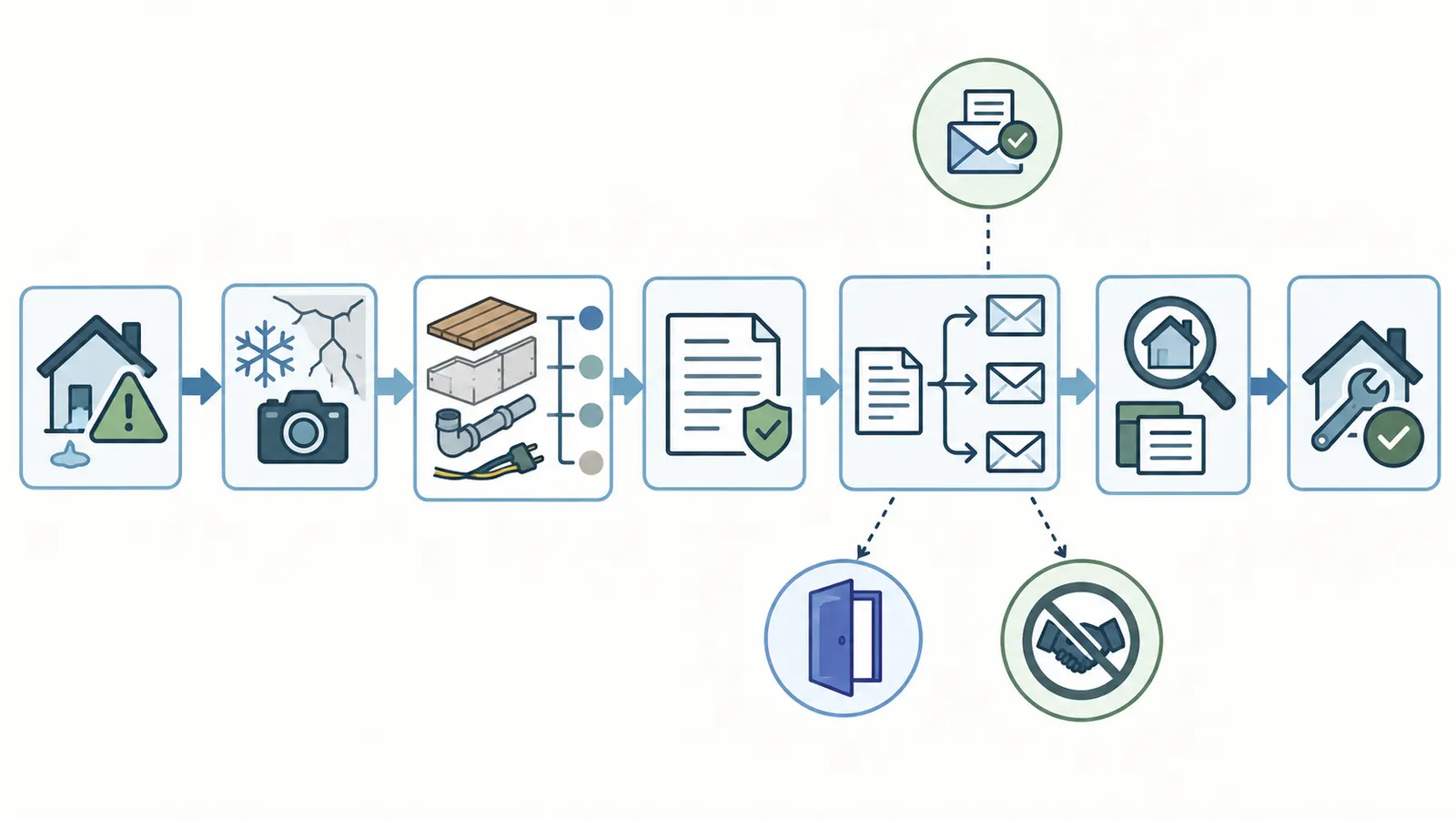
Stage 6: obtain a qualified response
Ask each party for the next concrete step, not just a position. The contractor should identify who will inspect, when, what will be opened, and how the area will be restored. The manufacturer should identify claim requirements, inspection or return steps, and the written term used. The authority should identify the applicable record or process for the actual address. The insurer should identify the claim number, adjuster, mitigation instructions, and documents required. The maintenance professional should identify the observed condition, service performed, and post-service result.
If the cause is concealed or technically complex, hire a qualified independent professional whose scope is limited to diagnosis and documentation. Ask for a written report with observations, tests performed, conditions not tested, photographs, instruments or measurement units if measurements are taken, and recommended next action. Do not ask for a legal conclusion or a coverage opinion from a trade professional who is not engaged for that purpose.
Stage 7: verify before you close
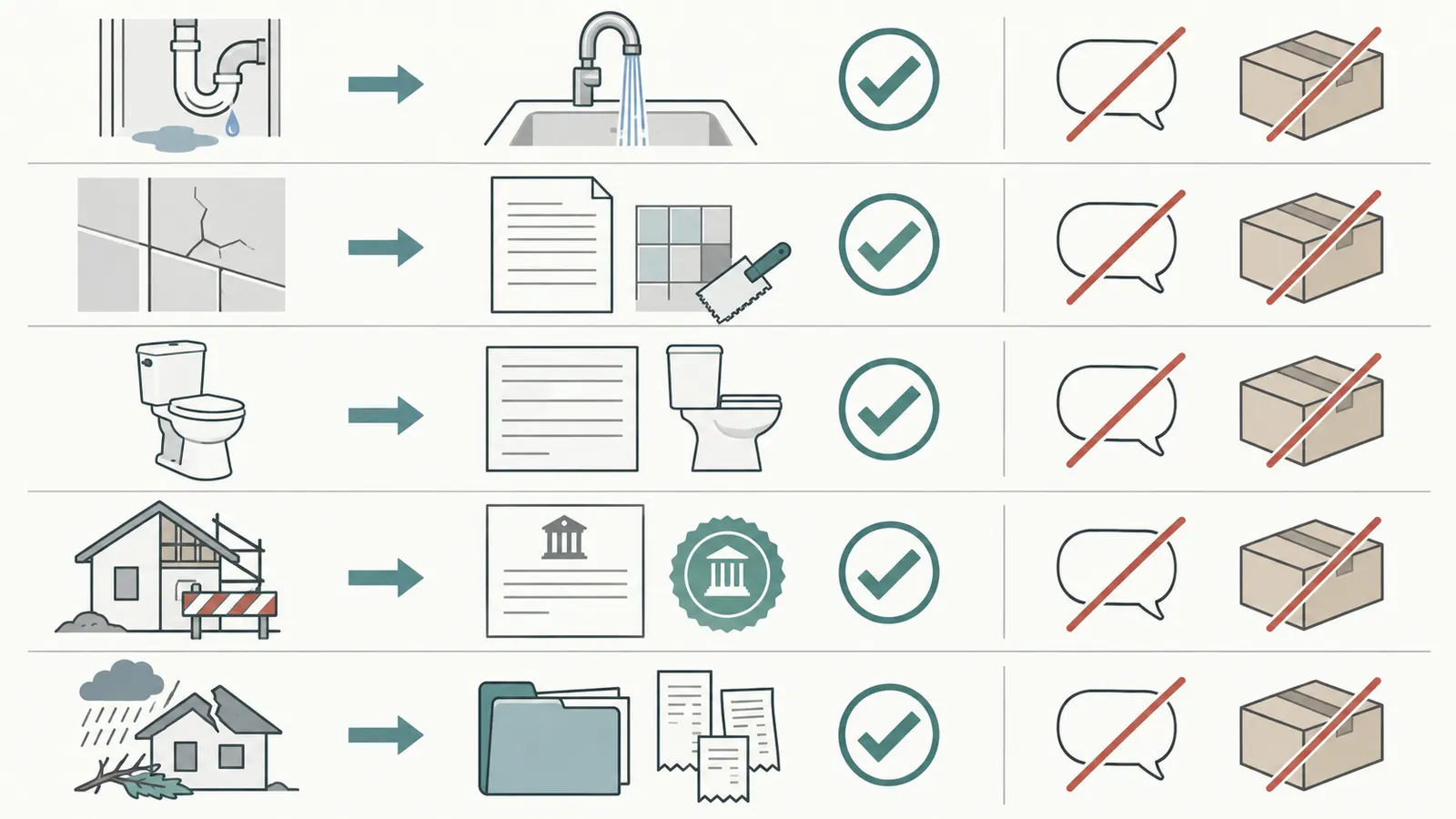
Verification should match the symptom. A leak needs a safe leak or functional test under relevant operating conditions, photographs of the repaired interface before concealment, and confirmation that adjacent damage is dry or has a separate remediation plan. A finish failure needs a written repair scope, substrate or moisture assessment when relevant, and an agreed observation period. An appliance or fixture needs a normal-operation test and the model or replacement record. A permit issue needs the authority’s record or final inspection status. An insurance file needs the claim scope, written coverage position, receipts, and open items.
Close a matrix row only when the next verification is complete and the evidence packet contains the result. “Contractor said fixed” is a communication entry, not a verification. “Manufacturer shipped a part” is not a verified repair. “Permit exists” is not the same as “affected work received final approval.” “Adjuster visited” is not the same as “coverage decision issued.”
Handle lead-safe, permit, and safety boundaries #
Renovation claim handling can create a second hazard if the homeowner opens walls, sands finishes, resets equipment, or removes contaminated material to investigate. Safety and jurisdiction boundaries must remain explicit: federal lead-safe requirements are not a general warranty rule, a city permit is not national law, and a remote article cannot diagnose a concealed defect.
Lead-safe renovation records
If the home is pre-1978 and paid renovation, repair, or painting work disturbed painted surfaces, check the federal EPA Renovation, Repair, and Painting program and the actual state or tribal program. EPA says covered firms generally must be certified, including general contractors and specialty trades, and lists activities such as remodeling, electrical work, plumbing, carpentry, painting preparation, and window replacement. Read the EPA contractor scope. The rule has exceptions and thresholds; do not assume a small-looking repair is exempt without checking the exact scope.
EPA recommends that owners of pre-1978 homes hire lead-safe certified contractors for RRP work. Read the EPA consumer page. EPA’s DIY page says the federal RRP Rule generally does not apply to a homeowner doing covered work in the homeowner’s own home, subject to stated exceptions, and says the homeowner should determine the home’s age, consider whether lead-based paint may be present, control dust, clean the work area, and use qualified testing or assessment where appropriate. See EPA’s DIY boundary and practices.
For a post-renovation claim, request the lead-safe handoff records when applicable: firm and renovator certification, worker training, pre-renovation education, any lead-free determination or testing record, containment and cleanup documentation, and post-renovation cleaning verification. EPA states that RRP records must be retained for three years after completion and lists lead-free determinations, pamphlet distribution, and compliance documentation. Review EPA’s current recordkeeping guidance. The federal rule at 40 CFR 745.86 requires covered renovation firms to retain and make available records needed to demonstrate compliance for three years, without displacing longer state or tribal duties. Read the current eCFR Part 745 text.
EPA describes the work-practice objective as minimizing dust and debris, preventing it from leaving the work area, and completing cleanup followed by verification. It also identifies records such as certified-renovator credentials, worker training, test-kit or paint-chip information, owner education, and other signed documents. See EPA’s work-practice page. These records can help route a lead-safe compliance question or a suspected cleanup failure; they do not prove that the contractor owes every later repair cost.
Do not scrape, sand, drill, or open painted surfaces to investigate a warranty issue unless the work is planned and performed under the applicable lead-safe requirements. If a child, pregnant person, or vulnerable occupant may have been exposed, seek qualified health and environmental advice promptly. A contractor’s claim that “the paint was probably fine” is not a substitute for the applicable record or testing path.
Permit and inspection boundaries
Permit rules depend on the jurisdiction, work type, building, zoning, and current code. The authority can tell you what record exists and what process applies; it may not decide a private contract dispute. Use the authority’s exact name in every note.
For the named local example, the City of Seattle says its addition or alteration permit covers remodeling and notes possible specialty permits and field-inspection pathways. See Seattle’s actual remodel page. If the home is in Seattle, ask SDCI for the applicable permit and inspection history. If the home is elsewhere, delete “Seattle” from the row and replace it with the actual authority. Do not copy Seattle’s exemptions, dollar thresholds, inspection terms, or code citations into another city or county.
If an inspection is still possible, do not conceal the affected work before asking the authority or qualified inspector what must remain visible. If a wall is already closed, record when it was closed, who closed it, which photos exist before closure, and what non-destructive evidence is available. A missing pre-close photo is an evidence gap, not proof that the work was wrong.
Hazard assignment
The homeowner can usually perform low-risk document collection, observation, file comparison, and communication. Assign the following to qualified professionals unless the person has the applicable training, authorization, and equipment:
- energized electrical diagnosis, panel work, concealed wiring, and service changes;
- gas, combustion, venting, refrigerant, pressure, or backflow work;
- structural opening, shoring, load-path assessment, foundation work, or suspected movement;
- roof, ladder, fall-exposure, excavation, confined-space, or exterior-height work;
- lead-paint disturbance, asbestos or other hazardous-material handling, and contamination cleanup;
- concealed moisture, mold, sewage, or indoor-air investigations that require controlled sampling or remediation;
- removal, disassembly, or testing that could alter a manufacturer claim or permit inspection;
- permanent repair before an insurer, authority, contractor, or manufacturer has had a reasonable opportunity to inspect when the issue may be material.
Remote photographs can establish that a symptom was visible on a date. They cannot establish concealed causation, code compliance, structural capacity, safe electrical condition, lead clearance, insurance coverage, or product failure by themselves. Say exactly what the photographs show and what they cannot show.
Escalate, close, and prevent the next overlap #
Escalation is appropriate when a party will not identify the term or evidence supporting its position, refuses a reasonable inspection, misses a promised response, requests irreversible work without explaining why, or leaves an unresolved safety, permit, insurance, or recordkeeping issue. Escalation should add documentation and the right decision-maker, not simply repeat an accusation.
Common failure cases and the corrective handoff
| Failure case | Why it causes trouble | Corrective action |
|---|---|---|
| The owner repairs before photographing or notifying anyone | The original condition and inspection opportunity disappear | Preserve what remains, document the repair sequence, retain removed parts and invoices, and send a factual update |
| The owner contacts only the manufacturer | Installation labor, access, contract scope, and resulting damage may be left unaddressed | Notify the contractor or installer in parallel with the product route |
| The contractor says “manufacturer warranty” and leaves | Product coverage does not answer installation, integration, or restoration scope | Ask for the contract clause and a written division of product, labor, access, and resulting damage |
| The manufacturer says “installer error” without inspecting | A verbal conclusion is not a complete technical record | Request the written term, observed basis, inspection protocol, and next authorized service step |
| The homeowner treats a permit as a quality guarantee | A permit record is not a private warranty or a promise that hidden work is defect-free | Ask the authority about permit and inspection facts, then use a qualified professional for quality diagnosis |
| The homeowner waits for a contractor reply before notifying insurance | A policy or state process may impose prompt notice | Review the policy and notify the insurer if a potential loss exists, preserving the product and contract routes |
| An insurer’s adjuster treats a workmanship question as settled | Coverage scope and technical cause are different questions | Request the written claim scope and use a qualified trade or engineer for technical diagnosis |
| An owner calls routine maintenance a warranty defect | A manual-directed service issue may not be a manufacturing or installation failure | Complete safe qualified maintenance, record the result, and keep the product route open if the symptom persists |
| The owner relies on a screenshot of a different warranty version | Terms, model families, markets, and dates can differ | Save the exact model, current applicable warranty, and purchase record |
| A pre-1978 project has no RRP handoff record | Lead-safe compliance, cleanup, and later exposure questions cannot be reconstructed | Request the federal/state records from the firm, avoid disturbing painted surfaces, and use the applicable authority or qualified professional |
| A local rule is copied from another city | Jurisdiction-specific requirements are misapplied | Name the authority for the actual address and cite its current official page |
| Everyone agrees to “come back later” | No owner, deadline, or verification is recorded | Send a written recap with owner, date, requested records, condition to preserve, and the next decision |
Escalate the contractor route
Escalate first inside the contractor’s documented process: project manager, owner, warranty coordinator, or designated dispute contact. Send the original packet, a short chronology, the clause at issue, the response requested, and a reasonable date for acknowledgment. If the contractor’s work may be licensed or regulated, consult the actual state or local licensing authority for its complaint process; do not assume a licensing complaint will obtain payment or replace a private claim. If significant money, concealment, injury, or a contract deadline is involved, a licensed attorney in the relevant jurisdiction can advise on rights and notice without this guide making a legal conclusion.
Escalate the manufacturer route
Ask the seller or manufacturer for the written denial or limitation, the warranty clause used, the inspection record, the appeal or supervisor path, and the authorized service procedure. Keep the product in the condition requested. If the issue remains unresolved after the documented seller and manufacturer route, the FTC suggests reporting unresolved company problems to the FTC or a state attorney general, but that reporting path is not a substitute for a private legal remedy and does not guarantee repair. See the FTC’s resolution guidance.
Escalate the authority route
Ask the permitting office for its published record-request, inspection, complaint, or correction process. Record the official’s name or reference number, not just an informal verbal answer. If the authority says no permit is required, save the answer with the date, address, project description, and conditions stated. If it identifies an unpermitted or nonconforming condition, ask what lawful next step is available. Do not direct an unsafe or unqualified person to open the work merely to satisfy an inspection.
Escalate the insurance route
Ask for the claim number, assigned adjuster, requested documents, inspection date, written coverage decision, and any deadlines. Keep the correspondence log and copies of all submissions. If the dispute is about claim handling, the state insurance department—not a manufacturer or contractor—may have a consumer assistance or complaint process. The California Department of Insurance describes written denial reasons and a state assistance path for California claims; other states have different rules and agencies. Use the actual state department for the property.
Close the row and hand off to ownership
At resolution, update the home’s handover file with the final symptom description, cause as stated by the qualified party, repair scope, replaced part and serial, invoice, warranty or service case, permit record, photographs before concealment, test result, and next maintenance date. If the result is “not resolved,” keep the row open and record the next escalation. If the result is “cause unknown,” do not convert it to maintenance simply because the symptom stopped temporarily.
The final handoff should answer six questions:
- What failed or was observed?
- Which party performed or authorized the corrective action?
- Which document or term governed that action?
- What was not covered, not tested, or still uncertain?
- What verification shows the home is safe and functioning for the intended use?
- What should the owner monitor, maintain, or report next, and by what date?
Prevent the next overlap at practical completion
The best warranty claim packet starts before the problem. At practical completion, ask for a signed scope, all change orders, product schedules, model and serial photographs, receipts, manuals, installation and maintenance instructions, installer and subcontractor identities, permit numbers, inspection results, lead-safe records when applicable, test and commissioning notes, closeout photos before concealment, warranty contacts, and written callback terms. Put the records in an owner-controlled folder, not only in a contractor portal.
For each installed product, create a one-line register: product, model, serial, seller, receipt date, installed date, installer, warranty period, exclusions that matter, service route, maintenance interval, and access requirement. For each permit, record authority, permit number, approved scope, inspection date, final status, and where the public record is stored. For each system, record what the homeowner can safely observe and what requires a qualified professional.
For pre-1978 covered renovation work, ask for the RRP handoff records before the crew leaves. EPA’s work-practice guidance identifies the kinds of certification, training, testing, owner-education, and compliance records that should exist for covered work. Use EPA’s current work-practice list. Keeping those records with the renovation file does not prove future coverage, but it makes a later safety or responsibility question answerable.
The next decision after a closed claim is not “forget it.” It is whether the repair changed maintenance, access, inspection, or insurance needs. A replacement part may have a different model and service interval. A sealed wall may need a labeled access panel. A permit correction may require a final inspection. A water event may warrant a moisture follow-up. A warranty replacement may reset part of the manufacturer’s record without extending every other deadline. Record those consequences in the ownership file.
The practical rule is simple: preserve first, route by evidence, notify in parallel when a route may have its own clock, ask each party for a written next handoff, and close only after the result is verified. That keeps a renovation problem from becoming an untraceable argument between contractor, manufacturer, authority, insurer, and homeowner.
Cite this guide
Brictale. “How to Route an Overlapping Home Renovation Warranty Claim.” Published 2026-10-04; updated 2026-10-04.
https://brictale.com/build/handover/manage-home-renovation-warranty-claim-routing · Read the Markdown version
Original contribution: Warranty-Route Handoff Matrix. A homeowner-facing matrix that routes a post-renovation problem among the contract, product manufacturer, permit authority, insurer, and maintenance paths while preserving parallel notice and evidence gaps.
Sources and scope
Evidence behind this page
- The FTC says written warranty terms must be available for a consumer to read before purchase and recommends saving the warranty and receipt; the receipt helps prove the purchase date and original ownership.
United States federal consumer guidance for written consumer-product warranties; this does not decide a particular contract, state-law implied warranty, or product claim.
Accessed · Link to this claim - The FTC advises a consumer with a product problem to contact the seller, then write to the manufacturer if the seller does not resolve it, and to keep proof that written notice was received; it also notes the warrantor may have a right to repair before refunding.
Warranties | Resolving Problems With Products
United States federal consumer guidance; the recommended contact sequence is not a promise of coverage, a statute of limitations, or a substitute for the written warranty and applicable state law.
Accessed · Link to this claim - The FTC says that if a company does not resolve a product problem after the consumer has tried to work it out, the consumer can report the company to the FTC at ReportFraud.ftc.gov or to the consumer's state attorney general.
United States federal consumer guidance for unresolved product-warranty problems; reporting is not a guarantee of repair or a substitute for a private remedy, contract, warranty terms, or applicable state law.
Accessed · Link to this claim - For paid renovation work that disturbs painted surfaces in pre-1978 housing or child-occupied facilities, EPA says firms generally must be lead-safe certified, including general contractors and specialty trades; the rule has specified coverage and exceptions.
Renovation, Repair and Painting Program: Contractors
Federal EPA RRP program scope for covered paid work in pre-1978 housing and child-occupied facilities; state, tribal, and local programs may add requirements.
Accessed · Link to this claim - EPA recommends that owners of pre-1978 homes hire lead-safe certified contractors for renovation, repair, and painting work that may disturb lead paint.
Renovation, Repair and Painting (RRP) Program: Consumers
Federal EPA consumer guidance for pre-1978 homes; it is not a diagnosis that a particular painted surface contains lead and does not replace state or local requirements.
Accessed · Link to this claim - EPA says the federal RRP Rule generally does not apply to a homeowner doing renovation, repair, or painting work in the homeowner's own home, but it does apply when the homeowner rents all or part of the home, operates a child-care center there, or buys, renovates, and sells homes for profit; EPA also advises checking the home's age, considering possible lead-based paint in pre-1978 homes, and using a qualified lead inspector or risk assessor when appropriate.
Lead-Safe Renovations for DIYers
Federal EPA DIY guidance for renovation, repair, and painting in homes; the stated RRP boundary and lead-safe practices have exceptions and do not displace applicable state, tribal, or local requirements.
Accessed · Link to this claim - EPA states that RRP records must be retained for three years after renovation completion and include, as applicable, lead-free determinations, lead-pamphlet distribution records, and compliance documentation.
Federal EPA RRP recordkeeping guidance for renovation firms; longer state or tribal retention duties can apply.
Accessed · Link to this claim - EPA describes RRP work practices as minimizing dust and debris, preventing them from leaving the work area, and requiring cleanup followed by a verification procedure; it lists job records such as renovator certification, worker training, testing, owner education, and work-practice documentation.
Renovation, Repair and Painting Program: Work Practices
Federal EPA RRP work-practice and recordkeeping guidance for covered work; it does not determine who owes repair costs for a defect.
Accessed · Link to this claim - 40 CFR 745.86 requires renovation firms to retain and, if requested, make available to EPA records necessary to demonstrate RRP compliance for three years after completion, without displacing longer state or tribal record duties.
40 CFR Part 745 — Lead-Based Paint Poisoning Prevention in Certain Residential Structures
Current federal regulation, specifically 40 CFR 745.86, for covered RRP renovations; the regulation is not a general renovation warranty rule.
Accessed · Link to this claim - Delta Faucet's United States warranty says covered faucet parts and finishes are warranted against defects in material and workmanship under normal installation, while labor charges and damage from improper installation, maintenance, or repair are excluded; it requests model, purchase date, and proof of purchase for claims.
Delta Faucet warranty terms for applicable United States residential products, including stated limits and exclusions; model-specific and current terms control.
Accessed · Link to this claim - The City of Seattle Department of Construction and Inspections says a construction addition or alteration permit is needed to build an addition or remodel, while some small projects may qualify for a subject-to-field-inspection permit or a listed exemption; Seattle rules do not establish requirements elsewhere.
House Additions & Remodels — Seattle Department of Construction and Inspections
Named local example: City of Seattle, Washington. Use the authority having jurisdiction for the home's actual address for every other project.
Accessed · Link to this claim - NAIC advises homeowners to notify the insurance company promptly if filing a claim, document damage with photos or video, provide policy and loss details, keep repair receipts, and recognize that reporting time varies by state.
What You Need to Know When Filing a Homeowners Claim
National Association of Insurance Commissioners consumer guidance within the United States state-based insurance system; the actual policy and state deadlines control.
Accessed · Link to this claim - The California Department of Insurance advises protecting property, reporting a loss to the insurer, keeping a log and copies of correspondence, and avoiding extensive permanent repairs before the adjuster assesses the damage; this is a California example, not a national rule.
Residential Property Claims Guide
Named state example: California residential property claims guidance. Use the policy and insurance department for the homeowner's actual state.
Accessed · Link to this claim - The California Department of Insurance's Residential Property Claims Guide says a claim denial must be in writing with specified reasons and a notice that the claimant may seek Department review, and it describes a Consumer Communications Bureau process that may provide a Request for Assistance for a claims-handling review.
Residential Property Claims Guide
Named state example: California insurance-claim guidance and California claims-handling rules described by the Department of Insurance; it is not a national rule and does not decide coverage or guarantee mediation eligibility.
Accessed · Link to this claim