How to Maintain a New Home’s Indoor Air Quality and Moisture Log After Move-In
Use a 30-day room-and-event log to track humidity, condensation, odors, particles, ventilation and alarms, then route evidence to the right owner.
The short answer
Start with a room-by-room baseline, then log every odor, condensation, humidity or particle event with date, time, weather, relative humidity, equipment mode, filter and vent status, photos, action, result and next owner. Treat each entry as an observation, not a diagnosis. Escalate alarms, persistent water, repeated excursions or equipment faults to the correct qualified party and check the actual state or local rule before relying on it.How to Maintain a New Home’s Indoor Air Quality and Moisture Log After Move-In
Start with a room-by-room baseline, then log every odor, condensation, humidity or particle event with the date, time, weather, relative humidity, equipment mode, filter and vent status, photos, action, result and next owner. Treat each entry as an observation, not a diagnosis. Escalate alarms, persistent water, repeated excursions or equipment faults to the correct qualified party, and check the actual state or local rule before relying on it.
Decide what the log is for before you change a setting #
The log is useful when it helps you choose the next responsible person and preserve the conditions that person needs to evaluate. It is not useful when it turns one odor, one humidity number or one particle reading into a confident explanation. Your first decision after an event is therefore: is this an immediate life-safety issue, a moisture or water-control issue, an installed-system issue, a source-control issue, or an observation that needs more time and better context?
Indoor air quality is not one single property of a new house. It is the result of sources, ventilation, filtration, moisture, combustion safety, occupancy and weather interacting in particular rooms. EPA describes source control, ventilation and filtration as complementary strategies, and says filtration does not replace removing or reducing a source or bringing in clean outdoor air. That is why a filter change may be relevant to a particle event but not to a leak, an unvented dryer, a blocked outdoor-air intake or an alarm. See the EPA guide to air cleaners and HVAC filters before treating an air cleaner as a complete solution.
Your record should help you answer six questions:
- What exactly did I observe, in which room, and at what time?
- What were the indoor and outdoor conditions when it happened?
- Which systems, appliances, doors, windows, fans, filters or humidifiers were operating?
- What safe, reversible action did I take, and what changed afterward?
- Who owns the next check: me, the builder, the HVAC installer, a manufacturer, the utility, the fire authority or a qualified professional?
- What evidence should I bring to that handoff, and what should I stop doing while I wait?
The originality brief
Current answers usually separate filter care, ventilation, humidity, moisture, radon and alarms into single-problem tips. The missing decision is how a new homeowner preserves evidence across rooms and operating modes, distinguishes an observation from a diagnosis, and routes the case to the right owner without experimenting past a safe boundary.
This guide’s original contribution is The 30-day room-and-event IAQ handover log. It is an inspectable worksheet, not a claim of field testing. Its declared method is: The worksheet combines EPA source-control, moisture, filtration, humidifier, and radon-maintenance guidance with DOE ventilation and federal alarm-maintenance guidance. Each entry separates a direct observation from an interpretation, records the equipment mode and weather, and routes the next action to the homeowner, builder, installer, manufacturer, utility, local authority, or qualified professional. Those inputs are drawn from the EPA’s source-control, ventilation, filtration and moisture principles, the Department of Energy’s home-ventilation guidance, EPA’s humidifier and radon-system maintenance guidance, and federal alarm-maintenance guidance. Its declared limitations are: This is an illustrative homeowner record, not a laboratory report, code inspection, medical assessment, mold-remediation plan, radon-mitigation design, combustion analysis, or electrical diagnosis. Readings depend on instrument placement and operating conditions; installed-equipment limits, warranties, and state or local requirements must be checked for the actual home and named jurisdiction. It cannot identify a pollutant, prove causation, establish a code violation, assess health, design radon mitigation, remediate mold, analyze combustion, or replace a site visit.
You can check the contribution yourself. Every row has an input, a unit or defined observation, a timestamp, a room, a system state and a next action. Every branch in the routing table points to a source-control, ventilation, filtration, moisture, alarm or professional-review category. If a row cannot support a safe next handoff, mark it incomplete rather than filling the gap with a diagnosis.
What a log can and cannot establish
| Your entry says | It can support | It cannot establish by itself |
|---|---|---|
| “Water droplets on the lower edge of the north bedroom window at 7:15 a.m.” | A moisture or surface-temperature investigation, with weather and RH context | The source of the water, a failed window, mold growth or a code violation |
| “Musty odor near the basement storage wall after rain” | A prompt inspection of drainage, seepage, wall and room conditions | The presence, species or extent of mold, or a health diagnosis |
| “Odor began 20 minutes after painting the nursery” | A source-control and ventilation review; preserve product labels and timing | The chemical identity or a safe exposure level |
| “PM reading rose from 6 to 42 µg/m³ while cooking” | A repeatable event record and a review of source capture and filtration | Which pollutant caused the reading or whether the sensor is accurate |
| “CO alarm chirped twice” | An immediate alarm and manufacturer or qualified-service handoff | That the battery, wiring, appliance or air is safe |
| “RH was 63% in the basement for four hours” | A moisture-control follow-up with temperature, weather and equipment mode | Hidden wetting, material moisture content or future mold growth |
This distinction protects the handoff. The builder needs a dated observation and location. The HVAC installer needs the equipment mode, filter size and controls. A qualified moisture professional needs the wetting pattern, photos, duration and access conditions. A local fire marshal needs the actual city, county or state jurisdiction and alarm configuration. A doctor, not this worksheet, evaluates symptoms.
Immediate stop conditions
Leave the normal logging sequence when a smoke or carbon-monoxide alarm is sounding, when someone may be in danger, when there is an active water release near electrical equipment, or when you smell fuel or combustion products. Do not silence, remove or relocate an alarm merely to make the entry easier. Use the manufacturer’s instructions and emergency guidance, and contact emergency services or the relevant utility or authority as appropriate. The U.S. Consumer Product Safety Commission’s CO-alarm guidance and the U.S. Fire Administration’s smoke-alarm guidance are starting points, not substitutes for the actual alarm label, local fire requirements or emergency response.
Do not open combustion appliances, alter flues, bypass interlocks, modify electrical circuits, enter a confined crawlspace, climb onto a roof, cut into a wall or disturb suspected contaminated material to improve the log. Record what you can from a safe location and route the work to a qualified person. A remote article cannot see the whole assembly, verify a pressure relationship, test combustion, determine hidden moisture or confirm that an alarm system is correctly installed.
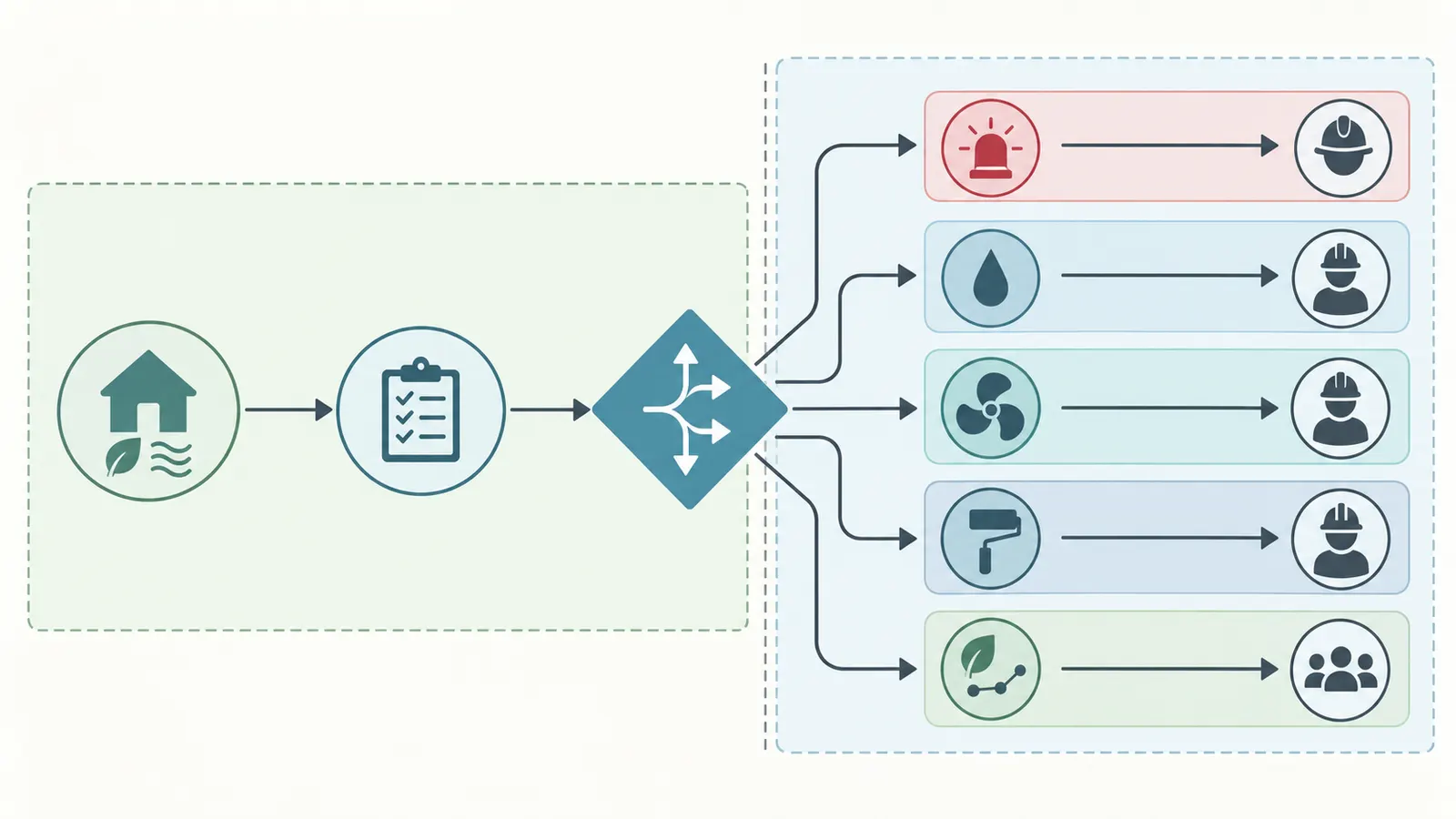
Build a first-year baseline from the handover packet #
Before you investigate a symptom, collect the home’s system map and create a repeatable baseline. The goal is not to measure everything continuously. The goal is to know what “normal for this house, room and operating mode” looked like before an event, and to make the records transferable when the responsible person changes.
Gather the prerequisites
Create one folder, paper or digital, for the home. Start with the handover documents you actually received:
- equipment names, model numbers, serial numbers and installation dates;
- HVAC, heat-pump, furnace, boiler, water-heater and ventilation manuals;
- filter dimensions, installed filter rating, replacement instructions and access points;
- thermostat, humidistat, dehumidifier, HRV, ERV or whole-house ventilation controls;
- kitchen, bath, laundry and dryer exhaust descriptions, including where each outlet terminates if documented;
- commissioning, balancing, startup, warranty, punch-list and service records;
- radon test results, mitigation-system information and warning-device instructions, if present;
- smoke and CO alarm model numbers, manufacture dates and power arrangement;
- permit, inspection or certificate records supplied at handover;
- the builder’s warranty contact, HVAC installer, ventilation installer, appliance contacts, utility emergency contact and local fire authority contact.
The document list is a handoff aid, not proof that the installation is correct. If a manual is missing, request it from the builder or installer in writing. Record the date and the person who accepted the request. If the home has a central ventilation system, ask for its intended operating mode, control location, filter or core maintenance instructions and any balancing or commissioning information. DOE describes whole-house ventilation as potentially exhaust-only, supply-only or balanced, so the word “ventilation” alone does not tell you what the installed system is meant to do. Read the DOE Consumer Guide to Home Ventilation alongside the exact manual.
Create the room map
Give every room a stable name. “Back bedroom” is less useful than “Bedroom 2 — north exterior wall,” especially when the house has several identical rooms. Include:
| Field | Example | Why it matters |
|---|---|---|
| Room ID | B2 | Keeps entries consistent |
| Location | North bedroom, second floor | Records orientation and floor |
| Boundaries | Exterior north wall, window, closet | Identifies cold surfaces and concealed zones to discuss |
| Nearby systems | Supply register 4 ft from door; no return; window | Adds airflow context without claiming airflow performance |
| Moisture sources | Two occupants; adjacent bath; no plumbing wall | Creates a starting source map |
| Instruments | Hygrometer H-02 on dresser, 1.2 m above floor | Makes later readings comparable |
| Baseline date | 2026-09-08 | Separates move-in conditions from later events |
Map spaces that are easy to overlook: closets, utility rooms, laundry rooms, the basement or crawlspace access area, attic access, attached garage, mechanical room and any room with a floor drain or condensate equipment. You do not need to enter a hazardous or inaccessible space. Mark “not visually inspected” and hand that limitation to the relevant professional.
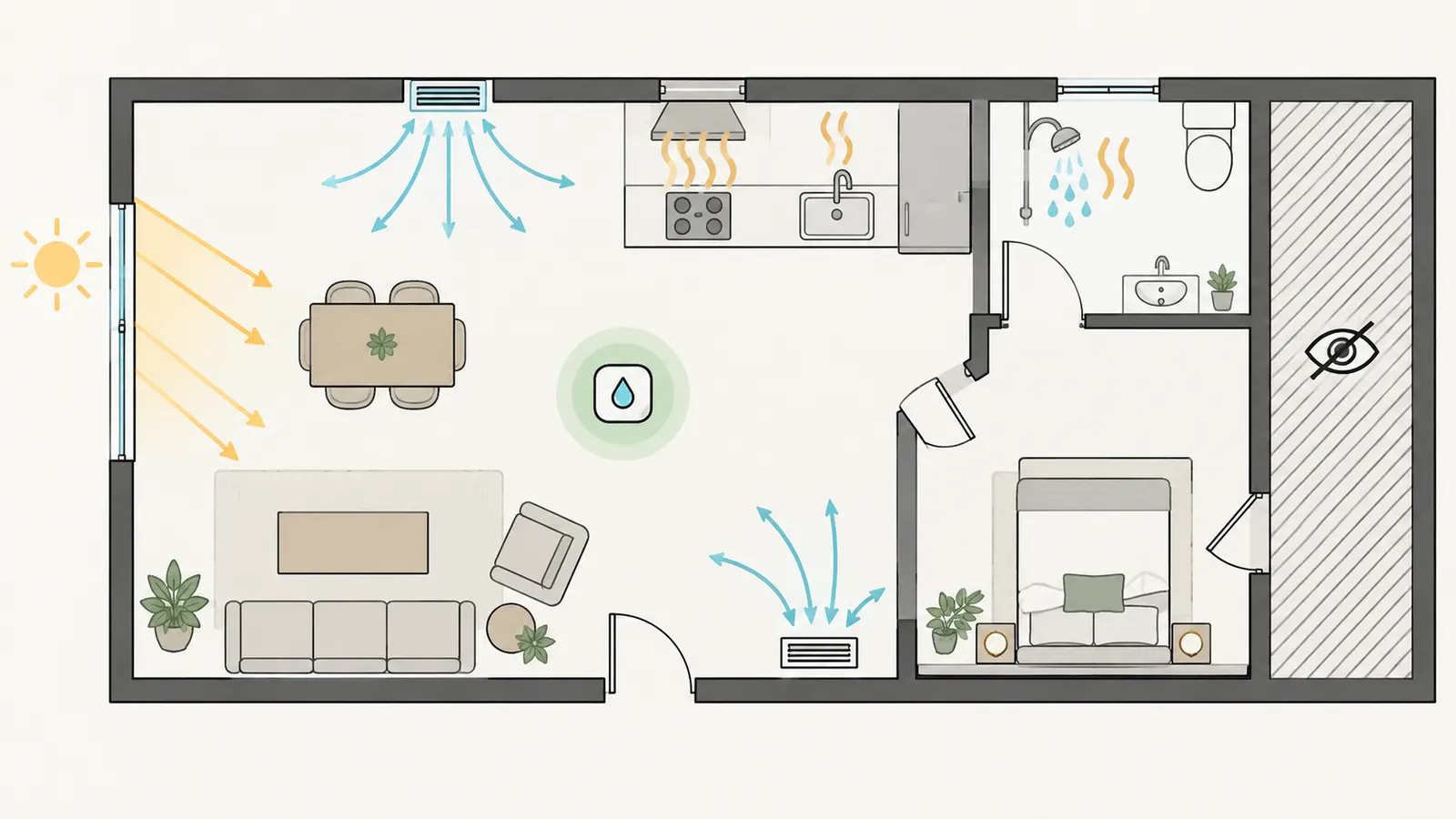
Record instruments without pretending they are laboratories
For every hygrometer, particle monitor or other consumer instrument, record the brand and model if known, the displayed unit, the placement and the date it was placed. Keep the instrument in a stable location away from direct sunlight, supply jets, exterior glass, a humidifier plume, a cooking surface and a dehumidifier discharge. Do not compare two different instruments as though their readings were interchangeable unless you have a documented reason to do so.
Relative humidity is not enough to compare condensation risk. EPA’s home moisture-control guidance explains that air temperature changes how much moisture air can hold and that moisture condenses on cold surfaces. A 50% reading beside a cold window and a 50% reading in the room center therefore do not establish the same surface condition. Record room temperature with RH when the device provides it, record the surface and visible condensation separately, and do not calculate a dew-point or assembly conclusion from a room reading alone. EPA’s consumer guidance says to keep indoor humidity below 60%, ideally 30–50%, and to use a humidity gauge; use that as an operating reference, not as proof that a particular wall assembly is safe at every temperature. See EPA’s home IAQ guidance.
For a particle monitor, record the displayed pollutant label and unit exactly as shown. Do not rename “PM2.5” as smoke, dust, mold or a chemical. A change may reflect cooking, candles, outdoor air, cleaning, a filter state, a sensor artifact or another source. The record is still useful if it preserves the event and leads to a repeatable, safe review.
Set the initial observation cadence
For the first seven days, take a morning and evening reading in the same occupied rooms, plus one reading after a normal cooking, showering or laundry event when safe. Note whether heating, cooling, ventilation, a humidifier, a dehumidifier or a portable air cleaner was operating. Take one whole-home walk-through each day for visible water, wet materials, blocked grilles, unusual odors and alarm status.
For days 8 through 30, continue daily readings in rooms that showed a difference, and take at least three whole-home checks each week. Log every event, not just the scheduled readings. After day 30, keep the baseline and shift to event-driven records plus a monthly systems check. During the first year, review the log after major weather changes, a change in occupancy, a remodel, a filter change, a ventilation-service visit, a new appliance or a change in how a basement or other lower level is used.
This cadence is a management choice created for the worksheet; it is not an EPA, DOE, code or medical requirement. It earns its place because the first month is when you are learning the house and still have a clear handoff trail to the builder. If the record shows no meaningful variation and no event, reduce the burden. If it shows a repeated pattern, increase the quality of the handoff rather than endlessly increasing readings.
Make comparisons fair enough to be useful
The most useful comparison is usually the same room under two similar conditions, not one room compared with a different room on a different day. If you compare the kitchen on a cooking evening with the bedroom on a dry morning, you are comparing activities as much as rooms. Write down the comparison you intend to make before you collect it: “Bedroom 2 at 07:00 on three rain-free mornings,” “basement after 24 hours without laundry,” or “kitchen during the same stovetop task with the hood in the same documented mode.”
Keep occupancy in the context field. A guest staying in the basement, a child sleeping in a previously empty room, a new pet, a long shower schedule or indoor clothes drying can change moisture and source conditions without indicating a defect. A home-office schedule can also change the duration a room is occupied and the amount of ventilation or filtration it needs. These are not reasons to dismiss a pattern; they are reasons to name the input before deciding who should inspect it.
When a reading changes after an action, record the action’s timing and whether other conditions changed at the same time. If you turned on a bathroom fan, opened a window and changed the thermostat together, you cannot tell which action mattered. That is acceptable for an immediate safe response, but label the result “combined action” and do not attribute the improvement to one device. For a later controlled comparison, change one user-accessible variable at a time, keep the activity and weather as similar as practical, and stop if the condition becomes unsafe or the manual does not authorize the change.
Seasonality also matters. A basement that is dry in winter can behave differently in a humid summer, and a tightly closed home that needs dehumidification in summer can become very dry in a cold winter. EPA notes that moisture problems and solutions differ among U.S. climate regions; do not copy a neighbor’s setpoint or a contractor’s general advice into the record without documenting the home, season and system. The log should reveal whether the next handoff is seasonal maintenance, an operating adjustment within the manual, or a building investigation.
Use the 30-day room-and-event log as a handoff record #
The most important entry is not the number. It is the combination of the number, the room, the time, the weather, the operating mode and the safe action that followed. One isolated reading can be noisy. A pattern tied to a room and a condition is more useful to the person who must inspect the home.
The minimum row
Use one row per observation or event. If an event lasts several hours, make a start row and an end row, or write the duration explicitly. Do not overwrite an earlier entry after the condition changes.
| Date/time | Room | Weather/outdoor context | RH / temperature | Visible moisture or odor/particle event | Operating mode | Filter and vent status | Photo or file | Action | Result and duration | Responsible party | Next test or handoff |
|---|---|---|---|---|---|---|---|---|---|---|---|
| 09/08 07:15 | B2 north window | 48°F outdoors; rain overnight | 58% RH / 68°F | Droplets on lower glass edge; no wall staining visible | Heat on; bath fan off | Filter installed; supply register open | B2-0908-0715.jpg | Wiped glass; recorded reading; did not change thermostat | Droplets returned at 09:00; duration at least 1 h 45 m | Homeowner to observe; builder/HVAC if repeated | Repeat during next cold/rain event; send photos if repeated |
| 09/09 18:40 | Kitchen | 72°F outdoors; calm | 47% RH / 70°F | Odor began during pan cooking; no alarm | Range hood on high; HVAC fan auto | Filter appears clean; hood outlet not verified | K-0909-1840.jpg | Stopped cooking; checked hood control and opened door briefly when outdoor conditions permitted | Odor reduced after 20 m; no conclusion about source | Homeowner; installer if hood fails to capture or exhaust | Repeat with normal cooking; check manual and termination |
| 09/12 02:10 | Basement | 61°F outdoors; heavy rain | 63% RH / 65°F | Musty odor near exterior wall; no standing water seen | Dehumidifier off; HVAC off | Floor drain visible; access panel closed | BS-0912-0210.jpg | Did not open wall or enter crawlspace; recorded event | Odor present next morning; RH 61% | Builder or qualified moisture professional | Inspect safe-access areas and exterior drainage; escalate if wetting persists |
The rows above are illustrative examples, not measurements collected by Brictale. The point is the shape of the record: direct observation first, context second, action third, and no causal claim hidden in the wording. “Odor reduced” is an observation. “The filter removed the VOC” would be an unsupported conclusion.

Capture the event before you change it
When an event is safe to observe, preserve the first state before opening windows, changing a setpoint, replacing a filter or moving furniture. Write the time you first noticed it, not only the time you started the log. Take a wide photo that locates the condition and a closer photo that shows the detail. Include a ruler or familiar object only if it can be placed safely and does not alter the condition. If a photo includes a gauge, also transcribe the displayed number; photographs can be hard to read later.
Write “not observed” when you did not check a field. Write “not accessible” when you could not safely inspect it. These are better than blanks that appear to be zero or normal. For weather, use the source you actually used and record the location if it is not the home. Avoid claiming that an outdoor weather report represents conditions at the wall or roof. It is context, not a site measurement.
Record the system state precisely enough for another person
“HVAC on” is not enough. Use the simplest accurate state available:
- heat, cool, off or fan-only;
- auto, scheduled, continuous or boost fan setting;
- ventilation off, low, normal, boost or unknown;
- bath or kitchen exhaust off, low or on, with start and stop times;
- dehumidifier off, running or target setting if visible;
- humidifier off, running or target setting if visible;
- portable air cleaner off, speed or automatic mode;
- windows and exterior doors open, closed or unknown;
- cooking, showering, cleaning, painting, laundry, candles, smoking or other relevant activity;
- filter installed, missing, visibly loaded, wet, damaged or unknown.
Do not remove a filter to inspect it if doing so requires unsafe access or exposes you to dust. Photograph the label and write down the nominal size and rating from the frame or package. A filter that looks clean is not proof of adequate airflow, correct installation or pollutant control.
Use simple calculations to identify a pattern
The worksheet can use modest calculations without pretending to perform a laboratory analysis.
For a room with readings (RH_1, RH_2, ... RH_n), calculate the arithmetic average:
average RH = (RH1 + RH2 + ... + RHn) / n
Example, illustrative: four readings of 47%, 52%, 61% and 50% produce (47 + 52 + 61 + 50) / 4 = 52.5%. That average does not erase the 61% excursion. Preserve both the average and the maximum, because a short high reading may coincide with a shower or a rain event and a long moderate reading may indicate a different handoff.
For time above a review threshold, define the threshold and the observation method before looking at the result. If an entry at 08:00 is 58%, 10:00 is 62%, 12:00 is 61% and 14:00 is 55%, record: “62% at 10:00 and 61% at 12:00; two above-threshold observations separated by a two-hour observation interval.” Do not write “RH stayed at or above 60% for two hours,” because the readings do not show what happened between 10:00 and 12:00. If a duration claim matters, use a logger or a pre-set sampling cadence and describe exactly what it records; discrete samples document sampled values, not every instant between them. The calculation is bounded by the observation method and intervals.
For event recurrence, use:
event rate = number of comparable events / observation days
Illustrative example: three basement condensation events over 15 comparable cold-weather days equal 3 / 15 = 0.20 events per day, or one event every five comparable days. This does not predict future events. It tells you that the issue is no longer a one-off anecdote and may justify a builder, HVAC or moisture review.
Show sensitivity instead of false precision
Consumer instruments and intermittent observations create uncertainty. If a hygrometer displays whole percentages and you take four readings of 47%, 52%, 61% and 50%, the worksheet should preserve the displayed values and the timing rather than report “52.5%” as though the home’s true RH were known to a tenth of a percent. The average is a comparison tool, not a calibrated result.
Illustrative sensitivity check:
| Scenario | Readings | Average | Decision effect |
|---|---|---|---|
| Displayed values | 47, 52, 61, 50% | 52.5% | Keep the 61% event visible; continue observing |
| Each reading one point lower | 46, 51, 60, 49% | 51.5% | The pattern still includes a 60% displayed excursion |
| Each reading one point higher | 48, 53, 62, 51% | 53.5% | The decision to preserve context and check moisture does not change |
The sensitivity result is not permission to choose a favorable number. It shows why the next action should depend on visible water, recurrence, room location, equipment state and duration, not a single decimal. If the next action would change only because of a small reading difference, repeat the measurement under comparable conditions or ask a qualified professional which instrument and method are appropriate.
Preserve before-and-after evidence after service
When a builder, installer or service professional visits, do not replace the original log with the service report. Add the report as a new document and record what was inspected, what was changed, what was not accessible, and what the professional recommended for verification. If a filter was changed, record the removed filter’s date and condition before disposal if it is safe and practical to photograph it. If a control setting was changed, record the old and new settings, the person who authorized the change and the date the new setting should be reviewed.
Use a before-and-after row rather than a success label:
| Field | Before service | After service |
|---|---|---|
| Comparable condition | Rain overnight; basement unoccupied | Rain overnight; basement unoccupied two weeks later |
| RH / temperature | 63% / 65°F at 02:10 | 54% / 66°F at 02:10 |
| Visible condition | Musty odor near north wall; no standing water seen | No odor observed; wall not opened |
| System state | Dehumidifier off; drain path not documented | Installer verified control operation; homeowner did not alter wiring |
| Confidence limit | One event; no causal conclusion | One comparable follow-up; continue watching |
| Next decision | Request qualified review | Repeat after two comparable rain events |
This example is illustrative. The lower RH after service is a result in the log, not proof that a particular repair caused it unless the professional’s scope and evidence support that conclusion. Keep the limitation visible because another change—weather, occupancy, door position, appliance use or the instrument itself—may have contributed. If the pattern returns, the original and follow-up records make the next visit more efficient.
Ask for written answers to four questions after any service visit: What was observed? What was changed? What remains unverified? What condition should trigger a return visit or a different professional? If the answer is “everything is fine,” ask what was actually inspected and under which operating mode. A record that names the limits of the visit is more useful than a broad reassurance that cannot be checked.
Route each event to the right investigation lane #
Use the symptom as a routing clue, not a diagnosis. A single event can occupy more than one lane. For example, condensation on a window after a shower may involve moisture generation, exhaust operation, cold surface temperature and room air movement. The correct next step is to preserve the sequence and inspect the relevant systems, not to declare that the window or the occupant caused it.
Decision matrix
| Observation pattern | First safe record | What to check without altering hazardous equipment | Likely next owner | Stop experimenting when |
|---|---|---|---|---|
| Odor tied to a product, cooking, shower or cleaning | Product/activity, start and stop time, room, ventilation mode, photo of label | Whether source was removed or contained; whether exhaust control responded; whether outdoor conditions permitted safe ventilation | Homeowner for source control; appliance or ventilation installer if capture or exhaust is uncertain | Odor is strong, unexplained, recurrent, associated with combustion or causes immediate concern |
| Condensation on glass, duct, wall or other cold surface | Location, surface, room RH and temperature, weather, duration, photo | Visible water, blocked airflow, closed door, humidifier, fan state and safe-access leaks | Homeowner for operating changes; builder, HVAC or moisture professional for recurring or concealed conditions | Water returns, materials stay wet, staining appears, or the location is inaccessible |
| RH above the chosen operating reference | Time series, room temperature, occupancy and moisture activity | Exhaust fan response, dehumidifier state, humidifier state, filter/return access and whether outside air is humid | HVAC or ventilation installer; builder if handover controls or drainage are incomplete | Repeated excursions persist after normal operation or moisture is visible |
| Particle or dust reading rises | Instrument label/unit, time, activity, windows, filter and air-cleaner mode | Cooking, candles, cleaning, outdoor smoke, filter fit and unobstructed air cleaner intake | Homeowner for source control; HVAC installer or qualified IAQ professional for repeated unexplained pattern | The reading is high and persistent, tied to combustion, or the instrument’s limits are unknown |
| Stuffy room or uneven air movement | Room, occupancy, door/window state, supply/return observations and ventilation control | Whether grilles are blocked; whether the documented control changes state; whether outdoor intake is visibly obstructed from a safe location | Builder, HVAC or ventilation installer | A fan is noisy, inaccessible, electrically suspect, or the system may be unbalanced |
| Alarm chirp or alarm event | Alarm type, exact sound, time, location, label, manufacture date and whether it reset | Only the user-accessible test or battery procedure in the manual, if no emergency is present | Emergency services or utility for active life-safety event; qualified electrician, alarm installer, builder or manufacturer for fault | The alarm sounds, a person feels unwell, fuel/combustion is suspected, or wiring is involved |
| Radon result or mitigation warning-device change | Test type, dates, location, result unit, mitigation status and warning-device observation | Visual status of the warning device from a safe location; no fan, pipe or electrical modification | Qualified radon measurement or mitigation professional; state or tribal radon program | A mitigation fan is off, warning device indicates a fault, or you are considering changing the system |
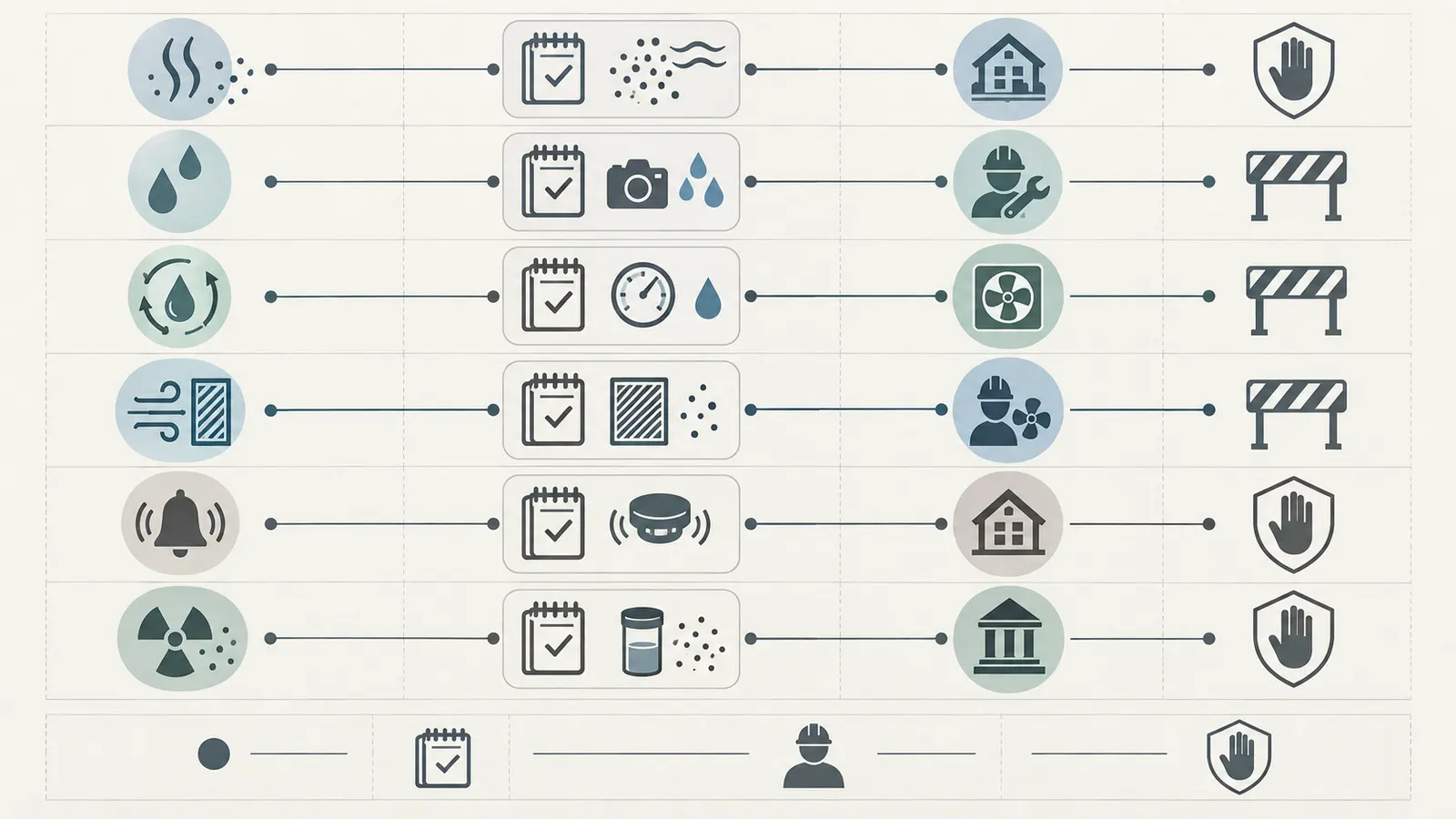
Source control comes first for odors and particles
The EPA guide to indoor air quality says the most effective improvement is usually eliminating or reducing an indoor source, then ventilating with clean outdoor air; filtration is a supplement. That ordering is practical for a log. Record what was happening before you buy another device: painting, new furniture, flooring, cleaning chemicals, cooking, candles, smoking, stored products, pets, construction dust, outdoor smoke or a malfunctioning appliance. Preserve labels, purchase dates and safety instructions. The same EPA guide lists household products, building materials and furnishings among possible VOC sources and identifies combustion appliances as potential sources of combustion pollutants when improperly vented or maintained.
For a product odor, close the container as directed, move it only if safe, follow the label and record the ventilation action. Do not mix cleaning chemicals to “neutralize” an odor. Do not use an ozone generator as a shortcut. EPA warns that no filter removes every pollutant and that some air cleaners can emit ozone; its air-cleaner guide says ozone generators sold as air cleaners have not been approved by a federal government agency for occupied spaces.
For a cooking event, record whether the range hood was on, whether it appeared to capture the plume, whether the makeup or outdoor-air arrangement is known, and whether the event stopped when cooking stopped. Do not infer from an odor that a hood is code-compliant or that the exhaust terminates outdoors. If the hood is noisy, ineffective, disconnected or not documented, send the event record to the appliance or ventilation installer and ask for a site-specific check.
Moisture and condensation need room, surface and weather context
The EPA home moisture-control guidance explains that water can enter through leaks or seepage, showers and cooking add moisture to indoor air, and warm moist air can condense on colder surfaces. It recommends controlling leaks, exhausting bathroom and kitchen moisture outdoors, using dehumidifiers or air conditioning where appropriate, and measuring humidity. The DOE Consumer Guide to Home Ventilation likewise describes moisture and condensation as risks in airtight homes and says kitchen and bathroom vents should lead directly outside, never into an attic.
The log should therefore distinguish:
- surface condensation: droplets, fogging, frost or dampness on a visible surface;
- air humidity: an RH reading at a specific room temperature and location;
- liquid water: a leak, spill, seepage or plumbing release;
- material wetness: a damp carpet, drywall, wood, insulation or other assembly;
- odor: a sensory observation whose source is unknown until inspected.
Do not write “high RH caused mold” unless a qualified investigation has established that conclusion. Do write “RH displayed 64% for four hours; musty odor continued; no visible growth inspected.” If a material is wet, stop decorating over it. Do not paint, caulk, seal or close an access panel over an unresolved wet condition. If the source is active, the location is hidden or the material cannot be safely dried, the next handoff is a qualified moisture or building professional and, if the issue may be a warranty matter, the builder.
Filtration supports the record but does not diagnose the source
The EPA filter and air-cleaner guidance says portable cleaners are designed for a room or area and HVAC filters operate only when the system operates. It recommends choosing a portable cleaner with sufficient CADR for the served area, considering ceiling height, and choosing the highest HVAC filter rating the installed fan and filter slot can accommodate. The guide says to consult an HVAC professional when you cannot determine that limit. Read the same EPA guidance before changing a rating.
A filter entry should include the nominal dimensions, the printed rating system, the installation direction if shown, the date installed, the date removed, the visible condition and the reason for replacement. A filter that is dirty may need more frequent replacement, but a clean filter does not prove that the house has no particles. A higher rating may increase resistance or fail to fit; never crush, bend, tape around, remove or modify a filter to force a fit. Ask the HVAC installer what the equipment can accommodate and record that answer with the model number.
For a portable air cleaner, record the room area and ceiling height, model, stated CADR, filter type, operating speed and run time. EPA’s example CADR table uses an 8-foot ceiling, so a high-ceiling or open-plan area needs a more cautious comparison. Do not treat an ENERGY STAR label as an air-cleaning performance certification; EPA says the label concerns energy efficiency, not effectiveness. Do not write “HEPA solved the odor” unless you have evidence that the relevant pollutant and device were evaluated. A particle filter and a gas/odor filter address different categories.
Verify ventilation, moisture controls and filters in a safe sequence #
Verification is a sequence of questions and observations, not a homeowner commissioning test. Start with the handover documents, then make safe user-level checks, then request a qualified inspection when the result is unknown or inconsistent.
Sequence 1: confirm the intended system
Ask the builder or installer to identify each of these in writing:
- What provides outdoor air to the home?
- Is it natural, spot, exhaust-only, supply-only, balanced, HRV, ERV or another arrangement?
- Which controls are intended to run continuously, intermittently or only during a boost event?
- Which bathroom and kitchen fans exhaust outdoors, and where are the terminations documented?
- Which appliances produce combustion gases, and what is the documented vent path?
- Which filters are installed, in what locations, with what dimensions and approved rating?
- How is humidity controlled in each season?
- Where does condensate drain, and what owner maintenance is required?
- Which warranty contact owns a failed control, noisy fan, disconnected duct, leak or incomplete handover item?
The DOE Consumer Guide to Home Ventilation distinguishes natural, spot and whole-house ventilation and describes balanced systems as including both fresh-air intake and stale-air exhaust. Do not infer the system type from a grille or from the sound of a fan. Treat each grille’s function as unverified until the handover drawing, equipment manual or qualified professional identifies it. If the drawing and installed condition differ, preserve the discrepancy and ask the builder or designer for clarification.
Sequence 2: check user-accessible conditions
With systems operating normally and without opening electrical or combustion compartments, check:
- supply and return grilles are not blocked by furniture, rugs or storage;
- exhaust-fan switches and controls respond as described in the manual;
- the dryer exhaust is connected and visibly terminates outdoors if that can be confirmed safely;
- the outdoor-air intake and exhaust termination are not visibly blocked from ground level;
- the filter is present, correctly sized and seated as the manual shows;
- the dehumidifier bucket, drain line or control shows no obvious leak or overflow;
- the humidifier is not creating dampness or window condensation;
- condensate pans and accessible drains do not show standing water beyond their intended design;
- doors, windows and access panels are in the normal state for the logged event.
If a check is beyond your safe access, record “not checked.” If a vent is on a roof, high wall, crawlspace or attic, do not climb or enter just to complete the worksheet. The missing observation belongs in the professional handoff.
Sequence 3: match action to the moisture event
If RH is rising after cooking, showering or laundry, first check whether the corresponding exhaust fan was intended to run and whether it appears to run. Record the start and stop times and whether the RH changed afterward. Do not assume a running fan exhausts outdoors; verify from the documentation or ask the installer.
If RH is high without a clear moisture activity, check for a leak, wet materials, a disabled dehumidifier, a failed condensate path, an unvented dryer, a humidifier setting or outdoor air entering through the ventilation system during humid weather. EPA notes that moisture problems differ by climate and construction. A window-opening action that helps in a cool dry climate can add moisture in a warm humid climate. Record outdoor conditions before using open windows as an experiment.
If you see condensation, record the exact surface and whether it repeats at the same outdoor condition. The DOE Consumer Guide to Home Ventilation explains that moisture condensing inside walls or attics can lead to wood rot and mold, but a visible window droplet does not prove hidden condensation. Do not remove trim or insulation to look for it. A repeated or concealed pattern needs a qualified building, moisture or HVAC review.
If water is entering, prioritize source control over air cleaning. EPA’s moisture guidance ranges from fixing leaks and seepage to addressing grading, gutters, plumbing and ventilation. Do not excavate, waterproof, open a wall or alter a foundation drainage system as a homeowner experiment. Give the builder a warranty notice if appropriate and ask for a qualified inspection.
Sequence 4: handle filters and humidifiers as equipment, not guesses
Replace a filter according to the installed equipment and filter manufacturer’s recommendation and the actual condition recorded. EPA’s air-cleaner guidance says filters need regular replacement and that the highest rating should be one the system can accommodate; the interval is not a universal rule. Record both the recommended interval and the observed replacement date.
For a humidifier, start with the product manual. EPA advises using it only when conditions require it, emptying and drying portable tanks daily, cleaning portable humidifiers every third day, using lower-mineral water where appropriate, and not humidifying above 50% RH. The EPA humidifier guide also warns that steam and boiling water can burn and that the unit should be unplugged before cleaning. A homeowner can follow the user-care instructions; electrical repairs, central humidifier changes and unsafe plumbing work belong to qualified professionals.
For a dehumidifier, record target setting, run time, drain arrangement, water collection and visible leaks. Do not place the unit where it blocks a required grille or creates a trip or electrical hazard. If a condensate line is hidden, pressurized, routed through a wall or connected to a pump, do not alter it without the appropriate professional.
Verification has an owner and a stopping point
Every action in the log should end with a verification question:
- Did the same safe user action change the displayed condition?
- Did the event recur under a comparable condition?
- Is the result consistent across the same room and instrument?
- Did the equipment operate as the manual says it should?
- Does the next owner need the original state preserved rather than another setting change?
If the answer is unknown after one bounded check, stop creating new variables. A house can look “better” after several simultaneous changes while the underlying issue remains. Keep the original record, restore normal settings if safe, and request an inspection that can evaluate the system in the relevant operating mode.
Keep radon and alarms on their own safety track #
Radon, smoke and carbon monoxide belong in the home record because they affect handover and maintenance, but they should not be collapsed into one general “air quality score.” Each has a different instrument, decision owner, hazard and jurisdictional path.
Radon is a test-and-maintenance record, not a symptom diagnosis
Radon is invisible and odorless, so an odor, humidity reading or particle monitor cannot stand in for a radon test. Record any test result with the test type, start and end date, room or level, result unit, test conditions, device or laboratory information and next action. If the home has an active mitigation system, record the fan or warning-device observation from a safe location and keep the contractor’s operating instructions.
The EPA radon-system maintenance page says radon reduction systems need occasional maintenance, the warning device should be checked regularly, and retesting at least every two years is a good idea. EPA’s separate radon retesting guidance says to retest when living patterns change and a lower level becomes occupied. In the page’s buying-or-selling context, it says a potential buyer may ask for a new test when the last test is not recent, the home has been renovated or altered, the buyer plans to occupy a lower level that was not tested, or state or local disclosure rules apply. Those are not universal homeowner retest rules; record which condition applies and verify the actual testing requirement with the named jurisdiction or qualified radon professional.
Do not turn that federal guidance into a local rule. The applicable jurisdiction is the actual state, tribal area, county or city involved. EPA notes that a state or local government may require radon disclosure in a sale, but the provided federal page does not identify the rule for your home. Record the jurisdiction you checked and the date you checked it. Use the state or tribal radon program, the local health or environmental authority, or a qualified radon measurement or mitigation professional for local requirements and system work. Do not turn a fan off, change a pipe, bypass a warning device or design a mitigation system from this worksheet.
Carbon monoxide requires immediate routing
CO is not an odor to log first and investigate later. If a CO alarm sounds, treat it as a life-safety event and follow the alarm manufacturer’s emergency instructions and local emergency guidance. If anyone feels ill, leave and seek emergency help. Do not re-enter to collect a better photograph. Once the immediate situation is controlled, record the alarm location, time, sound pattern, power source, manufacture date and the responding utility, fire department, qualified technician or other authority.
The CPSC CO-alarm guidance recommends monthly testing, annual battery replacement, smoke alarms on every level and near sleeping areas, and CO alarms on each level and outside sleeping areas. It says CO alarms generally should not be in attics or basements unless there is a sleeping area. Those are federal consumer recommendations, not a substitute for the alarm manual or the actual adopted rule in the city, county or state where the home sits. Do not open or adjust fuel-burning equipment to troubleshoot an alarm. The DOE Consumer Guide to Home Ventilation explains that combustion appliances must be correctly installed and vented outside because combustion products can enter the home when exhaust is not handled properly.
Smoke alarms combine maintenance with local verification
The USFA smoke-alarm guidance recommends smoke alarms inside every bedroom, outside each sleeping area and on every level including the basement. It recommends monthly testing and replacing smoke alarms 10 years from the manufacture date; it also says hardwired alarm installation should be done by a qualified electrician. Use those recommendations to create a maintenance row with alarm location, model, power arrangement, manufacture date, monthly test date, battery date and replacement due date.
The USFA smoke-alarm guidance explicitly says a city, county or state may require a specific type of alarm and directs readers to check with the local fire marshal. Therefore write the actual jurisdiction in your log, such as “City of ___, County of ___, State of ___,” and record the official contact or adopted rule you checked. Do not write “the code requires” without naming the jurisdiction and version. Do not remove a smoke-alarm battery because cooking or shower steam causes nuisance alarms. USFA says to use the hush function and improve the air or relocate the alarm according to the instructions; hardwired changes belong to a qualified electrician.
Do not use alarms as environmental sensors
A smoke alarm test is not a particle measurement. A CO alarm is not a general IAQ monitor. A radon result is not a humidity result. Keep those rows separate so a normal result in one category does not create false reassurance in another. The log’s job is to preserve the event and the handoff, not to create a composite score that hides a serious exception.
Escalate repeated patterns and close the first-year loop #
Escalation is appropriate when the evidence is repeatable, the consequence is material, the condition is hidden, the installed system does not match its documentation, or the safe homeowner checks do not resolve the event. You do not need to wait for a dramatic measurement when water is entering, an alarm is sounding, a combustion path is suspect or a warranty item is deteriorating.
Choose the next responsible party
Use the narrowest owner who can verify the condition without excluding the builder when the issue may be a handover or warranty defect.
| Handoff | Send | Ask for | Do not ask the recipient to infer |
|---|---|---|---|
| Builder or general contractor | Dated rows, photos, room map, weather, visible condition, handover document and warranty date | A site review, written responsibility decision and repair or inspection sequence | That your log proves negligence or a code violation |
| HVAC installer or service professional | Model/serial, filter size and rating, control state, RH/temperature timeline, fan noises, photos and manual | Verification of filter compatibility, airflow/controls, condensate, ventilation operation and safe settings | That a higher filter rating is automatically compatible |
| Ventilation installer or balancing professional | System type if known, control schedule, room event patterns, grille locations and commissioning records | Confirmation of intended operating mode, exhaust/intake routing and balance | That a grille’s appearance proves its function |
| Appliance manufacturer or installer | Appliance model, activity timing, control setting, symptoms and manual | Product-specific operating or service guidance | That the odor identifies a product failure |
| Utility or emergency authority | Alarm time, location, occupancy and safe contact details | Immediate life-safety routing | That you can safely test the fuel system yourself |
| Local fire marshal or authority | Actual jurisdiction, alarm locations, model/power arrangement and question | The applicable alarm rule or official interpretation | That a national recommendation is the local code |
| Qualified moisture or building professional | Moisture pattern, weather, surface, RH, photos, access limits and prior actions | A site-specific moisture-source and assembly evaluation | That a humidity number proves hidden mold or damage |
| Qualified radon measurement or mitigation professional | Test report, room/level, dates, result unit, mitigation warning-device record and jurisdiction | A testing or system-maintenance plan | That an IAQ sensor or odor can diagnose radon |
Build the professional evidence packet
Before sending the request, create a one-page cover note:
Decision requested: “Please determine whether the recurring basement condensation requires a warranty, HVAC, ventilation or moisture investigation, and identify the next safe test.”
Home and room: address, named room, level, orientation and whether the area was occupied.
Pattern: first observed date, number of comparable events, duration range and whether weather or an activity preceded it.
Measurements: instrument model, placement, displayed units, RH/temperature readings and exact timestamps.
Systems: HVAC and ventilation state, filter information, humidifier/dehumidifier state, windows/doors and relevant appliances.
Visible evidence: photos with filenames, water or odor description, access limits and what was not inspected.
Actions: only the safe actions taken, with start time, end time and result.
Documents: manuals, warranty contact, commissioning record, prior service record, radon record or alarm model.
Request: the person you want to own the next step and the verification you need in writing.
This packet is more valuable than a message saying “the air feels bad.” It also protects the builder and technician from receiving a preselected diagnosis. Ask the recipient whether the log contains enough information, what additional measurement is needed, and whether the system should be left in normal operation until the visit. Follow their answer only within the scope of their qualifications and the equipment instructions.
Know the professional boundary
The homeowner can observe, photograph, read labels, use normal user controls and maintain equipment according to the manual. A qualified professional should handle combustion testing, fuel appliance service, electrical work, hardwired alarm installation, concealed moisture evaluation, roof or foundation work, duct modifications, ventilation balancing, radon mitigation, mold remediation and any access involving falls or confined spaces.
Medical symptoms are outside the scope of this article. If someone has symptoms they believe relate to the home, the person should seek appropriate medical advice. Do not use the log to screen, diagnose or clear a person. You may bring the timeline to a healthcare professional while separately routing the building condition to the appropriate home professional.
First-year review schedule
At move-in, save the handover documents, identify every room and system, photograph alarm labels and record the initial filter, control and radon status. During the first 30 days, run the room-and-event log and review each unresolved pattern weekly. At 60 and 90 days, compare event recurrence, seasonal change, filter condition, humidifier/dehumidifier operation and open warranty items. At six months, check whether the household has changed rooms or occupancy, whether a lower level is now used, and whether the equipment schedule still matches how the home is occupied. At twelve months, archive the first-year baseline and create the next maintenance cycle.
| Review point | Owner | Check | Evidence to retain | Next decision |
|---|---|---|---|---|
| Move-in | Homeowner with builder handoff | Manuals, model numbers, room map, alarm dates, filter and controls | Handover packet and baseline photos | Is anything missing or inconsistent? |
| Day 7 | Homeowner | Morning/evening RH and temperature, visible moisture, odors, modes | First-week rows and event photos | Is there a repeatable room or activity pattern? |
| Day 30 | Homeowner plus relevant owner | Unresolved events, filter condition, ventilation response, warranty notices | Completed log and open-handoff list | Continue routine, request inspection or preserve an event for testing? |
| Day 60–90 | Homeowner; builder/HVAC if needed | Seasonal change, equipment operation, moisture trend and repairs | Service reports and before/after rows | Did the action resolve the observed condition without creating another? |
| Six months | Homeowner | Occupancy and lower-level use, radon retest trigger, alarm tests, humidifier/dehumidifier care | Updated system inventory | Which recurring maintenance dates should be scheduled? |
| Twelve months | Homeowner and warranty contacts | First-year pattern, completed repairs, remaining uncertainty | Archived baseline and current manuals | What becomes monthly, seasonal or professional maintenance? |
The review table is a planning tool, not a required inspection schedule. A life-safety event or active water problem moves to immediate routing. A stable home with no events may need less frequent observation; a home with recurring moisture or equipment faults may need a qualified evaluation before the next scheduled review.
Close an event without losing the history
An event is closed only when the record contains the action, result, verification and next maintenance owner. “Changed filter” is not a closure. A complete closure might say: “Filter replaced on 10/04 using the documented 16 × 25 × 1 size and installed rating; HVAC installer confirmed compatibility by email on 10/03; two comparable cooking events on 10/05 and 10/08 were logged with hood high; odor was not observed; no conclusion about hidden sources; recheck at monthly review.”
If the event is not resolved, leave it open. Write the next decision explicitly: repeat under comparable weather, request a builder warranty visit, ask the HVAC professional to verify airflow, contact the local fire authority about the named jurisdiction, arrange qualified radon measurement, or stop using a suspect appliance until it is evaluated. The value of a first-year record is not that every row ends happily. It is that uncertainty remains visible and the next person does not have to reconstruct the case from memory.
Use the log to decide what happens next #
The right ending is a decision, not a perfect indoor-air-quality score. After a month, you should be able to state which observations are normal for the home, which events recur, which systems are documented, which responsibilities are accepted, and which questions remain open.
Use this final decision test:
- No event and stable baseline: keep the room map, manuals and maintenance dates; switch to event-driven logging and scheduled alarm, filter, humidifier and ventilation care.
- One resolved event with a verified safe cause or action: retain the original row, record the verification and watch for recurrence without claiming the cause is universal.
- Repeated odor or particle event: preserve product/activity timing, check source control and ventilation, then route repeated unexplained patterns to the builder, installer or qualified IAQ professional.
- Repeated condensation, visible water or elevated moisture: prioritize water and moisture-source review, avoid covering or disturbing wet materials, and request a builder, HVAC or qualified moisture evaluation.
- Ventilation or filter uncertainty: stop changing ratings or settings, provide the system model and log, and ask the HVAC or ventilation professional to verify compatibility and operation.
- Radon concern: use an appropriate radon test or qualified radon professional, keep mitigation maintenance separate, and check the actual state, tribal or local jurisdiction for requirements.
- Alarm or combustion concern: use emergency routing first, then qualified service and local fire-authority verification; do not troubleshoot dangerous equipment from the log.
Your home’s record should make the next action smaller and safer. It should tell the builder which room and date matter, tell the HVAC professional which operating mode to reproduce, tell the local authority which jurisdictional question is being asked, and tell you when to stop adjusting controls. That is the purpose of maintaining an indoor-air-quality and moisture log after move-in: not to diagnose the house from a spreadsheet, but to preserve the decision trail from observation to responsible verification.
Cite this guide
Brictale. “How to Maintain a New Home’s Indoor Air Quality and Moisture Log After Move-In.” Published 2026-09-14; updated 2026-09-14.
https://brictale.com/build/handover/maintain-new-home-indoor-air-quality-moisture-log-after-move-in · Read the Markdown version
Original contribution: The 30-day room-and-event IAQ handover log. A reusable room-by-room and event-by-event record that preserves observations, operating context, actions, responsibility, verification, and the next handoff without assigning a pollutant diagnosis.
Sources and scope
Evidence behind this page
- EPA says indoor pollution sources are a primary cause of indoor-air-quality problems in homes, inadequate ventilation can increase indoor pollutant levels, and high temperature or humidity can increase concentrations of some pollutants; its homeowner overview links to source, ventilation, moisture, radon, alarm and filter-maintenance resources.
Protect Indoor Air Quality in Your Home
U.S. EPA homeowner overview for apartments, townhomes and single-family homes, including new-home and remodel context; it provides general IAQ guidance and linked resources, not a diagnosis or site-specific design determination.
Accessed · Link to this claim - EPA identifies VOC sources including paints, cleaning supplies, building materials and furnishings, and says combustion pollutants can come from improperly vented or unvented fuel-burning appliances; it recommends fresh-air ventilation for products and proper installation, use, adjustment and maintenance of fuel-burning appliances.
Care for Your Air: A Guide to Indoor Air Quality
U.S. EPA consumer IAQ guide covering common home pollutants and actions; the source supports source-control and safe-routing guidance but does not identify the pollutant or establish a site-specific exposure, code or health conclusion.
Accessed · Link to this claim - EPA describes source control, ventilation with clean outdoor air, and filtration as complementary ways to improve indoor air; filtration does not replace source control or ventilation.
Guide to Air Cleaners in the Home
U.S. EPA consumer guidance for portable air cleaners and furnace or HVAC filters in homes; applies as general IAQ guidance, not a diagnosis of a particular home or a guarantee for a specific device.
Accessed · Link to this claim - EPA says portable air cleaners are sized by CADR for the area served, HVAC filters operate only while the system runs, filters need regular replacement, and the highest filter rating should be one the system can accommodate; a professional may be needed to determine that limit.
Guide to Air Cleaners in the Home
U.S. EPA consumer guidance; CADR estimates assume an 8-foot ceiling, and equipment compatibility must be checked against the installed system and its manufacturer or HVAC professional.
Accessed · Link to this claim - EPA identifies leaks, seepage, cooking, showers, appliances and cold-surface condensation as moisture sources; it recommends controlling leaks, exhausting kitchen and bathroom moisture outdoors, using dehumidification where appropriate, and measuring indoor relative humidity.
What are the main ways to control moisture in your home?
U.S. EPA home moisture-control guidance; climate and construction change the moisture problem and solution. It is not a local building-code determination or mold-remediation protocol.
Accessed · Link to this claim - EPA consumer IAQ guidance says to keep indoor humidity below 60 percent and ideally between 30 and 50 percent, using a humidity gauge to observe conditions.
What can I do to improve indoor air quality in my home?
General U.S. EPA consumer guidance; this is an operating reference, not a promise that every room, climate, surface temperature, instrument or building assembly will behave identically.
Accessed · Link to this claim - EPA explains that the amount of moisture air can hold depends on air temperature and that moisture condenses on cold surfaces; condensation risk therefore depends on room moisture, air temperature and surface temperature rather than a relative-humidity reading alone.
What are the main ways to control moisture in your home?
U.S. EPA home moisture-control guidance; supports recording room temperature, relative humidity, surface and visible condensation together, but does not diagnose a building assembly or determine a safe site-specific threshold.
Accessed · Link to this claim - DOE says ventilation exchanges indoor and outdoor air, spot ventilation uses kitchen and bathroom exhaust fans to remove pollutants and moisture, whole-house systems may be exhaust-only, supply-only or balanced, and combustion exhaust must be vented outside.
Consumer Guide to Home Ventilation
U.S. Department of Energy consumer guide; system design, commissioning, balancing, combustion work and electrical work remain specific to the installed equipment and qualified professionals.
Accessed · Link to this claim - DOE notes that moisture from new-home materials can be released during the first year and that occupants add moisture through breathing, cooking, showering and laundry; it recommends outdoor-vented kitchen and bathroom exhaust and controlled ventilation after air sealing when needed.
Consumer Guide to Home Ventilation
U.S. Department of Energy consumer guide; the guide’s example is for a 2,000-square-foot new home and is not a measurement of the reader’s house.
Accessed · Link to this claim - EPA advises using a humidifier only when needed, emptying and drying portable tanks daily, cleaning portable humidifiers every third day, and not humidifying above 50 percent relative humidity; manufacturer instructions still control product-specific care.
Use and Care of Home Humidifiers
U.S. EPA consumer guidance for home humidifiers, especially portable ultrasonic and impeller units; does not replace the installed or product manufacturer’s instructions.
Accessed · Link to this claim - EPA says an active radon mitigation system needs occasional maintenance, its warning device should be checked regularly, and the home should be retested at least every two years.
How do I know if my radon mitigation system is working properly?
U.S. EPA general guidance for homes with radon reduction systems; system design, testing conditions, licensing and any disclosure rule must be checked for the actual state, tribal area or local jurisdiction.
Accessed · Link to this claim - EPA radon guidance says to retest when living patterns change and a lower level becomes occupied; in its buying-or-selling examples, a potential buyer may ask for a new test when the last test is not recent, the home has been renovated or altered, the buyer plans to occupy a lower level that was not tested, or state or local disclosure rules apply.
How often should I test/retest my home for radon?
U.S. EPA general guidance and examples; it does not establish a national disclosure rule or a universal test protocol for every jurisdiction.
Accessed · Link to this claim - CPSC recommends monthly testing of smoke and CO alarms, annual replacement of their batteries, smoke alarms on every level and near sleeping areas, and CO alarms on each level and outside sleeping areas; it cautions against installing CO alarms in attics or basements unless there is a sleeping area.
U.S. Consumer Product Safety Commission consumer recommendation; the actual state, county, city, fire code, adopted edition and manufacturer instructions may add or differ.
Accessed · Link to this claim - USFA recommends smoke alarms in every bedroom, outside each sleeping area and on every level including the basement; it recommends monthly testing and replacement at 10 years from manufacture, while hardwired alarm installation should be done by a qualified electrician.
U.S. Fire Administration consumer fire-safety guidance; USFA says city, county or state requirements may specify alarm type, so the local fire marshal and adopted jurisdictional rule must be checked.
Accessed · Link to this claim - EPA identifies stuffy air, moisture condensation on cold surfaces, and mold or mildew growth as signs of inadequate ventilation and points new-home owners toward drainage, foundation sealing, mechanical ventilation and properly vented appliances.
Care for Your Air: A Guide to Indoor Air Quality
U.S. EPA consumer IAQ guidance for homes and new-home considerations; these signs prompt investigation and do not identify a pollutant or prove a construction defect.
Accessed · Link to this claim