How to Build a New-Home Equipment Maintenance Calendar From Manuals, Warranties, and Local Rules
Build a traceable home-maintenance calendar from installed manuals, written warranties, local authority rules, and qualified-service handoffs.
The short answer
Build one row for every installed system. Record its model and serial, exact manual section, warranty condition, named local authority, trigger, responsible person, evidence, and next due date. Let a written local requirement or warranty condition govern where applicable; use the manual for model-specific work and national guidance only as bounded context. If an interval is unsupported, leave it blank and ask the manufacturer or a qualified service professional.How to Build a New-Home Equipment Maintenance Calendar From Manuals, Warranties, and Local Rules
Build one row for every installed system rather than copying a seasonal checklist. Record its model and serial, the exact manual section, any written warranty condition, the named local authority, the trigger, the responsible person, the evidence to keep, and the next due date. Let a local requirement or warranty condition govern where applicable; use the manual for model-specific work and leave unsupported intervals blank.
This guide is for a United States homeowner after a new-home handover or substantial renovation. It covers HVAC, whole-home ventilation, water heating, pumps, smoke and carbon-monoxide alarms, and other documented systems. It does not prescribe repairs, replace a manufacturer's manual, interpret a warranty, or determine a local code. It helps you choose the next legitimate maintenance action, assign it to yourself or a qualified service person, preserve proof, and know when the next handoff is required.
If you are still assembling the handover packet, use Brictale's home handover journey guide for the broader record-and-responsibility context, then return here to turn each installed system into a maintenance row. You can also browse the Brictale homeowner blog for related planning and ownership decisions.
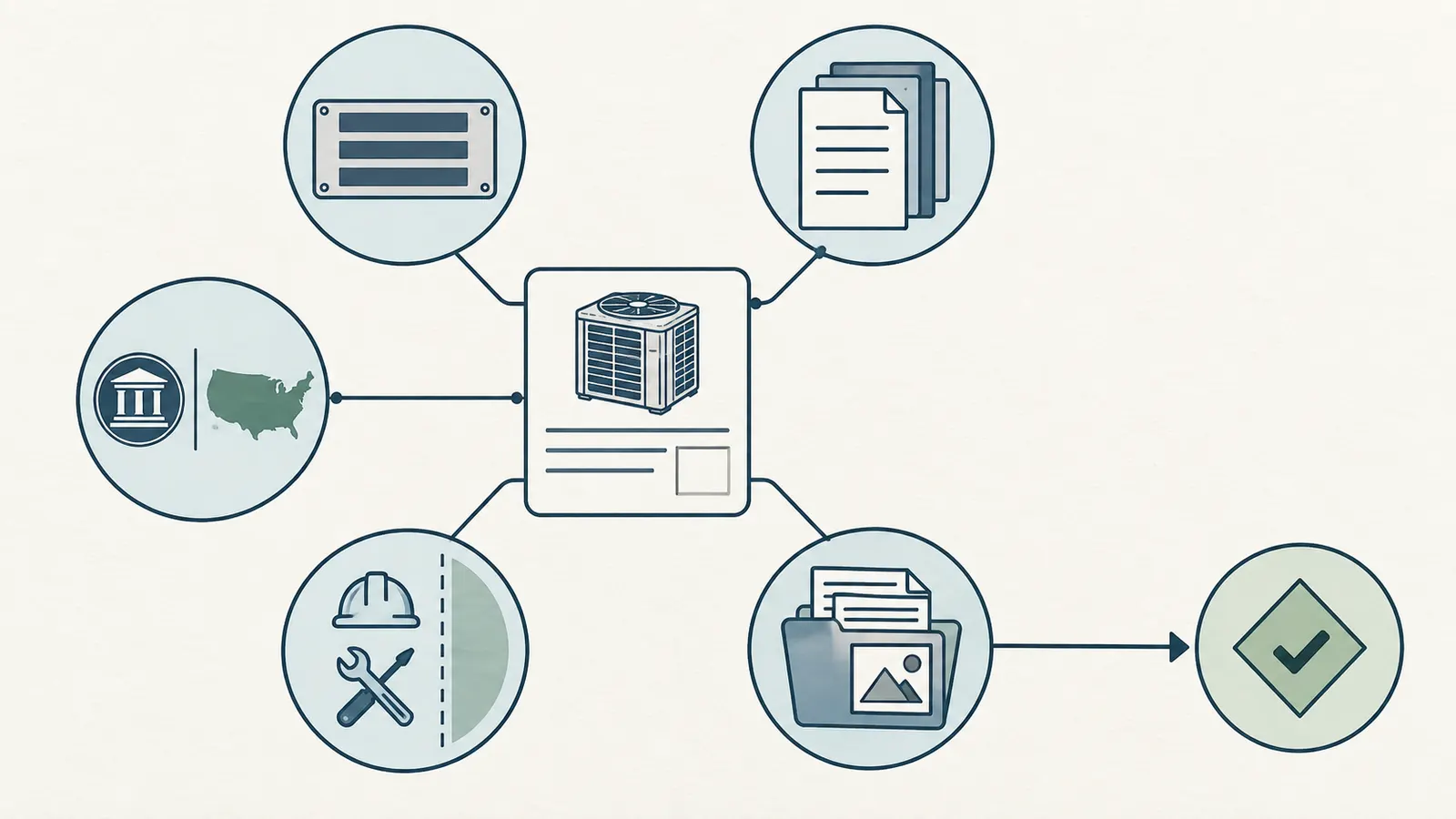
Start with the next legitimate action, not a generic seasonal list #
The right maintenance calendar is a traceability tool: for each installed system, it should tell you what to do next, why that action is due, who may perform it, what proves completion, and what decision follows. A list that says “service everything every spring” may be convenient, but it cannot tell you whether a ventilation unit has a filter alarm, whether a water heater warranty requires documented service, or whether a fire authority in the property's jurisdiction requires a particular alarm type.
Define the decision before opening a calendar app
The reader decision is not “How often should a house be maintained?” That question is too broad to answer safely. The decision is:
For this installed system, what is the next legitimate maintenance action, who is responsible, what evidence must be preserved, and what happens if the instruction, warranty, local requirement, or observed condition is missing or in conflict?
That narrower decision creates a useful stop condition. You are done with a row when you can answer all of these questions:
- What equipment or life-safety device is this?
- Where is it, and how can a person identify it without guessing?
- What exact model, serial, control, or alarm date is recorded?
- Which source creates the action: manual, written warranty, local authority, national guidance, or an observed condition?
- What is the trigger: a date, run time, season, alarm date, filter condition, leak, error code, or other event?
- Who is allowed to perform the action safely?
- What evidence is saved, and where?
- What is the next decision if the condition is not normal or the source is unclear?
If one of those answers is unknown, the correct calendar value is often “verify,” “ask,” or “not scheduled,” not a guessed interval. An empty due-date cell is safer than a false date that appears authoritative in six months.
Separate four kinds of calendar entry
A calendar mixes several kinds of work unless you label them. Separate them as follows:
| Entry type | What it means | Example of a legitimate next action | What it does not mean |
|---|---|---|---|
| Routine observation | A homeowner looks, listens, reads a display, or records a condition without opening hazardous equipment. | Record a heat-pump error code and photograph the nameplate. | A diagnosis or permission to repair. |
| Consumer test or care | A bounded action described for an occupant, often using a button, accessible filter, or visible control. | Test an alarm or replace a filter when the manual permits it. | A universal interval for every product. |
| Qualified service | A trained person inspects, measures, adjusts, cleans, tests, or repairs equipment within their trade and jurisdiction. | Have an HVAC professional inspect combustion or refrigerant-related components. | A homeowner DIY repair. |
| Authority or warranty verification | A record check with the manufacturer, builder, utility, fire marshal, permitting office, or other named authority. | Confirm which alarm requirement applies to the property's city and county. | A generic internet answer treated as local law. |
This distinction keeps a maintenance calendar from turning into a repair manual. The calendar can tell you to call a qualified person when an observation crosses a boundary; it should not teach you to open a gas appliance, alter a relief device, defeat an alarm, enter a confined space, work on energized wiring, or bypass a control.
Use national guidance as a bounded input, not as a replacement for the installed record
National consumer guidance can fill a known gap, especially for alarms and general observation. For example, the Consumer Product Safety Commission recommends monthly testing of smoke and carbon-monoxide alarms and annual battery replacement, and it gives general placement guidance for CO alarms; the exact product instructions and the applicable jurisdiction still belong in the row. See the CPSC CO alarm recommendations.
The same principle applies to HVAC. ENERGY STAR's Maintenance Checklist says to inspect, clean, or change central HVAC filters monthly and recommends annual pre-season contractor checkups. That is useful national consumer guidance, but it does not prove that an unidentified filter, heat pump, furnace, or ventilation unit has a monthly or annual requirement. Your row should identify whether the action is a manual instruction, a warranty condition, an applicable authority requirement, a national recommendation, or a response to actual conditions.
The first handoff is a decision, not a date
At handover, the first next decision is usually one of three outcomes:
- Schedule now: the source, task, person, evidence, and trigger are clear.
- Verify before scheduling: a model, manual section, warranty condition, local authority, or skill boundary is missing.
- Escalate immediately: there is a safety signal, active leak, combustion concern, alarm failure, exposed electrical hazard, repeated trip, overheating, or other condition that should not wait for a routine interval.
That triage is more valuable than sorting the whole house into “monthly,” “quarterly,” and “annual.” A new home may have systems that were never put into service, equipment with construction dust, incomplete labels, or warranty registrations that were not transferred. The next action is therefore often to make the record complete before the recurring calendar begins.
Build a complete installed-system record at handover #
Before assigning dates, assemble one evidence packet for each installed system and life-safety device. A calendar without identity information cannot reliably connect an instruction to the equipment that will be serviced, and a calendar without handover evidence cannot distinguish an owner task from a builder or installer closeout item.
Collect the minimum record
For each item, collect the following inputs. Treat a missing input as a handover gap and assign an owner to close it.
| Input | Where to find it | Why it changes the decision | If missing |
|---|---|---|---|
| System name and function | Handover index, equipment label, room plan | Prevents confusing a whole-home ventilator with an exhaust fan or a condensate pump with a sump pump. | Photograph the installed location and ask the builder or installer for the equipment schedule. |
| Manufacturer and model | Nameplate, control, manual cover | The maintenance action may be model-specific. | Do not select a replacement part or interval from appearance alone. |
| Serial number or manufacture date | Nameplate, alarm label, warranty portal | Supports warranty, age, and end-of-life decisions. | Ask the installer or manufacturer to confirm how the device is identified. |
| Installation date and start-up date | Certificate, invoice, commissioning record | Warranty and some schedules may run from different dates. | Record both as unknown until the responsible party confirms them. |
| Manual and section | Printed manual, manufacturer site, handover folder | Creates the exact instruction and warning boundary. | Request the complete use-and-care and installation documents; do not use a generic manual for a similar model. |
| Written warranty and registration | Warranty document, builder package, manufacturer portal | Shows coverage, exclusions, maintenance or claim steps, and proof requirements. | Contact the seller, builder, or manufacturer and record the answer in writing. |
| Local authority and jurisdiction | Permit file, fire marshal, utility, building department | Local rules are not safely inferred from another city or state. | Name the state, county, city, fire district, utility, or other AHJ, then verify the current source. |
| Location and access | Floor plan, photos, site walk | Determines whether an action is accessible to an occupant and whether falls or confined-space hazards exist. | Have the builder or service person identify safe access. |
| Assigned role | Owner, builder, installer, service company, utility, AHJ | Converts a recommendation into an accountable handoff. | Assign a person, not just “homeowner.” |
| Evidence location | Cloud folder, paper binder, warranty portal, service invoice | Makes the next claim or service visit auditable. | Create one property record with stable filenames and dates. |
Do not treat a product photograph as a complete record. A photo helps locate the device, but the useful evidence is the combination of model, serial, source, date, action, result, and person or company responsible. For a service visit, retain the invoice or report, not just a calendar checkmark. For a homeowner observation, record the date, visible condition, meter or display value if relevant, and what happened next.
Ask the builder for a handover index, then test it against the house
The builder's equipment schedule is an input, not the final truth. Walk the home and reconcile it against what is actually installed. Look for:
- two pieces of equipment serving one function, such as a primary and backup pump;
- a filter at a return grille, an air handler, or a dedicated ventilator rather than the location shown in a generic diagram;
- a water heater with an attached mixing or recirculation control;
- a condensate pump whose failure could affect ceilings, walls, or equipment;
- hardwired alarms with battery backup, interconnected alarms, or combination devices;
- exterior components exposed to snow, leaves, irrigation, salt, flooding, or wildfire smoke;
- equipment in an attic, crawl space, roof, shaft, or mechanical room where a routine owner visit is not safe;
- disconnected, unlabeled, inaccessible, or visibly damaged components;
- controls that do not match the manual supplied at handover.
This reconciliation is not a remote inspection. A photograph cannot establish that a flue terminates correctly, a relief line is safe, a heat exchanger is intact, a pump is electrically protected, or an alarm placement complies with the property’s jurisdiction. Record the uncertainty and direct the issue to the builder, installer, licensed trade, fire authority, or other qualified party as appropriate.
Preserve the warranty record without overreading it
The FTC explains that a warranty may cover a lot or a little, that details should be in writing, and that coverage can depend on how a product is used or maintained. It also advises saving the warranty and receipt. Apply that guidance by saving the FTC warranty record recommendations with each equipment record, then reading the actual written warranty for the installed model.
Create a short warranty abstract for your own use:
| Warranty field | Record this, in your words | Do not infer |
|---|---|---|
| Covered item | Model, serial, component, and owner | That a whole system is covered because one component has a warranty. |
| Start and end | The written start event and end date or condition | That the builder's handover date is always the manufacturer's start date. |
| Covered remedy | Repair, replacement, refund, labor, parts, or another stated remedy | That maintenance is free or that labor is included. |
| Conditions | Registration, installation, use, maintenance, notices, or claim process | That a casual service invoice satisfies an exact condition. |
| Exclusions | Parts, causes, misuse, modifications, environment, or labor excluded | That every failure is a warranty defect. |
| Claim contact | Seller, builder, installer, manufacturer, or other listed contact | That the first service company has authority to decide coverage. |
| Evidence required | Receipt, serial, service record, photos, error code, or other proof | That a calendar checkmark proves the claim. |
The warranty abstract is not a legal interpretation. If the wording is unclear, ask the warranty provider or a qualified attorney for the issue at hand. Keep the question and written answer with the record. A phone conversation that changes a maintenance decision should be summarized and confirmed in writing.
Resolve conflicts with a source-precedence rule #
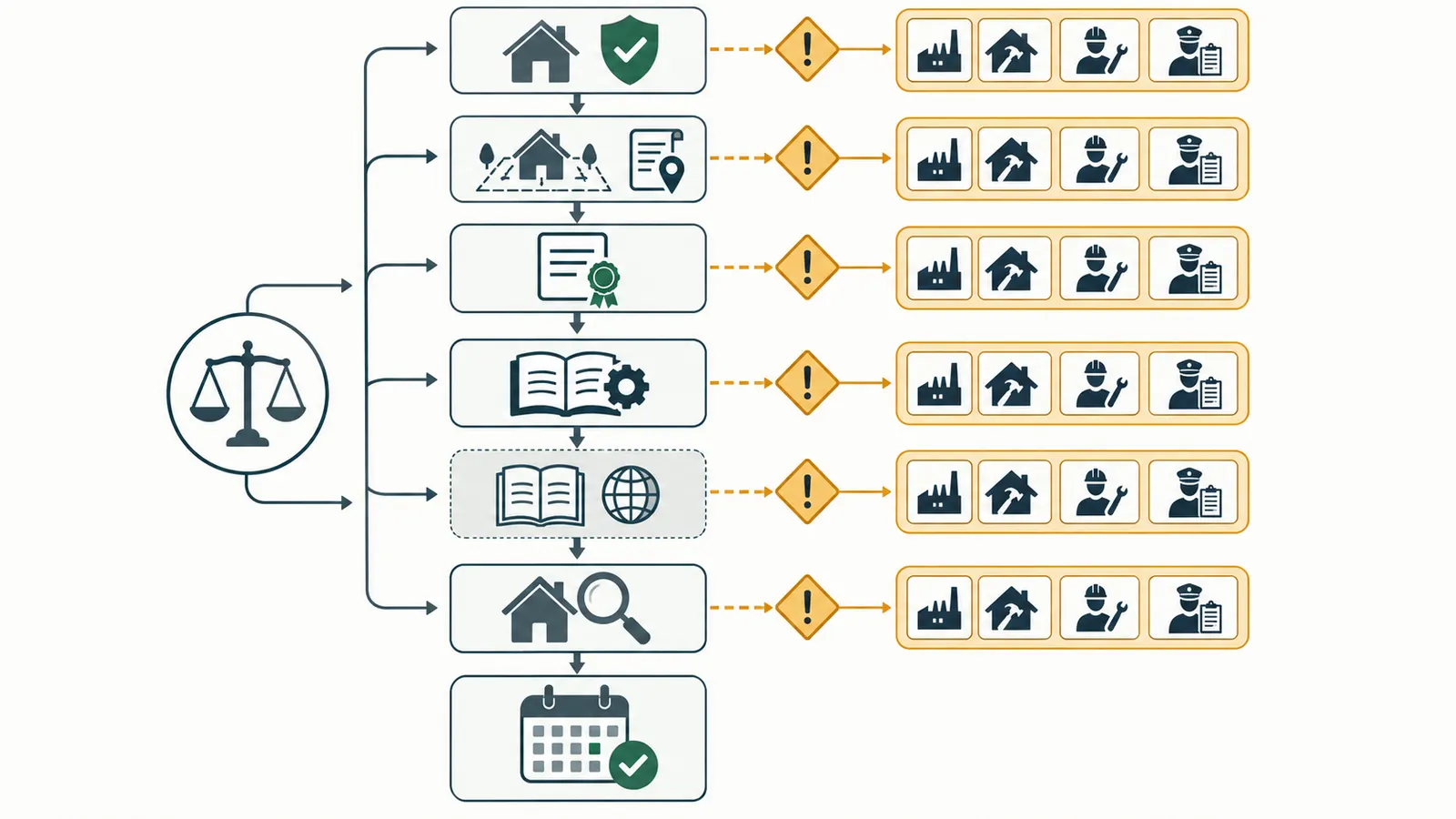
When a generic checklist, installed manual, warranty, observed condition, and local rule point in different directions, use a documented precedence process rather than choosing the most convenient date. The process is a Brictale synthesis for organizing homeowner decisions; it is not a national legal hierarchy.
Treat authority as a gate, warranty as a condition, and the manual as the product instruction
Use the following sequence:
- Safety gate: If the condition suggests immediate danger—CO alarm, smoke alarm failure, gas odor, burning smell, active electrical arcing, uncontrolled water, pressure release, overheating, structural damage, or a person needing unsafe access—stop the routine task and use the appropriate emergency, utility, fire, or qualified-service route.
- Applicable local requirement: Identify the actual property jurisdiction and authority having jurisdiction. A rule from the city, county, state, fire district, utility, permit office, or other named authority may govern the installation, inspection, alarm, utility connection, or required documentation. Record the exact source and effective date. If the authority cannot be identified, the requirement is unverified.
- Written warranty: Read the installed product's written warranty for maintenance, registration, notice, service, parts, labor, and claim conditions. A warranty condition is not necessarily a maintenance task; it may describe what evidence or process is needed if a failure occurs.
- Manufacturer's manual: Use the exact use-and-care, owner's, installation, alarm, or service section for the model. A manual for a visually similar product is not a substitute. Record section, page, revision, or URL.
- National consumer guidance: Use government and other authoritative guidance for bounded actions or context when the product-level record does not answer the question. Label it as national guidance, not as a local code or product requirement.
- Actual use and conditions: Adjust attention and escalation for occupancy, pets, dust, wildfire smoke, construction residue, humidity, climate, runtime, water quality, flooding, power interruptions, and other documented conditions. Use a condition as a reason to inspect or ask, not as permission to invent an interval.
- Calendar convention: Only after the source and trigger are clear should you set the due date. If the source says “replace when dirty,” the date field can be a review reminder, while the actual trigger remains observed condition.
The sequence does not mean that a local authority can be ignored because the manual says something else, nor that a generic government checklist overrides a written product instruction. A genuine conflict is a verification task. Ask the AHJ, manufacturer, builder, or qualified service professional whose scope covers the question, and record the response.
Know the difference between a requirement and a recommendation
Use labels that make strength visible:
| Label | Meaning | Calendar treatment |
|---|---|---|
| Required by named authority | A verified rule, permit condition, utility condition, or official instruction that applies to this property or installation. | Record authority, jurisdiction, citation, effective date, and evidence. Do not generalize it. |
| Warranty condition | A written condition connected to coverage or claims. | Record the exact condition and proof; do not call it a service interval unless it says so. |
| Manufacturer instruction | Model-specific use, care, testing, cleaning, replacement, or service direction. | Use exact trigger and manual section. Escalate unclear or hazardous work. |
| National recommendation | Consumer advice from a government or recognized program. | Use as bounded context, clearly marked and subordinate to the installed record. |
| Observed condition | A measured or visible state that calls for attention. | Record the observation, date, instrument or display if any, and next action. |
| Unknown | Source, applicability, or interval has not been verified. | Leave interval blank; schedule source verification, not the maintenance itself. |
This labeling prevents a common error: turning “check monthly” into “service monthly,” or turning “replace when dirty” into “replace every 90 days.” It also prevents a warranty statement such as “maintenance records may be requested” from becoming an invented requirement to hire a contractor every season.
Verify the local rule without inventing one
The default market for this guide is the United States, but there is no single national homeowner maintenance calendar for all systems. For alarms in particular, USFA says a city, county, or state may require a specific type and directs homeowners to the local fire marshal. Use the USFA smoke-alarm guidance to create the verification task, not to claim that one alarm specification applies everywhere.
For each local-rule row, write:
| Local-rule field | Example of the level of precision required |
|---|---|
| Jurisdiction | State of ___; County of ___; City of ___; ___ Fire District; named utility territory. |
| Authority | Building department, fire marshal, permitting office, utility, health department, or other AHJ. |
| Exact source | Official URL, code section, permit condition, bulletin, or written answer. |
| Applicability | New construction, alteration, replacement, occupancy, rental, fuel type, alarm type, or other stated scope. |
| Effective date | The publication, adoption, or effective date shown by the authority. |
| Required action | What the homeowner must do, who may do it, and by when. |
| Evidence | Permit closeout, inspection record, certificate, invoice, alarm label, or other requested proof. |
| Confirmation | Person, office, date, and question asked if interpretation was needed. |
If the row says only “local code,” it is not finished. If the row says “state rule,” name the state. If it says “fire requirement,” name the fire authority. If a source is unavailable, mark it unverified and do not place the claimed requirement in the calendar as fact.
Turn every system into a traceable calendar row #
Use one row per task, not one row per appliance. A single heat pump may have a homeowner filter observation, a condensate observation, a seasonal professional service, a warranty registration condition, and an authority-related permit record. Combining them hides different responsible parties and evidence.
Use this worksheet structure
The worksheet below is the original contribution for this guide. It is designed to be copied into a spreadsheet, paper binder, or home record system.
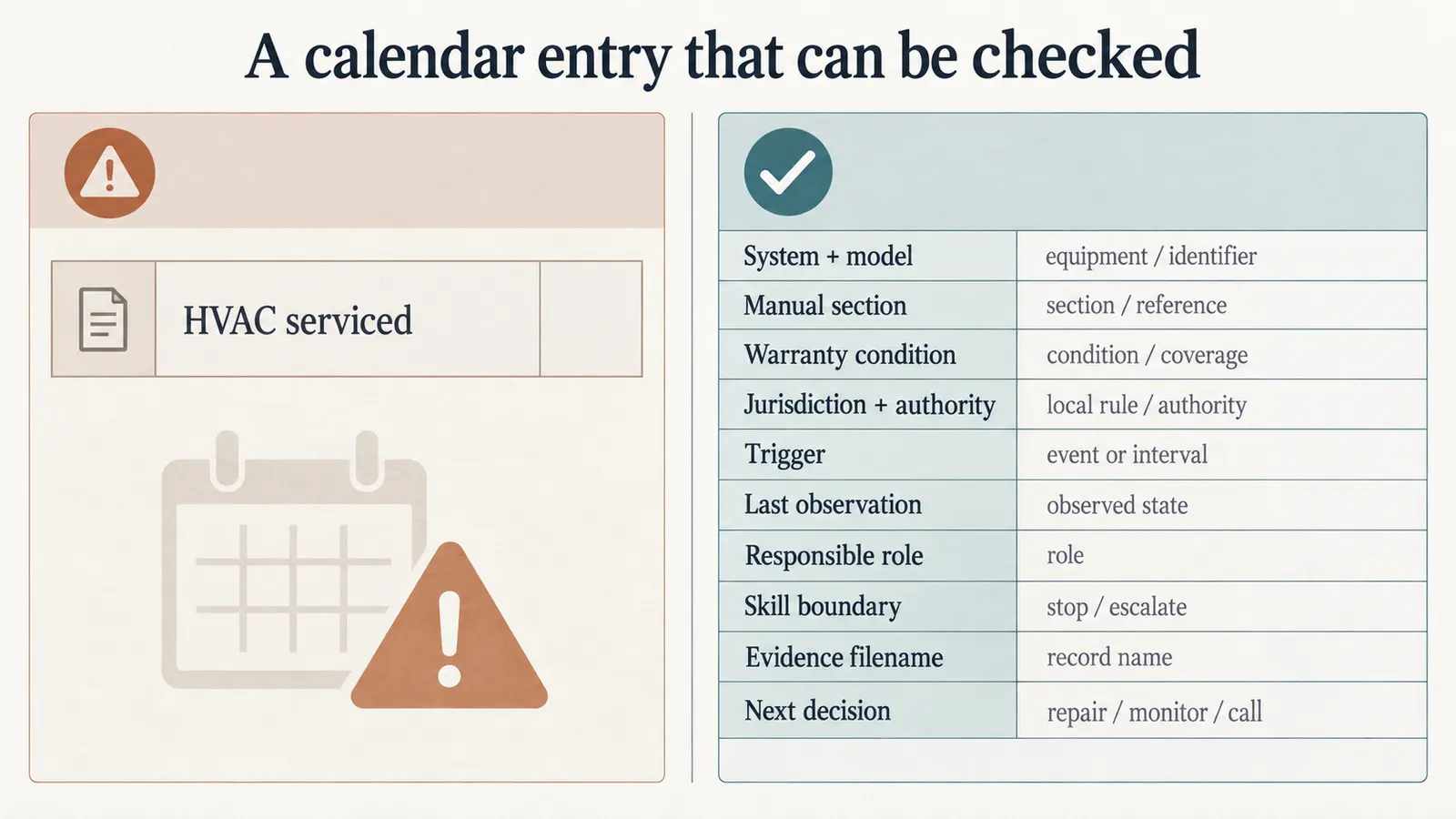
| Field | What to enter |
|---|---|
| System and task ID | Plain name plus stable ID, such as HVAC-01-filter-observe. |
| Function and location | What the system does, where it is, safe access route, and photo reference. |
| Manufacturer, model, serial | Exact text from the nameplate or documented source; include alarm manufacture date where applicable. |
| Manual section | Exact title, page, revision, or URL for use-and-care or test instruction. |
| Warranty condition | Exact condition, coverage window, claim contact, and evidence requested. Use “none found” only after reading the document. |
| Local authority requirement | Named jurisdiction, authority, source, applicability, and effective date; use “not identified—verify” when unresolved. |
| National guidance | Optional bounded recommendation and its source, labeled as recommendation. |
| Trigger | Calendar date, elapsed time, season, runtime, filter condition, alarm date, display code, leak, noise, moisture, or other event. |
| Last completed or observed | Date, person or company, result, and evidence filename. |
| Next due or review | A date only when supported; otherwise “verify source,” “condition-based,” or blank. |
| Responsible role | Homeowner, builder, installer, HVAC professional, electrician, plumber, alarm professional, utility, fire marshal, or other named role. |
| Skill boundary | What the owner may observe or do and what must be assigned to a qualified person. |
| Evidence to retain | Manual page, photograph, test result, invoice, report, receipt, permit record, or written answer. |
| Escalation contact | Warranty contact, builder, installer, trade, utility, AHJ, or emergency route. |
| Next decision | Close, reschedule, investigate, claim, repair, replace, or obtain authority/manufacturer clarification. |
Choose a trigger before choosing a date
There are five useful trigger types:
- Fixed interval: The exact source says a task occurs every specified period. Record the period and the event from which it runs.
- Seasonal or operating event: The source ties the action to heating season, cooling season, irrigation season, occupancy, startup, or a change in use.
- Condition-based: The task occurs when a filter is dirty, an alarm reaches its replacement age, a leak is seen, a control reports a fault, or another observable condition appears.
- Event-based: The task follows a renovation, flood, power event, extended vacancy, equipment replacement, warranty claim, or permit closeout.
- Unknown: The source or applicability is not verified. Create a “source verification” task and leave the maintenance interval blank.
The last category matters. If your manual is missing and the manufacturer portal cannot identify the model, do not fill the gap with “annual.” You can still record a homeowner observation or a safety test supported by national guidance, but you cannot represent an unknown equipment service interval as settled.
Worked example: an illustrative filter row with sensitivity
The following is an illustrative modeled example, not a report from a tested home and not a claim about any particular filter or HVAC model.
Assume the handover record contains these inputs:
- System: ducted heat pump return-air filter.
- Model: recorded from the nameplate; exact model-specific filter section located.
- Manual trigger: replace at 90 days, subject to the manual's condition language.
- Warranty: retain maintenance evidence for claims; the written warranty does not state that 90 days is a universal interval.
- National guidance: EPA says replace filters according to the manufacturer's recommendations and notes that typical manufacturer recommendations are often 60 to 90 days; EPA's filter guide also says a heavily soiled filter may need more frequent replacement.
- Actual condition: at a 60-day observation, the filter appears heavily loaded. This is an illustrative observation, not a measured result.
- Owner task: inspect the accessible filter without opening hazardous equipment; ask a qualified HVAC professional if the filter size, airflow, or rating is uncertain.
Let:
D_manual = 90 days
D_condition = 60 days if the documented observation shows the filter is heavily soiled
D_authority = not identified
D_warranty = no interval stated
The scheduling rule is:
next filter action = the earliest supported trigger, not the most familiar interval
For the illustrative inputs, the next action is at 60 days because the condition-based observation occurs before the 90-day manual trigger. That does not prove that every future filter should be changed every 60 days. The next row should record whether the installed manual permits the owner to inspect and replace the filter, the exact filter size and rating, and the result of subsequent observations.
Sensitivity matters:
| Input change | Calendar result | What it means |
|---|---|---|
| Filter is clean at day 60 and manual says 90 days | Keep the supported 90-day trigger, subject to the manual. | Observation did not shorten the interval. |
| Filter is heavily soiled at day 60 | Trigger replacement or qualified review at day 60. | Condition overrode the later routine date for this cycle. |
| Manual cannot be verified | Do not choose 60 or 90 days as a product requirement. | Create a source-verification task; use only a clearly labeled bounded consumer observation. |
| A higher MERV filter is proposed | Verify fan and filter-slot compatibility first. | EPA says the highest rating must be one the system can accommodate; a professional may be needed. |
| Construction dust or wildfire smoke is documented | Increase observation attention and ask whether the manual or service professional changes the schedule. | Context changes risk and loading, not by itself a universal interval. |
The formula is deliberately conservative about evidence: min() can choose the earliest supported trigger, but it cannot create a date from an unsupported input. If the input is unknown, the result is “unknown—verify,” not zero days and not a default annual date.
Calculate dates without hiding the source event
For fixed dates, use a visible formula:
next due date = source event date + documented interval
For example, if an alarm's last monthly test was recorded on September 8, 2026, a next monthly test reminder could be October 8, 2026. The record should still say “monthly test; CPSC/DOE/USFA national guidance and installed manual,” not merely “October 8.” If the alarm manual says to test on a different cadence or the local authority imposes another requirement, record those facts and resolve the conflict.
For age-based replacement, preserve the manufacture date:
replacement review date = manufacture date + product or guidance life
USFA says smoke alarms need replacement 10 years from manufacture date and also says to follow the manufacturer's instructions for long-life and hardwired alarms. Use the USFA alarm-care instructions as the national reference, then record the actual alarm label and manual. Do not calculate ten years from the move-in date when the manufacture date is older.
Set bounded actions for common systems without inventing intervals #
Common systems can be included in one calendar, but each has a different observation, skill boundary, source, and escalation path. The examples below show how to start each row without pretending that a generic checklist is a model-specific manual.
HVAC: filter, condensate, controls, and professional service
For HVAC, separate occupant-accessible care from service that involves electrical, refrigerant, combustion, pressure, or internal components. An owner may often be able to identify a filter, record its size, inspect its visible condition, and use a thermostat or control as directed by the manual. Whether an owner may remove a panel, clean a coil, access a condensate line, or reset a protective device is model- and installation-specific; leave that to the manual and a qualified person.
The ENERGY STAR checklist describes monthly filter inspection or replacement and seasonal contractor checkups, and lists condensate-drain inspection, control checks, coils, blower components, refrigerant, gas or oil connections, combustion, and heat exchangers as typical professional-checkup items. Use that list to ask a service person what was covered, not as permission to perform those tasks yourself.
EPA adds two useful boundaries. First, it says filters should be replaced according to the manufacturer's recommendations and that a heavily soiled filter may need more frequent replacement. Second, it says a higher-efficiency filter should be one the fan and filter slot can accommodate, and that a professional may need to determine compatibility. See EPA's HVAC filter guidance. A common failure is to buy a thicker or higher-rated filter because “more filtration” sounds safer, then restrict airflow or fit the filter poorly. Record the existing size, thickness, rating, airflow concern, and the qualified person's answer before changing the specification.
The HVAC rows should usually include:
| Row | Owner-safe input | Qualified-service handoff | Evidence |
|---|---|---|---|
| Filter condition | Date, size, visible loading, replacement part identity, manual section. | Confirm compatibility if rating, thickness, airflow, or access is uncertain. | Photo of old and new filter, receipt, manual section, date. |
| Condensate observation | Look for visible water, overflow, staining, or a control warning without opening equipment. | Inspect or clear the drain, pump, trap, or safety control according to trade scope. | Service report, photo, measured finding if the professional supplies one. |
| Seasonal operation | Record thermostat setting, start/stop behavior, unusual noise, odor, or error display. | Inspect electrical, refrigerant, combustion, heat exchanger, blower, or controls as applicable. | Invoice, report, readings the professional chooses to provide, unresolved items. |
| Exterior unit | Observe access, snow, leaves, vegetation, standing water, or visible damage from a safe location. | Disconnect, clean, repair, or assess energized components and refrigerant circuit. | Photo, service report, escalation date. |
Do not infer from a comfortable room that the system is safe or properly commissioned. Comfort is an observation, not proof of correct combustion, refrigerant charge, electrical protection, airflow, drainage, or code compliance.
Whole-home ventilation: confirm the system before scheduling filters or cleaning
First identify whether the home has natural, spot, exhaust-only, supply-only, or balanced whole-home ventilation. DOE describes natural, spot, and whole-house approaches and notes that proper ventilation helps manage pollutants, combustion gases, and moisture. Its Consumer Guide to Home Ventilation also says kitchen and bathroom vents should lead outdoors rather than into an attic.
Your calendar should record the ventilation type, fan or unit model, intake and exhaust locations, controls, filter locations, frost or defrost controls if present, and the manual's cleaning or filter instruction. A “run the bath fan” row and an “inspect the heat-recovery ventilator” row are not interchangeable. The first may be an occupant practice; the second may require a filter or service procedure from the unit's manual.
Use moisture as a condition signal. EPA says moisture problems and solutions differ by climate, and it recommends using a humidity indicator; prolonged excess humidity and condensation on cold surfaces can damage a home. See EPA's moisture guidance. Record the instrument type, room, date, reading, outdoor conditions if known, visible condensation, and what was done. A single humidity reading does not diagnose a vapor-barrier, ventilation, leak, or mold problem.
The safe escalation path is to ask a qualified building-science, HVAC, ventilation, or moisture professional to investigate persistent condensation, musty odors, visible mold, water entry, a nonfunctioning fan, or a suspected exhaust termination problem. Do not solve a moisture symptom by sealing or disabling a ventilation system without understanding combustion safety, pressure relationships, and the manufacturer's instructions.
Water heating: record the exact unit and keep the task boundary narrow
For a tank, tankless, heat-pump, or solar-assisted water heater, record fuel or electrical type, manufacturer, model, serial, capacity or rated input if shown, installation date, controls, drain or condensate arrangement, location, and the manual and written warranty. Record whether a recirculation pump, mixing valve, expansion tank, leak sensor, pan, or other accessory is installed. These accessories may have separate manuals and warranty conditions.
Start with safe observations: visible leakage, corrosion, unusual discharge, error display, loss of hot water, unusual noise, condensate, or a tripped control. Do not adjust temperature, open panels, touch wiring, operate a relief valve, alter gas controls, disconnect a vent, or drain a tank just because a generic checklist mentions it. The correct action depends on the model, installation, hazard, and local requirements.
DOE's Federal Energy Management Program publishes water-equipment operations guidance, but the page explicitly says it is for federal facilities and is not designed to replace or supersede manufacturer guidelines or specifications. That scope warning is useful here: the DOE water-equipment guidance can illustrate why leak observations, records, and manufacturer instructions matter, but it does not supply a universal residential water-heater schedule.
Create separate rows for the heater, leak detection, condensate or drain pump, recirculation, and any water-treatment accessory. If a leak is active or water is near electrical equipment, prioritize shutting down the hazard only if the manufacturer's or emergency instructions clearly identify a safe occupant control; otherwise use the appropriate emergency, utility, plumber, or service route. Document what was observed and when, rather than trying to diagnose from a photograph.
Pumps: distinguish the pump function and the consequence of failure
“Pump” is not a sufficient equipment name. A sump pump, condensate pump, sewage ejector, well pump, booster pump, circulation pump, and stormwater pump have different fluids, controls, hazards, and service boundaries. Record the function, pit or tank, discharge route, power source, alarm, backup, and consequence if the pump stops.
An owner may be able to observe an alarm, accessible switch, visible water, or a manual-described test. The owner should not enter a pit or tank, handle sewage, remove a sewage-ejector cover, work on energized wiring, alter a float, or enter a confined space. A professional can verify pump operation, check electrical protection, inspect discharge and backflow arrangements, assess backup capacity, and report findings within their trade scope.
The calendar should include an outage or vacancy handoff: who receives an alarm, who knows the shutoff and backup, and what happens if the pump fails during a storm or while the home is empty. “Test pump” is incomplete unless the record states the permitted test procedure, person, evidence, and escalation contact.
Smoke and carbon-monoxide alarms: preserve both national guidance and local verification
Alarm maintenance is one area where national consumer guidance offers clear bounded actions. CPSC recommends monthly tests and annual battery replacement for smoke and CO alarms and gives general placement guidance for CO alarms. USFA says smoke alarms should be tested monthly, 9-volt batteries replaced at least annually, and entire alarms replaced every 10 years; it says to follow the manufacturer's instructions for long-life and hardwired devices. Cite the CPSC CO alarm page and the USFA smoke-alarm page in the applicable rows.
Keep separate rows for:
- monthly test of each device or documented group test;
- battery replacement, if the installed device uses replaceable batteries;
- manufacture-date or manual-based replacement review;
- interconnection or notification observation, if the manual describes a safe owner test;
- local authority verification for alarm type, power, location, interconnection, or replacement;
- hardwired installation or wiring concerns, assigned to a qualified electrician;
- nuisance alarms, which should be investigated without removing the battery or disabling the device.
USFA states that a city, county, or state may require a specific type of smoke alarm and directs homeowners to check with the local fire marshal. It also says only qualified electricians should install hardwired smoke alarms. That means a calendar entry that says “smoke alarms comply with code” is not evidence. The record should name the actual jurisdiction and fire authority, identify the source checked, and retain the inspection or written response if one exists.
If an alarm sounds for smoke or CO, follow the alarm and emergency instructions, move people to safety, contact emergency services or the utility when appropriate, and do not treat the event as a routine maintenance reminder. A monthly test is not a substitute for responding to an alarm, and a quiet alarm is not proof that the fuel-burning appliance or installation is safe.
Assign responsibility and safety boundaries #
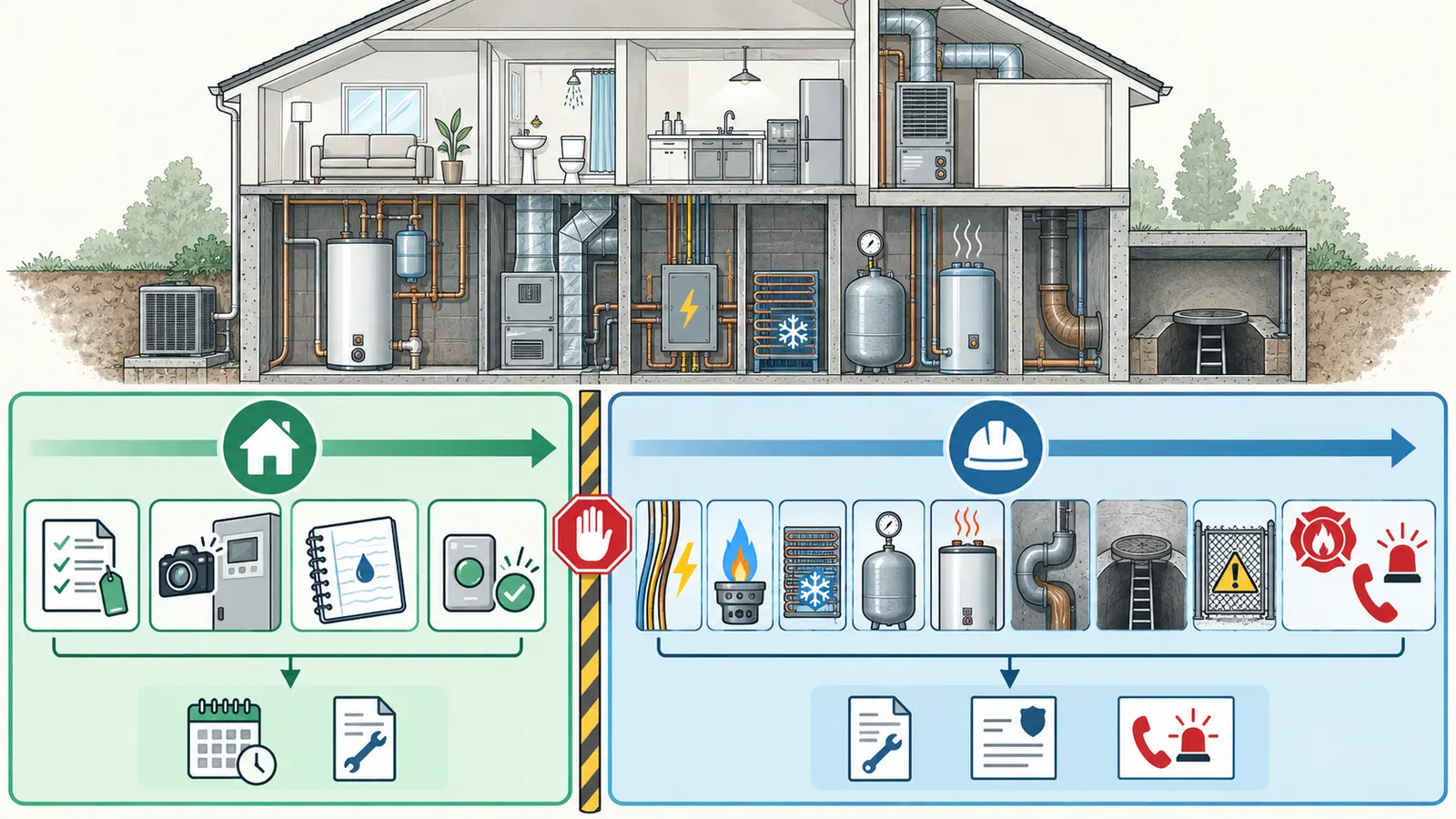
Every row needs a responsible role and a handoff condition. “Homeowner” is appropriate only for the portion the owner can safely perform under the product instructions; it is not a license to do electrical, gas, refrigerant, combustion, structural, sewage, confined-space, or hazardous-access work.
Use a role map
| Role | Appropriate responsibility | Handoff evidence |
|---|---|---|
| Homeowner or occupant | Read the manual, locate labels, conduct permitted tests, observe accessible conditions, replace an accessible filter or battery when the instructions allow it, and maintain records. | Dated log, photo, test result, receipt, question sent. |
| Builder or general contractor | Close handover gaps, provide installed-equipment schedule, manuals, warranties, commissioning or permit records, and correct incomplete work within the contract or warranty process. | Handover response, corrected document, punch-list closeout, service authorization. |
| Installing contractor | Explain startup, controls, normal indicators, service access, and exact maintenance boundaries for the installed model. | Commissioning record, orientation note, manual section, written answer. |
| Qualified HVAC or ventilation professional | Evaluate system performance, electrical and airflow concerns, refrigerant or combustion-related work, inaccessible components, drainage, and ventilation operation within scope. | Service report, measurements the professional chooses to provide, unresolved risks, next recommendation. |
| Qualified plumber or water-heating professional | Evaluate water-heating, pressure, gas, venting, leak, pump, relief, and drainage issues within scope. | Written report, invoice, photos, parts or model identity, escalation. |
| Qualified electrician | Install or service hardwired alarms, energized equipment, controls, circuits, and protective devices within scope. | Permit or service record, test result, closeout evidence. |
| Fire marshal or AHJ | Clarify the actual local requirement for the jurisdiction and occupancy or installation scope. | Official URL, code section, written answer, inspection record, or permit record. |
| Manufacturer or warranty administrator | Confirm model-specific instructions, warranty coverage, claim path, registration, and evidence requirements. | Case number, written response, current manual, warranty decision. |
| Utility or emergency service | Respond to utility-specific safety or supply issues and emergencies within its role. | Call reference, work order, clearance, or emergency record. |
Give the service person a useful packet
A service call is more effective when the homeowner brings the right record and does not pre-diagnose the problem. Send or provide:
- system function, location, model, serial, and installation or handover date;
- manual, warranty abstract, prior service reports, and relevant permit or commissioning records;
- the exact symptom, date, frequency, operating mode, and what changed before it appeared;
- photos of labels, displays, leaks, alarms, or visible conditions from a safe position;
- filter size and recent replacement date if HVAC-related;
- humidity or temperature readings with units, instrument, location, and time if moisture-related;
- whether there are pets, construction dust, wildfire smoke, unusual occupancy, vacancy, freezing weather, flood exposure, or repeated power interruptions;
- the question the professional must answer: observe, test, clean, adjust, repair, report, or advise warranty escalation;
- requested evidence: report, invoice, parts identity, test result, unresolved issue, and next recommended action;
- any local authority question and the exact jurisdiction involved.
Do not ask a professional to “make it code compliant” without naming the jurisdiction and desired scope. Do not ask a service company to decide whether a manufacturer's warranty applies unless the warranty gives it that role. Ask for a written description of what was inspected and what remains unresolved.
Recognize hazards before scheduling routine work
This is a moderate-safety decision because ordinary home systems can involve electricity, combustion, pressure, water damage, falls, contamination, and confined spaces. The calendar should label hazards explicitly:
- Electrical: energized panels, hardwired alarms, disconnects, capacitors, controls, and wet locations require a qualified electrician or service professional. Do not remove covers or probe wiring as a calendar task.
- Combustion and CO: fuel-burning appliances, vents, flues, and combustion testing require qualified service. A CO alarm or fuel odor is an immediate safety event, not a routine service date.
- Pressure and hot water: water heaters, expansion systems, relief devices, hydronic systems, and pressurized plumbing can discharge hot water or energy. Do not operate or alter components outside the manual's occupant instructions.
- Falls: attic, roof, ladder, elevated exterior, and mechanical-room access require safe access and may require a professional. A photo from the floor is acceptable; a roof inspection is not automatically a homeowner task.
- Water and contamination: sewage ejectors, mold, floodwater, and contaminated pits require appropriate protective procedures and qualified service. Never enter a pit or confined space.
- Weather and access: snow, ice, wildfire smoke, flooding, heat, and freezing conditions change the safe time to inspect outdoor equipment. Record the condition and reschedule or hand off safely.
Remote assessment has strict limits. A manual, photo, service invoice, or video call can help identify a model or visible condition, but it cannot establish hidden damage, safe combustion, electrical integrity, code compliance, structural soundness, pressure performance, or a complete repair scope. A photo, manual, or video call also cannot diagnose contamination—such as mold, sewage residue, or flood-related contamination—or certify that a confined-space entry condition is safe. EPA directs homeowners to use experienced professionals for sewage or other contaminated-water damage, and OSHA's confined-space guidance treats hazard evaluation and verification of acceptable entry conditions as a testing and control task, not a remote visual conclusion; see EPA's mold-cleanup guidance and OSHA's atmospheric-testing fact sheet. Use remote review to prepare a handoff, not to diagnose contamination, authorize entry, or certify the installation. Do not enter a pit, tank, crawl space, or other potentially confined or contaminated space to gather better evidence. Stop at safe observations and contact a qualified service professional or the appropriate protective-response provider for the property's hazard and jurisdiction.
Verify evidence and handle exceptions #
A calendar entry is closed only when the action, result, evidence, and next decision are recorded. If a task cannot be verified, keep it open with a named owner and a clear escalation date.
Close a task with a four-part record
Use this completion test:
- Identity: Is the record tied to the correct system, model, serial, room, and task ID?
- Action: What was actually done or observed, by whom, on what date, using which source or procedure?
- Result: Did the system pass the described test, show a condition, remain unresolved, or require a different trade?
- Next decision: Is the next due date supported, is the task condition-based, is a claim or repair open, or does a source still need verification?
For example, “HVAC serviced” fails the test. “HVAC-01; licensed HVAC company; September 8, 2026; filter inspected and replaced with [part identity]; condensate observation reported normal; electrical/combustion/refrigerant scope not included; invoice and report saved; next manual-directed filter review due or condition-based; follow-up required if water, error, odor, or noise appears” is much more useful. Only include facts that the service report actually states; do not add measurements or certifications that were not recorded.
Build an exception queue, not a hidden backlog
Use statuses that tell you why the row is open:
| Status | Meaning | Next action |
|---|---|---|
| Ready | Identity, source, role, trigger, and evidence path are known. | Schedule or perform the bounded action. |
| Source missing | Manual, warranty, local rule, or jurisdiction has not been found. | Assign a person and date to obtain it. |
| Condition-based | No fixed date is supported; an observation controls. | Set an observation reminder and record the threshold or symptom. |
| Professional required | The task involves skill, hazard, or inaccessible equipment. | Send the packet to the named trade and request a report. |
| Warranty open | A defect, claim, or coverage question is unresolved. | Preserve evidence and follow the written claim process. |
| Authority review | Applicability or compliance is unresolved. | Contact the named AHJ and preserve the answer. |
| Escalated | A safety or damage condition should not wait. | Use the emergency, utility, fire, builder, or qualified-service route now. |
| Closed | Action and result are supported by evidence. | Carry forward the next supported trigger. |
This queue prevents a common failure: a homeowner marks a task complete because a contractor visited, while the contractor did not inspect the component in question. Record the actual scope. If the report says “unable to access,” the task remains open or becomes an authority or builder handoff.
Common failure cases and the correct next decision
The handover folder contains a manual, but not for the installed model. Photograph the nameplate, contact the installer or manufacturer, and mark the model-specific interval unknown. Do not use the closest manual by appearance.
The warranty says maintenance is required, but no interval is stated. Record the wording exactly, ask the warranty administrator what evidence is expected, and separate the evidence condition from the service schedule. Do not invent an interval to satisfy an ambiguous clause.
A generic checklist conflicts with the installed manual. Preserve both sources, label the generic checklist as national guidance, and use the exact manual or seek manufacturer and qualified-service clarification. Do not silently choose the more frequent or less expensive option without documenting why.
A local rule appears in a search result but the jurisdiction is unclear. Find the property's state, county, city, fire district, utility, or other AHJ; open the official source; record scope and effective date; and ask the authority if applicability is unclear. Do not call it “code” in the calendar before verification.
The equipment is comfortable and quiet, but the owner cannot prove commissioning. Treat comfort as an observation only. Ask the builder or installer for commissioning, startup, permit, or inspection records, and schedule a qualified evaluation if safety or performance remains uncertain.
A professional gives a verbal recommendation to replace a component. Ask for the model identity, reason, applicable manual or warranty issue, urgency, and written scope. Do not claim that a replacement is required merely because it was suggested; record it as an open decision until supported.
The owner sees water near HVAC or water-heating equipment. Stop treating the row as routine. Record the location and apparent timing from a safe position, protect people and property if the instructions identify a safe control, and call the appropriate qualified service, builder, plumber, HVAC contractor, or emergency route.
An alarm gives nuisance alerts. Never remove the battery or disable the alarm as a maintenance shortcut. Follow the product's hush and placement instructions, ventilate or leave the area as appropriate, investigate the source, and escalate recurring or unexplained alarms.
A filter appears dirty earlier than the calendar date. Record the condition and ask whether the manual supports earlier replacement or whether a professional should verify filter size, fit, airflow, construction dust, or unusual pollutant loading. Do not infer that every future cycle has the same interval.
A source is silent. Silence is not permission. Mark the interval unknown, schedule source verification, and use only a separate, clearly supported observation or life-safety action in the meantime.
Keep records that can survive a warranty question
The FTC recommends saving the warranty and receipt. Extend that into a property record with a consistent file naming pattern, such as:
2026-09-08_HVAC-01_filter-replaced_model-serial_report.pdf
2026-09-08_SMOKE-02_monthly-test_owner-log.jpg
2026-09-08_AHJ_city-fire-marshal_alarm-question_response.pdf
Use the date of the action, not the date you uploaded the file. Keep original invoices and written responses. If a document is revised, preserve the old version and note which one controlled the decision. Back up the record in a place that the household can access if the homeowner changes, the property is sold, or a warranty claim occurs.
Use the worksheet to run the first 90 days and make the next decision #
The first 90 days after handover should be a controlled discovery period: complete the system inventory, verify missing sources, perform clearly supported occupant tests, observe how the house behaves, and hand hazardous or uncertain work to the right professional. Do not compress every unknown into a seasonal maintenance date.
A practical first-90-day sequence
At handover or immediately after occupancy:
- Create the equipment index and photograph every nameplate, control, alarm label, and accessible filter location.
- Obtain manuals, warranties, registration records, commissioning documents, permits, inspection records, and builder or installer contacts.
- Identify all fuel-burning appliances, smoke alarms, CO alarms, pumps, water-heating equipment, ventilation equipment, and systems whose failure can cause damage.
- Record what is unknown: missing model, inaccessible equipment, unclear jurisdiction, absent warranty, missing permit closeout, or unassigned responsibility.
- Test or operate only the alarms and user controls that the installed instructions permit; record results and any failure.
- Name the authority for any local rule. For alarms, begin with the local fire marshal or fire department contact identified for the property's jurisdiction, while keeping the USFA national guidance as context.
During the first month:
- Perform documented occupant observations: leaks, error displays, unusual noise or odor, condensation, blocked outdoor equipment, filter condition, fan operation, and alarm results.
- Use a humidity indicator if moisture or condensation is a concern and record units, location, time, and visible conditions. EPA says climate changes moisture problems and solutions, so do not compare a reading to an unscoped internet threshold.
- Ask the builder or installer to demonstrate normal controls, safe owner tasks, shutoffs, alarm response, and service access.
- Schedule qualified service only where a manual, warranty, observed condition, commissioning gap, or safety concern supports it. Send the service packet rather than a vague “new house check.”
- Update the warranty abstract when registration, claim, labor, or maintenance evidence is confirmed.
By the end of 90 days:
- Close rows with verified identity, source, role, result, and evidence.
- Convert known fixed intervals into dates tied to the correct event.
- Convert condition-based work into observation reminders with the condition written down.
- Keep missing intervals blank and leave a source-verification task with an owner.
- Separate builder punch-list or warranty items from owner maintenance so a defect is not disguised as normal wear.
- Review the first observations for repeat patterns: recurring moisture, alarm faults, filter loading, pump alarms, unexpected power trips, temperature instability, or unexplained water use.
- Decide whether the next handoff is owner observation, builder correction, warranty claim, qualified service, or authority clarification.
The source-precedence maintenance calendar worksheet
Originality brief. Current answers tend to offer generic seasonal checklists or separate manufacturer, warranty, alarm, HVAC, and ventilation advice. The missing decision is how a homeowner reconciles those sources for the installed system: what controls, who acts, what evidence proves completion, and what to do when the interval or jurisdiction is unknown. This guide contributes the Source-Precedence Maintenance Calendar Worksheet, which turns each system and task into a traceable row with an intentionally blank date when support is missing. Check it by tracing any row from model and serial to the exact source, trigger, assigned role, retained evidence, and next decision; an independent reviewer should be able to reproduce the row without relying on memory.
The original contribution is titled Source-Precedence Maintenance Calendar Worksheet. Its method is simple and inspectable: start with the installed model and serial; locate the exact manual section; read the written warranty; identify the actual local authority and jurisdiction; add bounded national guidance; record the trigger, responsible role, evidence, and next decision; then calculate a date only when the trigger is supported. The worked filter example shows min() logic for an earlier condition-based trigger and sensitivity when the manual, filter condition, or compatibility input changes.
The declared method is: For each system, record the installed model and serial, locate the exact use-and-care instruction, warranty condition, and named jurisdictional source, then choose the earliest applicable trigger. Add the owner or qualified service role, evidence to retain, and a next due date only when the trigger is supported. The worked example shows min-date logic and sensitivity to actual use.
Its limitations are equally important. The worksheet is an editorial synthesis, not a product manual, warranty interpretation, inspection report, legal document, laboratory record, or code certificate. It cannot determine a local rule without the property's actual jurisdiction and current authority source. It does not create a service interval when a manual, warranty, authority, or qualified professional has not supplied one. It also does not establish that a homeowner can safely perform a task merely because the task appears in a table.
The declared limitations are: This is an editorial synthesis, not a product manual, warranty interpretation, inspection report, code document, or service recommendation. It cannot determine a local rule without the property's state, municipality, fire authority, utility, or other authority having jurisdiction, and it leaves unsupported intervals blank.
You can check the contribution by tracing any completed row backward. A reviewer should be able to identify the equipment, see the source section or URL, confirm the source scope, understand why the trigger was chosen, see who was assigned, open the evidence, and reach the next decision without relying on memory. If a row cannot pass that test, it is not complete.
The next decision is the calendar's real output
After the first review, each item should land in one of four next decisions:
- Continue owner observation or care because the manual permits it, the condition is clear, and the evidence path is simple.
- Schedule qualified service because the task crosses an electrical, combustion, pressure, refrigerant, contamination, confined-space, structural, or access boundary.
- Pursue warranty or builder correction because the issue may be a defect, incomplete handover, or written coverage question.
- Verify the authority or source because the local rule, manual, warranty, model, or applicability is not established.
That is the durable calendar. Dates are useful only after the source, trigger, person, evidence, and handoff are visible. A homeowner who knows why the next action is due—and what not to infer from the record—can maintain a new home without turning generic advice into unsafe repair instructions or an unverified local rule.
Cite this guide
Brictale. “How to Build a New-Home Equipment Maintenance Calendar From Manuals, Warranties, and Local Rules.” Published 2026-09-19; updated 2026-09-19.
https://brictale.com/build/handover/build-new-home-equipment-maintenance-calendar-from-manuals-warranties-local-rule · Read the Markdown version
Original contribution: Source-Precedence Maintenance Calendar Worksheet. A traceable worksheet that turns each installed system into a next-action record with model identity, manual section, warranty condition, local authority, skill boundary, evidence, and an intentionally blank date when the interval is unknown.
Sources and scope
Evidence behind this page
- The FTC says written warranty details should be available to read before purchase and that coverage, exclusions, duration, and the remedy should be checked in writing; coverage is not automatically all repairs or all situations.
United States consumer guidance about written warranties for major purchases, including home appliances; it does not interpret a particular installed product warranty.
Accessed · Link to this claim - The FTC advises consumers to save a copy of the warranty and the receipt because the receipt helps prove the purchase date and original ownership.
United States consumer record-retention guidance for products with warranties; the article applies it as a handover-record practice, not as a statement about a particular builder or manufacturer.
Accessed · Link to this claim - The FTC says a manufacturer generally cannot require a consumer to use specific parts or services to keep warranty coverage unless it provides those parts or services for free or receives an FTC waiver, while the actual written warranty still governs coverage and claims.
United States federal consumer warranty guidance; it is not legal advice about a specific dispute and does not remove any written maintenance or safety condition.
Accessed · Link to this claim - EPA says all filters need regular replacement and that furnace or HVAC filters should be replaced according to the manufacturer's recommendations; it notes manufacturers commonly recommend 60 to 90 days but heavily soiled filters may require more frequent changes.
Guide to Air Cleaners in the Home
United States EPA consumer guidance for portable air cleaners and residential furnace or HVAC filters; the 60-to-90-day statement is described as typical manufacturer guidance, not a universal interval.
Accessed · Link to this claim - EPA says a homeowner choosing a higher-efficiency HVAC filter should use the highest rating the system fan and filter slot can accommodate and may need an HVAC professional to determine compatibility.
Guide to Air Cleaners in the Home
United States EPA consumer guidance for residential HVAC filter selection; it does not approve a particular brand or establish a filter rating for an unidentified system.
Accessed · Link to this claim - EPA says moisture problems and solutions differ by climate and recommends using a humidity indicator; it identifies prolonged excess humidity and condensation on cold surfaces as potential sources of damage.
What are the main ways to control moisture in your home?
United States EPA residential moisture guidance, updated February 18, 2026; it provides context for observing conditions, not a model-specific dehumidifier or ventilation interval.
Accessed · Link to this claim - DOE's Consumer Guide to Home Ventilation says ventilation exchanges indoor and outdoor air, identifies natural, spot, and whole-house ventilation, and warns that combustion gases and moisture can accumulate without proper ventilation; it recommends monthly CO-detector testing in that guide.
Consumer Guide to Home Ventilation
United States Department of Energy consumer guide for homes; its detector recommendation is general consumer guidance and does not replace the installed alarm's manual or a local fire requirement.
Accessed · Link to this claim - DOE's home-ventilation guide says combustion-appliance exhaust gases must be directly vented outside because combustion products, including carbon monoxide, can otherwise enter the home.
Consumer Guide to Home Ventilation
United States Department of Energy consumer safety guidance for combustion appliances; it is not a site inspection or a determination that a particular installation complies.
Accessed · Link to this claim - CPSC recommends testing smoke and carbon-monoxide alarms monthly, replacing their batteries annually, and placing CO alarms on each level and outside sleeping areas; it says CO alarms should not be installed in attics or basements unless there is a sleeping area.
United States Consumer Product Safety Commission consumer recommendation; local law, alarm instructions, installation type, and the authority having jurisdiction may impose additional or different requirements.
Accessed · Link to this claim - USFA says smoke alarms should be tested monthly, 9-volt batteries replaced at least annually, and the entire alarm replaced every 10 years; it also says to follow the manufacturer's instructions for long-life and hardwired alarms.
United States Fire Administration consumer fire-safety guidance, page last reviewed May 9, 2023; it is national guidance rather than a local code determination.
Accessed · Link to this claim - ENERGY STAR says homeowners should inspect, clean, or change central HVAC filters monthly and recommends annual pre-season contractor checkups, while describing its checklist as general maintenance guidance.
United States ENERGY STAR consumer checklist for central air conditioners, furnaces, and heat pumps; it is not a substitute for an installed system's manual or warranty.
Accessed · Link to this claim - DOE FEMP's water-equipment operations guidance says inadequate maintenance can cause leaks and premature failure, but expressly says its federal-facility guidelines are not designed to replace or supersede manufacturer guidelines or specifications.
Technical Operations and Maintenance Guidelines on Common Water Equipment
United States Department of Energy Federal Energy Management Program guidance for water-using equipment in federal facilities; used here to demonstrate scope discipline and source precedence, not to prescribe a residential interval.
Accessed · Link to this claim - EPA says that when water or mold damage is caused by sewage or other contaminated water, homeowners should call a professional experienced in cleaning and repairing buildings damaged by contaminated water; it also warns against running an HVAC system known or suspected to be contaminated with mold.
United States EPA residential mold and moisture guidance, last updated June 4, 2026; it supports escalation and exposure-control boundaries, not a diagnosis from a photo, manual, or video call.
Accessed · Link to this claim - OSHA explains that atmospheric testing in a confined space is used to evaluate hazards and verify that acceptable entry conditions exist, with test results recorded; a remote visual review cannot perform or certify that evaluation.
Procedures for Atmospheric Testing in Confined Spaces
United States OSHA federal workplace fact sheet on permit-space atmospheric testing; it is not a homeowner-specific code determination or authorization to enter a particular residential space.
Accessed · Link to this claim