Who Pays When a New Home Is Damaged Before Closing?
Verify who bears a new home's pre-closing fire, theft, storm, vandalism, or defect loss by reading the contract, builder's-risk policy, occupancy record, and closing file together.
The short answer
Usually, the contract and the active property policy work together: the policy may fund a covered construction loss, while the contract assigns the deductible, uncovered amounts, repair duty, and closing consequence. Do not assume the builder pays because the loss happened on the job, or that a homeowner policy replaces builder’s risk. Before closing, document the construction stage, written risk handoff, insurer consent, lender conditions, repair scope, and release conditions for this project and jurisdiction.Who Pays When a New Home Is Damaged Before Closing?
Usually, the contract and the active property policy work together: the policy may fund a covered construction loss, while the contract assigns the deductible, uncovered amounts, repair duty, and closing consequence. Do not assume the builder pays because the loss happened on the job, or that a homeowner policy replaces builder’s risk. Before closing, document the construction stage, written risk handoff, insurer consent, lender conditions, repair scope, and release conditions for this project and jurisdiction.
Use this verification surface with Brictale’s Choosing your team journey; the editorial method explains how source scope and uncertainty are recorded.
What “who pays” means before closing #
The short answer is that “who pays” is four different questions, and you need an answer to each one in writing: who bears the contract risk of loss, which policy is asked to respond, who funds the deductible or uncovered work, and who has authority to repair or release the home for closing. A builder, an insurer, a lender, and a closing agent can each have a different role. A certificate of insurance or a verbal promise that “the project is covered” does not answer all four. North Carolina law, as one jurisdiction-specific example, states that a certificate is not a policy and does not amend, extend, or alter the referenced coverage. Read the North Carolina certificate statute.
This guide is for a United States homeowner building a new home, whether the homeowner hired a general contractor, construction manager, architect-led team, or several trade contractors. The default market is the United States, but construction contracts, insurance forms, lien rules, occupancy approvals, and closing practice are not national in one uniform way. Wisconsin and Delaware appear below as clearly labeled examples. A Delaware public contract is useful for seeing how a sophisticated agreement can allocate the work; it is not automatically the rule for a private house in Delaware or anywhere else. A Wisconsin appellate decision shows why policy wording and timing can matter; it is not a universal answer for every Wisconsin loss or every policy.
The practical decision is this: can you trace an event at a particular date to one contract clause, one active property policy, one named or protected interest, one deductible allocation, one repair authority, and one closing condition? If you cannot, you have a handoff gap. The gap exists even if the builder is reputable, premiums were paid, and everyone expects the loss to be covered.
Risk of loss is not the same as insurance coverage
Risk of loss is the contract question. It asks which party must bear the economic consequence of damage at a specified stage. For example, a contract might say the contractor protects the work until substantial completion, or it might say the owner bears property loss once materials are delivered. Another contract might use a property-insurance clause that makes insurance proceeds the first recovery route and allocates the deductible separately. The words, definitions, exceptions, and order-of-precedence clause control the result.
Insurance coverage is the policy question. It asks whether the policy covers this property, at this location, during this phase, for this cause of loss, for this person or entity, up to what limit, subject to what deductible, and subject to what exclusions or conditions. The National Association of Insurance Commissioners explains that homeowners policies pay for perils listed in the policy up to policy limits and identifies the deductible as the portion of a covered home or personal-property loss the policyholder bears before insurer payment. Read the NAIC explanation of policy mechanics and deductibles. Separately, the NAIC’s Consumer Homeowners Insurance overview describes homeowners insurance as a legal contract.
Those questions can point in opposite directions. The contract might make the builder responsible for replacing a damaged wall, while the property policy is the source of funds and the owner is responsible for the policy deductible. Or a policy might exclude the particular loss while the contractor remains contractually responsible because the contractor caused it. Conversely, a covered loss can be paid by a property insurer even when no person was negligent; that does not mean the insurer has decided the builder breached the construction contract.
The four-party map
Before reading a clause, list the people and organizations who may touch the event:
- Owner: may own the land, owe the construction lender, hold the property policy, control closing instructions, and have rights to inspect or approve repairs.
- Builder or contractor: controls site operations, subcontractors, temporary protection, sequencing, and often the first notice to the insurer, but that authority must be verified.
- Design professional or construction manager: may inspect, certify progress, administer the contract, document substantial completion, or advise on repair scope. Their role is not automatically insurance authority.
- Insurer and broker: interpret and administer a policy, identify coverage positions, appoint an adjuster, and issue written consent or endorsements where required. A broker’s certificate does not replace the policy; North Carolina’s certificate statute provides that a certificate is not a policy and does not amend, extend, or alter the referenced coverage. See the jurisdiction-specific example.
- Lender and closing agent: may require evidence of property insurance, inspections, permits, lien releases, completion documents, or a particular treatment of insurance proceeds. They do not necessarily decide which construction party was contractually at fault.
- Public authority having jurisdiction: the city, county, state, or other agency with authority over permits and occupancy. The relevant authority is the one for the actual project address, not a rule remembered from another state.
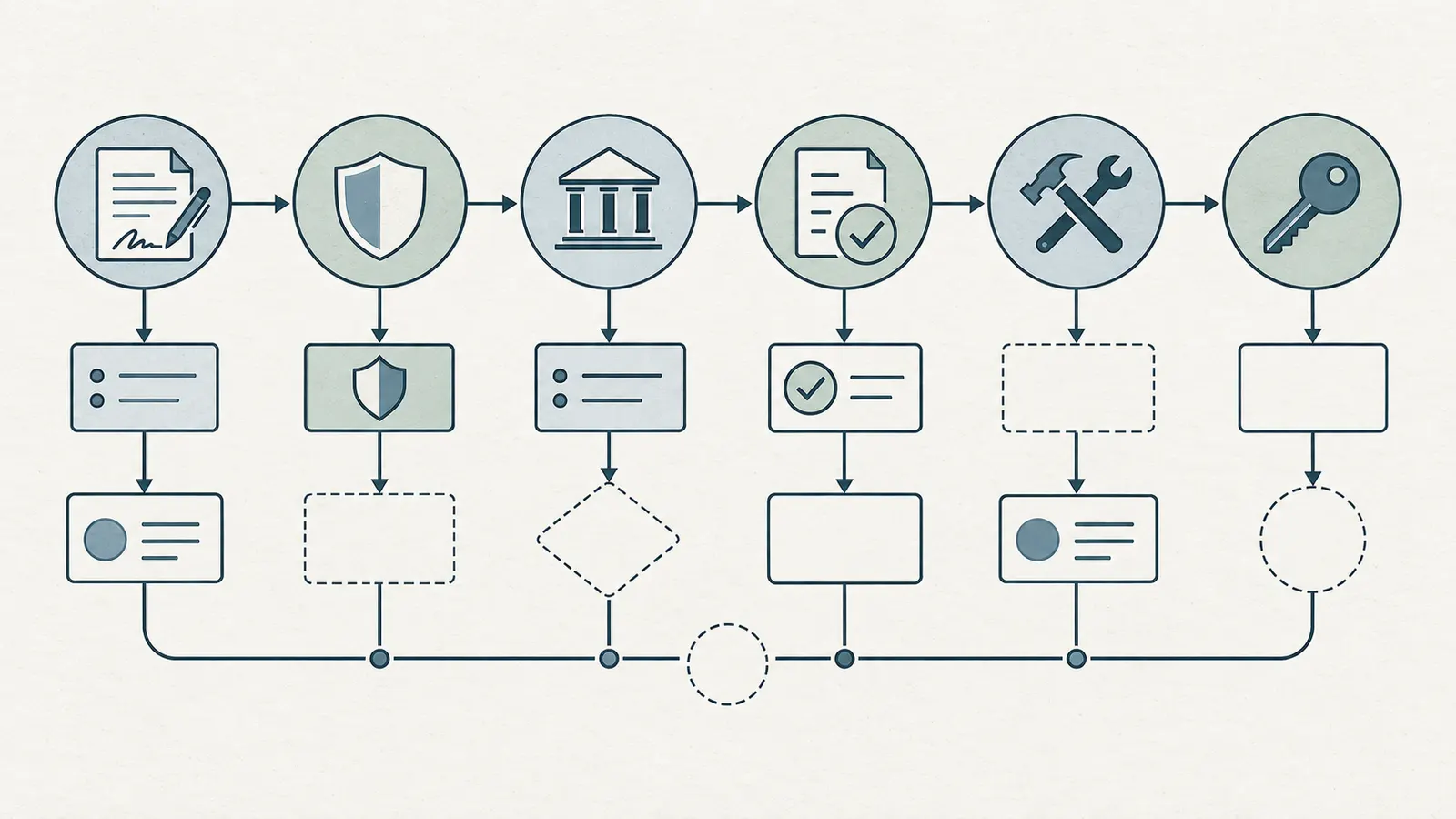
Write the role next to each document. A useful label is “decision authority,” not just “contact.” The person who can notify an insurer may not be the person who can authorize demolition. The person who can authorize demolition may not be able to waive the homeowner’s closing conditions. The person who can sign a change order may not be able to alter the insurance exhibit.
What a “builder’s-risk policy” does and does not prove
For this article, builder’s risk means a property policy intended to protect a building, materials, equipment, or fixtures during construction. It is a property route, not a finding that a contractor caused the loss. The policy’s declarations, forms, endorsements, exclusions, limits, deductibles, coverage territory, termination provisions, and insured-interest wording matter more than the label on the certificate.
A contractor’s commercial general-liability policy is a different route. Michigan Attorney General consumer guidance warns homeowners that a contractor saying the contractor is insured does not necessarily mean the insurance covers poor workmanship, incomplete construction, or damage to the owner’s or neighbor’s property; it tells consumers to ask what the insurance covers. Use Michigan’s “insured—for what?” warning as a document-check prompt. Treat that as consumer guidance from Michigan, not as a statement of every policy or a nationwide coverage rule.
That distinction changes the first question you ask. Do not ask only, “Does the builder have insurance?” Ask:
- What policy is intended to protect the partially completed home and project materials?
- Who purchased it, who is named, who is an additional insured if applicable, and who is listed as mortgagee or loss payee?
- What exact date or event starts and ends it?
- Does it address materials in transit, off-site storage, temporary structures, debris removal, code-required demolition, testing and startup, soft costs, delay, and early occupancy?
- Who reports the loss, who adjusts it, who receives proceeds, and who controls the repair decision?
- Who pays the deductible, self-insured retention, excluded amount, or amount over the limit?
If the answer to any item is “the certificate should say,” ask for the policy and the executed contract clause instead. As Brictale’s document-review rule, use a certificate as a pointer to documents to verify, not as a substitute for policy wording; North Carolina law illustrates the narrower legal point that a certificate is not the policy and cannot amend, extend, or alter the referenced coverage. Check the North Carolina certificate statute.
The first decision: continue, pause, or escalate
If there has been no loss, the safest next decision is whether the document set is complete enough to let work begin or continue. If there has been a loss, the safest next decision is whether the site is safe to enter and whether anyone has written authority to preserve evidence and protect the property. A homeowner should not enter a fire-damaged, unstable, flooded, electrically energized, contaminated, or otherwise restricted site to take photographs.
Do not perform structural shoring, electrical isolation, demolition, mold remediation, hazardous-material handling, roof work, ladder work, excavation, or work in a confined space yourself just to improve a claim record. Direct those tasks to the appropriate qualified local professionals and emergency responders. Keep the construction manager, builder, insurer, lender, and closing agent in the same written thread where practical. If their instructions conflict, ask for a written decision from the person with authority under the contract and policy, and get jurisdiction-specific legal advice before signing a release, accepting a settlement, waiving a lien, or moving the closing date.
How to read the contract and policy together #
Read the signed contract, exhibits, amendments, change orders, insurance certificate, full policy, endorsements, lender conditions, and closing instructions as one handoff file; a single sentence about “builder’s risk” is not enough. Your goal is to build a traceable chain from the work stage to the financial result, not to find a familiar phrase and assume it has the familiar meaning.
Assemble the document stack in the right order
Create a clean PDF or paper set with a table of contents and page numbers. The minimum stack is:
- signed owner–contractor agreement;
- general and supplementary conditions;
- insurance and bonds exhibit;
- scope, drawings, specifications, allowances, and exclusions;
- every signed change order and amendment;
- subcontracts or purchase terms that the contract makes part of the project documents;
- builder’s-risk declarations, forms, endorsements, exclusions, deductible schedule, and renewal or cancellation notices;
- contractor liability certificate and policy information, if the contract requires it;
- permanent homeowners or dwelling policy, if it was issued before completion;
- construction-loan and permanent-loan insurance conditions;
- permit, inspection, temporary occupancy, and certificate-of-occupancy records;
- progress-payment applications, stored-material invoices, delivery tickets, title records, and lien waivers;
- substantial-completion certificate, punch list, final completion record, warranty start record, and closing statement.
Michigan’s Attorney General guidance recommends a signed written contract before work starts and specifically lists start and completion dates, required permits, a cost breakdown, payment dates and events that trigger payment obligations, and contractor identifying information as items to include. That is Michigan consumer guidance, not a national legal checklist, but it is a strong practical test for whether your own contract makes the event sequence visible. Review the Michigan written-contract checklist.
Do not rely on a draft that was used for a loan application if the parties later signed an amendment. Do not rely on a certificate that lists a policy number but omits the endorsement that changed the loss-payee language. Do not assume an email is a change order if the contract requires signed amendments. If documents conflict, mark the conflict and ask the contract administrator or construction attorney to apply the order-of-precedence clause.
Extract the clauses with a repeatable key
Use the following key as a search-and-review worksheet. Record the exact document name, section, page, effective date, and a short quotation or faithful paraphrase. Never record only “covered” or “builder pays.”
| Field to extract | What the field must answer | Why it matters before closing |
|---|---|---|
| Work definition | What building, temporary work, materials, equipment, and site are included? | A policy or risk clause can fail at the edges: a detached structure, rented equipment, stored cabinetry, or neighboring property may be treated differently. |
| Risk trigger | What event changes risk: delivery, installation, payment, substantial completion, occupancy, title transfer, final payment, or another date? | The incident date must be compared with the actual trigger, not the planned closing date. |
| Property policy | Who buys and maintains builder’s risk or equivalent property cover? | The responsible purchaser must produce the complete policy and renewal record. |
| Insured interests | Are owner, contractor, subcontractors, lender, mortgagee, loss payee, or other parties identified correctly? | An interest in the proceeds is not always the same as repair authority or contract responsibility. |
| Peril and exclusions | What causes of loss and resulting damage are included or excluded? | Fire, theft, wind, flood, vandalism, defective work, wear, neglect, and resulting damage can follow different rules. |
| Deductible / retention | What amount applies, per occurrence or otherwise, and who bears it? | A covered loss can still create a large immediate funding gap. |
| Settlement authority | Who notifies, adjusts, settles, receives, holds, and disburses proceeds? | The wrong person may promise a repair, sign a release, or spend money without authority. |
| Repair obligation | Who must protect, remove, replace, redesign, test, and certify the damaged work? | Insurance funding does not itself create a construction schedule or a code-compliant repair. |
| Time and delay | Is there a completion extension, delay-in-completion cover, liquidated damages rule, or closing extension? | A repair cost and a temporary-housing or rate-lock cost may be separate issues. |
| Handoff | What document records substantial completion, partial occupancy, permanent insurance, final payment, and closing release? | The handoff must be provable later; a verbal date is not a durable record. |
Highlight terms such as “until,” “unless,” “upon,” “prior to,” “written consent,” “subject to,” “except,” “loss payee,” “trustee,” “deductible,” “self-insured retention,” “permanent property insurance,” “partial occupancy,” “substantial completion,” and “period for correction.” These are not decorative drafting words. They are the hinges on which the responsibility sequence turns.
Separate four types of money
Make four lines in your event log instead of one line called “repair cost.”
- Covered direct physical damage: the amount the applicable property policy might pay, subject to the actual policy, valuation, limits, deductible, exclusions, and claim determination.
- Deductible or self-insured retention: the first amount or other amount the policyholder or contractually designated party must fund.
- Excluded or under-limit work: defective work, betterment, code upgrades, flood or earth movement, delay, temporary housing, professional fees, or other categories that may require special wording or another funding route.
- Contract or tort responsibility: an amount a builder, subcontractor, designer, owner, or another party might owe because of the contract or applicable law, regardless of which insurer first pays.
The categories can overlap. A policy may pay to remove and replace damaged work but not to correct the original defect. A contract may require the contractor to absorb a deductible when the contractor caused the casualty. A lender may control proceeds without deciding who ultimately bears the cost. Keep the categories separate until the documents and qualified advisers resolve them.
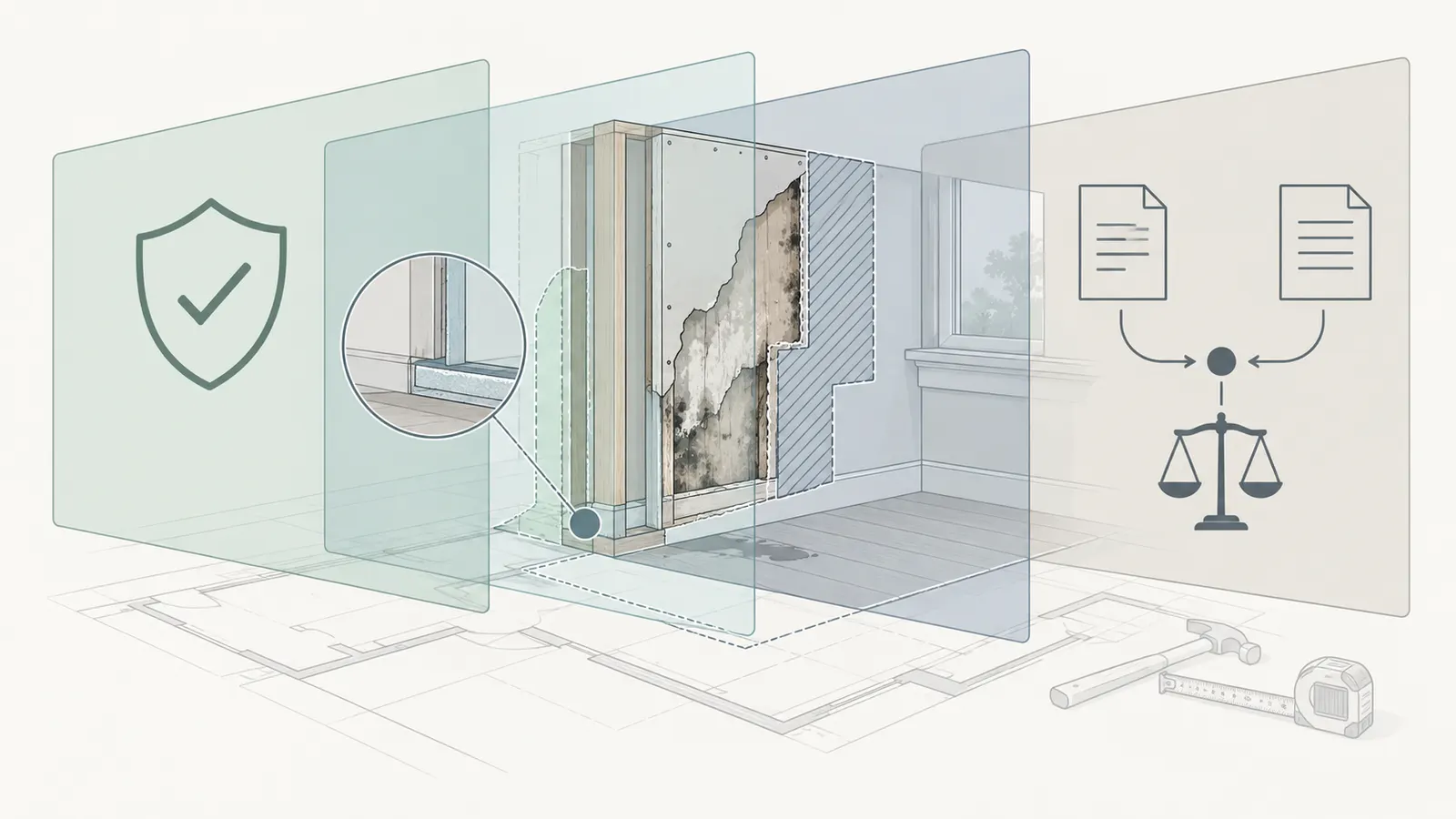
What the contract should say before mobilization
Before the first excavation, delivery, or temporary utility connection, ask for a one-page insurance and risk schedule signed by the parties. It should not replace the contract. It should point to the controlling clauses and list the project-specific choices.
At minimum, the schedule should state:
- policy purchaser and broker contact;
- policy number, effective dates, and project address;
- construction value and method used to keep limits current;
- property covered and property not covered;
- named insureds, additional insureds, mortgagee, lender, and loss-payee wording;
- perils, exclusions, sublimits, valuation basis, debris and code coverage, and delay or soft-cost coverage if purchased;
- deductible and self-insured retention by event or coverage;
- notice responsibilities and time-sensitive preservation steps;
- settlement and proceeds authority;
- temporary and permanent repairs authority;
- required inspections, permits, insurer consent, and partial-occupancy conditions;
- transition date or trigger to permanent property insurance;
- substantial-completion certificate requirements;
- closing prerequisites and treatment of an unresolved loss;
- whether a casualty creates a contract extension, change order, termination right, or price adjustment.
The AIA-MBA Joint Committee recommends that project-specific insurance provisions be used and that any deductible assigned to a contractor be stated in supplementary general conditions. It also says the participants’ legal responsibilities should be recognized and that a broadly worded hold-harmless clause should define the risks and liabilities rather than silently shifting the whole project. See the AIA-MBA insurance and liability guidance. Ask a construction attorney to review indemnity, waiver, subrogation, and hold-harmless language in your jurisdiction.
What a certificate can safely tell you
A certificate may help you identify a carrier, policy number, stated limits, named party, and date range, but it is only a starting point. As Brictale’s document-review rule, do not treat the certificate alone as proof that the policy covers the exact project, a specific damaged material, an early-occupancy condition, a flood or earth-movement event, a workmanship-related consequence, a deductible, or a claim after cancellation or expiration. The underlying policy and endorsements must answer those questions. North Carolina law is a jurisdiction-specific example of the boundary: it says a certificate is not a policy and does not amend, extend, or alter the referenced coverage. Read the North Carolina certificate statute.
Request the full policy and endorsements when the contract gives you that right or when the project is relying on the policy to protect your money. In the Delaware public-project example, the owner must secure evidence of required insurance and, on request, provide the contractor a copy containing applicable conditions, definitions, exclusions, and endorsements. Compare the Delaware insurance exhibit’s evidence-of-coverage language. The Delaware wording is a contract example; use the executed agreement for your project.
When the handoff changes as the home is built #
Treat mobilization, material delivery, enclosure, systems startup, substantial completion, partial occupancy, permanent insurance, and closing as separate handoff events; none should be collapsed into a single label such as “the builder is still responsible.” The active risk allocation should be checked at each event and after every change order, policy endorsement, payment, inspection, or occupancy decision.
Stage 0: contract signing to mobilization
At signing, the homeowner should know which documents control the property-insurance obligation before work starts. The builder should know who can authorize site protection, who owns or insures stored materials, and what evidence must be delivered. The lender should know what insurance it will accept for the construction loan. The closing agent does not normally substitute for this early coordination.
Verification packet:
- executed agreement and insurance exhibit;
- named project and legal owner;
- builder’s-risk quote or policy, not just a premium invoice;
- lender’s construction insurance checklist;
- site security and emergency contact list;
- baseline photographs and drawings;
- permits and notice-to-proceed record;
- written confirmation of the first coverage date.
Do not allow “we will obtain the policy after the first draw” to remain an oral assumption. If the contract makes insurance a condition to mobilization, treat missing evidence as a project decision requiring written resolution. If the contract is silent, do not fill the silence with a guess; ask the owner’s attorney, broker, lender, and builder to state their proposed allocation before exposure increases.
Stage 1: site work, foundation, and open structure
At the early stage, the work may consist of excavated soil, forms, rebar, concrete, temporary shoring, underground utilities, stored lumber, and equipment. A loss may affect work already incorporated, materials not yet installed, neighboring property, the public right of way, or a rented machine. These are not necessarily one insurance category.
Record who controls site security, weather protection, temporary drainage, dewatering, and equipment. A homeowner should not infer that a contractor’s duty to protect the site equals a promise to insure every resulting loss. The contract may set a standard of care, while a property policy defines covered physical damage. The party that failed to protect the work may owe money even if a policy pays first; that is a later contract or recovery question.
Verification packet:
- delivery tickets with dates, quantities, and storage location;
- photographs of installed and stored work;
- site protection and storm-preparation log;
- open excavation and utility maps;
- inspection approvals and failed-inspection notices;
- temporary-works responsibility;
- policy confirmation for materials, equipment, and transit;
- daily report identifying weather, access, and security events.
Stage 2: dried-in shell and stored materials
Once the structure is enclosed, high-value materials often begin arriving: windows, doors, roofing, mechanical equipment, electrical gear, cabinets, appliances, and finish materials. The risk question may change when title passes, when the materials arrive, when the owner pays for them, or when they are installed. The policy may treat on-site, off-site, and in-transit property differently.
The AIA-MBA Joint Committee distinguishes on-site and off-site materials and recommends documentation, owner access to inspect, insurance protecting the owner’s interests, and title transfer upon payment, subject to the actual contract and insurance provisions. Use the AIA-MBA stored-material guidance to audit paid-but-not-installed items.
For each high-value item, record five dates: order, payment, title transfer, delivery to the project, and installation. Add the address where it was stored and who had custody. A paid invoice is not proof that the item is insured at the project site. A delivery ticket is not proof that title passed. A builder’s-risk schedule may not automatically include off-site fabrication or transit. Ask the policyholder or broker for written confirmation.
Stage 3: systems testing and startup
Heating, cooling, plumbing, electrical, fire-protection, controls, elevators, generators, and other systems create a new exposure when they are energized, pressurized, fired, or tested. A water leak, electrical event, startup failure, or frozen pipe may damage the building, equipment, or third-party property. The correct response depends on the system, the event, and the policy language.
Make the responsible trade and the general contractor identify who may energize or pressurize each system, what preconditions apply, who must be present, and what test record is required. Have qualified professionals perform hazardous isolation and testing. Do not reset breakers, open gas valves, enter flooded electrical areas, bypass safety controls, or operate construction systems without authorization.
The Delaware public contract example specifically describes property insurance for building systems from testing and startup and for debris removal and certain services after an insured loss. That is evidence of one project’s drafted requirement, not proof that your private policy has the same wording. Review the Delaware project’s specific-required-coverages clause.
Stage 4: substantial completion
Substantial completion should be a documented responsibility change, not a casual synonym for “almost done.” In the Delaware public contract example, substantial completion is the point at which the work is sufficiently complete for the owner to occupy or use it for its intended purpose. The certificate establishes the date, lists what remains, assigns security, maintenance, heat, utilities, damage, and insurance responsibilities, and is accepted in writing by the owner and contractor. See the Delaware/AIA substantial-completion provisions.
Your contract may define substantial completion differently, may use a certificate from an architect or owner’s representative, or may not use the term at all. Do not import the Delaware/AIA definition without checking your agreement. Ask these questions:
- Is the whole home substantially complete, or only a designated portion?
- Can the owner use the portion for its intended purpose without unsafe unfinished work?
- What punch-list items remain and who must correct them?
- Has a public authority issued the required permit or certificate for the intended use?
- Has the insurer approved the change in use or coverage?
- Who carries security, temporary utilities, maintenance, heat, damage, and insurance after the date?
- Does the property policy continue through the correction period?
- Do warranties start on this date or on final completion, payment, transfer, or another trigger?
The handoff is not complete until the written certificate, policy change, permit record, and contract responsibilities agree. If the documents show four different dates, closing should be treated as a decision requiring resolution, not as an administrative appointment.
Stage 5: partial occupancy or early use
Early occupancy can change insurance, contract responsibility, safety, warranty timing, and lender approval; never move furniture into or sleep in a partially completed home without written permission from the parties whose documents require it. In the Delaware example, occupancy before substantial completion requires written insurer consent, and the general conditions tie partial occupancy to authorization by public authorities and written agreement on payments, security, maintenance, heat, utilities, damage, insurance, corrections, and warranties. Read the Delaware partial-occupancy provisions.
The Wisconsin example shows why this matters. In Fontana Builders, Inc. v. Assurance Company of America, a Wisconsin home was still incomplete when the builder’s owner and family moved in. The construction policy and a homeowner policy both became relevant, and the builder’s-risk policy contained language about coverage ending when permanent property insurance applied. The Wisconsin Court of Appeals reported that the jury found the homeowner policy applied and affirmed the judgments for Assurance. Read the Wisconsin Court of Appeals decision.
The case does not tell you that a homeowner policy always replaces builder’s risk after move-in. It tells you to locate the exact termination, occupancy, permanent-insurance, title, and policy-effective-date wording before anyone moves in. A lender’s requirement to bind a homeowner policy before closing can create a second policy that changes the construction policy’s operation; the contract and both policies must be reviewed together.
Stage 6: closing and permanent ownership
Closing is a financial and title handoff, not automatically the insurance handoff. The deed, construction contract, loan documents, insurance policy, occupancy authorization, substantial-completion certificate, final inspection, and closing statement may each use a different trigger. The correct release condition is the one required by the transaction documents and applicable law.
Most mortgage lenders require homeowners insurance and listing the lender as mortgagee, according to NAIC consumer guidance, but lender requirements do not answer who caused a construction loss or who owes a deductible. Check the NAIC mortgagee and homeowners coverage explanation.
Before releasing the homeowner to closing, create a written closing gate:
- no unresolved question about which property policy is active on the closing date;
- written confirmation that the permanent policy is effective when required and does not unintentionally cancel or reduce construction coverage;
- occupancy authorization for the actual use and location;
- substantial-completion record or contract-defined equivalent;
- repair scope and completion evidence for any casualty;
- independent inspection or professional sign-off appropriate to the damaged work;
- lender acceptance of the insurance, repair, escrow, and completion documents;
- lien waivers or releases required by the contract and state law;
- written treatment of deductible, excluded work, delay, temporary housing, and remaining punch-list items;
- closing agent’s written instructions for unresolved work and insurance proceeds;
- no broad release or acceptance document signed without legal review of its effect on claims, warranties, liens, and repair duties.
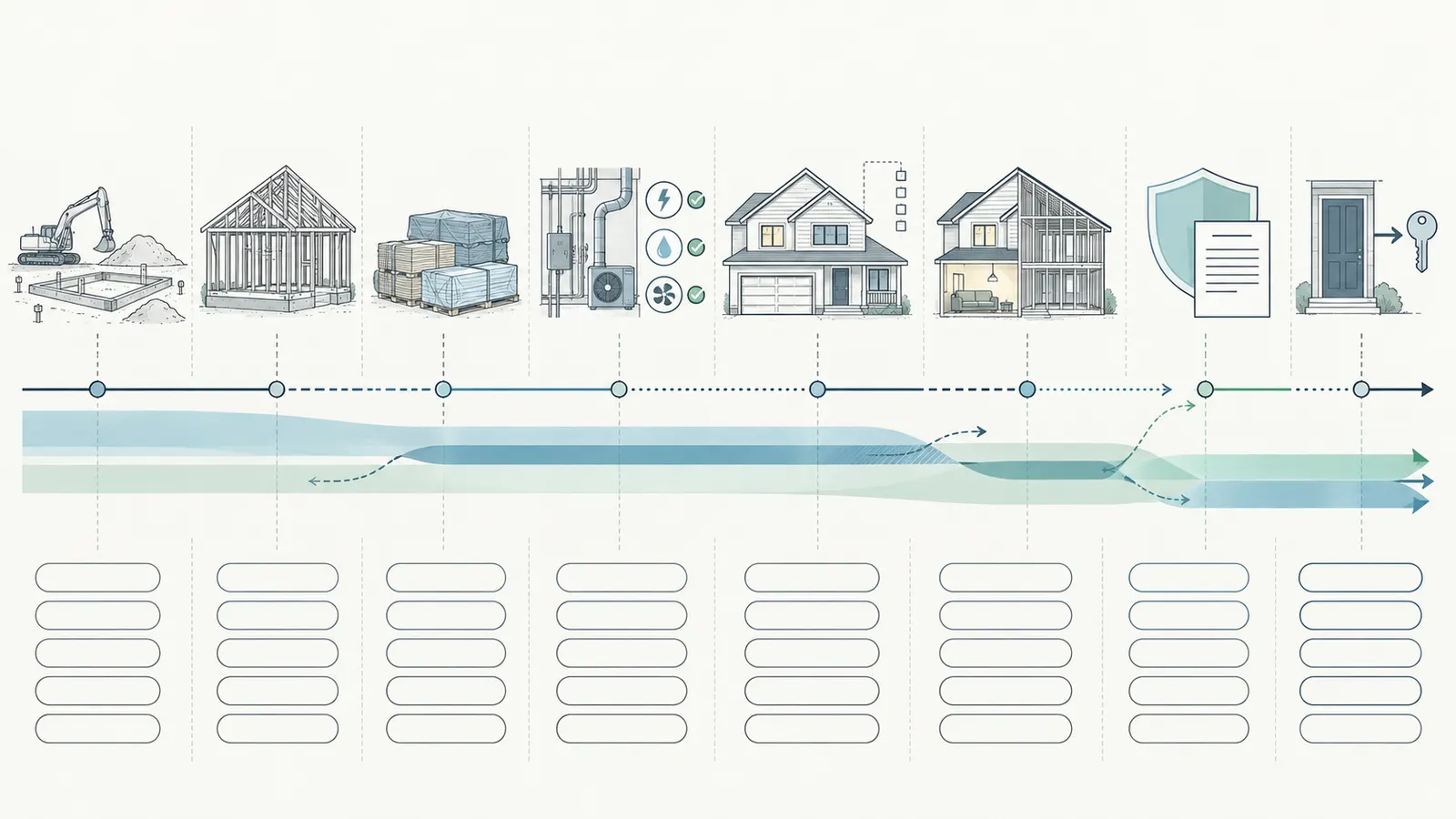
If a fire, theft, storm, or other casualty occurs shortly before closing, the default practical answer is to pause the release decision until the contract parties, insurer, lender, and closing agent document how the loss will be handled. That is not a prediction that closing must be delayed in every jurisdiction. It is a control against exchanging title and loan proceeds while the active policy, repair funding, and acceptance conditions are unknown.
The risk-of-loss and insurance handoff matrix #
The matrix below is the original Brictale contribution for this guide. It is a source-labeled decision matrix, not an insurance determination. It turns the approved event categories into a record a homeowner can complete before work starts and update after each handoff.
Originality brief
Current answers usually explain builder’s risk in general terms, summarize a policy, or discuss one dispute. They rarely let a homeowner compare construction stage, contract risk, policy route, deductible, repair authority, evidence, schedule, and closing release in one place. The missing decision is whether the contract and policy actually agree for the homeowner’s project at the date of loss.
The original contribution is the Risk-of-loss and insurance handoff matrix below. It can be checked by locating every proposed field in the signed contract, insurance documents, lender conditions, permit record, and written completion certificate; unresolved cells are visible gaps.
Method: The matrix combines the event categories in the approved brief with fields drawn from the Delaware public contract example, Wisconsin case facts, AIA-MBA guidance, Michigan consumer guidance, and NAIC policy explanations. Each row is an illustrative event; the homeowner fills the blank project-specific fields from the signed contract, policy, endorsements, lender conditions, and written certificates.
Limitations: It is not an insurance determination, legal opinion, claims-handling instruction, code inspection, or prediction of which party will ultimately pay. Coverage, contract interpretation, deductibles, liens, permits, and closing conditions depend on the actual documents and the project's jurisdiction.
How to fill the matrix
Fill one copy for the baseline project and one copy for each real event. Use a specific date and construction stage. In the “contract risk holder” column, write the exact party and clause, not just “builder.” In the “policy to notify” column, write the carrier, policy number, broker or claims contact, and reason for the route. In the “deductible or uncovered amount” column, write “unknown” if the documents do not resolve it; unknown is safer than a made-up number.
The repair decision-maker column should identify who may authorize emergency protection, demolition, temporary repair, permanent repair, design revision, and final acceptance. Those can be different people. The evidence column should include photographs only when they can be taken safely, plus delivery records, invoices, weather records, police or fire reports, inspection notes, daily logs, and written notices. The closing-release column should identify the exact item that must be completed, escrowed, waived, or approved before closing, rather than simply saying “close after repairs.”
| Illustrative event | Construction stage | Contract risk holder to verify | Policy to notify | Deductible or uncovered amount | Repair decision-maker | Evidence to preserve | Schedule effect | Closing release |
|---|---|---|---|---|---|---|---|---|
| Fire damages framing, wiring, and stored cabinets | Enclosed shell; before substantial completion | Owner or contractor under property-risk clause; contractor responsibility if negligent, if stated | Builder’s risk first; liability route only for a defined third-party or negligence issue; permanent policy if active | Deductible, excluded betterment, code upgrade, or under-limit amount from actual documents | Emergency responders and qualified safety professional for access; contract administrator and insurer for scope; lender for proceeds | Fire report, safe photographs, daily log, delivery/title records, policy and clause, inspection record | Rebuild duration, permit and inspection sequence, temporary housing, possible closing extension | Written insurer/lender position, repaired work inspected, occupancy approval, proceeds/deductible treatment, updated completion record |
| Theft removes appliances or copper | Materials delivered; not installed or during systems stage | Custody, title, and site-security clauses; do not infer from payment alone | Builder’s risk or policy covering theft; contractor liability only if a contractual/negligent route applies | Theft deductible, security exclusion, missing off-site/transit coverage, betterment | Owner and contract administrator for replacement authorization; insurer for policy route; builder for secure site | Police report, inventory, invoices, serial numbers, delivery tickets, access logs, photographs, security records | Replacement lead time and reinspection may move substantial completion | Replacement installed and tested, inventory reconciled, deductible paid or allocated, lender accepts evidence |
| Wind, hail, freeze, or fallen tree damages roof or work | Any stage; especially open shell or near completion | Weather-protection obligation and property-risk clause; compare force-majeure and negligence wording | Builder’s risk, flood or other separate policy if the peril requires it, and liability route only if applicable | Wind/hail percentage, flood exclusion, tree removal, temporary protection, limit or code gap | Qualified roofer/tree professional for safety; insurer and contract administrator for permanent scope; authority for permits | Weather service record, incident time, safe photos, temporary-repair receipts, roof inspection, policy endorsements | Dry-in, material lead times, moisture remediation, inspections, closing date | Dry structure verified, moisture or concealed damage evaluated, permit/inspection record, lender and insurer conditions cleared |
| Vandalism or malicious mischief damages partially finished home | Before substantial completion or during vacant period | Site-security, access, and property-insurance clauses; negligence only if supported | Builder’s risk for covered property damage; liability route if a known third party is responsible | Deductible, security-condition exclusion, cleanup, and non-covered personal property | Insurer and contract administrator; qualified trades for electrical, glass, structural, or hazardous repairs | Police report, access list, camera or alarm data, photographs, inventory, invoices, notice log | Cleanup and replacement may affect inspections and completion | Secure site, completed repairs, final inspection, written coverage and deductible treatment |
| Defect in workmanship causes damage or a leak | Systems startup, enclosure, or after installation; stage must be fixed | Contractor’s performance and correction duties; separate property-loss allocation | Property policy for resulting physical damage if policy says so; contractor liability or contract correction route for defective work | Original defective work, resulting damage, deductible, testing, code, or design revision may separate | Designer/engineer and qualified trade for cause and repair; insurer and contract administrator for covered scope | Before/after photos, test reports, nonconformance record, specification, change order, invoices, moisture or electrical record | Investigation can be longer than the repair and may reopen finishes | Cause and scope documented; correction accepted; warranty start and responsibility written; no blanket release over unresolved defect |
| Subcontractor or delivery vehicle damages the site or a neighbor’s property | Any stage; third-party property exposure | Contract indemnity, negligence, custody, and separate-contractor provisions | Builder’s risk for project property; contractor auto/general liability for third-party damage if applicable; owner policy only if its terms route the event there | Liability deductible or self-insured retention, project deductible, uninsured amount | Safety responders, owner/contract administrator, insurer, and affected third-party process; legal counsel for releases | Incident report, witness contacts, vehicle details, photos if safe, delivery ticket, site log, notices, repair estimates | Access, investigation, permit, and coordination with third party | Third-party settlement or release reviewed, project repaired, lender/title conditions and liens cleared |
| Owner moves in or uses a portion early | Before substantial completion or before final closing | Written partial-occupancy agreement, certificate, and responsibility schedule | Construction policy plus permanent policy; written insurer consent and public-authority authorization where required | Policy change, occupancy condition, personal-property gap, deductible, and temporary-utility cost | Owner and contractor in writing; insurer and authority for coverage/use approval | Occupancy date, joint inspection, permits, utility transfer, written consent, photos, condition list | May shift maintenance, warranty, utilities, or damage responsibility and affect closing | Occupancy authorized, coverage confirmed, responsibilities accepted, punch list and warranties recorded |
This matrix intentionally uses “to verify” language. A row is not a ruling. For example, “builder’s risk first” is a practical notification route to check when the project property policy is intended to protect construction work; it does not promise coverage. “Liability route” is not a finding that a contractor was negligent. “Deductible unknown” is an unresolved financial exposure that must be escalated, not a blank to ignore.
Worked illustrative example with sensitivity
The following is a modeled example, not a claim estimate and not a prediction of insurer payment. Assume a fire occurs on October 14 while the house is enclosed but before substantial completion. A qualified estimator describes a $240,000 reconstruction scope. The homeowner’s document review separates the scope as follows:
- $210,000: potentially covered direct physical damage under the property policy, subject to adjustment;
- $30,000: work not yet established as covered, such as a design change, code upgrade, original defect, or excluded item;
- $10,000: stated property deductible;
- $320,000: stated project limit, which is not itself proof that every cost is payable;
- closing in 21 days: planned date, not a risk handoff by itself.
The simple planning formula is:
planning proceeds before claim determination = potentially covered scope − applicable deductible
$210,000 − $10,000 = $200,000
The planning gap against the $240,000 working scope is:
working gap = total working scope − planning proceeds
$240,000 − $200,000 = $40,000
The $40,000 is not automatically the homeowner’s bill. It is the amount requiring a separate decision about excluded work, contract correction, code coverage, lender-controlled proceeds, contractor responsibility, contingency, or revised scope. If the contract assigns the deductible to the contractor for contractor-caused damage, the owner’s direct planning gap could differ. If the policy later determines only $170,000 is covered, the planning proceeds at the same $10,000 deductible would be $160,000 and the working gap would be $80,000. If the actual repair scope is $300,000 and potentially covered scope is $270,000 with a $10,000 deductible, the planning proceeds would be $260,000 and the working gap would be $40,000 again, but the schedule, code, and loan implications could be materially different.
| Scenario | Total working scope | Potentially covered scope | Deductible used for illustration | Planning proceeds before determination | Working gap to total scope |
|---|---|---|---|---|---|
| Base case | $240,000 | $210,000 | $10,000 | $200,000 | $40,000 |
| Lower covered amount | $240,000 | $170,000 | $10,000 | $160,000 | $80,000 |
| Larger scope | $300,000 | $270,000 | $10,000 | $260,000 | $40,000 |
| Higher deductible | $240,000 | $210,000 | $25,000 | $185,000 | $55,000 |
What this shows is sensitivity, not a coverage conclusion. A $15,000 deductible increase changes the planning gap by $15,000. A $40,000 change in potentially covered scope changes the planning gap by $40,000. The project team should not make a closing promise based only on the project limit or a builder’s estimate. Bring the inputs, units, formula, and uncertainty to the broker, contract administrator, lender, and construction attorney.
An empty-cell escalation rule
Use a red flag when any of these cells is empty or contradictory:
- construction stage at the time of the event;
- active policy and effective date;
- contract risk holder and clause;
- insured interest and mortgagee/loss-payee status;
- deductible or retention;
- excluded or disputed scope;
- settlement and repair authority;
- occupancy and public-authority status;
- lender instruction for proceeds and closing;
- completion or release document.
One empty cell may be normal during early planning. Several empty cells at substantial completion or before closing are not a minor paperwork issue. They mean the homeowner cannot yet show who will fund the first dollars, who can authorize the repair, or what must be true before title and loan documents are released.
What to do for each type of damage #
For any event, make the site safe, preserve the condition, give prompt written notice through the routes required by the contract and policy, and obtain a written responsibility and repair sequence; the correct insurer and final payer depend on the actual documents. The event playbooks below are comparison prompts, not claims-handling instructions or coverage opinions.
Fire or explosion
Fire is urgent because the visible burn may not be the full damage. Smoke, water, heat, soot, compromised framing, damaged wiring, contaminated insulation, and suppression-system discharge can require different professionals and different evidence. Emergency responders and the site’s qualified safety professionals control safe access. Do not energize systems, enter unstable areas, disturb suspected evidence, or begin broad demolition just to make the house look repairable.
The first written record should state the date and approximate time, construction stage, affected areas, occupancy status, emergency response, utilities isolated, and known third parties. Preserve the fire department report, incident number, alarm data, daily reports, delivery records, photographs taken by authorized professionals, and the exact policy and contract clauses. Ask who is authorized to approve emergency stabilization, temporary protection, engineering, debris removal, and permanent repair.
Compare the policy’s direct physical loss, resulting damage, debris, code, testing, and professional-service provisions with the contract’s correction, negligence, change, and insurance provisions. The Delaware example lists fire and explosion among required causes of loss and addresses resulting damage from certain construction deficiencies, but that language belongs to that Delaware project’s drafted insurance exhibit. Use the Delaware cause-of-loss clause as a comparison example.
The next decision is whether the home can remain on the planned closing path. Do not answer that from the repair estimate alone. Check whether the repaired work needs a new permit, concealed-work inspection, electrical or structural sign-off, moisture assessment, lender review, occupancy approval, or a revised completion certificate. If the parties propose escrow or a holdback, have the closing attorney explain who controls the money, what releases are signed, what happens if the repair costs more, and whether the arrangement preserves warranties and claims.
Theft
Theft requires an inventory and custody analysis as much as a police report. List each missing item, its status, model or serial number, owner, payment date, title status, delivery location, installation status, and replacement lead time. High-value items often move through order, fabrication, storage, delivery, and installation stages, and the risk clause may use one of those events.
Notify the route named in the policy and contract, and ask whether the item was covered on site, in a warehouse, in transit, or after payment. The AIA-MBA stored-material guidance recommends documentation and owner access to inspect on-site and off-site materials, and says the materials should be insured to protect the owner’s interests subject to the contract and insurance provisions. Audit the stored-material trail with that guidance.
Do not replace every missing item before the inventory and authorization are recorded if doing so would destroy useful evidence or create a dispute over substitutions. You may need a temporary security repair, but document who authorized it and keep receipts. A builder may be responsible for site security without being the party that insures the stolen appliance. A property policy may cover replacement without deciding whether the builder must reimburse a deductible. Keep those questions separate.
Before closing, confirm that replacement items are installed, connected, tested by qualified trades, and accepted under the contract. A delivery ticket alone does not show installation or operation. If the item affects occupancy, fire safety, heating, water, or electrical approval, the public authority and lender may have additional conditions.
Vandalism or malicious mischief
Vandalism is often discovered after a vacant-home walkthrough: cut wiring, broken windows, damaged controls, defaced finishes, blocked drains, or intentional water release. Treat damaged electrical, gas, structural, or pressurized systems as hazards. Secure the site through qualified professionals and do not invite untracked visitors to inspect.
Preserve access records, keys, lock changes, alarm data, camera footage, police report, contractor daily logs, visitor list, photos, and the condition record from the last safe inspection. Compare the event date to the policy period and any vacancy, security, or protection conditions. Ask whether the policy covers cleanup, temporary security, and resulting damage, and ask the contract administrator who is responsible for restoring the work.
If the builder says vandalism is “the owner’s problem because the owner owns the land,” ask for the clause and the date on which the contract says that risk began. If the owner says the builder must pay because the builder controlled the site, ask for the security and care obligation. The matrix should record both positions without prematurely deciding which is correct.
Weather, wind, hail, freeze, and fallen trees
Weather damage is a stage-and-peril problem. Wind may damage an open roof; hail may damage finished roofing; freeze may damage water-filled lines; a fallen tree may damage the structure and also require tree removal; flood or surface runoff may be treated differently from rain entering through a storm-opened roof. The policy’s definitions and exclusions matter.
Record the exact weather event and time using an available local weather record, but do not treat a weather report as proof of the damage mechanism. A qualified roof, structural, mechanical, or moisture professional should identify what can safely be observed and what needs to be opened or tested. Do not climb onto a damaged roof or enter standing water near electrical equipment.
The NAIC explains that common homeowners policy coverage depends on listed perils and that flood and earthquake coverage may be separate from a standard homeowners policy. This consumer explanation applies to common homeowners insurance, not automatically to builder’s risk or the project’s policy. Check the NAIC peril and separate-coverage explanation.
Compare three funding lines: emergency protection, permanent repair, and consequential delay or temporary housing. A tarp or board-up may prevent additional damage but may not settle the permanent scope. A delay may move the closing date without changing who bears the repair. If the tree came from an adjacent property or affected a neighbor, a third-party route may also exist. Get the property and contract parties to state their routes in writing.
Defective work and resulting damage
Defective work is the event most likely to be misclassified. A failed flashing detail, improperly installed pipe, undersized support, wrong material, or faulty connection can create a distinction between the cost to correct the defect and the cost to repair other property damaged as a result. The contract may require correction; the property policy may treat resulting physical damage differently; a liability policy may have its own terms; and a design professional may be involved.
Do not label the event “not covered” merely because the original work was defective, and do not label it “covered” merely because water or smoke damaged another component. Ask a qualified professional to document the observed condition, likely sequence, testing method, affected areas, temporary protection, and limits of the inspection. Preserve the approved drawings, specifications, manufacturer instructions, photographs before concealment, inspection reports, test records, change orders, invoices, and communications.
The AIA-MBA Joint Committee recommends a clear understanding and documentation of warranties, says notification is critical, and notes that warranty commencement is typically tied to substantial completion unless otherwise agreed. Use the AIA-MBA warranty handoff guidance. Do not use a repair agreement or closing release that silently starts, shortens, or waives a warranty without legal review.
The next decision is whether the suspected defect can be corrected without closing, whether the affected work must be opened for inspection, and whether the parties agree on a temporary or permanent remedy. If a repair changes the design, obtain the required design and permit review. A change order should identify price, schedule, responsibility, testing, warranty, and effect on the closing gate.
Third-party damage
Third-party damage includes a delivery vehicle hitting a wall, a subcontractor damaging a neighbor’s fence, a utility strike, a fire spreading from adjacent property, or construction activity damaging an owner’s existing structure. Identify the damaged property and the legal relationship before choosing an insurance route. The project property policy and a liability policy may be relevant for different property and different responsibilities.
Preserve the incident report, safe photographs, witness information, vehicle and delivery records, site plan, subcontractor identity, permits, utility markings, and written notices. Do not sign a release for the neighbor, delivery company, subcontractor, or insurer without understanding whether it releases project-property claims, personal-property claims, delay, liens, warranties, or the owner’s contract rights.
The AIA-MBA guidance says that contractor liability requirements should identify the risks applicable to the project and that any protection for the owner should be tied to specifically defined negligent acts rather than the project generally. Compare the AIA-MBA liability guidance. That recommendation does not decide which policy responds; it tells you why “indemnify everything” is not a sufficient project handoff.
Owner occupancy or use
Occupancy is itself an event in the matrix. It can change who controls the site, who maintains heat and utilities, whose personal property is present, when warranties start, and whether a property policy continues in the same form. It can also create safety and permit issues even if the space looks finished.
Before using a portion of the home, obtain a written agreement that identifies the portion, permitted use, date, access, security, maintenance, utilities, heat, damage, insurance, corrections, warranty start, and who can suspend use. Require written insurer consent when the policy or contract calls for it and verify authorization from the actual public authority having jurisdiction. The relevant city, county, state, or other agency depends on the address.
Make a joint condition record immediately before use. The Delaware/AIA general conditions call for joint inspection before partial occupancy or use and say that partial use does not necessarily accept nonconforming work. Compare the Delaware partial-occupancy inspection language. This is a useful control even when your project uses a different form.
If a loss occurs after early use, record whether it happened in the occupied portion, an unfinished portion, or both. Do not assume the occupant caused it or that the builder no longer has responsibility. Compare the written occupancy agreement, policy consent, substantial-completion status, and actual use.
Wisconsin and Delaware: what the examples teach #
Wisconsin and Delaware illustrate two different verification lessons: Wisconsin shows that overlapping property policies and early occupancy can create a fact-specific coverage dispute, while Delaware shows how a contract can spell out property insurance, deductibles, occupancy, substantial completion, and proceeds authority. Neither example supplies a shortcut for a private homeowner’s documents.
Wisconsin: a fire, early occupancy, and overlapping policies
In the Wisconsin Court of Appeals case Fontana Builders, Inc. v. Assurance Company of America, the builder had a builder’s-risk policy on a new home. Before completion, the builder’s owner and family moved into the home, which remained titled to the builder. A bank required the prospective home buyers to obtain homeowner’s insurance before closing on a loan. A fire then destroyed much of the home and contents. The builder claimed under builder’s risk; the buyers claimed under their homeowner’s policy.
The court’s online decision describes a builder’s-risk policy provision under which coverage terminated when permanent property insurance applied. It also describes a prior remand for a jury to determine whether permanent property insurance applied, the homeowner insurer’s settlement payments, and the jury’s finding that the homeowner policy applied at the time of the fire. The Court of Appeals affirmed the judgments for Assurance. Read the official Wisconsin decision and its procedural posture.
The lesson is narrow but important. A policy can contain a transition clause that depends on another policy “applying.” A lender’s requirement to bind a homeowner policy can matter even if construction is incomplete. Title, occupancy, policy effective dates, who purchased the policy, and what the policy says about permanent insurance can all become evidence. The case does not establish that a permanent homeowners policy always applies first, that builder’s risk always terminates at occupancy, or that the lender determines coverage.
For a Wisconsin project, ask a Wisconsin-licensed insurance professional and Wisconsin construction attorney to review the actual policy and contract. Do not turn the Fontana facts into a Wisconsin rule for every new home. Record the jurisdiction because the opinion is a Wisconsin Court of Appeals decision, not a national insurance standard.
Delaware: a public contract with explicit choices
The Delaware public contract is a useful comparison document because its insurance exhibit makes choices visible. It says, unless the obligation is placed on the contractor, the owner purchases builder’s-risk all-risks or equivalent property insurance on a replacement-cost basis for the total project value. It identifies the interests of the owner, contractor, subcontractors, and sub-subcontractors as insureds and includes mortgagee interests as loss payees. It states a maintenance period through substantial completion and a continuation or replacement approach afterward. Read the Delaware public-project insurance exhibit.
The same example identifies a list of causes of loss, additional property categories, a deductible allocation, occupancy consent, and the possibility that the contractor provides the property insurance if that option is selected. If the contractor provides it, the example requires deductible disclosure, policy access on request, and owner authority to adjust and settle the loss and act as trustee of proceeds unless changed in the contract.
The example also links partial occupancy to insurer consent and public-authority authorization, calls for written assignment of responsibilities, and uses a substantial-completion certificate to establish responsibility for security, maintenance, heat, utilities, damage, and insurance. Those details are valuable because they show the fields a homeowner should look for. They are not a conclusion that every private Delaware agreement contains them or that a Delaware homeowner automatically bears the same deductible.
For a Delaware project, verify the actual municipal or county permit and occupancy requirements for the property address, the executed agreement rather than the public sample, and the policy issued for the project. For a project in any other state, use the Delaware document as a comparison example only.
Comparing the lessons without blending jurisdictions
| Question | Wisconsin case lesson | Delaware contract-example lesson | Homeowner action |
|---|---|---|---|
| Can two policies matter? | Yes, the court described builder’s-risk and homeowner policies in dispute after early occupancy and a fire. | The contract anticipates construction property coverage and continuation or replacement around substantial completion. | List every policy active or proposed on the incident date and read transition wording. |
| Does occupancy matter? | Early occupancy was part of the facts and policy dispute. | Written insurer consent and public-authority authorization are expressly addressed for partial use. | Do not occupy until written consent and authority are confirmed for the actual project. |
| Does the label decide? | No; the policy’s “permanent property insurance” wording and evidence mattered. | No; the exhibit requires choices about purchaser, insured interests, deductibles, causes, and duration. | Capture exact clauses, not just “builder’s risk” or “homeowners.” |
| Who gets proceeds? | The case describes payments to buyers and a mortgagee in that dispute. | The contractor-provided option identifies owner settlement and trustee duties unless changed. | Ask who adjusts, settles, receives, and controls proceeds in your documents. |
| Is it national law? | No; it is a Wisconsin appellate decision with specific facts and policies. | No; it is a Delaware public-project contract example. | Name the project jurisdiction and obtain local legal and insurance review. |
How to verify the handoff before you close #
Use a staged verification meeting with the owner, builder, design professional or contract administrator, broker or insurer, lender, and closing agent; leave with signed documents, not a shared understanding. The meeting can be remote, but remote review cannot establish site safety, concealed damage, permit compliance, structural adequacy, or policy coverage by itself.
Seven days before a planned closing
Ask each responsible party for a written status with the same date and project address. Request:
- Contract status: current completion percentage, open change orders, unresolved notices, pending claims, and responsibility for remaining work.
- Insurance status: construction policy active dates, permanent policy effective date, endorsements, deductible, lender listing, and any written occupancy or transition consent.
- Inspection status: permits, failed and passed inspections, certificate of occupancy or equivalent, and any required special inspections.
- Damage status: event log, cause investigation, repair scope, open questions, emergency work, and expected completion.
- Money status: paid-to-date, retainage, insurer proceeds, deductible, escrow or holdback, contingency, and disputed amounts.
- Title and lien status: waivers, releases, recorded notices, and the closing agent’s requirements under applicable law.
- Handoff status: substantial-completion or equivalent certificate, punch list, warranties, manuals, keys, security, utilities, maintenance, and date responsibility changes.
Compare the responses line by line. If the builder says “complete,” the inspector says “not approved,” the insurer says “coverage pending,” and the lender says “documents missing,” the project is not ready for an unqualified release decision. Ask the closing agent what can be postponed, escrowed, or documented and ask counsel what rights would be released.
The day of the final inspection
Bring the matrix, contract, policy summary, permit list, repair scope, and the last condition record. The purpose is not to perform a professional inspection yourself. It is to confirm that the responsible professionals inspected the affected work and that the paperwork identifies what they accepted.
Observe safely from accessible areas:
- Is the affected space dry, secure, and free of visible active damage?
- Are temporary protections still in place, and who maintains them?
- Are utilities connected only where authorized and tested?
- Are repaired finishes concealing work that still needs inspection?
- Are labels, serial numbers, and equipment records consistent with the replacement scope?
- Are unfinished items clearly on a signed punch list with an owner, date, and completion standard?
- Does the home’s actual use match its occupancy approval?
Do not infer from a clean surface that concealed framing, wiring, insulation, ductwork, waterproofing, or fire protection is sound. Do not infer from a certificate of occupancy that the contract’s quality, insurance, or warranty obligations are complete. Do not infer from a lender’s approval that a construction dispute is resolved.
The written questions to send
Send a short numbered list so answers can be compared:
- “Identify the clause that assigns risk of loss for this event at this date.”
- “Identify the policy, form, endorsement, and effective date you believe applies.”
- “State the named insureds, additional insureds if relevant, mortgagee or loss payee, and who may receive or control proceeds.”
- “State the deductible or retention and the contract party responsible for it.”
- “List the scope you consider covered, excluded, defective, code-related, or still unknown.”
- “Name the person authorized to approve emergency protection, demolition, permanent repair, design changes, and final acceptance.”
- “List the inspections, permits, and professional certifications still required.”
- “State the effect on substantial completion, warranties, occupancy, utilities, maintenance, schedule, and closing.”
- “State what document will record the final handoff and who must sign it.”
Michigan Attorney General guidance advises homeowners to review the policy and deductible, contact the insurer, and write down the questions, answers, people contacted, and dates. That recordkeeping practice is useful in every state, even though the guidance itself is Michigan-specific. Use the Michigan contact log recommendation.
The minimum event log
Keep an event log with one row per fact or decision:
| Date/time | Fact or decision | Source document or person | Exact wording / reference | Owner action | Next handoff |
|---|---|---|---|---|---|
| 2026-10-14, 18:20 | Fire discovered in enclosed shell | Fire department report | Report number and page | Do not enter; request qualified safety assessment | Builder, insurer, lender, contract administrator |
| 2026-10-15 | Builder’s-risk notice submitted | Policy notice | Policy number and confirmation | Save confirmation; ask for adjuster and authority | Insurer and owner |
| 2026-10-17 | Temporary protection approved | Written insurer / contract instruction | Email or letter reference | Track receipts and scope | Repair estimator and permit office |
| 2026-10-22 | Repair scope divided | Scope report | Covered / excluded / unknown categories | Update matrix and cash plan | Lender and closing agent |
The dates in this example are illustrative. Replace them with actual records. Avoid backdating a completion certificate, policy consent, change order, inspection, invoice, or release to make the closing file appear cleaner.
What commonly fails and what decision comes next
The most expensive handoff failures are usually ordinary assumptions: a label substitutes for policy review, payment substitutes for title evidence, occupancy substitutes for substantial completion, and a clean walkthrough substitutes for professional verification. Each failure has a specific next decision.
“The builder is insured”
Why it fails: the statement may refer only to workers’ compensation or general liability, not property protection for the incomplete home. Michigan consumer guidance makes this distinction directly and tells homeowners to ask what the insurance covers. Use the Michigan warning as a scope question.
Next decision: obtain the property policy, liability certificate, applicable endorsements, insurer, limits, deductible, effective dates, and policyholder. Match each to the contract requirement.
“Builder’s risk covers everything”
Why it fails: a policy can have exclusions, sublimits, deductibles, valuation conditions, location limits, occupancy conditions, termination clauses, and missing off-site or transit coverage. The Delaware example is broad because that project’s contract specifically lists causes and supplemental coverages; it does not prove a private policy has identical terms.
Next decision: make a peril-by-peril and property-by-property schedule. Mark fire, theft, vandalism, wind, hail, flood, earth movement, freeze, defective work, resulting damage, code work, debris, delay, temporary housing, and materials by location as confirmed, excluded, limited, or unknown.
“The invoice proves the material is ours”
Why it fails: payment, title, custody, installation, and insurance can be different events. The AIA-MBA stored-material guidance recommends documentation and inspection access and makes the contract and insurance provisions controlling. Compare the stored-material recommendation.
Next decision: create a material register with order, payment, title, delivery, storage, installation, serial number, and insurance status. Reconcile it at each draw.
“The policy certificate is the coverage”
Why it fails: the certificate may omit exclusions and endorsements. A certificate may show a date range but not whether the project value, location, mortgagee, early occupancy, or loss-payee status is correct. North Carolina law, for example, says a certificate is not a policy and does not amend, extend, or alter the referenced coverage. Review the North Carolina certificate statute.
Next decision: request the full policy or the specific documents the contract gives you access to. Ask the broker to identify, in writing, the document that answers each matrix field.
“Substantial completion means final closing”
Why it fails: substantial completion, final completion, final payment, title transfer, occupancy, warranty start, and closing can be different triggers. The Delaware/AIA example uses a certificate that establishes responsibilities and correction timing, but the private contract may use another structure.
Next decision: list the project’s actual triggers on a timeline and obtain a written certificate or equivalent for each. Ask the closing agent and lender which one they require.
“The walkthrough looks fine”
Why it fails: visible condition cannot prove concealed work, code compliance, system testing, or absence of moisture or structural damage. Remote photographs and video are especially limited.
Next decision: hire the appropriate qualified inspector, engineer, licensed trade, or other local professional for the affected work. Bring them the incident record and ask for the limits of their inspection in writing.
“We can sign a release now and sort out the repair later”
Why it fails: a release, final payment, acceptance, lien waiver, settlement, or closing document may affect claims, warranties, responsibility, proceeds, or lien rights. The effect depends on the document and jurisdiction.
Next decision: pause signature and obtain jurisdiction-specific legal review. Ask the reviewer to identify what rights are released, what remains, who controls escrow, and what happens if the repair cost or schedule changes.
“The closing date is the handoff date”
Why it fails: the risk may have shifted at an earlier contract event, or the policy may have changed at substantial completion, occupancy, or permanent-insurance activation. Conversely, the contract may keep the builder responsible after closing for corrections or warranty work.
Next decision: compare the closing date to every risk and insurance trigger, then record the agreed date in the closing file. Do not use the calendar as a substitute for the clauses.
The final decision: close, conditionally close, or pause #
Choose among closing, a documented conditional arrangement, or a pause only after the owner, contract administrator, insurer or broker, lender, closing agent, and local professionals have addressed the matrix; the right choice depends on the transaction documents and jurisdiction. The article cannot select the legal or financial outcome for a specific home.
Close only when the handoff is complete
An ordinary closing path is strongest when the home has the required occupancy authorization, the contract-defined completion record, active permanent insurance where required, clear treatment of any construction policy, lender approval, required lien documents, and no unresolved casualty or hidden-repair question. A punch list can remain if the contract and lender expressly allow it and the responsibility, timing, money, and warranty treatment are written.
Use conditions only when they are precise
A conditional arrangement should identify the unfinished or damaged item, responsible party, scope standard, inspection method, funding source, deductible, escrow or holdback, completion deadline, access rights, warranty start, lender approval, and remedy if the work is late or costs more. “Builder will fix anything later” is not a usable condition.
Ask the closing agent and attorney to draft or review any escrow, repair holdback, credit, amendment, acceptance, or release. The condition should preserve the rights the homeowner expects to preserve. It should also state what happens to insurance proceeds, deductibles, supplements, code costs, temporary housing, and delay.
Pause when the evidence chain is broken
Pausing is the prudent control when no one can identify the active policy, the deductible is unknown, occupancy is unauthorized, the lender has not approved the insurance or repair treatment, the damage may be concealed, the contract and policy conflict, or the proposed release would extinguish unresolved rights. A pause can be expensive, but an unrecorded handoff can be more expensive and harder to unwind.
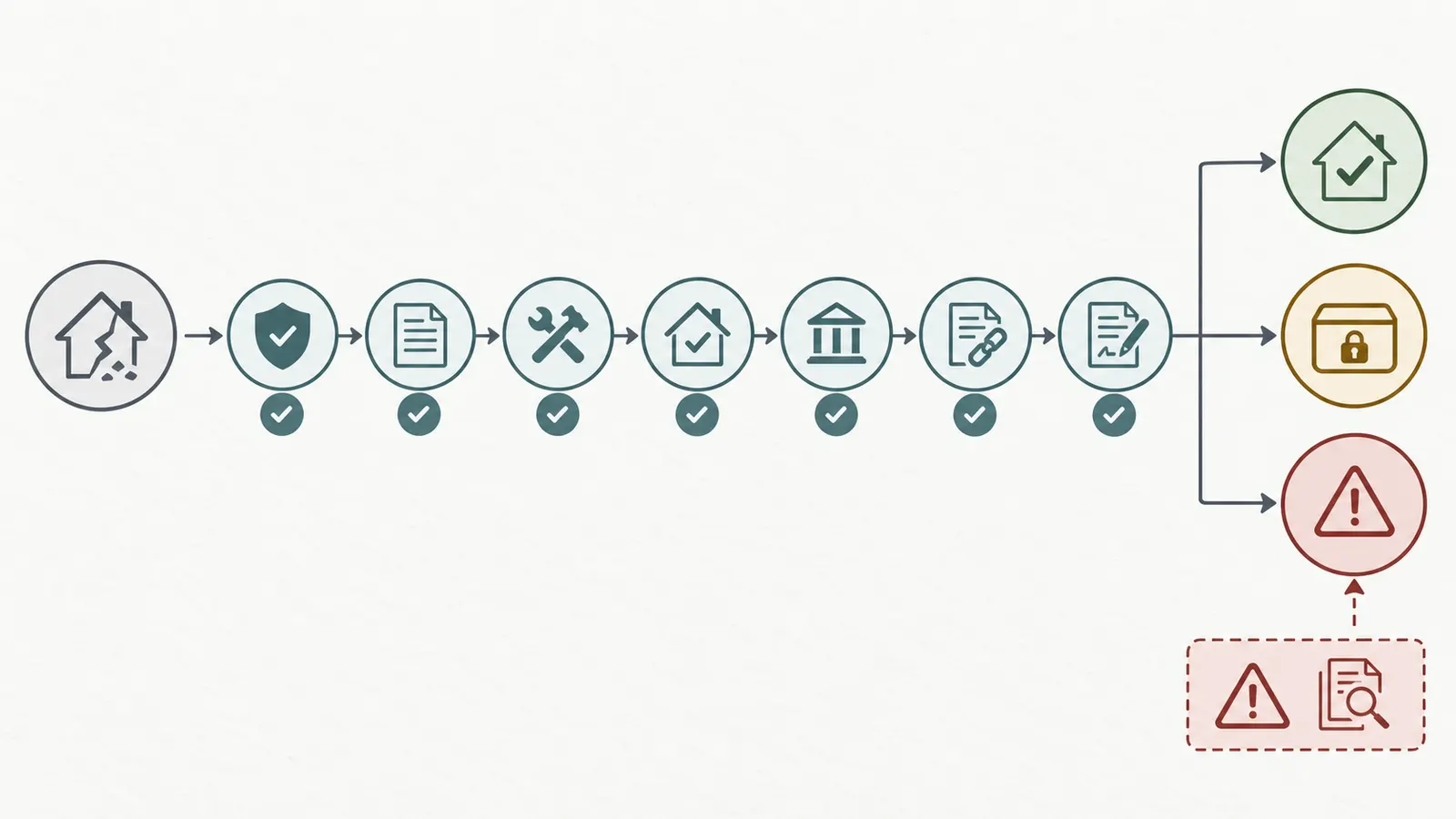
What to bring to professionals
Bring one organized folder and one-page timeline containing:
- address, owner, builder, lender, closing date, and jurisdiction;
- signed contract, insurance exhibit, amendments, and order of precedence;
- complete property and liability policy records available to you;
- incident date, time, construction stage, occupancy status, and safe condition record;
- photos, reports, delivery and title records, invoices, payment applications, and inspection results;
- matrix with confirmed, disputed, and unknown cells;
- working repair scope and illustrative financial sensitivity;
- proposed closing conditions and every document you are asked to sign;
- names, roles, written instructions, and dates of prior contacts.
Ask the construction attorney which state’s law and contract provisions apply, the insurance professional what the policy actually says and requires, the qualified inspector or engineer what was and was not inspected, the lender what evidence it needs, and the closing agent what can legally be released. Those professionals answer different questions. No single person’s reassurance replaces the full handoff record.
The next decision after this guide is not “which insurer do I call?” It is “which cell of the handoff matrix is still unsupported, who has authority to fill it, and what must be true before the next payment, occupancy event, repair authorization, or closing release?” Make that decision in writing, then update the matrix when the project changes.
Cite this guide
Brictale. “Who Pays When a New Home Is Damaged Before Closing?.” Published 2026-09-20; updated 2026-09-20.
https://brictale.com/build/contractors/verify-new-home-construction-damage-risk-before-closing · Read the Markdown version
Original contribution: Risk-of-loss and insurance handoff matrix. A source-labeled worksheet for separating contract risk, policy route, deductible exposure, repair authority, schedule impact, and closing release after damage before closing.
Sources and scope
Evidence behind this page
- The Delaware public contract's AIA insurance exhibit assigns the owner, unless the obligation is placed on the contractor, to secure builder's-risk all-risks or equivalent property insurance on a replacement-cost basis for the total project value; it includes the interests of the owner, contractor, subcontractors, sub-subcontractors, and mortgagees as loss payees, and is maintained until substantial completion unless the documents or written agreement provide otherwise.
State of Delaware OMB/DFM Project MC3514000054 Specifications, Insurance and Bonds Exhibit A.2.3
Delaware public-project contract example reproducing AIA A101-2017 Exhibit A language; not a nationwide rule or a reader's policy. PDF pp. 42-43, lines 1390-1419.
Accessed · Link to this claim - In the Delaware contract example, the required property insurance is written to address direct physical loss and does not exclude listed causes including fire, explosion, theft, vandalism, malicious mischief, collapse, earthquake, flood, or windstorm; it also describes ensuing loss or resulting damage from construction-method, design, specification, workmanship, or material deficiencies, subject to the actual policy and sublimits.
State of Delaware OMB/DFM Project MC3514000054 Specifications, Insurance and Bonds Exhibit A.2.3.1.1
Delaware public-project contract example; the clause describes required scope for that contract and does not prove that a private residential policy covers every listed peril or defect. PDF p. 43, lines 1420-1426.
Accessed · Link to this claim - The Delaware contract example states that the owner is responsible for loss not covered because of deductibles or self-insured retentions under the owner property-insurance section; where the contractor provides the property insurance instead, the contractor must disclose the deductible and the owner is responsible for losses within it unless the contract changes that result.
Delaware public-project contract example; deductible allocation is document-specific. PDF pp. 43 and 47, lines 1435-1441 and 1625-1638.
Accessed · Link to this claim - The Delaware contract example requires written insurer consent before owner occupancy or use of a completed or partially completed portion before substantial completion, and says the parties must not take action that causes cancellation, lapse, or reduction of insurance; its general conditions also tie partial occupancy to public-authority authorization and written allocation of responsibilities.
Delaware public-project contract example; any actual occupancy permit and local authority requirements must be checked in the project's city/county/state jurisdiction. PDF pp. 43 and 102, lines 1442-1446 and 4179-4194.
Accessed · Link to this claim - The Delaware contract example defines substantial completion as the stage when the work is sufficiently complete for intended occupancy or use; its certificate establishes the date, assigns security, maintenance, utilities, damage, and insurance responsibilities, sets correction timing, and requires written acceptance of the assigned responsibilities.
Delaware public-project contract example reproducing AIA language; substantial completion is not automatically the same as final payment, title transfer, or closing in every private project. PDF pp. 66 and 102, lines 2048-2077 and 4154-4178.
Accessed · Link to this claim - The Delaware contract example permits the contractor, if the option is selected, to provide property insurance of the same type and scope as the owner section, while requiring disclosure of the deductible, providing the policy on request, and assigning the owner responsibility to adjust and settle the loss and act as trustee of the proceeds unless the contract states otherwise.
State of Delaware OMB/DFM Project MC3514000054 Specifications, Insurance and Bonds Exhibit A.3.3.2.1
Delaware public-project contract example; actual authority to submit, settle, and receive proceeds must be read in the executed agreement and policy. PDF p. 47, lines 1625-1638.
Accessed · Link to this claim - The AIA-MBA Joint Committee recommends using project-specific insurance provisions and states that any deductible assigned to the contractor should be stated in supplementary general conditions; it also distinguishes each participant's legal responsibilities and warns that broadly worded hold-harmless clauses need specific risk definitions and legal review.
AIA-MBA Joint Committee, Bonds, Insurance, and Liability, Sections F-2 and F-3
Professional best-practice guidance, reviewed on the source page in 2011/2010 and hosted by the AIA-MBA Joint Committee; recommendation, not law or a residential policy form.
Accessed · Link to this claim - The AIA-MBA Joint Committee distinguishes on-site and off-site stored materials and recommends documentation, owner access to inspect, insurance protecting the owner's interests, and transfer of title upon payment, subject to the contract and insurance provisions.
Professional best-practice guidance; recommendations do not replace the executed purchase, payment, title, storage, transit, and insurance terms for a private home.
Accessed · Link to this claim - The AIA-MBA Joint Committee says contractor general-liability requirements should state the risks applicable to the project and explains that a hold-harmless provision should be tied to specifically defined negligent acts rather than the project generally.
AIA-MBA Joint Committee, Bonds, Insurance, and Liability, Section F-2 Hold Harmless Clauses
Professional best-practice guidance, not a determination of coverage or liability under a particular state law or insurance policy.
Accessed · Link to this claim - In Fontana Builders, Inc. v. Assurance Co. of America, the Wisconsin Court of Appeals described a new home substantially damaged by fire before construction was complete, with builder's-risk and homeowner policies in dispute; the court reported that the builder's-risk policy terminated when permanent property insurance applied under its policy language and affirmed the judgments for Assurance after a jury found the homeowner policy applied.
Wisconsin Court of Appeals decision dated April 1, 2015, involving the parties and policies in that case; it illustrates policy wording and factual uncertainty, not a nationwide coverage rule.
Accessed · Link to this claim - The Michigan Attorney General's consumer guidance tells homeowners after disaster damage to review their homeowner policy for potentially covered damage and the deductible, contact the insurer, and record questions, answers, people contacted, and dates; it also advises putting promises and expectations in writing.
Michigan Attorney General, Building and Remodeling Advice for Homeowners
Michigan consumer guidance; the recordkeeping practice is broadly useful, but any Michigan-specific consumer rights or contract rules must be applied only in Michigan.
Accessed · Link to this claim - Michigan Attorney General guidance warns that a contractor saying they are insured does not necessarily mean the insurance covers poor workmanship, incomplete construction, or damage to the owner's or neighbor's property; it recommends asking what the insurance covers.
Michigan Attorney General, Building and Remodeling Advice for Homeowners
Michigan consumer guidance; an educational warning, not a statement of every contractor policy's terms or a rule for all states.
Accessed · Link to this claim - Michigan Attorney General guidance recommends a signed written contract before work starts and says it should include start and completion dates, required permits, a cost breakdown, payment dates and events that trigger payment obligations, and contractor identifying information.
Michigan Attorney General, Building and Remodeling Advice for Homeowners
Michigan consumer guidance; use as a documentation checklist, not as a nationwide contract-law requirement.
Accessed · Link to this claim - The NAIC explains that homeowners insurance is a legal contract, that most mortgage lenders require insurance and listing the lender as mortgagee, and that common homeowner coverage includes the dwelling while separate flood or earthquake policies may be needed for those risks.
National Association of Insurance Commissioners, Consumer Homeowners Insurance
NAIC consumer education describing common homeowners insurance; state forms, endorsements, lender conditions, and construction-stage coverage vary.
Accessed · Link to this claim - The NAIC explains that homeowners policies pay for perils listed in the policy up to policy limits and that a deductible is the portion of a covered home or personal-property loss for which the policyholder is responsible before insurer payments.
National Association of Insurance Commissioners, Insurance Topics: Homeowners Insurance
NAIC consumer education; it describes common policy mechanics and does not determine coverage for a particular construction loss.
Accessed · Link to this claim - North Carolina General Statutes § 58-3-149(b) states that a certificate of insurance is not a policy of insurance and does not amend, extend, or alter the coverage afforded by the referenced policy.
North Carolina General Statutes § 58-3-149, Certificates of insurance
North Carolina statute governing certificates of insurance; it is a jurisdiction-specific legal boundary and does not by itself decide a project's coverage, deductible, occupancy conditions, or repair authority elsewhere.
Accessed · Link to this claim