How to Verify a Mediation or Arbitration Clause in a Custom-Home Contract
Use a clause worksheet to verify triggers, notice, forum, costs, rules, remedies and agency limits before signing a custom-home contract.
The short answer
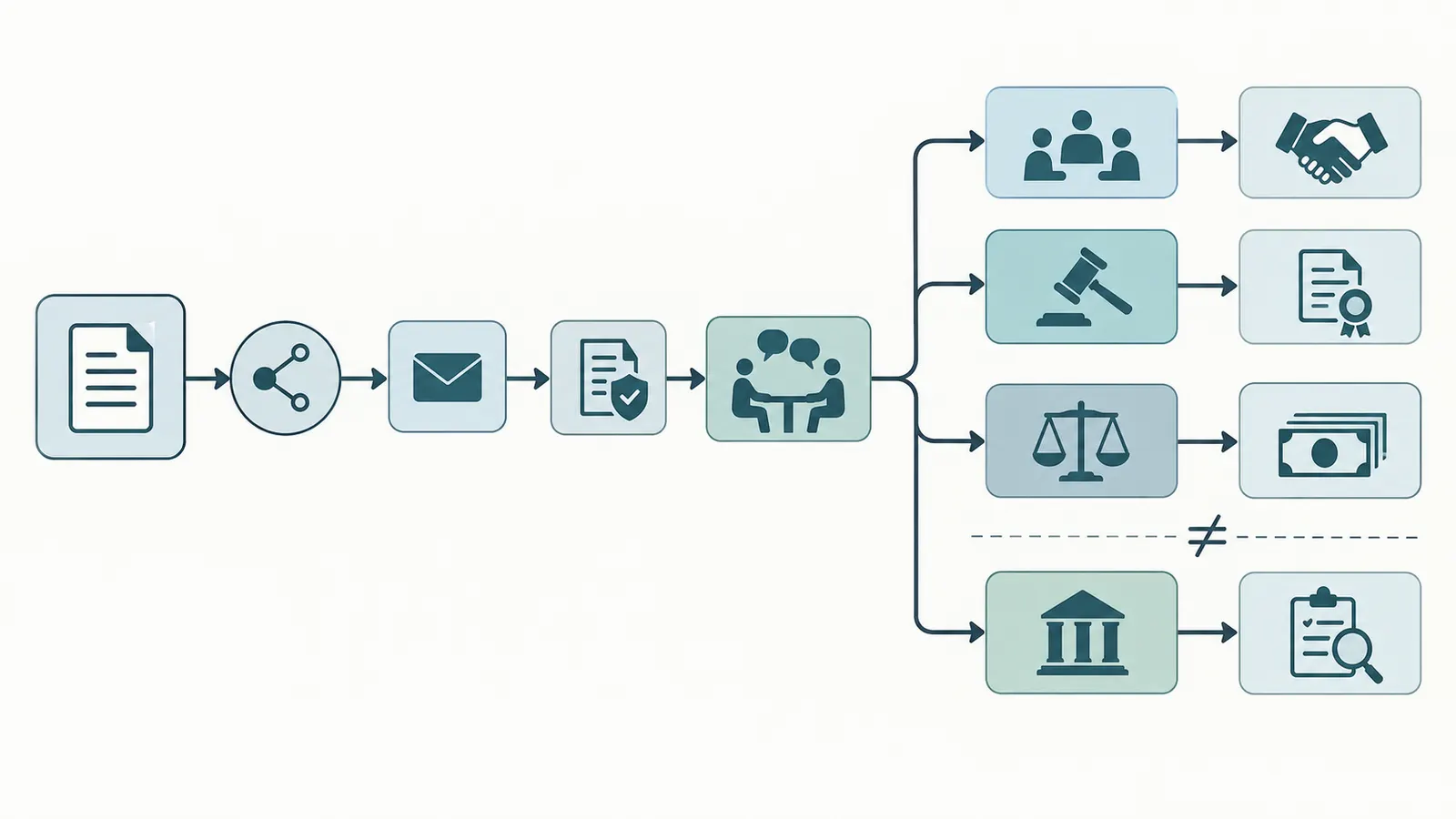
Before signing, copy the entire dispute-resolution clause and record what disputes it covers, who receives notice, any cure period, whether mediation is mandatory, when arbitration or court begins, the administrator and rules, the county or hearing location, every fee and cost-allocation rule, available remedies, review rights, and whether a licensing agency can still investigate. Compare the record with current forum rules and have local counsel review unresolved terms.How to Verify a Mediation or Arbitration Clause in a Custom-Home Contract
Before signing, copy the entire dispute-resolution clause and record what disputes it covers, who receives notice, any cure period, whether mediation is mandatory, when arbitration or court begins, the administrator and rules, the county or hearing location, every fee and cost-allocation rule, available remedies, review rights, and whether a licensing agency can still investigate. Compare the record with current forum rules and have local counsel review unresolved terms.
This guide is for a homeowner reviewing a United States new-home or major residential-construction contract before signing. It does not decide whether a clause is enforceable or advise which remedy a particular homeowner should pursue after a dispute. The same words can operate differently under the law of the state where the project is located, the law chosen in the contract, the named forum’s current rules, a lender’s requirements, a warranty program, or a separate subcontractor agreement. Treat Oregon, Michigan and Utah as labeled examples, not as a national rule.
The practical finish line is a signed pre-signing record that another person can follow without guessing. It should show the first notice, the person or address that receives it, the response or cure time, the event that unlocks mediation or arbitration, the forum and governing rules, the money required to start, the likely evidence limits, the remedies that are expressly preserved or excluded, and the agency or warranty handoffs that sit outside the private clause. If any field is blank, contradictory or incorporated only by a vague website reference, the next handoff is local legal review before you sign.
Brictale safety boundary. This guide does not provide remote diagnosis or homeowner go/no-go instructions for pressure systems or confined-space entry. Do not enter a confined space, open or operate a pressurized system, perform electrical or structural work, or disturb suspected contaminated material based on this article. When contamination is possible, a condition cannot be safely observed from outside the hazard area, or the responsible jurisdiction is uncertain, limit your role to safe observation and record preservation, then obtain qualified local review from the appropriate professional or authority.
If you are still assigning responsibilities across the project, use Brictale’s choosing-your-team guidance; for a live build, the managing-the-build route helps keep decisions and handoffs visible, and handover and ownership guidance covers the records that should survive signature and construction.
What you should be able to explain before signing #
You should be able to explain the complete dispute path in plain language, including its trigger, notice, waiting period, forum, cost allocation, decision-maker, remedies and agency boundaries, before you sign the custom-home contract. A label such as “mandatory ADR” is not a complete path. It tells you that a process may be required, but not what you must do, when you must do it, how much it may cost, what evidence you can present, or whether the result can be reviewed.
Start with the difference between negotiation, mediation, arbitration and court
Negotiation is a conversation between the parties or their representatives. It may be required by contract, but it does not necessarily create a neutral decision-maker. A clause can require a written notice and a meeting without requiring a mediator or arbitrator. That distinction matters because the person who receives the notice may be a project manager who cannot authorize a settlement, while the contract may require a corporate officer or insurer to approve one.
Mediation adds a neutral who helps the parties seek a voluntary settlement. The mediator does not ordinarily decide who is right. AAA’s Home Construction materials describe mediation as an extension of negotiation and say the mediator does not have authority to impose a settlement. They describe arbitration separately as a process in which an arbitrator issues a binding award. AAA’s Home Construction Rules and Mediation Procedures are an example of one administrator’s terminology, not a universal rule for every forum.
Arbitration is a private adjudicative process. The decision-maker evaluates evidence and issues an award under the incorporated rules and contract. “Binding” does not mean that every legal issue is decided exactly like a court case, that every remedy is available, or that a broad appeal is guaranteed. It means you should identify the award, review, correction and court-entry language before assuming a court trial remains the default.
Court litigation is a public legal process with its own venue, filing, discovery, evidence, motion, judgment and review rules. A clause can require negotiation or mediation before court while preserving litigation. It can also require arbitration after an unsuccessful mediation. A clause can preserve a court application for temporary or emergency relief, lien rights or enforcement of an award without making court the forum for the underlying dispute. Those exceptions must be written clearly; do not infer them from a heading.
The Federal Arbitration Act is one reason a written arbitration provision deserves careful attention. Section 2 of Title 9 says that, for a contract evidencing a transaction involving commerce, a written agreement to arbitrate a future controversy is generally valid, irrevocable and enforceable, subject to grounds at law or in equity for revoking a contract and exceptions otherwise provided in chapter 4. The current federal statute at GovInfo is not a conclusion about your clause. It is a reason to treat the arbitration paragraph as a real allocation of process rather than boilerplate to read later.
The seven answers that expose an incomplete clause
Use these questions before comparing the clause with a state example or forum rules:
- What event starts the path? Is it any disagreement, a written claim, a missed payment, a defect notice, a termination notice, a warranty denial or only a dispute that remains after direct negotiation?
- Who sends the first notice, to whom and by what delivery method? Does email count? Does the clause require certified mail, a registered agent, a contract address or a particular corporate department?
- What must happen before filing? Is there a meeting, inspection, estimate, cure opportunity, mediation, engineer review, warranty claim or agency notice? Is the step mandatory, optional or merely encouraged?
- Which forum administers the process and which rules apply? Is the named rule set attached, linked by a stable title and version, or left to be selected later?
- Where does it happen and who pays? Record the county, city, remote-hearing option, filing fee, mediator or arbitrator compensation, hearing room, expert and transcript costs, and the rule for shifting costs.
- What can the decision-maker award or preserve? Look for repair, completion, money damages, retainage, lien or bond consequences, attorney fees, consequential damages, punitive damages, specific performance, emergency relief and warranty remedies.
- What is the next handoff if the process fails? Identify court enforcement, appeal or review, a licensing complaint, a consumer-protection complaint, a warranty administrator, a lender or insurer, and the records each one needs.
If you cannot answer one of these questions from the contract and the current rules it incorporates, mark the field “unverified.” Do not fill the gap with what a builder says the clause probably means. Ask for a written revision or send the exact text and incorporated documents to local counsel.
Separate verification from enforceability
Verification is a pre-signing fact exercise: what does the proposed contract say, what rules does it name, and what operational steps follow? Enforceability is a legal analysis: can a court or arbitrator apply this wording to this party, claim and project under the governing law? A homeowner can perform the first exercise without purporting to perform the second.
A clause can be understandable yet still require legal review. For example, a clause may clearly require arbitration in a named county but raise questions about a statutory claim, a warranty, an absent subcontractor, a consumer-rights remedy, a lien deadline or a non-signatory lender. Conversely, a clause can be legally enforceable in some circumstances yet be operationally poor because it does not say where to send notice or how an administrator is selected.
Do not treat the presence of an agency complaint path as proof that the agency can decide the contract. Oregon’s Construction Contractors Board says its role is to help parties settle certain disputes and that it is not a decision-making entity; Utah DOPL says it does not have authority to enforce the private contract in its optional agreement example; Michigan LARA says its Bureau of Construction Codes does not have authority over contractual, monetary or warranty issues. Oregon CCB’s dispute guidance, Utah DOPL’s construction-contract page and Michigan LARA’s enforcement page show why “there is an agency” and “the agency can award my contract money” are different statements.
The minimum pre-signing packet
Ask for one review packet rather than reviewing a lone paragraph in isolation. The packet should contain:
- The complete proposed agreement, including exhibits, addenda, warranty terms, lender forms and referenced policies.
- The exact dispute-resolution clause with page and section numbers.
- Every incorporated rule set, fee schedule, administrator term, consumer supplement and amendment provision.
- The governing-law, venue, notices, attorney-fee, limitation, warranty, lien, change-order and termination sections.
- The builder’s legal name, license information, notice address, service address, insurance contact and authorized contract representative.
- Any lender, insurer, home-warranty company or developer agreement that creates a separate dispute path.
- A clean comparison copy showing every proposed change and the date of the latest draft.
The person responsible for assembling this packet is usually the homeowner or the homeowner’s project attorney. The builder is responsible for producing the contract it wants signed and identifying incorporated terms it expects to enforce. The forum is responsible for publishing its rules and fees, but it is not responsible for guessing which version the parties intended. The homeowner should verify the final signed version, not rely on an earlier proposal.
First stop: the clause worksheet
The answer you want from this chapter is not “mediation first” or “arbitration required.” It is a filled record that lets you replay the path without memory or interpretation. The next chapter provides that record.
How to extract the clause into a dispute-path record #
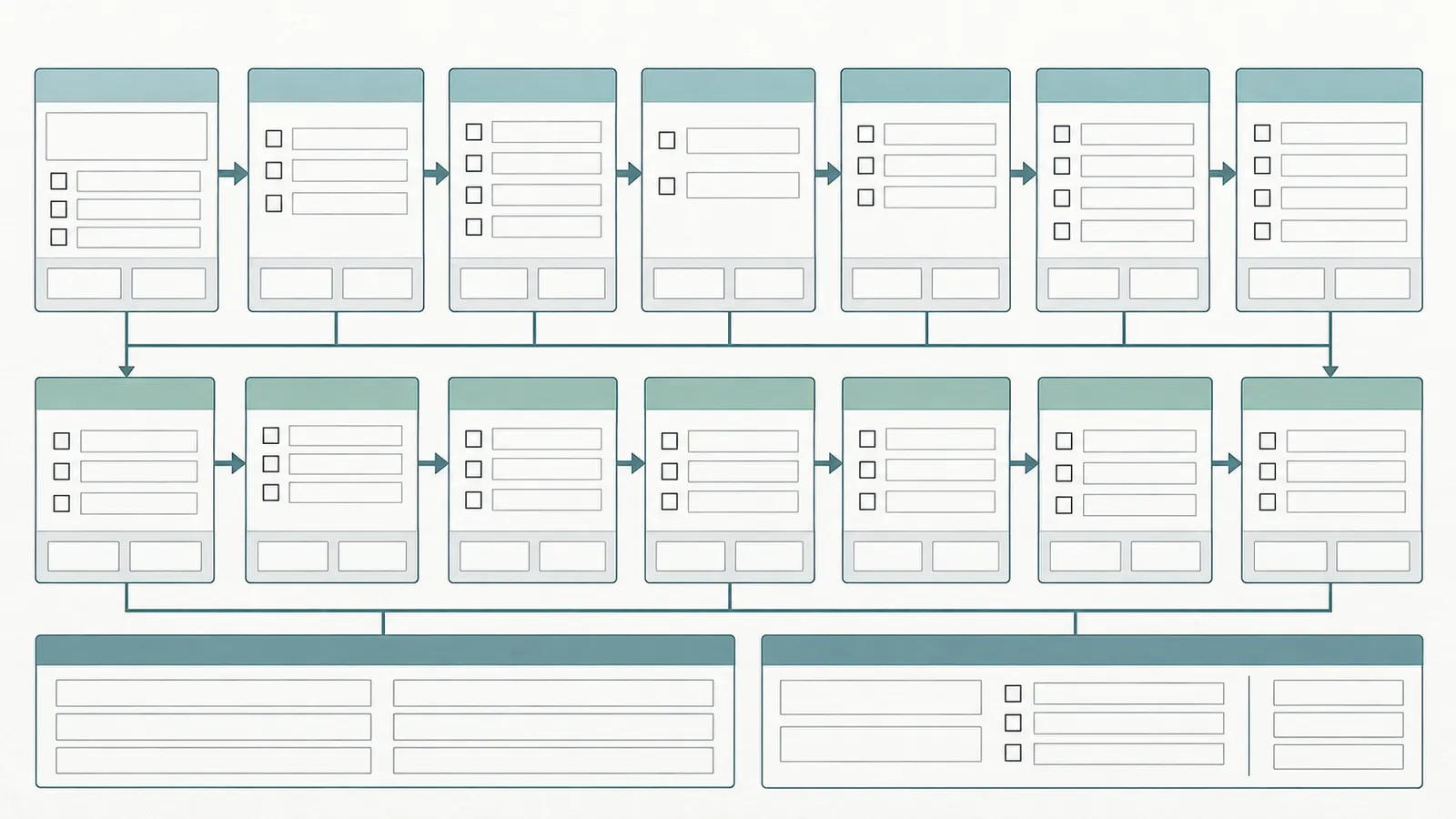
Create one row for every operational field and write “not stated,” “not applicable” or “needs counsel” instead of making an assumption. The worksheet is useful only if it preserves uncertainty. It should be attached to the contract review file, not used as a substitute for changing ambiguous language.
The dispute-path clause comparison worksheet
This is Brictale’s original contribution: the Dispute-path clause comparison worksheet. Its method is to extract the clause into fields, compare those fields against the named forum and the actual jurisdictional agency source, then model three clause shapes and a bounded fee sensitivity. Its limitations are important: it is not a contract form, legal opinion, enforceability test or recommendation about a post-dispute remedy. It does not know the full agreement, facts, governing law, lender documents, warranty terms or current rule amendments. Only local counsel can assess the actual contract.
Method: Extract the executed clause and its incorporated rules into the worksheet, verify each field against the named administrator and the applicable Oregon, Michigan or Utah agency source when relevant, then compare three illustrative clause shapes and model administrative-fee sensitivity without treating it as a legal conclusion or quote.
Limitations: This is an editorial verification aid, not a contract form, legal opinion, enforceability test or recommendation about a post-dispute remedy. State law, the full agreement, incorporated rules, lender or warranty terms and current fee schedules may change the result; local counsel must assess the actual contract.
Fill the “proposed contract” column from the document you may sign. Fill “verification” with the page, rule section, source URL or written response that proves the entry. Have counsel complete the “open issue” column where the answer could change a right or deadline.
| Field | What to record from the proposed contract | Verification and open issue |
|---|---|---|
| Dispute definition | Exact words covering “claim,” “dispute,” “controversy,” defect, payment, delay, termination, warranty, lien, statutory claim, negligence or any dispute “arising out of” the agreement | Does the scope include only contract claims or also claims against affiliates, subcontractors, designers and insurers? |
| Trigger | Event that starts the process: disagreement, written claim, failed meeting, notice of defect, nonpayment, termination or another event | Is the trigger objective enough to date? Does a party have to declare that negotiations failed? |
| Notice recipient | Legal name, individual or department, physical address, email, registered agent and copy recipients | Is the address current? Does email alone satisfy the clause? What proves delivery? |
| Notice content | Facts, contract section, requested cure, amount, photographs, expert report, estimate or proposed meeting | Does the notice require a legal conclusion or only facts? What attachments are safe and necessary? |
| Cure or response period | Number of calendar or business days, start date, holidays, extensions and what counts as cure | Is the period a condition before filing, a target or a waiver? Does an emergency exception exist? |
| Direct negotiation | Required participants, meeting format, authority to settle and whether it tolls any deadline | Who on the builder side can make a binding decision? Is the homeowner required to attend personally? |
| Mediation | Mandatory or optional; mediator selection; administrator; timing; confidentiality; attendance; cost split; settlement signature | Does mediation suspend a statute or contract deadline? What happens if a party refuses to participate? |
| Arbitration trigger | Exact event after mediation, negotiation or cure; whether either party may demand it; demand deadline | Is arbitration the exclusive merits forum or only available by later agreement? |
| Forum and county | Administrator, state, county, city, remote or in-person hearing, governing law and venue | Is the named provider available for this consumer-home dispute and claim size? |
| Rule set and version | Rule title, effective date, incorporated exhibits, amendment rule, expedited track and evidence/discovery limits | Can the provider identify the exact version at signing and at filing? Can rules change without mutual consent? |
| Fees and allocation | Filing, case, mediator, arbitrator, hearing, room, transcript, expert, travel, attorney and award-enforcement costs | Who advances each cost, who may recover it, and what happens if a party cannot advance it? |
| Decision-maker | Number, qualifications, selection method, disclosures, conflicts, replacement and authority | Is subject-matter construction experience required? Who decides a challenge to the clause? |
| Remedies | Repair, completion, money, retainage, fees, interest, consequential or punitive damages, injunction, emergency relief and lien/bond rights | Does the clause cap or waive a remedy? Are statutory remedies preserved or excluded? Counsel must review. |
| Evidence and inspection | Site inspection, testing, destructive investigation, expert exchange, photos, records, testimony and discovery limits | Can evidence be preserved before repairs? Who pays an inspection? Are electronic records admissible? |
| Appeal or review | Correction, clarification, optional appeal, court confirmation, vacatur or other review language | Is review narrow, optional or subject to another rule set? What deadline applies? |
| Agency relationship | Licensing complaint, code enforcement, consumer protection, bond, recovery fund and warranty administrator | Does the agency decide private money or only discipline/license/code matters? What independent notice is required? |
| Document-retention handoff | Final signed contract, clause, rules, notices, delivery receipts, responses, photos, estimates, permits, payments and outcome | Who holds originals and which files go to counsel, forum, agency, lender or warranty provider? |
The table is deliberately longer than most contract checklists because an ADR clause is a sequence. If the contract states “the parties shall mediate and, if unsuccessful, arbitrate under the rules of a provider,” the worksheet should not mark “complete.” It should identify the provider, rules, fee schedule, trigger, county, notice method and version. The phrase “under the rules then in effect” may be meaningful, but it also means you must understand how amendment timing works and whether the contract incorporates later terms.
Use a source column, not just a notes column
For each important entry, record where it came from:
C-12, page 18: the proposed agreement.Exhibit D, page 3: a warranty or dispute supplement.AAA Home Construction ARB-15: a current forum rule.Oregon CCB consumer page, accessed 2026-09-08: a state-specific agency process.Counsel question 4: an unresolved legal issue.
This prevents a common failure: copying a fee or venue from a provider’s public page into the contract record when the agreement actually names a different rule set. It also leaves a trail for the person who later sends the notice. A document-retention handoff is part of the decision, not clerical cleanup. If a project lasts two years and an owner changes email addresses, the saved notice address and signed clause may be the difference between a timely record and a reconstruction from memory.
Three illustrative clause shapes
The following comparison is modeled and illustrative. It is not a recommendation, a claim that these are the only clause designs, or an opinion about enforceability. The same shape can produce a different result when state law, the rest of the contract or the chosen rules change.
| Illustrative shape | Sequence visible to the homeowner | What is defined | What remains risky or unknown |
|---|---|---|---|
| A. Negotiation, then court | Written notice → response period → good-faith meeting → court if unresolved, subject to any preserved emergency or deadline rights | Notice recipient, meeting, county, governing law and court route if fully drafted | A meeting may not pause another deadline; the clause may not identify a cure standard, evidence process or fee rule |
| B. Mediation, then administered arbitration | Written claim → cure or negotiation → named mediator → mediation → demand to named administrator → arbitrator award | Provider, rule set, selection, hearing locale, fee schedule and award route if fully drafted | Cost allocation, discovery, emergency relief, non-signatory parties, review and statutory remedies still need clause-specific review |
| C. Broad “ADR” reference | Unclear dispute → unspecified ADR → unspecified provider or rules | Only a general intention to avoid court | Trigger, notice, forum, fees, deadlines, decision-maker, evidence, remedies and agency relationship are not reliably operational |
Shape B may sound more complete, but “AAA arbitration” is not enough by itself to tell you whether the contract uses Home Construction Rules, Construction Industry Rules, commercial rules, a consumer supplement or a different version. AAA publishes multiple construction-related rule sets, forms and fee schedules and says the filing party submits a demand, the arbitration provision naming AAA and the appropriate fee when the parties already agreed to arbitrate. Review the AAA construction rules page and then compare the exact contract language.
Shape A is not automatically safer because court can be expensive, slow or subject to a different pre-filing step. Shape C is not automatically invalid because legal enforceability depends on more than readability. The worksheet’s role is to show what a lawyer, homeowner and builder would have to resolve before the signature is treated as informed.
A modeled illustrative fee calculation
The point of a fee model is sensitivity, not forecasting. Use the current fee schedule named by the contract. If the contract names AAA Construction Industry Rules, the AAA schedule amended effective September 1, 2025 lists an initial administrative fee of $1,450 and a final administrative fee of $1,150 for a claim under $75,000. It says arbitrator compensation is not included and that, unless the parties’ agreement says otherwise, administrative and arbitrator fees are subject to allocation by AAA and ultimately an arbitrator. Read the published AAA fee schedule before using any number.
For a modeled claim amount of $74,000:
Modeled administrative fees = initial filing fee + final fee
$2,600 = $1,450 + $1,150
That $2,600 is not the total cost of arbitration. It excludes arbitrator compensation, attorneys, experts, travel, hearing room, transcript, document handling, mediator fees and enforcement. It is also the Construction Industry schedule, not automatically the Home Construction schedule. The model therefore belongs in the worksheet’s “source and limitation” cell.
The allocation sensitivity is:
| Allocation assumption | Homeowner’s modeled share of $2,600 administrative fees | What the model does not include |
|---|---|---|
| 50/50 advance or final allocation | $1,300 | Arbitrator, counsel, experts, travel, hearing, mediator and enforcement costs |
| Homeowner advances 100% | $2,600 | Same excluded costs; advance is not necessarily final allocation |
| Builder advances 100% | $0 initially for this line item | The contract or award may still reallocate costs; this is not a prediction |
The formula is simple, but the sensitivity is decision-relevant: the clause’s words “prevailing party,” “each party bears its own costs,” “shared equally,” “claimant advances” and “arbitrator may allocate” do different work. A homeowner comparing two proposals should not compare only the provider name. Compare the amount that must be advanced, the amount that can be recovered and the event that allows a cost award.
A second sensitivity is claim size. The same AAA schedule lists $2,375 initial plus $1,825 final for claims from $75,000 to less than $150,000, or $4,200 in modeled administrative fees before the exclusions above. That is a modeled increase of $1,600 from the under-$75,000 band. This does not mean the homeowner should split a claim, delay filing or choose a forum based on a table. It means the worksheet should record whether the rule schedule is claim-based, whether counterclaims can move the band, and whether nonmonetary relief triggers a different fee.
Originality brief: what this adds and how to check it
Current public answers commonly explain mediation, arbitration or agency complaints one jurisdiction at a time. Broad contract guides say to read the fine print. The missing decision is whether a homeowner can verify the clause’s operational sequence before signing and keep private contract enforcement separate from licensing, code, bond or consumer-protection routes.
The original contribution is the jurisdiction-aware dispute-path clause comparison worksheet plus the three-shape and fee-sensitivity model. You can check it by taking any proposed clause, filling every row from the agreement, opening the named administrator’s current rules and fee schedule, opening the actual state agency page, and marking every field that still needs counsel. If a reviewer cannot reproduce the trigger, notice, forum, cost and agency handoffs from the packet, the worksheet has done its job by exposing the gap.
The next decision is whether the missing fields can be clarified in a written revision or require legal review before signature.
How to verify trigger, notice, cure and deadlines #
Verify the first action as a dated sequence, not as a paragraph summary: identify the triggering event, send the required notice to the correct recipient using the required method, complete any stated response or cure step, and confirm which deadline continues to run while the parties negotiate or mediate. A clause that says “notice of dispute” without telling you what makes notice effective is incomplete for practical planning.
Mark the first event that can be proved
Use an event that leaves a record. Examples include the date a homeowner delivers a written defect notice, the date the builder rejects a change order, the date an invoice becomes overdue, the date a termination notice is received or the date a negotiation meeting ends without settlement. “The parties are unable to agree” is harder to prove unless the contract says who declares impasse and how.
Do not rewrite the contract in your worksheet. Quote the trigger, then paraphrase it in a second field. If the clause covers “any controversy arising out of or relating to the contract,” record that breadth and ask counsel whether the text reaches warranty, tort, statutory, lien, insurance, design or non-signatory claims. The worksheet is an index to interpretation questions.
For a new-home project, the trigger may be affected by a warranty provision, a punch-list procedure or a substantial-completion certificate. For a major remodel, it may be tied to a payment application, inspection, change order or discovery of defective work. The person who manages the construction sequence should log dates, but the homeowner should not assume that a project-management log is a legal notice unless the contract makes it so.
Verify the notice recipient and delivery proof
Record the party’s exact legal name, the notice address printed in the agreement, the email address, the individual or department and any required copy recipient. A site superintendent may be the best operational contact and still not be the contract notice recipient. Send operational courtesy copies if useful, but satisfy the legal method stated in the agreement.
Delivery rules are often more specific than “in writing.” The Utah DOPL optional agreement example says notices can be delivered in person, by email to the address in the agreement or by certified mail to the listed mailing address, with stated effectiveness rules for each method. That is a feature of the Utah model example, not a national notice standard. Utah’s construction-contract FAQ is useful as a comparison because it shows how a complete notice term can name method, address and effectiveness.
Save the notice as a PDF with attachments, the transmission receipt, postal receipt, tracking, delivery confirmation and any response. If the notice says a cure period begins on delivery, record the delivery date and calculate the deadline under the contract’s definition of days. If “business day” is undefined, do not silently substitute your preferred calendar. Ask counsel or the contract drafter to resolve it.
Identify the cure step and its exceptions
The cure step should answer four questions: what must be corrected, who decides whether the response is adequate, how long the responsible party has, and what happens if the problem cannot be cured within the stated period. A notice can request a repair without waiving a claim; a clause can require an opportunity to cure without guaranteeing that a cure ends every claim. The wording matters.
The Utah DOPL optional agreement example illustrates why detail matters: it includes written notice of a material violation and a 14-day opportunity to fix it before the stated termination right, while also describing a different procedure for a defect notification and cure. The agency’s own explanation warns that its optional agreement can be customized and is not legal advice. Treat the example as a comparison of contract specificity, not as a universal Utah cure period.
Look for emergency exceptions. A clause may allow immediate action to protect people or prevent property damage, preserve a lien deadline, seek temporary relief or stop work that would destroy evidence. An exception should say what notice remains possible and what information must be supplied afterward. If the exception is only implied, record it as an open legal issue.
Do not perform hazardous inspection, demolition, destructive testing, electrical isolation, structural stabilization or contaminated-material work to prove a defect. The homeowner can photograph visible conditions from a safe location, keep records and request a professional assessment. A qualified local contractor, engineer, architect, inspector or attorney should decide what testing is needed and how it affects the claim.
Compare contract deadlines with external deadlines
Put each deadline in a single timeline but keep its source label. The contract’s notice deadline, warranty notice period, mediation waiting period, arbitration demand period, statute of limitations, statute of repose, lien deadline, agency complaint deadline, lender notice term and insurance notice term are not interchangeable. A mediation clause does not automatically extend all of them.
Oregon is a concrete example of why a homeowner should not rely on a generic ADR timeline. For covered residential or certain small-commercial CCB complaints, Oregon CCB says the homeowner must first send a certified-mail notice of intent at least 30 days before filing and retain proof. It also warns that strict complaint time limits apply. See the Oregon CCB pre-complaint notice guidance. That agency sequence does not answer when an Oregon civil action or private arbitration demand is due.
Write the following columns in the timeline:
| Event | Source of deadline | Start date | Required action | Evidence of completion | Handoff |
|---|---|---|---|---|---|
| Defect or payment dispute identified | Contract, warranty or project record | Date actually observed or received | Preserve condition and classify issue | Dated photo, log, invoice or report | Builder representative and counsel if needed |
| Formal notice sent | Contract notice section | Contract-defined receipt date | Send exact content and attachments | Signed notice, delivery record | Builder and copied parties |
| Cure or response ends | Contract or written extension | Effective notice date | Inspect response and record unresolved items | Follow-up report, meeting minutes | Negotiation or mediation |
| Mediation demand | Contract or forum rules | Clause-defined trigger | File request and advance required fee | Filed request and receipt | Mediator or administrator |
| Arbitration demand or court filing | Contract, rules and applicable law | Trigger plus any waiting period | Preserve claims and file correctly | Case number or court-stamped filing | Arbitrator, court or counsel |
| Agency complaint | Agency rules or program | Jurisdiction-specific | File the required form and proof | Confirmation and full packet | Licensing, code or consumer agency |
The timeline is a planning record, not a deadline opinion. If a deadline could affect a right, ask counsel before waiting for negotiation or mediation to conclude.
The safe notice packet
For a pre-signing review, write down what the clause requires. For an actual dispute, a lawyer should decide whether the packet should include all of the following:
- Contract identity, project address, parties and section numbers.
- A neutral factual chronology with dates, not a long accusation.
- The specific work, payment, change, delay, defect or warranty item at issue.
- The requested response or cure, with a reasonable description of what would satisfy it.
- Photographs, drawings, inspection reports, invoices, payment records, change orders and messages that the contract or forum may require.
- A statement reserving rights if the wording or local law makes reservation appropriate.
- A request for the builder’s response and the name of a person with settlement authority.
- A delivery record and a copy stored in the project index.
The homeowner can collect this material. The homeowner should not misrepresent an untested condition, claim a code violation without a competent basis, threaten an agency with a result it cannot provide or promise that a notice tolls a deadline. A builder’s response can become important evidence, so preserve the original and the transmission metadata.
Common trigger and deadline failures
The first failure is treating a text message to the superintendent as the contract notice. The next safe step is to resend through the stated method while preserving the original, then ask counsel whether the first communication has legal effect.
The second is waiting for a verbal promise to repair while a written cure period or agency deadline runs. The next safe step is a neutral written confirmation of the promise and a deadline check with counsel.
The third is repairing a defect before documenting it. The next safe step is to address an immediate safety or property emergency through a qualified professional, preserve pre-repair photographs and records, and ask counsel or the appropriate expert what evidence remains necessary.
The fourth is treating a mediation invitation as permission to ignore a filing deadline. The next safe step is to put every deadline on the timeline and ask whether any written agreement or applicable rule actually changes it.
The fifth is sending a notice to an old address from an earlier draft. The next safe step is to verify the executed notice clause and the builder’s current legal/service information before delivery.
How to verify forum, rules, fees and hearing mechanics #
Verify the forum by naming the administrator, exact rule set, version, filing form, locale, decision-maker selection process, fee schedule and evidence rules; never treat a provider’s name alone as the complete agreement. Forum verification is the point where a readable clause becomes an operational process.
Name the administrator and rule set
“Arbitration under applicable rules” leaves the most important selection unresolved. A complete clause should identify an administrator or a method to select one, a rule set and how the parties obtain the current rules. If the contract names AAA, record whether it uses Home Construction Arbitration Rules, Construction Industry Arbitration Rules, commercial rules or another supplement. If it names JAMS, a state program or a private mediator, identify that organization’s construction or consumer procedures and fees.
AAA’s current construction materials list separate construction-related rule sets, forms and fee schedules. Its filing instructions say a party that previously agreed to arbitrate submits a demand, the arbitration provision naming AAA and the applicable filing fee. AAA’s construction rules and forms page is therefore a good verification target, but only if the contract actually names AAA and the same rule family.
The rule-version field matters because a forum may amend rules. AAA’s published Home Construction materials state that the rules and amendments apply in the form effective when administrative requirements are met for a demand received by AAA, and they allow written agreement to vary procedures within stated limits. Read the rule language itself. Ask counsel whether the proposed incorporation of later rules is acceptable and whether the contract should attach a version.
Check whether the rules fit the project
A custom home can involve a homeowner, builder, architect, designer, lender, developer, warranty company, subcontractor, supplier and insurer. A two-party homeowner-builder rule set may not handle joinder or consolidation the way a multi-party construction rule set does. AAA’s published Home Construction Rules state that they apply to two-party homeowner/home-builder cases under $1,000,000 and route larger, multi-party or joinder/consolidation cases to Construction Industry Rules. The AAA scope provisions show why the clause should be checked against the expected project relationships.
Record every person the clause binds. If an architect is not a signatory, ask whether a design claim can be decided in the same process. If a subcontractor agreement has its own arbitration clause, ask counsel how the paths interact. If a warranty administrator requires a separate claim before a private action, add that handoff. Do not solve a multi-party question by assuming consolidation is automatic.
Verify county, city and remote-hearing language
“Venue in the state” is not the same as a county or hearing locale. Record the county named in the contract, the project county, the builder’s county, the court venue, and the forum’s default hearing location. Note whether the hearing is remote, in person or selected later, and who pays travel and hearing-room expenses.
AAA’s Home Construction Rules provide that, absent a post-dispute agreement, the locale is the city nearest the project site as determined by AAA, subject to the arbitrator’s authority to finally determine the locale after the preliminary hearing. See AAA’s locale rule. That default can be materially different from a contract that requires a distant county or the builder’s headquarters. The worksheet should show both the contract term and the forum default, then flag the conflict.
Utah’s optional model agreement uses another clear example: it states Utah law governs and litigation occurs in the county where the property is located. The Utah page also says the agreement is optional and may be customized. Read the Utah model’s venue explanation. Do not copy that venue into a contract outside the model or outside Utah.
Calculate the first-dollar exposure, not just the fee label
For each process, list the amount needed to begin and the amount that might be allocated later. A “shared cost” clause may not tell you whether the claimant must advance the whole filing fee. A “prevailing party” clause may not tell you whether the arbitrator can award attorney fees. A “no costs” clause may exclude expert and hearing costs while covering only administrative charges.
Use this worksheet formula:
Initial cash exposure = filing advance + required deposit + first mediator/arbitrator advance + mandatory hearing or room fee
Potential final exposure = allocated fees + nonrecoverable counsel + expert + inspection + travel + transcript + enforcement costs
Leave unknown terms as unknown. Do not plug in a zero because the contract is silent. The AAA September 2025 Construction Industry schedule illustrates the problem: a claim under $75,000 carries a listed $1,450 initial and $1,150 final administrative fee, while arbitrator compensation is excluded. The source schedule also says fee allocation may ultimately be addressed by the arbitrator unless the parties’ agreement provides otherwise.
For a homeowner comparing a $60,000 defect claim and a $90,000 payment claim under that schedule, the modeled administrative totals are:
| Modeled claim | Initial fee | Final fee | Modeled administrative total | Sensitivity question |
|---|---|---|---|---|
| $60,000 | $1,450 | $1,150 | $2,600 | Does the clause require equal sharing or claimant advance? |
| $90,000 | $2,375 | $1,825 | $4,200 | Does a counterclaim move the amount band? |
The difference is ($2,375 + $1,825) - ($1,450 + $1,150) = $1,600. The calculation is transparent, but it is not a quote and not the applicable schedule unless the contract and administrator say so. For a homeowner, a missing fee rule is a decision issue worth resolving before signature, not a detail to discover after a demand is due.
Verify selection, conflicts, discovery and evidence
The rule set should tell you how the neutral is selected, how conflicts are disclosed, how a replacement is chosen, how many arbitrators serve, and how a party objects. AAA’s Home Construction Rules, for example, use roster lists and party strikes for certain dispute levels, and specify a timetable for returning preferences. The selection provisions are in AAA’s published rules. A clause that merely says “a mutually agreed arbitrator” should explain what happens when the parties cannot agree.
Discovery is a cost and proof issue. Record whether the rules permit interrogatories, document requests, depositions, expert reports, site inspections, photographs, testimony, subpoenas, destructive testing and electronic records. Do not infer “full discovery” or “no discovery” from the word arbitration. Ask the forum for the current procedure and ask counsel how the contract changes it.
For a home dispute, evidence may disappear when work is repaired, covered or demolished. The homeowner should preserve visible evidence safely and ask a qualified professional about measurements, photographs, moisture readings, structural evaluation or other testing. Do not take electrical, structural, excavation or hazardous-material measurements personally merely to build an evidence packet.
Verify mediation mechanics separately
Mediation can be mandatory, optional or a condition before arbitration. Record whether a party may refuse, whether refusal permits arbitration, whether the mediator can recommend a result, whether settlement authority must attend, whether communications are confidential and what written agreement closes the matter.
AAA’s Home Construction mediation procedures say parties and representatives should have authority to consummate a settlement, and describe the mediator as unable to impose one. They also describe private mediation proceedings and confidentiality provisions in that rule set. Review the AAA mediation provisions. A state agency may operate differently. Oregon CCB, for example, says its own mediation is voluntary and not intended to decide fault, with a settlement agreement signed if the parties reach one. Oregon CCB explains its agency mediation.
Ask who can sign a settlement for the builder. A project manager who attends without authority can turn a productive mediation into an informal status meeting. Put the settlement authority question in the preparation checklist. If mediation does not settle every issue, the written agreement should identify what remains open and whether the unresolved issues proceed to arbitration, court, warranty review or another path.
Forum verification failure cases
If the contract names a provider but not a rule set, request the exact rule name and version in writing. If the provider’s website shows multiple construction rules, flag the ambiguity.
If the clause names rules but not a provider, ask how filing begins and who appoints the neutral. If no one has authority to appoint, the process may be unusable without later agreement.
If the contract says costs are “as determined by the arbitrator,” model the amount that must be advanced before the arbitrator can decide allocation. If the contract shifts all costs to the homeowner, ask counsel to analyze the term under the governing law; do not declare it enforceable or unenforceable from a checklist.
If the contract changes the forum’s rules, make a side-by-side copy of the standard rule and the contract modification. The modified term controls the comparison, subject to legal review.
If a rule page is linked only by a moving URL, download a dated copy for the review packet and record the retrieval date. Still check the rule version in force when a dispute arises if the contract incorporates amendments.
The next decision is whether the verified forum is specific enough to price, schedule and staff, or whether the contract needs a written revision.
How to preserve and prove the record before choosing a route #
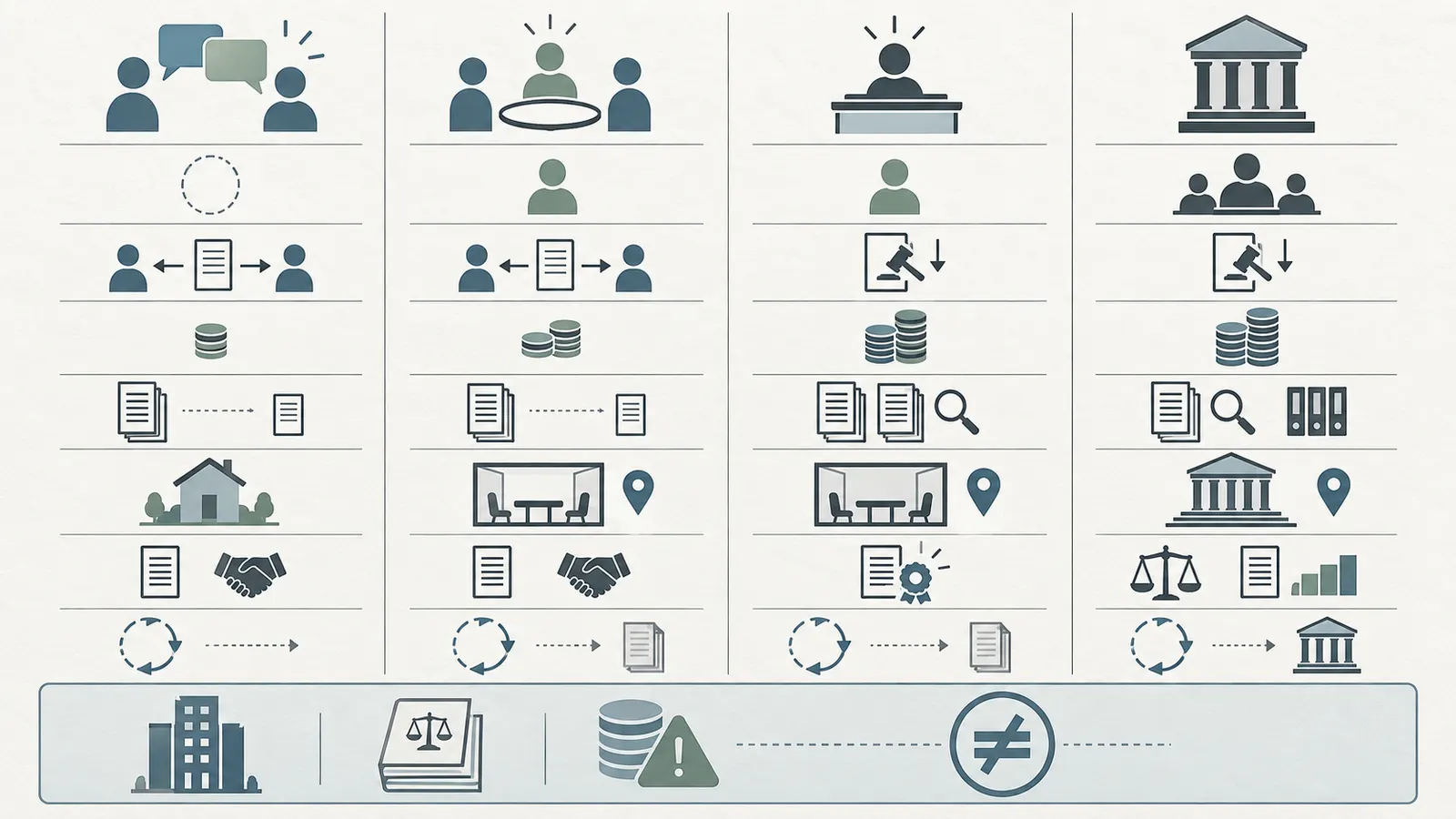
Before choosing negotiation, mediation, arbitration, court, a warranty process or an agency complaint, create one dated record that separates observed facts, contract language, deadline sources, requested outcomes and responsible handoffs. This record does not decide the remedy or automatically extend a deadline. It makes the next decision reviewable by the homeowner, builder, forum, agency and local counsel instead of relying on memory or a label such as “ADR.”
Make the record an input to the decision
The record starts with inputs, not conclusions. Put the project address, legal parties, contract date, governing-law clause, current contract version, clause page, incorporated rules, warranty documents and jurisdiction in an index. Add the source and access date for each public rule or agency page. If the project crosses a state line, the property location, contract choice-of-law term and forum clause may point to different places; record all three and send the conflict to counsel rather than silently choosing one.
The homeowner usually owns the index and the decision to sign. The builder or developer owns the accuracy of its proposed contract, notice address, legal identity and incorporated documents. A project manager can maintain the construction chronology, but an attorney licensed in the relevant jurisdiction should decide questions about enforceability, waiver, deadlines, remedies, non-signatories and agency interaction. The administrator or agency can explain its published filing mechanics; it cannot fill an ambiguity in the private agreement for the parties.
Use a simple source key:
| Record item | Minimum input | Owner before signature | Verification check |
|---|---|---|---|
| Contract clause | Exact quotation, page, section and draft date | Homeowner and builder | The quotation matches the final signed version |
| Incorporated rule | Title, administrator, version or effective-date language | Builder identifies; homeowner saves | The administrator confirms the rule family and current fee page |
| Notice path | Recipient, address, delivery method and effectiveness term | Builder supplies; homeowner tests the fields | A sample notice can be addressed without guessing |
| Warranty path | Warranty party, offer or acceptance record, claim method and exclusions | Builder or warranty administrator | The warranty is stored with the contract, not in a separate inbox |
| Agency path | Actual jurisdiction, scope, form and independent deadline | Homeowner verifies with the agency and counsel | The agency source does not promise a private award it cannot issue |
| Event record | Date, factual description, source document and response | Homeowner and project manager | Another reader can distinguish observation from opinion |
The “verification check” is what makes this more useful than a notes folder. If the builder changes the clause from mediation-first to direct arbitration, replace the quoted field, repeat the rule comparison and mark the old record superseded. Do not preserve a clean-looking worksheet that no longer describes the agreement you may sign.
Separate what was observed from what it means
Write three lines for each issue: observation, contract or rule reference, and requested action. An observation might say, “The north foundation wall has a visible crack photographed from the driveway on 2026-09-18.” The reference might say, “Contract section 12.4 requires written notice to the address in section 19; warranty exhibit B has a separate defect notice.” The requested action might say, “Ask the builder to confirm receipt, identify the inspection contact and preserve the condition pending professional review.” None of those lines should declare that the crack is a structural failure, that the builder breached, or that a deadline was tolled unless a qualified professional or counsel has a basis to say so.
This separation protects the handoff. A qualified inspector, engineer or contractor can evaluate a technical condition within that person’s scope. Counsel can evaluate legal significance. The agency can decide whether the submission fits its public authority. The forum can decide whether a demand satisfies its intake rules. Mixing those roles in the first email makes it harder to tell which statement is a measured fact and which is an argument.
Preserve visible conditions safely. Photograph from a safe location with a consistent reference scale when possible, save the original file and note the date, location, lighting and who made the observation. Keep invoices, payment confirmations, approved change orders, inspection reports, permit records, meeting minutes and delivery receipts in their original form. Do not enter a confined space, remove finishes, operate electrical or structural systems, test suspected contamination or perform destructive testing merely to improve a dispute file. Ask a qualified local professional what evidence is safe and necessary.
Build a deadline ledger without inventing a deadline
For each event, record the source rather than writing one blended due date. The ledger should distinguish the contract notice term, warranty notice term, forum filing rule, agency complaint instruction, lien or payment-security term, and any statutory limitation or repose period that counsel identifies. Put “source not yet verified” in the date cell instead of calculating from an assumption.
An illustrative, not legal, ledger entry might read: “Observed 2026-09-18; proposed contract says written notice is due within 14 calendar days of receipt; receipt date not yet established; certified-mail proof saved; counsel to confirm counting rule and interaction with warranty notice.” The input is the observed date, the unit is calendar days, and the formula to check is candidate date = contract-defined receipt date + 14 calendar days, subject to the contract’s counting language and applicable law. The sensitivity is the receipt event: a delivery date, successful email transmission or other contract-defined event can change the candidate date. Do not turn the candidate into a final deadline until the source and counting method are verified.
Reconcile the record before sending it onward
Run a contradiction check before choosing a route. Compare the notice address on the final contract with the builder’s invoice and service information. Compare the arbitration rule named in the clause with the administrator’s current rule family. Compare a warranty’s defect-notice step with the contract’s mediation step. Compare an agency’s public scope with the outcome the homeowner wants. If two documents disagree, quote both, mark the conflict and ask the responsible person for a written answer.
Common record failures include saving only a redline, relying on a project-management app as proof of legal notice, overwriting photos after repair, forwarding a fee page without its rule name, and sending an agency the entire project file without identifying the requested public action. The next step is not to choose the most forceful forum. It is to preserve the original, create a short chronology, identify the unresolved field and send the smallest complete packet to the person who owns that decision.
Use a handoff cover sheet with five fields: what happened, what document proves it, what response is requested, what deadline source is still open, and who must act next. For an Oregon CCB complaint, for example, the agency’s own post-mediation process requires a court filing and a copy of that filing within the stated agency sequence; the homeowner should not substitute a private arbitration email for the document the agency requests. Review the CCB’s current continuation instructions. For a Utah project using the optional DOPL model, record the exact notice method and effectiveness term from the signed agreement rather than borrowing the model’s example. Review the Utah model’s notice provision.
The next decision is now narrower: either the record shows a complete operational path and can be sent to local counsel for legal review, or one missing source, deadline, party or remedy prevents a reliable choice. In the second case, request the missing contract document or written clarification before selecting a forum. A complete record does not guarantee a favorable result; it prevents the homeowner from choosing a path that the documents never actually supported.
How to test remedies, review and agency interaction #
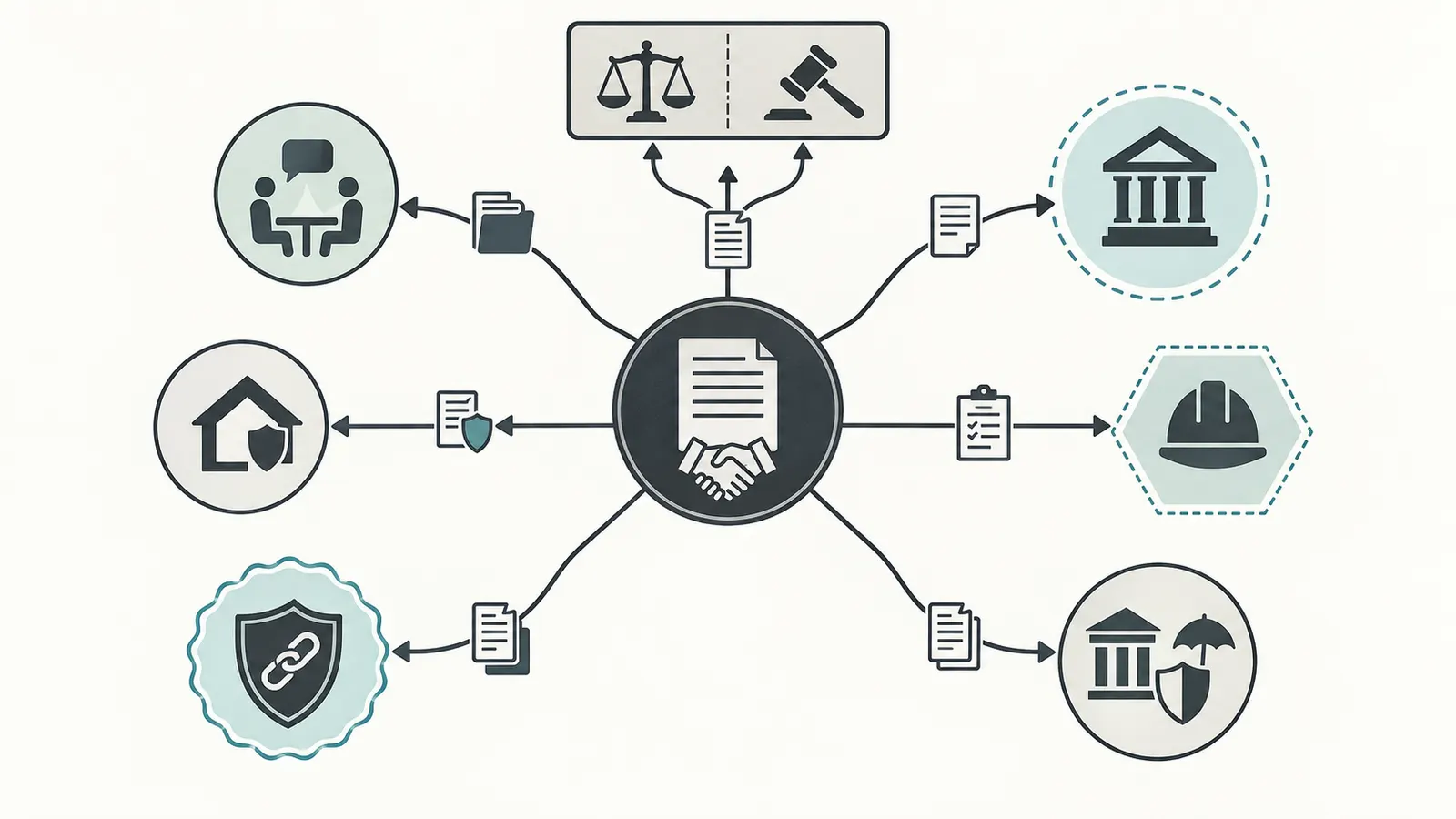
Test remedies by tracing each desired outcome to a decision-maker and a legal path: repair or completion, money, attorney fees, interest, emergency protection, lien or bond consequences, warranty work, discipline and court enforcement may belong to different systems. A licensing complaint is not automatically a private-money claim, and an arbitration award is not automatically an agency discipline order.
Build a remedy map
Start with the homeowner’s possible objectives without deciding which one to pursue: stop unsafe work, preserve a deadline, complete unfinished work, correct defective work, recover an overpayment, resist an improper charge, enforce a warranty, challenge a lien, report unlicensed conduct, obtain discipline, access a bond or recover money through a judgment or award. Put each objective in a separate row.
| Objective to test | Contract forum question | External path question | Responsible handoff |
|---|---|---|---|
| Repair or completion | Can the mediator record a binding repair schedule? Can the arbitrator order performance? | Does a warranty administrator require a claim first? | Homeowner, builder representative, counsel and qualified inspector |
| Money for contract loss | Does the clause permit the category of damages and interest? | Does an agency lack authority over private money? | Local counsel and the named forum |
| Immediate safety or property protection | Is emergency relief preserved and where is it sought? | Does the local building or code authority need notice? | Qualified professional, local authority and counsel |
| License or unprofessional conduct | Is a private ADR step required before a complaint? | What does the named state agency investigate? | Homeowner and state/local agency |
| Surety bond or recovery fund | What does the actual state program require—such as an active complaint and, in Oregon’s CCB residential/small-commercial pathway, a signed or certified court judgment? | What forms, notice and time limits apply? | State program and counsel |
| Lien or payment security | What notice and release terms apply? | What local recording or statutory deadline applies? | Construction attorney, title/lender contacts |
| Warranty remedy | What notice, inspection and cure procedure does the warranty require? | Is the warranty administrator a separate party? | Homeowner, warranty administrator and counsel |
The table does not tell a homeowner which row to use. It prevents the error of asking one agency or forum to deliver every result.
Oregon: CCB mediation and private dispute paths are not identical
In Oregon, the CCB says residential written contracts must include the existence of any mediation and arbitration provision. Oregon’s contract guidance also identifies the owner’s ability to file a CCB complaint as a contract right that must be addressed in the required residential contract terms. The homeowner should therefore record both the private clause and the CCB language rather than treating one as a replacement for the other.
Oregon CCB describes its mediation as voluntary and says the agency is not a decision-making entity. Its current complaint instructions say that after jurisdiction is established, most complaints involve a $50 statutory processing fee, and that the only path to access a contractor’s bond is through a signed court judgment. The same page tells a claimant whose mediation is unsuccessful to file in court; later instructions refer to a certified judgment in the claimant’s favor that goes unpaid. Read the current Oregon CCB consumer-protection page. This is a specific Oregon agency pathway with its own eligibility and timing. It does not mean that every Oregon contract dispute belongs in CCB mediation, and it does not mean a CCB mediator can issue the private judgment the homeowner may need for the bond route.
The CCB also says that when mediation does not succeed, the complainant must file in court to keep the complaint open and provide the analyst with a copy of the court filing within 30 days to pursue damages from the contractor or surety bond; its guidance describes a limited reopening period after closure. Read the CCB’s post-mediation court-filing instructions. Record the agency’s current instruction in the “agency relationship” row and verify the current form before acting. Do not assume that a private arbitration demand satisfies every CCB step or that a CCB complaint pauses every private deadline.
For an Oregon new-home contract, check the separate warranty and maintenance documents before signing. Oregon CCB guidance says a contractor building a new home must make a written warranty offer before or at contract signing and include contract statements showing whether the owner or first purchaser accepted or rejected it. See the CCB’s new-home warranty guidance. The same guidance says the contractor completing a new residential structure must provide a recommended maintenance schedule covering moisture intrusion and water damage, including causes, preventive maintenance timing, warning signs and response steps. See the CCB’s maintenance-schedule guidance. These records can create a notice, inspection and cure trail that later matters even if a private ADR clause exists; keep them with the clause packet and ask counsel how they interact.
Michigan: ADR may affect court rights and LARA authority
Michigan’s Attorney General tells homeowners to read arbitration provisions because they may affect rights and remedies. Its building and remodeling guidance states that, for builders, both the homeowner’s right to bring legal action and LARA’s authority to initiate a proceeding may be limited when the contract requires ADR. Read the Michigan Attorney General’s consumer alert. This is a warning to analyze the exact contract and Michigan law, not a blanket statement that every arbitration clause eliminates every agency or court option.
Michigan LARA separately explains that the Bureau of Construction Codes investigates specified licensing, permit, fraud, deceit and related complaints but does not have authority over contractual, monetary or warranty issues. It also says local code-enforcing agencies may have jurisdiction and a complaint may be forwarded to the local jurisdiction. Michigan LARA’s enforcement guidance should be checked against the location and subject of the issue.
The pre-signing worksheet for a Michigan project should therefore have separate entries for private contract enforcement, LARA/BCC licensing or conduct, local code enforcement, Attorney General consumer protection and any warranty administrator. A builder’s arbitration clause may affect some of those routes, but the homeowner should not infer the effect. Ask counsel to identify which claims or agency actions are within the clause and which are outside it.
Michigan’s complaint-documentation page provides a practical records model: contracts, quotations, proof of payment and notes, with a signed written complaint. It gives a separate 18-month period for real-estate complaints and says a complaint against another licensed party may be filed at any time. Michigan’s documentation guidance is not a general statute-of-limitations answer, but it supports retaining a complete packet and verifying the category before relying on a deadline.
Utah: an optional model agreement illustrates the agency boundary
Utah DOPL describes its Residential Construction Agreement as an optional, customizable starting point for homeowners and contractors, not legal advice. The agency’s FAQ says the example uses Utah law and county-of-property venue for litigation, and that DOPL does not have authority to enforce the private agreement even though it may investigate unprofessional or unlawful conduct. See Utah DOPL’s construction-contract page.
That distinction is central to the worksheet. “Who enforces the agreement?” should not be answered with “DOPL” simply because DOPL published the model. The contract party and the private forum handle private enforcement; DOPL evaluates professional or unlawful conduct within its authority. The exact contract may choose mediation or arbitration instead of litigation, so the homeowner must replace the model’s example route with the signed clause.
Utah DOPL’s complaint page is even more direct about limits: it says DOPL will not act as the homeowner’s attorney to settle or recover monetary loss and cannot investigate for the purpose of the homeowner’s personal litigation. Read the Utah complaint boundary. A complaint can still matter for licensing oversight, but it is not a substitute for counsel or the private dispute path.
The Utah model also gives useful comparison fields for notice, written changes, permits, inspections, contractor duties, warranty notice and cure. It says a requested change should be described in writing and, unless an emergency involves safety or property damage, the contractor should provide a written estimate of cost and time impact before proceeding. Use the Utah page only as a labeled model example. It does not establish a nationwide change-order rule.
Check remedies that are not in the clause
Ask whether the contract has a separate provision for:
- Emergency court relief or preservation of evidence.
- Payment withholding, retainage or suspension of work.
- Construction liens, lien waivers and releases.
- A surety bond, recovery fund or statutory notice.
- Manufacturer warranties and assigned product warranties.
- A third-party home warranty or builder warranty.
- Insurance notice, appraisal or coverage dispute.
- Lender approval and draw inspection disputes.
- Claims against a design professional or subcontractor.
- Public-record agency complaints or code correction.
Do not call a remedy “preserved” because the contract is silent. Silence can invite interpretation. Record “not addressed—counsel review.” If the clause excludes consequential damages, limits attorney fees or requires a prevailing-party award, quote the exact words and identify the claims that might be affected.
Review and appeal fields need exact language
The word “final” is not enough. Record whether the award can be corrected, modified, clarified, vacated, appealed by optional procedure, confirmed as a judgment or challenged on a narrow statutory basis. Record the deadline and the court that handles enforcement if the rule set provides one. If the clause says the arbitrator’s decision is “binding and final,” local counsel should review the interaction between that wording, the named rules and applicable law.
Mediation is different: a mediator’s recommendation generally does not become binding unless the parties sign a settlement or another contract gives it effect. AAA’s Home Construction materials state that the mediator cannot impose a settlement and that the parties’ authorized representatives should attend. The AAA mediation provisions support recording the settlement signature and authority fields separately from the arbitration award fields.
Agency interaction failure cases
If a homeowner assumes the licensing agency can award contract damages, the next step is to read the agency’s authority page and identify the private forum. In Utah, DOPL expressly disclaims acting as the attorney for monetary recovery; in Michigan, BCC expressly excludes contractual, monetary and warranty authority; in Oregon, CCB explains that it mediates and is not a decision-making entity.
If a homeowner assumes a private arbitration award automatically triggers a bond or recovery fund, the next step is to verify the state program’s requirements. For the Oregon CCB residential/small-commercial pathway described here, the agency’s current instructions point to an active complaint and a signed or certified court judgment, with court filing after unsuccessful mediation; do not substitute a private arbitration award for that stated court step without current Oregon legal advice.
If a homeowner files an agency complaint believing it pauses private deadlines, the next step is to ask counsel and the agency in writing. Agency guidance often describes the agency’s process, not tolling of private contract or statutory deadlines.
If a homeowner sends the agency a full litigation strategy expecting investigation for private case-building, the next step is to follow the agency’s document and privacy instructions. Utah DOPL says it cannot investigate for the purpose of the homeowner’s personal litigation, and Michigan LARA warns complainants to consider what personal information they send.
The next decision is a remedy map with a named responsible person for each route, not a general instruction to “contact the state.”
How to complete the pre-signing handoff and decision #
Complete the review by giving the builder a written list of unresolved operational terms, giving local counsel the full contract packet and worksheet, and storing the final signed agreement with the rules and delivery records. Do not sign a clause that you cannot explain merely because the builder says it is standard.
Who owns each task
The homeowner owns the decision to sign, the accuracy of the homeowner’s contact information, the review packet, the questions and the retained records. The homeowner should not be expected to know state law or forum procedure without help.
The builder or developer owns the accuracy of the proposed contract, its incorporated documents, its legal name and notice information, its representative authority and its explanation of the forum it selected. The builder should provide a clean response to requested revisions rather than relying on a verbal assurance that the paragraph “will not matter.”
An attorney licensed in the relevant jurisdiction owns the legal analysis of enforceability, waiver, statutory rights, deadlines, remedies, forum selection, arbitration scope, non-signatories and agency interaction. A construction attorney can also spot conflicts among the main agreement, warranty, lender forms, subcontractor terms and change-order system.
The forum or administrator owns its published procedural rules, forms, rosters, fee schedules and administrative intake. It does not choose the contract’s wording for the parties and cannot tell a homeowner that a clause is legally safe merely because the provider will administer a case.
The architect, engineer, inspector or qualified contractor owns technical opinions within their scope. They should identify the observed condition, method, limitations, code or contract reference and need for further testing. They should not be asked to decide a legal remedy or represent that an agency will award money.
The licensing, code or consumer agency owns the public authority granted by its jurisdiction. Read its actual page. Agency staff can often explain filing mechanics, but the homeowner should not treat an intake answer as a private legal opinion.
A four-pass review sequence
Pass 1: collect. Assemble the proposed agreement, every exhibit, warranty, addendum, lender or insurer term, rule set, fee schedule and current agency page. Save dated copies. Do not begin by copying only the bold heading.
Pass 2: extract. Fill the worksheet with exact quotations and page numbers. Put each trigger, notice method, waiting period, provider, rule, fee, venue, remedy, review term and agency reference in its own field. Mark “not stated” where needed.
Pass 3: verify. Open the named administrator’s current rules and fee schedule. Check whether the case type, project size, parties and claim value fit. Compare forum defaults with the contract. Check Oregon, Michigan or Utah only if the project is in that state; identify the actual county and local code authority where a local rule matters.
Pass 4: hand off. Send the exact contract and worksheet to local counsel with a short question list. Ask the builder to answer operational blanks in a written redline. After revisions, repeat the extraction and save the final version. Do not carry an earlier worksheet forward if the clause changed.
The counsel question list
A useful legal-review request is specific and bounded:
- What law governs this clause and the contract, and what jurisdiction would decide a formation or enforceability dispute?
- Does the clause cover contract, warranty, statutory, tort, lien, payment, design, insurance and non-signatory claims, or does it leave gaps?
- Are the notice, cure, mediation and arbitration deadlines clear, and do any of them interact with a limitation or repose deadline?
- Is the named administrator and rule set appropriate for a homeowner, this project size and the likely parties?
- What must the homeowner advance, what costs can be shifted and what attorney-fee or damages language is material?
- What remedies are preserved, limited or waived, including emergency relief, repairs, completion, money, warranty, lien, bond and agency routes?
- What is the county or locale, and what happens if a subcontractor, architect, warranty company or lender is not a signatory?
- What documents should be attached or incorporated so that a future forum does not have to reconstruct the agreement?
Give counsel the full packet. A single paragraph copied into an email can hide the notice section, definition section, warranty carve-out and amendment provision that change the analysis.
A sign-or-pause decision rule
Pause signing for legal review when any of these conditions exists:
- The clause requires arbitration but names no administrator, rules or filing method.
- The contract incorporates a website, policy or rule set that is not attached or identifiable by title and version.
- The forum, county, governing law and notice address conflict.
- The clause has a cure or mediation deadline but no rule explaining what happens to other legal deadlines.
- Costs, attorney fees, expert expenses or the award of fees are undefined or unusually one-sided.
- The clause limits remedies, damages, public enforcement, warranty claims, lien or bond access, or emergency relief.
- The contract contains a separate warranty, lender, insurer or developer dispute provision.
- The project has several parties and the clause does not explain joinder, consolidation or non-signatory claims.
- A builder asks the homeowner to sign with blanks, checkboxes or referenced terms to be filled later.
- The homeowner cannot obtain the exact version of the proposed final contract.
These are review triggers, not conclusions that the term is invalid. A local attorney should decide what change, explanation or risk allocation is acceptable.
What a completed handoff looks like
The final folder should contain a read-only PDF of the signed agreement, the editable review worksheet, a redline showing negotiated changes, each incorporated rule and fee document, the builder’s written answers, counsel’s advice, proof of insurance or license if relevant, and a one-page contact sheet. Put the project address, contract date, legal parties, governing law and notice addresses at the front.
During construction, add dated notices, delivery receipts, meeting minutes, photos, inspection records, approved change orders, payment applications, lien releases, warranty notices and responses. A document-retention handoff should say who updates the folder, where the original is stored, how files are named and which copies go to counsel, the forum, an agency, the lender or warranty administrator.
If a dispute later arises, the homeowner should not have to search old inboxes for the clause that determines the route. The safe handoff is a complete record before the first problem, not a frantic collection after a deadline.
Final checklist
- I have the exact final contract, every exhibit and every referenced rule or warranty document.
- I can quote the dispute definition and identify which claims may be included or excluded.
- I know the trigger, notice recipient, delivery method, required contents and proof of delivery.
- I know the cure period, mediation requirement and arbitration trigger, with all exceptions marked.
- I know the administrator, rule set, version, filing form, fee schedule and hearing locale.
- I have modeled initial cash exposure and separated administrative fees from arbitrator, counsel, expert and enforcement costs.
- I know how a neutral is selected, how conflicts are handled and what evidence or discovery rules apply.
- I have recorded remedies, damages limits, attorney-fee language, emergency relief and review or enforcement terms.
- I have separated private contract enforcement from Oregon CCB, Michigan LARA/BCC, Utah DOPL, local code, warranty, lender and insurance paths where relevant.
- I have identified the responsible person and document handoff for every next step.
- Local counsel has reviewed unresolved legal questions before signature.
- The final signed copy and the verified worksheet are stored together.
The next decision is straightforward: if every operational field is clear and counsel has resolved the legal questions, sign only the final dated version and preserve it; if a field is blank, contradictory or materially one-sided, request a written revision or pause for local legal review. A dispute-resolution clause is workable only when the homeowner can see the whole path before agreeing to walk it.
Cite this guide
Brictale. “How to Verify a Mediation or Arbitration Clause in a Custom-Home Contract.” Published 2026-09-24; updated 2026-09-24.
https://brictale.com/build/contractors/verify-custom-home-dispute-resolution-clause-before-signing · Read the Markdown version
Original contribution: Dispute-path clause comparison worksheet. A jurisdiction-aware worksheet that converts a mediation or arbitration paragraph into checkable trigger, notice, forum, cost, rules, remedies, agency and records fields before a homeowner signs.
Sources and scope
Evidence behind this page
- For a contract evidencing a transaction involving commerce, 9 U.S.C. § 2 states that a written provision agreeing to arbitrate a future controversy is valid, irrevocable and enforceable, subject to grounds at law or in equity for revoking a contract and exceptions otherwise provided in chapter 4.
United States Code, Title 9, § 2, GovInfo
United States federal statute; describes the federal statutory text, not whether a particular homeowner clause is enforceable or which state law applies.
Accessed · Link to this claim - Oregon Construction Contractors Board guidance says residential written contracts must identify the existence of any mediation and arbitration provision, along with core party, work, price and payment information.
Contractor Tools: Required Contracts, State of Oregon Construction Contractors Board
Oregon residential construction contracts and Oregon CCB consumer guidance; not a national contract rule.
Accessed · Link to this claim - For covered Oregon residential or certain small-commercial CCB complaints, the owner must first send the contractor a written intent-to-file notice by certified mail at least 30 days before filing and keep proof of mailing; Oregon CCB also warns of strict complaint time limits.
Oregon CCB complaint process for the covered work and claimant categories described by the agency; it is not a universal pre-filing rule for every Oregon lawsuit, arbitration or contract.
Accessed · Link to this claim - Oregon CCB says its mediation is voluntary, the agency is not a decision-making entity, most complaints have a $50 statutory processing fee after jurisdiction is established, and its complaint instructions state that the only path to access a contractor's bond is through a signed court judgment; the page separately says an unsuccessful mediation is followed by a court filing.
Oregon CCB complaint, mediation and surety-bond pathway; agency process and eligibility limits apply.
Accessed · Link to this claim - Michigan Attorney General guidance says homeowners should understand how ADR clauses can affect rights and remedies and states that, for builders, both the homeowner's right to bring legal action and LARA's authority to initiate a proceeding may be limited when the contract requires ADR.
Building and Remodeling Advice for Homeowners, Michigan Attorney General
Michigan Attorney General consumer guidance about Michigan builders and home-improvement contracts; it is not a case-specific enforceability determination.
Accessed · Link to this claim - Michigan LARA's Bureau of Construction Codes says it investigates specified licensing, permit, fraud, deceit and related complaints but does not have legal authority over contractual, monetary or warranty issues; local code authorities may have jurisdiction and complaints may be forwarded locally.
Enforcement Section, Michigan Department of Licensing and Regulatory Affairs
Michigan BCC enforcement scope and local-jurisdiction guidance; not a statement about every Michigan agency or private remedy.
Accessed · Link to this claim - Michigan LARA complaint guidance asks complainants to collect contracts, quotations, payment proof and notes, and says complaints must be written and signed; the page gives a separate 18-month period for real-estate complaints and says other licensed-party complaints may be filed at any time.
Documenting Your Complaint, Michigan Department of Licensing and Regulatory Affairs
Michigan LARA complaint-documentation page; timing depends on the complaint category and is not a general statute-of-limitations answer.
Accessed · Link to this claim - Utah DOPL says it will not act as a homeowner's attorney to settle or recover monetary loss, cannot investigate for the purpose of the homeowner's personal litigation, and uses complaints to evaluate possible occupational or professional-law violations.
File a Complaint, Utah Department of Commerce Division of Professional Licensing
Utah DOPL complaint boundary; does not describe private contract enforcement, all Utah agencies or a particular homeowner's claim.
Accessed · Link to this claim - Utah DOPL's optional agreement example requires a written description of a requested change and, except for safety or property-damage emergencies, a written estimate of cost and time impact before the contractor proceeds; the agency page also describes written notices and a 14-day cure provision in that example.
Terms in Utah DOPL's optional model agreement; not a universal Utah statutory cure period or change-order rule.
Accessed · Link to this claim - AAA's construction page says its current construction rules, forms and fee schedules cover filing requirements, arbitrator appointment, hearings and costs, and that a filing party submits a demand, the arbitration provision naming AAA and the appropriate filing fee when the parties previously agreed to arbitrate.
Construction Arbitration Rules, Forms and Fee Schedule, American Arbitration Association
AAA-administered construction disputes under the applicable AAA agreement and rules; the clause may name a different administrator or rules.
Accessed · Link to this claim - AAA's published Home Construction Rules apply to two-party homeowner/home-builder cases below $1,000,000, use expedited procedures below $100,000 unless changed, and provide that absent post-dispute agreement the locale is the city nearest the project site as determined by AAA, subject to the arbitrator's authority to finally determine locale.
Home Construction Arbitration Rules and Mediation Procedures, American Arbitration Association
AAA Home Construction Rules amended and effective August 1, 2018, as published by AAA; actual contract language, later amendments and a different AAA rule set may control.
Accessed · Link to this claim - AAA's Home Construction materials distinguish mediation from arbitration: a mediator helps parties reach a voluntary settlement and cannot impose one, while the home-construction arbitration process produces a binding arbitrator award; AAA also requires settlement-authorized representatives at mediation under its procedures.
Home Construction Arbitration Rules and Mediation Procedures, American Arbitration Association
AAA Home Construction mediation and arbitration procedures; other administrators, contract terms and applicable law may differ.
Accessed · Link to this claim - AAA's Construction Industry administrative fee schedule amended and effective September 1, 2025 lists, for example, a $1,450 initial and $1,150 final administrative fee for claims under $75,000, excludes arbitrator compensation, and says allocation ultimately may be addressed by the arbitrator unless the parties' agreement provides otherwise.
AAA Construction Industry schedule, not necessarily the AAA Home Construction schedule; fees can change and do not include every case cost.
Accessed · Link to this claim - For a covered Oregon CCB residential complaint, the agency says that when mediation is unsuccessful the complainant must file in court to keep the complaint open and provide the analyst with a copy of the court filing within 30 days to pursue damages from the contractor or surety bond; the agency also describes limited reopening after a closure.
Oregon CCB's agency complaint and mediation continuation instructions for the covered residential and small-commercial complaint categories; not a universal deadline for an Oregon lawsuit, arbitration demand or every bond claim.
Accessed · Link to this claim - Oregon CCB contractor guidance says a contractor that contracts to build a new home must make a written offer of a warranty to the owner or first purchaser, and the offer must be made before or at the time the construction contract is signed; the contractor must include contract statements showing that the offer was made and accepted or rejected.
Contractor Tools: New Home Warranties, State of Oregon Construction Contractors Board
Oregon CCB guidance about new-home warranty offers under Oregon residential construction requirements; the page notes an exception for manufactured dwellings and does not determine the scope or enforceability of a particular warranty contract.
Accessed · Link to this claim - Oregon CCB contractor guidance says a contractor completing a new residential structure must provide the owner or first purchaser with a recommended maintenance schedule; the minimum information includes moisture-intrusion and water-damage definitions, causes, preventive maintenance timing, warning signs and appropriate response steps.
Oregon CCB guidance about the recommended maintenance schedule for a new residential structure; the page identifies ORS 701.335 and OAR 812-012-0120 and does not establish a private ADR remedy.
Accessed · Link to this claim - Utah DOPL's optional Residential Construction Agreement model says notices must be in writing and may be delivered in person, by email to the address in the agreement or by certified mail to the listed mailing address; it gives different effectiveness examples: on delivery, on successful transmission or two days after the USPS postmark, respectively.
Notice language in Utah DOPL's optional, customizable model residential construction agreement; it is an example term, not a universal Utah notice rule or a statement that every signed contract uses these methods.
Accessed · Link to this claim