How to Verify Contractor Lien Waivers Before a Home-Builder Progress Payment
Use a contract-to-claimant packet to verify a custom-home draw before paying, with labeled California, Washington and Texas lien-release limits.
The short answer
Before releasing a custom-home progress draw, reconcile the signed contract and schedule of values to observed completion, stored-material proof, approved changes, prior payments and the current application. Then map every preliminary notice or known claimant to a correctly signed conditional or unconditional release and payment proof. Release only the supported amount; hold, condition, use a joint check or escalate unresolved exceptions under your state, contract and lender rules.How to Verify Contractor Lien Waivers Before a Home-Builder Progress Payment
Before releasing a custom-home progress draw, reconcile the signed contract and schedule of values to observed completion, stored-material proof, approved changes, prior payments and the current application. Then map every preliminary notice or known claimant to a correctly signed conditional or unconditional release and payment proof. Release only the supported amount; hold, condition, use a joint check or escalate unresolved exceptions under your state, contract and lender rules.
Originality brief. Current answers from state agencies explain mechanics liens, preliminary notices, joint checks and releases, while consumer guidance recommends written contracts, staged payments and inspection. AIA explains what a payment application can contain. The missing decision is one homeowner-safe sequence for reconciling a builder's draw with the work, stored materials, changes and the people who may be owed money. This guide supplies a Progress-Payment Release Packet and Lien-Exposure Register, checks it against the cited source records, and labels California, Washington and Texas limits. You can check the contribution by tracing each row from contract line to evidence, claimant, release, payment proof, exception and next gate. For adjacent decisions about builder scope and responsibility, continue through Brictale's Choosing your team journey. For the publication's source and review boundaries, see how Brictale researches and reviews its guides. It is a worksheet, not legal or construction certification.
Progress-Payment Release Packet and Lien-Exposure Register
Method. Start with one row per schedule-of-values line and one row per known subcontractor, laborer or supplier. For each row, record the contract line, requested amount, completed-versus-stored status, field or delivery evidence, approved change order, preliminary notice, claimant, release type, payment proof, responsible person, date, exception and next gate. Reconcile the arithmetic before considering a waiver “good.” Then apply the contract's payment procedure and the law of the actual project jurisdiction.
Limitations. This worksheet cannot prove that hidden work is installed correctly, that a supplier list is complete, that a claimant has no other legal remedy, that a signature is authorized, that a check will clear, that a stored item belongs to the project, or that a lien is valid or invalid. It is not an official inspection, legal release, lender certificate, title search, accounting record or substitute for a current state and county review. If a lien notice, threatened lien, disputed payment, insolvency concern, unsafe condition or deadline is involved, move the packet to the qualified professional named in the contract or to a local construction attorney.
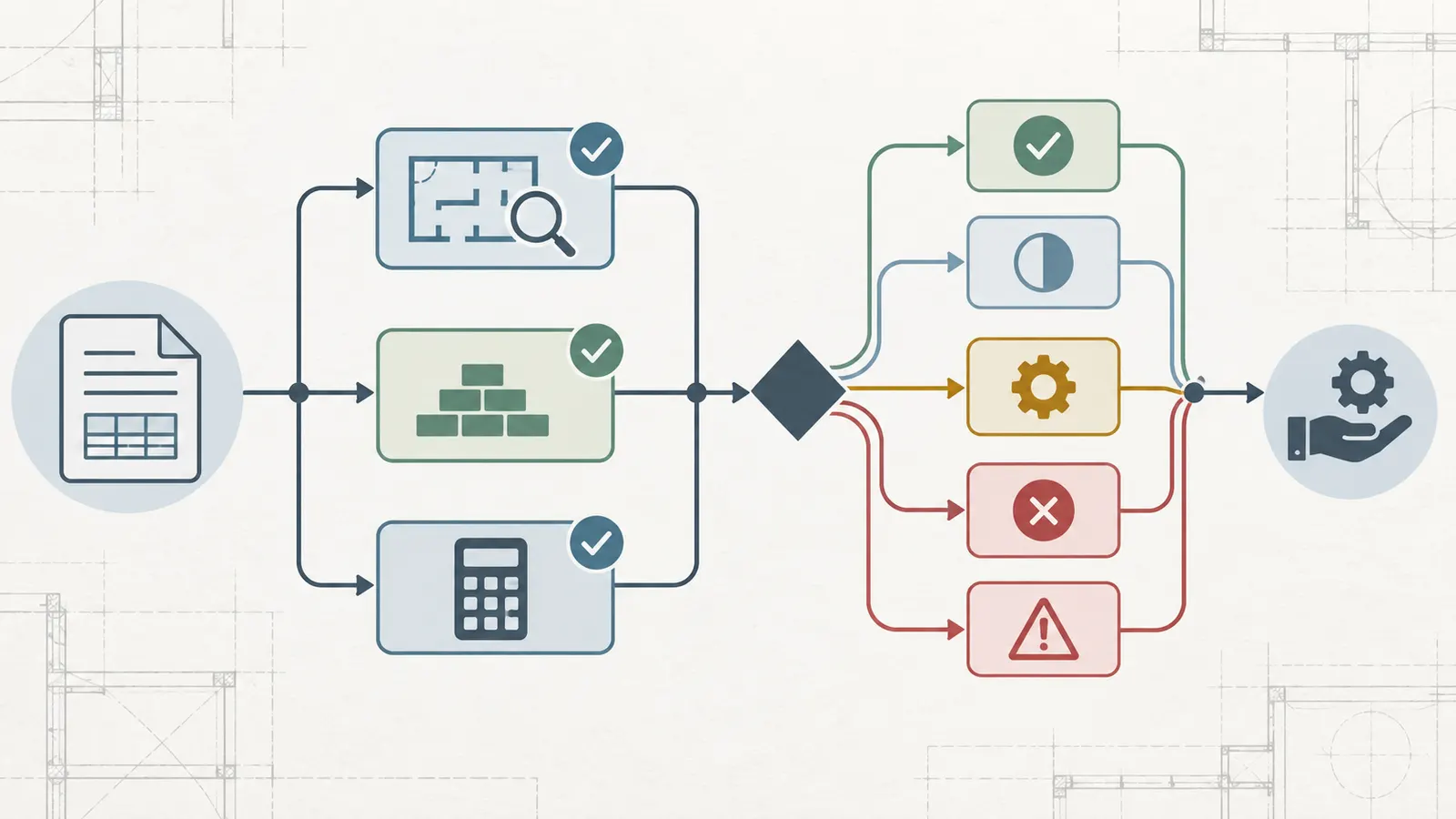
What must be true before you release a progress draw? #
A progress draw is ready only when the requested amount is supported by the contract and current evidence, the responsible reviewers have completed their checks, and the lien-exposure record is complete enough for the next payment gate. A signed waiver by the builder alone is not enough: California CSLB warns that paying the direct contractor or obtaining that contractor's release does not guarantee that subcontractors and suppliers have been paid. (California CSLB's release guidance)
Think of the decision as three separate gates. A draw can pass one gate and fail another:
- Scope gate: Is the work or material claimed in this draw authorized by the contract or a signed change order, and is its status observable or documented?
- Amount gate: Does the requested amount reconcile to the schedule of values, stored-material rules, retainage, prior payments and approved changes without double counting?
- Payment-protection gate: Have you identified the relevant claimants and collected the release or payment evidence required by the contract and the project's jurisdiction?
The gates prevent a common error: treating a lien waiver as an invoice receipt. A release addresses a claimant's rights only within its wording, date, project and exceptions. It does not tell you whether the framing is plumb, whether the concrete reached the specified strength, whether a delivery is yours, whether an allowance was used reasonably, or whether a change was approved. Conversely, a good inspection report does not prove a supplier was paid. Your packet should keep those facts in different columns.
The release decision is not binary
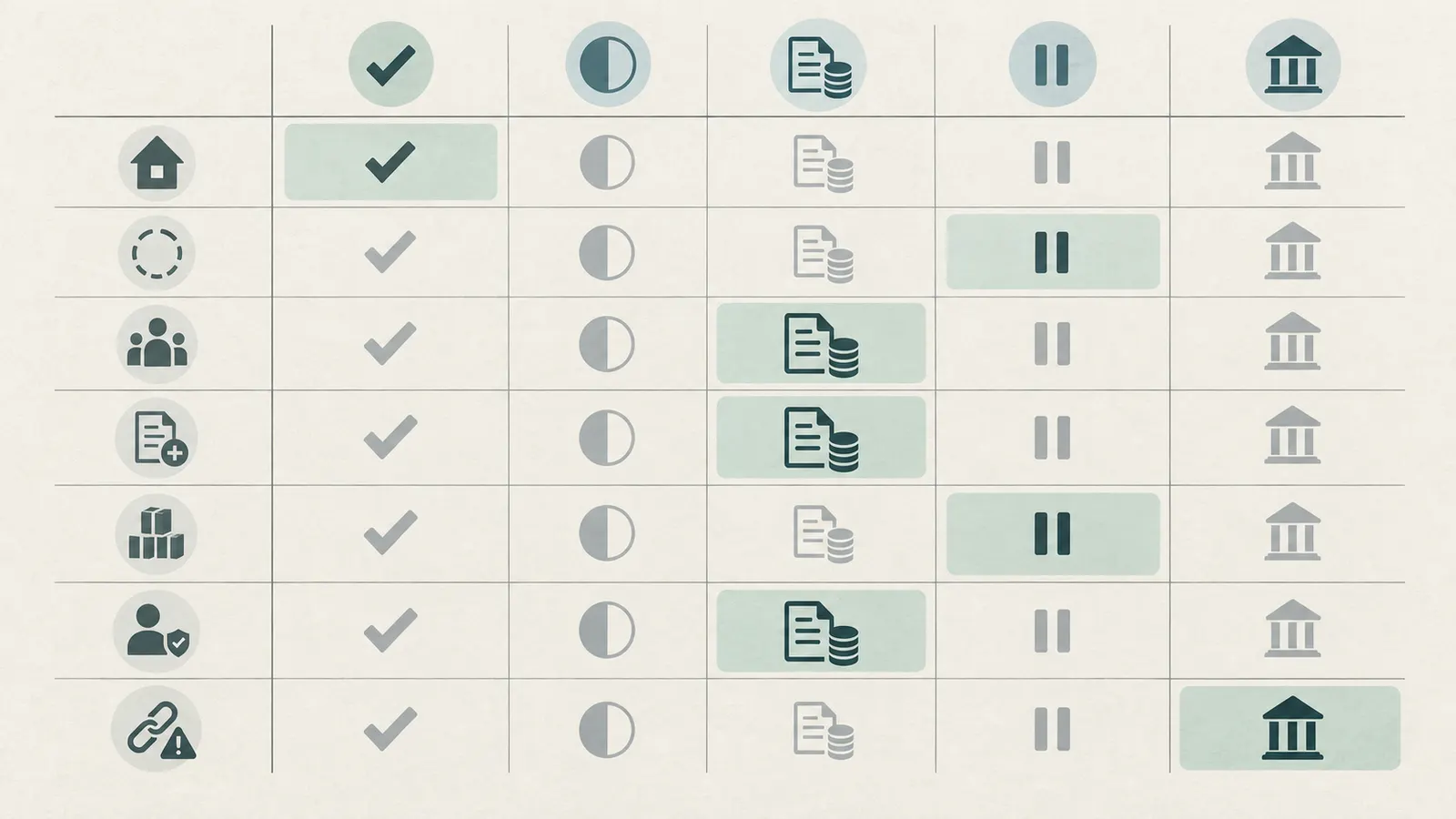
Use four outcomes rather than forcing every draw into “pay” or “do not pay.”
| Outcome | Use when | Payment action | Next handoff |
|---|---|---|---|
| Release | Scope, amount and claimant evidence pass, and no unresolved material exception exceeds the contract's process | Authorize the reconciled amount, not an unexplained invoice total | File payment proof and set the next draw gate |
| Partial release | Some lines pass while others are unsupported, unapproved or incomplete | Pay only the supported line or agreed undisputed amount, retaining what the contract permits | Builder issues corrected application or resolves exceptions |
| Condition or joint check | Work is supported but a named claimant has not yet been paid, or the contract and local process support a controlled payment | Use the contract-approved condition, escrow control or joint check; do not invent a new legal mechanism | Builder, claimant, lender or escrow confirms endorsement and clearance |
| Hold or escalate | Scope is unsafe or disputed, amount cannot be reconciled, release is false or unauthorized, lien notice is active, or a deadline is close | Pause the disputed amount and follow notice, dispute and professional-advice provisions | Architect, lender, escrow, insurer, engineer or local construction attorney |
“Partial release” here means a payment administration choice, not a legal conclusion that a lien right has been extinguished. “Condition” means a written, contract-compatible instruction that should be reviewed before it changes anyone's rights. In California, CSLB specifically recommends obtaining a signed conditional release before payment and an unconditional release after payment, and says a property owner may withhold the next payment until prior unconditional releases are obtained. (California CSLB's prevention guidance) That is a California example; do not paste it into a Washington, Texas or another state's payment process without checking.
The minimum release packet
Create one dated folder or record for each draw. Give it a stable name such as Draw-04-2026-09-07. At minimum, place these in it:
- the signed owner-builder contract and amendments;
- the current schedule of values and a copy of the previous approved application;
- the builder's current payment application, continuation sheet or equivalent detail;
- an updated change-order log with signed approvals and pending proposals separated;
- progress photos, site notes, inspection reports and delivery tickets tied to line items;
- stored-material invoices, delivery records, insurance or custody information and a plan for protecting the material, if stored items are billable under the contract;
- the current list of subcontractors, laborers and material suppliers, with the person who supplied each record;
- preliminary notices or similar notices received, indexed by claimant, project address and date;
- signed conditional or unconditional waivers/releases, each tied to a payment period and amount;
- canceled-check images, bank or escrow confirmation, joint-check endorsement evidence or other contract-accepted payment proof;
- the lender's draw form, inspection report and conditions, if construction financing is involved;
- an exceptions register showing what is missing, who owns the follow-up, the due date and the next gate.
Do not ask the builder to “send lien waivers” without specifying the period and claimants. Ask for “the signed release and payment evidence for every claimant included in Draw 04, covering the amount and period stated in the attached register.” A vague request produces vague paperwork, often with a form that says “all amounts” even though the draw covers only one phase.
Which records and people do you need before checking the form? #
Collect the contract, the payment application, the schedule of values, the change-order log, the claimant map and the jurisdiction before interpreting a release. The homeowner owns the decision to authorize the payment, but the builder, architect, lender, escrow agent and claimants each control different evidence; no one person can honestly substitute for all of them.
Start with the contract and its payment mechanics
Read the clauses that answer these questions, and copy the answers into the front of the packet:
| Contract question | Input to record | Why it changes the check |
|---|---|---|
| Who applies for payment? | Builder, general contractor, construction manager or owner representative | Identifies the sender and the person responsible for correcting the application |
| Who certifies the work? | Owner, architect, owner's representative, lender inspector or no third party | Defines whose observation is evidence and whether certification is advisory or contractual |
| What is the billing basis? | Fixed price, cost-plus, guaranteed maximum price, unit price or allowance | Determines whether invoices, quantities, markups and allowances must be shown |
| What is the payment period? | Dates or draw number | Keeps releases from the wrong month or prior project phase |
| What is the schedule of values? | Line IDs, descriptions and original amounts | Provides the denominator for earned-value reconciliation |
| What may be billed as stored? | Allowed location, ownership transfer, insurance, delivery and documentation requirements | Prevents paying for undelivered, off-project or unprotected goods |
| What retainage applies? | Percent or dollar amount and release event | Avoids paying the retained amount twice or treating it as an informal holdback |
| What change process applies? | Required proposal, pricing, signature, notice and time effect | Separates approved scope from a pending request |
| What releases are required? | Form, claimant class, period, conditional/unconditional language and timing | Determines what to request and when a payment proof is needed |
| What is the dispute process? | Notice, cure, meeting, mediation, arbitration, counsel and payment deadlines | Keeps a hold from becoming an undocumented breach or waiver |
| Who controls the money? | Homeowner, construction lender, escrow, title company or draw administrator | Establishes the correct handoff and evidence of disbursement |
If the contract uses AIA G702/G703 or a similar application, use its structure as a reconciliation starting point. AIA describes those forms as showing work completed and stored to date, retainage, previous payments, a change-order summary, the current payment request and a schedule of values; it also says an architect can certify an amount different from the amount applied for with an explanation. (AIA's G702 application description) The form's presence does not mean your contract adopted it, and an architect's certification is not a lien-release certificate or a warranty that concealed work is sound.
Assign responsibility by evidence, not by title
The following assignment is a practical starting point. Adjust it to the signed contract:
| Evidence | Usually prepared or supplied by | Homeowner's verification question |
|---|---|---|
| Payment application and schedule of values | Builder or general contractor | Does this match the contract revision and draw period? |
| Field completion status | Builder, architect, owner's representative or inspector | What was actually observed, when and by whom? |
| Quantity or unit backup | Builder and trade performing the work | Are the units, locations and installed quantities identifiable? |
| Stored-material proof | Builder, supplier and sometimes lender inspector | Was it delivered, segregated, insured and billable under this contract? |
| Signed change order | Owner and builder, often with architect pricing review | Is there an approval before billing, not merely a proposal? |
| Claimant list | Builder, with notices and supplier records | Does each name, legal entity and scope map to the project? |
| Preliminary notice | Claimant or its authorized sender | When was it received, and what work or materials does it describe? |
| Conditional release | Claimant or authorized agent | What payment, date, amount and exceptions make it conditional? |
| Unconditional release | Actual claimant or authorized agent | Does it assert receipt, and is it limited to the right period and amount? |
| Payment proof | Bank, escrow, builder and claimant | Did the instrument clear or did the claimant acknowledge payment? |
| Draw inspection | Lender or designated inspector | What did this inspection cover, and what did it expressly exclude? |
The builder is responsible for assembling a truthful application and, where the contract says so, obtaining releases from its trades. That does not make the builder's spreadsheet independent proof. The homeowner or owner's representative should compare documents; the lender may have a separate underwriting or inspection standard; the architect may certify only the information within the architect's role. A supplier controls its own release. If the release is signed by a person whose authority is unclear, mark it as an exception and ask the claimant or counsel how authority is established.
Establish the jurisdiction before applying a rule
Put these fields at the top of the register:
- property street address, county and state;
- whether it is a new home, remodel, addition, repair or owner-occupied homestead;
- owner-builder, general-contractor or construction-manager structure;
- construction lender and draw administrator;
- contract signing date and governing-law clause;
- county recorder or land-records office relevant to the property;
- known preliminary-notice, notice-to-owner or notice-of-lien records;
- date the packet was assembled and date each source was checked.
This matters because lien rights and release forms are not national. California CSLB, Washington L&I and the Texas Attorney General provide different descriptions and different practical cautions. Federal FTC guidance can support prudent payment behavior, but it does not tell you whether a claimant has a lien right in your county. Your lender may require more paperwork than state law, and your contract may create a payment gate even where a state agency describes only a recommendation.
How do you reconcile the draw with completed work and stored materials? #
Reconcile each line, rather than trusting a total: calculate the current earned amount from the contract line, add only documented approved changes, subtract previous payments and required retainage, then compare the result with the requested amount. A payment application should make the period's work and stored materials visible; AIA's description of G702/G703 is a useful model for those fields, but your signed agreement controls. (AIA G702/G703 description)
Use a line-level formula
For a fixed-price line, record the following in dollars unless the contract uses another unit:
Current line due = (contract line value × eligible completion fraction) + eligible stored-material value + approved change-order amount allocated to line − previous payments − retainage − credits
The completion fraction is not a guess that makes the draw total work. It must be supported by a measurable definition: installed area, verified quantity, milestone completion, delivery accepted under the contract, or the responsible professional's certification. For a unit-price line, replace the fraction with accepted quantity × contract unit price. For cost-plus work, use the contract's cost categories, receipts and markup rules. If the contract prohibits stored-material billing until delivery to the site, set eligible stored-material value to zero even if the builder has paid a supplier.
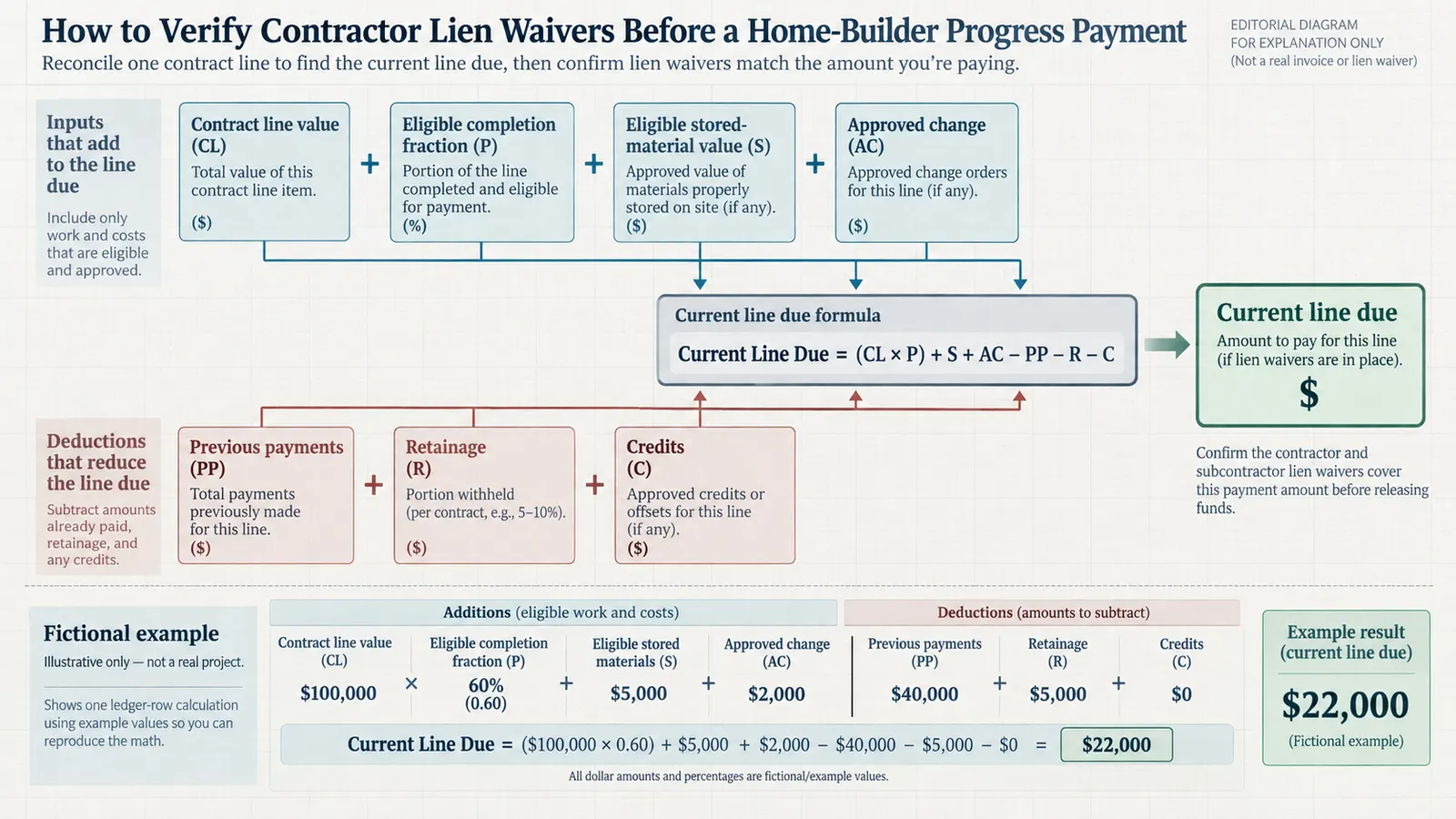
Use one currency and one date basis. If the schedule contains square feet, linear feet, cubic yards, units or hours, retain the original unit and quantity in separate columns. Do not convert an invoice total into a completion percentage without showing the conversion. A $30,000 invoice for 60 percent of a $50,000 line can be evidence of cost, but it is not automatically proof that 60 percent of the contracted work is complete.
Illustrative modeled example: Draw 04
The following is an illustrative modeled example, not a market price, contractor quote, inspection result or Brictale measurement. Assume a fictional project in Washington with a fixed-price contract and a 10 percent retainage on eligible progress. The contract permits stored materials only when delivered to the site, identified for the project, insured and documented. The builder requests Draw 04 on September 7.
| Line | Contract value | Eligible status this draw | Current gross earned | Prior gross billed | Change this draw | Retainage | Current line due |
|---|---|---|---|---|---|---|---|
| Site concrete | $42,000 | 100% of scheduled work observed; signed inspection note | $42,000 | $30,000 | $0 | $1,200 | $10,800 |
| Framing | $118,000 | 65% completion supported by measured wall and roof scope | $76,700 | $55,000 | $0 | $2,170 | $19,530 |
| Windows | $36,000 | 50% installed; $8,000 of delivered, identified units stored on site | $26,000 | $10,000 | $0 | $1,600 | $14,400 |
| Electrical rough-in | $54,000 | 30% claimed; only 20% accepted by inspection | $10,800 | $5,000 | $3,000 approved change | $880 | $7,920 |
| Total | $250,000 | $155,500 | $100,000 | $3,000 | $5,850 | $52,650 |
For site concrete, the current earned amount is $42,000 − $30,000 = $12,000; 10 percent retainage on the $12,000 current gross is $1,200, so current due is $10,800. For framing, $118,000 × 0.65 = $76,700; subtract $55,000 prior gross and $2,170 retainage, producing $19,530. For windows, the installed value is $36,000 × 0.50 = $18,000; add $8,000 of eligible delivered storage for $26,000, subtract the $10,000 prior gross and $1,600 retainage, producing $14,400. For electrical, use the accepted 20 percent, not the claimed 30 percent: $54,000 × 0.20 = $10,800; add the $3,000 approved change, subtract $5,000 prior gross and $880 retainage, producing $7,920.
The packet's current supported total is therefore $10,800 + $19,530 + $14,400 + $7,920 = $52,650. If the builder's application requests $60,650, the $8,000 difference is not a “small rounding issue.” It is an unresolved exception. It may be an additional approved change, a retainage convention, a prior-payment error, or unsupported work. Ask for a corrected application with the difference identified. Do not solve a reconciliation problem by signing a broad release.
Add sensitivity instead of hiding uncertainty
If the framing completion fraction is disputed, show the range. At 60 percent, framing gross earned would be $118,000 × 0.60 = $70,800; after $55,000 prior gross and 10 percent current retainage of $1,580, the line due would be $14,220. At 65 percent it is $19,530. The five-point disagreement changes this line by $5,310. That is large enough to affect the payment decision and deserves an architect, owner's representative or contract process—not a verbal compromise that disappears from the register.
For windows, if the $8,000 stored value fails the contract's delivery, identification or insurance test, remove it from the current eligible amount. The line then becomes $18,000 − $10,000 − $800 = $7,200, $7,200 lower than the modeled line due. If the material is properly delivered and accepted, retaining it may be reasonable under the contract. If it is in a supplier's warehouse, the contract must say whether title, risk and storage satisfy the draw condition; do not infer those facts from an invoice.
For the electrical change, compare two scenarios. With the signed $3,000 change, the line due is $7,920. Without an executed change order, the same accepted base work yields $10,800 − $5,000 − $580 = $5,220 if retainage is calculated on that $5,800 current gross. The $2,700 difference is not due until the change authority is established. Record the change separately so a future release does not accidentally release both the base work and a disputed extra.
What each kind of progress evidence can and cannot prove
| Evidence | Can support | Cannot establish by itself |
|---|---|---|
| Dated site photo | Location and apparent progress at a point in time | Code compliance, concealed quality, ownership or payment |
| Builder daily report | Builder's contemporaneous account of labor and events | Independent completion percentage |
| Architect or inspector observation | The stated observed condition within that person's scope | Payment of every trade or validity of a lien |
| Delivery ticket | Delivery date, item and location if details are complete | Installation, ownership transfer, suitability or payment |
| Supplier invoice | Amount invoiced and described goods | That goods were delivered, used on this project or paid |
| Test or inspection report | The test or inspection result and its stated scope | Completion of unrelated line items or lien protection |
| Certificate or permit record | A governmental or professional process at its stated stage | Full contract completion or payment to claimants |
| Signed change order | Agreement to the described change and price if properly executed | Completion of the changed work |
| Conditional release | A claimant's release condition as written | That payment cleared before it does |
| Unconditional release | A claimant's assertion of receipt and release as written | That every claimant signed or that concealed work is sound |
| Canceled check or bank record | The instrument cleared or money was disbursed | That the payment covered the right project line unless mapped |
This separation is the heart of the packet. If an inspector says “framing appears 65 percent complete,” place that observation beside the calculation, not inside the release column. If a supplier release says “paid in full through August 31,” place it beside the claimant and period fields, not beside the completion percentage. A draw can be technically supported and still lack payment protection; it can also have excellent releases and still overstate the work.
How do you verify changes, stored materials and prior payments? #
Verify every amount that changes the contract total, timing or claimant list before it enters the current draw. An approved change must be distinguishable from a proposal; stored material must satisfy the contract's custody and delivery conditions; and prior payments must be tied to earlier applications and releases so a line is not billed twice.
Separate four types of change status
Use these labels in the change-order log:
- Proposed: priced or described, but not approved by the person named in the contract. It is not current earned contract value unless the contract expressly allows it.
- Authorized to proceed: the owner has permitted work to start, but final price or time may still be unresolved. Record the written authority and do not treat the unresolved price as settled.
- Executed change order: signed by the required parties with scope, price, schedule effect and any allowance or credit. It can enter the contract value under the stated terms.
- Closed: the changed work is complete, paid and included in the relevant release or closeout record.
The most frequent failure is a builder's application that adds “owner selections,” “field directive,” “material escalation” or “extra labor” as if the label itself were approval. Ask for the document that created the obligation. If there is no signed change order, identify the amount as disputed or pending and route it through the contract's change procedure. If the homeowner verbally agreed, write down the date, participants and exact scope, then ask the contract administrator or attorney how to document it; do not backdate a signature.
For each executed change, add a row to both the schedule reconciliation and claimant map. A change may bring in a new supplier, extend a trade's scope, alter the release amount or create a new payment milestone. The original contract line and the changed line should remain traceable. A broad unconditional release that lists only the original contract can be misleading if the claimant's change work is excluded.
Test stored materials through five questions
Stored material is a payment category, not a shortcut around completion evidence. Ask:
- Delivery: Is there a dated ticket or other record showing the material arrived at the location allowed by the contract?
- Identity: Is it labeled, photographed or otherwise segregated so you can distinguish it from another project's inventory?
- Quantity: Does the delivered quantity and unit match the amount billed, including partial shipments and backorders?
- Risk and custody: Who owns it, who insures it, who protects it from theft or damage, and what happens if the contract terminates?
- Eligibility: Does the contract or lender permit this material to be billed before installation, and does the lender require a separate inspection?
If any answer is unknown, set eligible stored value to zero until resolved, or mark the amount as conditional under a written contract-compatible process. A photograph of pallets can show presence but not title. A paid supplier invoice can show the builder incurred a cost but not that your project received the goods. A delivery ticket can show arrival but not that the units meet the specification. Bring product identifiers, packing lists and the contract clause to the responsible architect, builder or lender inspector.
Reconcile previous payments before trusting a release
Create a cumulative ledger with one row per application:
| Draw | Application date | Gross earned to date | Approved changes to date | Stored material | Retainage held | Previous payments | Net requested | Release period complete? |
|---|---|---|---|---|---|---|---|---|
| 01 | date | amount | amount | amount | amount | amount | amount | yes/no |
| 02 | date | amount | amount | amount | amount | amount | amount | yes/no |
| 03 | date | amount | amount | amount | amount | amount | amount | yes/no |
| 04 | date | amount | amount | amount | amount | amount | amount | yes/no |
The important comparison is not simply “current requested” against “current invoice.” It is cumulative. For each line, calculate gross earned to date − prior gross billed = current gross before retainage, then subtract only the current retainage or other credit required by the contract. If a previous application billed stored windows and this application bills installed windows without crediting the stored amount, the total may be correct under one accounting method or double counted under another. Ask the builder to show the method explicitly.
Tie each earlier payment to proof of disbursement and the release period. A new unconditional release may assert that a claimant received a progress payment, but it does not automatically prove that all prior periods, change orders or other claimants are covered. California CSLB says the progress-payment conditional and unconditional forms do not cover all items. (California's form descriptions) Treat every exception or carve-out as data.
How do you match preliminary notices and releases to actual claimants? #
Build a claimant map from the legal entity on each notice, invoice and release, and match it to the project, scope, period, amount and signature authority. A contractor-provided spreadsheet is a starting list, not proof that it contains every potential claimant; the rules differ by state and project type.
The claimant register
Use one row per claimant, not one row per trade category:
| Claimant legal name | Role | Contracted by | Scope or materials | Notice received | Notice date | Amount in draw | Release type | Release signer/authority | Payment proof | Exception | Next gate |
|---|---|---|---|---|---|---|---|---|---|---|---|
| Example Framing LLC | subcontractor | builder | framing labor/material | yes/no | date | $ | conditional/unconditional | name and title | check/bank/acknowledgment | text | owner/builder/counsel |
| Example Millwork Supply Inc. | supplier | Example Framing LLC | lumber or components | yes/no | date | $ | conditional/unconditional | name and title | check/bank/acknowledgment | text | builder/supplier |
For every notice, copy the claimant's exact legal name, address, project description, sender, service method and stated scope. For every release, compare the name character by character with the notice and the invoice. “ABC Plumbing” and “ABC Plumbing, LLC” may be related or may not be the same legal claimant. If an entity changed names, ask for documentation or professional advice; do not decide from a logo.
Also compare the claimant's scope with the current draw. A roofing supplier's release should not be used to cover electrical labor. A release for “payment through June 30” may not cover the July delivery billed in Draw 04. A release that excludes retainage, disputed extras, unpaid checks or future deliveries should show those exclusions in the register. A blank or crossed-out exception is not a clean record.
California: distinguish the release state and notice state
California CSLB says a waiver and release is not binding unless the claimant signs and delivers it. It describes a conditional waiver and release upon progress payment as appropriate when the claimant has not yet been paid and says it becomes effective only if the claimant is actually paid. It describes an unconditional progress-payment release as one in which the claimant asserts receipt of the progress payment. Both descriptions also warn that the release does not cover all items. (California CSLB on conditional and unconditional releases)
The practical sequence for a California homeowner is therefore:
- Before the progress payment, request a signed conditional release from each relevant potential claimant, using the statutory form or a form that counsel confirms substantially complies with the applicable California Civil Code section.
- Match the claimant, project, period, amount and exceptions to the register.
- Release the payment only as the contract and payment gate allow.
- After payment, obtain the actual claimant's unconditional release for the paid portion and retain proof that the payment reached the claimant.
- Do not treat the builder's promise that “everyone is covered” as a substitute for claimant-level records.

California CSLB says subcontractors and material suppliers may need to provide a preliminary notice, while direct contractors and laborers do not have to provide that notice. It describes a 20-day example and says a late notice can limit the period for which payment is required. (California CSLB's preliminary-notice guidance) Record when you received a notice; do not infer from the absence of one that no payment risk exists, because the direct contractor and laborer exceptions matter.
If a California lien is already recorded, stop treating the packet as a routine draw checklist. CSLB says a recorded lien remains in county records until action is taken and can make it difficult to sell, refinance or obtain a line of credit; it also says timing and validity questions may require an attorney. (California CSLB's recorded-lien guidance) Preserve the packet, record service dates and send it to a California construction attorney or the professional named in the contract.
Washington: do not infer safety from paying the prime
Washington L&I says unpaid subcontractors, suppliers or laborers can look to the property for payment even when the owner has paid the contractor in full. Its facts sheet distinguishes a new home from a remodel and says that, for a remodel, the owner's liability may be limited to the amount owed to the prime contractor when the lien is filed. (Washington L&I's Facts About Construction Liens) Those are Washington-specific statements, not a formula to apply elsewhere.
For a Washington project, add the following gates to the claimant register:
- ask the prime contractor to disclose all potential lien claimants as a condition of payment, while labeling the list as contractor-supplied rather than complete;
- record when any claim of lien or related notice was received and whether the claimant sent the owner the recorded claim;
- check the contract's release requirement at each progress draw and before final payment;
- ask the construction lender what payment verification or lender supervision it performs;
- if the packet reaches final payment, request a completed lien release from each contractor and material supplier, as Washington L&I recommends;
- use the current RCW and local professional advice for deadlines, property type and claimant status.
Washington L&I describes a 90-day period tied to cessation of performance or delivery of materials for the claim described in its facts sheet and cites RCW 60.04.091. (Washington L&I on construction-lien timing) Do not calculate a deadline from the date printed on your draw alone. A claimant's last delivery, last labor, project completion and the legal classification of the work can be different dates. If you receive a lien notice, tell the builder and lender immediately and ask a Washington attorney to assess the record.
Texas: add homestead and construction-account checks
Texas needs a separate caution because the Texas Attorney General's consumer guidance on unpaid claimants says that if a subcontractor or supplier furnishing labor or materials is not paid, the property may be subject to a lien even when the homeowner did not contract directly with that party. The same Texas page says a contract signed for work on a homestead must contain a specified warning about the parties' obligations and possible loss of ownership rights, and says that when a lien will be placed on a homestead, a notary other than the salesperson must witness the homeowner's signature on the document creating the lien. (Texas Attorney General homestead-contract guidance) Those are Texas-specific checks, not national rules or a conclusion that a particular lien is valid. The AG also says that, when a homestead improvement exceeds $5,000, the contractor is required by law to deposit homeowner payments in a construction account. It advises requesting written verification and monitoring deposits and disbursements, with account access included in the written contract. (Texas Attorney General construction-account guidance)
For a Texas project, add these fields before a draw:
- Is the property a homestead, and does the contract contain the applicable warning and execution formalities?
- Does the stated $5,000 threshold and construction-account requirement apply to this project and payment structure today?
- Who holds the account, who can view records, and how are subcontractor, laborer and vendor disbursements identified?
- Does the lender or escrow process preserve the records the contract requires?
- Does the payment application identify the completed portion rather than only a request for funds?
The Texas AG also advises that a homeowner should not pay in full until the work is complete, inspected and satisfactory, and that a partial-payment schedule should identify what part of the job is complete when payment is due. (Texas AG payment guidance) This supports the scope gate for a progress draw, but it does not answer whether a particular lien release is valid. For a homestead lien, disputed draw or threatened filing, obtain Texas legal advice promptly.
How do you choose release, hold, joint check or escalation? #
Choose the least risky outcome that follows the contract and preserves the homeowner's rights: release a supported amount, pay an undisputed portion, use a documented joint-check or escrow control when appropriate, or hold and escalate a material exception. Never use an unconditional release to make missing payment proof disappear.
Decision matrix
| Observed packet state | Scope and amount | Claimant/release state | Recommended administrative outcome | Ask for next |
|---|---|---|---|---|
| All lines supported; approved changes included; claimant records match; releases complete | Pass | Pass | Release reconciled amount | Payment confirmation and next draw date |
| One line has weak completion evidence; other lines pass | Partial | Pass | Hold that line; release supported lines only if contract permits | Responsible professional's observation or corrected application |
| Work and amount pass; named supplier has not been paid | Pass | Conditional release or no release | Follow the contract's condition; consider joint check only after builder, lender/escrow and counsel confirm process | Claimant acknowledgment, cleared payment or valid release |
| Builder release provided; supplier preliminary notice exists; supplier release missing | Pass or uncertain | Fail | Hold the exposed amount or use a contract-approved controlled payment; do not rely on builder release | Supplier release and payment proof |
| Change appears in draw with proposal but no required signature | Unapproved | Any | Exclude or hold the change amount | Executed change order or formal dispute route |
| Stored material lacks delivery, identity or insurance proof | Uncertain | Any | Exclude stored value until contract test passes | Delivery ticket, segregation, insurance and custody record |
| Release is signed by a person whose authority is unclear | Maybe | Fail | Treat as unresolved | Claimant confirmation or counsel's authority analysis |
| Release period does not match draw period | Maybe | Fail | Hold or obtain a corrected release | Claimant-specific corrected form |
| Payment instrument has not cleared | Pass | Conditional | Do not treat it as unconditional payment proof | Bank clearance or written claimant acknowledgment |
| Recorded lien, demand, threatened foreclosure or imminent deadline | Unknown | High exposure | Stop routine processing and escalate | Local construction attorney, lender and contract administrator |
| Unsafe, inaccessible or concealed work cannot be verified remotely | Unknown | Any | Do not certify completion; keep people out of the hazard area | Qualified inspector, engineer or trade professional |
The matrix is intentionally conservative about evidence, not about legal conclusions. A hold is a status that says “the packet is incomplete or disputed”; it is not a finding that the builder or claimant is wrong. Put the reason in writing, identify the amount affected, state the document needed, and follow the contract's notice window. Do not withhold unrelated undisputed work simply because one trade's release is missing unless the contract or local advice permits that treatment.
When a joint check may help—and why it is not automatic
A joint check can direct one payment to both a builder and a supplier or subcontractor, creating a record that both parties endorsed it. California CSLB calls joint checks a simple way to help ensure subcontractors and suppliers are paid and tells owners to compare the bill to the payment schedule and preliminary notices, confirm the work and make the check payable to both parties. (California CSLB's joint-check guidance)
That does not mean a homeowner should unilaterally rewrite the payment process. Before using one, check:
- whether the contract permits or addresses joint checks;
- whether the construction lender, escrow agent and bank can process the payees;
- whether the named supplier or subcontractor agrees to the amount and scope;
- whether endorsement and clearance will produce the payment evidence you need;
- whether the builder's invoice, markup, retainage and tax treatment remain clear;
- whether the check covers only the identified claimant and period rather than implying a universal settlement.
If the claimant refuses a joint check because of a dispute, do not treat refusal as proof of fraud. Record the reason, keep the undisputed scope separate, and move the issue to the contract administrator or attorney. If the builder refuses to identify a named claimant or will not permit a contractually required payment control, that is a material packet exception and may justify a hold or escalation.
What counts as payment proof?
Classify payment evidence by strength and scope:
- Bank-cleared instrument: shows that a check or transfer cleared, but map the payee, amount, date, invoice and project.
- Joint-check endorsement: shows the named payees endorsed the instrument, but retain the front, back and bank status where legally and practically available.
- Claimant written acknowledgment: strongest when it identifies claimant, project, amount, date and released period; check that the signer is authorized.
- Unconditional release: records the claimant's assertion of receipt and release as written, but inspect exceptions and coverage.
- Builder statement: useful as a lead or reconciliation document, but not claimant-level proof when a claimant's own release is required.
Do not email bank statements containing unnecessary account numbers. Redact sensitive information while leaving the payee, last four digits if needed, amount, date, clearing status and transaction reference visible. Store the unredacted record only where the contract, lender, privacy policy and security controls permit. Ask the lender or escrow agent which record it accepts; a lender's “draw funded” notice may prove its disbursement, not the builder's later payment to a supplier.
What should you do when the packet fails? #
When evidence is missing or conflicting, document a specific exception, notify the responsible person in writing, protect the payment deadline and choose the next handoff; do not fill the gap with a promise, a backdated form or a broad waiver. The FTC recommends written contracts and estimates, staged rather than full upfront payment, inspection before final payment, and keeping copies and notes when a problem occurs. (FTC home-improvement guidance)
Failure branch: the application is a lump sum
Ask the builder to resubmit against the schedule of values with line descriptions, current percentage or quantity, stored-material detail, prior payments, retainage, credits and change-order references. If the contract does not have a usable schedule of values, do not invent one after the fact and silently make it binding. Ask the contract administrator, architect or attorney how a supplemental breakdown should be approved. The payment decision may be delayed because the prerequisite was missing at contracting; record that as a process gap to fix before the next draw.
Failure branch: the builder says waivers come later
Ask which exact release is due before payment and which is due after payment under the contract and state. In California, CSLB's guidance expressly describes obtaining a signed conditional release before payment and an unconditional release after payment, and says the direct contractor should obtain releases from potential claimants. (California CSLB payment-protection guidance) In Washington, L&I recommends requesting completed releases from each contractor and material supplier before final payment and tells owners to ask the lender about payment verification. (Washington L&I guidance) These examples do not resolve your contract, but they show why “later” must be a dated gate with a named owner.
If the contract allows payment before a release, record the contractual basis and what additional protection substitutes for it. If no basis exists, hold the exposed amount or ask local counsel. Do not let a builder pressure you to sign an unconditional form that says you received money before the money cleared.
Failure branch: the release is broad, but the invoice is narrow
Read the release's project, period, amount and exceptions. A release that covers “all claims through date” may be broader than the current draw, but you cannot assume it is legally effective or that the signer intended every change and retainage. Ask the claimant to identify what is released and what remains open, then have counsel review if the wording affects lien rights. California CSLB notes that its progress-payment forms do not cover all items. (California CSLB form guidance)
The safe administrative move is to preserve the original, mark the mismatch and request a corrected claimant-level form rather than editing the signed document yourself. Never crop out an exception or convert “conditional” to “unconditional” in a spreadsheet.
Failure branch: a supplier says it has not been paid
Do not decide who is truthful from the builder's balance sheet or a phone call. Ask the supplier for its legal name, invoice or delivery references, amount claimed, dates, notice, and the release it would accept. Ask the builder for the corresponding purchase order, invoice, payment record and explanation. Keep both accounts in the register and state whether the amount is disputed, undisputed or unknown.
Then follow the jurisdiction path. California CSLB warns that payment to the direct contractor does not guarantee suppliers are paid. Washington L&I says an unpaid supplier may look to the property even if the prime was paid. Texas AG guidance likewise warns that unpaid subcontractors and suppliers can expose the property to a lien. (California CSLB, Washington L&I, Texas Attorney General) These are not interchangeable legal rules; they are reasons to move the issue to the state's process promptly.
Failure branch: the work cannot be safely inspected
Do not enter an excavation, climb an unguarded structure, open energized equipment, disturb suspected hazardous material or enter a confined area to make the packet complete. Do not test, open, disconnect, bleed, adjust or diagnose pressurized plumbing, pressure tanks, hydronic equipment, boilers, compressors or another pressure system yourself; route pressure-test results, relief-device questions and system-condition evidence to the qualified trade or inspector responsible for that system. A draw inspector's remote review has limits; a photo cannot substitute for a qualified professional where the risk is structural, electrical, fall-related, excavation-related, contamination-related, pressure-related or otherwise outside homeowner observation. Ask the builder or designated professional to supply a safe inspection, report the inaccessible area and identify the effect on the requested line.
The homeowner can safely collect the contract, photos from a safe location, delivery records, applications, notices and correspondence, and can ask the responsible trade or inspector to identify the pressure-system test, date, instrument or report used. Qualified professionals should perform unsafe access, structural assessment, electrical testing, pressure-system testing or diagnosis, code-related inspection, hazardous-material evaluation and legal lien analysis. If the unsafe condition is itself a breach or an emergency, follow the contract's notice provisions and local emergency process.
Failure branch: a lien is recorded
Stop the routine “approve and archive” workflow. Preserve the notice, envelope or service record, recording information, claimant communications, all applications, releases, checks, notices and contract documents. Notify the builder, lender and the professional required by the contract. Do not promise the claimant payment, admit validity, sign a release, transfer title or let a sale/refinance deadline pass without local legal advice.
California CSLB says homeowners should evaluate filing, service and foreclosure timing and may need an attorney; it also explains that an invalid lien can remain in county records until action is taken. (California CSLB's lien guidance) Washington L&I tells owners to take a notice to enforce a lien seriously, inform the contractor and determine what arrangement is being made to pay the sender. (Washington L&I's construction-lien facts) The next gate is legal and jurisdiction-specific, not a spreadsheet decision.
How do you run the handoff and preserve the next decision? #
Close every draw with a written decision, an evidence index and a next gate that names the responsible person, date and required record. A packet is useful only if the next builder, architect, lender, escrow agent or attorney can understand what was released and what remains open without reconstructing the project from email.
The draw review sequence
Use this sequence for each progress application:
- Freeze the inputs. Save the contract revision, schedule of values, current application, change log and prior approved draw. Record the property jurisdiction, draw period and requested amount.
- Check authority. Confirm who submitted the application, who may certify work, who must approve changes and who controls the disbursement.
- Reconcile the money. Recalculate each line and the cumulative ledger. Separate base contract, approved change, pending change, stored material, retainage, credit and previous payment.
- Check the scope. Compare each claimed status with safe observation, inspection or delivery evidence. Mark unobservable or unsafe work rather than estimating it from the total.
- Build the claimant map. Add every claimant named in notices, invoices, builder lists, releases and lender records. Match legal entity, scope, period and project.
- Verify release wording. Identify conditional or unconditional status, payment condition, amount, period, exceptions, signer and authority. Preserve the original file.
- Verify payment proof. Link cleared checks, joint-check endorsements, bank confirmation or claimant acknowledgment to the claimant and period. A promise to pay remains an exception.
- Apply the decision matrix. Release, partially release, condition, joint check, hold or escalate. State the amount affected and contract clause used.
- Route the handoff. Send the appropriate packet subset to the builder for correction, the architect or inspector for scope, the lender or escrow agent for funding, or local counsel for lien and disputed-rights analysis.
- Set the next gate. Record the next draw date, required completion milestone, outstanding release, change-order decision, stored-material check or closeout requirement.
The one-page decision record
At the front of the packet, write:
| Field | Record |
|---|---|
| Project and jurisdiction | Address, county, state; new home/remodel/homestead status |
| Draw | Number, application date, period and requested amount |
| Contract basis | Contract revision, schedule-of-values revision, retainage and stored-material rule |
| Scope reviewer | Name, role, observation date and limitations |
| Financial reviewer | Name, calculation date and total supported amount |
| Claimant reviewer | Name, source of list and notices checked |
| Decision | Release, partial, condition, joint check, hold or escalate |
| Amount authorized | Dollar amount and lines included/excluded |
| Exceptions | ID, description, amount, owner and deadline |
| Handoffs | Builder, architect/inspector, lender/escrow, attorney or other professional |
| Next gate | Specific evidence and date required before the next payment |
Add a short reason such as: “Authorize $45,450 of $52,650 supported in Draw 04; hold $7,200 windows storage value pending contract-compliant delivery/insurance proof; hold $0.00 electrical change because executed change order received; claimant register complete for notices received through September 7; builder to provide supplier releases and lender to confirm draw conditions by September 12.” In this example, the numbers are illustrative and must be replaced by the actual line calculation. The point is to make the decision auditable.
Keep the next draw from inheriting a hidden exception
Carry forward unresolved items explicitly. A missing release should not vanish because the next application has a new date. Use statuses such as open, awaiting-builder, awaiting-claimant, awaiting-lender, awaiting-inspector, disputed, escalated and closed. For each item, record the last request, the response, the amount at risk and the next action. If the item is closed, attach the document that closed it; do not mark it closed because someone said it was “handled.”
At the next draw, test whether the previous exception affects cumulative amounts, claimant periods or the new scope. For example, a supplier's unpaid July invoice may not be cured by an August release if the August form excludes prior work. A pending framing change may alter both the schedule of values and the amount claimed by the framing subcontractor. A stored-material exception may become an installed-work line, but the packet should show the transition from delivery to installation and the credit or prior billing treatment.
What should you ask each handoff partner?
Ask each participant only for the evidence within that participant's responsibility, then record the answer and limitation. This prevents the common handoff failure in which a lender assumes the architect checked payment rights, the architect assumes the builder checked suppliers, and the homeowner assumes the draw inspection checked concealed work.
Builder or general contractor
Request the corrected application, current schedule of values, change log, claimant list, preliminary notices received, releases for the draw period and payment proof for the prior period. Ask:
- What exact contract clause makes each current line billable?
- Which percentage or quantity is being claimed, and how was it measured?
- Which stored materials are included, where are they, who owns and insures them, and what is the delivery record?
- Which changes are executed, which are pending and which are included in the current amount?
- Which claimant signed each release, and how is signer authority known?
- Which payments cleared, to whom, for what period and which application?
- What exception remains open, who owns it and by what date will it close?
Give the builder a structured correction request, not an accusation. A useful request identifies line ID, amount, missing record, contract reference and due date. Keep delivery evidence and responses in the packet.
Architect, owner's representative or independent inspector
Request the scope of the observation, date, areas accessed, documents reviewed, exclusions and whether the person is certifying an amount under the contract or merely reporting conditions. Ask for a line-level statement rather than “the project looks on track.” A professional can support visible progress and identify defects or incomplete work within the engagement; that does not make the person a lien examiner or payment auditor unless the contract says so.
If the observation depends on concealed work, request the inspection, test or record that happened before concealment. Do not ask a professional to certify a condition that was inaccessible or outside the professional's role. If a field report conflicts with the builder's application, preserve both, identify the dollar difference and follow the contract's dispute or certification process.
Construction lender or draw administrator
Ask which documents are required before funding, whether a lender inspection covers stored material, whether the lender requires a title update, what releases it accepts, and whether it verifies downstream payments. Washington L&I specifically tells owners with interim or construction financing to ask the lender what precautions it takes and to request lender supervision; use that as a Washington-specific prompt, not a promise that every lender offers the same service. (Washington L&I lender guidance)
The lender's approval is not the homeowner's approval. A lender may fund a draw based on loan collateral, budget and inspection criteria while the homeowner still has a contractual dispute or missing claimant record. Conversely, a homeowner's packet may be complete while the lender requires a different form. Record both outcomes and do not represent one as the other.
Escrow or title agent
Ask what payment controls, joint checks, retainage, lien affidavits, title updates or disbursement records are available under the escrow agreement. Confirm who may give instructions and when funds are deemed disbursed. An escrow agent cannot give a homeowner a legal opinion merely by holding money. If a recorded lien, release, payoff or title exception is involved, obtain the title professional's and local attorney's instructions in writing.
Local construction attorney
Escalate when the packet involves a recorded or threatened lien, a disputed release, a signature-authority question, a payment deadline, insolvency, a homestead or property-title issue, a demand for a waiver broader than the paid scope, or a proposed hold that may breach the contract. Bring the attorney the contract and amendments, schedule of values, all applications, claimant register, notices, releases, checks, inspection records, change orders, correspondence and a timeline. Ask a narrow question: “What can this release legally release in this jurisdiction, for this claimant, amount and period, and what must we do before the next payment date?”
Do not ask the attorney to infer facts that the packet does not contain. If a claimant is missing, say that. If the builder's accounting is inconsistent, show the two calculations. If the work is unsafe or concealed, identify the inspection limit. Good legal advice becomes more useful when the evidence and uncertainty are explicit.
How do you maintain the packet through final payment and closeout?
Maintain the register cumulatively through final payment, retainage and closeout; final-payment paperwork is not a cleanup for missing progress-draw records. Washington L&I recommends completed lien releases from each contractor and material supplier before final payment, while California CSLB explains that the final and progress forms have different conditional and unconditional uses. (Washington L&I facts sheet, California CSLB release forms) Use the actual state's requirements and your contract.
Final-payment readiness checklist
- All schedule-of-values lines are either complete, credited, formally omitted or transferred through an approved change.
- All approved change orders are in the cumulative contract amount; pending proposals are separately listed and not silently included.
- Stored-material lines are installed, returned, credited or documented under the contract's closeout rule.
- Prior applications reconcile to the general ledger, lender records and cleared payments.
- Retainage is calculated once and its release condition is documented.
- Claimant names match notices, invoices, releases and payment proofs.
- Each required claimant has signed the correct release for the correct period and scope.
- Exceptions have a written disposition, not a verbal promise.
- Required inspections, certificates, permits, warranties and as-built or product records are held by the responsible person.
- The lender, escrow or title agent has confirmed its own closeout conditions.
- The homeowner has not signed a completion certificate before the contract's actual completion and satisfaction requirements are met. The Texas AG specifically warns homeowners not to sign a certificate of completion until the work is completely finished, the site is cleaned up and the homeowner is satisfied. (Texas AG completion guidance)
- A local professional has reviewed any lien, title, payment or release question that the worksheet cannot answer.
The maintenance rhythm after each draw
Set a short administrative rhythm while the project is active:
- At application receipt: save the original, freeze the contract revision and log the requested amount.
- Within the review window: reconcile line values, inspect safely, update changes and claimant records, and issue one written exception list.
- Before authorization: confirm release status, payment proof and lender/escrow conditions.
- At disbursement: save the authorization, paid amount and transaction reference.
- After downstream payment: collect claimant-level unconditional or completed releases when required, map them to the paid period and close exceptions.
- Before the next application: carry forward all open items and test cumulative totals.
- At final payment: perform the closeout checklist and preserve the complete project record in a secure location.
The packet works because it makes the handoff visible. It tells the builder what to correct, the inspector what line needs verification, the lender what evidence is separate from its own draw test, the escrow agent what payment control is being requested, and the attorney what legal question remains. It also gives the homeowner a defensible answer to the immediate decision: this amount is supported, this amount is not yet supported, this document proves only its stated fact, and this is the next gate.
Bottom line
Before paying a home builder, verify the draw in this order: contract authority, line-level completion, stored-material eligibility, approved changes, cumulative math, claimant map, release wording, payment proof and handoff conditions. Release only the amount that survives all applicable gates. In California, Washington and Texas, the official guidance shows why paying the prime or holding a single builder waiver does not create one national lien shield. Recheck the current law of the property, the county record, the signed contract and the lender's process, and escalate a lien or disputed-rights question locally.
Cite this guide
Brictale. “How to Verify Contractor Lien Waivers Before a Home-Builder Progress Payment.” Published 2026-10-06; updated 2026-10-06.
https://brictale.com/build/contractors/verify-contractor-lien-waivers-before-progress-payment · Read the Markdown version
Original contribution: Progress-Payment Release Packet and Lien-Exposure Register. A reusable homeowner worksheet for reconciling a builder's progress draw with scope, schedule-of-values amounts, completed and stored work, approved changes, claimants, releases, payment proof, exceptions and the next handoff.
Sources and scope
Evidence behind this page
- California CSLB states that no lien release is binding unless the claimant signs and delivers a waiver and release; a signed form releases the owner, construction lender and surety within its scope.
Conditional and Unconditional Waiver and Release Forms
California; CSLB homeowner guidance on signed waiver and release forms, not a national rule or a determination that a particular form is legally sufficient.
Accessed · Link to this claim - California CSLB warns that paying the direct contractor or obtaining a release from that contractor does not guarantee that subcontractors and suppliers have been paid or cannot claim a lien.
Conditional and Unconditional Waiver and Release Forms
California homeowner guidance; describes potential claimants including subcontractors and suppliers.
Accessed · Link to this claim - California CSLB says subcontractors and material suppliers generally provide preliminary notice when they may need lien rights, while direct contractors and laborers do not have to provide that notice; a late notice can limit the recoverable period.
How to Prevent a Mechanics Lien
California; CSLB explanation of preliminary notices and the stated 20-day timing example. Confirm current statute and project facts.
Accessed · Link to this claim - California CSLB describes a conditional waiver and release upon progress payment as useful when the claimant has not yet been paid and says it is effective only if the claimant is actually paid; it does not cover all items.
Conditional and Unconditional Waiver and Release Forms
California; progress-payment form description, not a recommendation to use a form without checking statutory language and project-specific exceptions.
Accessed · Link to this claim - California CSLB describes an unconditional waiver and release upon progress payment as the form used when the claimant asserts that the progress payment was received, and notes that the release does not cover all items.
Conditional and Unconditional Waiver and Release Forms
California; progress-payment release description. The article uses this only to distinguish asserted receipt from a condition that payment must clear.
Accessed · Link to this claim - California CSLB says a property owner may withhold the next payment until unconditional releases for the previous payment are obtained, and advises making sure the actual claimant signs the unconditional release.
How to Prevent a Mechanics Lien
California; CSLB homeowner guidance. Do not generalize this withholding right to another state or ignore the contract, lender instructions or dispute procedures.
Accessed · Link to this claim - California CSLB says a recorded lien can remain in county records and affect sale, refinance or a line of credit; it also identifies filing and foreclosure timing questions that may require an attorney to assess.
What if a Mechanics Lien is Filed on Your Property?
California; CSLB consumer guidance about recorded liens and legal review, not legal advice for a particular property.
Accessed · Link to this claim - Washington L&I says unpaid subcontractors, suppliers or laborers may look to the property for payment even if the owner has paid the contractor in full; for a remodel, the owner's liability may be limited to the amount owed to the prime contractor when the lien is filed.
Facts About Construction Liens
Washington; L&I consumer facts sheet distinguishes a new home from remodeling and describes the potential lien exposure.
Accessed · Link to this claim - Washington L&I says people supplying materials or labor ordered by the contractor may enforce a construction-lien claim only if they act within 90 days of cessation of performance or delivery of materials, citing RCW 60.04.091.
Facts About Construction Liens
Washington; summary of the timing described by L&I. Apply the current statute and facts, including project type and claimant status.
Accessed · Link to this claim - Washington L&I recommends requesting a completed lien release from each contractor and material supplier before final payment and suggests asking the lender about payment verification and lender supervision for interim or construction financing.
Facts About Construction Liens
Washington; L&I consumer guidance, with final-payment wording and lender questions. It is not a universal progress-draw requirement.
Accessed · Link to this claim - Washington L&I advises asking the prime contractor to disclose all potential lien claimants as a condition of payment and notes that a lien claimant must send the owner a copy of the recorded claim within 14 days under RCW 60.04.091(2).
Facts About Construction Liens
Washington; L&I guidance and statutory reference. Confirm the current statute and do not treat a contractor list as proof that no other claimant exists.
Accessed · Link to this claim - The Texas Attorney General says that for a homestead improvement exceeding $5,000, the contractor is required by law to deposit homeowner payments in a construction account and advises asking for written verification and monitoring deposits and disbursements; it recommends putting account access in the written contract.
How to Avoid Home Improvement Scams
Texas homestead improvement guidance as stated by the Texas AG; confirm the current statute, contract type, threshold and account requirements with Texas counsel or the relevant authority.
Accessed · Link to this claim - The Texas Attorney General says that if a subcontractor or supplier furnishing labor or materials for improvements is not paid, the property may be subject to a lien for the unpaid amount, even when the homeowner did not contract directly with that claimant.
How to Avoid Home Improvement Scams
Texas Attorney General consumer guidance; describes potential homestead and property lien exposure, not a determination that a particular claimant has a valid lien or that Texas rules apply elsewhere.
Accessed · Link to this claim - The Texas Attorney General says a contract signed for work on a homestead must contain a specified warning about the parties' obligations and possible loss of legal ownership rights if the terms are not met.
How to Avoid Home Improvement Scams
Texas homestead-improvement consumer guidance; verify the current contract, property status and statutory requirements with Texas counsel before relying on the warning.
Accessed · Link to this claim - The Texas Attorney General says that when a lien will be placed on a homestead, a notary other than the salesperson must be present to witness the homeowner's signature on the document creating the lien.
How to Avoid Home Improvement Scams
Texas homestead-lien consumer guidance; confirm the document, execution facts and current legal requirements with a Texas attorney or relevant authority.
Accessed · Link to this claim - The Texas Attorney General says a homeowner should not pay in full until the work is complete and inspected and satisfactory, and that a partial payment schedule should identify what portion of work is complete when payment is due.
How to Avoid Home Improvement Scams
Texas consumer guidance; the article uses the inspection and staged-payment principle as a workflow input, not as a universal payment law.
Accessed · Link to this claim - The FTC advises checking that contractors are licensed and insured, getting written estimates that describe work, materials, completion date and price, not paying the full amount up front, and not making final payment until work is done and satisfactory; it also says to keep copies and notes when a problem occurs.
How To Avoid a Home Improvement Scam
United States consumer guidance; general risk controls, not state lien law or a construction inspection standard.
Accessed · Link to this claim - AIA describes G702 and G703 as payment-application forms that show work completed and stored to date, retainage, previous payments, change-order summary, current payment requested and a schedule of values; an architect may certify a different amount with an explanation.
G702-1992 Application and Certificate for Payment
AIA document description; use depends on the project contract and edition. The form is a reconciliation model, not proof that work is compliant or that lien claimants were paid.
Accessed · Link to this claim